The defense of Insanity

Criminal law is a wide field of study that is riddled with issues. Despite a vast literature on various parts of the issues, the subject of criminal responsibility and mental disorder has posed a challenge to jurists, attorneys, and psychiatrists for centuries, and it has remained an unsolved conundrum. For hundreds of years, the insanity defense has served as a defense against criminal charges for defendants who were unable to understand what they were doing or distinguish between right and wrong. Because most defendants in our criminal justice system must have had some knowledge or intent when committing a crime, the insanity defense offers protection to people who are deemed incapable of establishing such mental states.
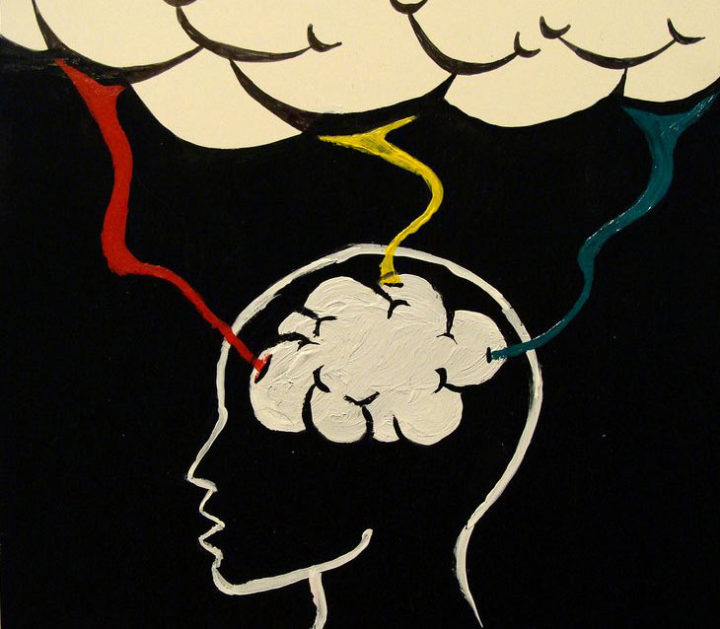
Originally, most states required the prosecutor to prove beyond a reasonable doubt that a person was not insane if he or she claimed insanity as a defense. However over the course of time and with help of few modifications the burden of proof is now shifted from the prosecutor to the defense, requiring defense lawyers to prove the defendant’s insanity through clear and compelling evidence.

Even though it was put in place to improve judgment, most people exploit the insanity defense to avoid legal penalties, making it a loophole that encourages more offenders to commit crimes. Such a condition creates a serious problem, as people will become increasingly involved in such crimes since they are not afraid of the law. The Indian government has put in place a number of rules for performing an insanity test on the accused. They must meet two important criteria: the necessity for mental illness and the condition for loss of reasoning. Section 84 of the Indian Penal Code (IPC) deals with this issue.

Essentials: A person of unsound mind must carry out the act.

Such a person was mentally unstable at the time of the incident.

The accused incapacity should be due to mental illness.

Such person had no idea what he was doing was wrong.

Despite the fact that these strict regulations exist, many people try to exploit this defense by falsifying certifications or influencing the judiciary. To avoid the various controversies and confusions it is suggested that a well-defined definition of the term ‘insanity’ should be established. Many countries, notably Germany, Argentina, and Thailand, have prohibited this defense due to its widespread misuse. India can investigate this and decide whether or not the insanity defense should be recognized in the legal system.

World social media day

Hello guys!!

Do you know we celebrate world social media day on June 30 th.
Today is a very special day cause today is the day we celebrate the evolution of media from old times till now to the present social media, which made communication lot more easier,accessible,accurate.

Social media is a platform where different kinds of people are connected together .But the security and privacy is still the top most priority of the social media apps

As technology is developing faster and faster the social media applications are also evolving at an
astonishing rate .

Especially during this pandemic
Social media was one of the reasons why people were still able to connect with people at various places.

Social media became extremely essential during these times.we can even say that bonds,relations and specially the connections between people is maintained .

They are even updating their apps constantly so users can benefit from it,the user should not feel alone when they use these apps that is what a successful app must have .

Through social media not only people connect ,but people with similar interests gather together under one roof that is to say at the same place same place and enjoy each other’s company.

Social media acts as a platform where even a small issue can gather lots of attention and raise awareness among people about various issues.It is changing people’s ideals it’s telling what is good and what is not.It is helping us to gain knowledge , entertainment,education,news etc.

Social media has their own advantages and disadvantages based on how we use them.

Social media is both boon and Bane because it is the reason why people who are at different places able to connect and it is also the reason why we are becoming more far to our own families .

So as they say everything should be done in limit,and anything that exceeds the limit is not good .

So even usage of social media should be limited .Even the applications are also updated their apps and added new features where we can view our usage of that particular app so we can limit our usage to certain extent.

So at last what I want to say is every thing is in your hands either to make social media your boon or your Bane depends on you.

Thankyou^^

INDIA AND INDUSTRIAL REVOLUTION 4.0 Part-2

This article is in continuation with the previous part INDIA AND INDUSTRIAL REVOLUTION 4.0 Part-1.

Reasons why Industrial Revolution 4.0 is lagging-

1. Security is a crucial foundation of the Internet while the major challenge for the Industrial Revolution 4.0. As time goes the trend of Industrial Revolution 4.0 inflates from millions of devices to billions. As increasing the number of connected devices, the chance to exploit safety vulnerabilities is also increasing, in cheap or low standard designed devices, due to incomplete data streams, the chances of data theft is increased by which people’s health and safety can be risky. Many IoT arrangements will also include collections of similar or adjacent similar devices. This homogeneity expands the potential impact of any single security weakness by the total number of devices that all have the same features.

2. As Authenticity, trustworthiness and confidentiality are important aspects there are some other requirements also important like discriminatory access to certain facilities, preclude them from sharing with other things at certain Times and business communications involving smart objects would need to be secure from opponents’.The data networks are still delicate and also costly in comparison to other developed countries. From an Indian perspective, the cloud storage operation is still in the emerging stage. Transmit the data to a cloud service for processing, sometimes includes a third party. The gathering of this information leaks legal and regulatory challenges facing data protection and privacy law. To realize the opportunities of the Industrial Revolution 4.0, some new strategies will be required for privacy choices through a broad range of expectations, while still developing innovation in new technologies and services.

3. Absence of standards and documents can assist Senseless activities by devices. Low standard or cheap designed and configured devices have undesirable consequences for the networking resources. Without standards to guide developers and manufacturers, sometimes design products that operate in disruptive ways on the Internet. When any technology has a standard development process then it can be easily available everywhere and can be used by all applicants and increase the growth also. While in today’s world, global standards are followed by every local station.

4. Implementation of every technology requires a team of skilled persons who have ample knowledge of network, hardware, software and about that technology. And India is developing at this point where manpower thinks when technology is spread, they lose their job and there is no life of new technology. So, they don’t take any initiative to learn about it. So, every organization face lots of problem during their changeover phase from the legacy systems to IoT enabled systems. Similarly, Scalability, Fault tolerance and Power supply are also big challenges in India.

5. Advanced technologies require advanced mechanisms which require more amount of money. As India is a developing country, it is not possible to invest on a large scale in Industrial Revolution 4.0. As a result of failed fueled ‘money’, India is not able to cope with Industrial Revolution 4.0.

6. Another major problem with a developing country like India is the fuel needed to run. While the population is on a way steady rise, demand is quite increasing. India produced 557 million tons (metric tons) of coal in 2012-13, and India’s rapidly growing power industry consumed the majority of it. Coal production has steadily increased since the industry was nationalized in the 1970s. A trend almost certain to accelerate as the country faces growing urbanization and an expanding middle class, India has a high dependence on imports for its petroleum needs and is the world’s fourth-largest importer of crude oil.

7. The percentage of illiteracy in India is alarming. Every five persons among ten in India are illiterate. The condition in villages is worse than in cities. Though several primary schools have been set up in rural India, the problem persists. Also, providing education just to children won’t solve the problem of illiteracy, as many adults in India are also untouched by education. The education system of India is blamed now and then for being too theoretical but not practical and skill based. Students study to score marks, not to gain knowledge. This so-called modern education system was introduced by the colonial masters to create servants who could serve but not lead, and we still have the same education system. Rabindranath Tagore had written many articles offering suggestions to change the education system of India. But still, success is as elusive as ever.

Read more about India and Industrial Revolution in next part, INDIA AND INDUSTRIAL REVOLUTION 4.0 Part-3.

UN World Food Programme: II

SYRIA: Millions of people have been displaced from their homes , Conflicts in Syria’s northeast and northwest have increased levels of hunger and food insecurity as families have lost their homes, businesses and incomes

In December 2019, conflict escalated in northwest Syria and western

Aleppo. Close to one million people were forced to flee their homes in the largest wave of displacement since the crisis began.

WFP launched an immediate response and scaled up its ongoing humanitarian operations in the northwest and is now providing emergency food assistance to more than one million people each month through cross-border operation from Turkey.

Across Syria, WFP continues to ensure that food reaches the most vulnerable families when they need it the most.

4.8 million people in Syria receive lifesaving food from WFP each month. 

The Nobel Peace Prize 2020 was awarded to World Food Programme (WFP) “for its efforts to combat hunger, for its contribution to bettering conditions for peace in conflict affected areas and for acting as a driving force in efforts to prevent the use of hunger as a weapon of war and conflict.”

And just like that, when the World Food Programme were offered UN Peace Price amidst all the harsh realities, and morbidities, the deaths, the wars — 2020 acknowledged the work and effort that the Food Programme have constantly been putting in, in order to create an equal, and secured environment. 

You can check their work and know more about them at: https://www.wfp.org

United Nations World Food Programme: I

The Nobel Peace Prize is one of the 5 Nobel Prizes established by the will of Swedish inventor Alfred Nobel, along with the prizes in Chemistry, Physics, Physiology or Medicine, and Literature.The Nobel Peace Prize has been awarded 101 times to 135 Nobel Laureates between 1901 and 2020, 107 individuals and 28 organisations. The International Committee of the Red Cross has been awarded the Nobel Peace Prize 3 times. The Office of the United Nations High Commissioner for Refugees has been awarded the Nobel Peace Prize 2 times . The most recent prize was awarded to the World Food Programme in 2020; nominations for the 2021 prize closed in January 2021. WFP was established in 1961, when George McGovern, director of the US Food for Peace Programmes, proposed establishing a multilateral food aid programme. WFP launched its 1st  programme in 1963, in Sudan. WFP operations are funded by voluntary donations principally from governments of the world, and also from corporations and private donors. In 2019, funding was  recorded around US$8 billion, of which the largest donors were the United States ($3.4 billion) and Germany ($886.6 million).

The Motto of the UN World Food Programme stands for, “Saving Lives – Changing Lives become substantial.  In 2015 the global community adopted the 17 Global Goals for Sustainable Development to improve people’s lives by 2030. With priority of achieving  Goal 2 – Zero Hunger –which pledges to end hunger, achieve food security, improve nutrition and promote sustainable agriculture, 

This is the WFP’s vision – 5 steps to Zero Hunger.

a. Put first those who are furthest behind 

b. Pave the road from farm to market

c. Reduce food waste

d. Encourage a sustainable variety of crops

e. Make nutrition a priority

For more than 50 years, the World Food Programme (WFP) has provided emergency food assistance, often in conflict, post-conflict or disaster situations. WFP has  evolved to combine frontline action with the quest for durable solutions.

This also includes – Cash transfers, that is Empowering the people through provision of cash and/or value vouchers, In-kind food distribution to most vulnerable household.

Please read the following post for more information.

Institute of Chartered Accountants ofIndia (ICAI)

• statutory body set up in 1949 – by The Chartered Accountants Act, 1949.

• premier accounting body.

• regulates the profession of Chartered Accountancy in the country.

• functions under the administrative control of
the Ministry of Corporate Affairs.

• second largest professional body of Chartered Accountants in the world.
• Management:
 in accordance with the provisions of Chartered Accountants Act, 1949 and the Chartered Accountants Regulations of 1988.
 Council – empowered to frame Regulations under the Act and to constitute necessary standing and non-standing Committees.
 40 members – 32 elected by CAs and 8 nominated by the Central Government.
 nominees generally represent the Comptroller and Auditor General of India,
SEBI, Ministries of Corporate Affairs and Finance etc.

• maintains highest standards in technical,
ethical areas and for sustaining stringent
examination and education standards.

Role:
 Regulate the profession of Accountancy
 Education and Examination of Chartered Accountancy Course
 Continuing Professional Education of Members
 Conducting Post Qualification Courses
 Formulation of Accounting Standards
 Prescription of Standard Auditing Procedures
 Laying down Ethical Standards
 Monitoring Quality through Peer Review
 Ensuring Standards of performance of Members
 Exercise Disciplinary Jurisdiction
 Financial Reporting Review
 Input on Policy matters to Government .

• functions– Educational, Regulatory and Disciplinary.
 formulates the code of ethics to be followed by its members.

THE DOUBLE SLIT EXPERIMENT

One of the most famous experiments in physics is the double slit experiment. It demonstrates, with unparalleled strangeness, that little particles of matter have something of a wave about them, and suggests that the very act of observing a particle has a dramatic effect on its behaviour.

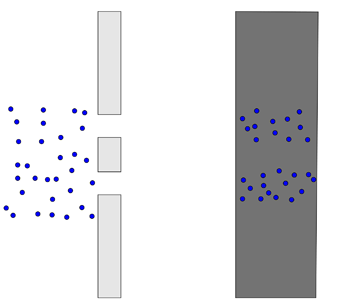
To start off, imagine a wall with two slits in it. Imagine throwing tennis balls at the wall. Some will bounce off the wall, but some will travel through the slits. If there’s another wall behind the first, the tennis balls that have travelled through the slits will hit it. If you mark all the spots where a ball has hit the second wall, what do you expect to see? That’s right. Two strips of marks roughly the same shape as the slits.

In the image below, the first wall is shown from the top, and the second wall is shown from the front.

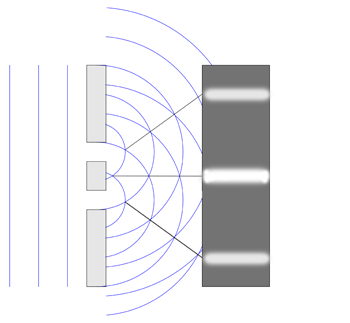
Now imagine shining a light (of a single colour, that is, of a single wavelength) at a wall with two slits (where the distance between the slits is roughly the same as the light’s wavelength). In the image below, we show the light wave and the wall from the top. The blue lines represent the peaks of the wave. As the wave passes though both slits, it essentially splits into two new waves, each spreading out from one of the slits. These two waves then interfere with each other. At some points, where a peak meets a trough, they will cancel each other out. And at others, where peak meets peak (that’s where the blue curves cross in the diagram), they will reinforce each other. Places where the waves reinforce each other give the brightest light. When the light meets a second wall placed behind the first, you will see a stripy pattern, called an interference pattern. The bright stripes come from the waves reinforcing each other.

Here is a picture of a real interference pattern. There are more stripes because the picture captures more detail than our diagram.

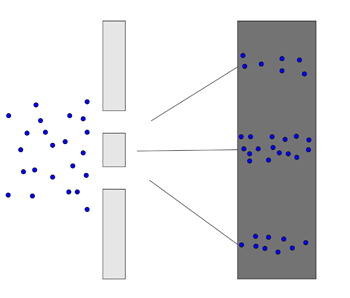
Now let’s go into the quantum realm. Imagine firing electrons at our wall with the two slits, but block one of those slits off for the moment. You’ll find that some of the electrons will pass through the open slit and strike the second wall just as tennis balls would: the spots they arrive at form a strip roughly the same shape as the slit.

Now open the second slit. You’d expect two rectangular strips on the second wall, as with the tennis balls, but what you actually see is very different: the spots where electrons hit build up to replicate the interference pattern from a wave.

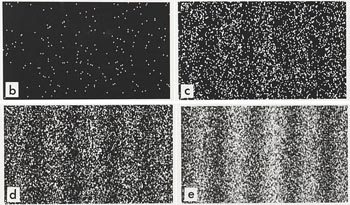
Here is an image of a real double slit experiment with electrons. The individual pictures show the pattern you get on the second wall as more and more electrons are fired. The result is a stripy interference pattern.

What does the experiment tell us? It suggests that what we call “particles”, such as electrons, somehow combine characteristics of particles and characteristics of waves. That’s the famous wave particle duality of quantum mechanics.

Studying International Relations

Go for it, if you are curious of the process of International Relations among nations.

I’ve already provided my simplest version of the answer, but to dig deeper into this notion of taking up such an interesting, and recently developing subject choice has to do so much with the socio-political situation alongside the increasing globalisation we have encountered  with changing times. 

The subjects holds weird fascination to me, when I first encountered it, and I hope it does the same to you. 

But do make your self aware that you won’t directly jump into knowing what Russia or China is handling it’s relations with India, there isn’t anything direct that could give you an eureka movement, but there are these tiny steps you get to take to understand each and every detail when it come to the subject of International Relations.

From Realism, and Trade Policies to tonnes of agreements, and UN and it’s branches, you slowly understand the subject and then next you deal with Diplomacy and its multitudinous types to how a mere decision over their actions on a global scale is surely going to affect someone else. This leads to another set of trials and tribulations but nonetheless the whole idea or the fascination behind this subject lies, for me, is in the knowledge that someone could hole so much power to change something, or some region could change course to appease and pacify another region, all as an act to not create a situation that is surely going to get out of hands, if not monitored. 

Content marketing

When it comes to knowing about a particular word it is better to break it and understand the half-half syntax to get the whole picture. So content marketing which seems a complex term to get, turns out to be a simple one. Content is any written form of piece and marketing is selling of a particular commodity therefore when we talk about content marketing we refer to writing valuable and relevant content for a good which depicts its value and give entire information about it.

It is not as straightforward as it seems as writing content that attracts the reader is very important. Simple tips to write a good content for a product and for making content marketing successful:

Answer your audience questions and write according to giving every answer possible. providing them something of value keeping them wanting more.

Do audience segmentation to divide different goals people considering their interests and write accordingly.

Content writing goals are of four categories- entertain, inspire, educate, convence

Think for which media are you writing for, types of media- owned, earned, and paid. Write the necessary information required for the three.

Optimize list content- The featured snippets for listicles show a bulleted or numbered list on the results page. They are great for “best” and “how-to” searches. With a list, searchers get a quick and easy-to-understand answer.

Read value-added materials like books, magazines, newspapers to enhance your vocabulary and to come across new styles of writing.

There are many more things you can do just reseach, get aware, take your thoughts and pen and get started.

It seems difficult and vast until the beginning so doesn’t worry if you like writing and can think of innovative lines this field is for you, you can do wonders!

Media Bias: the shoddy practice

Media Bias is a term used to describe biases and personal prejudices of a journalist in the selection of events that will be reported and the manner in which they’ll be reported.

In earlier times, every media organisation had a political backing, that is, funded by any political party or group. It was only with late 19th century and early 20th century, journalists began to feel the need for a truth and unbiased reporting.

Types of Media Bias:

A) Bias by Omission

This is one of the methods in which journalists wipe out one side of the story or series of facts over a period of time.

B) Bias by Selection of Sources:

In this method, journalists usually approach those sources who will favour their own prejudices. Both sides of a story aren’t given any importance.

C) Bias by Story Selection.

This mostly happens when a media organisation is funded by a political party. In this, journalists only highlight those issues and stories that pertain to one political party. For example, only talking of achievements of a political party and ignoring its failures.

D) Bias by Placement.

This means where an editor places the story and how much they consider the story is important. For example, if a news organisation is supporting a certain political party and there’s a humanitarian crisis in any city because of that political party, in this case, news editor would place the story at the end so that it gets less importance.

E) Bias by Spin.

In this, reporters and journalists give their own “subjective comments” to a factual story and make it appear before the public their own way. These interpretations can be harmful as they divert the minds of public from actual facts.

Some examples of Media Bias:

A) Ethnic Bias:

This is the form of bias which includes racism, nationalism or xenophobia. For example, western media’s portrayal of India as a poverty stricken country with no toilets. Yes, India suffers with poverty but the western media made it look like it’s the only thing India is all about.

B) Corporate Bias:

Media is also extremely biased at times when reporting about corporate misconduct. This is because some media channels are funded by big industrialists and business people.

C) Class Bias

Media houses are extremely bias when it comes to class. Higher class cases are handled with dignity whereas oppressed classes are treated with lack of respect and humanity.

D) Religious Bias

Certain media houses favour one religion according to their own religious ideologies and thus even start supporting or give a biased reporting when their religious community is doing something wrong.

E) Political Bias

Probably the most famous form of bias in which a media house supports a political party right from the beginning of covering their political campaigns to trying to hide their political mismanagements.

Journalists must separate fact from opinions and do an unbiased reporting for a better transportation of news information to the public. This way it would also be able to hold the system responsible.

A Survey Of Pens Across The Globe!

“A Pen Is The Tongue Of The Mind.”

  • Horace

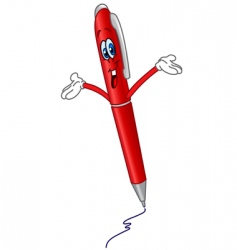
Today’s article is a work of fiction as it conducts a survey with all the ‘Pens’ across the globe. As you very well know, Pens are associated deeply with the writing process because they pose as a medium to disseminate our thoughts onto that sheet of paper before us. Yes, I totally agree that one has to whack their brains for this as well, but pens make your thinking process worth it!

I conducted a survey with all the Pens across the globe and received certain responses regarding the writing process.

The questions were, “What are your thoughts regarding the Writing Process?” and a Yes or No question being “Do you think Writing is Boring?”

The Responses Were As Follows:

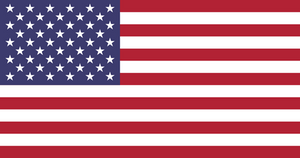
A Pen From The United States Of America, Indiana

I find the writing process fun and love it when people begin working on it while using me as a medium. I am glad that I have some worth and value in this world. But the sad part is that pens are only looked upon when it comes to writing, while other times, we lose our worth.”

Yes Or No Question:

No, writing is not a boring task. Instead it is an interesting job that helps awaken your imagination.

A Pen From The United Kingdom, Wales

“Writing is a subjective process and totally depends on the perspective of the person involved. If the person admires the process and remains keen in imagining and coming up with creativity then it is fun, otherwise it isn’t. I, as a pen can only wait for the right person to initiate writing, who wholeheartedly surrenders himself to the process without any sort of disturbance.”

Yes Or No Question:

As I just said, this is a subjective process, so it could be either Yes or No, depending upon the person involved.

A Pen From Berlin, Brandenburg

“Writing is an art that can’t be learned. It is a god gifted talent that not every person possesses. It is because creativity is something that needs to be within. The urge to think and come up with something unique needs to sprout from within. These things can’t actually be learned. We pens, do not form the intellect of the writer, but prove to be important when it comes to initiate the process. For me, every writer is important because they make us productive and increase our worth.”

Yes Or No Question:

Yes, writing is a boring task for a person who isn’t interested but is just into it, for the sake of livelihood. This art requires love because when you love writing, not only that particular write up but also the pen loves you back! 😉

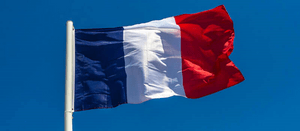
A Pen From France, Brittany

“I, as a Pen can only say that write ups require sheer practice, dedication, love, patience, devotion and focus. The writer needs to be acquainted with holding me 24/7 in order to enrich the process. We pens need to be held frequently because it is easy to receive thoughts on the upper floor of the human body, but to jotting those umpteen thoughts down is a complex task. A writer can’t possibly occupy an entire day for writing. Thus, practice with us (pens) is important, very important!

Yes Or No Question:

Writing is boring for a person who finds it a pesky job to maintain the word count. Thus, practice is essential. After all, Practice Makes Perfect, doesn’t it?

A Pen From Saudi Arabia, Mecca

“Write when a stable mind is ensured. Writing isn’t all about jotting down anything one pleases. It is also about writing the sensible thing with utmost creativity. However, it depends on the genre whether you are expected to use creativity or reality more.”

Yes Or No Question:

No, writing is not a boring task because it comes with convenient branches comprising of various genres. One has complete freedom to choose any genre to work on. Also, you are free to choose your own set of topics. What more does one need?

Interesting responses aren’t they? These are some of the pens that responded while others just voted with a Yes or No.

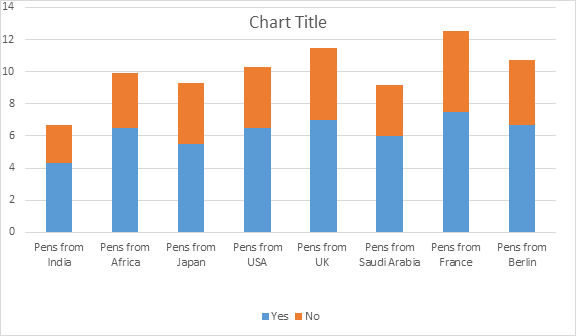
These are the Pens from countries that actually responded. As visible, the responses are mostly No, stating that writing is not a boring task. We thank all the Pens who participated in the survey and helped it become a success! So, what are you waiting for? Writing isn’t a boring task after all. Begin writing now!

Happy Writing!

Thank You For Reading!

Happiness and Virtue!

t is believed that if we do something hoping for the sake of its own good will, then it will be in a realm of ultimate good. People shouldn’t be doing something good because they want something out of it, but for the sake of the good will only they should do it. When people do attain the ultimate good, its usually ends there with the end as its highlight. Aristotle has remarked that politics is what governs everything in life, we can’t find an activity around us that does not involve politics. All the sciences have politics in them and so the end of such sciences is the end of politics too.

Aristotle thinks that happiness can only be chosen in itself and not any other principles. It can only be attained directly, and there is no short cut or other way around it. We do something for various pleasures and wants in life but we want happiness for its own sake. Man, always want to be the best in everything they can achieve, this is with their soul’s conformity. It is always aligned with their certain principles and man always sets standards he wants to achieve. If he achieves these certain elements with the full passion he had put in to for its result, then he has attained his virtue. 

Happiness is an action that is to be lived well and achieved justly. It shouldn’t be deceived or cheated because only if you put the most efficient of work and passion, it can be achieved. Then only it becomes a virtue. It should be lived well to the virtue of the conformity. People aren’t born happy, but they find happiness on their journey of life. It is an activity throughout a person’s life achieved over time. Happiness is something that we gather across our life, through our experiences. It is not something that can be bought with. It is the result of certain actions attached with virtue.

Virtue is of two types o Intellectualo Moral 

Intellectual focuses on the intelligence, theoretical and wisdom of the virtue while the moral part focuses on kindness and generosity. No man should be less of one of the virtues. Both the virtues are important to lead a life. No man should be void of practical wisdom nor intelligence. Intellectual virtue is acquired though learning and training. You acquire it through your experiences and you learn new things on your way. While Moral virtues are attained out of habit(ethos).

Practical wisdom comes under the intellectual virtue, it is about the wisdom that one gains over a course of time in life. It is not something that you can learn while attending a class nor a seminar but it is something that you attain while learning life and adjusting to different circumstances in life. At each stage of our life, we come across different circumstances where we learn and become the better versions of ourselves. 

Political Wisdom and Practical Wisdom: Even though they are similar in some ways their core aspect is quite different. Political wisdom completely deals with the politics and legislation and it is quite different from Practical wisdom because it revolves around one’s thoughts. Political wisdom is different from the other one since we cannot have one’s views on making laws for the citizens. 

Political wisdom and Deliberation: Deliberation in action is quite a slow process, it is about investigating the whole picture and finding the end result through the right means. It requires calculation and proper understanding unlike guessing which goes quite quickly.

Practical wisdom is important in one’s life to make fair and good choices, to act in accordance with the goodwill of all and oneself. It is to achieve virtue in its highest form with a rational beginning for the end. 

Unlike any other we attain virtue only by practice, just like how an artist’s paints or a writer writes, we can only achieve virtue by putting it into practice. This is where the role of a lawgiver comes in, he is said to inculcate the good habits into its citizens. This is the duty of a good lawgiver. Accordingly, Aristotle believes more in the moral aspects which are to be attained over habits in one’s course of life. 

Virtue is highly associated with pleasure and pain in one’s life. A man must go through both pain and pleasure from the start of their childhood, then and then only they will be able to achieve true virtue. The right amount of pleasure and pain in certain circumstances lead to whether it was morally right or wrong. Pleasure should be attained at the right time and not the wrong one so as to develop. If pain is attained at a wrong time then it will only led to deterioration of the character and will not achieve virtue.

AGNI CLASS OF MISSILES

• Agni-1, Agni-2, Agni-3, Agni-4, Agni-5 and Agni-P.

• Designed & developed by DRDO.

• Family of medium to intercontinental range
ballistic missiles.

• can be fired from road- and rail-mobile launchers.

• powered by solid propellants.

• Agni-1 to Agni-5 – product of the Integrated Guided Missile Development Project (IGMDP).

• Inducted into Services to act as deterrence & meet the country’s security requirements – credible deterrence against China and Pakistan.

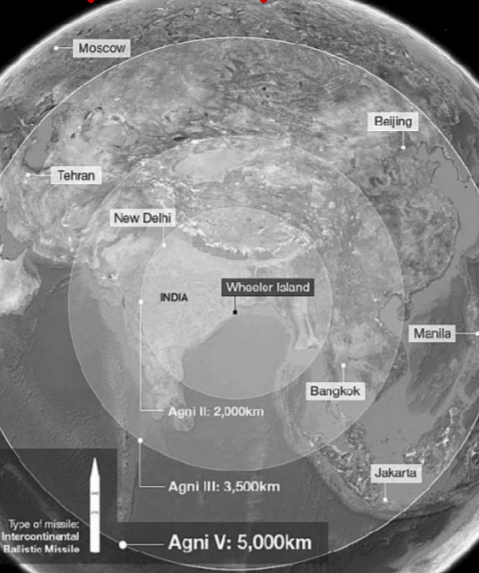
Agni missile range on map, source-Indiasnucleartraids pdf

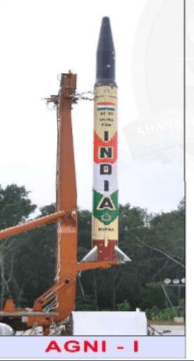
Agni-1

• medium-range ballistic missile – range of 700-800 km. • weight – 12 tonnes; length – 15 meters.

• capable of carrying a conventional payload of
1,000 kg or a nuclear warhead at a speed of
2.5 km/s.

• operational with the
Strategic Force Command
of Indian Army.

Source- http://www.drdo.gov.in

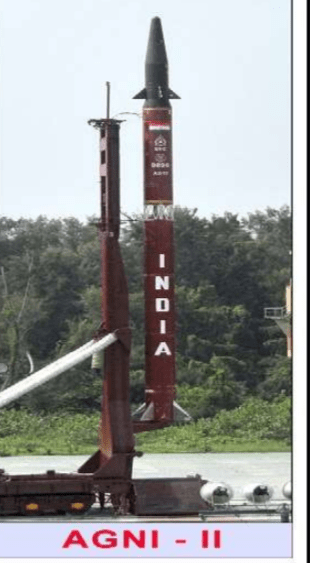
Agni-2

• surface-to-surface nuclear-
capable missile.

• Intermediate-Range Ballistic Missile (IRBM) – capable to cover the range of 2,000- 2,500 km.

• length is 20 meters, with the diameter of 1 meter.

• weight – 18 tonnes.

• 2 stages – solid propellant in
both of its stages.

Source- http://www.drdo.gov.in

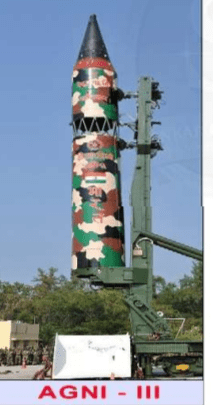
Agni-3

• It is an IRBM – range of 2500-3,000 km.

• powerful solid propellant in its both stages.

• can carry a warhead of 1.5 tonnes.

• claimed that the missile’s circular error probable
(CEP) lies within of 40
meters – most accurate
and deadliest strategic
ballistic missiles of range
class in the world.

Source- http://www.drdo.gov.in

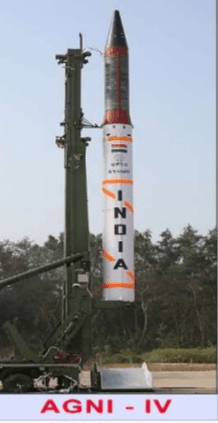
Agni-4

• range of 3500-4000km.

• earlier termed as Agni II
prime

• can carry a warhead of 1
tonne.

• two-stage missile.

• length is 20 meters and
launch weight is about 17
tonnes

Source- http://www.drdo.gov.in

Agni-5

• intercontinental surface-to-surface ballistic missile.

• India’s first ICBM.

• range – more than 5,000 km

• long-range

• Length – 17.5 m; weight – 50
tonnes.

• 3 propulsion stages.

• can carry a warhead weighing more than a tonne. • uses a canister launch missile system or Canisterisation of missile.

Canisterisation of missile

• warheads are pre-mated to the delivery vehicle and kept sealed for storage and transport.

• provides increased readiness – shorter
response time with an ability to launch in “just a few minutes”.

• provides necessary operational flexibility to
the forces.

• enhances missile longevity – protects the solid fuel from the elements.

Agni-P missiles

• successfully test-fired.

• new-generation advanced variant of Agni class of missiles – advanced
version of the ‘Agni-1’ missile.

• designed and developed by DRDO.

• will strengthen India’s credible deterrence capabilities.

Features:
 Nuclear-capable ballistic missile.
 Canisterised missile.
 range – between 1,000 and 2,000 kms.
 surface to a surface missile that can
carry a payload of around 1,000 Kg or a nuclear warhead.
 two-stage missile – composite rocket motors.
 guidance systems equipped with electromechanical actuators.
 solid-fuelled weapon system – state-of- the-art navigation system.
 Can be fired from road and rail-mobile launchers.
 complete technology upgrade in every way possible – improved parameters, manoeuvring and accuracy.
 sleek missile that weighs less than its previous variant – due to the integration of new technologies.

Career counselling

Career counselling provide correct and consolidate information to our young brigade by giving them whole basket of available option after school is par excellence.The exposure to technology ,Media and Social Networking on a larger scale has made our youth aware to a great extent ,but they are little aware of the authenticity of information which are exposed to on a regular basis .ITS VERY IMPORTANT for our young and dynamic students to have proper and worthy information which is only possible through proper and useful career counselling.

Free Trade Policy . (Meaning , Advantages , Disadvantages)

What is Free trade policy?

Free trade policy refers to a trade policy without any tariffs , quantitative restrictions and other devices obstructing the trade of goods between countries ..

According to Adam Smith,
The policy of free trade is a system of commercial policy which draws no distinction between the domestic and foreign commodities and thus neither impose additional burden on the latter nor grants any special favour to the former “

The theoretical case for free trade is based on Adam Smith’s argument about absolute comparative advantage , that the division of labour among countries leads to specialization, greater efficiency, and higher aggregate production.

Free trade therefore , signifies a non discriminatory trade policy that places no artificial barriers upon free international movement of goods and services .

Definitions :-

Prof Jagdish defines free trade policy as , ” absence of tariffs , quotas, exchange restrictions , taxes , subsidies on production , factor use and consumption “

Prof Lipsey gives a very simple definition ,
“A world of free trade would be one with no tariffs and no restrictions of any kind on importing or exporting . In such a world a country would import all those commodities that it could buy from abroad at a delivered price lower than the cost of producing at home .”

In Haberler’s words , ” free trade is the external trade system of liberation which opposes every interference by the state with the free play of economic forces .”

Thus ,the policy of free trade means simply complete freedom of international trade without any restrictions on the movement of goods between countries.

Free trade, also called laissez-faire,
a policy by which a government does not discriminate against imports or interfere with exports by applying tariffs (to imports) or subsidies (to exports).

However sometimes, governments with generally free-trade policies still impose some measures to control imports and exports.
For instance , in the United States, most industrialized nations negotiate “free trade agreements(FTA ),” or , with other nations which determine the tariffs, duties, and subsidies the countries can impose on their imports and exports.

Theories Of Free Trade :-


The years of debates over the benefits versus the costs of free trade policies to domestic industries, two predominant theories of free trade have emerged: mercantilism and comparative advantage.

Mercantilism

The theory of maximizing revenue through exporting goods and services is Mercantilism. High tariffs on imported manufactured goods are a common characteristic of mercantilist policy.
Mercantilist policy helps governments avoid trade deficits, in which expenditures for imports exceeds revenue from exports.
The goal of mercantilism is a favorable balance of trade, in which the value of the goods a country exports exceeds the value of goods it imports.
Mercantilism lost its popularity as it often led to colonial expansion and wars.

Today many multinational organizations such as the WTO work to reduce tariffs globally, free trade agreements and non-tariff trade restrictions supersede mercantilist theory.

Comparative Advantage

David Ricardo in his book “Principles of Political Economy and Taxation,” 1817 , stated the law of comparative advantage which refers to a country’s ability to produce goods and provide services at a lower cost than other countries.
The Comparative advantage theory is that worldwide openness in trade will improve the standard of living in all countries.
Comparative advantage holds that all countries will always benefit from cooperation and participation in free trade.


Advantages ( pros ) of Free Trade Policy.

Free trade policy has many advantages for a country.
The following are some pros of free trade policy :-

1: Maximum of Output :- Under free trade the country specialises in the production of those commodities which it is relatively best suited to produce and exports them in exchange for those imports which it can obtain more cheaply . This maximises the output of all the participating countries because all gain from trade which in turn , increases the real national income of the world economy . Thus free trade leads to the maximisation of output income and employment.


2: International Specialization :-
Free trade causes international specialisation as it enables the different countries to produce those goods in which they have comparative advantage . International trade enables countries to obtain the advantage of specialisation . If there were no international trade many countries would have to go without some products .

3: Optimisation of Consumption :-
Free trade secures the optimisation of consumption . In other words ,it benefits the consumers when they are able to buy a variety of commodities from abroad at the minimum possible prices . This results in raising their standard of living .

4:. Link with others Countries :-
International trade and commercial relations often lead to an interchange of knowledge ,ideas and culture between nations . This often produces a better understanding among those countries and leads to amity and reduces the possibility of commercial rivalry and war .

5:. Prevent Monopolies :-
Free trade prevents the establishment of monopolies . Under free trade, the country specialises in the production of a few commodities ,and the firms or industries are of the optimum size so that the cost of production of each commodity is the minimum . Thus , free trade ensures a lower price for exports as well as imports and the price mechanism under perfect competition prevents the formation of Monopolies.

6:. Higher Efficiency and optimum Utilisation of Resources :-
Free trade stimulates home producers who face to foreign competition to put forth their best efforts and thus increase managerial efficiency . Again as under free trade each country produces those goods in which it has the best advantages , the resources of each country are utilised in the best possible manner.

7:. Best policy for Economic Development :-
Haberler points out that “substantial free trade with marginal insubstantial corrections and deviations is the best policy from the point of view of economic development “
Besides the direct gains of free trade noted above , free trade fosters development in the following ways
(a) it leads to the importation of capital goods , and raw material ;
(b) it instills new ideas and brings technical know-how, skills , managerial talents and entrepreneurship to the developing countries ;
(c) it facilitates the flow of foreign capital and fosters healthy competition and checks inefficient and exploitative monopolies.


Disadvantages ( cons ) of Free Trade

Despite having several advantages , there are certain theoretical and practical difficulties in following free trade policy .

Some of those disadvantages are :-

1:
Excessive dependence :- Free Trade policy leads to unwanted dependence for goods among countries which leads to major problems in a countries economy if there is some conflicts between the Countries due to some matter .

2:
Obstacles to Development of home Industries :-
If foreign goods are imported freely , the domestic industries of the developing countries would not be able to develop rapidly due to the superior strength of foreign industries .

3:
Empire Builder :- Under the free trade the foreign traders particularly the dominant ones may try to become empire builders in future . In the past it is see ,free trade gave rise to colonialism and imperialism.

4:
Import of Expensive Harmful Goods :- With no restrictions it’s easy to import expensive harmful foreign goods . This leads to diminution of social welfare . Trade restrictions on import goods become necessary.

5:
Less job opportunity :- While free of tariffs, products imported from foreign countries may be seemingly good for consumers, it makes it hard for local companies to compete, forcing them to reduce their workforce. It causes job loss through outsourcing: Tariffs tend to prevent job outsourcing by keeping product pricing at competitive levels. with lower wages cost less.


In conclusion , we can say that at present no country in the world follows the policy of free trade . Every country imposes some restrictions on the import and export of goods .
T.Scitovsky has pointed out that free trade can be shown to be beneficial to the world as whole but has never been proved to be the best policy for a country .


However , poor countries that have adopted free-trade policies have experienced high economic growth, with China and India as prime examples. Free trade allows companies from rich countries to directly invest in poor countries, sharing their knowledge, providing capital and giving access to markets.