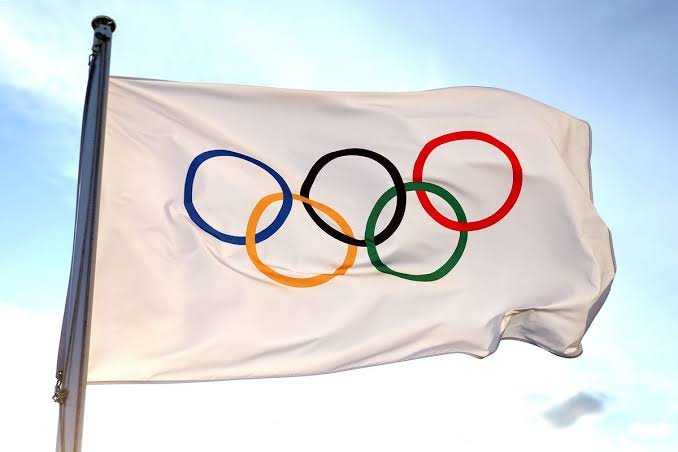
OLYMPICS

An ancient Panhellenic festival held every fourth year and made up of contests of sports, music, and literature with the victor’s prize a crown of wild olive.

The modern Olympics are leading international sporting events featuring summer and winter sports competitions in which thousands of athletes from around the world participate in a variety of competitions. The Olympic Games are considered the world’s foremost sports competition with more than 200 nations participating.[3] The Olympic Games are normally held every four years, alternating between the Summer and Winter Olympics every two years in the four-year period.

Their creation was inspired by the ancient Olympic Games , held in Olympia, Greece from the 8th century BC to the 4th century AD. Baron Pierre de Coubertin founded the International Olympic Committee (IOC) in 1894, leading to the first modern Games in Athens in 1896. The IOC is the governing body of the Olympic Movement , with the Olympic Charter defining its structure and authority.

The evolution of the Olympic Movement during the 20th and 21st centuries has resulted in several changes to the Olympic Games. Some of these adjustments include the creation of the Winter Olympic Games for snow and ice sports, the Paralympic Games for athletes with disabilities, the Youth Olympic Games for athletes aged 14 to 18, the five Continental games (Pan American, African, Asian, European, and Pacific), and the World Games for sports that are not contested in the Olympic Games. The IOC also endorses the Deaflympics and the Special Olympics. The IOC has needed to adapt to a variety of economic, political, and technological advancements. The abuse of amateur rules by the Eastern Bloc nations prompted the IOC to shift away from pure amateurism, as envisioned by Coubertin, to the acceptance of professional athletes participating at the Games.

International Olympic Committee
The Olympic Movement encompasses a large number of national and international sporting organisations and federations, recognised media partners, as well as athletes, officials, judges, and every other person and institution that agrees to abide by the rules of the Olympic Charter.[86] As the umbrella organisation of the Olympic Movement, the International Olympic Committee (IOC) is responsible for selecting the host city, overseeing the planning of the Olympic Games, updating and approving the Olympic sports programme, and negotiating sponsorship and broadcasting rights.[


“The most important thing in the Olympic Games is not to win but to take part, just as the most important thing in life is not the triumph but the struggle. The essential thing is not to have conquered but to have fought well.”

“ALESSANDRO VOLTA” Biography

“Alessandro Volta” was an Italian physicist and inventor of electric battery. He was born in Como, of Milan, on 18 February, 1745. His father’s name was Filippo Volta and mother name was Donna Maddalena. Child he did not display much Intelligence and did not start peking until he was four years old.

He received his early education at the royal seminary in como in 1774 Volta began his career in the field of Physics by teaching the subject at the Royal School of Como. During the year he studied atmospheric electricity and conducted experiments in fields of electrochemistry electromagnetism and electrophysiology in 1775, he pioneered the electroporous, a device that produced a static electric charge. This was a device that would be charged with electricity only bye rubbing and this charge could be transferred to other object between 1776 and 1778 Volta worked in the realm of gases and discovered methane gas in the nature environment which he was able to isolate by the end of this period. In 1880, he invented Volatile the first elected battery. This battery was actually a pile of alternating disc of Copper and zinc, separated by pieces of cardboard soaked in a brine that had tha ability to maintain steady electric current. He also developed the law of capacitance and theorized the law of bimetallic contact. One of the major published works of this ingenious scientist, was “De vi attractive ignis electrici”, on 1769, it was based on his extensive research on attractive force present in the electric fire. He is also regarded as the father of the electric automobile in 1791 he was made a fellow of the Royal Society of London for his groundbreaking work and physics at specially development of electroscope. He married Terasa Peregrini, in 1794, at the age of 48. The couple had three sons in 1794 he was awarded the Copley medal by the Royal Society of London for development of Voltas law of the electrochemical series. In 1801 he was honoured with the title of “Count”, by Napolean Bonaparte after he demonstrated the functionality of his battery to him. He died in Como, Lombardy-Venetia, on 5 March, 1826, at the age of 82.

What Is Fast Fashion?

Clothes shopping used to be an occasional event—something that happened a few times a year when the seasons changed or when we outgrew what we had. But about 20 years ago, something changed. Clothes became cheaper, trend cycles sped up, and shopping became a hobby. Enter fast fashion and the global chains that now dominate our high streets and online shopping. But what is fast fashion? And how does it impact people, the planet, and animals?

It was all too good to be true. All these stores selling cool, trendy clothing you could buy with your loose change, wear a handful of times, and then throw away. Suddenly everyone could afford to dress like their favourite celebrity or wear the latest trends fresh from the catwalk.

Then in 2013, the world had a reality check when the Rana Plaza clothing manufacturing complex in Bangladesh collapsed, killing over 1,000 workers. That’s when consumers really started questioning fast fashion and wondering at the true cost of those affordable t-shirts. If you’re reading this article, you might already be aware of fast fashion’s dark side, but it’s worth exploring how the industry got to this point—and how we can help to change it.

What is fast fashion?

Fast fashion can be defined as cheap, trendy clothing that samples ideas from the catwalk or celebrity culture and turns them into garments in high street stores at breakneck speed to meet consumer demand. The idea is to get the newest styles on the market as fast as possible, so shoppers can snap them up while they are still at the height of their popularity and then, sadly, discard them after a few wears. It plays into the idea that outfit repeating is a fashion faux pas and that if you want to stay relevant, you have to sport the latest looks as they happen. It forms a key part of the toxic system of overproduction and consumption that has made fashion one of the world’s largest polluters. Before we can go about changing it, let’s take a look at the history.

How did fast fashion happen?

To understand how fast fashion came to be, we need to rewind a bit. Before the 1800s, fashion was slow. You had to source your own materials like wool or leather, prepare them, weave them, and then make the clothes.The Industrial Revolution introduced new technology—like the sewing machine. Clothes became easier, quicker, and cheaper to make. Dressmaking shops emerged to cater to the middle classes.

Many of these dressmaking shops used teams of garment workers or home workers. Around this time, sweatshops emerged, along with some familiar safety issues. The first significant garment factory disaster was when a fire broke out in New York’s Triangle Shirtwaist Factory in 1911. It claimed the lives of 146 garment workers, many of whom were young female immigrants. By the 1960s and 70s, young people were creating new trends, and clothing became a form of personal expression, but there was still a distinction between high fashion and high street.

In the late 1990s and 2000s, low-cost fashion reached its zenith. Online shopping took off, and fast-fashion retailers like H&M, Zara, and Topshop took over the high street. These brands took the looks and design elements from the top fashion houses and reproduced them quickly and cheaply. With everyone now able to shop for on-trend clothes whenever they wanted, it’s easy to understand how the phenomenon caught on.

How to spot a fast fashion brand

Some key factors are common to fast fashion brands:

  • Thousands of styles, which touch on all the latest trends.
  • Extremely short turnaround time between when a trend or garment is seen on the catwalk or in celebrity media and when it hits the shelves.
  • Offshore manufacturing where labour is the cheapest, with the use of workers on low wages without adequate rights or safety and complex supply chains with poor visibility beyond the first tier.
  • A limited quantity of a particular garment—this is an idea pioneered by Zara. With new stock arriving in store every few days, shoppers know if they don’t buy something they like, they’ll probably miss their chance.
  • Cheap, low quality materials like polyester, causing clothes to degrade after just a few wears and get thrown away.

What’s the impact of fast fashion?

On the planet: Fast fashion’s impact on the planet is immense. The pressure to reduce costs and speed up production time means that environmental corners are more likely to be cut. Fast fashion’s negative impact includes its use of cheap, toxic textile dyes—making the fashion industry the second largest polluter of clean water globally after agriculture. That’s why Greenpeace has been pressuring brands to remove dangerous chemicals from their supply chains through its detoxing fashion campaigns through the years.

Cheap textiles also increase fast fashion’s impact. Polyester is one of the most popular fabrics. It is derived from fossil fuels, contributes to global warming, and can shed microfibers that add to the increasing levels of plastic in our oceans when washed. But even ‘natural fabrics’ can be a problem at the scale fast fashion demands. Conventional cotton requires enormous quantities of water and pesticides in developing countries. This results in drought risks and creates extreme stress on water basins and competition for resources between companies and local communities.

The constant speed and demand mean increased stress on other environmental areas such as land clearing, biodiversity, and soil quality. The processing of leather also impacts the environment, with 300kg of cehmicals added to every 900kg of animal hides tanned. The speed at which garments are produced also means that more and more clothes are disposed of by consumers, creating massive textile waste. In Australia alone, more than 500 million kilos of unwanted clothing ends up in landfill every year.

On workers: As well as the environmental cost of fast fashion, there’s a human cost. Fast fashion impacts garments workers who work in dangerous environments, for low wages, and without fundamental human rights. Further down the supply chain, the farmers may work with toxic chemicals and brutal practices that can have devastating impacts on their physical and mental health, a plight highlighted by the documentary The True Cost.

On animals: Animals are also impacted by fast fashion. In the wild, the toxic dyes and microfibres released in waterways are ingested by land and marine life alike through the food chain to devastating effect. And when animal products such as leather, fur, and even wool are used in fashion directly, animal welfare is put at risk. As an example, numerous scandals reveal that real fur, including cat and dog fur, is often being passed off as a faux fur to unknowing shoppers. The truth is that there is so much real fur being produced under terrible conditions in fur farms that it’s become cheaper to produce and buy than faux fur!

On consumers: Finally, fast fashion can impact consumers themselves, encouraging a ‘throw-away’ culture because of both the built-in obsolescence of the products and the speed at which trends emerge. Fast fashion makes us believe we need to shop more and more to stay on top of trends, creating a constant sense of need and ultimate dissatisfaction. The trend has also been criticized on intellectual property grounds, with some designers alleging that retailers have illegally mass-produced their designs.

Differences between agency and distribution agreement

When a supplier/manufacturer wishes to distribute products, he examines whether he needs to select an agent or a distributor to do so, as this is an essential choice, and forms an agreement accordingly. There are several factors that must be considered while making such a decision. As a result, it is necessary to understand the distinctions between an agency agreement and a distribution agreement.

Now we need to know who is an agent. An agent is defined in section 182 of the Indian Contract Act, 1872. He is a middle man or a mediating person who is involved in making a contract between the primary supplier and the primary client. There are two types of agents where goods are sold i.e. the sales agent who does the sales work and a marketing agent who does the marketing of goods. The sales agent has the authority to enter the agreement on behalf of the supplier and the prescribed agreement is binding to the supplier as well. Unlike the sales agent, the marketing agent doesn’t have the authority to bind the supplier but he can market and endorse the supplier’s goods and articles to potential clients. Now when there is a demand or wish in the market by the client to make a purchase of goods the supplier completes the contract. 

The next step is to determine who is a distributor. In this case, the distributor gets the products from the supplier/manufacturer and then resells them in the market in a specific location where there is demand, on his own description, with complete control over the pricing and profit. Let us continue reading to learn more about the distinctions between an agency agreement and a distribution agreement.

Agency agreement

The agency agreement is a legal document in which the supplier/manufacturer and the agent enter into a contract with certain particular acceptable terms and conditions, and the agent, on behalf of the supplier, mediates between the primary supplier and the client for the sale of products to the market. It establishes a fiduciary connection between the agent and the manufacturer, as well as an indirect link between the manufacturer and the customer.

In this contract, the self-regulating body assumes all the risks in the work and makes all the choices on behalf of the first-party as stipulated in the contract. This contract is defined and controlled by the Agency Agreement Legislation, and it also has the rights of agents specified in the Contract law under sections 217, 219, 225, 222, and 223 and in the Sales of Goods Act, 1930. Agency arrangements might be exclusive, non-exclusive, or sole.

Advantages:

  • To begin, the supplier can reclaim control of the conditions of sale of the goods, namely the price and marketing tactics.
  • Can also establish direct contact with needy consumers on their own, eliminating the necessity for a middleman in sales and reducing competition.
  • In comparison to the margins earned by distributors, the agent generally receives a lesser commission.

Disadvantages:

  • The Commercial Agents (Council Directive) Regulations 1993(the “Commercial Agents Regulations”) shall apply and impart certain legal necessities benefiting the agents wherein the parties cannot exclude the agents. 
  • During the contract, the agent will be entitled to commission and under certain situations, after its termination too as per the Commercial Agents Regulations. 
  • The supplier regains all of the monetary possibilities of those goods which are not sold. 
  • Tax-related issues can arise wherein sometimes a supplier can be held as a dealing person in a place where an agent is based so tax liabilities can lead to him. 
  • An agent would be working for several manufacturers/suppliers so he carries several goods from them. So if some goods of any supplier are not selling well, the agent focuses more on the saleable goods of other suppliers. 

Distribution agreement

This agreement is a legal contract in which the supplier/manufacturer authorises distributors to distribute products for resale in a certain location. A combined partnership of two firms is necessary in such a deal to distribute the goods. It is accomplished through the authorization or commercial practises of the provider. The distributor is the sole authorised party to engage in such operations and is permitted to profit by putting the cost on the goods. As there is no legal regulation, no unified jurisprudence on analogicality of both civil and commercial law applies to the distribution agreement.

There are several types of distribution agreements, such as exclusive rights, sole rights, non-exclusive, selective distributorship agreements, and so on. Exclusive rights agreements forbid the supplier from seeking sales in his region and appointing any other distributors in the same area. Sole rights permit the supplier to seek sales but do not permit the appointment of any other distributor in the same region. Non-exclusive rights are those in which the provider may designate as many distributors as he wishes and pursue direct sales in the same geographic region. Selective distributorship agreements are ones in which the provider appoints distributors based on his own needs.

Advantages:

  • The majority of the supplier’s risk is transferred to the connected items in this case.
  • The distributor is encouraged to sell the majority of the items acquired from the supplier, taking the risk of not generating sales, and the distributor will be held accountable for any difficulties that arise.
  • The supplier will simply be required to validate and check accounts with the distributor.
  • According to the current law, the provider is not obligated to pay any compensation or indemnity upon termination of the agreement.

Disadvantages:

  • Under this case, unlike in an agent arrangement, the supplier has no influence over the distributor’s operations.
  • All risk associated with the location where the distributor is appointed is transferred to the distributor with the credit risk rather than to each client/customer.
  • In this arrangement, the distributor is constantly at danger of violating competition legislation, which jeopardises the agency’s connections.

Differences between agency and distribution agreement

To distinguish the agency agreement from the distribution agreement, both are completely distinct. To begin, an agent is hired to assist the supplier/manufacturer in negotiating and concluding contracts on his behalf, but the distributor is appointed exclusively to resale the supplier’s goods on its own terms. Second, an agent is a paid person who is given a percentage commission by the supplier and distributor to buy and own the products from the supplier, sell them in the market, bear the risk on his own, and add a profit margin to cover its expenses and profit from it.

Third, the agent does not own the products, but the distributor does and also bears the risk of commodities that do not sell in the market for any reason. Fourth, an agent interacts with the client on behalf of the supplier/manufacturer, whereas the distributor interacts with the consumer directly, and the supplier has no idea to whom his goods/products were sold.

When it is necessary to extend the firm into a new market or location, distributorships are utilised as a low-risk method. He accepts legal responsibility for his own conduct or omissions in connection with the sale of products. The distributor assumes a higher amount of risk than the agent in the course of his operation. Because the consumer knows the distributor, if there is a problem with the product/goods, he can sue the distributor rather than the provider.

On the other hand, the agent is a self-employed mediator who negotiates with the customer for the sale of the goods and concludes the deal on behalf of the supplier/manufacturer. He has no ownership of the goods so no risk for any legal issues it remains with the supplier itself. 

Conclusion

We learned about the numerous distinctions between the agency and distribution agreements in the preceding session. Both operate for very distinct purposes and employ entirely different methodologies. Prior to commencing the partnership, it is critical to consider and investigate formalising these commitments in writing. Failure to do so may result in uncertainty, and the connection may result in litigation rather than commercial progress. So, before entering into any commercial contracts, it is essential to evaluate the significance and differences of such agreements.

The Indian courts have made a clear distinction between non-competent covenants after the terms of the agreement and beyond the duration of the agreement. To assess enforceability, the courts consider whether the covenant is or is not a trade limitation. To improve customer service and efficiently manage product sales and price, relevant limitations must be imposed in accordance with contract law and competition law.

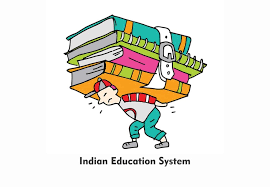
Indian Education System

Education plays an important role in the development of an individual and making him a knowledgeable citizen. It is the education that makes an individual self-reliant, helps to suppress the social evils and contribute towards the development of the society and nation as a whole. Education helps in unravelling the mystery of nature. It enables us to understand and improve the working of our society. It creates conditions for a better life. Education brings out the capabilities to fight injustice happening in society. Every individual has the right to education. 

Indian Education is one of the largest and complex education systems in the world along with China. India is committed to providing basic education to its citizens, the framework of which is defined in the National Policy of Education. Elementary education is now compulsory in India. At the time of Independence, only 14% of India’s population was literate. Now after so many decades since Independence, the number of literates has increased by fivefold.

History of Education System

The history of Indian education system comes from the times of Ramayana and Mahabharata. The historic Indian education system is also called the Gurukula system. There were gurus then who are now known as teachers and shishyas who are called students now. The gurus and the shishyas lived together under one roof in Gurukula until the completion of their education. The shishyas were expected to help the guru in all the daily chores as part of their learning. The children belonging to higher strata of the society were taught all the subjects from Sanskrit to Holy Scriptures and mathematics to metaphysics by the gurus. The Gurukulas during those times focused on the practical aspects of life. The students were taught in the open classroom in the surrounding area of nature. This early system of education in India continued for many years until the modern education system came into the picture in the nineteenth century.

In the early 19th century, during the British period, the modern education system was brought into our country by Lord Thomas Babington Macaulay. The basic strength of this modernized education system was the examinations and a well-defined curriculum, which gave importance to subjects like science and mathematics and subjects like philosophy, metaphysics were given a back seat. The brick and mortar classrooms replaced the open classrooms in the Gurukulas. The essence of the guru shishya bond was taken over by a more formal relationship between the teacher and the student. To understand the progress of any student, examinations were conducted at frequent intervals. The focus of the education system shifted from learning to memorizing of the concepts to score good marks in the examinations.

Problems of Indian Education System

Over a period of time, it has been observed that there are many loopholes in the system of education in India. Instead of understanding the concepts, students started cramming and memorizing the lessons. Knowledge is given a backseat and scoring in high rankings takes importance. The modern parents have tuned their mindsets accordingly and their goal is to ensure that their children score good marks instead of acquiring knowledge right from the primary level. 

Private schools and colleges have been rapidly increasing in the country but the results produced by them are far beyond satisfactory. It has also been observed that the quality of teachers deteriorated with the passing of time. Our examination system is responsible for the wide skill gap. India is producing lakhs of engineers and professionals every year but only a fraction of this number is actually getting employed. This is because the Indian examination system focuses more on scoring good percentages rather than the actual continuous comprehensive evaluation. 

Research and development, which should be the cornerstone of our system, are given the least importance. The private schools and colleges focus on the admission of more students and are least interested in the quality of their education. This is the major reason why the faculties and the teachers lack skills and specialization. This is quite evident from the fact that a single professor is assigned to teach multiple subjects. 

How Can We Improve the Indian Education System?

First and most importantly we should improve the grading system. Rote learning should be discouraged completely. Teachers and faculties should focus more on the analytical skills of the students and grade them accordingly. There should be more focus on comprehensive evaluation instead of scoring only good marks. Workshops must be organized for teachers on a regular basis to keep them updated about the latest developments in the sector of education. At the same time, the curriculum should be reframed according to the present needs of education in India. 

The payroll structure of the teachers and the faculties especially in the government institutions should be improved. This step will help in motivating the teachers to develop their skills and they will take a keen interest in grooming or shaping up a student’s life and career. The government and other entities who are associated with the education sector, need to understand the importance of quality of education. Education should be a holistic process that must focus on the overall development of the physical, emotional, social and cognitive skills of a child. It needs to be a slow and cyclic process and must take place gradually to help the child develop into an autonomous, independent and knowledgeable individual.

Conclusion

An educated individual is an individual who should be able to contribute towards the betterment of the economic and social development of the society as well as the country. The true goal of education must exceed awarding the degrees and certificates to the students. Education is not a tool to earn livelihood but it is a way to liberate the mind and soul of an individual. 

How can online learning influences the education of a Student?

When the world has witnessed one of the most infectious diseases spreading around the globe that affects not only the physical health but also the mental health of people. It was really difficult for any educational institutions, schools, or a college to manage classes physically, But 21st-century technology made it easier and helped institutions with their breathtaking software to conduct online classes and tests.

Photo by Julia M Cameron on Pexels.com

How online education is a new way of learning?

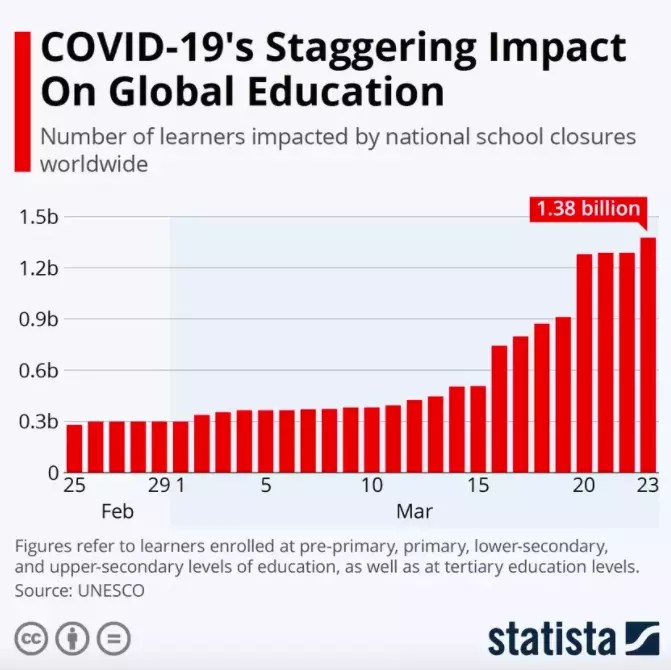
Prior to the COVID-19 pandemic, there were people who used to study on E-platforms, but not often, there were people who didn’t go to school and studied at home. Technology made a click away to explore and learn anything a student wanted to. Now one can carry their textbooks in their pocket, one can meet up anyone face to face on a software, just a click away and one can do learn anything from the internet. After school closed as a result of the pandemic, about 1.8 billion students from 186 different countries, their education was affected, but again technology did not want the student’s life to be ruined by the physical closure of schools. 

Future of Online Education

As per some scholars and economists, it’s highly believed that the overall market for online learning can be up to US $350 Billion in 2025 or more. Parents and students now don’t have to spend extra charges for classrooms, Electricity, or for any other activities that the school asks the students to pay. Parents who used to worry about their kids in school about their bullying, consuming drugs or any other harmful activities now are totally diminished. Now parents can witness their kid’s education during their online classes. Students now can easily study as well as can upgrade their extra skills through e-learning. Many students nowadays do internships, do extra courses, learn new things as well as the technology. Now a 8 year old student knows how to operate a mobile phone or a PC. Some believe that in future online education would be easily available and students don’t have to pay more for their education. “I believe that the integration of information technology in education will be further accelerated and that online education will eventually become an integral component of school education,“ says Wang Tao, Vice President of Tencent Cloud and Vice President of Tencent Education.

As Online education can also put the students in a bad or harmful influence, there are people who don’t want the online education as a major medium of learning.

Reasons why online education can be a harmful influence for the students?

  • Nowadays, most of the school or college students don’t study and cheat on their online exams or tests. It can be a really bad impact on their future and can be the core reason for the lack of their knowledge.
  • The daily and often use of electronic devices can make a person sick and hits their mental health in a really bad way.
  • Students are well aware of the technology and now are highly active on social media networks and making online friends. One can be good, but there are high number of chances to meet a fraud one. Those frauds assault the kids and ask them to do things which a kid didn’t want to.
  • Nowadays students as well as the adults store their personal information on their electronic devices and one don’t know that there are people on the internet named as hackers, who often used to steal the random people information from their cloud and upload them in the Dark web. There is a high number of chances of a kid or high school student could be one of the victims of online frauds and assault.

Reasons why online education can be a good influence for the students?

  • Firstly, the online education can be done in massive numbers at a time, which in physical classes were not possible. A student can know a number of different answers to a same question which is really helpful for a kid to understand that how an answer could be framed for a question.
  • Question answers from textbooks were limited, but in online education one can know more about a question through exploring it on the internet.
  • Technology is our future generation and learning about it since childhood could be an advantage for a student in their future.
  • In a traditional way of learning, one has to stick by a particular teacher and had to adapt their teaching style, but in online education a student can get through a number of teachers and can stick with the one they liked the most.

Disadvantages of Online education

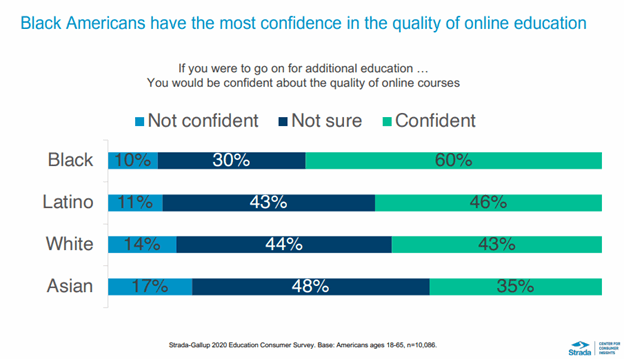
Schools, Colleges are one of the best moments one could live in and online education can totally dismiss it. The other activities in schools like Upgrading leadership qualities through school/college competitions, Outdoor games for physical health of a student, and more things which a student learns through offline education are not possible through online education. The major and the core problem is, not every student or kid have mobile phones or PC and the access to the internet. They all were dependent on government schools, offline classes and free books from the school for their education. Poor family conditions, Bad environment, Poor Electronic facilities could be reason in the future for a student who might lose their interest in their education through E-Learning.

In the end, the conclusion of learning through online education has more disadvantages than their benefits.

Sources:-

https://www.weforum.org/agenda/2020/04/coronavirus-education-global-covid19-online-digital-learning/

https://www.google.com/url?sa=i&url=https%3A%2F%2Fwww.insidehighered.com%2Fnews%2F2020%2F07%2F30%2Fsurvey-data-reveal-impact-covid-19-perceptions-online-education&psig=AOvVaw28oKObAFVXLJ-UO6vhxiqv&ust=1627984700132000&source=images&cd=vfe&ved=0CAwQjhxqFwoTCKCFmYeKkvICFQAAAAAdAAAAABAK

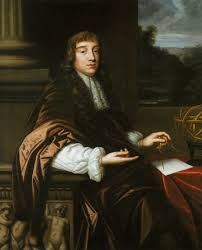
“ROBERT HOOKE” Biography

“Robert Hooke” was an architect natural philosopher and brilliant scientist. He was born on 28 July, 1635 in freshwater, Isle of Wight, England. His father’s name was John Hooke and Mother’s name was Cecily Gyles. His father was a Church of England priest. Robert had three siblings. He received most of education at home because our continual frail health. His father passed away in 1648.

He studied Greek Latin mechanics and mathematics in 1655 Robert hooke become an assistant to the famous scientist Robert Boyle and worked in this capacity till 1662. He helped in the construction and operation of Boyle’s air pump. He discovered the law of elasticity which eventually came to be known as Hooks law. He described this law in an anagram ceiiionsssttuv in 1660 and gave its solution in 1678. This La is extensively used in all branches of Science and Engineering in 1660 the Royal Society were formed by 12 men at the Gresham college and on Sir Moray proposal along with Boyle’s support. Hooke was named as the curator of the society. He became a fellow of the society in 1663, he succeeded Arthur Dacresias professor of geometry at the Gresham College. In 1665 he published the book micrographia which considered to be one of the most important scientific books ever written he made tremendous contribution to time keeping by improving pendulum clocks. In astronomy Robert Hooke studied the Pleiades star cluster, the crater on the Moon rings of Saturn and the double star system Gamma Arietis. In 1582 he proposed A Remarkable mechanistic model of the human memory which addressed the components of encoding memory capacity repetition retriever and forgetting. he was also an architect who served as a Surveyor of London city. After the great fire in 1666 he help to rebuild the city and core designed many architecture Robert hooke is received the degree of doctor of physic in 1691 he never married but his diary records that he had sexual relations with his niece, Grace, and several of his housekeepers. He point records that on the this housekeepers gave birth to you girl but does note the paternity of the child. He died in London United Kingdom on 3rd March 1703 at the age 67.

Reserve Bank Of India

The Reserve Bank of India (RBI) is India’s central bank, also known as the banker’s bank.
The RBI controls the monetary and other banking policies of the Indian government. The Reserve Bank of India (RBI) was established on April 1, 1935, in accordance with the Reserve Bank of India Act, 1934. The Reserve Bank is permanently situated in Mumbai since 1937.

Establishment of Reserve Bank of India

The Reserve Bank is fully owned and operated by the Government of India. The Preamble of the Reserve Bank of India describes the basic functions of the Reserve Bank as;

1)Regulating the issue of Banknotes

2)Securing monetary stability in India

3)Modernising the monetary policy framework to meet economic challenges

The Reserve Bank’s operations are governed by a central board of directors, RBI is on the whole operated with a 21-member central board of directors appointed by the Government of India in accordance with the Reserve Bank of India Act.

The Central board of directors comprise of:
Official Directors – The governor who is appointed/nominated for a period of four years along with four Deputy Governors.
Non-Official Directors – Ten Directors from various fields and two government officials.

Functions of RBI

  1. The Issuer of the Currency: It has the sole authority to produce the currency. It also takes action to stop regulating the passage of fake money.
  2. Banker to the Government: It acts as a financer both to state and central government. It delivers short-term credit. It governs all new matters of government lands, maintaining the government debt unsettled, and taking care of the market for the government securities. It counsels the government on banking and monetary subjects.
  3. Banker’s Bank: It is the bank of all banks in the country as it delivers the loan to banks, rediscounts the invoice of banks and receives the payment of banks.
  4. Lender of Last Resort: All the other banks can borrow from the RBI by keeping qualified securities as a deposit at the time of crisis.
  5. Money Supply and Regulator of Credit: To manage demand and supply of cash in economy by Open Market Actions, Credit Ceiling and much more. It has to meet the credit necessities of the remaining banking system. It requires sustaining price stability and an elevated rate of economic growth.

Role Of Todays Youth In Building A Self Reliant India

“Self-reliance is the key to a vigorous life.”

Self-reliant India is the vision of the Prime Minister of India Narendra Modi of making India a self-reliant nation. The first mention of this came in the form of the ‘Self-Reliant India Mission’ during the announcement of the coronavirus pandemic related economic package on 12 May 2020. This self-reliant policy does not aim to be protectionist on nature and as the Finance Minister clarified, ” Self-reliant India does not mean cutting off from rest of the world”. The largest fund in the country worth Rs. 21,000 crore was setup by the IIT Alumni Council with the aim of supporting the mission towards self-reliance.

Everybody knows, that the youth are the future of any country. But India can take lead over many other nations because about 65 percent of the country’s population is below 35 years and 50 percent is below 25 years. With huge, educated young population, India is very uniquely poised to realise the demographic potential amd reap the advantage of this vast powerhouse of human resource talent. The need of the hour is to upgrade the skill or upskill the youth to meet the emloyment needs of technology driven 21st century and accelerate the pace of self-reliance.

The uncertainity created by the pandemic is being seen by many as an opportunity to upgrade knowledge and acquire new skills that will cater to the post-corona virus job scenario. The skills required for tomorrow’s jobs will be completely different from the skill-sets youth possess today.

So, its high time now, we have to make India self-reliant and youth plays the most important role in this mission.

International Workers Day

“Without labour nothing prospers.”

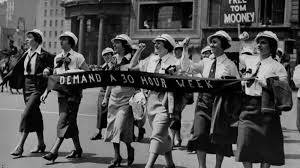
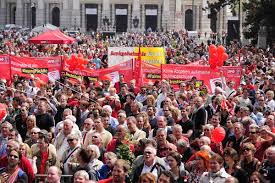
Labour Day or International Workers Day is celebrated annually on 1 May to celebrate the working class and labourers across the world. Socialist and labour unions celebrate this day by organising programmes to improve wages and working conditions of the workforce. In more than 80 countries Labour Day is a national holiday.

Before a formal Labour Day came into place, deaths, injuries and dangerous working conditions were very common among the working class globally. During the rise of industrialisation, the U.S. exploited the working class during the nineteenth century and made them work upto 15 hours a day under rigorous conditions. The rising death of the workforce in industries forced the working class to raise their voices for their safety. After efforts made by the workers and socialists, eight hours was declared as the legal time for the workers in the late nineteenth century by the American Federation of Labour.

The origin of Labour Day goes back to an incident in Chicago on May 4, 1886 known as the Haymarket Affair. On this day workers assembled as part of a peaceful rally in a strike demanding an eight hour work day. An unknown person threw a dynamite bomb at the police as they acted to disperse the meeting, and the bomb blast and ensuing gunfire resulted in the deaths of seven police officers and atleast four civilians; dozens of others were wounded. The Chicago protests led to many countries and at last they got the proper labour rights.

So, they had a long repression from the society. So, now the time has come to live respectfully and safe. Without labour no country can prosper. They are the ones who make a way towards country’s development. Their hardwork, dedication cherishes the path of development of country. So, respect them and provide safe working conditions to them. The below mentioned lives are aptly quoted;” A worker is a creator and a great asset to every nation”.

Erik Erikson’s psycho social development

Introduction:
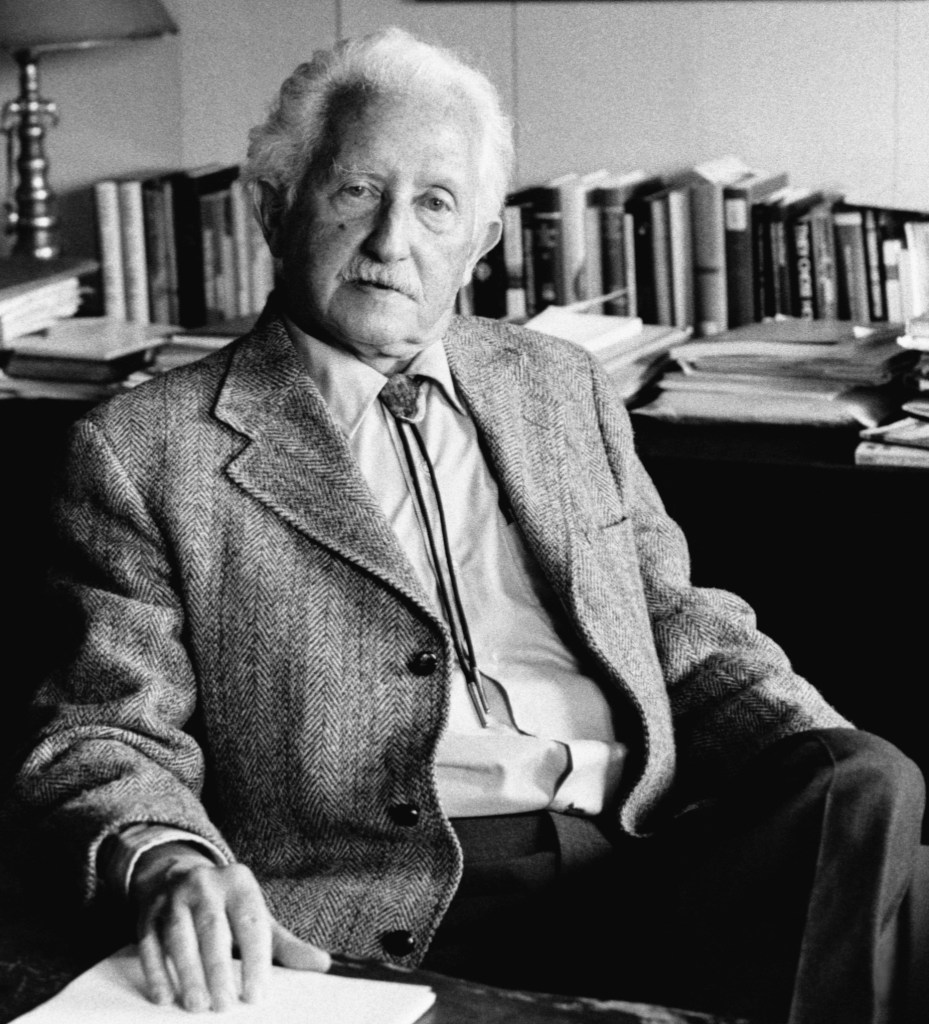
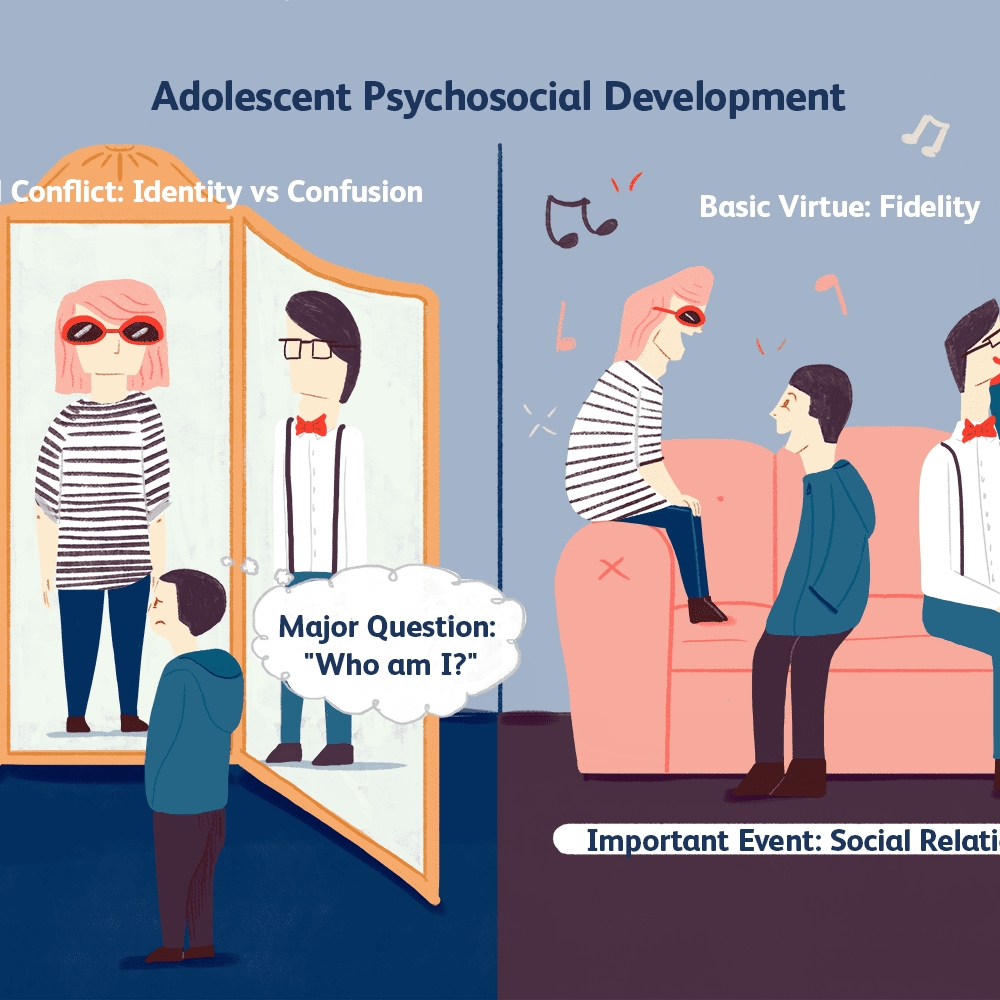
Erik Erickson was a German-American development psychologist and psychoanalyst known for his theory on psychological development of human beings. Erik Erickson’s psychosocial development theory mainly talks about how human development happens in 8 stages and their personality development also takes place through these eight stages starting from infancy to old age. His argument was about how a social life was important and how in each stage, when we interact with other humans, we learn and grow together and help us understand our social environment and surroundings.

The psychosocial development is influenced by Sigmund Freud’s Id, Ego and Super Ego. Development is a lifelong process and is divided into eight stages and is called ‘crisis in personality’, later referred to as competing tendency. The eight stages are:


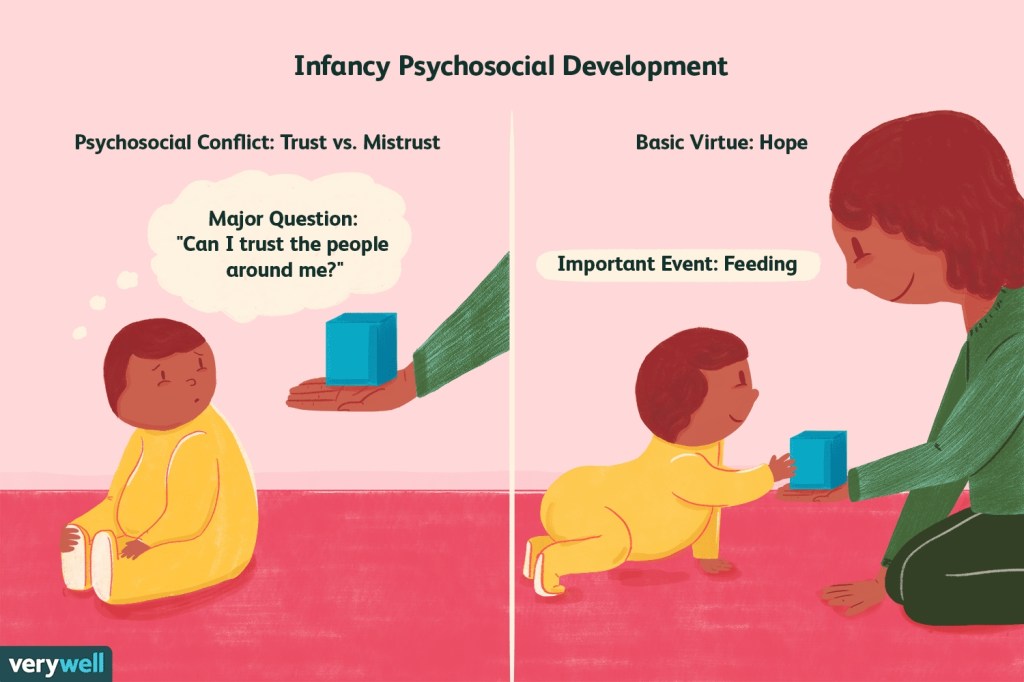
• Trust Vs Mistrust:
The first stage begins at the age of 12 months and continues till 18 months. The crisis in this stage is trust Vs mistrust. In the stage, the child learns a virtue in this stage called Hope. The first stage is where the child learns whom to trust and whom not. The mother is the most trusted person as the child feels more safe and connected to the mother than to anyone else.


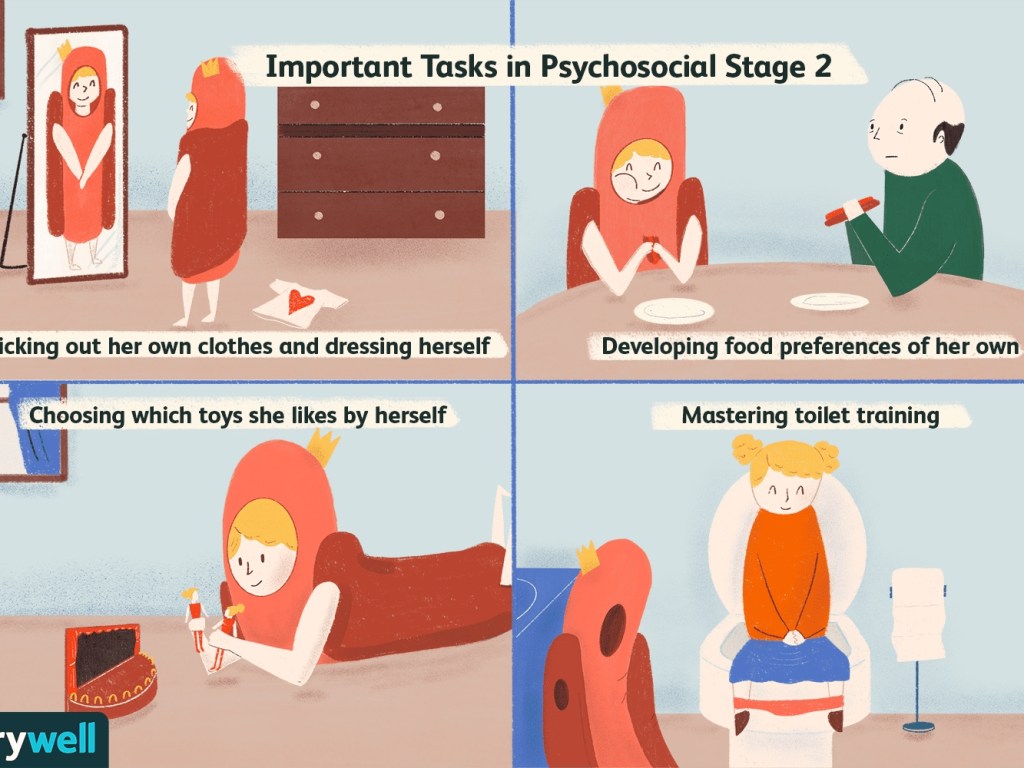
• Autonomy Vs Shame:
The second stage is Autonomy Vs Shame. This stage starts from (12-18) months to 3 years. The virtue learnt here is Will. In this stage, child engages in activities and learns to be independent or the child grows up to be shy and timid. Autonomy means independence. So, their own decision of doing something or not is what is learnt in this stage.


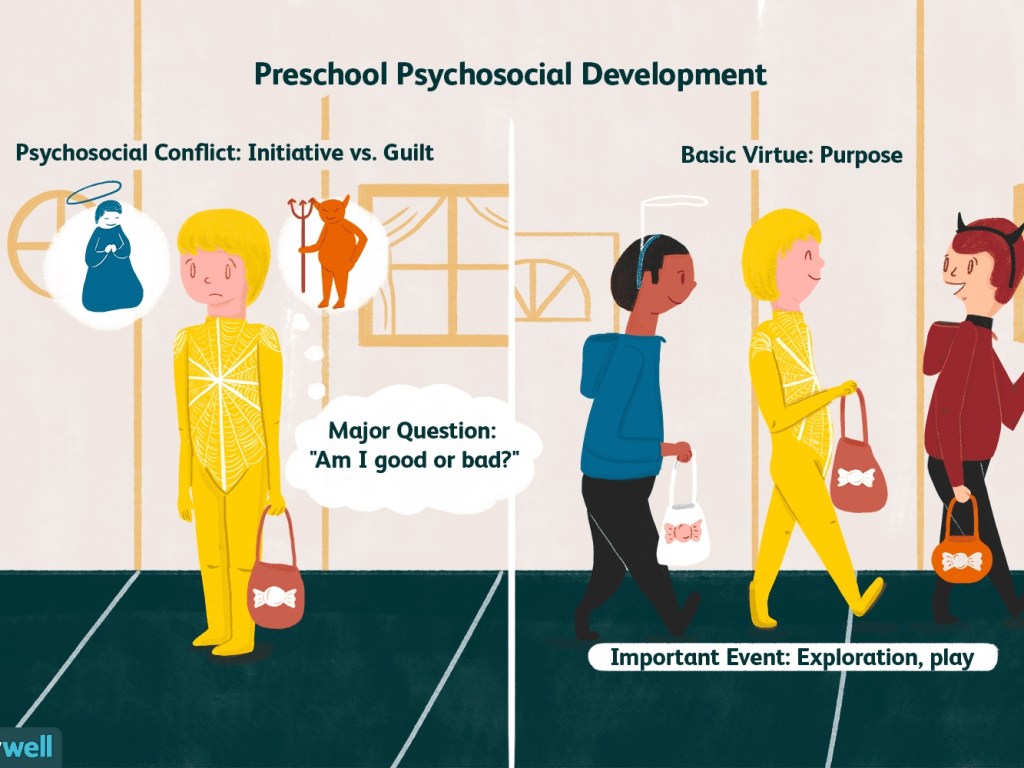
• Initiative Vs Guilt:
The third stage is from 3 years to 6 years. The crisis here is initiative Vs guilt and the virtue learnt here is purpose. The child price to be initiative and creative and tries to learn new things of feels guilty towards learning anything new. The child takes initiative in learning new things and exploring new possibilities or the child feels like if they try to do something new it’s wrong or it shouldn’t be done that way.


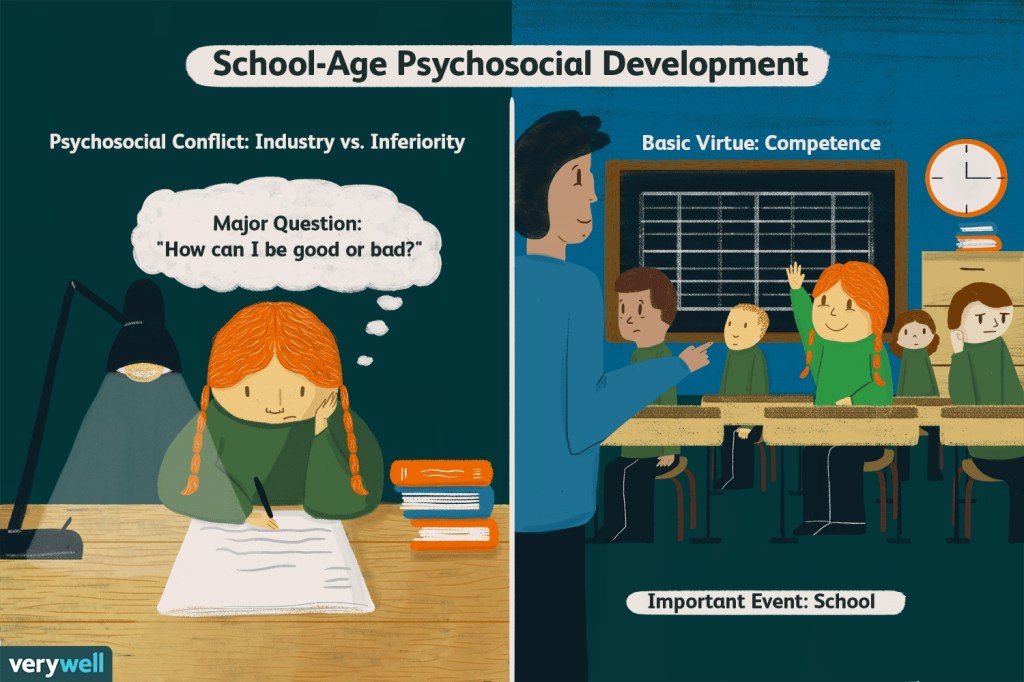
• Industry Vs Inferiority:
The fourth state starts from 6 years and last puberty. The crisis here is industry Vs inferiority. The main virtue learnt here is competence. In the states the child learns new hobbies for activities and tries to be bold or the child feels inferior to others. This state is where the child explorers new activities or interest of their own or when they see other people doing new things or activities they feel they are not good enough for feel inferior to others.


• Identify Vs Identify Confusion:
The first stages from puberty to young adulthood. The crisis identity Vs identity confusion and the virtue learnt here is fidelity. At this stage the child tries learning about themselves and tries to establish and identity for themselves for the child is confused about who they are. This is an important stage as this is the building blocks for the rest of your life. If one does not know who they are then they cannot go on with their life.


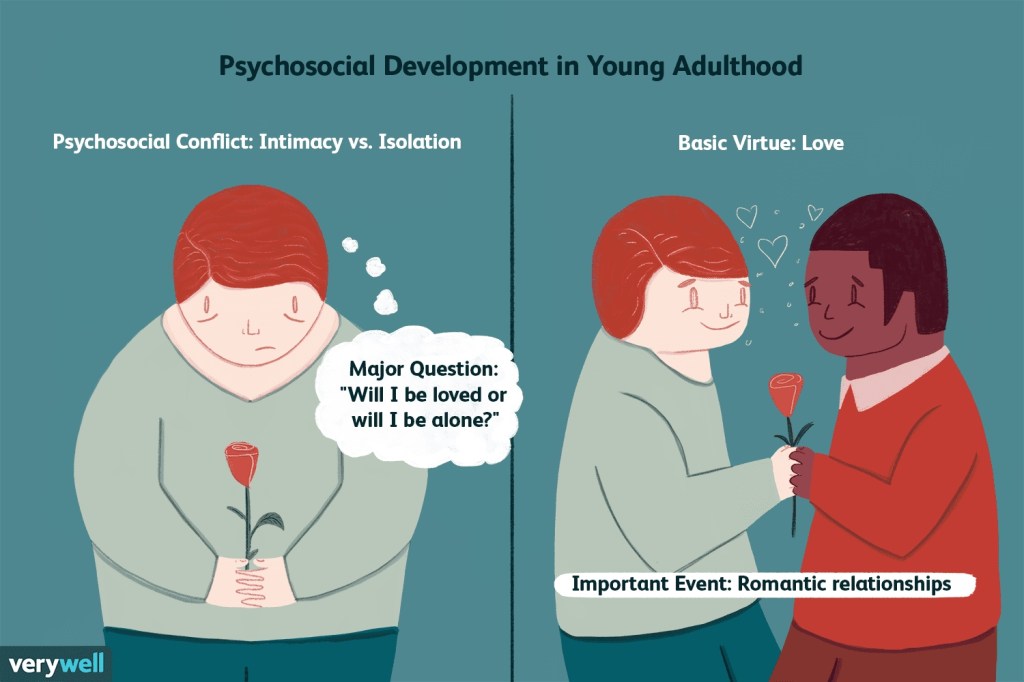
• Intimacy Vs Isolation:
The 6th stage is young adulthood where the crisis is intimacy Vs isolation. The virtue learnt here here is love. Here, the child learns to communicate with the opposite sex and establishes a connection or is shy and spends time in isolation.


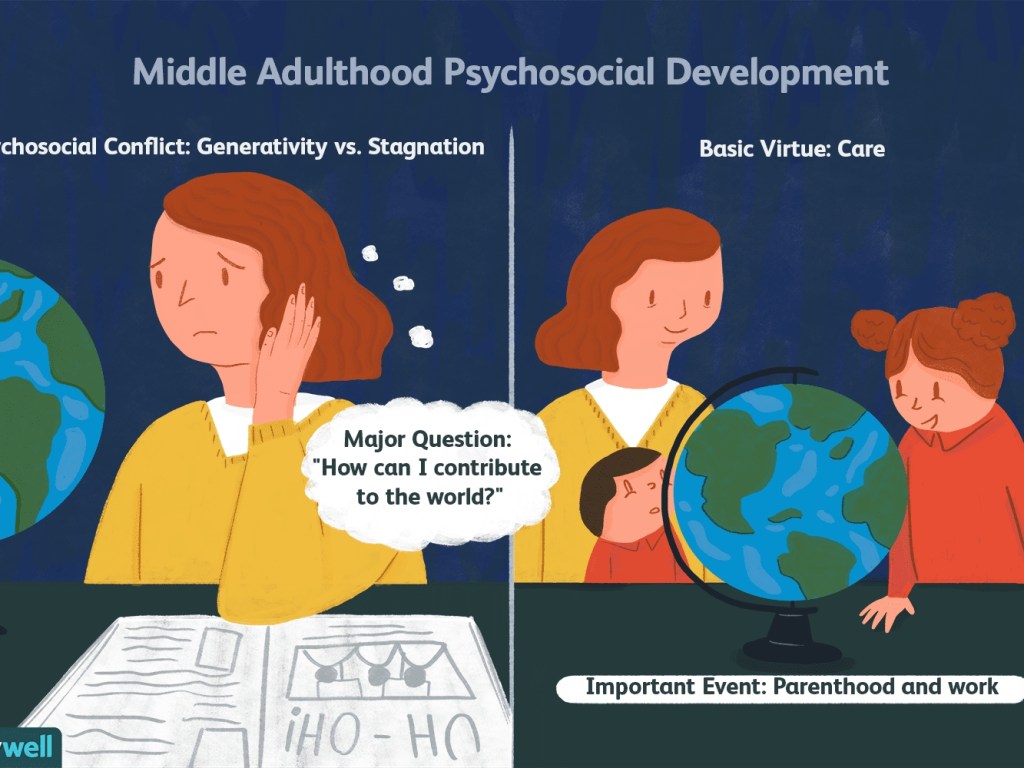
• Generativity Vs Stagnation:
The 7th stage is middle adulthood. The virtue learnt here is care. Here, the person learns to care for others and to be productive or is stagnant. Either they try to help other people how they learnt from their mistakes or they just do not care about anyone else other than themselves.


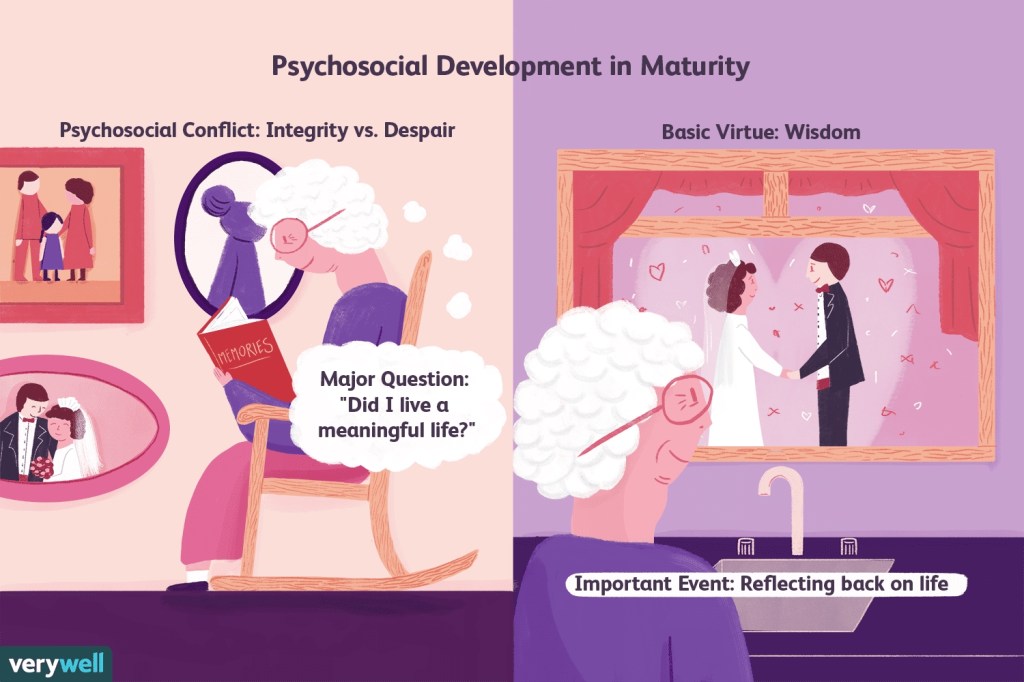
• Ego Integrity Vs Despair:
The eight stages late adulthood. The virtue learnt here is wisdom. Here, the adult is either a smart person who is proud of how they have led their life or someone who’s in despair because of how they lived. You can either be proud of who you are or you will regret what ever you have done in your life. That is what this stage is about.


Conclusion:
Development just doesn’t take place in one particular time period. It lasts throughout your lifetime and therefore it is important to learn from your mistakes and make sure to lead a good life so when you look back at how you led your life, you can be proud of who you are and were.

New Forms of Punishment

Section 53 prescribes five types of punishments to be meted out to a person convicted of a crime under the Code, depending on the nature and gravity of the offence,viz .:

(i) Death; (ii) Imprisonment for life; (iii) Imprisonment, rigorous with hard labour, or simple; (iv) Forfeiture of property; and (v) Fine.

It is suggested to add five new forms of punishment to the existing ones in section 53, IPC with a view to deter particular types of criminals. Such punishments will have more psychological, social and moral impact on the criminals and will go a long way in curbing crimes. The proposed punishments are: (i) Externment, (ii) Compensation to victims of crime, (iii) Public Censure, (iv) Community service, and (v) Disqualification from holding public office.

(i) Externment: Externment or banishment is a form of punishment in which an accused is sent out of the place of his residence to another place for a specified period of time as mentioned in the order issued by the court. This is done to deprive the accused of the company of his family members, friends and associates so that he or she may not indulge in criminal activities. Externment is resorted to primarily in case of anti-social, hardened and habitual criminals.

(ii) Compensation to victims of crime: Unfortunately, the victims of crime in our country do not attract the attention of law makers. Of late, Civil Procedure Code, 1973 in section 357 has empowered the court to award compensation to the victims of crime in very limited cases at the time of passing the judgment. No doubt, the higher judiciary has on times provided compensation to the victims of crime of custodial violence, sexual assault, rape, illegal detention by invoking Article 21 of Constitution, but such instance will not serve the plight of helpless victims.
(iii) Public Censure: Public Censure or social censure is one of the methods of punishment prescribed in some of the countries, such as Russia, Columbia etc., in respect of certain offences of anti-social nature, such as white-collar crimes, tax crimes, food adulteration, etc. In ancient India, public censure was considered suitable punishment for certain class of criminals.

(iv) Community Service: Community service or corrective labour is a form of punishment in which the convict is not deprived of his liberty. Corrective labour is the standard penalty given in those cases where it is considered that the accused need not to be isolated from the society. The period ranges between one month to one year in such cases. This system is used in Soviet Russia with good results. An important feature of this type of punishment is that the accused is not deprived of his liberty and he may go home after the day’s work.

(v) Disqualification from holding public office and contest elections: Disqualification to hold public office and contest election of legislature and local bodies as a form of punishment will have the adequate and desired deterrent sanction, if sincerely implemented. Representation of the People Act, 1951 disqualifies a person convicted for a period of two years or more to contest election for a period of six years. But the provisions are very limited in scope and are being abused with impunity.

Theories of Punishment in Indian Penal Code,1860

Introduction

Punishment is the sanction imposed on an accused for the infringement of the established rules and norms of the society.

Objective

The object of punishment is to protect society from mischievous and undesirable elements by deterring potential offenders, by preventing the actual offenders from committing further offences and by reforming and turning them into law abiding citizens.

Types of Theories

  1. Deterrent Theory
  2. Preventive Theory
  3. Retributive Theory
  4. Reformative Theory
  5. Multi Approach Theory

a) Deterrent Theory: According to this theory, the object of punishment is not only to prevent the wrong-doer from doing a wrong second time, but also to make him an example to others who have criminal tendencies. Salmond considers deterrent aspects of criminal justice to be most important for control of crime. Deterrent punishment is likely to harden the criminal instead of creating in his mind a fear of law. Hardened criminals are not afraid of imprisonment.

b) Preventive Theory: According to Paton:’The theory concentrates on the prisoner and seeks to prevent him from offending again in the future. The death penalty and exile serve the same purpose of disabling the offender’. Critics point out that preventive punishment has the undesirable effect of hardening first offenders, or juvenile offenders, when imprisonment is the punishment, by putting them in association of hardened criminals.

c) Retributive Theory: In primitive society punishment was mainly retributive. The person wronged was allowed to have revenge against the wrong-doer. The principle of ‘an eye for an eye’, ‘a tooth for tooth’, was the basis of criminal administration. According to Justice Holmes: ‘It is commonly known that the early forms of legal procedure were grounded in vengeance’. The advocates of this theory plead that the criminal deserves to suffer.

d) Reformative Theory: According to this theory, the object of punishment is reformation of criminals. The object of the punishment should be to reform the offender. The criminal must be educated and taught some art and craft or industry during his term of imprisonment, so that he may be able to lead a good life and become a responsible and respectable citizen after release from jail.

e) Multi Approach Theory: In fact, a perfect system of criminal justice could never be based on any single theory of justice. Every theory has its own merits and every effort should be made to extract the good points of each and integrate it so that best of all could be achieved. Punishment should be proportionate to the nature and gravity of the crime. The object of any concession given to an offender should be to convince him that normal and free life is better than life in jail.

Are online classes worth it?

As you know COVID-19 destroyed the world economy to a great extent and still we are not fully back on our track. The major impact of this can be seen on education as well. All the schools and universities shut down causing the harm to the students. They are forced to complete their education by the means of internet only just by sitting at their homes. Internet no doubt provides us with alot of opportunities and ed-tech is one of them but it also leads to huge destruction of students carrier and their mind. When the virus hitted the economy the teachers started taking the classes online by the way of various available platforms and both the negative as well as the positive impact for the students were observed.

Agree that there are various advantages of online classes that a student can learn on their time just by sitting at their homes but it has a disadvantage in itself because most of the students just join the classes but don’t give due care to the lectures.Some students don’t feel comfortable asking their queries in class so in an online class they can pause videos or return to concepts covered in previous modules. But this opportunity is not taken by most of the students because they are one who are completely ignoring the lectures and doing something else in their home.

Teachers are also facing alot of issues in this as the network issues hits alot while taking the classes. Also video can’t be open by the students who are living in remote areas. If we also look up in the worst ground then there are students who are even not having the proper equipment to attend the classes and also not able to give exams which is the reason of stress and anxiety among them.

We can just pray together that everything comes back on the track very soon so that we can see the happy faces going to schools and universities rather attending classes just by being on their bed.

GENDER AND EDUCATION


Abstract

 This article aims to documented and understand how education is not an easy task for girls mainly in poor families. We talk about the various major issues revolving around the high dropout rates amongst girls in India. And many initiatives by the government to strengthen the education system of India.

Introduction

Education is the single most important factor to ensure gender equality and empowerment. But, gender inequality in education is a persistent problem in Indian society- especially for girls residing in rural areas, belonging to lower socioeconomic backgrounds, and lower castes. India has succeeded in many ways to address the educational inequalities- like moving towards universal school enrollments and coming up with educational policies based on gender. However, education gaps still exist.

And gender is not only about males and females but it is also about the third gender called transgender. They also faced much discrimination regarding education as they are not much appreciated in studies.

Gender education gaps 

According to census 2011, a person above 7 years is considered literate if he/she can read and write in any language with understanding. A person is not considered literate if he/she can only read but cannot write. The Census also states that it is not necessary that a person should have received formal learning or minimum education to be considered literate. 

Women constitute 48.5% of the country’s population. According to Census 2011, the female literacy rate is only 64.64% (as opposed to the male literacy rate of 80.89%) of the total female population of India, with Kerala being at the highest with 91.98% rate, and, Bihar and Rajasthan being at the lowest levels with 53.33% and 52.66% respectively 

Indian women having the most illiteracy rates in Asia as there is discrimination among girls and boy child among most of the Indian families as they don’t allow girls for higher education some due to patriarchy and some due to economic crises, the huge gender gap in enrolment for science subjects, the value of quality in school, etc.

Following are the major issues revolving around the high dropout rates amongst girls in India:

  • Poverty

Poverty happens to be the single biggest cause of illiteracy in India and a precursor to all other effects. In a poor family, girls are the main victims; they are malnourished and are denied the opportunity of better education. The poor parents are unable to afford the education of their children. It is very difficult for them to meet the daily expenses. In such a situation they cannot buy textbooks, pencils, erasers, etc., and pay school fees. Even if they can afford to educate one child, the son would always be preferred over the daughter. . Illiteracy and poverty go together because they are similar expressions of lack of access to resources in society.

  • Poor school facilities

Inadequate school facilities can sometimes serve as a deterrent for the girl child’s participation in formal schooling. 

Lack of basic sanitation and privacy is driving girls out of school. According to UDISE 2013-14 data for the Swachh Bharat Swachh Vidyalaya mission, 9.27% of schools in the entire country do not have a separate toilet for girl students, while 8.03% of toilets are dysfunctional. The lack of water, inadequate sanitation, unhygienic common or separate toilets, and absence of separate toilets for girls reflect in their extremely low attendance in schools.

  • Lack of Transport

Some villages do not have schools and the students need to travel long distances to study. This is also one of the main reasons behind female illiteracy as the family does not find it safe for girls to travel such long distances every day. Due to staggered habitations, children are forced to travel more than 3 km. Thus, the daughters are usually discouraged due to unsafe environments and the fear of sexual harassment and violence on way.

  • Patriarchy

Patriarchy refers to a system of society in which men hold the power and women are largely excluded from it. The normality of covert forms of discrimination, and how everyday form of oppression determine institutional spaces, present a great challenge for women and girls to negotiate spaces and rights in public life. Patriarchy sees women as nothing more than domestic workers, which in turn discourages them right at a young age, to not pursue education and rather help in cooking, washing, and other household chores- which they are meant to do at later stages of life; after marriage as well. Thus, parental reluctance to educate girls is a huge factor inhibiting their access to education.

  • Lack of teachers

Girls are more likely to attend schools if they have female teachers. Girls are more comfortable and more local with female staff, thus are found to be active in focusing and participating in the learning process. Also, the parents – especially in rural areas- are hesitant to send their daughters to schools that majorly have male teachers. The dearth of female teachers is a concerning issue. Nearly all committees and commissions that have looked into illiteracy have recommended increased recruitment of female teachers.

  • Household chores 

Fixed school hours do not suit many girls in rural areas; as they are required to lend a helping hand at household chores, at farms, and fields during those hours. Girls are even expected to take care of their younger siblings, while their parents are out on their daily wage. This is one of the causes of the low participation of girls in education. The enrolment rates of girls and their retention can be improved if the schools offer flexible hours. Flexible school timings have been tried in Rajasthan under the Shiksha Karmi Project and Lok Jumbish, and the results are quite encouraging.

  • Sexual Harassment and Violence

Parents often complain about the security issues of girls attending schools. Instances of abduction, rape, and molestation of girls dampen the enthusiasm of girls and their parents in pursuing education beyond a particular age; thereafter they are bound to sit at home and save their chastity.

  • Early marriage:

The patriarchal society still endorses the idea of pubescent marriages of girls. Most child marriage involves underage women, many of whom are in poor socio-economic conditions. Jharkhand is the state with the highest child marriage rates in India. 

  • Menarche and Menstruation:

A national study by AC Nielsen and NGO Plan India in 2012 found that lack of facilities causes widespread absenteeism each month, stating that girls miss an average of 50 days of school each year because of menstruation. It also found that 23% of girls in India drop out of school when they hit puberty.

The Government of India has taken many initiatives to strengthen the education system of India.

The major centrally sponsored schemes are the Sarva Shiksha Abhiyan (SSA), National Program for Education of Girls at Elementary Education (NPEGEL), Midday Meal Scheme, Right to Education (RTE) Act, Beti Bachao, Beti Padhao,  Kasturba Gandhi Balika Vidyalaya, etc to improve the educational situation of India but somewhere we are still lacking behind and more work is needed to improve the quality of education in India, as well as the condition of girls, is more worst than boys in case of education as they are getting the equity, not equality.

Conclusion 

A women’s life is better when she is educated as she can take her own decision not dependent on others as this study shows that still, the literacy rate is low of women more work is needed to be done to improve the condition.

References

  1. .https://www.thehindu.com/opinion/open-page/gender-equity-in-education/article31600127.ece
  2. http://www.create-rpc.org/pdf_documents/PTA18.pdf
  3. http://www.jcreview.com/fulltext/197-1582715201.pdf
  4. Bashin, K. (2003). Understanding gender. New Delhi: Women Unlimited