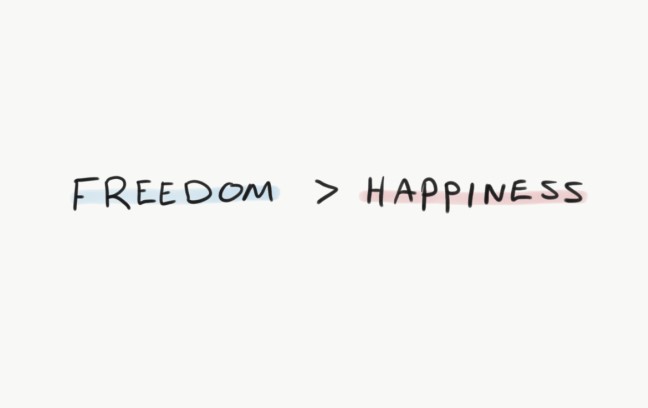
Happiness and Virtue!

t is believed that if we do something hoping for the sake of its own good will, then it will be in a realm of ultimate good. People shouldn’t be doing something good because they want something out of it, but for the sake of the good will only they should do it. When people do attain the ultimate good, its usually ends there with the end as its highlight. Aristotle has remarked that politics is what governs everything in life, we can’t find an activity around us that does not involve politics. All the sciences have politics in them and so the end of such sciences is the end of politics too.

Aristotle thinks that happiness can only be chosen in itself and not any other principles. It can only be attained directly, and there is no short cut or other way around it. We do something for various pleasures and wants in life but we want happiness for its own sake. Man, always want to be the best in everything they can achieve, this is with their soul’s conformity. It is always aligned with their certain principles and man always sets standards he wants to achieve. If he achieves these certain elements with the full passion he had put in to for its result, then he has attained his virtue. 

Happiness is an action that is to be lived well and achieved justly. It shouldn’t be deceived or cheated because only if you put the most efficient of work and passion, it can be achieved. Then only it becomes a virtue. It should be lived well to the virtue of the conformity. People aren’t born happy, but they find happiness on their journey of life. It is an activity throughout a person’s life achieved over time. Happiness is something that we gather across our life, through our experiences. It is not something that can be bought with. It is the result of certain actions attached with virtue.

Virtue is of two types o Intellectualo Moral 

Intellectual focuses on the intelligence, theoretical and wisdom of the virtue while the moral part focuses on kindness and generosity. No man should be less of one of the virtues. Both the virtues are important to lead a life. No man should be void of practical wisdom nor intelligence. Intellectual virtue is acquired though learning and training. You acquire it through your experiences and you learn new things on your way. While Moral virtues are attained out of habit(ethos).

Practical wisdom comes under the intellectual virtue, it is about the wisdom that one gains over a course of time in life. It is not something that you can learn while attending a class nor a seminar but it is something that you attain while learning life and adjusting to different circumstances in life. At each stage of our life, we come across different circumstances where we learn and become the better versions of ourselves. 

Political Wisdom and Practical Wisdom: Even though they are similar in some ways their core aspect is quite different. Political wisdom completely deals with the politics and legislation and it is quite different from Practical wisdom because it revolves around one’s thoughts. Political wisdom is different from the other one since we cannot have one’s views on making laws for the citizens. 

Political wisdom and Deliberation: Deliberation in action is quite a slow process, it is about investigating the whole picture and finding the end result through the right means. It requires calculation and proper understanding unlike guessing which goes quite quickly.

Practical wisdom is important in one’s life to make fair and good choices, to act in accordance with the goodwill of all and oneself. It is to achieve virtue in its highest form with a rational beginning for the end. 

Unlike any other we attain virtue only by practice, just like how an artist’s paints or a writer writes, we can only achieve virtue by putting it into practice. This is where the role of a lawgiver comes in, he is said to inculcate the good habits into its citizens. This is the duty of a good lawgiver. Accordingly, Aristotle believes more in the moral aspects which are to be attained over habits in one’s course of life. 

Virtue is highly associated with pleasure and pain in one’s life. A man must go through both pain and pleasure from the start of their childhood, then and then only they will be able to achieve true virtue. The right amount of pleasure and pain in certain circumstances lead to whether it was morally right or wrong. Pleasure should be attained at the right time and not the wrong one so as to develop. If pain is attained at a wrong time then it will only led to deterioration of the character and will not achieve virtue.

PRODUCTIVITY TIPS FOR PROCRASTINATORS

1. MAKE AN ATTRACTIVE TO-DO LIST

We often make a to-do list but the point we mostly miss out on is making it attractive and that’s the reason why to-do list fail. But, there is one way to make the list attractive and that is by making it more specific and actionable.

For example, instead of writing doing the workout, be more specific and write wearing workout clothes, which one is easy and attractive? Hope you got my point.

2. BREAK IT INTO SMALL PIECES.

The most common reason we procrastinate is we get overwhelmed by the size of the task and the time it will require to finish that task.

Thus try to break down your task into very small pieces that would be super easy for performing.

3. USE THE 10 MINUTE RULE

If the work is overwhelming or you can’t give a start and procrastinate, tell yourself that you are going to do it only for 10 minutes. Then once you get started you will be much more likely to keep going. This is a highly effective hack that helps break the pattern of stalling or dreading work.

4.REWARD YOURSELF

Rewarding yourself will always work best for you, what you have to do is just set a reward for accomplishing a task and if a task is completed get that reward, and if not don’t reward yourself.

Rewarding yourself will make it attractive to do and at the same time, you will feel satisfied for getting your favorite thing as a reward.

Basic rules of netiquette

Successful relationships, whether in our personal or professional lives, depend on effective communication.

In today’s world most of the meetings occur online, communication isn’t just a nice skill to have – it’s essential. Good communication can be the difference the way you answer an email or what you say on social media directly affects people’s perceptions of you.

Now that such a considerable amount of our daily lives is facilitated by the internet, digital communication skills are essential to ensure messages are delivered and received correctly. We are lucky to have incredible 4G connectivity to help us communicate digitally.

Teleconferencing programs, group chat apps, and other digital tools are part of everyday life now as we attempt to strike a balance between isolation and connection. 

As we all know, there aren’t many chances to improve the first impression. Some of you may have heard the term “netiquette” being used in online circles. Netiquette defined simply refers to the code of courtesy and respect followed when communicating with others on the Internet. 

Start speaking at a normal volume when talking over the phone or video chat. Be as polite as you would be in offline encounters.

Do not send emails and text messages in ALL CAPS. Writing in all caps can oftentimes be interpreted as YELLING! and will be viewed as impolite. Make sure your emails are easy to read.

Avoid sending spam to others, keep your messages meaningful. Don’t send forwarded content created by others. 

Be yourself. Don’t say anything to anyone you wouldn’t say in person. Don’t be funny, sarcastic, passive or aggressive. A joke can oftentimes be perceived as a rude remark. A light-hearted joke can be viewed differently in text. While in-person, we communicate with the help of facial expressions and gestures. Conveying the same message online can prove more challenging.

Tone is important when you can’t speak in person. Chances of miscommunication are high when you’re relying on communication through the phone or computer. Sometimes things just go wrong. 

Stay on topic. When there is a discussion happening, it’s crucial that everyone stays on topic. Make sure that you understand what the discussion is about and only reply with things relevant to it. 

Use respectful language. It’s not just what you say, but how you say it.

Don’t let your point get lost in translation by typing too many unnecessary words. 

Online communication can easily be improved through proofreading. Check for: Grammar and punctuation errors, Poor sentence structure, Incorrect use of tenses. Use real words and complete sentences, and skip the emojis.

Verify facts before sharing information. You should be careful when providing information. It’s important to fact-check everything you read and possibly include sources when giving advice or information.

Being open to guidance and feedback, which means researching different options and tools of communication

Your day with some Motivation

Change your life today. Don’t gamble on the future, act now, without delay.

Simone de Beauvoir

What’s stopping you, is it your fear ?

From whom you are running , is it a failure ?

When to start , am I getting late ?

What if I hesitate , will they understand ?

How am I going to talk to them ?

In different phases of our life we faced different challenges that may be hard to accept and makes you feel ashamed of yourself.

Most of the time we think our fear might harm us but what we don’t understand is that , if we don’t face them it would never leave .

We hesitate , we fear , we run , we ignore , we lack and in the end we loose hope .

And what we are going to is to reconstruct that hope and trust ourselves . We might need some tools for that and one of them is MOTIVATION .

What is MOTIVATION ? How it works? Will it help ? And so on … There are many questions and the time is limited. So let’s begin .

Introduction

Being successful is not enough in today’s world . To keep the success we need a companion and that is Motivation.

Motivation has a powerful aura it can be your solution if only you used directly on your aim . I might play some tricks with you but the result will always be on your side .

Well it is going to be very hummy dumpy article but who cares (that’s not me ) . What’s important is what you learn from it .

The author Steven Pressfield wrote a great line in his book , The War of Art, which I think gets at the core of motivation.

“At some point, the pain of not doing it becomes greater than the pain of doing it.”

Well said pressfield , in other words (or my words) It is easier to take action , rather than sitting and self,- petrified ourselves.

Like it is easier for MOJO to prepare for his exam rather than think about the result OR It is easier for OJO to workout in the gym rather than sitting in the chair eating junk food . (Well I prefer junk food over gym , just ignore I said that .)

This I think is the core of motivation . To gain something we need to pay the price first . It may be time , energy , sacrifice , risk or it can be anything .

Take action

A lot of people get confused that how to find motivation and when to take action . They are wasting too much time for making plans and than for process . To make it easy find motivation and get started. The more you delay the more it get difficult.

If you waste resources trying to decide when or where to work, you’ll impede your capacity to do the work.

Their are some rituals needs to perform if you want to get motivated :

1. Exercise daily .

2. Become more creative.

3. Start your day stress free .

4. Sleep better .

5. Last but not the least do whatever makes you happy . ( But don’t do nasty things ) .

You’ve gotta dance like there’s nobody watching, love like you’ll never be hurt, sing like there’s nobody listening, and live like it’s heaven on earth.”

― William W. Purkey

Link

Career counselling

Career counselling provide correct and consolidate information to our young brigade by giving them whole basket of available option after school is par excellence.The exposure to technology ,Media and Social Networking on a larger scale has made our youth aware to a great extent ,but they are little aware of the authenticity of information which are exposed to on a regular basis .ITS VERY IMPORTANT for our young and dynamic students to have proper and worthy information which is only possible through proper and useful career counselling.

Free Trade Policy . (Meaning , Advantages , Disadvantages)

What is Free trade policy?

Free trade policy refers to a trade policy without any tariffs , quantitative restrictions and other devices obstructing the trade of goods between countries ..

According to Adam Smith,
The policy of free trade is a system of commercial policy which draws no distinction between the domestic and foreign commodities and thus neither impose additional burden on the latter nor grants any special favour to the former “

The theoretical case for free trade is based on Adam Smith’s argument about absolute comparative advantage , that the division of labour among countries leads to specialization, greater efficiency, and higher aggregate production.

Free trade therefore , signifies a non discriminatory trade policy that places no artificial barriers upon free international movement of goods and services .

Definitions :-

Prof Jagdish defines free trade policy as , ” absence of tariffs , quotas, exchange restrictions , taxes , subsidies on production , factor use and consumption “

Prof Lipsey gives a very simple definition ,
“A world of free trade would be one with no tariffs and no restrictions of any kind on importing or exporting . In such a world a country would import all those commodities that it could buy from abroad at a delivered price lower than the cost of producing at home .”

In Haberler’s words , ” free trade is the external trade system of liberation which opposes every interference by the state with the free play of economic forces .”

Thus ,the policy of free trade means simply complete freedom of international trade without any restrictions on the movement of goods between countries.

Free trade, also called laissez-faire,
a policy by which a government does not discriminate against imports or interfere with exports by applying tariffs (to imports) or subsidies (to exports).

However sometimes, governments with generally free-trade policies still impose some measures to control imports and exports.
For instance , in the United States, most industrialized nations negotiate “free trade agreements(FTA ),” or , with other nations which determine the tariffs, duties, and subsidies the countries can impose on their imports and exports.

Theories Of Free Trade :-


The years of debates over the benefits versus the costs of free trade policies to domestic industries, two predominant theories of free trade have emerged: mercantilism and comparative advantage.

Mercantilism

The theory of maximizing revenue through exporting goods and services is Mercantilism. High tariffs on imported manufactured goods are a common characteristic of mercantilist policy.
Mercantilist policy helps governments avoid trade deficits, in which expenditures for imports exceeds revenue from exports.
The goal of mercantilism is a favorable balance of trade, in which the value of the goods a country exports exceeds the value of goods it imports.
Mercantilism lost its popularity as it often led to colonial expansion and wars.

Today many multinational organizations such as the WTO work to reduce tariffs globally, free trade agreements and non-tariff trade restrictions supersede mercantilist theory.

Comparative Advantage

David Ricardo in his book “Principles of Political Economy and Taxation,” 1817 , stated the law of comparative advantage which refers to a country’s ability to produce goods and provide services at a lower cost than other countries.
The Comparative advantage theory is that worldwide openness in trade will improve the standard of living in all countries.
Comparative advantage holds that all countries will always benefit from cooperation and participation in free trade.


Advantages ( pros ) of Free Trade Policy.

Free trade policy has many advantages for a country.
The following are some pros of free trade policy :-

1: Maximum of Output :- Under free trade the country specialises in the production of those commodities which it is relatively best suited to produce and exports them in exchange for those imports which it can obtain more cheaply . This maximises the output of all the participating countries because all gain from trade which in turn , increases the real national income of the world economy . Thus free trade leads to the maximisation of output income and employment.


2: International Specialization :-
Free trade causes international specialisation as it enables the different countries to produce those goods in which they have comparative advantage . International trade enables countries to obtain the advantage of specialisation . If there were no international trade many countries would have to go without some products .

3: Optimisation of Consumption :-
Free trade secures the optimisation of consumption . In other words ,it benefits the consumers when they are able to buy a variety of commodities from abroad at the minimum possible prices . This results in raising their standard of living .

4:. Link with others Countries :-
International trade and commercial relations often lead to an interchange of knowledge ,ideas and culture between nations . This often produces a better understanding among those countries and leads to amity and reduces the possibility of commercial rivalry and war .

5:. Prevent Monopolies :-
Free trade prevents the establishment of monopolies . Under free trade, the country specialises in the production of a few commodities ,and the firms or industries are of the optimum size so that the cost of production of each commodity is the minimum . Thus , free trade ensures a lower price for exports as well as imports and the price mechanism under perfect competition prevents the formation of Monopolies.

6:. Higher Efficiency and optimum Utilisation of Resources :-
Free trade stimulates home producers who face to foreign competition to put forth their best efforts and thus increase managerial efficiency . Again as under free trade each country produces those goods in which it has the best advantages , the resources of each country are utilised in the best possible manner.

7:. Best policy for Economic Development :-
Haberler points out that “substantial free trade with marginal insubstantial corrections and deviations is the best policy from the point of view of economic development “
Besides the direct gains of free trade noted above , free trade fosters development in the following ways
(a) it leads to the importation of capital goods , and raw material ;
(b) it instills new ideas and brings technical know-how, skills , managerial talents and entrepreneurship to the developing countries ;
(c) it facilitates the flow of foreign capital and fosters healthy competition and checks inefficient and exploitative monopolies.


Disadvantages ( cons ) of Free Trade

Despite having several advantages , there are certain theoretical and practical difficulties in following free trade policy .

Some of those disadvantages are :-

1:
Excessive dependence :- Free Trade policy leads to unwanted dependence for goods among countries which leads to major problems in a countries economy if there is some conflicts between the Countries due to some matter .

2:
Obstacles to Development of home Industries :-
If foreign goods are imported freely , the domestic industries of the developing countries would not be able to develop rapidly due to the superior strength of foreign industries .

3:
Empire Builder :- Under the free trade the foreign traders particularly the dominant ones may try to become empire builders in future . In the past it is see ,free trade gave rise to colonialism and imperialism.

4:
Import of Expensive Harmful Goods :- With no restrictions it’s easy to import expensive harmful foreign goods . This leads to diminution of social welfare . Trade restrictions on import goods become necessary.

5:
Less job opportunity :- While free of tariffs, products imported from foreign countries may be seemingly good for consumers, it makes it hard for local companies to compete, forcing them to reduce their workforce. It causes job loss through outsourcing: Tariffs tend to prevent job outsourcing by keeping product pricing at competitive levels. with lower wages cost less.


In conclusion , we can say that at present no country in the world follows the policy of free trade . Every country imposes some restrictions on the import and export of goods .
T.Scitovsky has pointed out that free trade can be shown to be beneficial to the world as whole but has never been proved to be the best policy for a country .


However , poor countries that have adopted free-trade policies have experienced high economic growth, with China and India as prime examples. Free trade allows companies from rich countries to directly invest in poor countries, sharing their knowledge, providing capital and giving access to markets.

Colorism in India.

Ethnic complexities or relations in India have historically been complex. “Ethnic relations” refers to attitudes, behaviors and opinions towards people of other ethnicity or races. India is one of the most ethnically diverse countries, with more than 2,000 different ethnic groups. There is also significant diversity within regions, and almost every state/province has its own distinct mixture of ethnicities, traditions, and culture. Throughout the history of India, ethnic relations have been both constructive with mutual cultural influences and destructive with discrimination against other ethnicities. In this research paper we will talk about the progress or the current scenario of racial discrimination in India and its various problems.

Racism is most commonly used to name a form of prejudice in which a person thinks that their “race” is better or superior over other races. This most often takes the form of believing that those with other skin colors especially darker skin colors are inferior physically, intellectually, morally, and/or culturally, and mistreating and discriminating against them because of this. Such a belief typically promotes the notion that white people are “the default” that whiteness is “normal” and that people with other appearances are the ones who are “different” (and “inferior”).Racism has existed in our society from ages right from the time of colonization of India.

According to local sources, unity in diversity has been growing in India, making the country more tolerant. One World Values Survey reported 43.5% of Indians responded that they would prefer not to have neighbors of a different race.

What is race?

To fully understand racism, we have to understand the meaning of race. Throughout history, the word race has been used to classify humans based on various physical characteristics, especially skin color, facial form, and eye shape. But sorting people into such races is truly arbitrary they’re not based on meaningful scientific differences (like, for example, those used to determine legitimate scientific classifications such as species and genus). The obsession with the difference in people’s skin color is one of the foundations of racism.

Biases related to the caste system

Racism is linked to the prevalent caste system which is hierarchical in nature. The broad orderings and the sub-orderings in India seem complex and confusing as classifications are often overlapping: region, religion, caste, sub-caste, Jati, Gotra, Kula, Varna and language. “Any effort to simplify them beyond a point can lead to a distortion of social reality.”

earliest classification, as found in Rig Veda, was not based on birth but on the hierarchy that was determined by one’s occupation; however, it is certain that at some particular point in history it became birth-based and rigid

The killing or discrimination was not rooted in color, which some scholars mistakenly believe it to be the case rather this was a time of constant wars and conflicts between the invader immigrants and the actual tribal population of the time..

earliest classification, as found in Rig Veda, was not based on birth but on the hierarchy that was determined by one’s occupation; however, it is certain that at some particular point in history it became birth-based and rigid

The killing or discrimination was not rooted in color, which some scholars mistakenly believe it to be the case rather this was a time of constant wars and conflicts between the invader immigrants and the actual tribal population of the time.

Status of Racial discrimination in the 21st century

  • The next part of this research paper will discuss how skin tone is still so deeply      attached to the normal Indian psyche that it gets confused with the societal value system  of caste, class, and religion
  • Skin tone also forms various strata of variables and acceptability in society. Beauty ideals are now governed by the media, which glorifies lighter skinned models–both male and female–who are chosen to advertise almost all products over darker skinned models
  • In the wake of George Floyd’s death the debate about colorism and skin tone in India has been discussed in several media outlets, and as part of the general critique a big Indian matchmaking website, Shaadi.com has removed a filter where people could use to mark skin color preferences for their potential partner

In the state of Maharashtra, a group of young tribal girls trained to be flight crew through a government scholarship program that aimed to empower women; however, the program seems to have actually disempowered darker skinned women. The majority of girls were denied employment due to their darker skin tone. A few of those women obtained jobs, but only as out-of-sight ground crew.

STREET MARKETS- A GATEWAY TO LEARN BUSINESS

Learning lessons of management from business books is not the only option to gain knowledge about business but we can gain similar knowledge by exploring our Indian street markets where we encounter a wide variety of businesses and street vendors. We can learn something new point from every interaction on streets.

WHY INDIAN UNORGANIZED SECTOR GOT THAT MUCH POPULARITY IN MAKING ECONOMY?

The street markets (or) small businesses comes under unorganized or non-corporated sector. This sector has loin share in national income, manufacturing activities, employment, forex earnings etc.. Only unorganized sector itself comprises 92 percent of Indian workforce.

Street vendors every day thrive through many difficulties. The environment where they operate is dynamic and constantly changing. They used to adopt different strategies to sell their limited sources to the customers. Most of the small businesses or street vendors do not have permanent shops. Street vendors should set up shops every day and close them by evening.

For Example: When we come across a street markets, we can observe the prices of commodities cheaper when compared to the marts. This is because, they do not have to pay rent or electricity bills or fees to the government and there will be a large number of shops which sell the same goods. If some trader charge high on a particular commodity then people would move to the other shop where they can get same commodity under low price or where the buyer can bargain and bring the price down.

The above stated example shows us the scenario of the street markets and make us to understand the hectic competetive situation of the vendors.

THE TECHNIQUES THAT WE CAN LEARN FROM THE STREET VENDORS ARE:

1) Most of the street vendors “work with limited resources. They doesn’t any office setup to sell their products. They only look about how to sell their products using less resources.

2) Street vendors used to be customer centric: Yes, most of the street vendors truly apply the fact that ” customer is the king”. They take the initiative step to interact with the customers instead of waiting for the customers. Not only that most of the street vendors like to set up their shop where they can get the potential customers to sell their products.

3) Discipline and Consistency: Street vendors used to be focused to wards their work. They have to wake up early in the morning in order to get the stocks for that day and will return to their stay after every one has gone. They should maintain the same routine through out the year. This shows that discipline and consistency are the virtues that should be possessed by every entrepreneur in order to see profits in their business.

4) Symbiotic co-existence with customers : Street vendors possess a good collaborative skills with their competitors also. Though they sit next to each other and sell the same products also they used to help each other. This is one of the best thing that we can learn from vendors.

5) Adaptive nature: Street vendors used adapt different strategies to sell their goods as per the demand. At the same time they used to manage their business by changing the products to sell according to the season and demand.

CONCLUSTION:

Finally, when we start understanding the street markets or small businesses they teach us the other side of the coin. The one, who really want to get succeed as an entrepreneur (or) who want to learn tactics of the business then try to visit your local market places where you can learn many new principles that you can’t even get from your academics to execute your business wisely.

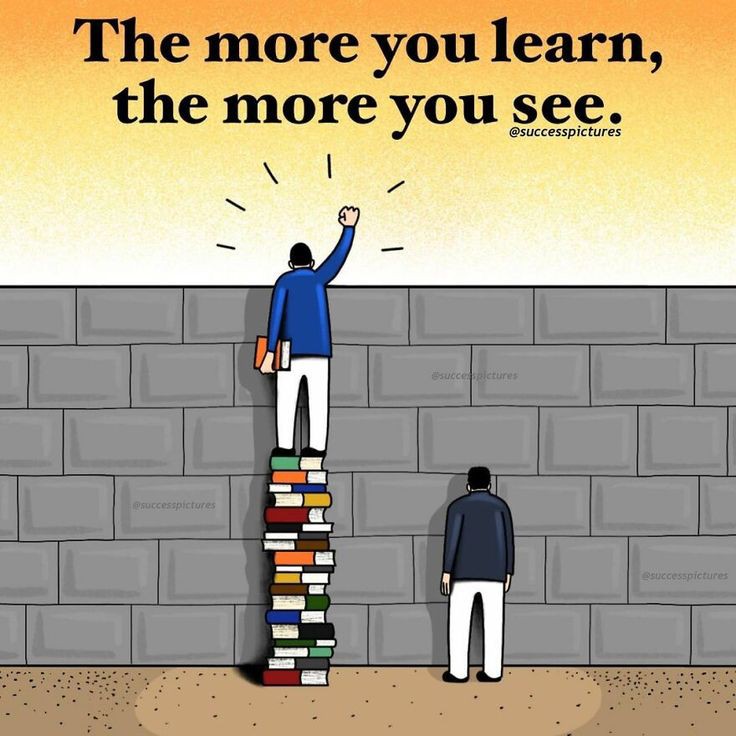
” THE KEY TO LEARN SOMETHING NEW IS TO OBSERVE THE THINGS AROUND YOU “

Randomised Controlled Trial

The 2019 Nobel Prize in Economic Sciences was awarded to Abhijit Banerjee and Esther Duflo, who currently work at the Massachusetts Institute of Technology, and Michael Kremer of Harvard University. The Prize committee noted that these economists “introduced a new approach to obtaining reliable answers about the best ways to fight global poverty.” The new Nobel laureates are considered to be instrumental in using randomised controlled trials to test the effectiveness of various policy interventions to alleviate poverty.

So what is randomised control trial?

A randomised controlled trial is an experiment that is designed to isolate the influence that a certain intervention or variable has on an outcome or event. A social science researcher who wants to find the effect that employing more teachers in schools has on children’s learning outcomes, for instance, can conduct a randomised controlled trial to find the answer. The use of randomised controlled trials as a research tool was largely limited to fields such as biomedical sciences where the effectiveness of various drugs was gauged using this technique. Mr. Banerjee, Ms. Duflo and Mr. Kremer, however, applied RCT to the field of economics beginning in the 1990s. Mr. Kremer first used the technique to study the impact that free meals and books had on learning in Kenyan schools. Mr. Banerjee and Ms. Duflo later conducted similar experiments in India.

Why is randomised controlled trial so popular?

At any point in time, there are multiple factors that work in tandem to influence various social events. RCTs allow economists and other social science researchers to isolate the individual impact that a certain factor alone has on the overall event. For instance, to measure the impact that hiring more teachers can have on children’s learning, researchers must control for the effect that other factors such as intelligence, nutrition, climate, economic and social status etc., which may also influence learning outcomes to various degrees, have on the final event.Randomised controlled trials promise to overcome this problem through the use of randomly picked samples. Using these random samples researchers can then conduct experiments by carefully varying appropriate variables to find out the impact of these individual variables on the final event.

What are some criticisms of randomised controlled trials?

A popular critic of randomised controlled trials is economist Angus Deaton, who won the economics Nobel Prize in 2015. Mr. Deaton has contended in his works, including a paper titled “Understanding and misunderstanding randomised control trials” that simply choosing samples for an RCT experiment in a random manner does not really make these samples identical in their many characteristics.

While two randomly chosen samples might turn out to be similar in some cases, he argued, there are greater chances that most samples are not really similar to each other. Other economists have also contended that randomised controlled trials are more suited for research in the physical sciences where it may be easier to carry out controlled experiments. They argue that social science research, including research in the field of development economics, may be inherently unsuited for such controlled research since it may be humanly impossible to control for multiple factors that may influence social events.

Prejudices and Stereotypes

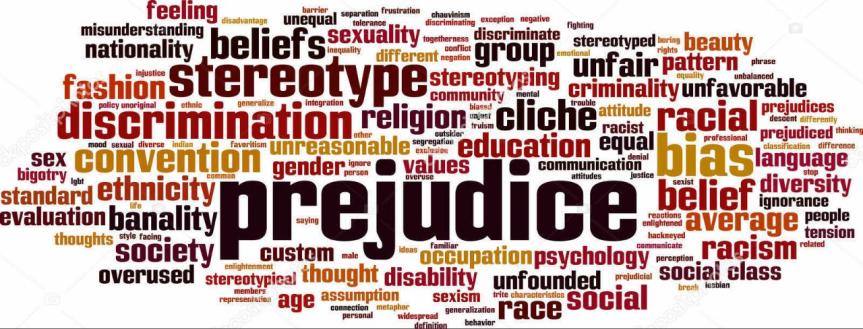
Prejudices refers to a set attitudes towards a particular group of people. They usually refer to negative attitudes. Attitude is a state of mind or set of views with an evaluative feature. Prejudices are often based on stereotypes about the specific group.
Stereotypes refers to fixed ideas regarding the characterstics of a specific group. Usually, stereotypes consist of undesirable characteristics about the target group. All members of the group are assumed to possess these characteristics which is often not true in reality.
Prejudice is often accompanied by dislike or hatred towards members of the group. Prejudice can be seen in behaviour through discrimination. Discrimination makes a distinction between the two groups by favouring one group over other. Sometimes prejudice can lead to excessive hatred and discrimination which may even lead to mass killing of innocent people. An example of this is the holocaust of Jews by Nazi Germany. Discrimination can controlled by law but attitudes and minds sets of people cannot.
Just like any other attitude, prejudices are also learned through observation, association, exposure to information or through culture. The family, groups, personal experiences, media also play a role in learning of prejudices. In some cases it has been observed that a strong social identity towards one’s own group may cause group bias and lead to negative attitudes towards other groups and lead to prejudice.
Another reason for prejudice is scapegoating. It is a group based way of expressing frustration towards the weaker group and it leads to negative attitudes. Here the stronger group places the blame for its problems on the weaker group. The weaker group is too weak to defend itself.
https://www.bbc.co.uk/bitesize/guides/zcb42hv/revision/3#:~:text=One%20bad%20experience%20with%20a,and%20can%20lead%20to%20prejudice
Sometimes people continue to hold stereotypes because they believe that after all, there may be some truth in what people say. These sorts of beliefs are rather difficult to change as they originate in response to other stronger beliefs.
Stereotypes are also learned in the similar manner as attitudes. Stereotypes are usually formed by hearing different things about the particular group. A single bad experience with the member of a group may lead to the assumption that all members of that group behave that way.
https://blogs.hope.edu/getting-race-right/our-context-where-we-are/the-history-we-inhaled/what-are-the-causes-of-stereotypes/
Stereotypes provide grounds for prejudices which lead to discrimination. This however, is not always true. Sometimes prejudices may develop without stereotypes or may not lead to discrimination. Similarly, discrimination may be seen without prejudice. But even so, these three are often considered to be connected.
Prejudices are attitudes and are not very easy to change if once formed. In order to control it, strategies should focus on minimising the opportunities for learning prejudices or changing such attitudes at an earlier stage. Narrow social identity based on the in-group should not be emphasised and people should be encouraged to seek out truth rather than blindly believing in what they hear.
These goals can be achieved through education and information. By correcting the stereotypes that are formed on false grounds. Emphasis should be given to individual identities rather than group identities. This can weaken strong in-group bias. Increasing the contact between the two groups can remove misunderstandings, mistrust and can lead to communication which may lead to discovery of positive characteristics.

AGNI:THE FAMILY OF BALLISTIC MISSILES

The name Agni(meaning fire) was given after one of the 5 elements in nature(Agni, Vayu, Prithvi, Akash, Jala). Agni missiles are medium to intercontinental-range ballistic missiles, developed under the Integrated Guided Missile Development Programme, INDIA. The family of missiles consists of AGNI I, AGNI II, AGNI III, AGNI IV, AGNI V, AGNI P, AGNI VI. And here is a brief description of each one of them.

India night-tests Agni-I missile

Agni I:

Agni I is an intermediate-range ballistic missile, it is 14.8 m long, with a diameter of 1.3 meters, and weighs 22,000 kgs. With a maximum payload of 1,000 kgs, the missile could extend its range up to 1,200 km of distance. Agni I is used by the SCF of the Indian Army. It is made of all-carbon composite materials to protect the payload during its re-entry stage. It is designed to be launched from Transporter-Erector-Launcher (TEL) vehicles, either by road or rail-mobile through transportation. The development of this missile began in 1999, and was first tested in January 2002 from a TEL vehicle at the Interim Test Range on Wheelers’ Island of India’s eastern coast. This missile has relatively high accuracy, simplicity, and due to its combination of an inertial guidance system with a terminal phase radar correlation targeting system on its warhead. 

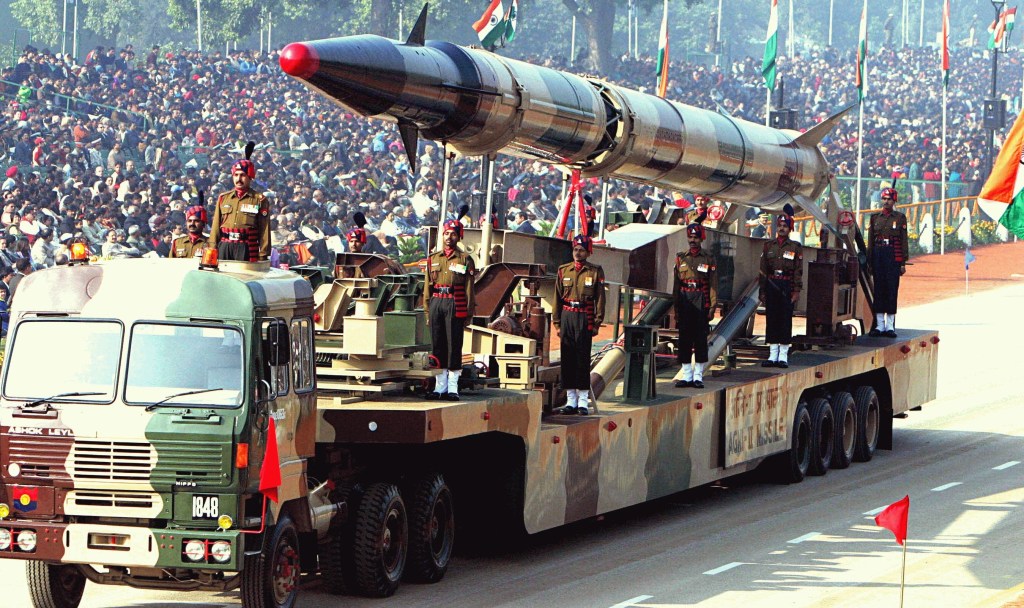
Agni II missile

Agni II:

Agni II is a medium-range, two-and-half-stage solid propellent ballistic missile, and is 20 m long, with a diameter of 1 m, and weighs around 26,000 kg. With a payload of 820-2,000 kgs, the missile could extend its range from 2,000 to 3,500 km. Agni II was first tested on 11th April 1999 at the Wheelers’ Island of the Odisha coast using IC-4 launch pad, over the range 2,000 to 2,200 km. The Agni II uses a combination of inertial navigation and GPS in its guidance module as well as dual-frequency radar correlation for terminal guidance. The 20-meter-long, two-stage ballistic missile has a strike range of 2,000 km to 3,000 km during the night trail of a nuclear-capable intermediate-range ballistic missile on 16th Nov 2019.

Agni-3 ballistic missile successfully launched by India’s Strategic Forces Command (SFC) from Wheeler Island, off the coast of Odisha on September 21, 2012.

Agni III:

Agni III is an intermediate-range, two-stage solid propellent ballistic missile, it is shorter (17 m and wider and 2 m in diameter) compared to other missiles (Agni I and Agni II), and weighs up to 44,000 kg. With a payload of 2,500 kg, Agni III could extend its range from 2,000 to 3,000 km. It is made using advanced carbon composite materials, while the second-stage booster is made of iron-based steel alloy. Agni-III was first tested on 9th July 2006 from Wheeler Island on the coast of the eastern state of Odisha, by Rail-mobile, possible road-based TEL( Transporter-Erector-Launcher). It was again tested on 12th April 2007 successfully, again from Wheeler Island. The third successive trail-test was fired on 7th May 2008 from Wheelers island, which had a range of 3,500 km, taking a warhead of 1.5 tonnes. It is the most accurate strategic ballistic missile which increases the “kill efficiency” of the weapon. It was reported that with a low payload Agni III and hit a target of over 3,500 km.

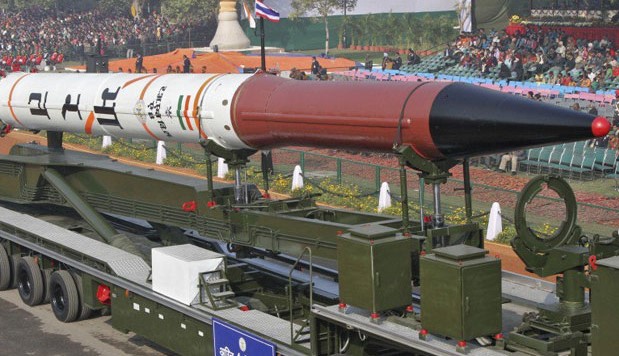
Agni IV missile

Agni IV:

Agni IV is an intermediate-range, two-stage nuclear-capable ballistic missile, it is 20 m long, with a diameter of 1 m, and weighs up to 17,000 kg. It was previously called as Agni II prime. Agni IV was first tested on 15th November 2011 and on 19 September 2012 from Wheeler Island(Abdul Kalam Island) off the coast of the eastern state of Orissa. It could reach the target up to the range of 3,500–4,000 km with a payload of 800–1,000 kg. On 20th January 2014, that is during its third test, the missile was lifted off from the launcher and after reaching an altitude of over 800 km, and impacted near the target in the Indian ocean with a remarkable accuracy carrying a payload of 900 kg. Agni IV is equipped with state-of-the-art technologies, that include indigenously developed ring laser gyro and composite rocket motor.

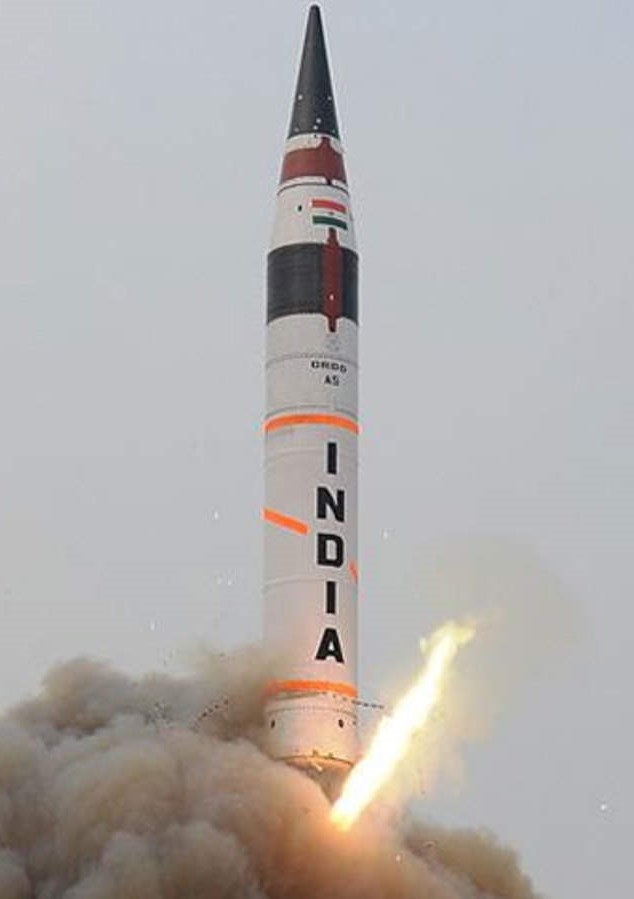
Agni V missile

Agni V:

Agni V is an intercontinental-range, three-stage solid-fuel ballistic missile, it is 17 m long, with a diameter of 2 m, and weighs up to 50,000 kg, developed by the Defense Research and Development Organisation of India. It could reach a target of more than 5,500 km. It was first test-fired on 19th April 2012, from Abdul Kalam Island formerly known as Wheelers Island off the coast of Odisha. It is a canister launch missile system and ensures that it has the requisite operational flexibility and can be swiftly transported and fired from anywhere. The second test launch of Agni-V was completed on 15th September 2013 and the canisterized version was launched in January 2015.

Agni P missile

Agni P:

Agni prime is a medium-range, two-stage solid-fueled ballistic missile, it is half of the weight of Agni III, developed by the Defense Research and Development Organisation, India. Both the first and second stage of the missile was made of composite materials. It could extend its range up to 1,000-2,000 km. As per DRDO, Agni-Prime is a new generation advanced variant of the Agni family, launched on 28th June 2021. “Being a canister-launched missile, Agni-P will give the armed forces the requisite operational flexibility to swiftly transport and fire it from anywhere they want. The test at 10:55 met all mission objectives with a high level of accuracy,” says DRDO. This missile has followed the Textbook trajectory with a great level of accuracy.

Agni VI under development

Agni VI:

Agni VI will be a four-stage intercontinental ballistic missile, currently in the hardware development phase and expected to have a Multiple Independently targetable Reentry Vehicle(MIRV) as well as a Maneuverable Reentry Vehicle(MaRV). It is expected as the latest and most advanced version among the Agni Missiles.

References:

http://www.indianexpress.com/news/india-successfully-testfires-agni-i-ballist/715859/

https://timesofindia.indiatimes.com/india/india-successfully-test-fires-new-generation-agni-p-ballistic-missile/articleshow/83914848.cms

https://en.wikipedia.org/wiki/Agni_(missile)

https://frontline.thehindu.com/dispatches/india-successfully-test-fires-agni-prime-missile/article35022926.ece

credits to the right owner of the images used.

EVERYONE’S JOURNEY IS DIFFERENT

My mom told me a story about how everyone has their own story

A Young Man and his father were travelling by train and they seem to be very happy. A young man in his twenties was seeing out from the train’s window and suddenly he is shouted father, see the sun it looks like a circle Then his father smiled at him.

young men again shouted – father, look at the trees as they are going behind. father again smiled at the young man. A couple sitting nearby looked at the young man’s childish comment with pity.

Suddenly the young men exclaimed again.. father, look at the clouds and sun! they are all running with us. The couple observed the young man’s behaviour for a long time they couldn’t resist and said to the old man “why don’t you take your son to a good doctor?” The old man smiled at his son and said “we did and we are just coming from the hospital”

The couple saw them with strange expression. The Old man said again “My son was blind from birth and he just got his vision today”

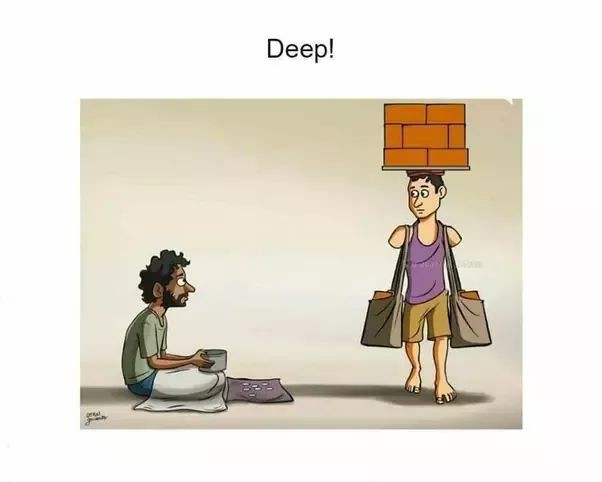
Every person in the world has a story. Don’t judge people before you truly know them. The Truth might surprise you.

Everyone’s journey is different

SOCIAL MEDIA

Needs and merits

The ability to build real relationships is one of the most important aspects of social media and a key factor in attracting people of all ages, genders and nationalities. It is an important part of developing healthy social networks and powerful social network tools. People can share their business, products and services with the world as long as they stay connected and use social media. Social networks allow people to communicate, and everyone can update and report at any time. Companies make full use of social media to improve your online reputation and greatly help increase sales and personal income.

  • You need to make sure to use all social media platforms to gain insight into the needs of your customers. To make the most of social media for your business, make sure you have a content marketing plan. If you need content on any social media platform, you can use social media asset management tools to create high-quality content.
  • You can also use social media to track what people say on social media. Although social media is mainly used by the public, the government also uses it to raise public awareness.
  • Although the use of social media for teaching can be distracting, educators can do everything they can to guide students to develop good habits and practices, Benefit. Regarding the advantages provided by social networks.
  • If you consistently and continuously invest time and effort, you will see the real benefits of social media marketing. Social media can give your business a huge advantage by helping you connect with your target audience. It can cover a large number of people, but for social media, it is also a media sharing network.
  • Social media advertising is one of the two components used together to attract potential customers and spread information and brand awareness. Different from classic ads. When you actively post on social media pages, social media marketing is easy.

SOCIAL MEDIA AS A BLESSING

There are some people who actually make a good or can say the best use of the social media. Like if we talk about the young entrepreneurs who have just begun with a start up but is lacking in public attraction and funding so they create a short 30seconds advertisement and attach it with the trending apps which work through network connection . Talking about the awareness ;both the social media and mass media have been playing their roles very well by keeping their viewers updated with the latest screamers , exposing the Scams ,scandals , and even the worse parts of humanity .

Scope of SEO in india

The developing utilization of online applications has opened diverse vocation roads for youth across the globe. Regardless of an applicant is a fresher or an accomplished one, these new position profiles help one in better proficient future and furthermore great motivations.

One of such occupation profile is of Search Engine Optimization (SEO) proficient. As a large portion of individuals across the world use web crawlers like Google to determine their questions. Website design enhancement is one of the advanced showcasing methods that assistance in better streamlining of a site and rank it top in web search tools for applicable questions.

There are many type of improvement, for example, on location content and site page enhancement or site backlink streamlining. Web optimization not just plans to rank better sites or drive quality traffic yet in addition assist with building brand perceivability in the online world.

Different ongoing investigations recommend that SEO will be a significant showcasing device for creating leads and procuring new clients. It has constrained pretty much every organization to put more in SEO prompting expanded interest of SEO experts in India. The developing interest of SEO experts has constrained alumni and website specialists to learn SEO for a superior profession ahead.

What is Catcalling?

Catcalling is a form of harassment primarily consisting of unwanted sexual comments. This may include honking, wolf-whistling and indecent exposures. Most of the time, it is a man who catcalls and a woman who is catcalled.

According to surveys by Stop Street Harassment (a non-profit organization):

  • Nearly 95% of female respondents were honked at one or more times
  • Nearly 82% of female respondents were the target of a vulgar gesture at least once
  • Nearly 81% of female respondents were the target of sexually explicit comments from an unknown man at least once
  • Just over 77% of women said they were the target of kissing noises from men.

Where catcalling takes place?

Catcalling doesn’t only happen on the streets. Sexual harassers find targets on campus sidewalks, in restaurants and movie theaters, at work, inside homes – literally anywhere. Similarly, anyone can be a catcaller – including a person’s acquaintances. Online catcalling is also an issue just as severe as in-person catcalling. What’s worse, people on social media are able to say more because they are protected by a screen.

The Problems with Catcalling

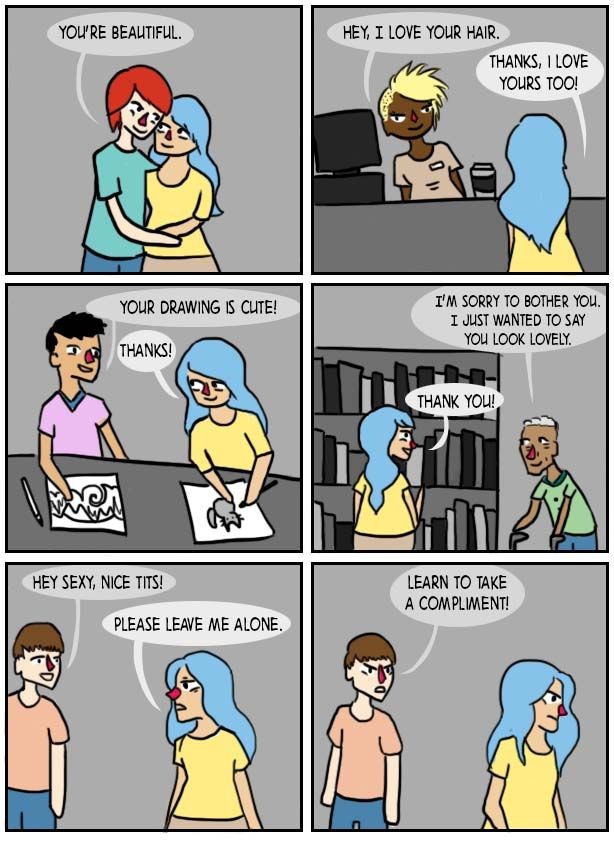
  • It’s disrespectful: Catcalling is uncalled-for and usually makes the victim feel exposed and uncomfortable. In some cases, catcalling is used as a method of expressing power over someone, rather than the misperception of it being a “compliment”.
  • It’s not impressive: Someone may catcall in order to impress their friends, or the person they are catcalling at, but it’s actually unimpressive and immature.

Catcalling is not a compliment, it’s a harassment!!

Whilst compliments and flirting can be harmless and fun, shouting at strangers is not flattering, it leaves “targets” feeling exposed.

Catcalling is degrading, demeaning, and disgusting.

Women have the right to be treated with as much respect and dignity when walking down the street as any man. Women deserve to feel safe.

How to react if you are being catcalled?

  • Catcallers usually look for a reaction. Don’t give them one, especially fear.
  • Get to a safe or crowded place as soon as you can. Seek help if needed.
  • If you are around other people and it’s safe, you can use a simple comeback like “that’s harassment” or “don’t do that”.
  • While snapping back (if you choose to do so), make sure to keep walking and don’t stop.
  • Avoid the use of swear words or eye contact.
  • If it’s online, you can block and report them. Choosing to reply is also an option (e.g., asking “would you find it okay if someone spoke to your mother or sister in that way?”).
  • Document it: write it down or take a picture/screenshot. By doing this you can call them out later.
  • Share your story if you feel comfortable.

How to intervene if someone is being catcalled?

  • Call out the harasser if it is safe to do so.
  • Create a distraction or start chatting with the target (e.g., drop your keys and ask “are these yours?”).
  • Approach the target afterwards to see if they need company or if there is anything else you can do to help.
  • Whatever you do, don’t put the person who is catcalled at greater risk (e.g., becoming aggressive).

Catcalling has become normalized, as it is often disregarded as a “joke”, or even a compliment. These are some tips to learn why this is absolutely not the case.