Father Stan Swamy Passes Away at 84

Introduction

Father Stan Swamy, a tribal rights activist and a political prisoner, an accused in the Bhima Koregaon caste violence case, passed away on 5th July 2021 at 1:24 pm. The medical director of the Holy Family Hospital, where Fr. Swamy was admitted said that Fr. Stan had a pulmonary infection after his COVID-19 complications in the lungs and pneumonia. He suffered from a cardiac arrest on July 4, 2021, at 4:30 am, he was put on a ventilator at that time but did not regain consciousness after. He also had Parkinson’s disease. He had told the court on May 21, 2021, that he was eating less and less, and his co-accused were worried about him, and that he would prefer to suffer and die like that in jail than being admitted to the hospital. And he requested for the judiciary to consider an interim bail. He passed away when the Bombay High court was hearing his interim bail plea.

About him
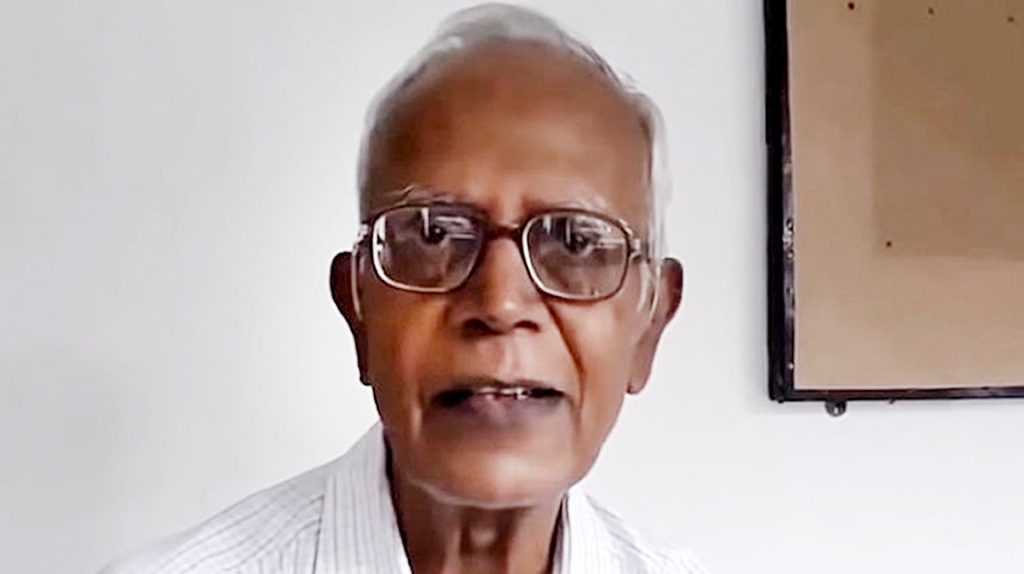
He was a native of Tiruchirapalli in Tamil Nadu. He was born on 26 April 1937 and was an Indian Roman Catholic priest, member of the Jesuit order. He was known for his work with tribal people and for fighting for their rights, especially in Jharkhand. He studied theology and Masters in Sociology in the Philippines in the 1970s. He was influenced by the work of the Brazilian Catholic Archbishop Helder Camara with poor people. He was also the former Director of the Jesuit-run Indian Social Institute in Bangalore.

His work

He was a tribal rights activist in Jharkhand. He had worked in the state for almost three decades for the Adivasi communities on issues of land, forest, and labour rights. He is well known for questioning the non-implementation of the Fifth Schedule of the Constitution about “Provisions as to the Administration and Control of Scheduled Areas and Scheduled Tribes”. This schedule had the provision of setting up a Tribes Advisory Council with members only of the Adivasi community for their protection, well-being, and their development in the state. He also filed a Public Interest Petition against the state in the High Court asking for all young adivasis who had been labelled as “Naxals” indiscriminately to be released on a personal bond and to conduct a speedy trial. He said that his expressing dissent against the government’s policies must be why they are eager to put him out of the way.

Allegations against him

The National Investigation Agency arrested Fr. Swamy on October 7, 2020; he was sent to judicial custody till October 23. His residence was searched by the NIA, claiming that he had links to the Maoist forces. In his chargesheet, it was claimed that he was a CPI (Maoist) and was active in their activities It also claimed that he received funds from other cadres. The NIA claimed that he was a convener of Persecuted Prisoners Solidarity Committee (PPSC) which is assumed to be the frontal organisation of CPI (Maoists). The NIA said that it recovered incriminating documents, propaganda, and literature from him but Fr. Swamy said that these extracts were fabricated and he did not own any of them. He also said that what was happening to him is not unique as many other activists and journalists end up being the target of the country because of expressing their dissent.

The case he was charged under

The accused of the case named Elgar Parishad/ Bhima Koregaon are alleged to have links with the banned CPI (Maoists). The arrests for this case were made in 2018. On January 1, 2018, a huge number of Dalits gathered near Pune to celebrate the 200th anniversary of the Battle of Bhima Koregaon which was fought by a huge number of Dalit soldiers against the Peshwas in 1818 but was won by the British army. During this gathering, there was violence where the people who were assembled were assaulted and their vehicles were burnt. But on January 8, another FIR was filed which claimed that this violence was a result of another gathering which was held on December 31, 2017, called Elgar Parishad. The Pune police then arrested activists claiming that this gathering was a part of the Maoist activity.

Conclusion

Fr. Stan Swamy had written a letter from inside the prison where he said that many of the people in there don’t even know what they are charged for and that they are just sitting stuck in there with no legal help at all and that he would help them as well. The least that is expected is for the prisoners to know what they are charged for and it is their fundamental right to be able to defend their charges. Fr. Swamy was a tribal activist worth remembering for all his hard and dedicated work.

References

Kaleshwaram project

Hello guys!!

Today I am going to give you guys an insight about a very hot and trending topic “The kaleshwaram project”.

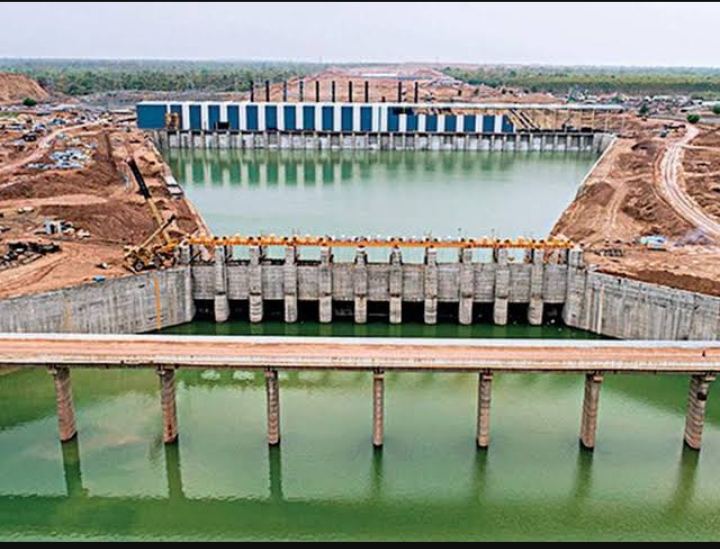
This project is a multi purpose irrigation project on the Godavari river in kaleshwaram in Telangana state.

It’s main purpose is irrigation to crops,supplying power and water. It is constructed to overcome the famine conditions.

From Times of India

In The Kaleshwaram Lift Irrigation System is considered to be one of the world’s largest multi-purpose projects. It is designed to provide water for irrigation and drinking purposes to about 45 lakh acres in 20 of the 31 districts in Telangana, apart from Hyderabad and Secunderabad.

Indian express.com

It’s construction began in 2016 and approximately 1.2 lakh crores were spend in the construction of this Although inaugurated the project is no where near completion.

From The Hans India

This project has at is own fair share of disadvantages too.

This project will displace at least 30,000 people in 19 villages.

It will affect land of about 1 lakh acres (40,015 hectares).

Considering all other costs, this project will be a major burden on the people of the state and farmers for generations to come

From Deccan Chronicle

The result is yet to be known whether the project is a success or not ,but if the result is good then the sacrifices that were done to built the project will not go to waste.

The amount of time, money, and labour spending on this project will never comeback so whether it will live up to the expectation of people or not is the question that is yet to be answered.

Thankyou^^.

5-month-old baby girl in UK ‘turning to stone’

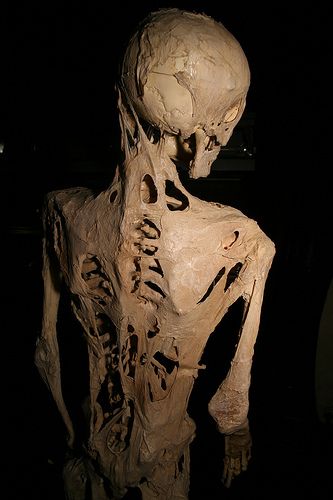
The effects of fibrodysplasia ossificans progressiva, a disease which causes damaged soft tissue to regrow as bone.

Lexi Robins, 5 month old from the UK is “turning to a stone”due to an extremely rare genetic condition Fibrodysplasia Ossificans Progressiva (FOP) that turns muscles into bones.

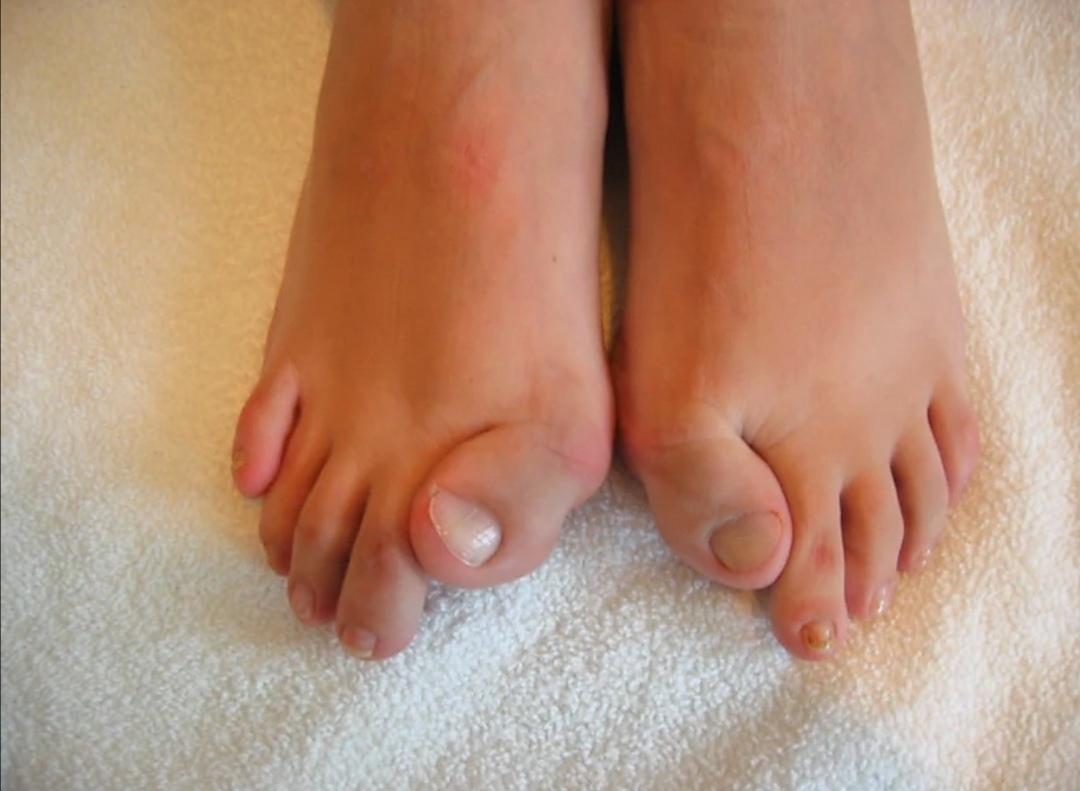
Lexi Robins was born on January 31 and seemed like any other normal baby, except she didn’t move her thumb and had bigger toes.

Lexi was diagnosed with a life-limiting disease called Fibrodysplasia Ossificans Progressiva (FOP), which affects just one in two million.

Due to the disorder, Lexi’s condition may worsen rapidly if she suffers any minor trauma, as simple as falling over. She cannot receive injections, vaccinations and dental care and cannot give birth.

Post by Alexandera robins https://www.instagram.com/tv/CQnwqnTIUlV/?utm_source=ig_embed&utm_campaign=loading.

FOP is a severe, disabling disorder with no current cure or treatment. It is the only known medical condition where one organ system changes into another. Fibrodysplasia ossificans progressiva is caused by a mutation of the gene ACVR1.

The FOP can lead to bone formation outside skeleton and restrict movement. It is believed to replace muscles and connective tissues, such as tendons and ligaments, with bone. Thus, it is generally perceived that the condition turns a body into stone.

People with this disease, which has no proven treatment, can be bedridden by the age of 20 and their life expectancy is around 40 years.

It has no current cure.

Bose-EinsteinCondensate The 5th Matter

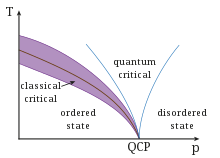
QuantumPhaseTransition.svg

In condensed matter physics, a Bose–Einstein condensate (BEC) is a state of matter (also called the fifth state of matter) which is typically formed when a gas of bosons at low densities is cooled to temperatures very close to absolute zero (−273.15 °C or −459.67 °F). Under such conditions, a large fraction of bosons occupy the lowest quantum state, at which point microscopic quantum mechanical phenomena, particularly wavefunction interference, become apparent macroscopically. A BEC is formed by cooling a gas of extremely low density (about one-hundred-thousandth (1/100,000) the density of normal air) to ultra-low temperatures.

This state was first predicted, generally, in 1924–1925 by Albert Einstein following and crediting a pioneering paper by Satyendra Nath Bose on the new field now known as quantum statistics.

This transition to BEC occurs below a critical temperature, which for a uniform three-dimensional gas consisting of non-interacting particles with no apparent internal degrees of freedom is given by:{\displaystyle T_{\rm {c}}=\left({\frac {n}{\zeta (3/2)}}\right)^{2/3}{\frac {2\pi \hbar ^{2}}{mk_{\rm {B}}}}\approx 3.3125\ {\frac {\hbar ^{2}n^{2/3}}{mk_{\rm {B}}}}}{\displaystyle T_{\rm {c}}=\left({\frac {n}{\zeta (3/2)}}\right)^{2/3}{\frac {2\pi \hbar ^{2}}{mk_{\rm {B}}}}\approx 3.3125\ {\frac {\hbar ^{2}n^{2/3}}{mk_{\rm {B}}}}}

where:

{\displaystyle \,T_{\rm {c}}}is the critical temperature,
\,nthe particle density,
\,mthe mass per boson,
\hbar the reduced Planck constant,
{\displaystyle \,k_{\rm {B}}}the Boltzmann constant and
\,\zeta the Riemann zeta function; {\displaystyle \,\zeta (3/2)\approx 2.6124.}\,\zeta(3/2)\approx 2.6124. 

Interactions shift the value and the corrections can be calculated by mean-field theory. This formula is derived from finding the gas degeneracy in the Bose gas using Bose–Einstein statistics.

Superfluidity of BEC and Landau criterion

The phenomena of superfluidity of a Bose gas and superconductivity of a strongly-correlated Fermi gas (a gas of Cooper pairs) are tightly connected to Bose–Einstein condensation. Under corresponding conditions, below the temperature of phase transition, these phenomena were observed in helium-4 and different classes of superconductors. In this sense, the superconductivity is often called the superfluidity of Fermi gas. In the simplest form, the origin of superfluidity can be seen from the weakly interacting bosons model.

2300 year old step well found near Erode

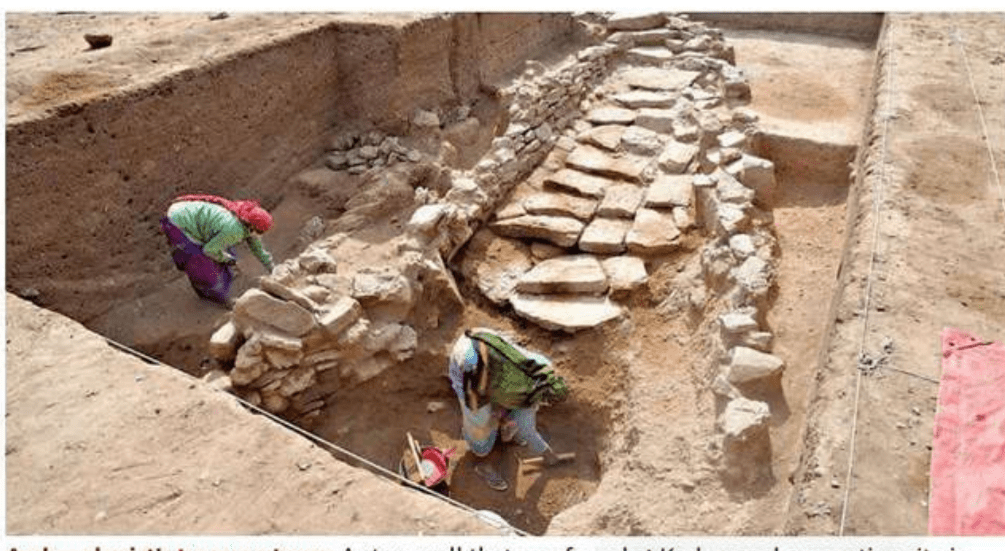
Kodumanal Excavation site

• Located – Erode, a district in Tamil Nadu.

• Northern bank of the Noyyal river – Tributary of River Cauvery.

• Excavation – Megalithic period; Early historic period. • Habitation-cum-industrial site.

• Excavations since 1981.

• Industrial complex – beads and semi- precious stones were manufactured.

• Iron smelting units – forged steel at the site.
• Trade centre – 5th – 1st BCE. • Village – Chera capital of Karur with the Chera port of Muciri in Pattnam in Kerala.

Excavations

• Circle-shaped step-well – found for the first time. • Scientific dating – 2,300 years old.

• 2020 – Rubble masonry wall of 3.5 metres – waterway.

• Current excavation – trench was dug near the
last year’s trench • Result – Discovery of the well.
• Well – 2.65 metres wide; Depth – deposits were
removed.

• Steps – weathered rocks, slopes down from the
ground to the well that served the habitation.

• Two rubble masonry walls existed on either
side of the steps.

• Site – habitation come industrial site
 Water – Used both for household needs as
well as for polishing beads and other industrial activities.
Other Findings:
 Pottery – Black and red ware, black slipped
ware, russet coated ware and red slipped ware.
 Beads – Quartz and clay.
 Potsherds
 Megalithic cairn circle
 Iron sword
 Double edged axe
 Small daggers

Huge spike in fuels prices

Huge spike in fuels prices

• Four factors influencing rise in prices:
 Crude oil, freight and processing charges to the dealer.
 Excise duty charged by the
government.
 Dealer commission to the gas station.
 Value Added Tax levied by the state government.

Impacts of taxes on fuel price hike

• Increasing central and state taxes on fuel – key
reason for high fuel prices.

• 2020: Centre hiked the excise duty on petrol and
diesel by Rs. 13 and 16 per litre.
 To shore up revenues.

• Example: In Delhi, central and state taxes – 57 % of
pump prices of petrol and is about 51.4 % for diesel.

• Central government has not cut central taxes – taxes
on auto fuels should be cut to curb inflation.

Fuel price hike and inflation

• When fuel prices rise, so does inflation.

• Higher the inflation – lower will be the inflation-adjusted returns.

• India’s retail inflation became 6.3% in May 2021- breached the upper
limit of RBI (6%).

Way forward

• ICRA: government may cut cess levies on retail prices
of petrol and diesel to ease prices.

• Petrol consumption is estimated to grow 14% and diesel 10% year-on-year in FY22.
 Reason: Recovering economic activities and mobility – easing of curbs and accelerating Covid19 vaccinations.

• Higher consumption of fuels – support a rise in the
indirect taxes levied on them. • Growth in consumption would result in Rs. 40,000 crore of extra cess collections.

• Existing fuel price can be cut by ₹4.50 per litre for
petrol and diesel.

Vaccine passport system introduce by European union.

News

• New Vaccine passport system has come into effect across the European Union from July 1st

Green Passport

• European Union – EU Digital COVID Certificate.
 Ease travel restrictions for people travelling to
EU countries.

• Digital proof – Attests informations of the person.
 Vaccinated by any one of the four European Medicines Agency approved vaccines.
 Received a negative test result.
 Recovered from the viral infection.

• Certificate – digital signature which is verified
when the QR code is scanned. • Issuing body – own digital signature key, all of which
are stored in a secure database in each country.

• Certificate – recognized by all 27 EU countries,
Switzerland, Liechtenstein, Iceland and Norway.

• Possession of the certificate – exempted from free
movement restrictions.

• Member States – refrain from imposing additional
travel restrictions unless necessary.

• Lack of certificate – subjected to the usual travel
restrictions and quarantine rules which are in effect
in every country.

Issue

• EMA – listed only four vaccines.
 Vaxzevria (Oxford-AstraZeneca)
 Comirnaty (Pfizer-BioNTech)
 Spikevax (Moderna)
 Janssen (Johnson & Johnson).

• None of the three vaccines – approved for use in India till date is featured on the list.
 Covishield, Covaxin and Sputnik V.

• Only essential travel is allowed into EU
countries and that too special permission has
to be taken.

• Global concerns – Delta variant (first detected
in India), more restrictions are put in place.

Stand of the European Union

• Reason behind excluding – Serum Institute of India’s Covishield is a biologically different product.
 Needs to apply separately for EMA clearance.

• Serum Institute of India and AstraZeneca – Process of seeking clearances.

• Covaxin – yet to gain recognition from the
World Health Organization.

• Claim – Hint of racism.
 Vaccines cleared by the EMA are those taken
by residents in Europe and North America.

World Health Organisation

• Stand of the WHO
 Vaccine passports should not be made mandatory for travel and should be optional.
 The proof of COVID-19 vaccination should not
be required as a condition of entry and exit from a country.

India’s stand on the Issue

• Recent G20 ministerial conference – External Affairs
Minister registered a strong protest over the issue.

• Sources – India was prepared to initiate reciprocal harsh quarantine measures against countries that discriminate against Indians.

India’s concerns – three-fold

• Vaccine inequality – vaccine passports being restricted to passengers from countries that don’t have the same access to vaccines

• Gain recognition to Covishield

• Indian-approved vaccines – Worldwide recognition.
Stance of Africa .

• African Union and Africa Centres for Disease Control and Prevention – statement raising concerns
 Covishield vaccine was the “backbone” of the EU-supported international
COVAX alliance’s programme in Africa.

Current Status

• Nine countries – agreed to independently make
exemptions for Covishield
 Austria, Germany, Greece, Iceland, Ireland,
the Netherlands, Slovenia, Spain and Switzerland have.

• Estonia – accepted both Covishield and
Covaxin.

• Hope – enough pressure will be built on the EMA to include exemptions for Indian vaccines
as well.

CHINA AWARDED A MALARIA FREE CERTIFICATION FROM WHO

News

• After a 70-year effort, China has been awarded a malaria-free certification from WHO.

Malaria

• A life-threatening disease caused by Plasmodium
parasites.

• Vector – Mosquito.

• P. falciparum and P. vivax pose the greatest threat.

• 2019: 229 million cases of malaria worldwide.

• Most malaria cases and deaths occur in sub-Saharan Africa.
• Also prevalent in South-East Asia, Eastern Mediterranean, Western Pacific, and the
Americas.

• 40 countries/ territories are malaria-free -WHO.

• China – first country in WHO Western Pacific
Region to be awarded a malaria-free certification in more than 3 decades.
 Other countries in the region – Australia (1981), Singapore (1982) and Brunei
Darussalam (1987).

• India is not yet a malaria free country.

China’s Malaria elimination journey

• 1950s: Chinese health authorities worked to locate
and stop the spread of malaria.
 Provided preventive antimalarial medicines.

• A major effort to reduce mosquito breeding grounds

  • use of insecticide spraying. • 1967: Chinese Government launched the “523 Project”.
  •  Nation-wide research programme aimed at finding new treatments for malaria.
     Led to the discovery in the 1970s of artemisinin.
     Core compound of artemisinin-based combination therapies (ACTs) – most effective antimalarial drugs available today.
    • 1980s: China – one of the first countries in the world to extensively test the use
    of insecticide-treated nets (ITNs).
  • • 1988: more than 2.4 million nets had been
    distributed in China.
  • • 1990: number of malaria cases in China fell to 1,17,000; deaths were reduced by 95%
  • • Funding by the Global Fund to Fight AIDS, Tuberculosis and Malaria, launched in 2002.
  • • 2021: China was declared as a Malaria free country.

Chennai’s water crisis- Natural or man made?

Chennai, the capital city and heartthrob of Tamil Nadu observed ZERO DAY on 19th June, 2019 when there was no water left in all the four reservoir tanks built in the city. Chennai is a city located on southeast coast of India serving as a gateway to the magnificent South India with the Bay of Bengal surrounding it on one side, the city is intersected by three rivers. How come that the city which has “abundant of water bodies” becomes dry. Read this blog to know how the water crisis in Chennai is a result of man’s selfish actions and is a warning giving a hint of what the nature holds for us in future if we degrade it.

Causes of water scarcity in Chennai

Chennai is situated on the south east coast of India and receives majority of its rain during winters because being situated on the south east coast, it lies on the leeward side of the Western Ghats preventing the south west monsoon winds which originates in the Arabian sea on the west coast of India to shed its rain there during summers when generally rest of the country experiences monsoon. Thus it gets majority of its rain from retreating southwest monsoon winds and northeast winds during the months of December and January. The rest of the months the city has to rely on occasional rains and mainly on the reserved water which is scarce in Chennai.

Owing to Urbanisation and construction on the bodies which once were the catchment and flood relief basins, the space required to hold the rains is now blocked. The very suitable example being the very famous IT corridor of Chennai which is built on 230 square kilometers of marshland , has reduced the area of the places to hold the precipitation which occurs during its monsoon. Moreover with the rise in the number of Industries , the water bodies in Chennai are highly polluted. Though the industrialization resulted in Chennai being called “The Deteroit of India” due to the vast automobile sector established there housing the scions such as the Tata motors, the neglection of the authorities in maintaining the precious water bodies resulted to Chennai experiencing the ZERO DAY.

Chennai receives rain on an average of 54 days per year with a minimum average of 140 centimeters of rainfall which is enough for the survival if the water is properly harvested but it is the inability to collect and reserve the rain water which led to the MAN MADE water crisis. Between 1893 and 2017 the area covered by the water bodies is reduced from 12.6 square kilometers to 3.2 square kilometers. As reported by The Diplomat, NITI Aayog  predicted in June that 21 Indian cities would run out of groundwater in 2020. A report by the London-based risk analytics firm Verisk Maplecroft named Chennai as facing an “extreme risk” of water stress, saying its present crisis “could be the new normal for tens of millions of people” in India’s urban centers.

Since there is no enough reserved water for the heat days which comes in June and the water remaining in the water bodies is either too saline or too polluted to be fit for use, Chennai has to rely on the tanks which carry water from hundreds of kilometers far away to satisfy its water needs. As suggested by the various reports , there is 85 percent decline in Chennai’s groundwater levels.

Actions taken by the Government to prevent

  • Chief Minister of Tamil Nadu Edappadi Palaniswami , after that dreadful day in June 2019, announced a public program including maximum participation of women covering everything from rainwater harvesting to water saving and recycling to the protection of water bodies and a massive study on how to clean the polluted rivers. Until the research and the plan is completed , the government decided the construction of desalination plants in the city which though costly will help in a great way to solve Chennai’s water problems until the natural water bodies are restored, by desalining the sea water making it fit for domestic and industrial use. The plan is however still in the initial process as there are many protests regarding how it will cause environmental damages and intense loss to the local fisheries.
  • The past always comes to the rescue. Supported by the Asian Infrastructure Investment Bank and the Dutch Government , the Greater Chennai Corporation has started an initiative called “the city of 1000 tanks” which aims at restoring the tanks near the temples and making it the reservoirs for storing the rain water just like in the past and building new tanks too surrounded by green slopes to help catch the rainwater and increase the groundwater level.

The state of Tamil Nadu of which Chennai is the capital has predicted in its climate action plan that the annual temperature of the city will raise by 3.1 degree celsius by 2100 from its original level of what it was in 1983 and 2000s with the annual rainfall falling by 9%.Further , the little rainfall which the city experience in June and September which was enough to refill the reservoirs and maintain the growth of crops will decrease while the winter rainfall will increase causing more floods and droughts.

The condition which Chennai is facing can be taken as a threat issued by nature to not degrade it else the consequences can be severe. The day is not too far when the rest of the world may also experience what Chennai is , if the present practice continues and that day will lead to our downfall.

India-Chinarelations

• Progressive talks – disengagement of troops
near Pangong Tso Lake and Kailash ranges.

• China – Tactical manoeuvres in border regions
across Ladakh.
 New militia units comprising local Tibetan
youth – deployed in Eastern Ladakh – high
altitude warfare and surveillance.

• Peaceful relationship – peaceful functioning of
the world.

• No proper answer – why China chose to attack
Indian positions in Ladakh.

Global Concerns .

• Nations expressing concern about threat posed
by China to the existing world order.

• G-7 and NATO – Criticized China for its
military ambitions.

• China – undeterred in its ambitions.
 Aggressive actions in the South and East
China Seas.
 Subjugating the Uighur Muslim minority.
 Risks – Democracy and laissez faire
economic system of Hong Kong.
 Continues – Tactical manoeuvring on Indian
borders.

• Reasons for China’s attack on India
 India’s prominent role – Quad grouping.
 India’s significant role in Indo-Pacific region.
 China’s internal turmoil.

Past Lessons from Mao Tse Tung/Mao Zedong .

• Ill-conceived policies and programmes – Huge issues.

• Worst famines – Great Leap Forward Movement.
 Chinese communists – Tried to organize vast
population into large-scale rural communes.
 Develop labor-intensive methods of industrialization

  • Emphasize manpower rather than machines and
    capital expenditure.
     Gradual accumulation of capital and
    purchase of heavy machinery.
  • • Internal problems in Communist party of
    China.
     Many members were critical of Mao’s autocratic attitude and ill-conceived
    policies.
  • • Attacked India as a diversion and to
    strengthen his position inside the party.

Xi Jinping – Mao clone

• Sheer dominance over the CPC.

• Trying to consolidate power and achieve pre-
eminence – enjoyed by Mao Zedong.

• Pushing China to become a super power by
overtaking the U.S.

• Chinese military – making it world’s most
powerful military.

• Issues:
 Aspirations of Xi Jinping are stalling and CPC
members questioning his policies and moves.
 Chinese economy showing signs of slow down.

 Other countries are tilting towards India –
diplomatic flexibility and ideological
sophistication.
 CPC – leaders and members wanted ‘peaceful coexistence’ with India.
 Finding it difficult to push through ‘new
socialist ideology with Chinese
characteristics’.

• Diversion tactic – attacked India and
escalated tensions last year.

Conclusion

• India should expect, and prepare for more
similar situations.

Eye of Fire – Marine disasters

Introduction

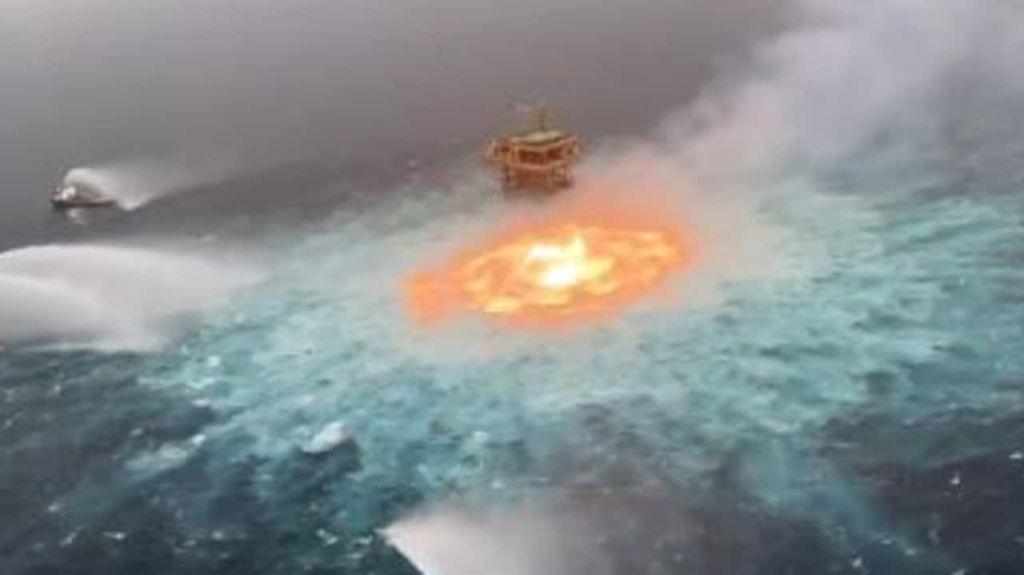
A recent picture of fire on the ocean, called ‘eye of fire’ has been going viral. This picture was captured in the west of Mexico’s Yucatan peninsula on 2nd July 2021. The reason for this fire was a gas leak of an underwater pipeline of the state oil company known as Pemex. The origin of the fire was an underwater pipeline that connects to a platform at the Ku Maloob Zaap oil development. The fire took more than five hours to put out. The company Pemex has a long history of major industrial accidents at their facilities. The fire was put out using Nitrogen by the company workers. Such incidents keep making us wonder about the marine ecosystem and how these activities keep endangering it. Although this was an accident of gas leak from inside, it reminds us of the many oil spills that keep occurring and the effect they have on the marine ecosystem.

Mauritius Oil Spill

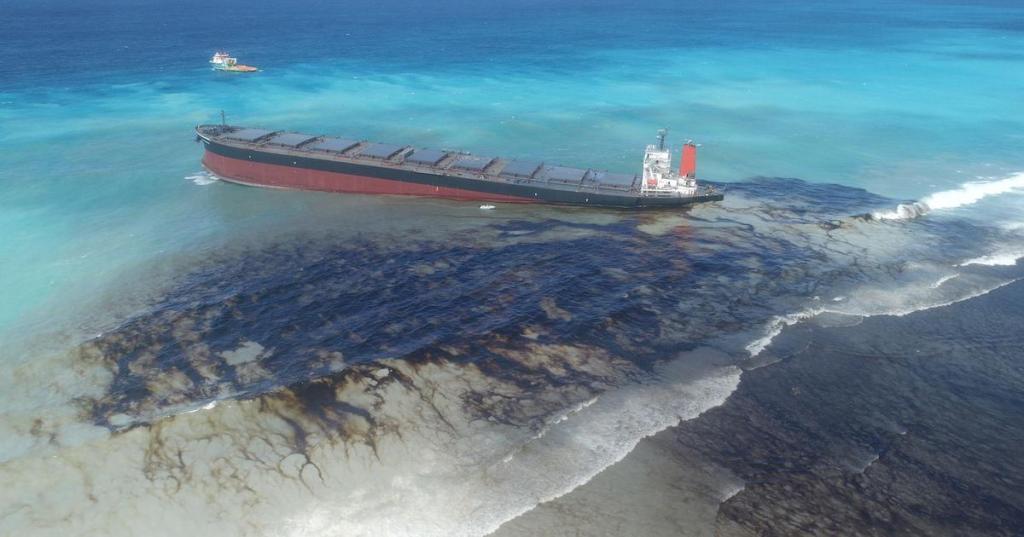
On July 25, 2020, a Japanese-operated ship named MV Wakshio hit a coral reef on the coast of Mauritius. The vessel carried 4000 tonnes of crude oil out of which more than 1000 tonnes of oil leaked from the crack in an environmentally sensitive region which polluted the coral reefs, beaches, and lagoons of the island, and an environmental emergency was declared by the Prime Minister of Mauritius. This leak has caused a lot of damage and will continue to for years because of its location being near two environmentally protected marine ecosystems and the Blue Bay Marine Park reserve. These oil spills don’t just affect for the time being till they are cleaned up, the soluble compounds of the oil dissolve in the water and form a layer on the surface of the water which affects the whole marine ecosystem. The toxic hydrocarbons released from the spill bleach the coral reefs which are a very important part of Mauritius, and because of this bleaching, they will eventually die. The oil is less dense than the saltwater so it floats over the water which ends up sticking to the fur and feather of the marine animals and the birds which harms the water-repelling properties of their skin which can then expose them to the cold. Moreover, swallowing the oil can poison them.

The Deepwater Horizon Oil Spill

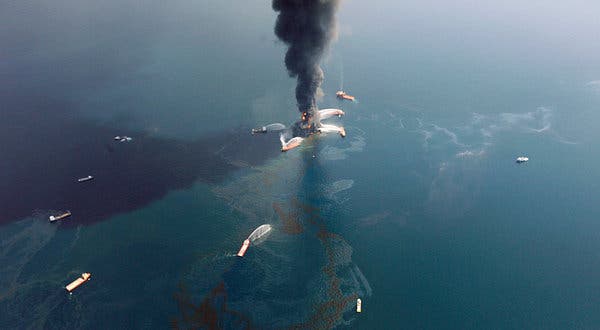
This spill of 2010 is known as the biggest oil spill in the United States with a spill of more than 200 million gallons of oil. It was found that the spill changed the amount of sediment collection on the bottom of the sea and choked them of oxygen. The reef fish changed after the spill, it absorbed some of the oil-source contaminants. This spill endangered the food chain and more than 400 species. It also severely affected dolphins of the area, there were a lot of stillbirths or baby dolphins with abnormal or underdeveloped lungs and seriously ill adult dolphins with drastically low blood sugar, low weight, and some were found with liver cancer and lung cancer.

Exxon Valdez Oil Spill

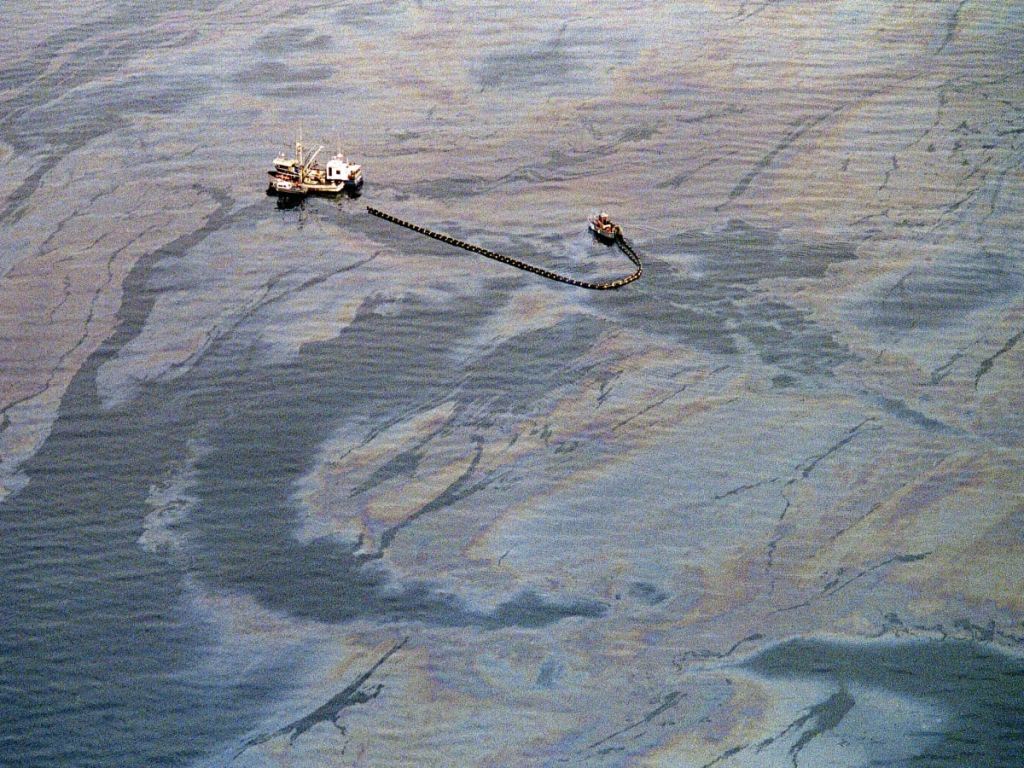
This disaster was caused by an oil tanker named Exxon Valdez which spilled 11 million gallons of crude oil into Alaska’s Prince William Sound on March 24, 1989. It killed around 2,50,000 sea birds, 3000 otters, 300 seals, 250 bald eagles, and 22 killer whales. It also played a role in the collapse of salmon and herring fisheries which resulted in fishermen going bankrupt and the economy suffering.

Environmental Effects

Seeing three important cases of Oil spills above we can discuss the major environmental effects of an oil spill:

  • Big impact on temporary animal
  • Fish loss of habitat
  • Affects organism functions like respiration, feeding, and thermo-regulation
  • The cleaning of oil spills ends up damaging the remaining plants.
  • Bleaching of coral reefs
  • Depletes oxygen content in water
  • Failure in the reproductive system of sea animals (as seen in dolphins above)

Responsible Bodies

The MARPOL convention of 1973 covers pollution of the marine environment by ships, it also lists forms of marine pollution caused by harmful substances, oil, sewage, and garbage from ships. The key international bodies that take care of oil spills are International Oil Pollution Compensation Fund (IOPC), and United Nations Environment Program World Conservation Monitoring Center (UNEP-WCMC). Other than these, every country has its government agency to take care of the spills. India has a National Oil Spill Disaster Contingency Plan (NOS-DCP).

Conclusion

With all the use of natural resources, the environment is being affected but adding to that is the leaks of these natural resources which further destroys the environment. The first step for acting on anything is to get to know about the history of incidents and the effect that has had on the environment.

References

Recently Discovered Letter Written by Albert Einstein Discusses Link Between Physics and Biology – Seven Decades Before Evidence Emerges

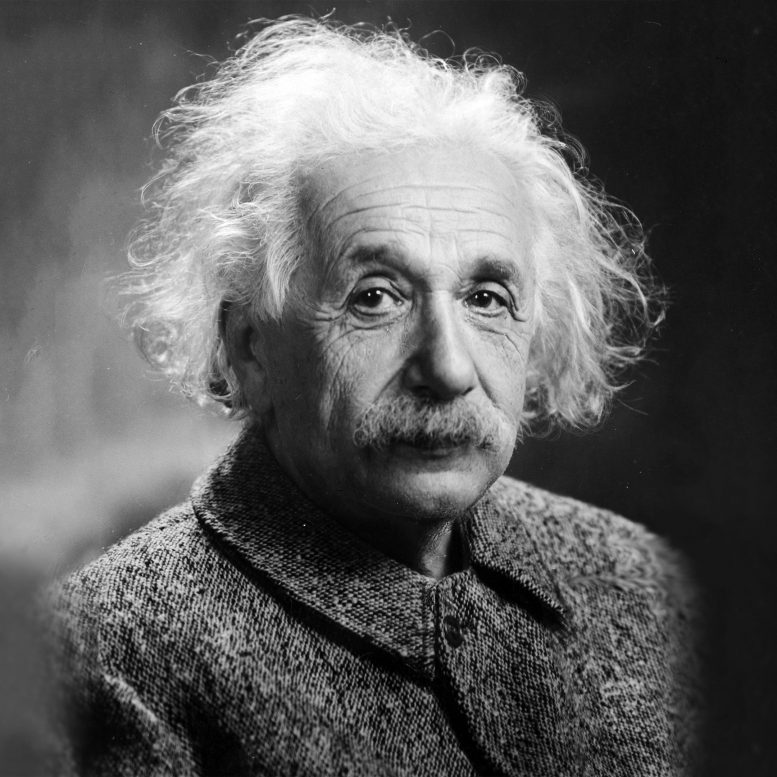
Albert Einstein Portrait

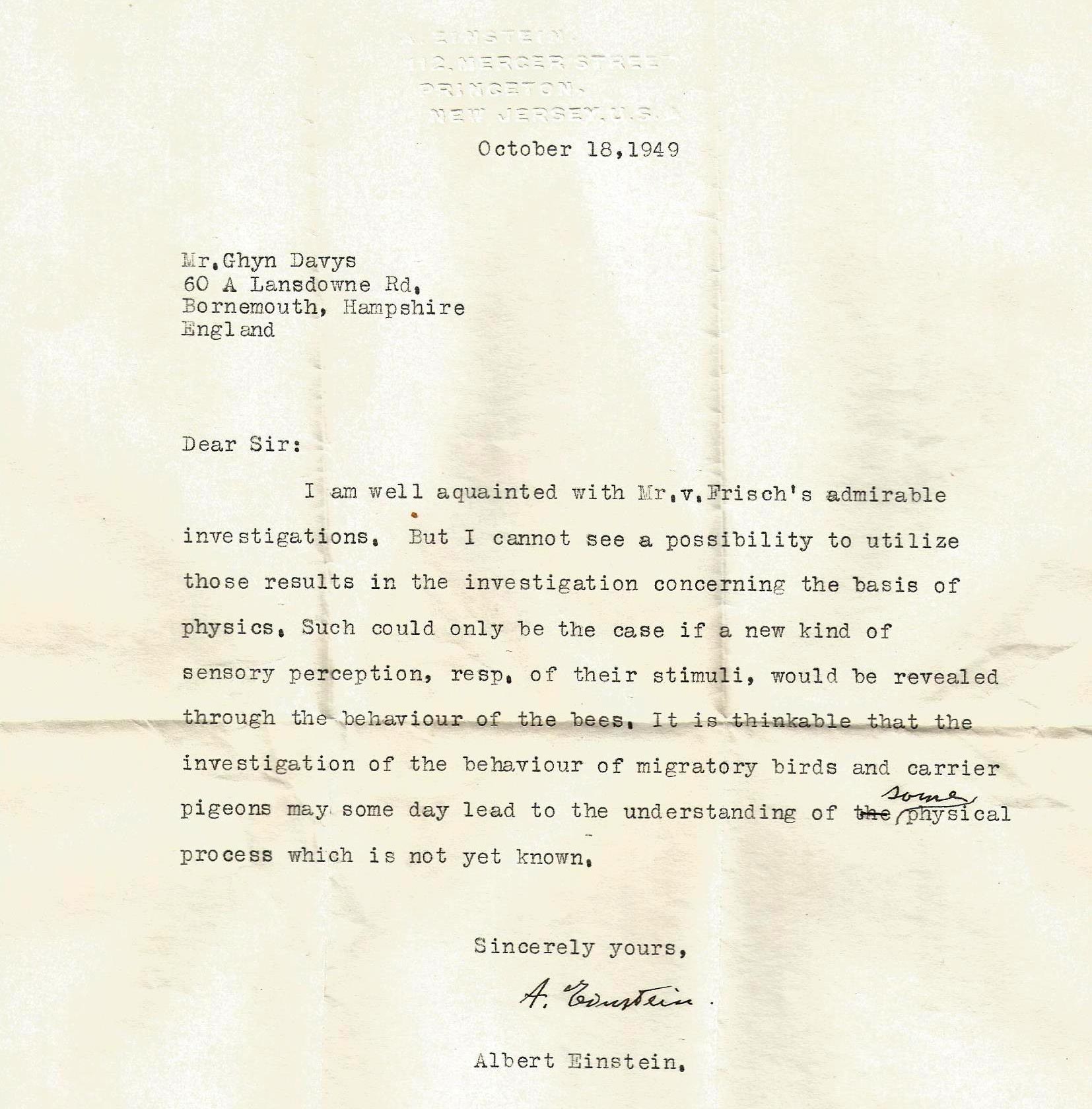
Previously Unknown Letter Reveals Einstein’s Thinking on Bees, Birds and Physics

The 1949 letter by the physicist and Nobel laureate discusses bees, birds, and whether new physics principles could come from studying animal senses.

It’s a position still being realized within physics to this day, with a growing body of research and understanding of how animals such as birds and bees find their way around.

Now a study led by RMIT University in Melbourne, Australia, discusses how recent discoveries in migratory birds back up Einstein’s thinking 72 years ago.

The previously unpublished letter was shared with researchers by Judith Davys — Einstein had addressed it to her late husband, radar researcher Glyn Davys.

RMIT’s Associate Professor Adrian Dyer has published significant studies into bees and is the lead author of the new paper on Einstein’s letter, published in the Journal of Comparative Physiology A.

Letter by Albert Einstein, validated by The Hebrew University of Jerusalem, where Einstein bequeathed his notes, letters and records. Credit: Dyer et al. 2021, J Comp Physiol A / The Hebrew University of Jerusalem

Dyer said the letter shows how Einstein envisaged new discoveries could come from studying animals.

“Seven decades after Einstein proposed new physics might come from animal sensory perception, we’re seeing discoveries that push our understanding about navigation and the fundamental principles of physics,” he said.

The letter also proves Einstein met with Nobel laureate Karl von Frisch, who was a leading bee and animal sensory researcher.

In April 1949, von Frisch presented his research on how honeybees navigate more effectively using the polarization patterns of light scattered from the sky.

The day after Einstein attended von Frisch’s lecture, the two researchers shared a private meeting.

Although this meeting wasn’t formally documented, the recently discovered letter from Einstein provides insight into what they might have talked about.

“It is thinkable that the investigation of the behavior of migratory birds and carrier pigeons may someday lead to the understanding of some physical process which is not yet known,” Einstein wrote.

Professor Andrew Greentree, a theoretical physicist at RMIT, said Einstein also suggested that for bees to extend our knowledge of physics, new types of behavior would need to be observed.

“Remarkably, it is clear through his writing that Einstein envisaged new discoveries could come from studying animals’ behaviors,” Greentree said.

More than 70 years since Einstein sent his letter, research is revealing the secrets of how migratory birds navigate while flying thousands of kilometers to arrive at a precise destination.

In 2008, research on thrushes fitted with radio transmitters showed, for the first time, that these birds use a form of magnetic compass as their primary orientation guide during flight.

One theory for the origin of magnetic sense in birds is the use of quantum randomness and entanglement. Both of these physics concepts were first proposed by Einstein.

Reference: “Einstein, von Frisch and the honeybee: a historical letter comes to light” by Adrian G. Dyer, Andrew D. Greentree, Jair E. Garcia, Elinya L. Dyer, Scarlett R. Howard and Friedrich G. Barth, 10 May 2021, Journal of Comparative Physiology A.
DOI: 10.1007/s00359-021-01490-6

The letter to Glyn Davys shows the openness of Einstein’s mind to novel possibilities observed in nature and the evidence that he took an interest in von Frish and his bee research.

Filigree- the metal work

Hello guys!!

I am going to tell you guys about my sweet memory regarding this topic,before we jump right into the topic.

I remember going to an exhibition with my mother.The exhibition used to take place monthly twice.

While we are shopping through the baazar I saw a person making something with some metals and tools and it piqued my curiosity so I asked my mother what was it .

My mother said it is filigree, the art of making jewellery.I was so impressed by their work and asked them if I can watch them more closely.They gave permission and were happy cause I was showing interest in their craft.

They delicately and precisely made jewellery with their hands ,they twisted ,and turned the metals but the result was beautiful in whatever way they turn.

Filigree is also called as filigrann or filgrene.This form of metal work can be traced back to 17th to 19th century of itialian and French and Portugal Metal works.

The word can be broken into two word filum and granum ,which means a thread and grain or bead respectively.

Filigree is mainly done on two metals those are gold and silver.The customers love the works crafted through this art which are often described to be classy,unique.

This work needs a lot of concentration and finesse while making these metal works intricately.
This works still remains popular in India and some other parts of Asia .

Jewellery ,watches,spoons,beads and what not everything that is made through this metal work is just wonderful.

Filigree is a metal art because every piece created by this technique is a chef’s kiss or to say a craftsman kiss.

I love this craft cause every piece has its own delicate nature that it depicts and also the finite accuracy in each twist and turn of the metal reminds me the hardwork,the time they sacrifice for our satisfaction.

Thankyou^^

Legal analysis of doxxing


What is the definition of doxxing?
Doxxing, short for “dropping dox,” is an internet attack in which hackers collect personal information and documents, hence the “dox” element of “dropping dox,” in order to reveal the true identity of someone who wanted to remain anonymous.
Doxxing is a harmful act carried out by hackers against someone with whom they disagree or detest. The goal is usually to make the victim feel humiliated or harassed. Hackers, for example, might divulge the identify of an anonymous message board troll in order to embarrass that person. They might want that person to lose their job or be shunned by their coworkers or friends.


Doxxing comes in a variety of forms:—


Doxxing celebrities
Journalists frequently gather information about a celebrity’s personal life and publish it on their social media platforms. Doxxing, on the other hand, isn’t exactly common in the entertainment world. The hacker reveals personal information about the celebrity, such as credit card numbers, email addresses, social security numbers, and phone numbers.

Doxxing with a flaw
Doxxing is occasionally carried out by online vigilantes who are too indolent to conduct full research or examinations on their targets to ensure they are dealing with the correct person. Rather, they mistakenly link people to unrelated activities or events. As a result of such “bad” doxxing, innocent persons face the following consequences:
Loss of reputation, job loss, harassment, physical damage, or death are only few of the consequences.

Doxxing for retaliation
Doxxing can be used as a method of retaliation. They disclose publicly identifiable details about their rivals on the internet to humiliate them.

Doxxing swapping
Swatting is a doxxing technique. When someone falsely accuses someone of committing a crime, police (or a SWAT squad, as the case may be) are dispatched to the victim’s home to harass them. The victim of doxxing, on the other hand, is frequently killed.

Doxxing is a method of exposing criminals.
While most swatting is done for fun, some people use it to commit serious crimes like murder. They publicise personal information about their opponents on the internet and encourage others to harm them. The purpose could be personal vengeance or expressing disagreement or animosity toward a particular cause, religion, activity, or race..


Is it legal to doxx someone?
Doxxing is usually not deemed illegal if the content exposed is in the public domain and was obtained legitimately. However, regulations intended to prevent stalking, harassment, and threats may make doxxing unlawful in your jurisdiction.
It also relies on the specific information disclosed. Giving someone’s true name, for example, is less risky than giving out their home address or phone number. Doxxing is both immoral and unlawful, and you could face serious legal consequences, including imprisonment, if you are caught harassing people and releasing their personal information. Detecting and prosecuting these kinds of crimes can be difficult.

Warli paintings

Hello guys!!

Have you guys ever heard about warli painting?even if you don’t know it’s name I think many of you can recognise the paintings ,they are present almost on any design,dress,wall art.

Still you haven’t got a clue? No problem .Have you ever seen stick figures on brown walls ,or on any dresses,they are called warli paintings.

From pinterest

Warli painting’s originated from maharastra.The name warli came into light because of the tribe warli in Maharashtra.Warli paintings showcase their drawings on mud walls,brown walls and now recently it is even used as design on dresses.

Warli painting’s have simple structure that is they mostly draw with circles,squares,and rectangles,they put emphasis on the story they are delivering through the painting.

Mostly it’s about their lifestyle,that is farming,dancing,singing,working.

On special occasions they draw these things with the white pigment.

These paintings garnered attention for their simplicity,and raw feel that these drawings show.
These paintings are very popular and they are available on many online sites ,people love to decorate their homes with these paintings.

Even the small figures when painted on the walls they recieve so much attention ,they are pleasing to the eyes. The dancers take a long turn in the audience and try to encircle them for entertainment. The circle formation of the dancers is also said to resemble the circle of life.people are doing their own activities and enjoying their time.The huts depict,their homes,the trees.

Every thing is depicted in those basic geometric shapes becoming its own speciality and oozes uniqueness,and sense of familarity.

I remember we had an activity where we had to draw over walls and the topic was warli paintings ,it was very fun to draw those things on the walls.

These paintings depict their culture, lifestyle,and their essence is the depicting small things in our life in a beautiful way.

Thankyou^^

Featured pic taken from pinterest.

Please visit the below website for more information https://en.m.wikipedia.org/wiki/Warli_painting