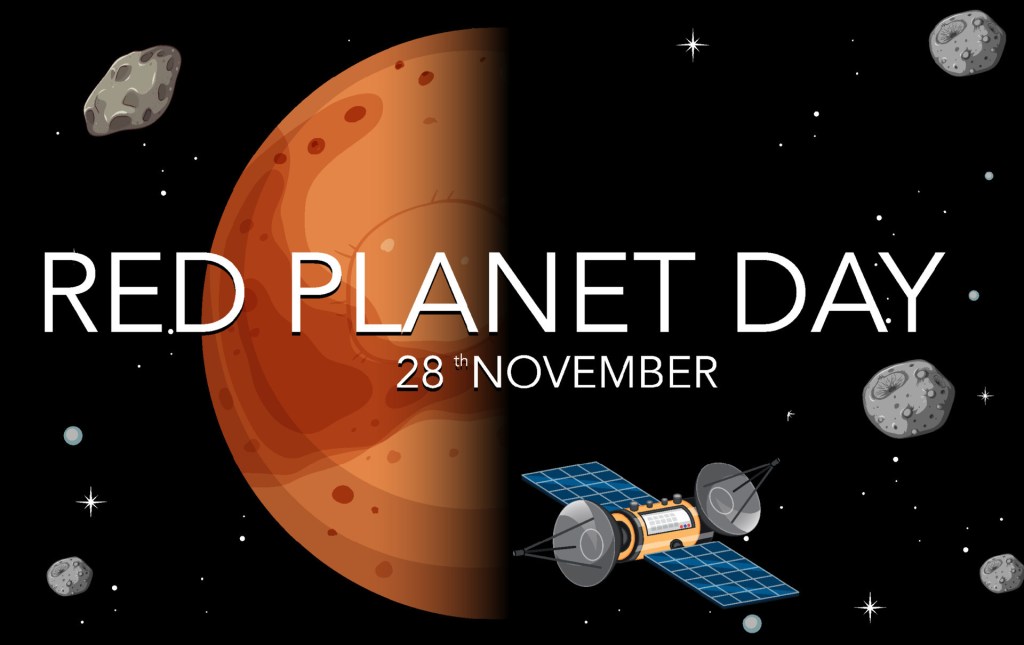
Red Planet Day is an annual event celebrated on November 28 to honor the fascinating planet Mars, often referred to as the “Red Planet” due to its reddish appearance caused by iron oxide (rust) on its surface. The day is an opportunity to reflect on humanity’s interest in Mars, its exploration, and the ongoing research that helps us understand its potential to support life.
Why November 28?
Red Planet Day marks the anniversary of the launch of Mariner 4, NASA’s first successful mission to Mars. On November 28, 1964, Mariner 4 was launched, and it became the first spacecraft to send back close-up images of the Martian surface, providing humanity with its first glimpse of the planet beyond telescopic observations. These images revealed a barren, cratered landscape, shattering some of the earlier misconceptions about Mars, such as the idea that it harbored canals built by intelligent life.
Mars: The Red Planet
Mars has been a subject of fascination for astronomers and science fiction writers for centuries. It is the fourth planet from the Sun and, like Earth, it has seasons, polar ice caps, and weather patterns. However, Mars differs significantly from Earth in its environment and atmospheric conditions.
Mars has:
A thin atmosphere, mostly carbon dioxide, which offers little protection from the harsh solar radiation.
The largest volcano in the solar system, Olympus Mons, which stands nearly three times the height of Mount Everest.
The longest canyon, Valles Marineris, stretching over 4,000 km, which dwarfs the Grand Canyon.
Evidence of past water flows, with dried riverbeds and ancient lake basins suggesting that liquid water may have once existed on its surface.
Despite its inhospitable surface, Mars remains one of the most studied planets in our solar system because of its potential for past life and its suitability for future human exploration.
The History of Mars Exploration
Over the decades, various space missions have explored Mars, and each has revealed new secrets about the planet. Here are a few key milestones:
Mariner 4 (1964) – As mentioned, it was the first spacecraft to send back images of Mars, proving that the planet was not as Earth-like as once believed.
Viking Program (1976) – NASA’s Viking 1 and Viking 2 orbiters and landers provided crucial data about the Martian atmosphere, surface, and geology, as well as the first in-depth studies of its potential for supporting life.
Mars Rovers – In the 21st century, rovers such as Spirit, Opportunity, Curiosity, and Perseverance have landed on Mars to explore its surface, conduct experiments, and search for signs of past life. Perseverance, which landed in February 2021, is tasked with collecting rock samples that could one day be returned to Earth.
Mars Helicopter Ingenuity – As part of the Perseverance mission, the small helicopter Ingenuity made history in 2021 by becoming the first powered flight on another planet. It successfully flew on Mars, providing aerial reconnaissance for scientific studies.
Why Celebrate Red Planet Day?
Red Planet Day serves multiple purposes:
Education: It’s an opportunity to educate people of all ages about Mars, its exploration, and what we’ve learned from it. Schools, observatories, and museums often host special events or activities focused on Mars-related science and space exploration.
Inspiration: Mars continues to inspire the imagination of people around the world. Celebrating the day can ignite curiosity about space and foster a sense of wonder about our universe.
Scientific Advancement: As new missions to Mars are planned, including NASA’s Artemis Program aiming to return humans to the Moon and eventually send astronauts to Mars, Red Planet Day reminds us of the long-term goals of space exploration and the scientific advancements being made in the process.
Future Exploration: Red Planet Day is also an opportunity to look forward to the future of Mars exploration, especially as private companies like SpaceX and governmental agencies like NASA are working towards the goal of human missions to Mars, potentially establishing the first human colony on another planet.
How Is Red Planet Day Celebrated?
While it is not a widely recognized holiday in the same way as some other observances, space enthusiasts, astronomers, and scientists mark Red Planet Day in various ways:
Public Events: Some observatories and space museums host special exhibits, workshops, and presentations about Mars exploration.
Social Media Campaigns: On Red Planet Day, many space organizations, including NASA and SpaceX, share information, updates, and fun facts about Mars on their social media platforms.
Stargazing: Many amateur astronomers take the opportunity to observe Mars with telescopes, especially when the planet is in close proximity to Earth during opposition (when Earth is directly between Mars and the Sun).
Educational Outreach: Schools and universities might engage in special lessons or activities centered on Mars, its exploration, and space science.
The Future of Mars Exploration
The future of Mars exploration is incredibly exciting. Several planned missions aim to further unravel the mysteries of Mars and explore its potential for human settlement:
NASA’s Mars Sample Return Mission: In collaboration with the European Space Agency (ESA), NASA aims to bring Martian soil samples back to Earth by the late 2020s or early 2030s.
SpaceX’s Starship Missions: SpaceX is developing the Starship vehicle with the goal of sending humans to Mars. Elon Musk’s vision is to eventually establish a sustainable human presence on Mars, potentially as soon as the 2020s or 2030s.
Colonization: While still a long way off, there are ongoing discussions about establishing permanent human colonies on Mars. These would require advanced technologies for life support, food production, and protection from radiation.
Conclusion
Red Planet Day is not only a celebration of the Mariner 4 mission but also a reminder of our collective curiosity and ambition to explore Mars. As we continue to explore and learn about Mars, the planet holds promise as a stepping stone for humanity’s future in space. Whether through scientific discoveries, technological innovations, or inspiring the next generation of explorers, Red Planet Day is a chance to celebrate humanity’s ongoing journey to the stars.
Media plays a crucial role in shaping public perceptions and disseminating information, including scientific knowledge, to the general populace. However, while media has the potential to foster scientific thinking among newspaper readers, it also faces several challenges that can hinder its effectiveness in achieving this goal.
On the positive side, media can serve as a powerful tool for popularizing scientific concepts, discoveries, and advancements. Well-written articles and features in newspapers have the potential to simplify complex scientific subjects, making them accessible to a wider audience. Through engaging storytelling and relatable examples, media can bridge the gap between scientific jargon and public understanding, fostering a sense of curiosity and interest in science.
Furthermore, media coverage can help shed light on critical scientific issues such as climate change, public health concerns, and technological innovations. By presenting accurate and balanced information, media can elevate public awareness and prompt informed discussions, which are vital for making informed decisions at both individual and societal levels.
However, there are challenges that media encounters in effectively spreading scientific thinking. One significant concern is the oversimplification or sensationalization of scientific news for the sake of grabbing attention. This can lead to the distortion of scientific facts and misrepresentation of research findings, which in turn undermines the credibility of scientific information.
Additionally, the competition for readership and the need for high click-through rates in the digital age can encourage the prioritization of sensational stories over in-depth, accurate reporting. This can result in the neglect of more complex scientific issues that require nuanced understanding and analysis.
Furthermore, the lack of scientific literacy among journalists can contribute to inaccurate reporting. Misinterpretation of scientific studies or failure to critically evaluate the credibility of sources can perpetuate misinformation, leading to a misinformed public.
In conclusion, media has the potential to be a powerful agent for spreading scientific thinking among newspaper readers. However, responsible journalism, accurate reporting, and a commitment to presenting science comprehensibly and unbiasedly are crucial for media to effectively fulfil this role. Balancing the demands of generating attention-grabbing content with the responsibility of promoting accurate scientific knowledge is essential for fostering a scientifically informed society.
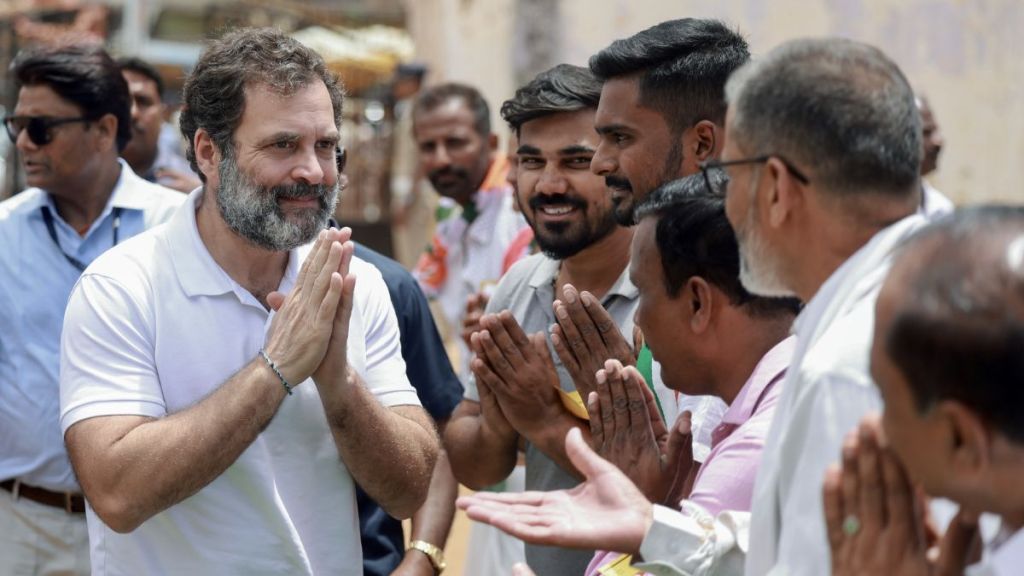
Demography, encompassing factors like age, caste, and religion, influences voting patterns in Karnataka state elections. Understanding the composition of the electorate helps analyze alliances and voting behavior. Rahul Gandhi, a prominent politician from the Indian National Congress, has campaigned in Karnataka and sought to mobilize support for his party. His effectiveness in connecting with voters and influencing the election outcome varies, as it depends on multiple factors beyond an individual’s influence. Other dynamics, such as party strategies, local issues, and the performance of rival parties, also play crucial roles in determining the results of Karnataka state elections.
Demography plays a significant role in elections as it involves the study of population characteristics and their influence on political outcomes. In the context of the Karnataka state election results, demography can provide insights into the composition of the electorate, such as age, gender, caste, and religion, which can shape voting patterns and alliances. Rahul Gandhi is a prominent Indian politician and a member of the Indian National Congress party. His role in the Karnataka state election results would depend on various factors, including his party’s performance, his campaign efforts, and his ability to connect with voters. While he may have campaigned in the state and tried to mobilize support for his party, the overall outcome of the election would depend on multiple factors beyond any individual’s influence.
Changing Demography of Karnataka
Karnataka has experienced significant demographic changes in recent years. The state’s population has been growing steadily, primarily due to natural increase and in-migration from other parts of India. According to the 2011 census, Karnataka had a population of approximately 61 million. Urbanization has been a prominent trend in the state, with cities like Bengaluru, Mysore, and Mangalore witnessing rapid growth. Bengaluru, in particular, has emerged as a major IT and technology hub, attracting professionals from different parts of the country. This influx of migrants has contributed to the cosmopolitan nature of the city. Karnataka is linguistically diverse, with Kannada being the primary language spoken by a majority of the population. However, there are also significant populations that speak other languages such as Tamil, Telugu, Urdu, and Konkani, among others. In terms of religious composition, Hinduism is the predominant religion in Karnataka, followed by Islam, Christianity, and Jainism. The state is also home to various religious sects and communities, contributing to its religious diversity. Caste continues to be a factor influencing Karnataka’s demography and politics. Historically influential communities, such as the Lingayats and Vokkaligas, have played significant roles in the state’s social and political landscape. However, other communities, including Scheduled Castes (Dalits) and Scheduled Tribes, have also gained political representation and influence.
It’s important to note that the demographic landscape of Karnataka may have evolved since my last update. For the most up-to-date and precise information, referring to recent studies and official data sources is recommended.
Emergence of Rahul Gandhi
Rahul Gandhi is a prominent Indian politician and a member of the Indian National Congress party. He is the son of former Indian Prime Minister Rajiv Gandhi and the grandson of former Prime Minister Indira Gandhi. Rahul Gandhi’s emergence as a political figure in India began with his active involvement in the Indian National Congress party and his eventual entry into electoral politics. Rahul Gandhi initially served as a general secretary of the Indian National Congress, working behind the scenes to strengthen the party’s organization and support its electoral campaigns. Over time, he took on a more prominent role within the party, becoming the vice president in 2013 and eventually the president of the Indian National Congress in 2017. Rahul Gandhi’s emergence as a political leader has been characterized by efforts to connect with the youth, marginalized communities, and rural populations. He has advocated for issues such as social justice, inclusivity, and economic development. Rahul Gandhi has campaigned extensively in various state elections, including Karnataka, and has sought to rally support for his party’s candidates. While Rahul Gandhi has garnered a considerable following and support within the Indian National Congress party, his political journey has seen ups and downs. He has faced criticism and scrutiny from political opponents and has been actively involved in debates and discussions on various national and regional issues. It is worth noting that political dynamics and individual influence can vary over time, and the specific impact and future trajectory of Rahul Gandhi’s emergence in Indian politics will continue to evolve as political landscapes change.
History of Karnataka Elections
The history of Karnataka elections dates back to the formation of the state in 1956. Since then, Karnataka has witnessed numerous state assembly elections as well as Lok Sabha (parliamentary) elections. Here is a brief overview of the history of Karnataka elections: Early Years: The first general elections in Karnataka took place in 1957. The Indian National Congress (INC) dominated the political landscape in the early years, winning the majority of seats in the state assembly. Coalition Politics: In the 1980s and 1990s, Karnataka witnessed the rise of coalition politics. The Janata Party, a coalition of various anti-Congress parties, came to power in 1983, marking a shift from single-party dominance. This period saw multiple governments being formed by different alliances, including the Janata Dal and Bharatiya Janata Party (BJP). Rise of the BJP: The Bharatiya Janata Party (BJP) gained prominence in Karnataka during the late 1990s and early 2000s. In 2004, the BJP formed its first government in the state, led by Chief Minister B.S. Yeddyurappa. However, the government faced internal issues, leading to its collapse. Congress Revival: The Indian National Congress made a comeback in Karnataka politics, winning the state assembly elections in 2013. Siddaramaiah became the Chief Minister, leading a Congress government. However, in the 2018 elections, the Congress was unable to secure a majority, leading to a coalition government with the Janata Dal (Secular) party.
Recent Elections: In the most recent state assembly elections held in 2018, the BJP emerged as the single largest party. After a period of political uncertainty, the BJP formed the government with B.S. Yeddyurappa as the Chief Minister. However, in subsequent by-elections, the BJP lost a few seats, resulting in a change of Chief Minister with B.S. Yediyurappa resigning and Basavaraj Bommai taking office in 2021. It’s important to note that the political landscape in Karnataka has been dynamic, with various parties and alliances vying for power. State elections in Karnataka have seen the emergence of regional parties, coalition governments, and shifts in power between the Indian National Congress and the Bharatiya Janata Party. The outcome of elections in Karnataka has had implications for state governance as well as national politics.
New Challenges for Congress Party
The Congress Party in India has faced several challenges in recent years. Here are some of the key challenges it has encountered:
Electoral Performance: The Congress Party has witnessed a decline in its electoral performance, especially in national elections. In the 2014 and 2019 Lok Sabha elections, the party faced significant setbacks, winning only a limited number of seats. This decline has impacted its overall political influence and ability to form a government at the national level.
Leadership Crisis: The party has grappled with a leadership crisis, with a lack of clear and dynamic leadership. This has resulted in a leadership vacuum and internal factionalism, which have weakened the party’s ability to present a united front and effectively communicate its message to the electorate.
Ideological Positioning: The Congress Party has faced challenges in clearly articulating its ideological positioning. In recent years, there has been a growing trend of political parties aligning themselves with specific ideologies or issues, while the Congress Party has struggled to define and communicate its distinct ideological stance.
Regional Strongholds: The Congress Party has lost ground in many states where it previously had strongholds. Regional parties have gained prominence and appeal, leading to a fragmentation of the political landscape. This has reduced the Congress Party’s ability to form alliances and consolidate its support base.
Youth Appeal: The Congress Party has faced difficulties in appealing to the aspirations and concerns of the younger generation. It has struggled to connect with the youth, who are increasingly looking for dynamic and transformative leadership and policies.
Communication Strategy: The Congress Party has faced challenges in effectively communicating its policies and achievements to the electorate. It has struggled to counter the narrative of its political opponents and has often been perceived as lacking a robust communication strategy.
Organizational Strength: The Congress Party has faced issues with its organizational strength and grassroots presence. It has struggled to rejuvenate its party structure and mobilize workers effectively, particularly at the local level.
To overcome these challenges, the Congress Party needs to undertake significant introspection, revitalize its leadership, redefine its ideological positioning, and strengthen its organizational structure. It must also focus on engaging with the aspirations of the youth and effectively communicate its policies and vision to regain public trust and support.
Concluding Remarks
The Congress Party’s performance in Karnataka elections has been subject to critical appraisal due to a mix of successes and failures. While the party has experienced some notable achievements, it has also encountered significant setbacks. Here is a critical appraisal of the Congress Party’s performance in Karnataka elections:
Mixed Electoral Performance: The Congress Party has had mixed electoral performances in Karnataka. It won the state assembly elections in 2013, forming the government under the leadership of Siddaramaiah. However, in the subsequent 2018 elections, the party failed to secure a majority and had to form a coalition government with the Janata Dal (Secular) party. This highlighted a lack of sustained popularity and the inability to secure a clear mandate.
Leadership Challenges: The Congress Party has struggled with leadership challenges in Karnataka. While Siddaramaiah played a significant role in the party’s victory in 2013, his tenure as Chief Minister was marked by controversies and internal rifts. Additionally, the absence of a strong and decisive leader at the state level has affected the party’s ability to effectively mobilize support and present a cohesive image.
Intra-party Factionalism: The Congress Party in Karnataka has been plagued by factionalism and infighting. Internal divisions and power struggles have hindered the party’s unity and cohesion, leading to weakened electoral campaigns and suboptimal coordination among party members.
Failure to Capitalize on Governance: The Congress Party’s tenure in Karnataka witnessed a mixed record in governance. While some initiatives were undertaken, such as social welfare programs and measures to address agrarian issues, the party failed to effectively communicate and capitalize on these achievements. Inadequate implementation and a lack of clear messaging hindered their ability to connect with voters and secure their trust.
Inability to Counter BJP’s Rise: The Congress Party has struggled to counter the Bharatiya Janata Party’s (BJP) rise in Karnataka. The BJP’s strong organizational structure, effective campaign strategies, and appeal to Hindutva ideology have posed significant challenges for the Congress Party. The party has been unable to effectively counter the BJP’s messaging and address the concerns of a changing electorate.
Failure to Strengthen Party Organization: The Congress Party has faced challenges in strengthening its party organization at the grassroots level in Karnataka. The absence of a robust and well-connected organizational structure has hindered their ability to mobilize support and build a strong voter base.
To improve their performance in national elections, the Congress Party needs to address these critical issues. They should focus on nurturing strong and decisive leadership, resolving internal factionalism, communicating their achievements effectively, countering the BJP’s rise, and revitalizing the party organization at all levels. Additionally, connecting with voters on issues that resonate with them and presenting a clear vision for the state’s development will be crucial in rebuilding public trust and support.
References
Antil, A., & Verma, H. V. (2021). Rahul Gandhi on Twitter: An analysis of brand building through Twitter by the leader of the main opposition party in India. Global Business Review, 22(5), 1258-1275.
Devi, B. U. (2013). Rahul Gandhi’s Immaturity. Economic and Political Weekly, 48(43), 5-5.
Gould, H. A. (1997). General Elections, 1996: Karnataka: Decline and Fall of the Congress Machine. Economic and Political Weekly, 2335-2349.
Manor, J. (2008). Letting a winnable election slip away: Congress in Karnataka. Economic and Political Weekly, 23-28.
Mahapatra, S., & Plagemann, J. (2019). Polarisation and politicisation: the social media strategies of Indian political parties.
Manor, J. (2013). Lucky in Its Adversaries: A Slipshod Congress Gains a Majority in the Karnataka Election. Economic and Political Weekly, 51-59.
Palshikar, S., & Suri, K. C. (2014). India’s 2014 Lok Sabha elections: Critical shifts in the long term, caution in the short term. Economic and Political Weekly, 39-49.
Pinto, A. (1994). Karnataka Assembly Elections: An Overview. Economic and Political Weekly, 3309-3311.
Shastri, S. (2009). Leadership at the state level mattered. Economic and Political Weekly, 88-91.
Shastri, S. (2013). The 2013 Karnataka Assembly Outcome: Government Performance and Party Organization Matters. Studies in Indian Politics, 1(2), 135-152.Simmons, C. (2019). Dynastic Continuity and Election in Contemporary Karnataka Politics. In South Asian Sovereignty (pp. 136-149). Routledge India.
The Union Cabinet, chaired by the Prime Minister Shri Narendra Modi, has approved the continuation of its flagship initiative, the Atal Innovation Mission (AIM), under the aegis of NITI Aayog, with an enhanced scope of work and an allocated budget of Rs.2,750 crore for the period till March 31, 2028.
AIM 2.0 is a step towards Viksit Bharat that aims to expand, strengthen, and deepen India’s already vibrant innovation and entrepreneurship ecosystem.
The approval underscores the government’s commitment to fostering a robust innovation and entrepreneurship ecosystem in India. With India at rank 39 on the Global Innovation Index and home to world’s third-largest start-up ecosystem, the next phase of Atal Innovation Mission (AIM 2.0) is expected to further enhance India’s global competitiveness. The continuation of AIM will directly contribute to creating better jobs, innovative products, and high-impact services across sectors.
While building on the accomplishments of AIM 1.0, such as Atal Tinkering Labs (ATL) and Atal Incubation Centers (AIC), AIM 2.0 marks a qualitative shift in the mission’s approach. Whereas AIM 1.0 involved implementing programs that built new innovation infrastructure to strengthen India’s then nascent ecosystem, AIM 2.0 involves piloting new initiatives designed to fill gaps in the ecosystem and scaling successes through central and state governments, industry, academia and community.
AIM 2.0 is designed to strengthen India’s innovation and entrepreneurship ecosystem in three ways: (a) by increasing input (i.e., ushering more innovators and entrepreneurs), (b) by improving the success rate or ‘throughput’ (i.e., helping more startups succeed) and (c) by improving the quality of ‘output’ (i.e., producing better jobs, products and services).
Two programs target increasing input to the ecosystem:
The Language Inclusive Program of Innovation (LIPI) to build innovation and entrepreneurship ecosystems in India’s 22 scheduled languages for lowering entry barrier confronting innovators, entrepreneurs and investors who don’t speak English. 30 Vernacular Innovation Centers will be established in existing incubators.
The Frontier Program to create customized templates for the innovation and entrepreneurship ecosystems of Jammu and Kashmir (J&K), Ladakh, the North Eastern states (NE), Aspirational Districts and Blocks where 15% of India’s citizens live. 2500 new ATLs will be created for template development.
Four programs target improving the throughput of the ecosystem:
The Human Capital Development Program to create a system for producing professionals (managers, teachers, trainers) to build, operate, and maintain India’s innovation and entrepreneurship ecosystem. The pilot will produce 5500 such professionals.
The Deeptech Reactor to create a research sandbox for testing ways of commercializing research-based deep tech startups that require significantly longer time and deeper investment to get to market. Minimum 1 Deeptech Reactor will be piloted.
The State Innovation Mission (SIM) to assist states/UTs with building a strong innovation and entrepreneurship ecosystem that focuses on their areas of strength. SIM will be a component of the NITI Aayog’s State Support Mission.
The International Innovation Collaborations program to take India’s innovation and entrepreneurship ecosystem international. Four areas of intervention are identified: (a) an Annual Global Tinkering Olympiad (b) creation of 10 Bi-lateral, multilateral engagements with advanced nations (c) as a knowledge partner, helping the United Nation’s World Intellectual Property Organization (WIPO) spread the models of AIM and its programs (ATL, AIC) to the countries of the global south, and (d) anchoring the Startup20 Engagement Group of the G20 for India.
Two programs target improving the quality of output (jobs, products, and services):
The Industrial Accelerator program to increase industry involvement in scaling-up advanced startups. Minimum 10 Industry Accelerators in critical sectors will be created in Public Private Partnership (PPP) mode.
The Atal Sectoral Innovation Launchpads (ASIL) program to build iDEX-like platforms in central ministries for integrating and procuring from startups in key industry sectors. Minimum 10 launchpads will be built across key ministries.
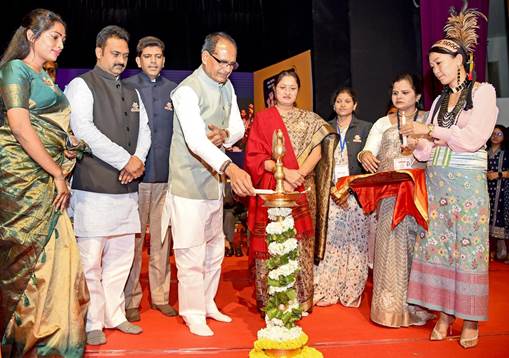
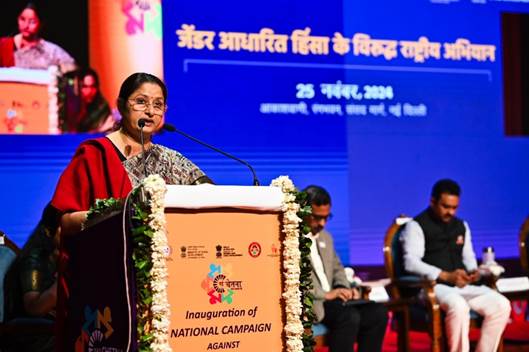
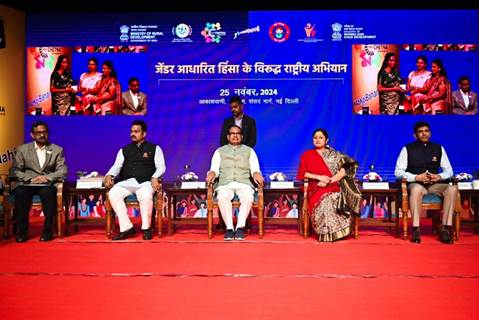
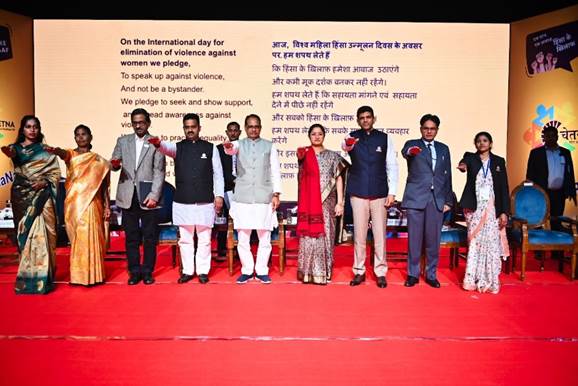
A National Campaign “#AbKoiBahanaNahi” was launched today in New Delhi. It is a collaborative effort between the Ministries of Women and Child Development and Rural Development, with support from UN Women. The Union Minister for Women and Child Development, Smt. Annpurna Devi, Union Minister for Rural Development, Shri Shivraj Singh Chouhan, Minister of State for Rural Development Shri Kamlesh Paswan and Dr. Chandra Sekhar Pemmasani, Minister of State for Rural Development and Communications were present on this occasion.
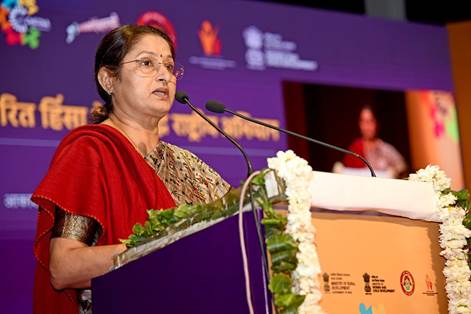
While addressing the gathering the Minister Smt. Annpurna Devi said that the purpose of this campaign being launched today is to advance the rights of women and individuals of diverse genders, and to free their lives from fear and gender-based discrimination. This aims to empower women to break free from shame and societal constraints, enabling them to report the atrocities they have faced and fight for their dignity.
This year, building on the Global Campaign of the United Nations of #NoExcuse, which draws attention to the alarming escalation of violence against women to revitalize commitments, call for accountability and action, the Government of India launched #AbKoiBahanaNahi with the aim to highlight the message of urgency of ending violence against women and girls, and underscoring zero-tolerance stance of central India towards any and all forms of gender-based violence.
The Government of India, implementing the paradigm shift in governance to women-led development, has created enabling provisions for women’s full, equal and meaningful participation in all spheres of life and the economy, such as several large scale interventions to reduce women’s drudgery and poverty, building public care infrastructure and universal access to healthcare, to reduce women’s disproportionate care work, improving access to formal financial systems, bridging the gender digital divide, ensuring safe mobility, safe accommodation, and building a robust service delivery infrastructure for the prevention and redressal of all forms of violence against women and girls.
Highlighting the good work already underway the Union Minister for Rural Development, Shri Shivraj Singh Chouhan, said that if women are to be completely empowered, then women empowerment, social empowerment, political empowerment, and educational empowerment must be achieved. Under the leadership of Prime Minister Shri Narendra Modi, women empowerment initiatives are being implemented as a campaign.
Gender-based violence inhibits women and girls from living with dignity and contributing as equal partners in the development process. As India aims to become a developed country by 2047, under the visionary leadership of Prime Minister Shri Narendra Modi, this dream will not be possible without women’s full and equal contribution, which, in turn, is hindered if women continue to face violence or the threat of violence. The Union Minister for Women and Child Development reiterated the importance of female participation in the economy to make Viksit Bharat, as envisioned by Prime Minister, a reality.
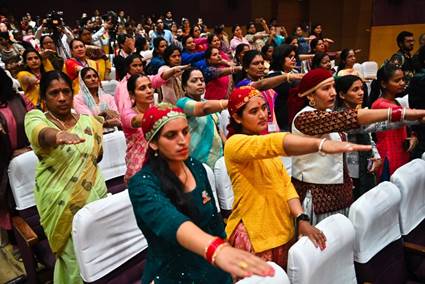
Hence, in order to urge all stakeholders to take decisive steps towards addressing violence against women and girls, the “#AbKoiBahanaNahi” (#अबकोईबहानानहीं) campaign commenced with a national Call to Action. To ensure a wide reach on spreading the call to action on ending gender-based violence, leaving no one behind, the campaign was launched in conjunction with the ‘Nayi Chetna 3.0 campaign,’ organized by the Ministry of Rural Development, reaffirming the national commitment to end all forms of gender-based violence.
At the launch event, a film on #AbKoiBahanaNahi was showcased, highlighting the need for accountability from all stakeholders, including citizens, to pledge against ending gender-based violence.
The primary objective of the campaign is to foster advocacy efforts and inform policy directives concerning the safety and security of women and girls. Furthermore, this campaign serves as a critical and urgent call for systemic change, emphasizing the imperative for justice, equity, and transformation. The campaign aims to catalyze a ripple effect, where each action and initiative contributes to reinforcing the message of women’s safety as a fundamental and non-negotiable priority for national growth and development.
The launch event was attended by women leaders from Self Help Groups across the country, staff from service providers for redressal for survivors of violence against women and girls, such as One Stop Centres, and Aanganwadi workers, amongst others. To spread the awareness of the campaign to the remotest corners of the country, the launch was telecast live through the Webcast link and Ministry of Women and Child Development’s YouTube channel.
Globally, every year, from 25th November, which is observed as the International Day for the Elimination of Violence against Women, to 10th December, which is observed as the Human Rights Day, the 16 Days of Activism campaign is observed by civil society to raise awareness on ending gender-based violence.
YouTube Link -https://www.youtube.com/embed/xTcQfXFuRmo
The Ministry of Tourism undertakes various promotional activities in important and potential tourist generating markets with the objective of showcasing India’s tourism potential and promoting tourism to the country, including the state of Himachal Pradesh. Details of promotional activities are as follows:
i. Participation in international travel fairs and exhibitions such as World Travel Market (WTM) London, Feria Internacional de Turismo (FITUR) Madrid, International Travel & Hospitality Show (MITT) Moscow, Asia-Pacific Incentives and Meetings Event (AIME) Sydney, Internationale Tourismusbörse (ITB) Berlin, Arabian Travel Market (ATM) Dubai, International Meeting Exchange (IMEX) Frankfurt, International & French Travel Market (IFTM) Top Resa Paris, Japan Expo, Internationale Tourismusbörse Asia (ITB Asia), Singapore etc.
ii. The Chalo India initiative has been launched by the Ministry to encourage the huge Indian diaspora to become Incredible India ambassadors and encourage their five non-Indian friends to visit India, every year.
iii. A Chalo India portal has also been developed for registration of the Indian diaspora. Further gratis e visa to one lakh foreign tourists, visiting India under the referral program was announced.
iv. Ministry of Tourism has launched the Incredible India Content Hub on the revamped Incredible India digital portal (www.incredibleindia.gov.in) on 27th September, 2024. The Incredible India Content Hub is a comprehensive digital repository of high-quality images, films, brochures and newsletters which can be easily accessed by the industry stakeholders (travel media, tour operators, travel agents) across the globe required to amplify Incredible India in all their marketing and promotional efforts. The revamped Incredible India Digital Portal is a tourist-centric, one-stop digital solution designed to enhance the travel experience for visitors to India.
v. Inviting media personalities, tour operators and opinion makers to visit the country under the Hospitality Programme of the Ministry.
vi. The promotions are being carried out in association with the State Governments and the Overseas Indian Missions including the 20 identified Indian Missions.
Ministry of Tourism, Government of India is not the regulatory authority for deciding the rate structure charged by Tourism Stakeholders.
In order to boost tourism sector in the country during Amrit Kaal, the Ministry of Tourism has taken the following initiatives: –
The Ministry of Tourism undertakes several promotional activities in potential international & domestic markets to promote various tourism destinations and products of the country in holistic manner. This includes release of media campaigns, social media promotions, webinars, participation & support to promotional events, dissemination of information and engagement through website etc. In addition, Indian Missions overseas also undertake various promotional activities to attract more global travellers to various tourist destinations of the country.
Ministry of Tourism launched the Incredible India Content Hub on the revamped Incredible India digital portal which is a comprehensive digital repository, featuring a rich collection of high-quality images, films, brochures and newsletters related to tourism in India. This repository is intended for the use of a diverse range of stakeholders, including tour operators, journalists, students, researchers, film makers, authors, influencers, content creators, government officials and ambassadors.
The Ministry of Tourism under the schemes of ‘Swadesh Darshan’, National Mission on Pilgrimage Rejuvenation and Spiritual Heritage Augmentation Drive (PRASHAD)’ and ‘Assistance to Central Agencies for Tourism Infrastructure Development’ provides financial assistance to State Governments/ Union Territory Administrations/ Central Agencies for the development of tourism related infrastructure and facilities at various tourism destinations in the country.
Ministry has revamped Swadesh Darshan Scheme as Swadesh Darshan 2.0 (SD2.0) with the objective to develop sustainable and responsible destinations following a destination centric approach.
Ministry of Tourism has been providing financial assistance to State Governments/ UT Administrations for organising fairs/festivals and tourism related events.
Ministry is conducting Programmes under the ‘Capacity Building for Service Providers’ (CBSP) Scheme to train and upgrade manpower to provide better service standards.
To enhance the overall experience of tourists by making available a pool of local, trained professionals at tourist sites across the country, Ministry launched the Incredible India Tourist Facilitator (IITF) Certification Programme – a Pan-India online learning program.
Indian Railways have taken various steps to improve the railway network and other infrastructures, which are outlined below:
i) Railway Infrastructure Projects are taken up on the basis of remunerativeness, last mile connectivity, missing links and alternate routes, augmentation of congested/saturated lines, socio-economic considerations, enhancing connectivity to tourist and cultural places etc. depending upon liabilities of ongoing projects, overall availability of funds and competing demands. As on 01.04.2024, out of 488 Railway Infrastructure projects (187 New Line, 40 Gauge Conversion and 261 Doubling) of total length 44,488 Km costing approx. Rs. 7.44 lakh crore, 12,045 Km length has been commissioned across Indian Railways with an expenditure of Rs. 2.92 lakh crore. Augmenting railway infrastructures across Indian Railways is an ongoing and continuous process.
ii) The Ministry of Railways has recently launched the Amrit Bharat Station Scheme for development of Railway stations on Indian Railways. The Scheme envisages development of stations on a continuous basis with a long-term approach. It involves preparation of Master Plans and their implementation in phases to improve amenities at stations, like improvement of station access, circulating areas, waiting halls, toilets, lift/escalators as necessary, platform surfacing and cover over platform, cleanliness, free Wi-Fi, kiosks for local products through schemes like ‘One Station One Product’, better passenger information systems, Executive Lounges, nominated spaces for business meetings, landscaping etc. keeping in view the necessity at each station. So far, 1337 stations have been identified under the Amrit Bharat Station Scheme over Indian Railways.
iii) Under the National Rail Plan (NRP), around 243 tourist destinations in India were identified. Out of these, 111 places are already connected with the existing rail network, 30 tourist places are within a distance of 10 kms from the nearest railway station and 30 are within a distance of 15 kms from the nearest railway station. The remaining 72 locations are primarily wildlife sanctuaries, beaches and areas located in hilly and mountainous terrain where providing rail connectivity is either not advisable or difficult.
Further, with a view to provide enhanced amenities and facilities for tourists, projects for joint development of tourist amenities at 22 railway stations by the Ministry of Railways (MoR) and Ministry of Tourism were sanctioned on cost sharing basis.
Details of month-wise Foreign Tourist arrivals (FTAs) in the country during 2023 and 2024 (till August) are given below:
Recognizing the immense potential of rural tourism in the country, Ministry of Tourism has formulated National Strategies for Development of Rural Tourism and promotion of Rural Homestays in India.
The Ministry of Tourism promotes India in a holistic manner, through various initiatives. As part of the on-going activities, promotion of various tourism destinations and products including Rural tourism and Rural homestays are taken up.
In addition, the Ministry of Tourism has identified Rural Circuit as one of the thematic circuits under its Swadesh Darshan Scheme. The details of projects sanctioned under Rural Circuit of the scheme are given at Annexure.
The Swadesh Darshan 2.0 scheme has been initiated with the objective of developing sustainable and responsible destinations following a tourist & destination centric approach. Under this scheme, Rural Tourism Cluster Experience project has been sanctioned at Gunji, Uttarakhand.
The Government has approved the initiative to develop tribal home-stays under Swadesh Darshan Scheme, as part of ‘Pradhan Mantri Janjatiya Unnat Gram Abhiyan’. The said intervention includes development of 1000 homestays with support of upto Rs.5 Lakh per unit (for new construction), upto Rs.3 Lakh (renovation) and Rs.5 Lakh for village community requirement.
This information was given by Union Minister for Tourism and Culture Shri Gajendra Singh Shekhawat in a written reply in Lok Sabha today.
Annexure
PROJECTS SANCTIONED UNDER RURAL CIRCUIT OF SWADESH DARSHAN SCHEME
(Amount in ₹ crore)
S. No.
Name of State
Year
Project Name
Amount Sanctioned
Amount Released
1.
Bihar
(2017-18)
Development of Gandhi Circuit: Bhitiharwa- Chandrahia- Turkaulia
44.27
40.31
2.
Kerala
(2018-19)
Development of Malanad Malabar Cruise Tourism Project
As per the UNWTO Barometer published in September 2024, export revenues from international tourism in 2023 were recorded at USD 1.8 trillion, which includes receipts from tourism activities as well as passenger transport.
Based on data from the Bureau of Immigration, the Ministry of Tourism classifies foreign tourists into 6 categories according to their purpose of visit. The total Foreign Tourist Arrivals (FTAs) stood at 9.52 million in 2023. A breakdown of the same is provided below:
S. No.
Tourist Category
Percentage share
1
Leisure Holiday and Recreation
46.2
2
Indian diaspora
26.9
3
Business and professional
10.3
4
Medical
6.9
5
Student
0.5
6
Others (including unknown)
9.2
Total
100.0
Ministry of Tourism has undertaken several steps to revitalize the tourism industry such as:
1. Improve the quality of infrastructure and facilities at various tourist destinations across the country under schemes such as ‘Swadesh Darshan’, ‘PRASHAD’, and ‘Assistance to Central Agencies for Tourism Infrastructure Development’, in collaboration with States/UTs, Central agencies and private stakeholders.
2. Enhance connectivity and accessibility at various tourist destinations across the country in collaboration with Line Ministries. The Ministry of Tourism has partnered with the Ministry of Road Transport and Highways, Ministry of Civil Aviation, Ministry of Railways, and Ministry of Ports, Shipping, and Waterways to achieve this goal.
3. Enhance the overall quality and visitor experience through initiatives focused on capacity building, skill development such as Incredible India Tourist Facilitator (IITF), ‘Paryatan Mitra’ and ‘Paryatan Didi’ and also through events and campaigns such as ‘Dekho Apna Desh,’ ‘Chalo India,’ ‘International Tourism Mart’ and ‘Bharat Parv’.
Ministry of Tourism under its ‘Pilgrimage Rejuvenation and Spiritual Heritage Augmentation Drive’ (PRASHAD) Scheme provides Financial Assistance to the State Governments and Union Territories Administration for development of Tourism Infrastructure at the Pre-Identified Pilgrimage destinations/Heritage Cities. Under this Scheme, infrastructure interventions are carried out in consultation with the State Governments/UTs.
Ministry of Tourism, from time to time receives proposals from various sources regarding development of infrastructure under PRASHAD Scheme and these proposals are evaluated as per scheme guidelines and established procedures.
Ministry of Tourism has sanctioned 46 projects under its PRASHAD Scheme including 3 projects in Andhra Pradesh. A total of 29 sites are identified for development under the PRASHAD Scheme including 2 sites in Andhra Pradesh. The details of the projects sanctioned and sites identified are Annexed.
This information was given by Union Minister for Tourism and Culture Shri Gajendra Singh Shekhawat in a written reply in Lok Sabha today.
Annexure
List of projects sanctioned under PRASHAD Scheme of Ministry of Tourism given below:
(Rs. in Crore)
State/UT
S.No.
Project Name
Sanction Year
Approved Cost
Amount Released
Physical Progress%
Financial Progress%
Andhra Pradesh
Development of Pilgrim Amenities at Amaravati
2015-16
27.77
27.77
100
100
Development of Srisailam Temple
2017-18
43.08
43.08
100
100
Development of Pilgrimage Amenities at Sri Varaha Lakshmi Narsimha Swami Vari Devasthanam at Simhachalam
2022-23
54.04
13.69
28
25
Arunachal Pradesh
Development of Parshuram Kund
2020-21
37.88
21.95
86
58
Assam
Development of Pilgrimage amenities at Kamakhya Temple
2015-16
29.80
29.80
100
100
Bihar
Development at Patna Sahib
2015-16
29.62
29.62
100
100
Development of basic facilities at Vishnupad temple
2014-15
3.63
3.63
100
100
Chhattisgarh
Development of Pilgrimage amenities at Maa Bamleshwari Devi Temple
2020-21
48 .44
32.13
84
66
Gujarat
Development of Dwarka
2016-17
13.08
10.46
100
80
Development of Pilgrimage Amenities at Somnath
2016-17
45.36
45.36
100
100
Development of Promenade at Somnath
2018-19
47.12
47.12
100
100
Development of Pilgrim Plaza with Queue management complex at Somnath Gujarat
2021-22
49.97
0.00
0
0
Development of Pilgrimage Facilities at Ambaji Temple
2022-23
50.00
10.54
30
21
Haryana
Development of Mata Mansa Devi Temple and Nada Saheb Gurudwara
2019-20
48.53
34.68
74
71
Jammu and Kashmir
Development at Hazratbal Shrine
2016-17
40.46
34.30
90
85
Jharkhand
Development of Baba Baidya Nath Dham
2018-19
36.79
34.95
100
89
Karnataka
Development of Pilgrimage Amenities at Sri Chamundeshwari Devi Temple
2023-24
45.71
0.00
0
0
Kerala
Development at Guruvayur Temple
2016-17
45.19
45.19
100
100
Madhya Pradesh
Development of Amarkantak
2020-21
49.99
34.73
68
69
Development of Omkareshwar
2017-18
43.93
43.93
100
100
Maharashtra
Development of Trimbakeshwar
2017-18
42.18
29.93
93
57
Meghalaya
Development of Pilgrimage Facilitation at Nongswalia Church, Nartiang Shakti Peeth, Aitnar Pool and Charantala Kali Temple
2020-21
29.29
24.92
100
100
Mizoram
Development of Infrastructure for Pilgrimage and Heritage Tourism at Chite Vang, Zuangtai, Reiek and Aizawl
2022-23
44.89
13.18
22
29
Nagaland
Development of Pilgrimage Infrastructure at Molungkimong, Noksen Church, Aizuto, Wokha and Kohima
2018-19
25.20
21.33
100
84
Development of Pilgrimage Tourism Infrastructure at Zunheboto
2022-23
18.18
10.90
62
60
Odisha
Infrastructure Development at Puri
2014-15
50.00
10.00
–
20
Punjab
Development of Karuna Sagar Valmiki Sthal at Amritsar
2015-16
6.40
6.40
100
100
Development of Chamkaur Sahib
2021-22
31.57
17.49
79
55
Rajasthan
Integrated Development of Pushkar/Ajmer
2015-16
32.64
26.11
92
80
Sikkim
Development of Pilgrimage Facilitation at Four Patron Saints, Yuksom
2020-21
33.32
28.31
87
85
Tamil Nadu
Development of Kanchipuram
2016-17
13.99
13.99
100
100
Development of Velankanni
2016-17
4.86
4.86
100
100
Telangana
Development of Jogulamba Devi Temple
2020-21
38.90
33.07
72
85
Development of Pilgrimage and Heritage Tourism Infrastructure at Rudreshwara (Ramappa) Temple
2022-23
62.00
12.82
37
21
Development of Pilgrimage Infrastructure at Bhadrachalam
2022-23
41.38
8.43
15
20
Tripura
Development of Tripura Sundari Temple
2020-21
34.43
25.62
63
68
Uttar Pradesh
Development of Varanasi –Phase –I
2015-16
18.73
18.73
100
100
Development of Mathura-Vrindavan as Mega Tourist Circuit (Ph-II)
2014-15
10.98
10.98
100
100
Development of River Cruise Tourism at Varanasi
2017-18
9.02
9.02
100
100
Construction of Tourist Facilitation Centre at Vrindavan
2014-15
9.36
9.36
100
100
Development of Varanasi – Phase II
2017-18
44.60
31.77
100
71
Development of Infrastructure facilities at Govardhan
2018-19
37.59
30.97
99
78
Uttarakhand
Integrated Development of Kedarnath
2015-16
34.77
34.77
100
100
Development of Infrastructure for Pilgrimage Facilitation in Badrinath Ji Dham
2018-19
56.15
27.43
62
49
Augmentation of Pilgrimage Infrastructure Facilities at Gangotri and Yamunotri Dham
2021-22
54.36
10.22
100
18
West Bengal
Development of Belur Math
2016-17
30.03
23.39
92
78
Total
1605.20
1036.96
List of Identified sites under PRASHAD Scheme
S.No.
State/UT
Project / Subject
1
Andhra Pradesh
Annavaram, Kakinada District
2
Andhra Pradesh
Vedagiri Lakshmi Narasimhawamy Temple, Nellore District
3
Bihar
Simariya Ghat, Begusarai District
4
Bihar
Aami Mandir, Saran District
5
Chhattisgarh
Kudargarh Temple, Surajpur District
6
Goa
Bom Jesus, Old Goa District
7
Gujarat
Shri Nilkanth Mahadev Temple, Sunak, Mahesana District
8
Himachal Pradesh
Maa Chintpurni Temple, Una District
9
Jammu & Kashmir
Utterbehni and Purmandal, Samba District
10
Karnataka
Sri Renuka Yallamma Temple, Saudatti, Belagavi District
11
Karnataka
Papnash Temple, Bidar District
12
Madhya Pradesh
Shri Peetmbra Peetha, Datia District
13
Madhya Pradesh
Shanidev Temple, Morena District
14
Maharashtra
Shri Ghrushneshwar Shivalaya, Chhatrapati Sambhaji Nagar District
15
Maharashtra
Tuljapur, Dharashiv District District
16
Maharashtra
Shre Kshetra Rajur, Ganpati Temple, Jalna District
17
Mizoram
Vangchhia, Champhai District
18
Odisha
Chausath Yogini Temple, Ranipur, Jharial, Balangir District
19
Odisha
Maa Kichakeswari Temple in Kiching, Mayurbhanj District
20
Puducherry
Navagriha Temple- Sri Dharbaranyeswarar Temple & Spiritual Park, Karaikal District
21
Punjab
Durgyana Temple, Amritsar District
22
Rajasthan
Shri Karni Mata Mandir, Bikaner District
23
Rajasthan
Sun Temple, Budhahita, Kota District
24
Rajasthan
Malaseri Dungri
25
Tamil Nadu
Navagriha Temple at 8 places in Tamil NaduSri Kailasanathar Temple, Thingalur, Thanjavur DistrictGuru Bhagvan Temple, Alangudi, Thanjavur DistrictSri Naaganathar Temple, Thirunageshwaram, Thanjavur DistrictSri Suryanaar Temple, Thiruvidaimaruthur, Suriyanar Kovil, Thanjavur DistrictSri Agneeswarar Temple, Kanjanur, Thanjavur DistrictSri Vaitheeshwaran Temple, Vaitheeswaran Kovil, Mayiladuthurai District Sri Naganatha Swamy Temple, Keelaperumpallam, Mayiladuthurai District Suweathaaranyshwarar Temple, Thiruvenkadu, Mayiladuthurai District
26
Telangana
Goddess Yellamma Temple at Balkampet, Hyderabad District
27
Uttar Pradesh
Shri Kali Mandir established by Adiguru Shankaracharya, Chowk, Lucknow District
As per the 3rd Tourism Satellite Account (TSA), 2015-16, the percentage contribution of tourism sector to the country’s Gross Domestic Product (GDP) for 2018-19 to 2022-23 is given below:
Tourism GDP
2018-19
2019-20
2020-21
2021-22
2022-23
Total Share in GDP (in %)
5.01
5.18
1.50
1.75
5.00
Direct (in %)
2.61
2.69
0.78
0.91
2.60
Indirect (in %)
2.40
2.49
0.72
0.84
2.40
The above estimates are updated using National Account statistics 2024.
Ministry of Tourism has taken several initiatives over the years for development of tourism sector in the country. Some of these key initiatives are:
The Ministry of Tourism under the schemes of ‘Swadesh Darshan’, National Mission on ‘Pilgrimage Rejuvenation and Spiritual Heritage Augmentation Drive (PRASHAD)’ and ‘Assistance to Central Agencies for Tourism Infrastructure Development’ provides financial assistance to State Governments/Union Territory Administrations/ Central Agencies for the development of tourism related infrastructure and facilities at various tourism destinations in the country.
The Ministry of Tourism has revamped its Swadesh Darshan Scheme as Swadesh Darshan 2.0 (SD2.0) with the objective to develop sustainable and responsible destinations following a tourist & destination centric approach.
Financial assistance has also been provided to the State Governments/UTs for organizing fairs/festivals & tourism related events under Domestic Promotion & Publicity including Hospitality (DPPH) Scheme.
Dekho Apna Desh initiative launched with the objective to encourage citizens to travel within the country.
Thematic tourism like wellness tourism, culinary tourism, rural, eco-tourism, etc. amongst other niche subjects are promoted so as to expand the scope of tourism into other sectors as well.
With an aim to enable lawful inward movement of foreigners including foreign tourists, Government has taken a number of initiative over the last few years to liberalize, streamline and simplify visa regime with a view to facilitate the legitimate foreign travellers. Facility of e-Visa for 07 sub-categories i.e., e-Tourist visa, e-Business visa, e-Medical visa, e-Medical Attendant visa, e-Ayush Visa, e-Ayush Attendant Visa and e-Conference visa for the nationals of 167 countries has been provided. Visa fee has also been substantially reduced.
For improving air connectivity to important tourist destinations, Ministry of Tourism has collaborated with Ministry of Civil Aviation under their RCS-UDAN Scheme. As on date, 53 tourism routes have been operationalized.
Ministry of Tourism is running Pan-India Incredible India Tourist Facilitator (IITF) Certification Program, a digital initiative that aims at creating an online learning platform with the objective of creating a pool of well trained and professional Tourist Facilitators/Guides across the country and generating employment opportunities at local level.
Conducting Programmes under the ‘Capacity Building for Service Providers’ (CBSP) Scheme to train and up-grade manpower to provide better service standards.
Ministry of Tourism also launched a national responsible tourism initiative by the name of ‘Paryatan Mitra’ and ‘Paryatan Didi’. The initiative encompasses providing tourism related training and awareness to all individuals who interact and engage with tourists in a destination.
This information was given by Union Minister for Tourism and Culture Shri Gajendra Singh Shekhawat in a written reply in Lok Sabha today.
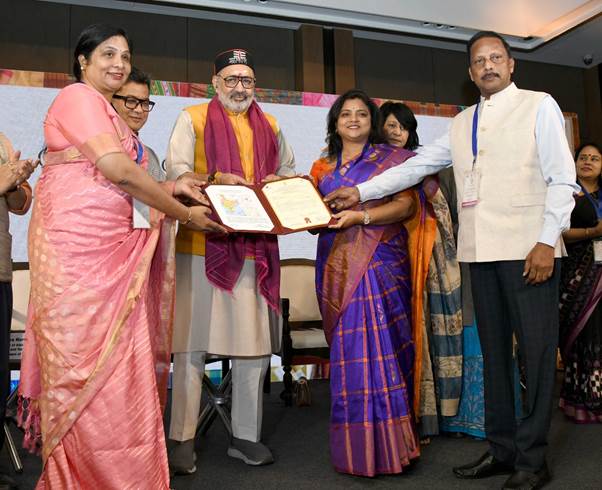
The “GI & Beyond 2024” Summit, organized by the Office of the Development Commissioner for Handlooms, Ministry of Textiles, in collaboration with the Handloom Export Promotion Council (HEPC), successfully concluded on 25.11.2024 at New Delhi. The event highlighted the exceptional skills of artisans who manufactured India’s Geographical Indication (GI) tagged handloom and handicraft products and their global significance.
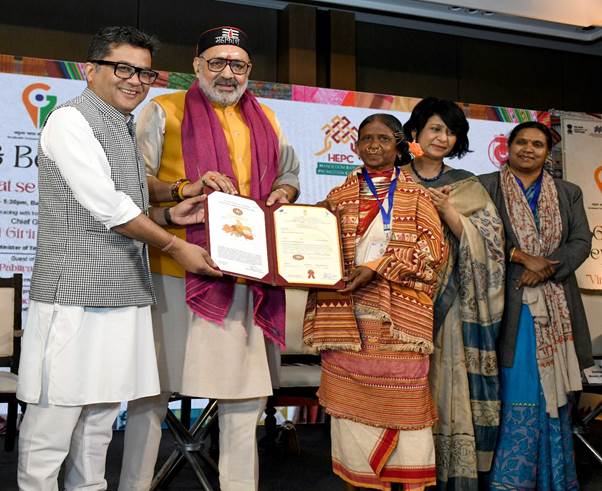
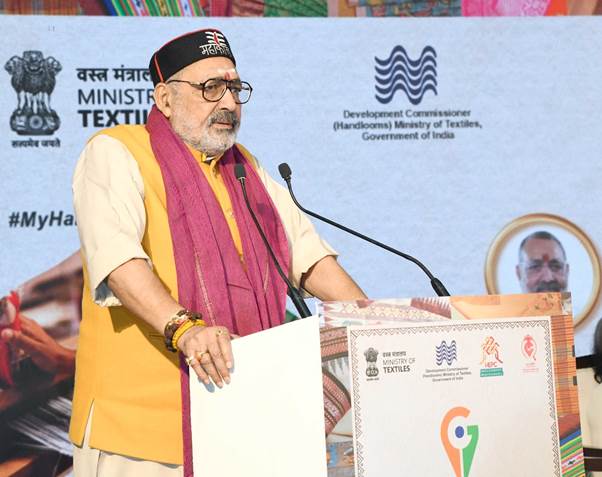
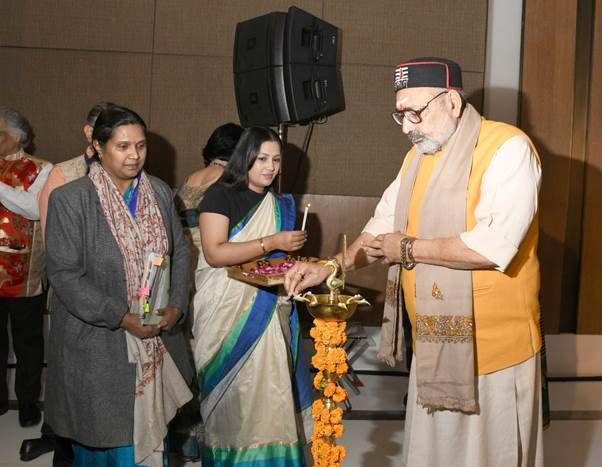
The event was inaugurated by Shri Giriraj Singh, Hon’ble Union Minister of Textiles as chief guest who highlighted the importance of GI products in promoting India’s rich cultural heritage and invited attention of the gathering on the attractive tourism concepts like heritage and cultural tourism for marketing GI goods. HMOT distributed GI certificates to 10 artisans from various parts of the country. Speaking on the occasion, Shri Giriraj Singh said that India received its 1st GI certification in 2004 and now our focus is to increase the income of artisans and how to make GI tagged products go global. The Minister exhorted that we should progress the GI tagged products from “Gaon to Global”. HMOT emphasised the importance of marketing and telling the world about the creativity of our artisans for the promotion of GI products and incorporate the GI tagged products as part of religious and cultural tourism. The Minister appealed the states having GI tagged products to collaborate with Textile Ministry to organize trade festivals exclusively for the promotion and marketing of the products, in the lines of Kutch festival. HMOT highlighted honourable Prime Minister’s vision of Atmanirbhar Bharat and emphasized that along with Vikas we need our Virasat as well. GI tag represents our heritage and as we heading towards Vikasit Bharat, our heritage is our capital, the Minister added.
Shri Pabitra Margherita, Hon’ble Minister of state for Textiles, Government of India graced the occasion as guest of Honour. Speaking at the occasion the MoS pointed out that handloom and handicrafts sector are not just industries, and they are the testament of our country’s diversity, creativity and legacy. Each craft and each artisan tell us a story of its people and its traditions.GI is a tool for empowerment and a shield of our heritage and a bridge to the global market., MOS added.
Smt.Rachana Shah, Secretary Textiles and Dr.M.Beena,Development Commissioner for Handlooms ,Ms. Amrit Raj,Development Commissioner for Handicraft, Ms.Roop Rashi, Textile Commissioner and Shri Unnat Pandit, Controller General of Patents, Trademark & GI also graced the occasion.
The event had representation from 13 countries spread across 4 continents and witnessed around 20 overseas buyers, 50 exporters & MNCs, 70 GI authorised users and 40 officials from various departments including state governments. The diverse representation from various stakeholder of the industry fostered meaningful discussions and collaborations to expand the market potential for GI-tagged products
The technical session on various domains of the trade emphasized the integration of traditional handwoven and handcrafted skill with modern business practices to enhance the global appeal of India’s traditional textiles and craft.
During the event, overseas buyers and domestic exporters interacted with the authorized users of Geographical Indications (GI). The overseas buyer applauded this event which beautifully narrated the tale of ethnic handwoven and handcrafted tradition of India. The domestic exporters stated that the products displayed are quite impressive and captivating. The exporters and overseas buyers expressed their willingness to extend possible support in promoting and to enhance the global presence of GI products.
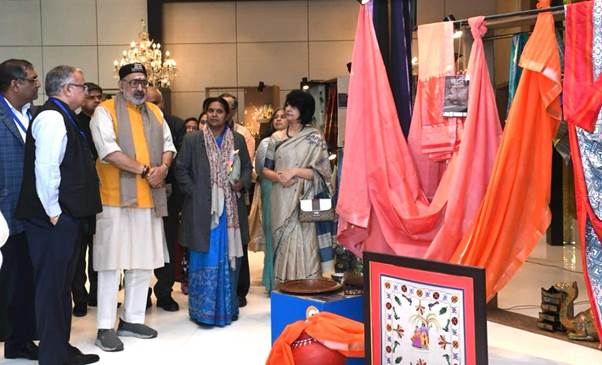
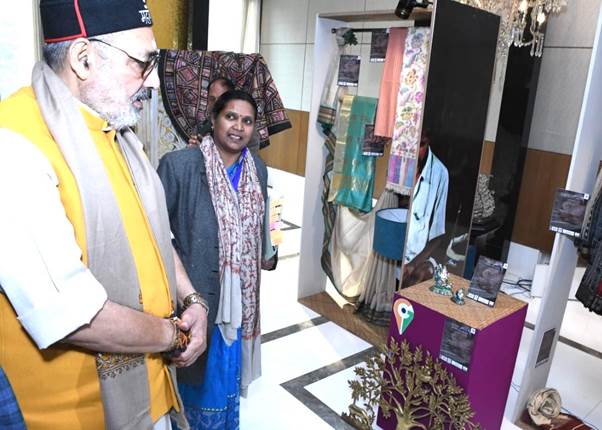
A special thematic display showcased an array of GI-tagged handloom and handicraft products across India, with participation from GI holders and authorized users. The display highlighted the regional uniqueness and cultural value of these artisanal products, attracting significant interest from attendees.
The summit concluded with a collective commitment to continue supporting India’s handloom and handicraft sector, ensuring that the legacy of GI products thrives both nationally and internationally.
Ministry of Statistics & Programme Implementation is releasing the employment related statistics in the formal sector covering the period September 2017 onwards, using information on the number of subscribers who have subscribed under three major schemes, namely the Employees’ Provident Fund (EPF) Scheme, the Employees’ State Insurance (ESI) Scheme and the National Pension Scheme (NPS).
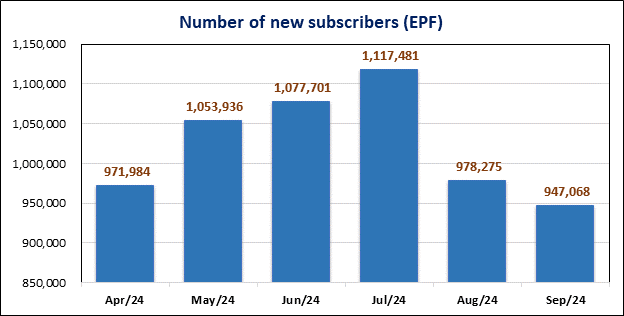
The total number of new EPF subscribers during the month of September, 2024 is9,47,068, which was 9,78,275during the month of August, 2024. The highest number of EPF subscribers 1,117,481 were added during July, 2024.
2.Employees’ State Insurance Scheme:
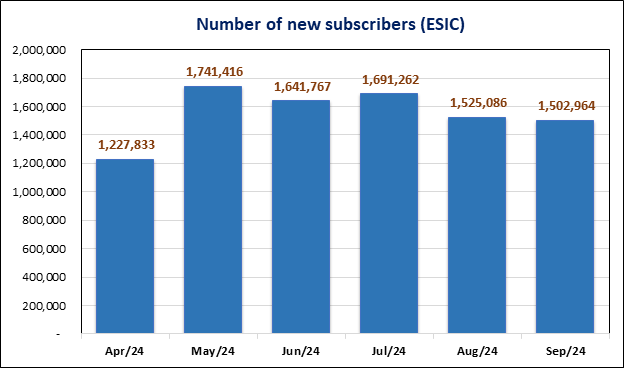
The newly registered employees and paying contribution under the ESI scheme during the month of September,2024 is 15,02,964which was 15,25,086 during the month of August, 2024.
3.National Pension Scheme (NPS):
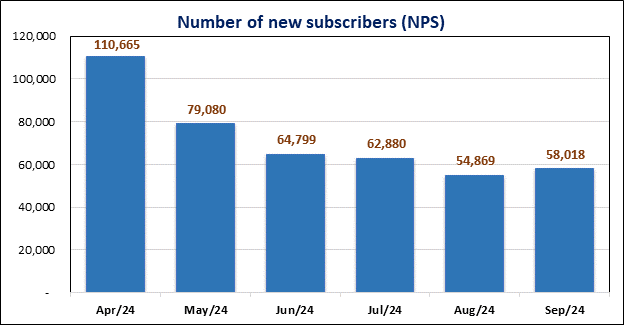
During September 2024, the NPS recorded a total of 58,018new contributing subscribers which was54,869 duringthe month of August, 2024.
National Statistics Office (NSO) under the MoSPI is responsible for conducting large scale sample surveys on various socio-economic subjects on All India basis. These surveys are either Household based surveys where the primary unit of enumeration is a household or Enterprise based surveys where the primary unit of enumeration is an enterprise. These surveys are designed to meet the requirements of various stakeholder Ministries and departments, based on recommendations from various expert groups and committees. The household surveys primarily collect information that is not available either through administrative records or through surveys conducted by domain-specific Ministries or departments.
The surveys are being conducted in digital platform using Computer Assisted Personal Interview (CAPI) or web-based application with in-built validation mechanism to ensure consistency at the stage of data collection. Collected data are thoroughly scrutinized by the supervisory level officers to identify inconsistency, if any and necessary clarifications are obtained/corrections are incorporated. Monitoring of survey process is also accomplished through the digital platform. Before commencement of any survey, extensive training on survey instruments as well as use of CAPI are provided to the field officials. Clarifications are also given on a regular basis on the queries raised by field officials during the course of the survey. Further, Data quality workshops are also organised to address the conceptual queries and monitoring the survey data quality time-to-time. Additionally, survey instruments are periodically improved to enhance data quality. Before taking up any new survey, whether the indicators to be generated from the surveys are available from any other government survey/administrative data sources, are extensively verified to rule out the possibility of duplication of surveys. Also, consultations with relevant line Ministries and departments are held to avoid duplication of work, effort, etc.
Regular dialogues with data users are conducted so that Ministries/ Departments can incorporate their feedback on additional data coverage and disclosure requirements. To facilitate this, MoSPI conducts Data User Conferences after release of results of sample surveys with an aim to engage stakeholders and enhance understanding of the survey’s findings, focusing on data access, interpretation, user concerns and survey methodology. Further, to ensure transparency of survey results, unit level data of the surveys are also made available on MoSPI’s website for access by various researchers, policymakers, etc to better understand, analyze and explore the country’s data.
This information was given by the Minister of State (independent Charge) of the Ministry of Statistics and Programme Implementation, Minister of State (Independent Charge) of the Ministry of Planning and Minister of State in the Ministry of Culture, Shri Rao Inderjit Singh in a written reply in the Rajya sabha today









 Eduindex
You must be logged in to post a comment.