Evolution of Computers

As of now 2021, Computers become very important for our daily life. Computers are in each of every sector like banking, gaming, health care sectors. 20 years back, computers were just used in some purposes only. But now computers become very important for each of every sector. In this blog we are going to discuss the following topics. What is a computer? Why computers are important? Evolution of Computers, and at last Is Computer Science the future of the world?

Photo by Tranmautritam from Pexels

WHAT IS A COMPUTER?

A Computer is machine that can be programmed to carry out sequences of arithmetic or logical operations automatically. Computer consist of two things, one is Hardware and the other is Software. The all physical components of computer like keyboard, CPU, mouse, monitors etc. Comes under the Hardware. The programs, files and programming languages comes under the Software.

EVOLUTION OF COMPUTERS

  1. In 1882, the first computer was invented by Charles Babbage.
  2. In 1880, Herman Hollirith developed in computer which can record and store information in it.
  3. In 1936, the first programmable computer was developed by Konrad Zuse.
  4. In 1947, Bell Telephone Company invented transistors which were the key component of the computer.
  5. In 1953, IBM(International Business Management) came out with there first computer.
  6. In 1962, the first computer video game was invented.
  7. In 1963, Douglas Engelbart invented the computer mouse.
  8. In 1974, IBM and Apple were the companies to sold personal computer(pc) to the people.
  9. In 1991, the first laptop computer came out.

WHY COMPUTERS ARE SO IMPORTANT?

Communication

Due to the use of computers, the communication become much more easier with the help of internet. Now you contact any person in the corner of the world. We can send messages to every person in the world within seconds, all this happen because of computers.

Business

With the help of computers, Huge transactions can be made within seconds. Computers are used to store details about there product in business. Computers are used to keep of record of profit and loses of the company.

Education

Due to the covid-19 pandemic, all schools shifted there education in online mode. Teachers use computers to teach children online. Due to computer, a student can learn anything which he wants from his home itself.

Hospital

Computers are used in hospitals to keep the track record of the patients admitted to the hospital. They are used to detect diseases. They help doctors to perform an operation.

And there are many more reasons why computers become so important in this world.

IS COMPUTER SCIENCE THE FUTURE OF THE WORLD?

Now we came to the most interesting topic in this blog. Nowadays, people are showing more interest towards computer science. Computer science is the most famous branch of education. New emerged careers such Artificial intelligence, Data science and full stack Developer are highest paying jobs in the world, all these are the parts of computer science. Due to the covid-19 pandemic the opportunities of other careers are some what decreased. But the opportunities in Computer science was tend to grow double. There are many career options in computer science. Experts suggest that the growth rate of computer science is 16 percent through 2028. With this we can say that Computer science is the future of the world.

I hope you like this blog, If you like this blog kindly like and rate it. It gives me motivation.


Pros and cons of learning online

Online mode of learning was always there in the market but it has been acquired by almost every institution, college, and school during the pandemic. Login…join a lecture…logout, presently this is what a student’s life sounds like.

So, is the online learning mode efficient enough? 

Well, be it online or offline it always depends upon the pupil. As everyone has a different pace of learning and acquiring things. The online mode may be suitable for someone or maybe not. But in this pandemic, the only option left to us is to learn online. 

So, it brings us to the next question. 

What are the pros and cons of online learning?

There are many pros as there are cons. So, let’s go through them very quickly.

Pro: Flexibility increased

One of the biggest advantages of online learning is the increase in flexibility. You can study at your own pace, you can choose where you want to study, and how you want to study. But this doesn’t mean that the workload is decreased, it will be the same. 

Con: No labs/experiments

Courses like engineering, applied sciences, MBBS need to be understood by experiments and lab practices, which is a major missing when it comes to the online mode of learning.

Pro: More Affordable

Transportation, books, eating at the cafeteria can cost thousands of bugs per semester. Which can be saved while learning online. You just need to pay the annual fee.

Con: Lack of social interaction

One of the biggest disadvantages of learning online is the lack of social interaction. Especially applicable for young undergraduates who should be interacting with people and making friends. 

Pro: Ease of access

In the online mode of learning, all you need is a computer/smartphone with internet access. All the study materials, assignments, and lectures are available either via email or a particular platform like Microsoft Teams, Google Meets, etc.

At the rate by which technology is developing, online learning may become the only option. Well, this you never know. Until the pandemic is over, one should practice discipline in regards to the timetable to learn in a better way. 

Data Breach – An Overview

A data breach occurs when sensitive, confidential, or otherwise protected data is accessed and/or disclosed without authorization. Personal information, such as credit card numbers, Social Security numbers, driver’s licence numbers, and healthcare records, as well as company information, customer lists, and source code, are all common data breach targets. A data breach occurs when someone who is not authorised to see or steals personal data from the entity in responsibility of securing it.

Causes of a data breach

While data breaches can take many forms, they are virtually usually the result of a weakness or flaw exploited by hackers to obtain access to an organization’s systems or processes. A data breach could be caused by a variety of factors, including:

  • weak login credentials
  • social engineering scams
  • malware or ransomware
  • phishing
  • lost or stolen hardware (laptops, hard drives, mobile devices)
  • lack of access controls
  • back doors
  • insider threats
  • user errors

Regulations on data breaches

To avoid data breaches, a number of business guidelines and government compliance rules need stringent controls over sensitive information and personal data. There are no particular laws that govern intellectual property protection. However, a breach of that type of data might result in serious legal conflicts as well as regulatory compliance concerns.

The Payment Card Industry Data Security Standard (PCI DSS) governs who can receive and use personal information (PII) in financial institutions and other businesses that handle financial data. Financial information such as bank account numbers and credit card numbers, as well as contact information such as names, addresses, and phone numbers, are examples of PII.

What can be done to avoid data breaches?

There is no single security technology or control that will completely eliminate data breaches. Commonsense security policies are the most reasonable means of preventing data leaks. These include well-known security fundamentals like:

  • conducting ongoing vulnerability assessments
  • penetration testing
  • implementing proven malware protection
  • using strong passwords/passphrases
  • consistently applying the necessary software patches on all systems

While these measures will help to prevent intrusions into an environment, experts recommend encrypting sensitive data, whether on-premises or in the cloud. Encryption will prevent threat actors from accessing the actual data in the event of a successful breach into the environment.

Well-written security rules for employees, as well as continuing security awareness training to promote those policies and educate staff, are further strategies for preventing breaches and minimising their impact.

Employees may be given the minimal minimum of permits and administrative rights to accomplish their jobs under such rules, such as the principle of least privilege (POLP).

In addition, firms should have an incident response plan in place in the case of a security breach or intrusion. A rigorous method for identifying, containing, and quantifying a security event is usually included in this strategy.

A list of notable data breaches

According to the 2020 Verizon Data Breach Investigations Report, the banking business has the most verified data breaches, followed by information services and the public sector. In recent years, there have been numerous massive data breaches at both huge corporations and government institutions.

Target:
Target Corporation revealed in 2013 that it had experienced a large data breach that exposed customer names and credit card information. People, state governments, and credit card companies have all filed lawsuits as a result of the Target data breach, which affected 110 million customers. Legal settlements totaled tens of millions of dollars for the company.

Sony Pictures:
When threat actors launched malware that disabled workstations and servers in late 2014, Sony Pictures Entertainment’s corporate network was shut down. The data theft was blamed on a hacking group known as Guardians of Peace, which exposed unreleased films taken from Sony’s network as well as private communications from corporate leaders.

Source:
What is a data breach? (techtarget.com)

What is a Bug Bounty Hunter? An Overview

A bug bounty hunter is someone who understands the ins and outs of cybersecurity and is skilled at detecting bugs and weaknesses. Simply defined, a bug bounty hunter examines apps and platforms for bugs that even the in-house development team may overlook. When these professionals find a bug, they report it to the company (or the responsible authority behind the application or platform) and get compensated for their efforts. The advantages aren’t usually monetary in nature.

The concept of a bug bounty is not new, but it has gained hold in India during the previous decade. A bug bounty hunter is not restricted to working for a particular client or firm; instead, all they have to do is find defects and submit them to the appropriate authorities. But why don’t businesses create an in-house bug-hunting team? The rationale behind this is that when a large number of hackers (white hats) are trying to uncover a defect, the chances of the problem being solved fast and easily are substantially higher.

And, if you think about it, firms don’t have to pay their in-house staff on a monthly basis; instead, they can hire people to help them find all the problems and reward them with benefits.

How To Become A Bug Bounty Hunter

Before we get started on how to become a bug bounty hunter, having a cybersecurity expertise or a good understanding of vulnerability assessment will be beneficial.

This is the first and most important item to perform before diving into the getting started process, regardless of the domain. Look for trends in the bug bounty sector, such as what platforms are used, what hacking methods are used, and what tools are used, and so on. This will give you an idea of how to go about getting started as a bug bounty hunter. Cross-site scripting (XSS), SQL Injection, Business Logic, and Information Gathering are some of the major areas to concentrate on.

Training And Education

Cybersecurity is a broad subject that cannot be grasped in a few days. When it comes to studying the ins and outs of vulnerability assessment, people either take a quick course or enroll in a full-fledged course. However, it is entirely up to you and how quickly you want to learn.

You can always enrol in full-time cybersecurity training, such as CEH, if you want to take things a step further. And just because you’re enrolled in a full-time programme doesn’t mean you can’t employ the practical approach. When you first begin to gather expertise, you should start with various online bug bounty programmes.

Another way to learn the game is to read POCs written by other hackers or to watch YouTube lessons. It’s also regarded as one of the most effective strategies to broaden your horizons. When it comes to practising vulnerability assessment or penetration testing, this is one of the most important things to remember. While training colleges give you with a practise platform, self-taught professionals may find it difficult. It is not legal to hack into random websites or platforms on the internet. As a result, setting up a virtual system to practise your talents is always a good idea. You can also try practising on bug bounty programmes on your own. You examine all of the previous year’s bugs, as well as the tactics employed.

Can we ever be able to travel with speed of light?

From more than a century humankind is asking about could we ever be able to travel with speed of light, Is travel with speed of light is possible?. As space enthusiasts, could space ships shown in movies star trek and star wars be possible, can we make warp drives?

Let us first discuss about speed of light. It is a cosmic speed limit. Speed of light is fastest speed of which any two poles in space can communicate with each other. It is a speed at which light travels. In one second a beam of light can make 8 rotations. The standard speed of light if we convert to km/hr than speed of light is 1,079,252,848.8 km/hr(1.07 billion km/hr). Or we can say 299,792,458 meter/sec. So again question arises can this speed be achievable. If we can make to travel with speed of light then to reach to our nearest star Proxima Centauri it will take 4.2 earth years. So if we travel 5 times speed of light then to reach proxima centauri it will take nearly 1 year.

In 1994 a Mexican physicist Miguel Alcubierre published a theory, in which he showed how a warp drive is possible with Albert Einstein’s Theory of General Relativity. He said that in order to make a warp drive it will require a huge amount of negative energy. Negative energy equivalent t mass of Jupiter.

Alcubierre said that if the lift hand side of Einstein’s equation is for curvature of space-time, right hand side is newton’s gravitational constant with T is stress energy factor, then there requires a negative energy in right side to bend fabric of space-time. Alcubierre determined that the ship needed to stay inside a flat space-time bubble, which is such that it can move with any arbitrary speed.

But, Alcubierre’s theory is as real as fiction. As we know that negative energy is not possible and does not exists. Anti matter exists and is different from negative energy. Anti matter is a regular matter with opposite charge but with it has positive mass.

In 2021 paper by physicist Erik Lentz of Gottingen University showed that space time warp bubble solution is possible by positive energies and theoretically move at any arbitrary speed.

Again we have question that is warp drives be possible? The answer is Yes.

In recent papers published by Advanced propulsion laboratory at Applied Physics authors Alexey Bobrick and Gianni Martire showed that how warp drives are possible without negative energy. They showed that we can travel with some fraction of speed of light, but to travel faster than speed of light you would need a superluminal matter. In other words, you would need a matter that travels faster than speed of light. Accelerating anything with mass to speed of light requires an infinite amount of energy. This would be true for any warp engine design, but is impossible.

Gianni and Bobrick showed that there are four types of warp drives, of which Alcubierre showed class 3 type. They showed that Class 1 type of warp drive is physically possible with positive energy and real matter and they don’t travel with speed of light. These classification is based on speed inside the bubble(Vin) and speed outside the bubble(Vout).

These can be achieved by time dilation. Gianni and Bobrick proposed two ways of time dilation, either you go really fast with 90% of speed of light or you put yourself into a strong gravitational field. The stronger the gravitational speed the slower the time passes for passengers. If we make a ship of super dense material, perhaps close to mass of a neutron star then gravitational field will be strong enough for time dilation. They designed a shape, if the ship has diameter of 620 meter with mass of 10% as of sun then time for the passengers inside the ship will be 1/10. The passengers will travel to Proxima Centauri in 9 Earth years but for passengers inside ship will feel as of 10 months.

But to move such a massive ship we need a powerful engine. If we convert its 13% mass to energy than we can get enough energy. The one way is fusion as it converts 1% of mass to energy. The one Bobrick and Gianni proposed that if we take advantage of Gravitational Accretion Energy. This is disklike flow of dust, gas and plasma orbiting around a massive astronomical object. The friction and loss of angular momentum creates huge amount of energy that potentially be harnessed. Accretion disk can convert 10% of any given mass into energy which is highly sufficient.

Now the question is no longer “If” humanity will achieve warp travel, now the question is “When”.

Credit: Arvin Ash: https://youtu.be/PA66ah9b0U4 Reference Papers: Bobrick and Martire: https://arxiv.org/pdf/2102.06824.pdf Website: https://appliedphysics.org/ Lentz: https://arxiv.org/pdf/2006.07125.pdf

Online Risks and Threats

The internet is a fantastic tool for communicating, sharing information, and collaborating, but users of all ages must adhere to specific guidelines in order to stay safe online. Every Internet user leaves a digital trail of data, which includes websites viewed, emails sent, and information provided to online services. Consider the data trail you’re leaving in your wake. Before writing a nasty email, keep in mind that you are leaving your digital footprint, as the message may live online indefinitely. Be more selective about what you post on social networking platforms. While you can usually delete content from social media sites, there’s no guarantee you’ll ever be able to delete digital data once it’s been shared online.

Grooming on the internet

Strangers, or even known people, form an emotional bond with a child or young person online or in person in order to gain their trust for sexual abuse or exploitation. Many youngsters and teenagers begin to acquire feelings of a particular connection or relationship and are unaware that they are being groomed.

To seduce the youngster, the perpetrators are known to utilise a variety of ways, including:

Bribing: This can include giving the child money or presents. In an online game, the gifts could be in the form of even points, lives, and in-game goodies.
Flattery: They strive to earn the child’s affection by showering them with praise and attention.Intimacy building and sexualized games: They put the child’s fragility to the test by adding slightly sexual overtones in conversation or during play. If the child responds positively to his overtures, he will try to develop a deeper relationship with him.
Desensitization: They show the child pornography and child sexual abuse material in an attempt to desensitise the child to sexual behaviours.
Threats and extortion: To acquire access to the youngster, they use forceful coercion.
When parents are unsure what the youngster will respond to, they may try all of the above in an attempt to pique the child’s interest and attention.

Sexual exploitation on the internet

The internet has also become a tool for sexually exploiting children, resulting in practises known as “online,” “ICT-facilitated,” or “cyber-enabled” child sexual exploitation, which encompasses all acts of sexual exploitation committed against a child that have, at some point, a connection to the online environment. It includes any use of ICT that leads to sexual exploitation or causes a child to be sexually exploited, or that leads to or causes the production, purchase, sale, possession, distribution, or transmission of photographs or other material documenting such exploitation.

Theft of one’s identity

Personal information such as address, email address, prior addresses, mother’s maiden name, place of birth, pin number, bank account details, Aadhaar number, and passwords is obtained by fraudsters and used in an unlawful manner for personal advantage. Companies or service providers frequently demand this information as part of their verification procedure. They can access other information about the potential victim and make unauthorised financial transactions using the victim’s credit card or bank account, as well as commit other crimes such as illegally entering (or exiting) a country, trafficking drugs, smuggling other substances, committing cyber-crimes, laundering money, and much more, by obtaining some information. They can even exploit the victim’s identity to commit nearly any crime in his or her name.

If a criminal uses another person’s identity to commit a crime, the victim may be suspected by the authorities. The victim may find themselves the subject of a criminal inquiry, and they may find it difficult to prove their innocence in such situations. Victims of financial fraud may face a slew of problems. You might be stuck with debts if your information was utilised in any type of monetary transaction. Most of the time, if you can show that the debts are not your fault, you will not be held guilty. Proving that you are not at blame, on the other hand, can be difficult and time-consuming.

Cyberbullying

When someone utilises technology (such as the internet or a mobile phone) to bully others, this is known as cyberbullying. Being a victim of cyberbullying can be extremely upsetting for a young child, especially when they often have no idea who is tormenting them. Sending threatening text messages or emails, or creating a hate group on a social networking site, are examples of cyberbullying. Bullying can occur at any time of day or night, and the victim is frequently targeted even when they are at home. On the internet, images and text messages may spread quickly and widely, making it difficult to counteract cyberbullying.

Source:
Online risks and threats — Vikaspedia

Viruses and Malicious software

A computer virus is a piece of software that can “infect” other programs by modifying them; The modification includes injecting the original program with a routine to make copies of the virus program, which can then go on to infect other programs. A virus can do anything that other programs do. The difference is that a virus attaches itself to another program and executes secretly when the host program is run.

The terminology in this area presents problems because of a lack of universal agreement on all of the terms and because some of the categories overlap. Malicious software can be divided into two categories: those that need a host program, and those that are independent.

  • Need a host program : The former, referred to as parasitic, are essentially fragments of programs that cannot exist independently of some actual application program, utility, or system program.  Examples: Viruses, logic bombs, and backdoors
  • Independent malware is a self-contained program that can be scheduled and run by the operating system.  Examples : Worms and bot programs

Backdoor or Trapdoor

A backdoor, also known as a trapdoor, is a secret entry point into a program that allows someone who is aware of the
backdoor to gain access without going through the usual security access procedures. Programmers have used backdoors legitimately for many years to debug and test programs; such a backdoor is called a maintenance hook. It Has been commonly used by developers. A threat when left in production programs allowing exploited by attackers. It is very hard to block in O/S. It requires good s/w development & update.

Logic Bomb

It is one of oldest types of malicious software. The code is embedded in legitimate program. It is activated when specified conditions met
 Eg presence/absence of some file
 Particular date/time
 Particular user
When it is triggered it typically damages system, Modify/delete files/disks, halt machine, etc.

Trojan Horse

A Trojan horse is a useful, or apparently useful, program or command procedure containing hidden code that, when invoked, performs some unwanted or harmful function. Trojan horse programs can be used to accomplish functions
indirectly that an unauthorized user could not accomplish directly, Which is usually superficially attractive. Eg game, s/w upgrade etc. When it runs performs some additional tasks. Allows attacker to indirectly gain access they do not have directly. Often used to propagate a virus/worm or install a backdoor. Another common motivation for the Trojan horse is data destruction. The program appears to be performing a useful function (e.g., a calculator program), but it may also be quietly deleting the user’s files.

Zombie

Program which secretly takes over another networked computer is called zombie. Then uses it to indirectly launch attacks. Often used to launch distributed denial of service (DDoS) attacks. Exploits known flaws in network systems.

Getting a Job in Google.

Year after year, Google has been ranked as one of the top companies to work for, so it’s no surprise that the tech giant receives roughly three million applications per year. With an acceptance rate of 0.2%, you’d have a better chance of getting into Harvard.

It is difficult to get a job at Google because of their quality standards and the high number of applications they receive per year. For example, INC reported that Google receives 2 million job applications per year, which means it’s more competitive to get into than Harvard University.

Google is an employer of choice for the world’s top talent, typically receiving hundreds of resumes for every opening, which allows them to be extremely selective in their hiring.The hardest part is getting an interview. If you attend a university, go through campus recruiting.

According to the Pascale, The lowest paid Google employees are Entry Levels at $51,000.Google says there is no degree or prior experience required. In fact, 61% of learners enrolled do not hold a four-year degree. This certificate could be a perfect launchpad to a career in IT.

So if you have a keen interest in working at Google California or at any other branches of Google work hard my friend. More than studies work on yourselves, on your IQ level the interviewees are not going to ask you a question from your syllabus.

Types of Attacks

The following are the four general types of attacks:

  1. Interruption
  2. Interception
  3. Modification
  4. Fabrication

Interruption

A system asset is destroyed, made unavailable, or made useless. To put it another way, a network service is degraded or made unavailable for lawful purposes.

They are attacks against the availability of the network.

Examples of Interruption Attacks:

  • Overburdening a server host to the point that it is unable to reply.
  • Severing a chain of communication
  • Overloading an intermediary network or network device to prevent access to a service.
  • Requests are being redirected to invalid locations.
  • There is a risk of software or hardware theft or destruction.
  • File management systems are disabled.

Mitigate the attack:

  • Firewalls can be used to allow or reject protocols, ports, or IP addresses. Modern stateful firewalls, such as the Check Point FW1 NGX and Cisco PIX, have the capacity to distinguish between legitimate traffic and DoS attack traffic.
  • Maintaining appropriate backups of system configuration data.
  • Replication.

Interception

An asset is accessed by an unauthorized person. A human, software, or a computer might be an unauthorized party. To put it another way, an unauthorized person obtains access to confidential or private data.

They are the attacks against the confidentiality objective of the CIA Triad.

Examples of Interception Attacks:

  • Eavesdropping in on conversations.
  • Telecommunications networks are being wiretapped.
  • Copying files or programs without permission.
  • Obtaining copies of messages in order to replay them later.
  • To capture data from a computer system or network, packet-sniffing and keylogging are used.

Mitigate the attack:

  • Encrypting the flow of information from source to destination – SSL, VPN, 3DES, and BPI+ are used to encrypt the flow of information from source to destination so that if someone is able to eavesdrop on the traffic, all they will see is ciphered text.
  • Traffic Padding is a function that generates ciphertext output endlessly, even when plain text is not available. A random data stream is created endlessly. The plaintext is encrypted and sent when it is available. When there is no plaintext in the input, the random data is encrypted and delivered. As a result, an attacker will be unable to discriminate between tree data flow and noise, and hence will be unable to estimate the quantity of traffic.

Modification

An unauthorized person not only obtains access to an asset but also tampers with it.

This is an attack against the integrity of the information.

Basically, there are three types of modifications:

  • Change: Make a change to the information that already exists. The information was previously available, but it was wrong. Change attacks can be used to target either sensitive or public information.
  • Insertion: When an insertion attack is carried out, data that did not exist earlier is inserted. This attack might be used against historical data or data that hasn’t been acted on yet.
  • Deletion: Deletion is the process of removing data from a system.

Examples of Modification Attacks:

  • Modifying the contents of network communications.
  • Changing data files and their contents.
  • Changing programs to make them function better.
  • System hardware or network topologies are being reconfigured.

Mitigate the attack:

  • Intrusion detection systems (IDS) were introduced, which could check for various signatures that indicate an attack.
  • Encryption methods are used.
  • Padding for traffic
  • Backing up your data
  • Use checksums, sequence numbers, digests, and authentication codes as communications methods.

Fabrication

Counterfeit items are inserted into the system by an unauthorized entity. Simply said, a person introduces false information, resources, or services into a network.

This is an attack against authenticity.

Examples of Fabrication Attack:

  • Using the identity of another person to send communications across the network.
  • Replaying communications that were previously intercepted.
  • The act of impersonating a website or other network service.
  • Taking another host’s or service’s address and effectively-becoming that host or service.

Mitigate the attack:

  • Authentication and authorization methods are used.
  • Putting Firewalls to Work
  • Use Digital Signatures – A digital signature method is a mathematical scheme for proving a digital message or document’s authenticity.

Short and Long form content: Their relevance

The terms short and long-form content gets thrown around a lot in the realm of the internet but if we were to clearly define and differentiate both type of content. Then it becomes much harder to discern between the two.

For instance, if we were to describe, how many word counts define long-form content. Then we will notice that there is no particular amount of words that will fulfill those criteria. For some content creators, 1000 words might be long and for some, it may be short. This same principle can be applied to the viewers as well. Due to these many experts consider long-form and short-form as more of beliefs rather than any specific word count. The word count can also vary according to the type of content and subject.

Now let us transition into the social media platforms instead to understand this phenomenon better. In a nutshell, the rise of short-form of content and marketing sounds likes a great deal but we have to look at the underlying challenges and opportunities that come with it. Tik-Tok, Instagram, and many other platforms have become quite popular but somehow YouTube still manages to be relevant. Why is that?

One of the biggest strengths of YouTube and its encouragement of long-form of content is the higher level of engagement. Long-form of content is easier to monetize, instead of one ad banner in a one-minute video a creator can add multiple advertisement banners in a 20-minute video. Advertisers prefer that and so does the platform, this also incentivizes the content creator to make long-form content. In the advent of the pandemic, many platforms that focused on short-form content have suffered. An example of this is ‘Quibi’, which started as a Netflix alternative on the go, and many people were not traveling and restricted to their homes due to the restriction and lockdowns. The relevance of Quibi shifted to a very volatile situation. Because when a person is at home, he/she prefer to watch a full episode instead of a brief version of that content. We cannot determine the exact failure of Quibi but it’s certainly one of the major contributors to this.

When does short content Work?

This is not to say that short-form content does not work, because the popularity of platforms that cater to short-form content is thriving especially when it comes to images and short videos. This means that it’s very crucial to determine the target audience. Although Tik-Tok and Instagram might not have the original content and monetization possibilities as compared to YouTube. They are still the go-to platforms for many new creators and numerous advertisers.

But things are a little different when the content is in written form. It’s also essential to understand when the short-form content works and when it does not. For instance, Buzzfeed focuses on large volumes of shorter content. Another thing to keep in mind is that multimedia is an integral part of Buzzfeed content and sometimes the content only acts as a supplementary shell for their multimodal content.

Due to a busy work-life balance, people tend to have less time to spare, and short-form content seems like the right choice. It also works well on mobile application platforms. Applications like ‘inshorts’ and ‘dailyhunt’ have perfected the short-form content delivery. While working on short-form content, there are a few more prerequisites that are necessary. For example, the content needs to be on point and needs to convey the whole story succinctly. To keep the engagement the need for multimedia inputs also becomes more important. Due to the digital transformation of the news, the time cycle of news has become compressed, readers demand any kind of news instantly and news is now consumed in binges.

Things to keep in mind and is it good or bad?

Short-form content also requires short-form marketing. This is a challenging area where advertisers are trying to keep the users engaged but they also have to ensure to not annoy them with on the face and bombastic ads. This is one area that is still not well received by the consumers.

There is no particular answer to the question if the rise of short-form content is good or bad. This all depends on the context of the problem. While designing and creating the content, the writer will have to determine the target audience. This essentially solves half the problem. There is a demand for short-form content but this is more relevant concerning video and photo content sharing. Written short-form content needs to be accompanied by multimedia to make it enticing. While the heading needs to be attractive but overly clickbaity headings should be avoided. The epidemic of fake news in instant messaging platforms like Whatsapp has left a sour taste in people’s mouths.

Many predicted that desktops will be wiped out as smartphones arrive but desktops are still relevant and even though a mobile-first strategy is preferential, almost every major website still offers a desktop equivalent to their mobile counterparts. The reason is simple, less bounce and significantly higher average time on the site.

The same can be applied to the long-form content, with long-form content there are more possibilities compared to short-form content. There can be additional content and features like good or bad, or pros and cons, just like I’m doing here! Various examples, references, graphs, etc can be complimented to the content. It also becomes easier to organize content with numerous subheadings to make content much more intelligible. This is not to say that the longer the content is necessarily better because sometimes long-form content results in a point of diminishing returns. In many cases, the topic and subject are much more important than the form of content. Content relevance, internal linking structure, User Experience design, pictures, videos, and the quality of a website or application are very important as well.

In conclusion, we can say that both short-form and long-form of content are relevant, the only catch is to determine which type of content applicable in that particular situation. Short-form content platforms have seen a huge surge of popularity but on the contrary, marketing and monetizing of short-form has their own sets of problems that are needed to be addressed.

History Of C Language

There are many programming languages in use today, one of which is C. There are many offshoots of the C programming language, including Objective-C, C++, and C#. None of these are the same language.
THE BEGINNING:
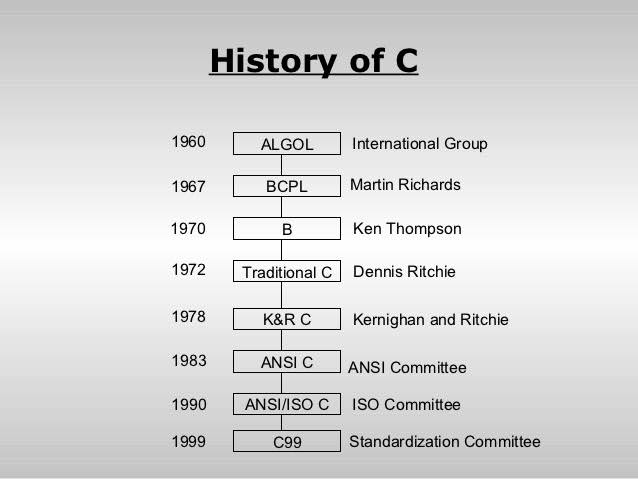
The C programming language came out of Bell Labs in the early 1970s. According to the Bell Labs paper The Development of the C Language by Dennis Ritchie, “The C programming language was devised in the early 1970s as a system implementation language for the nascent Unix operating system. Derived from the typeless language BCPL, it evolved a type structure; created on a tiny machine as a tool to improve a meager programming environment.” Originally, Ken Thompson, a Bell Labs employee, desired to make a programming language for the new Unix platform. Thompson modified the BCPL system language and created B. However, not many utilities were ever written in B due to its slow nature and inability to take advantage of PDP-11 features in the operating system. This led to Ritchie improving on B, and thus creating C.

The development of C was to become the basis for Unix. According to the Bell Labs paper, “By early 1973, the essentials of modern C were complete. The language and compiler were strong enough to permit us to rewrite the Unix kernel for the PDP-11 in C during the summer of the year.” This now meant that C was becoming a strong language that could, and would be, implemented across many systems. By the middle of the 1970s, the C-based Unix was used in many projects within the Bell System as well as “a small group of research-oriented industrial, academic, and government organizations outside [Bell Labs]”. In 1978, Brian Kernighan and Dennis Ritchie published The C Programming Language, which would serve as the language reference until a formal standard was adopted. Five years later, the American National Standard Institute (ANSI) formed the committee, X3J11, to establish the formal standard of C. The C standard was ratified as ANSI X3.159-1989 “Programming Language C”. This was the first formal standard of C. Currently, we are on the fourth standard of C, known as C18 as it was published in June of 2018

Over time, C began to be used in personal computers for developing software applications and other purposes.
The first change (even if only a little) came when the American National Standards Institute (ANSI) formed a committee in 1983 to standardize C. After a review of the language, they modified it a little so that it was also compatible with other programs that preceded C. So the new ANSI standard came into being in 1989, and is known as ANSI C or C89. The International Organization for Standardization (ISO) has also contributed to the standardization of C.
Over time, C has evolved as it has added some significant features like memory management, functions, classes and libraries to its rich feature set. C is being used in some of the biggest and most prominent projects and products in the world.
C has also influenced the development of numerous languages such as AMPL, AWK, csh, C++, C–, C#, Objective-C, Bit C, D, Go, Java, JavaScript, Julia, Limbo, LPC, Perl, PHP, Pike, Processing, Python, Rust, Seed7, Vala and Verilog.
USES TODAY :
According to Toptal, UNIX operating systems are written in C and most of Linux is also in C. Also databases such as Oracle Database, MySQL, MS SQL Server, and PostgresSQL are at least partially written in C. C is the basis of many system kernels. Other programming languages, like Python and Perl, use compilers or interpreters that are written in C.
C has changed over the years and is still a common language to use in lower level programs, like kernels. But it is also used for many applications ranging from device drivers to other programming languages’ compilers or interpreters. The language also made way for C++, Objective-C, C#, and many more C-based languages that each have their own speciality.

Flavors of Unix

Unix is not a single operating system. It is in fact a general name given to dozens of o.s. by different companies, organizations or groups of individuals. These variants of unix are referred to as flavors. Although based on the same core set of unix commands, different flavors can have their own unique commands and features, and are designed to work with different types of h/w. Linux is often considered a unix flavor.

Among the ways in which the various flavors of UNIX differ are (1) fundamental design, (2) commands and features, (3) the hardware platform(s) (i.e., processors) for which they are intended and (4) whether they are proprietary software (i.e., commercial software) or free software (i.e., software that anyone can obtain at no cost and use for any desired
purpose).

Linux :
The most popular and fastest growing of all the Unix-like operating systems. It is developed by Linus Torvalds, Linux is a product that mimics the form and function of a UNIX system, but is not derived from licensed source code. Rather, it was developed independently; by a group of developers in an informal alliance on the net. A major benefit is that the source code is freely available (under the GNU copyleft), enabling the technically astute to alter and amend the system; it also means that there are many, freely available, utilities and specialist drivers available on the net. Linux is a registered trademark of Linus Torvalds. Recent versions of Glibc include much functionality from the Single UNIX Specification, Version 2 (for UNIX 98) and later.

FreeBSD :
The most popular of the BSD systems (all of which are direct descendants of BSD UNIX, which was developed at the University of California at Berkeley). BSDI is an independent company that markets products derived from the Berkeley Systems Distribution (BSD), developed at the University of California at Berkeley in the 60’s and 70’s. It is the operating
system of choice for many Internet service providers. It is, as with Linux, not a registered. UNIX system, though in this case there is a common code heritage if one looks far enough back in history.

IBM :
IBM has been quietly working on its mainframe operating system (formerly MVS) to add open interfaces for some years. In September 1996, The Open Group announced that OS/390 had been awarded the X/Open UNIX brand, enabling IBM to identify its premier operating system to be marked UNIX 95. This is a significant event as OS/390 is the first product to guarantee conformance to the Single UNIX Specification, and therefore to carry the label UNIX 95, that is not derived from the AT&T/ SCO source code.

NetBSD :
NetBSD is a free, fast, secure, and highly portable Unix-like Open Source operating system. It is available for a wide range of platforms, from large-scale servers and powerful desktop systems to handheld and embedded devices. Features the ability to run on more than 50 platforms, ranging from acorn26 to x68k

OpenBSD :
The OpenBSD project produces a FREE, multi-platform 4.4BSD-based UNIX-like operating system. Our efforts emphasize portability, standardization, correctness, proactive security and integrated cryptography. As an example of the effect
OpenBSD has, the popular OpenSSH software comes from OpenBSD. It May have already attained its goal of becoming the most secure of all computer operating systems.

Darwin :
Darwin is an open-source Unix-like operating system first released by Apple Inc. in 2000. It is composed of code developed by Apple, as well as code derived from NeXTSTEP, BSD, Mach, and other free software projects The new version of BSD that serves as the core for the Mac OS X

Many of the proprietary flavors have been designed to run only (or mainly) on proprietary hardware sold by the same company that has developed them. Examples include:

  • AIX – developed by IBM for use on its mainframe computers
  • BSD/OS – a commercial version of BSD developed by Wind River for Intel processors
  • HP-UX – developed by Hewlett-Packard for its HP 9000 series of business servers
  • IRIX – developed by SGI for applications that use 3-D visualization and virtual reality
  • QNX – a real time operating system developed by QNX Software Systems primarily for use in embedded systems
  • Solaris – developed by Sun Microsystems for the SPARC platform and the most widely used proprietary flavor for web servers
  • Tru64 – developed by Compaq for the Alpha processor

Legal analysis of doxxing


What is the definition of doxxing?
Doxxing, short for “dropping dox,” is an internet attack in which hackers collect personal information and documents, hence the “dox” element of “dropping dox,” in order to reveal the true identity of someone who wanted to remain anonymous.
Doxxing is a harmful act carried out by hackers against someone with whom they disagree or detest. The goal is usually to make the victim feel humiliated or harassed. Hackers, for example, might divulge the identify of an anonymous message board troll in order to embarrass that person. They might want that person to lose their job or be shunned by their coworkers or friends.


Doxxing comes in a variety of forms:—


Doxxing celebrities
Journalists frequently gather information about a celebrity’s personal life and publish it on their social media platforms. Doxxing, on the other hand, isn’t exactly common in the entertainment world. The hacker reveals personal information about the celebrity, such as credit card numbers, email addresses, social security numbers, and phone numbers.

Doxxing with a flaw
Doxxing is occasionally carried out by online vigilantes who are too indolent to conduct full research or examinations on their targets to ensure they are dealing with the correct person. Rather, they mistakenly link people to unrelated activities or events. As a result of such “bad” doxxing, innocent persons face the following consequences:
Loss of reputation, job loss, harassment, physical damage, or death are only few of the consequences.

Doxxing for retaliation
Doxxing can be used as a method of retaliation. They disclose publicly identifiable details about their rivals on the internet to humiliate them.

Doxxing swapping
Swatting is a doxxing technique. When someone falsely accuses someone of committing a crime, police (or a SWAT squad, as the case may be) are dispatched to the victim’s home to harass them. The victim of doxxing, on the other hand, is frequently killed.

Doxxing is a method of exposing criminals.
While most swatting is done for fun, some people use it to commit serious crimes like murder. They publicise personal information about their opponents on the internet and encourage others to harm them. The purpose could be personal vengeance or expressing disagreement or animosity toward a particular cause, religion, activity, or race..


Is it legal to doxx someone?
Doxxing is usually not deemed illegal if the content exposed is in the public domain and was obtained legitimately. However, regulations intended to prevent stalking, harassment, and threats may make doxxing unlawful in your jurisdiction.
It also relies on the specific information disclosed. Giving someone’s true name, for example, is less risky than giving out their home address or phone number. Doxxing is both immoral and unlawful, and you could face serious legal consequences, including imprisonment, if you are caught harassing people and releasing their personal information. Detecting and prosecuting these kinds of crimes can be difficult.

The Truth About Crop Circles

Garden-variety crop circle.

Crop circles have been appearing in grain fields all over the earth during the last few decades. They appear suddenly, usually at night. At first they were simple circles of bent-over grain stalks. Soon a new crop of more elaborate designs evolved—geometric forms reminiscent of profound mathematical theorems.

Some cerealogists (people who study crop circles) say that these diagrams must be created by intelligent alien beings from elsewhere. Even though these diagrams must be constructed in a very short timespan, the genuine crop circles never show any serious mistakes or blunders of execution. Cerealogists see this as evidence that the aliens must be very intelligent and much more advanced than we are. That’s mere speculation, of course. Others say the real reason is that there’s a worldwide conspiracy to hide the fact that the aliens sometimes do make mistakes. This coverup is carried out by people who want to preserve the myth that the aliens are a perfect race. The fact that you’ve never heard of such crop circle blunders just shows how effective this coverup is, they say. Mistakes are repaired at the site, or sometimes photographs of the circles are retouched. This has about as much to recommend it as any of the other conspiracy theories accepted and believed by simple-minded people.

Let’s look at more plausible explanations. Actually, a few designs do seem at first to have apparent irregularities or flaws. Some of these are surely caused by wind or rain, careless hoaxers or the trampling feet of crop circle buffs. But let’s set those aside and look only at those that are genuine and undisturbed. What appear at first to be iregularities or errors, may only be perfection of a higher and subtler kind, that we do not as yet understand.

Crop circles made by aliens?

Why should supposedly intelligent aliens travel huge cosmic distances across the galaxy just to doodle in our grain fields? What an absurd idea! [1] No one has ever seen them doing it, have they? Usually there aren’t even any ufo sightings associated with the circles, except for those reported after the fact by people with overactive imaginations. Surely intelligent aliens have better things to do. The true origin of crop circle designs may be nearer to home.

The whole thing begins to make sense once we realize that the earth is flat. We live on the backside of a huge flat blackboard (whiteboard, scratch paper, or whatever) used by aliens in their schools and universities. There are many of these in the universe. The flat disk of the earth is thin enough that student doodles made in alien art and math classes “bleed through” to our side. This happens because their writing instruments emit mitogenetic radiation (M-rays) that are well known to affect some living plants, especially wheat, barley, oats and corn. [2] M-rays weaken the stalk structure near the ground, and the stalks bend over gently to lie flat on the ground, showing no evidence of forceful breaking. So the crop circles in grain fields are nothing more than the reverse pattern of alien students’ diagrams made in geometry class.

Look carefully at photos of crop circles in books and on the internet, and a striking fact emerges. Crop circle designs are constructed from circular arcs and straight lines. Even the more complex crop circles, including those made to look like Mandelbrot sets, or the head of Mickey Mouse ©, conform to this rule. All crop circles can be constructed using the standard methods of Euclidean geometry. This should tell us something. The aliens making these drawings must be using ungraduated rulers and compases. [3] Has anyone ever seen a crop circle based on the form of a pentagon?

It’s true that a few designs have straight lines and curves that seem at first to be more complex than circles. But we must remember that straight lines are simply circles of infinite radius. Any complex curves can be constructed approximately from circular arc segments of different radius.

Did they use a ruler?

There’s good evidence that aliens have been defacing the earth’s surface with geological grafitti for a very long time. The curious lines and drawings on the Nazca plain in Peru likely have the same cause. At that earlier time in history the aliens had only primitive writing instruments. They were still using “pens” made of inorganic material, that emit E-rays (Earth rays). These only affect non-living things. Sand on flat ground is easily moved around with very little energy. The sandy surface of the Nazca plain acted like a giant Etch-A-Sketch ®. No advanced mathematical figures are found at Nazca, only long straight lines, pictures and geometric doodles. Obviously the aliens weren’t as scientifically advanced then. Then why are the lines so perfect, and the straight lines so straight? The reason is quite simple: on their side of the blackboard the aliens used rulers.

School kid’s prank?

A number of commentators claim to have proven to their own satisfaction that the Ancient Egyptians didn’t have the resources or technology to build the pyramids. Could it be that the pyramids of Egypt were built by alien kids, who, in a playful mood, pushed their play blocks into their blackboard, all the way through, coming up point first on our side? Following this line of reasoning, perhaps Stonehenge and similar structures are the result of an alien children’s game in which stone pegs are pushed into a geometric array of holes

Infosys Success Story

Infosys is a Indian Multinational Company and one of the top IT company in India. Infosys was started in 1981 with just 10,000 rupees. By April 2021, the net worth of Infosys is $78.32 Billion making it one the top IT company in India. In this blog we going to discuss Who started Infosys? Growth of Infosys ? Milestones of Infosys ? Infosys Tagline. Competitors of Infosys. Some interesting facts about Infosys.

WHO STARTED INFOSYS ?

Infosys stands for Information Systems was started in Bangalore by the employees of Patni Computer Systems. The founders of Infosys are Narayana Murthy, Nandan Nilekani, Shibulal, Kris Gopalakrishnan, Ashok Aurora, Raghavan and Dinesh. They started the company with just 10,000 Rupees and named it Infosys Consultants. The company began in a small office room infront of Murthy’s house. For the first two years of there company they didn’t have at least one computer because they don’t have enough money. After two years they bought two computers of Data General 32 bit MV8000.

GROWTH OF INFOSYS

The growth of Infosys was started from 1993. This has been possible because of the ability to increase per capita income and attract many brightest investments.

MILESTONES OF INFOSYS

>> In 1987, they opened there first international office in Boston, USA. >> In 1994, they opened a development center at Fremont. >> In 1995, they opened there first office in European continent, UK and implemented E-business practices. >> In 1996, Infosys foundation was established. >> In 1997, they opened there office in Toronto, Canada. >> In 1999, Revenue crossed $100 million USD, Company get listed in NASDAQ, Infosys Consulting Business is launched, becomes 21st company in the world to achieve CMM level 5 certification. >> In 2000, Revenue crossed $200 million USD, Opens office in France and Hong Kong. >> In 2001, Revenue crossed $400 million USD. >> In 2002, Revenue crossed $500 Million USD, Nilekani becomes CEO of Infosys. >> In 2005, Revenue crossed $1 Billion USD. >> In 2006, Revenue crossed $2 Billion USD

INFOSYS TAGLINE

The tagline of Infosys is “Powered by Intellect, Driven by Values”

WHO ARE THE COMPETITORS TO INFOSYS

The top competitors of Infosys are TCS, Wipro and HCL. 1.TCS(Tata Consultancy Service) is one the biggest competitor of Infosys. TCS it was founded in 1968 by J R D Tata, F.C Kohli, Simit Doshi, and Jahangir Tata. Its headquarter is located at Mumbai, India. 2. Wipro(Western India products) is also one the biggest competitor of Infosys. Wipro was founded in 29 December 1945, by Azim Hasham Premji. Its headquarter is located at Bangalore, India. 3. HCL(Hindustan Computers Limited) is the 3rd top competitor of Infosys. HCL was founded in 1976 by Shiv Nadar. Its headquarter is located at Noida, India.

SOME INTERESTING FACTS ABOUT INFOSYS

  1. As of now 2021, Infosys have 222709 employees in there company.
  2. The revenue of Infosys in 2021 is 1.027 Trillion Indian Rupees.
  3. Infosys was almost about to sold in the year 1989.
  4. Pune was the first headquarter of Infosys, In 1983 they shifted to Bangalore.
  5. Infosys have 7 founders.
  6. Infosys is the second largest IT company after TCS in India

I hope you like this Blog, if you like please like and rate it, it gives me motivation.