SPITTING IN INDIA: A PUBLIC NUISANCE

 INTRODUCTION

As you are aware that Smoking/spitting tobacco is also a major public health hazard which contributes to the spreading of communicable diseases like Tuberculosis, Swine Flu, Avian Flu and Pireumonia disease. As India combats the novel coronavirus and ensures the safety of every citizen, the government is making stringent laws to help control the spread of COVID-19 pandemic.

On that note and in view of this there are new laws that can come into force as a bane to many Pan Masala lovers. The national directive on lockdown conditions issued by the Home Ministry on Wednesday, April 15 states that the violators will be punished. It states that “Spitting in public spaces shall be punishable with a fine. There should be a strict ban on the sale of liquor, gutka, tobacco etc.” 

RELEVANT PROVISIONS APPLICABLE

Following are the sections under the Indian Penal Code, 1860:-

  1. Section 268 : Public nuisance:- a person is guilty of a public nuisance who does any act or is guilty of an illegal omission which causes any common injury, danger or annoyance to the public or to the people in general who dwell or occupy property in the vicinity, or which must necessarily cause injury, obstruction, danger, or annoyance to persons who may have occasion to use any public right.
  1. Section 269:- Negligent act likely to spread infection of disease danger­ous to life:—Whoever unlawfully or negligently does any act which is, and which he knows or has reason to believe to be, likely to spread the infection of any disease dangerous to life, shall be punished with imprisonment of either description for a term which may extend to six months, or with fine, or with both.
  1. Section 278 :- Making atmosphere noxious to health:—Whoever voluntarily vitiates the atmosphere in any place so as to make it noxious to the health of persons in general dwelling or carrying on business in the neighbourhood or passing along a public way, shall be punished with fine which may extend to five hundred rupees.

WHAT’S IN IT?

The Union Ministry has made public spitting an offence under the Disaster Management Act. With a daily rise of novel coronavirus, the patients around the country and the State Governments are ensuring strict laws. On that note, Himachal Pradesh police have issued a law for people who spit in public will now be charged with attempt to murder.

The reason for this measure that not only Himachal Pradesh but various states around the country are banning spitting because of its scientific reasons. Medical professionals state that droplets expelled in the air by infected patients via coughing or sneezing are the common means of transmission of the virus. As such, spitting is more dangerous as it can carry the pathogen to a longer distance than even coughing or sneezing could. 

CONCLUSION

Other states in India have their own take when it comes to public spitting. In states like Uttar Pradesh, pan masala products are banned to discourage spitting. Other states including Bihar, Telangana, Haryana, and Assam, have banned smokeless tobacco products and public spitting. Furthermore, the Brihanmumbai Municipal Corporation imposed ₹1000 fine on anyone caught spitting in public. So everyone, do be careful and refrain from spitting in public.  

BOOKS REFERRED

  1.  Pillai’s, P S A Criminal Law Lexis Nexis 13th edition 2017 p. 537

WEBSITES REFERRED

  1. https://curlytales.com/you-can-now-be-charged-with-attempt-to-murder-if-you-spit-in-public-places/#:~:text=The%20national%20directive%20on%20lockdown,%2C%20gutka%2C%20tobacco%20etc.%E2%80%9D
  2. http://pbhealth.gov.in/6e.pdf
  3. https://www.ijlmh.com/wp-content/uploads/2019/04/Law-Relating-to-Public-Nuisance-in-India.pdf
  4. https://indiankanoon.org/doc/734195/#:~:text=%E2%80%94Whoever%20unlawfully%20or%20negligently%20does,with%20fine%2C%20or%20with%20both
  5. https://indiankanoon.org/doc/209076/
  6. https://indiankanoon.org/doc/1368265/#:~:text=278.,extend%20to%20five%20hundred%20rupees.
  7. https://www.dreamstime.com/no-spitting-sign-white-background-illustration-no-spitting-sign-illustration-isolated-white-warning-sign-red-circle-image137114866

N.E.O.N

N is ‘N’OBLE

E is ‘E’NERGY

O is ‘O’BEDIENT

N is ‘N’IFTY

  • “N” OBLE, Law is a ‘Noble’ Profession as its purpose is to conserve and preserve the moral sanctity that binds the society and it protects and upholds the law, this is depicted in Article 14 as per the Constitution of India, the State shall not deny to any person equality before law or the equal protection of the laws within the territory of India.
  • “E” NERGY, we are full of ‘Energy’ and ‘zeal’ due to Lawyers providing legal aid to all as “Justice delayed is Justice denied”.
  • “O” BEDIENT, as Lawyers  we appear in Hon’ble Court in person at certain place, time and aid the person who seeks justice when the  summons, notice, order, or proclamation proceeding issued from any public servant who is  legally competent to the same as stated  under Section 174 of Indian Penal Code.
  • “N” IFTY meaning Skilful. An Advocate is effective and good in proffering legal assistance, apart from being an avid Listener and an effective communicator.

Books Referred:-

  1. Universal Law Publications :- The Constitution of India by P.M. Bakshi,  15th edition
  2. “Professional Bare Act”:- Indian Penal Code

Websites Referred:-

  1. https://www.lexico.com/en/definition/nifty
  2. https://www.legistify.com/indianpenalcode/details/ipc-section-174-non-attendance-in-obedience-to-an-order-from-public-servant/
  3. https://pib.gov.in/newsite/mbErel.aspx?relid=118011
  4. https://www.hiclipart.com/free-transparent-background-png-clipart-pvuct

TRUTH AND HONESTY: TWO SIDES OF THE SAME COIN

As the saying goes by “Honesty is the best policy”. The power of truth can be known from the fact that nobody, not even the greatest liar in the world, has the courage to say that he is telling a lie or that truth is not good. A man who tells a lie is like a criminal who has committed murder and is pleading not guilty even though all the facts, circumstances and evidences point towards the criminal. And the thing which a criminal pleads guilty for a crime which the hardened criminal is pleading not guilty yet it is that criminal who has committed the murder, one must always be truthful and honest no matter how henious the crime is and also avoid lying and being dishonest.

And when the truth is known, that person is terribly upset and highly afraid. An ordinary criminal may be afraid of fine, imprisonment or other punishment. But if the liar i.e the criminal happens to be a well-known popular figure, that person may be afraid of losing his popularity or reputation. In this respect, truth also becomes an acid test for our inner strength or bravery.

Many people may not be afraid of losing their life with a bullet but there must be few who have the courage to face the bullet of truth. A truly brave person sticks to the truth in all the circumstances. But many succumb to pressure or fear of torture or death like a criminal might. Joan of Arc, a young girl of eighteen, who refused to bow before the church and the government and embraced death by being burnt but she stuck to what she believed to be the truth.

WEBSITES REFERRED

  1. https://www.shareyouressays.com/english-essays/342-words-short-essay-on-the-value-of-truth/3031
  2. https://www.123rf.com/clipart-vector/honesty.html?sti=lj06uh9mvspsnqs4rk|
  3. https://www.dreamstime.com/stock-images-truth-not-lies-board-shows-honesty-image25845894

Electricity (Amendment) Bill 2020: A Gist and Overview

INTRODUCTION

Recently, the Central government has introduced the Electricity (Amendment) Bill 2020 to amend various provisions in the Electricity Act 2003.

The Electricity Act, 2003 (the “Electricity Act”) was enacted to consolidate the electricity laws in India. While the Electricity Act facilitated significant private investments, market development, and adoption of transparent tariff mechanism etc., the power sector has been facing various developmental hurdles for some time.

Consequently, to address various issues which have been highlighted by the industry and to further reform the power sector, the Ministry of Power (“MoP”), Government of India, released the draft Electricity (Amendment) Bill, 2020 (the “Amendment Bill”) on April 17, 2020, to amend the Electricity Act. 

The MoP has requested the stakeholders to provide their comments and suggestions on the Amendment Bill within 21 (twenty-one) days from the date of release of the Amendment Bill (i.e. by or before 8 May 2020).

The electricity amendment seeks to end the malaise in the production, distribution and transmission. Further, it seeks to revive investments and promote growth in line with the vision of a $5 trillion economy in the near future

KEY OBJECTIVES:

Following are the key objectives of the Electricity (Amendment) Bill 2020:

  1. Ensure consumer centricity
  2. Promote Ease of Doing Business
  3. Enhance the sustainability of the power sector
  4. Promote green power

THE DIMENSIONS 

There are two dimensions, these are as follows:

  1. Static Dimension: The Electricity Act, 2003 and Privatisation of Discoms and;
  2. Current Dimension: UDAY Scheme, T&D Losses, Need for a new amendment and Important features.

WHY IS THE NEW AMENDMENT REQUIRED

  1. Some of the provisions of the Act have become dated and archaic and needs an update. 
  2. Policy modifications are needed to address some recurring issues and to promote further commercial incentive for private players to enter the market in the generation, distribution and transmission of electricity.
  3. Measures need to be augmented to ease the financial crunch of the Discoms.
  4. It is necessary to promote a legal and administrative ecosystem which harbours special attention to renewable energy.

ISSUES INVOLVED

  1. Cost reflective tariff has been a concern for states like Telangana which provide free electricity to the farming sector.
  2. Formation of ECEA has also been criticized as a move towards centralization of power.
  3. Recognition of franchisees and sublicensees might open the sector to private players.

IMPORTANT FEATURES OF THE DRAFT

  1. The bill enables state as well as central power regulators to specify transmission charges under open access (earlier both functions were with the central commission).
  2. The draft law provides for the introduction of power distribution sub-licensee or franchisee, which would not require a separate licence from the state commission.
  3. The Electricity Act would be applicable to the entire country, including the Union Territories of Jammu and Kashmir and Ladakh.

KEY AMENDMENTS  

  1. National Selection Committee:  Instead of the separate Selection Committee (for appointment of Chairperson and Members of State Electricity Regulatory Commissions-SERCs), there is a proposal to set up a National Selection Committee.
  2. Introduction of Direct Benefit Transfer: Direct Benefit Transfer will be beneficial for both the State Governments and as well as Distribution Companies. It will be beneficial for the State Government because it will ensure that the subsidy reaches the people who are actually entitled and the State Government gets clear accounts of the amount given as subsidy.
  3. National Renewable Energy Policy: India is a signatory to the Paris Climate Agreement. It is therefore proposed to have a separate policy for the development and promotion of generation of electricity from renewable sources of energy. The policy prescribes a minimum percentage of the purchase of electricity from renewable sources of production. It seeks to give special attention to hydropower.
  4. Sustainability: To address this problem, the Amendment has prescribed a period of 60 days to adopt the determined tariffs. Failing such a timeline of 60 days, the tariff would be deemed to be accepted.
  5. Cost Reflective Tariff: To address this problem, the Amendment has prescribed a period of 60 days to adopt the determined tariffs. Failing such a timeline of 60 days, the tariff would be deemed to be accepted.
  6. Payment Security:  It is proposed to empower Load Dispatch Centres to oversee the establishment of adequate payment security mechanisms before dispatch of electricity, as per contracts.
  7. Ease of Doing Business:
  1. Establishment of Electricity Contract Enforcement Authority (ECEA): The Authority will enforce performance of contracts related to purchase or sale or transmission of power between a generating company, distribution licensee or transmission licensee.
  2. Central Electricity Regulatory Commission (CERC) and State Electricity Regulatory Commissions (SERCs) do not have powers to execute their orders as a decree of a civil court.
  3. Cross Subsidy: The Bill provides for the SERCs to reduce cross-subsidies as per the provisions of the Tariff Policy.

8. Open Access: Under the Electricity Act, open access can be granted to a consumer on the payment of surcharge and wheeling charges as determined by the relevant State Commission. However, such charges do not include charges for intra-state transmission and interstate transmission of power. In view of this, the Amendment Bill proposes to add such transmission charges, wherever applicable, to the existing charges (i.e. surcharge and wheeling charges). 

Further, it is proposed under the Amendment Bill that open access surcharge and cross-subsidies will be “progressively reduced” by the State Commission in the manner provided in the tariff policy – Section 42 of the Electricity Act envisaged reduction in cross-subsidy as per discretion of the relevant State Commission, however, the Amendment Bill seek to take away the discretion of the State Commission for determination of cross-subsidy and post amendment the State Commission will be bound to follow the mandate of the Central Government.

Miscellanous:

  1. Strengthening of the Appellate Tribunal (APTEL): It is proposed to increase the strength of APTEL to at least seven to facilitate quick disposal of cases.
  2. Penalties: In order to ensure compliance of the provisions of the Electricity Act and orders of the Commission, section 142 and section 146 of the Electricity Act are proposed to be amended to provide for higher penalties.
  3. Cross Border Trade in Electricity: Provisions have been added to facilitate and develop trade in electricity with other countries. and Lastly 
  4. The Distribution sub-licensees: To improve quality of supply, an option is proposed to be provided to Discoms to authorize another person as a sub-license to supply electricity in any particular part of its area, with the permission of the State Electricity Regulatory Commission.

WEBSITES REFERRED:

  1. https://powermin.nic.in/sites/default/files/webform/notices/Draft_Electricity_Amendment_Bill_2020_for_comments.pdf
  2. https://www.drishtiias.com/daily-updates/daily-news-analysis/electricity-amendment-bill-2020
  3. https://induslaw.com/app/webroot/publications/pdf/alerts-2020/InfoAlert-Highlights-of-the-Electricity-Amendment-Bill-2020-April-2020.pdf
  4. https://www.manifestias.com/2020/05/15/electricity-amendment-bill-2020/#:~:text=The%20Union%20power%20ministry%20has,power%20generation%20companies%20(gencos)
  5. https://www.indiathinkers.com/2020/04/electricity-act-amendment-bill-2020.html

EUTHANASIA LAW IN INDIA

WHAT IS EUTHANASIA?

The word Euthanasia originiates from the Greek words: Eu (good) and Thanatos (death) and it means “Good Death”, “Gentle and Easy Death.” It is also known as Mercy killing. It was first used in a medical context by Francis Bacon in the 17th century, to refer to an easy, painless, happy death, during which it was a “physician’s responsibility to alleviate the ‘physical sufferings’ of the body”.

According to the World Medical Association Euthanasia means:

Deliberate and intentional action with a clear intention to end another person’s life under the following conditions: The subject is a competent informed person with incurable illness. Who voluntarily asked for ending his life. The person who is acting knows about the state of this person and about his wish to die and is doing this action with an intention to end life of this person. The action is done with compassion and without any personal profit.

TYPES OF EUTHANASIA

Following are the types of euthanasia:-

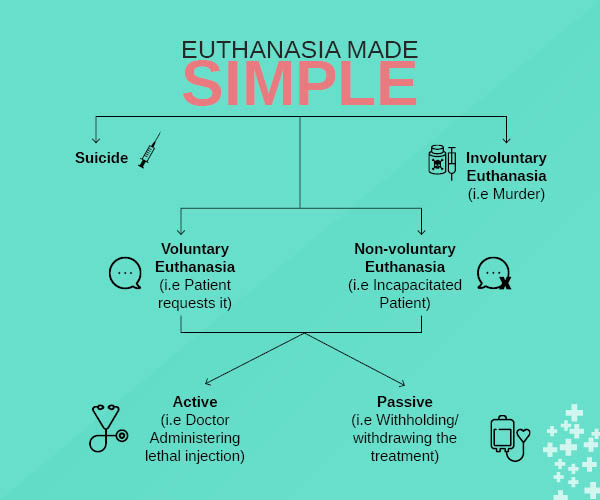
  1. Passive or Negative euthanasia means the withdrawal of necessary medical treatment with the deliberate intention to hasten the death of a terminally-ill patient is a must. In order for the death to be voluntary, the medicines which aids in saving lives will be discontinued so that death is brought about voluntarily. A common practice of this is a patient signing a ‘Do Not Resuscitate’ (DNR) document. It implies discontinuing or not using extraordinary life sustaining measures to prolong life. Others include act of omission such as failure to resuscitate a terminally ill or incapacitated patient (e.g. a severely defective new-born infant).

2. Active or Direct euthanasia means when one induces death by giving or providing medication or treatment leading to death.

3. Voluntary Euthanasia, sometimes called “assisted suicide”, is used in cases where the sufferer has made it clear that s/he wishes to die and has requested help to bring this about. When the euthanasia is practiced with the expressed desire and consent of the person concerned

4. Involuntary Euthanasia is one which is conducted without the consent and where an individual makes a decision for another person who is incapable of doing so. E.g. prolonged comma, old age, etc. It occurs when no consent or wish to die is expressed by the sufferer. When the euthanasia is practiced against the will of the person and also involuntary Euthanasia is one where patients can express a wish to die but don’t (this equates to murder).

5. Non- Voluntary Euthanasia is one where patients cannot express a wish to die. Patients who are in comas, infants, profound mentally retarded, severely brain damaged, cases of extreme senile dementia, those who cannot communicate for other reasons.

LEGAL VALIDITY IN INDIA

Passive euthanasia is legal in India. As per the 2018 ruling, The Supreme Court has held that the right to die with dignity is a fundamental right.

WHAT IS THE LEGAL POSITION AND TRENDS OF EUTHANASIA IN DIFFERENT COUNTRIES?

The Laws around the world vary greatly with regard to euthanasia, and are constantly subject to change as cultural values shift and better palliative care, or treatments become available. It is legal in some nations, while in others it may be criminalized. In some countries there is a divisive public controversy over the moral, ethical, and legal issues of euthanasia. Those who are against euthanasia may argue for the sanctity of life, while proponents of euthanasia rights emphasize alleviating suffering, and preserving bodily integrity, self-determination, and personal autonomy. Countries which have legitimized euthanasia are The Netherlands,Belgium, Oregon and Washington in the USA. In Switzerland only assisted suicide is legal. In India as mentioned above only passive euthanasia is legal.

LANDMARK CASE IN INDIA

Aruna Ramchandra Shanbaug vs Union Of India

FACTS OF THE CASE

Aruna Shanbaug, a nurse who was assaulted by a ward boy, and went into a vegetative state in 1973. • She remained blind, deaf, paralyzed and in a vegetative state till her death in 2015. A Writ Petition was filed by Pinki Virani claiming that her right to life guaranteed by the constitution had been violated. The petition was rejected by the court after medical examination. However, later in Aruna Ramchandra Shanbaug vs Union Of India, the Supreme Court in March 2011 held that passive euthanasia could be given a nod in case of exceptional circumstances and under strict monitoring of the apex court.

On 7 March 2011 the Supreme Court of India legalized passive euthanasia by means of the withdrawal of life support to patients in a permanent vegetative state. The decision was made as part of the verdict in a case involving Aruna Shanbaug, who had been in a Persistent Vegetative State (PVS) for 42 years until her death in 2015.

The Supreme Court of India specified two irreversible conditions to permit Passive Euthanasia:

  1. The Brain-Dead for whom the ventilator can be switched off.
  2. Those in a Persistent Vegetative State (PVS) for whom the feed can be tapered out and pain-managing palliatives be added, according to laid-down international specifications.

GUIDELINES LAID DOWN BY APEX COURT:

The following guidelines were laid down: A decision has to be taken to discontinue life support either by the parents or the spouse or other close relatives, or in the absence of any of them, such a decision can be taken even by a person or a body of persons acting as a next friend. It can also be taken by the doctors attending the patient. However, the decision should be taken bona fide in the best interest of the patient.

Even if a decision is taken by the near relatives or doctors or next friend to withdraw life support, such a decision requires approval from the High Court concerned. When such an application is filled the Chief Justice of the High Court should forthwith constitute a Bench of at least two Judges who should decide to grant approval or not.

A committee of three reputed doctors to be nominated by the Bench, who will give report regarding the condition of the patient. Before giving the verdict a notice regarding the report should be given to the close relatives and the State. After hearing the parties, the High Court can give its verdict.

WHAT ARE THE ARGUMENTS FOR AND AGAINST EUTHANASIA? 

Benefits of Legalizing Euthanasia (Arguments For)

  1. Provides relief to extreme pain.
  2. Relieves physical, mental and psychological pain for the patient and the family.
  3. Provides more facilities and funds for other patients needing medical treatment and attention.
  4. Euthanasia provides a way of relief when a person’s quality of life is low.
  5. It is another case of freedom of choice – the right to commit suicide.
  6. People should not be forced to stay alive.
  7. Speedy termination of physical and emotional suffering.
  8. Organs can be put to good use.
  9. Relieve mental suffering for the patient and his relatives.

Consequences of legalizing Euthanasia (Arguments Against)

  1. The ‘living will’ could be misused
  2. Religious beliefs could pose as a conflict in few scenarios
  3. The person might not be well informed of the possible treatment options
  4. Guidelines of the content of ‘living will’ has to be standardized
  5. Euthanasia demeans and devalues the sanctity of human life.
  6. Euthanasia can become a means of health care cost containment.
  7. Euthanasia will become non-voluntary.
  8. Euthanasia would not only be for people who are terminally ill.
  9. It amounts to murder and it is only God who can take away human life.
  10. It destroys life, which has potential that could be yet unknown to the patient, doctor or the family members.
  11. It discourages scientists who are looking for a cure for incurable ailments.
  12. An irreversible damage

WEBSITES REFERRED:

  1. https://www.slideshare.net/digitaltejas/euthanasia-types-arguments-for-and-against
  2. https://www.slideshare.net/altacitglobal/euthanasia-law-in-india
  3. http://racolblegal.com/euthanasia-an-act-of-mercy-killing/
  4. https://www.latestlaws.com/articles/euthanasia-the-contemporary-art-of-dying-by-aman-kumar-and-richa-hudilwala/
  5. https://byjus.com/free-ias-prep/euthanasia-or-mercy-killing/
  6. https://www.123rf.com/photo_109776197_stock-vector-red-flat-line-banner-trends.html
  7. https://www.slideserve.com/nami/euthanasia-mercy-killing
  8. http://racolblegal.com/the-dharma-jurispudence-of-the-supreme-court/

Consumer Protection Bill 2019, (E-Commerce) Rules, 2020

An Act to provide for protection of the interests of consumers and for the said purpose, to establish authorities for timely and effective administration and settlement of consumers’ disputes and for matters connected therewith or incidental thereto.

The Indian Parliament, on 6 August 2019, passed the landmark Consumer Protection Bill, 2019 which aims to provide the timely and effective administration and settlement of consumer disputes. The Consumer Protection Act, 2019 (New Act) received the assent of the President of India and was published in the official gazette on 9 August 2019. The New Act will come into force on such date as the Central Government may so notify. The New Act seeks to replace the more than 3 (three) decades old Consumer Protection Act, 1986 (Act).

While e-commerce has opened new avenues and has made transactions faster and more convenient, they have also been prone to unfair trade practices. Although e-commerce platforms tried to resolve the grievance of the customers, there was a need to streamline the functioning of the same. With this perspective, the Central government notified the Consumer Protection (E-commerce) Rules, 2020.

From Amazon to Walmart and now Facebook and Google, through Reliance Jio are all betting on India being their next big online consumer market.

Walmart has invested $1.2 billion in Flipkart in an equity round, two years after it bought a 77% stake in the Indian retail giant for $16 billion. Walmart’s investment came just days after Amazon invested ₹2300 crore or $305 million into its Indian arm, following Jeff Bezos’ $1 billion investment promise to India. Earlier this year, Amazon had also signed a long-term business agreement with Kishore Biyani’s Future Group.

Meanwhile, Facebook’s $5.7 billion investment and Google’s $4.5 billion bet on Reliance Jio come at a time when Reliance chairperson Mukesh Ambani is betting on retail as the next big venture. One of the most significant factors of the Facebook-Jio deal was that Reliance Retail and WhatsApp are now in a commercial partnership to accelerate JioMart’s growth. Through JioMart and WhatsApp, the entities will now help support consumer businesses.

E-commerce Rule, 2020

The intention of the Legislature to specifically deal with e-commerce and online transactions was evident from the very enlargement of the definition of consumer under Section 2(7) of the Act by including both online and offline transactions within the scope of ‘buying goods’ and ‘hiring services’. Further, the Act categorically defines relevant e-commerce, electronic service provider and misleading advertisement while specifically addressing the most commonly faced issues such as refusing to take back defective goods or refusing to refund the amount.

The Rules are pretty exhaustive in their sweep and, at the outset, declares its application to:

(i) All goods and services bought or sold over digital or electronic network including digital products;

(ii) All models of e-commerce, including marketplace and inventory models of e-commerce;

(iii) All e-commerce retail, including multi-channel single brand retailers and single brand retailers in single or multiple formats; and

(iv) All forms of unfair trade practices across all models of e-commerce.

A bare perusal of the same demonstrates that the intention of the Legislature is, clearly, to encompass every aspect of e-commerce and keep consumer interests on the highest pedestal while streamlining the functioning of e-commerce platforms. This is also demonstrated from the fact that the Rules clearly define the relevant players of the e-commerce space, such as e-commerce entity, inventory e-commerce entity, marketplace e-commerce entity and seller.

Loss Of Ice Cover In The Arctic Sea

The National Centre of Polar and Ocean Research (NCPOR) recently found the largest decline in the Arctic Sea ice as seen in last 41 years due to global warming in July 2019.

Between 1979 and 2018, NCPOR noted that the sea ice has seen a declination at a rate of -4.7 per cent per decade while its rate in July 2019 was found to be -13 per cent.

Sea ice is basically frozen seawater that floats on the ocean surface. It forms in each hemisphere’s winter of both the Arctic and the Antarctic. The ice retreats in the summer. However, it does not completely disappear.

The Research has clarified that if this trend continues, there would be no ice left by 2050 in the Arctic sea since the volume of ice loss during summers might surpass the volume of the same formed during winters. This rapid decline in Arctic sea ice cover has been linked with growing carbon emissions and subsequent global warming.

The Impacts of Declining Arctic Sea ice cover can be huge. It would have an influence on regional weather as the decline of sea ice may impact the evaporation rates, cloud cover, air humility and rainfall of neighbouring regions.

The National Centre for Polar and Ocean Research (NCPOR) was established in 1998 as an autonomous Research and Development Institution under the Ministry of Earth Sciences. The objective was to primarily carry out research activities in the polar and Southern Ocean realms.

It is also responsible for maintenance of the Indian stations in Arctic (Himadri) and Antarctica (Maitri & Bharati).

In recent times, the high temperatures that have been recorded in the Siberian region have caused a prolonged heatwave that has been ascribed to the absence of sea ice among other factors.

Loss of habitat for seals and polar bears have also increased resulting encounters between polar bears and humans. As the sea ice retreats from coastlines, wind-driven waves combined with melting permafrost may also lead to more rapid coastal erosion.

In the Arctic region, the ocean circulation is driven by the sinking of dense and salty water. Fresh meltwater coming largely from the Greenland Ice Sheet could furthermore interfere with ocean circulation at high latitudes, ultimately slowing it down. Any changes in ocean circulations can have unpredictable global impacts even in lower latitudes such as extreme weather events, droughts etc.

It is a result from the positive feedback cycle known as the ice-albedo feedback states that sea ice has higher albedo than ocean water. Once sea ice begins to melt, a self-reinforcing cycle often begins whereby as more ice melts and exposes more dark water. Then the water absorbs more sunlight and the sun-warm water then melts more ice.

On concluding, Arctic sea ice is part of a complex global system, and as a result it affects communities at all latitudes. The loss of Arctic sea ice has to be slowed down existentially by reducing carbon dioxide and other greenhouse gas emissions and also by conserving other natural resources that have global impacts. The world needs to come together as one.

20 Tips for Mastering the Art of Public Speaking

When my class was asked to describe our greatest fear- some said spiders while some said ghosts. But when the fingers were pointed at me and the entire class was staring at me for an answer, I froze. That is exactly when I knew my greatest fear was public speaking. The best way one can get over their fear is by practising it hence I made it my goal to be an ace at it. Today I’m a teacher and I speak in front of my students with ease and charisma.

The Wolf of Wall Street': A howling disappointment

Here are some of the tips that helped me through my process of practising public speaking:

1. Know your audience.

If you are speaking in front of an audience, there is usually a reason. Know who you are speaking to and what they want or need to take away. If it’s friends and family, entertain them. If it’s a corporate event, teach and inspire them. Knowing the demographic of the audience is imperative.

2. Rehearse, rehearse, rehearse.

Nothing becomes muscle memory unless you practice relentlessly. If you have a big speech coming up, make time every day to practice. Prepare your goals and the content well ahead of time. This can be done while driving, exercising, in the car, on a plane…anywhere.

3. Practice with your friends and family.

Once I know the content, I like to add a little bit of distraction to test how well prepared I really am. Turn on the TV or rehearse while pushing your child in the swing. Anything that adds a little more challenge. While taking a shower or even while dinner with your parents.

4. Maintain your own style.

Different events will often require a different approach or style. Sometimes reading a prepared speech is fine. But know it backward are forward so you’re not staring down at the pages the whole time. Some use notes. Others prefer to be 100 percent scripted and memorized. If that’s your style, memorize the content so well that you can go off script if needed — and so you don’t sound like you’re reciting a poem. Use the proper approach for the appropriate event.

5. Know the environment.

Know the venue where you will be speaking. Get there well ahead of time. Walk the room. Walk the stage. Get a feel for the vibe of the environment so you are more comfortable when its “go time.”

6. Test all equipment.

Nothing sucks more that last-minute technical difficulties. Avoid adding even more stress by testing any and all equipment and audio visual functions ahead of time. And have backups.

7. Practice in front of a mirror.

Practicing in front of a mirror is a good way to learn the proper amount of body motion, hand usage and facial expressions.

8. Take every opportunity to speak.

The only way to get better at anything is to do it all the time. Rehearsing is good, but nothing compares to actually getting up in front of an audience and doing it for real.

9. Practice body language and movement.

Remember, communication is much more about tone and body language than the words we say. The words of course matter, but emphasis comes with movement and body language.

10. Slow down.

We have some great sayings in the SEAL teams: “slow is smooth, and smooth is fast, ” and “don’t run to your death.” Nothing shows nerves more than racing through your presentation. If you want to impact the audience in a meaningful way, make sure they actually hear what you are saying. Slow it down.

11. Make eye contact, but avoid heavy body movements.

This one is very important, and it doesn’t matter how big the audience is. Make eye contact with as many people as possible. It makes the audience members feel like you are speaking directly to them. And don’t just stick to people in the first couple rows. Look at the people in the back too.

12. Know your material.

If your goal is to become a thought leader or actually teach the audience something, only a truly authentic understanding of the material will get you there.

13. Take long pauses.

Similar to slowing things down, make a point to take long pauses. And make them longer than you even think is appropriate. It can have a great impact on emphasizing key points and emotionally connecting to the audience.

14. Practice tone and voice modulation.

Don’t just eek your way through a speech using the same tone and volume. Tone and projection add a layer of entertainment and help keep the audience fully engaged from start to finish. These too must be practiced religiously.

15. Use humor and emotion.

It doesn’t matter what you are talking about. There is always a place for emotion or humor, or both. I find self-deprecating humor to work the best. And if you are starting to get emotional, so what? Use it. The audience may not remember everything you said, but they will remember how you made them feel. 

16. Mentally prepare.

Find time during the hour before your speech for some solitude. Get your mind right. Clear your head. If it’s five minutes before, just relax. The time for making sure you know the material perfectly has passed.

17. Exercise before you go on.

It’s almost impossible to feel stress and anxiety after a good workout. If you have the time, exercise. The closer to your speech, the better. It’s also a good time to practice. I like to rehearse while running or swimming.

18. Project confidence.

The more you project confidence, the more confident you are likely to feel. Get out there and own the room. Even if you are terrified. Fake it. Look people in the eye and command their attention.

19. Don’t go over the allotted time.

When in doubt, go under the allotted time. Less is sometimes more. But never, ever, go over. It’s poor speaking etiquette and shows you are not prepared. It’s also disrespectful of the agenda for the event. Again, just practice.

20. Ask for feedback.

Most of us don’t like to ask for feedback, especially when we know the response may include some constructive criticism.

However feedbacks if taken positively can do wonders for your speech improvisation especially from a third-party point of view.

Why Are We Clapping? - A History of Applause

Speaking is a great way to connect with people and a skill we all should master.

It’s a must for leaders and managers. It’s a must for sales. It’s basically a requirement for all entrepreneurs and business leaders.

So go on and practice this skill which will be your life saver!

Invites for the Frontline COVID Warriors: A special feature of the I-Day 2020 celebrations in India this year

Ministry of Home Affairs | MyGov.in

INTRODUCTION

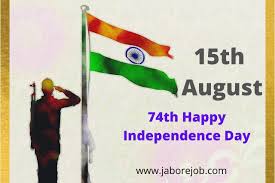
The Ministry of Home Affairs (MHA) has issued the guidelines for the Independence Day celebrations that will take place amid the cloud of novel coronavirus pandemic. Due to this unfortunate and extraordinary situation the Independence Day celebrations on the 15th August will be subdued and low key.

THE LETTER

Joint Secretary Anuj Sharma has written a letter to all States and Union Territories sharing with them how the celebrations should be carried out in these testing times. In the letter preventive measures like social distancing, wearing of masks that are absolutely imperative have been mentioned in order to make sure that the celebrations are carried out without any collateral damage.

“In view of the spread of Covid-19 pandemic, while organizing various programmes or activities for the Independence Day celebrations, it is imperative to follow certain preventive measures such as maintaining social distancing, wearing of masks, proper sanitization, avoiding large congregations, protecting vulnerable persons, etc.; and follow all guidelines related to Covid-19 issued by the Ministry of Home Affairs and Ministry of Health a Family Welfare,” the letter read. Hence one can assume and infer that all the functions organised countrywide will be deprived of large gatherings.

Happy 74th Independence Day Wishes India | 15th August 2020

CELEBRATIONS AT THE LAL QILA

The Ceremony at Red Fort consisting of the presentation of a Guard of Honour by the Armed Forces and the Delhi Police to the Prime Minister (Pradhan Mantri), unfurling of the National Flag accompanied by playing of the National Anthem and firing of 21-gun salute, speech by the Prime Minister, singing of the National Anthem immediately after PM’s speech, and release of tricoloured balloons at the end. This will be followed by “At Home” reception at Rashtrapati Bhawan. As regards holding of “At Home” reception at Raj Bhawan /Raj Niwas by the Governor/Lt. Governor on the Independence Day, the matter is left to the discretion of Governors/Lt. Governors.

CELEBRATIONS AT THE STATE LEVEL

A ceremony in the morning (after 9.00 AM) in the State/Union Territory Capitals consisting of unfurling of the National Flag by the Chief Minister; playing of the National Anthem; presentation of Guard of Honour by the Police including Para-Military Forces, Home Guards, NCC, Scouts, etc; speech by the Chief Minister; and singing of the National Anthem.

In view of Covid-19 pandemic, large congregation in the ceremony be avoided. It is imperative that social distancing norms, wearing masks, etc., are followed. It would also be appropriate that Covid-19 warriors like doctors, health workers, sanitation workers, etc., are invited in the ceremony as a recognition of their noble service in fight against Covid-19 Pandemic. Some persons cured from Covid-19 infection may also be invited.

CELEBRATIONS AT THE DISTRICTS, SUB DIVISIONAL BLOCS AND PANCHAYAT HEADQUARTERS

The Districts, Sub Divisional blocs, Panchayat headquarters will have to follow similar protocols as the states. In view of the COVID-19 pandemic, preventive measures such as maintaining social distancing, wearing of masks, proper sanitization, avoiding large congregations, protecting vulnerable groups, etc., and other measures as prescribed and recommended by the Ministry of Health a Family Welfare, are to be followed. It would be appropriate that frontline warriors and workers like the doctors, health workers, sanitation workers, etc., are invited in the ceremony as recognition for their noble service in fight against the COVID-19 Pandemic. Some persons who have been cured from the infection may also be invited.

Performance of Police/Military bands may be recorded at places of historic importance associated with the Independence movement; and recorded versions thereof may be displayed through large screens/digital media, during public functions and on social media.

Other functions of the day may include activities like planting of trees; inter-school/inter-college debates on digital platforms; online quiz contests/patriotic essay writing and poetry competitions; launching of any important scheme, singing patriotic songs/delivering patriotic talks by selected boys/girls on the social media; illumination of Government Buildings/State Bhawans, etc; thematic webinars; online campaign by NSS and NYKS centered around patriotic themes; or any other activity deemed appropriate by the State Government/Union Territory Administration befitting the occasion. Other innovative ways of celebrating Independence Day may be considered like propagating patriotic or national integration messages/songs through digital and social media platforms, sound shows/lighting of important public buildings, waving of National Flags by people at rooftops/balconies, etc.

“It would be appropriate that the theme of “Aatmanirbhar Bharat” is suitably spread and publicized amongst the masses through various activities/messages in the functions and on social media during Independence Day celebrations,” the letter signed off with.

WEBSITES REFERRED

  1. https://www.mha.gov.in/sites/default/files/IndependenceDay_24072020.pdf

2. https://www.indiatvnews.com/news/india/independence-day-celebrations-guidelines-covid-19-coronavirus-new-guidelines-mha-636649

3. https://www.ndtv.com/india-news/74th-independence-day-covid-warriors-to-be-invited-on-independence-day-government-to-states-2268156#:~:text=Prime%20Minister%20Narendra%20Modi%20will,Independence%20Day%20on%20August%2015

4. https://secure.mygov.in/group/ministry-home-affairs/

5. https://www.jaborejob.com/happy-74th-independence-day-wishes-india-15th-august-2020/

Podcasts I Love

“Journalists have linked this online podcasting boom to the ubiquity of smartphones, time spent in transit, and online music services. Others attribute it to the brain-stimulating and addictive effects of audio learning, or the multitasking potential of listening. The beauty is in the overlap.”

Jeff Desjardins, Editor-in-Chief of Visual Capitalist

The Seen and Unseen:

Amit Verma.

Writer, Journalist, and Podcaster.

“The Seen and the Unseen is a weekly podcast hosted by Amit Varma. It takes its title from Frédéric Bastiat’s famous essay, ‘That which is seen and that which is unseen’. In his essay, Bastiat uses the example of what later came to be known as the “Broken Window Fallacy”, and pointed out that to evaluate the consequences of any action, we need to look at both its seen effects, which are often the rationale behind the action, and its unseen effects, which include unintended consequences and ripple effects.

The Seen and the Seen started off looking at the unintended consequences of public policies, and then evolved into a deep-dive interview podcast. It has tackled subjects such as the life and thought of Mahatma Gandhi, the Emergency, Hindutva, cricket, Demonetization, the Bangladesh War, Plato, Venezuela, the Harappans and the Me-Too Movement. Its guests have included Ram Guha, Srinath Raghavan, Steven Pinker, Matt Ridley, Tyler Cowen, Shashi Tharoor, Tony Joseph, Aakar Patel and Harsha Bhogle.

The Seen and the Unseen is supported by the Takshashila Institution, an independent centre for research and education in public policy.

The Seen and the Unseen is owned and produced by Amit Varma. It releases every Monday.”

I Weigh:

Jameela Jamil.

Actress, Model, Writer, and Activist.

“What started with a social media post has become a movement, and now a podcast. On I Weigh, Jameela Jamil challenges society’s definition of worth through weight by asking different thought-leaders, performers, activists, influencers, and friends about how they are working through their past shames to find where their value truly lies. With hilarious and vulnerable conversations, I Weigh will amplify and empower diverse voices in an accessible way to celebrate progress, not perfection.”

Ted Talks Daily:

“TEDx is a grassroots initiative, created in the spirit of TED’s overall mission to research and discover “ideas worth spreading.” TEDx brings the spirit of TED to local communities around the globe through TEDx events. These events are organized by passionate individuals who seek to uncover new ideas and to share the latest research in their local areas that spark conversations in their communities. TEDx events include live speakers and recorded TED Talks, and are organized independently under a free license granted by TED. These events are not controlled by TED, but event organizers agree to abide by our format, and are offered guidelines for curation, speaker coaching, event organizing and more. They learn from us and from each other. More than 3000 events are now held annually.”

Work in Progress:

Sophia Bush.

Actress, Director, Producer, and Activist.

“Work in Progress with Sophia Bush features frank, funny, personal, professional, and sometimes even political conversations with people who inspire Sophia about how they’ve gotten to where they are, and where they think they’re still going. These discussions stem from her “aha” moment of realizing you are allowed to be both a masterpiece and a work in progress, simultaneously.”

BBC Global News Podcast:

“We’re impartial and independent, and every day we create distinctive, world-class programmes and content which inform, educate and entertain millions of people in the UK and around the world.

The day’s top stories from BBC News. Delivered twice a day on weekdays, daily at weekends”

Daily Dose:

News Laundary.

News Channel.

“News Laundry is a news, current affairs and media analysis organisation. We value independence and transparency and believe the two are integral to democracy and a healthy society. This applies to news media too, often referred to as the fourth pillar of democracy. You can read about our mission here and see our ownership structure here.

We will question established ways and models that get too comfortable and cozy. No one should be above scrutiny: Not politics, industry, civil society, and certainly not the media. Not them, not you, not us – no one.”

Zombies – A Myth or a Reality?

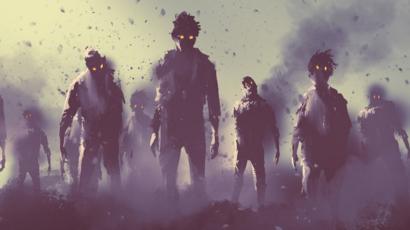
Have you watched the popular series – “The Walking Dead”? If you have watched it, you will definitely know what exactly I am talking about. If you do not know, I will just give a brief about it. It is a series about how survivors of zombie apocalypse are trying to escape and combat the threats from the zombies and how with time, human beings formed their own communities and groups and the rise of conflict between those communities. So basically this is a series about zombie apocalypse and how they are being termed as ‘walkers’ on earth.

So what exactly are these zombies? Do they exist for real or are they just a figment of imagination? From ages, zombies are being described as flesh eating corpse with a ravenous appetite, terrorizing on the grounds like a strong robot, looking to infest on flesh. Such creatures are almost dead and oozes every signs of inhumanity.

Are these new or have they always infested the earth? Well, history says that the stories of zombies first originated in Haiti culture, where the West African slaves were brought to work on Haiti’s sugar cane plantations. But they were treated so brutally, that their life or afterlife represents the zombie culture. Other says that the Ancient Greek Civilization was the first to experience this. In fact, many skeletons which were pinned down to ground using stones were unearthed, which kind of verifies their existence.

Who is prepared for a 'zombie apocalypse'? - BBC News
Zombie Apocalyse

But there do exists some true facts about the zombies and voodoo. Voodoo is practised as a religion in some cultures like Haiti where some people believe that zombies are people who are revived by a voodoo practitioner, Bokor. It is a concoction of herbs, bones, animal parts and especially ‘tetrodotoxin’ which is a deadly neurotoxin found in marine species, which if injected in high quantities can lead to paralysis and coma. It manifest zombie like qualities among the human beings. Thinking that infected person to be dead, they usually revive and thus rose the term ‘zombie’.

But is there even a bit of truth? Medical reports suggests so. One instance was that a person named Clairvius Narcisse, who was admitted to hospital due to acute respiratory problems in 1962, but later slipped into coma and being declared as dead, was buried later. 18 years later, a man goes to Angelina Narcisse and claims to be her brother. Upon verification by doctors, that he was buried alive, he was sent off to work in the sugar plantation.

Zombies might not exist as there have been no mention of these in Old Testament or New Testament but there have been mentions of resurrections of saints and sinners in Bible. So there is a very little evidence as to whether such zombies exists or if there is even a zombie apocalypse. Not only on religious books, since the eighteenth century, there have been various literatures of spirits and ghosts. Various movies were also made such as Night of the Living Dead and World War Z, just to name a few.

It is ultimately all about perception. Disasters have always caused such huge destruction and there is always this survival of the fittest psychology which goes among us. So it might be true that zombies do not exist, but then again who are we to judge history?

World Nature Conservation Day

‘The Earth is a fine place and worth fighting for’Ernest Hemingway

Indeed it is. Today, 28th July, 2020 marks the World Nature Conservation Day, a day when we pledge to provide ultimate protection to our Mother Earth and its bountiful resource. This day is celebrated to create an awareness that it not always justifiable to always use the natural resources but it is also essential to give back to the nature. Our resources – air, water and trees, is continuously depleting due to man-made activities and this day essentially reminds us that we should adopt sustainable practices to prevent dwindling of these natural, yet depleting resources.

July 28th was initially introduced as a day to educate people about the best practices to protect the natural resources on the earth and also to create an awareness that Earth only has a limited resources to cater to the upcoming human generations.

Part 39 >> July 28, 2017 " World Nature Conservation Day " — Steemit

To embark upon the World Nature Conservation Day, as inhabitants of this earth, we can adopt some very simple measures at individual and at group level. Some of these measures are:

  • Reduce plastic use. Be it buying groceries or food delivery or throwing away our sanitary pads, we should be concerned with plastic use and substituting by either paper or cloth bag. Used plastic thrown out as garbage usually ends up in water bodies and landfills, causing death of marine life, organisms and land animals mostly due to choking. It is not biodegradable and natural process takes years for the plastic to degrade.
  • Reduce electricity consumption. Dams built across the rivers might generate thousands of watts of electricity which is a renewable source of energy but it is harmful for the marine life. Records show that it disrupts the water ecosystem which will ultimately affect the human life, at least in the long run. So care has to be taken to minimize or stop the use of electrical appliances, unless there is an emergency.
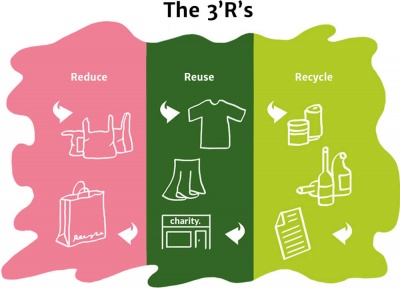
  • Tactical management of waste. Ensure to desegregate the daily wastes into degradable and non-degradable before dumping it into the ground. Human beings should religiously follow reduce, reuse and recycle mantra for waste management.
  • Reduce water consumption. In some countries, we receive water as if it is our birth right but other countries sweat to just receive a mug of it. We should ensure justified consumption of water so as to allow equitable distribution across all geographic nations.
  • Plant trees but save paper. Our world is getting depleted of trees day by day. A suggestion here is that each individual should take the onus to plant one sapling once a year, anywhere on this earth. Isn’t is satisfying to nurture it from time to time and to see it grow every day? But just growing trees is not a feasible solution if we do not take a chance to protect it. One way is to switch over to digital mode for reading like e-newspaper and e-books rather than going out and buying books and newspaper. Consequently, while shopping for groceries, switch to cloth bag which can be used multiple times, rather than single use of paper or plastic bags.

These are the few ways by which we can protect our Earth and the limited resources that it possess. And just by pledging to protect will not work unless we modify our shopping, eating and especially our consumer habits.

Source: https://www.hindustantimes.com/more-lifestyle/world-nature-conservation-day-2020-history-significance-how-to-live-sustainably/story-HWYhl06t7oYlZtFmT3RSJI.html

Depression : a myth or a serious problem ?

What is depression

Most of the time people feel sad or depressed. It’s normal reaction to loss or struggles in life. But when this sadness become intense – including feeling helpless, worthless , hopeless , lack of self esteem and lack of confidence – last for many days to weeks and keeps you from living your life happily, it may something more than sadness. You could have clinical depression – a treatable medical condition. 

Symptoms of depression 

Depression symptoms can vary from mild to severe and can conclude: 

1. You can’t sleep or sleep too much almost every day,

2.  You have almost no interest or pleasure in many activities nearly every day,

3.  You’ve lost or gained weight.

4.  You feel restless,

5.  You often think about suicide or death,

6. You feel tired or lack of energy,

7.  Loss pleasure in life,

8.  Have sad, anxious or empty feelings.

Physical signs of the depression

There are some physical sign of the condition they may include back pain, joint pain, digestive problems, sleep trouble and  breathing problems. At any one time it is estimated that more than 300 million people have depression – about 4% people of the world’s population when the figures were published by world health organization (WHO) in 2015 women are more likely to be depressed than man.

Treatment

The WHO estimates that Fewer than half of people with depression are receiving treatment. Many more will getting inadequate help, often focused on medication. 

The most common therapy is congnitive Behavioural therapy, which breaks down overwhelming promotion into Situations , thoughts, emotions, physical feelings And actions try to break a cycle of negative thoughts.

If you or you know someone who has symptoms of depression, talk to your doctor. he can evaluate you And offer you treatment or refer you to a mental health professional.

Conclusion

While there are more and more treatments for depression. The problem is rising not falling. 

According to a research , From 2005-15 , cases of Depressive illness increase by nearly a fifth. People born after 1945 are 10 times more likely To have depression this reflects both population growth and a proportional increase in the rate of depression. Among the most at- risk ages. the WHO said.

A key reason for the Continuing rise in depression cases Is that drug is that drug not necessarily “cure” the patient. And other therapies that can make the crucial difference are not in sufficient supply.

So we have conclude that we should openly talk about depression illness and it’s symptoms we should not take it lightly or as a myth. Mostly in Indian society when anyone is suffered by depression insted of helping the person, we considered that person as mentally disabled. We need to understand that depression is Simlar to cold and fever if anyone is needed is just the right treatment. 

Trump executive order possibly provide better market access to indian pharma companies in U.S

President Donald Trump executive orders, aimed at substantially reducing drug prices for the US residents, underscore the campaign pitch of the next election. Pharma pricing has been one of the most widely debated topic in America and we are likely to see some pre-election action on the issue.

Trump said the first order “will require federal community health centers to pass the giant discounts they receive from drug companies on insulin and EpiPens directly to their patients,” while the second allows some drug importation and the third will take discounts away from middlemen such as pharmacy benefits manager and give them to patients.

The fourth order will require that Medicare purchase drugs at the same price as foreign countries pay, Trump said. It “will end global freeloading on the backs of American patients and American seniors.

Though the enforcement of the orders before the November 3 election looks difficult because of legal hurdles and various caveats, if they go through Indian drug manufacturers may stand to benefit in terms of increased market access on the formulation side.

As a result of the orders, the heads of major drug companies have requested a meeting on Tuesday to discuss how to lower drug prices and out-of-pocket expenses for Americans, the president added. If talks are successful, the administration may not need to implement the fourth executive order.

The Trump’s order in general is aimed at reducing the gains of middlemen in the US pharma value chain and to that extent, at least optically, it doesn’t impact manufacturers directly. But the way drug price negotiations are usually done it can have an indirect impact on the large pharma manufacturers.

The most important executive order from the manufactures point of view is the fourth one. Spooked by this order, the stocks of the US-based big pharma companies reacted negatively on Friday. While the order doesn’t distinguish between patented drugs and generic drugs, it is most likely meant for the former as the generic market is already quite competitive.

Since the whole idea of the executive orders is to make drugs affordable, there is a good chance of a revamp of the US medicare and the way drug price negotiations are done. This can have a positive outcome on market access. In our opinion, Indian drug manufactures such as Cadila, Lupin, Cipla, Dr Reddy and Sun Pharma and a few small-sized pharma companies, such as Laurus Labs, may benefit if such an event unfolds. In such a case, volume opportunity may offset the incremental pricing erosion.

Trump over the years often has stated that drug companies are “getting away with murder” and prices are “out of control,” though this year he has been meeting with pharma execs as their companies work on a CoronaVirus vaccine.

Raising an ECO-FRIENDLY Generation

We as a generation were born with resources available to us at a switch of a button. But would that be the same considering our irresponsible usage?

Let’s make a few lifestyle changes and teach our kids to become eco-friendly and live in a sustainable environment and household.

  • WATER CONSERVATION:
Cropped image of woman putting toothbrush under water - Stock ...

Do not encorage your kids to take long showers. Teach them to take a bucket water bath and advice them on keeping the taps shut. If they brush their teeth with running tap water, show them how water is needed only while rinsing the mouth. Tell them the importance of water in our lives and how it is essential to survive.

  • PAPER WASTAGE:
Using Technology To Reduce Paper Waste - Food & Nutrition Magazine

Encourage your children to use both sides of the paper. Tell them how papers are made from trees and the importance of trees in our lives. Adopt paper savvy techniques like using of eco-friendly notebooks and e-newspapers instead of hardback papers.

  • PLANT TREES, INHALE FRESH:
How to start your own tree planting project — TreeSisters

Plant trees in your backyard with them. You can teach them the art of gardening and also tell them about compost pits. It is a good hobby for your kids to row up nurturing a living organism and to be compasssionate towards others.

  • BEST OUT OF WASTE:
Best Out Of Waste Ideas : Best Things Made From Car Tyres

Making interesting and useful objects at home from waste will be a good bonding activity. One can make creative items like newspaper wall hangings, old plastic bottles can be made into show pieces or pen stands,etc.Show them how to reusee than discarding and hence creating less wastage.

  • REUSE- REDUCE -RECYCLE:
Reduce, Reuse, Recycle - Knowledge Bank - Solar Schools

Use tote bags or bins when shopping, say no to the plastic shopping bag. Select packaging that does not have a lot of excess waste. Use dinnerware that can be washed instead of paper plates and plastic ware. Only buy things that you will use in the immediate future.

Give your discards a chance at a second life by holding a yard sale or donating items to Goodwill, the Salvation Army, Habitat for Humanity, or other charitable outlets.  Contact schools and nursery schools to find out different types of items they reuse for art projects.  Donate used books to the Library.  Several organizations take used cars and even boats.