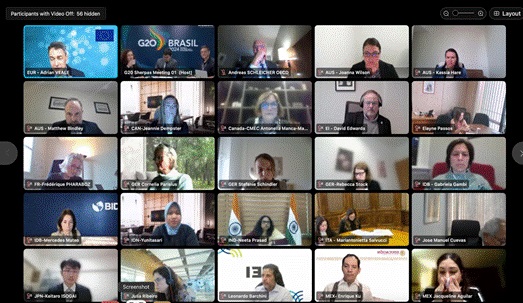
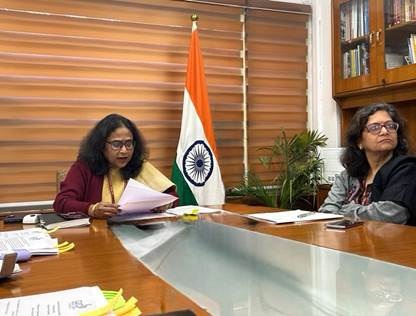
Day one of the first Education Working Group (EdWG) meeting under Brazilian G20 Presidency was held virtually today wherein, the Indian delegation reiterated the government’s commitment to enhance the global education agenda. The delegation highlighted the importance of capacity building for educational professionals, innovative teaching-learning processes and emerging trends and on making tech-enabled learning more inclusive, qualitative and collaborative at every level and highlighted the crucial role of education in achieving SDGs, particularly through LiFE (Lifestyle for Environment) initiative.
Sharing inputs on the priorities, the Indian delegation of senior Ministry officials highlighted India’s best practices on the identified priorities as guided by the National Education Policy 2020. Initiatives included SWAYAM, SWAYAM PRABHA, Academic Bank of Credit, SAMARTH, National Professional Standards for Teachers, 4-year Integrated Teacher Education Programme, DIKSHA, NISHTHA, Malviya Mission Teacher Training Programme, National Mission for Mentoring, industry collaboration for training courses and equipping educators in emerging technologies.
As part of the EdWG track, Brazil has identified the following 3 priorities for the meeting deliberations:
Valuing and Building Capacity of Education Professionals: what can we collectively do?
Connecting Managers of Digital Resource Platforms: the sharing of education material on Education for Sustainable Development.
The G20 Award for School-Community Engagement
The first EdWG discussions will continue on day two of the meeting to be held on 6th February 2024. Discussion will centre on the second and third priority that is, digital resource platforms and award for school-community engagement.
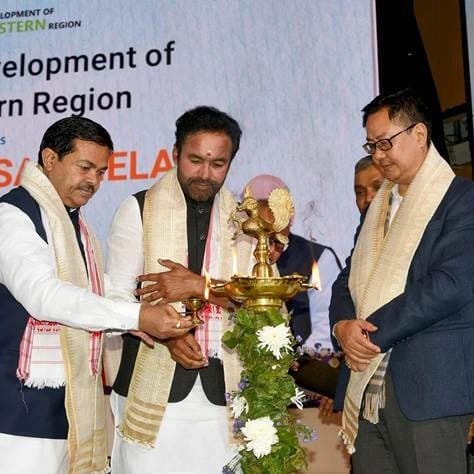
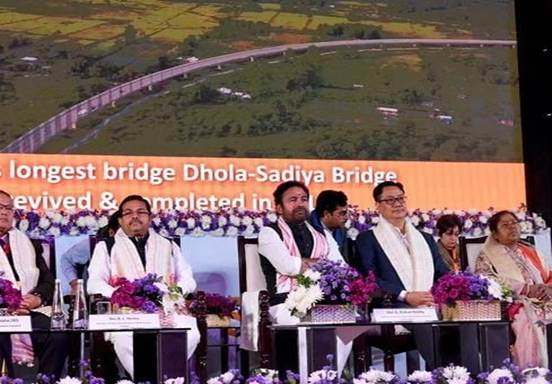
Ministry of DoNER organized a North East Sammelan on February 4th, 2024 at Ambedkar International Centre, New Delhi. Minister for DoNER, Tourism and Culture Shri G. Kishan Reddy was the chief guest for the event and virtually laid foundation stone of the North Eastern Cultural and Social Institute in Dwarka built at the cost of Rs 116.38 crore and inaugurated the Barak Hostel at JNU, New Delhi, worth Rs 28.67 crore, in presence of Minsiter for Earth Science Shri Kiren Rijiju ji, Minister of State DoNER Shri B.L. Verma, Minister of State for Social Justice and Empowerment Km. Pratima Bhoumik and Minister of State for External Affairs and Education, Shri Rajkumar Ranjan Singh and other dignitaries.
The event garnered the presence of esteemed dignitaries, including Union Ministers, Members of Parliament from the North East, and MLAs from the North Eastern States. Noteworthy attendance comprised officers representing various cadres in the North East region, alongside officers from diverse backgrounds. The gathering, comprising an audience of 1000, notably included a substantial contingent of students from the North East studying in institutions across Delhi. The distinguished presence of Smt. Sangkhumi Bualchhuak, a recipient of the Padma Shri award for her commendable efforts in women empowerment, added a significant dimension to the occasion.
The North Eastern Cultural and Social Institute in Dwarka, with a budget of Rs. 116.38 crore, will feature diverse amenities, including an auditorium, a library-cum-reading room focused on materials related to the North Eastern Region, an Art Gallery showcasing the region, an exhibition hall, research center, sale outlets and a Guest House. The center will also house facilities like a State Handloom Display, a food court, and exhibition spaces. Concurrently, the construction of Barak Hostel for North-East Students at JNU, New Delhi, with an estimated cost of Rs. 28.675 Crore, featuring 214 rooms for both genders equipped with modern amenities, aims to enhance hostel accommodations for a larger population of North-East students.
During the unveiling ceremony of the two projects, Shri G. Kishan Reddy expressed that these initiatives have been long-awaited and will serve as focal points for cultural and regional integration. He emphasized that the North Eastern Cultural and Social Institute in Dwarka is anticipated to facilitate extensive discussions, meaningful discourse, and constructive exchanges aimed at promoting the holistic development of the North Eastern Region.
During his address at the Sammelan, the Union Minister for Development of North Eastern Region, Culture, and Tourism, Shri G Kishan Reddy, highlighted the North East Sammelan as a remarkable platform to spotlight the abundant opportunities and rich cultural diversity inherent in the North Eastern Region. He emphasized the unprecedented growth and development witnessed over the last decade, transforming the region from a neglected area to the Ashtalakshmi of Bharat
Shri Reddy underscored the significant investments made, amounting to over Rs. 5 Lakh Crores since 2014, driving comprehensive and inclusive development across the region. He also lauded the remarkable progress in maintaining peace and security, evident in the notable reduction of insurgency incidents and civilian casualties, reflecting the government’s steadfast commitment to fostering stability.
Furthermore, Shri Reddy highlighted the establishment of state-of-the-art cancer hospitals catering to the healthcare needs of the populace, underscoring the government’s dedication to enhancing healthcare infrastructure. Shri Reddy emphasized the substantial financial infusion into the region over the past decade, ensuring unhindered development. He noted a considerable increase of approximately 233% in expenditure, from Rs. 24,819 Crores in 2014-15 to Rs. 82,690 Crores in 2022-23, allocated by 54 Central Ministries to the North Eastern Region under 10% GBS (Gross Budgetary Support).
Union Minister for Earth Sciences, Shri Kiren Rijiju in his address said that he extended his heartfelt congratulations to the people of the North East as we witness the significant launch of Barak Hostel at JNU for NE students and the foundation stone laying of the North Eastern Culture and Social Institute in Dwarka, New Delhi. Shri Kiren Rijiju, further added that North East Region is witnessing a transformative phase of development be it physical infrastructure, connectivity with rest of India or emotional and cultural integration. He added that the government ensures monthly visits of union ministers to different States of NER to ensure that the grievances and issues are addressed at the highest level. He further said that the Government, under the visionary leadership of PM Shri Narendra Modi Ji is taking forward the developmental activities on the vision of ‘Ek Bharat Shreshtha Bharat’. He underscored the vital link between peace and Northeast development and highlighted the pivotal role of youth and emphasized that genuine progress in the region can only occur through people-led development, underscoring the critical need for sustained peace in the area.
Addressing the audience at the North East Sammelan, Union Minister of State Shri B.L. Verma highlighted that Prime Minister Shri Narendra Modi Ji has not only recognized but also underscored the crucial role of the North-East in the Nation’s development, setting the stage for comprehensive national prosperity. This emphasis signifies a dedicated commitment to uplifting the region and fostering inclusive growth for the entire country especially commending effective governance and initiatives for the Ashtalakshmi’s over all development.
The dignitaries inspected the stalls and exhibitions put up by PSUs of DoNER North Eastern Regional Agricultural Marketing Corporation (NERAMAC), North Eastern Handicrafts and Handloom Development Corporation (NEHHDC) showcasing the initiative sand achievements towards welfare of farmers and artisans of the region. A stall by the North Eastern Development Finance Corporation Ltd was also put up which showcased the milestones achieved in promoting SHGs, Small and micro enterprises and young entrepreneurs. The Ministers took the opportunity to engage with artisans and entrepreneurs present.
The Sammelan featured special videos that showcased PM Shri Narendra Modi Ji’s vision for roadmap and development for North Eastern Region. The event also featured videos highlighting the following achievements in the North-Eastern Region over the past decade.
The event concluded with a well-received cultural performance showcasing diverse traditional dances. Today’s initiatives collectively channel Government of India’s efforts to unlock the unparalleled potential of the North-East. The achievements outlined are not merely milestones but a testament to the Government’s commitment to a brighter and more prosperous future for the region.
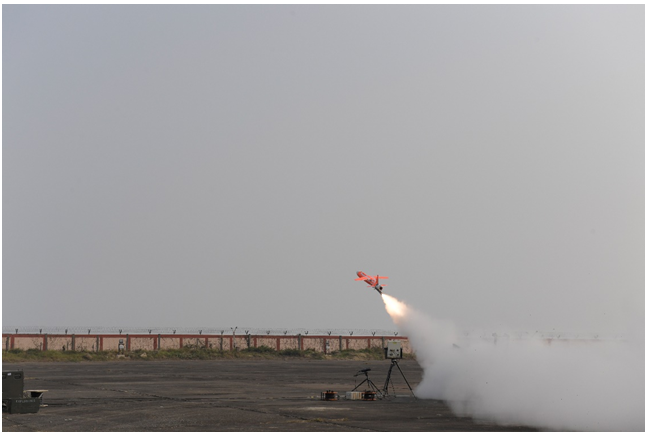
Four flight trials of High-speed Expendable Aerial Target (HEAT) – ABHYAS were successfully carried out by Defence Research & Development Organisation (DRDO) from the Integrated Test Range, Chandipur in Odisha during January 30 to February 02, 2024. The trials were conducted with four different mission objectives in a revised robust configuration using a single booster designed by Advanced Systems Laboratory, Hyderabad to provide reduced launch acceleration.
The objectives like safe release of booster, launcher clearance and attaining the required end of launch velocity were achieved. During the flight trials, various parameters like required endurance, speed, manoeuvrability, altitude and range were successfully validated.
Designed by DRDO’s Aeronautical Development Establishment (ADE), ABHYASoffers a realistic threat scenario for practice of weapon systems. It is designed for autonomous flying with the help of an auto pilot indigenously made by the ADE. It has Radar Cross Section, Visual and Infrared augmentation system required for weapon practice. It has a laptop-based Ground Control System with which the aircraft can be integrated and pre-flight checks, data recording during the flight, replay after the flight and post-flight analysis can be carried out. ABHYAS requires minimum logistics and is cost effective compared to imported equivalents.
The systems tested recently were realised through Production Agencies – Hindustan Aeronautics Limited (HAL) and Larsen & Toubro (L&T) Defence. With identified production agencies, ABHYAS is ready for production. The system has export potential and can be offered to friendly countries.
Raksha Mantri Shri Rajnath Singh has congratulated the DRDO, the Armed Forces and the Industry for the successful flight trial of ABHYAS. The development of this system will meet the requirements of aerial targets for the Armed Forces, he said.
Secretary, Department of Defence R&D and Chairman DRDO Dr Samir V Kamat appreciated the efforts of the teams associated in the design, development and testing of the system.
The Government of India has decided to map and document all villages under Mera Gaon, Meri Dharohar (MGMD) Programme. A web portal on MGMD has also been launched on 27.07.2023. The MGMD seeks to compile comprehensive information detailing the life, history, and ethos of Indian villages and to make the same available to virtual and real-time visitors. Under the MGMD, information is collected under seven broad categories as given below-
Arts and Crafts Village
Ecologically Oriented Village
Scholastic Village linked with Textual and Scriptural Traditions of India
Epic Village linked with Ramayana, Mahabharata and/or Puranic legends and oral epics
Historical Village linked with Local and National History
Architectural Heritage Village
Any other characteristic that may need highlighting such as fishing village, horticulture village, shepherding village etc.
The Ministry of Culture is implementing a Scheme of Financial Assistance for Promotion of Art and Culture consisting 08 components through which cultural organizations are given financial assistance for the promotion of art and culture. The details of the Schemes, through which cultural organizations are given financial assistance under scheme of Financial Assistance for Promotion of Art and Culture are placed at Annexure-I.
Financial outlay of Rs.353.46 Crores is approved under the scheme of Financial Assistance for Promotion of Art and Culture consisting 08 scheme components for a period of five financial years w.e.f 2021-2022 to 2025-2026.
Government of India decided to celebrate Azadi Ka Amrit Mahotsava in befitting manner at national and international level during 15th August 2022 to 15th August 2023. Azadi ka Amrit Mahotsav has been formally launched on 12th March, 2021 viz 75 weeks prior to 15th August 2022. Under the “Azadi Ka Amrit Mahotsav”, Govt. of India celebrated Janjatiya Gaurav Diwas, vide which, the contribution of Tribal freedom fighters was highlighted, and commemorations were held in remembrance of freedom fighters.
Through the campaigns Qila aur Kahaniya and Wonder Caves, the contribution of India’s forts and caves to the freedom struggle were highlighted. Through Janjatiya Gaurav Diwas, the contribution of Tribal freedom fighters was also highlighted, and commemorations were held in remembrance of freedom fighters.
Centenary of Jallianwala Bagh massacre commemorated from 13.4.2019 to 13.4.2020. A tribute paying ceremony on 13.4.2019 was led by Hon’ble President at the Memorial site where commemorative coin and postage stamp were released. Memorial has been renovated. Museum and Light & Sound show has been set up. Inauguration ceremony of renovated Jallianwala Bagh National Memorial, Amritsar was presided over by Hon’ble Prime Minister on 28.8.2021.
Government of India commemorated 125th birth anniversary of Netaji Subhash Bose from 23rd January, 2021 to 23rd January, 2023. To mark the 125th Birth Anniversary of Netaji Subhash Chandra Bose, on September 8, 2022, Hon’ble PM unveiled Netaji Subhas Chandra Bose’s 28ft jet black granite statue near India Gate. Government of India also declared 23rd January as Parakram Divas.
ANNEXURE – I
A. SCHEME OF FINANCIAL ASSISTANCE FOR PROMOTION OF ART AND CULTURE: The scheme consists of the following scheme components:
Financial Assistance to Cultural organizations with National Presence
The objective of the scheme component is to provide financial assistance to reputed cultural organizations with national presence (‘not-for-profit’ organizations, NGOs, Societies, Trusts, Universities, etc.) with a view to disseminate and propagate art & culture by organizing various cultural activities at National/International level for promotion of art and culture of the country. This grant is given to such organizations which has a properly constituted managing body, registered in India having an All India Character with National Presence in its operation, adequate working strength and have spent Rs. 1crore or more during any 3 of the last 5 years on cultural activities. The Quantum of assistance under this scheme is up to Rs. 1 Cr.
Cultural Function & Production Grant (CFPG)
The objective of this scheme component is to provide financial support to NGOs/ Societies/ Trusts/ Universities etc. for Seminars, Conference, Research, Workshops, Festivals, Exhibitions, Symposia, Production of Dance, Drama-Theatre, Music etc. The maximum grant provided under CFPG is Rs.5 Lakh which can be increased to Rs. 20 Lakh under exceptional circumstances.
Financial Assistance for the Preservation & Development of Cultural Heritage of the Himalayas
The objective of this scheme component is to promote and preserve the cultural heritage of the Himalayas through research, training and dissemination through audio visual programmes. The financial support is provided to the organizations in the States falling under the Himalayan Region i.e. Jammu & Kashmir, Himachal Pradesh, Uttarakhand, Sikkim and Arunachal Pradesh. The quantum of funding is Rs. 10.00 lakhs per year for an organization which can be increased to Rs. 30.00 lakhs in exceptional cases.
Financial Assistance for the Preservation & Development of Buddhist/Tibetan Organization
Under this scheme component financial assistance is provided to the voluntary Buddhist/Tibetan organizations including Monasteries engaged in the propagation and scientific development of Buddhist/Tibetan Cultural and tradition and research in related fields. The quantum of funding under scheme component is Rs. 30.00 lakhs per year for an organization which can be increased to 1.00 crore in exceptional cases.
Financial Assistance for Building Grants including Studio Theatres
The objective of this scheme component is to provide financial support to NGO, Trust, Societies, Govt. Sponsored bodies, University, College etc. for creation of Cultural infrastructure (i.e. studio theatre, auditorium, rehearsal hall, classroom etc.) and provision of facilities like electrical, air conditioning, acoustics, light and sound systems etc. Under this scheme component, the maximum amount of grant is up to Rs.50 Lakh in metro cities and up to Rs.25 Lakh in non- metro cities.
(vi) Financial Assistance For Allied Cultural Activities
The objective of sub-component is to provide financial assistance to all eligible organizations for creation of assets for enhancing the audio-visual spectacle for allied cultural activities to give firsthand experience of live performances on regular basis and during festivals in open/closed areas/spaces where large numbers of tourists/visitors come regularly and during major events/festivals the number of visitors swells to lakhs. Grants are given to projects for procurement of audio-video equipment etc. Maximum assistance under the scheme component, including applicable duties & taxes and also Operation & Maintenance (O&M) costing for five years, will be as under:- (i) Audio: Rs.1.00 crore; (ii) Audio+Video: Rs. 1.50 crore.
(vii) Scheme for Safeguarding the Intangible Cultural Heritage:
This scheme was launched by the Ministry of Culture in 2013 for safeguarding the intangible cultural heritage and diverse cultural traditions of the country with the objective of reinvigorating and revitalizing various institutions, groups, NGOs, etc. so that they may engage in activities/projects for strengthening, protecting, preserving and promoting the rich intangible cultural heritage of India.
B. Domestic Festivals and Fairs
The objective of this scheme is to provide assistance for holding the ‘Rashtriya Sanskriti Mahotsavs’ organized by Ministry of Culture.
This information was given by Union Minister for Culture, Tourism And Development of North Eastern Region Shri G.Kishan Reddy in Lok Sabha today.
Allancient monuments and archaeological sites and remains declared as national importance are accessible to public.
So far as provisions for disability are concerned the activity of Archaeological Survey of India (ASI) are regulated by provisions of the Ancient Monuments and Archaeological Sites and Remains Act, 1958 considering feasibility, scope and norms to maintain original character of the monument Various facilities are provided at protected monuments, details thereof are at Annexure.
There is no separate provision for the said activities. However, the expenditure is met out from overall budget of ASI allocated for the conservation and maintenance. The expenditure incurred on the same including providing amenities during last 5 years is as under:
(Amount in Crore)
Year
Expenditure
2018-19
406.38
2019-20
435.61
2020-21
260.90
2021-22
270.00
2022-23
392.71
The Right of Persons with Disabilities Act, 2016 provides provision for the same.
DETAILS OF AMENITIES / FACILITY AVAILABLE FOR DIFFERENTLY ABLED-PERSONS (DIVYANG) AT PROTECTED MONUMENTS
SL.
NO.
STATE/UT
RAMP
WHEEL CHAIR
DIFFERENTLY ABLED (DIVYANG) TOILETS
SIGNAGE IN BRAILLE
AUDIO GUIDE
PATHWAY WITH TACTILE STRIP
Andhra Pradesh
3
8
10
–
–
–
Assam
3
5
6
–
–
2
Bihar
2
5
4
2
2
1
Chhattisgarh
1
3
10
2
–
1
Daman & Diu, Dadar Nagar Haveli (UT)
–
–
1
–
–
–
Goa
12
5
3
–
–
–
Gujarat
6
15
12
5
–
–
Haryana
4
6
5
–
–
–
Himachal Pradesh
3
3
2
–
1
1
Jammu & Kashmir (UT)
2
13
4
6
–
–
Jharkhand
1
4
–
–
–
–
Karnataka
21
40
25
13
1
1
Kerala
8
29
7
–
–
–
Ladakh (UT)
1
2
–
1
–
–
Madhya Pradesh
14
33
5
27
2
8
Maharashtra
4
14
13
3
25
1
Manipur
1
1
–
–
–
–
Mizoram
1
1
1
–
–
–
NCT Delhi
6
41
10
7
1
1
Odisha
11
8
9
7
–
–
Punjab
3
7
4
–
–
–
Rajasthan
27
13
9
1
–
4
Tamil Nadu
27
47
38
22
–
9
Telangana
6
11
4
–
–
–
Tripura
3
3
2
–
–
6
Uttar Pradesh
14
31
31
20
–
1
Uttarakhand
20
25
10
11
2
–
West Bengal
7
30
10
27
–
11
Total
211
403
235
154
34
47
This information was given by Union Minister for Culture, Tourism And Development of North Eastern Region Shri G.Kishan Reddy in Lok Sabha today.
Under Azadi Ka Amrit Mahotsav (AKAM) about 2.00 lakh events/ programmes have been organised in last two years. The entire country has participated in these events. The main events/programes organised under AKAM including honouring freedom fighters are as under:
1. The Ministry of Culture organized the 217th Pazhassi Veerahuthi Raja Day on November 30th, 2022 and celebrated the contributions of Pazhassi Raja in Valliyoorkavu Temple ground, Mananthadavy.
2. Har Ghar Tiranga – The Hon’ble Prime Minister announced the Har Ghar Tiranga campaign on 22nd July 2022, encouraging people to bring home the National Flag to mark the 75th year of independence. More than 20 crore households hoisted the flag from 13th to 15th August 2022 and in the year 2023, more than 10 crore people uploaded their selfies with Tiranga on harghartiranga.com.
3. Rani Durgavati Commemoration: Hon’ble Prime Minister, Shri Narendra Modi performed ‘bhoomi poojan’ of ‘Veerangana Rani Durgavati Smarak aur Udyaan’ in Jabalpur in line with the 500th birth centenary celebrations of Rani Durgavati.
4. SWASTI Zonal Rashtriya Sanskriti Mahotsav was organized from 29th September – 2nd October 2023 at Central Park, Connaught Place. Hon’ble Union Home Minister and Minister of Cooperation Shri Amit Shah graced the occasion on 2nd October with his presence.
5. To mark the 125th Birth Anniversary of Netaji Subhash Chandra Bose, on September 8, 2022, PM unveiled Netaji Subhas Chandra Bose’s 28-ft jet black granite statue near India Gate. Govt. of India also declared 23rd January as Parakram Divas.
6. On the special occasion of 150th Birth Anniversary of Sri Aurobindo, Hon’ble Prime Minister released a commemorative stamp and coin in honour of Sri Aurobindo’s memory.
7. Shruti Amrut – Campaign under the theme “Cultural Pride” is a musical fiesta dedicated to honor the memories of unsung heroes. The performances by renowned singers is being organized across the nation from 1st October 2022 to 5th February 2023.
8. An exhibition on Women Freedom Fighters was organised in Rampur Raza Library, Rampur on the occasion of birth anniversary of Rani Laxmi Bai from 19th to 29th November, 2022. From the start, Azadi Ka Amrit Mahotsav has made special effort to increase the awareness and spotlight unsung heroes of freedom struggle and enable people to pay their tributes to those who made out freedom possible.
9. Large scale efforts such as Azadi ki Railgaadi aur station, events in Meghalaya commemorating Tirot Sing, national events connected to Lachit Borphukan, inauguration of Biplabi Bharat Gallery in Victoria Memorial are some of the key initiatives in this direction.
10. Under the aegis of Azadi Ka Amrit Mahotsav, an outreach program called KRANTITEERTH planned across India to commemorate unsung heroes, organisations, and places related to the freedom movement. The idea was to explore the marginalized or hidden histories of the leaders of India’s freedom struggle and bring out their historical contribution to the mainstream narratives. More than 190 events have been organized across Bihar, Uttar Pradesh, Jammu and Kashmir, Ladakh, Madhya Pradesh, West Bengal, Tripura, and Odisha and included painting competitions, debates, essay writing competitions, seminars, nukkad naataks, institutional activities for students and youths. Families of martyrs were also honoured and felicitated under Krantiteerth. More such events are still being organized.
11. Digital Jyot campaign: Through a sky beam light installed in Central Park, Delhi, people paid their tributes to the sacrifices made by our Bravehearts. A website was created for people to pay their tributes digitally, and more approx. 97 lakh people paid their tributes.
12. Meri Maati Mera Desh: A program that connected Indians with their land, history, and heritage – fostering national pride and conservation of India’s cherished cultural heritage. More than 2.33 lakh Shilaphalakams have been built across 36 States/UTs till date. Almost 4 crore Panch Pran pledge selfies have been uploaded on website till date. More than 2 lakhs Braveheart felicitation programmes have been organized across the country. On 31st October, Hon’ble Prime Minister poured mitti in the Amrit Kalash, paying his tribute to the Bravehearts of our country.
13. Through the campaigns Qila aur Kahaniya and Wonder Caves, the contribution of India’s forts and caves to the freedom struggle were highlighted. Through Janjatiya Gaurav Diwas, the contribution of Tribal freedom fighters was also highlighted, and commemorations were held in remembrance of freedom fighters.
14. Karpoori Thakur: Ministry of Culture celebrated the life and sacrifices of Karpoori Thakur ji on the occasion of his 100th birth anniversary on 24th January 2024. His contribution to freedom struggle and his honest public life as a politician were portrayed through an exhibition and a commemorative stamp and coin were released. On the eve of his birth centenary, the Government of India announced that Shri Karpoori Thakur Ji will be conferred with the Highest Civilian Honour, Bharat Ratna posthumously.
15. A Digital District Repository has been compiled to discover and document stories of people, events, and places linked to the freedom struggle of India at the micro level of the district. As on date, about 14500 stories have been compiled and uploaded on the portal. These stories are broadly classified under the heading – People & Personalities, Events & Happenings, Hidden treasures -Built & Natural Heritage, and Living Traditions & Art Forms.
All Ministries/Departments, State Governments, UTs and their Attached/Subordinate/Autonomous Bodies, PSUs etc. Incur the expenditure on the events organised by them from their respective budget heads and there is no separate budget for AKAM.
This information was given by Union Minister for Culture, Tourism And Development of North Eastern Region Shri G.Kishan Reddy in Lok Sabha today.
There is a significant upswing in the enrollment of women pilots in India. In the year 2023, total number of commercial pilot licenses (CPL) issued are 1622 of which 294 CPLs were issued to women constituting, 18 percent of total CPLs issued.
There is an increase of 22 percent in number of CPLs issued to women in the year 2023 (294 CPLs) as compared to year 2022 (240 CPLs)
At present, the total number of women pilots employed with various Indian scheduled and non-scheduled operators is approximated at 14 percent of the total flight crew strength.
The Ministry of Civil Aviation and its associated organisations have taken steps to increase the number of pilots in the country, both women and men. These include issuing award letters by Airports Authority of India for nine new Flying Training Organisations (FTO) at five airports namely Belagavi, Jalgaon, Kalaburagi, Khajuraho and Lilabari in the first phase and six more FTOs at five Airports in the second phase namely Bhavnagar, Hubballi, Kadapa, Kishangarh and Salem.
In addition, the Women in Aviation International (WAI) – India Chapter conducts many awareness programmes across the country in collaboration with the Ministry of Civil Aviation, industry and leading women aviation professionals, with special focus on young schoolgirls, especially from low income families.
This information was given by the Minister of State in the Ministry of Civil Aviation Gen. (Dr) V. K. Singh (Retd) in a written reply to a question in Rajya Sabha today.
A total of 519 routes have been operationalised under the Regional Connectivity Scheme (RCS) – UdeDeshkaAamNagrik (UDAN) since its launch.
At present, 76 airports including 2 water aerodromes and 9 heliports have been operationalised under the UDAN scheme. 4 airports are ready for operation of RCS flights. Development works of the 09 airports/heliports have been completed and licensing is in progress. The development works of 17 airports/Heliports are in progress under the UDAN scheme. The development work of the remaining airports, is in the planning stage.
Presently 18 Airports, including 2 Water Aerodromes, are temporarily non-operational due to various reasons such as shut down of some airlines like Jet airways, Zoom air, TruJet, Deccan air, Air Odisha, due to higher maintenance costs, lower availability of trained pilots, lack of MRO facilities in the country, owing to completion of 3 years VGF tenure, shortage of aircraft, shortage of spare parts & engines & low PLF etc.
This information was given by the Minister of State in the Ministry of Civil Aviation Gen. (Dr) V. K. Singh (Retd) in a written reply to a question in Rajya Sabha today.
Prime Minister Shri Narendra Modi will visit Goa on 6th February, 2024. At around 10:30 AM, Prime Minister will inaugurate ONGC Sea Survival Centre. At around 10:45 AM, he will inaugurate India Energy Week 2024. Thereafter, at around 2:45 PM, he will participate in the Viksit Bharat, Viksit Goa 2047 programme.
India Energy Week 2024
Achieving Aatmanirbharta in energy requirements has been a key focus area of the Prime Minister. In yet another step in this direction, India Energy Week 2024 will be held from 6 – 9 February in Goa. It will be India’s largest and only all-encompassing energy exhibition and conference, bringing together the entire energy value chain, and will serve as a catalyst for India’s energy transition goals. Prime Minister will hold a roundtable with Global oil & gas CEOs and experts.
Encouraging and fostering startups and integrating them into the energy value chain will be an important focus for India Energy Week 2024. It is expected to witness participation of around 17 Energy ministers from different countries, 35,000+ attendees and more than 900 exhibitors. It will have six dedicated country pavilions – Canada, Germany, Netherlands, Russia, UK and USA. A special Make in India Pavilion is also being organised to showcase innovative solutions which Indian MSMEs are spearheading in the energy sector.
Viksit Bharat, Viksit Goa 2047
Prime Minister will inaugurate and lay the foundation stone of projects worth over Rs. 1330 crores in the public programme in Goa.
Prime Minister will inaugurate the permanent campus of National Institute of Technology Goa to the nation. The newly built-up campus has various facilities such as tutorial complex, departmental complex, seminar complex, administrative complex, hostels, health centre, staff quarters, amenity centre, sports ground and other utilities to cater to the needs of students, faculty and staff of the Institute.
Prime Minister will dedicate the new campus of the National Institute of Watersports. The institute will introduce 28 tailor-made courses aimed at fostering the development of watersports and water rescue activities catering to both the public and the Armed Forces. Prime Minister will also inaugurate a 100 TPD Integrated Waste Management Facility in South Goa. It has been designed for the scientific treatment of 60 TPD wet waste and 40 TPD dry waste, while also featuring a 500 KW solar power plant that generates surplus electricity.
Prime Minister will lay the foundation stone for Passenger Ropeway, along with associated tourism activities, connecting Panaji and Reis Magos. Foundation stone for the construction of a 100 MLD Water Treatment Plant in South Goa will be laid by him.
Further, he will also distribute appointment orders to 1930 new Government recruits across various departments under Rozgar Mela and also hand over sanction letters to beneficiaries of various welfare schemes.
ONGC Sea Survival Centre
ONGC Sea Survival Centre has been developed as a one-of-a-kind Integrated Sea Survival Training Centre to advance the Indian sea survival training ecosystem to global standards. It is expected to train 10,000-15,000 personnel annually. Exercises in simulated and controlled harsh weather conditions shall enhance Sea Survival skills of trainees and thus potentially increase the chances of safe escape from real life disasters.
The Prime Minister, Shri Narendra Modi, congratulated musicians Ustad Zakir Hussain, Rakesh Chaurasia, Shankar Mahadevan, Selvaganesh V and Ganesh Rajagopalan for winning the Grammy award for the ‘Best Global Music’ today.
Their band ‘Shakti’, a fusion music group, has won the prestigious award for ‘This Moment’.
He said that their exceptional talent and dedication to music have won hearts worldwide, making India proud.
The Prime Minister posted on X:
“Congratulations Zakir Hussain, Rakesh Chaurasia, Shankar Mahadevan, Selvaganesh V and Ganesh Rajagopalan on your phenomenal success at the Grammys! Your exceptional talent and dedication to music have won hearts worldwide. India is proud! These achievements are a testament to the hardwork you keep putting in. It will also inspire the new generation of artists to dream big and excel in music.”
The Prime Minister, Shri Narendra Modi replied to the motion of thanks on the President’s address to Parliament in the Lok Sabha today.
The Prime Minister began his address to the House by referring to the Sengol that led the procession with pride and respect as Rastrapati Ji arrived in the new House to deliver her address and the rest of the Parliamentarians followed her lead. PM Modi underlined that this legacy increases the dignity of the house manifold and said that the 75th Republic Day, the new Parliament House and the arrival of the Sengol was a very impactful event. He thanked the Members of the House for contributing their thoughts and ideas to the Motion of Thanks on the President’s Address.
The Prime Minister underlined that the President’s address is a huge document based on facts that gave an indication of the speed and scale of India’s progress and also drew attention to the fact that the nation will become developed faster only if the four pillars of Nari Shakti, Yuva Shakti, the poor and the Ann Data are developed and strengthened. He said the address illuminates the path for the nation to become Viksit Bharat by strengthening these four pillars.
Stressing the need for a strong opposition, the Prime Minister said that dynastic politics is a cause for concern for the Democracy of India. Throwing light on the meaning of dynastic politics, PM Modi explained that a political party which runs a family, prioritizes its members, and where all decisions are taken by the family members is considered dynastic politics rather than several members of a family who are making their way forward in politics on its own strength with the support of the people. “I welcome all young people in politics who are here to serve the nation”, PM Modi exclaimed, drawing attention to the dangers of dynastic politics to democracy. He lamented the emergence of a culture in politics and said the developments taking place in the country do not belong to one person but to every citizen.
Commenting on India’s robust economy which is being appreciated by the world today, the Prime Minister said, “Modi’s guarantee that India will become the 3rd largest economy of the world in the present government’s third term”. He said that the world’s views and opinions towards India can be summed up by the success of the G20 Summit.
Underlining the role of the government in steering the nation towards prosperity, Prime Minister Modi drew attention to the Interim Budget tabled in the House in 2014 by the previous government and the statement of the then Finance Minister. He pointed out that during his address, the then Finance Minister had informed about India being the 11th largest economy in terms of the size of its GDP, while today the country has reached the 5th position. Further quoting the then FM, the Prime Minister said that the nation would grow to become the 3rd largest economy in the world after the USA and China in the next 3 decades. “Today”, the Prime Minister exclaimed, “I assure the nation that India will become the 3rd largest economy in the world in the present government’s third term.”
Prime Minister Modi underlined that the whole world is watching the speed of the work of the government as well as its big goals and courage. He informed the House that the present government built 4 crore houses for the rural poor and 80 lakh pucca houses for the urban poor. In the last 10 years, electrification of 40,000 kms of railway lines was achieved, 17 crore extra gas connections were provided, and sanitation coverage increased from 40 percent to 100 percent.
Lamenting the half-hearted approach of the previous governments towards welfare and its lack of confidence in the people of India, the Prime Minister reaffirmed the present government’s belief in the strengths and capabilities of Indian citizens. He remarked, “In the first term, we kept filling the potholes of the previous governments, in the second term we laid the foundation of a new India, in the third term we will accelerate the development of a Viksit Bharat.” The Prime Minister listed down the schemes of the first term and mentioned Swacch Bharat, Ujjwala, Ayushman Bharat, Beti Bachao, Beti Padhao, Sugamya Bharat, Digital India and GST. Similarly, PM Modi said that the nation witnessed the abolition of Article 370, the passage of Nari Shakti Vandan Adhiniyam, the adoption of Bhartiya Nyay Samhita, the repealing of more than 40,000 obsolete laws, and the launch of Vande Bharat and Namo Bharat trains in the second term. “From North to South, from East to West, people have seen the pending projects being completed in a timely manner”, he said. He stated that the Viksit Bharat Sankalp Yatra has shown the government’s dedication and determination towards making basic facilities available to everyone. Speaking about the consecration of the Ram Temple, PM Modi said, “Ram temple in Ayodhya will continue to give energy to the great culture and tradition of India”
Prime Minister Modi emphasized that the present government’s third term will be focused on major decisions. “Government’s third term will lay the foundations of the country for the next 1000 years”, the Prime Minister remarked. Expressing confidence in the capabilities of the 140 crore citizens of the country, PM Modi said that 25 crore people have risen out of poverty in the last 10 years. He reiterated that the poor can defeat poverty if they are provided with the right resources and self-respect. Shri Modi mentioned 50 crore poor own bank accounts, 4 crore own houses, 11 crore receive tapped water connections, 55 crore possess Ayushman Cards and 80 crore people received free food grains. “Modi is concerned for those who were once nobody’s concern”, Shri Modi said, mentioning the street vendors who now avail interest-free loans under PM Svanidhi, Vishwakarma Yojna for artisans and handicraftsmen, PM Jan Man Yojna for Particularly Vulnerable Tribal Groups, Vibrant Villages Program for development of border areas, focus on millet production, Vocal for Local and strengthening the Khadi sector.
PM Modi also drew attention towards conferring Shri Karpoori Thakur with the Bharat Ratna and pointed out how the great personality was treated with disrespect by the previous governments. He recalled the attempts made to overthrow his government when Shri Thakur was the Chief Minister of Bihar in the 1970s.
The Prime Minister highlighted the contributions of the government to empower the Nari Shakti of India. “Now there is no such sector in India where the doors are closed for the daughters of the country. They are also flying fighter jets and keeping the borders safe”, a proud Prime Minister said. He expressed confidence in the capabilities of women’s self-help groups which have more than 10 crore members and give impetus to India’s rural economy. PM Modi informed that in the coming years, the nation will witness 3 crore Lakhpati Didis. He expressed delight with the change in thinking where the birth of a girl child is celebrated and elaborated on the measures taken by the government to make the lives of women easier.
Speaking about farmer welfare, the Prime Minister informed that the annual agricultural budget was increased from Rs 25,000 crores during previous governments to Rs 1.25 lakh crores now. He mentioned disbursing Rs 2,80,000 crores to farmers under PM Kisan Samman Nidhi, Rs 1,50,000 crores under PM Fasal Bima Yojna at a premium of Rs 30,000, formation of a dedicated Ministry for Fisheries and Animal Husbandry and PM Kisan Credit Cards for fishermen and cattlemen. He also mentioned 50 crore vaccinations for foot and mouth disease to save animal lives.
Throwing light on the opportunities created for the youth of India, the Prime Minister spoke about the advent of the startup age, unicorns, the emergence of digital creators and the Gift economy. PM Modi underlined that today, India is the leading digital economy of the world and it will create numerous new opportunities for India’s youth. He also touched upon mobile manufacturing in India and the availability of cheap data. He also acknowledged the growth in India’s tourism sector and aviation sector. PM Modi stressed the government’s approach to providing employment opportunities and social security to the youth of India.
Prime Minister Modi informed the House that the infrastructure budget of the country has increased from 12 lakh crore in the last 10 years before 2014 to Rs 44 lakh crores in the last 10 years. He also mentioned encouraging India’s youth towards making the country a research and innovation hub of the world by developing proper systems and economic policies. Highlighting the government’s efforts to make the nation Atmanirbhar in the energy sector, the Prime Minister touched upon India taking the lead in investments in the green hydrogen and semiconductors sectors.
The Prime Minister also touched upon price rise and recalled the rate of inflation at 30 percent in 1974. He praised the government of today for checking price rise in the country amid two wars and the coronavirus pandemic. PM Modi recalled the times when discussions in the House revolved around scams in the country. He mentioned a two-fold increase in cases under PMLA since previous governments and the seizure by the Enforcement Directorate increasing from Rs 5,000 crores to 1 lakh crores. “All seized funds were used for the welfare of the poor”, he added, informing about disbursing more than Rs 30 lakh crore via Direct Benefit Transfer.
The Prime Minister pledged to fight corruption to the very end and said, “Those who looted the nation will have to pay back.” Praising the efforts of the government to maintain peace and tranquility in the nation, the Prime Minister reiterated that the world is obligated to follow India’s policy of zero tolerance for terrorism. He expressed pride and faith in the capabilities of India’s defence forces while condemning the ideology of separatism. He also lauded the developments taking place in Jammu and Kashmir.
Prime Minister Modi urged the Members of the House to come forward shoulder to shoulder for the development of the nation. “I ask for your support in the development of Maa Bharti and its 140 crore citizens”, he concluded.
The officer trainees of 31st batch of Probationers Training Course at the Arun Jaitley National Institute of Financial Management called on the President of India, Smt Droupadi Murmu at Rashtrapati Bhavan today (February 5, 2024). These officers are from Indian Civil Accounts Service, Indian Defence Accounts Service and Indian P&T (Finance and Accounts) Service.
Addressing the officers, the President said that it is a well-known fact that a good public financial management system is the very basis of good governance. The organized financial services that they represent have the onus to build and maintain a financial management system that helps in carrying out efficient functioning of the government. Therefore, their role in administration is of immense importance as they have to ensure propriety and prudence in governance. She urged them to shoulder this responsibility with utmost sincerity by acquiring and utilizing their abilities.
The President said that they have joined at a time when the country is undergoing digital transformation. There is a rising expectation among the public for greater efficiency in service delivery, while ushering in transparency and accountability. To address these concerns, it is imperative for the government departments to make the best use of technology and make the governance system citizen-centric, efficient, and transparent. She said that their job is not only limited to the maximization of the utility of financial resources but also includes analysing the impact of policy changes and proposing reforms to improve the various systems of governance including the financial management systems. She advised them to keep pace with the world of ever-changing and advancing technology to undertake these tasks. She stated that their efforts and endeavours should be to devise mechanisms to use the latest technology and make our accounting and auditing systems seamless.
eBooks, short for electronic books, have become a popular and convenient way for people to access and consume written content in a digital format. Here are key aspects of eBooks:
Digital Format:
eBooks are digital versions of traditional printed books. They are created and distributed in electronic format, allowing readers to access them using electronic devices such as eReaders, tablets, smartphones, and computers.
Accessibility:
One of the primary advantages of eBooks is their accessibility. Readers can carry an entire library with them on a single device, making it easy to access a wide range of titles anytime and anywhere.
Portability:
Unlike physical books, which can be bulky and heavy, eBooks are lightweight and easily portable. This makes them ideal for people who are constantly on the move or those who prefer to travel without the added weight of multiple books.
Variety of Formats:
eBooks come in various formats, including EPUB, MOBI, PDF, and others. Different devices may support different formats, but many eReaders and reading apps are versatile enough to handle multiple formats.
Interactive Features:
eBooks often include interactive features that enhance the reading experience. These may include hyperlinks, multimedia elements (such as audio and video), and interactive quizzes or annotations.
Adjustable Text and Fonts:
Readers can customize the appearance of text in eBooks, adjusting font size, style, and background color. This feature is particularly beneficial for individuals with visual impairments or those who prefer personalized reading settings.
Search and Navigation:
eBooks typically offer search functionalities, making it easy for readers to find specific keywords or phrases within the text. Additionally, navigation tools such as clickable table of contents and bookmarks enhance the overall user experience.
Instant Access and Downloads:
When purchasing an eBook, users can often download it instantly after completing the purchase. This immediate access eliminates the need to wait for shipping or visit a physical store, adding to the convenience of digital reading.
Environmental Impact:
eBooks contribute to environmental sustainability by reducing the demand for paper and ink. Digital distribution eliminates the need for physical production, transportation, and storage of printed books, resulting in a smaller ecological footprint.
Self-Publishing and Indie Authors:
eBooks have facilitated the rise of self-publishing and the success of independent authors. Writers can publish and distribute their work digitally, reaching a global audience without the need for traditional publishing channels.
Cost Efficiency:
eBooks are often more affordable than their printed counterparts. Digital distribution eliminates printing and distribution costs, allowing publishers to offer eBooks at lower prices.
Global Accessibility:
eBooks break down geographical barriers, enabling readers worldwide to access content without concerns about shipping costs or availability in local bookstores.
While eBooks have experienced widespread adoption, some readers still prefer the tangible experience of holding a physical book. The coexistence of both formats provides readers with diverse options to suit their preferences and needs.
Here are ten highly regarded books on financial management:
“The Intelligent Investor” by Benjamin Graham – Considered a classic in value investing, this book provides timeless wisdom on investing and managing risk.
“A Random Walk Down Wall Street” by Burton Malkiel – Malkiel explores various investment strategies and offers insights into the principles of financial markets.
“Common Stocks and Uncommon Profits” by Philip Fisher – Fisher’s book focuses on stock selection and long-term investing strategies, emphasizing the importance of understanding a company’s business.
“Security Analysis” by Benjamin Graham and David Dodd – This foundational work provides in-depth insights into the principles of security analysis and valuation.
“The Interpretation of Financial Statements” by Benjamin Graham – Graham’s guide helps readers understand and interpret financial statements to make informed investment decisions.
“Corporate Finance” by Stephen A. Ross, Randolph W. Westerfield, and Jeffrey Jaffe – This textbook is widely used in finance courses, covering essential topics in corporate finance.
“Financial Management: Principles and Applications” by Sheridan Titman and John D. Martin – This book is known for its comprehensive coverage of financial management principles and their real-world applications.
“Margin of Safety: Risk-Averse Value Investing Strategies for the Thoughtful Investor” by Seth A. Klarman – Klarman discusses value investing principles and the importance of a margin of safety in investment decisions.
“Capital in the Twenty-First Century” by Thomas Piketty – While not specifically a financial management book, Piketty’s work explores economic inequality and its implications, offering insights for those interested in financial policy.
“Financial Shenanigans: How to Detect Accounting Gimmicks & Fraud in Financial Reports” by Howard M. Schilit – This book helps readers identify common accounting tricks and frauds that companies may use in their financial reports.
Remember to check for updated editions or newer releases, as the field of financial management continually evolves, and new insights may have emerged






 Eduindex
You must be logged in to post a comment.