

📚 Calling all aspiring authors and knowledge enthusiasts! 🌟


Ever dreamt of seeing your thoughts and ideas immortalized on the pages of a book? Well, dream no more! Edupedia Publications Pvt Ltd is your gateway to turning that dream into reality.

Picture this: Your book, professionally published, with a touch of excellence that only Edupedia Publications can provide. They offer the incredible opportunity to publish your book for free, with only minimal costs associated with additional services. Your words, your story, your expertise—all within reach!
But it’s not just about publishing; it’s about leaving your mark on history. Edupedia Publications believes in the power of sharing knowledge through books, making education accessible and impactful. Your book can be the beacon that lights the way for generations to come.
What’s more, Edupedia Publications values the wisdom of retired professors and experts. They’re offering a unique service—free ISBN for books authored by these seasoned professionals. It’s their way of honoring and celebrating a lifetime of knowledge and experience.
So, seize this opportunity to be part of something extraordinary. Send your manuscript to editor@pen2print.org and let the journey of your book begin. Edupedia Publications is not just a publisher; it’s a platform that champions the voices of those who believe in the power of written words.
Don’t let your ideas stay confined within your mind. Let Edupedia Publications bring them to life on the pages of a book. Your knowledge deserves to be shared, and there’s no better way to do it than through the unique and bankable services provided by Edupedia Publications Pvt Ltd. Embrace your authorial journey now! 🚀📖
How to Promote book using Guest Posting
Guest posting can be a fantastic way to promote your book! Here’s a quick guide to help you get started:

- Identify Relevant Blogs: Look for blogs in your book’s niche or genre. Make sure they have an engaged audience that would be interested in your book.
- Build Relationships: Before reaching out, engage with the blog by commenting on their posts and sharing their content. This helps establish a connection and makes your pitch more likely to be accepted.
- Craft a Compelling Pitch: When reaching out to the blog owner or editor, be concise and highlight what makes your book unique. Explain why their audience would be interested and how your guest post can provide value.
- Propose Topics: Offer a few potential guest post topics that align with the blog’s content. This shows you’ve done your research and increases the chances of your pitch being accepted.
- Create Quality Content: Once your pitch is accepted, write a high-quality guest post. Make it informative, engaging, and relevant to the blog’s audience. Include a byline with a link to your book or author website.
- Optimize Your Bio: Craft a compelling author bio that not only introduces you but also encourages readers to check out your book. Include a call-to-action and a link to where they can purchase it.
- Promote Your Guest Post: Once the post is live, promote it on your own social media channels, newsletter, and any other platforms you’re active on. Encourage your network to visit the blog and engage with your content.
- Follow Up: Stay engaged with the blog’s audience by responding to comments on your guest post. This can help you build connections and attract more readers to your book.
Remember, consistency is key. Keep guest posting on relevant blogs to expand your reach and promote your book effectively. Good luck!
Top ten Book on Social Change
I can recommend ten influential books on social change that have been widely recognized for their impact and insight.
-
“The Power of Habit: Why We Do What We Do in Life and Business” by Charles Duhigg
- This book explores the science behind habits and how they can be transformed to bring about personal and social change.
-
“The Tipping Point: How Little Things Can Make a Big Difference” by Malcolm Gladwell
- Gladwell explores the concept of the tipping point, examining how small actions can lead to significant societal changes.
-
“Evicted: Poverty and Profit in the American City” by Matthew Desmond
- This Pulitzer Prize-winning book sheds light on the impact of eviction on poverty in American cities, offering insights into social and economic challenges.
-
“The New Jim Crow: Mass Incarceration in the Age of Colorblindness” by Michelle Alexander
- Michelle Alexander critically examines the U.S. criminal justice system, highlighting its impact on racial inequality and advocating for social change.
-
“Silent Spring” by Rachel Carson
- Although originally published in 1962, this groundbreaking book by Rachel Carson played a crucial role in sparking the environmental movement by addressing the dangers of pesticides.
-
“Nickel and Dimed: On (Not) Getting By in America” by Barbara Ehrenreich
- Barbara Ehrenreich’s immersive journalism explores the challenges faced by low-wage workers in America, shedding light on economic inequality.
-
“Pedagogy of the Oppressed” by Paulo Freire
- A classic work in education and social change, Freire’s book explores transformative education and the liberation of oppressed individuals.
-
“The Sixth Extinction: An Unnatural History” by Elizabeth Kolbert
- Kolbert investigates the ongoing biodiversity crisis, examining the impact of human activities on the planet and advocating for environmental awareness.
-
“Half the Sky: Turning Oppression into Opportunity for Women Worldwide” by Nicholas D. Kristof and Sheryl WuDunn
- This book explores the challenges faced by women worldwide and offers solutions for empowering women as a means of creating positive social change.
-
“The Audacity of Hope: Thoughts on Reclaiming the American Dream” by Barack Obama
- Written by the 44th President of the United States, this book reflects on the themes of unity, social justice, and the potential for positive change in America.
These books cover a range of social issues, and reading several of them can provide a comprehensive understanding of different aspects of social change. Always check for more recent publications and reviews to find the most up-to-date and relevant works.
Book Conversion Service
Book conversion services typically involve converting books or educational content into various digital formats suitable for e-publishing, online platforms, or educational technology. These services may include converting print books to e-books, creating interactive e-learning materials, or adapting content for different digital platforms.
Benefits of Working with NGO
Collaborating with a Non-Governmental Organization (NGO) offers a multitude of benefits, both personally and professionally. Here are some key advantages of working with an NGO:

Two-Week Advanced Leadership Development Programme on Public Policy and Governance for Senior Civil Servants of the African Region in Delhi in partnership with MEA
The National Centre for Good Governance (NCGG), an apex-level autonomous institution of the Government of India, completed the Two-week Advanced Leadership Development Programme on Public Policy and Governance for Civil Servants of the African Region on 2-01-2024 that was organised for the first time by the centre. 34 senior officers from five African countries, Eritrea, Kenya, Ethiopia, Tanzania, and Gambia participated in the program. The participants included Mr. Tamsir Ann Presidential Advisor, Office of President, Government of Gambia, Mr. Mahat Abukar Yussuf Director Garissa County Government of Kenya, Mrs. Tumaini Luanda Mtetemela Principal Examination Officer University of Dododma Government of Tanzania, Mrs. Rahel Beyene Teklu Protocol Officer Ministry of Foreign Affairs Government of Eritrea, Mrs. Etmet Assefa Asamrie, Presiding Judge Federal Supreme Court of Ethiopia.

Shri V. Srinivas, Director General, National Centre for Good Governance & Secretary, Department of Administrative Reforms and Public Grievances (DARPG), addressed the valedictory session. The historic relationship between India and Africa and the efforts made under Prime Minister Modi to strengthen relations was presented. The valedictory session also discussed the Digital Public Infrastructure policies of India as a shared global public good for bringing citizens and government closer using technology, improving justice delivery systems in land administration, effective redressal of public grievances and the creation of a MyGov portal in Gambia with Indian collaboration. The delegates expressed the need to collaborate with various institutions of India which will help in providing people-centric governance to improve the quality of life of people in their respective country. They also requested to organize some more training programmes in future to Civil servants of African region having duration of two weeks.
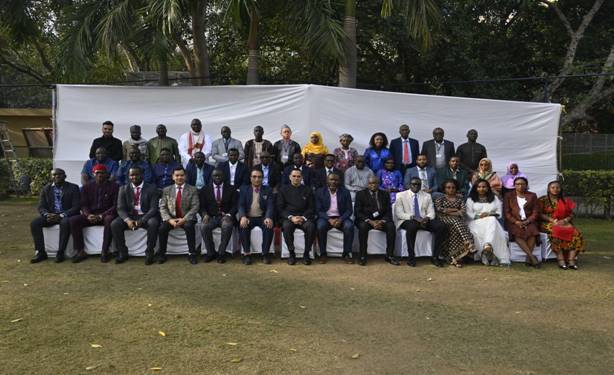
Dr. A.P Singh, Course Coordinator and Associate Professor NCGG, gave the welcome address and provided a comprehensive overview of the two-week program, detailing the diverse topics covered during the training. The program includes sessions on Changing paradigms of governance, Aadhar : a tool for good governance, Land record modernization, GeM, Swamitva Scheme, Public-private partnerships, Climate change policies, Sustainable development goals among others. He also highlighted that the participants of the programme had the valuable opportunity to partake in exposure visits, which proved to augment their overall learning journey. Among the planned visits were the Ministry of Rural Development, DMRC, AIIMS, PM Sangrahalaya, and Taj Mahal among others.
The capacity-building program was supervised by Dr A.P Singh, Course Coordinator, Dr. Mukesh Bhandari, Associate Course Coordinator, Shri Sanjay Dutt Pant, Programme Assistant, and the dedicated capacity-building team of NCGG. The successful conduct of the 5-Nation Africa program represents a milestone for National Centre for Good Governance in its efforts as an apex capacity building institution for international civil servants under the ITEC program.
<
Editorial Assistance for Scopus and SCI Journal Submission
body {
font-family: Arial, sans-serif;
line-height: 1.6;
margin: 20px;
}
    h1 {
        color: #333;
    }

    img {
        max-width: 100%;
        height: auto;
        margin-bottom: 15px;
    }

    .rating {
        display: inline-block;
        unicode-bidi: bidi-override;
        color: #888;
        font-size: 24px;
        height: 1em;
        position: relative;
    }

    .rating span {
        display: inline-block;
        position: absolute;
        overflow: hidden;
        color: #FFD700;
    }

    .rating input {
        display: none;
    }

    .rating label {
        cursor: pointer;
        width: 1em;
        font-size: 24px;
        text-align: center;
        line-height: 1.6;
    }

    .rating label:before {
        content: '★';
    }

    .rating input:checked ~ label,
    .rating input:checked ~ label ~ label {
        color: #FFD700;
    }


<h1>In the ever-evolving landscape of academic publishing, achieving publication in prestigious databases such as Scopus and SCI (Science Citation Index) journals is a significant milestone for researchers and scholars. Our Editorial Assistance service is tailored to support authors in fine-tuning their manuscripts to meet the rigorous standards of these esteemed platforms.</p><div class="separator" style="clear: both;text-align: center"><a href="https://blogger.googleusercontent.com/img/b/R29vZ2xl/AVvXsEiA61063XcznSG056gT8V2Kq4bLj65KyBFBmo6PJ-mGXAV4r8wIE7dhFis2jwikwy_zBB3XI7Pd_OvI463svfTSbWbNZP8NjX_YRvWYAmFCfV3W85XPSN-Yj4ZwBIlCFakUjjzRKxdnMIyYVoGoJclEvX1ll6vJ3C7jIdRw33cYP5XN7ujqe6okn-VEdw6j/s1280/maxresdefault.jpg" style="margin-left: 1em;margin-right: 1em"><img border="0" height="360" src="https://blogger.googleusercontent.com/img/b/R29vZ2xl/AVvXsEiA61063XcznSG056gT8V2Kq4bLj65KyBFBmo6PJ-mGXAV4r8wIE7dhFis2jwikwy_zBB3XI7Pd_OvI463svfTSbWbNZP8NjX_YRvWYAmFCfV3W85XPSN-Yj4ZwBIlCFakUjjzRKxdnMIyYVoGoJclEvX1ll6vJ3C7jIdRw33cYP5XN7ujqe6okn-VEdw6j/w640-h360/maxresdefault.jpg" width="640" /></a></div><br /><p>
Key Features:
-
Manuscript Refinement: Our experienced team of editors is dedicated to refining your manuscript for clarity, coherence, and adherence to the specific guidelines of Scopus and SCI journals. We meticulously review language, grammar, and overall writing style to enhance the readability and professionalism of your work.
-
Structural Enhancement: A well-structured manuscript is crucial for successful journal submission. We provide comprehensive structural assistance, ensuring that your paper follows the prescribed format, including abstract, introduction, methodology, results, discussion, and conclusion. Our goal is to present your research in a logical and organized manner.
-
Technical Accuracy: Precision in technical details is paramount for acceptance into high-impact journals. Our editors pay close attention to data accuracy, statistical analysis, and methodology, ensuring that your research meets the stringent criteria set by Scopus and SCI databases.
-
Formatting Compliance: Journal guidelines often have specific formatting requirements. We meticulously format your manuscript, ensuring compliance with citation styles, references, and any other formatting specifications outlined by the target journal.
-
Quality Assurance: Our editorial process includes multiple rounds of review to ensure the highest quality. We prioritize accuracy, coherence, and the overall scholarly merit of your article.
Benefits:
-
Increased Acceptance Rates: By aligning your manuscript with the standards of Scopus and SCI journals, our service enhances the likelihood of acceptance, propelling your research into the global academic arena.
-
Time Efficiency: We understand the importance of timely submissions. Our efficient editorial process aims to expedite the preparation of your manuscript, facilitating a faster turnaround for journal submission.
-
Expert Guidance: Benefit from the expertise of our seasoned editors who are well-versed in the requirements of Scopus and SCI journals. Receive valuable insights to elevate the impact and relevance of your research.
Embark on your journey towards successful Scopus and SCI journal publication with confidence, knowing that our Editorial Assistance service is committed to maximizing the potential of your scholarly work.
The Art of Writing: A Creative Odyssey
By Shashikant Nishant Sharma
Writing is more than just words on paper; it’s an art form that allows individuals to express their thoughts, emotions, and imagination in a unique and captivating way. The art of writing is a dynamic and evolving process that involves creativity, discipline, and a deep understanding of language. In this article, we will explore the key elements of the art of writing and how aspiring writers can hone their craft.

-
Embrace Creativity:
At the heart of the art of writing is creativity. Allow your imagination to roam freely, breaking free from the constraints of reality. Create vivid worlds, intriguing characters, and compelling narratives that transport your readers to new realms. Embracing creativity means being open to unconventional ideas and finding inspiration in the mundane and extraordinary alike. -
Master the Craft of Language:
Language is the painter’s palette, and words are the colors. Mastering the craft of language involves understanding the nuances of grammar, syntax, and vocabulary. Develop a rich and varied vocabulary to paint detailed images with your words. Experiment with different writing styles, tones, and voices to discover your unique literary fingerprint. -
Find Your Voice:
Every writer has a distinct voice that sets them apart. It’s the tone, style, and perspective that make your writing uniquely yours. Finding your voice requires self-discovery and a willingness to be authentic in your expression. Don’t be afraid to experiment until you discover the voice that feels most natural and resonant with your inner self. -
Cultivate Discipline:
While creativity fuels the art of writing, discipline provides the structure. Set aside dedicated time for writing, establish goals, and stay committed to your craft. Discipline is the force that turns fleeting ideas into tangible stories. Whether it’s a daily writing routine or a structured timeline for completing projects, cultivating discipline is essential for consistent and meaningful output. -
Edit and Revise:
The first draft is just the beginning. The true art of writing involves the meticulous process of editing and revising. Be prepared to scrutinize your work, refine your language, and polish your prose. Editing is where the raw material transforms into a polished masterpiece. Embrace feedback from others and be open to making necessary changes to enhance the overall impact of your writing. -
Emotionally Connect with Your Audience:
Great writing is not just about conveying information; it’s about evoking emotions. Whether it’s laughter, tears, or contemplation, strive to emotionally connect with your audience. Infuse your writing with authenticity and vulnerability, allowing readers to relate to the human experience within your words.
Conclusion:
The art of writing is a dynamic and deeply personal journey. It involves a harmonious blend of creativity, language mastery, self-discovery, discipline, and emotional connection. Aspiring writers should approach their craft with a sense of wonder and a commitment to continuous growth. Through the art of writing, individuals have the power to inspire, challenge, and transport readers to new worlds, making it a truly transformative and timeless form of expression.
References
Raimes, A. (1998). Teaching writing. Annual review of applied linguistics, 18, 142-167.
Sharma, S. N. How to Write a Grant Proposal in an Effective Manner to get Projects.
Weigle, S. C. (2002). Assessing writing. Cambridge University Press.
STEM is FEM – a Ukrainian educational initiative
Sergey Tokarev, an IT investor and initiator of STEM is FEM, a Ukrainian educational initiative, discloses that a significant portion of its female participants attribute their educational choices to the project’s influence. With more than 50% of the girls expressing the impact on their further education, including a notable 17% who underwent a radical change in their educational goals, STEM is FEM emerges as a powerful catalyst for shaping the academic trajectories of Ukrainian girls.

STEM is FEM, recognized by the Ministry of Foreign Affairs of Ukraine as the “Honorary Ambassador of Ukraine in the field of scientific and educational diplomacy” in 2023, is dedicated to promoting Science, Technology, Engineering, and Mathematics (STEM) disciplines among Ukrainian girls. Over its five-year journey, the project has successfully united over 500 participants, fostering a supportive community.
Girls typically join the project between the ages of 16-20, providing a unique opportunity to witness their progression from high school to university and beyond. Sergey Tokarev emphasizes the project’s role in inspiring young Ukrainian women to pursue their dreams, challenge gender stereotypes, and emerge as the next generation of STEM professionals.

A survey conducted by STEM is FEM reveals that 96% of community participants would like to get a mentor—a successful woman in their chosen industry who can share knowledge and experiences. Additionally, 97% of girls aspire to intern in their preferred specialty, often gaining such opportunities through the project’s organized educational events.
The impact of STEM is FEM extends beyond inspiration to tangible results, as demonstrated by the 2023 “Urbanism” course. Renata Seyfullina, a civil engineering student at Lviv Polytechnic, discovered her passion for urban planning and transferred to the Kharkiv School of Architecture. Other course graduates, Anfisa Kaida, Daria Koval, and Natalia Liuklian, engaged in internships with UrbanReform, contributing to the post-war reconstruction of Okhtyrka.
Moreover, 55% of STEM is FEM girls opted for STEM education, with members like Olena Petryshyn studying at Milton Academy and Margarita Perepelytsia achieving recognition at the International Environmental Genius Olympiad. These success stories underscore how STEM is FEM events empower participants to shape their future professions, acquire knowledge, find community support, and develop motivation to pursue careers within STEM disciplines.
Correlation of Dynamics of Pedagogical Skill and the Psychological Support


By Sushila & Dr. Yogendra Nath Chaubey

“Quality Education” the fourth goal among the seventeen Sustainable Development Goals (SDG) outlined by the United Nations, is “to ensure inclusive and equitable quality education and promote lifelong learning opportunities for all”. These descriptions are remarkably similar to the focus identified through this research and, with this in mind, the three dimensions of this research are further explained as being; (1) the ‘Importance of Interaction’ – referring to the various levels of interaction between individuals within the school environment, accounting for behaviour, atmosphere, and types of communication, (2) the ‘Dynamics of Individuation’ – referring to the way in which the differing needs of individuals are personalised and catered for, accounting for classroom pedagogical approaches and student diversification, and (3) the ‘Need for Psychological Support’ – referring to the way in which individuals within the school and the school as a whole is supported by its community, from both an educational and psychological perspective. By suggesting that these research directions are intertwined concepts, they propose a holistic observation of contributing factors that influence the educational process.
This assessment could be used to identify teacher strengths from a personal, interpersonal, psychological, and pedagogical perspective. The Questionnaire of Teacher Interaction (QTI), Technological Pedagogical and Content Knowledge (TPaCK), and Mental Health Inventory (MHI) were used in the pilot study and were considered to be suitable for the needs of this research stage.
The ‘Educational Bubble’
In a recent talk, Seema Bansal (2016) mentioned being asked by the then head of the Department of Education in the state of Haryana (India), for help in addressing issues in their public schools. These ‘issues’ ranged in detail and complexity, including that up to 50% of students fall so far behind their peers before the age of eleven that they will be unable to recover. Despite public schools offering free meals or books to students, it was also found that 40% of parents would pull their children out of these public schools and register them into private schools. Bansal (2016), representing BCG (Boston Consulting Group), was asked to assist in the education renovation of an Indian state of Haryana, which consists of 15,000 public schools with over 2 million students. Bansal mentions needing to uncover the factors that have caused the educational issues in the first place and, in identifying the goals necessary to develop strategies for reaching this particular goal, decided to go directly into classrooms and observe the way educators were teaching. Reporting that the problem within Indian schools was the quality of education, not access to education, mentions that Bansals’ BCG team devised a three-year plan that was based around student learning outcomes and explicit focusing of accountability, data systems, and organizational capacity.
Bansal (2016) reports that Haryana teachers were very capable of teaching a class but, the majority of their time was spent outside of the classroom; this was interesting as, before physically entering a classroom, non-educators had apparently viewed teachers being ‘lazy’ or ‘incapable’. Although Bansal (2016) reported teachers not necessarily teaching, she mentions that it was because they were supervising the construction of new classroom buildings, supervising the cooking of student lunches, or visiting a bank to deposit scholarship money for students. This particular insight was (and is) incredible; Bansal asked teachers why they were not teaching and the teachers answered by saying that “when a supervisor comes to visit us, these are exactly the things that he checks” (5:29). This particular finding shows that in the provision of government programmes in Haryana, designed to motivate students to stay in school and give greater access, had become an additional point of accountability for teachers and had started to impede classroom instruction. Seeing this as an issue, Bansal and her team began to look at the literature at various educational programmes and pilot programmes that have been shown to improve instructional practice. However, what a large proportion of individuals fail to recognise is how the implementation of these programmes will always come at a cost. For example, schools that take part in a pilot that explores the use of innovative technologies on student learning might show that this programme does indeed result in higher levels of academic outcomes.
In Bansal’s (2016) talk she mentions that, with regards to studies and interventions, researchers will typically bring in resources such as money, experience, research assistants, or products. Unless researchers intend to roll out this innovation across every classroom in the country, the findings are most likely going to be un-scalable, ungeneralisable, unusable, and does not reflect a real-world classroom setting. It has been previously mentioned that “teaching requires being responsive to real-world conditions and constraints that shape the activities of the classroom and students” (Motoca et al., 2014, pg. 120). This view is similar to schools being ‘learning organisations’ where the “emphasis of research might be more upon the selection and differentiation of pupils and on their subculture rather than on the authority structure or the decision-making processes within the school” (Bell, 1980, pg.183). Hamzah, Yakop, Nordin and Rahman (2011) explain that, like all organisations, there is a strong emphasis on schools to adapt to their surroundings, encourage flexibility, and to be responsive to the various societal and cultural changes across an educational landscape.
While there is a large body of evidence favouring schools as learning organisations (Mulford, 1997; Stoll and Fink, 1996), research concerning how a school should go about this change is not as prevailing (Silins, Zarins, & Mulford, 2002). While it is clear that there are similarities between a school and an ‘organisation’, both have structure, both have management, there is leadership, interaction, and varying levels of accountability, it is also clear that many factors influence the way in which both operate. Johnston (1998) sought to investigate the key characteristics that involved a school identifying itself as being a ‘learning organisation’. Although focusing exclusively on post-primary schools based in Austrailia, it was found that inclusive, collaborative structures, effective communication channels, integrated professional development, and learning-focused leadership were the four main characteristics of schools being one of these ‘learning organisations’.
Under the three guiding topics of this research, explicitly outlined through questions and hypotheses, this current research sought to discover what the Irish educational environment needs and how a piece of research could be used practically to support school systems and the individuals within them. This research is looking towards the perception of a school being a learning organisation; considering the way which Silins, Zarins and Mulford’s (2002) express the four factors of ‘learning organisations’ above. These descriptions are remarkably similar to the focus identified through this research and, with this in mind, the three dimensions of this research are further explained as being; (1) the ‘Importance of Interaction’ – referring to the various levels of interaction between individuals within the school environment, accounting for behaviour, atmosphere, and types of communication, (2) the ‘Dynamics of Individuation’ – referring to the way in which the differing needs of individuals are personalised and catered for, accounting for classroom pedagogical approaches and student diversification, and (3) the ‘Need for Psychological Support’ – referring to the way in which individuals within the school and the school as a whole is supported by its community, from both an educational and psychological perspective. By suggesting that these research directions are intertwined concepts, they propose a holistic observation of contributing factors that influence the educational process.
While research in an Irish context has found that only 33.1% of schools regularly engage with SSE (Brown, 2010), this dispute between the DES and teaching unions will cause frustration, anxiety, and confusion throughout the educational community. The SSE is a thorough research process that requires considerable resources, the problem is one of ‘lack of support’, almost mirroring the issues faced by Bansal’s (2016) team in Haryana. Additionally, this lack of support echoes in other ways. For example, on 30th of March 2016, the INTO released a press release that argued against the cut in government funding for education and highlighted that schools are being forced to fundraise themselves, that they are “kept running on cake sales, raffles and sponsored walks” (2016b), despite having no empirical evidence to support.
3.6. Conclusion – The Individualised Teacher Report
This claim within the press release itself, it does clearly articulate the many problems experienced in Irish Education.
Despite focusing on the individual educator, rather than the collective school environment, this Ph.D. project somewhat resembles the development of a self-evaluation process; it requires educators to compete measures that evaluate their subjective instructional and psychological resources. Although the issues surrounding self-evaluation may be a possible limitation, this research would argue the opposite. This study could provide a process that allows schools to self-evaluate in a way that takes the workload away from schools, provides tailored feedback to individual educators, has a standardised methodological approach, and is evidence based and research driven. A new model of self-evaluation may be considered a momentous task; however, it is not beyond the scope of this project.
According to Collins and Pratt (2011), “there is a move to adopt a single, dominant view of effective teaching … [where] teachers are asked to reflect on who they are and how they teach but with an implied message that reflection should conform to some preconceived notion of a ‘good’ teacher” (pg. 359). It is naïve to assume that there is a ‘single view’ of what it means to be an effective educator, as the requirements and needs of one classroom group will differ that than of another. What is arguably more appropriate for education, rather than training educators to teach in the same way and conform to a preconceived notion of what a ‘good teacher’ is, is to encourage and train teachers to be self-reflective and adapt their teaching to suit the needs of their students. Boud, Keogh, and Walker (1985) mentioned that reflective practice is an important human activity where provision is given for individuals to recapture their experiences and evaluate them to improve on one’s abilities. One consistency throughout the literature of educator training and interaction is the importance of self-reflection; Paterson and Chapman (2013), for example, argue that self-reflection that motivates an individual to learn from their experiences and is the key towards the maintenance and development of competency throughout their work practices. Others, such as or Hendrickx et al. (2016), mentions that reflective teachers who are aware of their influence on student behaviour can tailor their interactions to benefit their instructional practices.
According to Patil (2013), reflective practices are self-regulated processes that aim to enhance an individuals’ ability to communicate and make balanced decisions. Educational researchers, such as Valli (1997), describe reflective teachers as being individuals that can “look back on events, make judgments about them, and alter their teaching behaviors in light of craft, research, and ethical knowledge” (pg. 70). Other researchers argue that reflective action “involves intuition, emotion, and passion and is not something that can be neatly packaged as a set of techniques for teachers to use” (Zeichner & Liston 1996, pg. 9). These quotes would suggest that reflective practice in education is an ideal that pedagogics and educational researchers would encourage teachers to become accustomed to, but that the practical implementation of may be somewhat difficult to achieve.
Kay and Johnson (2002), speaking about the University of Washington’s teacher education programme, mention that the reflective seminars and completion of reflective portfolios are a useful method to provide support to student teachers in developing the skills necessary to reflect on their practices. Kay and Johnson (2002) do mention that the limitation of these methods is the way they categorise dimensions of reflection into a teachable concept, or that the use of typologies naturally constrain teachers towards ‘thinking like a teacher’. But, similar to Pratt and Collins (2010) view of the TPI, the concept of using this approach as a tool is quite useful. Without the opportunity and a way for teachers to systematically reflect on their instructional practices, they may be unable to view the importance of their instructional decisions, interactions, and relationships with students.
REFERENCES:
- Bansal, S. (2016, May). TED Paris: How to fix a broken education system without any more money. Retrieved 1/7/2016 from TED.com at https://www.ted.com/talks/ seema_bansal_how_to_fix_a_broken_education_system_without_any_more_money?language=en.
- Motoca, L. M., Farmer, T. W., Hamm, J. V., Byun, S. Y., Lee, D. L., Brooks, D. S., … & Moohr, M. M. (2014). Directed consultation, the SEALS model, and teachers’ classroom management. Journal of Emotional and Behavioural Disorders, 22(2): 119-129.
- Bell, L. A. (1980). The School as an Organisation: a re‐appraisal. British Journal of Sociology of Education, 1(2), 183-192.
- Hamzah, M., Yakop, F. M., Nordin, N. M., & Rahman, S. (2011). School as learning organisation: The role of principal’s transformational leadership in promoting teacher engagement. World Applied Sciences, 14, 58-63.
- Mulford, B. (1998). Organisational learning and educational change. In A. Hargreaves, A. Lieberman, M. Fullan and D. Hopkins (Eds). International Handbook of Educational Change. Norwell, MA: Kluwer Academic Publishers.
- Silins, H., Zarins, S., & Mulford, W. R. (2002). What characteristics and processes define a school as a learning organisation? Is this a useful concept to apply to schools? International Education Journal, 3(1): 24-32.
- Johnston, C. (1998). Leadership and the learning organisation in self-managing schools. Unpublished doctoral dissertation, University of Melbourne, Victoria.
- Brown, (2010). A mixed methods analysis of a mixed methods system: attitudes of Post Primary school Principals to internal/external evaluation: The Case of Ireland. Cited In McNamara, G., & O’Hara, J. (2012). From looking at our schools (LAOS) to whole school evaluation-management, leadership and learning (WSE-MLL): the evolution of inspection in Irish schools over the past decade. Educational Assessment, Evaluation and Accountability, 24(2), 79-97.
- Collins, J. B., & Pratt, D. D. (2011). The teaching perspectives inventory at 10 years and 100,000 respondents: Reliability and validity of a teacher self-report inventory. Adult Education Quarterly, 61(4); 358-375.
- Boud, D., Keogh, R., & Walker, D. (1985). Reflection, Turning Experience into Learning. Routledge.
- Paterson, C., & Chapman, J. (2013). Enhancing skills of critical reflection to evidence learning in professional practice. Physical Therapy in Sport, 14(3): 133-138.
- Hendrickx, M. M., Mainhard, M. T., Boor-Klip, H. J., Cillessen, A. H., & Brekelmans, M. (2016). Social dynamics in the classroom: Teacher support and conflict and the peer ecology. Teaching and Teacher Education, 53, 30-40.
- Patil, S.S.J. (2013). Reflective practice in education. Global Online Electron Int Interdi Res J, 2(1): 356-358.
- Valli, L. (1997). Listening to other voices: A description of teacher reflection in the United States. Peabody Journal of Education, 72(1): 67–88.
- Zeichner, K. M., & &Liston, D. P. (1996). Reflective teaching: An introduction. Mahwah, New Jersey: Lawrence Erlbaum Associates.
- Johnson, B.R., & Kay, A.J. (2002). Mixed Methods Research: A Research Paradigm whose Time Has Come. Educational Researcher, 33(7): 14-26.
Link to DOWNLOAD Full PDF
Famous Cricket Tournaments
There are several famous and prestigious cricket tournaments played around the world. Here’s a list of some of the most well-known cricket tournaments:

- ICC Cricket World Cup:
- Format: One Day International (ODI)
- Frequency: Held every four years
- Organized by the International Cricket Council (ICC), it is the premier international ODI tournament.
- ICC T20 World Cup:
- Format: Twenty20 International (T20I)
- Frequency: Held every two years
- The ICC T20 World Cup is a global competition for national teams in the T20 format.
- The Ashes:
- Format: Test Matches
- Frequency: Generally held every two years
- A historic Test series played between England and Australia, one of the oldest and most prestigious rivalries in cricket.
- Indian Premier League (IPL):
- Format: Twenty20 (T20)
- Frequency: Annual
- A professional T20 league in India featuring franchises representing different cities and regions.
- Big Bash League (BBL):
- Format: Twenty20 (T20)
- Frequency: Annual
- Australia’s premier domestic T20 competition, featuring city-based franchises.
- Pakistan Super League (PSL):
- Format: Twenty20 (T20)
- Frequency: Annual
- Pakistan’s premier T20 league featuring franchises representing different cities.
- Caribbean Premier League (CPL):
- Format: Twenty20 (T20)
- Frequency: Annual
- A T20 league featuring teams from various Caribbean nations.
- NatWest T20 Blast:
- Format: Twenty20 (T20)
- Frequency: Annual
- England’s domestic T20 competition.
- Bangladesh Premier League (BPL):
- Format: Twenty20 (T20)
- Frequency: Periodic
- A T20 league featuring franchises representing different cities in Bangladesh.
- Ranji Trophy:
- Format: First-class (four-day) and limited-overs (One Day)
- Frequency: Annual
- India’s premier domestic cricket competition, played among regional teams.
- Sheffield Shield:
- Format: First-class (four-day)
- Frequency: Annual
- Australia’s premier domestic first-class competition.
- Royal London One-Day Cup:
- Format: One Day Domestic
- Frequency: Annual
- England’s domestic 50-over competition.
- Super Smash:
- Format: Twenty20 (T20)
- Frequency: Annual
- New Zealand’s domestic T20 competition.
These tournaments showcase cricket at different levels and formats, ranging from international competitions to domestic leagues, contributing to the global popularity of the sport.
Meaning of Andragogy
Andragogy, a term often mystified yet integral to our understanding of adult education, stands at the forefront of lifelong learning. Unlike traditional education models, andragogy shifts the focus to the mature learner, tailoring educational methods to suit the unique needs of adults. In a world where continuous learning is not just a benefit but a necessity, understanding andragogy becomes crucial.

What is Andragogy?
Andragogy, derived from the Greek words ‘andr’, meaning ‘man’, and ‘agogos’, meaning ‘leader’, is the method and practice of teaching adult learners. This concept stands in contrast to pedagogy, the method of teaching children, underscoring a significant shift from teacher-led to learner-centered methodologies. For a comprehensive exploration of this topic, visit https://pg-group.online/what-is-andragogy/. Here, andragogy is presented as emphasizing the learner’s experience, self-direction, and readiness to learn, all of which are essential components in the realm of adult education.
Historical Background
The journey of andragogy from a nascent idea to a cornerstone of adult education is both fascinating and pivotal. Its roots can be traced back to Europe in the early 19th century, yet it wasn’t until the mid-20th century that the term gained substantial recognition. This rise in prominence is largely credited to Malcolm Knowles, an American educator whose contributions in the 1970s were instrumental in shaping andragogy as we understand it today.
Knowles’ work illuminated the unique needs and approaches necessary for adult learning, distinguishing it significantly from traditional child-centric education models. This distinction marked a significant shift in the educational paradigm, placing adult learners at the forefront of their educational journey. Over time, andragogy has evolved, absorbing and integrating a variety of theories and practices from the broader field of adult education. This evolution reflects the dynamic nature of adult learning, adapting to the changing societal and individual needs of adults seeking education.
Principles of Andragogy
Central to understanding andragogy are the principles outlined by Malcolm Knowles. These principles differentiate adult education from traditional children’s learning methods. Firstly, the shift in self-concept from being dependent learners to being self-directed is crucial. Adults prefer to take charge of their learning journey, guiding their educational paths. Secondly, adults bring a rich tapestry of experience to their learning. This wealth of personal and professional experience becomes a valuable resource in the learning process.
Moreover, adults demonstrate a readiness to learn things that are immediately relevant to their roles in society, particularly in professional and personal settings. The orientation towards learning in adults is problem-centered rather than content-centered. They prefer to learn in the context of real-life tasks and problems. Finally, while external factors like job advancement can motivate adults, internal motivators such as self-esteem, satisfaction, and quality of life are often stronger drivers.
Andragogy in Practice
The principles of andragogy come to life in various adult learning environments, creating engaging and effective educational experiences. These principles are applied in several distinct ways:
- Interactive Learning: This includes workshops, seminars, and discussion groups that foster active participation and collaborative learning.
- Self-Directed Learning: Adult education often features flexible programs that allow learners to choose their own learning paths, topics, and pace.
- Practical Application: Courses and training are focused on practical, real-world application, ensuring that learning is immediately relevant and useful.
- Technology-Enhanced Learning: The integration of interactive tools, online resources, and blended learning models enhances the overall learning experience.
- Peer Learning and Mentorship: Opportunities for collaborative projects and mentorship programs enrich the learning process through shared experiences and expert guidance.
These varied applications of andragogy principles cater to the unique needs of adult learners, making their educational journey both impactful and relevant.
Conclusion
Andragogy, as a learner-centered approach, is pivotal in empowering adults in their educational pursuits. It opens doors to endless opportunities, playing a key role in both personal and professional spheres. By embracing the principles of andragogy, adults are equipped to thrive in a constantly evolving world.
Creating a Blogger theme based on another platform's theme, like Colinear for WordPress
Creating a Blogger theme based on another platform’s theme, like Colinear for WordPress, involves understanding the structure and design elements of the original theme and then adapting them to fit Blogger’s template system. While I can’t provide you with a fully functional Blogger theme here, I can guide you on how to get started.
Here are the general steps you can follow:
1. Understand Colinear Theme:
Visit the Colinear WordPress theme’s official page or documentation to understand its structure, features, and design elements. Note down key components like header, footer, sidebar, and main content area.
2. Set Up a New Blogger Blog:
If you don’t have a Blogger blog, create one. Go to Blogger and sign in with your Google account. Click on “Create a blog” to set up a new blog.
3. Access Blogger Theme Editor:
Once your blog is set up, go to the Blogger dashboard, and navigate to the “Theme” section.
4. Back Up Existing Theme:
Before making any changes, it’s a good practice to back up your existing Blogger theme. Click on the “Backup/Restore” button and download the current template.
5. Analyze Blogger Template Structure:
Familiarize yourself with the structure of the default Blogger template. Understand how it uses XML and widgets to define the layout.
6. Create HTML Structure:
Take the HTML structure from Colinear’s theme and modify it to fit Blogger’s XML format. Pay attention to the placement of widgets, headers, footers, and other key elements.
7. Add CSS Styles:
Blogger uses CSS for styling. Copy the CSS styles from Colinear’s theme and adapt them for Blogger. Ensure that the styling matches the HTML structure you created.
8. Customize Widgets:
Blogger uses widgets for various elements like the sidebar, header, and footer. Add and customize widgets based on the ones used in the Colinear theme.
9. Test Responsiveness:
Ensure that your Blogger theme is responsive. Test it on different devices and screen sizes to make sure it looks good everywhere.
10. Test Functionality:
Test all the functionality of your Blogger theme, including navigation, links, and any custom features.
11. Optimize for SEO:
Make sure your theme is optimized for search engines. Add relevant meta tags and descriptions.
12. Publish Your Theme:
Once you’re satisfied with your Blogger theme, click the “Apply to Blog” button to publish it.
Remember that creating a Blogger theme based on another platform’s theme requires careful consideration of the differences between the two platforms. Additionally, respect copyright and licensing terms if you’re using someone else’s design as a base.
Elevate Your Conference Experience: Unlock the Power of Publication Support with Pen2Print
body {
font-family: Arial, sans-serif;
line-height: 1.6;
margin: 20px;
}
    h1 {
        color: #333;
    }

    img {
        max-width: 100%;
        height: auto;
        margin-bottom: 15px;
    }

    .rating {
        display: inline-block;
        unicode-bidi: bidi-override;
        color: #888;
        font-size: 24px;
        height: 1em;
        position: relative;
    }

    .rating span {
        display: inline-block;
        position: absolute;
        overflow: hidden;
        color: #FFD700;
    }

    .rating input {
        display: none;
    }

    .rating label {
        cursor: pointer;
        width: 1em;
        font-size: 24px;
        text-align: center;
        line-height: 1.6;
    }

    .rating label:before {
        content: '★';
    }

    .rating input:checked ~ label,
    .rating input:checked ~ label ~ label {
        color: #FFD700;
    }


<h1>Dear Conference Organizers, Esteemed Researchers, and Academic Enthusiasts,
Are you gearing up to host an exceptional conference that deserves widespread recognition and global impact? Look no further! Pen2Print is here to elevate your conference experience with our comprehensive publication support services, ensuring that your research reaches the pinnacle of success.

Unleashing the Power of Publication Support:
-
Conference Proceedings ISBN Allotment:
Give your conference proceedings the recognition they deserve with our ISBN allotment services. A unique ISBN not only adds credibility to your proceedings but also facilitates their cataloging and accessibility.
-
Publication as a Special Issue in International Journal of Research (IJR):
Take your research to new heights by featuring it in a special issue of the esteemed International Journal of Research (IJR). Benefit from the wide readership and high impact factor that IJR offers, amplifying the visibility of your work.
-
Allotment of DOI (Digital Object Identifier):
Ensure the permanence and traceability of your research with the allotment of a DOI. A DOI guarantees that your work remains easily accessible and citable, enhancing its impact in the academic community.
-
Indexing of Articles:
Secure a place for your articles in renowned indexing services, increasing their discoverability and readership. Pen2Print ensures that your research receives the recognition it deserves by indexing it in reputable databases.
Conference Proceedings ISBN Allotment:
Give your conference proceedings the recognition they deserve with our ISBN allotment services. A unique ISBN not only adds credibility to your proceedings but also facilitates their cataloging and accessibility.
Publication as a Special Issue in International Journal of Research (IJR):
Take your research to new heights by featuring it in a special issue of the esteemed International Journal of Research (IJR). Benefit from the wide readership and high impact factor that IJR offers, amplifying the visibility of your work.
Allotment of DOI (Digital Object Identifier):
Ensure the permanence and traceability of your research with the allotment of a DOI. A DOI guarantees that your work remains easily accessible and citable, enhancing its impact in the academic community.
Indexing of Articles:
Secure a place for your articles in renowned indexing services, increasing their discoverability and readership. Pen2Print ensures that your research receives the recognition it deserves by indexing it in reputable databases.
Maximize Exposure and Impact:
-
Promotion of Your Conference:
We don’t stop at just publication support! Pen2Print goes the extra mile by actively promoting your conference. Leverage our extensive network and marketing strategies to ensure maximum participation and engagement.
-
Send Your Inquiry Today!
Ready to take your conference to the next level? Send an email to editor@pen2print.org to inquire about our publication support services. Our dedicated team is committed to assisting you every step of the way.
Promotion of Your Conference:
We don’t stop at just publication support! Pen2Print goes the extra mile by actively promoting your conference. Leverage our extensive network and marketing strategies to ensure maximum participation and engagement.
Send Your Inquiry Today!
Ready to take your conference to the next level? Send an email to editor@pen2print.org to inquire about our publication support services. Our dedicated team is committed to assisting you every step of the way.
Why Pen2Print?
-
Expertise:
Benefit from the expertise of our seasoned professionals who understand the nuances of academic publishing.
-
Global Reach:
Ensure your research reaches a global audience through our wide network and collaborations.
-
Tailored Solutions:
We offer customized solutions to meet the unique needs of your conference and research.
Expertise:
Benefit from the expertise of our seasoned professionals who understand the nuances of academic publishing.
Global Reach:
Ensure your research reaches a global audience through our wide network and collaborations.
Tailored Solutions:
We offer customized solutions to meet the unique needs of your conference and research.
Don’t let your hard work remain confined—let Pen2Print be your partner in unlocking the full potential of your research. Elevate your conference experience and make a lasting impact in the academic world!
Get ISBN for Conference Proceedings
Best Regards,
editor
Pen2Print Team
editor@pen2print.org
 Eduindex
You must be logged in to post a comment.