Understanding NIFTY

S&P CNX NIFTY is an Index computed from performance of top stocks from different sectors listed on NSE (National stock exchange). NIFTY consists of 50 companies from 24 different sectors. NIFTY stands for National Stock Exchange’s Fifty. The companies which form index of NIFTY may vary from time to time based on many factors considered by NSE.  NIFTY is for NSE similarly SENSEX is for BSE. Some mutual funds use NIFTY index as a benchmark meaning the mutual funds’ performance is compared against the performance of NIFTY. On NSE there are futures and options available for trading with NIFTY as underlying index. India Index Services and Products Ltd. (IISL) owns NIFTY.  

IISL is a joint venture of NSE and CRISIL. CRISIL is a subsidiary of Standard and Poor (S&P). And so NIFTY is also called as S&P CNX NIFTY. CNX ensures common branding of indices, to reflect the identities of both the promoters, i.e. NSE and CRISIL. Thus, ‘C’ stands for CRISIL, ‘N’ stands for NSE and X stands for Exchange or Index. The S&P prefix belongs to the US-based Standard & Poor’s Financial Information Services. Nifty stocks represent about 63 percent of the Free Float Market Capitalization. Impact cost of the S&P CNX Nifty for a portfolio size of Rs.50 laks is 0.06%. Market impact cost is the best measure of the liquidity of a stock. It accurately reflects the costs faced when actually trading an index. For a stock to qualify for possible inclusion into the S&P CNX Nifty, it has to reliably have market impact cost of below 0.75 percent when doing S&P CNX Nifty trades of Rs. 50 Lakhs. S&P CNX Nifty is professionally maintained and is ideal for derivatives trading.  

S&P CNX Nifty always uses the best stocks possible for its index. The weakest stocks are removed from inside the S&P CNX Nifty and the new stock into it. The world changes, so the index should change. Yet, the change should not be sudden – for that would disrupt the character of the index. S&P CNX Nifty uses clear, researched and publicly documented rules for index revision. These rules are applied regularly, to obtain changes to the index set. Index reviews are carried out every six months to ensure that each security in the index fulfills all the laid down criteria. IDBI was once not listed; SBI was once illiquid; Infosys was once an obscure software startup. The world changes, and one by one, these stocks have come into the S&P CNX Nifty. Each change in the S&P CNX Nifty is small, so the continuity of the index is maintained. Yet, at all times, S&P CNX Nifty represents the 50 most important liquid stocks in the country, the best stocks to build an index out of.  

NSE has the best surveillance procedures in India, so the extent of market manipulation is minimum. In NSE, since, the professional staff of the surveillance department has no positions on the market, this elimination of conflicts of interest and generates a more honest focus upon eliminating market manipulation. On a day to day basis millions of shares get traded on the NSE generating huge order flows. Due to the liquidity and order flow from numerous market players manipulation of the closing price becomes very hard. NSE is the most liquid exchange in India. Hence, the prices observed there are the most reliable. NSE has the highest trading intensity and their bid-ask spreads are the tightest.    

Sister indexes of NIFTY

S&P CNX Defty  

S&P CNX Defty is S&P CNX Nifty, measured in dollars. If the S&P CNX Nifty rises by 2percent it means that the Indian stock market rose by 2percent, measured in rupees. If the S&P CNX Defty rises by 2percent, it means that the Indian stock market rose by 2percent, measured in dollars.

S&P CNX 500  

S&P CNX 500 is India’s first broadbased benchmark of the Indian capital market. The S&P CNX 500 represents about 86percent of total market capitalisation and about 78percent of the total turnover on the NSE. The S&P CNX 500 companies are disaggregated into 72 industries, each of which has an index called S&P CNX Industry Index. Industry weightages in the index dynamically reflect the industry weightages in the market. So for e.g. if the banking sector has a 5percent weightage among the universe of stocks on the NSE, banking stocks in the index would have an approximate representation of 5percent in the index. The S&P CNX 500 is a market capitalisation weighted index. The base date for the index is the calendar year 1994 with the base index value being 1000. Companies in the index are selected based on their market capitalisation, industry representation, trading interest and financial performance. The index is calculated and disseminated real-time.  

CNX Nifty Junior  

S&P CNX Nifty is the first rung of the largest, highly liquid stocks in India. CNX Nifty Junior is an index built out of the next 50 large, liquid stocks in India. It is not as liquid as the S&P CNX Nifty, which implies that the information in the S&P CNX Nifty Junior is not as noise-free as that of the S&P CNX Nifty. S&P CNX Nifty and the CNX Nifty Junior taken together constitute 100 most liquid stocks in India. S&P CNX Nifty is the front line blue-chips, large and highly liquid stocks. The CNX Nifty Junior is the second rung of growth stocks, which are not as established as those in the S&P CNX Nifty. A stock like Satyam Computers, which recently graduated into the S&P CNX Nifty, was in the CNX Nifty Junior for a long time prior to this. CNX Nifty Junior can be viewed as an incubator where young growth stocks are found.   

As with the S&P CNX Nifty, stocks in the CNX Nifty Junior are filtered for liquidity, so they are the most liquid of the stocks excluded from the S&P CNX Nifty. Buying and selling the entire CNX Nifty Junior as a portfolio is feasible. The maintenance of the S&P CNX Nifty and the CNX Nifty Junior are synchronised so that the two indices will always be disjoint sets; i.e. a stock will never appear in both indices at the same time. Hence it is always meaningful to pool the S&P CNX Nifty and the CNX Nifty Junior into a composite 100 stock index or portfolio.

CNX MidCap

The medium capitalised segment of the stock market is being increasingly perceived as an attractive investment segment with high growth potential. The primary objective of the CNX MidCap Index is to capture the movement and be a benchmark of the midcap segment of the market. The CNX MidCap Index is a market capitalisation weighted index with its base period of the index being the calendar year 2003 and base value as 1000.The distribution of industries in the CNX MidCap Index represents the industry distribution in the MidCap segment of the market. All companies are evaluated for trading interest and financial performance.  

CNX MNC Index  

The CNX MNC Index comprises 15 listed companies in which the foreign shareholding is over 50percent and/or the management control is vested in the foreign company. The index is a market capitalisation weighted index with base period being the month of December, 1994 indexed to a value 1,000. Companies in the index should be MNCs and are selected based on their market capitalisation, industry representation, trading value and financial performance.  

CNX PSE Index  

As part of its agenda to reform the Public Sector Enterprises (PSE), the Government has selectively been divesting its holdings in public sector enterprises since 1991. With a view to provide regulators, investors and market intermediaries with an appropriate benchmark that captures the performance of this segment of the market, as well as to make available an appropriate basis for pricing forthcoming issues of PSEs, IISL has developed the CNX PSE Index, comprising of 20 PSE stocks.  

CNX IT Sector Index  

With the Information Technology (IT) sector in India growing at a fast rate, there is a need to provide investors, market intermediaries and regulators an appropriate benchmark that captures performance of this sector. Companies in this index should have more than 50percent of their turnover from IT related activities like software development, hardware manufacture, vending, support and maintenance. The index is a market capitalisation weighted index with its base period being December 1995 with base value 1,000. NSE being the leading stock exchange in India, the NIFTY index is not only a prime index for the exchange itself but also it is an indicator of the booming Indian economy. Despite of the recent slowdown in the global economic scene the NIFTY index has sustained a regular growth after overcoming the sudden impact. The index for so many reasons has attracted investors not only from the domestic market but also from foreign countries.
Struggles of an extrovert

You get excited over nearly everything
Even a little thing makes you excited and satisfied. You always make sure that you are entertained all by your own self.

When you’re upset you have to talk to as many people as you can about it.
You need many of them to listen to your problem because you can’t keep it up to yourself. Sharing the same will make it lighter.

Being home alone actually gives you anxiety.
You have the habit of staying with people and you don’t have the habit of being alone as you need someone always. But when you are home alone it actually gives you anxiety.

People often associate you with words like, “intense” “full on” or “very loud.
People often judge you because of your extra behaviors which for you is normal. As you are always ready for anything and everything there are chances when people won’t like it.

Wanting to go out when everyone else wants to stay in.
You can never be at rest. Be it your workplace, classroom or a weekend you have to go out for any reason.

You’re apparently not allowed to be sad.
Extroverts are not robots. They have emotions as equal as others. But people always believe that you can never be sad as they have always seen you excited and happy.

You’re expected to be the entertainment, everywhere, every time.
Not everytime they have the same energy, they have their own issues, sometimes they may be sad. But everyone expect you to be the one who entertains them.

Being expressive makes them seem like a rebel.
Maybe you don’t do it intentionally but you may sound like a one at some point because of your tone or your ways of expressing it.

Career in content writing.

“writing” the word itself means hard and smart work, both combined to give a great boost to your creative career in content writing
, The best way to start a career in content writing is only with more practice. One can opt for content writing as their career if you are enthusiastic to prove your writing skills. This can be done when you start writing your own blogs about any specific topic it might be any topic or field in which you are interested. And following some effective tips to write the content will be helpful.

To start a career in content writing means you already need to start writing all by yourself. All you need is to know how to write and it should be presentable and approachable. A career in this field is not as easy at it seems to be, so you need to have utter patience, educate yourself as much as you can, take criticisms positively and make your words make worth. Because, in the sudden moment, you will need to mold yourself into the market demands in writing, yet keeping alive your creativity. To write effective content one should have good command over English and vocabulary
There are many such organizations, websites which gives you a wide range of platform to showcase your writing skills through their blogs, post, etc which gives you an experience, knowledge, and grip to your career.
Start writing, gain the experience, get better at writing and you’ll find there are a ton of opportunities awaiting you.

Struggles of an introvert.

Not a conversation starter
They never start a conversation instead they sulk in the background until someone introduces them.

Staying home can become an addiction.
As they don’t like socializing much they prefer to be isolated rather than being with people. They prefer staying at home as a better option rather being out with others.

Social anxiety hits them anytime.
It’s really hard for them to actually be in large groups and from nowhere they may have a serious anxious feeling.

Phone calls are the absolute WORST.
They always try to avoid people as much as they can. They are much more of a ‘text’ person.

People underestimate them.
As they don’t come up usually, people underestimate them which is wrong. People have a misconception that they may lack talent or they are of no use but in reality they have much more than the ordinary.

Saying No
It’s very hard for them to say no. As they are not sure for the same. They would rather die than just saying no.

Public Speaking
This is the most challenging and horrying thing for a shy person. Human interaction foe them is so scary and when the same is in huge numbers you can’t imagine the fear they come across.

Making idle conversation is hard
They are better when they have their loved ones with them. They never approch or have a conversation with a stranger. And evend if they do so it turns out to be real hard.

Someone Approaching them.
This is the most hardest thing for a shy person. They always try to avoid people, specially strangers. And if someone approaches they become anxious.

Positive effects of lockdown in environment.

Effect on Air Quality
After the lockdown in many countries, there was lesser travelling done by people, whether it be by their own cars, or by trains and flights.
Industries were closed down and not allowed to function. This in turn led to the pollution in the air dropping significantly, as there was a marked decline in nitrous oxide emission.

Water Quality:
Since there were no boats, whether they be fishing or other activities, be it on the rivers and waterways, the water has cleared up.
In areas like Venice, the water became so clear that the fish could be seen and there was better water flow. No doubt, because of the lesser human footfall even the oceans are recovering and marine life is thriving.

Effect on Wildlife:
Again where fish is concerned, the lockdown has seen a decline in fishing, which means that the fish biomass will increase after over-fishing almost depleted it.
Apart from that, animals have been spotted moving about freely where once they would not dare to go. Even sea turtles have been spotted returning to areas they once avoided to lay their eggs, all due to the lack human interference.

Effect on Vegetation:
Plants are growing better because there is cleaner air and water, and because yet again there is no human interference.
With everything at a standstill, plants are allowed to thrive and grow and produce more coverage and oxygen. Less litter also means lesser clogging of river systems, which is good in the long run for the environment.

Pollution level:
Be it air pollution, water pollution or noise pollution the levels have decreased a lot as compared to the previous datas.
This lockdown has definetley proven positive for the environment around.

In conclusion, though there has been a positive impact on the environment due to the lockdown, there is fear that once people start travelling again or go back to doing what they have been doing, all the positive impact will also disappear.

Patents in India

What is a patent ?

A patent is a legal document that is granted by the government of the state or the country, depending on the national rules. It gives an inventor of a particular thing, the exclusive right to make, use and sell his or her creation for a specified period of time. 

The basic idea of this system is to encourage the inventors to safeguard their own creations. Books, movies, and some artworks cannot be patented. However, one can protect these assets under the law of copyright. The law of patent is one branch of the larger legal field known as intellectual property, which also includes trademark and copyright law.

Patent is a form of intellectual property rights (IPR) which apart from patents also includes trademarks, copyrights, geographical indicators etc. A patent is an exclusive right granted for an innovation, which is a product or a process that provides, in general, a new way of doing something, or offers a new technical solution to a problem.

Objective of patent is to grant the innovator of the product or process some benefits where invention/innovation cannot be commercially made, used, distributed or sold without the patent owner’s consent. These patent rights are usually enforced in a court, which, in most systems, holds the authority to stop patent infringement. In India, patents are governed by Indian Patents Act 1970 which initially provided for the process patents only and not for product patents for food, chemicals and drugs.

Suppose if product has been developed by an inventor, then he can file patent for the process through which that product has been developed and not for that product itself. In the case of inventions being claimed relating to food, medicine, drugs or chemical substances, only patents relating to the methods or processes of manufacturer of such substances were provided. Thus patent act of 1970 emphasized public interest over monopoly rights. However, under World Trade Organization (WTO), Trade Related Intellectual Property Rights (TRIPS) agreement provides for product patent for 20 years. After the expiry of 20 years, anyone can manufacture that product. All WTO members had to comply with TRIPS agreement before 2005 because of which Indian parliament passed Patent Amendment Act 2005 which brought product patent regime in India. Important features of 2005 Amendment Act and extension of product patent protection to all fields of technology including drugs, foods and chemicals were granted.   

Exemptions under 2005 Act are –  

• Frivolous claims contrary to natural laws

• Anything contrary to law or morality or injurious to public health

• Mere arrangement or rearrangement of duplication of known devices.

• A method of agriculture or horticulture

• Inventions related to atomic energy  

Further, act also empowers the government to import, make or use for its own purpose. It also empowers import of drugs for public health distribution. It also empowers the government to revoke the patent which is found mischievous to state or prejudices to public. State can also acquire a patent to meet national requirements. Patents act is supposed to have most important bearing on the pharmaceutical industry. Drug manufacturing MNCs incur huge cost in the form of R&D for development of new drugs. In order to recover that cost, they sought patent and sell these drugs at exorbitant prices. After the term of patent (20years) is over, every company is free to manufacture those drugs and price of these drugs reduces drastically as new companies don’t engage in the R&D and its cost is reduced. Such drugs whose patent is expired are called as Generic medicines and Indian pharmaceutical companies produce these generic medicines at mush less cost than their western counterparts.  

Under the 1997 patent act, Indian companies could produce these drugs even before expiry of 20 years through different process but after 2005 amendment; they have to comply with the product patent. Therefore, it may have an adverse impact on price of medicines in India as they have to comply with TRIPS. Bolar Provision facilitates production and marketing of patented product immediately after the expiry of term of patent by permitting preparatory action by non patent companies during the term of the patent. According to this provision, despite the patent rights, research and tests for regulatory approval does not constitute infringement of patent. There have been few apprehensions in various quarters particularly for health sector regarding its impact on drug prices as it may rule out the availability of low cost drugs. However, it is said that 97 percent drugs manufactured in India are off patents and will remain unaffected.  

Further, legislation has strong provision for the outright acquisition of patents to meet national requirements. Besides, there is also Drug Price Control Order administered by National Pharmaceutical Price Authority. There are also adequate safeguards to protect the interest of domestic industry and common man from any increase in the prices of drugs. Although there are adequate safeguards are assured by the government, but some impact on prices cannot be ruled out which will further alienate the poor from the health due to rising cost of medicines. Since it is also nor immoral on part of the companies conducting extensive research on the development of life saving drugs, treatment can be assured to all the persons through universalization of Health Insurance which may be partially public funded.    Just like government had imposed cess on petrol and diesel to recover the cost of High development, some cess can also be imposed to recover the cost of universal health programme. In 2009-10, as many as 34287 patents were filed out which only 6168 patents were granted. Moreover, only 17 percent of these patents were granted to Indian while rests were granted to the foreigners. In 2010-11, of the total 7,486 patents granted, Indians could claim only 1,272. On the other hand, foreigners walked away with 6,214 patents. In the world, Japan is credited with maximum number of patents.

The nightingale of India: Lata Mangeshkar

The nightingale of India, Lata Mangeshkar, who has charmed the people in India and across the globe with her melodious voice by singing over 50,000 songs as a playback singer in films at least in 14 languages. Perhaps, she must have been the most recorded voice in the history of this century.
Born on 28th September, 1929 in Indore Madhya Pradesh, Lata hails from a singers family. Her father ‘ Dinanath Mangeshkar’ was a play back singer and owned a theatrical company and her sister Asha Bhosle remind her sole competitor still the 90’s. Lata took her first music lessons from her father at the age of 5 and also studied with Aman Ali Khan Sahib and later Amanat Khan. Following her father’s death in 1942 and the burden of supporting the family forced Lata to choose the singing profession at the very early age of 16. She started her singing career by the movie Kiti Hasal in 1942. In the later coming years, she also played miscellaneous roles from a producer to composer and actress for various films.
She has been defying the law of gravity for more than 50 years by staying firmly ensconced in her position, as though age has bypassed her. Lata sang innumerable songs in her awesome repertoire which cannot be denied either on merit or success and songs that contributed to shaping one of the greatest success stories of the 20th Century. Whether she sang Madhubala to eternal fame with Ayega aanewala in Mahal at the age of 20, or at 44, she immortalized Dimple Kapadia by singing Hum tum ek kamre mein band hon in Bobby or at 69, Dimple’s daughter Twinkle attained an aura of stardom when Lata sang Madhosh dil ki dhadkan for her in Jab Pyar Kissise Hota Hai and a barely a year later, Preity Zinta swung and sang into action with Jiya jale in Dil Se. There is a halo of youthfulness around her. In her body language. Her sense of humor. The timbre of impishness in her voice, which lends itself so naturally to a Tabu (Hu Tu Tu) or a Manisha Koirala (Kachche Dhaage) even today at 74, Lata continues to exude the magic that has made her a legend and gives her voice with the same volume and melody to the actresses who are 1/3rd of her age as she did back in her young age. The telephone rings persistently with people calling to congratulate her on her latest achievement.
Lata Mangeshkar has sang in more than 500 films and for many Lata is the most admired singer. Along with singing, Lata also acted in 8 movies between 1942 and 1948 and her last movie being Chachha Zindabad in 1955. She also composed for the movie Sadhi Manse in 1965 and produced the movie Lekin in 1990. Lata Mangeshkar at 74 is a milestone and a speed-breaker. The breakneck pace at which music is written, rehearsed, rendered and recorded makes Lata a helpless giantess. For Lata, music is a kalpavruksh (a lush tree) whose every branch is covered with beautiful flowers and rich, green leaves. It was after India’s losses in the India-China war in 1962 that a young Lata had sung the song, “Ai Mere Watan Ke Logon, Zara Aankh Me Bhar Lo Pani” the song, written by Kavi Pradeep, moved many heartening people into tears and still remains to be one of the most patriotic song sung by her.
From early on Lata was recognized as being highly gifted musically, and her natural talent meant that she could master the vocal exercises effortlessly on first pass and marked her entrance into music world by competing with the strong and powerful voices of 1940s like Noorjehan, Shamshad Begum and Zohrabai Ambalewali and faced set backs. Lata was even rejected for Shaheed (1948) by producer S. Mukherjee who complained that her voice was too thin, but in 1949 broke with series of hits and particularly the song titled “Aaega Aanewaalaa” from Mahal, really struck home with the nation. By 1950, Mangeshkar’s high-pitched singing style had changed the industry and practically swept away the career of all the existing female singers of that era and dominated the industry till the late 1950s single handedly. With the rise of her sister Asha Bhosle in late 1950s both revolutionized the music world and remained the queens of Indian playback singing up until the 1990s.
Her phenomenal success made Lata the most powerful woman in the Film Industry and nothing stopped Lata from being the best. she rendered obsolete the heavy nasal voices of the day and in search of perfection she even learned Urdu by hiring a tutor. After working with stalwarlts like Madan Mohan, Sajjad Hussain, S. D. Burman, Laxmikant-Pyarelal and R. D. Burman, Lata feels that today the music is not so encouraging. These days she sings more of classical based songs and restrains herself from singing in obscenity songs.
The evidence of Lata Mangeshkar’s contribution comes from the various trophies and awards she has received. She received several doctorates from various universities varying from Pune University to New York University. Awards like Padma Bushan, Padma Vibushan and the no less prestigious Dadasaheb Phalke award in 1990 are the feathers in her Crown. Recently, she was awarded the ‘Bharatha Rathna’ – the highest civilian honor by the Government of India.
Lata has gradually eased herself out of the rat-race of playback singing, though she does sing an occasional number and she no longer needs to announce her retirement from films. Hindustani cinema has itself announced how much need it now has for her. There were those moments of high anguish when Lata felt diminished by the departure of contemporaries like Geeta Dutt, Mukesh, Mohammed Rafi, Kishore Kumar and Hemant Kumar.
For Lata, along with fame came sometimes allegations that she stole her sister’s Asha Bhosle songs or from several female playback singers who could not, perhaps, match her range and talent, alleging that she did not let other talented singers come up. It is not known how much truth there is in such allegations, but it is beyond dispute that Lata is undeniably the best singer India has produced. Her contribution to making music popular throughout India and the world is incalculable.
No human being gets everything in life and at a certain stage in life regrets, but today Lata is beyond all that and doesn’t regret for not getting married. Lata Mangeshkar is a proud Indian and in fact a true living legend.

25 years of cell phone

In the early hours of New Year’s Day 1985, Michael Harrison phoned his father Sir Ernest to wish him a happy new year. There may appear nothing remarkable in such a private show of filial affection, but Sir Ernest was chairman of Racal Electronics and his son was making the first-ever mobile phone call in the UK, using the network built by its newest investment, a company based round the corner from a curry house in Newbury, Berkshire.
Later that morning, comedian Ernie Wise made a very public mobile phone call from St Katherine’s Dock, east London, to announce that the very same network, Vodafone, was now open for business. A few days later, its sole rival, Cellnet, a joint venture between BT and Securicor, was also up and running.At the time, mobile phones were barely portable, weighing in at almost a kilogram, costing several thousand pounds and, in some cases, with little more than 20 minutes talktime. The networks themselves were small; Vodafone had just a dozen masts covering London and the M4 corridor while Cellnet launched with a single mast, stuck on the BT Tower. Neither company had any inkling of the huge potential of wireless communications and the dramatic impact that mobile phones would have on society over the next quarter century.
“We projected there would only be about a million ever sold and we would get about 35% of the market and BT projected there would be about half a million and they would get about 80% of the market,” remembers Sir Christopher Gent, former Vodafone chief executive who was at St Katherine’s Dock a quarter of a decade ago as he prepared to take up his post of managing director the following day. “In the first year, we sold about 15,000 to 20,000 phones. The hand portable Motorola was about £3,000 but most of the phones we sold were carphones from the likes of Panasonic and Nokia.”
Having seen mobile phone penetration soar above 100% in 2004, the industry has spent the later part of the past decade trying to persuade people to do more with their phones than just call and text, culminating in the fight between the iPhone and a succession of touchscreen rivals – soon to include Google’s Nexus One.
John Cunliffe, chief technology officer at Ericsson in north west Europe, believes the next wave of growth for mobile telephony will come not from persuading more people to get a phone – because many already have one – but connecting machines to wireless networks. Everything from vehicle fleets and smart electric and water meters to people’s fridge freezers will one day be able to communicate.
“What we have at the moment is 4.5 billion devices worldwide, what we at Ericsson see is that going to 50 billion devices by 2020,” he reckons. “This is all about machine to machine communication, touching all aspects of our lives.”

Fiscal structure in India

Fiscal federalism refers to the division of responsibilities with regards to public expenditure and taxation between the different levels of the government. Having a fiscal federalism mechanism allows the government to optimize their costs on economies of scale, because in this manner, people will get public service which they prefer, and there will be no unnecessary expenditure. From the economic point of view also, having a federalised structure helps as it creates a unified market.
India has a federal form of government, and hence a federal finance system. The essence of federal form of government is that the Centre and the state governments should be independent of each other in their respective, constitutionally demarcated spheres of action. Once the fundamentals of the government are spelt out, it becomes equally important that each of the government should be provided with sources of raising adequate revenues to discharge the functions entrusted to it.
Constitutional Provisions
The fiscal powers and functional responsibilities in India have been divided between the Central and State governments following the principles of federal finance. Article 246 of the Constitution lays down the list of subjects on which different levels of government can make laws. The division of functions is specified in the Seventh Schedule of the Constitution in three lists vis. the Union List, the State List and the Concurrent List.


The Union List contains 97 subjects of national importance, such as defence, railways, national highways, navigation, atomic energy, and posts and telegraphs. 66 items of State and local interest, such as law and order, public health, agriculture, irrigation, power, rural and community development, etc. have been entrusted to the state governments. 47 items such as industrial and commercial monopolies, economic and social planning, labour welfare and justice, etc. have been enumerated in the Concurrent List. The concurrent list is one in which both state and the Centre can make legislations. However, in case of a conflict or tie, federal laws prevail. Similarly, the borrowing powers have also been clearly mentioned in the Constitution. Under Article 292, the Central government is empowered to borrow funds from within and outside the country as per the limits imposed by the Parliament. According to Article 293(3), the States can borrow funds within the Country. Article 293(2) empowers the Centre to provide loans to state subject to conditions laid down by Parliament.


Fiscal Imbalances in India

Fiscal imbalance occurs when there is a mismatch between a government’s future debt obligations and future income streams.


Vertical Fiscal Imbalance occurs when the revenues of different levels of government (i.e. centre, state and local) do not match their expenditures responsibilities. There is a mismatch in the revenue capacity and expenditure responsibilities of the central, state and local govt. The lower level government (state and local) are often dependent on the central govt for finances to meet their expenditure responsibilities and this necessitates inter-governmental transfers from central govt to lower level governments.


Horizontal fiscal imbalance occurs when governments at the same level in different regions of a country have different abilities to provide services due to different abilities of raising funds. For example, not all states or municipalities in India raise equal amount of tax revenue, which will ultimately define the quality of services provided by individual states to their respective people. Then some region have higher cost of services compared to other regions, so this kind of an imbalance or mismatch in the revenue and expenditure accounts of governments at same level is known as horizontal fiscal imbalance.


Typically, federations (including the Indian one) face vertical and horizontal imbalances. A vertical imbalance arises because the tax systems are designed in a manner that yields much greater tax revenues to the Central government when compared to the state or provincial governments; the Constitution mandates relatively greater responsibilities to the state governments. For example, in India, post the advent of Goods and Services Tax (GST), the share of states in the public expenditure is 60% while it is 40% for the Centre to perform their constitutionally mandated duties.
Justifying Centripetal Biases
For the analysis of Indian fiscal federalism, nevertheless, it must be kept in mind that the Indian federation differs from the developed federations in many important respects.


First, India is vast country with wide inter-regional differences in economic endowments as well as levels of income, and is faced with conflicting tendencies of centralisation and decentralisation, the former designed to reduce inter-regional disparities and the latter to meet the diverse patterns of demand. Besides, the Indian economy is faced with severe interjurisdictional competition, underlining the need for utmost cooperation among various jurisdictions.
Second, the low levels of income and wide inter-regional disparities have necessitated governmental intervention not just in the provision of public services; the government has taken the major responsibility for economic development of the country by taking up the role of both catalyst and an entrepreneur. The multilevel planning adopted for the purpose has brought forth additional com plexities in the fiscal arrangements in terms of heavy fiscal dependence of the states on the Centre, high degree of vertical and horizontal tax and expenditure spillovers and multiplicity in intergovernmental transfer schemes with overlapping and ambiguously defined objectives.
Third, as the pattern of investments in pre-independent era was largely determined on the basis of colonial interests of the ruling power, the differences in the levels of development currently in vogue among the states do not necessarily represent their varied resource endowments.
Finally, the existence of wide inter-regional differences in the levels of development itself under lines a significant role for inter- governmental equitable transfer schemes, as the nexus between levels of development and resource endowments seems to be tenuous in most cases. In such a situation, equitable transfers at the expense of richer states may not necessarily result in lower economic growth.


The Case of Horizontal Imbalances
The horizontal imbalances arise because of differing levels of attainment by the states due to differential growth rates and their developmental status in terms of the state of social or infrastructure capital. Traditionally, Finance Commissions have dealt with these imbalances in a stellar manner, and they should continue to be the first pillar of the new fiscal federal structure of India.
However, in India, the phenomenon of horizontal imbalance needs to be understood in a more nuanced fashion. It involves two types of imbalances. Type I is to do with the adequate provision of basic public goods and services, while the second, Type II, is due to growth accelerating infrastructure or the transformational capital deficits. The latter are known to be historically conditioned or path dependent. It is here that we believe that NITI Aayog must create a niche, assume the role of another policy instrument and become the second pillar of the new fiscal federal structure.


What Can be Done?


Reimagining NITI Aayog
In the past, the Planning Commission used to give grants to the states as conditional transfers using the Gadgil-Mukherjee formula. Now with the Planning Commission disbanded, there is a vacuum especially as the NITI Aayog is primarily a think tank with no resources to dispense, which renders it toothless to undertake a “transformational” intervention. On the other hand, it is too much to expect the Union Finance Commission to do the dual job. In other words, there is an urgent need for an optimal arrangement. It is best that the Union Finance Commission be confined to focussing on the removal of the horizontal imbalance across states of the Type I: i.e. the basic public goods imbalance. We need another institution to tackle the horizontal imbalance of the Type II; for this the NITI Aayog is the most appropriate institution. It can be argued that the Finance Ministry is the other alternative to deliver the goods in this regard but it is ill-suited to do this; its primary duty is to concern itself with the country’s macro-economic stability and the proper functioning of the financial system rather than be an instrument of growth at the subnational level.
Towards this task of cooperative federalism, NITI Aayog should receive significant resources (say 1% to 2% of the GDP) to promote accelerated growth in States that are lagging and overcome their historically conditioned infrastructure deficit, thus reducing the developmental imbalance. In short, the NITI Aayog should be engaged with the allocation of “transformational” capital in a formulaic manner, complete with incentive-compatible conditionalities.
NITI Aayog should also be mandated to create an independent evaluation office which will monitor and evaluate the efficacy of the utilisation of such grants. In doing so, it should not commit the mistake of micro-management or conflicts with line departments. It must be also accorded a place at the high table of decision-making as it will need to objectively buy-in the cooperation of the richer states as their resources are transferred to the poorer ones.

Unlock 3.0: MHA issues guidelines: Schools, Colleges and Coaching institutions to be shut till 31 August; yoga institutes, gyms to reopen from Aug 5

The Ministry of home affairs (MHA) has issued fresh guidelines for third phase of ‘Unlock’. These guidelines will come into effect from 1 August, 2020. The restrictions on the movement of individuals during night have been removed, while yoga institutes and gymnasiums will be allowed to open from August 5.

Lockdown shall continue to be implemented strictly in the containment zones till August 31. All activities, except the following shall be permitted outside containment zones – Metro Rail, cinema halls, swimming pools, entertainment parks, theatres, bars, auditoriums, assembly halls and similar places.

Also, schools, colleges and coaching institutions will remain closed till August 31. The government also said the new guidlines issued today are based on feedbacks received overtime by authorities and chief ministers of states and Union Territories. Social/political/sports/entertainment/academic/cultural/religious functions and other large congregations are still not permitted.

Guidelines for containment zones:

According to the order, lockdown in containment zones will remain imposed till 31 August, 2020. These virus containment zones need to be carefully demarcated by the state governments or UTs. Within the perimeters of containment zones, strict social distancing and other norms of containing the spread of the virus shall be maintained and only essential activities will be allowed, MHA said in a statement.

These containment zones will be notified on the websites of respective district collectors of the states and UTs and activities taking place in these zones will be strictly monitored by the authorities. MHA also stated that the states and UTs can impose its own guidelines outside the containment zones, which they deem necessary.

India went under a complete nationwide lockdown from 25 March in order to curb the spread of the novel coronavirus in the country. In an attempt to bring back normalcy, the MHA has been issuing a number of guidelines in its Unlock India mission in order to provide relaxations in a graded manner and kickstart the economy. Meanwhile, with 48,513 people testing positive for coronavirus in a day, India’s Covid-19 tally crossed 15 lakh-mark today, while the recoveries jumped to 9,88,029, according to the daily bulletin of Ministry of Health & Family Welfare.

The country’s death toll rose to 34,193 with 768 fatalities being recorded in a day. The fatality from covid currently stands at 2.25% in India as compared to global average of about 4%. Total virus positive cases now stand at 15,31,669 including 5,09,447 active cases, the health ministry said.

WEBSITES REFERRED:

  1. https://www.mha.gov.in/sites/default/files/Unlock3_29072020.pdf
  2. https://timesofindia.indiatimes.com/videos/news/unlock-3-0-mha-issues-guidelines-yoga-institutes-gyms-to-reopen-from-aug-5/videoshow/77245574.cms
  3. https://www.livemint.com/news/india/unlock-3-0-night-curfew-removed-gymns-to-open-under-new-guidelines-details-here-11596030267259.html
  4. https://www.dreamstime.com/unlock-india-now-open-again-india-unlock-very-long-strict-lockdown-to-fight-covid-indian-economy-unlock-image185165878

EUTHANASIA LAW IN INDIA

WHAT IS EUTHANASIA?

The word Euthanasia originiates from the Greek words: Eu (good) and Thanatos (death) and it means “Good Death”, “Gentle and Easy Death.” It is also known as Mercy killing. It was first used in a medical context by Francis Bacon in the 17th century, to refer to an easy, painless, happy death, during which it was a “physician’s responsibility to alleviate the ‘physical sufferings’ of the body”.

According to the World Medical Association Euthanasia means:

Deliberate and intentional action with a clear intention to end another person’s life under the following conditions: The subject is a competent informed person with incurable illness. Who voluntarily asked for ending his life. The person who is acting knows about the state of this person and about his wish to die and is doing this action with an intention to end life of this person. The action is done with compassion and without any personal profit.

TYPES OF EUTHANASIA

Following are the types of euthanasia:-

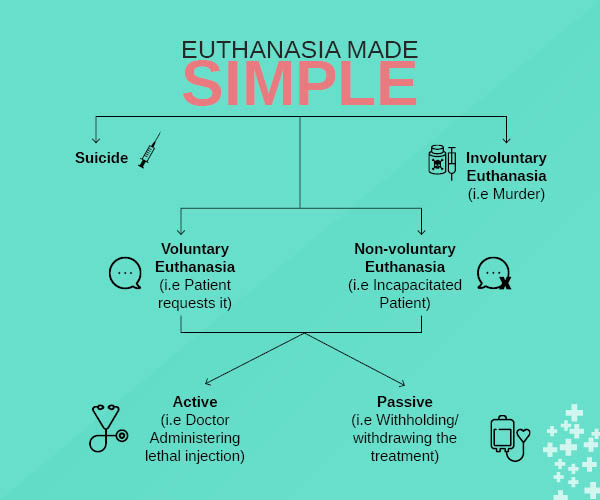
  1. Passive or Negative euthanasia means the withdrawal of necessary medical treatment with the deliberate intention to hasten the death of a terminally-ill patient is a must. In order for the death to be voluntary, the medicines which aids in saving lives will be discontinued so that death is brought about voluntarily. A common practice of this is a patient signing a ‘Do Not Resuscitate’ (DNR) document. It implies discontinuing or not using extraordinary life sustaining measures to prolong life. Others include act of omission such as failure to resuscitate a terminally ill or incapacitated patient (e.g. a severely defective new-born infant).

2. Active or Direct euthanasia means when one induces death by giving or providing medication or treatment leading to death.

3. Voluntary Euthanasia, sometimes called “assisted suicide”, is used in cases where the sufferer has made it clear that s/he wishes to die and has requested help to bring this about. When the euthanasia is practiced with the expressed desire and consent of the person concerned

4. Involuntary Euthanasia is one which is conducted without the consent and where an individual makes a decision for another person who is incapable of doing so. E.g. prolonged comma, old age, etc. It occurs when no consent or wish to die is expressed by the sufferer. When the euthanasia is practiced against the will of the person and also involuntary Euthanasia is one where patients can express a wish to die but don’t (this equates to murder).

5. Non- Voluntary Euthanasia is one where patients cannot express a wish to die. Patients who are in comas, infants, profound mentally retarded, severely brain damaged, cases of extreme senile dementia, those who cannot communicate for other reasons.

LEGAL VALIDITY IN INDIA

Passive euthanasia is legal in India. As per the 2018 ruling, The Supreme Court has held that the right to die with dignity is a fundamental right.

WHAT IS THE LEGAL POSITION AND TRENDS OF EUTHANASIA IN DIFFERENT COUNTRIES?

The Laws around the world vary greatly with regard to euthanasia, and are constantly subject to change as cultural values shift and better palliative care, or treatments become available. It is legal in some nations, while in others it may be criminalized. In some countries there is a divisive public controversy over the moral, ethical, and legal issues of euthanasia. Those who are against euthanasia may argue for the sanctity of life, while proponents of euthanasia rights emphasize alleviating suffering, and preserving bodily integrity, self-determination, and personal autonomy. Countries which have legitimized euthanasia are The Netherlands,Belgium, Oregon and Washington in the USA. In Switzerland only assisted suicide is legal. In India as mentioned above only passive euthanasia is legal.

LANDMARK CASE IN INDIA

Aruna Ramchandra Shanbaug vs Union Of India

FACTS OF THE CASE

Aruna Shanbaug, a nurse who was assaulted by a ward boy, and went into a vegetative state in 1973. • She remained blind, deaf, paralyzed and in a vegetative state till her death in 2015. A Writ Petition was filed by Pinki Virani claiming that her right to life guaranteed by the constitution had been violated. The petition was rejected by the court after medical examination. However, later in Aruna Ramchandra Shanbaug vs Union Of India, the Supreme Court in March 2011 held that passive euthanasia could be given a nod in case of exceptional circumstances and under strict monitoring of the apex court.

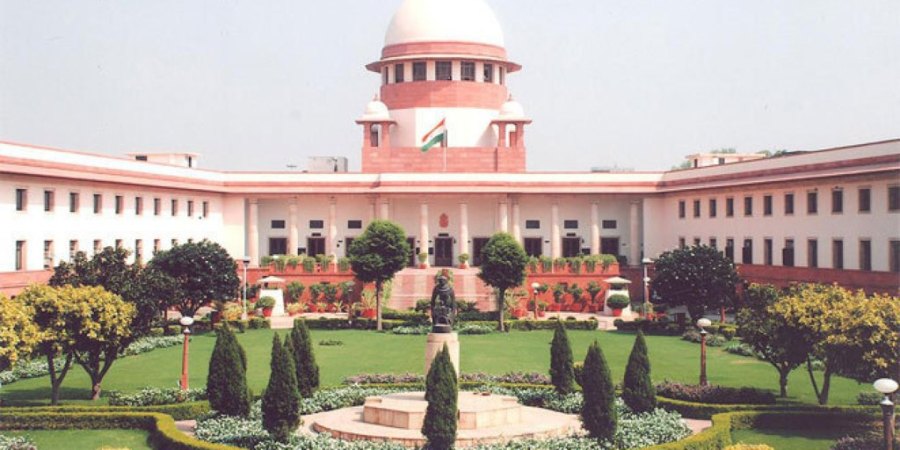
On 7 March 2011 the Supreme Court of India legalized passive euthanasia by means of the withdrawal of life support to patients in a permanent vegetative state. The decision was made as part of the verdict in a case involving Aruna Shanbaug, who had been in a Persistent Vegetative State (PVS) for 42 years until her death in 2015.

The Supreme Court of India specified two irreversible conditions to permit Passive Euthanasia:

  1. The Brain-Dead for whom the ventilator can be switched off.
  2. Those in a Persistent Vegetative State (PVS) for whom the feed can be tapered out and pain-managing palliatives be added, according to laid-down international specifications.

GUIDELINES LAID DOWN BY APEX COURT:

The following guidelines were laid down: A decision has to be taken to discontinue life support either by the parents or the spouse or other close relatives, or in the absence of any of them, such a decision can be taken even by a person or a body of persons acting as a next friend. It can also be taken by the doctors attending the patient. However, the decision should be taken bona fide in the best interest of the patient.

Even if a decision is taken by the near relatives or doctors or next friend to withdraw life support, such a decision requires approval from the High Court concerned. When such an application is filled the Chief Justice of the High Court should forthwith constitute a Bench of at least two Judges who should decide to grant approval or not.

A committee of three reputed doctors to be nominated by the Bench, who will give report regarding the condition of the patient. Before giving the verdict a notice regarding the report should be given to the close relatives and the State. After hearing the parties, the High Court can give its verdict.

WHAT ARE THE ARGUMENTS FOR AND AGAINST EUTHANASIA? 

Benefits of Legalizing Euthanasia (Arguments For)

  1. Provides relief to extreme pain.
  2. Relieves physical, mental and psychological pain for the patient and the family.
  3. Provides more facilities and funds for other patients needing medical treatment and attention.
  4. Euthanasia provides a way of relief when a person’s quality of life is low.
  5. It is another case of freedom of choice – the right to commit suicide.
  6. People should not be forced to stay alive.
  7. Speedy termination of physical and emotional suffering.
  8. Organs can be put to good use.
  9. Relieve mental suffering for the patient and his relatives.

Consequences of legalizing Euthanasia (Arguments Against)

  1. The ‘living will’ could be misused
  2. Religious beliefs could pose as a conflict in few scenarios
  3. The person might not be well informed of the possible treatment options
  4. Guidelines of the content of ‘living will’ has to be standardized
  5. Euthanasia demeans and devalues the sanctity of human life.
  6. Euthanasia can become a means of health care cost containment.
  7. Euthanasia will become non-voluntary.
  8. Euthanasia would not only be for people who are terminally ill.
  9. It amounts to murder and it is only God who can take away human life.
  10. It destroys life, which has potential that could be yet unknown to the patient, doctor or the family members.
  11. It discourages scientists who are looking for a cure for incurable ailments.
  12. An irreversible damage

WEBSITES REFERRED:

  1. https://www.slideshare.net/digitaltejas/euthanasia-types-arguments-for-and-against
  2. https://www.slideshare.net/altacitglobal/euthanasia-law-in-india
  3. http://racolblegal.com/euthanasia-an-act-of-mercy-killing/
  4. https://www.latestlaws.com/articles/euthanasia-the-contemporary-art-of-dying-by-aman-kumar-and-richa-hudilwala/
  5. https://byjus.com/free-ias-prep/euthanasia-or-mercy-killing/
  6. https://www.123rf.com/photo_109776197_stock-vector-red-flat-line-banner-trends.html
  7. https://www.slideserve.com/nami/euthanasia-mercy-killing
  8. http://racolblegal.com/the-dharma-jurispudence-of-the-supreme-court/

New education policy

After 34 years the government of India has taken crucial decision by bringing changes in education policy by 5+3+3+4 system

The government of India also mentioned the degree students can choose the tenure of the courses, students can complete their degree in 2 years with a diploma certificate, the students need to complete their 5 the grade by mother tongue

From age 3 to 18 the students must pursue their education

Growing level of competition good for children?

In this day and age where the pace of carrying on with the existence we long for causes significant damage in us. the change through this periods of life are rarely disturbing and we either fall into them or being pushed in the race of life to endure. ultimately Darwin long back gave the mantra – its survival of the fittest.

Present populace of India is 1.27 billion and is developing step by step because of this developing populace less open door is accessible for one prompting elevated level competition,competition in any general public is viewed as solid for the development of the general public and are not left away from it and it they among whom rivalry is the most, rivalry can be in any field scholastic, vocation, or games ” it is smarter to wear out than to blur away” is presumably turning into the best impression of developing rivalry today, for youth it is a race which must be succeeded at any cost and this opposition begins with open level tests in school and continues endlessly for school, work thus on..but where does this opposition start from is an unavoidable issue? What’s more, the response for this is training because rivalry and instruction are interrelated for which rivalry begins from school when a kid contends to take confirmation in school and goes on further till he grows up and passes school life and go into progressively serious reality where he needs to confront heavy cut off ( d.u – 99%) and further more competition..the level of rivalry isn’t with others however with oneself , among young ladies and young men where young ladies wanna substantiate themselves better than young men and arrive at the top position.. rivalry in any capacity causes a kid to build up his character, it encourages a youngster to build up his abilities to come out of the weight, encourages one to know his quality and shortcoming, how to manage basic circumstance rivalry just educates us but a major issue here is that it rivalry essentially right? Is it truly helping a kid to develop decidedly or blurring endlessly his character, rivalry can be sure and adverse and the second side of the coin is pessimistic which represents a danger to youngster’s character and at last his presentation a major job in this is played by relatives and their weight on their kid to turn into the best which prompts different issues looked by a kid like mental weight, stress, tension and if a kid can’t deal with this he thinks better to take up his life, self destruction endeavor by the kids after load up tests is aftereffect of this just then again it prompts weak wrongdoing carried out by youth eg -spilling test paper or paying off and which is at times helped by their folks also,drugs and liquor turns out to be every day part of adolescents life which he feels supportive to alleviate stress,this rivalry isn’t just observed among academicians yet in addition in other circle of life like competitor enjoying different violations and so forth.. The circumstance here requests for us to see when we are standing and what might be it’s outcomes is a kid building up it’s character or simply going for futile way of life , it becomes obligation of guardians to create solid rivalry obligation of school and companions to instruct the kid right thing once abilities, , qualities ought to be improved such a way, that it prompts create a correct way and not overlook his actual character because youngsters are assets and it ought to be used in a superior manner by the general public an entirety

Healthy Competition among all gives us the feeling of where we stand yet it must be from inside not a weight included upon by the guardians or the pitiless framework which just perceives the best. India being the second biggest populated nation makes this opposition for the up and coming age slanted to a furious one. The strain to perform well should not over shadow our character and ought not propel us to tumble from the correct way. Kids must be ingrained with virtues first whereupon the belief system of Survival of the fittest must be dealt with. After the entirety of its not how well you ran the race it how you finish that issues

Public Interest Litigation in India

Introduction

The expression ‘Public Interest Litigation’ has been borrowed from American jurisprudence, where it was designed to provide legal representation to previously unrepresented groups like the poor, the racial minorities, unorganised consumers, citizens who were passionate about the environmental issues, etc.PIL is not defined in any statute or in any act. It has been interpreted by judges to consider the intent of public at large.

Public interest litigation (PIL) refers to litigation undertaken to secure public interest and demonstrates the availability of justice to socially-disadvantaged parties and was introduced by Justice P. N. Bhagwati. It is a relaxation on the traditional rule of locus standi.The liberal interpretation of locus standi where any person can apply to the court on behalf of those who are economically or physically unable to come before it has helped. Judges themselves have in some cases initiated suo moto action based on newspaper articles or letters received.

Some Landmark Judgements

• In December 1979, Kapila Hingorani filed a petition in regards to the condition of the prisoners detained in the Bihar jail, whose suits were pending in court. The petition was signed by prisoners of the Bihar jail and the case was filed in the Supreme Court of India before the bench headed by Justice P. N. Bhagwati. The petition was filed under the name of a prisoner, Hussainara Khatoon, and the case was therefore named Hussainara Khatoon Vs State of Bihar. The Supreme Court decided that prisoners should receive free legal aid and fast hearings. As a result, 40,000 prisoners were released from jail. Thereafter many similar cases have been registered in the Supreme Court. It was in the case of SP Gupta vs Union of India that the Supreme Court of India defined the term “public interest litigation” in the Indian context.

The concept of public interest litigation (PIL) is suited to the principles enshrined in Article 39A of the Constitution of India to protect and deliver prompt social justice with the help of law. Bhagwati and Justice V. R. Krishna Iyer were among the first judges to admit PILs in court.

A new era of the PIL movement was heralded by Justice P.N. Bhagawati in the case of S.P. Gupta vs. Union of India.

  • In this case it was held that “any member of the public or social action group acting bonafide” can invoke the Writ Jurisdiction of the High Courts (under article 226) or the Supreme Court (under Article 32) seeking redressal against violation of legal or constitutional rights of persons who due to social or economic or any other disability cannot approach the Court.
  • M.C Mehta vs. Union of India: In a Public Interest Litigation brought against Ganga water pollution so as to prevent any further pollution of Ganga water. Supreme Court held that petitioner although not a riparian owner is entitled to move the court for the enforcement of statutory provisions, as he is the person interested in protecting the lives of the people who make use of Ganga water.
  • Vishaka v. State of Rajasthan: The judgement of the case recognized sexual harassment as a violation of the fundamental constitutional rights of Article 14, Article 15 and Article 21. The guidelines also directed for the Sexual Harassment of Women at Workplace (Prevention, Prohibition and Redressal) Act, 2013.

Who Can File a PIL and Against Whom?

  • Any citizen can file a public case by filing a petition:
    • Under Art 32 of the Indian Constitution, in the Supreme Court.
    • Under Art 226 of the Indian Constitution, in the High Court.
    • Under sec. 133 of the Criminal Procedure Code, in the Court of Magistrate.
  • However, the court must be satisfied that the Writ petition fulfils some basic needs for PIL as the letter is addressed by the aggrieved person, public spirited individual and a social action group for the enforcement of legal or Constitutional rights to any person who are not able to approach the court for redress.
  • A Public Interest Litigation can be filed against a State/ Central Govt., Municipal Authorities, and not any private party. The definition of State is the same as given under Article 12 of the Constitution and this includes the Governmental and Parliament of India and the Government and the Legislature of each of the States and all local or other authorities within the territory of India or under the control of the Government of India.

Conclusion


Public Interest Litigation is working as an important instrument of social change. It is working for the welfare of every section of society. It’s the sword of every one used only for taking the justice. The innovation of this legitimate instrument proved beneficial for the developing country like India. PIL has been used as a strategy to combat the atrocities prevailing in society. It’s an institutional initiative towards the welfare of the needy class of the society.