

Smart Waste Management and Recycling Coordination Platform

Citation

Jain, P., Chintawar, H., Phillips, J., Patel, B., Ramteke, C., & Singh, D. (2026). Smart Waste Management and Recycling Coordination Platform. International Journal of Research, 13(4), 1–7. https://doi.org/10.26643/ijr/edupub

Prachi Jain, Harshith Chintawar, Joshua Phillips, Bhargav Patel, Chetan Ramteke, Divyansh Singh

Department of Computer Science & Engineering,

G H Raisoni University, Amravati, Maharashtra

Abstract: The Smart Waste Management and Recycling Coordination Platform is an innovative digital solution designed to enhance the efficiency, transparency, and sustainability of urban waste management systems. With the rapid growth of urban populations and the increasing volume of solid waste, traditional waste collection and recycling processes face significant challenges such as inefficiency, lack of coordination, and limited public participation. This platform integrates modern technologies such as Internet of Things (IoT), data analytics, and mobile applications to streamline waste collection, segregation, and recycling processes. Smart bins equipped with sensors monitor fill levels in real time and notify waste collection authorities for optimized routing, thereby reducing operational costs and environmental impact. The system also enables users to schedule pickups, track waste disposal activities, and receive incentives for proper segregation and recycling.

Additionally, the platform connects households, waste collectors, and recycling centres through a centralized interface, improving communication and coordination among stakeholders. Data driven insights help municipal authorities make informed decisions, forecast waste generation patterns, and implement effective waste management policies.


Keywords: AI analytics, voice interaction, data transformation, multi-source ingestion, automated dashboards, user data isolation, self service analytics. 

1. INTRODUCTION 

Rapid urbanization, population growth, and increased industrial activity have led to a significant rise in waste generation across cities and communities. Despite the availability of recycling technologies and authorized waste processing organizations, waste management remains inefficient due to poor coordination, lack of transparency, and limited access to organized recycling channels.

The Smart Waste Management & Recycling Coordination Platform is designed to address these challenges by creating a unified digital ecosystem that connects waste generators, recycling organizations, and administrative authorities on a single platform. The system enables efficient waste reporting, intelligent matching with nearby authorized recyclers, and streamlined coordination for waste collection, processing, and tracking. 

This platform allows waste generators—such as households, businesses, institutions, and industries—to easily submit waste details including type, quantity, and location. 

1.1 Research Objectives 

The key objectives of this research include: 

  • To develop a web-based platform that allows users to enter waste details such as type, quantity, and location in a structured manner.
  • To provide a comparison table of available recyclers, displaying key parameters such as minimum quantity requirement, value/cost, location, and availability, to support informed decision-making.
  • To implement an AI-assisted decision support mechanism that analyses user input and recycler constraints to recommend the most suitable recycler.
  • To reduce manual effort and decision delays by automating the process of recycler comparison and selection.
  • To improve operational efficiency of recycling organizations by ensuring that only relevant and eligible waste requests are received.
  • To enable administrative monitoring and control for managing recycler data, waste requests, and ensuring transparency and accountability.
  • To promote responsible waste disposal and environmental sustainability by encouraging efficient recycling through technology-driven solutions.

2.RELATED WORK 

In recent years, the use of Artificial Intelligence in waste management has gained significant attention. Many research efforts have focused on automating waste classification and improving recycling efficiency through advanced technologies such as machine learning, computer vision, and IoT.

Several studies have demonstrated that AI-based image classification models, particularly Convolutional Neural Networks (CNNs), can effectively identify waste categories such as plastic, metal, and organic materials. These systems reduce human effort and increase sorting accuracy. However, they often require large, well-labeled datasets and high computational resources, which limits their accessibility. Other approaches combine AI with IoT systems, where smart bins and sensors monitor waste levels and optimize collection processes. While these systems improve operational efficiency, they are expensive and complex to implement, especially in developing regions. Industrial solutions have also integrated roboticarms with AI models to physically segregate waste. Although highly efficient, these systems are mostly restricted to large-scale recycling plants and do not address the problem at the user level.

A key limitation observed across existing systems is the lack of user-centric design. Most solutions focus on backend automation rather than helping individuals make correct disposal decisions. Additionally, many systems fail to provide contextual guidance, such as handling contaminated or mixed-material waste.

3. SYSTEM ARCHITECTURE 

The EcoBridge system follows a modular client server architecture designed to ensure scalability, efficiency, and real-time responsiveness.

At a high level, the system consists of three main layers:

  1. User Interface Layer (Frontend) This layer allows users to interact with the system through a web or mobile interface. Users can input waste details, upload images, or use voice commands. The interface is designed to be simple and intuitive, ensuring accessibility for all types of users.
  • Application Layer (Backend) The backend acts as the core processing unit of the system. It handles:
  • API requests 
  • Business logic 
  • Waste classification and recycler matching 
  • Communication with external services (Google APIs) 

It processes      user      inputs   and generates meaningful          outputs such     as recycler recommendations and disposal guidance.

3. Data Layer (Database & External APIs) This layer manages data storage and retrieval. It includes:

  • MongoDB database for storing recycler details and user requests 
  • External APIs like Google Places and

Geocoding for real-world data. 
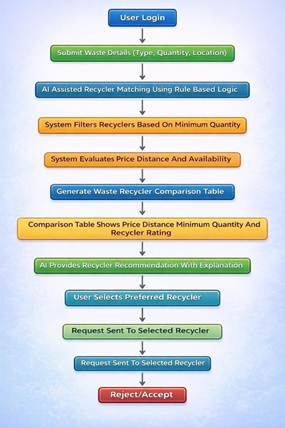
Fig 3.1 Flowchart of EcoBridges system 

This flowchart illustrates the workflow of the EcoBridges system The flowchart represents an AI-based waste management system where the user first logs in and submits waste details such as type, quantity, and location. The system uses rule-based logic to match suitable recyclers and filters them based on minimum quantity requirements. It then evaluates factors like price, distance, and availability to generate a comparison table. Based on this analysis, the AI recommends the best recycler with an explanation. Finally, the user selects a preferred recycler, sends a request, and the recycler either accepts or rejects the request.

4. SYSTEM MODULES 

The proposed system is composed of several key modules that contribute to the overall functionality of the analytics platform. 

4.1 Data Upload Module: Users can provide data in multiple ways, such as:  Entering waste type manually 

  • Uploading images of waste 
  • Providing location details 
  • Using voice input 

The module ensures that the data is captured in a structured format and sent to the backend for further processing. It is designed to be simple and user-friendly so that even non-technical users can easily interact with the system.

4.2 Data Processing Module: This module performs several important tasks:  Cleaning and validating input data 

  • Converting location into coordinates

(latitude & longitude) 

  • Normalizing waste types 
  • Preparing data for analysis 

It ensures that the input is accurate and ready for further computation. This step is crucial because the quality of processing directly affects the final output.

4.3 Query Processing Module: It takes processed data and performs:

  • Recycler matching 
  • Distance calculation (using Haversine formula) 
  • Price comparison 
  • Score calculation for recommendation

 It combines data from:

  • Internal database 
  • External APIs (Google Places) 

Based on these factors, the system identifies the best recycleroption and generates meaningful results. This module ensures that users receive accurate and optimized recommendations.

4.4 Visualization Module: It displays:

  • Comparison tables
  • Recommended recycler 
  • Distance and pricing details 
  • Map integration for location view 

The goal of this module is to make complex data easy to understand. A clean and structured interface helps users quickly make decisions without confusion

4.5 Key Features 

  • AI Waste Classification
  • Real Time User Assistance
  • User Friendly Interface
  • Contextual Disposable Guidance
  • Scalability and Future Expansion

5. METHODOLOGY 

The development of the proposed system follows a structured methodology to ensure efficient implementation and reliable performance. 

  • The first stage involves requirement analysis, where the needs of users and system objectives are identified. This stage helps define the functional and technical requirements of the system. 
  • The second stage focuses on system design. During this phase, the architecture of the system and the interaction between different modules are defined. 
  • The third stage involves system implementation. The platform is developed using appropriate programming technologies, database systems, and analytical frameworks. 
  • The fourth stage is system testing. Various testing techniques are applied to ensure that the system operates correctly and produces accurate analytical results. 
  • The final stage involves system deployment, where the developed platform is integrated into a real world environment and made available for user interaction. 

6. RESULTS AND DISCUSSION 

The implementation of the AI-powered smart data analytics system demonstrates significant improvements in data accessibility and usability. Users can retrieve meaningful insights from large datasets through a simplified interaction process. 

The automated dashboard generation feature allows users to visualize complex datasets through graphical representations. This approach significantly improves data interpretation compared to traditional tabular outputs. 

Performance testing indicates that the system provides efficient query processing and rapid response times. The platform is capable of supporting multiple users simultaneously while maintaining stable performance. 

The experimental evaluation confirms that the proposed system successfully simplifies the data analytics process and enables nontechnical users to interact with data more effectively. 

The system provides a structured yet flexible approach to system development. It enables real time decision making, integrates real world data with internal logic and ensures scalability for future expansion.

The system is cost effective, user friendly, and capable of smart waste management solutions.

Snapshot 6.1 Login Page 
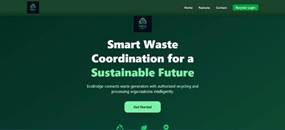
Snapshot 6.2 Home Page 

Snapshot 6.3 Role Selector Page

Snapshot 6.4 Request Status Pending Page 
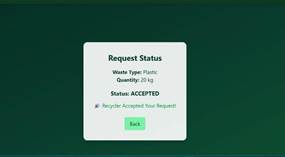
Snapshot 6.5 Request Status Accepted Page

Snapshot 6.6 Comparison Table Page

Snapshot 6.7 Google Maps Page

Snapshot 6.8 Finding Recycler Page 

Snapshot 6.9 Recycler Login Page
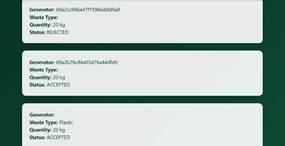
Snapshot 6.10 Recycler waste Details Page 

7. CONCLUSION AND FUTURE WORK 

In this paper, the EcoBridge system has been presented as an intelligent and user-centric solution for improving waste management and recycling coordination. The system successfully addresses the gap between waste generators and recyclers by integrating real-time data processing, location-based services, and smart recommendation techniques.

Unlike traditional waste management approaches that primarily focus on large-scale industrial solutions, EcoBridge emphasizes accessibility and usability at the individual level. By allowing users to input waste details and receive optimized recycler recommendations, the system simplifies the decision-making process and promotes responsible waste disposal practices.

The implementation of the system demonstrates that combining backend processing, external APIs, and a user-friendly interface can lead to efficient and practical solutions. The results show that the system is capable of providing accurate recycler matching, fast response times, and meaningful outputs in real-world scenarios.

Although the current system performs effectively, there are several opportunities for enhancement to further improve its functionality and impact.

One of the major future improvements is the integration of AI-based waste classification, where users can upload images of waste items and automatically identify their type using computer vision techniques. This will reduce manual input and increase system intelligence.

Another important enhancement is the implementation of a dynamic pricingsystem, where real-time pricing data from recyclers can be fetched and updated. This will provide more accurate earning estimations and improve decision-making for users.

The system can also be extended by adding a live tracking feature, enabling users to track recycler pickup status and view real-time location updates. This will enhance transparency and user trust.

REFERENCES

  • Benhamou Global Ventures, “Artificial Intelligence in Recycling,” Benhamou Global Ventures, Online Article, 2023.
  • VPRC Research Team, “Artificial Intelligence and Machine Learning in Waste Sorting: Advancements and Implementation for Sustainable Waste Management,” VPRC Research & Training Institute, India, 2022.
  • S. K. Authors, “Smart Waste Management System using Artificial Intelligence,” in Proc. Int. Conf. on Smart Systems, 2023, pp. 1–6.
  • A. B. Authors, “Machine Learning Based Waste Classification for Recycling,” Academic Research Paper, 2024, pp. 1–8. [Online]. Available: (from PDF – w22)
  • G. Ginting and R. D. Apnena, “Smart Waste Management and Recycling Based on IoT using Machine Learning Algorithm,” Journal of Applied Intelligent System, vol. 9, no. 2, pp. 112–120, 2024, doi:10.62411/jais.v9i2.10766.
  • B. Sulistio and A. S., “The Effectiveness of

Smart   Waste       Recycling       Management

Applications,” Journal of Computer Science Application and Engineering (JOSAPEN), 2024, pp. 45–52.

[7]  A participatory design study,” Journal of Social Robotics, vol. 15, no. 3, pp. 1507–1523, 2023 .

[8] World Bank, “What a Waste 2.0: A Global Snapshot of Solid Waste Management to 2050,” 2018.

s

[9] United Nations Environment Programme, “Global Waste Management Outlook,” 2015.

Daily writing prompt
What place in the world do you never want to visit? Why?

Impact of CSR Activities  in Rajasthan Micro, Small and Medium Enterprises Sector

Citation

Kumar, H., & Bindal, M. (2026). Impact of CSR Activities in Rajasthan Micro, Small and Medium Enterprises Sector. Journal for Studies in Management and Planning, 12(2), 46–57. https://doi.org/10.26643/jsmap/9

Hemant Kumar-Research Scholar, Lords University-Alwar (Raj.)

Dr. Meenakshi Bindal– Research Supervisor, Lords University-Alwar (Raj.)

Abstract: –

Corporate Social Responsibility (CSR) activities in Rajasthan’s small sector (Small and Medium Enterprises, or SMEs) provide significant benefits, including enhanced reputation, improved access to markets and finance, and increased employee retention. While most formal CSR funding in the state comes from large corporations, SMEs often engage in “silent social responsibility,” which contributes to both community development and business growth despite challenges like limited resources. 

CSR in Rajasthan involves government platforms like the Environment Portal to guide corporate spending on projects in education, health, environment (water, energy), and livelihoods, with industries like cement leading in sustainability, focusing on community development and meeting legal mandates, while research highlights trends in integrating CSR with business strategy for inclusive growth, addressing local issues like ‘Save the Girl Child’, and improving stakeholder collaboration. 

Key-Words: -CSR, MSME, NGO, CFP.

Introduction: –

In FY 2023-24, Rajasthan received ₹1,145.67 crore in CSR funds. The funds primarily targeted education, health, and rural development. However, specific, collated data in a tabular form detailing the precise impact of these activities only on the small sector (MSMEs) of Rajasthan in 2024 is not available in the search results. 

The available data focuses on the overall CSR landscape in the state and the government’s supportive policies for MSMEs in 2024. 

General CSR Impact in Rajasthan (FY 2023-24 Data)

While comprehensive impact data on the small sector specifically is unavailable, the total amount of CSR funds received and their allocation to key sectors in Rajasthan provides context. The main recipients of the funds were large-scale community development projects, which indirectly benefit local small sectors as shown in Table 1. 

Table 1 :General CSR Impact in Rajasthan (FY 2023-24 Data)

Focus Area Amount Received (INR Crore)Key Initiatives/Impact
Education₹546.43Funding for infrastructure, scholarships, and special education programs.
Health₹213.45Provision of diagnostic machines, health camps, and TB elimination programs.
Rural Development₹150.15Infrastructure building, water conservation, organic farming, and livelihood programs.
Environmental SustainabilityN/A (Significant investment)Water harvesting systems, waste management, and adoption of alternative fuels in manufacturing units.

Impact on Rajasthan’s Small Sector (MSMEs) in 2024

The primary impact on MSMEs in 2024 stems from the Rajasthan MSME Policy 2024, which aims to make the sector globally competitive and locally sustainable through fiscal and non-fiscal interventions rather than direct CSR spending data. 

  • Financial Inclusion: The policy provides subsidies and interest subventions to reduce borrowing costs for MSMEs.
  • Skill Development: To enhance workforce quality, the government covers 50% of training costs for up to six months for MSMEs.
  • Sustainable Practices: MSMEs adopting green growth initiatives receive incentives like 50% reimbursement on environmental infrastructure projects, electricity duty exemptions, and subsidies on clean machinery.
  • Employment: The MSME sector in Rajasthan is a significant employer, providing jobs to around 92 lakh people, a figure the new policies aim to boost further. 

The impact on small businesses is largely measured by improvements in their operating environment, access to capital and markets, and adoption of sustainable practices, as outlined in government policies and reports. 

Impact on MSMEs

While formal CSR is often associated with large corporations, many MSMEs in Rajasthan engage in informal, self-driven social responsibility initiatives, which yield numerous business benefits. 

  • Enhanced Brand and Reputation: Engaging in CSR helps MSMEs build a strong public image and reputation, which differentiates them from competitors and attracts socially conscious customers and investors.
  • Improved Financial Performance and Operational Efficiency: Responsible practices such as efficient resource use (e.g., water and energy saving) and waste reduction can lower operating costs and increase efficiency.
  • Talent Attraction and Retention: Companies with strong CSR commitments often enjoy higher employee morale, loyalty, and productivity, which helps in attracting and retaining a skilled workforce in a competitive job market.
  • Access to New Markets and Finance: A commitment to sustainable and ethical practices can open up niche markets and improve access to funding opportunities, as more investors look to support responsible businesses.
  • Risk Management: Integrating CSR into business strategy helps manage risks associated with regulatory non-compliance, environmental issues, and social concerns, safeguarding the company’s financial health. 

Impact on the Community in Rajasthan

CSR initiatives by MSMEs contribute to the socio-economic development of Rajasthan, particularly in rural areas, by focusing on key development areas. 

  • Employment Generation and Skill Development: MSMEs play a critical role in creating jobs, especially at the low-skill level, and providing training and skill-enhancement programs for local people, including rural women.
  • Women Empowerment: Many CSR projects specifically target women’s empowerment through entrepreneurship programs, self-help groups, and education, helping them achieve financial independence and improve their communities.
  • Community and Infrastructure Development: CSR funds are channelized into various community projects such as improving healthcare access, renovating school infrastructure, providing clean drinking water facilities, and building anicuts (small dams) for water conservation.
  • Environmental Sustainability: Initiatives include tree plantation drives, promoting the use of renewable energy (like solar pumps for farmers), and managing waste, which helps address local environmental challenges like water scarcity and pollution. 

Challenges and Opportunities

MSMEs in Rajasthan face challenges in formal CSR implementation, such as limited resources, financial constraints, and a lack of expertise. However, government initiatives like the state’s dedicated CSR web portal help channel funds and provide a platform for collaboration between companies, NGOs, and government bodies to ensure effective implementation of projects in alignment with state priorities. 

By overcoming these barriers through collaboration and integrating CSR into core business strategy, MSMEs can unlock their full potential for both business growth and sustainable development in Rajasthan. 

Literature Review:

Oh & Park (2023) examined the connections between CSR and corporate financial performance (CFP) of Korea from 2004 to 2010. The result shows that the CSR is positively affects CFP in Korea and the investors concept appears to be legitimate. The investigation of industries indicates distinctive outcomes by every industry’s appearance. And the result also say the impact of CSR on CFP didn’t increment after the global financial crisis.

Roy, Vyas & Jain (2020) examined the important influencing factors for SMEs to involve in CSR practices. The result of factor analysis said that the main factors included customer proposition, stakeholder value, founder characteristics, business values and motives. Also, SMEs were ready and able to make important contributions to backing principally local events.

Shetty (2019) examined the trend and current status of CSR in Karnataka to gain an understanding of its contribution towards inclusive growth. The result of survey analysis is saying that positive attitude to CSR and the degree of their connection in CSR activities has enhanced. The CSR activities are increasing and the government also support for executing CSR initiatives will be supportive for channelizing private as well as public sector funds for strategic development of the nation.

Sharma &Kiran (2018) examined the position and growth and initiatives of CSR policy inclosing and execution in big firms of India. The result shows the IT and Auto industry is high going for taking up CSR activities and FMCG segment is not concentrated on CSR activities. The government is also enforcing to increase or initiate the proper CRM strategies for the development of human resources and increase the status and profit and performance of the firms.

Key Impacts on SMEs and the Community

  • Enhanced Brand and Reputation: SMEs engaging in CSR are seen as more committed to social responsibility, which builds goodwill, attracts customers who value ethical practices, and helps differentiate them from competitors.
  • Improved Employee Morale and Retention: CSR initiatives boost employee morale and loyalty by fostering a sense of purpose and pride in the workplace, aiding in attracting and retaining skilled talent.
  • Access to New Markets and Capital: A commitment to CSR, such as fair trade or sustainable practices, can open up niche markets and attract investors looking for socially responsible businesses.
  • Operational Cost Savings: Pursuing sustainability can lead to innovations like more efficient production processes, reduced waste, and lower energy costs, which directly benefits the bottom line.
  • Community Development: Activities are often locally focused (e.g., in Jaipur, Udaipur, Ajmer) and aim to improve education, healthcare, and rural infrastructure, directly addressing local needs.
  • Women’s Empowerment and Livelihoods: Many projects focus on women’s empowerment through skill development, self-help groups (SHGs), and entrepreneurship programs, leading to greater financial independence. 

Challenges for SMEs

SMEs in Rajasthan face specific challenges in implementing formal, large-scale CSR:

  • Limited Resources: Financial and human resource constraints make it difficult to invest in extensive, formal CSR programs.
  • Lack of Expertise: SMEs often lack the knowledge or dedicated personnel to design, implement, and measure the impact of strategic CSR initiatives.
  • Focus on Short-Term Profitability: The urgency of maintaining profitability often leads to a short-term focus, making long-term CSR investments seem less appealing. 

Government and Collaborative Support

The Rajasthan government is working to facilitate CSR, particularly by encouraging collaboration and providing support systems. 

  • Rajasthan CSR Portal: The state has developed a unique interactive platform (csr.rajasthan.gov.in) to connect companies with government-approved projects and implementing NGOs, making it easier to channel funds effectively.
  • Collaboration: Pooling resources through cluster associations allows SMEs to undertake larger, more impactful, and long-term projects that they could not manage individually, while also reducing operational costs.
  • MSME Policy: The state’s MSME Policy provides various incentives like interest subsidies and reimbursements for obtaining quality and environmental certifications, encouraging sustainable practices. 

Top CSR initiatives in Rajasthan

Major flagship programmes and latest CSR initiatives in Rajasthan inlcude:

Shree Cement’s Partnership with Fifty Villagers Seva Sansthan for Rural Girls in Rajasthan

Shree Cement Ltd. has partnered with Fifty Villagers Seva Sansthan, a Barmer-based grassroots NGO dedicated to transforming the lives of underprivileged rural children through education. Under this partnership, Shree Cement will support 25 underprivileged girls from across Rajasthan through a residential medical entrance coaching program, helping them prepare for NEET and pursue careers in medicine. The company has committed ₹25 lakh per year for two years to the program.

Founded in 2012 by Dr. Bharat Saran, a government medical officer, the initiative began in a small, rented room where he taught children after hospital hours. Over time, this small act of service became a movement, one that has so far supported 286 students, including 119 admitted to medical colleges, 23 at AIIMS and 52 serving in government roles such as teachers, police officers and Air Force personnel. His dedication has inspired hundreds of children to rise beyond their circumstances and build meaningful futures.

These children come from some of Rajasthan’s most remote and underprivileged areas, often facing hunger, long walks to school and limited resources. Despite these challenges, many have excelled academically, scoring over 75% without access to coaching.

Football Academy by Hindustan Zinc Ltd.

Football Academy is a pioneering effort by Mining major Hindustan Zinc Ltd. (a subsidiary of Vedanta Limited.) in Rajasthan to identify local football talent at an early age and train them to be Indian Football Stars. The objective of the project is to initiate a large scale holistic Football programme for strengthening grassroots community connect by setting up the HZL Football Academy as well as Community Football Centres in communities around HZL operations; identifying talented young footballers from Rajasthan; training them using the latest methodologies and technological interventions to create Indian Football stars.

The project has 4 pillars:

Community Outreach Programme – Geared to generate mass community engagement in football. 64 Community Football Centers are being set up in select communities around HZL operations. Children coming to these centers receive training for 2 hours a day for 3 days a week. Goal-Post campaigns to train 32 local community coaches have also been initiated. In just 4 months since the initiation of the Project, the outreach programme reached out to 2500 children from Zawar, Debari and Dariba. Talent Hunts are being initiated across Rajasthan. Given the interest shown by girls during outreach camps, plans have been put in place to explore possibilities of forming girls Football teams in the Community Football Centers.

HZL Football Academy – Set up as a residential programme for the most talented players. Training is provided by highly qualified expert coaches using world class infrastructure facilities, latest scientific methodologies and technology. The students selected for this football Centre of Excellence receive intensive football training as well as formal education till class 12. The Academy now has a capacity of 80 boys.

Performance Analysis Center – A high technology centre to provide world class scientific and technological training facilities to local football talents from an early age. It is being built at Zawar and will be ready by February 2018.

Zinc Football League – The best way to become a football champion is to play football matches and to win games and championships. A grassroots football league is being created to strengthen community connect and to give our young champions a taste of playing real games.

Unchi Udaan by Hindustan Zinc Ltd.

The ‘Unchi Udaan’ programme is built on the base being created by Shiksha Sambal, another Flagship programme by Hindustan Zinc. The objective of the programme is to give wings to dreams of meritorious students, studying in government schools in communities around HZL operations, to study in IITs and other prestigious Engineering Colleges by providing quality coaching and residential schooling.

UNCHI UDAAN identifies and prepares young meritorious students from government schools in communities around HZL’s operational areas in Ajmer, Bhilwada, Chittorgarh, Rajsamand, Udaipur districts of Rajasthan and Pantnagar district of Uttarakhand. It gives wings to children’s dreams, of studying in IITs and other institutions of national repute. This is a multi-year residential programme being implemented in partnership with ‘Resonance Eduventures Pvt. Ltd.’ (coaching institute) as the technical partner and Vidya Bhawan as the school and hostel partner.

CSR of Bajaj Finance Limited: Healthy Motherhood-Healthy Childhood

Bajaj Finance Limited (BFL), a subsidiary of Bajaj Finserv Limited, is one of the major spenders for CSR in Rajasthan. The company has a project for Healthy Motherhood-Healthy Childhood and Targeting the Hardcore Poor (Rural development) in Sikar and Dungarpur districts. They have been working towards addressing issues of Child Protection and Nutrition (Healthcare and promoting gender equality) in Bharatpur, Alwar, Sikar, Baran and Ajmer district and Early Childhood Care in Rural Areas (Healthcare) in Udaipur district.

They also have projects for education of autistic and slow learner children, community based management of disability- childhood to livelihood, holistic nutrition support to underprivileged children afflicted with cancer, mother and child care, construction of school building, comprehensive tribal model village development program, imparting vocational training and rehabilitation services in different areas of Rajasthan.

Vedanta Nand Ghar

Nand Ghars are a flagship social impact project dedicated to benefit rural children and women in India. A measure undertaken by Vedanta Resources Ltd. under the Anil Agarwal Foundation Initiative, together with the Ministry of Women and Child Development (MoWCD), the project aims at progress of rural India.

Nand Ghar has over 200 centres across Rajasthan’s Jodhpur district. A network of a model Anganwadi, Nand Ghar provides pre-school education through e-learning, BaLa designs, and smart kits. Nand Ghars are equipped with solar panels to ensure 24X7 electricity, water purifiers, clean toilets, and smart television sets and have become a model resource centre for the local communities. Pre-school education is provided to children in the age group of 3-6 years. Nutritious meals and take-home rations are being provided for children, pregnant and lactating women. Primary healthcare services are rendered through mobile health vans & telemedicine facilities and women are empowered through skilling, credit linkage, and enterprise development.

To transform the lives of women and children, Vedanta signed a MOU with the Government of Rajasthan last year to develop 25,000 Nand Ghars across 13 districts.

ICICI Rural Self-Employment Training Institutes

The Central government’s Ministry of Rural Development (MORD) has roped in banks to set up RSETIs (Rural Self Employment Training Institutes) for young people from rural communities. On behalf of ICICI Bank CSR, the Foundation has been managing a residential RSETI in Udaipur and its satellite centres for a decade. Satellite centres provide doorstep training and flexible courses on location.

ICICI RSETIs have a high success rate, with more than 75% of the trainees continuing gainful employment long after they have passed out; nearly 58% are women. The curriculum is designed after surveying local employers. There are skilling courses in more than 30 trades, which also align with the guidelines of the National Skills Qualifications Framework. Other activities include roadshows and Ratri Choupal gatherings to generate interest in entrepreneurship.

These centres build micro-entrepreneurs and attempt to walk them through the venture end-to-end support. They will inform them about credit schemes from the government, fill out application forms and show the procedure to set up their business enterprise. There are follow-ups for two years after training where the team checks up on their progress.

HDFC Bank Parivartan

HDFC bank’s CSR initiatives in Rajasthan mainly focus on rural development initiatives, education, vocational skill training and healthcare. HDFC Bank Parivartan, the bank’s umbrella programme for social initiatives impacted lives of over 35.43 lakh people in Rajasthan in the FY 2020-21, as per their announcement. The bank reached out to 132 villages across 13 districts – Bhilwara, Sikar, Baran, Alwar, Jaipur, Chittorgarh, Pratapgarh, Dhaulpur, Jaisalmer, Karauli, Dausa, Pali, Rajasmand and Alwar. #Parivartan aims at mainstreaming economically & socially-challenged groups across the country by ushering growth, development and empowerment.

HDFC Bank’s Holistic Rural Development Programme (HRDP) includes farm and nonfarm-based livelihood, water conservation, on-ground training for farmers, creation of Farmer Producer Organisations, sanitation and Natural Resource Management. The bank facilitates livelihood enhancement opportunities, particularly for women and youth, primarily in agriculture and allied areas such as dairy and poultry. The objective is to help them find jobs locally, enhance their household income and discourage migration.

The bank aims to reduce the carbon and ecological footprint of communities by promoting clean and renewable energy solutions. This includes undertaking projects such as tree plantation for carbon sequestration and biodiversity conservation. In addition, it is providing solar home lights, biomass chulha, biogas plant, solar study lamp, and a solar irrigation unit, covering 25% of the households in each village. The biomass stoves have helped improve indoor air quality, creating a direct positive impact on women’s health.

HDFC Bank is implementing a programme to promote education in line with India’s Sarva Shiksha Abhiyaan. Under this theme, a multi-faceted support is provided to schools, to enhance the quality of education – which includes training the teachers, providing scholarships and career guidance to students, as well as infrastructure support to schools, such as building toilets and improving classrooms.

The Bank has dedicated programmes for improving teachers’ skills and scaling up no-cost solutions for improving existing systems and processes. It has also been working towards establishing libraries, scientific labs and digital classrooms. Under this theme, the aim is to enhance the quality of education in government schools through a three-dimensional, target-driven approach.

CSR of Honda Motorcycle And Scooter India

Honda Motorcycle & Scooter India Pvt. Ltd. (HMSI), a leader in two-wheeler manufacturing is a major spender in CSR projects in Rajasthan. The company has undertaken CSR initiatives like computer lab training and hardware (Gyantantra Digital Dost), water conservation projects through Self Help Groups, hospital upgradation and maintenance of toilets at community health centres in Alwar district.

Apart from these, they also have initiatives for education, health camps and mobile medical unit & static medical unit. Honda has invested in developing the existing local government Community Health Centres (CHC) in two locations around the Honda plants in Tapukara and Tijara in Alwar district. These include redevelopment of boundary walls, post-mortem room, parking area for ambulance, X-ray machines, medical equipment, first aid care, oxygen pipeline, cleaning staff and cleaning equipment, facilitating over 800 local residents.

The company’s water conservation projects through Self Help Groups in Alwar include construction and restoration of water structures and a dam in Kalikhol village, Skill development of an SHG by providing them training in the field of water conservation along with infrastructure development.

They have also supported the learning of 75,000 government school students in Rajasthan through a WhatsApp based home learning model. Honda has also developed playgrounds and sports ground facilities in the villages of Burera, Ishroda and Tapukara villages in Alwar district

Satya Bharti Schools

With a strong belief that education is critical to empower children, particularly in rural India, Bharti Foundation (the CSR arm of Bharti Enterprises) launched its flagship Satya Bharti School programme in 2006. The CSR programme imparts free, quality education to less privileged children of India. Currently, 28 schools are functioning in Jodhpur district, directly impacting the lives of over 170 teachers and 6,300 students with a 50-50 ratio of girls and boys and more than 75% being from disadvantaged communities.

All the schools provide free quality education to underprivileged children, with a special focus on the girl child. Specially designed girl-child policy, separate toilet for girls, one female teacher in each shift and special sensitization campaigns have been put in place to encourage parents to send their daughters to school. The curriculum followed in the schools is at par with curricular structures followed in schools across the country. It is also integrated with community campaigns, which helps children in developing life-skills as well as critical and creative thinking skills through hands-on experiences.

CSR of LIC Housing and Finance Ltd. for rural development

LIC Housing and Finance Ltd collaborated with NGO AROH Foundation in 2021 for an aspirational Holistic Rural Development Project ‘Hriday’ for seven indigent villages of Rajasthan. Hriday aimed at socio-economic reformation of villagers in the Antah block of Baran District in Rajasthan. These were targeted to achieve through various interventions in agriculture, animal husbandry, water & natural resource management, health, education, employment, nutrition, awareness & advocacy.

The Holistic Rural Development Programme seeks to bring about dignified and healthy living among the rural communities and strengthen community self-governance. The project also instils and fosters scientific innovations in its implementation and substantiation processes. Some of these include SMART class set ups for government schools, scientific agricultural practices, chemical-free and organic farm activities, use of GPS for asset tagging and monitoring, extensive use of technology for monitoring and tech based models for access to water and education interventions.

Reference: –

  • Bhardwaj & Rathore. (2022). A Review of Rural Entrepreneurship in Rajasthan. Inspra Journals.
    • Baumann-Pauly, D., Wickert, C., Spence, L. J., and Scherer, A. G. (2013). Organizing corporate social responsibility in small and large firms: Size, as ever, plays a crucial role. Journal of Business Ethics, 115(4), 693–705. https://doi.org/10.1007/s10551-013-1827-7.
    • Sodani, P., & Sharma, M. (2019). CSR as a New Perspective towards Inclusive Development: Evidence from Industries in Rajasthan. ResearchGate.
    • Agarwal, S., & Handa, P. (2025). Corporate Social Responsibility Initiatives In Small Enterprises in India. IJCRT.org.
    • Teli, J. L., & Sharma, M. L. (2023). To Study the Impact of Corporater Social Responsibility (CSR) in Rural Development (A Study of Selected Companies in Rajasthan). Quest Journals: Journal of Research in Business and Management, 11(6), 153-156. Quest Journals. 
Daily writing prompt
Describe a positive thing a family member has done for you.