Men Share What It’s Like to Become a Nurse

A recent NYU study found that the number of men in the nursing workforce is steadily increasing, growing nearly 5% between 2005 and 2015.

Employment in the healthcare sector is booming, and more men are entering into healthcare professions than ever before. In fact, a recent NYU study found that the number of men in the nursing workforce is steadily increasing, growing nearly 5% between 2005 and 2015.

While it might have been unusual several years ago for men to work in certain healthcare jobs, there’s now a push for more gender diversity in healthcare staff. This is especially true in nursing, as hospitals struggle to find enough qualified nursing staff to meet the growing demand for their healthcare services.

The Bureau of Labor Statistics predicts that employment for registered nurses (RNs) will increase by as much 15 percent by 2026, adding more than 400,000 new jobs.


We sat down with two of our recent BSN graduates, Jonathan Cabrera and Brandon Shaver, to talk about why they chose a career in nursing.


Q: Why did you choose a career in nursing?

Cabrera: I’ve always known that I wanted to help people. As I got older, I wanted to do something in medicine. I considered surgery, massage therapy and chiropractic medicine, but none of those careers felt like the right path for me. I knew that nursing would allow me to make a difference in the medical field and increase my opportunities for employment.

Shaver: After being in the military for four years, I wanted a complete change of pace. I found myself watching shows like Scrubs, House, Grey’s Anatomy, and ER, thinking to myself, “I could totally do that.” I was working as a dental assistant at the time, and one day a coworker mentioned that I should look into becoming a registered nurse. I did some research and immediately knew that was the route I should take.

Q: Despite the increasing demand for nurses, it’s still a profession that is largely dominated by women. Do you feel that this is changing? Why should more men consider nursing as a career option?

Cabrera: It’s not so much about whether you’re a girl or a guy. It’s about what you want to do and how you want to help others. I think a diverse classroom of students brought a good balance to my studies and my clinical experiences. We each brought a unique set of experiences to the table. As a nurse, I find that having a mix of different perspectives helps us find well-rounded solutions and allows us to do our jobs better.

Shaver: It’s not unusual to meet a man in the nursing field. Doctors used to be only men and nurses used to be only women, but we know that those stigmas don’t matter anymore. Nursing is a great line of work to get into, no matter your gender. There are so many options for growth, and if you’re like me and you get bored easily, there are always different specialties to explore and a variety of ways to advance your career.

Q: What did you enjoy the most about your nursing classes/clinical?

Cabrera: I completed a clinical rotation at a local community clinic, and I loved seeing first-hand how much we were able to help people. I enjoyed being a part of the staff and providing medical assistance for people that would otherwise be underserved due to their financial circumstances.

Shaver: My first clinical rotation at a nursing home made me reevaluate if I really wanted to be a nurse. It can be challenging at first, but as the semesters move along and you start making connections with your classmates, you realize that you’re all struggling together. You learn to make the best of the challenging moments and rely on each other. When I think back about all of my classes and clinical experiences, I remember all the people I shared those stressful times with and all the memories we had together.

Q: What do you enjoy the most about the nursing profession?

Cabrera: I’m glad to see that the field is changing. I think I finally found where I’m supposed to be, and I’m grateful not only for my experience at Herzing but for the opportunity to make a real difference in others’ lives.

Shaver: I like knowing that all my hard work has finally allowed me to have a great job, in the specialty I wanted to work in, in a location I wanted to live, working the hours I’d like to work, making the money I think I deserve. Not everyone can say that, but the nursing profession has so many options and opportunities for everyone.

Q: What words of wisdom do you have for those considering a career in nursing?

Cabrera: It doesn’t feel like it’s a woman’s job or a woman’s world. We’re all working together to help care for people in need.

Shaver: Make the leap sooner rather than later. Rely on your friends and family to help you get through the tough moments. Your classmates will get you through the hard times in school. Work with them, not against them, and you will be successful.

Thinking about a career change to nursing? Like Cabrera and Shaver, more men are realizing that nursing isn’t only a viable career option, it’s a job they’d like to do. Whether you’re just beginning your nursing career or looking to advance, Herzing University offers a variety of degree pathways to help you achieve your goals.

Learn more about our nursing programs and get started on your own journey today!

How to Master Online College Classes

Time management, organization and good study habits are even more crucial to your success as an online student.

A quarter of college students are both full-time workers and full-time students, according to a study by Georgetown University’s Center on Education and the Workforce.

To help busy students to fit education into their lives, many universities offer online course options or online degree programs. A third of all undergraduate students are currently taking at least one course online, according to the National Center for Education Statistics (NCES).

Being able to learn at your own pace is a huge perk for online students. Course materials are typically made available through an online portal, allowing you to work on assignments whenever is convenient for you throughout the week. You can also communicate with your instructors through the portal, making it easier for you to get the personalized help you need to succeed.

While online courses offer many benefits, it is a very different learning experience from a traditional classroom environment. Time management, organization and good study habits are even more crucial to your success as an online student.

Here are five tips for mastering your online classes:

1.) Have a plan

Create a weekly study plan right from the get-go. The first step is to determine when you will set aside time to focus on your schoolwork. It could be in between appointments, after work or over the weekend – whatever works best for you. Proactively block off your calendar during this time so you can hold yourself accountable to finishing your work. Another helpful organizational tip is to review the course syllabus and write down all important due dates in a planner or calendar. This way, you can keep track of – and plan ahead for – major deadlines throughout the semester.

2.) Stick to a schedule

As an online student, you have much more flexibility in setting your own schedule. This can be to your advantage, but it can also present a challenge if you don’t have strong time management skills. It might take some time to establish a routine that suits your lifestyle and allows you to get your assignments done well and on time. Once you have nailed down the right schedule, you can use a planner or digital calendar app to keep yourself on track.

3.) Connect with your classmates

Being an online student doesn’t mean you have do everything alone. While you might not get to meet your classmates face-to-face, there are many ways you can connect online and build your own college community. In fact, many online courses require students to engage with each other on class discussion boards in order to facilitate the same kind of thoughtful exchange you’d have in a regular classroom. You could also take the initiative to start a social media group for your class where you can share notes, ask questions and collaborate on assignments.

4.) Set goals for yourself

Setting goals can help you stay motivated throughout the semester. To be successful with goal-setting, it’s important to have a mix of both short-term and long-term goals. For example, a short-term goal could be improving your test score on your next exam. A long-term goal could be improving your writing skills by the end of the semester. This might involve more work and dedication, like setting a standing appointment with a tutor and working ahead on writing assignments.

Once you’ve identified your goals, write them down and track your progress. When you complete one of your goals, be sure to reward yourself! This could be something small like giving yourself an extra study break, going out for dinner, or spending time on another activity that allows you to unwind and relax.

5.) Make the class a priority

Some students assume online classes are easier than regular classes. This is not true. As an online student, you need to make your education a priority and hold yourself accountable to meeting your deadlines. Minimizing distractions like television and social media is a great way to stay focused during your designated study time.

Online classes are a great option for busy students who cannot easily attend an in-person class. With the right amount of planning and prioritizing, it is possible to be successful without having to step in the classroom.

Gamification to encourage learner autonomy

This post tries to pull together a couple of things I have been thinking about recently. The first was a post I saw on the 21st Century Fluency Project blog a few weeks back. The title of the article ‘How I Turned My Classroom into a ‘Living Video Game’ caught my eye and before I even had time to read it I started thinking about how the factors that create motivation in computer games could be applied to the classroom. The article is well worth reading, although this is only one element it touches on.

The other thing I have been thinking about recently is time management and distraction as it is one of the more significant objections which teachers often raise to having students using computers and mobile devices in the classroom, so when I saw ‘HabitRPG‘ I thought it could be a useful tool to help deal with the problems and implement more of a gamified approach to the  classroom.

HabitRPG is a time and task management tool which overlays motivational elements of computer games onto managing time and tasks.

The two major motivational elements are health points, which can be used up and coins which can be earned by doing daily tasks, following good habits and doing jobs from your ‘Todos’ list. These coins can then used to buy rewards.


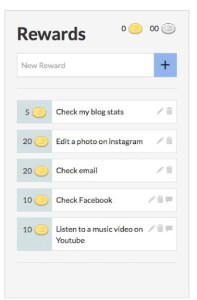
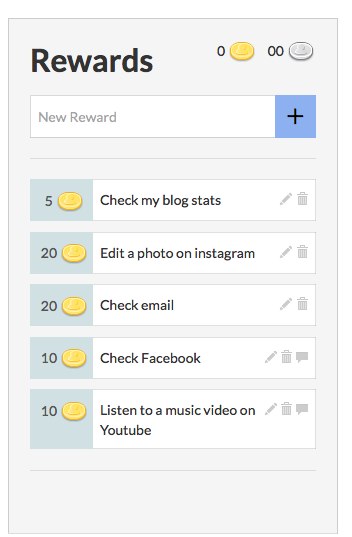
You can define the rewards for yourself. In my case I decided to define the rewards as the things that I usually do to procrastinate, such as check my email or look at facebook updates etc.


Then you can simply add your list of ‘one off’ jobs to the ‘Todos’ list. For me these are things like ‘write an article’, ‘complete a job application’, ‘update my CV’ etc. These become more valuable the longer they are left and so this increase motivation to do them and gain the coins so that you can pay for your rewards.


Then there are my daily chores which I can set up. These are things like ‘update my blog’ , ‘add some links to Scoop.it’ , ‘search my RSS feeds for interesting articles’ etc. If I do these they earn me coins, but if I don’t do them by the end of the day I lose health points.


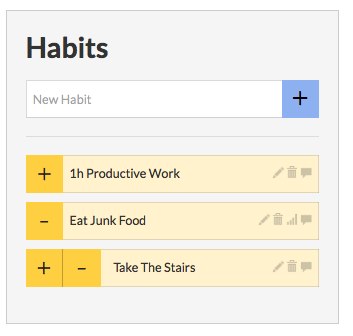
Lastly, there are the habits. These can be positive or negative depending on whether you do them or not, like ‘take a walk’ or ‘have a snack’.


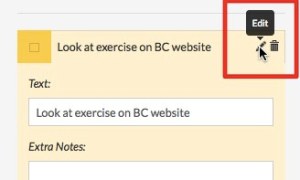
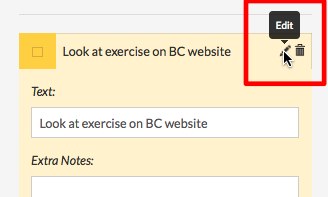
You can edit all of your lists quit simply by clicking on the pen icon, making the changes and then clicking on save and close.


The main thing you may need to edit is the price of rewards and the amount of coins you get for each task.

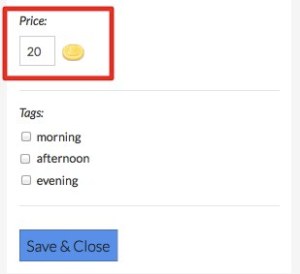
To change the price of the rewards, you just click the edit icon and then type in the price. The default amount for a reward is 20, but you can adjust the price depending on how much time your reward takes.


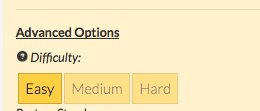
To change the amount of coins you are rewarded for doing each task, you need to go to edit and then go into the advanced options and choose, Easy, Medium or Hard. Doing a hard task will of course earn you more coins.


Once you have your lists set up it becomes quite easy just to click the + and – each time you do a task or have a reward.

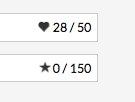
Everyone starts off with 50 health points and if they have no coins to buy rewards or if they indulge in bad habits then they have to pay with health points. The challenge is to stay alive and build up enough coins to start buying rewards.

So how would this work with students?

  • Well you could set the rewards as similar things to my own rewards, especially in a connected classroom. You could also add things like play a game or have a few minutes free browsing time online etc.
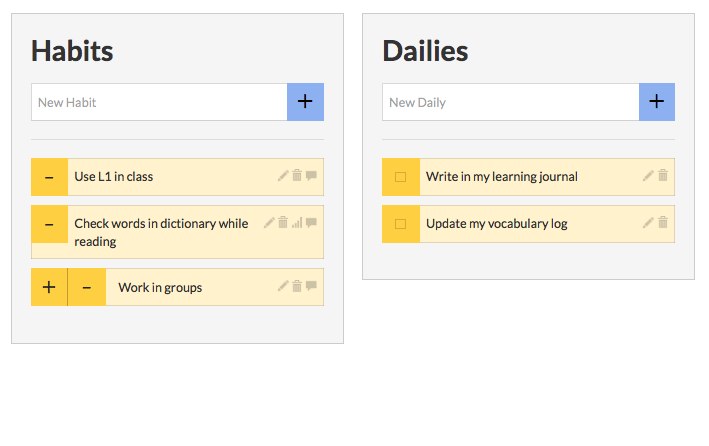
  • Within the habits you could have things like ‘speak L1’, ‘take notes’ or ‘copy an answer’ etc.
  • The daily things could be ‘revise vocabulary’, ‘read a short article’, communicate with someone in English’, ‘do an activity from the course book’ etc.
  • The ‘Todos’ could be a range of homework and autonomous learning assignments.


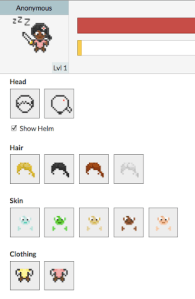
Here’s what I imagine an ELT students profile would look like.


You’ll need to guide students through the set up process and make sure they understand that for this to work they will need to be honest. You could actually have one page for the whole class, or set a page up for a group of students, but it will probably work better if they manage their own page.

They can also add a few elements of personalisation. If the click on the avatar (top left) there are a range of ways to change its appearance.


What I like about HabitRPG

  • It’s free and easy to use.
  • It can help get students to take responsibility for their ‘bad habits’ and reduce the amount of ‘policing’ you have to do.
  • It can encourage students to work on single tasks with concentration, rather than constantly multitasking.
  • It’s a great way to get students to take responsibility for their own time and learning and have some fun at the same time.
  • It could increase motivation and help your students to be better organised.
  • Students have their own account so they can log in on any computer.


Things I’m not so sure about

  • Each student would need to have a computer or mobile device for this to work effectively.
  • It would be great to see this on mobile, but I think that is being planned and it does run in the safari browser on iPad.
  • There is some down time sometimes.
  • Grouping students would also be great, but again I think this is coming.


If you want to know more about HabitRPG, there is quite a long tutorial below which shows a number of other features that you can unlock by playing the game.


I hope you enjoy HabitRPG and that it helps your students to be more organised and disciplined about they way they use their computer or mobile device for learning.

Related links:

innovation JISC online conference

Innovating eLearning 2006 JISC online conference
A couple of entries really caught my eye and very much match with some of the isssues our institution is currently facing. Peter Miller – University of Liverpool
pointed us to the idea of Shared Learning Contexts (SLCs) which are described in Scott Wilson\’s blog at http://www.cetis.ac.uk/members/scott/blogview?entry=20050210014657 The diagram of the SLC illustrates a learner-centred model using open source technologies.

Geoff Stead\’s statement summed it up really – \”VLE fervor has put shackles on a lot of creativity from people like ourselves who earn a living using technology to service learning. Five years ago we were creating learning tools that assisted low-literacy learners to find their voice and publish themselves online. We created project-based environments to share problems and strategies for dealing with low maths skills. But these things are impossible within SCORM (the standard VLE materials need to comply with) Almost 100% of the demand we get for resources to support learning need to fit into the lowest common denominator of VLEs … namely: a single thread of learning objects, each one insular, curriculum mapped, with no connection to the learning process, no inbuilt dialog / saving / thought origination for the student. So yes, they have provided an excuse for less adventurous staff to hide behind. But they have also imposed a set of standards on all purchasing that have ended out stamping out a lot of creativity that was previously embedded in the resources as well. And all with the best intent! \”

Some of the replies to this statement, referred to the usefulness of VLEs for staff new to eLearning. My thought on this is that we have basically trained people up to expect the VLE or Learning Management System approach whereas if the use of a variety of tools could have been \”sold\” to staff early on – through really good resourcing and support – we wouldn\’t all be caught up in using the corporate, expensive, proprietary tools. Tools which suit the company not the teachers and learners.

There was a very good article on one of the discussions – an evaluation of the use of blogging in a course related to technology.

Reflecting on professional practice by Annette Odell, University of East London. \”Applications of Learning Technologies\” is an accredited professional development course. Assessment is by means of a portfolio of work built up during the course and a key component within this is a reflective log, kept online using a blog.

This presentation describes the use of blogs on this context; briefly discusses different uses of blogs; reflects on personal experience with using blogs for different purposes and why the \’reflective blog\’ appears to be a consistently successful use; discusses factors that promote success and problems to be oversome; and summarises the participants\’ perspective on the value of keeping a reflective blog within this course and as part of their professional development record.

5 Steps to Become a Neuroscience Nurse

As the need for nursing support increases, there are myriad opportunities for new and experienced nurses to advance their careers in specialties.

As the need for nursing support increases, there are myriad opportunities for new and experienced nurses to advance their careers in specialties, such as oncology, the emergency room and even neuroscience.
Neuroscience is one of the most complex areas of study in the healthcare field. Nurses who pursue this specialty embrace the opportunity to make a difference in the lives of patients who are recovering from serious injuries and/or lifelong impairments.

What is a neuroscience nurse?

A neuroscience nurse treats patients with neurological injuries and disorders, including head and spinal trauma from accidents, or illnesses such as Parkinson’s disease, Alzheimer’s, epilepsy and multiple sclerosis. It’s important for these nurses to have a firm understanding of how the nervous system works and how it can affect both the mind and the body.
Patients struggling with a neurological disorder or injury can behave unpredictably. Neuroscience nurses need to be strong, patient and compassionate communicators in order to help patients with chronic or long-term disabilities learn how to live with and manage their situations.

What do neuroscience nurses do?

Neuroscience nurses are involved in many aspects of patient care, including assessing, diagnosing and treating patients. Many neuroscience nurses are part of the neurological unit at a hospital, but they can also work for rehabilitation facilities, homecare agencies and neuroscience specialists.
As a neuroscience nurse, you might be involved in:
  • Performing physical assessments and neurological exams
  • Daily living assistance
  • Physical rehabilitation
  • Surgical or wound care

How do I become a neuroscience nurse?

Think you might be interested in becoming a neuroscience nurse? Follow these five steps to help make it a reality.
  1. Earn your Bachelor of Science in Nursing: The Bachelor of Science in Nursing is quickly becoming the new educational standard for nurses, as it offers more opportunity for employment.
  2. Become a Registered Nurse (RN): If you’re not already a registered nurse, you will have to pass the NCLEX-RN exam, then apply for opportunities in neurological treatment and care. Be sure to use these NCLEX study tips as you prepare for the exam.
  3. Immerse yourself in the world of neurological nursing: Volunteering with a neurological unit at a hospital or specialized facility can help you get first-hand exposure to what neuroscience nursing is all about. You can also demonstrate your commitment and passion to continued education and patient care, both of which can help differentiate you from other candidates if you choose to pursue a neuroscience nursing career.
  4. Become a Certified Neurological Registered Nurse (CNRN): If you want to become a certified neuroscience nurse, you will have to sit for the Certified Neuroscience Registered Nurse (CNRN) exam, which requires at least one year of neurological nursing experience as an RN. The American Board of Neuroscience Nursing, which administers the exam, has many helpful resources for preparing for the exam and continuing your neuroscience education.
  5. Recertification and advancing your career: You’ll need to regularly renew your nursing license and CNRN certification. You can take it one step farther and consider a Master of Science in Nursing for positions as a nurse practitioner or nurse educator, giving you the opportunity to position new nurses for success and help shape the future of patient care.

How much does a neuroscience nurse make?

The average salary for a RN is $70,000 per year, or about $33.65 per hour, according to the Bureau of Labor Statistics—and the average salary for a BSN will be higher compared to a nurse with only an associate’s degree. Your pay will be dictated by the state you work in, your place of employment, and the relative demand for the neuroscience specialty in your area.
Earning your Bachelor of Science degree in nursing means you may also pursue graduate nursing programs to become more qualified in your specialty and pursue jobs in management or administration.

Gamification to encourage learner autonomy

This post tries to pull together a couple of things I have been thinking about recently. The first was a post I saw on the 21st Century Fluency Project blog a few weeks back. The title of the article \’How I Turned My Classroom into a ‘Living Video Game’ caught my eye and before I even had time to read it I started thinking about how the factors that create motivation in computer games could be applied to the classroom. The article is well worth reading, although this is only one element it touches on.

The other thing I have been thinking about recently is time management and distraction as it is one of the more significant objections which teachers often raise to having students using computers and mobile devices in the classroom, so when I saw \’HabitRPG\’ I thought it could be a useful tool to help deal with the problems and implement more of a gamified approach to the  classroom.

HabitRPG is a time and task management tool which overlays motivational elements of computer games onto managing time and tasks.

The two major motivational elements are health points, which can be used up and coins which can be earned by doing daily tasks, following good habits and doing jobs from your \’Todos\’ list. These coins can then used to buy rewards.


You can define the rewards for yourself. In my case I decided to define the rewards as the things that I usually do to procrastinate, such as check my email or look at facebook updates etc.


Then you can simply add your list of \’one off\’ jobs to the \’Todos\’ list. For me these are things like \’write an article\’, \’complete a job application\’, \’update my CV\’ etc. These become more valuable the longer they are left and so this increase motivation to do them and gain the coins so that you can pay for your rewards.


Then there are my daily chores which I can set up. These are things like \’update my blog\’ , \’add some links to Scoop.it\’ , \’search my RSS feeds for interesting articles\’ etc. If I do these they earn me coins, but if I don\’t do them by the end of the day I lose health points.


Lastly, there are the habits. These can be positive or negative depending on whether you do them or not, like \’take a walk\’ or \’have a snack\’.


You can edit all of your lists quit simply by clicking on the pen icon, making the changes and then clicking on save and close.


The main thing you may need to edit is the price of rewards and the amount of coins you get for each task.

To change the price of the rewards, you just click the edit icon and then type in the price. The default amount for a reward is 20, but you can adjust the price depending on how much time your reward takes.


To change the amount of coins you are rewarded for doing each task, you need to go to edit and then go into the advanced options and choose, Easy, Medium or Hard. Doing a hard task will of course earn you more coins.


Once you have your lists set up it becomes quite easy just to click the + and – each time you do a task or have a reward.

Everyone starts off with 50 health points and if they have no coins to buy rewards or if they indulge in bad habits then they have to pay with health points. The challenge is to stay alive and build up enough coins to start buying rewards.

So how would this work with students?

  • Well you could set the rewards as similar things to my own rewards, especially in a connected classroom. You could also add things like play a game or have a few minutes free browsing time online etc.
  • Within the habits you could have things like \’speak L1\’, \’take notes\’ or \’copy an answer\’ etc.
  • The daily things could be \’revise vocabulary\’, \’read a short article\’, communicate with someone in English\’, \’do an activity from the course book\’ etc.
  • The \’Todos\’ could be a range of homework and autonomous learning assignments.


Here\’s what I imagine an ELT students profile would look like.


You\’ll need to guide students through the set up process and make sure they understand that for this to work they will need to be honest. You could actually have one page for the whole class, or set a page up for a group of students, but it will probably work better if they manage their own page.

They can also add a few elements of personalisation. If the click on the avatar (top left) there are a range of ways to change its appearance.


What I like about HabitRPG

  • It\’s free and easy to use.
  • It can help get students to take responsibility for their \’bad habits\’ and reduce the amount of \’policing\’ you have to do.
  • It can encourage students to work on single tasks with concentration, rather than constantly multitasking.
  • It\’s a great way to get students to take responsibility for their own time and learning and have some fun at the same time.
  • It could increase motivation and help your students to be better organised.
  • Students have their own account so they can log in on any computer.


Things I\’m not so sure about

  • Each student would need to have a computer or mobile device for this to work effectively.
  • It would be great to see this on mobile, but I think that is being planned and it does run in the safari browser on iPad.
  • There is some down time sometimes.
  • Grouping students would also be great, but again I think this is coming.


If you want to know more about HabitRPG, there is quite a long tutorial below which shows a number of other features that you can unlock by playing the game.


I hope you enjoy HabitRPG and that it helps your students to be more organised and disciplined about they way they use their computer or mobile device for learning.

Related links:

Notification for extension of validity of fee payment and paying fees

In pursuant to the guidelines issued by Ministry of Home Affairs vide No.40-3/2020-DM-I(A), Dated 24th March 2020 and subsequent amendments regarding imposition of complete lock down due to outbreak of COVID-19, the MoRTH had issued an advisory dated 30th March, 2020 to all regarding extension of validity of the documents related to Motor Vehicles Act, 1988 and Central Motor Vehicle Rules, 1989. It was advised that documents whose extension of validity could not or not likely be granted due to lock-down and which have expired since 1st of Feb, 2020 or would expire till 30th June 2020, Enforcement authorities were advised to treat such documents valid till 30th of June, 2020.

It has also come to the notice of the Government that citizens are facing difficulties in respect of various fees/late fees as mandated under rule 32 and 81 of Central Motor Vehicle Rules 1989 due to lock down in the country and closure of Government Transport Offices. There are cases where the fees have already been paid, for the service or renewal, however the process could not be completed due to lockdown. Further, there are issues where citizen is finding difficult to deposit fees due to closure of RTO offices.

In order to facilitate citizens during  COVID –19, MORTH has issued a statutory order prescribing that the fees paid on or after 1st February 2020 for the activity(s) including renewal and in case such activity(s) is not completed due to conditions for prevention of COVID-19 pandemic, the fees paid shall continue to remain valid. And   If there is delay in paying the fees from 1st of Feb, 2020 till the period of lockdown there would not be any additional or late fee yo be charged for such delays  till 31st July 2020.

Success of Digital India Initiatives a Hope for Poor and Developing Countries

In a very encouraging endorsement of the success of Digital India programme initiated by the Government led by the Prime Minister Shri Narendra Modi, the Secretary General of the Commonwealth Ms. Patricia Scotland has expressed her appreciation for this initiative and has called it as a new hope for other developing and aspiring countries of the Commonwealth.

Ms. Scotland, in an interaction with a private news channel recently said that the way India has tried to address the aspirations of the people with innovation and opportunities by offering affordable digital services is commendable. She further said, “if you look at our poorer countries, our smaller, our developing countries, many of them look to the developed nations and they fear that they cannot aspire to do or replicate what the developed countries have done because of the cost. But when they look at India and fact that India is developing these things at scale and at a cost which looks accessible to so many. That brings hope.”

She also mentioned about her visit to India during January, 2020 where she interacted with the Ministers in Government of India and technology experts. During these interactions she got to understand that India was really focusing on helping the small, the vulnerable and the developing. “I very much welcome that”, she added further.

Conveying her appreciation for the contributions made by Sh. Ravi Shankar Prasad, Union Minister for Electronics and IT, in the success of Digital India, Ms. Scotland further added that the Minister has been in the forefront of these developments. Talking about what Ravi Shankar Prasad has done she remarked, “he has electrified the other members of our Commonwealth family.”

Seven flights from Gulf under Vande Bharat Mission took off

Seven flights from Muscat, Doha, Riyadh, Bahrain and Dubai from the Gulf under the Vande Bharat Mission took off with nearly 1200 distressed and stranded Indians back to the country today.

From Dubai , there were three flights. Dubai Srinagar flight had 151 passengers and four infants.  This was the first flight for Srinagar from any of the Gulf countries.

Consul General Vipul called this a historic flight as this is the first time that a direct flight was operated from Dubai to Srinagar  to repatriate stranded and distressed passengers. There are no direct flights for Srinagar from Dubai otherwise.

Teamwork and team spirit

Two other flights from Dubai were scheduled for Hyderabad and Kochi . While Hyderabad had  177 passengers on board, the Kochi flight had 180 passengers.
Doha – Bengaluru flight took off with 177 passengers and five infants on board. This was the 8th flight from Doha under the Vande Bharat Mission. Till now 1374 passengers and 45 infants have been repatriated so far.

Riyadh Hyderabad flight via Vijayawada had 150 passengers including three infants. Bahrain- Thiruvananthapuram flight took off with 177 passengers including 32 pregnant women , 34 medical emergency cases , 16 senior citizens , 37 children and five infants. Muscat Kannur flight had 177 passengers and four infants.

Priority on all the flights have been given to distressed blue collared workers , medical emergency cases, pregnant women, stranded tourists and elderly people.

UAE sends aid plane carrying medical supplies to Afghanistan

United Arab Emirates yesterday sent an aid plane carrying seven metric tons of medical supplies to Afghanistan. Emirates News Agency said, the aid will assist approximately 7,000 medical professionals as they work to combat the COVID-19 pandemic.
 
Commenting on the aid delivery, UAE Ambassador to Afghanistan Eisa Salem Mohammed Aldhaheri said, UAE is committed to ensuring that the medical professionals of Afghanistan are equipped with the appropriate protective equipment to enhance their health and safety as they bravely combat the COVID-19 pandemic.
 
In March, the UAE dispatched an urgent medical aid shipment to Afghanistan containing 20,000 testing units and equipment to examine thousands of people. Till date, the UAE has sent over 641 metric tons of aid to 54 countries, supporting more than 641,000 medical professionals in the process.

Thousands leave Dhaka for Eid as police relax restrictions on movement

Amid rapidly growing cases of Corona in the country, thousands of people are leaving Dhaka for celebrating Eid at their home-towns and villages as the police relaxed restrictions on the movement of people from the capital city. On Friday, the Director General of Rapid Action Battalion (RAB) Chowdhury Abdullah Al Mamun told UNB that people can go to their village, homes in their private vehicles on the occasion of Eid-ul-Fitr. As the restriction on public transport including autos and taxis and continues, people travelled out of Dhaka on cars, microbuses, pickup vans and motorcycles.
 
Large rush was reported over the last few days at the ferry terminals in Dhaka. People were allowed to leave Dhaka through river route as authorities started ferry services at Shimulia-Kathalbari and Paturia-Daulatdia ferry terminals. The Dhaka Metropolitan Police (DMP) had imposed strict restriction on the movement in and out of the city in the wake of Corona pandemic and subsequent announcement of general holidays by the government till May 30. However, the police has relaxed the restrictions including the on inter-district movement of private vehicles in view of the Eid festival coming up shortly.
 
In order to contain the spread of Corona virus, the police in Dhaka issued fresh guidelines asking people to offer prayers only at the local mosques instead of Eidgahs or open fields. Police has asked people to avoid embracing each other as part of ritual or shaking hands after the Eid prayers. In a press release the DMP has asked people to celebrate Eid at their homes only and not visit their relatives. Mosque authorities have been asked to clean the mosques with disinfectant before the prayers. They have also been asked not to lay out carpets for the people coming to offer prayer.
 
In the meanwhile, large number of Corona cases and deaths continue to be reported from Bangladesh. Continuing with the record breaking number over the last many days, 1873 new Corona positive cases were reported in the last 24 hours on Saturday. In a virtual briefing, the Directorate General of Health Services (DGHS) said that with the new cases of Corona the total number of infected persons in the country has gone up to 32078. Bangladesh also reported 20 more deaths over the same period taking the death toll to 452. 

Van Dhan for Jaan and Jahaan: The Story of Shahapur’s Katkari Tribe

What can come out of a group of a few dedicated boys led by an able leader and enabling support from government organisations? A lot, apparently.

This has been proved yet again, by “Adivasi Ekatmik Samajik Sanstha” of Shahapur in Thane, which markets Giloy and other products. Giloy is a medicinal plant with huge demand from pharmaceutical companies.

The journey started when Sunil Pawar, a youth from Katkari (कातकरी) community, and his team of 10 -12 friends started facilitating various works of Katkari tribals at revenue offices in his native place. Katkari is one of the 75 Particularly Vulnerable Tribal Groups, as per the classification by Ministry of Home Affairs.

There are certain tribal communities who use a pre-agricultural level of technology, face stagnant or declining population growth, and are equipped with only an extremely low level of literacy and a subsistence level of economy. 75 such groups of tribals in 18 States and one Union Territory have been identified and categorized as Particularly Vulnerable Tribal Groups (PVTGs).

Sunil Pawar, a young lad and his friends started this enterprise of selling giloy in local markets. A good samaritan in the form of Shri Arun Pansare saw their efforts and offered them a place to start their office. Once they started working from an office situated near the market area, more tribals came to know about it and started joining them.

Sunil Pawar meanwhile came across an advertisement of Pradhan Mantri Van Dhan Yojana run by TRIFED, Ministry of Tribal Affairs, Govt. of India in association with Nodal Agency – ST Welfare Department, Govt. of Maharashtra.

Sunil approached them for help which he readily received and soon the demand for giloy picked up. Called गुडूची in Ayurveda, giloy is used in medicines which treat various kinds of fever (viral fever, malaria, etc.) as well as diabetes. It is used in extract form, powder form or cream.

“Not confining ourselves to local market and pharma companies, we plan to take giloy to far away markets with the help of big retail chains like D-Mart. We have created a website too. Online sale is happening through it during lockdown period. Government is forthcoming in issuing passes to us so that produce can be transported and sold without hindrance”, Shri Pawar said.

Efforts were made by Adivasi Ekatmik Samajik Sanstha, Shahapur co-ordinated by Sunil to not only expand the market for the produce but also to diversify into other forest products. They have started collecting and selling the 7 types of  Samidha (sacrificial offerings made mostly of wood) which are offered in the holy fire during the performance of Puja.

“Shabri Adivasi Vitta Vikas Mahamandal plans to train these SHGs in establishing backward and forward linkages for their produce. In backward linkages, we will train tribals about how to pick giloy without affecting its long-term availability, this way it will be available for a longer period and they will also be taught about plantation of the same. In forward linkages, we will train them to process the giloy into making different products which will fetch better price for them,” said Shri Nitin Patil, Managing Director of the Shabari Adivasi Vitta Mahamandal under Government of Maharashtra.

Pradhan Mantri Van Dhan Yojana provides working capital for these SHGs. So they don’t have to sell their produce in distress, moreover they can immediately pay tribals for produce they have picked up, this greatly helps tribals in having steady income, Shri Patil informed.

PS:

Youth from Maharashtra desirous of undertaking Adivasi Ekatmik Samajik Sanstha – like activity can contact Ms. Rutuja Pangaonkar on 8879585123 for guidance and assistance. 

Background

Pradhan Mantri Van Dhan Yojana (PMVDY) is a retail marketing led value addition plan for Minor Forest Produce (MFP), meant for forest-based tribes to optimize the tribal income, locally. Under the program, MFP-based tribal groups / enterprises of around 300 members are formed for collection, value addition, packaging & marketing of Minor Forest Produces (MFPs).

These tribal enterprises will be in the form of Van Dhan SHGs which will be a group of 15-20 members and such 15 SHG groups will further be federated into a larger group of Van Dhan Vikas Kendras (VDVKS) of around 300 members.

TRIFED will support the VDVKs through providing them with model business plans, processing plans & tentative list of equipment for carrying out the value addition work of MFPs. The details would be made available on the TRIFED’s website.

HIL( INDIA) geared to provide locust control Pesticide to Iran

Despite logistics and other challenges posed by Covid 19 lockdown HIL (india) Limited a PSU under Department of Chemicals and Petrochemicals, Ministry of Chemicals and Fertlizers   ensured timely production and supply of pesticides for farming community. 

HIL is now in process of production and supply of  25 MT Malathion Technical  for supply to locust control  programme to Iran under Government to Government arrangement.   Union Ministry of External Affairs (MEA ) has  approached HIL for manufacturing and supply of said commodity to Iran. 

Credit rating of Central PSU upgraded to BBB- from BB.which is a stable investment grade.

The Company has exported 10 MT of fungicide – Mancozeb to Latin American country, Peru  and another 12 MT will be exported in next one week. 

HIL has also signed an agreement with Ministry of Agriculture and Famers Welfare for the supply of Malathion Technical to Rajasthan and Gujarat for Locust Control Programme. HIL had manufactured and supplied 67 MT of Malathion Technical  till last week 

HIL supplied to malathion Technical to municipal corporations for dengue and chikungunya control programme.

supply of 314 MT of DDT 50% wdp to various states like Rajasthan,  Punjab ,Odisha,Andhra pradesh etc was executed as per the supply order placed by ministry of family welfares, NVBDCP programmes .the company is in process of supplying balance quantity of 252 MT to other state.

During the lockdown period till 15th May 2020, HIL produced 120 MT of Malathion Technical, 120.40 MT of DDT Technical , 288 MT of DDT 50%, , 21 MT of HILGOLD (Water Soluble Fertilizer), 12 MT of Mancozeb Fungicide for Exports and 35 MT of different agrochemical formulations so that farming community and health department may not feel the heat of lockdown. 

Indian govt to ease corona virus-linked global travel restrictions

The Indian-Americans have welcomed the decision of the Indian government to ease the corona virus-linked global travel restrictions imposed on those having Overseas Citizens of India- OCI cards, describing it as a big relief for them.
 
OCI card is issued to people of Indian origin globally which gives them almost all the privileges of an Indian national except for the right to vote, government service and buying agricultural land. The OCI card gives them a visa free travel to India. Yesterday, the central government allowed certain categories of OCI card holders, who are stranded abroad, to come to the country.
 
Earlier, according to the regulations issued by the Indian government in April, visas of foreign nationals and OCI cards were suspended as part of the new international travel restrictions following the COVID-19 pandemic.