pro-active measures taken by India towards COVID-19

Dr. Harsh Vardhan, Union Minister of Health & Family Welfare participated in the 73rd World Health Assembly (WHA) through Video Conference, here today. India’s response on address of Director General, World Health Organization (WHO), delivered by Dr. Harsh Vardhan is as follows:

“Her Excellency Ms. Keva Bain, President of the World Health Assembly, Dr. Tedros, Director General of WHO & Excellencies,

At the very outset, I wish to express my deepest condolences at the loss of lives across the world due to COVID-19. I also take this opportunity to express my sincere gratitude for the efforts of those who are in the frontline of this battle.

We, in India, undertook the COVID-19 challenge with the highest level of political commitment. Our Hon’ble Prime Minister, Mr Narendra Modi, personally monitored the situation and ensured a pre-emptive, pro-active and graded response, leaving no stones unturned to contain the deadly virus from spreading.

India took all necessary steps well in time, including surveillance at points of entry, evacuation of nationals stranded overseas, massive community surveillance through robust disease surveillance network, strengthening of health infrastructure, capacity building of over two million frontline human resources, risk communication and community involvement. I think we did our best and we did well. We are learning and we are confident of doing better in the months to come. 

Excellencies, today there are compelling circumstances that have forced us all to meet virtually. The 73rd WHA is the first ever virtual health assembly, it is unprecedented, but it’s also perhaps the most important one ever; because as we sit and discuss here, the pandemic continues to kill thousands of people and also causing a deep global recession.

This is the time when humankind must come together. Today, I urge upon all Governments, industry and philanthropy to prioritise the long term and pool their resources, to ensure everyone benefits.

On our part, India is playing a key role in fostering bilateral and regional partnerships. Under our Prime Minister’s able leadership, India has supplied essential medicines to 123 nations as an expression of solidarity.

Therapeutics, diagnostics and vaccines for the whole world is the only way out of this pandemic. Global collaboration is paramount. Governments, industry and philanthropy must pool resources to pay for the risk, the research, manufacturing and distribution, but with the condition that the rewards should be available to everyone, regardless of where they have been developed.

Today, in the two-day deliberations, we should share our learnings from how each one of us has tackled this catastrophe since January, how we can support the financial or technical gaps that some of our member states may have and agree to continue R&D in an aggressive and collaborative way.

In congratulating all those who are striving to save humanity, we welcome efforts to make all International Institutions more reflective of 21st Century realities. India will always stand with such efforts to foster meaningful and broad-based change.

I close my speech today with a loud applause for all those across the world who are in the forefront of this battle against a deadly virus.

I stand here to honour the doctors, the nurses, the paramedics, the scientists, the journalists, the delivery boys, security staff, sanitation staff and the police personnel – the forgotten roles who are today playing ‘super humans’. They are our real heroes.

Many thanks for the opportunity to speak before this august gathering.”
Mega Boost to Cottage & Village Industries Sector

India has taken the first big step towards becoming Aatmanirbhar (self-reliant). Immediately after Prime Minister Shri Narendra Modi’s call for encouraging local products, Home Minister Shri Amit Shah has made it mandatory for all canteens and stores of paramilitary forces to sell only “Swadeshi” products procured from Khadi and Village Industries Commission (KVIC). The move will open great employment opportunities for farmers, unemployed youths and lakhs of people already engaged with cottage and village industries.

An order to this effect has been issued by the Ministry of Home Affairs on 15 May 2020 that will come into force from June 1, 2020. Once it is enforced, only Indian products procured from KVIC will be sold through Central Armed Police Forces (CAPF) canteens. The decision will also positively impact the production and sales of KVIC.

“The Khadi and Village industries Commission with 17 products has been registered with Kendriya Police Kalyan Bhandar (KPKB)…Now the Ministry of Home Affairs, Government of India, has decided that only swadeshi products will be sold through KPKB Bhandars w.e.f 1st June, 2020. In view of the above, all Master Bhandars may place their demands directly to KVIC,” the order read.

KVIC Chairman Shri. Vinai Kumar Saxena has lauded the decision of Home Minister saying this will provide a big boost to the cottage and village industries sector apart from the MSME units. “This decision will directly benefit lakhs of people engaged with manufacturing of various products of village industries.  With this order over 10 lakh personnel of the various paramilitary forces will be added to KVIC’s consumer base. As a goodwill gesture, the KVIC has also decided to supply products to CAPF canteens at a small margin of 3% as against the 20% margin in other cases,” Saxena said.

Notably, there are 20 master bhandars of these forces across the country with an annual turnover of over Rs 1800 crore. The KVIC is likely to get major share of the total turnover. At present, KVIC has registered 17 products for supply to CAPF canteens. These include khadi national flag, eatables like honey, pickles, edible oils, agarbatti, papad, amla products,  cotton towels etc Further, a list of 63 new products like Khadi clothes,  woollen, cosmetics like herbal oil, shampoo, soaps, face wash, tea, coffee and others has been submitted to CAPF canteens to be included in the supply list at these stores.

Quality education and learning

In a discussion today at work about quality processes I remembered the model of education which has been successful for Athabasca university in Canada. Their enrolments have increased many fold because people can enrol for gap courses to complete qualifications they are taking at other universities etc.
Also students can enrol any time and at any stage of a course. To enable this flexible learning, Athabasca has a well resourced production team which goes through a strict quality control process to create high quality learning resources for distance students. The team comprises designers – educational and graphic, technical staff, editors, content experts, a project manager and others.
Once courses are developed for flexible/online modes, student support is well sychronised and tutors are employed to teach the courses which academics had a hand in developing as content experts. The academic staff merely oversee their courses and spend their time conducting research which increases the reputation of the university. Plus they are spreading the word and helping others to produce quality online learning.
For example, several staff have written a book on the Theory and Practice of Online Learning and it is freely available under a Creative Commons licence at: http://cde.athabascau.ca/online_book/ The book is edited by Terry Anderson and Fathi Elloumi (2003).
It provides an overview of educational theory, strategic approaches and infrastructure, technologies, development of courses, team projects, copyright, teaching, support for discussions and learners, library support, quality.
I guess this model gauges quality by the enrolment rates and the reputation of the university. Academic staff become well known because their ideas and research is of a high standard and they get time to undertake research and present and write scholarly articles. This means they are up to date with current trends and in turn this raises the reputation of the university which then attracts students.
The research reputation of an institution does influence the status of institutions in the international arena and I guess this is what has happened with places such as Harvard, Cambridge, Stanford and Oxford. All you need is a few high status researchers and the place goes up in lights…and of course the ability to attract the rich and famous

More stuff about quality

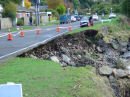
This picture shows the damage done to the road when the Water of the Leith got out of control in the May 2006 floods. I took this on a sunday walk with the dogs. This illustrates for me that \”Quality is about preventing damage in education,not about fencing it off afterwards.\”

This week and last we had two visiting speakers which focussed me in on quality again. John Milne from Massey university ran a workshop on eLearning Guidelines (an eLearning Collaborative development funded project). All NZ tertiary educators are invited to contribute to the guidelines and develop their own for practical use in their institutions through a wiki accessible from the eLearn website.

In response to a scenario we developed with a student who joined the workshop, we developed a couple of new and very important guidelines, and found several existing ones which were relevant.

The scenario was:
An off-campus multimedia student is using blended methods (mainly eLearning)in a course. The student has a dial-up connection at home and has difficulty getting on-campus access to the computers and software. Not all computers have the necessary tools/software. The student also doesn\’t have them at home and no access from home. The students are given training in using some software in the first week, then no further training and little support from the lecturer. There is no after hours support.

Some people in the workshop found the session a bit wishy washy, but it was a collaborative and consultative exercise which doesn\’t suit everyone. Some people just want to be told. Guidelines are guidelines not standards and as such need ongoing discussion be dynamic and continually evolving.

The other speaker was Professor Fred Lockwood, a very experienced academic in the field of open and distacne learning. I went to hear his talk at the university about quality and distance education. I recorded part of the talk and had his permission to use it, though he did seem bemused that anyone would want to listen to it.

In his talk he made several interesting points in the way of questions about what we do in distance/flexible learning. Reading between the lines and through his humour it was clear to me that he thought the university was deficient in many areas – he had just conducted a review of their distance programmes and was helping them with a distance learning strategy.

The points which I identified with were:
1. Learner needs and how important it was to pay attention to them.
2. The need to conduct developmental testing with realstudents and reward them with free fees for such courses, with new flexibly offered courses. Even something as a textbook recommended by a lecturer can be unsuitable in the opinion of the students. This is rarely done at OP.
3. Too much information was a common problem so that students who were expecting to study for 5 hrs a week ended up getting increasingly more stuff to read and hand in until they could end up studying well over the 5 hrs per week. In Fred\’s words, \”good value for money getting 35 hrs a week of study…\”

I brought Fred back to OP to speak with a small group (in the Council room with tea) including some managers and people from EDC and other parts of OP which was good. We had an informal discussion and some good points came out e.g. open courseware. Looking out for the learners – part-time, lifelong learners etc. It was a useful session but I wish I\’d asked him to chat about developmental testing so the managers could have got the message.

Fred has also asked me to contact him about putting together a book proposal for something from NZ and across countries too for the Open and Flexible Learning series. Not sure whn I\’ll have time to do anything, but it would be good to coordinate something and collaborate to write a chapter.

Quality is very important in not only attracting students but also in helping with retention. Quality starts before students enrol (18% lost before they \”register\”) and should continue all the way through with the resources offered, access, teacher support/facilitation and should meet learners\’ needs.

Unfortunately in the model we appear to be adopting, online and product is being pushed which is shoving us along the inflexible rather than the flexible path. If we were truly to meet learner needs, we would adopt a truly flexible model where learners negotiate their content and their assessments and the way they learn. We are trying this to some extent with the Design course.

Which Healthcare Management Concentration Should I Pursue?

The first step to a rewarding, successful healthcare management career is choosing the right concentration.

Healthcare management is becoming an increasingly attractive career option for aspiring healthcare professionals. Not only does a degree in healthcare management offer strong job security, it’s also incredibly versatile, preparing graduates to work in a variety of healthcare settings, from hospitals to healthcare consulting. Learn about what healthcare management consists of from an experienced professional in the industry.
But, with so many different career possibilities to choose from, how do you know which is right for you?
The first step to a rewarding, successful healthcare management career is choosing the right concentration. Consider how each of these two core knowledge areas can help prepare you for the healthcare job you want:

1. Leadership

The healthcare landscape is constantly evolving, and healthcare managers are tasked with helping their organizations keep up with the pace of change. If you’re a forward-thinking problem solver, a leadership concentration might be the right path for you.
In order to lead their companies into the future, healthcare management professionals must possess a strong mix of critical thinking, decision-making and communication skills. In addition to helping organizations meet the growing demand for healthcare services, today’s healthcare managers might oversee how new information systems are integrated into an organization’s existing processes, or lead initiatives designed to improve employee education and enhance the quality of patient care.
Students who pursue a leadership track in their healthcare management program learn the fundamentals of healthcare management from a business standpoint, from change management to administrative law. Graduates can go on to pursue careers as a hospital administrator, medical practice manager, health and social service manager, and much more.

2. Managed Care

If you’re interested in helping to expand access to healthcare services, you might find yourself at home in the managed care field.
In today’s health insurance market, the majority of insurance providers and healthcare organizations provide some degree of managed care, which is a means of delivering healthcare services (such as insurance) in ways that improve quality and control costs. Managed care encompasses more than just insurance, though – you can also find managed care roles in public health, working to fulfill community healthcare needs.
Pursuing a concentration in managed care gives students an advantage in the job market for management and leadership roles at health insurance companies, managed care providers, hospitals, and more.

What you can do with a degree in healthcare management

Jobs in healthcare management range from recordkeeping and secretarial roles to executive level leadership positions in a medical institution. Your first step to achieving your goals is to get the education you need to become qualified. Learn more about how much you can make in healthcare management and the job outlook in coming years from the Bureau of Labor Statistics.
No matter where your interests lie, there’s a healthcare management position for you. Building specialized knowledge through a career-focused healthcare degree program is the key to finding the role that’s right for you and ensuring your long-term career success.

Publishing 3.0 – A new model for independent educational publishing

My New Years resolution this year was to start work on a series of ebooks for iPads, e-readers and other digital devices. This has been my ambition since I published my first book Web 2.0 Tools for Teachers back in 2009, but I’ve never felt that the time, the technology or the market was at the right place.


Significant changes over the last couple of years though have led me to believe that now is the time to look at a new model of ELT publishing, at least for the realm of teacher development books.

The changes I mention above include

  • A proliferation of increasingly low cost e-reading devices and tablets.
  • The development of powerful free software and applications such as iBooks Author for the development of media rich ebooks.
  • The combination of these applications with secure and reliable marketing platforms, such as Lulu and iBookStore.
  • The development of crowd-funding platforms such as KickStarter and Indigogo.


I believe that the combination of these developments is now enabling individual teachers to write develop and launch their own products to the market on a commercially competitive basis with established publishers.

So why is this a good thing?
Well anyone who has ever approached a publisher with an idea for a book will know how difficult it can be to get it accepted. The established publishers are, by necessity, cautious about taking on new, innovative or risky projects. Producing and distributing paper-based books is a hugely expensive endeavor and in the case of teacher development books, the returns are likely to be small for both the publisher and the writer.

The changes I mention above, however, have the potential to liberate writers from the established publishing process and give them the freedom to develop their own projects and products independently.

  • The proliferation of low cost mobile devices such as e-readers, tablets and iPads provides a really useful and accessible medium on which to publish teacher development materials. Instead of having your books at home on the bookshelf you can now carry them around with you on your device so they are on hand at the moment of need.
  • These devices and the applications used to develop content for them are capable of providing a media rich experience with colour interactive images, audio, video and a range of interactive learning apps, none of which is possible in a traditional paper-based book.
  • The combination of these applications with established secure marketing platforms means that writers with the commitment to see their projects through to completion can easily market them internationally and actually get a reasonable financial return on the work they put in.
  • Crowd-funding platforms like KickStarter and Indigogo enable writers to raise the funds they need to develop good quality professional products that the market wants.


I’ve put the crowd-funding platform at the end of my list, but really it should be at the beginning, because crowd-funding doesn’t just supply the money to launch the product, it also acts as a market research tool to see if there really is a market for the product. If the people for whom the product is intended aren’t willing to invest in it to get it created, then it’s likely that there isn’t really a viable market for this product.

So this brings me back to where I started with my New Years resolution. I have launched my own crowd-funding project to try to create the first in a series of ebooks in a series that I intend to call The Digital Classroom. The first of these will focus on the use of online video as a tool for learning.

You can find out more about this project by following this link Digital Classrooms – Online Video or watching the video below.


If you think this is a product you would be interested in having them please do support it buy either buying and advance copy of the book or by sharing the link with others you think may be interested.

You can also get an idea of the kind of content the book will cover and even contribute your ideas for what the book should contain, using the crowd-sourcing questionnaire below. Just add your ideas and vote for the things you would most like included in the book. That way you can ensure that I produce the book that you need to help support and develop your teaching.


powered by tricider

You can also follow the project on Facebook by going to The Digital Classroom and clicking on \’Like\’.

I hope you find the project interesting and that this post gets you started thinking about how you can produce your own book too.

More about my family

When I composed yesterday’s post, I got so excited sharing the history of my family that I forgot part of what I wanted to say. Here it is:

This month I have been posting historic family pictures on FaceBook each day. Sometimes it’s a single picture, sometimes it’s two or three pictures. I’ve been getting good reactions from family—including cousins I almost never see anymore—as well as from other friends.

Why am I doing this? Well, as a historian and an archivist, I want to promote the business. Especially those weeks that I had to work from home, trying to do the same things I would be doing at work, I knew that I had to do the full job of an archivist—not merely to preserve and to organize, but also to share. Archivists don’t digitize the entire collection and put it online—we digitize a small amount of material that is interesting or informative. Real researchers don’t stop at surfing the internet; when they find something of interest, they identify where it is located and come to that place to look at the rest of the collection.

Beyond that, I have gotten major fatigue scrolling through FaceBook and other social media. It feels like a game of dodgeball back in junior high school, trying to avoid all the mentions of disease and politics and the intersection of the two. So I thought I’d change the subject—give myself and other people something different to talk about and think about. And that has worked.

It has worked so well that my sister and some of my cousins commented over the weekend that I ought to take all this family information I’ve been gathering and write a book. I’ve handled books written by genealogists. They tend to be dry as dust—recording vital information, but often omitting the interesting and unusual family stories about these various individuals.

So I’m considering a book on the Salvageable family. The first question is: how much of the family do I want to cover? Am I writing for my children and their descendants—do I want to include my wife’s side of the family? Do I want to focus on me and my ancestors? Or do I want to stick to my mother’s side of the family, which contains most of the interesting stories that have come to light thus far. (And includes those cousins who are suggesting that I write a book.)

Even though that matter is not settled, I have made two other decisions. If I write this book, I will start each family line with the immigrant who came to the United States. Where I know names and dates for ancestors who remained in Europe, I might include them in an appendix or sidebar, but I want this to be an account of the Salvageables in America. Also, rather than focusing on one line at a time, with chapters relating to different streams that entered the river, I want to make the book chronological. I would like to write a chapter for each decade, describing where the various ancestors were during that decade and what they were doing.

Moreover, I want to include some historic context in each chapter. Think how much fun the 1860s will be—men fighting each other in the Civil War (and I have ancestors who fought for the Union and ancestors who fought for the Confederacy). Wouldn’t it be cool to find two great-great grandfathers involved in the same battle, shooting each other? (And, if either of them had been a better soldier, I would never have been born.)

I can only guess how long it will take to complete the family research and begin writing. This project likely will be years in the making. And it will not be lucrative—we’re not talking Roots here. I don’t care to dabble in historical fiction, creating conversations that may have happened. I want to include verifiable facts, along with family stories and mysteries.

And this is much more fun than slogging through the current international crisis and thinking only about it night and day. J.

Why Nurses Should Get Their MSN

I graduated with my bachelor’s degree in nursing in 2017 and it wasn’t long before I started thinking about advancing my education with an MSN.

I graduated with my bachelor’s degree in nursing in 2017 and it wasn’t long before I started thinking about advancing my education with an MSN. I have a passion for teaching and I wanted to do more for my patients and help them learn how to lead healthier lives.

Deciding to go back to school wasn’t an easy decision. I was somewhat nervous about enrolling in an online MMSN program, especially because I was going to be working full-time while in school. My friends all said that earning their MSN was the best thing they ever did, but I wasn’t sure if I could make it work. Was I smart enough? Would I have the time? What if I failed?

I put those doubts aside and I’m glad I did. In nine short months, I will graduate with my Master of Science in Nursing from Herzing University’s Family Nurse Practitioner program. It has been challenging at times, but I have no doubt that it will be worth the time and the effort.

As a nurse practitioner, I will be able to be more involved in providing excellent care for my patients and I will owe it all to taking that first step to continue my education.

Here’s why you should consider earning your MSN:

1. Increasing demand for experienced, specialized nurses

As healthcare organizations deal with a growing patient population and a shortage of skilled healthcare professionals, nurses with advanced knowledge and skills are in high demand. With an MSN, you can expand your scope of practice, help train new nurses and play an increasingly central role in ensuring quality patient care.

Why Nurses Should Get Their MSN

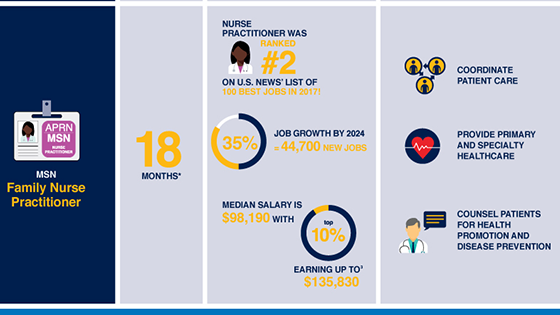
The Bureau of Labor Statistics predicts that employment for nurse practitioners will increase by 36 percent from 2016-2026, due in part to a shortage of primary care physicians and ever-growing demand for healthcare services. FNPs can make a very good salary; learn more about how much a family nurse practitioner can make in your state.

I wanted to be more involved in patient care, so becoming a nurse practitioner seemed like the perfect next step for me. Nurse practitioners are certified to provide many of the same services as a general physician and can help increase access to health care in underserved areas.

Why Nurses Should Get Their MSN

2. Advancement opportunities

I also knew that I would soon be left behind if I didn’t continue my education. New nurses are joining the workforce at a rapid rate, creating opportunities for experienced nurses to move into specialized roles and leadership positions. With an MSN, you can pursue specialties in a variety of different areas, including nurse education and nurse leadership. Advancing your education not only makes you more marketable for leadership roles, but it also increases your value to an organization and makes you an indispensable part of the nursing team.

Why Nurses Should Get Their MSN

3. More responsibility

As you advance to these leadership roles, you also gain more responsibility and have more opportunities to make a difference in patient outcomes. I knew that pursuing my MSN would allow me to be involved in the nursing process at a higher level, prescribing medications and working alongside physicians.

Why Nurses Should Get Their MSN

Today, I’m looking forward to graduation and I’m proud of the success I’ve had thus far. The support and resources provided by the faculty and staff at Herzing University have helped make this process possible. I have not felt alone once, which is especially important to me as an online student.

No matter what your inspiration is, earning your master’s degree in nursing is worthwhile. It will help you grow exponentially, not only in your career but in your relationships with others, as you will become their inspiration for continuing their education.

When I look in my nine-year-old daughter’s eyes, I know that she deserves this. I want to show her how hard work pays off, and that if you set a goal, it is attainable. I can only hope that this will inspire her someday, not to follow in my footsteps (although that would be lovely), but to set her own goals and see that they are within arm’s reach.

You owe it to yourself to dust off the books and advance your nursing degree. Your community will thank you and your future self will thank you. There is no better time than now to pursue the next step in your nursing career.

FLLinNZ meeting

Our planning session for the Flexible Learning leaders in New Zealand planning meeting all the 1st and 2nd round FLLinNZers gathered at Wiapuna Hotel at Mt Wellington, Auckland. We started with a warmup and a discussion of what we are expecting from the third round of funding and any issues.

The facilitator presented on the situation in Australia. Main points were:

  • competency-based apprenticeships
  • qualifications recognised across Aus
  • maximum flexibility in system – impacts on quality
  • grow private training orgs with effective competition
  • school-based apprenticeships
  • RPL – want to improve uptake
  • industry wants to control knowledge base – web 2 does not fit
  • training providers not keeping pace with rapid technological change – important
  • costs, flexibility and access
  • need training to meet needs of lifelong learners – skills shortages, shiftworkers, contractors, mature learners, just-in-time and to suit learners
  • need to build capability – respond to physical and online environment
  • changing role of education and training
key activity: who can we connect with to make the most influence?
often fail to equip people with skills to be able to problem solve and think forthemselves.
Pedagogical shifts
  • more of the following:
  • distributed networks
  • social networking
  • blended and flexible models
  • facilitation driving pedagogy not instruction
  • innovation
  • market changes e.g. full employment
Less occurrence of the teacher teaching many.
Examples: Motor Traders Association – mp3 audio files used in training to capture their interest
Caryl Oliver – mlearning – there is a recording of an interview with Caryl.
Manager of 2020: multigenerations, longer later, more teams, flexible working, performance emphasised, innovation
Overview of pressures on the NZ tertiary education sector can be seen on the concept map (to be loaded).
Facilitator talked about Australian Flexible Framework and how we could have links with Australian projects. Learnscope and Knowledge tree online journal. eLearning networks project is running a September Online Event: Tapping into Resources for E-learning 6 – 8 September 2006

Why I Became a Nurse After the Navy: Q&A with Shaeye Frierson

We sat down with Shaeye to learn more about her experience in the nursing program, as well as her transition to a career as a nurse educator.

Military veterans have a lot of relevant experience to share after their service to the country is over, and many of them are choosing a career in nursing to help meet growing demand.

Shaeye Frierson, a nursing instructor at Herzing University, joined the military at age 22, in hopes of building a better life for her 2-year-old son. During her 11 years as a hospital corpsman in the Navy, and through several deployments, she realized she had a true passion for helping others.

In 2010, Shaeye applied her Post-9/11 GI Bill funds toward nursing school at Herzing, while her mother helped her raise her two young children. She’s now working on her master’s degree while teaching nursing classes at Herzing, and serving as an unofficial mentor for military vets on campus.

We sat down with Shaeye to learn more about her experience in the nursing program, as well as her transition to a career as a nurse educator.

What inspired you to become a nurse?

I always knew I wanted to go into the medical field, but I wasn’t sure what I wanted to do. When I joined the military, I was offered a medic position and I really enjoyed it. I moved up in rank, and became even more passionate about my work. Our fellow soldiers depended on us for their lives. I thought there could be no more rewarding career than that. I knew then that I wanted to pursue a career in nursing.

What did you enjoy about the accelerated nursing program?

What was challenging? In the military, your education is so fast, and you get used to learning that way. The accelerated program was perfect for me, and I excelled because of my medical training and my experience with learning at that pace.

Balancing the demands of work and school can be challenging at times, and a lot of students struggle with that at first, especially in an accelerated program. I created a schedule for myself, setting aside time for homework, work, sleep, etc., because that’s how you’re programmed to do things in the military. It worked for me, and I share that tip with a lot of my students. It seems to work for them as well.

What are some of the differences between civilian healthcare and military healthcare?

A hospital corpsmen in the Navy can do pretty much everything a civilian nurse can do, and more. Our medical training in the military is often more advanced and accelerated than a traditional nursing program because we have to know how to handle a lot of different situations.

For example, in 2004, I was deployed on a ship for eight months. We only had one doctor on the ship. If a person was sick, they would come to us – the corpsmen—and we would treat them or provide recommendations for the doctor to sign off on. We had more autonomy than a civilian nurse because that’s the only way you can ensure everyone receives the care they need.

Why did you choose to become a nurse educator?

I graduated from Herzing with my BSN in 2013. I had become a mentor and resource for other military veterans on campus, and when the dean asked me if I wanted to be an instructor I accepted. Students with a military background need someone to help them navigate the transition to an accelerated nursing program, and I can be that person because I’ve done it myself. I’m currently enrolled in the MSN Nurse Educator program and expecting to graduate in January 2020.

What is most rewarding about being an educator?

The most rewarding part about my job is giving back to the university that helped me become the nurse I am today. I love helping out the military veteran students – even those that aren’t in the nursing program. I usually find out who they are during orientation, and make an effort to meet with them and ask about their concerns, if they need help with their benefits, etc. I want to help them be successful.

What advice would you offer to other veterans who want to pursue a healthcare career?

I would say Herzing is the perfect school for a military veteran, especially if you want to become a nurse. The accelerated BSN program is a smooth transition because the pace of learning is similar to what you’re used to. We also have incredibly supportive instructors to help you every step of the way.

How to Study Like a Straight-A Student

Establishing a study plan that works for you is most important, as everyone finds success in different ways. Here are some study tips!

Achieving straight A’s can be difficult, especially if you are just beginning your college journey. It takes time and practice to develop effective study habits, but once you master them, you will be well on your way to achieving the grades you want.

Developing good study habits has other benefits as well. If you suffer from test anxiety, better study habits can help boost your confidence and your comprehension of course material, which will make timed quizzes or final exams less stressful.

Establishing a study plan that works for you is most important, as everyone finds success in different ways. Once you find what works, it can truly be a game-changer.

Here are some tips for studying like a straight-A student:

1) Don’t procrastinate

Starting your assignments in a timely fashion is a simple and effective way to achieve higher grades. Procrastination is a bad habit that will make it difficult for you to do your best work. Once you are assigned something, try getting a start on it in the first few days, even if the due date is not for a few weeks. Working on assignments little by little can help break up a major task into more manageable pieces.

2) Ask for feedback whenever possible

Professors won’t know you need help unless you tell them. If you feel stuck on an assignment and need guidance, be proactive and approach the professor right away. The feedback they provide can help you determine whether you are on the right track or if you could use some re-direction. If you receive a poor grade on a paper, you can also talk to your professor after the fact to learn what you could have done differently. You can take this feedback to a tutor, or make a note of the things you want to correct the next time you have to complete a similar assignment.

3) Eliminate all possible distractions while studying

In order to be productive in your studies and achieve the best possible grade, you truly need to be 100% focused on the task at hand. Students that want to achieve high grades remove all distractions so that they are completely focused on their work. Leaving your phone or the TV remote in another room until you finish your schoolwork can make a world of difference in your productivity. That funny cat video will still be there when you are finished!

4) Study for understanding rather than memorization

It can be tempting to breeze through your study materials quickly, but this is not an effective study technique. Memorization may work well for a pop quiz, but it won’t do you much good on a final exam. Most professors care less about the specifics you’ve memorized and more about how you can apply your knowledge to real-world situations. Studying for understanding is a much better method to use because it will help you be better prepared for those more detailed assessments. Creating a study guide is one of the best ways to prepare for an exam and achieve a deeper understanding of the material.

5) Avoid cramming

Cramming the night before an exam is about as effective as not studying at all. If you try and cram a month’s worth of material into your brain in just one night, chances are you will only retain a small part of it. Spacing out your studying is much more effective and will help you to understand the concepts more thoroughly. In a study conducted at the University of California, spacing out your learning was proved to be more effective than cramming for 90% of participants. Studying in advance will also help you feel more prepared for an exam, which will help dull any last-minute exam stress.

6) Ask questions to test your understanding

Participating in class is another great way to test your comprehension of material and make sure that you are well-prepared for an upcoming assessment. Professors are always willing to answer questions and you can learn a lot from the answers they give you. This is also why it is important to attend every class session. There might be important topics discussed during class that are not in the textbook, and you never know when they might show up on an exam.

7) Work with other motivated students

Studying with other students who are as driven as you are can be quite a helpful resource. If others around you are engaging in productive activities, it is more likely that you will feel motivated to do the same. Study groups are also a great place to share ideas with your fellow classmates, learn new study techniques, and get help preparing for major tests or projects, especially if you are all taking similar courses.

Not only will these tips help you boost your grades, they can also help you develop other skills that will be important for your future, such as time management and communication. Even though grades won’t necessarily be a concern post-college, the need for a strong work ethic won’t disappear. By developing effective study habits now, you can position yourself for success both in and out of the classroom.

FLLinNZ meeting

Our planning session for the Flexible Learning leaders in New Zealand planning meeting all the 1st and 2nd round FLLinNZers gathered at Wiapuna Hotel at Mt Wellington, Auckland. We started with a warmup and a discussion of what we are expecting from the third round of funding and any issues.

The facilitator presented on the situation in Australia. Main points were:

  • competency-based apprenticeships
  • qualifications recognised across Aus
  • maximum flexibility in system – impacts on quality
  • grow private training orgs with effective competition
  • school-based apprenticeships
  • RPL – want to improve uptake
  • industry wants to control knowledge base – web 2 does not fit
  • training providers not keeping pace with rapid technological change – important
  • costs, flexibility and access
  • need training to meet needs of lifelong learners – skills shortages, shiftworkers, contractors, mature learners, just-in-time and to suit learners
  • need to build capability – respond to physical and online environment
  • changing role of education and training
key activity: who can we connect with to make the most influence?
often fail to equip people with skills to be able to problem solve and think forthemselves.
Pedagogical shifts
  • more of the following:
  • distributed networks
  • social networking
  • blended and flexible models
  • facilitation driving pedagogy not instruction
  • innovation
  • market changes e.g. full employment
Less occurrence of the teacher teaching many.
Examples: Motor Traders Association – mp3 audio files used in training to capture their interest
Caryl Oliver – mlearning – there is a recording of an interview with Caryl.
Manager of 2020: multigenerations, longer later, more teams, flexible working, performance emphasised, innovation
Overview of pressures on the NZ tertiary education sector can be seen on the concept map (to be loaded).
Facilitator talked about Australian Flexible Framework and how we could have links with Australian projects. Learnscope and Knowledge tree online journal. eLearning networks project is running a September Online Event: Tapping into Resources for E-learning 6 – 8 September 2006

Learning about Clinicals: Ask an ASN grad

We asked former Herzing nursing student Shenese Stewart about her clinical experience and what other nursing students can do in order to be successful

Your first clinical externship can be daunting, but it’s also exciting. You’re ready to get to work in the field, but it’s normal to feel a little nervous about working with real patients
We asked former Herzing nursing student Shenese Stewart about her clinical experience and what other nursing students can do in order to be successful.

What did your clinical mean to you?

Clinical was important to me because it gave me the opportunity to put my classroom knowledge into \”real life\” practice. I was able to work with patients and had the opportunity to ask questions.

In your opinion, why is a clinical experience so important to your nursing career?

Clinical experience is important to your nursing career because you are able to explore different areas in the clinical setting. Many times, you find what you like and don\’t like in clinical and that helps you decide what types of positions you will apply for when you graduate. It also helps connect the dots between theory and practice. Reading about something and actually doing it can help solidify it in your mind.

Do you have any secret tips on how to survive clinical?

Clinical can be intimidating, but don\’t leave with unanswered questions. Learn your medications and labs. Know how to keep your patient safe and never assume anything. Always ask questions, especially if it’s something you need to know to stay safe.

How important was your cohort during your clinical?

I feel that your cohort in clinical, not class, can make or break you. Your clinical cohort is experiencing a lot of the same feelings that you are, and they can encourage you, motivate you and explain things to you sometimes in a way that your instructors cannot. Try not to be the lone wolf in clinical.

How important is your clinical instructor?

Your clinical instructor is an invaluable resource who guides you and helps pull it all together. Don\’t be scared to tell your clinical instructor what you don\’t know. You may lose points, but you\’ll know next time, and your instructor will know that they can trust you to be honest, which is critical in nursing.

Tell us about a time that you struggled during your clinical and how you overcame that struggle.

It took a lot of practice for me to learn about all the different medications, side effects and drug classes. I was in a LPN clinical and was giving medications to a patient with my instructor. The patient asked me what Lisinopril was for and I told her it was for cholesterol (it’s actually for blood pressure). Not only did I lose 10 points for the day, the patient laughed and said, \”Stupid student, I knew I\’d get you.\” The lesson for me was to never treat any student in a disrespectful way – regardless of what profession they are preparing for – and to learn everything there is to know about Lisinopril!

Tell us a great memory about your clinical.

My best memories from clinical were when I felt that accomplishment of completion, when the light bulb went off in my head and I saw the big picture. You just connect bits and pieces until one day it all just makes sense.

Managing behaviour in the digital age

If you ask most teachers, especially newly trained ones, what one of the biggest challenges of teaching is, they would probably say managing student behaviour. Especially as class sizes grow and more students are bringing along potentially distracting digital devices, making sure you are keeping students on task is becoming ever more important. If this is something that concerns you, then read on.

ClassCharts could be the solution to your problem. ClassCharts is a digital management tool which can help you, your students and their parents to track and improve student behaviour across the whole school.


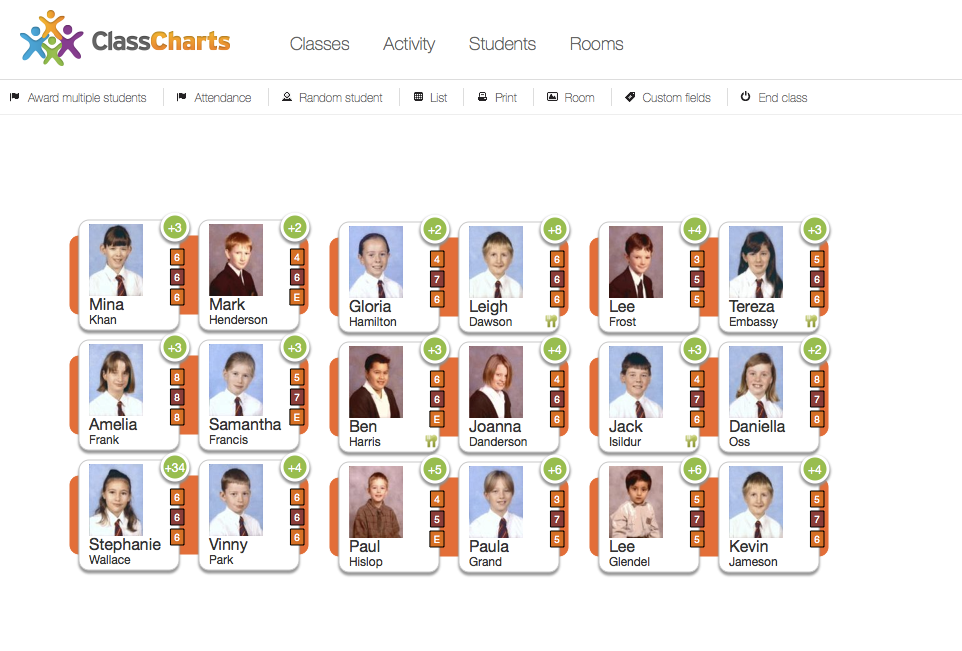
Using ClassCharts you can set up seating charts for every room in your school and create a profile for each student. Teachers can then use ClassCharts to monitor and reward positive behaviour as well as track negative behaviour. As the teacher builds up data across classes they can start to understand how different seating arrangements and student pairing and grouping can impact on behaviour, then generate seating charts for students that group them in ways that help them to work more efficiently and harmoniously.


So how does it work?

Well one of the first things to do is to add seating plans of your rooms. This is easy to do and you can drag the virtual desks around into whatever configuration you have in your classroom.


Then you also need to upload your students. What I really like about ClassCharts is that you can also upload a photograph of each one, and this can be really useful if you have large classes and lots of students names to remember, especially when it comes to writing reports.


You can then either manually assign seats or generate a random seating chart. During the class you can use ClassCharts acknowledge a range of positive and negative behaviours. These behaviours are all customisable so you can create your own or use the default ones.


ClassCharts uses html 5 so should run in any modern browser whether it’s a laptop, iPad or Android tablet, so the teacher can use an tablet during the class to instantly update behaviours.

Either before or during the class the teacher can also shuffle the class seating depending on a number of criteria from things like attainment targets to gender or previous behaviour.


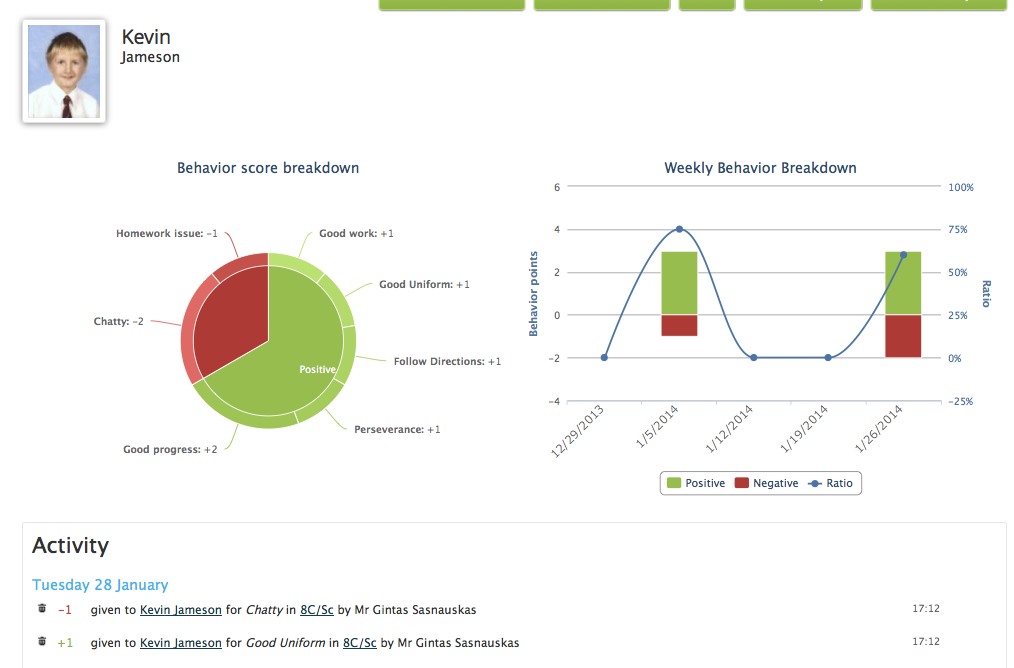
One of the real time-savers of ClassCharts though is when it comes to report writing time. Each students’ behaviour has been tracked through their various classes and teachers can get a detailed report, including dates when different behaviours were recorded.


Both students and parents can also access live reports and monitor progress throughout the term, so students and parents know how they are doing and parents don’t have to wait until the end of term to find out what’s been going on with their child.

This helps to share responsibility and makes it much easier to get parents involved in dealing with any negative behaviour at the earliest possible date.

Although ClassCharts is free and has been designed so that a single teacher can set it up to track their own classes independently, the real power of the platform is its ability to work across the school and track student behaviour in every class. To make this easier ClassCharts also interconnects with a range of other educational management software systems, from simple tools like Edmodo to more complex ones like SIMS and PowerSchool.


What I like about ClassCharts

  • I’m really impressed by the fact that such a powerful and well designed tool is free.
  • It’s great that a system like this and the data it collects can be applied and shared across a whole school.
  • I really like that you can see the student and access a range of information about them from targets, to behaviour and even a little about their background.
  • Great to get parents involved and students monitoring their own progress.


What I’m not so sure about

  • This is quite a complex tool and creates a lot of data, so I think it’s going to take a bit of getting used to for teachers and perhaps a bit of training too.
  • It does produce a lot of data and you can easily get a bit too tied up in this and forget about the person.
Well I hope you find ClassCharts useful and give it a try.
Related links:

Photographs and genealogy

Years ago, when I first saw this picture in the family collection, it puzzled me. I knew that the little girl to the left was my grandmother, and I suspected the other two children on the floor were her brother and sister. I assumed that the man to the left was her father and that the woman in back was her grandmother? But who is the other boy in the room? My family and I dubbed him Heathcliff, remembering that he joined the Earnshaw family by adoption when he was a young boy (Wuthering Heights).

This spring I’ve had the opportunity to go through family photographs and also to research my family tree. I deduced that this picture was taken Christmas 1905. The extra boy is a cousin to my grandmother. These same people were still in the same household at the 1910 census. The grandmother, by the way, is the mother of my grandmother’s mother, mother-in-law to the man in the picture.

Here’s another picture of the same family taken a few months earlier. The younger woman is my great-grandmother; she died in June of 1905. The man with the cigar is probably Heathcliff’s father, and the two additional girls are Heathcliff’s sisters.

Why are those sisters missing from the Christmas picture? According to the 1910 census, they were boarding at the Chicago Industrial School for Girls. Later records show that both grew up, had jobs as clerks, and got married.

Here’s Heathcliff and his sisters—possibly taken at their school. On the desk is a cube with the date: Wednesday December 27. Historians, archivists, and genealogists love clues like that hiding in photographs. (December 27, 1905, was a Wednesday.)

And what became of Heathcliff? He also got married. He and his wife had a son who lived only three months and a daughter who eventually grew up and married. In 1917, when Heathcliff registered for the Great War, he was a clerk supporting wife and mother (possibly mother-in-law). In 1920, he was living with his wife, in-laws, and infant son. In 1930, though, he was divorced and living alone in Chicago. October 1930 saw him incarcerated at Leavenworth, Kansas—I have no idea why. By 1942, when he registered because of the second World War, he was back in Chicago, working for Keller & Sons. He died in 1959, at the age of 63.

“Heathcliff’s” real first name was the same as his father and his grandfather. By coincidence, my wife and I chose the same name for our son. After skipping several generations, it’s nice to have the name return to the family, even though the previous holder of that name was a crook. J.