

https://doi.org/10.26643/ijr/2026/30


Taiwo, N. B., Bert-Okonkwor, C. B. N., Mbadugha, L. C., & Fadumo, O. D. (2026). An Examination of the strategies for Effective Material Management in Building Construction Sites in Auchi, Estako Local Government, Edo State. International Journal of Research, 13(2), 22–38. https://doi.org/10.26643/ijr/2026/31
Nkechi Benedicta Taiwo1, Chiagozie Bertrand Nonso Bert-Okonkwor1, Lynda Chinwendu Mbadugha2 and Oluwatayomi Daniel Fadumo1
Affliation
1.Department of Building, Faculty of Environmental Sciences, Nnamdi Azikiwe University, Awka-Anambra State.
2.Department of Architecture , Faculty of Environmental Sciences, Nnamdi Azikiwe University, Awka- Anambra State.
Corresponding Author: taiwostical@gmail.com
Abstract
A lot of problems have been known to confront material management in building construction sites in Auchi, Estako local government, Edo state; one of the key issues is adoption of improper material management practices that don’t take care of material requirements, vendor evaluation, purchasing, handling, storage and site distribution. This study therefore examines strategies for effective material management in the study area with a view to enhancing successful project delivery. This study adopted a mixed survey design approach (quantitative survey) in accordance with the research objectives. The sampling techniques adopted for the study were multi-stage sampling for non-probabilistic samples, whereas purposive sampling was used to select the area (Auchi). Overall, the findings indicate moderate adoption of project-decided material management practices, with greater emphasis on conventional methods rather than modern-technology-driven approaches; Stock and Waste Control (3.91), Just-in-Time Method (JIT) (3.80), Warehousing Management (3.54) etc.are some of the existing practices. The study identifies the need for a formal material management system (3.39) as the most effective measure for improving material management on construction sites. This underscores the importance of structured and possibly digital systems for tracking, monitoring, and controlling materials. Other highly ranked measures include material scheduling for contractors (3.36), training of management and staff (3.34), and effective site supervision and administration (3.30). Overall, the study concludes that the right selection of appropriate material management practice is a fundamental aspect of successful building construction project execution. Poor management of materials leads to cost overruns, time delays, and reduced quality, while proper choice of management practices ensures smooth project flow, reduced wastage, and improved profitability. Based on these findings , the study recommends that the selection of a material management practice should be based on the merits of the selection, not just on familiarity. The findings emphasize systemic, managerial, and capacity-building solutions over isolated site-level controls.
Keywords: Material management, building construction sites, material management strategies, construction professionals, construction industry
1.0 Introduction
Building is a form of shelter, and its construction is an ancient human activity which evolved as the need for shelter became an important means of survival. (Ashiwini, 2023). Constructed shelters were the means by which human beings were able to adopt themselves to a wide variety of climates and other global species. However, Akadiri(2015), emphasizes that building construction is costly and requires huge resources to erect them. This factor has made building construction a Herculean task which has attracted the interest of professionals (e.g. builders, architects, civil engineers etc.) as the most effective means of managing building construction. Consequently, Tunji-Olayemi, Emetere and Afolabi (2017) state that to successfully erect a project, a number of issues arise as regards the material usage. The study further emphasizes the critical role that efficient material management plays in enhancing project performance and sustainability. Material management is a process that coordinates planning, assessing the requirements, sourcing, purchasing, transportation, storing and controlling materials, minimizing the wastage and optimizing the profitability by reducing the cost of materials (Chetna, 2011). The result of improper handling and managing material on site during a construction process will influence the total project cost, time and quality (Ashwini, 2013). The problem of material management is one of the key issues facing construction sites in developing countries, as discovered by many researchers. Okolie, Ngwu, and Ezeokonkwo (2015) explain that the activities identified in the supply channel (the sourcing and transmission of purchase orders to control of material wastage) are considered key to material management because they primarily affect the economy, effectiveness of material movement, productivity, optimization of profit and reduction of material cost. Presently, building materials are poorly managed in the study area, thereby resulting in a lot of abandoned building projects. The use of the traditional material management practice often takes care of material requirements, vendor evaluation and purchasing, while details of handling, storage and site distribution are left to be decided on site. There are other forms of material management systems that enable that material to be planned, ordered, delivered and handled while recognizing the cost associated with late ordering, wastage and poor handling facilities on construction sites in Auchi. Building professionals losses in productivity from the wrong choice of material management practice, which will eventually affect profit margins.
A lot of problems have been identified confronting effective material management; Okolie, Ngwu, and Ezeokonkwo (2015) explain that certain activities in the supply channel (the sourcing and transmission of purchase orders up to control of material wastage) often affect material management in terms of economy, material movement, productivity, profit and material cost. The study therefore recommends proper execution and control of standard materials delivered within time, budget and doesn’t compromise quality. The increasing cost of erecting a building as a result of poor material management practices during the construction process is worrisome. There is concern among building construction practitioners and professionals that the inherent dangers of poor management of materials in building construction affect the quality of building. (Kadiri, 2025). Most of the time, the contractor finds himself not meeting up with the budget because of lack of materials. The human cost is usually associated with a poorly delivered building and the cost of reconstruction and managing it is usually un_quantifiable. The challenges both have implications in building delivery and building management practices, which has prompted continuous research into their causes. Also, Akadiri (2015) study on understanding the barriers affecting the selection of sustainable materials in building projects only emphasized barriers that affect the selection of sustainable materials in building projects without highlighting the consequences of the use of such materials in both the project delivery and the safety of the project. This study therefore examines strategies to minimize these challenges and enhance effective material management practices on construction sites in Auchi. The research work is of immense benefit to future researchers and professionals in the field of building construction as a reference material for material management, and provides a cost-effective solution that ensures timely completion of projects and eliminates project abandonment.
2.0 LITERATURE REVIEW
2 1 Discussing Existing Material Management Practices in Building Construction
Effective management of materials contributes significantly to the success of the project. There are major issues which affect materials management activities, such as constraints on storage areas, site logistics with regard to materials handling and distribution, and also ordering and delivery of materials to the construction site. According to Canter (2009), material management practices are categorized into five processes, which are planning, procurement, logistics, handling and stock and waste control. Ocheoha (2013), also identify practices such as the just-in-time (JIT) method, Economies Order Quantity (EOQ), warehousing management, and recovery and recycling method as part of materials management practices that should be taken seriously, and these practices are detailed below:
1. Planning practices: The process of planning construction methods has been defined as “understanding what has to be built, then establishing the right method, in the most economical way to meet the client’s requirements” (Barrie and Paulson,2010). This is a detailed scheme for achieving an objective for certain work tasks. In the case of materials, there is a need for appropriate planning, which must be done concurrently with engineering, construction, and other project plans. He also mentions that material planning will provide guides for all the subsequent activities and could have a great impact on the project plan. The materials planning process covers setting up and maintaining the records of each part used in each plant to determine target inventory levels, and delivery frequency. As a result, excellent management of the materials record will help the flow of materials at the site in order to avoid several problems such as materials out of stock and materials that have not been delivered. Material planning would provide subsequent activities and could have a great impact on the project plan. The materials planning process covers setting up and maintaining the records of each part used in each plant to determine target inventory levels, and delivery frequency. As a result, excellent management of the materials record will help the flow of materials at the site in order to avoid several problems such as materials out of stock and materials that have not been delivered. Material planning would provide guides for all the subsequent activities and this could have a great impact on the project plan. The materials planning process covers the set-up and maintenance of records and determines the target inventory levels, and delivery frequency. Planning of access and routing of materials within a construction site has an important implication for the development of an effective materials management strategy (Waziri,2016), particularly in terms of increasing productivity and profit and facilitating the timely completion of construction projects. Planning and programming of work should include strategies, tactics, and tools for managing the design and construction delivery processes and for controlling key factors to ensure the client receives a facility that matches their expectations and function as it is intended to function. The requirement for efficient materials planning is to increase the productivity and profit of the company, and facilitate the completion of construction projects. Thus, better planning of raw materials on site can help to eliminate project delays and reduce activities.
2.Procurement processes: The term procurement encompasses a wide range of activities that includes purchasing of equipment, materials, labour and services required for construction and implementation of a project (Barrie and Paulson,2007). The objective of procurement in materials management is to provide quality materials at the right time and place, and at an agreed budget. Akbar Rasouli Kamran Behdinan and Salmon Farsi, (2016) state that procurement is about organizing the purchasing of materials and issuing delivery schedules to suppliers and following-up, to make sure that suppliers deliver on time. Canter (2009) states that failure in the purchasing process or in organizing buying functions results in:(a) over-ordering of materials (wastage problems);(b)Over-payments for materials (inadequate administration procedure);(c)Loss of benefits (lack of skilled negotiating procedures); and (d)Lack of knowledge (when and where the best service/source might be available at any particular time).
Purchasing in building construction involves obtaining all materials, equipment, and services needed to execute a project efficiently, on time, and within budget. It ensures that the right materials are delivered at the right quantity, quality, time, and cost, aligning with project specifications and construction schedules. The process involves (i)Identification of Material Needs from a work schedule or bill of quantities (BOQ) using a material requisition form. (ii)Approval of Material Requisition (iii) Supplier or Vendor Selection (iv)Request for Quotation (RFQ) (v)Quotation Evaluation and Negotiations(vi.) Issuance of Purchase Order (PO) (vii.) Delivery and Inspection of Materials (viii)Storage and Record Keeping(ix) Invoice Verification and Payment(x)Supplier Performance Evaluation
┌────────────────────────┐
│ Material Need │
│ Identified by Site │
│ Engineer │
└──────────┬──────────────┘
┌──────────▼──────────────┐
│ Requisition Approval │
│ by Project Manager │
└──────────┬──────────────┘
┌──────────▼──────────────┐
│ Supplier Selection & │
│ Request for Quotation │
└──────────┬──────────────┘
┌──────────▼──────────────┐
│ Evaluate & Negotiate │
│ Quotations │
└──────────┬──────────────┘
┌──────────▼──────────────┐
│ Issue Purchase Order │
│ (PO) to Supplier │
└──────────┬──────────────┘
┌──────────▼──────────────┐
│ Material Delivery & │
│ Inspection at Site │
└──────────┬──────────────┘
┌──────────▼──────────────┐
│ Storage & Record │
│ Keeping │
└──────────┬──────────────┘
┌──────────▼──────────────┐
│ Invoice Verification │
│ Payment Processing │
└──────────┬──────────────┘
┌──────────▼──────────────┐
│ Supplier Evaluation │
│ for Future Projects │
└─────────────────────────┘
Figure 2.1: Typical Purchasing Procedure in Building Construction
Source: Hohns (2017)
3. Logistics: Logistics is a concept that emphasizes movement, and it encompasses planning, implementing, and controlling the flow and storage of all goods from raw materials to the finished product to meet customer requirements. Raw materials for construction are usually varied, bulky and heavy and require proper handling in the supply process. Consequently, the construction industry requires active movement of materials from the suppliers to the production area in both the factory and the work site. Experienced traffic personnel can have a positive impact on the execution of the project while minimizing transportation costs (Ahuja and Dozzi 2021). The primary focus of the logistics concept in construction projects is to improve coordination and communication between project participations during the design and construction phases, particularly in the materials flow control process (Agapiou etal., 2021). He also mentions that problems arise in the materials flow control process, which includes delays in material supply, due to some materials purchased just before they are required and waste of materials during storage, handling and transporting when procured in large quantities without complying with the production needs on site. Previous research suggested that the routing of materials is one of the main causes which affect cost and time during construction projects. Hence, the factors that should be taken into consideration during the logistics process for effective materials’ management include: optimum forecasting of materials movement (Mahdjoubi and Yang, 2001).
4. Handling: Materials handling provides movement to ensure that materials are located and that a systematic approach is required in designing the system. Handling of materials is the flow component that provides for their movement and placement. The importance of appropriate handling of materials is highlighted by the fact that they are expensive and engage critical decisions. Due to the frequency of handling materials, there are quality considerations when designing a material handling system. The selection of the material handling equipment is an important function as it can enhance the production process, provide effective utilization of the workforce, increase production and improve system flexibility (Chan, 2002). The importance of appropriate handling of materials is highlighted by the fact that they are expensive and involve critical decisions. The material handling equipment selection is an important function in the design of a material handling system in order to enhance the production process, provide effective utilization of human power, increase production, and improve system flexibility. In addition, materials scheduling is also an essential part of handling materials on site, which has several benefits (Ezeh and Etodike, 2017), such as: showing the quantities involved in each particular operation; providing a key to the distribution of materials on site; and demonstrating useful way of checking quantities required by subcontractors, etc. Materials must be delivered to site undamaged and without any wastage. The most common problem associated with materials supply is inadequate unloading and handling facilities, which relates to a high proportion of wastage (Canter,2009). Therefore, handling with safety during movement of materials on site, which reduces the percentage of material wastage and finally fosters significant improvement, can often increase the total system productivity.
5. Stock and Waste Control: Delivery of the bulk of the construction materials requires proper management of the stock control. Stock control is a technique to ensure all items such as raw materials, processed materials, components for assembly, consumable stores, general stores, maintenance materials and spares, work in progress and finished products are available when required. Construction activity can generate an enormous amount of waste (Teo and Loosemore, 2001) and materials waste has been recognized as a major problem in the construction industry. They also mentioned that construction materials waste, in the USA contributes approximately 29%In the UK it contributes more than 50% and in Australia it contributes 20–30%. This is evidence to control construction materials in a good way during the construction process. The cause of waste in construction projects indicates that waste can arise at any stage of the construction process from inception, right through the design, construction and operation of the built facility. Therefore, waste can be reduced through the careful consideration of the need for minimization and better reuse of materials in both the design and construction phases (Dainty and Brooke, 2004). Material storage on site requires close attention in order to avoid waste, loss and any damage to materials which would affect the operations on the construction project. Problems often arise during materials supply because of improper storage and protection facilities. Previous studies have identified that building materials often require a large storage capacity which is rarely available on site (Agapiou et al., 2021). There are a few considerations to be taken into account in the planning of the storage space, such as timing of the initial buy, and historical information and experience. Materials management on site should seek to reduce loss of profit due to theft, damage and wastage, as well as running out of stock. Therefore, the requirements for storage space should be taken into consideration from the initial stage of the construction process.
6. Just-In-Time Method (JIT): The acronym JIT has been highly visible since late 1980, as manufacturing attempted to meet competitive challenges by adopting newly emerging management theories and techniques, referred to as Lean production. Again, Just in Time (JIT) manufacturing is described as a system that helps in making an appropriate order of materials available to each operating unit at the right time in the right quantity. JIT is a systematic concept consisting of JIT purchasing, JIT transportation and JIT production. These three elements combine to create a material handling system that avoids waste and minimizes inventory investment. The technique has changed employees’ beliefs, attitudes, work habits and awareness of quality assurance. It is an operating management philosophy of continuous improvement in which non-value-adding activities (or waste) are identified and removed for the purposes of reducing cost. The objectives of JIT are to reduce processing time, eliminate waste, have respect for people and cost minimization and these can be achieved if this hold zero inventory; a system known as keen supply chain. The summary of the objectives of the supply chain-oriented organizations is to improve productivity by minimizing the cost of shady products. The following factors can be considered for the required improvements from Procom and product design, thing slate-of -the-art equipment and technology, holding zero inventories, reducing lead-time of supply of material, reducing batch size, using a pull production system, simplifying factory layout.
7. Economic Order Quantity (EOQ): This determines the amount of order that minimizes total variable costs required to order and hold inventory. The economic order quantity (BOQ) refers to the order size that will result in the lowest total of ordering and carrying costs for an item of inventory. If a firm places unnecessary orders, it will incur unneeded order costs. If a firm places too few orders, it must maintain large stocks of goods and will have excessive carrying costs. It is recommended that the assumptions of economic order quantity are to: deal with only one material whose demand is assumed to be completely predetermined and demand remains constant over a period of time; holding and ordering rented costs per unit remain constant during the period of one year, irrespective of the order quantity. No stock out is allowed and ordered materials arrive instantaneously and the lead time, which is the time between ordering and receiving goods, is instantaneous and is equal to 0, and all materials ordered are delivered.
8. Recovering and Recycling: Recycling is the process of collecting materials that are often considered trash and remanufactured tin for new products that can be resold or used again. Recovering simply refers to the process of retrieving the disposed or about to be disposed of and making it ready for recycling. That is, removal of materials from the solid waste stream for sale, use, or reuse as raw materials (Monczka, 2002).
9. Warehousing Management: Chee-Chen, 2009 opines that warehousing can be defined as a storage facility used for storing construction material and supplies. He continued by saying that it serves as a central location for receiving, storing and distributing materials needed for construction projects. All organizations have a minimum level of inventory they keep for future operation. Whether they operate JIT or a traditional delivery system where inventory is kept, it is typically referred to as a warehouse. Although, in many logistical arrangements, the role of a warehouse is more properly viewed as a switching facility as contrasted to a storage facility, i.e. effective distribution systems should be designed not to hold inventory for an excessive length of time, there are times when inventory storage is economical. In the same vein, warehouse management means effective and efficient storage and provision of required materials to ensure smooth operations. Decentralized warehousing permits materials to be stored in the right places to facilitate production operations and provide quality customer service. Decentralization of warehouses is a common practice of large organizations that have different plants and product lines scattered over the country. The importance of warehousing include: a reduction in transportation costs; warehousing and the associated inventory are added expenses, but they may be traded off at a lower cost realized if JIT transportation is adopted; achieving smooth production—warehousing to some levels of inventories make materials available at all time for production process, hence, it helps to avoid stock-out of materials; coordination of supply and demand-firms that experience highly seasonal production and sales most times have problem in coordinating supply with demand of materials, warehouse helps them to even out supply and demand of materials over a given period; enjoy quantity purchase discounts- availability of warehouse encourages bulk purchases at discounted prices and maintaining a reliable source of supply-companies that have where to store materials always purchase materials and have regular supplier(s).
2.2 Strategies for Effective Material Management in Building Construction Sites
Material management has been an issue of concern in the construction industry.40% of the time lost on site can be attributed to bad management, lack of materials when needed, poor identification of materials and inadequate storage. The need for an ineffective material planning system has become mandatory. Some companies have increased the efficiency of their activities in order to remain competitive and secure future work. Many other firms have reduced overheads and undertaken productivity improvement strategies. According to Okorocha (2013), Effective Material Management should focus on the system adopted for pricing materials issues which largely depend upon the nature of the material, the undertaking concerned and the circumstances which require to be taken into consideration. These areas might be taken care of: the Materials Schedule for the Contract on Hand, the Bill of Materials, Purchase Requisition, Purchasing of Materials, Issuing of Materials for Use, and Use of Material on Site. In order to achieve good materials’ management on building projects, Calistus (2013) opines that the following areas have to be taken very seriously, i.e. Training of management and other staff, inventory control of materials on site, ensuring proper planning, monitoring, control. Management, supervision and administration of sites, provision of adequate storage of materials, proper usage of materials, materials schedule for the contract on hand, provision and accessibility of site layout and attention to weather conditions. To achieve good materials’ management on a building project, Calistus (2013) opines that the following areas have to be taken very seriously: i.e. Training of management and other staff, inventory control of materials on site, ensuring proper planning, monitoring and control. Alwi, Hampson, and Mohammed (2009), recommend the following effective materials’ management of building projects, which includes: management, supervision and administration of sites, provision of adequate storage of materials, proper usage of materials, material schedule for the contract on hand, materials delivery, provision and accessible site layout, Attention to weather conditions.
1. Training of Both Management and Other Staff: It is necessary to provide education and training to encourage and promote the benefit of reuse, recycling and reducing material consumption. However, cost savings for reuse to reduce material consumption are difficult to measure, in which the material can be used and reduce consumption several times. It is more effective to provide training and education among staff, and involve employees’ participation in implementing waste management. They pointed out that employees’ participation could only be effective with genuine support from management.
2. Inventory Control of Materials on Site: It involves taking note of the use and inventory of materials on site and recordings, i.e. the loading and off-loading, transit and handling of materials. It is recommended that arrangements be made for materials to arrive on time. When a construction material is delivered to a site, it should be checked for damage, quantity, quality and specification. It involves physical control of materials, preservation of stores, minimization of obsolescence and damage through timely disposal and efficient handling, maintenance of store records, proper location and stocking. Stores are also responsible for the physical verification of stocks and reconciling them with book figures. The inventory control covers aspects such as setting inventory levels, ABC analysis, fixing economical ordering quantities, setting safety stock levels, lead time analysis and reporting.
3. Ensuring Proper Planning, Monitoring and Control: Construction site management practice is the process of determining, analyzing, devising and organizing all resources necessary to undertake a construction project. It also includes monitoring and controlling the planned actions towards successful project delivery. Some of the specific activities include the production of a Gantt chart, network analysis, method statements, resource leveling, progress reports and exception reports. The core element of planning is the establishment of a program which reflects the planning process in relation to real-time. Construction planning is the total process of determining the method, sequence, labor, plant, and equipment required to undertake a building project. All but the simplest tasks require planning in order to be accomplished with the best utilization of time and resources.
4. Management, Supervision and Administration of Sites: Supervision is the direction of people at work and management is the planning and control of the work process on a construction site. Supervisory, management and administration of site are gradually spread throughout the earth because it is a more efficient way of accomplishing work. All work requires the coordination of effort; this is accomplished by giving workers assigned tasks and assigned time in which they are to accomplish these tasks, but instruction is not enough. A clear, specific instruction on what is to be done, monitor the worker in the course of their efforts, Jimoh, (2012). This is the arrangement on construction sites that lends to effective information dissemination and exchange. Information such as correspondence, minutes, labor allocations, payroll, progress reporting, notices or claims, instructions, drawing register and technical information flows among stakeholders, for processing and further actions during and after project construction.
5. Provision of Adequate Storage of Materials: Kasim (2005), opines that material storage on site requires close attention in order to avoid waste, loss and any damage to materials which would affect the operation of the construction project. There must be a proper storage facility provided for materials on site. Some materials are usually not stored in sheds or locked-up buildings, and double handling of materials because of improper or indecision about the proper storage facility constitutes waste. Old stock must be available for use after fresh delivery is made, and these materials must be placed in such a way that damage will not be done to them by human activities or traffic on site. Bagged materials such as cement should be stored in a place that is free from moisture.
6 Proper Usage of Materials: The use of materials is the flow component that provides for their movement and placement. Material usage can be defined as the provision of proper handling techniques either manually or mechanically for the components held on site during the construction process. Adequate care must be taken to prevent wastage when working with materials on a construction project. The assembly or the installation process involves the practical incorporated into the project of materials, depending on the skills of the workers involved. Materials on the job site at times may have had a little defect due to poor storage or poor quality on the part of the manufacturer.
7 Materials Schedule for the Contractor Hand: It has been established that the preparation of a good materials schedule helps a long way in solving the problem of material handling on site. This is prepared at the contract stage of the building contract by an estimator and also by the contactor in order to know accurately how much material to mobilize the site. This entails accurately detailing the type, the size of materials and all other possible information regarding the required materials and the quantities and date on which they should be delivered. Materials schedules are valuable to the buyer for ordering and also to the site supervisor to ensure that materials, when delivered, are allocated or unloaded at or for the projects or building elements for which they are specified for ordered productivity. Project schedules should establish guidelines as to when and how the project should be executed, schedule requirements need to be communicated and properly managed throughout the entire project. The purpose of scheduling is to organize and allocate the resources, equipment and labour with the construction projects tasks over a set period of time.
8 Provision and Accessibility Site Layout: Construction site layout involves identifying, sizing, and placing temporary facilities within the boundaries of the construction site (Heap, 2007). These temporary facilities range from simple lay down areas to warehouses, fabrication shops, maintenance shops, batch plants, and residence facilities. Required temporary facilities and their areas are dependent on many factors including the project type, scale, design, location, and organization of construction work. A detailed planning of the site layout and location of temporary facilities can enable the management to make considerable improvement by minimizing travel time, waiting time, and increasing worker morale by showing a better and safer work environment.
9 Attention to Weather Conditions: According to Muhwezl (2012), severe weather conditions were ranked in the first positions at asthmas. Significant was teat tribute on projects in the respective categories, exposing materials to inclement weather such as steel bars which rust and may get damaged. Using research results conducted by (Wahab and Lawal, 2011). Adverse weather is considered one of the main factors causing delays and cost overruns on construction projects (Osama and Khaled,2002).
Literature Gap: There are still gaps in literature on existing material management practices specific to the study area and measures to manage the observed effects of poor material management practices in the study area and this is what this study filled.
3.0 Methodology
This work adopts a mixed survey design approach (quantitative and qualitative survey) in accordance with the research question and hypotheses. A combination of qualitative and quantitative survey was used to collect data related to the objectives of this research. These are data which were generated through questionnaire and direct observation. The population of this study is 401, which constitutes all site-based professionals like Quantity Surveyors, Builders and Architects in the study area, duly registered in Edo state with the relevant professional bodies.
Table 3:1 Total Population of the Study
| No of Practicing Builders in Auchi | 148 | Source: NIOB Auchi Branch |
| No of Practicing Quantity surveyors In Auchi | 128 | Source: NIQS Auchi Branch |
| No of Practicing Architects in Auchi | 125 | Source NIA Auchi Branch |
| TOTAL | 401 |
Source: NIOB, NIQS, NIA Auchi Branch(2024)
The sample size of the study was 200 respondents using the Taro yamane formula was adopted out of the entire population of 401 practicing builders, practicing quantity surveyors, and practicing Architects all in Auchi (Table 3.1). The sampling techniques for the study were multi-stage sampling for non-probabilistic sample whereby purposive sampling was used to select the area (Auchi).
4.0 FINDINGS
4.1 Response Rate
The sample size of the study was 200 respondents out of the entire population of 401 made up of practicing builders, practicing quantity surveyors, and practicing Architects all in Auchi (Table 3.1). The sampling techniques for the study were multi-stage sampling for a non-probabilistic sample whereby purposive sampling was used to select the area (Auchi). A total of 401 questionnaires were administered, 250 (62%) were retrieved while 200 (80%) were validly and returned. The high response rate recorded by the researcher could be attributed to the data collection procedures. For instance, the researcher pre-notified the potential participants for the survey, the researcher administered the questionnaire with the help of research assistants and follow-up calls were also made to clarify queries as well as to prompt the respondents to fill in the questionnaires.
4.2 Testing/Ranks of Variables
Question 1: What are the existing material management practices adopted by building construction companies in the study area?
Table: 4:1 Existing material management practices adopted by building construction companies in the study area
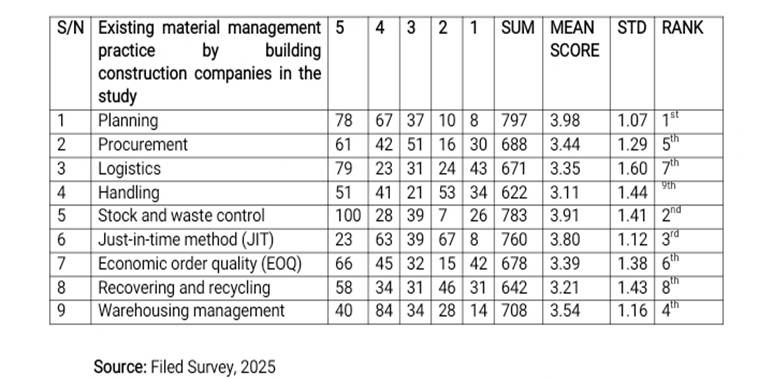
A. Planning (Rank 1, Mean Score: 3.98, Std Dev: 1.07): Planning emerged as the most highly ranked practice among the respondents. With a mean score of 3.98, it indicates that most construction companies prioritize careful preparation and scheduling of materials before and during project execution. The relatively low standard deviation (1.07) suggests that respondents had a fairly consistent view regarding the importance of planning. Effective planning ensures that materials are available when needed, reducing delays and inefficiencies on construction sites.
B. Stock and Waste Control (Rank 2, Mean Score: 3.91, Std Dev: 1.41): The second-highest ranked practice is stock and waste control, highlighting that construction companies are conscious of minimizing wastage and maintaining optimal inventory levels. A mean score of 3.91 demonstrates that the companies recognize the financial and operational benefits of controlling stock and reducing material losses. The standard deviation of 1.41 indicates some variability in perception, possibly due to differences in company sizes or management systems.
C. Just-in-Time Method (JIT) (Rank 3, Mean Score: 3.80, Std Dev: 1.12): The Just-in-Time method, ranked third, reflects the adoption of modern material management techniques. By receiving materials only as they are needed, companies can reduce storage costs and the risk of overstocking. The mean score of 3.80 is high, suggesting moderate to strong implementation, while the relatively low standard deviation (1.12) indicates general agreement among respondents about its effectiveness.
D. Warehousing Management (Rank 4, Mean Score: 3.54, Std Dev: 1.16): Warehousing management ranks fourth, emphasizing the importance of organized storage systems for materials. Companies with proper warehousing practices ensure materials are safe, accessible, and well-documented. A mean of 3.54 indicates that while important, it is not as prioritized as planning or stock control. The standard deviation of 1.16 shows relatively consistent opinions across the sample.
E. Procurement (Rank 5, Mean Score: 3.44, Std Dev: 1.29): Procurement ranks sixth, showing that while acquiring materials is essential, it is slightly less emphasized compared to other practices. A mean score of 3.44 demonstrates that respondents acknowledge its importance but may face challenges such as supplier reliability or cost issues. The standard deviation (1.29) suggests a reasonable spread of opinions among respondents.
F. Economic Order Quantity (EOQ) (Rank 6, Mean Score: 3.39, Std Dev: 1.38): Economic Order Quantity, a quantitative approach to determine the optimal order size, is ranked fifth. This reflects moderate adoption among building companies. With a mean score of 3.39, EOQ is recognized as a useful tool for reducing costs and avoiding excess stock, but it may not be widely implemented due to technical or operational constraints. The standard deviation of 1.38 indicates moderate variability in understanding or application.
G. Logistics (Rank 7, Mean Score: 3.35, Std Dev: 1.60): Logistics is ranked seventh, which points to moderate implementation in material transportation and handling. The mean score of 3.35 indicates that construction companies recognize its role in timely delivery of materials, but the high standard deviation (1.60) suggests significant variation among companies, possibly reflecting differing levels of expertise or resource availability.
H Recovering and Recycling (Rank 8, Mean Score: 3.21, Std Dev: 1.43): Recovering and recycling practices are less emphasized, ranking eighth. A mean score of 3.21 shows that although some companies adopt sustainable practices, it is not yet mainstream. The standard deviation of 1.43 indicates a moderate level of disagreement among respondents, perhaps due to differing priorities or awareness levels about sustainability.
I. Handling (Rank 9, Mean Score: 3.11, Std Dev: 1.44): Handling of materials is ranked tenth, indicating that it is given relatively lower priority. While proper handling is crucial for preventing damage and loss, it appears that companies may rely on other practices like planning and stock control to indirectly manage handling. The higher standard deviation (1.44) suggests differing views on its significance.
Research Question 2: Suggest and recommend effective measures for managing materials in building construction sites in the study area
Table: 4.2: Effective measures for managing materials in building construction sites in the study area
| S/N | Statements | 5 | 4 | 3 | 2 | 1 | SUM | MEAN SCORE | STD | RANK |
| 1 | Training of both management and staff | 44 | 49 | 54 | 38 | 15 | 699 | 3.34 | 15.18 | 3rd |
| 2 | Inventory control of material on site | 58 | 34 | 31 | 43 | 34 | 639 | 3.19 | 11.02 | 5th |
| 3 | Ensuring proper planning, monitoring and control | 42 | 23 | 24 | 70 | 41 | 555 | 2.77 | 19.04 | 7th |
| 4 | Management, supervision and administration of sites | 44 | 46 | 54 | 38 | 18 | 660 | 3.30 | 13.56 | 4th |
| 5 | Provision of adequate storage of materials | 38 | 56 | 17 | 85 | 4 | 639 | 3.19 | 32.06 | 5th |
| 6 | Proper usage of materials | 29 | 17 | 56 | 39 | 59 | 518 | 2.59 | 17.8 | 11th |
| 7 | Material schedule for the contractor hand | 63 | 45 | 35 | 15 | 42 | 672 | 3.36 | 17.38 | 2nd |
| 8 | Provision and accessibility site layout | 42 | 20 | 24 | 70 | 44 | 546 | 2.73 | 19.85 | 8th |
| 9 | Attention to weather conditions | 23 | 60 | 39 | 67 | 11 | 617 | 3.08 | 23.78 | 6th |
| 10 | Importance of material for a project | 33 | 20 | 65 | 50 | 32 | 522 | 2.61 | 17.59 | 9th |
| 11 | Need for a material management system | 66 | 45 | 32 | 15 | 42 | 678 | 3.39 | 18.67 | 1st |
Source: Field Survey, (2025)
- Need for a Material Management System (Rank 1st, Mean = 3.39, STD = 18.67): This measure received the highest rank, indicating that respondents perceive having a formal material management system as the most critical strategy for effective material management. A structured system ensures tracking of materials, reduces wastage, improves procurement efficiency, and helps in accountability. The relatively high standard deviation suggests some variability in responses, indicating that while most agree, there may be differences in how effectively such systems are implemented on site. Construction companies should adopt digital inventory and tracking systems to standardize material management.
B. Material Schedule for the Contractor Hand (Rank 2nd, Mean = 3.36, STD = 17.38): This measure scored highly, making it the second most important factor in effective material management. A material schedule ensures that contractors know precisely what materials are needed, when, and in what quantity, reducing wastage and delays. Its high mean score indicates strong consensus among respondents, while a moderate standard deviation shows some variability in opinions but overall agreement on its importance. Prioritizing proper material scheduling improves site efficiency and cost management.
C. D. Training of Both Management and Staff (Rank 3rd, Mean = 3.34, STD = 15.18): Training staff and management is critical for improving material handling, reducing errors, and enhancing project efficiency. The relatively high rank and mean score suggest that respondents see capacity building as a vital tool for effective material management. A lower STD reflects moderate agreement on its importance. Continuous training programs should be instituted to improve knowledge and skills related to materials handling.
D. Management, Supervision, and Administration of Sites (Rank 4th, Mean = 3.30, STD = 13.56): Effective supervision and administrative control on construction sites play a crucial role in ensuring that materials are used efficiently and according to plan. It ranked fourth, indicating its substantial but slightly lower perceived importance compared to scheduling and training. Adequate supervision ensures adherence to project schedules and material usage protocols, minimizing losses.
E. Inventory Control of Material on Site & Provision of Adequate Storage of Materials (Rank 5th, Mean = 3.19, STD = 11.02 & 32.06 respectively): Inventory control involves tracking materials from delivery to consumption, while storage provision ensures that materials are protected from damage and theft. Both measures scored equally in mean score but differed in standard deviation; storage showed high variability (STD = 32.06), indicating differing perceptions about its effectiveness. Maintaining proper inventory systems and storage facilities is important but may require site-specific adaptation.
F. Attention to Weather Conditions (Rank 6th, Mean = 3.08, STD = 23.78): Weather can significantly affect materials on-site, causing deterioration or damage if not managed properly. It was ranked moderately high, reflecting recognition of its role in protecting materials. The high STD indicates some disagreement among respondents, possibly due to variations in site locations or climate considerations. Construction sites should implement protective measures against adverse weather for sensitive materials.
F. Ensuring Proper Planning, Monitoring, and Control (Rank 7th, Mean = 2.77, STD = 19.04): Although planning, monitoring, and control are fundamental management practices, respondents ranked this relatively lower. This may suggest that while these practices are essential, their effectiveness in directly managing materials might be perceived as secondary to specific interventions like training or material scheduling. Strengthening site planning and control mechanisms will still benefit overall material management, but more tangible measures may take precedence.
G. Provision and Accessibility of Site Layout (Rank 8th, Mean = 2.73, STD = 19.85): An organized site layout facilitates smooth material flow and reduces handling losses. Its lower rank indicates that respondents may view layout accessibility as less critical compared to scheduling or training. Site layout optimization should complement other key material management strategies.
5.0 CONCLUSION
The descriptive statistics reveal that building construction companies in the study area predominantly rely on traditional material management practices, with planning emerging as the most widely adopted practice, contractors place strong emphasis on advanced preparation and scheduling of materials, as well as growing awareness of waste reduction and efficient inventory management. However, there is limited adoption of sustainable practices and weak institutional mechanisms for continuous improvement. Since poor management of materials leads to cost overruns, time delays, and reduced quality, there is a need for efficient management that ensures smooth project flow, reduced wastage, and improved profitability through “Waste Reduction and Recycling” as well as “Monitoring and Control Systems” recorded the lowest mean value
6.0 RECOMMENDATIONS
Based on the findings and conclusions of this research, the following recommendations are made:
1. Adopt Digital Material Management Systems: Construction firms should integrate modern digital tools and software such as ERP systems, bar-coding, and inventory tracking technologies to improve accuracy, transparency, and accountability in material handling.
2. Strengthen Planning and Scheduling: Proper planning and scheduling of material procurement and usage should be implemented before project commencement to prevent shortages, waste, and delays.
7.0 CONTRIBUTION TO KNOWLEDGE
This research has contributed to the body of knowledge by providing empirical evidence on the state of material management practices in Auchi, Etsako West Local Government Area, a region with limited prior academic documentation on this topic. It bridges the knowledge gap between theoretical material management frameworks and their practical application in rural and semi-urban Nigerian construction environments.
i) Acknowledgments
Special acknowledgment to everyone who made this study a success and to the Departments of Building, Nnamdi Azikiwe University, Awka Anambra State, for the support of data collection.
(II)Disclosure of Conflict of Interest
Authors declare that there is no conflict of interest regarding the publication of this manuscript.
(iii) Statement of Ethical Approval
All relevant ethical approval for this study has been obtained and maintained.
(iv) Statement of informed Consent
All necessary informed consent were obtained.
(v)Funding
This research received no external funding.
(Vi)Data Availability Statement
The original contributions presented in the study are included in the article, further inquiries can be directed to the corresponding author/s.
REFERENCES
Agapiou, A., et al. (2021). Materials flow control in construction: recent perspectives.
[Publisher/journal unknown].
Ahuja, H., & Dozzi, S. (2021). Traffic personnel and transportation management in
construction projects. International Journal of Production Economics, 56(2),
N121–133.
Akadiri, P. O. (2015). Understanding the barriers affecting the selection of
sustainable materials in building projects. Journal of Building Research and
Information, 43(1), 1–15.
Akbar Rasouli, A., Behdinan, K., & Farsi, S. (2016). Procurement organisation and
delivery schedules in construction projects. Journal of Building Technology 7(3)
567-671
Alwi, H., Hampson, K., & Mohammed, S. (1999). Effective materials management in
building projects.
Ashwini,K. (2023). Construction project materials and cost management.
International Journal of Construction Management, 8(2), 22–30
Barrie, D. S., & Paulson, B. L. (2007). Professional construction management (edition).
Nigerian Journal of Construction Technology and Management, 10(1), 14–23.
Calistus, C. (2013). Measures for good materials management on building projects. [.
International Journal of Project Management, 29(4), 403–408.
Canter, D. (2009). Materials management in construction: planning, procurement,
logistics, handling, stock and waste control. Journal of Construction
Engineering and Management, 135(7), 708–718.
Chan, E. (2002). Selection of material handling equipment and system design
considerations. International Journal of Construction Engineering and
Management, 1(1), 40–46
Chee Chen, C. (2009). Warehouse management and distribution in construction
logistics. [. International Journal of Built Environment and Sustainability, 1(1),
45–53.
Chetna, M. (2011). Material management in construction. International Journal of
Engineering and Advanced Technology, 1(2), 25–32.
Dainty, A. R. J., & Brooke, R. (2004). Waste minimisation in construction: design and
operational approaches. International Journal of Project Management, 14(1),
37–45
Ezeh, S., & Etodike, F. (2017). Materials scheduling and distribution on construction
sites. International Journal of Construction Research, 4(2), 71–84
Ghosh, A., & Jintanapakanont, J. (2024). Impact of materials management on.
construction productivity and cost control. International Journal of
Environmental Management, 17(3), 141–150.
Heap, [Initials]. (2007). Construction site layout and temporary facilities. [African
Journal of Environmental Science and Technology, 5(3), 246–254.
Hohns, H. M. (2017). Typical purchasing procedure in building construction [Figure].
[Source/publisher unknown].
Husnain-Arshad, M., & Jamaluddin, Z. (2017). Functions and practices of material
management in the construction industry. International Journal of Civil
..Engineering and Technology, 8(9), 560–572.
Jimoh, A. (2012). Site administration and information flow on construction projects.
Management science and management 6(4) 78-57
Kadiri, O. (2025). Impact of material shortage on building construction performance
in Nigeria. Journal of Construction Management Studies, 10(2), 99–112.
Kasim, A., Anumba, C., & Dainty, A. (2005). Improper materials management and
project performance. [Publisher/journal unknown].
Mahdjoubi, L., & Yang, Q. (2001). Forecasting material movement for construction
logistics.
Monczka, R. (2002). Purchasing and supply chain management: recovering and
…recycling materials.
Muhwezl, M. (2012). Weather impact on construction waste and schedule.
Ocheoha, T. (2013). Objectives and application of JIT in construction projects.
[Publisher/journal unknown].
Okorocha, O. (2013). Materials pricing and issues control in construction.
Okolie, K. C., Ngwu, C., & Ezeokonkwo, J. (2015). Material management practices in
the Nigerian construction industry: Challenges and prospects. Journal of
Construction Engineering and Project Management, 5(3), 23–34.
Osama, S., & Khaled, T. (2002). Impact of weather on construction schedules. JOURNAL OF
Tunji-Olayemi, P., Emetere, M., & Afolabi, A. (2017). Effective material management
for building construction projects. Journal of Sustainable Development in
Africa, 19(4), 35–49.
Waziri, B. S. (2016). The role of material management in construction project delivery.
Journal of Environmental Design and Construction, 12(3), 55–64.











 ≈ 218
≈ 218








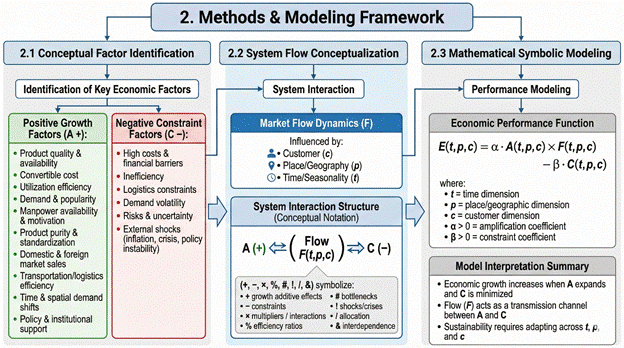

 = time,
  = place/geography,
  = customer characteristics.
 and negative factors
  are defined as vectors, and flow
  represents market access modified by time, space, and demand.
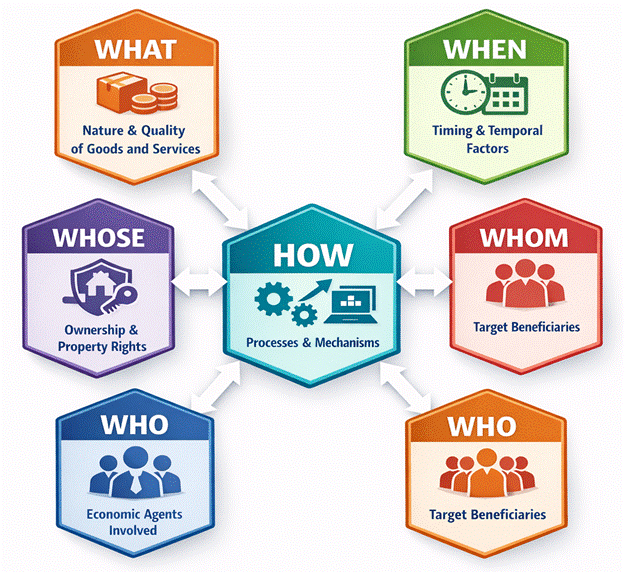
 demonstrates that a single improved variable—such as product quality, workforce motivation, or manufacturing efficiency—is insufficient to produce sustained gains unless accompanied by favorable conditions in the broader system. For example, high product quality cannot translate into economic strength without market access, competitive pricing, logistics, and policy stability. This systems-based observation aligns with the logic of structural and institutional economics, which argues that development is path-dependent and shaped by multiple interlocking dimensions rather than singular shocks or interventions. The model therefore highlights the importance of complementarity among factors: productivity gains must interact with domestic and international market flows, while policy must facilitate allocation of resources, protection of investment, and mitigation of market failures.
 is explicitly conditioned by time (seasonal cycles, short vs. long-run dynamics), place (local, national, or international markets), and customer characteristics (income level, demographic composition, cultural preference). This result resonates with empirical findings in regional and development economics, where performance varies across territories due to resource availability, infrastructure, institutional capacity, and demand heterogeneity. Weaver (1993) demonstrated that export performance and growth differ across national contexts depending on external demand, internal constraints, and structural preparedness, illustrating how geographical variation shapes economic trajectories. Similarly, demographic economics emphasizes that demand patterns shift with population age structure, income distribution, and consumption preferences, affecting the magnitude and elasticity of market flows. The framework underscores that economic systems are not temporally uniform or spatially homogeneous, meaning actors—whether firms or governments—must adapt strategies to evolving temporal market cycles, geographic constraints, and evolving consumer needs.
 incorporates high costs, logistical inefficiencies, market risks, demand volatility, and external shocks—including inflation, financial crises, or geopolitical instability. These variables contribute to economic friction, reducing the effective output of positive growth drivers. Even if productive capacity and market demand expand, increases in costs, bottlenecks, or uncertainty can neutralize these gains. This result aligns with structural constraint theories in development economics, which argue that infrastructure gaps, institutional rigidities, and volatility impose ceilings on growth potential, particularly in developing economies. The symbolic subtraction term
  within the model emphasizes that constraints increase as a weighted function of contextual friction, implying the arithmetic of development includes both additive growth forces and subtractive obstacles. Therefore, economic improvement depends not only on amplifying positive forces but also on mitigating or eliminating persistent constraints.
 ,
,  ,
,  , and
, and  implies a strategic control problem: governments or institutional actors can maximize economic performance by increasing the magnitude of positive drivers
  , reducing constraints
  , and improving the efficiency of flow dynamics
  through better infrastructure, market access, and temporal coordination. Policy levers may include regulatory reforms, trade agreements, logistics development, workforce training, technology upgrading, institutional strengthening, and stabilization mechanisms against external shocks. The model therefore suggests that policy success derives not from isolated interventions but from coordinated optimization across multiple dimensions.
 by maximizing
  , minimizing
  , and optimizing
  .
.

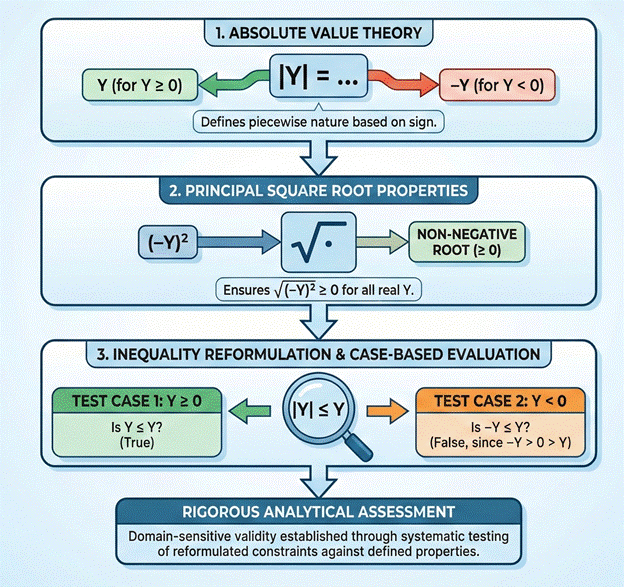
 holds, despite the universal validity of the underlying identity
  . The approach proceeds through three interconnected methodological components, each of which contributes to a rigorous evaluation of domain-sensitive validity.
 , the absolute value is defined piecewise as:
 reduces directly to
  , which provides a bridge between radical expressions and piecewise-defined functions. By introducing this piecewise structure, the method explicitly anticipates that different domain intervals (such as
  and
and  ) will exhibit different behaviors with respect to the target inequality.
 , which is defined to yield the non-negative real number whose square equals the argument. This definition is essential because it ensures
  for all
  . In the current context, since squaring eliminates sign, the expression
  is always non-negative, and thus its principal square root satisfies
  for every real
  . This property plays a determinant role when comparing
  with
with  , because if
  , the left-hand side becomes non-negative while the right-hand side becomes strictly negative, creating an inherent asymmetry.
 , the target inequality becomes
  . Since
  is piecewise-defined, the inequality must be evaluated separately for the intervals
  and
and  . This case-based evaluation allows the study to determine precisely where the inequality holds and where it fails, yielding a domain-sensitive conclusion.

 , we note that it follows the same transformation principle as the more common form
  . In both cases, the squaring operation eliminates the sign information of the inner quantity, producing a non-negative result, and the principal square root operator returns the non-negative magnitude. This allows us to invoke the well-established identity
  for any real number
  . Accordingly, if we treat
  as the inner argument, its squared value will be non-negative, and therefore
  . When the specific expression simplifies to
  , the identity becomes
  , reflecting the magnitude of
  independently of its sign. This reformulation bridges radical expressions with absolute value theory and sets the stage for inequality-based reasoning.
 . This transformation is crucial for two reasons. First, it replaces a radical expression with a piecewise-defined function, which naturally leads to domain-based interpretation. Second, it makes explicit that the analytical challenge is no longer about evaluating a square root, but rather about understanding how the sign of
  influences the relationship between
  and
and  . Since the absolute value function either preserves or negates its input depending on its sign, the reformulated inequality highlights that the validity of the original inequality hinges entirely on the sign of
  . The reformulation therefore serves as a critical methodological link between symbolic manipulation and domain-sensitive inequality analysis.
 , the next step is to determine the domain over which this inequality holds true. Since the absolute value function is defined in a piecewise manner, its behavior depends on the sign of
  . Therefore, the evaluation naturally requires a division of the real number line into distinct intervals corresponding to non-negative and negative values of
  . This case-based approach is essential because the inequality may demonstrate different logical outcomes in each interval, even though the original identity
  is universally valid over all real numbers.
 , the definition of the absolute value function reduces to
  . Substituting this into the inequality yields
  , which holds as an equality. Consequently, for all non-negative values of
  , the original inequality
  is satisfied. In the second case, when
  , the definition of absolute value becomes
  . Since
  whenever
  is negative, the substituted inequality becomes
  , which is false. Thus, no negative value of
  satisfies the inequality. The case-based evaluation therefore reveals a sharp contrast between positive and negative domains, demonstrating that sign plays a decisive role in the inequality’s validity.
 — and by extension
  — is not universally valid over the real numbers. Instead, its validity is restricted to those values of
  for which the absolute value function does not introduce a sign change. Formally, the inequality holds if and only if
  . For all values of
  , the inequality fails because the non-negative output of the principal square root cannot be less than or equal to a negative input.
 is valid for all real values of
  because it rests on definitions that apply unconditionally over the real number system: squaring removes sign information, and the principal square root returns the non-negative magnitude of its argument. However, once the equality is reformulated into the inequality
  , the universal validity disappears. The inequality no longer holds for all
  ; instead, its validity becomes contingent on the sign of
  , yielding a domain restriction to
  . This shift from an unrestricted to a restricted domain illustrates how relational operators such as ≤ or ≥ introduce asymmetry into statements that were originally symmetric under equality.
 is defined to return the unique non-negative real number whose square equals the input. As a result,
  is always non-negative, while
  itself may be negative. When the inequality compares a non-negative quantity to a potentially negative one, a sign conflict arises: if
  , then
  , making the inequality false. This asymmetry is invisible in the original equality because equality imposes a bidirectional condition of equivalence that is satisfied regardless of sign. In contrast, inequality imposes a directional relation that only holds over a restricted subset of values. The result reinforces the broader principle that inequality reasoning requires more careful attention to sign behavior and functional range than equality reasoning does.
 , instructors can illustrate how expressions that seem trivial in equality form can become nontrivial when reinterpreted under inequalities. Such instruction fosters more robust logical reasoning and prepares students for advanced topics where domain issues are central, including measure theory, functional analysis, and numerical methods.
 holds universally for all real values of
  , the derived inequality
  is satisfied only when
  . For
. For  , the inequality fails due to the non-negativity of the principal square root, which produces values that cannot be less than or equal to negative quantities. This contrast highlights a key conceptual point: equality-based identities may retain validity over entire domains, whereas their inequality counterparts may introduce implicit restrictions that alter the set of permissible input values.
 . Mathematics of Computation, 34(149), 77–91.















 (Total Rating) (1)
 (2)
(2)  (3)
(3) (4)
(4) (6)
(6) 

You must be logged in to post a comment.