The Vice President, Shri M. Venkaiah Naidu today said that time has come to revisitour history textbooks and to give adequate importance to freedom fighters from all parts of the country.
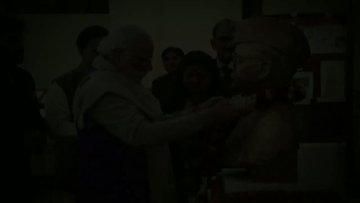
Unveiling the statue of NetajiSubhash Chandra Bose in Raj Bhawan, Chennai, on the occasion of his Birth Anniversary today, the Vice President said that the history should inspire our children and they should read the life stories of the heroes of our freedom struggle.
Shri Naidu expressed disappointment that many of the stalwarts of Indian independence movement, such as SardarVallabhbhai Patel, NetajiSubhash Chandra Bose, Veer Savarkar, Shri Chidambaram Pillai, Subramania Bharti, AlluriSeetharamaRaju and VeerapandiyaKattabomman did not find adequate place in our history text books.
He further said that the history should be comprehensive and re-capture our past glory and instill a sense of pride in India’s rich culture and heritage.
Referring to the sufferings underwent by several freedom fighters at Cellular Jail including Veer Savarkar, the Vice President said that some people are trying to belittle their contributions, either due to ignorance or due to their leanings.
Calling upon the youth to take inspiration from the life of NetajiSubhash Chandra Bose, Shri Naidu asked themto strive towards building a progressive, harmonious and inclusive India.
The Vice President also said that Netaji’s vision and his nationalistic outlook can be an important guiding light for building a New India.
Referring to the diversity of philosophies and approaches in our freedom struggle, the Vice President said it was a bouquet of individual and collective actions, ranging from peaceful satyagraha to more organized resistance.
“Even as Gandhiji was turning ‘ahimsa’ into a powerful weapon of our struggle, the likes of Bhagat Singh and Subhash Chandra Bose continued with their efforts of unsettling the British”, he said.
Although Gandhiji was not in favor of Netaji’s militant approach, he respected him and once referred to him as the ‘patriot of patriots’.
Highlighting his leadership of Azad Hind Fauj, Shri Naidu said that Netaji Bose unfurled the Tricolor in Port Blair on 30th December 1943 and declared Andaman and Nicobar Islands to be the first Indian Territory to be free from British Raj.
Recalling the close connection of the people of Tamil Nadu with Indian National Army, the Vice President paid rich tributes to Shri MuthuramalingaThevar who was a close confidante of Netaji.
“Shri MuthuramalingaThevar was an influential leader who was instrumental in establishing Shri Subhash Chandra Bose’s strong presence in Tamil imagination”, Shri Naidu said. Shri MuthuramalingaThevar also launched a Tamil Weekly Nethaji and was one of the founding pillars of Forward Bloc.
He had played an instrumental role in mobilizing huge support for INA, VP said.
He also lauded the daredevilry of Lakshmi Swaminathan who had had set up the Rani of Jhansi Regiment in INA and came to be known as Captain Lakshmi Sahgal.
Expressing pride in the fact that we Indians are inheritors of a five thousands years old civilization, Shri Naidu highlighted that Netaji firmly believed in our civilizational values and its history. This history should form the bedrock of our national pride and collective self-confidence, he added.
Lauding the Government’s decision to declassify all records and files associated with Netaji, the Vice President said that researchers will now be able to delve deep into his life and come up with many more meaningful publications on the life story of this great patriot.
The statue of NetajiSubhash Chandra Bose unveiled in Raj Bhawan, Chennai today has been sponsored by BharatiyaVidyaBhawan.
The Governor of Tamil Nadu, Shri BanwariLalPurohit, Chief Minister of Tamil Nadu, Shri Edappadi K. Palaniswami, Speaker of Tamil Nadu Legislature Assembly, Shri P. Dhanapal, Deputy Chief Minister, Shri O. Paneerselvam,Chairman of BhartiyaVidyaBhawan N. Raviwere among the dignitaries who graced the occasion at Raj Bhawan.
Following is the full text of the speech –
“I am pleased to unveil the statue of NetajiSubhash Chandra Bose — one of the most illustrious sons of mother India. His clarion call of ‘Give me blood, and I shall give you freedom’ inspired millions to fight for the nation. He still lives in our hearts.
We in India are the inheritors of the legacy of a great civilization that is more than five thousand years old and had faced several upheavals and tumultuous moments throughout history.
A major landmark in the modern history of our country is the gaining of Independence from British rule.
Given the riches of our motherland, many had set their eyes on our country from the Huns to the English, Our freedom struggle was marked by a variety of philosophies, thoughts, and approaches. It was a bouquet of individual and collective actions, ranging from peaceful satyagraha to more organized resistance.
As the struggle was still to acquire force, momentum and mass acknowledgment, Gandhiji returned to India in 1915 and gave it a direction and collective identity.
Even as Gandhiji was turning ‘ahimsa’ into a powerful weapon of our struggle, the likes of Bhagat Singh continued with their efforts of unsettling the British.
Netaji was another leader, who had left an indelible imprint on the freedom struggle—he had stirred the imagination of millions of countrymen through his thoughts, words, and deeds.
Shri Subhash Chandra Bose or ‘Netaji’, as he is fondly known as, is one of the most revered freedom fighters of India. His charismatic personality made him a natural leader, especially among the youth.
Shri Subhash Chandra Bose was the son of a wealthy and prominent Bengali lawyer.
In his youth, he was deeply influenced by Swami Vivekananda’s teachings and was known for his patriotic zeal.
He studied at the prestigious Presidency College, Calcutta, from which he was expelled for nationalistic activities in 1916. He later graduated from the Scottish Churches College and went to London, where he passed the Indian Civil Service examination in 1920. However, he had resigned from the coveted service in April 1921 and hurried back to India as the struggle for independence gathered momentum.
Netaji joined the non-cooperation movement started by Gandhiji and became a youth educator, journalist, and commandant of the volunteers of Bengal.
He was arrested and jailed several times and deported for his nationalistic activities. In 1938, Netaji was elected president of the Indian National Congress and formed a National Planning Committee, which formulated a policy of broad industrialization.
Although he was supportive of Mahatma Gandhi’s ideals initially, the two leaders gradually drifted apart. Netaji along with the younger group of leaders wanted ‘complete self-rule and without any compromise’ for India whereas the older, more moderate leadership was in favor of the ‘dominion status for India within the British rule’.
Although Gandhiji was not in favor of Netaji’s militant approach, he respected him and once referred to him as the ‘patriot of patriots’.
Netaji founded the All India Forward Bloc in a bid to unify the more radical elements in the struggle for independence but was again incarcerated in 1940. He refused to remain in prison at this crucial period of India’s history and went on a fast to death.
The British government had to relent and was forced to release him.
Inspired by Shri Subhash Chandra Bose, Azad Hind an Indian Provisional government was formed by Indian nationalists in exile in 1943 in Singapore with the support of Japan. Bose also took leadership of the Azad Hind Fauj.
On 6th November 1943, the then Prime Minister of Japan had declared in the Tokyo Assembly of Greater East Asiatic Nations that the Andaman and Nicobar Islands would be transferred to the provisional Government, Azad Hind.
The Japanese imperial forces were in occupation of these islands from 23rd March 1943 during the World War.
NetajiSubhash Chandra Bose unfurled the Tricolor in Port Blair on 30th December 1943 and declared Andaman and Nicobar Islands to be the first Indian Territory to be freed from British Raj.
Netaji was the Supreme Commander of Azad Hind Fauj and head of the state of the provisional government of Azad Hind.
Let me now touch upon the connection of the people of this State with the INA. As you all are aware, if there was one individual instrumental in establishing Shri Subhash Chandra Bose’s strong presence in Tamil imagination, it has got to be MuthuramalingaThevar.
He was an influential leader and a close confidante of Netaji. He was also one of the founding pillars of Forward Bloc and had played an instrumental role in mobilizing huge support for INA. He also launched a Tamil Weekly Nethaji.
Of course, the daredevilry of Lakshmi Swaminathan (famously known as Captain Lakshmi Sahgal) is well known. She had set up the Rani of Jhansi Regiment in INA and came to be known as Captain Lakshmi Sahgal (her husband Prem Kumar Sahgal also served in the INA). Another Tamil Malaysian woman, JanakyAthiNahappan, Malaysian freedom fighter and social activist, RasammahBhupalan also joined Rani of Jhansi regiment. As a 14 year old, Janaky once attended a rally of Bose and was so enthralled by his idealism that she handed over her expensive earring to INA as a part of fund raising drive.
I recently visited the 150-foot high flag mast built to commemorate the 75th Anniversary of the unfurling of the National Flag by Netaji, at Port Blair in Andaman and Nicobar. The Prime Minister, Shri NarendraModi had unfurled the Tricolor at the 150-foot high mast at Port Blair in 2018.
Netaji firmly believed in our civilization and its values and its history which should form the bedrock of our national pride and collective self-confidence. He was spiritual and an intellectual genius.
NetajiSubhash Chandra Bose was one of the tallest leaders of India’s struggle for independence. I pay my humble tributes to this great son of India on the occasion of his birth anniversary today.
I also pay my respects today to all the freedom fighters, including Veer Savarkar, who had bravely fought against the British in the face of the most daunting odds. Veer Savarkar was given two life sentences and imprisoned for 10 years in the infamous cellular jail, where he was subjected to inhuman treatment.
Unfortunately, some people are trying to belittle his invaluable contribution to the nationalistic cause and the freedom struggle.
I feel that our history textbooks must highlight the life stories of our national icons like SardarVallabhbhai Patel, NetajiSubhash Chandra Bose, Veer Savarkar, Shri Chidambaram Pillai, Subramania Bharti and AlluriSeetharamaRaju who were not given due recognition. We must continue to take inspiration from their sacrifices and strive to build a strong, inclusive, progressive, peaceful and harmonious nation.
My dear sisters and brothers,
India has been independent for more than seven decades now.
Certainly, substantial progress has been achieved on all fronts during these decades.
But much more needs to be done. Pockets of poverty, illiteracy, inequality, poor infrastructure, poor sanitation, and social evils continue to haunt us.
We have to build an India where every Indian has an equal opportunity and inspired by a shared and common sense of pride. Let’s build an India, where every Indian is empowered through education, health and economic opportunities to unleash his or her inner and creative energies for the individual and common good.
As we seek to surmount the contemporary challenges to build a ‘New India’, there is so much to draw from the life and struggle of Netaji, his vision and his nationalistic outlook.
Today, India is at a cusp of transformation. It has the largest youth population in the world-65 percent of its population is below 35 years of age.
This youth population will determine India’s future.
We must channelize the creative energy of this tremendous youth population into creative pursuits for nation-building.
Netaji was a very popular youth icon. Very few leaders have inspired the youth of our country like Netaji has. He can be the guiding light for the Indian youth of the 21st century.
I urge the youth of our nation to take inspiration from his life, his adherence to discipline, his dedication to the cause at hand, his courage and conviction, his resilience and his uncorrupted idealism.
He was a man of action as well as thought.
To a certain extent, the details of his life are shrouded in mystery. The government has recently declassified all records and files associated with Netaji and made them available to the National Archives of India.
This is indeed a laudable step. More researchers will now be able to delve deep into his life and come up with many more meaningful publications on the life story of this great patriot and his relentless struggle for freeing India from the clutches of the British.
The government has also opened a Subhash Chandra Bose museum at the iconic Red Fort to mark the leader’s 122nd birth anniversary in 2019.
Such memorials and symbols such as this statue will keep the memory of Netaji alive in the consciousness of this nation.
On the 123rd Birth Anniversary of this great patriot, I bow my head in reverence to the great soul.
Thank You!
Jai Hind!”
*****





 Eduindex
You must be logged in to post a comment.