Earthquake

Recently lots of earthquake news coming. Results of this earthquake destruction will be pathetic. So many people have died. People have nothing to own,all they had got destroyed.

It’s time to be alert and should stop exploiting natural resources. So many people are dying in recent decades by natural calamities. Who will take the responsibility of this? So many people have become homeless, what will they do to earn livelihood?

It’s time to support the environmental movements and stop unnecessary burden on earth or else soon the earth won’t be able to carry our burden.

Earthquake

Recently lots of earthquake news coming. Results of this earthquake destruction will be pathetic. So many people have died. People have nothing to own,all they had got destroyed.

It’s time to be alert and should stop exploiting natural resources. So many people are dying in recent decades by natural calamities. Who will take the responsibility of this? So many people have become homeless, what will they do to earn livelihood?

It’s time to support the environmental movements and stop unnecessary burden on earth or else soon the earth won’t be able to carry our burden.

Rural Tourism

Rural Tourism and Rural Homestays (CNA – RT and RH) under the Ministry of Tourism has identified six niche experiences for tourists wanting to visit rural India, including agritourism, art and culture, ecotourism, wildlife, tribal tourism, and homestays.

The Ministry of Tourism is also working on launching the State assessment and ranking criteria to help foster competition and reach the overarching objectives of promoting sustainable and responsible tourism.
What are the Key Points of the Move?Objective:The push aims at sustainability, avoiding large-scale infrastructure development.
It aims to rope in local resources and communities to provide a unique organic experience and bolster employment opportunities in villages.
The Ministry of Tourism is in the process of formulating a budget, with certain training modules at district levels being 100% centrally financed, and other aspects being 60% Centre and 40% State financed.
Village Clusters:Clusters of five to seven villages will be identified in close proximity.
A cluster will offer more tourist attractions than rural tourism projects of individual villages separated by long distances.
It can also aid in the marketing of local products of a group of villages through craft bazaars.
What is the Concept of Rural Tourism?About:Rural tourism in India is a form of tourism that focuses on exploring and experiencing the rural lifestyle and culture.
It involves traveling to rural areas and participating in various activities such as farming, handicrafts, and village walks, to gain a deeper understanding of the local culture and way of life.For instance, Tamil Nadu’s Kolukkumalai is the highest tea plantation in the world; Kerala’s Dewalokam is a yoga centre on the banks of a river; Nagaland’s Konyak Tea retreat takes visitors on a trip through tribal culture etc.
Scope:India’s rural tourism potential lies in its diverse and vibrant culture, handicrafts, folk arts, festivals, and fairs.
U.S.-based market research firm Grand View Research estimates that agritourism alone will develop at a Compound Annual Growth Rate (CAGR) of 11.4% from 2022 to 2030.
Significance:Not only can rural tourism revitalize local art and crafts and prevent viable traditional occupations from being displaced, it will also help redevelop rural areas and rejuvenate rural life, create jobs and new business opportunities.
Benefits:Reduce out-migration, Increase alternative business opportunities
Increase entrepreneurial scopes
Helps in poverty alleviation.
Community empowerment
Art and Crafts sale
Heritage Preservation
What are the Challenges for Rural Tourism in IndiaLack of Infrastructure:Rural areas often lack basic amenities such as good roads, electricity, and healthcare facilities, which can deter tourists from visiting.
Inadequate infrastructure can also make it difficult for local communities to provide quality services to visitors.
Limited Awareness:Lack of awareness about rural tourism among tourists and local communities can hinder its growth.
Many people are unaware of the potential of rural areas as tourist destinations and the benefits that tourism can bring to local communities.
Low Income and Unemployment:Rural areas often suffer from low-income levels and high unemployment rates.
This can make it difficult for local communities to invest in tourism infrastructure and provide quality services to visitors.
Threat to Ecology:Rural tourism has the potential to have a negative impact on the environment and local communities if not managed properly.
Overcrowding, pollution, and destruction of natural habitats can harm the local ecology and culture, which can deter visitors in the long run.
Safety Concerns:Rural areas can be perceived as unsafe by tourists due to a lack of proper security arrangements, which can make it difficult for them to enjoy their experience and create a negative image of the destination.

What are the Related Initiatives?The Government is exploring organic agriculture areas developed under the Paramparagat Krishi Vikas Yojana (PKVY) and Mission Organic Value Chain Development in North East Region (MOVCD-NER) for development as rural tourist spots.
Best Tourism Village Competition Portal was launched recently to select the best tourism village from across the country, and also to promote rural tourism in the countryThe ‘Best Tourism Village Competition’ will be held in three stages, and will seek entries at district level, state level and finally at the national level.
The Ministry of Tourism has launched Visit India Year 2023, focusing on inbound travel to India, to highlight varied tourism offerings of our country and showcase them to the global tourists.
PRASHAD (National Mission on Pilgrimage Rejuvenation and Spiritual and Heritage Augmentation Drive) scheme was launched by the Ministry of Tourism in 2015.Till date, under PRASHAD scheme, a total of 45 projects for an amount of Rs.1586.10 Crore have been sanctioned.
Swadesh Darshan scheme in 2014-15 with focus on integrated development of theme-based tourist circuits in the country.76 projects were sanctioned for an amount of Rs.5315.59 Crore under various themes such as eco, heritage, Himalayan, coastal theme etc.
Way ForwardThe rural tourist destinations should be specific and near to places where people usually visit.
Accessibility to destinations should be the first criteria for selection of destinations to be developed for rural tourism.
Advertising the destinations will help artisans to sell their products better and proper marketing of the project is required to increase tourists.
The income generated from tourism can be utilized in preserving ethnic forms of art, dance and folk songs. It will safeguard rural people’s interests and will reduce the pressure to earn a living miles away from their homes.

Vertical Axis Wind Turbines and its types

A vertical axis wind turbine (VAWT) is a type of wind turbine that has its rotor shaft oriented vertically rather than horizontally, as in the case of traditional horizontal axis wind turbines (HAWT). VAWTs are relatively less common than HAWTs, but they have some advantages, such as the ability to operate in turbulent winds, and the fact that they do not require a yaw mechanism to keep the rotor facing the wind.

VAWTs can be classified into two main types based on their rotor design: drag-type and lift-type. Drag-type VAWTs, also known as Savonius turbines, have a rotor with a curved blade that resembles an S-shape, which generates torque by using the drag force of the wind. Lift-type VAWTs, on the other hand, have a rotor with blades that are designed to produce lift, similar to the wings of an airplane.

VAWTs have some limitations, such as lower efficiency compared to HAWTs, and the fact that they can generate more noise and vibration due to their proximity to the ground. However, they are still an interesting alternative for certain applications, such as urban and residential areas, where space and height limitations make the installation of HAWTs impractical. 

         
Darrieus Wind Turbine

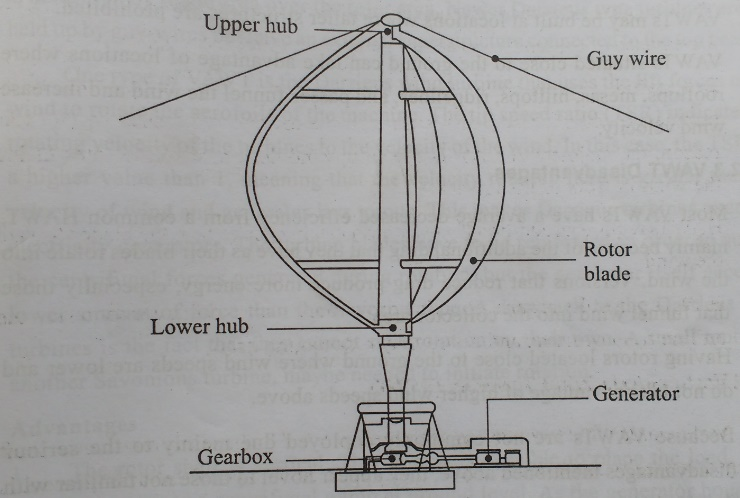
Darrieus turbine has long, thin blades in the shape of loops connected to
the top and bottom of the axle; it is often called an “eggbeater windmill.” The
Darrieus turbine is characterized by its C-shaped rotor blades which give it
its eggbeater appearance. It is normally built with two or three blades. They
have good efficiency, but produce large torque ripple and cyclic stress on the
tower, which contributes to poor reliability. Also, they generally require some
external power source, or an additional savonius rotor, to start turning,
because the starting torque is very low. The torque ripple is reduced by using
three or more blades which results in a higher solidity for the rotor. Solidity
is measured by blade area over the rotor area. Newer Darrieus type turbines are
not help up by guy-wires but have an external superstructure connected to the
top bearing.

One type of VAWT is the Darrieus wind turbine that uses the lift forces
of the wind to rotate the aerofoils of the machine. The tip speed ratio (TSR)
indicates the rotating velocity of the turbines to the velocity of the wind. In
this case, the TSR has a higher value than 1, meaning that the velocity
rotation here is greater than the velocity of wind and generates less torque.
This makes Darrieus turbines excellent electricity generators. The turbine
blades have to be reinforced in order to sustain the centrifugal forces
generated during rotation, but the generator itself accepts a lower amount of
force than the Savorius type. A drawback to the Darrieus wind turbines is the
fact that they cannot start rotation on their own. A small motor, or another
Savonius turbine, maybe needed to initiate rotation.

         
Savonius wind turbine

The Savonius wind turbine is a
type of vertical-axis wind turbine invented by the Finnish engineer
sigurd Savonius in the 1920’s. It is one of the simplest wind turbine designs.
It consists of two to three “scoops” that employ a drag action to convert wind
energy into torque to drive a turbine. When looked at from above in
cross-section, a two scoop Savonius turbine looks like an S-shape. Due to the
curvature of the scoops, the turbine encounters less drag when moving against
the wind than with it, and this causes the spin in any wind regardless of
facing.

Drag type wind turbines such as
the Savonius turbine are less efficient at using the wind’s energy than
lift-type wind turbines, which are the ones commonly used in wind farms.

A
Savonius is a drag type turbine, they are commonly used in cases of high
reliability in many things such as ventilation and anemometers. Because they
are a drag type turbine they are less efficiency than the common HAWT. Savonius
are excellent in areas of turbulent wind and self starting.

How did plate tectonics led to continental drift?

Plate tectonics is a scientific theory that explains the movement and behavior of the Earth’s lithosphere, the outermost layer of the Earth that includes the crust and upper part of the mantle. The theory states that the lithosphere is broken up into several large plates that are constantly moving and interacting with one another.


Source – World Atlas

The movement of the plates is driven by the process of convection in the mantle, which is the transfer of heat from the Earth’s interior to its surface. Hot material rises from the Earth’s core and moves towards the surface, while cooler material sinks back down towards the core. This movement creates a circular flow, known as a convection current, which drives the motion of the plates.

There are three types of plate boundaries: divergent, convergent, and transform.

  • At divergent boundaries, plates are moving apart from each other. This typically occurs at mid-ocean ridges, where new crust is being created as magma rises up to fill the space created by the diverging plates. This process is known as seafloor spreading.
  • At convergent boundaries, plates are moving towards each other. When one plate is forced underneath another, a process called subduction, it creates a deep ocean trench and can trigger earthquakes and volcanic eruptions. If two plates of continental crust collide, it can result in the formation of mountains. The collision between the Indian and Eurasian plates is responsible for the formation of the Himalayas.
  • At transform boundaries, plates are moving past each other horizontally. This can create faults, which can lead to earthquakes as the plates rub against each other. The San Andreas Fault in California is an example of a transform boundary.

The theory of plate tectonics has provided explanations for many geological phenomena, such as the formation of mountains, the creation of ocean basins, and the occurrence of earthquakes and volcanic eruptions. It has also helped explain the distribution of natural resources, such as oil, gas, and mineral deposits.

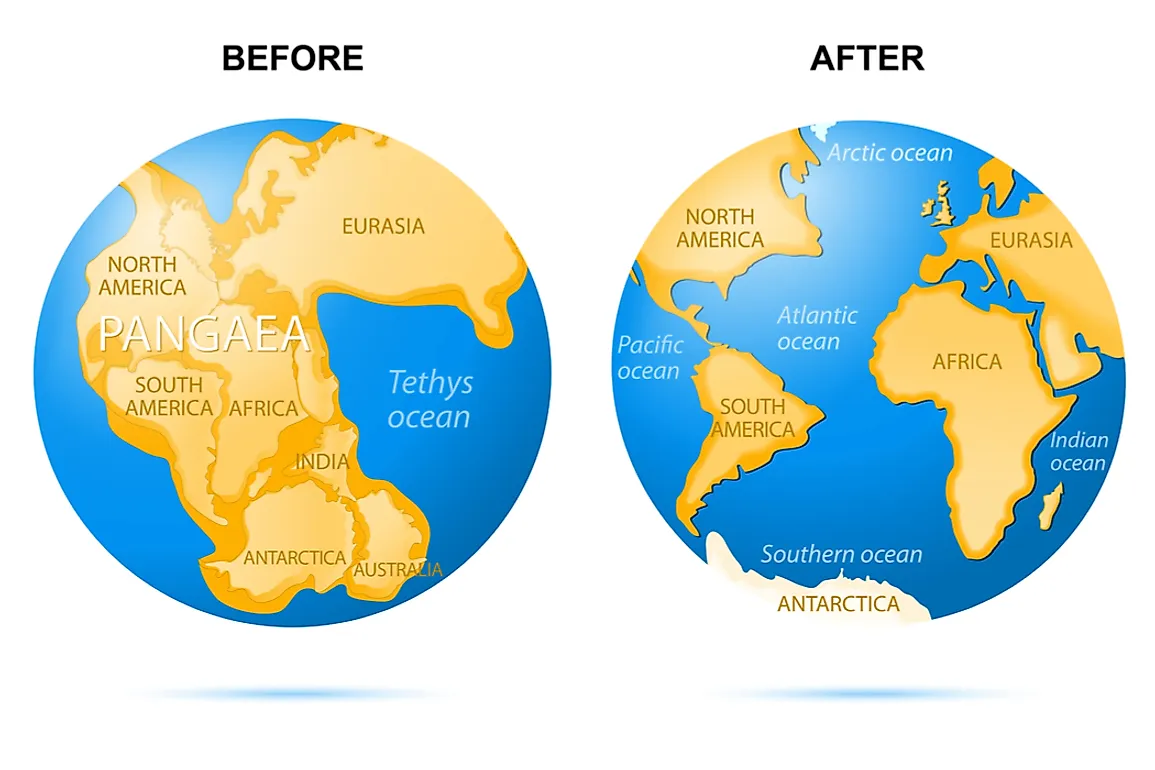
One example of how plate tectonics has influenced the Earth’s surface is the formation of the continents. Over millions of years, the movement of plates has caused the continents to break apart and come together in different configurations. This process is known as continental drift, and it has played a crucial role in the evolution of life on Earth. The separation of the supercontinent Pangaea into the current configuration of continents allowed for the development of unique ecosystems and species that would not have been possible otherwise.

The study of plate tectonics is ongoing, and scientists continue to explore and discover new aspects of this theory. For example, recent research has shown that the movement of plates can be influenced by factors such as changes in sea level and the formation of mantle plumes, which are hotspots of magma that rise up from the Earth’s core. By understanding the behavior of the plates, scientists can gain insights into the history and future of the Earth’s geological processes.

Operation Dost #turkey #india #foreignrelations

Operation Dost refers to the friendly relations and collaborations between Turkey and India in various fields, including politics, trade, defense, and cultural exchanges. Both countries have a history of diplomatic ties and mutual cooperation that have strengthened over time.

In recent years, their relationship has seen advancements in economic cooperation, especially in trade and investment. They’ve also collaborated on defense initiatives, aiming to enhance their strategic partnership. Cultural exchanges, educational collaborations, and people-to-people contacts have further deepened their bond.

However, it’s important to note that specific initiatives or policies under the label “Operation Dost” might not exist formally in diplomatic agreements or official statements. Rather, it could refer to the broader ongoing efforts between the two nations to bolster their relationship and foster closer ties.

Turkey and India have recognized the importance of mutual cooperation in various regional and international issues, contributing to stability and development. Their partnership is a testament to the significance of bilateral relationships in a global context.

‘Golden Globe’ to Oscar: ‘Naatu Naatu’ song glorified India across the world

Indians are proud and joyous because the Telugu blockbuster RRR, short for Rise Roar Revolt, Naatu Naatu is the first Indian film to win the Academy Award for best original song, making history. According to BBC News (www.bbc.com/news/world-asia-india-64899481), “the song became a global sensation – inspiring endless Instagram reels and dance trends on social media – after the film’s release in US last year, where its quick tempo and synchronised choreography were an instant hit with the audiences”. According to the Reuter, “The song – a fast-paced number that has found fans all over the world, spawned a TikTok challenge and has millions of views on YouTube – won a standing ovation when it was performed at the 95th Academy Awards”. It is pertinent to mention that Indians had won Oscars earlier, but no Indian film had won an Academy Award before. “The Elephant Whisperers” which won best documentary short film, gave the country two Oscar-winning films in one night. Thus, with two laurels Indian films particularly in Indian languages have reached across the world. According to BBC News, “It took around 19 months for all the elements of superhit musical number Naatu Naatu – which won a historic Oscar for Best Original Song – to fall into place”. In January 2023 it won the ‘Golden Globe’ for best original song. I appreciate the statement of the Director of the film S. S. Rajamouli when said, “It’s not just because of the music or the dance – the entire story of RRR can be summarised within these 10 minutes of Naatu Naatu,” (ibid). For the benefit of readers, I wish to mention that the Academy Award for Best Original Song is one of the awards given annually to people working in the motion picture industry by the Academy of Motion Picture Arts and Sciences (AMPAS). It is presented to the songwriters who have composed the best original song written specifically for a film. The performers of a song are not credited with the Academy Award unless they contributed either to music, lyrics, or both in their own right. The songs that are nominated for this award are typically performed during the ceremony and before this award is presented. I am presenting a few lines from en.wikipedia.org/wiki/Academy_Award
“The Academy Award for Best International Feature Film (known as Best Foreign Language Film prior to 2020) is one of the Academy Awards handed out annually by the U.S.-based Academy of Motion Picture Arts and Sciences (AMPAS). It is given to a feature-length motion picture produced outside the United States with a predominantly non-English dialogue track.”
“When the first Academy Awards ceremony was held on May 16, 1929, to honor films released in 1927/28, there was no separate category for foreign language films because most of the films released in 1927 and in 1928 were silent films. Between 1947 and 1955, the academy presented Special/Honorary Awards to the best foreign language films released in the United States. These awards, however, were not handed out on a regular basis (no award was given in 1953), and were not competitive since there were no nominees but simply one winning film per year. For the 1956 (29th) Academy Awards, a competitive Academy Award of Merit, known as the Best Foreign Language Film Award, was created for non-English speaking films and has been given annually since then”.
I from the core of my heart congratulate all the people who were either at the forefront or behind the curtain for making success and bringing laurels to the entertainment world through the two films “RRR” and “The Elephant Whisperers”. I feel these two films have given a Great New Year (2023) gift to all the Indians – staying in the country or outside the country.

Dr. Shankar Chatterjee, Hyderabad.

‘Golden Globe’ to Oscar: 'Naatu Naatu' song glorified India across the world

Indians are proud and joyous because the Telugu blockbuster RRR, short for Rise Roar Revolt, Naatu Naatu is the first Indian film to win the Academy Award for best original song, making history. According to BBC News (www.bbc.com/news/world-asia-india-64899481), “the song became a global sensation – inspiring endless Instagram reels and dance trends on social media – after the film’s release in US last year, where its quick tempo and synchronised choreography were an instant hit with the audiences”. According to the Reuter, “The song – a fast-paced number that has found fans all over the world, spawned a TikTok challenge and has millions of views on YouTube – won a standing ovation when it was performed at the 95th Academy Awards”. It is pertinent to mention that Indians had won Oscars earlier, but no Indian film had won an Academy Award before. “The Elephant Whisperers” which won best documentary short film, gave the country two Oscar-winning films in one night. Thus, with two laurels Indian films particularly in Indian languages have reached across the world. According to BBC News, “It took around 19 months for all the elements of superhit musical number Naatu Naatu – which won a historic Oscar for Best Original Song – to fall into place”. In January 2023 it won the ‘Golden Globe’ for best original song. I appreciate the statement of the Director of the film S. S. Rajamouli when said, “It’s not just because of the music or the dance – the entire story of RRR can be summarised within these 10 minutes of Naatu Naatu,” (ibid). For the benefit of readers, I wish to mention that the Academy Award for Best Original Song is one of the awards given annually to people working in the motion picture industry by the Academy of Motion Picture Arts and Sciences (AMPAS). It is presented to the songwriters who have composed the best original song written specifically for a film. The performers of a song are not credited with the Academy Award unless they contributed either to music, lyrics, or both in their own right. The songs that are nominated for this award are typically performed during the ceremony and before this award is presented. I am presenting a few lines from en.wikipedia.org/wiki/Academy_Award
“The Academy Award for Best International Feature Film (known as Best Foreign Language Film prior to 2020) is one of the Academy Awards handed out annually by the U.S.-based Academy of Motion Picture Arts and Sciences (AMPAS). It is given to a feature-length motion picture produced outside the United States with a predominantly non-English dialogue track.”
“When the first Academy Awards ceremony was held on May 16, 1929, to honor films released in 1927/28, there was no separate category for foreign language films because most of the films released in 1927 and in 1928 were silent films. Between 1947 and 1955, the academy presented Special/Honorary Awards to the best foreign language films released in the United States. These awards, however, were not handed out on a regular basis (no award was given in 1953), and were not competitive since there were no nominees but simply one winning film per year. For the 1956 (29th) Academy Awards, a competitive Academy Award of Merit, known as the Best Foreign Language Film Award, was created for non-English speaking films and has been given annually since then”.
I from the core of my heart congratulate all the people who were either at the forefront or behind the curtain for making success and bringing laurels to the entertainment world through the two films “RRR” and “The Elephant Whisperers”. I feel these two films have given a Great New Year (2023) gift to all the Indians – staying in the country or outside the country.

Dr. Shankar Chatterjee, Hyderabad.

Transients in Power Systems

In power systems, transients refer to short-term disturbances or fluctuations in voltage, current, or power that can occur due to various factors, such as sudden changes in load demand, faults in the system, lightning strikes, switching operations, and generator or load tripping.

Transients can have different time durations, ranging from a few microseconds to a few seconds, and can cause various problems, such as equipment damage, system instability, and power quality issues. Transients can destroy computer chips and TV.

To mitigate the effects of transients, various protective devices are used in power systems, such as circuit breakers, fuses, surge arresters, and voltage regulators. These devices help to limit the magnitude and duration of transients, and protect the system and equipment from damage.

Simulation tools, such as transient stability analysis software, are also used to model and analyze the behavior of power systems during transients, and help to identify potential problems and optimize system performance.

Transients are usually classified into two categories:

  • Impulsive and
  • Oscillatory

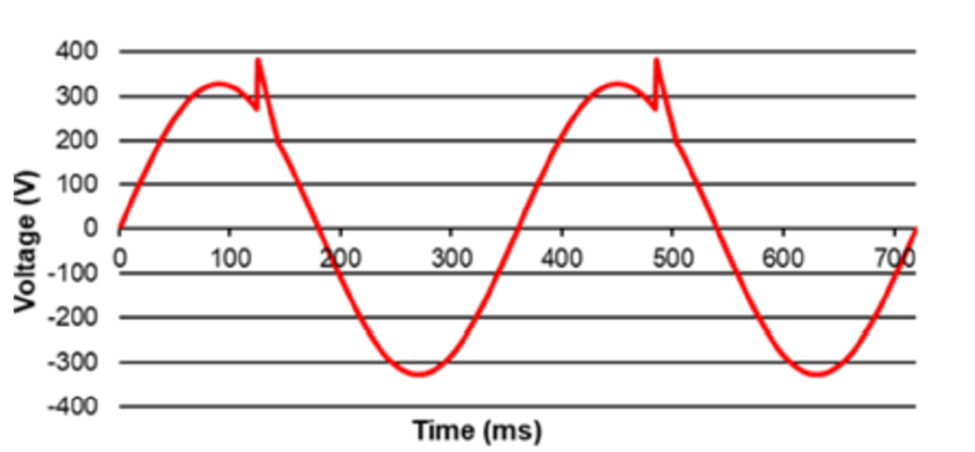
Impulsive transient caused by a lightning stroke.
Switching of lines with power factor correction capacitor banks, poor
grounding, switching of inductive loads, utility fault clearing, disconnection
of heavy loads, and electrostatic discharge. Impulsive transients can be very
fast events (5 ns rise time from steady state to the peak of the impulse) of
short-term duration (less than 50 ns), and may reach thousands of volts, even
in low voltage.

Devices are needed to prevents damage to electrical equipment
caused by impulsive transients from lightning strokes Utilities use lightning
arresters mounted on their transmission and distribution systems and in their
substations, while many utility customers use transient voltage surge
suppression (TVSS).

Fig- Impulse transients

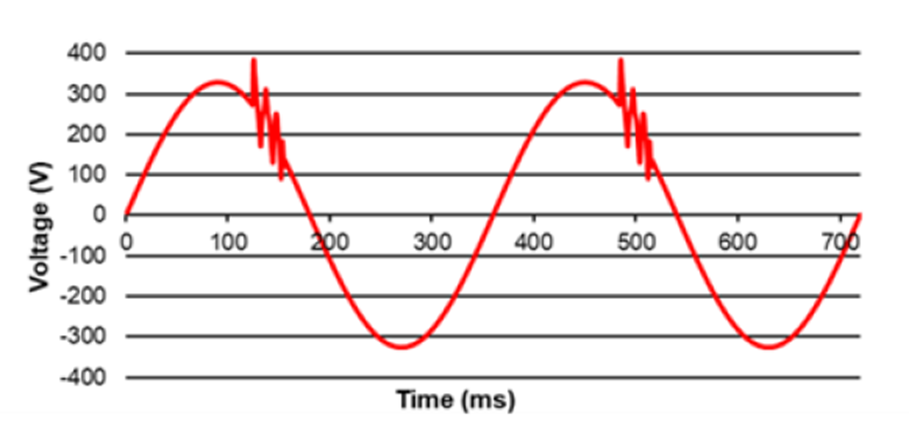
Oscillatory transients occur when switching inductive
or capacitive loads such as motors or capacitor banks. An oscillatory transient
occurs because the load resists the change. Lighting, utility fault clearing
and transformer energization and Ferro resonance could also cause oscillatory
transients.

Oscillatory transients do not decay quickly like impulsive
transients. They tend to continue to oscillate for 0.5 to 3 cycles and reach 2
times the nominal voltage or current. Another cause of oscillatory

transients, besides lightning strokes going into resonance, is
switching of equipment and power lines on the utility’s power system.

Fig – Oscillatory transients

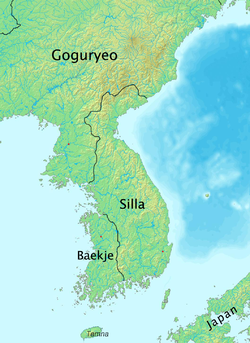
Silla – The first Korean Kingdom

 Silla was one of the three kingdoms that emerged in the Korean peninsula during the Three Kingdoms period, which lasted from the 1st century BCE to the 7th century CE. Silla was founded in 57 BCE by Bak Hyeokgeose, who established his capital in the city of Gyeongju, in what is now the southeastern region of South Korea.


Source – Wikipedia

Silla began as a small state in the southeastern part of the Korean peninsula, but gradually expanded its territory through military conquest and political alliances. In the 4th century CE, Silla formed an alliance with the neighboring kingdom of Baekje, which allowed it to take control of much of the Han River basin in central Korea. Silla also fought against the kingdom of Goguryeo to the north, but was unable to conquer it.

Silla’s rise to prominence came in the 7th century CE, when it formed an alliance with the Tang dynasty of China to defeat the neighboring kingdom of Baekje and Goguryeo. This alliance enabled Silla to control the entire Korean peninsula, ushering in a period of political stability and cultural flourishing known as the Unified Silla period.

During the Unified Silla period, Silla became a major center of Buddhism in East Asia. The ruling elite adopted Buddhism as their official religion and built many temples and pagodas throughout the kingdom. Silla also had a sophisticated system of government, with a centralized bureaucracy and a powerful aristocracy that dominated political and economic life.

Silla’s achievements in art and culture were also noteworthy. Silla artisans produced exquisite pottery, bronze sculptures, and gold ornaments that reflected the influence of Chinese and Central Asian styles. Silla literature, including poetry and historical records, also flourished during this period.

However, Silla’s dominance was not to last. In the late 8th century CE, Silla faced a series of rebellions by regional warlords and the rise of a new power in the north, the kingdom of Balhae. In 918 CE, Silla was overthrown by the kingdom of Goryeo, which established a new dynasty that would last for nearly 500 years.

Despite its relatively short lifespan, Silla played an important role in the history of Korea. Its military conquests and political alliances laid the foundation for the unification of the Korean peninsula, while its cultural achievements helped to shape the artistic and literary traditions of Korea for centuries to come. Today, the legacy of Silla can be seen in the many historical sites and artifacts that have been preserved in Gyeongju, including the Seokguram Grotto and the Bulguksa Temple, which have been designated as UNESCO World Heritage Sites.

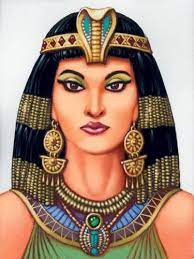
Did Cleopatra Really Die by Snake Bite?

Cleopatra VII was the last pharaoh of Egypt and is famously known for her death by suicide. Her death is a significant event in history and has been the subject of numerous artistic depictions, including plays, novels, and movies. In this essay, I will discuss the circumstances surrounding her death and the possible reasons behind it.


Source – Pinterest

Cleopatra was born in 69 BC and became the queen of Egypt in 51 BC, at the age of 18, after her father’s death. She ruled jointly with her younger brother, Ptolemy XIII, but soon became embroiled in a power struggle with him. Cleopatra fled to Syria and gathered an army to fight her brother, and with the help of Julius Caesar, she regained her throne in 47 BC.

Cleopatra had a romantic relationship with Julius Caesar and bore him a son, Caesarian. However, Caesar was assassinated in 44 BC, and Cleopatra formed a new alliance with Mark Antony, one of Caesar’s generals. Cleopatra and Mark Antony had a passionate love affair and had three children together.

However, their relationship became strained after Mark Antony’s military campaign against Parthia was a failure, and he returned to Alexandria, Egypt. Mark Antony was forced to marry Octavia, the sister of his fellow triumvir, Octavian, who later became the emperor Augustus. Cleopatra, feeling betrayed, fled to her mausoleum and pretended to commit suicide.

Mark Antony, upon hearing the news of Cleopatra’s death, was devastated and decided to follow suit. He fell on his sword and died shortly afterward. However, Cleopatra was not dead but was only in a deep sleep induced by a poisonous snake, most likely an asp. When Cleopatra woke up, she learned of Mark Antony’s death and realized that she had no choice but to take her own life. She instructed her servants to bring her a basket of figs, which she had secretly poisoned with deadly toxins. She then took her own life by ingesting the poison.

Cleopatra died on August 30, 30 BC, at the age of 39. Her death marked the end of the Ptolemaic dynasty and the beginning of Roman rule in Egypt. Her life and death have been the subject of many myths and legends, and her image has been immortalized in countless works of art and literature.

There are many possible reasons why Cleopatra chose to end her life. Some historians suggest that she was afraid of being paraded through Rome as a captive, as many other defeated monarchs had been. Others argue that she was devastated by the loss of her lover and decided to follow him into death. Some believe that Cleopatra was trying to protect her children and prevent them from being used as political pawns by the new Roman rulers.

In conclusion, the death of Cleopatra remains a fascinating and mysterious event in history. Despite the numerous depictions of her death, we may never know the true circumstances that led to her tragic end. However, her legacy as a powerful and intelligent leader, a romantic figure, and a symbol of ancient Egypt will continue to inspire and captivate people for generations to come.