
Book Title: Mandala Sign of the Zodiac and planets
Editor: N C Macaulay
ISBN: 978-93-94433-10-6

Book Title: Mandala Sign of the Zodiac and planets
Editor: N C Macaulay
ISBN: 978-93-94433-10-6
Book Title Mandala Angels and Spiritual signs
Editor: N C Macaulay
ISBN: 978-93-94433-11-3

Rishi Sunak has scripted history by becoming Britain’s first Indian-origin Prime Minister. His former boss Boris Johnson and Penny Mordaunt could not gather the support of 100 MPs needed to stand in the elections. The former U.K. Treasury chief was runner-up to Ms. Liz Truss in the contest to replace the scandal-plagued Mr. Boris Johnson as Conservative Party leader and Prime Minister. But Ms. Truss quit after a turbulent 45-day term, and Mr. Johnson has abandoned a comeback attempt, leaving Mr. Sunak a strong favorite to finally assume the office he missed out on less than two months ago.
Rishi Sunak will become Britain’s next prime minister after he won the race to lead the Conservative Party, leaving him with the task of steering a deeply divided country through an economic downturn set to leave millions of people poorer.
Sunak, one of the wealthiest politicians in Westminster and set to be the country’s first leader of colour, will be asked to form a government by King Charles, replacing Liz Truss, the outgoing leader who only lasted 44 days in the job before she resigned.
Sunak, the 42-year-old former finance minister, becomes Britain’s third prime minister in less than two months, tasked with restoring stability to a country reeling from years of political and economic turmoil. The multi-millionaire former hedge fund boss will be expected to launch deep spending cuts to try to rebuild Britain’s fiscal reputation, just as the country slides into a recession, dragged down by the surging cost of energy and food.
Rishi Sunak has scripted history by becoming Britain’s first Indian-origin Prime Minister. His former boss Boris Johnson and Penny Mordaunt could not gather the support of 100 MPs needed to stand in the elections. The former U.K. Treasury chief was runner-up to Ms. Liz Truss in the contest to replace the scandal-plagued Mr. Boris Johnson as Conservative Party leader and Prime Minister. But Ms. Truss quit after a turbulent 45-day term, and Mr. Johnson has abandoned a comeback attempt, leaving Mr. Sunak a strong favorite to finally assume the office he missed out on less than two months ago.
Rishi Sunak will become Britain’s next prime minister after he won the race to lead the Conservative Party, leaving him with the task of steering a deeply divided country through an economic downturn set to leave millions of people poorer.
Sunak, one of the wealthiest politicians in Westminster and set to be the country’s first leader of colour, will be asked to form a government by King Charles, replacing Liz Truss, the outgoing leader who only lasted 44 days in the job before she resigned.
Sunak, the 42-year-old former finance minister, becomes Britain’s third prime minister in less than two months, tasked with restoring stability to a country reeling from years of political and economic turmoil. The multi-millionaire former hedge fund boss will be expected to launch deep spending cuts to try to rebuild Britain’s fiscal reputation, just as the country slides into a recession, dragged down by the surging cost of energy and food.
Rishi Sunak, (born May 12, 1980, Southampton, England), British politician and financier who became leader of the Conservative Party and prime minster of the United Kingdom in October 2022. Previously he served as chancellor of the Exchequer(2020–22).
Sunak was born into a family with immigrant roots. His grandparents emigrated from Punjab, in northwestern India, to East Africa, where his mother and father were born in Tanzania and Kenya, respectively. They met and married after their families migrated in the 1960s to Southamptonin southern England. Sunak’s father became a general practitioner for the National Health Service. His mother, a pharmacist, owned and operated a small pharmacy, for which Sunak, the eldest of their three children, would eventually keep the books. Later, during his political career, Sunak would draw parallels between his experiences working in the family business and the values he gained from them and those of Conservative Party icon Margaret Thatcher, the daughter of a grocer.
As a result of his parents’ sacrifices and saving to fund his education, Sunak was able to attend Winchester College, the exclusive private school that has produced no fewer than six chancellors of the Exchequer. In addition to becoming “head boy” at Winchester, Sunak was the editor of the school’s newspaper. During summer vacations he waited tables at a Southampton Indian restaurant. Sunak went on to study philosophy, politics, and economics (the degree obtained by many future prime ministers) at Lincoln College, Oxford. There he was president of the Oxford Trading & Investment Society, which provided students with opportunities to learn about financial markets and global trading. While at Oxford, Sunak also had an internship at the headquarters of the ConservativeParty.
After graduating from Oxford in 2001, Sunak became an analyst for Goldman Sachs, working for the investment banking company until 2004. As a Fulbright scholar, he then pursued an MBA at Stanford University, where he met his future wife, Akshata Murthy, daughter of Narayana Murthy, an Indian billionaire and cofounder of technology giant Infosys. Returning to the United Kingdom in 2006, Sunak took a job with The Children’s Investment Fund Management (TCI), the hedge fund operated by Sir Chris Hohn, who made him a partner some two years later. In 2009 Sunak left TCI to join another hedge fund, Theleme Partners. That year he married Murthy; they would have two daughters. By virtue of Sunak’s success in business and his wife’s 0.91 percent stake in Infosys, the couple began to amass a considerable fortune, which would be estimated at about £730 million ($877 million) in 2022 by The Sunday Times. (Some sources estimated Akshata Murthy’s net worth at as much as £1 billion [$1.2 billion].)
In 2010 Sunak began working for the Conservative Party. During this period he also became involved with Policy Exchange, a leading Conservative think tank, for which he became head of the Black and Minority Ethnic (BME) Research Unit in 2014. That year Policy Exchange published A Portrait of Modern Britain, a pamphlet that Sunak wrote with Saratha Rajeswaran, deputy head of the BME unit. In 2014 Sunak was chosen as the Conservative Party’s candidate for the House of Commons representing Richmond in North Yorkshire, a safe Conservative seat in the north of England long held by onetime party leader (1997–2001) William Hague. In May 2015 Sunak was elected by a commanding majority. He came into office a Euroskeptic and firmly in the “leave” camp on the issue of Brexit, which he said would make the United Kingdom “freer, fairer, and more prosperous.” He would be reelected to Parliament in 2017 and 2019, and he voted three times in favour of Prime Minister Theresa May’s Brexit plans.
From 2015 to 2017 he was a member of the Environment, Food and Rural Affairs Select Committee and parliamentary private secretary at the Department for Business, Energy and Industrial Strategy. In January 2018 he was appointed to his first ministerial post as undersecretary of state at the Ministry of Housing, Communities and Local Government. Sunak became a vocal supporter of Boris Johnson’s pursuit of the party’s leadership, and, when Johnson became leader and prime minister, he rewarded Sunak with a promotion, appointing him chief secretary to the Treasury in July 2019.
During Sunak’s tenure as second-in-command at the Treasury ministry, tensions were rising between his boss, Chancellor of the Exchequer Sajid Javid, and Johnson. When Javid resigned in February 2020, Johnson replaced him with Sunak, who, at age 39, became the fourth youngest person ever to hold that position. Almost immediately Sunak was faced with the manifold challenges brought about by the arrival in Britain of the COVID-19 global pandemic. As the British economy was clobbered by the shutdowns imposed by the government in an attempt to stem the spread of the coronavirus SARS-CoV-2, the cause of COVID-19, Sunak employed the powers of his office to try to offset the economic and human damage. He instituted a broad economic-support program that dedicated some £330 billion ($400 billion) in emergency funds for businesses and salary subsidies for workers aimed at job retention and easing the burden of the lockdown for individuals and companies alike. Those rescue programs were widely popular, and the polished, poised Sunak became the welcome face of the government at daily press conferences where the prime minister appeared less composed.
Sunak’s “Eat Out to Help Out” scheme, aimed at supporting restaurants and pubs with government-subsidized food and drinks, was viewed by some observers as a rousing success, but critics pointed to it as having likely played a significant role in the emergence of a catastrophic spike in COVID-19 cases in autumn 2020. Nonetheless, the portrait of Sunak that arose during the pandemic was that of a superslick, social-media savvy, immaculately dressed, handsome, but down-to-earth politician. “Dishy Rishi” was named “Britain’s sexiest MP” in 2020.
Sunak’s gleaming brand was tarnished, however, by a series of disclosures in April 2022. Perhaps most damaging was the revelation that his wife, as an Indian citizen and non-domiciled U.K. resident, had claimed a tax status that allowed her to avoid paying British taxes on her overseas income, which may have saved her as much as £20 million ($24 million) in U.K. taxes over a roughly seven-and-a-half-year period. While not illegal, the maneuver cast a bad light on Sunak, and Murthy was quick to revise her tax status. Sunak’s patriotism was also called into question when it was revealed that he had held on to a green card for U.S. residency until late October 2021, which seemed to suggest a desire to keep his options open. Finally, in April 2022 Sunak was fined by the police for having been among the guests at a birthday party for Johnson at his office in 2020 in violation of the government’s rules against social gatherings at that stage of the pandemic. Sunak claimed that his appearance at the party was inadvertent and the result of having appeared early for a meeting with the prime minister.
The fallout from the incident for Sunak, however, was much less than what the “Partygate”scandal would bring for the increasingly embattled Johnson. When the series of scandals involving Johnson’s integrity and honesty expanded to include the prime minister’s mishandling of allegations of sexual misconduct against former Conservative deputy chief whip Chris Pincher, Sunak joined Javid, then serving as health secretary, in resigning from the cabinet on July 5, 2022. Their prominent resignations contributed greatly to the groundswell of opposition within the Conservative Party that eventually forced Johnson’s resignation as party leader. Although some Tories saw Sunak’s action as traitorous, he was quick to declare his intention to replace Johnson as leader with a cannily produced campaign video that was released hot on the heels of Johnson’s announcement that he was stepping down.
With Johnson remaining as a caretaker prime minister until the party could choose a replacement for him, the parliamentary party (sitting Conservative MPs) set about the series of votes that incrementally winnowed the field of candidates for the leadership from eight to two. At the end of that process, Sunak and Foreign Secretary Liz Truss remained as the final duo whose names were submitted for a vote by the party’s whole membership.
Sunak stood to be the first person of colour and first Hindu to lead Britain. To achieve that end, he would have to overcome the perception among some Conservatives of his being too wealthy to understand the needs of the average British citizen at a time of devastating inflation and the reservations of other Conservatives who were put off by the tax increases Sunak had imposed on corporations and national insurance in an attempt to help offset the costs of the government’s pandemic relief programs. When the results of the election were announced on September 5, Sunak came up short, taking 42.6 percent of the vote, compared with 57.4 percent for Truss, who became party leader.
Truss’s tenure in office would prove to be the shortest in British history at just over six weeks. Her attempt to impose an unfunded £45 billion ($50 billion) in tax cuts while also capping energy prices for two years promised to open a gaping budget deficit and panicked financial markets. (During the leadership campaign, Sunak had warned against just such tax cuts.) After the pound plummeted, mortgage rates climbed, and the cost of U.K. government borrowing rose, the Bank of England was forced to take emergency action to calm the markets. Truss quickly replaced her Chancellor of the Exchequer Kwasi Kwarteng with Jeremy Hunt, who almost immediately rescinded Truss’s economic plan, but confidence in Truss’s leadership was damaged beyond repair. Although Conservative Party rules protected Truss from a vote on her leadership for a year, dissent among Conservative MPs grew rapidly, and calls for her resignation mounted. On October 20 Truss announced her resignation, putting into motion another leadership contest.
This time around, 100 nominations from Conservative MPs were required for candidate eligibility. With 357 Conservative MPs, it meant that at most only three candidates could advance for consideration. Again the two finalists were then to be put to a vote by the party membership. Sunak, who still enjoyed broad support among MPs, was the early favourite. House of Commons leader Penny Mordaunt was the first to declare her candidacy, but support for her was limited. Defense Secretary Ben Wallace looked to be a popular choice, but he opted not to run and threw his conditional support to Johnson—who suddenly was back in the mix despite being ousted from office only months earlier—not least because of his continued popularity with the broader party membership. As tensions grew, Johnson made a dramatic return to the U.K. from a vacation in the Dominican Republic. All of this unfolded in a matter of days. On October 23, the day before nominations were due, Johnson withdrew from consideration. By early October 24 more than half the MPs had already committed to nominate Sunak. When Mordaunt dropped out shortly before the deadline, the way was clear for Sunak, as the sole remaining candidate, to be confirmed as party leader, setting the stage for him to become prime minister.
Rishi Sunak is a British politician who has served as Prime Minister of the United Kingdom and Leader of the Conservative Party since October 2022. He previously held two cabinet positions under Boris Johnson, lastly as Chancellor of the Exchequer from 2020 to 2022.
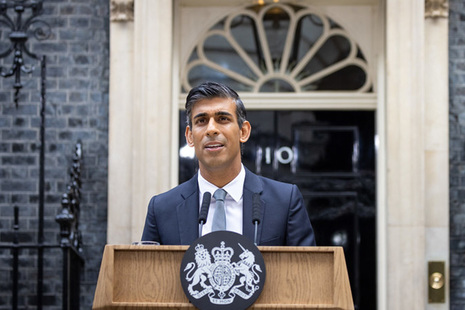 Biography
Rishi Sunak became Prime Minister on 25 October 2022.
He was previously appointed Chancellor of the Exchequer from 13 February 2020 to 5 July 2022.
He was Chief Secretary to the Treasury from 24 July 2019 to 13 February 2020, and Parliamentary Under Secretary of State at the Ministry of Housing, Communities and Local Government from 9 January 2018 to 24 July 2019.
Rishi went to Winchester College and studied Politics, Philosophy and Economics at Oxford University. He was also a Fulbright Scholar at Stanford University (USA) where he studied for his MBA.
Rishi was elected Conservative MP for Richmond (Yorks) in May 2015 and served as a Parliamentary Private Secretary at the Department for Business, Energy and Industrial Strategy from June 2017 until his ministerial appointment.
Rishi spent his professional career before politics in business and finance, working internationally. He co-founded an investment firm working with companies in multiple geographies. He then used that experience to help small and entrepreneurial British companies grow.
Rishi is married with two young daughters.
The Prime Minister is the leader of His Majesty’s Government and is ultimately responsible for the policy and decisions of the government.
As leader of the UK government the Prime Minister also:
As Minister for the Union, the Prime Minister works to ensure that all of government is acting on behalf of the entire United Kingdom: England, Northern Ireland, Scotland, and Wales.
The First Lord of the Treasury is one of the Lords Commissioners of the Treasury. This role is usually held by the Prime Minister.
Since the 17th century, the Lords Commissioners of the Treasury have collectively carried out duties that were previously held by the Lord High Treasurer (head of His Majesty’s Treasury).
The Lords Commissioners of the Treasury also include:
10 Downing Street is the official residence of the First Lord of the Treasury, and not of the Prime Minister.
As Minister for the Union, the Prime Minister works to ensure that all of government is acting on behalf of the entire United Kingdom: England, Northern Ireland, Scotland, and Wales.
The Minister for the Civil Service is responsible for regulating the Civil Service.
The Civil Service (Management Functions) Act of 1992, allows the Minister for the Civil Service to delegate power to other ministers and devolved administrations.
This role was created in 1968 and is always held by the Prime Minister.


Australia is a melting pot of cultures, ethnicities, and faiths. People from a wide range of cultural, ethnic, linguistic, and religious backgrounds helped to build this country. Since 1945, the lives of Australians have altered dramatically as a result of the aggressive immigration strategy (Brett 2003). Today, many diverse cultures have come together to call Australia home, and the majority of those cultures have accepted the Australian way of life. This essay will first provide a brief overview of Australian immigration history, including previous policies and the period of multiculturalism that dominated for several decades, before moving on to examine government practices and changes in immigration policies before, during, and after the Howard administration.
Multiculturalism refers to the integration of many cultures so that they can coexist happily and equitably as one. The history of human settlement in Australia began with the arrival of the first families of the existing aboriginal Australians. It is thought that Australia’s first indigenous tribes migrated from an unknown location in Asia about 50,000 years ago (Brett 2003). In 1606 a Spanish explorer sailed into the Torres Strait, which divides Australia from Papua New Guinea, to begin European discovery of Australia. Soon after, Dutch, French, and English explorers arrived and began mapping the continent. Australia was widely portrayed as a faraway and unappealing country for European settlement, yet it has deliberate and socioeconomic worth in the United Kingdom. The British control of the continent provided a solution for the relocation of criminals in its overcrowded jails, as well as a base for British naval operations. As a result, the British colonization of Australia started in 1788, and the colony quickly grew as free immigrants arrived from Britain and Ireland and fresh areas were freed up for cultivation.
However, the character of Australian migration altered dramatically with the discovery of gold in 1851. This gold rush era resulted in an early migration boom and the beginning of international migrations, with people arriving in significantly bigger numbers and from far more diverse origins than ever before. Over 600,000 individuals immigrated to Australia between 1851 and 1861.
Control of immigration altered when the colonies united in 1901. The immigration limitation act, popularly known as the “White Australian Policy,” was the first piece of legislation approved by the new parliament. Despite the comparatively significant number of Chinese citizens in Australia, this legislation insured that people who were not of European origin were not allowed to dwell there and also prohibited Asian migration for the next fifty years. With the onset of the First World War in 1914, migration nearly ended. Furthermore, formerly acceptable migrants from Germany, Hungary, Bulgaria, and Turkey were classed as ‘enemy aliens,’ and citizens from these nations were barred from entering the country for five years (Hodge 2006, p. 91). Churches and community groups such as the YMCA and the Salvation Army sponsored migrants, as they did after the conclusion of World War I. Small numbers also arrived on their own. As the United States attempted to curtail Southern European migration, an increasing number of young men from Greece and Italy financed their way to Australia. By the 1930s, a higher number of Jewish settlers began to arrive, many of them refugees from Hitler’s Europe.
Before World War II, Australia had a homogeneous European population and remained so for some time. During WWII, however, Australia became a haven for many non-European refugees, particularly from Asian nations. Malaysians, Filipinos, and Indonesians have established themselves in the nation. Australia aggressively sought these immigrants, and because of a rising economy and big infrastructure projects like the Snowy Mountain Programme, many of them found work. There were labourers from over thirty different countries who were not all of European ancestries. Seventy per cent of the workers in the project were foreigners who saw opportunities in coming to Australia.
The ambition of former Australian Prime Minister John Curtis of preserving Australia in the hands of its white European forebears did not last. Australia began to modify its White Australia policy in the 1950s. Non-European inhabitants were granted the right to petition for citizenship in 1956. Two years later, as a further measure of exclusion, the transcribing Test was eliminated. By the 1960s, mixed-race migration was becoming more common, and Australia signed its first migration pact with a non-European country in 1966. This was a significant step forward for Australia since it was the first time that both the political government and the Australian people decided to allow diverse cultures to coexist. Although diversity was recognized by the government and welcomed by the majority of Australians, there were significant problems during that period. Political concord on diversity was destroyed when opposition leader John Howard took a different stance on multiculturalism. Howard was a firm supporter of traditional Australian values. In 1988, Howard advocated for a variety of policy reforms, including a shift in the mix of migrants and a ‘One-Australia’ post-arrival policy. He stated that the rate of Asian immigration into Australia should be reduced for the sake of societal cohesiveness.
Multiculturalism is increasingly being embraced by national and state governments as a vocabulary of communal relations aimed at social cohesion. In July 2000, the Council for Multicultural Australia was founded and entrusted with executing A New Agenda for Multicultural Australia. Its mission is to promote the benefits of diversity in business and to supervise the application of a public service charter in a culturally varied society. The Howard administration issued its multicultural policy statement, Multicultural Australia: United in Diversity, in May 2003. It revised the 1999 New Agenda, established strategic orientations for 2003-06, and committed to establishing a Council for Multicultural Australia.
Australia received 123,000 new settlers in 2004-05, a 40% increase over the previous ten years. Sydney attracted the greatest number of immigrants (40,000 in 2004/05). The bulk of immigrants came from Asia, with China and India leading the way. There was also a large increase in Asian student numbers, as well as a continuous high number of Asian visitors. In 2005/06, the planned immigration influx more than quadrupled compared to 1996. As of 2007, immigration accounted for slightly more than half of Australia’s population increase. Immigration accounts for almost three-quarters of population growth in New South Wales and South Australia. The anticipated intake for 2007/08 was about 153,000, including 13,000 under the humanitarian programme and 24,000 New Zealanders under a unique trans-Tasman arrangement. During the Howard administration, the quota for skilled migrants increased dramatically in comparison to the quota for family reunions
Australia’s last multicultural policy, Multicultural Australia United in Diversity (2003-2006), was terminated in 2006. In late 2008, the Rudd Government launched a new multicultural advisory board.
Australia is not only far richer in experiences, but also has much stronger economic and social ties with other countries as a result of its broad multinational population. Multiculturalism has had an impact on Australian fashion, gastronomy, and culture since it defines what it means to be an Australian. Australia is proud of its multicultural society and values the range of cultures that continued global migration brings. Cultural variety affects and enriches all Australians; its success was accomplished by all Australians and should be treasured and embraced by all Australians.
 Eduindex
You must be logged in to post a comment.