An exhibition of paintings wholly inspired by Prime Minister Shri Narendra Modi

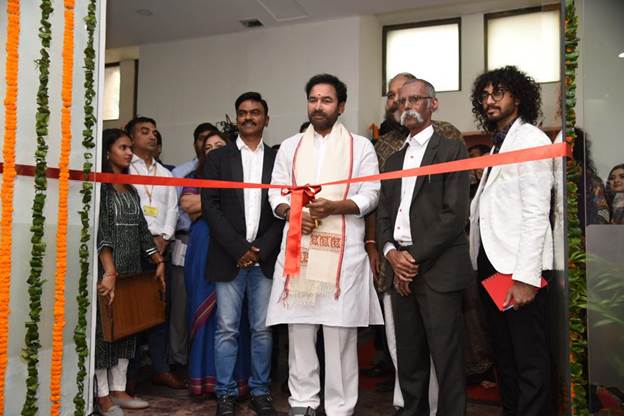
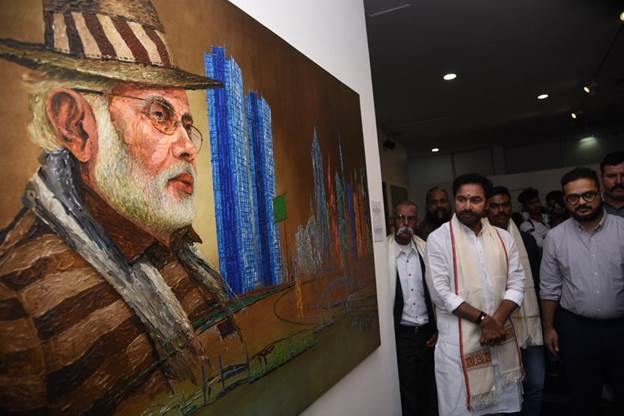
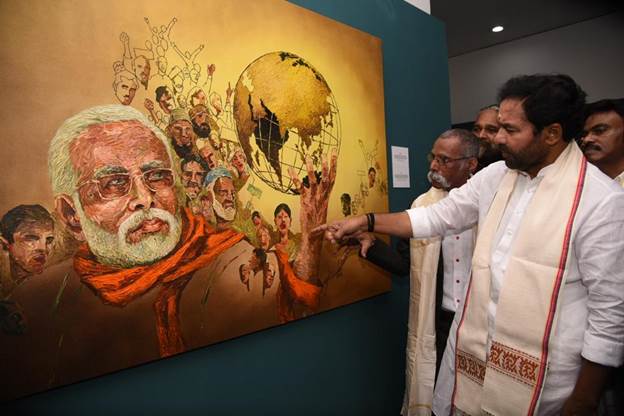
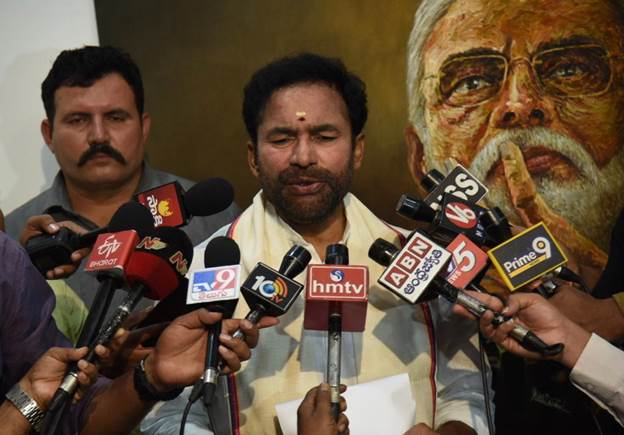
 Shri G Kishan Reddy, Union Minister for Culture, Tourism and Development of North-eastern Region, inaugurated an exhibition of paintings by eminent artist, Akbar Saheb today at National Gallery of Modern Art, New Delhi.  The art of Akbar Saheb is unique as all fifty-five artworks are wholly inspired by the Prime Minister Shri Narendra Modi and his incredible journey and vision. The exhibition, curated by the well-known Rajeev Menon is open to the public from 28th October to 3rd November 2022.

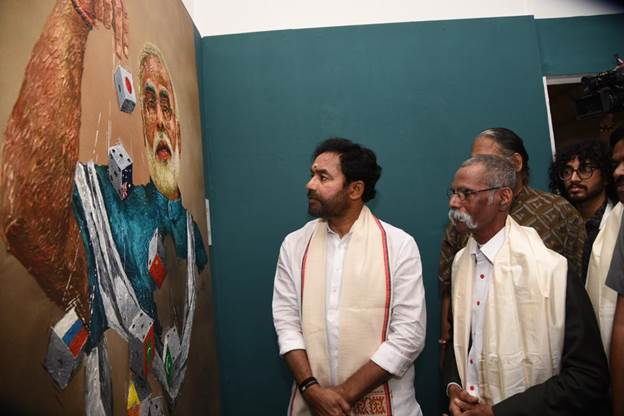
On the occasion, the Union Minister said that Akbar Saheb has shown the journey of Prime Minister Shri Narendra Modi including from Gujarat to becoming the world leader. He added that the paintings show major policy decisions such as GST and depict demonetisation and surgical strike in a clear manner. Shri G.K also said the paintings show the challenges faced by Shri Narendra Modi and his achievements as Prime Minister. The paintings are also important as they show the impact of Shri Narendra Modi  around the world.


The themes presented promise to resonate with every Indian across the country. Each work is deeply rooted in the initiatives taken by the Union government and is directly linked to the aspirations of the common man and the progress of the nation. With his exceptional paintings, Akbar Saheb’s sole intention is to simply encourage and inspire Indians to follow their dream. Of particular interest is the painting titled ‘Dare to Dream’ which documents the courageous journey of a young boy, selling tea in a small town in Gujarat to realise his destiny as Prime Minister of the world’s largest democracy.

The paintings also highlight Prime Minister Shri Narendra Modi’s success stories as well as the many challenges faced with various projects such as Vibrant Gujarat, Shining Bright (based on Asia’s largest solar park in Gujarat), Statue of Unity, Truth Prevails, Sadhbhavana Yatra and so on. Some paintings of note are ‘Lasting Impact’ which depicts his formidable power of resilience and endurance. ‘Bharat Mata’ is another evocative work where the Hon’ble Prime Minister’s mother is personified as Bharat Mata.

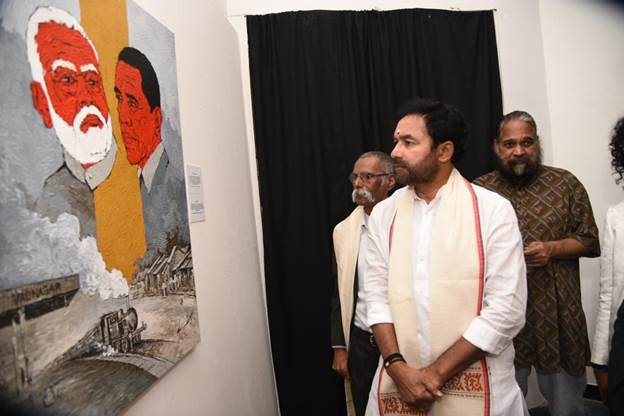
Interestingly more than forty artworks are fine expressions based on the popular series of talks, Mann ki Baat. Works like Sankalp Se Siddhi, Say NO to Black Money, Beware of Drugs, Save our Farmers, Water is a Blessing and Helping Hands are masterful compositions that are not only aesthetically pleasing but also send out a powerful message of humanity and compassion. A painting titled ‘Two Great Leaders’ illustrates some special moments shared with President Barack Obama of the United States. There are also the artist’s masterstrokes on the challenges of demonetization, Indus water treaty and the heroic sacrifices of the Indian army.

Akbar Saheb’s paintings present a narrative of mass mobilization and the positive impact of programmes like Swachh Bharat, Digital India, Mudra Yojana, Yoga as part of Life, electrification of villages and LPG connections for the poor. They also illustrate the revitalisation of the economy with the ambitious Make in India project and the growth of tourism as a showcase for the cultural heritage of the country.

***
IEPFA organises an Investor Education, Awareness and Protection Conference in Srinagar, Jammu & Kashmir

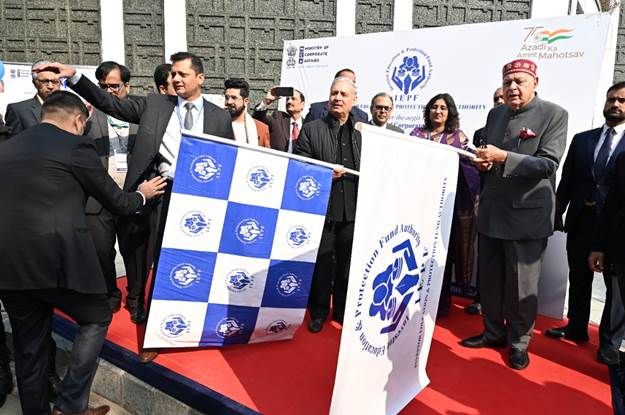
The Investor Education and Protection Fund Authority (IEPFA) under the aegis of Ministry of Corporate Affairs (MCA) organised an Investor Education, Awareness and Protection Conference in Srinagar, Jammu & Kashmir today at Kashmir International Conference. The Conference was inaugurated by Chief Guest, Union Minister of State for Ministry of Corporate Affairs Shri Rao Inderjit Singh.


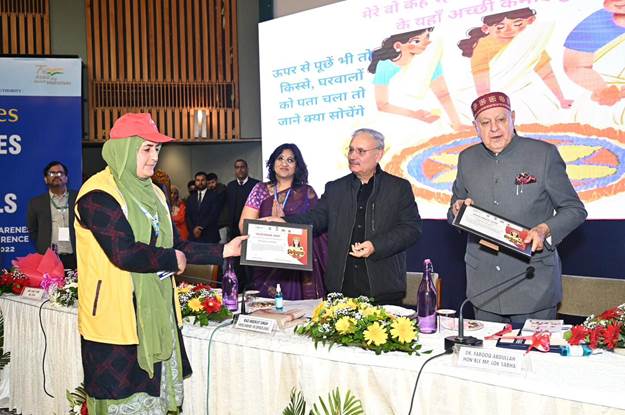
The event was also graced by Guest of Honour Dr. Farooq Abdullah, Member of Parliament (Srinagar), Smt. Anita Shah Akella, CEO IEPF Authority & Joint Secretary, MCA, Shri Sanjay Shorey, Regional Director (Northern Region), Ministry of Corporate Affairs, Shri Hamid Bukhari Registrar of Companies (ROC) Srinagar and other dignitaries from the Union Territory of Jammu & Kashmir along with senior officials from IEPF Authority, India Post Payment Bank and Department of Posts, CSC e-governance, Institute of Company Secretaries of India, Kashmir Chamber of Commerce, Central Reserve Police Force.

During the inaugural session, Shri Rao Inderjit Singh and Dr. Farooq Abdullah released various major initiatives of IEPF Authority and MCA:


  • IEPFA Mascot “Fundoo” which was selected through Jan-bhagidari after a month-long open contest on MyGov platform. The mascot is conceptualised with an idea symbolizing IEPFA’s vision of taking investor awareness to the last mile with the objective of making it easier to connect with its message, mandate and initiatives.
  • “Niveshak Didi” which is a unique endeavour of IEPF Authority with India Post Payment Bank wherein Investor Education will be promoted in “By the women, for the women” concept. The Niveshak Didi i.e. female Dakiya has intense social connect to the rural population especially women. Three representatives Niveshak Didi from the valley were given certificates by the Chief Guest and Guest of Honour during the Conference.
  • “Niveshak Sarathi”, an investor awareness van was flagged by the Shri Singh and Dr Abdullah and is an initiative by IEPFA to promote financial literacy among people in far-flung areas by spreading knowledge through dedicated audio-visual and print material & a specially designed van equipped with a TV display, public announcement system, internet connectivity etc.
  • “Investors’ Handbook” – a concise compilation of information on savings, budgeting, and investments and provide a vast knowledge of financial instruments in capsule form thereby enabling them to make informed and sensible financial decisions.
  • “75 dedicated IAPs” in the Union territory of J&K to involve stakeholders of different segments of society in the caravan of Investor Awareness.


During his keynote address, Shri Singh appreciated IEPFA’s initiative of conducting the Conference on Investor Education & Awareness in Srinagar, Jammu & Kashmir. He also shared ideas, need and significance of spreading inclusive financial literacy, investor awareness & protection for overall economic growth and nation building.

The inaugural session was followed by a technical session on Financial Literacy as a tool for Economic development. The event was summed up with Nukkad Natak, quiz and other related activities on Financial Literacy involving School Students and other diverse audiences. The conference was attended by around 650 delegates which included students, professionals, academicians, housewives, artisans, CRPF personnel, panchayat representatives and general public from the UT of J&K.


ABOUT IEPFA

IEPF Authority has been established under sub-section (5) of section 125 of Companies Act, 2013 with the objective of promoting Investor Education, Awareness and Protection and for administration of the IEPF fund. It has undertaken a wide gamut of activities to accelerate the pace of investor education among the masses at large. Till date more than 65,000 Investor Awareness Programmes covering above 30 lakh citizens have been conducted by IEPFA. In addition, more than 28,000 claim refunds have been approved with transfer of about 1.6 crore shares and related dividends.


**** 

NEOM : the futuristic sci-fi city of Saudi Arabia.

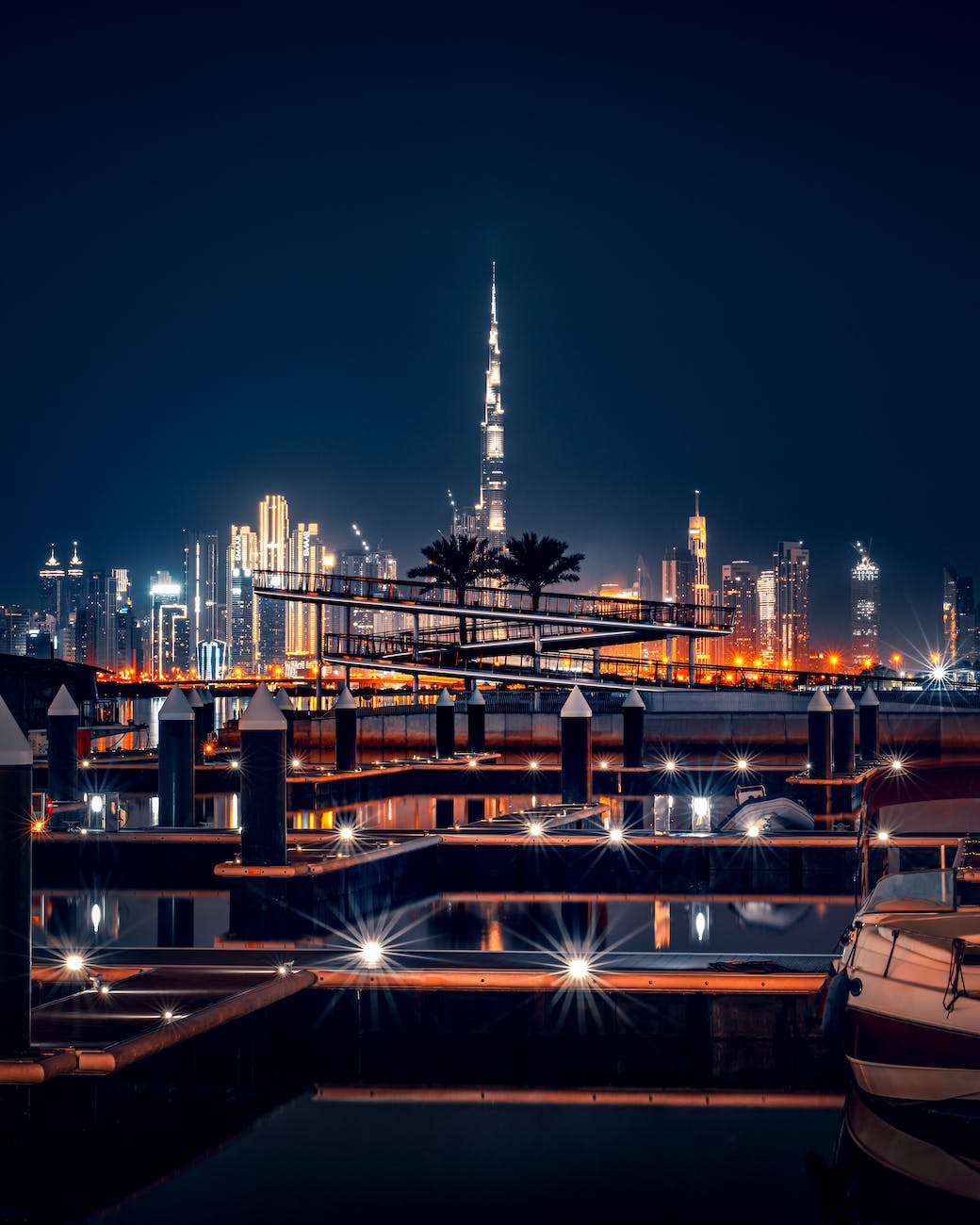
With plans under way to build Saudi Arabia’s smart city Neom, it is set to be a place in the desert unlike anything else on Earth.

NEOM is being called as what ‘New Future might look like’ by Saudi Arabia. Neom is a portmanteau of the Greek word neos. NEOM is being built on the Red Sea in northwest Saudi Arabia. It can be imagined as a place where entrepreneurship and innovation would frame the course for this New Future. The city is being marketed as a new model for sustainable living, working and prospering. Saudi officials describe it as “the world’s most ambitious project.”

Unveiling the project, Crown Prince Mohammed bin Salman said the 170-kilometre coastal strip in the north-west of the country would be free of cars and streets and have zero carbon emissions.

The smart city will be powered entirely by clean energy, a major step in Saudi Arabia’s shift away from an oil-based economy.

The Line is to be built in Neom and will be home to nine million people, who will live in interconnected societies run by artificial intelligence designed to coexist with nature, with excavation on this massive project having now started.

Confronting the traffic, pollution and infrastructure challenges that overshadow urban life in conventional cities, this futuristic development will prioritise walkability, clean energy and technology to create a new way of living.

NEOM : the futuristic sci-fi city of Saudi Arabia.

With plans under way to build Saudi Arabia’s smart city Neom, it is set to be a place in the desert unlike anything else on Earth.

NEOM is being called as what ‘New Future might look like’ by Saudi Arabia. Neom is a portmanteau of the Greek word neos. NEOM is being built on the Red Sea in northwest Saudi Arabia. It can be imagined as a place where entrepreneurship and innovation would frame the course for this New Future. The city is being marketed as a new model for sustainable living, working and prospering. Saudi officials describe it as “the world’s most ambitious project.”

Unveiling the project, Crown Prince Mohammed bin Salman said the 170-kilometre coastal strip in the north-west of the country would be free of cars and streets and have zero carbon emissions.

The smart city will be powered entirely by clean energy, a major step in Saudi Arabia’s shift away from an oil-based economy.

The Line is to be built in Neom and will be home to nine million people, who will live in interconnected societies run by artificial intelligence designed to coexist with nature, with excavation on this massive project having now started.

Confronting the traffic, pollution and infrastructure challenges that overshadow urban life in conventional cities, this futuristic development will prioritise walkability, clean energy and technology to create a new way of living.

India will become a global economic power with collective efforts

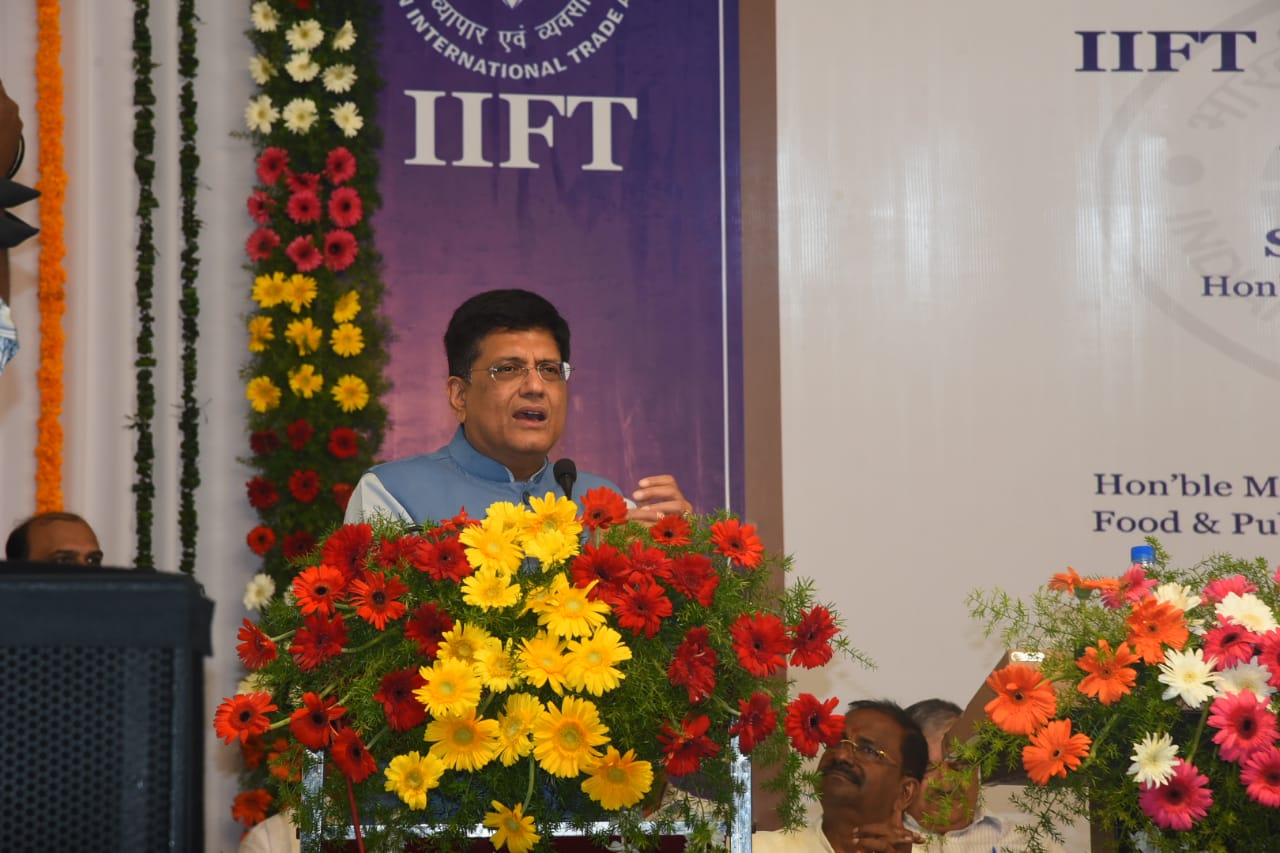
 Union Minister for Commerce and Industries, Consumer Affairs, Food, Public Distribution and Textiles Shri. Piyush Goyal attended as Chief Guest at the inagural of Indian Institute of Foreign Trade (IIFT), Kakinada Campus, in Andhra Pradesh today. Union Minister of Finace, Corporate Affairs Smt. Nirmala Sitaraman inagurated the IIFT Kakinada campus.


Union Minister Piyush Goyal, on this occasssion said that Union Finance Minister Smt. Nirmala Sitaraman paid special attention and initiative for the establishment of IIFT campus. The establishment of this new campus marks the beginning of a new chapter.

He further said that an expert management of human resources is necessary for Indian commerce to gain more international recognition in the future. These human resources will be made available through IIFT’s. 


With political stability, high competitiveness, collective efforts and developing economic system, India will become an economic force in the world to rekonwith. 


He also said that at present, the Indian economy is worth of 3.5 trillion US dollars. A developing country can be taken to the level of a developed country with integrated economic growth and collective efforts. With continuous efforts Indian economy will reach tenfold in the next 25 years, by 2047, when we mark the 100th year of independence. The development can be achieved by making available expert human resources to the maximum extent.

He mentioned that the actions and special allocation of budgets by the central government under the Atman Nirbhar Bharat makes country’s economic system much stronger and enriched. , He also said that Andhra Pradesh is growing a lot in the fields of agriculture, fisheries etc, and the state of Andhrapradesh also have various special economic zones.

The minister has called for the promotion of local products, artisans, skilled weavers etc, as it is important to support them in every way.


The programme was attended by Members of Parliament, Smt. Vanga Geeta, Shri GVL Narasimha Rao, Shri P. Subhas Chadnrabose, Shri M. Bharat Ram, Andhra Pradesh Finance Minister Shri B. Rajendranath Reddy, Civil Supplies Minister, Shri K. Venkata Nageswara Rao, BC Welfare, I&PR and Cinematography Minister Shri Ch. Venugopala Krishna, R&B Minister Shri D. Raja and others.


****

PSYCHOANALYSIS AND EDUCATION

 Many movements and activities have arisen as a result of psychoanalysis, providing a drive to new schooling. It has altered the way education is seen and intended. Education is no longer regarded as a constraint to be overcome by external regulatory mechanisms such as punishment and incentives.

The goal of education is to develop the full person, including intellect and emotions, for socially beneficial objectives. Psychoanalysis has emphasized psychological motivations such as love, instinctual usage, permissiveness and forbearance, and the child’s own choice or desire. It has shed light on and explained the differences in the absorption of diverse disciplines among different youngsters. This suggests that some deficits, among other things, may be caused by emotional inhibition. Psychoanalysis has explained a child’s resistance to learning as a result of unfavourable environmental conditions, unsympathetic and critical teachers and parents, a lack of preparation, and emotional blocking caused by anxiety and aggression in the form of phobias or inharmonious parent-child or intra-parental relationships.

Thus, psychoanalysis emphasizes the significance of a suitable setting for children’s education. The atmosphere in school and at home should be designed to lower the likelihood of repression and raise the likelihood of sublimation. It should allow for spontaneous and creative actions as well as all sublimations. Psychoanalysis has emphasized the importance of play in children’s education. The numerous curricular and co-curricular activities in the school should be determined by play as well as other natural interests of children. Because of this emphasis on play, play therapy and play-way have emerged as essential strategies in the treatment of academic and emotional difficulties. 

It is impossible to deny that psychoanalysis has fueled movements such as “child guidance,” “mental hygiene,” “paido-centrism,” and “child independence.” The latter popularised notions like ‘free discipline.’

Other contributions of psychoanalysis to education include the need to honouring the child’s individuality at an early age, examining the child’s early years, analysing behavioural norms from a fresh perspective, recognising the potency of the sex impulse, and sex education. However, one of the most significant contributions has been the knowledge of maladjustments in children’s behaviour and delinquencies in adolescence that psychoanalysis has provided. Emotional conflicts caused by poor inter-personal relationships within the family and repression of children’s unconscious needs and demands or reality have been highlighted as important causes, without underestimating the importance of inadequate environmental conditions such as broken homes, poor economic situations, bad neighbourhoods, inadequate school programmes, a lack of proper recreational facilities, and others.

To summarise, much of what is progressive in New Education can be traced back to the impact of psychoanalysis.

Home affordability report on Indian cities.

Ahmedabad continues to be the most affordable housing market at 22 per cent, followed by Pune at 26 per cent and Chennai at 27 per cent, among the top eight cities in India, global property consultant Knight Frank India’s Affordability Index for the third quarter (Q3) of 2022 showed.

Driven by the constant demand for housing properties, Bengaluru has emerged as the fourth most expensive real estate market in the country, stated in report.

Along with this, Mumbai and Hyderabad were known to have one of the most expensive residential markets in the country.

The index revealed that Bengaluru’s affordable housing market has become more expensive mainly because of the 50 bp hike in the repo rate by the Reserve Bank of India the previous month.

The repo rate hike ultimately caused the rise in median loan rates. These loan rates are a direct indication of the affordability of interested buyers and also impact consumer behaviour.

Home affordability report on Indian cities.

Ahmedabad continues to be the most affordable housing market at 22 per cent, followed by Pune at 26 per cent and Chennai at 27 per cent, among the top eight cities in India, global property consultant Knight Frank India’s Affordability Index for the third quarter (Q3) of 2022 showed.

Driven by the constant demand for housing properties, Bengaluru has emerged as the fourth most expensive real estate market in the country, stated in report.

Along with this, Mumbai and Hyderabad were known to have one of the most expensive residential markets in the country.

The index revealed that Bengaluru’s affordable housing market has become more expensive mainly because of the 50 bp hike in the repo rate by the Reserve Bank of India the previous month.

The repo rate hike ultimately caused the rise in median loan rates. These loan rates are a direct indication of the affordability of interested buyers and also impact consumer behaviour.

Why is water important?

Water is inarguably the most valuable biochemical of all. Without water, life would not exist on this planet. While it has a hundred thousand benefits, it can also be a nuisance if not used or managed correctly. However, in this article, we will talk only about the importance of water and its general chemical structure, which makes water, water! 

Water as a major component of the human body:

It is believed that all humans are about 60% water. This includes your blood and all the bodily secretions as well. Water is also a crucial component of cells, typically forming around 70% to 95% of the mass of a single cell — that’s simply startling! It means we depend on water and cannot afford to lose it. Fun fact: losing about 10-15% of the water from your body can be fatal. A loss of 1
5-25% causes death! 

Molecule of water: 

Water is a polar molecule (a molecule with an uneven charge distribution) which has a general formula of H2O. Although it is a relatively simple molecule, water has some wonderful attributes. For example, the hydrogen bonds in water enable it to be strong, and as a result, it becomes difficult to convert water from a liquid to a gas. It requires a lot of energy to do so. By contrast, compounds with no hydrogen bond exist as a gas at average room temperature. 

Importance to Marine life: 

Water provides an ideal environment for all those organisms that reside inside water. Fishes, Crocodiles, Shrimps, Turtles, Sea-horses etc. All these animals (along with many others) survive in water. Their survival is made possible because of the fact that water contains dissolved oxygen, and many other useful minerals, which aid in the growth and development of marine life. 

Importance to humans: 

We all quench our thirst with a glass of cold water every day. However, this is not the only thing water does. Your saliva is made up of water. Some hormones in your body are made up of water. Your tears are made up of water. Some enzymes (a biological catalyst that speeds up a rate of a reaction) are made up of water. For example, synovial fluid in your body is made up of water. Your sweat is made up of water. Almost everything in your body has something to do with water. This makes water an ultimate life-saver (you can sometimes silently say thanks to water, it wouldn’t mind). 

Water as a transport medium in animals and plants: 

Animals need a transport medium to distribute the required elements within no time throughout the body to carry out life processes. Thankfully, animals use blood as their transport medium. Blood is made up of water. Hence, it is safe to say that animals use water as a transport medium. Blood transports oxygen and nutrients. 

As far as plants are concerned, plants also use water as a transport medium. Root hair cells take up water from the soil, and it is then transported throughout the plant with the help of xylem vessels. 

Therefore, drink water, stay hydrated, and keep the water channels pure, for everyone!

Status of India’s Forex reserve.

Until the beginning of this year, the country had saved enough for the rainy day, because of strong capital flows in the past. However, those reserves are depleting fast. India lost nearly $85 billion of its forex reserves in the first half of the fiscal year, the second biggest depletion among major emerging market (EM) peers during the period.

India’s forex reserves were $528.4 billion as of 14 October, the lowest since July 2020, and sharply down from the record $642.4 billion last year. The rupee has crashed more than 10% against the US dollar this year and slipped below 83 for the first time in past few weeks.


To help arrest rupee’s record fall, the Reserve Bank of India has also burned $114 billion from its forex coffer, triggering concerns on this front as well. The central bank has however attributed about two-thirds of the decline to valuation effects. The decline of the forex reserves cannot be solely attributed to a central bank’s intervention to defend the currency against the dollar.

There has been a sharp depletion of forex reserves in the last few months, but what is comforting is India’s high level of reserves that has enabled it to withstand the sharp depletion without any major panic so far. Another comforting factor is the country’s low external debt (20% of gross domestic product) and the short-term debt as a share of total external debt is around 20%.

Status of India's Forex reserve.

Until the beginning of this year, the country had saved enough for the rainy day, because of strong capital flows in the past. However, those reserves are depleting fast. India lost nearly $85 billion of its forex reserves in the first half of the fiscal year, the second biggest depletion among major emerging market (EM) peers during the period.

India’s forex reserves were $528.4 billion as of 14 October, the lowest since July 2020, and sharply down from the record $642.4 billion last year. The rupee has crashed more than 10% against the US dollar this year and slipped below 83 for the first time in past few weeks.

To help arrest rupee’s record fall, the Reserve Bank of India has also burned $114 billion from its forex coffer, triggering concerns on this front as well. The central bank has however attributed about two-thirds of the decline to valuation effects. The decline of the forex reserves cannot be solely attributed to a central bank’s intervention to defend the currency against the dollar.

There has been a sharp depletion of forex reserves in the last few months, but what is comforting is India’s high level of reserves that has enabled it to withstand the sharp depletion without any major panic so far. Another comforting factor is the country’s low external debt (20% of gross domestic product) and the short-term debt as a share of total external debt is around 20%.

My Heart and Other Black Holes- Book Review

DISCLAIMER: This review contains spoilers.

One emerging trend in media is the glorification and romanticization of mental health disorders. As a result of the same, a lot of Young Adult (YA) novels have integrated various mental health issues into their plots while still bearing inaccurate representations as young adults look at these serious issues through rose-tinted glasses. Ofter, it ends on a high note thus masking the dark reality of these problems and wrongly depicting the healing process.

My Heart and Other Black Holes by Jasmine Warga is a transitional piece of literature to me. I find that it balances the scale- it depicts certain aspects of mental health issues that are appealing to young adults through the form of romance while also portraying very dark aspects of depression in a fairly blunt manner.

This book follows the bittersweet tale of two teenagers with traumatic childhoods. Aysel is a sixteen-year-old girl who was raised by her father- however, her father murdered a local boy and she carries that stigma everywhere. She pushes her friends and family away to the point where they barely interact with her anymore. Roman, a sixteen-year-old boy blames himself for his sister’s death and bears the weight of that guilt on his shoulders. Both of them want to end their lives and they become Suicide Buddies through a website. Roman wishes to die by drowning on the anniversary of his sister’s death. They both decide to die together.

Naturally, they begin to fall for each other. Warga artfully depicts the contrast between the thought processes of the two teenagers. For Aysel, all she really needed was to be close to someone again, so meeting Roman helped her heal. Roman, on the other hand, was plagued by guilt and was in his own head which meant that the chances of love changing his thoughts and feelings were far less likely. She showcases this beautifully as we can see Aysel’s determination to take her own life reduce and Roman’s determination to do the same be unwavering. Roman’s final suicide attempt without Aysel shows that he loved her enough to want a good life for her but not enough to live his life. The book ends on an ambiguous note and the readers are left wondering about the uncertain future of Aysel and Roman.

Jasmine Warga displays a clean and slightly poetic writing style throughout the book. The language and narration remain consistent throughout the book. There is clear character development for the main characters and adequate character development for others.

All in all, My Heart and Other Black Holes is a very well written piece of YA fiction. I would highly recommend this book to those looking for a quick yet meaningful read.

Rating:

Rating: 4 out of 5.

My Heart and Other Black Holes- Book Review

DISCLAIMER: This review contains spoilers.

One emerging trend in media is the glorification and romanticization of mental health disorders. As a result of the same, a lot of Young Adult (YA) novels have integrated various mental health issues into their plots while still bearing inaccurate representations as young adults look at these serious issues through rose-tinted glasses. Ofter, it ends on a high note thus masking the dark reality of these problems and wrongly depicting the healing process.

My Heart and Other Black Holes by Jasmine Warga is a transitional piece of literature to me. I find that it balances the scale- it depicts certain aspects of mental health issues that are appealing to young adults through the form of romance while also portraying very dark aspects of depression in a fairly blunt manner.

This book follows the bittersweet tale of two teenagers with traumatic childhoods. Aysel is a sixteen-year-old girl who was raised by her father- however, her father murdered a local boy and she carries that stigma everywhere. She pushes her friends and family away to the point where they barely interact with her anymore. Roman, a sixteen-year-old boy blames himself for his sister’s death and bears the weight of that guilt on his shoulders. Both of them want to end their lives and they become Suicide Buddies through a website. Roman wishes to die by drowning on the anniversary of his sister’s death. They both decide to die together.

Naturally, they begin to fall for each other. Warga artfully depicts the contrast between the thought processes of the two teenagers. For Aysel, all she really needed was to be close to someone again, so meeting Roman helped her heal. Roman, on the other hand, was plagued by guilt and was in his own head which meant that the chances of love changing his thoughts and feelings were far less likely. She showcases this beautifully as we can see Aysel’s determination to take her own life reduce and Roman’s determination to do the same be unwavering. Roman’s final suicide attempt without Aysel shows that he loved her enough to want a good life for her but not enough to live his life. The book ends on an ambiguous note and the readers are left wondering about the uncertain future of Aysel and Roman.

Jasmine Warga displays a clean and slightly poetic writing style throughout the book. The language and narration remain consistent throughout the book. There is clear character development for the main characters and adequate character development for others.

All in all, My Heart and Other Black Holes is a very well written piece of YA fiction. I would highly recommend this book to those looking for a quick yet meaningful read.

Rating:

Last solar eclipse of the year witnessed today.

For the uninitiated, a partial solar eclipse is one where the Earth moves through the lunar penumbra as the moon travels between the earth and the sun. It is referred to as ‘partial’ because the moon does not block the entirety of the sun, when witnessed from the Earth.

After Diwali on October 25, India and many parts of the world witnessed a partial solar eclipse which was visible in the different regions.

A Solar eclipse occurs when the Moon comes between Sun and Earth and blocks the light of the sun, casting a shadow onto Earth.

When the sun and moon are not perfectly aligned in a straight line, a partial solar eclipse occurs. The sun takes on a crescent shape as if the moon has taken a bite out of it and the Moon only reflects the outer part of Earth’s shadow, known as the penumbra.

Today’s eclipse is special as the last partial solar eclipse was seen from India in 2007 and the next such event would occur only in 2032. Although another partial solar eclipse will occur only in 2025 but that event would not be visible from India.