Google is eyeing moving some production of its Pixel smartphone lineup to India, according to a report, the latest in a series of phonemakers with growing ambitions to locally assemble their handsets in the world’s second largest market.
Like Apple, Google has also been moving some of its manufacturing efforts outside of China. Nikkei Asia reported that Google was also planning to move some Pixel manufacturing to Vietnam.
Google is considering moving some production of Pixel phones to India. This move comes following disruptions in China from COVID-19 lockdown and the country’s rising tensions with the United States. Parent company Alphabet Inc has reportedly invited bids from manufacturers to make between 500,000 and 1 million Pixel smartphones.
According to a report by The Information, Google is aiming to produce 10-20 per cent of the estimated annual production for Pixel. Chief Executive Officer Sundar Pichai reportedly considered a plan for manufacturing in India earlier this year but the final decision is yet to be made, the report said. However, if the approval follows through, India will need to import components from China. Alphabet is also considering Vietnam as an alternative.
The move away from China comes as the Biden administration plans to broaden the curbs on US shipments of semiconductors to China. US companies like KLA Corp, Lam Research Corp and Applied Materials Inc have been forbidden from exporting chipmaking equipment to Chinese factories.
Google is eyeing moving some production of its Pixel smartphone lineup to India, according to a report, the latest in a series of phonemakers with growing ambitions to locally assemble their handsets in the world’s second largest market.
Like Apple, Google has also been moving some of its manufacturing efforts outside of China. Nikkei Asia reported that Google was also planning to move some Pixel manufacturing to Vietnam.
Google is considering moving some production of Pixel phones to India. This move comes following disruptions in China from COVID-19 lockdown and the country’s rising tensions with the United States. Parent company Alphabet Inc has reportedly invited bids from manufacturers to make between 500,000 and 1 million Pixel smartphones.
According to a report by The Information, Google is aiming to produce 10-20 per cent of the estimated annual production for Pixel. Chief Executive Officer Sundar Pichai reportedly considered a plan for manufacturing in India earlier this year but the final decision is yet to be made, the report said. However, if the approval follows through, India will need to import components from China. Alphabet is also considering Vietnam as an alternative.
The move away from China comes as the Biden administration plans to broaden the curbs on US shipments of semiconductors to China. US companies like KLA Corp, Lam Research Corp and Applied Materials Inc have been forbidden from exporting chipmaking equipment to Chinese factories.
Triparna Chakraborty from Kolkata was crowned “India’s first Sleep Champion”. Fifteen candidates were selected as sleep interns having slept nine hours for 100 days. The interns will be selected through various processes, they will be provided with mattresses and sophisticated sleep tracker. The interns will be counseled on ways to improve their sleep health through various empowering sessions with fitness professionals, nutritionist and wellness experts and Sleep specialists. The internship is provided by Wakefit.co it provides homesolutions that include furniture and mattresses. It is offering a novel internships to students.
For more information- https: //www. Wakefit.co/sleepintern.
Onam is the harvest festival of Kerala it is time everything looks fresh. During this period flowers blossom , crops ripe and vegetables and fruits attain full growth. In this day Malayali nurtures an emotional bond that evoke rich memories of glorious past. For people away from Kerala, onam sets stage for nostalgic homecoming. It is an occasion of family reunions. In Kerala, onam embodies the spirit of its people. It is celebrated across different communities. All famous publications bring out special programs for the festival. The numerous television channels compete with one another to render better fare for their viewers. The railway run special trains, hotels have special tariffs, film industries churn out new releases to satisfy filmy appetite in Kerala. Most of home finance companies offer onam special rates during festive season. Home appliances and different consumer durables Markey come up with attractive discount rates and are sold off like hot pancakes. People will go on for shopping and most salaried employees will receive festive bonus and incentives during Onam. Street vendors are making brisk business in onam carnival. It is a revival for the market altogether. Malayali associations across the world actively celebrate onam with the same Kerala style. The handloom industries provide the rebate offered by the government. Weavers across Kerala organize variety of expo in different parts of the state to reach out the common people. Major jewelry showrooms offer alluring offers like bumper prizes like trips,cars etc through lucky draw. They offer discount on making charges of jewelleries. Tempting offers galore all around. Onam is festival of prosperity.
The myth behind Onam festival is that it is believed that during Onam, Mahabali, the erstwhile king of Kerala comes on for an annual revisit to his kingdom. According to mythology prosperity prevailed during reign of Mahabali and gods become envious of it, Lord Vishnu in order to put an end to Mahabali ‘s regime appeared in disguise as little Vamana. He requested land equal in size of his three footsteps. On being agreed Lord Vishnu took his full form physically and ethereally. The first step covered the entire celestial world. With second step covered the world of demons. Mahabali realized that third step would take earth which will affect his people. Mahabali pleaded to take the third step over him to spare his people. As mark of respect to his sacrifice of bebevolent monarch made for his people. Mahabali was allowed to visit his kingdom once every year. Onam is the time of year when malayalam calender begins. It is followed by monsoon in Kerala. Onam falls on mid- chingam the maiden month of malayalam calendar. With Atham the real countdown to Thiruvonam begins. Floral carpet is laid in front of household begins from Atham and continues 10 days till Thiruvonam. Rituals such as laying of pookkalam in courtyards of homes and gifting new clothes called Onakkodi are customs during Onam. Cultural events like Oonjalaattam, Onathallu, Pullikali, Thalapandu etc are organized in Kerala. Sadya in tender plantain leaves is part of festivity.
LGBTQ is an acronym for “lesbian, gay, bisexual, transgender, and queer. Lesbian, Gay, Bisexual and Transgender, Queer. Over the past decade, LGBT people have gained more and more tolerance and acceptance in India, especially in large cities.
LGBTQ people in India remain closeted, fearing discrimination from their families, who might see homosexuality as shameful. Discrimination is still present in rural areas, where LGBTQ people often face rejection from their families and forced opposite-sex marriages. People in the LGBTQ community are fighting for equal rights and acceptance. Trans people, especially, face a lot of difficulty in finding acceptance. People in the LGBTQ community are looked down upon all the time.
This is a major issue because discrimination against the LGBTQ community is highly prevalent. People’s prejudices lead them to think that LGBTQ people are odd and very different. Today, homosexuality and queer identities may be acceptable to more Indian youths than ever before but within the boundaries of families, homes, and schools, acceptance remains a constant struggle for LGBTQ people. I have heard of people coming out of the closet and declaring to their families that they are not the person their family expected them to be. Being L, G, B, T, or Q is not a ‘problem’, nor is it a ‘choice’ as such. LGBTQ individuals are merely individuals who have sexual preferences that differ from what would appear to be the ‘norm’, due to differing learned behaviors and, you know, having a personal perspective and mindset that differs from everyone else’s. Saying that it’s objectively wrong for people to have sexual preferences that differ from the norm is objectively wrong itself.
Transgender people in India are allowed to change their legal gender post-sex reassignment surgery under legislation passed in 2019 and have a constitutional right to register themselves under a third gender. Additionally, some states protect hijras, a traditional third-gender population in South Asia through housing programs, and offer welfare benefits, pension schemes, free operations in government hospitals as well as other programs designed to assist them. There are approximately 480,000 transgender people in India as per Census 2011. Article 15 of our Indian Constitution Article 15, 1949. 15. Prohibition of discrimination on grounds of religion, race, caste, Sex, or place of birth.
In 2018, in the landmark decision of Navtej Singh Johar v. Union of India, the Supreme Court of India decriminalized consensual homosexual intercourse by reading down Section 377 of the Indian Penal Code and excluding consensual homosexual sex between adults from its ambit. Amidst strong political movements in favor of LGBTQ rights, people are more accepting of same-sex relationships, with around three out of four Indians supporting them according to an opinion poll. In the 2010s, LGBT people in India increasingly gained tolerance and acceptance, especially in large cities.
The backlash is the biggest concern at the moment. Homophobia is still one of the last acceptable forms of bigotry in some regions, and my hope is that that changes. Legally India has taken many steps in this area to identify the rights of LGBT community. Discrimination and the fear of discrimination is an important concern among the minorities at workplace.
If normal men and women have the right to live in this society with respect then why not a person who belongs to LGBTQ can live in this society with respect? It’s not about what our religion says it’s about what humanity says.
Feminism is a range of socio-political movements and ideologies that aim to define and establish the political, economic, personal, and social equality of the sexes. Feminism incorporates the position that society prioritizes the male point of view and that women are treated unjustly in these societies.
Who started Feminism ?
Mary Wollstonecraft is seen by many as a founder of feminism due to her 1792 book titled A Vindication of the Rights of Woman in which she argues for women’s education. Charles Fourier, a utopian socialist and French philosopher are credited with having coined the word “féminisme” in 1837.
The important aspect of feminism:
1. Feminism is defined as the belief in the social, political, and economic equality of the sexes.
2. The goal of feminism is to challenge the systemic inequalities women face daily.
3. Contrary to popular belief feminism has nothing to do with belittling men feminism does support sexism against either gender. Feminism works towards equality, not female superiority.
4. Feminists respect individual, informed choices and believe there shouldn’t be a double standard in judging a person. Everyone has the right to sexual autonomy and the ability to make decisions about when, how, and with whom to conduct their sexual life.
5. There isn’t just one type of feminism, there are a variety of feminist groups including girlie feminists, third-wave feminists, pro-sex feminists, and so on. All these groups aim to deal with different types of discrimination women, and sometimes men, face.
6. Women earn 78 cents for every dollar a man makes.
7. Only 17% of the seats in Congress are held by women.
8. Although 48% of law school graduates and 45% of law firm associates are female, women make up only 22% of federal-level and 26% of state-level judgeships.
9. Even in the 10 top paying jobs for women, females earn less than men; only one career, speech pathology, pays the same regardless of gender.
10. Despite previous attempts to ratify a UN treaty guaranteeing the elimination of all forms of discrimination against women, the U.S. refuses to support an international bill of rights for women signed by nearly every other nation on the planet.
11. What feminists want the world to know, or at least acknowledge is the different ways men and women are treated, and although there have been great strides towards equality, women and men are far from playing on the same field.
The First Wave of Feminism:
This first wave of feminism activism included mass demonstrations, the publishing of newspapers, organized debates, and the establishment of international women’s organizations. At around the same time, women became more active in communist, socialist and social democratic parties because increasing numbers of women began to work outside the home in factories and offices. Women were first allowed to go to university in the early 20th century, having both a career and a family. In certain countries, when fascist parties gained power the feminist movement was banned. Women started organizing again after the end of the Second World War, and they soon gained equal political rights in most European countries, with women’s emancipation becoming an important aim and most women being allowed to take on full-time jobs, divorce their husbands and go to university.
The Second Wave of Feminism:
The second wave of feminism aimed to achieve ‘women’s liberation, different groups had different ideas about how this should be done. Liberal feminists wanted better equality laws and reform of institutions such as schools, churches, and the media. Radical feminists argued that the root cause of women’s inequality is patriarchy: men, as a group, oppress women. They also focused on violence against women by men and started to talk about violence in the family, and rape. Socialist feminists argued that it is a combination of patriarchy and capitalism that causes women’s oppression. The second wave of feminism also resulted in new areas of science: women’s studies became a discipline to be studied at university, and books began to be published about women’s achievements in literature, music, and science and recording women’s previously unwritten history.
The women’s movement played an important role in the drafting of international documents about women’s rights, such as the Universal Declaration of Human Rights and the Convention on the Elimination of all Forms of Discrimination Against Women (CEDAW, 1979).
The Third Wave of Feminism:
The third wave of feminism mainly refers to the American movement in the 1990s, and was a reaction to the backlash of conservative media and politicians announcing the end of feminism or referring to ‘post-feminism’.t the third wave of feminism can be characterized by increased awareness of overlapping categories, such as race, class, gender, sexual orientation. More emphasis was also placed on racial issues, including the status of women in other parts of the world (global feminism). This was also a moment when several feminist non-governmental organizations were established, but focused on specific feminist issues, rather than claiming to represent general feminist ideas. Third-wave feminism actively uses media and pop culture to promote its ideas and to run activities, for example by publishing blogs or e-zines. It focuses on bringing feminism closer to people’s daily lives. The main issues that third-wave feminists are concerned about include: sexual harassment, domestic violence, the pay gap between men and women, eating disorders and body image, sexual and reproductive rights, honor crimes, and female genital mutilation.
The Fourth Wave of Feminism:
The term cyberfeminism is used to describe the work of feminists interested in theorizing, critiquing, and making use of the Internet, cyberspace, and new media technologies in general. The term and movement grew out of ‘third-wave’ feminism. Cyberfeminism is considered to be a predecessor of ‘networked feminism’, which refers generally to feminism on the Internet: for example, mobilizing people to take action against sexism, misogyny, or gender-based violence against women. One example is the online movement #metoo in 2017, which was a response on social networks from women all over the world to the case of Harvey Weinstein, a Hollywood producer who was accused of sexually harassing female staff in the movie industry.
Feminism can be seen as a movement to put an end to sexism, sexist exploitation, and oppression and to achieve full gender equality in law and practice. The women’s movement is made up of women and men who work and fight to achieve gender equality and to improve the lives of women as a social group.
A fashion blog can cover many topics, such as specific items of clothing and accessories, beauty tips, trends in various apparel markets (haute couture, prêt-à-porter, etc.), celebrity fashion choices, and street fashion trends. Many fashion blogs could also be categorized as shopping blogs, similar to the content of fashion magazines. Some retailers in the fashion industry have started blogs to promote their products. Some blogs focus more on fashion advice, featuring how-to articles for the lay reader. Articles discuss clothing fit, the matching and complementing of colors, and other information on clothes wearing and care, along with prescriptive advice on adhering to basic standards and recent trends.
History:
Fashion blogs first appeared in the blogosphere before 2002. Both the number of fashion blogs and the number of media mentions of fashion blogs have grown considerably since then. Published accounts of the growing number of fashion blogs are mentioned above, and a Facteva search reveals that media articles mentioning “fashion blogs” grew from one in 2002 to over 100 in 2006. In 2006, the commercial success and growing profile of fashion bloggers were the two main themes in the coverage of fashion blogs. In 2009, CNN wrote about a blogger, Rumi Neely of Fashion Toast, who went from a small website to the runway for a popular label.
Impact on Fashion Industry:
Fashion is a multi-billion dollar industry that has a considerable impact on the way ordinary people dress and present themselves and relies heavily on media and advertising to communicate the producer’s preferences and goals and influence public perception through various types of promotion; at the same time, fashion can be influenced by social change and counter-trends outside the producer, retailer or advertiser’s control. As fashion is driven by trends within and without the fashion industry, fashion blogs and other “new media” outside the control of traditional establishments represent a disruptive innovation to the social dynamics of mass media and fashion consumption in modern consumer society.
From the industry’s standpoint:
The New York Times “Style” section writer, Eric Wilson, did an extensive study on the impact of fashion bloggers on the fashion industry for one of his style columns. Wilson wrote that these bloggers have ascended ‘from the nosebleed seats to the front row’ in the past year and that the divide between the ‘high code’ editors with a professional opinion and the ‘amateur’ fashion bloggers is beginning to disintegrate.
From a reader’s standpoint:
A similar statement was said by Constance White, the style director for eBay and former fashion journalist, saying that the impact of the fashion blogosphere has allowed the whole population to take ownership of the fashion world, including people of all different races, genders, and social standings. Unlike fashion-focused magazines and television shows, fashion blogs can be updated more frequently, keeping up to date with the new and up-and-coming fashion trends.
From an advertising standpoint:
Many of these fashion blogs also serve as a source of advertisement for both designers and fashion retail stores. These advertisements have had a heavy influence on fashion designers of various standings, helping to give a name to small up-and-coming designers as well as bringing high-end designers back to life. Many of the top fashion bloggers are said to have received free samples of the designer pieces that they have mentioned in their blogs and some top fashion bloggers got paid for wearing and publishing a brand name product on their Instagram accounts.
Types of fashion blogs:
• By writer’s expertise:
Fashion blogs may be written by insiders, outsiders, or aspiring insiders. Insiders are people who work (or have previously worked) in the fashion industry or for the traditional fashion media. In addition, some fashion insiders write occasionally as guest bloggers on larger sites. For example, the fashion designer Nanette Lepore has contributed to Glam.com. Aspiring insiders are people who want to work in the fashion industry or media and believe their blog may provide a ‘back door entry into a mainstream fashion writing job.
• By ownership:
Fashion blogs may be owned either by individuals or by companies. The types of individuals running fashion blogs are listed above. The types of companies now running fashion blogs include large mainstream media organizations and fashion retailers. Condé Nast Publications is a mainstream media organization with fashion blogs. Fashion retailers with blogs include Bluefly, Queen of Suburbia, and Splendora.
Fashion blogs are increasingly becoming a part of the mainstream fashion press. Many big media organizations have started fashion blogs and the best fashion bloggers are now also being offered mainstream media positions. Fashion blogging is also now regarded as worthy of mainstream media coverage. The reference list below shows the very high caliber of media publications that have written about fashion blogs. These publications include the Wall Street Journal, The New York Times, Fast Company, and the Sydney Morning Herald. Fashion blogging is rapidly becoming a highly profitable new media business, with a mixture of independent blogs and well-funded fashion blog networks competing to dominate the space.
Zambia is known as Republic of Zambia. The capital is Lusaka. Other large cities are Kitwe, Chingola. The main languages spoken are Bantu and English. Currency of Zambia is Kwacha. It got independence on 24th October 1964. The Government type is Republic. Zambia is in South Central Africa. It got its name from River Zambezi. It is originally known as Northern Rhodesia and it is separated from Zimbabve by Zambezi river. One of the biggest man made dam Kariba Dam is situated on Zambezi river. Maize, tobacco, millet,cassava, ground nut, cotton, sugar are produced. The country is rich with minerals such as copper, zinc, cobalt, lead, uranium, manganese.
Zimbabwe is known as Republic of Zimbabwe. The capital is Harare. Large cities include Gweru and Bulawayo. The main languages spoken are English, Ndebela and Shona. Currency is Zimbabwean dollar. The type of government is parliamentary democracy. It achieved independence on 18th April 1980. The country is rich in minerals like copper, nickel, gold, chrome and coal. More than 40 different types of metals and minerals are produced. Maize, ground nut, cotton and tobacco are mainly produced here. It is one of the largest producer of tobacco.
Nykaa is a brand based in India that specializes in multi-beauty and personal care products. It had originally been set up as a sole e-commerce medium until it later began building up various retail outlets in many other urban cities across India.
Nykaa Founders
A graduate with MBA from IIM Ahmedabad, Falguni Nayar begins to work at Kotak Mahindra in investment banking after her graduation. She became the Managing director at Kotak in 2005. She worked for Kotak Mahindra for about 18 years, during which she decided to move beyond the banking sector and experience in other sectors. She recognized the unexplored potentiality of the online beauty sector.
Nykaa was started in 2012 by Falguni Nayar and is headquartered in Mumbai. She entered the market to remove the irregularities in the beauty industry. Despite high demand, the industry was not up to the mark. Her expertise in Investment banking has made her value the sustainability of the business.
Despite being a capital-intensive industry, she decided to raise and accommodate funds accordingly. The company has pioneered in providing a one place shopping experience for all domestic brands, international brands, luxury & prestige brands, premium brands, niche, and cult brands.
Business Model of Nykaa
Its business model revolves mainly around inventory management as the company purchases the products directly from brands or distributors and then provides them to the customers on its platform.
Thinking about how it is different from marketplace models like that of Amazon or Flipkart?
Well in the latter, products are listed by third-party sellers for the customers to make a purchase, which is not the case of Nykaa. This helps Nykaa to secure its customers from any fraudulent sellers and maintain the authenticity of the platform.
Apart from this, exclusive collaborations with big brands in beauty and fashion, the creation of private labels across categories, and having a physical presence have all helped it stand out in a competitive e-commerce industry where buyers are generally vendor-sceptic and looking for the best deal.
Furthermore, the company’s offline stores are present in 3 formats – On Trend, Luxe, and Kiosks. On Trend & Luxe deals with trending and fashionable brand products. While Kiosk is specifically for featuring premium and luxury brands including Dior, MAC, Huda Beauty, Estee Lauder, and many more prestigious brands.
Apart from Amazon and Flipkart, purple.com is a direct competitor of Nykaa. Purple is one of the companies present in the online retailer business in the same segment.
Further, in order to interact with beauty enthusiasts, the company formed an online platform – Nykaa Network. This helps them connect better with the customers and provide them with a unique experience.
Nykaa’s Marketing Strategy
The main element is to promote brands and products via multiple channels, websites, and blog pages. It pitches the products digitally to reach customers in all regions of the country. To directly reach the right audience, the company also collaborated with Femina to conduct Femina Miss India over the last few years.
Another key to its success is its ability to create relevant, engaging, and relatable content for its audience. The focus is to connect with beauty enthusiasts through their YouTube and Instagram handles. The company’s ability to establish itself as a legitimate voice in beauty and, increasingly, fashion talks through social media platforms.
How is Nykaa operating now?
This India-based startup originally began as the sole e-commerce platform. Since then, the company is continuously expanding its operations.
It started with the online operations but then diversified into offline stores as well. Currently, the company has 76 brick-and-mortar stores. Earlier, it was only operating in the women’s segment. But in 2019, it entered into the men’s segment by launching Nykaa Men. As of now, the company has 300+ brands in its catalogue under the women, men, and kidswear sections.
Conclusion
The company is planning to expand further in the offline mode through its brick-and-mortar stores. It is planning to open 180+ stores by 2024. This will help the company to boost its sales and revenue. Apart from this, the company is launching an IPO soon, which could take its valuation to 4 billion dollars. It will be the first company in the online beauty marketplace to launch an IPO. Besides, the company is also planning to achieve profitability before going public.
We could say that Nykaa has become the amazon of the beauty industry. This platform has been instrumental in dispelling the misconception that e-commerce and beauty retail does not work well in India. Due to a continuous rise in sales and the profitability of the company, its plan to launch the IPO has been preponed.
One can say Nykaa has become into the Amazon of the cosmetics sector. Because of this platform, the myth that e-commerce and beauty retail don’t function well in India has been decisively disproven. The company’s plan to start the IPO has been postponed due to an ongoing increase in sales and profitability.
Raksha Mantri Shri Rajnath Singh has appealed to the Nation, especially the youth, to unite and fight against drug addiction, terming the menace as one of the stumbling blocks for India to achieve its full potential. He was interacting with National Cadet Corps (NCC) cadets and youth at a function ‘An Interaction with NCC cadets and Pledge Against Drug Abuse’, organised by Ministry of Social Justice & Empowerment in New Delhi on September 12, 2022. Cadets from all 17 State Directorates and youth from different parts of the country joined the event through video conferencing. The Raksha Mantri urged them to fight and eliminate drug addiction on the same scale as the country’s revolutionaries fought for the freedom struggle and ensured independence.
“India is moving forward in the direction of becoming one of the superpowers of the world. But, there are some limitations which are preventing us from achieving our true potential. Drug addiction is one such limitation. Despite having all qualities, our country has not yet been able to stand in the line of developed countries, as there are many people, especially the youth, who are in the grip of drugs. Youth are the future of the country. They are the cornerstones of the nation. If their present is intoxicated, their future can be easily guessed. We need to wedge a fight against drugs like we did for our Independence,” Shri Rajnath Singh said.
Elaborating more on the ill-effects of the drugs, the Raksha Mantri stated that it not only adversely affects the maintenance of law and order in society, but also gives rise to terrorist activities at national and international levels. He added that many international organisations accept that the money earned from illegal drug trade is used to aid terrorist organisations, which threaten the defence and security of many countries. There is an urgent need to work together and get rid of the menace from all sections of society, he said.
Shri Rajnath Singh urged the NCC cadets to form a group of 3-4 cadets and try to reach out to the youth addicted to drugs, informing them about the ill-effects of drug use. He exhorted them to first gain knowledge about the harmful effects of drug use as well as the how to easily approach de-addiction centres set up by the Government at various places. Through this, the cadets will be able to help those who wish to free themselves from the clutches of drugs. ‘Our NCC cadets are in a way another avatar of our armed forces. If our forces are protecting the country from external enemies, then our NCC cadets can protect the country from internal enemies like drugs’, he said.
The Raksha Mantri exuded confidence that the Nation will be free from the menace of drugs in ‘Amrit Kaal’ through the concerted efforts from all sections of society.
The interaction event was jointly presided over by Minister for Social Justice & Empowerment Dr Virendra Kumar. The Department of Social Justice & Empowerment is the Nodal Department in the Government of India for Drug Demand Reduction. To create awareness among youth, children and community, Nasha Mukt Bharat Abhiyaan (NMBA) was launched by the government on August 15, 2020 in 272 identified districts. So far, more than eight crore people, including three crore youths, two crore women and 1.59 lakh educational institutions have become a part of NMBA.
With active involvement of NCC Cadets, the Department of Social Justice & Empowerment is expected to take this Abhiyaan to newer heights and achieve its objective of Nasha Mukt Bharat.
All India Institute of Ayurveda (AIIA), under the Ministry of Ayush, today launched the Ayurveda Day 2022 programme. AIIA has been chosen as the nodal agency for driving the Ministry of Ayush’s mandate for Ayurveda Day this year. The theme for the celebration is‘Har Din Har Ghar Ayurveda’.
Ayurveda Day curtain raiser for the six-week long programme (12th September-23rd October) saw the virtual presence of Minister of Ayush Shri Sarabananda Sonawal, MoS for Ayush Dr Munjapara Mahendrabhai Kalubhai, Secretary Vaidhya Rajesh Kotecha, Special Secretary Shri P.K Pathak and NCSIM chairman Vaidya Jayant Deopujari.
The Ministry of AYUSH celebrates Ayurveda Day every year on Dhanvantari Jayanti and this year it will be celebrated on 23 October. This year the Ministry is celebrating it in collaboration with all the Ministries and departments of Government of India so that every person of the nation is made aware of traditional system of medicine.
Speaking at the occasion, Shri Sonawal said, “The six-week programme is a noble endevour to take forward the vision of Prime Minister Narendra Modi ji. The success of this programme will be possible only if we are able to reach every citizen of India, and therefore, over the coming weeks, we will focus all our energies to interact with and sensitise the people so that the message of Ayurveda can percolate down to all levels. ‘Har Din Har Ghar Ayurveda’ stresses on creating awareness of ‘Ayurveda for Holistic Health’ in every household. This will help our nation become healthy and strong.”
Sharing his views, Dr. Mahendrabhai said, “By joining hands with other countries, we aim to take Ayurveda to every house and make true the vision of “From Healthy India to a Healthy World”.
Director AIIA Prof. Tanuja Nesari shared the details of the programme and highlighted the key events that will take place over the next few weeks. The programme will see participation from various ministries of the Government of India with the aim of 3Js – Jan Sandesh, Jan Bhagidari, and Jan Aandolan.
Railways, being a cleaner mode of transportation, not only helps automobile industry to quickly transport bulk volumes over long distances, but also gives opportunity to reduce their carbon footprint. Automobile traffic over Indian Railways has witnessed a tremendous growth during the recent past. This growth in automobile traffic has been the result of various initiatives viz. availability of specialized privately owned wagons. On the basis of the issues raised by the stakeholders in the automobile industry, including Society for Indian Automobiles Manufactures (SIAM), the Automobile Freight Train Operator (AFTO) policy has been liberalized from time to time. It allows automobile manufacturers to own their wagons specialized for their needs.
To accommodate SUV cars, new design of auto-carrier wagons is under finalization in RDSO in addition to existing BCACBM wagons.
To facilitate loading /unloading of automobiles, design-modification to the existing NMG wagons is also under execution (NMGH and NMGHS) based on the suggestions received from investors/logistics providers.
Also, for increasing short lead traffic, freight rate has been revised for NMG/BCCNR and BCACM wagons upto -1200 km. More terminals are being opened up for automobile traffic as per demands of the industry.
Presently, Indian Railway has a fleet of 90 NMG rakes. In addition, 43 BCACBM rakes have been inducted by approved Train Operators under AFTO scheme.
Number of rakes loaded
2019-20
1,599
2020-21
2,681
2021-22
3,344
2022-23 (till Aug)
2,206
Comparison with last year:
Number of rakes loaded
2021-22
2022-23
April
270
369
May
123
392
June
284
443
July
317
494
August
320
508
Therefore, volume of transportation of small passenger vehicles(cars) by railways has increased by 68% YoY during the first five months of the current FY.
Modal share in ‘domestic’ transportation of ‘passenger vehicles (cars)’*:
2013-14: 1.50%
2014-15: 2.08%
2015-16: 3.62%
2016-17: 4.13%
2017-18: 4.50%
2018-19: 7.06%
2019-20: 11.17%
2020-21: 14.71%
2021-22: 16.00%
* These are estimates based on transportation of cars only. Domestic traffic of 2-wheelers and commercial vehicles have not been taken into account.
Prime Minister Shri Narendra Modi’s pivotal call has been the core objective of Khadi and Village Industries Commission to position Khadi as a Fashion Fabric. It has been a constant effort of the Prime Minister to promote Khadi for all, especially the beacons of our society- the youth.
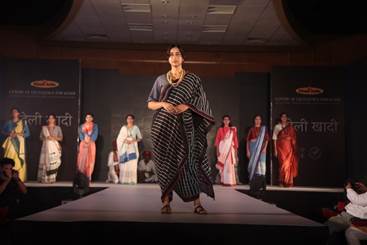
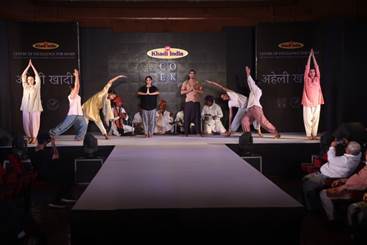
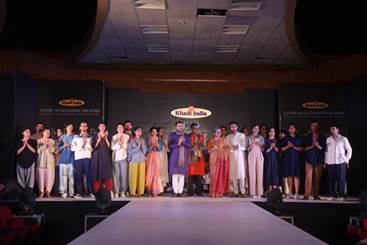
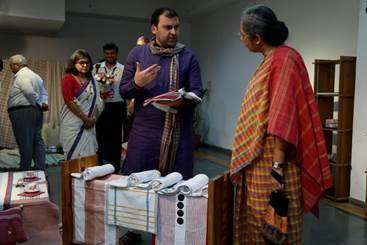
With the intention to reach out to young audience and global market, an exhibition and to popularise khadi as a fabric and showcase its use for traditional and contemporary cloths ‘Aheli Khadi’ a Fashion Show was organized by Khadi India at the Tana Riri Auditorium, NIFT Gandhinagar on Sunday.
Shri Manoj Goel, Chairman of KVIC graced the function as chief guest. Eminent designers, fashion industry members, students and khadi institutions graced the fashion show.
Khadi is symbolic of the Swadeshi movement, and has been a front runner in establishing its robustness as a fabric that is both empowering and modern in its interpretation. That’s why Khadi has found favour with the younger generation, as it transcends from being termed as fabric and showcase its use for traditional and contemporary clothing, “Aheli” khadi means pure khadi; was showed during the fashion show.
Apparel for Yoga as “SWADHA” chic, now accepted as an effective medium of communication designed by NIFT designer was the prominent attraction of the fashion show.
Another attraction of the fashion show was “Aheli”; the fabric showcased at ramp was sourced from the khadi institutions to design for pan generational consumer. NIFT designers designed six distinct collections of apparel and sarees ranging from ethnic, fusion, western and casual look. Hand embroidery, stitch detailing and hand block printing has been used to add value to the exquisite khadi. Home linen collections were designed with Khadi fabrics of different weights and yarns combining Indian crafts with an International look to position Khadi as Global.
The show was designed and presented by NIFT students, who walked on the ramp as models.
Shri Manoj Goel, Chairman, KVIC in his key note addressed said; our effort will be to make “Khadi Global”. The aim of KVIC is to promote and pitch Khadi at a relatable, high design level, it also wishes to encourage use of khadi as an environmentally sustainable fabric to replace non-biodegradable unsustainable product in the domain of home and apparel.
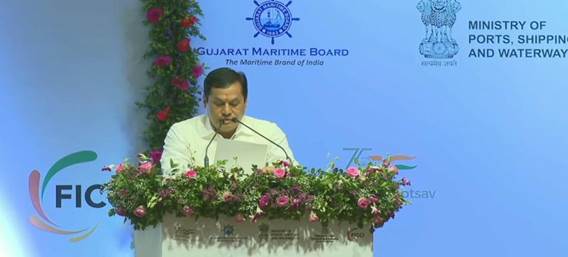
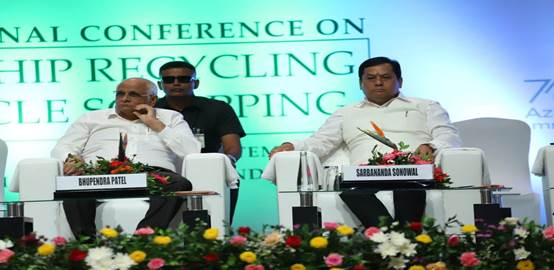
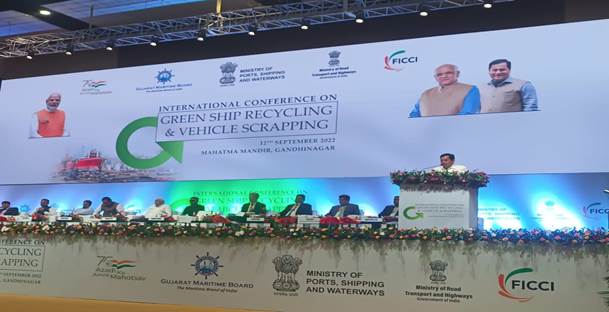
Union Minister of Ports, Shipping and Waterways Shri Sarbananda Sonowal has said that Gujarat is the business gateway of India and one of the world’s preferred maritime destinations. Addressing International Conference on Green Ship Recycling and Vehicle Scrapping in Gandhinagar today he said with a coastline of 1,600 km, Gujarat handles over 40% of India’s cargo throughput and contributes 18% of the total cargo transported using coastal shipping. He said Gujarat was the first state in the country to privatise the port sector, and by virtue of its strategic location, proactive policies, and robust infrastructure has emerged as the flag bearer of India’s maritime success story. Shri Sonowal said India is a leading destination for ship recycling and the planned doubling of capacity of Alang-Sosiya shipyard in Gujarat will create a large number of employment opportunities and bring in more economic prosperity to Gujarat and the country.
Taking about the Sagarmala Programme, Shri Sonowal said it has given impetus to the thriving maritime sector in Gujarat with projects such as port modernisation, rail, road, cruise tourism, RO-RO & passenger jetties, fisheries, coastal infrastructure, skill development, etc. There are 74 projects worth Rs. 57,000 crore under Sagarmala Programme in Gujarat, of which 15 projects worth Rs. 9,000 crore have been completed, 33 projects worth over Rs. 25,000 crore are under implementation and 26 projects worth Rs. 22,700 crore are under development, he said.
Speaking on the occasion Chief Minister Shri Bhupendra bhai Patel said under the leadership of Prime Minister Narendra Modi, Gujarat is now moving towards port-led development. Gujarat is India’s coastal gateway. He said the state is home to Alang, the largest ship-breaking yard in the world. Just as Gujarat has been dominant in ship breaking-recycling sector, it will also be in green recycling. He said Gujarat has the potential and the political will to become a hub for green ship recycling. The Gujarat government is committed to making Gujarat a global centre for green recycling. He said Alang also has a well-developed ecosystem and capacity for vehicle scrapping and will contribute majorly to the vehicle scrapping policy.
The International Conference on Green Ship Recycling and Vehicle Scrapping is showcasing the current status of ship recycling industry in Gujarat and the adoption of HKC Convention compliances. The conference is also facilitating discussion on how the EU shipping industry can take advantage of ship recycling facilities in Gujarat, and explore partnerships with EU member countries.
Highlighting the significance of the conference, MK Das, Additional Chief Secretary of Ports and Transport Department, Government of Gujarat, said the conference will put Alang on the global map as a preferred destination for sustainable ship recycling that has safe and environmentally sound ship recycling best practices in place. He said the conference will also help in exploring synergies between Alang’s ship recycling industry with the vehicle scrapping industry, and enable Alang to emerge as a vehicle scrapping hub.
Two sessions were also organised as a part of the conference. The first session on “Ship Recycling Industry in India and Compliances” focused on the Ship Recycling Act, the role of GMB, compliance with HKC and EU Ship Recycling Regulation (EUSRR), and safe and sustainable recycling.
The second session was on Vehicle Scrap Policy and saw an overview of the policy. It also showcased Alang’s capabilities as a hub of vehicle scrapping.
Representatives from the Ministry of Ports, Shipping & Waterways, CEOs, and national and international industry representatives from the shipping sector including shipping lines, ship recyclers, ship owners, etc. participated in the conference. The conference will be followed by a visit to the Alang ship breaking yard on September 13.
Shri Sonowal also visited the site of proposed National Maritime Heritage Complex near Lothal and reviewed the progress of the project in presence of senior officers of Government of Gujarat and Ministry of Ports, Shipping and Waterways. The project is being developed by the Government of India through MoPSW for an estimated amount of Rs.3500 crore. The proposed Complex would showcase India’s rich and diverse maritime heritage and will be the first of its kind in the country and one of the world’s largest maritime museums dedicated to the legacy of maritime heritage of India.
Life size architecture of the Lothal will be depicted in the museum. The various components like, lower town, middle town, Citadel, cemetery, houses, pattern of the street, sanitation system, wells, industries/workshop and marketplace, etc. will be depicted in the museum. To provide First-Hand Experience to visitors, a working model of the Lothal dockyard, functioning of the warehouse etc. will also be showcased along with typical Harappan house with components like, oven, etc. The museum will portray renowned Harappan Water Harvesting and Management system excavated at the site of Dholavira.
Renowned architecture firm Ms. Architect Hafeez Contractor has been appointed as the Project Management Consultant of the project and have already prepared Concept Design & Plan for following 5 Galleries of phase 1A:
a) Gallery- 1 Orientation and oceanic mythology
b) Gallery-2 Harappans: The Pioneer Seafarers
c) Gallery- 3 Post Harappan Trajectories: The Impact of Climate change
d) Gallery- 4 India’s contact with the Greco-Roman world
e) Gallery- 5 Special exhibitions
The work on concept design of Gallery 6 (Emergence of Indian Navy) is in progress by Ms. Architect Hafeez Contractor in consultation with the officials of Indian Navy and consolidated list of artefacts for the galleries has been finalized.
The EPC work of the NMHC phase 1A has been awarded to Tata Projects Ltd. in Mar 2022 and is targeted to be completed by Mar 2024.
The project will boost the tourism in the state of Gujarat in turn developing the economy of the region including the nearby villages namely Saragwala and Utelia. The proposed six galleries planned in the NMHC project will focus on different time periods of the Maritime history to the visitors.
Speaking after the visit Shri Sonowal stated that the project will be developed as a new international destination for tourist and to stand at par with other renowned international museums of the world under the Sagarmala program of the Ministry of Shipping. He said It will also create an opportunity of employment for the local people and help them develop a number of cottage industries thus materializing the vison of Atmanirbhar Bharat of Prime Minister Shri Narendra Modi.
Business Process Outsourcing (BPO) is the delegation of the Ownership, Administration, and Operation of a process to a third party. Many people see it as an evolution from Information Technology Outsourcing (ITO). Business Process Outsourcing (BPO) is the delegation of one or more IT-intensive business processes to an external provider that in turn owns, administers and manages the selected process based on defined and measurable performance criteria. Business Process Outsourcing (BPO) is one of the fastest growing segments of the Information Technology Enabled Services (ITES) industry.
Several MNCs are increasingly unbundling or vertical disintegrating their activities i.e. they have begun outsourcing activities which formerly performed in house and concentrating their energies on a few functions. Outsourcing involves withdrawing from certain stages/activities and relying on outside vendors to supply the needed products, support services or functional activities. These outside vendors are called BPOs. The outsourcing industry is growing from strength.
Why do everything yourself, when someone else can do it at low cost? In the current scenario, the theory says exactly the same. The global market today is highly competitive and continuously changing. A company must, thus, focus on improving productivity and at the same time, cut down costs. This is the basic premise of outsourcing. Outsourcing works because what is non-core for one organisation, is core for another.
In brief, business process outsourcing can be seen as a process in which a company delegates some of its in-house operations or processes to a third party. Thus, it is a transaction through which one company acquires services from another, while maintaining ownership and ultimate responsibility for the processes.
The company then informs its provider what it wants, and how it wants the work to be performed. The main motive for business process outsourcing is to allow the company to invest more time, money and human resources into core activities and building strategies, which fuel company growth.





 Eduindex
You must be logged in to post a comment.