Business Process Outsourcing (BPO) is the delegation of the Ownership, Administration, and Operation of a process to a third party. Many people see it as an evolution from Information Technology Outsourcing (ITO). Business Process Outsourcing (BPO) is the delegation of one or more IT-intensive business processes to an external provider that in turn owns, administers and manages the selected process based on defined and measurable performance criteria. Business Process Outsourcing (BPO) is one of the fastest growing segments of the Information Technology Enabled Services (ITES) industry.
Several MNCs are increasingly unbundling or vertical disintegrating their activities i.e. they have begun outsourcing activities which formerly performed in house and concentrating their energies on a few functions. Outsourcing involves withdrawing from certain stages/activities and relying on outside vendors to supply the needed products, support services or functional activities. These outside vendors are called BPOs. The outsourcing industry is growing from strength.
Why do everything yourself, when someone else can do it at low cost? In the current scenario, the theory says exactly the same. The global market today is highly competitive and continuously changing. A company must, thus, focus on improving productivity and at the same time, cut down costs. This is the basic premise of outsourcing. Outsourcing works because what is non-core for one organisation, is core for another.
In brief, business process outsourcing can be seen as a process in which a company delegates some of its in-house operations or processes to a third party. Thus, it is a transaction through which one company acquires services from another, while maintaining ownership and ultimate responsibility for the processes.
The company then informs its provider what it wants, and how it wants the work to be performed. The main motive for business process outsourcing is to allow the company to invest more time, money and human resources into core activities and building strategies, which fuel company growth.
At the touch of a screen, most people now get their news information online, especially from social media. Social media reaches a maximum audience. In a recent survey, 50 percent of internet users said that they get to know about the latest news via social media even before it is on a news station. Social media in reporting is that the news does not get spread fairly quickly. If information is correct then it can be an excellent way of getting the news.
Positive -:
1. The news on social is immediate, while traditional media, can be delayed due to press times
2. Social media is versatile (you can make changes or delete once published. Whereas traditional media, once published, is set in stone.
3. The accessibility of social networks across devices makes them easy to use on the go and one of the most convenient ways to read the news.
4. RVCJ media page that provides the latest news on Instagram
Negative -:
1. There is a fierce media competition 2. Social platforms have control over what news and information we see. Our social media friends have become “managing editors” deciding what we see. An article needs to be liked and shared multiple times before many see it in their feed. Therefore, social media friends have control over what news pieces we see and what we do not. 3. The authentic content is hard to come by now. In fact, fake news is actually more likely to spread than the truth. 4. Falsehood diffused significantly farther, faster, deeper, and more broadly than the truth in all categories of information.
Conclusion -:
News happens fast now. Today’s story will be tomorrow’s forgotten story. It is easy to miss things now because of how quick stories can get turned around and shared. While having so much information at our fingertips is great, it is worth always checking sources and not taking headlines as truth. With social media as our new news managers, it is up to us to be the new fact checkers for media.
Kerala was formed on 1st November 1956. Chief language of state is malayalam. Main rivers are Periyar, Bharatapuzha, Pamba,Chaliyar, Achenkovil, Muvattupuzha. Mountains are Anamala is the highest peak, Karinkulam, Mukutti, Devimala. The main beaches are Kovalam, Varkala, Vizhinjam, Shankumukham(trivandrum)etc. The main waterfalls are Athirapally, Palaruvi and Vazhachal. The wildlife sanctuaries include Peppara lNational park, Silent valley, Parambikulam National Park, Periyar National Park, Eravikulam National Park known for its Nilgiri Tahr.
Thiruvananthapuram (Trivandrum) is the capital of Kerala, it is a beautiful city with art galleries, palaces, beaches etc. Main places to visit are Sri Padmanabhaswami temple, Kuthiramalika palace museum, Kanakakkunnu palace, Science and technology museum and planetarium, Observatory tower, Napier museum, Sri Chitra Art gallery. Kovalam beach, Veli tourist village, Neyyar dam andvwildlife sanctuary , ponmudi hill resort and Varkala beach.
Kumarakom
At Kumarakom house boat sailing on backwaters. The kottayam, kollam, alapuzha route is famous for scenic beauty. Boat races are held here annually and it’s a royal attraction. Kumarakom bird sanctuary, Vembanadu lake is place for water ride.
Thekkady
Periyar wildlife sanctuary with artificial lake surrounded by evergreen forest and grasslands. It’s home to bison, antelopes, sambhar, monkeys, langur, elephants, tigers etc.Thekkady is centre inside Park with hotels and boat jetty. Kumily is the closest town.
Kochi
Kochi consist of Ernakulam, Wellington Island, Bolgatty, Mattanchery, Vypin Island, Fort Cochin etc. St. Francis church with tombstone of Vasco da Gama, the Mattanchery palace, the Jewish synagogue constructed in 1568. Other attractions are Bolgatty Island, Harbour, Chinese fishing nets, ParishathThampuran museum and Veegaland amusement park.
Thrissur
Thrissur is known as kerala’s cultural capital. Places to visit are Vadakumnatha temple, churches include Our Lady of Lourdes cathedral, Puthenpalli, Chandran church etc. Many important temple festivals including thrissur pooram, peruvanam pooram, Arattupuzha pooram, thaipooya maholsavam etc. Kerala Kalamandalam and Guruvayoor Sree Krishna temple is situated in thrissur.
Kannur
Kannur is the best place to enjoy Kerala’s ritual art Theyyam. Regular Theyyams are held in Parassinikadavu temple and at Kerala folklore academy. The Portuguese built St. Angelo fort and Kanjirode weavers cooperative are worth visiting. The famous Bakel fort and Kappil beach are places to visit.
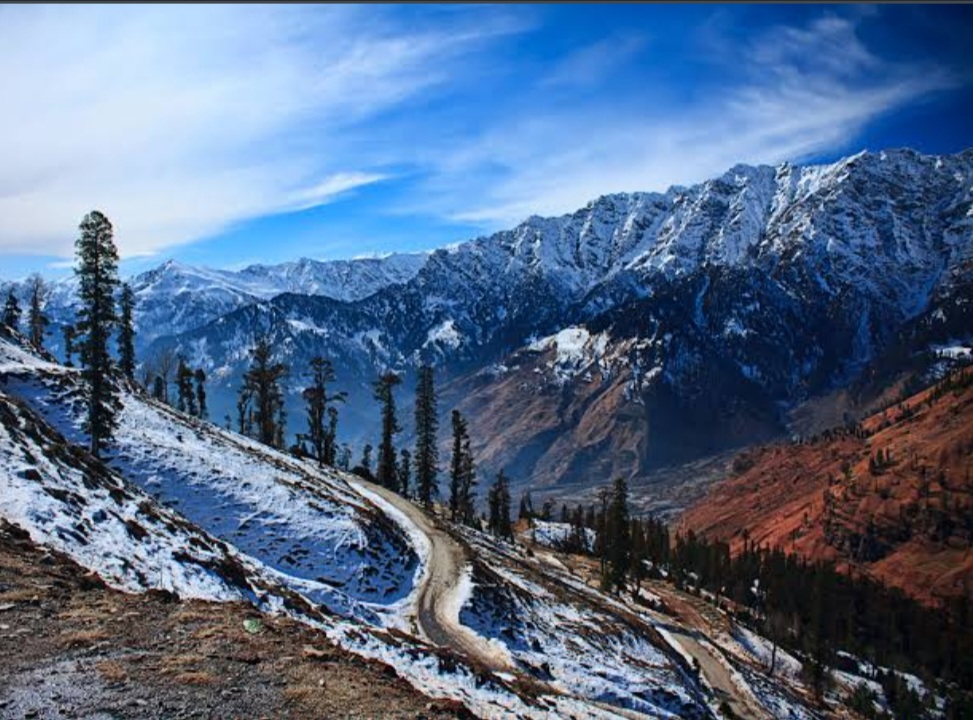
Himachal Pradesh was formed on 25 January 1971. The capital is Shimla. The languages spoken by people are Pahari, Hindi, Punjabi and Kinnauri. The main towns are Shimla, Mandi,Dharmashala, Kullu, Manali,Bilaspur, Chamba, Kye- lang, Kalpa and Kangra. For shopping Pashmina shawls are famous, rugs, gudma, namdas are attractions. Dal housie- kulu shawls and Tibetan handicrafts, lakkar bazar are worth visiting. The main rivers are Beas, Chenab,Ravi, Satluj, Yamuna. Mountain ranges are Great Himalaya , Punjab Himalaya, Saket hills, Shimla hills, Shiwalik range, Missouri range. The main valleys are Kangra Valley, Mahasu Valley, Lahul Valley, Baspa Valley etc.
The famous places to visit in Himachal pradesh are Shimla known as summer capital of British India. The summer hill and the Prospect hill, the Viceregal lodge(Rashtrapati niwas), and botanical garden, the Indian Institute of Advanced Studies, the Himachal State Museum etc are worth visiting. Many beautiful places to visit like Jakhu hill and temple, Skating rink, Annandale, Chadwick falls, Chail, Malhotra etc.
Dharamsala
It is ideal location for meditation, quiet walks, trekking, rock climbing etc. It is also referred to as “ Little Lhasa”.Tibet museum and the Tsunglagkhag temple. St. John’s church, the Kangra art museum, Tibetan institute of performing arts, Dip Tse- Chok Ling Gompa, library of Tibetan works, Tibetan medical and astrological institute, Dharamkot, Bhagsunath waterfall, Machhirial waterfall etc.
Chamba
Chamba on the banks of the river Ravi is famous for shikara hindu temples,Chamba rumal(miniature paintings), Brajeshwari Devitemple, Chamunda devi temple, Rang mahal, Bhuri Singh Musuem, Saloni and Bhandal valley.
Dalhousie
It is a hill station spreading over five hills. Main attractions include Gandhi Chowk, Subhash Chowk, Panjpulla, Moti Tibba, Karelnu, Khajjiar meadow.
Kullu
Kullu is famous and colorful during Dussehra festival in October and filled with picturesque lush green valleys. Mandi is gateway to Kullu Valley and the junction of roads from Kullu Valley, Kangra Valley and Shimla. Rani Amrit Kaur park, Rewalsar lake, prashar lake, Roerich gallery, Naggar castle, great Himalayan National Park etc are main attractions.Manali is the North of Kullu. The nearest airport is Bhuntar to Kullu and Manali. It is ideal place for trekking, mountaineering, rafting, skiing, jeep safaris, fishing etc.
The super rich industrialists and financiers such as John D. Rockefeller, Andrew W. Mellon, Andrew Carnegie, Henry H. Rogers, J.P. Morgan, Cornelius Vanderbilt of the Vanderbilt family, and the prominent Astor family were labeled as “robber barons” by the common people.
A robber baron is a term used frequently in the 19th century during America’s Gilded Age to describe successful industrialists whose business practices were often considered ruthless or unethical. Robber baron is a term that is also sometimes attributed to any successful businessperson whose practices are considered unethical or unscrupulous. This behavior can include employee or environmental abuse, stock market manipulation, or deliberately restricting output to charge higher prices.
These practices included exerting control over natural resources, influencing high levels of government, paying subsistence wages, squashing competition by acquiring their competitors to create monopolies and raise prices, and schemes to sell stock at inflated prices to unsuspecting investors. The term combines the sense of criminal (“robber”) and illegitimate aristocracy (a baron is an illegitimate role in a republic). This monopoly was achieved in part by crushing rivals and systematically cheating Native Americans of fur pelts.
During 19th century the chief complaint that was capitalists were becoming monopolists. Fear over the robber barons and their monopoly practices increased public support for the Sherman Antitrust Act of 1890 (The Sherman Anti-Trust Act authorized the federal government to institute proceedings against trusts in order to dissolve them). Many so-called robber barons. became wealthy entrepreneurs through product innovation and business efficiency. Of the goods and services they provided, supply grew, and prices fell rapidly, greatly boosting Americans’ standards of living. This is the opposite of monopolistic behavior.
Some Of The Major Robber Barons -:
1. James Fisk, one Wall Street’s first great financiers, accumulated much of his fortune by fraudulent stock market practices. The venture brought them vast sums but led to a securities market panic that began on September 24, 1869, a day that was long remembered as Black Friday.
2. Leland Stanford became involved in Republican politics in California and was elected governor in 1861. With three colleagues, he formed the Pacific Association and used their combined assets to bribe congressmen and others with political influence in the country’s capital. In return, the association was provided 9 million acres (3.6 million hectares) and a $24 million loan financed by federal bonds.
3. John D. Rockefeller made his immense riches from monopolizing America’s oil industry. Conspiring with refinery owners, he helped found what became known as the Standard Oil monopoly. Those who stubbornly resisted were confronted with price wars. By 1890, the Rockefeller trust controlled approximately 90 percent of the petroleum production in the United States, a situation that led to the passage of the Sherman Antitrust Act that same year.
4. J.P. Morgan who organized a number of major railroads and consolidated the United States Steel, International Harvester, and General Electric corporations
5. Andrew Carnegie who led the enormous expansion of the American steel industry in the late 19th century; shipping and railroad magnate
6. Cornelius Vanderbilt, Industralist
7. George Pullman the inventor of the Pullman sleeping car
8. Henry Clay Frick who helped build the world’s largest coke and steel operations.
Common criticisms of the early robber barons -:
Poor working conditions for employees, selfishness, and greed. Some robber barons including Robert Fulton, Edward K. Collins, and Leland Stanford earned their wealth through political entrepreneurship. Many wealthy railroad tycoons during the 1800s received privileged access and financing from the government via extensive use of lobbyists.
The major considerations of robber barons are – :
•While robber barons took advantage of their workers, they sometimes offered better working conditions than the norm of the day
•Some tycoons rank among the most noted philanthropists of all time. Rockefeller donated around 10% of every paycheck he ever earned.
•Railroad tycoon James J. Hill publicized and provided free education about crop diversification, and would transport immigrants at reduced rates if they promised to farm near his railroads.
Radio broadcasting began in India in 1922. The Government owned radio station All India Radio dominated broadcasting since 1936.
Broadcasting in India actually began about 13 years before AIR came into existence. In June 1923 the Radio Club of Bombay made the first ever broadcast in the country. This was followed by the setting up of the Calcutta Radio Club five months later. The Indian Broadcasting Company (IBC) came into being on July 23, 1927, only to face liquidation in less than three years.
In April 1930, the Indian Broadcasting Service, under the Department of Industries and Labour, commenced its operations on an experimental basis. Lionel Fielden was appointed the first Controller of Broadcasting in August 1935. In the following month Akashvani Mysore, a private radio station was set up. On June 8, 1936, the Indian State Broadcasting Service became All India Radio.
The Central News Organisation (CNO) came into existence in August, 1937. In the same year, AIR came under the Department of Communications and four years later came under the Department of Information and Broadcasting. When India attained independence, there were six radio stations in India, at Delhi, Bombay, Calcutta, Madras, Tiruchirapalli and Lucknow. The following year, CNO was split up into two divisions, the News Services Division (NSD) and the External Services Division (ESD). In 1956 the name AKASHVANI was adopted for the National Broadcaster. The Vividh Bharati Service was launched in 1957 with popular film music as its main component
The phenomenal growth achieved by All India Radio has made it one of the largest media organisations in the world. With a network of 262 radio stations, AIR today is accessible to almost the entire population of the country and nearly 92% of the total area. A broadcasting giant, AIR today broadcasts in 23 languages and 146 dialects catering to a vast spectrum of socio-economically and culturally diverse populace.
Programmes of the External Services Division are broadcast in 11 Indian and 16 foreign languages reaching out to more than 100 countries. These external broadcasts aim to keep the overseas listeners informed about developments in the country and provide a rich fare of entertainment as well.
The News Services Division, of All India Radio broadcasts 647 bulletins daily for a total duration of nearly 56 hours in about 90 Languages/Dialects in Home, Regional, External and DTH Services. 314 news headlines on hourly basis are also being mounted on FM mode from 41 AIR Stations. 44 Regional News Units originate 469 daily news bulletins in 75 languages. In addition to the daily news bulletins, the News Services Division also mounts number of news-based programmes on topical subjects from Delhi and its Regional News Units
AIR operates at present 18 FM stereo channels, called AIR FM Rainbow, targeting the urban audience in a refreshing style of presentation. Four more FM channels called, AIR FM Gold, broadcast composite news and entertainment programmes from Delhi, Kolkata, Chennai and Mumbai. With the FM wave sweeping the country, AIR is augmenting its Medium Wave transmission with additional FM transmitters at Regional stations.
In April 2020, as per a survey by AZ Research PPL, commissioned by the Association of Radio Operators for India (AORI) Radio listenership in India touched a peak of 51 million.
Does radio have a future?
The consoles, connected watches and TV’s that we use every day will be just another way in which radio stations can broadcast and increase their audience numbers. Since its creation, radio has continually evolved with the times
Why Radio is still popular?
Portable and Inexpensive: Radio is portable among many modes of communication. They can be used in cars, stores, and other places, which helps to reach the targeted audience. According to researchers, broadcast radio reaches 99% of the Indian population today.
The Government decision for transition to the digital mode of transmission, AIR is switching from analog to digital in a phased manner. The technology adopted is the Digital Radio Mondiale or DRM. With the target of complete digitization by 2017, the listeners can look forward to highly enhanced transmission quality in the near future.
The International Financial Services Centres Authority (“Authority” or “IFSCA”), with an overall objective to promote the establishment of a world-class FinTech Hub, at GIFT International Financial Services Centre (IFSC) in India, launched the IFSCA (FinTech Incentive) Scheme for providing financial support to FinTech activities in the form of specific grant(s). The Scheme was notified vide Gazette Notification number IFSCA/2021-22/GN/022 dated 2ndFebruary, 2022.
This scheme shall be open to –
Domestic FinTechs seeking access to overseas markets;
Domestic FinTechs seeking listing on IFSCA recognised stock exchanges;
Foreign FinTechs seeking market access to IFSCs in India and work within the Authority’s regulatory framework;
Foreign FinTechs seeking access to domestic market under Inter-Operable Regulatory Sandbox (IORS) framework;
Domestic FinTechs extending business to the IFSCs either by way of authorisation or registration or through the regulatory sandbox.
The types of incentives for eligible applicants are:
FinTech Start-up grant- This grant shall be utilized for developing a product or a service and related ‘go-to market’ initiatives for a start-up with a novel FinTech idea or solution with a focus on converting the idea into an MVP.
Proof of Concept (PoC) grant- This grant shall be utilized for the purpose of conducting a PoC by an early or mature FinTech Entity (FE) in domestic market or overseas.
Sandbox grant- This grant shall be utilized by FEs to experiment with innovative products or services in a sandbox.
Green FinTech Grant- This grant shall be utilized towards developing solutions facilitating sustainable finance and sustainability linked finance, including ‘Environmental, Social and Governance (ESG)’ investments.
Accelerator Grant- This grant shall be utilized for supporting accelerators at the IFSC for capacity building, build capabilities around mentors, bringing investors, bringing more projects or PoC, tie ups, etc.
Listing Support Grant – The grant shall be utilized for supporting Domestic FE aspiring to go for listing on stock exchanges recognised by the Authority.
The Grants contemplated under this scheme shall be available to eligible FEs:
who are part of the Authority’s Regulatory or Innovative Sandbox;
which are referred to the Authority under a FinTech bridge arrangement with a Counterpart Regulator
which have either participated or are participating in any Accelerator or Cohort or Special Programme supported or recognised by the Authority; or
who are referred to by the entity(ies) including regulatory or supervisory bodies having Memorandum of Understanding (MoU) or collaboration or special arrangement with the Authority.
The detailed Guidelines of the Scheme for implementation as well as the Application Form are hereby being issued.
Please refer to IFSCA Circular (may be accessed at https://ifsca.gov.in/Viewer/Index/292 ) dated April 27, 2022 on “Framework for FinTech Entity in the IFSCs” to obtain authorisation as FinTech Entity (FE).
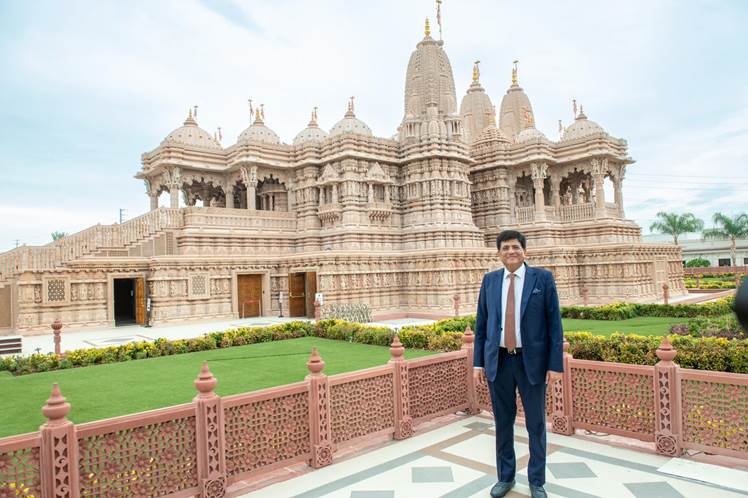
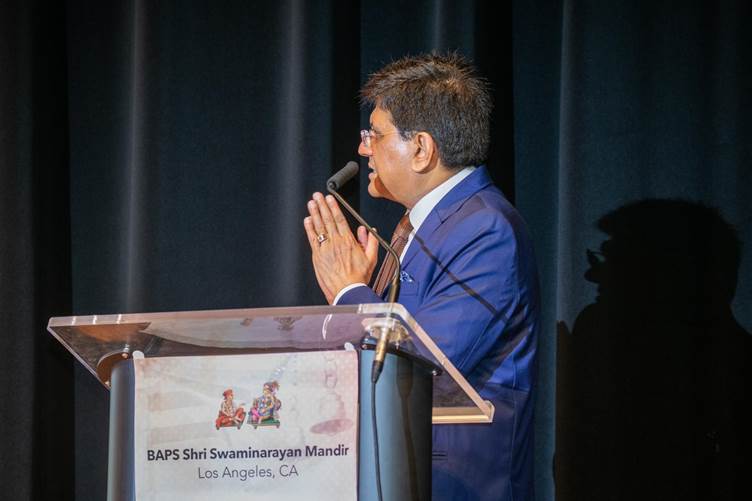
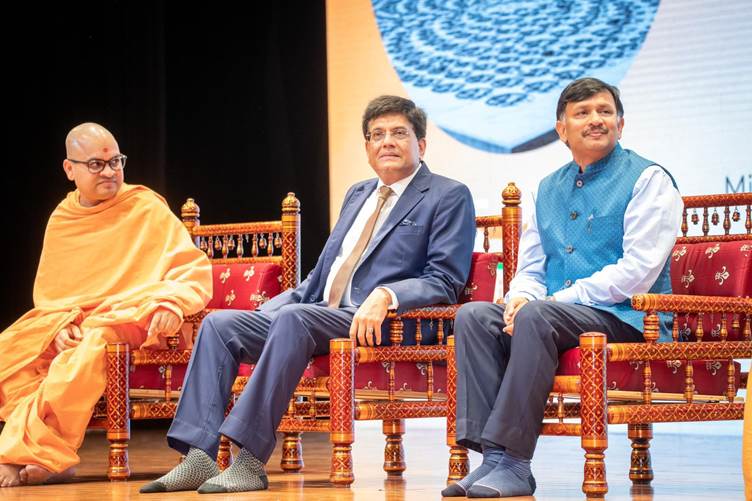
Union Minister of Commerce and Industry, Consumer Affairs, Food and Public Distribution and Textiles, Shri Piyush Goyal today said that BAPS Swaminarayan temple was doing great service to the society all over the world. He was addressing Indian Community after a visit to the Shree Swaminarayan Temple in Los Angeles.
Expressing his admiration at the beauty of the Shree Swaminarayan temple complex in Los Angeles and conveying his congratulations on the completion of 10 years of its existence, the Minister said that the presence of the temple was very befitting to the significant presence of Indians in the area and the contribution of Indians to the development and growth of the area of Los Angeles.
Paying his tributes to Pramukh Swami Maharaj on his centennial birth anniversary, he said that this was a very special occasion for all of us around the world who have received his blessings and learnt goodness from him. Reminiscing that he has had the privilege of having a special bonding with Pramukh Swami Maharaj Ji’s various programs over the years, Shri Goyal said that he also got a chance to actively participate in the 75th anniversary celebrations of Pramukh Swami Maharaj in Mumbai many years ago.
Shri Goyal said that he has always had the good fortune of visiting Shree Swaminarayan temples across the world and added that the temple in Los Angeles was very unique and beautifully planned and executed. The feeling of spirituality one experiences when visiting this temple in itself is very unique, he said.
The Minister observed that the contribution of BAPS in keeping Hindus together and keeping the spirit of Hinduism glowing and flowing all around the world is invaluable. He opined that when people moved out of India and experience the material facets of life, the, the next generation was observed to lose the connect to the motherland. But wherever Swaminarayan temple has come up, spirituality flourishes there and the next generation retains its connect with the motherland. They inculcate very good habits and practices. Therefore, this institution is doing great service to the society at large all over the world, he said.
Underscoring that Swaminarayan Bhagwan has always believed in humanity and spirituality and in service to society, Shri Goyal said that his teachings focussed on our role in giving back to the humanity at large. The wonderful teachings of gyan, bhakti and shraddha that Swaminarayan has taught us and Pramukh Swami Maharaj has propagated will remain with all of us. His teachings will continue to inspire and guide me all through my life, Shri Goyal said.
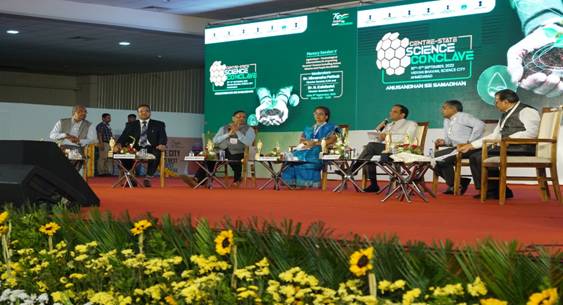
Technological interventions for processing, product development, sustainability, and export orientation that could improve farmers’ income were discussed at the Centre-State Science Conclave in Ahmedabad today.
“India is identified in the global arena for its strength in agriculture, and to continue with this position, we need to focus on S&T interventions in food and water,” said Dr. N Kalaiselvi, Director General, CSIR.
Dr. Himashu Pathak, Director General, ICAR,stressed on theadoption of a holistic approach to ensure production, protection, and sustainability for the agricultural system.
Dr. AK Singh, Deputy Director General, Horticultural & Crops Sciences, ICAR, spoke about the adaptation of technologies like ICAR-FUSICONT technology for medium and high-density plantations to bridge the yield gap, increase productivity, and collaboration to expand the online market places.
“With primary challenges focused on food grain production, the productivity of crops could be increased by using new techniques like genome editing,” Dr. KB Kathiriya, Vice Chancellor, Gujarat Agricultural University, Anand, pointed out.
D Srinivasa Reddy, Director, CSIR – IIIM, elaborated about the development of aroma-based entrepreneurs along with end-to-end technology. “While the purple revolution under CSIR-Aroma mission has empowered the farmers of several states, now floriculture mission has been initiated for crop diversification,” he added.
Shri Saurabh Bhagat, Secretary, Science & Technology, UT of Jammu & Kashmir, insisted on opportunities in horticulture and the establishment of demonstration farms.
“Sustainable agriculture technologies are being used to improve farmers’ economic conditions. Some of these are nano-fertilizers to increase soil fertility and IoT-based technologies to minimize the labour shortages,” said Dr. R Srinivasan, Member Secretary, S&T Council, Government of Tamil Nadu.
Shri N V Ramana, Samunnati Agri Enterprise, Hyderabad, pointed out that markets will have to be created for small farming sectors, technologies will have to be harnessed to enable non-linear scalability, and a digitally wrapped agri-ecosystem will have to be created.
The expert panelists at the agriculture session of the conclave organized by the Department of Science & Technology, Government of India, jointly with the Government of Gujarat at Science City, Ahmedabad, deliberated on challenges and their plausible solutions for improving agricultural income.
The Department of Water Resources, River Development and Ganga Rejuvenation, Ministry of Jal Shakti has launched the ‘Water Heroes: Share Your Stories’ contest. The 3rd edition has been launched on 01.12.2021 and will end on 30.11.2022 on MyGov portal. The 1st edition was launched from 01.09.2019 to 30.08.2020. The 2nd edition was launched from 19.09.2020 to 31.08.2021.
The objective of the contest is to promote value of water, in general, and for supporting country-wide efforts on water conservation and sustainable development of water resources. In accordance with the vision of Hon’ble Prime Minister Narendra Modi, a large population should be motivated to adopt the cause of water conservation in the country. The aim of the contest is to create awareness for water conservation by enhancing knowledge and sharing experiences of water heroes; and to create an attitude towards water conservation and management so that a behavioral change can be created amongst all stakeholders.
For the month of August 2022, there are six winners, they will get a cash prize of Rs. 10,000/- and a certificate, details given as below:
Divyansh Tondon:
He is from Meerut, associated with the campaign named “Paani Panchayat” under which they go to various villages, streets, towns, schools, localities and making public aware. He is vice president (Meerut Cantt.) Saarthi Social welfare society.
Vinay Vishwanath Gawas
He is a Project Director from Goa, campaigning about Rooftop Rainwater Harvesting and borewell recharge in Kelawade village, Keri sattari, Goa. The project is said to be built in collaboration with TERI.
Amit
He is a Gram Pradhan in Malakpura, Jalon, UP and was a Journalist in Delhi. He has done various activities for development such as providing healthy foods in the primary school of the village, working in plantation work, environment protection and Water purification through sedimentation activities.
Babita Rajpoot Ghuwara
She is from Chattarpur, Madhya Pradesh. She is involved in the construction of four check dams and two outlets and made bori bandahan.
Anurag Patel
Anurag Patel, District Magistrate, Banda in a considerable effort to conserve water ran two significant campaigns- ‘Jal Sanchay, Jeevan Sanchay’ and ‘Jal Kumbhi Hatao-Talab Bachao Abhiyan’. He took the initiative to remove water hyacinth from 126 ponds. He also took efforts to rejuvenate the Chandrawal River by digging up extra miles for renovation purpose. 664 ponds in Mirzapur and 101 in Janpad Farrukhabad was revived under his efforts.
Snehlata Sharma
Snehlata Sharma from Shivpuri District Block Badarwas, Piparodha Village has been doing a considerable and praiseworthy job in field of water conservation and management from the past 1 year. For creating awareness around the village about water and its conservation, she brought women in the forefront. She also generated awareness about the crops that uses less water in the field.
The contest is held monthly and may be seen on MyGov portal. To participate in the contest, one needs to post their success stories on water conservation efforts in the form of 1-5 minutes video, along with a write-up of 300 words and attach some photographs/ photos that depict the efforts. Also, the participants can share their videos (with the link to their YouTube video) on the MyGov portal (www.mygov.in). In addition to this, entries can be submitted at waterheroes.cgwb[at]gmail[dot]com .
Brazil is known as Federative Republic of Brazil. The capital of Brazil is Brasilia. Large cities include Sao Paulo, Rio de Janeiro, Belo Horizonte, Recife and Salvadore. Official language spoken is Portuguese, Spanish, French and English. The type of government is federative republic. Brazil is the largest South American state. It is land of dense forest and mighty rivers. The Amazon and the Sao Francisco cover the north of the country. Brazil’s industry has benefitted from its wealth of mineral resources. The major exports of Brazil are soyabean, sugar, coffee, iron, cocoa bean,maize, tobacco. It is also leading producer of orange, orange juice concentrate, cassava,sisal, alcohol and bananas. Brazil got independence on 7th September 1822.Currency of Brazil is Real. Brazil posses vast deposit of mineral wealth that include chrome ore, iron, phosphorus, uranium, copper, coal, gold, platinum. Oil is the state monopoly. The wax which was used for phonograph records and insulation is monopoly product of the state.
The official name of U.K is United Kingdom and Northern Ireland. The capital of U.K is London. The languages spoken are English, Welsh, Scottish and Gaelic. Large cities of U.K are Manchester, Birmingham, Glasgow, Leeds and Liverpool. The United Kingdom constitute greater part of British Isles which include England, Scotland and Wales. The capital of Scotland is Edinburgh. The capital of Wales is Cardiff. English and Welsh is spoken. Northern Ireland is also part of U.K. The United Kingdom’s system of government is known as constitutional monarchy. Ministers of the crown govern in the name of sovereign who is both head of state and head of government. Actual power is vested in hands of Parliament which is supreme legislative body in Great Britain. The Parliament consist of two houses – the House of Lord’s and the House of Commons. 84% of the people of U.K reside in England. Chief industries are iron and steel, chemicals, engineering, electronics, motor vehicles, metals and machinery, ship building etc. Agriculture and trawler – fishing are highly mechanized, country’s food supplies and most of its raw materials are imported. Chief crops are grain, sugar, fruits and vegetables. Thames and Severn are the largest rivers. The most famous church is Westminster Abbey. The most celebrated universities are Oxford and Cambridge.









 Eduindex
You must be logged in to post a comment.