NSF to reach out to unrepresented education institutions

 The US National Science  Foundation has expressed keenness to deepen and widen its collaborations with India in the education and skilling sectors. NSF Director Shri  Sethuraman Panchanathan met the Union Minister of Education Shri Dharmendra Pradhan in New Delhi today, to discuss mutual areas of interest and India’s plans for STEM studies under the National Education Policy 2020. 
2022-08-09 15:59:31.677000

Speaking at the meeting Shri Pradhan emphasized that India’s strength lies in its young demographics and strong knowledge base. He said a wealth of  talent is available in various institutions across different regions of the  country, waiting to be nurtured. NSF should therefore  look at increasing its engagement with lesser known and hitherto unrepresented institutions  like NITs, Central Universities and State Universities in addition to the premier  institutions in the country.  Referring to the education- skill continuum that is being created in accordance with NEP 2020, Shri Pradhan also emphasized the necessity of  bringing the  skill sector within the ambit of such collaboration by reaching out to institutions like polytechnics, ITIs and community colleges. He said it was top priority and responsibility of his Government to ensure that all youth, whether in  mainstream academics or in the formal or informal skill sector, get equal opportunity to quality education and skilling so that they are equipped to face the twenty first century challenges. 

NSF is an independent federal agency with the responsibility of promoting  scientific discovery, technological innovation and STEM education. With a budget of  US$8.8 billion, NSF is the major source of federal funding in fields such as mathematics, computer science and the social sciences . India’s engagements with the NSF include six Technology Innovation Hubs under which 8 institutions like IITs, IISc Bangalore and others are collaborating in 30 projects and some projects on Cyber Security. Director NSF is in India to explore ways to enhance these engagements.

Echoing India’s priorities Shri Panchanathan said that like India, inclusivity and accessibility of quality education are  a priority with the US Government too. He assured that NSA would reach out for collaboration with unrepresented institutions including those involved in skilling, so that talent in these places can also be nurtured.

Shri Pradhan has asked the Ministry of Education, led by AICTE, to prepare a framework for further engagement with the NSF, also consulting other relevant Ministries  in this regard.

*****

econfiguring curricular and pedagogical structure under NCF

 To take forward the process of widespread consultation for the development of the new National Curriculum Framework (NCF) based on the National Education Policy, 2020, the Ministry of Education held a meeting with senior officials/representatives of all Ministries and Departments of Govt. of India and important bodies including NCERT, Election Commission of India, ICAR, DRDO, etc. The meeting was chaired by Ms. Anita Karwal, Secretary, Department of School Education and Literacy (DoSEL), Ministry of Education (MoE), and focused on how ministries and organisations can contribute in developing a curriculum framework that is responsive and relevant to the developmental needs and interests of learners at different stages of their development.

In the said meeting, the officials present were first taken through a presentation by Ms LS Changsan, Additional Secretary, DoSEL, on how a curriculum framework is prepared, what are its deliverables and what is expected from them. Many areas of contribution were subsequently discussed, such as, the rapidly changing technology, need for innovation and generation of new ideas, need to focus on crucial areas like climate change, future skill requirements, crucial factors for agricultural growth, knowledge of India, especially in those areas where India is at the forefront for instilling a sense of pride, assistive technology for inclusion, enriching subject knowledge with real-life information, how to promote multilingualism, integration of sports, fitness, arts, etc.  The inputs from ministries would help in identifying and integrating several pertinent areas, skills and competencies in the NCF at relevant stages. It was also discussed that it would be very helpful if the ministries also point out their own role in taking certain ideas forward by partnering with school education ecosystem.

The key deliverables of NCF were discussed in detail, including, Early Childhood Care and Education, Foundational Literacy and Numeracy, Competency Based Education, Flexibility in Choice of Subjects in Secondary Classes, Reduction of Curriculum to Core Essentials, Reimagining Vocational education, Identification of Core Skills and Content, Inclusive Education, Multilingualism, Integrating Knowledge of India, citizenship, values like-appreciation of national heritage, respect for public property, taking care of elders, spirit of service, needs of Gifted Children,  Experiential learning, Integration of arts and craft, toys, health and well-being, sports and physical education Guidance and Counselling, Community involvement etc.

Given the crucial nature of the work undertaken by the MoE in preparing the new NCF, participants shared their ideas on how they would be able to contribute to the process. Ideas such as leveraging the innovation ecosystem of the Department of Science and Technology, understanding the efforts that go into agriculture to bring food on the table, the huge role of Gram panchayats in ensuring enrolment and retention in schools, the importance of imbibing volunteerism in early years, the need for every child to participate in activities related to physical health and well-being, focus on Divyang children, exposure to new technology from a young age, etc. were discussed. It was decided that all ministries would soon send written inputs for the National Steering Committee and NCERT to take cognizance of. In the end, the ministries were also requested to whole-heartedly participate in and disseminate the web-app based citizen survey being undertaken by NCERT on https://survey-ncf.inroad.in/#/ where the questionnaire is available in 22 Indian languages and in English.

The NCF process can be seen at: https://ncf.ncert.gov.in/#/web/home

*********

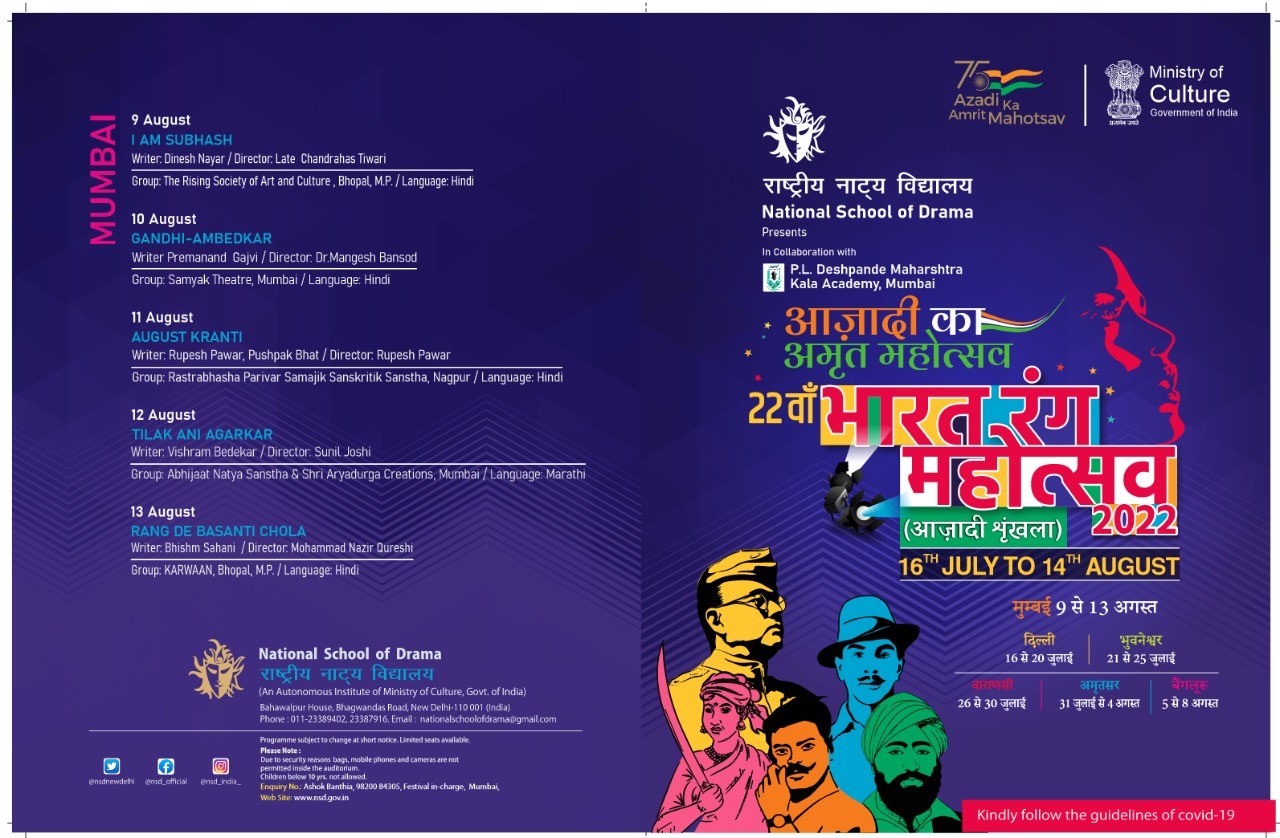
22nd ‘Bharat Rang Mahotsav’ at Rabindra Natya Mandir in Mumbai

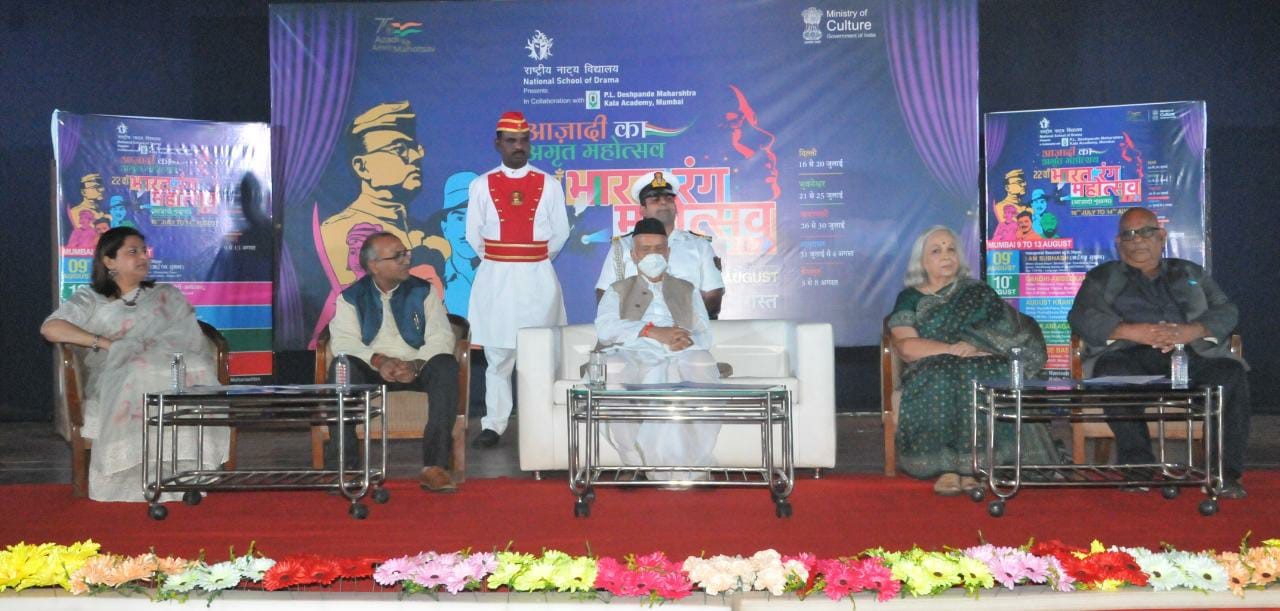
 Maharashtra Governor Shri Bhagat Singh Koshyari inaugurated the 22nd ‘Bharat Rang Mahotsav’ at Rabindra Natya Mandir in Mumbai today. The five-day drama festival (being held from August 9 to August 13, 2022) is being jointly organised by the Union Ministry of Culture and P.L. Deshpande Maharashtra Kala Akademi in the city to pay tribute to our freedom fighters. Veteran actress Rohini Hattangadi, Producer Director Satish Kaushik and Vani Tripathi Tikku also graced the inauguration ceremony in Mumbai today.  The Director of National School of Drama (NSD), Professor Ramesh Chandra Goud presided over the programme. 

Speaking on the occasion, Maharashtra Governor said that theatre is an important medium to spread joy, promote awareness and protect our rich heritage and culture.  Theatre has also an important role in showing us how we should be as a nation and society, he added. When the stories of great people such as freedom fighters are told through the plays of National Theatre Festival, it will provide inspiration for citizens to imbibe their qualities and make similar contribution, said the Governor. Speaking about the great role played by the NSD in shaping good actors, he expressed hope that more talented actors will come up from NSD. The Governor said that more theatre artists should come up and contribute positively to the society. Recalling that today is the 80th anniversary of the launch of Quit India Movement from Mumbai, the Governor wished all success for the Bharat Rang Mahotsav which showcases the contribution of Indian freedom fighters.

Actor Vani Tripathi said, “It is commendable that NSD has identified plays showcasing the stories of our freedom fighters from across the country. We all need to work together to make our youth too aware about the festival and the stories being portrayed in the plays of the festival”. Actor Rohini Hattangadi said, “This drama festival organized by the National School of Drama on the occasion of Amrit Mahotsav is a commendable initiative and it is an inspiration to the younger generation”.

NSD Director Professor Ramesh Chandra Goud stated that NSD has taken this initiative to remember the brave freedom fighters through various programmes on the occasion of Azadi Ka Amrit Mahotsav. Besides, a play called ‘Kargil Ek Shauryakatha’ was staged on Kargil Vijay Diwas a few days back, he added.

The festival is open for public. The festival will showcase plays of renowned theatre directors based on life and sacrifices of our freedom fighters. Hindi Drama ‘I am Subhash’ by Bhopal based theatre group ‘The Rising Society of Art and Culture’ and directed by Chandrahas Tiwari will be played on the first day of the festival. On August 10, Hindi play ‘Gandhi-Ambedkar’ by Mumbai-based Samyak Theatre and directed by Dr. Mangesh Bansod will be performed. Rupesh Pawar’s Hindi play “August Kranti” will be staged by Nagpur-based group ‘Rashtrabhasha Parivar Samajik Sanskritik Sanstha’  on August 11 and Marathi play “Tilak and Agarkar” directed by Sunil Joshi will be presented by Mumbai-based Abhijat Natya Sanstha and Shri Aryadurga Creations on August 12. The festival will conclude on August 13 with the Bhopal-based KARWAAN theatre group’s Hindi play ‘Rang De Basanti Chola’ which is directed by Mohammad Nazir Qureshi.

Over the five day festival in Mumbai, noted theatre personalities from Maharashtra will be felicitated from the stage of Bharat Rang Manch. This list includes Sohani Kumar, Anand Panchal, Ullas Surve, Chandrashekhar vaman kirdavkar, Pange Rohidas, Sharad Sawant, Lau Raul, Nayana Apte, Balu Mama Ghodke, Sushma Deshpande and Abhiram Bhadakmakar.

As part of the 22nd Bharat Rang Mahotsav, 2022 (Azadi Segment), 30 plays are being showcased in Delhi, Bhubaneshwar, Varanasi, Amritsar, Bengaluru and Mumbai from 16th July to 14th August, 2022. Bharat Rang Mahotsav (BRM) (भारत रंग महोत्सव) or the National Theatre Festival, started in 1999, is the annual theatre festival organized by National School of Drama (NSD), New Delhi. Bharat Rang Manch was started to stimulate the growth and development of theatre across the country. Originally a national festival showcasing the work of the most creative theatre workers in India, it has evolved to international scope, hosting theatre companies from around the world, and is now the largest theatre festival of Asia. The National School of Drama is India’s premier theatre training institute funded by Govt. Of India.

*** 

The cooperative model allows people with limited capital to come together and work on a large scale

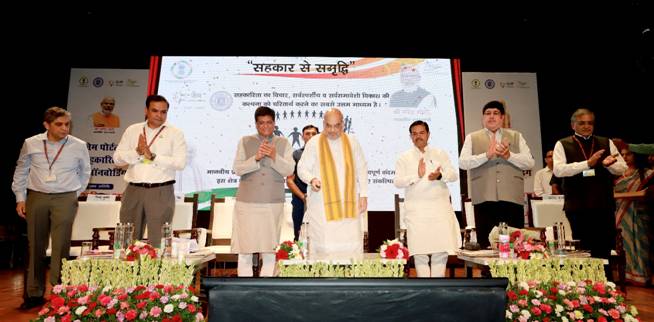
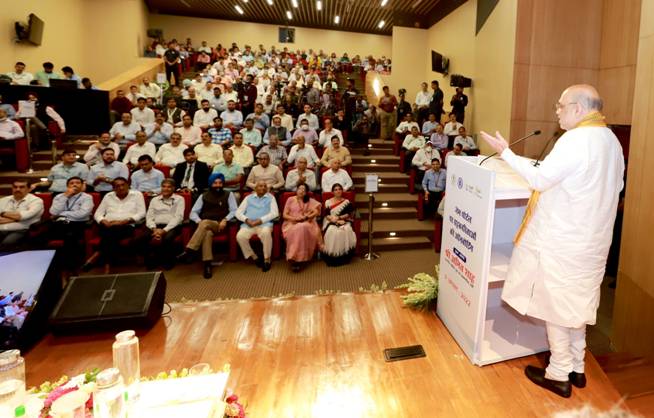
 The Union Home and Cooperation Minister, Shri Amit Shah launched the onboarding of cooperatives on the Government e-Marketplace (GeM) portal, today in New Delhi. The program organized by the Ministry of Cooperation, Government of India, the National Cooperative Union of India (NCUI) and GeMwas also attended by Union Minister of Commerce and Industry Shri PiyushGoyal, Union Minister of State for Cooperation and North East Region Development Shri B.L.Verma and the NCUI President Shri DilipSanghani and many other dignitaries.

https://static.pib.gov.in/WriteReadData/userfiles/image/image001QGDJ.jpg

In his address, Shri Amit Shah said that today is a very important day in Indian history. In 1942, on August 9, Gandhijibegan the Quit India Movement against British Rule and today another important work is being done task is taking place on the occasion ofAzadikaAmritMahotsav on August 9, in which access to GeMhas been given to cooperative societies in the country.  He said there is immense potential in the cooperative sector and the GeM portal will be a very useful platform for the expansion of this sector. The Union Minister of Cooperation said most of units of the government buy through GeM, so cooperatives should also start preparing for registration for supply on GeM to increase their market. He also appealed to the National Cooperative Union of India (NCUI) to expand marketing of cooperatives and for this there can be no better way than the GeM.

The Cooperation Minister said this sector has been neglected since Independence, but Prime MinisterNarendraModi is accelerating its expansion with historic reforms and modernization. Under the leadership of Shri Modi, the Ministry of Cooperation has taken a number of measures for expansion and in the last year the Ministry has been continuously working on 25 to 30 initiatives.

The government has to expand cooperatives but there is no database, therefore the ministry is also creating a national level database of different categories of cooperatives. Arrangements for training will also be made available. Shri Shah said an export house is also being registered the work for which will be completed by December. It will provide a platform for export from cooperatives across the country. He said radical changes are also being made in the Multistate Cooperative Act and the government led by Shri NarendraModi has also decided to computerize all PACS.

 Amit Shah said population size is a great advantage in aneconomy, because ultimately the population is also the market. Till 2014, India’s population was 130 crore, but the market was only 60 crore,as 70 crore people did not have purchasing capacity. 60 crore people worried about their next meal andother basic needs and generations went through the same ordeal. Prime Minister Shri NarendraModiopened bank accounts, provided gas cylinders, toilets, electricity, pure drinking water and food grains free of cost to the poor and as a result awakened the aspirations of these 60 crore people by fulfilling their basic needsand cooperatives havethe potential to fulfil all these aspirations. Today after fulfilling their primary needs, these people have ambitions to move ahead in life by earning more money and through cooperatives they can fulfil these ambitions. Shri Amit Shah said if these 60 crore people have justRs. 5,000, they can run the biggest of cooperatives. Giving the example of Amul, Shri Shah said today this cooperative has crosseda turnover of Rs.60,000crore and20 lakh women members are not only running the cooperative,but havealso been  making profits for many years.

https://static.pib.gov.in/WriteReadData/userfiles/image/image003TTRY.jpg

The Union Cooperation Minister said the cooperative model is a model in which even with limited capital people can come together and undertake large tasks easily. He said earlier the cooperative model did not have much potential, but Shri NarendraModihas awakened the aspirations of 60 crore people. He said if a system does not change itself with the times, then it becomes out dated, and therefore it is necessary to improve the cooperative system for the expansion of the sector. India’s cooperative system is 115 years old, the laws are also very old, thoughsmall changes have takenplace from time to time, radical changes and modernization according to the times have not taken place.

Shri Shah said now the cooperative sector cannot be given second class treatment, however there is a need to bring about change and to move in the direction of bringing transparency and for cooperatives to prepare themselves for change. The GeM portal will be very useful in bringing in transparency in the cooperative sector and when there is transparency, the trust of farmers and milk producers will also increase on the committees and their members. He said that by bringing theGeM portal, Shri NarendraModihas brought in transparency in government procurement. This is a new system, and therefore there may be some initial administrative problems, but no one should doubt the intention of bringing in this new system. Shri Shah said it is also very important to bring transparency in three areas within cooperatives – elections, recruitment and purchase. There can be no better medium than theGeM to bring transparency in procurement. The Union Minister of Cooperation said he is confident that the world will recognize this successful model of transparent government procurement in the next five5 years.

The UnionMinister of Cooperation said he is very optimistic about the future of GeM’s journey under the leadership of Union Minister for Commerce and Industry, Shri PiyushGoyal. He said of the589 of the committees to be added have a turnover of about Rs.100croreare of the state government and till date 289 of them have joined, as well as 45 of the 54 multistate cooperativeshave also joined, which is a huge achievement. Also more than 10,000 products and more than 288 services have been listed. Till now business worthRs. 2.78 lakh thousand crore has also been completed which is a huge achievement of the GeM. Shri Shah said this day is important for the Nation as the Quit India movement began on August 9 and six years ago on August 9 the GeM wasalso launched and todayonboarding of cooperatives has been initiated on this day.Shri Amit Shah congratulatedthose associated with cooperatives, the entire team of the GeM and eight lakh cooperative societies and especially Shri PiyushGoyal.


*****

The world sees India as an engine of economic growth

 Union Minister for Commerce and Industry, Consumer Affairs, Food and Public Distribution and Textiles, Shri PiyushGoyal today said that the world now sees India as an engine of economic growth. He was addressing the gathering at the VyapariUdyamiSammelan in New Delhi today.

Stressing that India enjoyed the confidence of the world today, Shri Goyal said that developed countries very keen to sign trade deals with India now. He added that before 2014, Indian economy was considered to be fragile and investors had their doubts bout doing business with India.

Stressing upon the need for transparency and ease of doing business, the Minister assured traders and entrepreneurs that the Government will fully support traders who raise their voice against harassment by any authority.

He called upon traders to work with the Government to reduce compliance burden of people and businesses, but asked that they strictly follow ethical trade practices. Unnecessary, cumbersome and counter-productive laws and regulations must be uprooted to improve ease of doing business, he added.

He asked traders to give priority to the quality of goods and services that India offered. He also underscored the need to encourage youngsters to come forward and lend a youthful energy to India’s growth story with new ideas. The clarion call of ‘vocal for local’ given by the Prime Minister, Shri Narendra Modi must be taken up by the youth of the nation, the Minister said. He added that we must also encourage more and more women to become traders and entrepreneurs.

Applauding Prime Minister’s visionary welfare policies, Shri Goyal said that these policies have been helping the poor emerge as consumers and have successfully transformed India’s population into its greatest strength. He added that the Prime Minister’s tireless work had ensured that every household in the country gets access to basic amenities such as cooking gas, drinking water, electricity and toilet and every village gets access to the internet. Shri Goyal said that the policies of the government had also given every Indian the courage to be ambitious and the confidence to aspire to become entrepreneurs.

The Minister also emphasized that traders and Micro, Small and Medium Enterprises (MSMEs) should benefit from demand of goods by beneficiaries of the Prime Minister’s welfare schemes. He asked all traders, entrepreneurs, and businesses, both big and small, to take a collective resolve to work together to take forward the dream of a self-reliant India by promoting more and more Indian products.

***


Policymaking and implementation should be a two way process with people’s participation

 The Vice President, Shri M. Venkaiah Naidu today emphasised the need for constant dialogue between the people and the governments for citizen centric and responsive governance. He said that policymaking and implementation should be a two way process with people’s participation at every stage. 

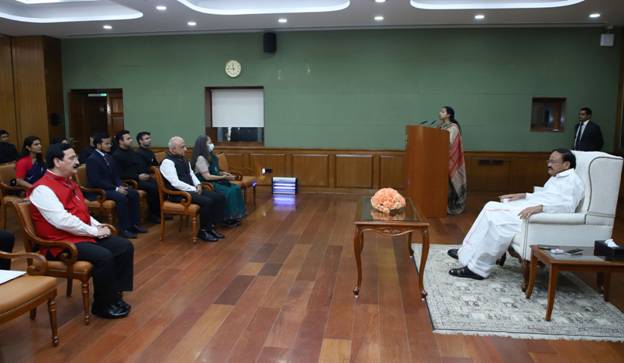
Addressing the Indian Information Service officers of 2018 and 2019 batches who came to call on him at Upa-Rashtrapati Nivas today, Shri Naidu highlighted the role of communication in bridging the divide between the governments and citizens. “In a democracy, people need to be empowered through timely information on government’s policies and initiatives in their mother tongues. On the other hand, governments also need to be apprised of people’s expectations and aspirations in an objective and timely manner,” he said.

Referring to the mass behavioral change campaign undertaken as part of the Swachh Bharat Mission, Shri Naidu said that the success of any reform depends on the cooperation from the people. He further said that people will understand and support an initiative better when they have been involved in its planning and implementation strategy from the beginning.

Describing India as the largest Parliamentary democracy in the world, he said that the purpose of any reform process should be to make people’s life happy and prosperous. “Therefore, the focus of all government policy measures should be on bringing lasting happiness to people’s lives,” he told the officers, and at the same time, underscored the need to bear with “temporary pain for long term gain”.

IIS officers of 2018 and 2019 batches in group photographs with the Vice President, Shri M. Venkaiah Naidu

Mentioning that the ICT revolution and spread of the internet have fundamentally changed the way we consume news, he cautioned that this ‘ease of information’ comes with its associated risks. “Misinformation, disinformation and fake news have emerged as new challenges which need to be promptly tackled by the government communicators round the clock,” he added. The Vice President also cautioned against the misuse of social media by certain anti-social elements, the Vice President called for curbing such tendencies at the earliest.

Drawing attention to the growing trend of ‘instant journalism’ triggered by the emergence of Internet and social media expansion, Shri Naidu expressed concerns about the erosion of journalistic norms and ethos due to this. He emphasized the importance of neutrality and objectivity in media reporting and said that news should not be mixed with views. “Media is the fourth pillar of democracy and its neutrality, objectivity and fairness is crucial for survival of India’s democratic ethos,” he stressed.

The Vice President asked the young officers to bring forth many developmental stories from across the nation. “You as government communicators should also make all efforts to ensure that the good work being done by various ministries and departments is covered adequately by the media,” he told them. Terming information & psychological warfare as an important dimension of modern day wars, Shri Naidu advised the IIS officers to develop expertise in these emerging and strategic areas.

Referring to the increasing frequency of extreme climatic events and erratic weather patterns across the globe, the Vice President asked the young officers to run a mass media campaign for nature conservation and environmental protection. “If you love nature, nature will protect you,” he told them.

Cautioning against the populist measures to garner votes by various political parties, Shri Naidu said that the freebie culture has led to deteriorating financial health of many states. “Government should definitely support the poor and needy, but at the same time should prioritize health, education and infrastructure development,” he said.

In his address, his last as the Vice President of India, Shri Naidu said that “the key to my rise from an ordinary farmer’s son to the second highest constitutional post in the country lies in sheer hard work, single minded devotion and constant travel and interaction with the people in every part of the country.”  I have learned a lot by meeting and talking to the people, he said.

Congratulating the officer trainees for joining the prestigious Civil Services, he exhorted them to work for transforming the lives of people in the country. It may be noted that the Indian Information Service (IIS) is a Central Group ‘A’ Service whose members work as the media managers of the Government of India. The IIS officers, in their various capacities, act as a vital communication link between the Government and the people by way of disseminating information and communicating various Government policies and schemes to the public at large.

Prof. (Dr.) Sanjay Dwivedi, Director General, IIMC, Shri Ashish Goel, ADG, IIMC, Dr Rinku Pegu, Associate Professor IIMC & Training Coordinator for IIS officers, officers of Indian Information Service batches of 2018 & 2019 were present during the interaction. Prof. Sanjay Dwivedi also presented his book titled, “Bharat Bodh ka Naya Samay” to the Vice President on this occasion.

******

e-learning platforms

 e-learning platforms

An online learning platform or e-learning is a web portal educational content that provides everything related to learning on one platform like lectures, training, resources, courses, changes to meet other students, etc. It is one of the best to learn at any time and anywhere and monitor students’ progress.
These platforms provide a lot of benefits like self-paced learning, work from home, improved technical, communication, and critical thinking skills even at very low cost, better time management, etc.
After the pandemic, the use of online learning platforms has risen because during covid educational system have been shaken all over the world and online learning platform has helped a lot to get education from home while closing educational institutions.
You need to just sign in to the e-learning website and you are good to go. You can select the course of your choice to learn. Some website provides free courses and other may require pay monthly subscription cost. Online classes are provided through online learning platforms.
There are various online learning platforms where a lot of quality education courses are provided by experts. These platforms are:
1. SWAYAM= SWAYAM is a program initiated by the Government of India and designed to achieve the three cardinal principles of Education Policy viz., access, equity, and quality. The objective of this effort is to take the best teaching learning resources to all, including the most disadvantaged. SWAYAM seeks to bridge the digital divide for students who have hitherto remained untouched by the digital revolution and have not been able to join the mainstream of the knowledge economy.
2. Coursera= Coursera is a popular online education platform that offers courses from top education providers around the world. Over the years, the company has grown rapidly and provides the world’s best standards of education through Massive open online courses. This online learning platform partners with universities including Stanford, Duke, Penn, Princeton, Michigan, Peking, and HEC Paris and companies like IBM, Google, and PwC. Overall, they have 190 active partners from 48 countries. 
3. Skillshare= Skillshare is an online education platform that is beneficial for both students and teachers. The website offers thousands of courses related to design, business, marketing, technology, photography, film, fashion, music, gaming, cooking, writing, and DIY. crafts, and more. Instructors can easily create classes through the step-by-step guidelines provided by the platform. This platform offers referral compensation for teachers if any of the students subscribe to the premium package.

4. BYJU’s= Byju’s is an Indian E-learning Company Headquartered in Bangalore, and they provide classes to CBSE, ICSE & State Boards. Byju’s had ventured into providing study material for competitive govt. exams such as UPSC CSE, Bank Exam, and other Government exams. It also includes various entrance exams such as JEE, NEET, CAT, GATE, etc. 

5.LinkedIn Learning= LinkedIn Leaning is a massive open learning website that covers a wide variety of creative, technology, and business courses. It has been offering informative and clear video-based training for individuals, corporate, and academics. The site is quite famous for teaching skills such as photography and coding.
6. Udemy= Udemy is a popular online learning platform that gives people a chance to develop their careers and explore a wide variety of hobbies. From web development to public speaking, they offer a broad range of courses. Reputed companies like Booking.com, Lyft, Adidas, and General Mills use the business plan of Udemy. Udemy provides great support for instructors. They can create, share and promote their courses via re-targeting ads, search and discovery, email campaigns, and external partner promotion.
7. edX= edX is an open learning platform that offers university-level online courses. It has over 120 institutional partners like Harvard, MIT, Berkeley, Delft, RWTH, Sorbonne, and more. The platform offers six different types of programs – one-off courses, Micro Master’s Program, Professional Certificates, Global Freshmen Academy, and XSeries Program.

8. Unacademy= Unacademy mainly started as an online platform for the Competitive examination such as UPSC, SSC, RRB, GATE, Bank Jobs, JEE, NEET, etc. Later on, Unacademy started classes for the student from class 6 to 12th. It’s one of the biggest hubs of educators started as a YouTube channel now they have more than 1 million video lessons with 14k educators.
 E-learning is the future of education. Now people are shifting towards it because it saves a lot of time and money. You can learn anything apart from your academics and enhance your skills.

Online Platforms for Learning.

An online learning platform is a webspace or portal for educational content and resources that offers a student everything they need in one place: lectures, resources, opportunities to meet and chat with other students, and more. It is also an excellent way for the student and the teacher to monitor student progress. Whether you want to learn a new language or obtain career-advancing certifications, signing up for an online course could be just the perfect solution. The online class is typically provided through online learning platforms. 

Online learning has numerous advantages over traditional learning methods. Some of these include the possibility for students to make use of self-paced learning and to choose their own learning environments. Additionally, e-learning is both cost-effective and cost-efficient, as it removes the geographical obstacles often associated with traditional classrooms and education. The benefits of an online course platform are that both students and teachers can track the students’ progress through the course material, and everything is neatly organized in one place. Additionally, students may also have an option of interacting with each other on the platform.

Some of the popular Online learning (e-learning) platforms.

Coursera.

Coursera isn’t just a place to take classes that are like college courses—it actually offers real academic courses from real professors and universities at a fraction of the cost of getting an online degree. The platform partners with over 200 universities and companies to provide real learning experiences that can connect to real-world benefits. In some cases, you can even earn certifications or degrees entirely through Coursera, which can then potentially lead to professional benefits like raises, promotions, and more. 

Course Hero.

Course Hero is home to study resources, 24/7 homework help and textbook guides to provide students across top institutions with tailored reinforcement of the courses in which they are enrolled. The library of materials uploaded to Course Hero’s platform can be searched by either school or textbook to find the exact resource a student needs, with tutors available to provide total support.

Edx.

Generally, this online learning platform has a high-end pedigree. edX was established by graduates from both MIT and Harvard University. Real college courses that are generated and taught by real college tutors are available in a vast array of topics and fields. They have a slight leaning toward the Science, Technology, Mathematics, and Engineering fields. Nonetheless, there are plenty of topics in the humanities, arts, and languages as well. By partnering with the universities, this course provides professional degree certificates as well as the “micro” degree programs at both the bachelor’s and the master’s levels. In this sense, they largely serve as tools for professional development. 

Skill Share.

Whereas many online class platforms do confer college-style classes, Skillshare is not formal and is mainly targeted at boosting creative skills. Some business and marketing classes exist on this online education platform. Most of the courses though tend to have a focus on the creative fields and are administered by practicing experts in various fields. Common examples of these fields are interior design, visual arts, animations, films, and photography. 

LinkedIn Learning.

Formerly called Lynda.com, LinkedIn Learning is an educational platform that confers professional course training in the fields of technology, business, creative fields, and technology-related areas mainly in the form of videos. The online learning marketplace is largely available as a premium service for the users of LinkedIn and has so far provided well over 16,000 courses in a whopping 7 languages. Its focus is mainly to aid individuals in investing in their professional development. 

Udemy.

If you want to learn something, it’s probably on Udemy. The site is less of a unified platform and more of a portal or repository where students can access well over 100,000 courses on every topic imaginable. There’s not one standard format for a Udemy course—the platform allows instructors to design multimedia lectures with audio, video, and text elements, plus readings, quizzes, and other activities. Udemy allows students to preview classes they’re interested in and does offer a 30-day refund if you’re dissatisfied.

FutureLearn.

FutureLearn lets you learn online from universities and companies all over the world, including Anglia Ruskin University, King’s College London, Monash University, and the University of Wollongong. On top of their university partnerships, they also partner with specialist organizations such as Accenture, Amnesty International, the British Library, and UNESCO. From personal development video lessons to employment-related course content, FutureLearn definitely deserves its place near the top of our best online learning platforms list.

Online Platforms for Learning.

An online learning platform is a webspace or portal for educational content and resources that offers a student everything they need in one place: lectures, resources, opportunities to meet and chat with other students, and more. It is also an excellent way for the student and the teacher to monitor student progress. Whether you want to learn a new language or obtain career-advancing certifications, signing up for an online course could be just the perfect solution. The online class is typically provided through online learning platforms. 

Online learning has numerous advantages over traditional learning methods. Some of these include the possibility for students to make use of self-paced learning and to choose their own learning environments. Additionally, e-learning is both cost-effective and cost-efficient, as it removes the geographical obstacles often associated with traditional classrooms and education. The benefits of an online course platform are that both students and teachers can track the students’ progress through the course material, and everything is neatly organized in one place. Additionally, students may also have an option of interacting with each other on the platform.

Some of the popular Online learning (e-learning) platforms.

Coursera.

Coursera isn’t just a place to take classes that are like college courses—it actually offers real academic courses from real professors and universities at a fraction of the cost of getting an online degree. The platform partners with over 200 universities and companies to provide real learning experiences that can connect to real-world benefits. In some cases, you can even earn certifications or degrees entirely through Coursera, which can then potentially lead to professional benefits like raises, promotions, and more. 

Course Hero.

Course Hero is home to study resources, 24/7 homework help and textbook guides to provide students across top institutions with tailored reinforcement of the courses in which they are enrolled. The library of materials uploaded to Course Hero’s platform can be searched by either school or textbook to find the exact resource a student needs, with tutors available to provide total support.

Edx.

Generally, this online learning platform has a high-end pedigree. edX was established by graduates from both MIT and Harvard University. Real college courses that are generated and taught by real college tutors are available in a vast array of topics and fields. They have a slight leaning toward the Science, Technology, Mathematics, and Engineering fields. Nonetheless, there are plenty of topics in the humanities, arts, and languages as well. By partnering with the universities, this course provides professional degree certificates as well as the “micro” degree programs at both the bachelor’s and the master’s levels. In this sense, they largely serve as tools for professional development. 

Skill Share.

Whereas many online class platforms do confer college-style classes, Skillshare is not formal and is mainly targeted at boosting creative skills. Some business and marketing classes exist on this online education platform. Most of the courses though tend to have a focus on the creative fields and are administered by practicing experts in various fields. Common examples of these fields are interior design, visual arts, animations, films, and photography. 

LinkedIn Learning.

Formerly called Lynda.com, LinkedIn Learning is an educational platform that confers professional course training in the fields of technology, business, creative fields, and technology-related areas mainly in the form of videos. The online learning marketplace is largely available as a premium service for the users of LinkedIn and has so far provided well over 16,000 courses in a whopping 7 languages. Its focus is mainly to aid individuals in investing in their professional development. 

Udemy.

If you want to learn something, it’s probably on Udemy. The site is less of a unified platform and more of a portal or repository where students can access well over 100,000 courses on every topic imaginable. There’s not one standard format for a Udemy course—the platform allows instructors to design multimedia lectures with audio, video, and text elements, plus readings, quizzes, and other activities. Udemy allows students to preview classes they’re interested in and does offer a 30-day refund if you’re dissatisfied.

FutureLearn.

FutureLearn lets you learn online from universities and companies all over the world, including Anglia Ruskin University, King’s College London, Monash University, and the University of Wollongong. On top of their university partnerships, they also partner with specialist organizations such as Accenture, Amnesty International, the British Library, and UNESCO. From personal development video lessons to employment-related course content, FutureLearn definitely deserves its place near the top of our best online learning platforms list.

Cultural diversity and it's types

Cultural diversity and it’s types

Cultural diversity

The things you do and the practices you were taught inform who you become . Culture is a broad term that encompasses beliefs , values , norms , behaviours, and overall can be understood as our ” way of being”. 

Everyone has their own culture and beliefs . In India also people follow different cultures, every state has their own culture even the every place has their own culture and people of that place follow it .

Cultural diversity is about appreciating that society is made up of many different groups with different interests, skills, talents and needs . It also means that you recognise that people in society can have different religious beliefs and sexual orientation to you .

Importance of culture 

Cultural diversity is important everywhere as every person has their own culture so if we work on a company different people of different cultures are present there and all of them has their own cultural belief so it is important to understand everyone culture and work according to that .
As everyone follow their culture their thinking is also different so it gives out creative and innovative ideas when these ideas are combined one more idea will come up with that which provide benefit to the company.

Types of cultural diversity 

1. Cultural diversity – 

This type of diversity is related to each person’s ethnicity and it’s usually the set of norms we get from the society we were raised in our families values. Having different cultures in the workplace is more common in multinational companies.

2. Race diversity – 

Race has to do with a person’s grouping based on physical traits ( despite the dominant scientific view that race is a socialist construct and not biologically defined ) . Examples of races are Caucasian , African , Latino , and Asian.

3. Religious diversity – 

This type of diversity refers to the presence of multiple religions and spiritual beliefs ( including lack thereof ) in the workplace.

4. Age diversity – 

Age diversity means working with people of different ages and , most importantly, generations. For example, millennials, GenZers and GenXers can coexist in the same workplace.

5. Sex / Gender / Sexual orientation – 

Sex and gender can be used in the traditional sense of male and female employees. For example, you may sometimes hear the term “gender balance” used by companies trying to achieve a 50- 50 balance between employees who identify as female. But as gender is increasingly redefined, the term ” gender diversity” may be more appropriate, since there are multiple variations in gender and sexual orientation.

6. Disability – 

There are various types of disabilities or chronic conditions included here, ranging from mental to physical. Companies often make reasonable accommodations to help people with disabilities integrate into the workplace, such as installing ramps for wheelchairs or providing mental health support. Some companies also adjust their hiring process to make sure it’s inclusive. 

BRITISH ENGLISH AND AMERICAN ENGLISH

 British and American English


Language is a very powerful tool and everyone use our abilities in infinite different varieties. We are all judged by the way we speak and write things. The English language has acquired the status of global language. English language had continued to evolve constantly , its flexible and accepted words from other foreign languages also. Today there are different forms of English mainly American, Australian, British, Canadian, Indian, Pidgin.

After the British established their colonies in America. The English language was used by many indigenous people. They were influenced by the colonizers. Americans also began to use and take words from Indians. They wanted to know native language so that they can identify animals, objects, physical features and trees that were specific in different places. New words were formed such as wigwam, tomahawk, raccoon.

When people started to travel from different parts of the world to America. They traveled to begin a new life and ideas which they brought with them influenced American English. The grammar and the sentence pattern formed remain intact. Pronunciation varied and there were difference in the lexis. The spellings of words differ in British and American English. For example, the difference in the spelling of the word manoeuvre(Br) and maneuver (Am). The word manoeuvre means movements of troops in a war, skillful plan, artifice etc.In India we tend to use both the varieties as we have influence from both countries.

The main difference is that in British English the spelling of different words are borrowed or absorbed from other languages such as from German and French. In American English spellings are mainly based on the way the words are sounded when they are spoken.

Other words are Cheque in British English and check used in American English . Some words change will be made in their endings such as license (British English) becomes licence (American English). The word civilization (American English) change to civilisation (British English). There are some variations in preposition also. For example, Monday to Friday (British English) in American English it is Monday through Friday. Apartment (American English), in British English it is flat. Automobile in American English, in British English it is car. Candy (American English), in British English it is sweets. Railroad (American English) in British English it is railway.

American English          British English

Elevator                            Lift 

Fall                                    Autumn

Kid                                    Child

Shot                                   Injection

Sidewalk                          Pavement

Store                                 Shop

Online platforms for learning

 Online platforms for learning

Today learning has become easier than before as now people can get any course or degree online from the comfort of home. if anyone just wants to explore a topic or to learn new skills then they can easily go on google and search for it and they will find end no platform where they can learn. 

How virtual learning platforms are good:

  • it has an effective remote learning experience 
  • get instant feedback from teachers 
  • learn in a safe environment as per your schedule or timings with comfort
  • get more time which spoiled in traveling to school

today we will discuss some online platforms from which you can learn any skills:

1: skillshare:

skillshare is a vast platform online wh possesses a library of over 20000 classes. it has earned the honor of being he top learning online platform. it consists of a presentation which has a duration of around 20 min with a class project.

skillshare membership contains:

  • 2-month free trial
  • free membership allows you to have access to 2000 classes
  • its premium membership is $15 per month and $ 99 for a year.

2: Coursera :

coursera provides various certificate, degree programs , and general courses which makes you excel in a field for your success. here the students bring education from top educational institutions and companies like duke university, standard, or Google.

what Coursera provides you:

  • free courses
  • the degree program includes MBA, computer science
  • professional certification in digital marketing

these all courses can help a person in development or enhance their skills for getting success in his career.

3:Udemy:

Udemy is low-cost education or learning option for anyone who wants to learn design, web development, marketing, music, and many more. it has around 155000 classes in which you can choose whichever you want as per your course or interest.

4:MOOC:

It stands for a massive open online course . as it is an extension of EDx. it is a great free online platform where you can learn free and can build your career in the field of engineering, data science, computer science business, and management.
 

5: EDx:

 it’s a great platform where you get to learn from top universities like Harvard, MIT many more. micro bachelor and micro master programs help adults to speed up their careers fastly with low-expense programs.

How to choose the best online platform:

  • How old are you like what are u looking for well it will depend upon your age as every platform is not made for everyone so choose the right one.
  • how many students does a platform teach at a time there are students who can not study with thousands of people at a time so decide it 
  • does they offer extra help if the student is not able to understand the class.

I hope it will help you in understanding how the digital era is changing and providing endless opportunities in the education field for learning.


Factors that lead to poor Performance of Employees

 It is important for an organization to identify the factors that have a crippling effect on the performance of an employee at the workplace and make suitable corrections.Thus, it is important for an organization to identify the factors that have a crippling effect on the performance of an employee at the workplace and make suitable corrections.The following are the factors that lead to poor performance of employees at the workplace.

Personality or Ego Clashes: This in general, is seen between two people with opposing personalities. The problem creeps in when there is mistrust between both the parties with respect to their motives and character.

Stress: The modern workplace is full of demands, deadlines, etc. There are employees who sustain and perform under pressure while there are employees who succumb to this rising pressure. Thus, an aggressive environment where the stress levels are high will prove detrimental to employee performance.

Heavy Workloads: If there is an alarming increase in workload, employees sometimes become disgruntled with their work and this is reflected in the quality of work. It also takes a toll on their health and demoralizes them.

Inadequate Resources: Adequate time and material resources should be available to employees to enable them perform their work easily. This will help them perform to the best of their ability and be proud of their achievements.

Poor Leadership from the Top Management: A supervisor motivates his subordinates, instills confidence, and evokes enthusiasm with regard to their work. But if the same supervisor engages in aggressive and punitive behavior, it results in harassment at the workplace. 

Lack of Role Clarity: This happens when two different workers are given incompatible roles at the same time. This lack of clarity in workers’ objectives and expectations creates tension between the employees and results in conflicts.

Lack of Clarity about Accountability: Lack of accountability results when there is no clarity amongst the employees regarding their roles and responsibilities and their relationship with team members. This leads to a situation wherein when something goes right, everyone would like to take credit for it and when something goes wrong, no one comes forward to accept responsibility.

Lack of Transparency: When employees are not informed about decisions, they will make their own assumptions which can spread rumors. This can hurt the image of the organization and also destroy trust in the management.

Clash of Values: An organization comprises employees from various walks of life. They bring in their own set of values, ideas, and principles which may not be received by everyone in the organization. This might result in some animosity and intolerance between individuals.

Gossip: Research has shown that office gossip creates great loss to the organization and also affects the individual productivity of employees at work.

Poor Selection or Pairing of Team Members: Employees tied with a wrong partner prove detrimental to the overall health of the organization. A lion’s share of their time will be consumed jostling against each other without any improvement in their overall performance.

Outdated Technology: To make an employee productive and efficient, it is important to equip them with the right tools. Ignoring the potential benefits of technology upgradation in the workplace may diminish the productivity and performance of employees.

Bullying or Harassment: There are cases where bosses or colleagues threaten an employee for no reason or pass offensive remarks against the employee. This leads to the creation of a hostile environment in the workplace. It also disturbs the sense of belongingness amongst employees.

Perceived Discrimination: Employee discrimination can have a negative effect on the organization’s bottom line. It hampers the main components of employees’ behavior which are directly associated with job performance. This might also result in a higher incidence of grievances among employees.

Poor Performance Management: Badly-conducted appraisals can create a lot of problems for the organization as well as its employees. If a hard working employee is under-rated, besides being unfair, it creates an inferiority complex in the mind of the employee, while being over-rated may create egoism. 

Depleting Health Conditions: The deteriorating health of an employee would greatly hamper the employee’s ability to be productive. It has a cascading effect such as rising absenteeism, low morale, and indifference to organizational goals.

List of Schedules of Indian Constitution


Schedules of Indian Constitution – 12 Schedules of India

There are 12 Schedules in the Constitution of India. One of the first mentions of Schedules was made in the Government of India Act, 1935 where it included 10 Schedules. Later, when the Indian Constitution was adopted in 1949, it consisted of 8 Schedules. Today, with the amendments in the Indian Constitution, there are a total of 12 Schedules.

This article will provide you with a list of Schedules of Indian Constitution, important for the IAS Exam from the perspective of Indian Polity (Mains GS-II).

List of Schedules of Indian Constitution

The table given below discusses the list of schedules of the Indian Constitution, important from the UPSC exam perspective:

Schedules in Indian Constitution
Schedules Features of Schedules
First Schedule of Indian Constitution It contains the name of States and Union Territories

Territorial Jurisdiction of states is also included

Second Schedule of Indian Constitution The provisions in relation to allowances, privileges, emoluments of:

  • President of India
  • Governors of Indian States
  • Speaker of Lok Sabha & Deputy Speaker of Lok Sabha
  • Chairman of Rajya Sabha & Deputy Chairman of Rajya Sabha
  • Speaker and Deputy Speaker of Legislative Assemblies of Indian States
  • Chairman and Deputy Chairman of Legislative Councils of the Indian States
  • Supreme Court Judges
  • High Court Judges
  • Comptroller & Auditor General of India (CAG)
Third Schedule It contains the forms of oath and affirmation for:

  • Union Ministers of India
  • Parliament Election Candidates
  • Members of Parliament (MPs)
  • Supreme Court Judges
  • Comptroller and Auditor General
  • State Ministers
  • State Legislature Elections’ Candidates
  • State Legislature Members
  • High Court Judges
Fourth Schedule It contains the provisions in relation to the allocation of seats for States and Union Territories in the Rajya Sabha
Fifth Schedule It contains provisions in relation to the administration and control of scheduled areas and scheduled tribes
Sixth Schedule It contains provisions in relation to the administration of tribal areas in the states of Assam, Meghalaya, Tripura and Mizoram
Seventh Schedule This schedule deals with the three legislative lists:

  • Union
  • State
  • Concurrent
Eighth Schedule It deals with the 22 official languages recognized by the Constitution of India:

  • Assamese
  • Bengali
  • Bodo
  • Dogri (Dongri)
  • Gujarati
  • Hindi
  • Kannada
  • Kashmiri
  • Konkani
  • Mathili (Maithili)
  • Malayalam
  • Manipuri
  • Marathi
  • Nepali
  • Oriya
  • Punjabi
  • Sanskrit
  • Santhali
  • Sindhi
  • Tamil
  • Telugu
  • Urdu
Ninth Schedule It deals with the state acts and regulations of that deal with land reforms and

abolition of the zamindari system. It also deals with the acts and regulations of the Parliament dealing with other matters.

Note:

1st Amendment Act 1951 added the Ninth Schedule to protect the laws included in it from judicial scrutiny on the ground of violation of fundamental rights.

However, in 2007, the Supreme Court ruled that the laws included in this schedule after

April 24, 1973, are now open to judicial review

Tenth Schedule It contains provisions relating to disqualification of the members of Parliament and State Legislatures on the ground of

defection.

Note:

This schedule was added by the 52nd Amendment Act of 1985, also known as Anti-defection Law

Eleventh Schedule It contains the provisions that specify the powers, authority and responsibilities of Panchayats. It has 29 matters.

Note:

This schedule was added

by the 73rd Amendment Act of 1992

Twelfth Schedule It deals with the provisions that specify the powers, authority and responsibilities of Municipalities. It has 18 matters.

Note:

This schedule was added

by the 74th Amendment Act of 1992

Since Schedules of Indian Constitution makes an important topic of the Indian Polity subject of UPSC syllabus 2022; aspirants should keep these schedules in mind.