Formalism

Formalism, also called Russian Formalism, Russian Russky Formalism, innovative 20th-century Russian school of literary criticism. It began in two groups: OPOYAZ, an acronym for Russian words meaning Society for the Study of Poetic Language, founded in 1916 at St. Petersburg (later Leningrad) and led by Viktor Shklovsky; and the Moscow Linguistic Circle, founded in 1915. Other members of the groups included Osip Brik, Boris Eikhenbaum, Yury Tynianov, and Boris Tomashevsky.

Although the Formalists based their assumptions partly on the linguistic theory of Ferdinand de Saussure and partly on Symbolist notions concerning the autonomy of the text and the discontinuity between literary and other uses of language, the Formalists sought to make their critical discourse more objective and scientific than that of Symbolist criticism. Allied at one point to the Russian Futurists and opposed to sociological criticism, the Formalists placed an “emphasis on the medium” by analyzing the way in which literature, especially poetry, was able to alter artistically or “make strange” common language so that the everyday world could be “defamliarized.” They stressed the importance of form and technique over content and looked for the specificity of literature as an autonomous verbal art.

They studied the various functions of “literariness” as ways to separate poetry and fictional narrative from other forms of discourse. Although always anathema to the Marxist critics, Formalism was important in the Soviet Union until 1929, when it was condemned for its lack of political perspective. Later, largely through the work of the structuralist linguist Roman Jakobson, it became influential in the West, notably in Anglo-American New Criticism, which is sometimes called Formalism.

Victor Erlich’s Russian Formalism (1955) is a history; Théorie de la littérature (1965) is a translation by Tzvetan Todorov of important Russian texts. Anthologies in English include L.T. Lemon and M.J. Reis, eds., Russian Formalist Criticism (1965), L. Matejka and K. Pomorska, eds., Readings in Russian Poetics (1971), and Stephen Bann and John Bowlt, eds., Russian Formalism (1973).

The focus in formalism is only on the text and the contents within the text such as grammar, syntax, signs, literary tropes, etc. Formalism also brings attention to structural tendencies within a text or across texts such as genre and categories. Formalism is based on an analysis of a text rather than a discussion on issues more distant to the text.

So Formalism is based on the technical purity of a text. Formalism is divided into two branches Russian Formalism and New Criticism. Formalism also argued that a text is an autonomous entity liberated from the intention of the author.

A text according to Formalism is a thing on its own without the need of external agents. As the name suggests, Formalism is a scientific, technical mode of understanding texts which expects a greater degree of mental intelligence instead of emotional intelligence from the readers.  

Russian Formalism was a school of literary criticism in Russia from 1910 to 1930. Some prominent scholars of Russian Formalism were Viktor Shklovsky, Yuri Tynianov, Vladimir Propp, Boris Eichenbaum, Roman Jakobson, Boris Tomashevsky and Grigory Gukovsky. Russian Formalism brought the idea of scientific analysis of poetry. Russian Formalism alludes to the work of the Society for the Study of Poetic Language (OPOYAZ), 1916 in St. Petersburg by Boris Eichenbaum, Viktor Shklovsky and Yury Tynyanov.

SHAKESPEAREAN COMEDY

A Shakespearean comedy has a happy ending, usually involving marriages between the unmarried characters, and a tone and style that is more light-hearted than Shakespeare’s other plays. Shakespeare started to write comedies by the year 1600. Shakespeare wrote more comedies than any other kind of play. Shakespeare comedies (or rather the plays of Shakespeare that are usually categorised as comedies) are generally identifiable as plays full of fun, irony and dazzling wordplay. They also abound in disguises and mistaken identities, with very convoluted plots that are difficult to follow with very contrived endings. But Shakespeare’s plays are not in the rigorous sense either pure tragedies or pure comedies. 

Shakespeare’s comedies represented a significant departure from the classical comedy that had dominated the stage before he arrived in London. Whereas classical comedies were fairly straightforward, Shakespearean comedies introduced several elements that made for more complicated plots. Classical comedies typically opened with an already established pair of lovers, and they told of how these lovers had to overcome some obstacle or another to confirm the legitimacy of their union. Shakespeare, however, did not write comedies with already established lovers, and instead emphasized the plot on the process of wooing itself.

Some of the chief characteristics of Shakespearean comedy:

Love and Marriage as motif:

Love and marriage are the main themes in Shakespeare’s comedies. The preoccupation of the noble characters is love. Sometimes love leads to intrigue but is happily resolved at the end. The course of true love never runs smooth and thus conflict arises. But sighers and lovers live side by side. Love is mingled with sighs and even sorrow in some cases, but finally it converges into laughter. Love is treated as a divine passion and life is a pilgrimage towards its realisation.

Love and Marriage in Twelfth Nigth

Supernatural:

Shakespeare uses the supernatural in some of his comedies like ‘A Midsummer Night’s Dream’. However, the supernatural acts as a foil to human actions and errors.

The supernatural element in A Midsummer Night’s Dream

Women Characters:


Shakespeare’s comedies are dominated by women characters. As Gordon says “his comedies are a riot of feminine supremacy, a feminine revel”. Shakespeare’s men love and remain idle; his women characters use their brain, wit, and grace to enlarge the progress of love. Such are Rosalind, Viola, Portia, and Beatrice. They are guided by a certain clear-headedness and frankness in facing facts.

Clown:

Clowns and fools are a part of Shakespeare’s comedies. They provide fun and laughter. they are the satiric commentators on life and correctors of the excesses of the urbane characters. Falstaff, Malvolio, and Jaques provide laughter of a high order whereas characters like Dogberry, Verges, Bottom, and Touchstone provide a good deal of farcical mirth by their vanity, stupidly and complacency.

Realism and Fantasy:

In Shakespeare’s comedy, there is a fine blending of observation and imagination, fact and fiction, realism and fantasy. The story and the plot move between the real and the illusory. The forest of Arden assumes a realistic existence due to Shakespeare’s imagination and fancy. In his comedies, the base is real but the superstructure deal.

Laughter:

Shakespeare’s philosophy of laughter is tolerance. His comedies bring together different points of view and contrasts. The end is the realization of perfect order through laughter. Dowden says “Shakespeare made laughter wise and taught seriousness how to be winning and gracious”.

Music:

Shakespeare uses music in most of his comedies. As Orsino says, music is the food of love. It enhances the romantic atmosphere of the play and relieves the tension. There is music in As You Like It, Twelfth Night, A Midsummer Night”s Dream, and The Merchant of Venice.

Disguise:

In most comedies, Shakespeare has used disguise. This takes the action to several funny situations and complications as in As You Like It, Twelfth Night, and The Merchant of Venice. Disguise brings to focus the incongruities and irrationalities of life’s endeavors.

Voila disguise as Cesario in Twelfth Nigth

MoE, AICTE and DPIIT organises ‘National Innovation Week’ from 10th – 16th January, 2022

 To commemorate 75th years of progressive India ‘Azadi Ka Amrit Mahotsav’, Ministry of Education (MoE), AICTE and Ministry of Commerce& Industry (DPIIT) are jointly organising ‘National Innovation Week’ from 10th – 16th Jan 2022. The innovation week is also the iconic week of Ministry of Education. This Innovation week will highlight various initiatives undertaken by these agencies to spread awareness to promote innovation and entrepreneurship in India. Renowned personalities gracing the occasion with there presence are Shri Sridhar Vembu, Founder, ZOHO Corporation, Dr. K. Radhakrishnan, Ex-Chairman, ISRO, Shri Ankit Agarwal, Founder & CEO, Phool, Smt. Arundhati Bhattacharya, Chairperson & CEO, Salesforce, Smt. Sri devi Pankajam, MD, Commonwealth Bank of Australia, Shri C V Raman, Chief Technology Officer, Maruti and many more

A 2 days long e- Symposium on ‘Building Innovation Ecosystem in Educational Institutions’ will be held on 11th and 12th January 2022 by the Ministry of Education. E-Symposium will be inaugurated by Shri Rajkumar Ranjan Singh Minister of State for Education on 11th Jan 2022 at 10.30 AM. Program will be held virtually and it will see huge participation from academic institutions, schools, industry, Start-up and investor community. 

From 10th January onwards, 75 innovative technologies selected from various programs such as National Innovation Contest, Smart India Hackathon, YUKTI2.0 and Toycathon conducted by the Ministry of Education will participate in e-exhibition and demonstrate their innovations. Alongside exhibition, there are full day activities scheduled for 11th and 12th Jan comprising of multiple key note sessions and panel discussions on emerging areas related to innovation and entrepreneurship in HEIs and schools.

Prof Anil D Sahasrabudhe, Chairman, All India Council for Technical Education (AICTE) said the Innovation week will inspire young innovators to solve the problems faced by society through constructive ideas and address upcoming challenges. Proposed symposium highlights key aspects for building innovation system like investment, mentoring etc. and we believe that this symposium will further encourage our educational institutes to focus on building innovation eco-system within their campuses. As India is witnessing an exponential growth in terms of number of Start-ups, concerted efforts to create holistic innovation culture will pave the way for making Atmanirbhar Bharat and a 5 trillion-dollar economy as envisioned by Prime Minister Shri Narendra Modi, he added.

Dr. Abhay Jere, Chief Innovation Officer, Innovation Cell, Ministry of Education said that the Innovation Week is an opportunity for all innovators to showcase their work and inspire the young minds to take their entrepreneurial journey more seriously so that India can emerge as a global Innovation and Start-ups hub. As Innovation Cell, we are under taking multiple Innovation, Entrepreneurship related initiative and through this symposium we would like to encourage our educational institutions to work closely with us so that a sustainable ecosystem is establish within the campus, he added.

Eminent industry leaders, emerging unicorn founder, investors and policy practitioners will join as key note speakers and panellists to share their views and perspective on different aspects of innovation and start-up. Special panel sessions consisting of panellists from early stage start-up founders, and student innovators will be held to motivate school kids and young minds to pursue innovation and entrepreneurship as career choice.

The program is aiming to sensitize and orient the stakeholders as part of innovation and Start-up ecosystem in academic institutions. 

*****


A knowledgeable individual is the building block of a just society

 Union Education and Skill Development Minister Shri Dharmendra Pradhan today virtally addressed the 82nd Indian Public Schools’ Conference (IPSC) Principals’ Conclave  organised by Doon School today.

Speaking on the occasion, Shri Pradhan said that National Education Policy (2020) focusses on equitable and inclusive education with special emphasis given on Socially and Economically Disadvantaged Groups. An inclusive classroom benefits everyone from myriad experiences and viewpoints, and understand  the various challenges facing this country, he added. The Minister urged all the schools attending the conclave to reflect how inclusive our leading schools are and what more can be done towards ensuring that every child in the country gets the best education.

The Minister stated that a knowledgeable individual is the building block of a good society, a just society, and a progressive society. The will to learn, apply and pass that knowledge forward has pushed humanity as far as it has, from discovering fire, to farming, to soaring past the skies and floating amongst the stars. He stressed that tt is the duty of every single one of us to do what is best for our children to give them the fundamental right to education, to guide them to their full potential, and thereby make our country and this world a better, more inclusive place. 

The Minister was happy to know that IPSC which started in 1939 with a few residential schools now has a strength of 81 schools including Sainik Schools and Military Schools. The annual meet of the Headmasters, Headmistresses of more than 80 leading schools of India holds significant weight in terms of the power to influence the generation of tomorrow. 

Shri Pradhan expressed his confidence that the Conclave has been productive where everyone has learnt something new, something to reflect on, something to innovate and implement in their respective schools so that they are able to produce curious, learned, and well-informed leaders for the society and the nation.

The  IPSC (Indian Public Schools’ Conference), since its inception in 1939, has guided public schools in India in forming traditions that also build character and personality of students engendering a well-rounded education.

Mrs. Nishi Misra, Chairperson of the IPSC, Dr. Jagpreet Singh, Headmaster Doon School were also present on the occasion.


Sports-integrated learnings for students to adopt fitness as a lifelong attitude

 Key Highlight:

  • The nation-wide quiz will give a chance to compete on a national platform and an opportunity to win a total cash prize of more than Rs 3 crores for their schools
  • This Fit India Quiz is part of the central government’s ‘Azadi Ka Amrit Mahotsav’ initiative to celebrate 75 years of India’s Independence
  • Tokyo Olympics medalists Neeraj Chopra and P V Sindhu virtually joined the event

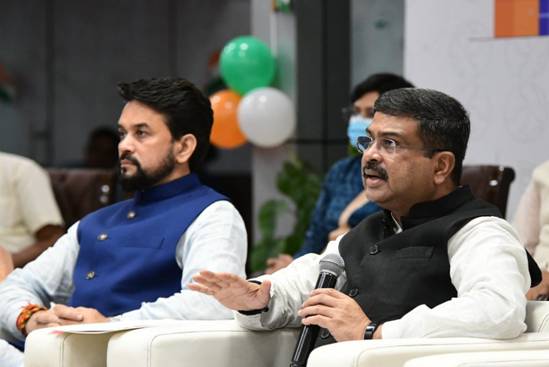
Union Minister of Education Shri Dharmendra Pradhan and Union Minister of Youth Affairs and Sports Shri Anurag Singh Thakur and launched the Fit India Quiz, which is the first-ever quiz on fitness and sports, in New Delhi today. Minister of State of Youth Affairs and Sports, Shri Nisith Pramanik also graced the launch event.  Tokyo Olympics medalists Neeraj Chopra and P V Sindhu virtually joined the event. A few school students also took part in an impromptu Quiz to launch the said initiative.

The nation-wide quiz is aimed at creating awareness about fitness and sports among school-going children, while giving them a chance to compete on a national platform and an opportunity to win a total cash prize of more than Rs  3 crores for their schools. This Fit India Quiz is part of the central government’s ‘Azadi Ka Amrit Mahotsav’ initiative to celebrate 75 years of India’s Independence and is designed to not just bring students from all states on to one platform, but also to involve them in a competition of mental skill and physical fitness.

Speaking on the occasion Shri Dharmendra Pradhan said that there is a strong interconnection between fitness and education. New Education Policy (NEP)-2020 gives special attention to sports-integrated learning for students to adopt fitness as a lifelong attitude as envisaged in the Fit India Movement. Shri Pradhan stated that COVID-19 pandemic has disrupted normal routines and the relevance of Fit India Movement has increased manifold. He said that Fit India Quiz will provide a national platform to students to showcase their knowledge about fitness & sports, create awareness about India’s rich sporting history, including indigenous sports, our sports heroes and how traditional Indian lifestyle activities hold the key to a Fit Life for all.

Speaking about the Fit India Quiz, Shri Thakur said, “Mental fitness is equally important to physical fitness. The Fit India Quiz will inculcate mental alertness at a very early age and the quiz is a perfect way to simultaneously enhance sports knowledge. India has a vast sporting history, along with our success at the Olympics; we’ll add momentum to the goal of building a sports culture in the country with the school students as its champions. A sense of competitiveness also build team character and team spirit. Prime Minister Narendra Modi has emphasised on holistic education and the importance of sports in our lives. His interaction with children has also built a stress free environment for students to learn and grow; the Fit India Quiz is aimed in this direction.” 

During his address MOS for YAS Shri Nisith Pramanik said that people of every age group have participated in the Fit India Mission and appealed to all schools to participate in Fit India quiz and make New India a Fit India.

Neeraj Chopra said that he is feeling very happy  that now we are thinking and doing so much about sports. It will  definitely motivate all students. P V Sindhu said that Fit India quiz is going to give a platform to students and she appealed to every student to participate in this quiz.

To participate in the quiz, the schools have will have to register on the link provided on the Fit India website between 1st September to 30th September 2021 and nominate their students who will take part in the preliminary round of the Quiz at the end of October.

The winners of the Preliminary Round will then take part in the State Round in the month of December and the winners of the state round will then go on to participate at the National level in January – February 2022. The Final round of the Quiz will be aired on Star Sports.

*******

Shikshak Parv 2021 to commence from 5th September

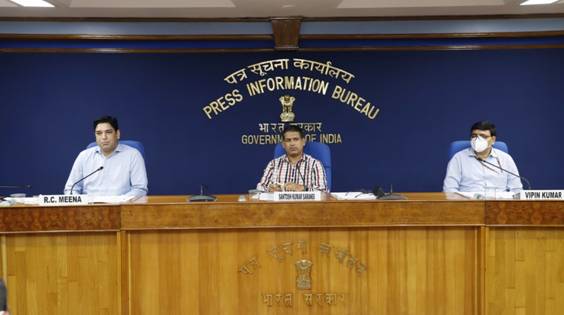
 Shri Santosh Kumar Sarangi, Additional Secretary, School Education, Shri R.C.Meena, Joint Secretary and Shri Vipin Kumar, Joint Secretary held a press conference on the upcoming National Award to Teachers and Shikshak Parv here today.

Shri Sarangi informed that in recognition of valuable contributions of our teachers and to take New Education Policy (NEP) 2020 a step forward, like the previous year this year too, the Department of School Education & Literacy has decided to celebrate Shikshak Parv-2021. Shikshak Parv 2021 will commence from 5th September, 2021 till 17th September through virtual mode, he said.

On vaccination drive to vaccinate more than 2 crore teachers, Shri Sarangi said that the vaccination progress in the states is being monitored by the Department of School Education and Literacy. This will also contribute to decisions pertaining to school reopening.

Shri Meena informed that President Shri Ram Nath Kovind will confer the awards to 44 Awardees through virtual mode on 5th September, 2021. A documentary film on each of the 44 Awardee Teachers will also be shown. He further informed that the National Awards to Teachers were first instituted in 1958 to recognize excellence and commitment of teachers in shaping the minds as well as future of the youth. The award was to accord public recognition to meritorious teachers working in elementary and secondary schools, he added.   

Shri Vipin Kumar informed that Prime Minister Shri Narendra Modi will be addressing the teachers, students, parents and stakeholders associated with education on 7th September, 2021 at 11 AM.  He also informed that Prime Minister will be launching five initiatives of the Department, that is, Indian Sign Language dictionary of 10,000 words, Talking Books (audio books for visually impaired), School Quality Assessment and Accreditation Framework (SQAAF) of CBSE, NISTHA teachers’ training programme for NIPUN Bharat, and Vidyanjali Portal (for facilitating education volunteers/donors/CSR contributors for school development). The conclave will be attended by Shri Dharmendra Pradhan, Union Minister for Education; Smt. Annpurna Devi, Minister of State for Education; Dr.Subhas Sarkar, Minister of State for Education and Dr.Rajkumar Ranjan Singh, Minister of State for Education along with senior officials of the Ministry.

Shri Vipin Kumar said that the inaugural conclave will be followed by webinars, discussions, presentations etc. upto 17th September, 2021 in which the educational practitioners from various schools of the country have been invited to share their experience, learnings and the roadmap ahead. It is noteworthy that teachers and practitioners from even remote schools will be speaking on issues relating quality and innovation in schools. The SCERT and DIETs in respective states will also be deliberating further on each of the webinars and suggesting the roadmap which will be consolidated by State SCERT. These will be shared with NCERT and provide inputs for curricular framework and teacher training modules, he said.

He highlighted that the theme of Webinars has been further segregated into nine sub-themes in the subsequent webinars such as Technology in Education: NDEAR, Foundational Literacy and Numeracy: A Pre-requisite to Learning and ECCE, Nurturing Inclusive Classrooms etc.  to highlight the best practices and initiatives which can be adopted by schools of India.

*****

R&D fair to create an enabling environment for cutting-edge research across the areas envisaged in NEP

 Union Education Minister Shri Dharmendra Pradhan chaired a virtual meeting with the Steering Committee constituted for organizing of the R&D fair of all Indian Institute of Technology (IIT).Minister of State for Education Shri Subhas Sarkar and Minister of State for Education, Shri Ranjan Kumar Singh; Shri Amit Khare, Secretary, Higher Education along with senior officials of the Ministry attended the meeting.

While addressing the participants, the Minister said that R&D Fair of all 23 IITs is scheduled to be held in second half of November, 2021 in commemoration of the 75thyear of Indian independence under the aegis of the Azaadi ka Amirt Mahotsav initiative. He further said the the fair will lead to better understanding and create awareness among Indian industry on the capabilities and the high technology readiness levels in the IITs.  

Shri Pradhan stated that this R&D fair will create an enabling environment for cutting-edge research across the areas envisaged in NEP. The collaborative initiative by 23 IITs with Indian industries on developing innovations for the Indian and global markets would facilitate ease of living and augment the investment by alumni and industries in futuristic research in emerging technologies.

The Minister suggested prioritizing the focus areas for thematic sessions on energy systems, communication tools, waste management, integration of traditional knowledge in structural and architecture, spatial research etc.

Ten themes have been identified in focused areas and 72 projects brought out by 23 IITs on these themes will be shortlisted by the Committee. After due scrutiny, these projects will be presented before the audience in the 2-day mega event. The audience for the event shall include partners from Indian Industry and global institutions, Faculties of various CFTIs, Scientists from DRDO, ISRO, CSIR and ICAR, Students and Youths and Research Scholars.

Dr Pawan Goenka, Chairman,  BoG IIT Madras; Dr BVR Mohan Reddy, Chairman,  IIT Hyderabad; Dr. K. Radhakrishan, Chairman, Standing Committee for IIT Council; Prof Virendra Kumar, Director, IIT KGP; Prof Bhaskar Ramamurthy, Director, IIT Madras; Prof Abhay Karandikar, Director, IIT, Kanpur; Prof Ramgopal Rao, Director, IIT Delhi; Prof T V Sitharam, Director, IIT Guwahati; Prof B.S.Murty, Director, IIT Hyderabad and Prof Subhasis Chowdhary, Director, IIT Bombay were present in the meeting. 

*****

Universities should promote learning in Indian languages & popularise the cultural heritage of India

 Union Education and Skill Development Minister Shri Dharmendra Pradhan today held a meeting with Vice Chancellors of Central Universities through video conferencing. Minister of State for Education Shri Subhash Sarkar, Secretary, Higher Education, ShriAmitKhare, Chairman UGC, Prof D P Singh and senior officials of the Ministry and UGC attended the meeting.

Addressing the participants, Shri Pradhan said that our universities are cradles of creativity, innovation and opportunities. The New Education Policy- 2020 will play a crucial role in placing India at the top of the emerging new world order and, as custodians of India’s destiny, our universities should fulfil their responsibilities outlined in the NEP.He stressed on making education a lot more vibrant & holistic and establishing India as a knowledge superpower through NEP.

The Minister said that our higher education institutions are key catalysts for promoting socio-economic development and for realising aspirations and national goals. The Minister appealed that universities should popularise and promote learning in Indian languages & cultural heritage of India.

Shri Pradhan encouraged Central Universities to work on mission-mode to fill-up the 6,000 vacant posts by October, 2021. He urged them to create a framework for alumni endowment.

Shri Pradhan expressed his happiness to learn about the best practices of Central Universities and on several matters of importance, including filling up of general and reserved vacancies, education during Covid19, online learning and status of NEP implementation.

The Minister exhorted the Universities to come with the strategies for making India fully literate, as well as to contribute helping the country to meet its Nutrition Challenge during ‘Poshan Month’ as a mark of AzadiKaAmrutMahotsav.

The VCs were also requested to encourage Sports in their Universities, thereby promoting a sporting culture in the country. The VCs were encouraged to make their students Job Creators by promoting innovation and research in their campuses.

The Minister thanked the VCs for their insights and valuable suggestions. He urged that as thought leaders, our central universities should assume pioneering roles in building capacities, initiating frameworks for implementation of Academic Bank of Credit, Multiple Entry & Exit, virtual universities and several other facets of the NEP from this academic year itself.

*****

NEP to revolutionize the educational sector in India

 Union Minister of Education Shri Dharmendra Pradhan conferred AICTE- Visvesvaraya Best Teacher Award to 17 faculty members in Engineering and Technology whereas 3 faculty members were awarded the AICTE-Dr. Pritam Singh Best Teacher Award in Management Education. He also conferred Chhatra Vishwakarma Award Clean and Smart Campus Award, 2020 to the winners today.


Minister of State for Education, Dr. Rajkumar Ranjan Singh also graced the occasion. Secretary, Higher Education Shri Amit Khare; Chairman, AICTE, Prof. Anil D Sahasrabudhe, Vice Chairman, AICTE, Prof. MP Poonia and Member Secretary, AICTE Prof. Rajive Kumar also complimented the awardees during the event and highlighted the importance of teachers in nation building.

Speaking on the occasion, Union Minister said that as we complete 75 Years of Independence, the citizens finally have the will to shape India. He stated that the new National Education Policy is expected to revolutionize the educational sector in India and lay the path for the next 25 years as per the Vision 2047 of Prime Minister Shri Narendra Modi. He stressed that the education has to make each one of us more responsible and become Global Citizen. The Minister congratulated AICTE for instituting these 4 awards. Apart from recognizing the efforts of the Teachers, these awards have also brought the spark for innovation, he said.

Shri Pradhan said that the aim of AICTE Visvesvaraya awards is to honour meritorious faculties and encourage them to update themselves to the ever changing needs of higher education at global level and thereby becoming an effective contributor to the knowledge society. Dr. Pritam Singh Best Teacher Award introduced this year only and is conferred on the faculty members for demonstrating teaching excellence and institutional leadership in management education, he added.

Shri Pradhan highlighted that Chhatra Vishwakarma Award provides a platform for our students to look at the societal challenges, with an aim to provide innovative and low-cost solutions. This year again, the council announced the Chhatra Vishwakarma Award 2020, with the theme of “INDIA’S ECONOMIC RECOVERY POST COVID: Reverse migration and rehabilitation plan to support “Atmanirbhar Bharat”. The Minister informed that 24 teams of students who developed very useful and creative solutions for various socio-economic issues have been awarded. The zeal, enthusiasm, innovativeness and hard work of these students will make India a focal point to generate innovative ideas in the near future, he added.

The Minister interacted with all the awardees and appreciated their contribution to the society. While visiting the displayed projects of students, he admired the innovativeness and efforts of winning teams of Chhatra Vishwakarma Award and expressed confidence in India’s bright future. 

Minister of State for Education, Dr. Rajkumar Ranjan Singh motivated the students & all other stakeholders. He encouraged them to enhance their respective activities so that tangible social outcomes are achieved.

Clean and Smart Campus Award, 2020 has also been conferred to selected technical institutes. The award aims to seek engagement with all stakeholders, primarily the student community, to draw their attention towards the immense scope and potential that the technology offers on abstract objectives such as cleanliness, sustainability and environment etc. in line with Swachh Bharat Abhiyan. Winning institutions have displayed great concern and commitment for the environment. All institutions must align their activities with sustainable, clean, and green environmental Policy.

A good teacher is a personality-builder, a society-builder, and a nation-builder

 The primary responsibility of combining the inherent talents of the students lies with the teachers; a good teacher is a personality-builder, a society-builder, and a nation-builder, said the President of India, Shri Ram Nath Kovind.  He was speaking at a virtual award ceremony today (September 5, 2021) on the occasion of Teachers’ Day wherein 44 teachers from across the country were honoured with the National Awards.


Union Minister for Education, Shri Dharmendra Pradhan and Minister of State for Education, Shri Subhas Sarkar;  MoS, Shri RajKumar Ranjan Singh and Smt Annapurna Devi also graced the occasion. Smt. Anita Karwal, Secretary, Department of School Education and Literacy and Shri Amit Khare, Secretary, Department of Higher Education and other senior officials were present on the occasion.


The President congratulated all the teachers who received the award for their distinguished contributions. He said that such teachers strengthen his belief that the future generation is safe in the hands of our well-qualified teachers. He said that teachers have a very important place in everyone’s life. People remember their teachers life-long. Teachers who nurture their students with affection and devotion always get respect from their students.


The President urged teachers to inspire and enable their students to envision a golden future and acquire aptitude to fulfill their aspirations. He said that it is the duty of teachers to inculcate interest in studies in their students. Sensitive teachers can shape the future of students by their behaviour, conduct and teaching. He said that they should pay special attention to the fact that each student has different abilities, talents, psychology, social background and environment. Therefore, emphasis should be laid on all-round development of each child according to their special needs, interests and abilities.


The President said that the National Education Policy, implemented last year, has set an ambitious objective of establishing India as a global knowledge super-power. We have to provide such education to the students which would be helpful in building a just society based on knowledge. Our education system should be such that students develop commitment to the constitutional values ​​and fundamental duties, strengthen patriotic feeling, and make them aware of their role in the changing global scenario.


The President noted that the Union Ministry of Education has taken some important steps to enable teachers. The Ministry has started integrated teachers’ training programme called ‘Nishtha’ under which efforts are being made for ‘Online Capacity Building’ for teachers. Apart from this, ‘Pragyata’ i.e. guidelines on digital education which were issued last year, is also a commendable step with a view to maintain the pace of education even during the crisis of Covid pandemic. He commended the entire team of Union Ministry of Education for finding new avenues even in difficult circumstances.


Speaking on the occasion, Shri Pradhan said that the role that a teacher plays is crucial for the robust development of a nation. They are instrumental in shaping the minds of our new generation, he added. Shri Pradhan thanked all the teachers who are working tirelessly to shape the destiny of a 21st-century India. 


The Minister congratuled all the 44 teachers from 28 states/UTs who have done exemplary work and been conferred with the National Awards. He also remembered Padma Shri Late Shri Prakash Rao of Odisha and countless others like him who have empowered children through education. 


Shri Pradhan said that he feels privileged to join the ceremony to recognise the, efforts of the best teachers in India. They have played a key role in ensuring continuity of education during Covid – 19, he added.


MoS, Education, Smt Annpurna Devi gave the Vote of Thanks.

*****

The Right Kind of Freedom

English Version | Fashion for Freedom | Vogue.pt

 As Maya Angelou rightfully says, “Each time a woman stands up for herself, without knowing it possibly, without calming it, she stands up for all women.” Everyone must be wondering why I choose to write articles that mainly revolve around equality, freedom for women most of the time. The reason is that we are moving so rapidly in the world and yet slow when it comes to feminism, equality, and freedom for women. I believe by writing some articles I have at least some kind of contribution towards speeding up this process that needs to change for a better future. This is not just for women but for society and the world as well.

Today the topic that I am going to talk about is something that every woman, a girl goes through daily. It is about how women are supposed to dress. It is very sad and disheartening when I realize that I have gone through similar instances myself and while writing about this topic, I have a flashback of several instances. It is time we realize that the only person who can decide what to wear is by the individual and nobody else. Let me ask all the readers out there a question. How many times have you seen or even had an experience of family members or relatives or friends or anybody else questioning the attire you are wearing? It is sad and disheartening how women or girls do not have complete control over their attires and clothing while under several circumstances men and boys have all the control over their attires and clothing.

Another thing that I have come across is that men or boys of any class, race, religion, and economic hierarchy can wear whatever they feel comfortable. One of the most common examples that I can give is shorts. However, that is not the case with dressing sense with women or girls. There are certain rules regulations that they need to follow while choosing to wear what they want. I am not specifying any one religion, caste, race, or ethnicity. It is seen everywhere. While women and girls are dressing up so many external factors that play a role and often whatever they choose to wear has to pass through these factors. One of the biggest reasons for this gender clothing discrimination is patriarchy. It seems to root itself in every single aspect. Unfortunately, patriarchy and the rules and regulation of women’s dressing sense seeps in not just men but also women. It has come to a pathetic state where the way one treats a woman is according to how they dress.

The fault does not lie just with the common people but also with the way movies, series, etc represent women according to the way they dress. To show a shy, timid, and introverted woman or girl they dress in ethnic wear, or with glasses, hair tied into a braid, etc. While to show a so-called “out of control” woman or girl they wear shorts, dark color clothes, hair left open, etc. The basis for ideal and non-ideal dressing for women is about in this way to the society, which needs to change. Over the years, we have had politicians and other famous people make the horrendous connection of rape to women’s dressing sense. It is a frightening reality of today’s world. Even if it is burning hot summer and men roam around with a sleeveless shirt and shorts, women still cannot do that. The reason is not because of choice but because they would have to deal with snarky comments, catcalling, etc. I am not saying this will happen to everybody but I can say that a majority of females will have to face this. Labeling of women happens even today according to the way they choose to dress and it is not surprising. Let any woman or girl dress the way they want whether it be jeans, pants, tops, kurta, or sari, the society still manages to give them a name and a label.

Is hate speech legal? - FIRE

In the millennial world of social media where people are trying to bring about some change and create awareness about how it is time for women and girls to dress according to their ideas and perspectives without keeping any factor in mind. However, often even these people face backlash, mean comments, rape, and death threats by people who do not even know them. The idea of culture and tradition is always brought up while making such horrible comments. Limiting women’s choice of dressing in the name of culture, tradition, and even upbringing is visible even today, which is sad and painful.

Under several circumstances, I have seen people justify this behavior saying things like ‘we stop or object women from dressing the way they want for their safety and protection.’ To everyone who says this, I would like to ask shouldn’t the safety and protection of women and girls be a priority regardless of what kind of dress they choose to wear. The other thing that we fail to recognize is that the idea of protecting and safe keeping that is done by the society is towards something that comes by the society. Society, community, government, every single person is responsible for the emergence of these evils in the society that threatens and plays a role in the way women and girls choose dress. It is high time we stop blaming women’s attires and rather hold the problems into account and find solutions to bring about a better change in the society rather than making it a normal thing.

It is high time women get their freedom and equal opportunities to dress according to their wish and will they choose to without any restrictions or barriers. Women and girls should be able to dress the way they want at any time, place, or event and should not face any negativity because of that. This is not something that needs to be asked for rather that should be naturally present as it is for men and boys. This article today revolves more about the freedom of women’s dressing choice than men though men also suffer the same kind of problem under several circumstances is because the percentage of women and girls going through this still a higher number than men and boys. This does not mean men do not deserve their freedom or equality to dress but it sure means that the press and requirements for women are needed at a faster rate.

To conclude, with just a single line that I read and says, “All women and girls should be respected regardless of their clothing.”

References

  1. Google searches for images and quotes.

The Stream of Judgment

Streams After 10th - Arts (Humanities), Commerce & Science

Before I start with the topic of this article, I would like to quote a great man’s wise words where he says, “Education is the most powerful weapon which you use to change the world.” The great man is none other than Nelson Mandela. I would like to ask all the Indian readers specifically out there. How many times have you come across criticism and comments about choosing the arts and humanities stream? I do know a lot of people would have because I too have seen and come across criticism, comments, statements, judgments for choosing the arts and humanities stream and not science, medical, engineering, or commerce stream like people around me.

Importance of the Stream of Arts and Humanities

Though we all know that all streams of education are important for society, community, and the world we still seem to be shunning and showing negativity to the stream of arts and humanities. Not many people realize this but, the stream of arts and humanities is so very important in human society and its well-being but people still seem to show negativity towards it due to prejudice and assumptions. I also have to put it here that people who graduated from the stream of arts and humanities and took the role of psychologist, journalist, dancer, painter, comedian, or any other job with this stream played an equally important role like doctors, biologists, engineers, and investors during the tough and gruesome time of the pandemic. That is something we should not forget. This stands as proof of how equally important the stream of arts and humanities is in the world.

The stream of arts and humanities has equal importance like any other stream or sometimes even more in other countries. However, in India that is not the case at least, this is what I feel. I will also agree when people say that things are slowly changing and people have become more accepting with the stream of arts and humanities. This has been possible because the younger generations are standing for their choices, breaking the stereotype, creating more awareness, breaking the chain of choosing to engineer, medical or science stream like everyone else in the family and so much more. This has been possible not just because of a certain age group but also because of the collective work of the community, society, government, and people of the country. Nevertheless, this is not enough. There is still a lot that needs to be done so that all streams are considered equal in the eyes of the people.

Let me tell all the readers out there something very important that we need to remember before we make critical statements and judgments about the stream of art and humanities. Our daily lives would be incomplete even till today had there not been people taking the stream of arts and humanities. Let me explain. We would not have content in the newspaper if people had not chosen to become news reporters, journalists, editors, or even for those matter writers. Yes, with the use of science and technology, people invented the machines that print newspapers but then what is the point of that invention if there are no people who have taken arts and humanities stream and decided to become a part of writing and bringing the news to people. We all enjoy and entertain ourselves with movies, TV shows, OTT series, and so much more these days. However what we fail to understand is that without people choosing the stream of arts and humanities there would not be actors, cinematographers, content writers, makeup artists, costume designers, production houses, etc. psychologists, therapists, etc play such a massive role during the pandemic and in our daily lives. If these people would not have chosen the stream of arts and humanities and pursued psychology then our mental health would have a negative impact on our physical and emotional health.

I can go on and on for a long time by giving basic and daily life examples about the importance of the stream of arts and humanities. It is high time now that we stop giving our judgment and criticism about the people who have chosen this stream and this stream in general.

Petition · Put a stop to all negative views , bias and criticisms against  the Humanities/Arts Stream. · Change.org

Is the Stream of Arts and Humanities easier than other streams?

Let me ask all the readers out there, how many times have people around you, ask the question “Did you choose arts because science was tough?” or questions like ‘Did you choose arts because you don’t like it or you are weak in math?” or something like “Did you score less in your board exams and that is why you took arts?” I for sure came across all this. I still do under so many different circumstances. The prejudiced idea that arts are something very easy and people who study this do not have to work hard is one of the biggest reasons for these kinds of questions.

However, what people fail to understand is that there is nothing easy about arts. If you ask me, it is tougher than the other streams. Let me tell you why. The reason is that in other streams there are definite notes, definitions, diagrams, tables, etc. Yes, some streams of arts and humanities have these too, for example, psychology. However, there are still many more subjects under this stream that do not have these definite things. Students who study the course of arts and humanities have to do their research, go through different sites and read about different things for their answers, should know the information of the past, present and sometimes even the future to be able to write their answers. These are just some of the things I mention that arts and humanities students do most of the time. There is so much more.

I have even met people who say “Arts is so easy and you still do not score well why?” This statement comes not just from outside people but sometimes even from our parents. This is because of the belief that arts and humanities are easy. Nevertheless, the stream of arts and humanities is over the years has become more complex with the rapid growth and changes in society and the world. The other thing, which many people are not aware of, is that students cannot get the complete marks for their answers even if their answers have everything that needs to be there. This is something that is often omitted and not taken into consideration by people who are not part of the arts and humanities stream. Just because answers do not get full marks, does not mean some people score above 95% and just because some people do does not mean everyone can.

The stream of arts and humanities is so important in society. Students who study through this course are aware not just of the information that is there in their syllabus but also so much more than that. This includes everything that is happening in society and the world. I can go on and on about the benefits of the stream of arts and humanities stream. The reason I chose this topic for my article is that it is high time that this stream is not judged and rather accepted with an open mind and heart.

 To conclude, with a quote by Michelle Obama where says, “The arts and humanities define who we are as people. That is their power to remind us of what we each have to offer, and what we all have in common. To help us understand our history and imagine our future. To give us hope in the moments of struggle and to bring us together when nothing else will.”

References

  1. Google searches for images and quotes.

The Chosen Family

Family vs. Friends: Comparing Key Relationships | LoveToKnow

 I was going through my phone and, I read these meaningful and deep lines that say, “A Friend is someone who accepts who you are, but also helps you become who you should be.” By this, everyone knows what my article is going to be about today. Yes, today the article is all going to be about friendship. Let me ask all the readers out there.

 How many times have we told out of anger, dismay, or sadness that we can stay alone and we do not need any friends? I am sure we all have said that at some point of time in our lives. Nevertheless, this entirely cannot be true. We human beings are social animals and therefore, we cannot be alone for long. We constantly need people around us even if we say otherwise. It is not necessary that we need to find our friends with human beings themselves. It can even be animals, plants anything that helps us have a strong bond and connection

Our progress and development over the years have always been about bringing people together, keeping them connected, meeting new people and so much more about just making things for humanity. Friendship is such an important thing in everyone’s life. Friendship plays such an important role in our lives. The reason I say that friendship is a chosen family is that it is you who decide with whom you want to spend your time. We tend to spend many hours outside our houses. Hence, what kind of friends we have plays a very important role in how things pan out for us. Yes, this might sound very cliché but it is very true. Friends tend to influence your actions, behaviors, thoughts and so much more. Sometimes we can see it but most of the time this happens unconsciously. When I say that one needs to see whether they are good people or not I do not mean it through their religion, looks, ethnicity, color, etc that one sees to judge a person. By right people, I mean through their thinking, actions, behavior, and goodness in their heart. These are true judges of the characters of a person.

There is another thing that one needs to keep in mind concerning friendship. Even if the friendship ends, people should not have any negative feelings about it. They should not speak badly about those people or have a sense of revenge. Rather I would suggest that they could cherish the good memories and move ahead positively about it. Friendship is a balance. If one takes it for granted then it is bad but if one takes it so seriously that it negatively affects them then that is also bad. This article is not to lecture anybody about their friendships rather just different perspectives, ideas, and thoughts that are present in the world.

Happy Friendship Day 2021: Wishes, Messages, Quotes, Images, Pictures and  Greeting Cards | The Times of India

Is there a right type of friendship?

Often there is confusion about whether there is a right type of friendship or not. According to me, it is both yes and no. Let me explain the answer. Yes, there is a certain type of friendship. A friendship is something that helps people in it grow and move forward and in the right manner. If only one person is moving forward and the other one is facing the negative impact of being in that friendship then it is clear that it is not the right type of friendship. Again, this might sound very cliché but friends are often those people outside your family that help you grow and become better individuals in society.

 Friendship is one of those relations where people do not judge you for your actions and at the same time if your judgment is wrong then they guide you show you a new path. Friendship is so precious because this relation helps you have your individuality and at the same time bring about the right changes in each other’s lives. The right type of friendship is when there is a positive impact on everyone’s life that is a part of the friendship. The decision of the rightness of a friendship should not be a decision made by someone outside the friendship. These are decisions that one has to make take on their own after seeing all the factors that play a role in their lives. Another thing, which makes any friendship right, is when mistakes are made by anyone in those relations they apologize and make sure that these do not happen again. If the idea of personal ego exists in a friendship negatively between anyone and that friendship is not right for anyone. There is nothing wrong with apologizing when you make a mistake, especially in a friendship.

When I say no there is no there is nothing like the right type of friendship I mean in the things that go about in the friendship. There is no certain type of friendship. People in a friendship do not necessarily have to talk every day to be under the category of friendship. People can talk once in a blue moon and still have the same feelings and connections in their friendship. People do not have to meet every day or see day to be in a friendship. When there can be long-distance relationships they why cannot there be long-distance friendships. People do not need to have alike thoughts, ideas, or perspectives to be friends and share a good relation. There are so many more things that society has set labels for good or strong friendship that do not necessarily have to be true. Though in friendship certain needs to be in mind and should follow however, there is no rulebook for friendship.

Yes, some friendships last for years together and some friendships last only a few years, weeks, or months and that is completely okay and natural. It is high time that we understand and normalize growing out of the friendship. It is completely okay to have two friends, as it is completely okay to have ten friends in your friendship circle. Friendship has and does not have limitations and boundaries. Some are crossable and some are not crossable. The decision is all of the individuals.

To conclude, with a beautiful quote by Invajy where he says, “A friend is someone who understands your past, believes in your future, and accepts you just the way you are.”

References

  1. Google searches for images and quotes.

Feminist Literary Critisim

Feminist literary criticism is literary criticism informed by feminist theory, or more broadly, by the politics of feminism. It uses the principles and ideology of feminism to critique the language of literature.

This school of thought seeks to analyze and describe the ways in which literature portrays the narrative of male domination by exploring the economic, social, political, and psychological forces embedded within literature.This way of thinking and criticizing works can be said to have changed the way literary texts are viewed and studied, as well as changing and expanding the canon of what is commonly taught. It is used a lot in Greek myths.

Traditionally, feminist literary criticism has sought to examine old texts within literary canon through a new lens. Specific goals of feminist criticism include both the development and discovery of female tradition of writing, and rediscovering of old texts, while also interpreting symbolism of women’s writing so that it will not be lost or ignored by the male point of view and resisting sexism inherent in the majority of mainstream literature. These goals, along with the intent to analyze women writers and their writings from a female perspective, and increase awareness of the sexual politics of language and style were developed by Lisa Tuttle in the 1980s, and have since been adopted by a majority of feminist critics.

The history of feminist literary criticism is extensive, from classic works of nineteenth-century female authors such as George Eliot and Margaret Fuller to cutting-edge theoretical work in women’s studies and gender studies by “third-wave” authors. Before the 1970s—in the first and second waves of feminism—feminist literary criticism was concerned with women’s authorship and the representation of women’s condition within the literature; in particular the depiction of fictional female characters. In addition, feminist literary criticism is concerned with the exclusion of women from the literary canon, with theorists such as Lois Tyson suggesting that this is because the views of women authors are often not considered to be universal.

Additionally, feminist criticism has been closely associated with the birth and growth of queer studies. Modern feminist literary theory seeks to understand both the literary portrayals and representation of both women and people in the queer community, expanding the role of a variety of identities and analysis within feminist literary criticism.

Feminist scholarship has developed a variety of ways to unpack literature in order to understand its essence through a feminist lens. Scholars under the camp known as Feminine Critique sought to divorce literary analysis away from abstract diction-based arguments and instead tailored their criticism to more “grounded” pieces of literature (plot, characters, etc.) and recognize the perceived implicit misogyny of the structure of the story itself. Others schools of thought such as gynocriticism—which is considered a ‘female’ perspective on women’s writings—uses a historicist approach to literature by exposing exemplary female scholarship in literature and the ways in which their relation to gender structure relayed in their portrayal of both fiction and reality in their texts. Gynocriticism was introduced during the time of second wave feminism. Elaine Showalter suggests that feminist critique is an “ideological, righteous, angry, and admonitory search for the sins and errors of the past,” and says gynocriticism enlists “the grace of imagination in a disinterested search for the essential difference of women’s writing.”

More contemporary scholars attempt to understand the intersecting points of femininity and complicate our common assumptions about gender politics by accessing different categories of identity (race, class, sexual orientation, etc.) The ultimate goal of any of these tools is to uncover and expose patriarchal underlying tensions within novels and interrogate the ways in which our basic literary assumptions about such novels are contingent on female subordination. In this way, the accessibility of literature broadens to a far more inclusive and holistic population. Moreover, works that historically received little or no attention, given the historical constraints around female authorship in some cultures, are able to be heard in their original form and unabridged. This makes a broader collection of literature for all readers insofar as all great works of literature are given exposure without bias towards a gender influenced system.

Women have also begun to employ anti-patriarchal themes to protest the historical censorship of literature written by women. The rise of decadent feminist literature in the 1990s was meant to directly challenge the sexual politics of the patriarchy. By employing a wide range of female sexual exploration and lesbian and queer identities by those like Rita Felski and Judith Bennet, women were able attract more attention about feminist topics in literature.

Since the development of more complex conceptions of gender and subjectivity and third-wave feminism, feminist literary criticism has taken a variety of new routes, namely in the tradition of the Frankfurt School‘s critical theory, which analyzes how the dominant ideology of a subject influences societal understanding. It has also considered gender in the terms of Freudian and Lacanian psychoanalysis, as part of the deconstruction of existing relations of power, and as a concrete political investment. The more traditionally central feminist concern with the representation and politics of women’s lives has continued to play an active role in criticism. More specifically, modern feminist criticism deals with those issues related to the perceived intentional and unintentional patriarchal programming within key aspects of society including education, politics and the work force.

When looking at literature, modern feminist literary critics also seek ask how feminist, literary, and critical the critique practices are, with scholars such as Susan Lanser looking to improve both literature analysis and the analyzer’s own practices to be more diverse.

Structuralism

The advent of critical theory in the post-war period, which comprised various complex disciplines like linguistics, literary criticism, Psychoanalytic Criticism, Structuralism, Postcolonialism etc., proved hostile to the liberal consensus which reigned the realm of criticism between the 1930s and `50s. Among these overarching discourses, the most controversial were the two intellectual movements, Structuralism and Poststructuralism originated in France in the 1950s and the impact of which created a crisis in English studies in the late 1970s and early 1980s. Language and philosophy are the major concerns of these two approaches, rather than history or author.

Structuralism which emerged as a trend in the 1950s challenged New Criticism and rejected Sartre‘s existentialism and its notion of radical human freedom; it focused instead how human behaviour is determined by cultural, social and psychological structures. It tended to offer a single unified approach to human life that would embrace all disciplines. Roland Barthes and Jacques Derrida explored the possibilities of applying structuralist principles to literature. Jacques Lacan studied psychology in the light of structuralism, blending Freud and Saussure. Michel Foucault‘s The Order of Things examined the history of science to study the structures of epistemology (though he later denied affiliation with the structuralist movement). Louis Althusser combined Marxism and Structuralism to create his own brand of social analysis.

Structuralism, in a broader sense, is a way of perceiving the world in terms of structures. First seen in the work of the anthropologist Claude Levi-Strauss and the literary critic Roland Barthes, the essence of Structuralism is the belief that “things cannot be understood in isolation, they have to be seen in the context of larger structures they are part of”, The contexts of larger structures do not exist by themselves, but are formed by our way of perceiving the world. In structuralist criticism, consequently, there is a constant movement away from the interpretation of the individual literary work towards understanding the larger structures which contain them. For example, the structuralist analysis of Donne‘s poem Good Morrow demands more focus on the relevant genre (alba or dawn song), the concept of courtly love, etc., rather than on the close reading of the formal elements of the text.

With its penchant for scientific categorization, Structuralism suggests the interrelationship between “units” (surface phenomena) and “rules” (the ways in which units can be put together). In language, units are words and rules are the forms of grammar which order words.

Structuralists believe that the underlying structures which organize rules and units into meaningful systems are generated by the human mind itself and not by sense perception. Structuralism tries to reduce the complexity of human experiences to certain underlying structures which are universal, an idea which has its roots in the classicists like Aristotle who identified simple structures as forming the basis of life. A structure can be defined as any conceptual system that has three properties: “wholeness” (the system should function as a whole), “transformation” (system should not be static), and “self-regulation (the basic structure should not be changed).

Structuralism in its inchoate form can be found in the theories of the early twentieth century Swiss linguist, Ferdinand de Saussure (Course in General Linguistics, 1916), who moved away from the then prevalent historical and philological study of language (diachronic) to the study of the structures, patterns and functions of language at a particular time (synchronic). Saussure’s idea of the linguistic sign is a seminal concept in all structuralist and poststructuralist discourses. According to him, language is not a naming process by which things get associated with a word or name. The linguistic sign is made of the union of “signifier” (sound image, or “psychological imprint of sound”) and “signified” (concept). In this triadic view, words are “unmotivated signs,” as there is no inherent connection between a name (signifier) and what it designates .

The painting This is Not a Pipe by the Belgian Surrealist artist Rene Magritte explicates the treachery of signs and can be considered a founding stone of Structuralism. Foucault‘s book with the same title comments on the painting and stresses the incompatibility of visual representation and reality.

Saussure’s theory of language emphasizes that meanings are arbitrary and relational (illustrated by the reference to 8.25 Geneva to Paris Express in Course in General Linguistics; the paradigmatic chain hovel-shed-hut-house-mansion-palace, where the meaning of each is dependent upon its position in the chain; and the dyads male-female, day-night etc. where each unit can be defined only in terms of its opposite). Saussurean theory establishes that human being or reality is not central; it is language that constitutes the world. Saussure employed a number of binary oppositions in his lectures, an important one being speech/writing. Saussure gives primacy to speech, as it guarantees subjectivity and presence, whereas writing, he asserted, denotes absence, of the speaker as well as the signified. Derrida critiqued this as phonocentrism that unduly privileges presence over absence, which led him to question the validity of all centres.

Saussure’s use of the terms Langue (language as a system) and Parole an individual. utterance in that language, which is inferior to Langue) gave structuralists a way of thinking about the larger structures which were relevant to literature. Structuralist narratology, a form of Structuralism espoused by Vladimir Propp, Tzvetan Todorov, Roland Barthes and Gerard Genette illustrates how a story’s meaning develops from its overall structure, (langue) rather than from each individual story’s isolated theme (parole). To ascertain a text’s meaning, narratologists emphasize grammatical elements such as verb tenses and the relationships and configurations of figures of speech within the story. This demonstrates the structuralist shift from authorial intention to broader impersonal Iinguistic structures in which the author’s text (a term preferred over “work”) participates.

Structuralist critics analyse literature on the explicit model of structuralist linguistics. In their analysis they use the linguistic theory of Saussure as well as the semiotic theory developed by Saussure and the American philosopher Charles Sanders Peirce. According to the semiotic theory, language must be studied in itself, and Saussure suggests that the study of language must be situated within the larger province of Semiology, the science of signs.

Semiology understands that a word’s meaning derives entirely from its difference from other words in the sign system of language (eg: rain not brain or sprain or rail or roam or reign). All signs are cultural constructs that have taken on their meaning through repeated, learned, collective use. The process of communication is an unending chain of sign production which Peirce dubbed “unlimited semiosis”. The distinctions of symbolic, iconic and indexical signs, introduced by the literary theorist Charles Sande  Peirce is also a significant idea in Semiology. The other major concepts associated with semiotics are “denotation” (first order signification) and “connotation” (second order signification).

Structuralism was anticipated by the Myth Criticism of Northrop Frye, Richard Chase, Leslie Fiedler, Daniel Hoffman, Philip Wheelwright and others which drew upon anthropological and physiological bases of myths, rituals and folk tales to restore spiritual content to the alienated fragmented world ruled by scientism, empiricism and technology. Myth criticism sees literature as a system based or recurrent patterns.

The French social anthropologist Claude Levi-Strauss applied the structuralist outlook to cultural phenomena like mythology, kinship relations and food preparation. He applied the principles of langue and parole in his search for the fundamental mental structures of the human mind. Myths seem fantastic and arbitrary yet myths from different cultures are similar. Hence he concluded there must be universal laws that govern myths (and all human thought). Myths consist of 1) elements that oppose or contradict each other and 2) other elements that “mediate” or resolve those oppositions (such as trickster / Raven/ Coyote, uniting herbivores and carnivores). He breaks myths into smallest meaningful units called mythemes. According to Levi-Strauss, every culture can be understood, in terms of the binary oppositions like high/low, inside/outside, life/death etc., an idea which he drew from the philosophy of Hegel who explains that in every situation there are two opposing things and their resolution, which he called “thesis, antithesis and synthesis”. Levi-Strauss showed how opposing ideas would fight and also be resolved in the rules of marriage, in mythology, and in ritual.

In interpreting the Oedipus myth he placed the individual story of Oedipus within the context of the whole cycle of tales connected with the city of Thebes. He then identifies repeated motifs and contrasts, which he used as the basis of his interpretation. In this method, the story and the cycle part are reconstituted in terms of binary oppositions like animal/ human, relation/stranger, husband/son and so on.

Concrete details from the story are seen in the context of a larger structure and the larger structure is then seen as an overall network of basic dyadic pairs which have obvious symbolic, thematic and archetypal resonance. This is the typical structuralist process of moving from the particular to the general placing the individual work within a wider structural content.

A very complex binary opposition introduced by Levi-Strauss is that of bricoleur (savage mind) and an engineer (true craft man with a scientific mind). According to him, mythology functions more like a bricoleur, whereas modern western science works more like an engineer (the status of modem science is ambivalent in his writings). In Levi-Strauss’s concept of bricolage, what is important is that the signs already in existence are used for purposes that they were not originally meant for. When a faucet breaks, the bricoleur stops the leak using a cloth, which is not actually meant for it. On the other hand the engineer foresees the eventuality and he would have either a spare faucet or all the spanners and bolts necessary to repair the tap.

Derrida, the poststructuralist, opposes Levi-Strauss‘s concept of bricolage in his Structure, Sign and Play, saying that the opposition of bricolage to engineering is far more troublesome that Levi-Strauss admits and also the control of theory and method, which Levi-Strauss attributes to the engineer would seem a very strange attribution for a structuralist to make.

In Mythologies he examines modern France from the standpoint of a cultural theorist. It is an ideological critique of products of mass bourgeois culture, like soaps, advertisements, images of Rome etc., which are explained using the concept of ‘myth’. According to Barthes, myth is a language, a mode of signification. He reiterates Saussure’s view that semiology comprises three terms: signifier, signified and sign, in which sign is a relation between the signifier and signified. The structure of myth repeats this tri-dimensional pattern. Myth is a second order signifying system illustrated by the image of the young Negro in a French uniform saluting the french flag, published as the cover page of the Parisian magazine, Paris Match, which reveals the myth of French imperialism at the connotative level.

The complexity and heterogeneity of structuralism, which is reflected even in the architecture of this period (eg., structuralist artefacts like Berlin Holocaust Memorial, Bank of China Tower, etc) paved the way to poststructuralism which attacked the essentialist premises of structuralism. Poststructuralism argues that in the very examination of underlying structures, a series of biases are involved. Structuralism has often been criticized for being ahistorical and for favouring deterministic structural forces over the ability of people to act. As the political turbulence of the 1960s and 1970s (especially the student uprising of May 1968) began affecting the academy, issues of power and political struggle moved to the centre of people’s attention. In the 1980s deconstruction and its emphasis on the fundamental ambiguity of language—rather than its crystalline logical structure—became popular, which proved fatal to structuralism.