
HUMAN ANATOMY

Introduction to Human Anatomy and Physiology

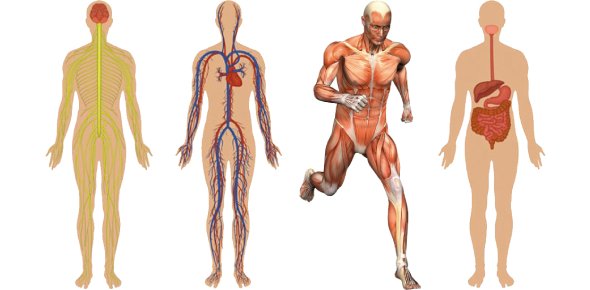
Anatomy is the study of the shape and structure of the body of organisms or living beings. The word anatomy is derived from the Greek words ‘ ana ‘ and ‘ tomy ‘ where ‘ ana ‘ means ‘apart’ and ‘tomy ‘ means ‘to cut’. In physiology, the functions of various system such as respiratory system, digestive system, nervous system, skeleton system and muscular system of organisms are studied. It can be said that physiology is the study of how the body and all its part function. It consists of two word, namely, ‘physio’ and ‘ ology’ where ‘physio’ means ‘nature ‘ and ‘ ology ‘ means ‘ study’. Here ,we will study human anatomy and human physiology.

Definition of Human Anatomy
Free Vector | Anatomy of the human body information infographic

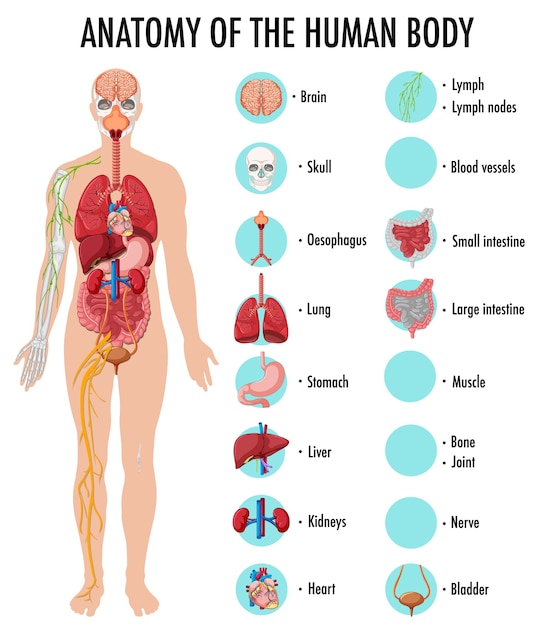
Human Anatomy is the study of structure ,shape, size , weight and location of all the organs of human body. A detailed knowledge of the structure of various system of human body is provided in human anatomy . For example , the shape, size, weight, structure and location of all the organs of the excretory system such as lungs, kidneys, large intestine, liver, skin, etc. are studied in human anatomy. Human anatomy can be defined as the science dealing with human body structure and relationships among structures.

Importance of Anatomy

The importance of anatomy and physiology is mentioned below.

  • Anatomy Provides the Knowledge of Structures of Various Organs : Human anatomy provides the detailed knowledge of the structure of various organ body . We get the knowledge of structure, shape, size, location and weight of organs of all the systems of our body. We come to know about the length of various organs such as the length, size and shape of the bones. With the help of anatomy , we get the knowledge of the percentage of white fibres and red fibres present in an individual. As a result of such knowledge , the teacher and coaches working in the field of physical education and sports may easily select the suitable sports according to the traits of students. For example, weightlifting is more appropriate for short statured students, who have more percentage of white fibres i.e., fast twitch fibres in comparison to red fibers i.e., slow twitch fibres can perform better in sprinting events instead of endurance events.

A glimpse at the most famous medical practitioner.

Biology, a term that defines the study of all living things. A major branch of biology is anatomy or the branch of biology concerned with the study of the structure of organisms and their parts. The study of anatomy has led early doctors and physicians to know more about the body and how to mend it or reduce its ailments. Almost all branches of the practice of medicine can in some way trace their origins to the study of anatomy. One of the most renowned physicians of medical history is Galen of Pergamon, who is also the most notorious. This towering figure in the field of medicine had doctors all of the world fearing and revering him not only during his lifetime but nearly 1300 years later as well. He was a Greek physician, author, and philosopher, working in Rome, who influenced both medical theory and practice until the middle of the 17th century CE.

Photo by cottonbro on Pexels.com

As a teen Galen left his hometown to pursue his love of medicine to the Mediterranean. When he returned, he was now seemingly an expert in anatomy and a very gifted surgeon. Ever the showman, he would enter public anatomy contests to show up his fellow physicians. HE did a lot of things which were outlandish and in taunting his rivals, he made them lose their reputations. He once made a pig lose its voice by tying of its nerve, in another instance he disembowelled a monkey and then did a surgery to repair it. A meticulous man, he milked the branch of anatomy for all its worth. While his peers would discuss symptoms and origins of various diseases, Galen was focused on anatomy. But since he was a physician in the roman era, and the roman law prohibited the use of human cadavers, he had to make do with animals. He carved up nearly every kind of animal he could find in his pursuit to realize his theory, that each organ had its own function. He did numerous experimentations and despite his handicap of not being able to use human cadavers, he produced some remarkable results. Galen was the one who proved that it was the brain that controlled the body and not the heart. he did so with one of the most outlandish experiments ever, which needed someone to be crazy and zealous as well as insanely talented according to those times. Fortunately, for Galen, he checked all the boxes. To prove this theory, cracked open the cranium of a cow while it was alive and prodded different parts of it to link to various functions. However, these experiments also resulted is misconceptions which were way off the actual truth. He thought that the liver and not the heart pumped blood and it would deplete completely in a one-way trip. He also gave his overwhelming support to a dreadfully wrong theory of the Four Humors. This stated that that the body functioned through the balance of four body fluids. This created a lot of problems and resulted in many unnecessary deaths. Galen, being ever so vain, penned down each of his discoveries ranging from anatomy to nutrition to bedside manner. Galen’s books became a staple for anyone pursuing the medical science. He was so revered that even when doctors would open up human cadavers, they would repeat Galen’s mistakes despite seeing clear evidence against it. He was so popular that the few practitioners who contradicted them were either ridiculed, ignored or silenced. It wasn’t until the !7th century that renaissance anatomist Vesalius who contradicted him, and successfully changed the mind of people. Even then it took nearly 300 years for the misguided works of Galen to fade away.

This serves as a reminder that science is evolving every day, what might be considered a plain fact today, might be a gross misconception tomorrow.