The whale shark

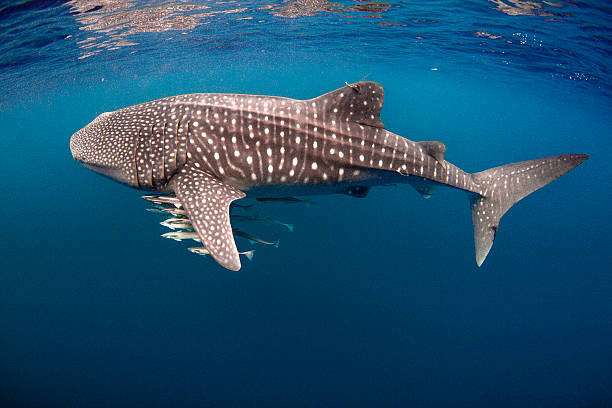
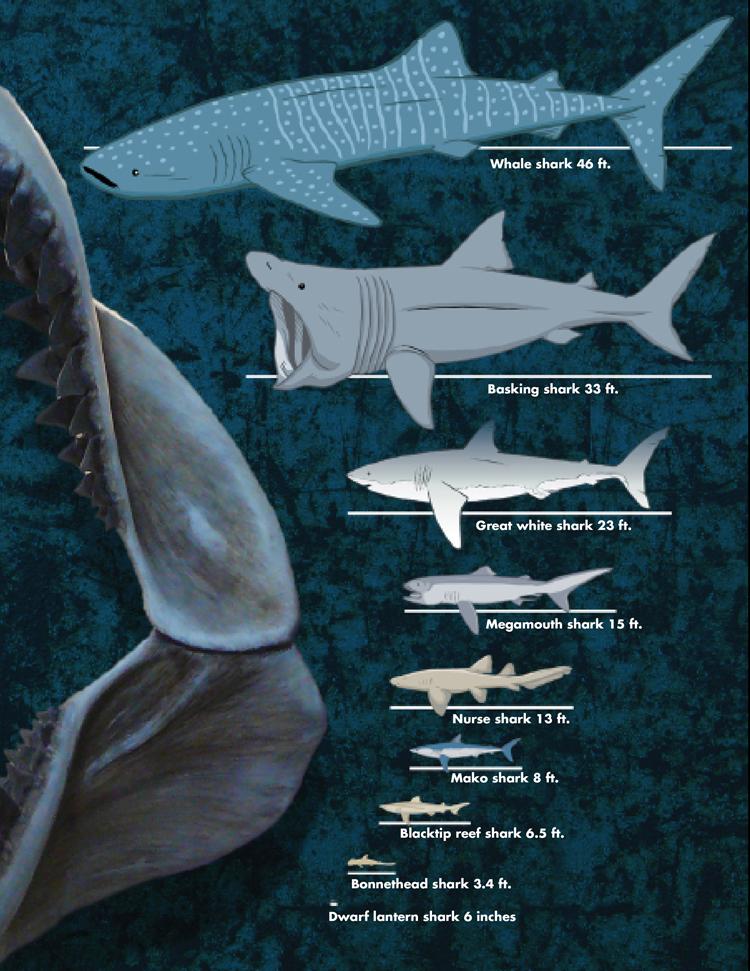
The whale shark (Rhincodon typus Smith, 1828) is the world’s largest fish, reaching 15 meters (m) and 18 metric tons (Colman 1997). The head is broad and flattened with a large terminal mouth, miniscule teeth, and large gill slits. The eyes are small and located just behind the mouth on each side of the head. There are three prominent ridges along the back. The first dorsal fin is larger than the second dorsal fin and is set midway back on the shark. Whale sharks have distinctive markings of pale white spots and stripes on their dark dorsal surface, which resembles a checkerboard pattern. It has been suggested that this checkerboard pattern functions as camouflage in the pelagic environment (Wilson and Martin, 2004). Since the arrangement of spots is specific to the individual, photographic identification libraries are being complied for whale shark populations around the world (ECOCEAN).
Habitat and diet

Though Whale Sharks have several hundred teeth, they don’t use them to eat. Instead, these fish are filter feeders, swimming forward to swallow prey. They are carnivorous, eating krill, crab and fish larvae, small schooling fish, and jellyfish. Humans are not on the menu. 

Whale Sharks live in all warm and tropical seas, are migratory, and swim more than 1,000 metres below the surface. Feeding aggregations occur seasonally at several locations, including Ningaloo Reef.

Where do whale sharks live?

What is well known is that whale sharks live in all of the world’s tropical and warm temperate seas and prefer surface water temperatures of 21 to 25 degrees Celsius. They are migratory, with individuals swimming thousands of kilometers to places where food “pulses,” like mass coral spawning events, at the same time every year. You’ll find no couch-potato habits among whale sharks, despite their size.

Whale sharks are considered to be highly migratory. Some moved over 8,000 miles in approximately three years (Eckert and Stewart 2001). In the Caribbean, specimens tagged off Belize moved westward to Honduras and others northward to the Yucatan peninsula (personal communication, R. Graham Wildlife Conservation Society). There are reports of a few sharks that have moved from Meso-American waters (e.g., Belize, Honduras) into the southern Gulf of Mexico (personal communication R. Graham, Wildlife Conservation Society). Two immature male whale sharks tagged off Holbox, Mexico, moved in different directions. One moved south to Honduras and the other moved north to Brownsville, Texas, (personal communication R. Hueter, Mote Marine Laboratory). There is no information on movements of whale sharks from the Caribbean Sea to the northern Gulf of Mexico.
Behaviour and reproduction

Whale Sharks do give birth to live young, but not in the way you’re thinking. The Whale Shark is oviparous, meaning the female sharks produce eggs that are hatched inside of her. These eggs are not all born at once, but are born in a steady stream over a certain period.

Able to birth around 300 young, Whale Sharks reach sexual maturity at 30 years and live to a total of around 70 to 100 years.

Threats

The Whale Shark population is at risk. Vessel strikes and being caught accidentally by commercial fishing vessels has led the Whale Shark to be considered a vulnerable species. 

Some Facts:

  • Whale Sharks can live up to 100 years.
  • Whale Sharks will often “cough” to clear particles from their filter pads.
  • Whale Sharks are covered in a pattern of spots that is unique to each shark, much like human fingerprints.
  • Sometimes, Whale Sharks allow swimmers to grab their fins and catch a ride!
  • A whale shark’s mouth is about 1.5 m wide. Inside, they have rows of over 300 teeth, but they don’t use these teeth to eat because they’re filter feeders.
  • While they are meat-loving carnivores, whale sharks do not attack humans. They are filter feeders and eat krill, crab and fish larvae, small schooling fish and jellyfish.
  • The whale shark is ovoviparous, meaning the female produces eggs that hatch insider her.
  • When the young are fully developed, the female gives birth to around 300 live young.

Spotted Wobbegong

The spotted wobbegong (Orectolobus maculatus) belongs to the Orectolobidae family, and is found in the eastern Indian Ocean around Australia; it is possibly endemic to this region. A relatively large shark (reaching lengths of up to 3m/9.8 ft), other common names are “carpet shark,” “common carpet shark,” “common catshark,” “tassel shark,” or just “wobbegong.”

This wobbegong can be distinguished by its unique pattern of dark saddle-like markings on their dorsal side on top of a golden-brown colour. On top of these are white rings scattered about.

The genus name Orectolobus is Greek from orectos (stretched out) and lobos (a rounded projection). The species name maculatus is Latin from macula (spot), most likely referencing the patterns on the shark’s body. The word ‘wobbegong’ itself is an Australian aboriginal word. ​Spotted Wobbegongs are found in the shallow, coastal waters of Australia down to about 100 m. These sharks are famous for their lie-in-wait hunting strategy, known to swallow smaller prey whole. Feeding primarily takes place at night, and food menu items include fish, crayfish, crustaceans and even cephalopods.

Habitat and Diet

Favorite foods of the spotted wobbegong include invertebrates such as crabs, lobsters, and octopi as well as bony fish such as sea bass and luderick. This shark is nocturnal, hunting at night and resting during the day. O. maculatus can extend its reach during prey capture by as much as 30% of the nasal distance from its anteriormost point to the anterior edge of the pectoral fin. This is equivalent to the combined length of the head and branchial arches.

The spotted wobbegong often sits at the bottom and waits for prey to wander near its mouth. Prey has even been known to nibble on this shark’s tentacles before being eaten. Other times this shark has been observed to slowly sneak up on its prey from a long distance.

Occurring on continental shelves, from the intertidal zone down to 360 feet (110 m), the spotted wobbegong is commonly found on or around reefs, under piers and on sandy bottoms. There have been many sightings of this shark in water barely deep enough to cover its entire body. It is considered sluggish and inactive and is often found resting on the ocean floor.

Status in the Wild

The spotted wobbegong is currently assessed as “Near Threatened” in waters off New South Wales due to serious declines in population numbers in that region and “Near Threatened” throughout the remainder of its range by the World Conservation Union (IUCN) Red List. The IUCN consists of a global union of state, governmental agencies, and non-governmental organizations in partnership whose goal is to assess the conservation status of different species.

Some Facts

  • There are 12 known species of wobbegongs.
  • Wobbegong sharks are nocturnal (active at night).
  • The name wobbegong comes from the Aborigine name meaning “shaggy beard”. They are also called carpet sharks.
  • They are not obligate ram ventilators (sharks that have to force water through their mouths and over their gills in order to breathe). They simply lay on the ocean floor, lazily, and open their mouths, sucking water in and over their gills. So they don’t have to keep swimming in order to breathe.
  • These sharks are ambush predators. They lay in wait for passing prey to happen upon their tassels thinking they are food. Then the typically lazy wobbegong opens their mouth, creating a vacuum and sucking in the prey whole. They snap up their prey in the blink of an eye.
  • Wobbegong sharks can actually move across the ocean floor using their bottom fins, which looks just like they are walking.
  • Their jaws are powerful and they also have very sharp teeth, albeit small, that can cut through wetsuit material, yielding a painful bite.

Bluebottle Jellyfish

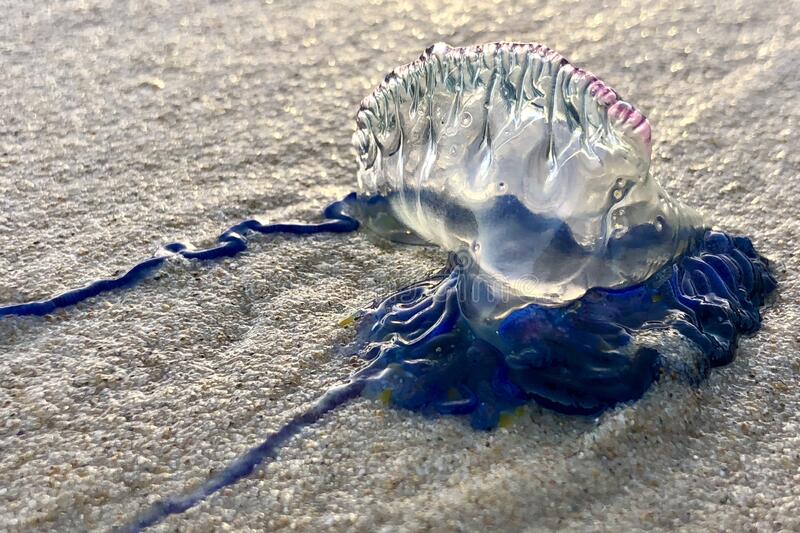
The blue bottle jellyfish, also known as the Portuguese man-of-war, is not actually a jellyfish, but a collection of organisms living together in a colony, called a siphonophore. The blue bottle jellyfish is composed of four separate organisms, each with a different job for the colony.

The major shape of the jellyfish comes from the first organism, making up a float called the pneumatophore. This beautiful blue-purple shape is where the jellyfish gets its name.

The second organism makes up the tentacles, responsible for capturing prey.

The third and fourth organisms make up the digestive system and the reproductive system.

Habitat

Imagine going on a tropical beach vacation to Florida. The soft white sand nearly burns your feet, but the ocean tide is just a few steps away. However, as you near the water you see warning signs for jellyfish and most people aren’t going in the water. Disappointed, a life guard informs you that there have been sightings of the blue bottle jellyfish in the area and advises you to stay out of the water.

Just like many people, the blue bottle jellyfish enjoys the warm tropical waters around the equator. It lives in the Atlantic, Indian and Pacific oceans, floating near the surface of the water.

It’s a common sight in Australia and can also be found along the coasts of India, the Caribbean and even the coasts of Florida. Sometimes gathering in groups of up to 1000 individuals, these organisms are passive and can be seen floating on or just below the ocean surface.

Adaptations

A blue bottle jellyfish is soft, without many defenses against larger, jawed predators. To survive the competition in warm, tropical seas, the blue bottle jellyfish has evolved several adaptations, or physical traits that help it survive.

Bluebottle and minor jellyfish sting

Stings by bluebottle jellyfish are the most common in Australia. These can cause intense pain and sores in the areas of skin which have been in contact with the jellyfish tentacles. The pain usually decreases or stops after 1–2 hours and the sores may fade after a few days. You may also have a rash or redness in the area which was stung.

Sting treatment

  • Wash the sting site with sea water and remove any tentacles.
  • Immerse the sting or run hot water on the skin for 20 minutes. Make sure the hot water will not burn the person. It should be as hot as they can tolerate — around 45 degrees Celsius. The person can also have a hot shower.
  • If there is no hot water, an ice pack may help to relieve the pain.

Jellyfish sting prevention

  • Some things you can do to help prevent jellyfish stings are:
  • Avoid swimming in the sea when warning signs about jellyfish are displayed.
  • Don’t touch any jellyfish in the water or on the beach.
  • Wear a full-body Lycra wetsuit and waterproof footwear

Ocean acidification

Ocean acidification is a serious environmental problem, it is equivalent to the problem of climate change or much bigger. As there are many changes happening around in the environment, some of which we can hardly see. Ocean acidification is related to the water bodies and the aquatic life as a result, the ultimate impact is faced by the aquatic creatures and indirectly by the humans.
Ocean acidification is associated with natural process, the carbon dioxide present in atmosphere is absorbed by the ocean bodies. It is a natural process that is actually beneficial for the environment as the extra amount of carbon dioxide gases present in the environment are absorbed this leads to reduction in the temperature. But the problem started when the absorption amount increased over the years and it keeps on increasing by every passing year. This might seem fine initially but, it is a matter of concern for scientists and researchers, just like any other major environmental problem this is not good for aquatic biodiversity.
There are multiple causes of ocean acidification and why ocean acidification can become a big challenge in future –
The raise in atmospheric carbon dioxide, due to excessive pollution, emission of harmful gases and other activities has increased the absorption level in the oceans as well.
Fossil fuels is another top reason for ocean acidification as the burning of fossil fuels like coal, petroleum produces carbon dioxide gas, which indirectly contributes to ocean acidification.
The waste that is disposed off in the ocean contaminates the water bodies and increases the level of acidity of water. This waste includes agricultural waste, industrial waste etc.
These are the main causes of ocean acidification, they directly or indirectly become hazardous sooner or later. The changes occurring in the ocean is not visible to us but, it can not be ignored in long run.
The process of acidification increases the PH level of water, this acidity can actually be determined by tests. The chemical composition of water is destroyed slowly and gradually. The effect can be seen on the aquatic life and aquatic organism, the corals can detoriate at a higher rate, the shells of animals can not form and the tiny organism which plays a significant role in the aquatic world can not adapt to this acidic level and thus can not survive. Basically, different aspects are targeted, which can create hurdles in the balance of aqua diversity.
This issue is widely discussed in international conferences and some countries have already started monitoring the condition. They are further working to take steps to answer the problem many people are dependent on ocean a fisherman earns his livelihood, a sailor sails in ocean and if not, profession wise; but we all are drinking water which come from these water bodies only. If not today then in future we will be drinking this acidic water. The fact that with development came higher amount of waste generation, pollution, deforestation, climate change, global warming, and new problems. If all the problems are not resolved responsibly at global level the earth and its people are going to suffer a lot in near future. We can already experience the impact in the form of frequent droughts, tsunami, earthquake, landslide, forest fires etc.

THE World under the OCEAN

Hellooo guys!!!

Today I am writing about a very interesting topic

We the humans are creatures of land, but there is totally a different world under the ocean.

Its as if the colours in the whole world can be seen under the ocean not only colours the different

aquatic beings are of different kind, they have their own designs patterns.

Its like a whole new ecosystem out there.

once you dive into this beautiful and colourful world under the ocean you can see a whole new unique world.

yes guys I am emphasising on the word “world” cause they have their own environment, their own living beings

I would like to tell you all about some of the intEresting facts and terminoligies i have heard about.

  • 1.CLOWN FISHES :- I am sure you all know about the famous fish nemo but do you guys know that its real name is clown fish. These kind of fishes are found in warm waters such as Red sea, pacific ocean. They are found in shallow waters.

Photo by Tom Fisk on Pexels.com
  • 2. TREASURES: I don’t know if the pirates really hunt for treasures or not but deep under the ocean the treasures really exist. you may get the doubt about how the treasures are under the sea these are caused to the shipwrecks.
  • Before you go on a journey to find the treasures please do not forget the treasure maps.
Photo by Suzy Hazelwood on Pexels.com
  • 3.Whale falls: THE WHALES live under the ocean but do you guys know there is term associated with the whales that is the whale falls
  • A whale fall occurs when the carcass of a whale has fallen onto the ocean floor at a depth greater than 1,000 m, in the bathyal or abyssal zones. On the sea floor, these carcasses can create complex localized ecosystems that supply sustenance to deep-sea organisms for decades.

  • 4. Blind fishes: The Mexican blind cavefish (Astyanax mexicanus), which no longer has eyes. Now scientists may have solved the riddle of why the fish lost their eyes in the dark.They live deep in the ocean.

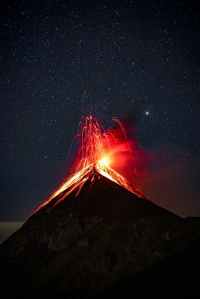
  • 5.Volcanic eruptions: we all know about the volcanoes and volcanic eruptions on land , but do you know most of the volcanic eruptions take place under the sea .
  • The active volcanoes are less than dormant volcanoes under the ocean but still they ratio of volcanic eruptions in the ocean is more compared to that on land.
Photo by Clive Kim on Pexels.com
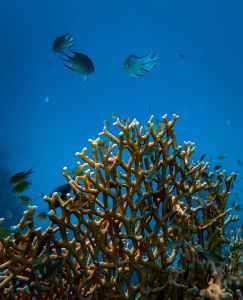
  • 6. As I mentioned earlier I call it as the marine world , They have their own environment, they even have lakes , waterfalls, forests, corals.
  • Even aquatic animals get attracted to them and even sometimes new species form there due to the environment.
Photo by Francesco Ungaro on Pexels.com

The above facts are just a sneak peak into the

” world under the OCEAN”

Thankyou^^