Active reading involves looking at the text in more than one way. For your reading responses write using these three “keys,” or methods, of analyzing what you have read:
Reading responses in this class generally vary from 250 – 400 words. The length required will be specified on the assignment.
Sometimes you will be asked to post your reading response to the Discussion Board and then follow-up with a response to one of your classmate’s postings. You may respond in any of the three “keys.” A sample response building on a previous posting might start off with a sentence like this: “I agree with David that advertising objectifies women by portraying them as dehumanized objects, but I wonder whether women benefit from that objectification in any way?” You can build your ideas on comments others have made. And feel free to keep chatting with each other.
Assam is is a state in northeastern India, south of the eastern Himalayas along the Brahmaputra and Barak River valleys. Assam covers an area of 78,438 km^2. The state is bordered by Bhutan and Arunachal Pradesh to the north; Nagaland and Manipur to the east; Meghalaya, Tripura, Mizoram and Bangladesh to the south; and West Bengal to the west via the Siliguri Corridor, a 22 kilometres wide strip of land that connects the state to the rest of India. Assamese is the official and most commonly spoken language of the state, followed by Bengali, which is official in the Barak Valley and Bodo which is official in Bodoland Territorial Region.
Assam is known for Assam tea and Assam silk. The state was the first site for oil drilling in Asia. Assam is home to the one-horned Indian rhinoceros, along with the wild water buffalo, pygmy hog, tiger and various species of Asiatic birds, and provides one of the last wild habitats for the Asian elephant. The Assamese economy is aided by wildlife tourism to Kaziranga National Park and Manas National Park, which are World Heritage Sites. Dibru-Saikhowa National Park is famed for its feral horses. Sal tree forests are found in the state which, as a result of abundant rainfall, look green all year round. Assam receives more rainfall than most parts of India; this rain feeds the Brahmaputra River, whose tributaries and oxbow lakes provide the region with a hydro-geomorphic environment.
Assamese Culture is traditionally a hybrid one developed due to assimilation of ethno-cultural groups of Austric, Dravidian, Tibeto-Burman and Tai origin in the past. Therefore, both local elements or the local elements in Sanskritised forms are distinctly found.
The modern culture has been influenced by events in the British and the post-British era. The language was standardised by American Baptist Missionaries such as Nathan Brown, Dr. Miles Bronson and local pundits such as Hemchandra Barua with the form available in the Sibsagar (Sivasagar) District (the ex-nerve centre of the Ahom Kingdom).[citation needed]
Increasing efforts of standardisation in the 20th century alienated the localised forms present in different areas and with the less-assimilated ethno-cultural groups (many source-cultures). However, Assamese culture in its hybrid form and nature is one of the richest, still developing and in true sense is a ‘cultural system’ with sub-systems. Many source-cultures of the Assamese cultural-system are still surviving either as sub-systems or as sister entities, e.g. the; Bodo or Karbi or Mishing. It is important to keep the broader system closer to its roots and at the same time focus on development of the sub-systems.
Some of the common and unique cultural traits in the region are peoples’ respect towards areca-nut and betel leaves, symbolic (gamosa, arnai, etc.), traditional silk garments (e.g. mekhela chador, traditional dress of Assamese women) and towards forefathers and elderly. Moreover, great hospitality and bamboo culture are common.
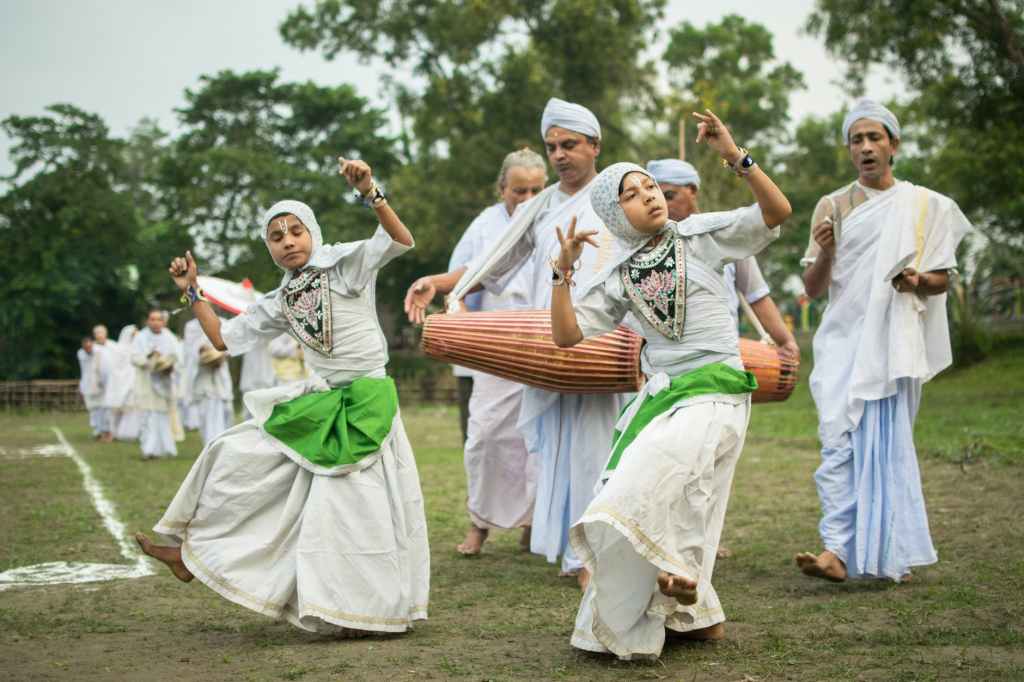
Bihu is the most popular folk dance of Assam. Bihu dances are performed by young boys and girls during the Bihu festivities which represent youthful passion, reproductive urge, and joy.It is characterized by brisk dance steps, and rapid hand movement. Dancers wear traditionally colorful Assamese clothing.




 Eduindex
You must be logged in to post a comment.