
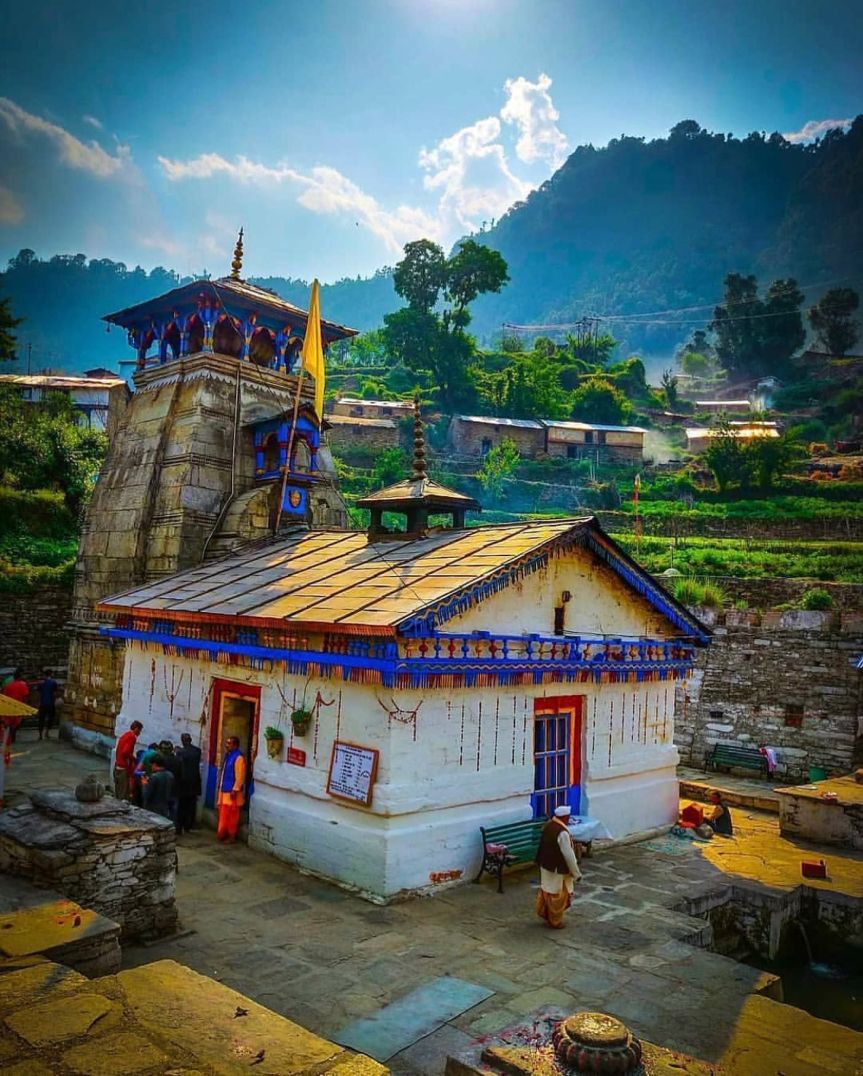
A temple believed to be a marriage place of Lord Shiva and Goddess Parvati.

Trijuginarayan Temple is a Hindu temple located in the village of Trijuginarayan in the Rudraprayag district, Uttarakhand, India. The ancient temple is dedicated to Lord Vishnu. Its a popular Hindu pilgrimage site because it is attributed to the legend that this is the place where the marriage of Lord Shiva and Goddess Parvati took place and which Lord Vishnu witnessed here. The hallmark of this temple is the eternal fire that burns in front of the temple. It is believed that the fire is burning from the time of Lord Shiva and Goddess Parvati marriage. Therefore, this temple is also known as Akhand Dhuni Temple. The temple courtyard is also the source of water that fills the three nearby sacred bathing ponds (Kund).

It is believed by many historian that Trijuginarayan Temple have been built by Adi Shankaracharya. Adi Shankaracharya is said to have built many temples in Uttarakhand. The shrine has a silver two-foot statue of Vishnu, accompanied by Consort (the goddess of wealth Lakshmi and the goddess of music and learning) Saraswati.The Trijuginarayan Temple is located at an altitude of 1,980 meters (6,500 feet), about 5 km from Sonprayag, the meeting junction of the Mandakini and Songanga rivers. During the three months of winter, the area is covered with snow. Apples and drupes are cultivated in this area for agricultural purposes.

According to Hindu Dharma, the goddess Parvati was the daughter of Himavat or Himavat-personification of the Himalayas. She was the reincarnation of Shiva’s first wife, Sati-who lost her life when her father offended Shiva. Parvati first tried to allure Shiva with her beauty, but failed. In the end, she suffered severe penance in Gaurikund, five kilometers from Trijuginarayan, and won Shiva. Pilgrim visitors to the Trijuginaryan Temple also visit the Gauri Kund Temple dedicated to Parvati, which is also the base camp for trekking to the Kedarnath Temple. According to mythology, Shiva proposed to Parvati in Guptakashi before getting married in the small village of Trijuginarayan .
Triwajinarayan is believed to be the capital of Himavat. It was the place where Shiva and Pearlvati married in heaven during Satya Yuga, and was witnessed in front of the eternally burning sacred fire in front of the temple of Havana Kund or Agni Kund. It is said Vishnu appeared at the wedding ceremony of Lord Shiva and Goddess Parvati as a brother of Parvati. Meanwhile, the Lord Brahma served as the priest of marriage which was witnessed by all the wise men of the time. The exact location of the wedding is indicated by a stone called Brahma Sila in front of the temple. The splendor of this place is also recorded in Stala Purana, a scripture unique to the Pilgrimage Center. According to the scripture , pilgrims visiting this temple consider the burning ashes of fire to be holy and carry it with them. The ashes from this fire are also believed to promote the bliss of the couple. There were no witnesses to the incident before the wedding, but it is believed that the gods taken bath from the four kunds: Rudra Kund, Vishnu Kund, and Brahma Kund. The stream of the three Kunds, according to legend, comes from Saraswati Kund, which is derived from the navel of Vishnu. Therefore, these Kund waters are considered a remedy for infertility.

Have stress and anxiety taken over your life: which Ayurveda can help

Hello readers I am the intern of HARYALI NGO and want to share the problem of stress and anxiety through this article. Have a read on this and get an idea to solve this problem.

Given the times we live in, stress and anxiety are even more common now. So we got an Ayurveda expert to share how you can deal with these problems.

The importance of harmony and mental equilibrium was well recognized by early Ayurvedic sages over two thousand years ago. Although chronic stress and anxiety may have had low prevalence in ancient India, grief and tragedy are an inescapable reality of the human condition. Thus, ancient Ayurvedic physicians were no strangers to depression, stress, and anxiety.

Stress in Ayurveda is viewed as a nervous system disturbance. The roots of this disturbance are found in the balance of natural energy or doshas that govern our physical and psychological traits. As vata plays a critical role in regulating the nervous system, it is imperative to understand your individual prakriti or balance of doshas to effectively manage stress.

Time to bring scientific rigour to the complex challenge of Ayurvedic  medicine - Nature India

By and large, however, such disorders may be linked to a vitiation or aggravation of vata. This can be caused through high exposure to sensory stimulation, such as overeating, inadequate rest, and overworking.

It should be noted that although vata imbalances are commonly to blame for stress and anxiety, pitta and kapha doshas can also play a role depending on the individual’s constitution. While vata-dominant dosha types are most vulnerable to stress disorders, such as anxiety and fear, pitta types are more likely to manifest stress in angry outbursts and impulsive behaviour. Kapha types tend to manifest stress disorders in increased sluggishness, lethargy, and a general loss of interest in activities. These changes also give rise to physical ailments, with a greater likelihood of hypertension, high blood sugar levels, slow metabolism and chronic gastrointestinal conditions.

1. Pamper yourself with a rejuvenating Ayurvedic head massage
Ayurvedic Head massage is an ancient technique to alleviate stress and calm the mind. It involves massaging the pressure points with circular strokes that focus on your head and neck regions.

This ancient but effective technique promotes sleep, enhances the circulation of blood to the mind, and improves scalp and hair conditions. An Ayurvedic head massage also uses natural and warm oils like narayan taila and brahmi oil. These Ayurvedic oils settle the vitiated Vata in the body. Slightly warm the oil and massage it onto your head, shoulder, and neck regions before going to bed to relieve stress and promote sound sleep.

2. Engage your feel-good hormones with delicious stress-relieving foods
Eating the right foods at the right time plays a significant role in controlling your hormones. Following a healthy diet not only keeps your weight in check but also manages your state of mind.

A bowl of warm oatmeal, wholewheat bread and pasta, cereals, oranges, spinach, avocado, pistachios, almonds, vegetables, and black tea are food items to eat every day. These boost the serotonin levels and tame the release of cortisol and stress harmones. In all, avoid sugar, alcohol, and caffeine-rich foods.

3. Experience the magic of Ayurvedic herbs
Ayurveda suggests using medicinal herbs to fight the disorder naturally. Herbs like tulsi, ginger, ashwagandha, brahmi, and jatamansi are adaptogenic and offer neuro-protective benefits. Ashwagandha and brahmi are ancient treasures of nature that lower cortisol levels and enhance cognitive abilities.

4.De-stress with yoga
Ayurveda and yoga go hand in hand. In Ayurveda, we believe in a holistic lifestyle thus, exercising or indulging in any form of physical training expands the capacities and enhances the process of circulation of nutrients in the tissues.

Top Tips For Yoga Beginners | realbuzz.com

Chyawanprash market in India

Chyawanprash (CP) is an Ayurvedic health supplement which is made up of a super-concentrated blend of nutrient-rich herbs and minerals. It is meant to restore drained reserves of life force (ojas) and to preserve strength, stamina, and vitality, while stalling the course of aging. Chyawanprash is formulated by processing around 50 medicinal herbs and their extracts, including the prime ingredient, Amla (Indian gooseberry), which is the world’s richest source of vitamin C. Chyawanprash preparation involves preparing a decoction of herbs, followed by dried extract preparation, subsequent mixture with honey, and addition of aromatic herb powders (namely clove, cardamom, and cinnamon) as standard. The finished product has a fruit jam-like consistency, and a sweet, sour, and spicy flavor. Scientific exploration of CP is warranted to understand its therapeutic efficacy. Scattered information exploring the therapeutic potential of CP is available, and there is a need to assemble it. Thus, an effort was made to compile the scattered information from ancient Ayurvedic texts and treatises, along with ethnobotanical, ethnopharmacological, and scientifically validated literature, that highlight the role of CP in therapeutics. Citations relevant to the topic were screened.

Chyawanprash is not just consumed in India but also the rest of the world. It is a brown paste which contains herbs, spices, and other ingredients, prepared according to Ayurvedic traditions. The market size of chyawanprash is approximately Rs 500 crores.  Chyawanprash is not a product that emerged in the market in the 20th century. In fact, its existence can be dated back to Vedic times, 10,000 years ago, when this formulation was prepared for Chyawan Rishi at his ashram on Dhosi Hill near Narnaul. Since it was prepared for Chyawan Rishi, the formulation came to be known as Chyawanprash.   

Chyawanprash can be consumed directly or mixed with warm water and milk. The main ingredient in Chyawanprash is amla and it is rich in Vitamin C. There are many health benefits linked to the consumption of Chyawanprash.    Chyawanprash helps to relieve cough and fever, has anti-ageing benefits, improves memory, digestion, and complexion, and gives strength to all sense organs. As a result, many people in India consume Chyawanprash daily to prevent any ailments. There are many Chyawanprash brands in the Indian market such as Dabur, Emami Group, Himalaya, Bajaj, and Baidyanath; however, the leading brand is Dabur, with a market share of 70 percent. The price of Chyawanprash is approximately Rs 200 per kilogram.   

Today, there are a number of variants of Chyawanprash to cater to the differing tastes of individuals. With growing stress among individuals, especially among the urban folks, there is a demand for stress-relief medicines and potions.    To cater to this group of individuals, Dabur has come up with Chyawanshakti, a slight variation of Chyawanprash. Chyawanshakti is a unique mix of herbs to help individuals combat all pressures of life. Also, there are sugar-free Chyawanprash products for those who are diabetic. To entice children into consuming Chyawanprash, new flavors such as chocolate, orange and mango have been introduced into the market. Chyawanprash has made its way into every household because it has kept pace with the times and tweaked its marketing campaigns to connect well with the masses, especially the younger generation.   

Apart from introducing new and exciting variants of Chyawanprash, organizations have backed their marketing campaigns with well-known stars. To entice the younger generation, Dhoni has been featured in Dabur Chyawanprash advertisements. In Uttar Pradesh and Bihar, Ravi Kishan has been signed by Dabur for the promotional activities of the company. Emami, on the other hand, signed Shah Rukh Khan as the brand ambassador for its Chyawanprash products.   Today, even though there is an influx of foreign health supplements into the Indian market, Indians are still consuming ayurvedic products such as Chyawanprash because they do not have any side effects. More and more Indians are becoming health conscious and they are preferring ayurvedic and organic products to those manufactured using chemicals. So, there is a huge market that has been left untapped by the Chyawanprash industry. As the saying goes, “prevention is better than cure,” it is better to strengthen one’s immune system and stay healthy instead of relying on medicines for cure. And this is exactly what Chyawanprash communicates.