

In the United States, an ‘on-air battery has been created that can hold electricity generated by wind or solar power plants for days before gently discharging it to the grid.
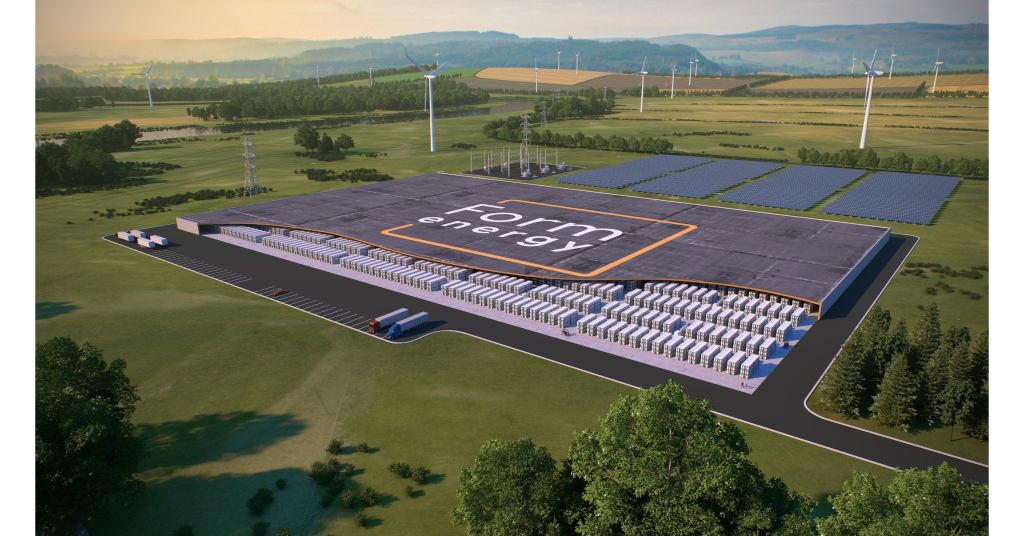
According to Form Energy, a technological firm based in Massachusetts, it will help combat climate change by eliminating the demand for fossil fuel power plants.
The Iron-Air battery is a ‘new kind of cost-effective, multi-day energy storage device,’ capable of supplying electricity for 100 hours at a fraction of the cost of lithium-Ion, the renewable energy technology’s “holy grail.”
It’s constructed of iron, one of the most abundant elements on the planet, and it operates by inhaling oxygen, changing iron to rust, and then converting rust back to iron.
It is charging and discharging the battery as it takes in oxygen and transforms iron back and forth, a process that allows the energy to be held for longer.
According to the company, the batteries are too hefty for use in electric automobiles since they are intended to handle the difficulty of maintaining a consistent power supply.
This will address one of the renewable energy’s most vexing problems: how to store vast amounts of electricity inexpensively and provide it to power networks when the sun isn’t shining for solar panels or the wind isn’t blowing for turbines.
Solar and wind resources are the cheapest sources of energy in much of the globe, but unlike fossil fuel power plants, they do not provide a consistent supply.
The electric grid now has to figure out how to deal with this supply unpredictability while maintaining electricity dependability and cost.
According to Form Energy, their innovative battery technology is the answer to this rising problem.
According to Mateo Jaramillo, CEO and Co-Founder of Form Energy, the company performed a thorough analysis of all existing technologies and ultimately redesigned the iron-air battery.
This was done to ‘optimize it for multi-day energy storage for the electric grid,’ according to the researchers.
According to the company, the battery they are creating would enable governments to retire thermal assets such as coal and natural gas power facilities completely.
‘We’re attacking the largest obstacle to deep decarbonization with this technology: making renewable energy accessible when and where it’s required, even over several days of harsh weather or grid disruptions,’ Jaramillo explained.
It will also be less expensive, according to the company. Nickel, cobalt, lithium, and manganese minerals are used in lithium-ion battery cells, which can cost up to $80 per kilowatt-hour of storage.
Form hopes to reduce mineral prices for each cell to less than $6 per kilowatt-hour by using iron and to maintain the cost of a whole battery system to less than $20 per kilowatt-hour of energy storage by cramming them into a full battery system.
Renewables will eventually be able to replace traditional fossil-fuel power facilities at this pricing range, according to experts.
Breakthrough Energy Ventures, a climate investment fund sponsored by Bill Gates, Jeff Bezos, and others, is one of the firm’s investors. They’ve also received investment from ArcelorMittal, the world’s largest iron-ore producer.
HOW DOES AN IRON-AIR BATTERY WORK?
According to the company, the primary concept of functioning is reversible rusting.
The battery takes in oxygen from the air during discharging and transforms ferrous metal into rust.
The introduction of an electrical current during charging transforms the rust to iron, and the battery exhales oxygen.
They collect energy from renewable sources, store it for up to 150 hours, and then discharge it to the grid when renewables are unavailable.
Each battery is just around the size of a washing machine.
Each of these modules is filled with a non-flammable, water-based electrolyte similar to that found in AA batteries.
Stacks of 10 to 20 meter-scale cells, which comprise iron electrodes and air electrodes, the elements of the battery that enable electrochemical processes to store and release electricity, are contained within the liquid electrolyte.
Thousands of battery modules are joined together in modular megawatt-scale power blocks, which are housed in an environmentally protected container.
Tens to hundreds of these power blocks will be linked to the energy grid, depending on the scale of the system.
A one-megawatt system, in its most compact form, takes roughly one acre of land.
3MW/acre can be achieved with higher density designs.
 Eduindex
You must be logged in to post a comment.