Mcaffeine Neem Face Wash

Mcaffeine Neem Face Wash Cleanser With Argan Oil & Vitamin E For Men And Women – 150 ml https://www.amazon.in/dp/B071X49GR9/ref=cm_sw_r_apan_glt_fabc_9B6RQWH965EW0W12D2T2

Factors used in this face wash are Caffeine, Neem, Argan Painting and Vitamin E. These all factor are skin-friendly. They not only clean your skin but also secure your skin. It’s extremely delicate to the skin, makes the skin smoother and vigour.

Status Signalling among birds

Paragraph 1

Many birds that form flocks compete through aggressive interaction for priority of access to resources such as food and shelter. The result of repeated interactions between flock members is that each bird gains a particular social status related to its fighting ability, with priority of access to resources increasing with higher status. As the number and intensity of interactions between birds increase, however, so increase the costs to each birds in terms of energy expenditure, time, and risk of injury. Thus, birds possessing attributes that reduce the number of costly interactions in which they must be involved, without leading to a reduction in status, are at an advantage. An external signal, such as a plumage type, announcing fighting ability and thereby obviating the actual need to fight, could be one such attribute.

Paragraph 2

The zoologist Rohwer assented that plumage variations in “Harris sparrows” support the status signaling hypothesis (SSH). He reported that almost without exception birds with darker throats win conflicts with individuals having lighter plumage. He claimed that even among birds of the same age and sex the amount of dark plumage predicts relative dominance status.

Paragraph 3

However, Rohwer’s data do not support his assertions: in one of his studies darker birds won only 57 out of 75 conflicts; within another, focusing on conflicts between birds of the same age group or sex, darker birds won 63 and lost 62. There are indications that plumage probably does signal broad age-related differences in status among Harris sparrows: adults, usually dark throated, have higher status than juveniles, who are usually light throated; moreover, juveniles dyed to resemble adults are dominant over undyed juveniles. However, the Harris sparrows’ age-related plumage differences do not signal the status of individual birds within an age class, and thus cannot properly be included under the term “status signaling.”

https://www.google.com/url?sa=t&source=web&rct=j&url=https://www.researchgate.net/publication/247193944_Plumage_Coloration_as_a_Signal_of_Social_Status&ved=2ahUKEwjlsZqa2ufxAhW7zzgGHYn5BbAQFnoECCAQAQ&usg=AOvVaw3yf5mNLgJJUHPQqo0l7lNS

https://www.google.com/url?sa=t&source=web&rct=j&url=https://www.jstor.org/stable/1369578&ved=2ahUKEwjlsZqa2ufxAhW7zzgGHYn5BbAQFnoECAgQAQ&usg=AOvVaw10FfMYrcscYgJr0eqziwI_

PHOENIX : Greek Mythology

A phoenix is a mythological bird that cyclically regenerates or is otherwise born again. Associated with fire and the sun, a phoenix obtains new life by arising from the ashes of its predecessor. Some legends say it dies in a show of flames and combustion, others that it simply dies and decomposes before being born again. Most accounts say that it lived for 500 years before rebirth. Herodotus, Lucan, Pliny the Elder, Pope Clement I, Lactantius, Ovid, and Isidore of Seville are among those who have contributed to the retelling and transmission of the phoenix motif. The phoenix symbolized renewal in general, as well as entities and concepts such as the Sun, time, the Roman Empire, Christ, Mary, and virginity.

The phoenix is best known as a being of Greek mythology, but has analogues in other traditions: including the Hindu garuda and bherunda, the Russian firebird, the Persian simorgh, the Georgian paskunji, the Arabian anqa , the Turkic Konrul, also called Zümrüdü Anka, the Tibetan Me byi karmo, the Chinese Fenghuang and zhu que, and the Japanese hō-ō .

The phoenix myth is also part of early Christian traditions. Some scholars have speculated that these early phoenix legends may have their origins in the bennu of Egyptian mythology. In the 19th century, scholastic suspicions appeared to be confirmed by the discovery that Egyptians in Heliopolis had venerated the bennu. However, the Egyptian sources regarding the bennu are often problematic and open to a variety of interpretations. Some of these sources may have actually been influenced by Greek notions of the phoenix, rather than the other way around.

Classical discourse on the subject of the phoenix points to a potential origin of the phoenix in Ancient Egypt. Herodotus, writing in the 5th century BC, gives a somewhat skeptical account of the phoenix.

To Appear:

The phoenix is sometimes pictured in ancient and medieval literature and medieval art as endowed with a halo, which emphasizes the bird’s connection with the Sun. In the oldest images of phoenixes on record these nimbuses often have seven rays, like Helios (the Greek personification of the Sun). Pliny the Elder also describes the bird as having a crest of feathers on its head, and Ezekiel the Dramatist compared it to a rooster.

Although the phoenix was generally believed to be colorful and vibrant, sources provide no clear consensus about its coloration. Tacitus says that its color made it stand out from all other birds. Some said that the bird had peacock-like coloring, and Herodotus’s claim of the Phoenix being red and yellow is popular in many versions of the story on record. Ezekiel the Dramatist declared that the phoenix had red legs and striking yellow eyes, but Lactantius said that its eyes were blue like sapphires and that its legs were covered in yellow-gold scales with rose-colored talons.

Herodotus, Pliny, Solinus, and Philostratus describe the phoenix as similar in size to an eagle, but Lactantius and Ezekiel the Dramatist both claim that the phoenix was larger, with Lactantius declaring that it was even larger than an ostrich.

World Shorebirds day in the Caribbean

Not only do birdwatchers the world over love looking at birds, they also love to count them: lists and data factor into the pastime in a big way. In the Caribbean, these “citizen scientists” play an important role in documenting the presence and the movements of island birds — there are special dates on which they spring into action, and one of these is World Shorebirds Day, which was recognised this year on September 6.

In honour of the occasion, regional birds were counted, photographed, and recorded in the eBird Caribbean database between September 3 and 9.

Many shorebird species in the Caribbean are migratory, often stopping off in different islands on their way to somewhere else. The chunky Red Knot, for example, is an incredible long-distance flyer. In its ongoing series of online colouring book pages, the nongovernmental conservation organisation (NGO) BirdsCaribbean noted:

Red Knots breed in the far north, the Arctic. They can spend the winter as far south as the southernmost tip of South America. This means they make some amazing migratory journeys of tens of thousands of miles overall! Red Knots gather in large groups in some places during autumn and winter; this makes them vulnerable to threats like sea-level rise and hunting.

BirdsCaribbean also shared a useful Shorebird ID guide, as many of these charming little birds can be deceptively similar:

BirdsCaribbean’s guide to identifying common Caribbean shorebirds.

Members of BirdLife Jamaica — much fewer in numbers this year, due to COVID-19 restrictions — trekked in ones and twos to their favorite viewing sites. One member, on arriving in Old Harbour Bay after heavy rains the day before, found the location overwhelmed with mud :

Watching seabirds often involves large quantities of mud. Photo courtesy of Ian Gage, with permission.

Many shorebirds have an amazing range. The Short-billed Dowitcher, for example, flies from Alaska to Canada, winters south in Brazil and spends time in the Caribbean, too:
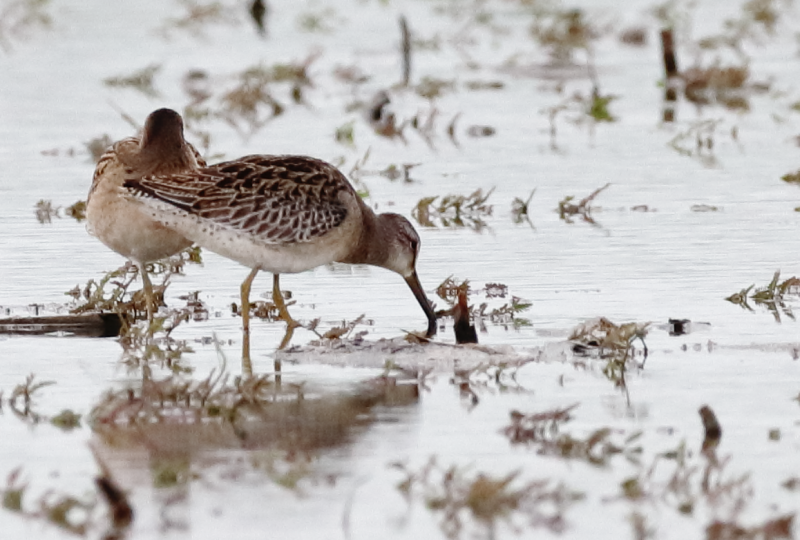
Short-billed Dowitchers in Great Bay, St. Elizabeth, Jamaica. Photo courtesy Ann Haynes Sutton, Conservation Ecologist, with permission.

The Grey or Black-bellied Plover is a global nomad. It breeds in the Arctic tundra and winters south, spreading virtually worldwide. This one decided to make a stop in Jamaica:
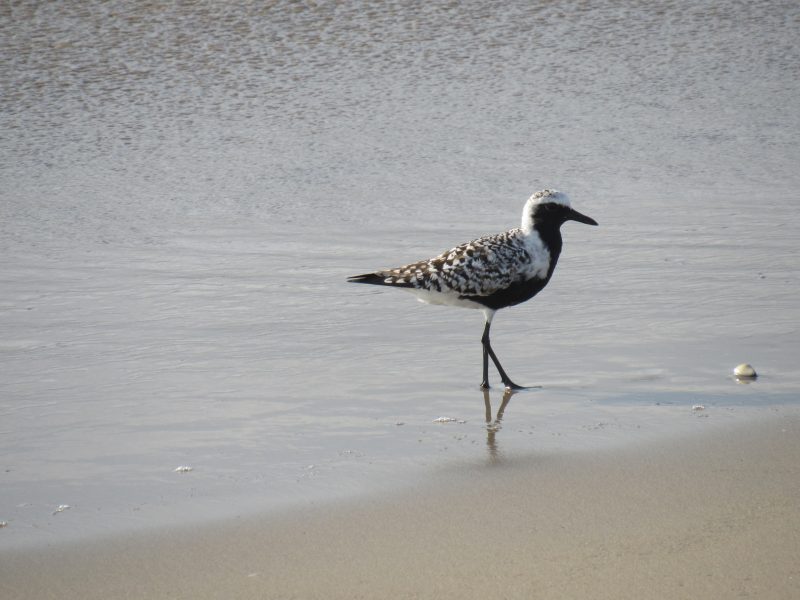
The Grey or Black-bellied Plover feeding along the water’s edge near Black River, St. Elizabeth, Jamaica. Photo courtesy Emma Lewis, with permission.

There were more sociable events on the calendar. The NGO SusGren (Sustainable Grenadines) shared photos of an educational trip to the newly-restored Ashton Lagoon on Union Island:

In celebration of World Shorebirds Day 2020, SusGren in collaboration with Environmental Attackers conducted educational outreach for some students of the Stephanie Brown Primary school. The high-spirited students, who were out of their beds as early as 5:30 a.m for the session, were engaged in activities such as bird labeling, bingo, and bird identification.

In Trinidad, a huge and diverse array of wetland species was on display. The Whimbrel, an elegant shorebird, is another Caribbean migrant that is still fairly widespread globally:

Whimbrel, Trinidad. Photo courtesy of Jerome Foster, with permission.

The Black Skimmer, however, is quite an unusual sight in the Caribbean. This bird literally skims the surface of calm coastal waters and lagoons:

Black Skimmer, Trinidad. Photo courtesy Jerome Foster, with permission.

The beautifully named Laughing Gull is fairly common across the Caribbean, where it breeds. It spends winters in northern Brazil:

Laughing Gulls in Trinidad. Photo courtesy Jerome Foster, with permission.

Some shorebirds, of course, do stick around. The Brown Pelican, for example, is a regular sight, cruising along the shorelines and further out to sea. Its local name in Jamaica is “Old Joe”; it is a common, year-round resident of the larger islands, gliding low over the waves or doing spectacular dives for fish:

Brown Pelican, known as “Old Joe,” in-flight at Palisadoes, Kingston Harbour, Jamaica. Photo courtesy Ian Gage, with permission.

Another charming Jamaican resident, whose numbers may be augmented by migrants from North America in winter, is the Black-necked Stilt. This noisy bird, on its spindly red legs, nests on the ground near water’s edge:
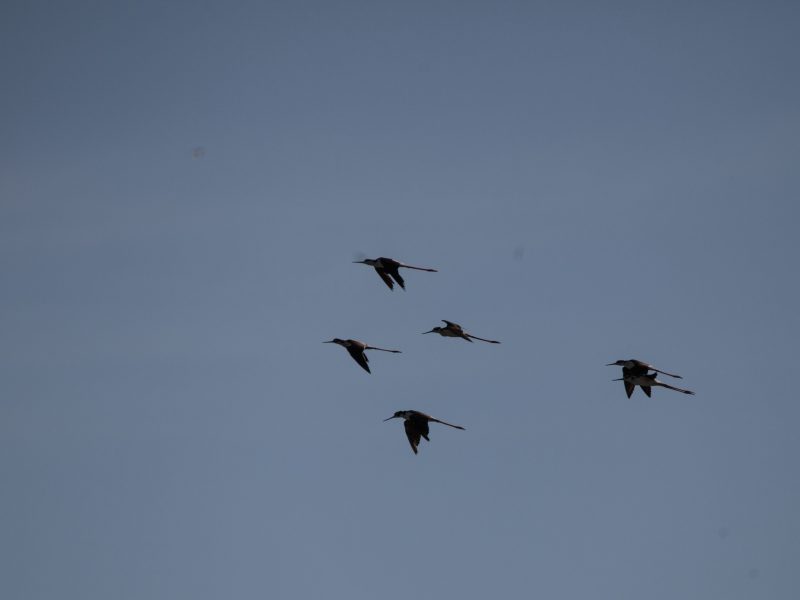
Black-necked Stilts in flight in Old Harbour Bay, Jamaica. Photo courtesy Ian Gage, with permission.

For Jamaican birders, the highlight of World Shorebirds Day was perhaps the appearance of an adorable family of West Indian Whistling Ducks, captured on video by Damion Whyte, biologist, birder and a passionate social media educator on all things environmental. The location — a sewage pond in Portmore, St. Catherine, — was perhaps not so beautiful, but a good birding spot nonetheless.

Species such as this beautiful bird are declining in numbers throughout their range in the Caribbean. Large tourism developments, including hotels, marinas and other projects, continue to be built along the islands’ coastlines, resulting in the destruction of vital mangroves and wetlands in which these birds rest along their migratory flyways. Currently, three tourism projects under way in Grenada threaten wetlands that shelter several endangered species, including turtles.

On some islands, especially in the French Caribbean, hunting and plastic pollution are major threats.

World Shorebirds Day in the Caribbean is not only a celebration of the birds themselves, but of the beautiful places they call home, even if only temporarily for many of them.