An organism is anything that has life i.e. Living . Every city has some characteristics that can be compared to that of a living organism some places of a city act as organs of an organism some bodies (legislature, judiciary, etc.) Function like organs of an organism.
The system of life is growing in size and in complexity, and so do the infrastructures sustaining it. In 2008 the point was reached where more than 50% of the world population lives in cities. That percentage is growing. By 2030, over 60% of the world’s population – nearly five billion people – will be living in urban area. Initially the two life-essential resources for cities were water and food. As cities grew and as technology evolved, the supply of these resources became dependent on energy for processing, for pumps and for transportation. In the process, cities and their resources evolved into a system of life energized by the individuals that populate cities, and fuel its dynamics.
A city protects a cluster of houses. A house protects a cluster of humans and a human protects a cluster of organs. All the way down to the bacteria, cooperative clusters are formed that give the participants a more secure way to live. A house is a body. It supports the body but it also contains all the bodily functions. If we provide the house with these bodily functions the house becomes more sustainable. It is possible to regenerate the waste that the humans produce into energy just as the liver is doing in our body.
Body parts
City parts
Heart
City centre (CBD)
Blood vessels
Roads
Brain
Legislature
Spinal chord
Secretariat
Nerves
People
Mouth
MediaIncludes newspapers, news channels
Ears
Judiciary
Nose, lungs
Green spacesparks, gardens
Kidneys
Drainage system
Hands
Services and facilities
For example, Secunderabad is a city located in the state of Telangana to the north of Hyderabad. This city is compared to as a living organism Heart:– Secunderabad – always busy, connected to all parts of the city. Blood vessels: Roads- means to connect the heart to every other part of the city. Skin:- Jawaharlal Nehru Outer ring road- all around the city; outer covering. Alimentary canal:- P V Narsimharao Expressway- longest expressway of India. Nervous System: Administration Brain: Legislature- law making. Spinal chord :- Secretariat- body which makes sure that laws are implemented. Nerves:- People- who elect representatives to enable reach of their problems to the legislature. Eyes. Birla Mandir One of the most prominent highest points of Hyderabad. View of the entire city from the top of the temple.
Mouth:- Media includes newspapers, news channels and their team- journalists; reporters; cameramen; creative team Local channels that promote tourism of the city and highlight culture of Hyderabad; radio channels. Ears:- Judiciary; mainly lawyers Listen to problems of the people Receptors: High court for the state of Andhra Pradesh and the state of Telangana. Respiratory system:- Nose, lungs, Green spaces parks, gardens. Lakes: Hussain Sagar Tank bund, Necklace road. Two cricket stadiums and many football grounds. Skeleton:- Metro rail Connects parts of the city. Bones join during the course of time- Metro was built in parts and joined later to form a continuous phase. Legs:- Modes of transportation predominant: APSRTC (now TSRTC) buses. Hands:- Services and facilities. Electricity and water supply educational institutions hospitals functions of GHMC. Shoulders;- Hi tech city carry weights of the economy of the city. Hyderabad as an IT hub – IT sector- major contributor to the economy of Hyderabad. Kidneys ;– Drainage system, collection of drainage, disposal or purification of the drains. Hair:- Tourismtourist attractions, add beauty to the city, Major attractions: Charminar, Golconda fort and Ramoji film City, Snow world, Hussain Sagar- Buddha statue and adjoining parks, Nehru zoo, etc.
I will always cherish my visit to Mumbai, the city of dreams, and a city after my heart. Known for beautiful places and some UNESCO heritage sites like Gateway of India, Elephanta Caves, Juhu Beach, Marine Drive, Chhatrapati Shivaji Maharaj Terminus, Galleries, Victoria and Art Deco buildings and Colaba Causeway, the iconic Crawford Market, Amazing Street food, and a lot more. The people of Mumbai are termed as “Mumbaikar”. Mumbai surrounded by the Arabian Sea was first known as Bombay which is located in a peninsular on the Western coast of Maharashtra state. Mumbai has tropical humidity, from March to May the weather is hot and dry, from June to November Mumbai has heavy rains, and from December to February, the temperature is cool.
Mumbai is the financial capital of India, making it one of the expensive cities in Asia. I think Mumbai is the best place to restart your life in India but you’ll have to work on your budget. For fitness freaks in the dawn to enjoying the nightlife, Marine Drive is the best place you will see in Mumbai. The soothing sound of waves helps you to unwind, well you can enjoy the beauty of the sea, but not relax as the emotion-struck couples engaged in PDA will make you gag, and believe me, it’s not at all romantic as you see in Bollywood films and speaking about movies. Mumbai is the base of the Bollywood industry with the largest producer of films, making Mumbai India’s largest entertainment capital, and who knows you may spot an actor in a diner or club. Acting and Drama hold special interest for Mumbaikars and one famous place is NCPA (National Center Of Performing Arts). People here are helpful and friendly and makes sure that you feel comfortable. Shopping buffs will love this place from Colaba Causeway to Bandra Linking road to Crawford Market for the street shopping. Each building has a history behind it, Be it Gateway of India or the Taj Hotel. Street food is one popular sensation of Mumbai. Mouthwatering Vada pav, Pani puri Falooda, Pav Bhaji, Ragda puri, Missal Pav, Snow Cones (Gola), Sev puri, to Chines food, and the list goes on. To budget-friendly eateries to posh Restaurants and Bars, Mumbai has it all. Some 5 Star hotels such as Trident, The Oberoi, Taj Mahal Hotel are just so classy.
Well, there are a lot more facts to know about, like Mumbai has a Coastline of about 150 Kilometers, Dharavi in Mumbai is the biggest slum in Asia, The famous network of Dabbawalas (lunchbox delivery system) that is only seen Mumbai, first bus service in India was started in Mumbai, etc. Even though Mumbai is a beautiful place, there are a lot of disadvantages too. The dense population has been causing a lot of damage to the environment like Land pollution, Air pollution, Water Pollution, Deforestation leading to drastic climate change. With proper care, awareness, and solution, we can restore its natural beauty. Mumbai will always remain my forever favorite. Even though there are problems within the city, I would say heaven is where your heart is.
City derives from a French word meaning citizenry. A city is a large or important town. In the United States, cities are incorporated municipalities with local governments. In Great Britain, a borough with a bishop’s seat is called a city. As with the words village and town, city can also refer to the its inhabitants. It’s like watching Paris from an express caboose heading in the opposite direction—every second the city gets smaller and smaller, only you feel it’s really you getting smaller and smaller and lonelier and lonelier, rushing away from all those lights and excitement at about a million miles an hour.
City Expressions
Many interesting uses of the word city exist in English. For example, imagine you see a place with a lot of stray dogs. You might call it “dog city” to indicate that it is full of or indicative of dogs. A city slicker is someone who doesn’t know much about country life. If you say that you can’t fight city hall, you are saying there’s no way you will win in a battle against bureaucracy.
Advantages of City Life:-
City life has an advanced and well-equipped environment. People migrate to cities because of better job opportunities, stability and a decent income which is a lack in villages.
Cities have a huge number of schools, colleges or universities established. Hence, the city folks get proper quality education which is a primary factor for standard living.
Recreation and entertainment are plenty in the cities. People also get adequate opportunities to establish and showcase their talents here.
City life provides commercialization, banking systems, and entrepreneurial businesses. This attracts more people from townships to settle in cities.
Better transportation, sanitation, availability of water and drainage systems are seen in cities. The drainage of polluted water goes through treatment before getting dumped in lakes or rivers. This keeps a small check on pollution too.
Medical help is at fingertips when required. There are a number of hospitals and clinics and well-equipped doctors and nurses for people in need.
Anonymity in cities helps in escaping from the judgements of people.
Disadvantages of city life:-
Urbanization is increasing at a rapid pace, and currently, about 30-33% of Indians lives in cities. This rate tends to be around 40% by 2030. With the high population density, the quality of life in cities is expected to degrade and become unfit for living.
City life is a very busy one, developing every second to a better version of itself. This results in a loss of cultural qualities and flavours.
High demand for city life has resulted in congestion. Human population has increased a lot in city areas.
The city’s population increases day by day. This leads to an environment with polluted air, smog, unclean water supplies, noise pollution
It follows from the previous point that an increase in pollution rates in the cities brings in more health issues. People tend to fall sick more in cities due to the polluted environment which is unfit for living.
Unfair competition among businesses, an increase in crime rates and immorality of the people is more in the cities.
Increase in costs and expenditure is a vital problem for city dwellers. This creates a reason for more competition for gaining wealth and hence increases stress and crimes too.
Village Life
The word village comes from a French term referring to a group of buildings. That’s exactly what a village is—a small community in a rural area. Sometimes, larger towns incorporate the houses of a village as a municipality. Village can also refer to inhabitants of a village and is even applied to groups of animal dwellings.
Advantages of village life:-
A pollution-free environment is available in the rural/village areas only.
Scenic beauty and greenery of rural areas are prominent. This also attracts tourists from around the globe.
Rural areas have a scope for socio-economic benefits like reduction in prices of agricultural and consumer products, access to markets, public transport, employment opportunities, and better education and healthcare facilities.
The essence of folk and culture is prominent in these areas. This defines the rural areas uniquely.
Disadvantages of village life:-
Lack of higher education is a backlog for rural lives. This creates the main hurdle for better standards of living.
Rural areas have poor road connectivity. Over 40 per cent of India’s rural population remains outside the rural road network. According to the Planning Commission’s Working Group on Rural Roads, there are over 3.3 lakh rural habitations with no road connection.
Limited medical help persists in these areas. A counted number of hospitals and even lesser doctors are available. Hence at times, people are bound to move to city areas for sustaining life.
Rural life is difficult for women more because of lack of proper sanitation and toilets. The primary reason for this has to be the lack of educational opportunities.
Conclusion:-
Though the city life has many disadvantages, people flock there more for its advantages.
Improper road connectivity is one of the main reasons for stopping growth in rural areas. But the government is making situations better for rural India. The Pradhan Mantri Gram Sadak Yojana (PMGSY) is a step towards improving road connectivity in rural parts of the country.
Hence, the reduction of pollution in cities and the development of roads and infrastructure in rural areas will bring a balance between the two.
“Glory to Allah, who created in pairs all things that the earth produces, as well as their own(human) kind and (other) things of which they have no knowledge.”
-The Holy Quran [36:36]
No element on the life sustaining earth exists without its complement. For example, the complement of zero is one; solids and voids; light and dark; if one did not exist, the other would lose its meaning. This refers to both in terms of the one who sustains as well as the energies sustaining them. The balance among the elements of the entire universe is maintained through the various visible as well as invisible energies which in turn exist in pairs. The energy could be classified as the ones within the human who sustain the energies of the earth and the other being the natural forces of the universe that aids the universal equilibrium which further keeps the physical and psychic activity in balance. The harmony of the earth is controlled by the physical as well as the metaphysical energy forces of the cosmic energy. The energy takes part in influencing all the occurrences on the earth be it at architecturally large scale element like a city or a small scale architectural structure as a home. Both would be classified into the microcosmic level of the energy.
“Space is nothing, yet we have a kind of vague faith in it.”
-Robert Smithson
The existence of energy occurs in the place of nothingness. Voids hold the highest sources of energy. The architectural design is nothing but a technique of designing voids to show a flow of spaces making a way for the flow of energy among the various spatial arrangements. Most of the people in the Indian Society prefer Vastu Vidya to be incorporated while designing a space. The major reason being the energies that is considered to be flowing through the designed spaces and to create the balance between the concrete mass and the natural elements. Humans occupy the voids yet they fail to understand the meaning of the unseen energy forces that is felt through the experiences they encounter while inhabiting that particular personalized void that is the physical manifestation of the memories and imagination of their own. The metaphysical aspect of architecture lies within the fact that it influences the user experiences of their inhabited voids in the line of time. It connects the past to present and brings about a psychological and emotional connection.
An environology master, David Koh, stated, “When people built the house, the energy inside the house is static. Once the people live in, the energy inside the house is dynamic. People may affect the building, and the building may affect the people. And it’s not positive thinking that the people need, but it’s energy that makes people think positively.” The energy flowing through the various spaces creates an imbalance due to the dynamism of the humans living in. This in turn, creates a flux within the dialects of energy within the physical, emotional and psychic connectivity of the people. Architecture is a living tapestry and a constantly changing phenomena. The connection of the energy within the human body and outside, impacts not only buildings but other elements too that together builds the abstract and hypothetical whole. The spatial fabrication of the concrete masses and the multiplicity of the same in diverse alignments as a whole builds the city fabric. A city is a spatial and temporal dimensions of architecture on a vast scale. The physicality that a city comprises is, districts, landmarks, streets, edges and nodes. The streets become the prominent defining thread of the city, connecting the different entities through its networks. They show a directional shift in motion of spaces with respect to different frames of reference exploring more than what is comprehended by the senses with the metaphysical lens to look behind the abstraction.
To represent the extraordinary within the ordinary, the light is put forth to a street in Kolkata, Topsia, recognized by the number ‘90’, has not yet been identified as one of the most alive streets of the city of joy yet they have the metaphysical fundamentalism. The street is particularly a connectivity to one of the Muslim populated locality of the place. The majority of the population living in the locality belongs to the middle class strata of society. They adapt themselves to the concept of ‘less is more’3 and seek the intangible aspects of the spaces that they use. Considering the theories relating to the energy sources, streets becomes the most dynamic element that could be considered as the life of the whole city. They deal with more than the vehicular and pedestrian movement. The streets deal with the dialects of dynamics of metaphysical consequences.
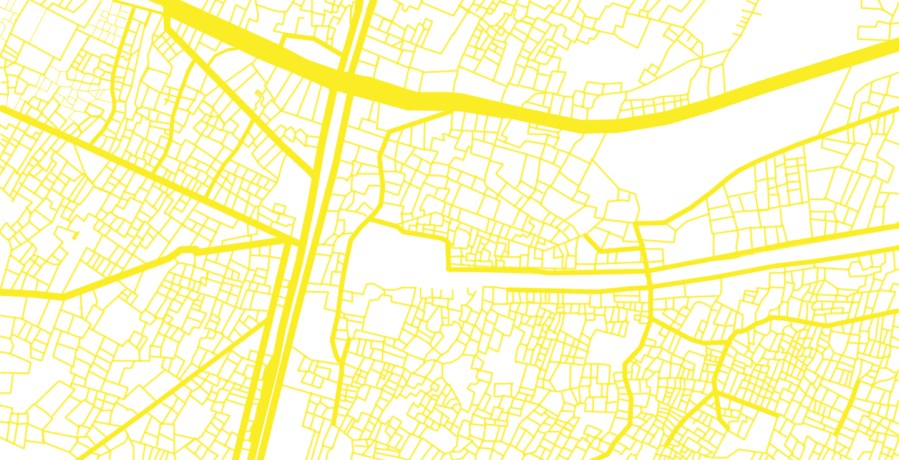
Figure 1: Layout of Streets of Kolkata; source: author.
Within and outside the realms of architecture, streets pave the way at the microcosmic level for the energy distribution network similarly to the way it functions for the crowd and vehicular activity. The metaphysical lens from different frames of reference gives an opportunity to analyze the impact of the metaphysical link and how it is evoked with the crowd in context to the existing surrounding. Different users feel a variety of different emotions in consideration to one particular space.
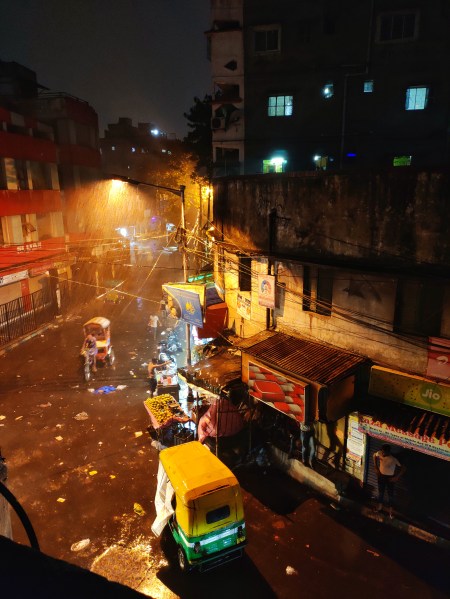
Figure 2: The Street ‘90’ on 12th June, 2019; source: author.
A resident of the place when asked about her experiences with the place said, “We have been staying here for about 15-18 years now. It has an essence of familiarity and home. The existing buildings, the shopkeepers, the vendors, and when I say vendors I really mean it. They are accurate with their location of stalls and wouldn’t trade it with anyone. Ive seen a lot of changes in the place. The building in red and white was built after demolition of an old 3-storey building for commercial purpose yet the upper floors still remain untouched after being built for so many years. The chaos is the essence of this place and without it, this street will lose its essence and identity.”
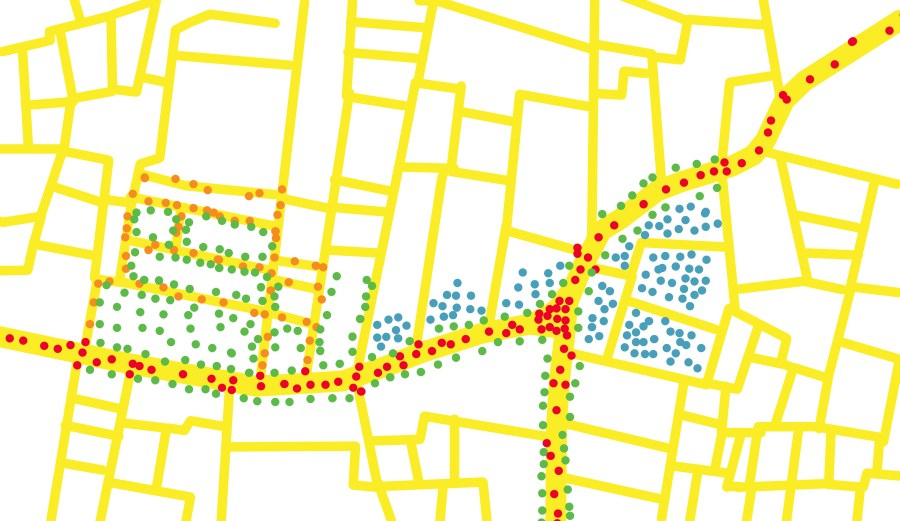
Considering the quantitative aspect of the street, it is about ten meters in width, with two meters of it occupied by the street vendors. An analysis of the street was done in three different phases of the day. When the morning struck, the silence is disturbed only by the daily activities of parents dropping off their half-dozed children to schools either by private or public convenience, which here is the auto rickshaws, who typically place themselves along the edge of the building as shown in Figure 2. Slowly and gradually as the time transcends the vegetable and fruit vendors take the edge of the street as their potential business spot. The traffic becomes evident by the noon with children coming back from school, having there go at the Sharbet waalas. As soon as the sun goes down, the street has an overwhelming response by the users creating itself in a chaotic mess of disoriented vehicles and people trying to make way to get out. Simultaneously, the sequence of functioning of the streets inflects thrrough its natural course. The female crowd encircles the ‘puchka waale bhaiya’, drooling over the smell of the tamarind water. A few steps towards the east would bring us to a smellscape of a multi-cuisine food corner with a large hot plate with parathas being fried, a traditional clay barbeque for the kebabs being cooked upon the coals, another man assorting the shelves with momos, fried crispy chicken and another struggling with delivering the order to the respective customers superimposing each other tones in a competitive streak to get their order first. The edges of the streets are defined by the utilities of all kind such as a pharmacy, general stores, grocery shops, food kiosks and corners, markets within a radius of a hundred meters, a shopping complex built few years back, occupied only the ground floor of the building structure. A fruit vendor defined the street as, “It is a metaphor of how our life is, always moving and moving in the forward direction. Despite the chaos we love our life so do we love this place.”
Figure 3: The Feeling Mapping of the Street (red-chaos, green- rejuvenation, orange-action, blue-contentment); source: author
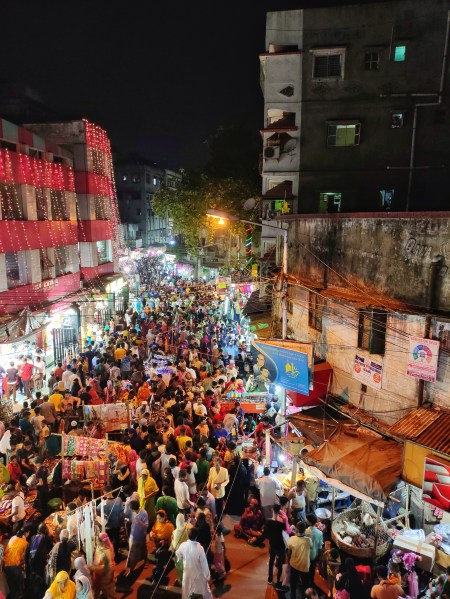
The rhythm of the basic functioning of the street is inflected during the festivities, such as the two Eids and Muharram. The zeal within the crowd becomes evident and the streets stop serving as a vehicular access instead it becomes a hub of utilities as shown in Figure 4.
Figure 4: The Street ‘90’ on 4th June, 2019 (On the Eve of Eid); source: author
In terms of architectural analysis, the flaws couldn’t remain unseen, but what the architects couldn’t see is the intrinsic experiences that the users have with the place. The elegance of the street is a culture of contentment and containment. It depicts the unification of the users belonging to all strata of the society interacting with each other whatever the purpose may be. The dynamics of the streets and the humans represent a whole of the community be it the rich or the poor. In a simple world, the whole of the world can be explored. The local architectural vocabulary of the streets shows motions and emotions of all colours. It depicts joy as well as sorrow. The chaos and the peace, all the comedies and tragedies. The energy drained is rejuvenated with the constant flow of energy on the street. The essence of the chaos in itself shows the intrinsic connection between the built and the unbuilt. The street evokes the intangible aspects of the userrs. The user activity is the result of the concentrated energy source at the micro cosmic level connecting humans with the space at a deeper level. Configuration of the whole of the city is determined by the streets that becomes the highest sources of energy flowing throughout. The built is to exist what the unbuilt is to life. The boundaries defined by the concrete is a personalized space to exist in harmony, but to co-exist, an undefined yet the key that holds the city together. A street has a potential to turn itself into anything it wants. The street is an induced public space. The street has evolved through the line of time of urbanization inflecting the course of its motion. Due to the increasing number of concrete massing, the spatial contraction of the streets are taking place in localities like Topsia in Kolkata whereas due to the urbanization, the expansion of streets also take place with putting an end to the life of the city creating it in a block of monotony and regularity only used as an access not as a space for creating an interaction between the built and the unbuilt, the known and the unknown. Spatial expansion and contraction taking place to accommodate structures. Street is one part to the whole that encapsulates the built and the user. People have a tendency to experience voids hence, they hold human sentiments. We are dehumanizing the streets by making it lose its existence by the loss of depiction of culture and tradition. It is a lost element with the thoughts drowned in hues of grey unaware of how to survive in the chaos. The task of an architect is to blend imagination with practicality by balancing ideas and reviving the true nature of the streets in context to human activities.
REFERENCES
1. The Holy Quran
2. Mustofa, 2011. According to Dr. R Tatang Santanu Adikara, the Head of Bioenergy Research Centre in Surabaya, human gets energy from two sources: inside the human body and outside the human body.
3. Metaphysical Approach for Design Functionality in Malay-Islamic Architecture, article in procedia-social and behavioral sciences-aug 2015
The first generic form of the city is the physical expanse or area of continuously built-up urbanization. The urban area is generally observable on a clear night from a high flying airplane. The urban area is simply the extension of urbanization. The urban area is not defined by jurisdictional boundaries, though where national statistical authorities define it is necessary to rely on building blocks such as census tracts and municipalities.
Like metropolitan areas, urban areas can extend across sub national jurisdictional lines (such as state, provincial or regional boundaries) or in special cases, international boundaries. Various terms are used by national statistical authorities in the United Nations.
An urban area will never be the same as a municipality. Usually it will include many municipalities, though in the case of many geographically large municipalities, such as Shanghai, the urban area will be smaller than the core municipality. The Chicago urban area (population over 8,000,000) includes the city of Chicago and many other cities. Some nations formally designate urban areas, which are called “urbanized areas” in the United States, “unites urbaines” in France, “urban areas” in the United Kingdom and Canada, “urban centers” in Australia and “urban agglomerations” in India. An urban area is also an agglomeration. A conurbation is an urban area that forms when two or more urban areas grow together. Four definitions of the city are considered here.
The first involves the city as a physical entity, or the area devoted to primarily urban uses. This Built City (BC) is perhaps the most familiar perception of the city, largely because it is relatively easy to visualize. The BC forms the core or basis of each of the other three definitions of the city. These are as follows: The Consumption City (an area within which most of the consumption of goods and services occurs in the BC); The Employment City (an area in which the bulk of the employed workforce works in the BC); and The Workforce City (an area upon which the BC draws for a given majority of its labour requirements). These four definitions of the city are brought together and shown to be interrelated.
The Functional City (Metropolitan Area)
The second generic form of the city is the functional expanse, which is also the economic expanse. The metropolitan area includes the built-up urban area and the economically connected territory to the outside. The economic relationship is generally defined by patterns of commuting to work into the urban area. Thus, metropolitan areas constitute labor market areas. Metropolitan areas can extend over subnational boundaries, except in rare cases where there is not free movement of labor (such as between Hong Kong and Shenzhen in China). Further, where free movement of labor is permitted by international agreements, metropolitan areas may cross national boundaries (such as in the European Union or between Switzerland and France, in the Basel and Geneva urban areas).
Political Entity
Political entities are basically systems of governing authority organized as governmental power structures. Empires, nation-states, city-states, and kingdoms are just a few examples of political entities. Most political entities are types of states, with the exception of stateless nations and autonomous regions. It is also important to note that when discussing a nation, we’re referring to a group of people with a shared language, religion, ethnicity or other cultural factors.
Social Entity
Social entity is an ideological concept in which a society or social structure is viewed as a “living organism”. From this perspective, typically, the relation of social features, e.g. law, family, crime, etc., are examined as they interact with other features of society to meet social needs. All elements of a society or social organism have a function that maintains the stability and cohesiveness of the organism.



 Eduindex
You must be logged in to post a comment.