
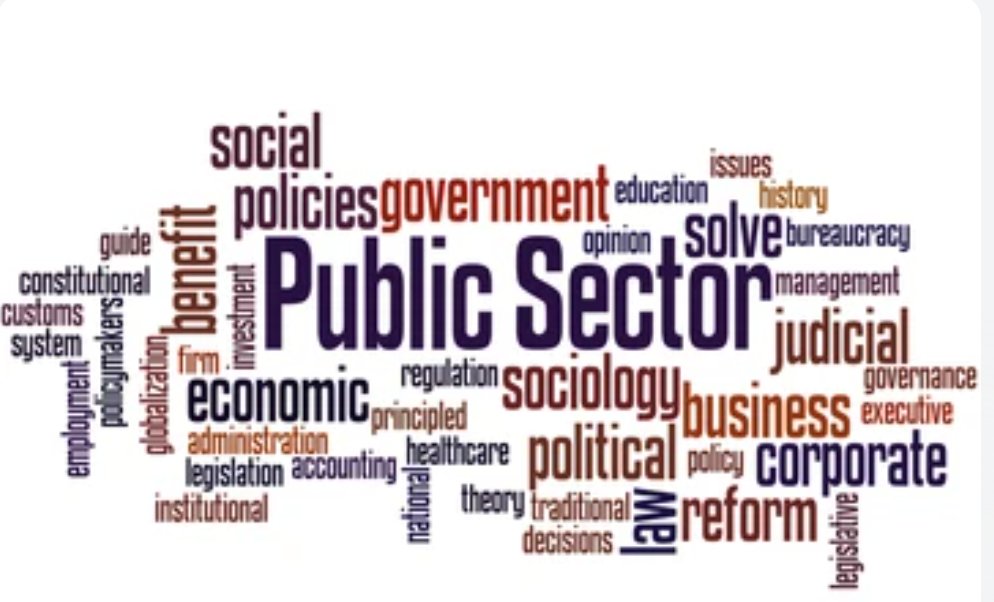
Magnitudes of Public Sector Enterprise for Policy making

Source: PSU.Watch

Government regulate the business activities of private enterprises for direct participation in business and set up public enterprises in areas like coal industry, oil industry, steel manufacturing, banking, insurance etc. These units are not owned by Central, State or local Government, managed and controlled by them and are termed as public sector enterprises.

Business activities were occupied to individual and organizations and the government was taking care of essential services such as railways, electricity supply, postal services etc. Private sector did not take interest in areas where investment is high and profit margin is low, such as machine building, infrastructure, oil exploration etc. Industries were also focus in some region that have natural advantages like availability of raw material, skilled labour.
Source: shutterstock

Public sector enterprises defined as any commercial or industrial undertaking owned and managed by the government with a view to maximize social welfare and upholds the Public interest. Public enterprises consist of nationalized private sector enterprises such as banks life insurance of India and enterprise set up by Hindustan, Gas Authority of India limited (GAIL) and State trading Corporation (STC).

During the colonial period, economic activities were limited to essential support facilitate for the maintenance and continued Growth of economy and defense such as railway transport, electricity project, ordinance factories, irrigation works, education and training Institutions.

The public sector to control certain key point in the economy such as the financial institutions for collecting saving of millions of individual and organizations making these available for investment.

By 1980s, besides traditional fields, the major banks and financial institutions, electricity undertakings, shipping, civil aviation, bus services and big enterprises in significance modern industries such as iron and steel, heavy machine building, light engineering, electronic, petroleum and Petro chemical, fertilizers, pharmaceuticals, cotton textiles and cement. The growth of investment in the central undertakings by way of contribution to share capital and long term loans. In addition, the central government had made large investment in departmentally run undertakings.

Characteristics of Public Enterprises

The public enterprises are owned and managed by the central or state Government or local authority. The government may either own the public enterprises or the ownership partly be with the government and with the private industrialists and the public. The control, management and ownership remain primarily with the government e.g, Oil and Natural Gas Corporation Limited (ONGC) and National Thermal Power Corporation (NTPC).

Public enterprises get their capital from government funds and the government has to make provision for their capital in it’s budget. Public enterprises are not move by profit motive. Their major focus on providing services or commodities at reasonable prices. GAIL Gas Authority of India and Indian Oil Corporation make available petroleum on subsidised price to the public.

Public sector enterprises concentrate on providing public utility services like transport, electricity, telecommunication etc. PE are governed by the government and are accountable to the legislature. The government rules and regulations force the Public enterprises to observe excessive formalities in their operations.

Role of Public Sector Undertaking in Public Policy

The public sector enterprises has been important role of achieving economic growth with social justice, generating larger social gains and strengthening country’s economy by removing regional disparities and promoting balanced development in different parts of the country. The impact of public sector undertaking on the regional development.

PSE through useful help and services in the development of human resources in underdeveloped areas. Investment in human capital is considered an essential ingredient of development planning. Such development is only possible if rural demographics ready to cope with modern knowledge and science & technology.

A large number of PSU have been set up in the regions or districts in order to capitalize the rural labour by equipping them with vocational education, technical training and managerial skills. The reason behind it is to transform the unemployed rural people to get self motivated and self inspired employment avenues in local areas economies.

PSU working as a vehicle of communication have taken the new learning to village and acted as agents for introducing changes in existing practices, initiating commercial use of appropriate village technologies in agriculture and allied activities, village artisan and handicrafts and local village industry by inducing use of productivity enhancing equipment and light machinery.

Improvement in economic infrastructure in the areas where policies cannot reach through PSU and active participation of PSU. Constructing and improving connection between village to make accessibility by modern means of transport, electricity for domestic use as well as for commercial and Industrial.


Comparative Study b/w Parliamentary and Presidential System of Government

Parliamentary system is a democratic form of government in which the party with the greatest representation in parliament (legislature) forms the govt., its leader becoming prime minister or chancellor. Presidential form of govt. is a democratic and republican govt. in which a head of govt. leads an executive branch. The head of govt. is in almost cases also the head of the state, which is called the President. India follows a parliamentary form of govt. modelled on Britain’s.

Features

Features of Presidential system are that the executive can veto acts by the legislature, the President has a fixed tenure and cannot be removed by a vote of no confidence in legislature. The President has the power to pardon or commute judicial sentences awarded to criminals and the President is elected directly by the people or by the people or by an electoral college whereas features of parliamentary system are- close relationship b/w the legislature and the executive, executive is responsible to the legislature, there are two executive i.e. real executive and titular executive, bicameral legislature, no fixed tenure, leadership of Prime Minister.

Merits

Merits of Presidential system are- seperation of powers, expert govt., stability and less influence of the party system.

Merits of Parliamentary system are- better coordination b/w executive and legislature, prevents authoritarianism, responsible govt., represents diverse groups, flexibility in the system.

Demerits

Demerits of Presidential system are- less responsible executive, deadlocks b/w executive and legislature, rigid govt., spoils system as the system gives the President sweeping powers of patronage.

Demerits of Parliamentary system are- no seperation of powers, unqualified legislators, instability, failure to take prompt decision because there is no fixed tenure, party politics is more.

Conclusion

The Presidential system is better for one because of its seperation of powers, the role of judiciary and the govt. accountability to its people. We should ensure a system of govt. whose leaders can focus on governance rather than on staying in power. The present parliamentary system has been tried and tested for nearly 70 years. It can be reformed thoroughly to remove the challenges thrown up by it. Also, there is a need to reform the electoral processes to make democracy more robust.

A Survivor : The Story of Lakshmi Agarwal

She was just a 15 year old girl . A girl , full of life . But what happened to her .

It’s her story . A story of a survivor.

She was powerful not because she wasn’t scared but because she went on so strongly, despite the fear.”

– Atticus

At the age of 15 , when a girl or a boy makes happy memories and learn about life . She was attacked in the market full of people . She was attacked because she rejected an old jerk of 32 years old.

A 32 year old proposed a marriage proposal to a 15 year old girl , who lives near the neighborhood. She ignored and rejected him and he planned an acid attack .

Her name is Lakshmi Agarwal , she was attacked at the age of 15 in 2005 in New Delhi after rejecting the romantic advances of Naeem Khan . She didn’t inform anyone about the scenario because she believed her parents and society would have blamed her and stopped her study .

After 10 months , Lakshmi was in the market and Naeem asked her again through message about the marriage proposal but she didn’t respond . And in no time , Kamran (Naeem’s older brother ) and his girlfriend attacked her with acid . He was in the motorcycle and his girlfriend Rakhi threw acid on Lakshmi , when Kamran called her name and she looked behind for response.

She fainted on the road and when she regain consciousness she went middle of the road asked for help and met with multiple accidents but no one stopped to help her . She was burning in fire and her skin was melting.

A man named Arun Singh called PCR and told police about the situation . Someone threw water to help her but it turned out opposite and the acid burnt her neck . Arun think it might be late , so he helped her on the backseat of his car , later the seat cover turned into black hole due to the acid .

Arun admitted her in the hospital , called police and her family . Lakshmi went through many surgeries and operations including eye surgery. Four days later Naeem Khan got arrested but was bailed after a month later .

Protests and media attention.

After many protests and media attention Naeem got life imprisonment .

Lakshmi’s story was one of the series in the Hindustan Times. Lakshmi was scared after the attack because most of her face and body parts were not same as before . But she didn’t loose hope ,she fought for justice , asked for help for the victims of acid attacks and pleaded the law for the ban on sale of acid.

Meanwhile government failed to frame policies on acid sale and chemical attacks .

Seriousness is not seen on the part of the government in handling the issue,” the bench headed by Justice RM Lodha.

In 2013 , the plea of Agarwal was heard and later claims that “ Acid is freely available in shops. Our own volunteers have gone and purchased acid easily. In fact, I have myself purchased acid,” she said. “We have launched a new initiative called ‘Shoot Acid’.

After , the law passed by Supreme court . Lakshmi founded NGO named Chhanv Foundation to help acid attack survivors in India.

In 2019, she was honored with the International Women Empowerment Award from the Ministry of Women and Child Development, the Ministry of Drinking Water and Sanitation and UNICEF for her campaign of Stop Acid Sale. In 2014, she received the International Women of Courage award at the hands of First Lady Michelle Obama.

And the movie Chhapaak is based on her life and stars Deepika Padukone in her role.

“And one day she discovered that she was fierce, and strong, and full of fire, and that not even she could hold herself back because her passion burned brighter than her fears.”

– Mark Anthony

Link

CONSTITUTIONAL BODIES IN INDIA

What is a Constitutional Body?

1. Those bodies whose formation is prescribed by the Indian Constitution itself are known as Constitutional Bodies.

2.They derive their powers and authority from the Indian Constitution.

3. A constitutional amendment is often required to change any powers or functions related to such bodies.

List of Constitutional Bodies in India

  1. ATTORNEY GENERAL OF INDIA

● Article 76 of the Constitution provides for the Attorney General of India.

● He is considered the highest law officer in the country.

● He is appointed by the president and holds office during his pleasure.

● A person who is qualified to be appointed as the judge of the Supreme Court is eligible for the office of Attorney General of India.

Duties of AG:

• To advise the government on the legal matters referred to him by the president.

• To appear on behalf of the GOI in SC in all the cases concerning the government.

• To represent GOI in the references made by the president to the SC under Article 143.

• To appear in HC in the cases concerning GOI when required.

Rights of AG:

• AG has the right to audience in all the courts in the territory of India.

• He has the right to speak and take part in the parliamentary proceedings. However, he doesn’t enjoy the right to vote.

• All the privileges and immunities available to a member of parliament are granted to the AG

2. COMPTROLLER AND AUDITOR GENERAL OF INDIA

● Article 148 of the Constitution provides for an independent office of Comptroller and Auditor General of india.

• CAG is considered as the guardian of the public purse. Along with the Supreme Court, the Election Commission, and the Union Public Service Commission, the office of CAG is treated as one of the bulwarks of the democratic system.

Appointment:

• President of India appoints CAG by a warrant under his hand and seal.

• He holds office for a period of six years or up to the age of 65 years, whichever is earlier.

• CAG can be removed from his office in the same manner as a judge of the Supreme Court.

Independence:

● CAG is provided with the security of tenure.

• His rights cannot be altered to his disadvantage after his appointment.

• All the expenses of the office of CAG are charged on the Consolidated Fund of India.

• His salary is equal to that of a judge of the Supreme Court.

Duties:

● The duties and powers of CAG are mentioned in article 149 of the Constitution.

• All the accounts related to the expenses from the Consolidated Fund of India, Consolidated Fund of the States, and Union Territories are audited by CAG.

● Also, the expenditure from Contingency Fund and Public Account of India and States are audited by CAG.

• CAG acts as a guide, friend, and philosopher of the Public Accounts Committee.

● All the receipts and expenditure of bodies financed from the central or state revenue are also audited by CAG.

• The audits of any other body as and when requested by the President or Governor are audited by CAG.

• Three reports are submitted by CAG to the President. They are:

(1) Audit report on appropriation accounts

(2) Audit report on finance accounts

(3) Audit report on public undertakings

Role of CAG:

• The office of CAG secures the accountability of the executive to the Parliament in the sphere of financial administration.

• The CAG acts as an agent of the Parliament and is responsible only to the Parliament.

● Along with legal and regulatory audits, CAG also conducts propriety audits.

3.ADVOCATE GENERAL OF THE STATE

● Article 165 of the Constitution provides for Advocate General for the states.

● He is considered the highest law officer in the state.

● The Advocate General is appointed by the governor and holds the office during his pleasure.

• A person qualified to be appointed as a judge of a high court is eligible for the office of Advocate General.

Duties and Rights of Advocate General:

• To advise the government of the state on the matters referred to him by the governor.

• To discharge those functions conferred upon him by the Constitution of India.

• He has the right to speak and take part in the proceedings of both the houses of the state legislature. However, he doesn’t enjoy the right to vote.

4. STATE FINANCE COMMISSION

● The governor of a state shall, after every five years, constitute a finance commission.

• Articles 243-1 and 243-Y deal with the formation of this body.

• The composition, qualifications of members, and the manner of their selection is decided by the concerned state legislature.

Functions:

● The distribution of the net proceeds of taxes, tolls, and fees between the state and local bodies.

• The determination of such taxes, duties, and tolls to be assigned to local bodies.

The grants-in-aid to be given to the local bodies from the consolidated fund of the state.

• Measures to be taken for improving the financial position of local bodies.

●Any other matter referred to the commission by the governor of the state.

5.STATE ELECTION COMMISSION

• The elections to the panchayats and municipalities are looked after by the State Election Commission.

● Articles 243-K and 243-ZA deal with the elections to the rural and urban local bodies.

● SEC consists of a state election commissioner who is appointed by the governor.

• The removal of the state election commissioner is the same as that of a judge of the state high court.

6.DISTRICT PLANNING COMMITTEE

• A district planning committee is constituted and given the task to consolidate the plans of both panchayats and municipalities.

• It prepares a draft development plan for the district.

• Article 243-ZD deals with the committee for district planning.

• The composition, manner of election of chairperson and members is decided by the state legislature.

● Four-fifths of the committee are elected by the elected members of panchayats and municipalities.

• The representation of these members is proportional to the ratio of the rural and urban population in the district.

• In preparing the plan, DPC should consider the following:

  1. Matters of common interest between the rural and urban local bodies regarding sharing of resources, infrastructure development, and conservation of environment.
  2. Extent and type of resources available.

7. METROPOLITAN PLANNING COMMITTEE

• A metropolitan planning committee is constituted for every metropolitan area.

• Article 243 -ZE deals with the committee for metropolitan planning.

• The composition, manner of election of chairpersons and members, functions, etc are decided by the concerned state legislature.

There are many other bodies also ….