Taxation System and Reform of Taxation Policy

Source: thenews.com.pk

Attribution of compulsory taxes by government is main characteristic of financial system. Taxes are levies in every country to generate revenue. Rudimentarily to raise revenue for government expenditure, and for other purposes as well. Without taxes, government would be unable to meet demands of the societal needs. Taxes are crucial because government collect the revenue and use it to finance social projects.

Tax system based on equality module that rich in the society will pay more than the poor. According to Adam Smith’s four principle in his famous book ‘Wealth of Nations’. Adam Smith stated that taxes should be proportional to income, that is everybody should pay the same rate or percentage of his income as tax.

Another important principle of a accurate tax system as per Adam Smith laid a good deal of stress in his cannon theory of certainty. The tax which each individual is bound to pay ought to be certain and not arbitrary. The time of payment, method of payment, the quantity to be paid ought all to be clear and plain to the contributor and to every other person.

 A successful function of an economy requires that the people, especially business class, must be certain about the sum of tax that they have to pay on their income from work or investment. The sum, the time payments of tax should not be certain but the time and manner of it’s payment should also be convenient to the contributor.

The Government has to spend money on collecting taxes levied by it’s collection costs of taxes and nothing to the national product, they should be minimised as  far as possible. If the collection costs of a tax are more than the total revenue yielded by it, it is not worth while to levy tax.

 Productivity of taxes when levied to generate sufficient revenue from the government. If few taxes imposed yield a sufficient funds for the state, they should be preferred over a large number of small taxes which are expensive in collection. Fair elasticity at any the government need of more funds, it should increase it’s financial resources without incurring any additional cost of collection.

Simplicity of tax system must be simple, plain and intelligible to tax payer. System of taxation should include a large number of taxes that is economical. The government should collect revenue from it’s subjects by levying direct and indirect taxes.

 Reforms in Taxation Policy

Source: canarahbsc.life

Tax Policy in India has evolved as an important component of fiscal Policy which had to play core role in the planned development strategy. Taxation Policy cannot be same always it keep on changing with changes in economic scope of the country. To structure and strengthen in taxation Policy various reforms we’re implemented and many are in stream like recent change was good and services tax was country’s biggest reform.

The taxation enquiry commission 1953 was the first comprehensive attempt to review the tax system, it design to structure. Holist tax system for the country; covered central and state also local taxes. In 1985, Government of India introduced long term fiscal policy; this policy led to Modified System of Value Added Tax (MODVAT) in 1986.

Economic crisis of 1991, tax reforms we’re initiated as a part of structural reform process. Tax reform committee recommend major reforms to stabilize economic turbulence in the country. Changes are Reflection of custom duty, Rationalize the capital gain tax and wealth tax, Reduce excise duty, bring the service sector in the VAT tax system, Improving quality of tax Administration, reduction of corporate taxes and reduce the cost of imported inputs.

Reform of Direct Taxes

The government brought consolidated direct taxes. The income tax act was passed in 1961. Direct Taxes Enquiry Committee was constituted to look into affair of direct taxes, tax reform committee (1991) has recommended various point to consolidated direct taxes and task force on tax Policy and administration gave explained path to reform direct taxes in country. National Securities Depository Limited (NSDL) established tax information network to moderate the collection, and monitoring accounting.

Reform of Indirect Tax

The indirect tax Enquiry report in 1977 recommended valuable reform in indirect tax regime. Initiated modified value added tax (MODVAT) for commodities in 1986 to replay the central excise duty, extend to all commodities through Central Value Added Tax (CENVAT). State replace sale tax and have Value added tax.


Health Education

A sound mind lives in a sound body’.

Introduction

Health education is a profession of educating people about health. Areas within this profession encompass environmental health, physical health, social health, emotional health, intellectual health, and spiritual health, as well as sexual and reproductive health education.

Health education teaches about physical, mental, emotional and social health. It motivates students to improve and maintain their health, prevent disease, and reduce risky behaviours. It also focuses on emotional, mental and social health too. Educating students on the importance of health builds their motivation.

Health education is one strategy for implementing health promotion and disease prevention programs. Health education provides learning experiences on health topics. Health education strategies are tailored for their target population. Health education presents information to target populations on particular health topics, including the health benefits/threats they face, and provides tools to build capacity and support behavior change in an appropriate setting.

History

From the late nineteenth to the mid-twentieth century, the aim of public health was controlling the harm from infectious diseases, which were largely under control by the 1950s. By the mid 1970s it was clear that reducing illness, death, and rising health care costs could best be achieved through a focus on health promotion and disease prevention. At the heart of the new approach was the role of a health educator.

Code of ethics

The Health Education Code of Ethics has been a work in progress since approximately 1976, begun by the Society for Public Health Education (SOPHE).

“The Code of Ethics that has evolved from this long and arduous process is not seen as a completed project. Rather, it is envisioned as a living document that will continue to evolve as the practice of Health Education changes to meet the challenges of the new millennium.”

Importance of Health Education .

Health education builds student’s knowledge, skills, and positive attitudes about health. Health education teaches about physical, mental, emotional and social health. It motivates students to improve and maintain their health, prevent disease, and reduce risky behaviours.

Health education curricula and instruction help students to learn skills so that they will use to make healthy choices throughout their lifetime.

Health education teaches people of all ages about how diet and exercise contribute to a healthy lifestyle. It also encourages positive changes in behaviour and lowers the risk of addiction to drugs, alcohol and unsafe sexual practices. The majority of schools around the country have courses aimed at teaching health education to students. These courses often revolve around the body, healthy eating, sex and exercising. Some students are taught basic health and physical fitness early on. More in-depth courses are designed for middle and high school students.

Health education encourages a person to make healthy choices. They are instructed to avoid unhealthy habits. ‘A sound mind lives in a sound body’. Rabindranath Tagore and C.V. Raman, if they were confined to sick bed, could not have won the Nobel Prize. In fact, a sickly student with all his talents and abilities lags behind in the race of life.

Health education also teaches about the emotional and mental health of the student. A healthy person is the happiest person in the world.

Link

Credit Creation by Commercial Bank . ( Explanation , Assumptions , Mathematical Representation , Process , Limitations )


Banks play an important role in financial stability and the economy of a country.
It is a financial institution that accepts deposits from the public and creates a demand deposit while simultaneously making loans.


Credit creation is one of the most important functions performed by commercial banks. It separates a bank from other financial institutions . In simple terms credit creation is the expansion of deposits. A bank expands the demand deposit into multiple cash reserves as demand deposits are the principal medium of exchange.

In words of Newly ” Credit Creation refers to the power of commercial bank to expand secondary deposits either through the process of making loans or through investment in securities “

Credit Creation is a situation in which banks give more loans to consumers and businesses with the result that the amount of money in circulation increases . In other words , it refers to the unique power of banks to multiply loans and advances and hence create credit on the basis of the primary deposit of the account holder .

According to G.N Halm ,
“The creation of derivative deposits is identical with what is commonly called the Creation of Credit .”
__________________________________________
Arguments Regarding Credit Creation .

There have been two views on the Credit Creation by bank by two economists
Hartley Withers
Walter Leaf .

According to Withers , banks can create credit by opening a deposit , every time they advance a loan . This is because every time a loan is sanctioned , payment is made through cheques . As long as a loan is due , a deposit of the amount remains outstanding in the books of the bank . This every loan creates a deposit .


Walter Leaf did not agree with this view . According to them, banks cannot create money out of thin air . They can lend only what they have in cash . Therefore , they cannot and do not create money .

The given argument was related to single bank and hence ,as pointed out by Prof Samuelson ,
“The banking system as a whole can do what each small bank cannot do : it can expand its loan and investments many times the new reserves of cash created for it , even though each small bank is lending out only a fraction of its deposits .”

Thus , banks are able to create credit or deposits by keeping a small cash in reserves and lending the remaining amount .


Basis of Credit Creation


Demand deposits are an important constituent of money supply and the expansion of demand deposits means the expansion of money supply . The entire structure of banking is based on credit . Credit basically means getting the purchasing power now and providing to pay at some time in the future .

Bank deposits form the basis of credit creation.


Bank deposits can be divided into two types :-

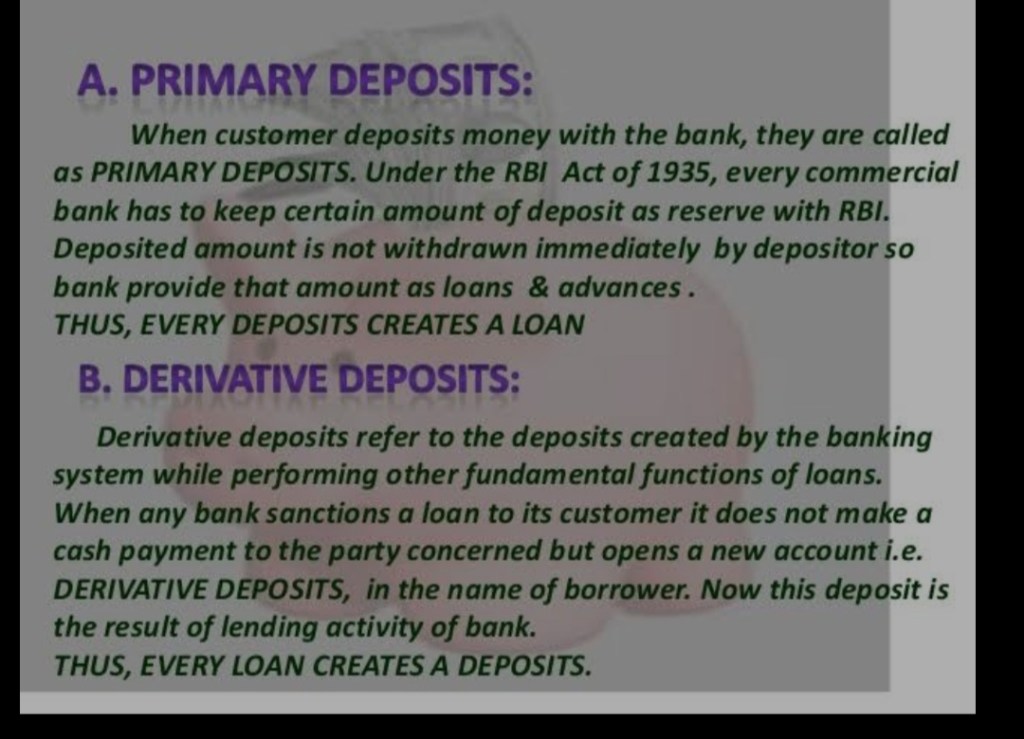
Primary Deposits :- A bank accepts cash from the customer and opens a deposit in his name . This is a primary deposit . These deposits simply convert currency money into deposit money . These deposits form the basis for the creation of credit. These deposit creates a loan .

• Secondary or Derivative Deposit :- A bank grants loans and advances instead of giving cash to the borrower , opens a deposit account in his name . This is the secondary or derivative deposit . Every loan creates a deposit . The creation of a derivative deposit means the creation of credit .

Banks can expand their demand deposits as a multiple of their cash reserves because demand deposits serve as the principal medium of exchange .


Aspects of Credit Creation


The two important aspects of credit creation are :-

Liquidity :- The bank must pay cash to its depositor when they exercise their right to demand cash against their deposit .

Profitability :- Banks are profit – driven enterprises . Therefore a bank must grant loans in a manner which earns higher interest than what it pays on its deposit .


Assumptions :-


The bank’s credit creation is based on the assumption that during any time interval only a fraction of its customers genuinely need cash . The bank also assumes that all its customers would not turn up demanding cash against their deposit at the same time .


Concepts of Credit Creation.


Bank deposit :- Bank deposits are the basis of credit creation . Bank deposits constituent of primary deposit and secondary deposit .

Bank as a Business institution :- Bank is a business institution which tries to maximize profit through loans and advances from deposits.

Borrowing rate :- The rate at which commercial banks accept deposits is known as the borrowing rate.

Lending rate :– The rate at which the commercial banks lend money to the customers is known as the lending rate.

Spread :- The difference between the lending rate and the borrowing rate is known as the spread.

Spread = Lending rate – Borrowing rate.

Concept of Cash Reserve Ratio :- It is legally compulsory for the bank to keep a certain minimum fraction of the deposit as a reserve. This is known as Cash Reserve Ratio (CRR) or Legal Reserve Ratio (LRR).

Banks only keep a fraction of deposits as cash reserves because all depositors do not approach the bank for withdrawal of money at the same time.
There is a constant flow of new deposits into the banks.

• Excess Reserves :- The reserves over and above the cash reserves are the excess Reserves used for loans and credit creation .

Concept of Credit Multiplier :- The credit multiplier or deposit multiplier measures the amount of money that the banks are able to create in the form of deposits with every unit of money that it keeps as a reserve.

It is calculate as,

Money Multiplier (MM or K) = 1/ CRR times


Given a certain amount of cash , a bank can create credit multiple times . In the process of multiple credit creation , the total amount of derivation deposits that a bank creates is a multiple of initial cash .


Mathematics representation of Credit Creation


Formula for Credit Creation :-

Total Credit Creation =

Cash deposit ( initial deposit ) X Credit Multiplier Coefficient .

where , credit multiplier coefficient = 1/ r

r = Cash Reserve Ratio .

Extending the above formula,

Total deposit = Cash Deposit + Credit Deposit .


Let ,

Cash Deposit = ∆ D
Cash Reserve Ratio = r
Total deposit = ∆ M


Derivation :-

∆ M = ∆ D + (1- r) ∆ D + ( 1- r ) ² ∆ D +( 1- r )³ ∆D +……….( 1-r ) ^ n-1 ∆ D .
– (i)

By multiplying both side by (1-r) in equation (i)

( 1- r) ∆M = (1-r ) ∆ D +(1-r)² ∆D + (1-r)³ ∆D ………..(1-r)^ n ∆ D.
-( ii )


Subtracting equation i and ii we get ,

( 1-r) ∆ M – ∆M = – ∆ D + ( 1- r) ^n ∆ D.

∆ M ( 1-r-1 ) = – ∆ D [ 1- ( 1-r) ^n ]

If n = ~
Then , (1-r) ^n =0

So ,

r ∆M = ∆ D ( 1-0 )
r∆ M = ∆ D

∆ M = 1/r × ∆ D .


Hence ,proved ,

Total deposit = Cash deposit × Credit Multiplier Coefficient.


Process of Credit Creation


There are two ways of analyzing the credit creation process:

• Single bank Credit creation system.

• Multiple bank Credit creation system.


Single Bank Credit Creation:-.


In this system, one bank operates all the cash deposits and cheques.

Explanation with hypothetical example :-.

Assumption :-

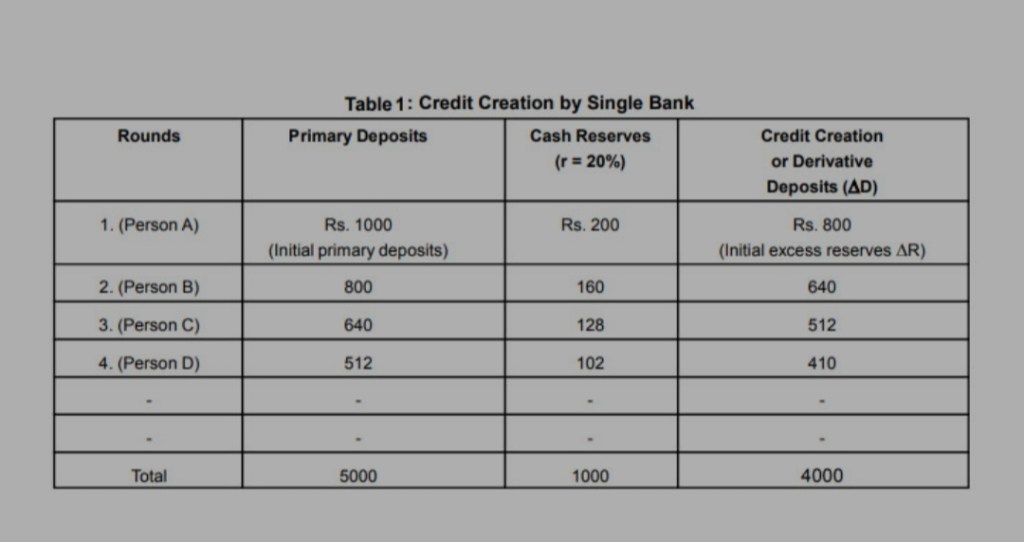
Bank receives a cash deposit from person A , of Rs. 1000.

The bank requires a CRR of 20 percent.

The remaining money is lent to another person B , C , D …and so on.

Explanation :-

Person A deposits 1,000 rupees with the bank, then the bank keeps only 200 rupees in the cash reserve and lends the remaining 800 to another person B.

They open a credit account in the borrower’s name for the same.

Similarly, the bank keeps 20 percent of Rs. 800 (i.e. Rs. 160) and advances the remaining Rs. 640 to person C.

Further, the bank keeps 20 percent of Rs. 640 (i.e. Rs. 128) and advances the remaining Rs. 512 to person D.

This process continues until the initial primary deposit of Rs. 1,000 and the initial additional reserves of Rs. 800 lead to additional or derivative deposits of Rs. 4,000 (800+640+512+….).

Adding the initial deposits, we get total deposits of Rs. 5,000.

In this case, the credit multiplier is 5 (reciprocal of the CRR) and the credit creation is five times the initial excess reserves of Rs. 800.


Multiple Credit Creation by the Banking System


In multiple credit creation by a bank , deposit of one bank is the gain of deposit for some other bank.
This transfer of cash within the banking system creates primary deposits and increases the possibility for further creation of derivative deposits


Multiple banking system includes the following assumptions :-

• There are. many banks , say A,B, C ,.etc.

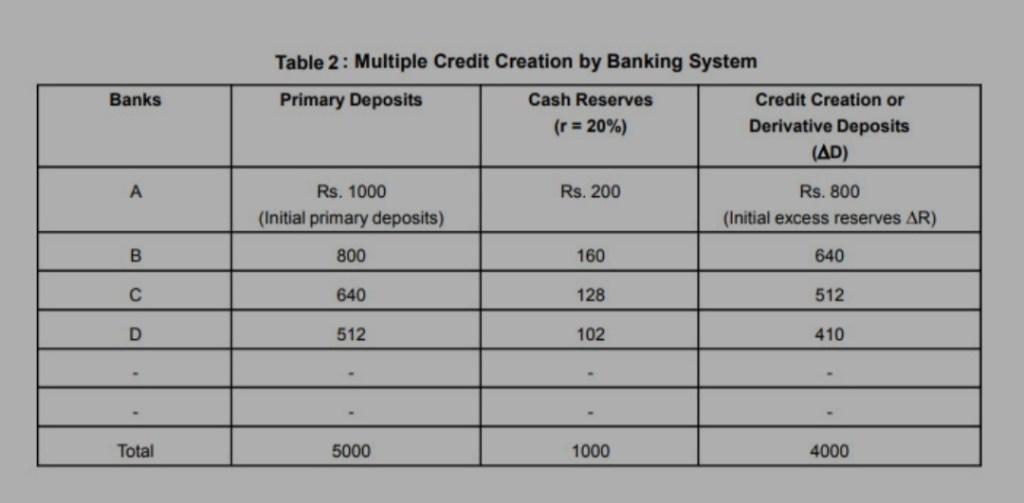
• First Bank has a cash deposit of Rs. 1000.

• The bank requires a CRR of 20 percent.

• The remaining money is lent to another bank B , C , D …and so on.


The initial deposit of Rs. 1,000 with bank A leads to a creation of total deposits of Rs. 5,000.


Limitations :-


Commercial banks have limited power in the creation of credit . The following are the limitations on the power of commercial banks to create credit.

•The credit creation power of banks depends upon the amount of cash they possess .

• An important factor that limits the power of banks to create credit is the availability of adequate securities .

• The banking habits of the people also govern the power of credit creation on the part of banks .

• The minimum legal reserve ratio of cash deposits fixed by the central bank is an important factor which determines the power of banks to create credit.

• The process of Credit Creation is based on the assumption that banks stick to the required reserve ratio by the Central Bank .

• If there are leakages in the credit creation steam of the Banking system , credit expansion will not reach the required level.

• The power of credit creation is further limited by the behaviour of the other banks .

___________________________________________

Referral links :-Cash Reserve Ratio, Credit Multiplier.