The Department of Biotechnology, Government of India hosted the ninth Webinar in its Biofoundry and Bio manufacturing Initiative series on March 7, 2025. The session centered on “Bio manufacturing of Biopolymers,” a crucial area under the BioE3 Policy, which was approved by the Union Cabinet in August 2024. The BioE3 Policy is designed to establish India as a global leader in bio-based innovations, emphasizing sustainable biomanufacturing across various thematic areas, including biopolymers. This Webinar served as a platform for academia, industry leaders, startups, and researchers to engage in discussions about advancements and opportunities in biopolymer biomanufacturing.
Dr. Vaishali Panjabi, Scientist ‘F’, DBT, highlighted the BioE3 Policy’s vision to foster high-performance biomanufacturing. She informed that the ninth Webinar in this series focuses on ‘Biomanufacturing of Biopolymers’. India, given its academic and industrial strength, is poised to create a vibrant ecosystem for cost-effective biopolymer production. She mentioned the potential gaps, challenges in this sectors followed by strengths and opportunities to address the same.
Dr. Binod Parameswaran, CSIR-NIIST, Thiruvananthapuram mentioned the major differences between biopolymers, process involved along with challenges and limitations in biomanufacturing. Finally he also shared the key trends shaping the future of biopolymer R&D in India.
Dr. Ashvini Shete, Praj Industries Ltd. mentioned in detail the process involved in the production of Biopolymers and the challenges associated with its production. She emphasized on the importance of strain and feed stock selection, process optimization and downstream processing for biopolymer production. She mentioned that a Vibrant Ecosystem for Cost-Effective Biopolymer Production can be created in India based on the rich availability of feedstock and technology with in the country.
The session concluded with a vibrant Q&A segment moderated by DBT and BIRAC officials. Participants actively engaged with the experts, discussing challenges and opportunities in bio manufacturing of biopolymers.
Discussions around shaping the contours of India’s industrial policy in light of the evolving geopolitical landscape, the role of Production Linked Incentive (PLI) schemes in driving manufacturing competitiveness, India’s green transition and inclusive sustainability in shaping India’s industrial policy and creating resilient global supply chains was at the central of the international conference organised by the Centre for Trade and Investment Law (CTIL).
The international conference was based on the theme “Navigating the Future: Industrial Policy and Global Competitiveness” organised by the Centre for Trade and Investment Law (CTIL), established by the Ministry of Commerce and Industry, Government of India, in collaboration with the Centre for International Trade and Business Laws, NALSAR University of Law and the World Trade Institute, University of Bern, together with the WTO India Chairs Programme. The international conference was held during 17th to 19th January 2025 at the NALSAR University of Law, Hyderabad.
Importantly, the conference discussed the role of WTO disciplines in ensuring that industrial policy measures do not negate the core principle of the ruled-based international trading system. The conference featured key insights into the current geopolitical landscape and energy transition.
The central theme of the conference ‘Navigating the Future: Industrial Policy and Global Competitiveness’ was explored through a series of panel discussions and technical sessions. The inaugural sessions featured discussions on the resurgence and evolution of industrial policy, metrics to measure its impact, and their compatibility with WTO rules in a changing global context. Prof. James J. Nedumpara, Head, CTIL, in his welcome speech, highlighted the relevance of the conference theme and the importance of green industrial policy in fostering innovation and technology in the current global context. This was followed by the presidential address delivered by Prof. Srikrishna Deva Rao, Vice Chancellor of NALSAR University of Law. Shri. Ujal Singh Bhatia and Professor Peter Vanden Bosche, former members of the WTO Appellate Body, also emphasised the need for an in-depth examination of the linkages between trade policy and industrial policy.
Shri Dammu Ravi, Secretary (Economic Relations), Ministry of External Affairs, during his address highlighted that emerging economies can play a catalyzing role in energy transition and pioneer an economic transformation. The Secretary emphasised the role that India can play in the global critical raw material supply chains and underscored that any strategy for value chain integration must be focused on creating value within India, including creating employment opportunities.
In the plenary session, Shri Montek Singh Ahluwalia, Former Deputy Chairman of the Planning Commission highlighted the global shift from free trade to protectionism in response to challenges from China’s rise and evolving U.S. policies. Shri. Ahluwalia emphasized the need for clear, cost-effective interventions in critical sectors, transparency in initiatives like PLIs, and adherence to WTO rules, as part of a balanced approach to security and economic priorities.
Several renowned scholars and policy experts of in the field of international trade and policy including Dr. Werner Zdouc, former Director of the Appellate Body, Mr. Sumanta Chaudhuri, Head Trade Policy, CII, Dr. Pritam Banerjee, Head, Centre for WTO Studies, Prof. Henry Gao, Professor, Singapore Management University, Professor Abhijit Das, former Head, Centre for WTO Studies, Dr. Alicia Gracia, Senior Fellow at Brugel, Dr. Isabelle Van Damme, Director, World Trade Institute, Dr. Rosmy Joan, Associate Professor, NALSAR University, among others spoke in the programme.
In the inaugural session, CTIL launched its monthly investment law newsletter, ‘Investment Law Compass: Navigating through the Global Investment Framework’ which aims to highlight the developments in the investment law landscape and transform it into an accessible and insightful journey for enthusiasts and professionals alike. The newsletter will be available online at www.ctil.org.in.
At the valedictory address, Professor James J Nedumpara reflected on the rich discussions on industrial policy and its various dimensions over the three days and highlighted that the conference was enriched by global participation. He extended his felicitations to the co-collaborators NALSAR and WTI and congratulated them on the successful conclusion of the Conference.
***
Daily writing prompt
What is your middle name? Does it carry any special meaning/significance?
Agriculture is a State subject and Government of India supports the efforts of States through appropriate policy measures, budgetary allocation and various schemes/ programmes. The various schemes/ programmes of the Government of India are meant for the welfare of farmers by increasing production, remunerative returns and income support to farmers. The Government has substantially enhanced the budget allocation of Department of Agriculture & Farmers’ Welfare (DA&FW) from Rs. 21933.50 crore BE during 2013-14 to Rs. 1,22,528.77 crore BE during 2024-25. Schemes/programmes initiated by DA&FW are conceptualised and implemented taken in consideration of improving the economic condition of farmers owning small handholdings, access to credit and to enhance overall income of farmers and remunerative returns in the agriculture sector.
PM KISAN Samman Nidhi Scheme has been launchedin 2019 with the sole objective to enhance the income of farmers owning small landholdings. This scheme provides Rs. 6000 per year in 3 equal instalments. So far, more than Rs.3.46 lakh Cr. has been disbursed to eligible farmers through 18 instalments.
The other major schemes run by Department of Agriculture & Farmers Welfare for enhance of overall income of farmers are as under:
Agri Fund for Start-Ups & Rural Enterprises’ (AgriSURE)
Per Drop More Crop (PDMC)
Sub-Mission on Agriculture Mechanization (SMAM)
Paramparagat Krishi Vikas Yojana (PKVY)
Soil Health & Fertility (SH&F)
Rainfed Area Development (RAD)
Agroforestry
Crop Diversification Programme (CDP)
Sub-Mission on Agriculture Extension (SMAE)
Sub-Mission on Seed and Planting Material (SMSP)
National Food Security and Nutrition Mission (NFSNM)
Integrated Scheme for Agriculture Marketing (ISAM)
Mission for Integrated Development of Horticulture (MIDH)
National Mission on Edible Oils (NMEO)-Oil Palm
National Mission on Edible Oils (NMEO)-Oilseeds
Mission Organic Value Chain Development for North Eastern Region
Digital Agriculture Mission
National Bamboo Mission
PM-AASHA (Pradhan Mantri Annadata Aay SanraksHan Abhiyan) scheme ensures remunerative prices for farmers’ produce and prevent distress sales. It aims to strengthen the Minimum Support Price (MSP) mechanism and provide better price support for farmers.
“Formation & Promotion of new 10,000 FPOs with budget outlay of Rs 6,865 Crore. Farmers Producer Organization (FPOs) are being set up to give farmers collective bargaining power in markets as well as enabling small farmers to pool resources, access technology, and get better prices for their crops.
Agriculture Infrastructure Fund (AIF) with financial provision of one Lakh Crore scheme has been launched with an objective to mobilize a medium – long term debt financing facility for investment in viable projects for post-harvest management Infrastructure and community farming assets through incentives and financial support in order to improve agriculture infrastructure in the country. Following supports are being provided under Agri Infra Fund.
Interest Subvention: All loans under this financing facility have interest subvention of 3% per annum up to a limit of ₹ 2 crore. This subvention is available for a maximum period of 7 years. In case of loans beyond ₹ 2 crore, interest subvention is limited up to ₹ 2 crore.
Credit Guarantee: Credit guarantee coverage is available for eligible borrowers from this financing facility under Credit Guarantee Fund Trust for Micro and Small Enterprises (CGTMSE) scheme for a loan up to ₹ 2 crore. The fee for this coverage will be paid by the Government. In case of FPOs the credit guarantee may be availed from the facility created under FPO promotion scheme of DA&FW.
Modified Interest Subvention Scheme (MISS) provides Interest Subvention (IS) of 1.5% to various Financial Institutions (Banks, RRBs, PACS, etc.) for delivering Short-Term Agriculture Operation (STAO) loans at a fixed rate of 7% to farmers through KCC. If the farmer repays the loan within time, he gets a Prompt Repayment Incentive (PRI) of 3%, bringing his loan liability to 4% overall (7% minus 3%). It is exclusively operated through Kisan Credit Card (KCC).
National Mission on Edible Oils – Oilseeds (NMEO-Oilseeds) has been launched on 3rd Oct, 2024 for enhancing the production of key primary oilseed crops such as Rapeseed-Mustard, Groundnut, Soybean, Sunflower, and Sesamum, as well as increasing collection and extraction efficiency from secondary sources like Cottonseed, Rice Bran, and Tree Borne Oils. The mission aims to increase primary oilseed production from 39 million tonnes (2022-23) to 69.7 million tonnes by 2030-31. Together with NMEO-OP (Oil Palm), the Mission targets to increase domestic edible oil production to 25.45 million tonnes by 2030-31 meeting around 72% of our projected domestic requirement. To ensure the timely availability of quality seeds, the Mission will introduce an online 5-year rolling seed plan through the ‘Seed Authentication, Traceability & Holistic Inventory (SATHI)’ Portal, enabling states to establish advance tie-ups with seed-producing agencies, including cooperatives, Farmer Producer Organizations (FPOs), and government or private seed corporations. 65 new seed hubs and 50 seed storage units will be set up in public sector to improve the seed production infrastructure.
The following have been proposed in the upcoming budget for income support, improve access to credit and overall growth of agriculture sector:
Enhanced Credit through KCC: – Loan increased from 3 lakh to ₹5 lakh to facilitate short term loans for 7.7 crore farmers, fishermen, and dairy farmers.
Aatmanirbharta in Pulses: – To launch a 6-year Mission with special focus on Tur, Urad and Masoor, emphasizing development and commercial availability of climate resilient seeds, enhancing protein content, increasing productivity and improving post-harvest storage and management, assuring remunerative prices to the farmers.
National Mission on High Yielding Seeds: – Targeted development and propagation of seeds with high yield, pest resistance and climate resilience.
Prime Minister Dhan-Dhaanya Krishi Yojana – It has been proposed Agri Districts Programme to cover 100 districts which is likely to help 1.7 crore farmers.
Mission for Cotton Productivity: – To be launched a 5-year mission to facilitate improvements in productivity and sustainability of cotton farming.
Makhana Board in Bihar: – It is proposed to set up Makhana Board to Improve production, processing, value addition, and marketing and organisation of FPOs.
Union Minister for Education Shri Dharmendra Pradhan lauded the Budget 2025-26, emphasizing it as a budget that takes everyone together and prioritizes welfare, well-being, and empowerment of all citizens while firmly placing India on the path to achieving the goal of developed India by 2047. The Minister expressed his gratitude to the Prime Minister Shri Narendra Modi and Finance Minister Smt. Nirmala Sitharaman for a visionary and futuristic Budget.
Shri Dharmendra Pradhan said that this Budget is aiming to cater to the comprehensive requirements, right from childhood to youth, who would be leading from the front in realizing the Viksit Bharat agenda in 2047 and beyond.
He further stated that the Budget announcements encompass today’s entire youth demographic, who will lead the nation for the next 25 years. This will strengthen the Bhartiya Gyan Parampara within our education system and foster a global community, he added.
The Minister highlighted that the Budget 2025-26 emphasizes investing in people and facilitating all-round development of India’s human capital. He noted that with “Gareeb, Yuva, Annadata, and Naari” as the pillars, this budget would uplift sentiments of the poor and middle class, accelerate spending, catalyze investments, and spur growth. He emphasized that it would remove regional imbalances, build rural prosperity, nurture research, innovation and entrepreneurship, invigorate the education and skilling landscape, and lead to employment-led development.
The Minister expressed gratitude for continuing with bigger and bolder investments in education, skilling, research, and innovation, stating that this budget represents another big leap towards empowering India’s population with more opportunities for world-class education and building capacities of human capital.
The Minister informed that the total budget allocation for the Ministry of Education has reached ₹128,650 crore, marking a 6.22% increase over BE 2024-25.
Union Education Minister informed that Fifty thousand Atal Tinkering Labs (ATL) will be set up in Government schools in next 5 years to cultivate the spirit of curiosity and innovation, and foster a scientific temper among young minds. With this, students of all Government secondary schools will have access to ATL. The Union Budget also proposes to provide Broadband connectivity to all Government secondary schools and primary health centres in rural areas under the BharatNet project, he added.
Shri Pradhan informed that the total number of students in 23 IITs has increased 100 per cent from 65,000 to 1.35 lakh in the past 10 years. Additional infrastructure will be created in the 5 IITs started after 2014 to facilitate education for 6,500 more students. Hostel and other infrastructure capacity at IIT, Patna will also be expanded, he further added.
Shri Pradhan said that with the aim to help students understand their subjects better, it is proposed to implement a Bharatiya Bhasha Pustak Scheme to provide digital-form Indian language books for school and higher education.
The Union Minister also informed that five National Centres of Excellence for skilling will be set up with global expertise and partnerships to equip youth with the skills required for “Make for India, Make for the World” manufacturing. The partnerships will cover curriculum design, training of trainers, a skills certification framework, and periodic reviews.
Shri Pradhan highlighted that the fourth AI Centre of Excellence in Education, envisioned in the Budget 2025-26, aims to revolutionize India’s educational system from pre-primary to professional and research levels. By harnessing artificial intelligence, it seeks to address disparities and inefficiencies, ensuring equitable and high-quality education across the nation. This Centre of Excellence in Artificial Intelligence for Education will be established with a total outlay of ₹500 crore, he added
The Minister informed the allocation of Rs 20,000 crore to implement private sector driven Research, Development and Innovation. In the next five years, under the PM Research Fellowship scheme, provision of ten thousand fellowships for technological research in IITs and IISc with enhanced financial support is also proposed in the Budget, he added.
The Minister informed that a Gyan Bharatam Mission for survey, documentation and conservation of our manuscript heritage with academic institutions, museums, libraries and private collectors will be undertaken to cover more than 1 crore manuscripts. A National Digital Repository of Indian knowledge systems for knowledge sharing will also be set up.
D/o School Education & Literacy
The Budget Allocation for the FY 2025-26 of ₹ 78572 Cr is the highest ever for the Department of School Education & Literacy.
There has been an overall increase of ₹ 5074 Cr (7%) in the Budget Allocation of Department of School Education and Literacy in the FY 2025-26 from BE 2024-25. As compared to RE of FY 2024-25, there has been an increase of ₹ 11,000 Cr (16.28 %).
The highest ever Budget Allocation may be seen in the Autonomous Body of Kendriya Vidyalaya Sangathan (KVS) at Rs. 9,503 Cr. Allocation in KVS has increased by ₹ 201.17 Cr as compared to Budget allocation of FY 2024-25. There has been an increase of ₹ 776 Cr (9%) as compared to RE of FY 2024-25.
Budget Allocation of FY 2025-26 in Flagship Schemes have increased i.e Samagra Shiksha (by ₹ 3750 Cr), PM-POSHAN (by ₹ 32 Cr) and PM-SHRI (by ₹ 1450 Cr) with respect to Budget Allocation (BE) of FY 2024-25. As compared to RE 2024-25, allocation in Samagra Shiksha has increased by ₹ 4240 Cr (11%), allocation in PM-POSHAN has increased by ₹ 2500 Cr (25 %) and allocation in PM-SHRI has increased by ₹ 3000 Cr (66%).
Out of the overall Budget Allocation in FY 2025-26 of ₹ 78,572 Cr, the Scheme allocation is ₹ 63,089 Cr and Non-Scheme Allocation is ₹ 15,483 Cr.
Increase in Scheme Allocation in BE 2025-26 is ₹ 5284 Cr (9.14 %) as compared to BE 2024-25. As compared to RE 24-25, increase in Scheme Allocation is ₹ 10248 Cr (19%) and non-Scheme allocation has increased by ₹ 752 Cr (5%) in BE 2025-26.
Fifty thousand (50,000) Atal Tinkering Labs (ALT) will be set up in Government schools in next five years to cultivate the spirit of curiosity and innovation, and foster a scientific temper among young minds.
Broadband connectivity will be provided to all Government secondary schools under BharatNet project in the next three years.
Department of Higher Education, Ministry of Education
The overall Budget Allocation in FY 2025-26 is Rs. 50077.95 Cr out of which Scheme allocation is Rs. 6990.88 Cr and Non- Scheme allocation is Rs. 43087.07 cr.
There has been an overall increase of Rs. 2458.18 Cr (5.16%) in the Budget Allocation of Department of Higher Education in the FY 2025-26 with respect to FY 2024-25.
Allocations to Major Autonomous Bodies under Higher Education
The total Allocation of Autonomous Bodies in 2025-26 increased to Rs. 42732 Cr from Rs. 39777.40 in 2024-25. There is increase of 7.42%
Allocation in Central Universities has been kept at Rs. 16691.31 Cr, against Rs. 15928 Cr in 2024-25 which is Rs 763.31 Cr more i.e. 4.79 % increase.
UGC has been allocated Rs.3335.97 Cr in 2025-26, against Rs. 2500 Cr in 2024-25 which is Rs. 835.97 Cr more i.e. 33.44 % increase.
IITs have been allocated Rs. 11349.00 Cr in 2025-26, against Rs. 10324.50 Cr in 2024-25 which is Rs. 1024.50 Cr more i.e. 9.92% increase.
For NITs, Rs.5687.47 Cr has been allocated in FY 2025-26, against Rs.5040 Cr in 2024-25 increasing the allocation by Rs. 647.47 Cr i.e. 12.85% increase.
Deemed Universities have been allocated Rs.604 Cr in 2025-26, against Rs.596 Cr in 2024-25 increasing the allocation by Rs. 8 Cr i.e. 1.34% increase.
IIMs have been allocated Rs.251.89 Cr in 2025-26, against Rs. 212.21 Cr in 2024-25 increasing the allocation by Rs. 39.68 Cr i.e. 18.70% increase.
IIITs have been allocated Rs.407.00 Cr in 2025-26, against Rs.315.91 Cr in 2024-25 increasing the allocation by Rs. 91.09 Cr i.e 28.83 % increase.
Grants for Promotion of Indian Languages have been allocated Rs.347.03 Cr in 2025-26, against Rs.310.10 Cr in 2024-25 increasing the allocation by Rs. 36.93 Cr i.e. 11.91% increase.
Natural Resources and Domestic and International Conflicts
Q35
Hydrocarbon Resources
Q37
Issues in International Trade
Q38
Government Policy
Q39
Other
Q4
Energy
Q40
General
Q41
Demand and Supply • Prices
Q42
Alternative Energy Sources
Q43
Energy and the Macroeconomy
Q47
Energy Forecasting
Q48
Government Policy
Q49
Other
Q5
Environmental Economics
Q50
General
Q51
Valuation of Environmental Effects
Q52
Pollution Control Adoption and Costs • Distributional Effects • Employment Effects
Q53
Air Pollution • Water Pollution • Noise • Hazardous Waste • Solid Waste • Recycling
Q54
Climate • Natural Disasters and Their Management • Global Warming
Q55
Technological Innovation
Q56
Environment and Development • Environment and Trade • Sustainability • Environmental Accounts and Accounting • Environmental Equity • Population Growth
If democracy and economy is to flourish then there is a need to have a good mechanism to detect and prevent the rise of crony capitalism in India. This can be done only if multi pronged strategies are adopted for this. Our legal system should work in close collaboration with the academia to ensure that good practices are evolved and new policies are adopted to make our democracy and economy work independently yet in a holistic manner to enhance the quality of life of the millions of India who have faith in our constitution.
Crony capitalism refers to a situation where businesses and individuals with close relationships to the government are given preferential treatment and advantages, often resulting in unfair competition and the misallocation of resources. India has faced several cases of crony capitalism over the years. The 2G spectrum scam, which came to light in 2010, involved the irregular allocation of 2G mobile spectrum licenses by the government. The scam resulted in a loss of billions of dollars to the exchequer. It was alleged that the licenses were sold at significantly undervalued prices to select companies with close ties to politicians and government officials. The coal scam, also known as “Coalgate,” involved the improper allocation of coal blocks by the government between 2004 and 2009. It was alleged that the coal blocks were allocated to private companies without following proper procedures, resulting in significant financial losses to the government. Many companies linked to politicians and influential individuals were accused of benefiting from the scam. The Commonwealth Games held in Delhi in 2010 were marred by allegations of corruption and mismanagement. It was alleged that contracts for various infrastructure projects related to the Games were awarded to companies close to influential politicians and government officials at inflated prices. The irregularities and misappropriation of funds led to public outrage and investigations. The Adarsh Housing Society scam, which surfaced in 2010, involved the illegal construction of a high-rise residential building in Mumbai. The building was initially intended to be a housing project for war veterans and widows, but it was alleged that influential individuals, including politicians and bureaucrats, obtained flats in the building through fraudulent means. The scam highlighted the nexus between politicians, bureaucrats, and real estate developers. Vijay Mallya, the former chairman of Kingfisher Airlines, faced allegations of crony capitalism and financial irregularities. It was alleged that he received preferential treatment from banks and politicians, including access to loans and financial assistance, despite the deteriorating financial health of his airline. Mallya left India in 2016 and is currently facing extradition from the United Kingdom.
These are just a few instances of alleged crony capitalism in India. It’s important to note that allegations are not proof of guilt, and legal proceedings and investigations are often ongoing in such cases. Curbing the rise of crony capitalism requires a comprehensive approach involving various stakeholders, including the government, regulatory bodies, and civil society. We need to enhance transparency in decision-making processes and public procurement. Government should implement measures such as e-auctions, online portals, and open bidding systems to ensure a level playing field for all businesses. There is a need to establish effective mechanisms to hold public officials and politicians accountable for any corrupt practices or undue favors. Time has come when a system of robust regulatory framework can be implemented and enforced strictly in conjunction with regulations and laws to prevent the abuse of power and manipulation of the system. While planning we must ensure that regulatory bodies have adequate resources and independence to perform their duties effectively. Regularly review and update regulations to address emerging challenges and loopholes. The competition commission of India should act in a progressive manner to foster a competitive market environment by breaking up monopolies and promoting fair competition. Encourage the entry of new players, both domestic and foreign, in various sectors. Empower competition commissions to monitor and take action against anti-competitive practices. The dress of Anna Hazare can be realized only by implementing and enforcing strong anti-corruption laws. All government departments should try to establish specialized anti-corruption agencies with adequate resources and independence to investigate and prosecute corruption cases. Encourage whistleblowing and protect whistleblowers from retaliation. Promote a culture of integrity and ethics in both public and private sectors. As envisioned by the makers of the constitution of India, we should ensure judicial independence and expedite the resolution of commercial disputes. Establish specialized courts to handle cases related to corruption and economic offenses. Streamline legal procedures and reduce the backlog of cases to ensure timely justice. On the pattern of Atal Bihari Vajpayee Institute of Good Governance and Policy Analysis (AIGGPA) as set up by the government of Madhya Pradesh to strengthen institutions and promote good governance practices at all levels. Encourage transparency in political funding and electoral processes. Implement effective measures to prevent the misuse of public funds and resources. After the setting up of the AIGGPA, in Madhya Pradesh there has been enhancement in the efficiency and accountability of government institutions and bodies in the state of Madhya Pradesh.
We should encourage the active participation of civil society organizations, non-governmental organizations, and the media in monitoring and exposing instances of crony capitalism. All institutions must support investigative journalism and protect the freedom of the press. Foster a culture of public scrutiny and accountability in the youths so that they can be the next leaders and businessmen. Government must implement robust financial and corporate governance practices. Enhance disclosure requirements for companies, particularly those related to beneficial ownership and related-party transactions. We must encourage adoption of auditing and accounting standards to ensure accurate and reliable financial reporting. To ensure transparency and fair competition in PPP projects we must encourage close collaboration of the public and private sectors in delivery of services. We must develop clear guidelines and criteria for project selection and bidding processes. Implement effective monitoring and evaluation mechanisms to prevent favoritism and ensure accountability in PPP projects. Government should undertake structural economic reforms to reduce excessive government intervention and promote market competition. Simplify and streamline regulatory processes to facilitate ease of doing business. Government must encourage entrepreneurship, innovation, and investment in sectors that promote inclusive growth. It’s important to note that curbing crony capitalism is a complex and ongoing process that requires consistent efforts and the involvement of all stakeholders. It necessitates a commitment to integrity, transparency, and ethical governance from both the government and the private sector.
References
Khatri, N. (2016). Definitions of cronyism, corruption, and crony capitalism. Crony capitalism in India: Establishing robust counteractive institutional frameworks, 3-7.
Gandhi, A., & Walton, M. (2012). Where do India’s billionaires get their wealth?. Economic and Political Weekly, 10-14.
Gowda, M. R., & Sharalaya, N. (2016). Crony capitalism and India’s political system. Crony Capitalism in India: Establishing robust counteractive institutional frameworks, 131-158.
Gupta, V. (2016). Indian administrative service and crony capitalism. Crony Capitalism in India: Establishing Robust Counteractive Institutional Frameworks, 177-205.
Kapil S. K. (2023). The Anatomy of Crony Capitalism in India. Economic and Political Weekly, vol LVIII no 20, 23-27
Shah, M. (2021). Reading KN Raj in the Age of Free Market Fundamentalism. Economic & Political Weekly, 56(14), 33.
Varma, A., Hu, B., & Bloomquist, L. (2016). Family oligarchies and crony capitalism in india. Crony Capitalism in India: Establishing Robust Counteractive Institutional Frameworks, 159-176.
India’s role in the multipolar global political economy is significant due to its economic and geopolitical importance. India is the world’s sixth-largest economy and has been experiencing steady economic growth in recent years. The country’s strategic location between East and West, coupled with its large population, make it an important player in the international arena.
India’s economic policies and reforms have contributed to its rise as a major economic power. The country has implemented policies to attract foreign investment and has opened up various sectors for private participation. The government has also focused on improving infrastructure, developing a skilled workforce, and promoting entrepreneurship. In addition to its economic importance, India also plays a significant role in global politics. The country is a member of various international organizations, including the United Nations, World Trade Organization, and BRICS. India’s leadership has been instrumental in shaping the agenda of these organizations and in promoting the interests of developing countries. India’s strategic location also makes it an important player in regional geopolitics. The country has been involved in various peacekeeping missions, and its military capabilities have been growing in recent years. India has also been strengthening its relationships with other major powers, including the United States, Russia, and China. Overall, India’s role in the multipolar global political economy is likely to continue to grow in the coming years. The country’s economic and geopolitical importance, coupled with its strategic location, make it a key player in the international arena. Global trade is an essential aspect of the modern economy, and it relies heavily on trust and confidence between parties involved. A breach of confidence can have severe consequences for international trade and the global economy as a whole.
A breach of confidence in global trade can take many forms, including the failure to fulfill contractual obligations, misrepresentation of goods or services, or the theft of intellectual property. These breaches can result in legal disputes, loss of revenue, and damage to reputation, which can be costly for businesses and countries involved. When a breach of confidence occurs, it can lead to a breakdown in trust between parties involved, making it more challenging to engage in future trade deals. This can lead to increased transaction costs, reduced investment, and lower economic growth, ultimately impacting consumers. The World Trade Organization (WTO) and other international bodies play a crucial role in promoting fair trade practices and resolving disputes between countries. However, their effectiveness is limited when it comes to enforcing trade agreements and preventing breaches of confidence.
Dollar hegemony refers to the dominant position of the US dollar in the global economy as the primary reserve currency and medium of exchange. The term is used to describe the extensive use of the US dollar in international trade, finance, and investment, giving the United States significant economic and political power.
The dollar’s dominance dates back to the Bretton Woods agreement of 1944, where the US dollar was established as the international reserve currency, and other countries pegged their currencies to the dollar. This allowed the US to enjoy significant economic and political power and played a crucial role in the post-World War II economic order. Today, the dollar remains the dominant currency in international trade and finance, with over 60% of global foreign exchange reserves held in US dollars. Many countries continue to use the dollar as a medium of exchange, and international commodity prices are usually quoted in dollars. The dollar’s dominance has several implications for the global economy. First, it provides the United States with a unique advantage in international trade, as other countries are dependent on the US dollar to conduct transactions. Second, it allows the US to borrow at lower interest rates, as investors have a high level of confidence in the US dollar and the US economy. However, the dollar’s hegemony also comes with some challenges. The US’s monetary policy decisions can have significant impacts on the global economy, as changes in interest rates and other monetary policies can affect other countries’ economies. Additionally, the US’s high level of debt has raised concerns about the dollar’s stability as a reserve currency. In recent years, there have been calls for the diversification of international reserve currencies and the establishment of alternative payment systems. Some countries, including China and Russia, have been promoting the use of their currencies in international trade and finance to reduce their dependence on the US dollar.
Overall, dollar hegemony continues to shape the global economy, and it is an essential factor in international trade and finance. The ongoing debates around its stability and the need for diversification demonstrate the complex and ever-changing nature of the global economic order.
India plays a significant role in the multipolar global political economy due to its economic and geopolitical importance. The country’s economic policies and reforms have contributed to its rise as a major economic power, and its strategic location makes it a key player in regional geopolitics. India’s leadership has been instrumental in shaping the agenda of international organizations and promoting the interests of developing countries.
However, India also faces several challenges, including poverty, inequality, and infrastructure gaps. The country has been working towards addressing these challenges through various initiatives such as the Make in India campaign, Digital India, and Swachh Bharat Abhiyan. India’s role in the global economy and its rise as a major economic power can provide opportunities for businesses and investors to tap into its large market and skilled workforce. The country’s focus on innovation and entrepreneurship can also create opportunities for collaboration and partnership in various sectors.
In conclusion, India’s position in the multipolar global political economy is significant, and its continued growth and development will have far-reaching implications for the global economy. However, the country faces several challenges that need to be addressed, and there is a need for continued investment and collaboration to unlock its full potential.
References
Bastos, M. (2014). The Indian Ocean and the rise of a multi-polar world order: The role of China and India. Policy Perspectives: The Journal of the Institute of Policy Studies, 11(2), 17-28.
Chakraborty, S. (2018). Significance of BRICS: Regional powers, global governance, and the roadmap for multipolar world. Emerging Economy Studies, 4(2), 182-191.
Cooper, A. F., & Flemes, D. (2013). Foreign policy strategies of emerging powers in a multipolar world: An introductory review. Third World Quarterly, 34(6), 943-962.
Kukreja, V. (2020). India in the emergent multipolar world order: Dynamics and strategic challenges. India Quarterly, 76(1), 8-23.
Peters, M. A. (2023). The emerging multipolar world order: A preliminary analysis. Educational Philosophy and Theory, 55(14), 1653-1663.
Sharma, S. N. (2017). Geopolitics and Terrorism in Asia-Pacific Region vis-a-vis India.
The ASEAN-India and Thailand trade relations have witnessed significant growth over the years, leading to positive impacts on the economies of the participating countries. This paper highlights the benefits and opportunities arising from the flourishing trade relations between India, Thailand, and ASEAN countries, including enhanced market access, increased trade volume, and strengthened economic ties. The study also sheds light on the challenges faced by the ASEAN-India and Thailand trade relations, such as non-tariff barriers and limited infrastructure. The paper concludes that the ASEAN-India and Thailand trade relations have the potential to be a driving force for economic growth and regional integration, and recommends measures to further enhance the trade and investment ties between the regions.
Keywords:
ASEAN, India, Thailand, Trade Relations, India and Thialand
The aim of the Association of Southeast Asian Nations (ASEAN) is to promote economic, political, and security cooperation among its member countries in Southeast Asia. ASEAN was established on August 8, 1967, with the signing of the ASEAN Declaration, also known as the Bangkok Declaration. The founding members of ASEAN were Indonesia, Malaysia, the Philippines, Singapore, and Thailand. Brunei Darussalam joined in 1984, Vietnam in 1995, Laos and Myanmar in 1997, and Cambodia in 1999.
ASEAN’s role in Asia is significant. It is a regional organization that fosters economic integration and cooperation, political stability, and social progress among its member states. ASEAN plays an important role in promoting peace, security, and stability in the region, as well as in enhancing regional economic growth and development. ASEAN also serves as a platform for dialogue and cooperation between the member states and with other countries in the region and beyond. It has established several partnerships with countries such as China, Japan, South Korea, India, and the United States, among others.
In recent years, ASEAN has become increasingly important in the evolving regional security architecture of Asia, particularly with the rise of China and its growing influence in the region. ASEAN-led forums such as the East Asia Summit (EAS) have become key platforms for discussing security issues in the region, including the South China Sea disputes.
India and Thailand share a long-standing historical and cultural relationship that dates back several centuries. India and Thailand have been trading partners for over two thousand years, with cultural and economic exchanges flourishing during the ancient times along the land and sea routes. In recent times, India and Thailand have developed a strong strategic partnership based on shared values and interests. The two countries have close economic ties, with Thailand being one of India’s important trading partners in the ASEAN region. The total trade between India and Thailand stood at USD 13.76 billion in 2020-21.
India’s main exports to Thailand include gems and jewelry, machinery, iron and steel, organic chemicals, and vehicles. Thailand’s main exports to India include pearls, precious stones, electrical machinery, boilers, machinery, and parts. India and Thailand also cooperate in areas such as defense, security, tourism, and cultural exchanges. In the defense sector, the two countries have been conducting joint military exercises, and Thailand has purchased military hardware from India.
Tourism is another area of cooperation, with over a million tourists from each country visiting the other annually before the COVID-19 pandemic. Cultural exchanges between the two countries are also vibrant, with several cultural festivals and events being held in each other’s countries. India and Thailand also collaborate in regional forums such as ASEAN, BIMSTEC, and the Mekong-Ganga Cooperation. The two countries share a commitment to promoting regional integration and connectivity in the region.
The 13th Meeting of the India Thailand Joint Trade Committee (JTC) took place in New Delhi today. Ms. Auramon Supthaweethum, the Director General of Department of Trade Negotiations, Ministry of Commerce of Thailand, and Ms. Indu C. Nair, the Joint Secretary, Department of Commerce, Ministry of Commerce & Industry, India, co-chaired the meeting. This was the first in-person meeting of the JTC since its revival in 2020, after a 17-year hiatus.
Thailand is an important trading partner for India in the ASEAN region, with a total trade of USD 16.89 Billion in 2022-23, accounting for 13.6% of India’s total trade with ASEAN. India exports gems and jewelry, mechanical machinery, auto and auto components, and agricultural products, especially marine products, to Thailand.
During the meeting, the chairs reviewed the current status of bilateral trade and discussed the need to identify new potential products and priority sectors to expand bilateral trade. They also discussed market access issues and technical barriers faced by exporters and agreed to resolve them through regular and sustained bilateral discussions. India raised concerns about the restrictions it faces in exporting marine, poultry, and meat products.
Both sides identified several potential commodities and sectors for a stronger partnership, such as value-added marine products, smartphones, electric vehicles, food processing, and pharmaceuticals. They also agreed that there is a vast scope for collaboration in the service sector and decided to explore establishing mutual recognition/cooperation arrangements in nursing, accounting, audio-visual, and medical tourism. The meeting also reviewed the progress of the ongoing efforts to connect India’s Unified Payment Interface (UPI) with Thailand’s Prompt Pay Service and the settlement of trade transactions in local currency.
Some recommendations for enhancing the India and Thailand trade relations are:-
Strengthen bilateral economic engagement through the establishment of joint ventures, investment, and technology transfer.
Enhance connectivity between the two countries by improving transport links, including air and sea connectivity.
Promote cooperation between small and medium enterprises (SMEs) in both countries to enhance trade and investment.
Work towards establishing mutual recognition/cooperation arrangements in various sectors, including nursing, accounting, audio-visual, and medical tourism.
Address trade barriers and technical issues faced by exporters through regular and sustained bilateral discussions.
Explore the possibility of signing a Free Trade Agreement (FTA) to further enhance economic engagement between the two countries.
Overall, there is significant potential for India and Thailand to deepen their trade and economic partnership. By addressing trade barriers, promoting cooperation in key sectors, and enhancing connectivity between the two countries, India and Thailand can further strengthen their relationship and realize the untapped potential of their trade and economic ties.
References
Sivadasan, S. K., Susheel, M. A., & Bindu, C. (2012). India-Thailand Bilateral Trade A Review against the Backdrop of the Framework Trade Agreement. ABAC Journal, 32(3).
Asher, M. G., & Sen, R. (2005). India-East Asia integration: A win-win for Asia. Economic and Political Weekly, 3932-3940.
Chenoy, A. M. (2023). The Multipolar Global Political Economy. Economic & Political Weekly, 58(2), 31.
Francis, S. (2011). A sectoral impact analysis of the ASEAN-India free trade agreement. Economic and Political Weekly, 46-55.
Marwah, R. (2020). Reimagining India–Thailand Relations: A Multilateral and Bilateral Perspective.
Nataraj, G., & Sekhani, R. (2015). China’s One Belt One Road: An Indian Perspective. Economic and Political Weekly, 67-71.
Sen, R., Asher, M. G., & Rajan, R. S. (2004). ASEAN-India economic relations: current status and future prospects. Economic and Political Weekly, 3297-3308.
In Urban Planning or Mapping: A street index is a reference list or map that organizes the streets within a particular area. This index allows people to easily locate streets based on their names, numbers, or grid system. It might be included in city maps, directories, or GPS applications, providing a comprehensive list of streets and their locations.
In Finance or Economics: A street index can sometimes refer to a benchmark or index that tracks the performance of a specific set of stocks or financial instruments, similar to the way the Dow Jones Industrial Average or S&P 500 tracks stock market performance. In this sense, “street” could be a shorthand reference to Wall Street or financial markets in general.
In Real Estate: A street index might be used to track property values, trends, or transactions specific to various streets within a city or region. This could be used by real estate professionals or analysts to measure the relative value of properties in certain areas.
In Postal Systems or Directories: A street index might be used in postal codes or address directories, helping individuals or delivery services quickly find specific streets based on postal codes or other identifiers.
If you meant a different concept by “street index,” please clarify, and I’d be happy to provide more specific information.
The Government of India has introduced a pension scheme for unorganized workers namely Pradhan Mantri Shram Yogi Maan-dhan (PM-SYM) to ensure old age protection for Unorganised Workers. The scheme was launched in March, 2019. The third party evaluation of PM-SYM was done by Indian Institute of Public Administration that recommended inter-alia, to increase income limit from Rs.15000 to Rs.18000 and entry age for eligibility criteria to be relooked to 18 to 50 years.
For the first time, the definition of ‘gig workers’ and ‘platform workers’ and provisions related to the same have been provided in the Code on Social Security, 2020 which has been enacted by the Parliament. The Code provides for framing of suitable social security measures for gig workers and platform workers on matters relating to life and disability cover, accident insurance, health and maternity benefits, old age protection, etc.
The Ministry of Labour and Employment had launched the e-Shram-“One Stop-Solution” on 21st October 2024. This entails integration of different social security/welfare schemes at single portal i.e. e-Shram. This enables unorganised workers registered on e-Shram to access social security schemes and see benefits availed by them so far, on single portal i.e. e-Shram.
“Labour” as a subject is in the Concurrent List of the Constitution of India and under the Codes, the power to make rules has been entrusted to Central Government as well as State Governments. As a step towards implementation of the four Labour Codes, the Central Government has pre-published the draft Rules under Labour Codes. As per available information, 32, 31, 31 and 31 State/Union Territories have also pre-published the draft Rules under the Code on Wages, 2019, the Industrial Relations Code, 2020, the Code on Social Security, 2020 and the Occupational Safety, Health and Working Conditions Code, 2020, respectively.
The Labour Codes strengthen the protection available to workers, including unorganized workers in terms of statutory minimum wage, social security and healthcare of workers. The Code on Wages, 2019 has envisaged statutory right for minimum wages and timely payment of wages to all workers to support sustainable growth and inclusive development. Besides, the Code on Social Security, 2020 aims to extend social security benefits to all workers both in the organised and unorganised sectors. The Labour Codes have been aligned with the present economic scenario and technological advancements along with reduction in multiplicity of definitions & authorities. The Codes also ease compliance mechanism aiming to promote ease of doing business/setting up of enterprises and catalyze creation of employment opportunities while ensuring safety, health and social security of every worker. Use of technology, such as, web-based Inspection has been introduced in order to ensure transparency & accountability in enforcement. A provision for worker reskilling fund has been envisaged in the Industrial Relations Code, 2020 for re-skilling the retrenched workers which provides for crediting fifteen days’ wages last drawn by the worker.
Department for Promotion of Industry and Internal Trade (DPIIT) today celebrated the 8th anniversary of 4 new industrial corridors namely Amritsar-Kolkata Industrial Corridor (AKIC), Chennai-Bengaluru Industrial Corridor (CBIC), East Coast Economic Corridor (ECEC), and Bengaluru-Mumbai Industrial Corridor (BMIC) being added to India’s Industrial landscape— that have accelerated India’s journey towards becoming a global manufacturing powerhouse.
Earlier, India’s first corridor Delhi Mumbai Industrial Corridor (DMIC) spanning Uttar Pradesh, Haryana, Rajasthan, Madhya Pradesh, Gujarat and Maharashtra was solely leading the Silent Industrial revolution in the country.
Approved on 20 November 2019, these corridors represent the Government of India’s pioneering vision to boost manufacturing and drive planned urbanization nationwide, creating significant socio-economic benefits.
The establishment of these corridors has been a critical step toward transforming India’s industrial landscape. Spread across key regions in India, each corridor was strategically designed to integrate industry and infrastructure, establishing world-class connectivity that supports rapid industrialization. With high-speed rail networks, modern ports, dedicated logistics hubs, and advanced airports, these corridors are setting new standards in infrastructure development.
Each of the five corridors has played a distinctive role in shaping India’s economic narrative:
Delhi-Mumbai Industrial Corridor (DMIC) has emerged as a flagship of industrial and urban development. Anchored by advanced infrastructure, DMIC’s Dholera Special Investment Region in Gujarat, Shendra-Bidkin Industrial Area in Maharashtra, Integrated Industrial Townships- Greater Noida and Vikram Udyogpuri have created a benchmark in high-tech manufacturing, offering ‘plug-and-play’ infrastructure that facilitates ease of doing business. As a joint initiative between Japan and India, DMIC also exemplifies international collaboration for industrial growth.
Amritsar-Kolkata Industrial Corridor (AKIC) connects Delhi, Amritsar, and Kolkata, spanning over 1,800 km and impacting 20 cities. This corridor benefits 40% of India’s population, supporting regional industrial development in one of the world’s most densely populated areas. Regions like Khurpia in Uttarakhand and Rajpura-Patiala in Punjab have seen a surge in industry interest, driven by tailored investment incentives and robust connectivity.
Chennai-Bengaluru Industrial Corridor (CBIC) is planned to achieve accelerated development and regional industry agglomeration in the states of Tamil Nadu, Karnataka and Andhra Pradesh. It is enhancing trade between East Asia and Southern India, with nodes stretching from Chennai to Bengaluru, and planned extensions to Mangalore.
East Coast Economic Corridor (ECEC), India’s first coastal corridor, has amplified the nation’s trade and export capacities. Several ports located across the corridor not only serve as international gateways but, more importantly, act as critical links in the supply chain. By supporting logistics, packaging, and other services for production clusters and distribution centers, they are a valuable source of economic activity and development. The Vizag-Chennai Industrial Corridor (VCIC) has been designated as the first phase of the ECEC.
Bengaluru-Mumbai Industrial Corridor (BMIC) has prioritized regions with high industrial potential, such as Dharwad in Karnataka and Satara in Maharashtra. As one of the latest corridors, BMIC is establishing high-tech, multi-modal logistics and manufacturing hubs that complement existing industrial zones, ensuring balanced regional development and bridging the north-south economic axis.
On 28 August, 2024, the Cabinet Committee on Economic Affairs chaired by the Prime Minister Shri Narendra Modi approved 12 new project proposals under the National Industrial Corridor Development Programme (NICDP) with an estimated investment of Rs. 28,602 crore. Spanning across 10 states and strategically planned along 6 major corridors, these projects represent a significant leap forward in India’s quest to enhance its manufacturing capabilities and economic growth.
Some of these new projects are situated directly on the five corridors.
On DMIC, the Dighi node in Maharashtra and Jodhpur-Pali node in Rajasthan will amplify the corridor’s capacity for high-tech manufacturing and logistics.
On AKIC, Khurpia in Uttarakhand, Rajpura-Patiala in Punjab, Agra and Prayagraj in UP, Gaya in Bihar will further integrate northern states into the nation’s industrial landscape, leading to inclusive regional economic growth.
On CBIC, Palakkad in Kerala will enhance connectivity with southern manufacturing hubs, promoting trade and export potential.
On ECEC, The nodes of Kopparthy and Orvakal in Andhra Pradesh will strengthen coastal supply chains, bridging export-driven industries with inland clusters.
These industrial smart cities, like jewels in India’s economic necklace, represent the next generation of connected, self-sustaining hubs that will support local communities and elevate India’s global standing. As the nation marks five years of significant industrial progress, the recent approval of 12 new nodes signals a strong future for India’s industrial landscape, strengthening the country’s capacity for innovation, self-reliance, and sustainable economic development.
As India celebrates this milestone, the significance of the industrial corridors becomes ever more evident. These corridors are not just roads and factories; they are arteries of growth, pumping life into the nation’s industrial ambitions. They are a testament to India’s potential and its commitment to innovation, resilience, and progress. As the nation steps into the future, the corridors stand as both a foundation and a promise of what lies ahead.
Gati Shakti Vishwavidyalaya (GSV) held its 1st Court meeting in Rail Bhawan in New Delhi today. Chairing the meeting, Sh. Ashwini Vaishnaw, Union Minister of Railways, Information & Broadcasting and Electronics & Information Technology said “GSV is set to emerge as the best university in India and World, in line with PM Shri Narendra Modi’s vision, with its focus on Industry-driven approach and employability-oriented courses for the entire transportation and logistics sectors, including railways, aviation, marine engineering, highways, shipping, logistics and defense sectors. He further said “All the newly-recruited officers of Indian Railway Management Service (IRMS) Officers shall undergo their probationary training designed by Gati Shakti Vishwavidyalaya, a combination of theoretical and practical experiences at CTIs and industry, resulting in an MBA degree from GSV. Further, new programs shall be added for Bridge and Tunnel Engineering, Aviation Operations, Maritime Infrastructure, Highway Engineering and for defense forces”.
This event was graced by Shri Satish Kumar Chairman & CEO, Railway Board, Shri V Uma Shankar, Secretary, Ministry of Road Transport and Highways, Shri Amardeep Singh Bhatia,Secretary, DPIIT, Vice-Chief of Army Staff Lt. Gen. NR Raja Subramani, Sunil Mathur,MD & CEO, Siemens India, Olivier Loison MD, Alstom India, Jaya Jagadish,MD, AMD India, Shri Sushil Kumar Singh, Chairman, Deendayal Port Authority, Prof. Manoj Choudhary,Vice-Chancellor, Gati Shakti Vishwavidyalaya, representatives of Ministry of Higher Education, Ports Shipping and Waterways, Civil Aviation, AICTE and the leading functionaries of Gati Shakti Vishwavidyalaya.
At the occasion, Prof. Manoj Choudhary Founding Vice-Chancellor, Gati Shakti Vishwavidyalaya presented a detailed progress and status report of the university since its inception on 06 Dec 2022. All the members wholesomely praised the huge strides and progress of GSV in such a short time, particularly its Industry-driven and innovation-led approach, focus and results achieved within such a short time, setting the foundation of a top-class university. The members of the Court offered several suggestions and collaborative inputs for future programs in highway engineering, ports infrastructure, artificial intelligence, green hydrogen and ports modernization, defense sectors logistics and supply chain, affiliating national academies in the infrastructure sectors, being a nodal center to other universities/institutions, infrastructure project management etc. The Annual Reports and Annual Accounts of the university were also approved to be tabled before the Parliament.
Gati Shakti Vishwavidyalaya (GSV) has quickly emerged as a game changer in the higher education sector, particularly for the transportation, logistics and infrastructure sectors. GSV Vadodara was established as a Central University through an Act of Parliament in 2022, for creating best in class manpower and talent for the entire transportation and logistics sectors. This Central University is sponsored by the Ministry of Railways, Govt. of India and is mandated to work across railways, shipping, ports, highways, roads, waterways, and aviation etc. Following a demand-driven curriculum and leveraging state of the art infrastructure of all the Centralized Training Institutes of Indian Railways, the GSV shall create a resource pool of professionals across technology, economics, management and policy comprising multidisciplinary teaching (bachelors/masters/doctoral), executive training and research. GSV shall also undertake training for Indian Railways probationers and serving officers. Being an Industry-driven and Innovation-led university, GSV has a very strong focus on collaborations with leading institutions and industries across the world.
Jeevan Pramaan is the vision of the Prime Minister, Shri Narendra Modi for Digital Empowerment of Pensioners. All key stakeholders – Pension disbursing banks, Department of Pensions and Pensioners Welfare, Controller General of Defence Accounts, Ministry of Railways, Department of Telecom, Department of Posts, IIPB, UIDAI and Pensioners Welfare Associations are working with whole of government approach to realise the vision of Digital Empowerment of Pensioners.
Department of Pensions and Pensioners Welfare launched the Nation-wide Digital Life Certificate Campaign 3.0 for Digital Empowerment of Pensioners at National Media Center, New Delhi on 6th November 2024. The DLC Campaign 3.0 is being held in 800 cities/ towns of India from November 1-30, 2024. 1575 camps have been held from November 1-17, 2024 in 800 cities/districts, 1.8 lac postmen deployed across the country.
In this campaign, the Department of Pension & Pensioners’ Welfare is putting all efforts to create awareness amongst all pensioners regarding DLC-Face Authentication technique by way of banners / posters placed strategically in offices and all Bank Branches / ATMs. All Banks have created a team of dedicated staff at their branches having downloaded the desired apps in their smart phones who are using this technology extensively for submission of Life Certificates by the pensioners. In case, the pensioners are not able to visit the Branches due to old age/illness/weakness, the Bank officials are also visiting their homes/hospitals for the above purpose.
The Pensioners’ Welfare Associations are extending their full support to the Campaign. Their representatives are motivating the pensioners to visit the nearby Camp locations and submit their DLCs. The officials from Department of Pension & Pensioners’ Welfare are also visited major locations through-out the Country to assist pensioners in use of various digital modes to submit their Life Certificates and monitoring the progress very closely.
As a result, Digital Life Certificate (DLC) Campaign 3.0 has made remarkable progress by the end of 2nd second week, achieving significant milestones in its mission to bring convenience and accessibility to pensioners across the nation. The campaign has successfully generated over 77 lacs Digital Life Certificates by the end of 2nd week of launch of the 3.0 Campaign, out of which about 1,77,153 pensioners above 90 years old and 17,212 pensioners between 80 – 90 years category could submit their DLCs from the comfort of their home/locations/offices/branches. This incredible momentum underscores the commitment of our pensioners, banking institutions, and government agencies towards a digitally empowered India. A lot of excitement has been observed amongst all the stakeholders, particularly sick / very old pensioners at all the locations.
Key highlights of the campaign include:
Mega Camps: As part of the Campaign, 4 Mega camps have been organized, 2 in Delhi (4-5 November), 1 in Bengaluru (8 November) and 1 in Hyderabad (12 November) involving all stakeholders. Secretary PPW participated in all these camps and encouraged pensioners to adopt digital modes of submission of LCs.
Bank-wise Achievements: SBI and PNB are leading the Campaign by generating more than 9 lacs DLCs by the end of 2nd week of the month-long Campaign, while Canara Bank and Central Bank of India registered impressive performances by generating 1 lacs and 57,000 DLCs respectively.
State-Wise Progress: Maharashtra led the way with over 10 lacs certificates generated, followed by Tamilnadu and West Bengal 6 lacs each. Uttar Pradesh has also done well with more than 5 lacs DLCs.
Departmental Contributions: The Defence Department stood out with a 21 lacs DLCs, while the Telecom Department generated an impressive 3.1 lacs DLCs. Civil Departments also contributed significantly with over 3.4 lacs certificates generated.
IPPBs Performance: IPPB generated 4.4 lacs DLCs by the end of 2nd week of the campaign. IPPB has played key role in delivering doorstep delivery of services.
Face Authentication: Advanced authentication methods such as Face Recognition contributed to 24 lacs certificates, making up 34% of the total DLCs generated. There is 204 times increase in DLCs submitted through Face Authentication under DLC Campaign 3.0.
This campaign is a testament to DoPPW’s unwavering commitment to harnessing digital tools for the benefit of every pensioner. All stakeholders extended their full support to this campaign. This momentum shall continue to make DLC Campaign 3.0 a historic success.
Sagarmanthan – The Great Oceans Dialogue, the South Asia’s largest Maritime Thought Leadership summit, began here today. The inaugural session was addressed by the Union Minister of Ports, Shipping & Waterways (MoPSW), Sarbananda Sonowal; the Minister of Maritime Affairs and Insular Policy, Greece, Christos Stylianides; the Minister of State for Fisheries and Ocean Resources, Maldives, Dr Amzath Ahmed; the National Representative for the Province of Rio Negro, Argentina, Ms Maria Lorena Villaverde; the Secretary of MoPSW, TK Ramachandran along with the President, Observer Research Foundation (ORF), Samir Saran in the presence of representatives from 61 countries along with hundreds of delegates from maritime sector.
The Ministry of Ports, Shipping, and Waterways (MoPSW) of the Government of India, in collaboration with the Observer Research Foundation, is organising the two-day event, Sagar Manthan: The Great Oceans Dialogue. The initiative brings together global policymakers, maritime experts, industry leaders, and scholars to deliberate on advancing sustainable and innovative maritime practices.
Speaking at the inaugural session, the Union Minister, Sarbananda Sonowal said, “India’s Maritime Vision 2047 is a roadmap to transform the maritime sector by fostering sustainability, enhancing connectivity, and leveraging technology. Under the visionary leadership of Prime Minister Narendra Modi ji, our ministry through initiatives like Sagarmala and the Maritime Amrit Kaal Vision is aiming at making India a leader in global maritime trade, achieving our goal of Viksit Bharat by 2047. Our vision aims to revolutionise India’s maritime sector with an investment of ₹80 lakh crores to enhance port capacity, shipping, ship building inland waterways. Key projects include the Vizhinjam International Seaport in Kerala, new mega ports at Vadhavan in Maharashtra, and Galathea Bay in Nicobar. By 2047, India targets a port handling capacity of 10,000 million metric tons per annum, leveraging strategic trade routes through initiatives like the India-Middle East-Europe Economic Corridor (IMEEC) and the International North-South Transport Corridor. Reviving its shipbuilding legacy, India is constructing the National Maritime Heritage Complex at Lothal while advancing clean-fuel shipbuilding to meet future sustainability goals.”
The dialogue underscores India’s strategic role in global trade, with a 7,500 kilometers coastline and strategic islands that bolster its maritime potential. The event also highlights the nation’s commitment to the decarbonisation of the maritime sector through green initiatives such as the Harit Sagar Guidelines and the National Green Hydrogen Mission.
Setting the context for the mega deliberations and discussion, Sarbananda Sonowal further added, “Recognising India’s maritime potential and its significance for economic growth, our government has implemented crucial policy measures for the ‘Blue and Ocean-based Economy’ over the last decade. Our participation in initiatives like the India-Middle East-Europe Economic Corridor (IMEEC) and the International North-South Transport Corridor underscores our commitment to strengthening global trade partnerships. We are also preparing to build future ships that run on clean fuels like ammonia, hydrogen, and electric, capable of traversing brown, green, and blue waters. Our Amrit Kaal Maritime Vision 2047 has placed great emphasis on climate action and environmental sustainability.”
The Minister of Maritime Affairs and Insular Policy, Greece, Christos Stylianides, said, “For us policy makers, it is crucial to ensure a stable regulatory framework and a global level playing field for the industry. It is now time to set the foundations for forward-looking and realistic policies which will the current maritime challenges into opportunities. International transport systems with shipping at its core as an integral part, should serve the three pillars of sustainability: the environmental, the social and the economic one. This will be done by optimising efficiency in connectivity, minimising pollution and ensuring resilience across the entire maritime chain. What we need now is collaboration and the ‘Sagarmanthan: The Great Oceans Dialogue’ is a great example in this direction. It is in our hands, in a spirit of partnership, to make this happen.”
The Minister of State, MoPSW, Shantanu Thakur highlighted the socio-economic potential of coastal communities and the need for global partnerships. The Minister stated, “India’s economic growth is guided by the principle of Vasudhaiva Kutumbakam—‘The World is One Family.’ Our ports and shipping corridors are not just about commerce but about connectivity, collaboration, and care for coastal communities and the environment. The oceans must be a global priority, not just for economic development but for ecological preservation and energy innovation.”
Speaking about this maiden initiative – Sagarmanthan, the Member, Prime Minister’s Economic Advisory Council (PM-EAC), Sanjeev Sanyal said, “This should serve as a guiding principle for all of us to strengthen and grow our maritime cluster. Our goal is to position ourselves at the forefront of the maritime sector, and to achieve this, we must draw on the expertise of industry leaders who set benchmarks across various verticals. The seas and oceans, gifts of nature, are abundant with resources, energy, and potential. It is our responsibility to harness them wisely, combining knowledge and skill to achieve sustainable growth. Our commitment must ensure that both the economy and ecology thrive in harmony, fostering progress without compromise. We have the technology, the young workers, the trade volume, the steel and the coastline – all the ingredients. So we should aspire in 10 years to build 10-12 per cent of the world’s ships and own/flag 8 per cent.”
On the sidelines of Sagarmanthan, the Union Minister of Ports, Shipping & Waterways, Shri Sarbananda Sonowal participated in a bilateral meeting with the Minister of Maritime Affairs and Insular Policy go Greece, Christos Stylianides here today. The two leaders discussed an array of topics and agreed to deepen the maritime relationship between the two countries. Both the leaders agreed to expand trade from the existing US$ 1.94 billion to doubling it by focussing on broadening, increasing, and balancing by 2030.
Speaking after the meeting, the Union Minister, Shri Sarbananda Sonowal said, “It was a good meeting that we had here on the sidelines of Sagarmanthan here today. We discussed on collaboration and cooperation in multiple areas of maritime sector between the two countries. Under the dynamic leadership of Prime Minister Shri Narendra Modi ji, India further deepened its bilateral relationship into strategic relationship with Greece. With this platform, India is working with Greece to expand economic cooperation with the European Union market. Given the economic potential in the Indian market, I am also reaching out shipping industries of Greece to consider setting their operations here through His Excellency the Minister of Maritime Affairs and Insular Policy of Greece.”
The two maritime ministers also discussed underscored the importance of the Joint Working Group (JWG) on maritime and shipping issues as important bilateral institutional mechanisms for consolidating sector specific cooperation. Both the leaders agreed to optimally use strategic maritime assets towards sustainable development. Given the rich heritage of both the nations, the ministers agreed to collaborate at the ongoing development of National Maritime Heritage Complex at Lothal, Gujarat by the Ministry of Ports, Shipping & Waterways, and Government of India. The talks also touched important subjects like renewable energy, cultural and educational cooperation in maritime studies and explore multiple areas of maritime infrastructure development and its potential.
The two day forum’s agenda includes sessions on maritime connectivity, sustainable development, technological innovation, and global maritime governance. The Ministry also showcased India’s advancements in port digitisation, renewable energy integration, and decarbonised shipping, reflecting the nation’s vision of becoming a global maritime hub. The Dialogue featured participants from 60 countries across the globe with more than 1700 participants including ministers, former heads of state and government, journalists, and experts.
Labour Force Participation Rate (LFPR) in urban areas among persons of age 15 years and above has increased from 49.3% during July – September, 2023 to 50.4% in July – September, 2024.
LFPR for male of age 15 years and above in urban areas increased from 73.8% during July – September, 2023 to 75.0% during July – September, 2024 reflecting overall increasing trend in male LFPR.
LFPR among female of age 15 years and above for urban areas increased from 24.0% during July – September, 2023 to 25.5% during July – September, 2024.
Worker Population Ratio (WPR) in urban areas among persons of age 15 years and above has increased from 46.0% during July – September, 2023 to 47.2% in July – September, 2024.
WPR for male of age 15 years and above for urban areas increased from 69.4% in July – September, 2023 to 70.7% during July – September, 2024 reflecting overall increasing trend in male WPR.
Unemployment Rate (UR) in urban areas among persons of age 15 years and above decreased from 6.6% during July – September, 2023 to 6.4% during July – September, 2024.
UR among males of age 15 years and above decreased from 6.0% during July – September, 2023 to 5.7% in July – September, 2024. UR among female of age 15 years and above decreased from 8.6% in July – September, 2023 to 8.4% in July – September, 2024.
A. Introduction
Considering the importance of availability of labour force data at more frequent time intervals, National Statistics Office (NSO) launched Periodic Labour Force Survey (PLFS) in April 2017.
The objective of PLFS is primarily twofold:
to estimate the key employment and unemployment indicators (viz. Worker Population Ratio, Labour Force Participation Rate, Unemployment Rate) in the short time interval of three months for the urban areas only in the ‘Current Weekly Status’ (CWS).
to estimate employment and unemployment indicators in both ‘Usual Status’ (ps+ss) and CWS in both rural and urban areas annually.
Twenty-three Quarterly Bulletins of PLFS corresponding to the quarter ending December 2018 to quarter ending June 2024 have already been released. In these quarterly bulletins estimates of labour force indicators, viz., Labour Force Participation Rate (LFPR), Worker Population Ratio (WPR), Unemployment Rate (UR), distribution of workers by broad status in employment and industry of work in the Current Weekly Status (CWS) for urban areas have been presented.
The present Quarterly Bulletin is the twenty-fourth in the series for the quarter July – September, 2024.
PLFS fieldwork during the quarter July – September 2024
The fieldwork for collection of information in respect of all the samples allotted for the period July-September, 2024, were completed timely for the first visit as well as revisit samples, except for 15 first visit FSU[1]s (4 in Maharashtra, 3 each in Manipur and Madhya Pradesh, 2 in Kerala, 1 each in Odisha, Assam and Andaman and Nicobar Islands) and 5 revisit FSUs (2 in Maharashtra and 1 each in Gujarat, Meghalaya and Uttar Pradesh) which were treated as casualty.
These aspects may be kept in mind while using the estimates of PLFS for the concerned quarter.
B. Sample Design of PLFS
A rotational panel sampling design has been used in urban areas. In this rotational panel scheme, each selected household in urban areas is visited four times, in the beginning with ‘First Visit Schedule’ and thrice periodically later with a ‘Revisit Schedule’. The scheme of rotation ensures that 75% of the first-stage sampling units (FSUs) are matched between two consecutive visits.
C. Sample Size
At the all-India level, in the urban areas, a total number of 5,739 FSUs (urban sampling unit curved out from Urban Frame Survey) have been surveyed during the quarter July – September 2024. The number of urban households surveyed was 45,005 and number of persons surveyed was 1,70,598 in urban areas.
Conceptual Framework of Key Employment and Unemployment Indicators for the Quarterly Bulletin: The Periodic Labour Force Survey (PLFS) gives estimates of key employment and unemployment Indicators like the Labour Force Participation Rate (LFPR), Worker Population Ratio (WPR), Unemployment Rate (UR), etc. These indicators, and ‘Current Weekly Status’ are defined as follows:
Labour Force Participation Rate (LFPR): LFPR is defined as the percentage of persons in labour force (i.e. working or seeking or available for work) in the population.
Worker Population Ratio (WPR): WPR is defined as the percentage of employed persons in the population.
Unemployment Rate (UR): UR is defined as the percentage of persons unemployed among the persons in the labour force.
Current Weekly Status (CWS): The activity status determined on the basis of a reference period of last 7 days preceding the date of survey is known as the current weekly status (CWS) of the person.
The Quarterly Bulletin for the quarter July – September 2024 is available at the website of the Ministry (https://mospi.gov.in). The key results are given in the statements annexed.
Annexure
Key Findings of PLFS, Quarterly Bulletin (July – September 2024)
Labour Force Participation Rate (LFPR) for persons of age 15 years and above
LFPR in urban areas was 50.4% in July – September 2024 for persons of age 15 years in above. While for male LFPR was 75.0% in July – September 2024, for female, LFPR was 25.5% during this period.
Statement 1: LFPR (in per cent) in CWS in urban areas for persons of age 15 years and aboveall‑India
survey period
Male
Female
Person
(1)
(2)
(3)
(4)
July – September 2023
73.8
24.0
49.3
October – December 2023
74.1
25.0
49.9
January – March 2024
74.4
25.6
50.2
April – June 2024
74.7
25.2
50.1
July – September 2024
75.0
25.5
50.4
Worker Population Ratio (WPR) for persons of age 15 years and above
WPR in urban areas was 47.2% in July – September 2024 for persons of age 15 years in above. For male, it was 70.7% in July – September 2024, for female, it was 23.4% during this period.
Statement 2: WPR (in per cent) in CWS in urban areas for persons of age 15 years and aboveall‑India
survey period
Male
Female
Person
(1)
(2)
(3)
(4)
July – September 2023
69.4
21.9
46.0
October – December 2023
69.8
22.9
46.6
January – March 2024
69.8
23.4
46.9
April – June 2024
70.4
23.0
46.8
July – September 2024
70.7
23.4
47.2
Unemployment Rate (UR) for persons of age 15 years and above
Unemployment Rate in urban areas was 6.4% in July – September 2024 for persons of age 15 years in above. For male, Unemployment Rate was 5.7% in July – September 2024 and for female, UR was 8.4% during the same period.
Statement 3: UR (in per cent) in CWS in urban areas for persons of age 15 years and aboveall‑India
survey period
Male
Female
Person
(1)
(2)
(3)
(4)
July – September 2023
6.0
8.6
6.6
October – December 2023
5.8
8.6
6.5
January – March 2024
6.1
8.5
6.7
April – June 2024
5.8
9.0
6.6
July – September 2024
5.7
8.4
6.4
E. Highlights of the Quarterly estimates of key Labour Market indicators
Trend in Labour Force Participation Rate (LFPR) for persons of age 15 years and above since 2022
The trend in LFPR in urban areas since the quarter January – March, 2022 for male and female are presented in figure 1 and 2.
Trend in Worker Population Ratio (WPR) for persons of age 15 years and above since 2022
The trend in WPR in urban areas since the quarter January – March, 2022 for male and female are presented in figure 3 and 4.
Trend in Unemployment Rate (UR) for persons of age 15 years and above since 2022
The trend in UR in urban areas since the quarter January – March, 2022 for male and female are presented in figure 5 and 6.




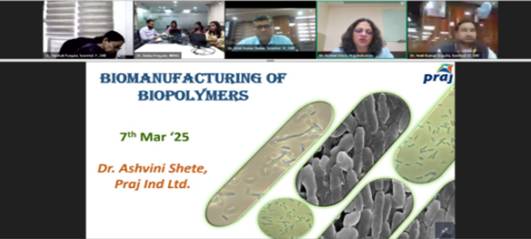
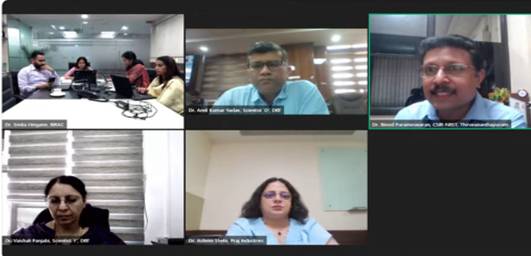
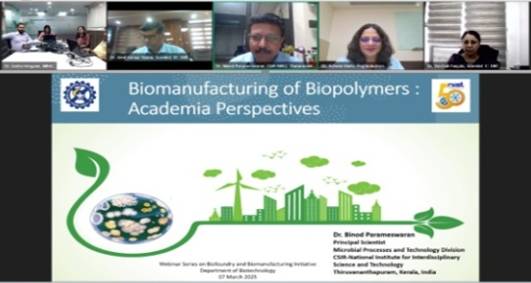
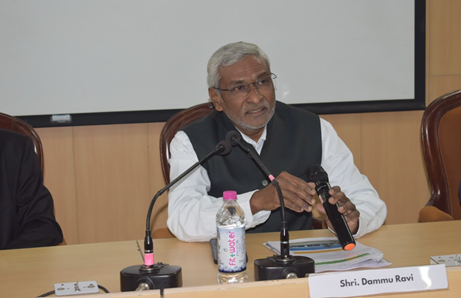
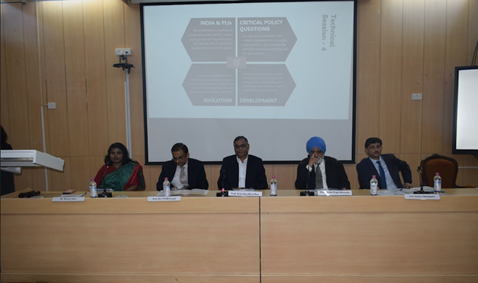






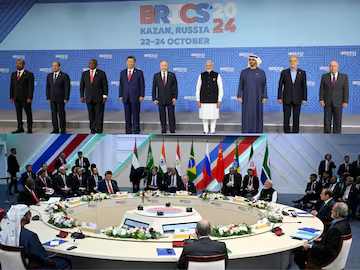


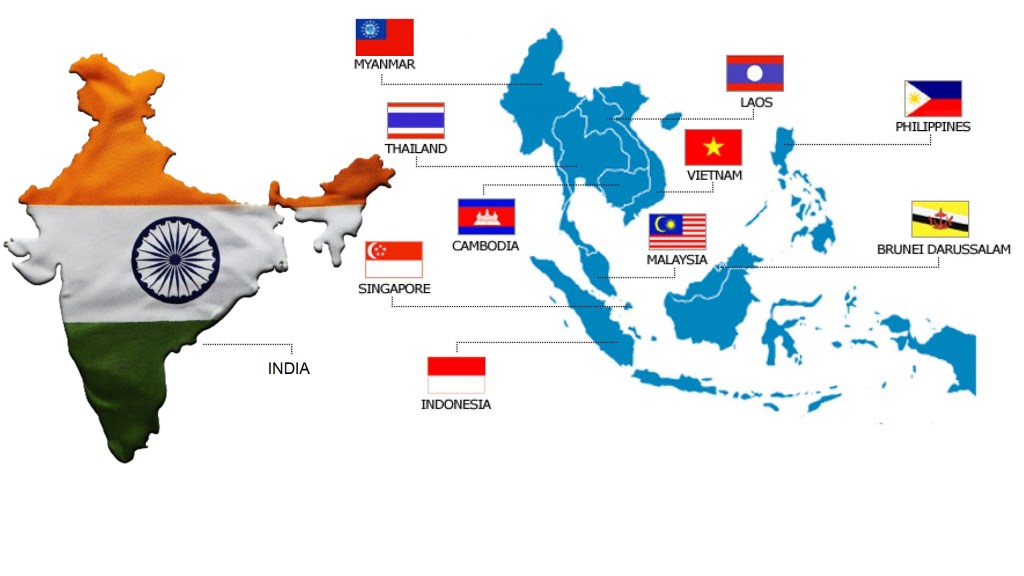





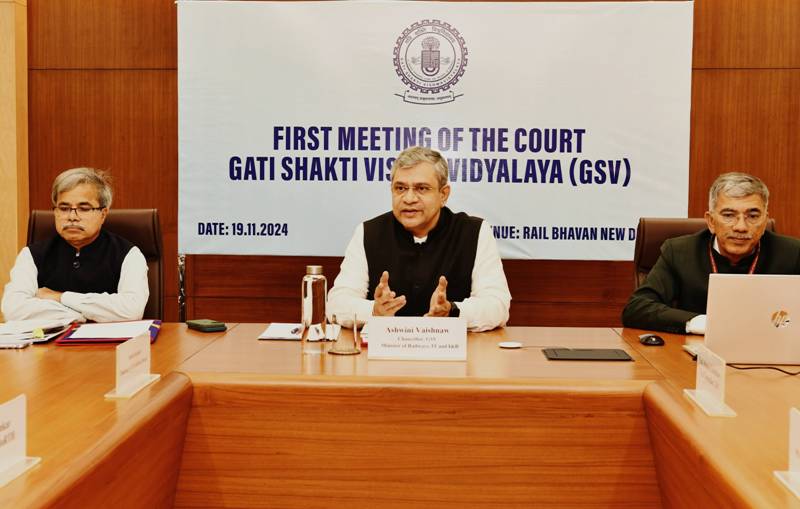



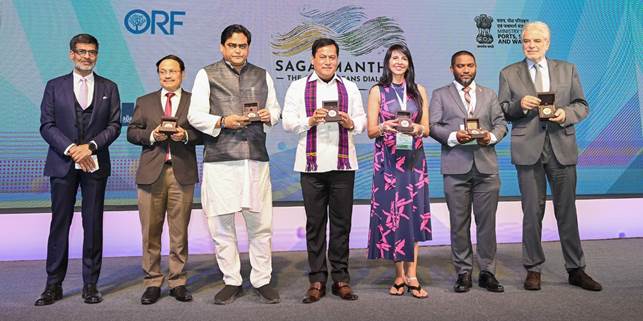
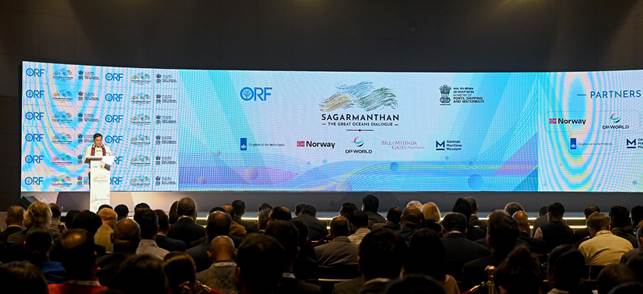
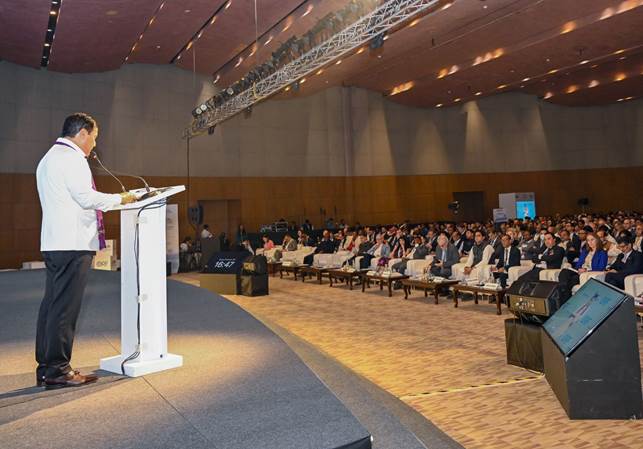
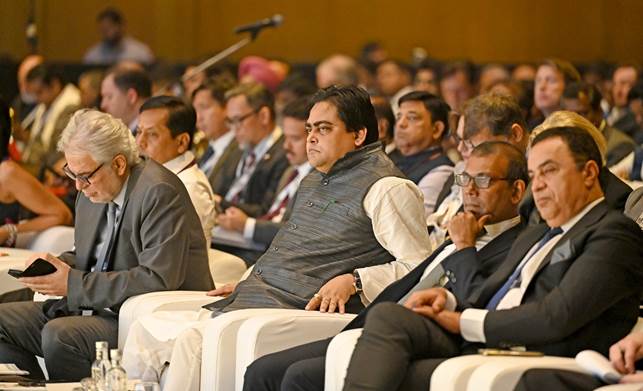
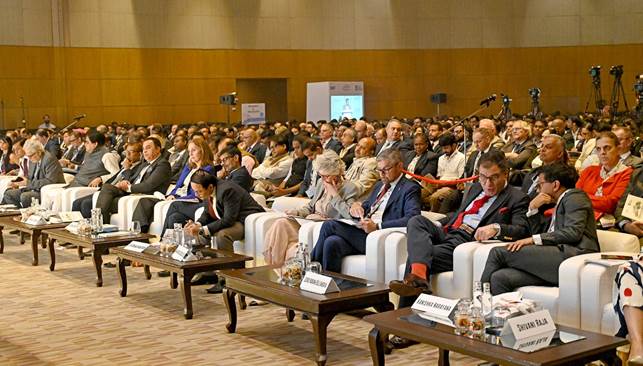
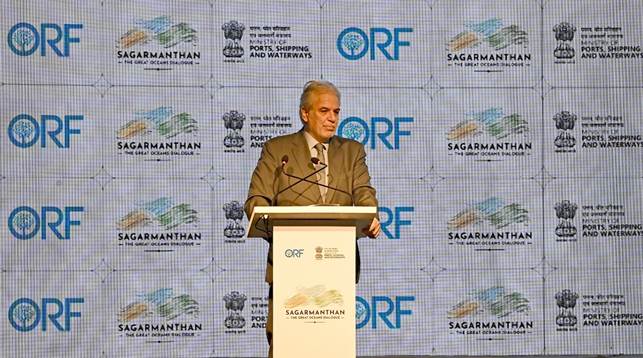
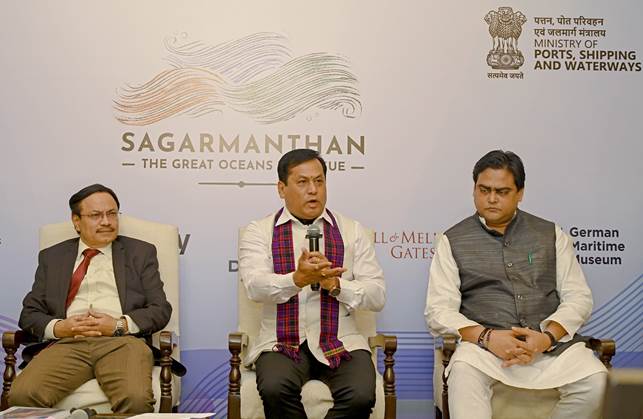
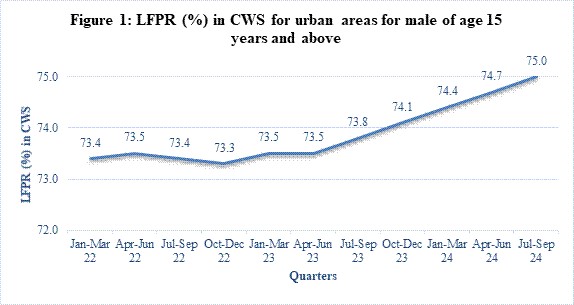
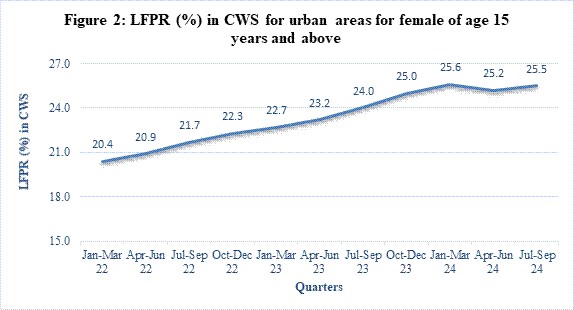
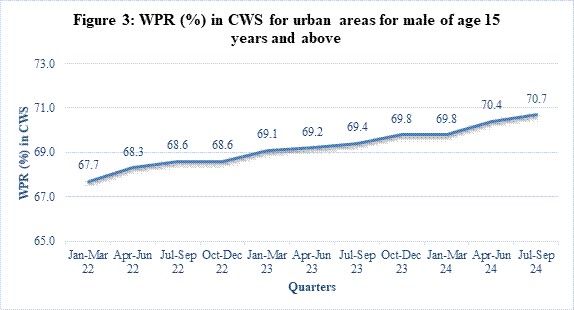
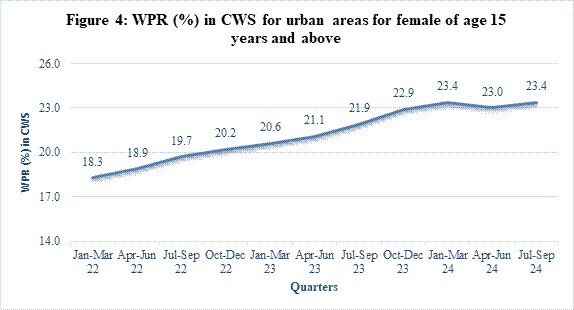
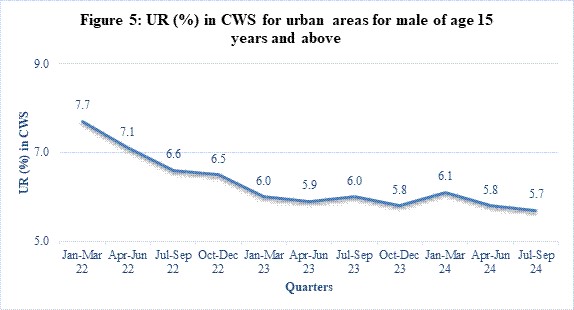
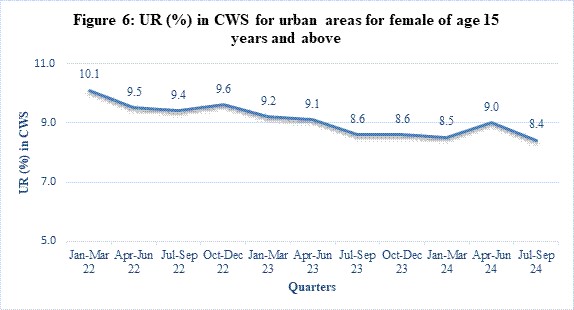
 Eduindex News
You must be logged in to post a comment.