Gambling laws in India

Introduction

Gambling is defined as betting, gaming, or participating in an activity that is based on luck not on the skills to win a huge amount of money or any other prize by wagering some amount of money. To control gambling across the country legislation was passed in the year 1867, the Public Gaming Act of 1867, and is the most important legislation that regulates gambling in India.

Under the gambling legislation, the meaning of the act of wagering or betting for money or money worth is understood in the 2006 “jay video games and electrical v. State of Gujarat’’  case.

So here we discussed about the gambling, why it has become a more sensible topic in India and other countries, how it has come in scenario where their strict laws are must needed, why gaming skills are excluded from gambling or why Indian law classifies the games into two broad categories i.e. game of chance and game of skills. What are those games where gambling is not a big deal?

Legality

As per the status of the legality of Gambling in India, there is no unified law regarding any activities of gambling as it comes under the State list of the 7th schedule of the Constitution. So the gambling is a state subject, so the state has only the rights to regulate the law for the gambling activities in their respective territory. The state legislatures, under the Constitution of India, have been entrusted with significant regulatory flexibility to form state-specific gambling laws. 

The Gambling Act is the central enactment that has been adopted by certain states in India and other states have enacted their own legislation to regulate and govern gambling activities within their territory. So some states have allowed or some have banned gambling in their state. For example, casinos are banned in the other states except for Sikkim, Goa and Daman.

 As per Section 12 of the Public Gaming Act 1867, any game of mere skill will not be treated as gambling, but games of chances will be treated as gambling. 

The Public Gambling Act of 1867 is a central law that prohibits running or being in charge of a public gambling house. The penalty for breach of this law is a fine of Rs. 200 or imprisonment of up to 3 months. Additionally, this Act prohibits visiting gambling houses. A fine of Rs.100 or imprisonment of up to one month is the penalty. 

There is always a doubt regarding which games are covered under gambling because poker in India has very unclear significance in Indian law because it could never figure out whether it is a game of skills or a game of chance. It’s very interesting that games, such as wagering on cricket, are prohibited and while Rummy is permitted as observed by the court under  Mahalakshmi  Cultural Association v. The Director, Inspector General of Police, State of Tamil Nadu in 2012. Gone are the times of Matka betting and the preferences in India. These days, you can just wager on a couple of sports, that too in some states. As of now, betting on horse racing, online poker in states like Goa and Sikkim, online rummy, lottery, and a couple of gambling clubs are legal in India in accordance with the case of K .R Lakshmanan v. state of Tamil Nadu in 1996. 

Not only wagering on games is illegal, visiting or working in those places is also unlawful or illegal under section 4 of the  Public Gaming Act. It is likewise unlawful to visit such a place. The main problem is that the exact meaning of betting is not adequate in the legislation. As per the Act, it states Gaming as betting or wagering of money on a game which is a game of chance and not of skill except Horse Racing.

Laws on online-based betting

In the Public Gaming Act of,1867 there were no provisions related to online-based betting. There is in addition to this Act another act that could be considered to identify with web-based wagering and gaming i.e. The Information Technology Act of 2000. From this Act, it is very easy to identify the offences with online gambling and gives the government ability to check and search if required. However, this Act also does not mention online-based gambling like Public Gaming Act, 1867 does. 

The laws for online gambling are enacted by several states also like Sikkim. The state of Sikkim enacted the Sikkim Online Gambling (Regulation) Act,2008, which was passed on 28th  June 2008 by the Sikkim Legislative Assembly with the object of controlling and regulating through electronic and non-electronic ways in online gaming. And imposes Tax also on online gaming within its territory.

Game of chance or game of skills

Gambling is understood both under its traditional form as well as modern avatar. The traditional gambling is understood in the context of physical space, brick and mortar format, whereas modern gambling consists of computers connected offline or online, mobile phones, internet, etc. the Gambling legislations exclude the “game of skills” from the statute of gambling and hence doesn’t attract the penal provisions.

A game of chance is a game where the result is leveraged by a random number creator in which the participant may choose to bet money for that result. While in a game of skill, A person bet on the result which comes out of the skills of person or person requires them to have a degree of mental expertise to succeed, for example, Betting on Horse racing. However, in games like Poker and Rummy, many times the courts got confused about whether these are Game of Chance or Game of Skill. 

Penalties

Under the Public Gaming Act,1867 any person is found playing games for money, wager, stake or something else with cards, dice, counters, shall be liable to imprisonment for any term not exceeding one month and fine not exceeding one hundred rupees. As per the section 45 of the Indian Penal code 1860.  

Any person found in such gaming rooms during any gaming or playing there shall be presumed, until proven, to have been there for gaming purposes.  

Conclusion

Whereas there are various legislations in India, even every state has its own legislation for gambling as legal and regulated in the most appropriate ways. There is a need for a section or portion which would provide which type of gambling is legal and which is not. Apart from this, there is a need for central laws for online Gambling, we see that few States like Goa, Sikkim, and Nagaland are the only states that permit online gambling. Also, such a type of thing showed that there are no possible ways to stop or curb. At least something could be done to regulate this.

The Government, being a welfare State, acts in a manner to promote the economic and social well-being of its citizens, and therefore, it is necessary for the State to protect the sensitive sections of the society. About gambling, they can at least form a committee to survey the need for gambling and improvisation on the current legislation based on that survey. Thus, there is a need for aggressiveness to be taken from the side of the executives as well as the parliament to provide such norms which would codify the system of gambling in India. 

History of Python Programming Language

Python

In this article we’ll see about the most popular and commonly used programming language, Python. So, let’s begin and learn about the development of Python and gain insights about the current IT trends.

Introduction of Python

Python is very famous for its simple programming syntax. code readability and English-like commands that make coding and English-like commands that make coding a lot easier and efficient. Due to this, it is the most popular and preferred language. Python is an interpreted, high-level, general-purpose programming language developed by Guido van Rossum at National Research Institute for Mathematics and Computer Science, Netherlands.

In contrast to popular belief that Python was named after the snake, Python was actually named after the show “Monty Python’s flying circus”. Guido van Rossum formulated Python in the late 1980’s as a successor to the ABC language.

Versions of Python

In 1994, Python version 1.0 was released with features like exception handling, Lambda, Map, Filter and Reduce. Python 2.0, released in 2000, introduced features like list comprehensions and garbage collection system capable of collecting reference cycle. Python 3.0 was released on the 3rd of December 2008. Undoubtedly, Python 2.x and 3.x have proven to be the most used versions. As of today, Python 3.9.5 is the latest stable version released in the summer of May 2021.

Applications of Python

Python is popularly used for development, scripting, and software testing. Top IT companies like Google, Facebook, Instagram, Spotify and Netflix, among others, use Python. Some major applications of Python can be seen in the fields of Machine Learning, Artificial Intelligence, Data Science and IoT.

Python Also Offers Many Libraries like

👉 Numpy

👉Scipy

👉 Keras

👉Tensor Flow

👉Django 

👉 Flask

Pep-8 is the official style guide that defines the styling conventions for Python code. A few popular open source Python projects include PipENV, Chatistics, solving the travelling salesman problem using self-organizing maps and Python to BPF converter. Popular websites on the internet, like Reddit and Quora, are built using Python. 

Some Popular Games Developed Using Python

👉EVE Online Freedom Force

👉Pirates of the Caribbean Online

👉 Civilization IV, Battlefield 2

👉Sims 4

👉World of Tanks  

According to Indeed, the average salary of a Python developer in India is about Rs.5,00,000 per annum and that in the US is around $124,000.

Users and admirers of Python, especially those considered knowledgeable, are referred to as Pythonists, Pythonistas, and Pythoneers. Since its inception, Python has come a long way to become the most popular coding language and continues to revolutionize the IT industry. This is the best course for all beginners who want to learn the new course.

Grow More Trees To Reduce Pollution

 By:Astha Raghav 

The alarm and the pain in the present situation which is cautioning people is the environmental pollution. Smoking chimneys, burning tree leaves and wastes, smoke spewing vehicles the city is almost dying. Year after year the situation is deteriorating and if nothing is done against this hazard, conditions will worsen further. The emergence of great factories and consumption of coal gas give rise to unprecedented air pollution. 

Trees conserve energy. Three trees placed strategically around a single family home can cut summer air conditioning needs by up to 50 percent.  By reducing the energy demand for cooling our houses.  We reduce carbon dioxide and other pollution emissions from power plants. In this urban century when there are going to be an extra two billion people in cities, smart cities should be thinking about how nature and trees can be a part of the pollution to keep air healthy.

Rather than to be blamed for inviting the worsen situation of pollution. 

People living in the vicinity should focus on how to reduce it. People should form action committees to launch afforestation drives to make city green. You should volunteer to promote “Each one Plant one”. Awareness rallies on ” Save the Environment” and “Go Green”  would be an eye opener. 

Thank You!

Kargil War – Why it happened? Real Story of Vikram Batra

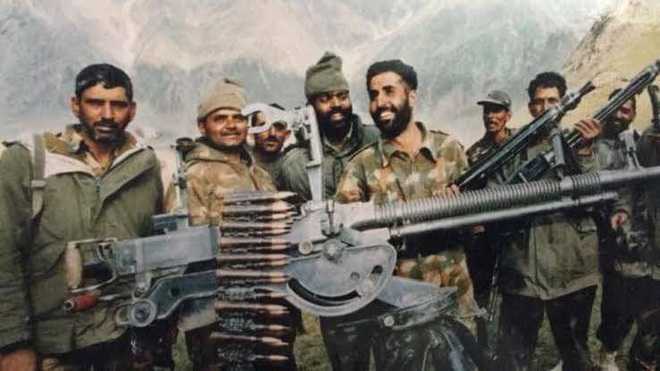
Hello, friends! The year was 1999. Some Pakistani soldiers infiltrated Indian territory. And the Indian Defence Forces retaliated bravely. Soon, a full-fledged war ensued between India and Pakistan. The war is now known as the Kargil War. Kargil War of 1999. This place became the centre of much international intrigue and war. Between India and Pakistan. 22 years ago, India was betrayed by its neighbour Pakistan. Prime Minister Atal Bihari Vajpayee, made it clear that India would emerge victorious. The world has seen that we want peace now the world will see that to protect our peace we can use strength if we need to. One of the most famous war heroes of the Kargil War was Captain Vikram Batra. Recently, a film has been made about him. Shersaah. On Amazon Prime Video. 

What was the Kargil War? What were the reasons that led to it? And what happened exactly? The international geopolitics at play there is also very interesting. Come, let’s find the answers to these in today’s video on Kargil War. Our story begins on 3rd May 1999. In a small village in the Batalik region there was a local shepherd Tashi Namgyal. He had lost his yak. He went to look for his yak with a friend. While looking through the binoculars, he saw something strange. He saw that some armed men digging bunkers. He found it quite fishy. “There we saw around 6 men, they were in black outfits, so I continued looking for some time. They were breaking rocks. And digging.” He got suspicious that those people were from the other side of LoC. So he went to the nearest post of the Indian Army. 

To inform the Indian Army. Thankfully, the Indian Army checked this information. And found that the information was correct. But this wasn’t a minor intrusion. This was a well-planned attack by the Pakistani Army. Intrusions were reported in Dras Kaksar and Mushkoh sectors. Overall, they had occupied more than 130 posts. Their aim was to block the critically important national highway NH 1. By blocking it, they could’ve cut off Kashmir from Ladakh. The code name of this operation was Operation Badr. If we look at this action from the perspective of international relations, this was a direct breach of the 1972 Simla Agreement. That was signed by the former Indian Prime Minister Indira Gandhi and the former Pakistani President Zulfiqar Ali Bhutto. According to this agreement, both neighbouring countries had agreed to never violate the LoC. And in case of any issue between India and Pakistan a peaceful resolution would be worked out. Through bilateral approaches. 
The unfortunate thing was that, friends, only a few months before the intrusions, in February 1999, the former Indian Prime Minister Atal Bihari Vajpayee had made a journey to Lahore in a bus. Where he had recited a poem, “Hum Jung Na Hone Denge” (We Will Not Let War Break.) And signed the Lahore declaration as well. Along with the former Pakistani Prime Minister Nawaz Sharif. This was, in a way, a monumental effort by the former Prime Minister Atal Bihari Vajpayee. To establish peace between India and Pakistan. “We’ve been enemies for too long. Now, we should spend some time as friends.” Only 3 months after this, this large-scale intrusion by the Pakistani soldiers, showed very clearly how there was someone in Pakistan that didn’t want this peace to last. But anyway, to retaliate against this, the Indian Army launched a counterattack. That was given the code name Operation Vijay (Victory). 

Thousands of Army troops were mobilized and sent to the Kargil sector. Then the Chief of Army was General Ved Prakash Malik. The Indian Airforce played a very crucial role. On 26th May, they launched the Operation Safed Sagar (White Sea). That aimed at driving out the Pakistani troops from the Indian territory. Traditionally, whenever air-power is used in a conflict, It is considered that all-out war has been declared. It was the first time that India had deployed air-power in such an environment. The Indian Airforce had also planned that they’d cross the LoC into Pakistan and bomb a few targets. But as Air Chief Marshall Anil Yashwant Tipnis has later revealed Prime Minister Vajpayee was completely against it. He had firmly ordered that LoC should not be crossed. And there is a very interesting diplomatic reason for it. Friends, whenever any two countries go on a war against each other, looking at the war from the third perspective, it becomes quite difficult to judge who is right and who’s wrong. Because often, both sides commit mistakes and violations are from both sides. 
Take your example. When we as Indians watch the war between Israel and Palestine or the war between Azerbaijan and Armenia, it becomes difficult for us to know who is in the right and who is in the wrong because often, both sides have good arguments to justify themselves. Similarly, in the Kargil War of 1999 between India and Pakistan, it was difficult to judge from an international perspective who was right and who was wrong. Which country could be trusted? So India showed a lot of restraint. By not crossing the LoC. It showed the international public that it was a defensive war. “Pakistani soldiers had intruded in the Indian territory we want to push them out, and we are not interested in crossing the LoC and carrying out bombings in Pakistan.” “We simply want to protect our country.” Doing this was a major diplomatic victory for India. Within the next few weeks, the other countries European Union, ASEAN Regional Forum, the United States, G8 Countries, all of them supported India in this Kargil War. The then US President Bill Clinton pressured Nawaz Sharif to withdraw the Pakistani soldiers. The entire world could see that India was in the right and Pakistan was wrong. 

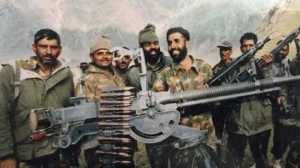
But talking about the ground situation, the Pakistani troops had an advantage. “Taking advantage of the geography of the region, which in many instances, favoured them, Pakistan Army regulars accompanied by fully armed and well-trained militants, sneaked into Indian territory.” The Pakistani soldiers were in an advantageous position in this war because they were on higher grounds in the mountains. Additionally, this region gets very cold. The Dras region is considered to be the coldest inhabited region in India. Often, temperatures fall to -40°C. So it was immensely difficult for the soldiers to fight in such conditions. But there is a popular saying in the Indian Army, ‘When the going gets tough, the tough get going.’ In the Kargil War, the Battle of Tololing is considered to be the turning point. When the war changed its course. To recapture the Tololing Hill, was a difficult task for the Indian Forces.

 At the height of 16,000 feet, temperature between -5°C to -11 °C, with blanket firing from above, because the enemies were placed higher in the hill. Because of all these reasons, for the Indian forces to move or try to climb that hill, was possible only in bad weather and moonless nights. The nights when the moon wasn’t visible in the sky. So that there isn’t much light and when they move, it doesn’t alert the enemies. Captain Ajit Singh was among the officers who attempted this. He recalled how to carry even 1 gram of extra weight meant carrying an extra load. Often the soldiers had to choose, between carrying food rations with them or carrying ammunition. Food packet weighing 2 kg, or 100 bullets. Captain Ajit chose bullets. And he survived for 3 days by smoking cigarettes. Without any food. Considering all these conditions it was estimated that till will take a fit soldier 11 hours to reach the top of the Tololing hill. Major Rajesh Adhikari led the company that tried to climb the mountain. 

And his company was successful to quite an extent. But when they were about 15 meters from the top, Intruders saw them and started firing. Major Adhikari and two other soldiers were martyred in hand-to-hand combat. Because of heavy firing from the enemy, the rest of his company had to retreat, and the company took three positions behind huge rocks. But as soon as the soldiers tried to move from behind the rocks, firing would start from the top. So they were trapped in between. 15,000 feet above the base, And approx 1,000 feet below the top. These soldiers were stuck in the middle. The situation was really bad. Because they did not have any more grenades with them. The Indian Army made it their current priority to recapture Tololing hill. Colonel Ravindranath handpicked 90 soldiers. To go help the soldiers stuck in between, and recapture the hill. Several washermen, cobblers and barbers in the battalion were also helping them because they had to carry the heavy ammunition to the top of the hill. 

So physical strength was needed. More people were needed. On 12th June they were successful at reaching the soldiers stuck in the middle. Around 8 pm. Only a thousand feet away from the enemy, Colonel Ravindranath gave a final pep talk to his soldiers. “I have given you what you wanted. Now you have to give me what I want.” The heavy firing lasted for 4 hours. More than 10,000 shells and more than 120 artillery guns were fired. There was so much firing that later this ridgeline was named Barbaad (Destroyed) Bunker. The plan was to divide the soldiers into 3 teams. Arjun, Bheem and Abhimanyu. (Characters from the Epic Mahabharata.) The first team would lead the frontal attacks. The second team would move to the other side of the cliff to a lower ridge, And the third team will cover fire. The enemies were attacked from the back by the platoon led by Major Vivek Gupta.

 A hand-to-hand battle took place and unfortunately, Major Vivek Gupta along with 6 other soldiers was martyred. But these soldiers were eventually successful in capturing Tololing. Thankfully, the intruders had left behind butter, tinned pineapple and honey, so there were no problems with getting food supplies. For the Indian soldiers who reached the top of this hill. About 1.6 km to the North of Tololing hill, was the Point 5140. It was the highest point in the same ridgeline. At the height of 17,000 feet. Thus, higher than the Tololing hill. Between Tololing and Point 5140, there were 10 high grounds known as Humps. From Hump 1 to Hump 10. 

These Humps were easily captured by the Indian Army. And then the Indian Army reached the base of Point 5140. Known as the Rocky Knob. The task of capturing Point 5140 was assigned to the Lieutenant Colonel Yogesh Kumar Joshi. After this, two groups of soldiers were formed to climb the hill in two different directions. One group was under the command of Lieutenant Sanjeev Singh Jamwal. And the second group was led by Lieutenant Vikram Batra. Whose code name was Shershaah. (Lion King) That’s why friends, the upcoming movie on Amazon Prime Video is named Shershaah. Both Lieutenants were told to choose a success signal. When they’d be successful in their mission, how will they signal the others? Lieutenant Sanjeev chose the signal “Oh! Yeah, Yeah, Yeah!” And Lieutenant Vikram Batra chose the signal “Yeh Dil Maange More.” (lyrics of a song; this heart desires for more) “The other company’s success signal, Oh, yeah, yeah which was passed to our Colonel Joshi on the radio set. 

After that, another bunker was captured. My company’s success signal was ‘Dil Maange More.’ The guys were so highly charged up that they’re wanting that some more bunkers should have been there and we would have got more chaps.” In the early hours of 20th June, Both groups started the climb. And both groups were successful. There were no casualties. And both sent their success signals to the command post. Lieutenant Vikram Batra was promoted because of the successful mission. To the rank of Captain. He called his father and told him, “Daddy, I have captured.” On capturing this point, India got its diplomatic victory. Because at this point, several Pakistani documents were recovered. “What you heard right behind you was the sound of Bofors guns directly targetting the top of Tiger hill. Prelude to the final assault.” 

Another major point was Tiger Hill. One side of Tiger Hill is a vertical cliff of 1,000 feet. And the Indian Army decided to surprise the enemy by climbing this cliff. By using mountaineering equipment. So between the nights of 3rd and 4th July, a group of 22 brave soldiers undertook this mission. One of the soldiers was 19-year-old grenadier Yogendra Singh Yadav. He had volunteered for this mission. They had reached halfway on this 1,000 feet high vertical cliff, when the enemy found out about them. Machine guns, as well as rockets, were fired on them from above. platoon commander along with 2 others were martyred then. But grenadier Yogendra Singh continued climbing despite the firing. He climbed 940 feet. He was only 60 feet away from the top. When three bullets hit him.

 In his legs and shoulder. But even after being hit by three bullets, he continued climbing. And he climbed to the top, threw a grenade and killed 4 enemies. He attacked another bunker with the soldiers. And the remaining soldiers of his platoon, were so motivated by his bravery, that they completed the climb to the top as well. And attacked Tiger Hill. And this mission was successful. Perhaps the most shocking part of this entire mission was despite being hit by multiple bullets, grenadier Yogendra Singh Yadav survived. He was admitted to the hospital And later he was given the title of Honorary Lieutenant. Do you remember Hrithik Roshan’s movie Lakshya? The vertical cliff that’s climbed at the end of the movie and the capture of the Hill, was inspired by the story of Yogendra Singh Yadav. On the other hand, more missions were being conducted to recapture the remaining hilltops.

 Capturing Point 4875 was one of them. For this mission too, Captain Vikram Batra was assigned. This time his battle companion was Captain Anuj Nayyar. On the morning of 8th July, he was successful at his mission of capturing this peak. The mission was almost completed. Captain Vikram Batra came out of his bunker, to rescue a Lieutenant. Who had lost his legs because of an explosion. No sooner than he had gone out to help the Lieutenant, the enemy that was retreating fired a bullet that hit him in the chest. And unfortunately, he was martyred. India won at Point 4875, but had to lose two heroes Captain Vikram Batra and Captain Anuj Nayyar. Today, this point is known as Batra Top. The Battle at Point 4875 was a major landmark of the Kargil War. That had almost sealed India’s victory. 

Two days later, on 11th July, the Pakistani Army started to withdraw. And India had captured the remaining major points of the Batalik. On 14th July, Prime Minister Vajpayee declared Operation Vijay to be a success. And on 26th July, the Kargil War officially ended when the Indian Army announced that all the intruders had been completely evicted from the Indian territory. Now, 26th July is celebrated as Kargil Vijay Diwas (Kargil Victory Day). Some months later, in October 1999, a bloodless coup takes place in Pakistan. Nawaz Sharif gets detained and Pakistan’s Army General Pervez Musharraf suspends the Constitution, declares an emergency in the country and takes over the control of the country. The internal politics of Pakistan becomes clearly evident here. Later it is revealed that Pervez Musharraf was actually the Chief Strategist of the Kargil plan. It was his idea to intrude into India dressed as Kashmiri militants. And do everything. 

All the peace talks between India and Pakistan, to end them all completely. On the other hand, Nawaz Sharif claims that he had no idea that the Pakistani Army had come up with the Kargil plan. In 2019, Pervez Musharraf was given a death sentence by a court in Pakistan. On the charges of treason. To act against his country. Although later, Lahore High Court overturns this. 

On the other hand, in India, India’s highest gallantry medal, that is the Param Vir Chakra, is awarded to 4 soldiers. Captain Vikram Batra, Lieutenant Manoj Kumar Pandey, Rifleman Sanjay Kumar, and Grenadier Yogendra Singh Yadav. Overall, it is estimated that around 527 Indian soldiers were martyred in the Kargil War. And around 1,300 were injured. Another unfortunate thing that happened was that all the efforts made by PM Vajpayee to maintain peace between India and Pakistan, all of it went in vain. 

India's Best School – Ratnavati School In Rajasthan

Hello, friends! In terms of historical architecture, I consider Rajasthan to be the most beautiful state of India. Here, you can find forts, palaces and mansions each more grand and beautiful than the last. This state is also rich culturally. The folk dance and folk music here and the Rajasthani cuisine, they’re all unparalleled. As well as the lakes, desert, camel safari. So it’s not surprising that Rajasthan is a very popular tourist destination for foreigners. But behind this facade of beauty, lies a harsh truth. Friends, Rajasthan is the worst state in the country in terms of female literacy. Only 57% of the females in the entire state are literate. They can read and write. Do you know the name of the country we’re living in? Country, as in? Do you know which country we live in? Which country do we live in? 

Rajasthan. Because of female illiteracy, female unemployment is also very high. According to a study, 73% of women in Rajasthan are jobless. Do you teach this to your children? So you teach it to your daughter.  You don’t teach it to your son. Why? Because my daughter will have to do these chores. Many people hide this bitter truth with a veil. And look the other way. But there are some brave people who try to bring about a change. In Rajasthan’s Jaisalmer, one such change was successfully introduced. Come, the Gem of India is not an individual. 

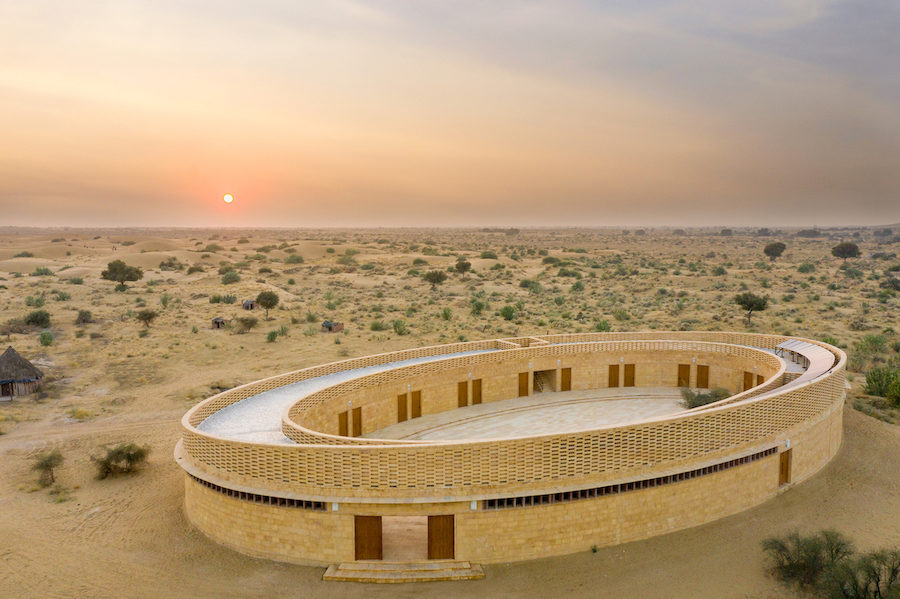
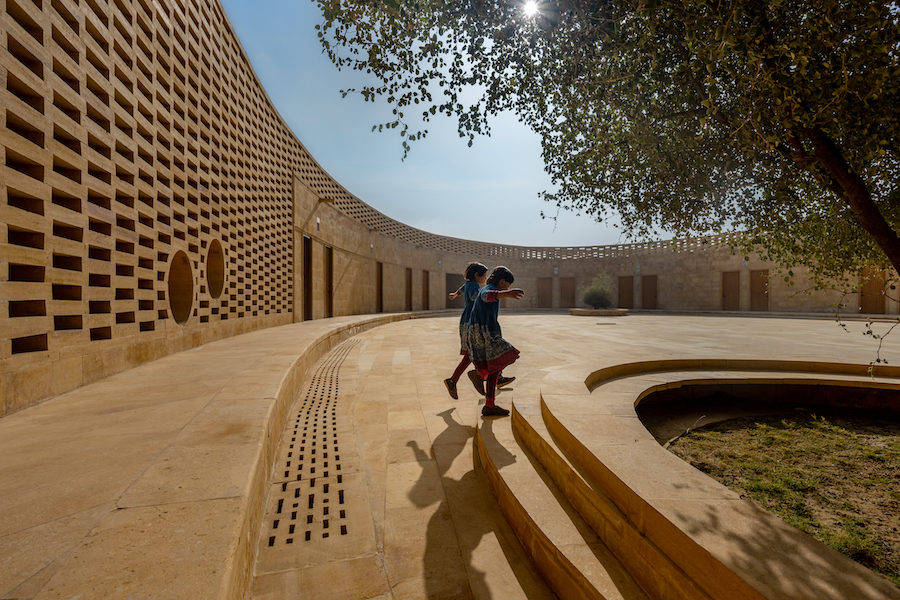
It is a school building. About 40 km from the city of Jaisalmer, there is a popular tourist spot known as Sam Sand Dunes. A few kilometres before this Sam desert, there is a village. This new school is built near this village. What’s special about the school is that not only is it a completely free school, to educate girls from below the poverty line, but the building of this school is also an architecture marvel. Look at this building. Look, at how beautiful it is. It is built in a futuristic-modern style. The building also looks minimalistic. Additionally, the traditional architecture of Rajasthan has also been used in it. To top it all, this is a sustainable building. There are solar panels on the roof of this building. There are no ACs inside. Instead, traditional architecture is used in the building in such a way that the stones used to build it, will keep it cool from the inside. And the design of this building, will help to cool down the interiors. Who built this school? And how? .

There’s a non-profit organisation, CITTA. Its founder is Michael Daube. He had a dream to build a school like this. So really it’s kind of, it didn’t happen like an epiphany, but it did mould like a chess game. It was kind of like realising ‘in the next 20 moves, what’s gonna happen?’ and really kinda mapping out the ripple effects of this. Talking about implementing dreams, the supervisor of this project is Chahat Jain. When our reporter Vijeta Dahiya was on site to film this school, the school hadn’t opened up then. At least, hadn’t completely opened up. Teachers were being recruited. For Class 1 through Class 10th. The plan is, there will be 40 girls in each class, in total, 40 x 10 400 girls would be given free education in this school. Everything will be free. Their transport facility. The transport from their homes to the school and back will be free. Their education. Their books and uniforms will be free. They would also get free lunch at school. About the curriculum of the school, Chahat has experience in handling several such projects. 

So, keeping holistic development in the forefront, he has designed a curriculum for the girls. Things like the local textile, singing, dance forms we included these in the curriculum so that the children can be proud of their heritage and the slowly fizzling out artforms can be protected and revived. It will be a holistic development of the child. It also includes computer skills, third languages that a child should normally know. To fulfill this dream, Michael had local support as well. Like, the support of Chaitanya Raj Singh Bhati who belongs to the erstwhile Royal family of Jaisalmer. And his mother, Mrs Raseshwari Rajya Laxmi was also on the Board of Directors of the CITTA India. Another member of the Board of Directors is Manvendra Singh Shekhawat. He is a hotelier. And a co-founder of the NGO I Love Jaisalmer.

 It was Manvendra who had contributed the land to build this school. While doing so, he had put forth a condition to the architect, that two berry bushes that were there, should not be harmed. They shouldn’t be removed. And the school should be built around them. Now at the centre of the school, those two berry bushes are proudly thriving. The architect used lime for the walls of the school. And the ceiling has been raised quite a bit. And windows at placed near the top. All these things improve air circulation. And the temperature remains cool inside. Not only solar panels are installed on the roof for generating electricity, but there is also a rainwater harvesting system in this building. It is a wholesome package of Sustainability and Eco-friendliness. The architect of this building is Diana Kellogg. And impressively, she didn’t charge anything for designing this building. Same with the costume designer.

 The costume designer that designed the uniforms for the girls, did not charge for this. To design the uniforms, what he did was that he went in and found local textiles like Ajrakh. Then it’s an age-old It’s one of the oldest block printing techniques in the world, and most complex. It’s one thing to design a building. But to actually build it with the design is the biggest challenge. And many local contractors refused to work on it. Because they looked at this complicated design and it was unlike anything they had ever done before so they decided to not do it. After a long search they found one contractor. Karim Khan. He implemented this plan and made it possible in real life. He helped in its building. This place is in the middle of a desert. There’s nothing around. It took us 2 years to build this. We used to work here even at 50°C temperatures. We had to carry food and water with us. One couldn’t find anything for miles here. This was a challenge for us. How could the girls study in those conditions? That’s why we build this school. So Diana and Karim Khan coordinated and local labourers were employed for this project and finally, this building was completed within one year. Once the school was built, Parag Ji takes care of the security of the school. And Raju Ji and Mange Khan see to the cleanliness of the school. From Michael to Raju this is the entire team that is enabling this dream to come true. After the school was ready their team carried out publicity of the school in the nearby villages.

 And the Chief of the nearby village also joined the CITTA team. We conducted a small event on behalf of the school, on behalf of the school’s management on behalf of Mr Shekhawat and the other members of the Board. Distributing ice cream among kids, that was really successful. Then we had another event on Republic Day, Many villagers attended that, adults as well as kids, We had a magic show there. The magic show was a huge success. It was great, all of us enjoyed it. 

How can someone sleep on a cloud? To make this whole project possible the money came through charitable donations. As I said, this is an NGO. You too can donate to it if you want to. They claim that all contributions are used for the education of the girls. The link to donate will be in the description below, in case you’re interested. We’re giving free education to the girls. They’ll get food and a uniform as well. The medium of instruction will be English. Teachers will come from Jaisalmer. The kids will be picked up and dropped off at home. That’s about the school. Now we want that the women in the neighbourhood of our students, like you their mother or their elder sister, we want to do something for them as well. Two more buildings are being built like the school building In it, we will provide training to women. Like what your mother-in-law was working on. 

You will get to learn something new. And we’ll even pay you for learning. Since you’ll work hard to learn. So we intend to support the women and girls around here. The most exciting thing is that, friends, while only one building has been built by now, but in reality, this entire project, called the Gyaan Centre, three buildings will be built in total. The two other buildings are yet to be built. Here, in the computer animation, you can see how the other two buildings will look. In one of the buildings, there will be a Women’s Cooperative. 

India's Best School – Ratnavati School In Rajasthan

Hello, friends! In terms of historical architecture, I consider Rajasthan to be the most beautiful state of India. Here, you can find forts, palaces and mansions each more grand and beautiful than the last. This state is also rich culturally. The folk dance and folk music here and the Rajasthani cuisine, they’re all unparalleled. As well as the lakes, desert, camel safari. So it’s not surprising that Rajasthan is a very popular tourist destination for foreigners. But behind this facade of beauty, lies a harsh truth. Friends, Rajasthan is the worst state in the country in terms of female literacy. Only 57% of the females in the entire state are literate. They can read and write. Do you know the name of the country we’re living in? Country, as in? Do you know which country we live in? Which country do we live in? 

Rajasthan. Because of female illiteracy, female unemployment is also very high. According to a study, 73% of women in Rajasthan are jobless. Do you teach this to your children? So you teach it to your daughter.  You don’t teach it to your son. Why? Because my daughter will have to do these chores. Many people hide this bitter truth with a veil. And look the other way. But there are some brave people who try to bring about a change. In Rajasthan’s Jaisalmer, one such change was successfully introduced. Come, the Gem of India is not an individual. 

It is a school building. About 40 km from the city of Jaisalmer, there is a popular tourist spot known as Sam Sand Dunes. A few kilometres before this Sam desert, there is a village. This new school is built near this village. What’s special about the school is that not only is it a completely free school, to educate girls from below the poverty line, but the building of this school is also an architecture marvel. Look at this building. Look, at how beautiful it is. It is built in a futuristic-modern style. The building also looks minimalistic. Additionally, the traditional architecture of Rajasthan has also been used in it. To top it all, this is a sustainable building. There are solar panels on the roof of this building. There are no ACs inside. Instead, traditional architecture is used in the building in such a way that the stones used to build it, will keep it cool from the inside. And the design of this building, will help to cool down the interiors. Who built this school? And how? .

There’s a non-profit organisation, CITTA. Its founder is Michael Daube. He had a dream to build a school like this. So really it’s kind of, it didn’t happen like an epiphany, but it did mould like a chess game. It was kind of like realising ‘in the next 20 moves, what’s gonna happen?’ and really kinda mapping out the ripple effects of this. Talking about implementing dreams, the supervisor of this project is Chahat Jain. When our reporter Vijeta Dahiya was on site to film this school, the school hadn’t opened up then. At least, hadn’t completely opened up. Teachers were being recruited. For Class 1 through Class 10th. The plan is, there will be 40 girls in each class, in total, 40 x 10 400 girls would be given free education in this school. Everything will be free. Their transport facility. The transport from their homes to the school and back will be free. Their education. Their books and uniforms will be free. They would also get free lunch at school. About the curriculum of the school, Chahat has experience in handling several such projects. 

So, keeping holistic development in the forefront, he has designed a curriculum for the girls. Things like the local textile, singing, dance forms we included these in the curriculum so that the children can be proud of their heritage and the slowly fizzling out artforms can be protected and revived. It will be a holistic development of the child. It also includes computer skills, third languages that a child should normally know. To fulfill this dream, Michael had local support as well. Like, the support of Chaitanya Raj Singh Bhati who belongs to the erstwhile Royal family of Jaisalmer. And his mother, Mrs Raseshwari Rajya Laxmi was also on the Board of Directors of the CITTA India. Another member of the Board of Directors is Manvendra Singh Shekhawat. He is a hotelier. And a co-founder of the NGO I Love Jaisalmer.

 It was Manvendra who had contributed the land to build this school. While doing so, he had put forth a condition to the architect, that two berry bushes that were there, should not be harmed. They shouldn’t be removed. And the school should be built around them. Now at the centre of the school, those two berry bushes are proudly thriving. The architect used lime for the walls of the school. And the ceiling has been raised quite a bit. And windows at placed near the top. All these things improve air circulation. And the temperature remains cool inside. Not only solar panels are installed on the roof for generating electricity, but there is also a rainwater harvesting system in this building. It is a wholesome package of Sustainability and Eco-friendliness. The architect of this building is Diana Kellogg. And impressively, she didn’t charge anything for designing this building. Same with the costume designer.

 The costume designer that designed the uniforms for the girls, did not charge for this. To design the uniforms, what he did was that he went in and found local textiles like Ajrakh. Then it’s an age-old It’s one of the oldest block printing techniques in the world, and most complex. It’s one thing to design a building. But to actually build it with the design is the biggest challenge. And many local contractors refused to work on it. Because they looked at this complicated design and it was unlike anything they had ever done before so they decided to not do it. After a long search they found one contractor. Karim Khan. He implemented this plan and made it possible in real life. He helped in its building. This place is in the middle of a desert. There’s nothing around. It took us 2 years to build this. We used to work here even at 50°C temperatures. We had to carry food and water with us. One couldn’t find anything for miles here. This was a challenge for us. How could the girls study in those conditions? That’s why we build this school. So Diana and Karim Khan coordinated and local labourers were employed for this project and finally, this building was completed within one year. Once the school was built, Parag Ji takes care of the security of the school. And Raju Ji and Mange Khan see to the cleanliness of the school. From Michael to Raju this is the entire team that is enabling this dream to come true. After the school was ready their team carried out publicity of the school in the nearby villages.

 And the Chief of the nearby village also joined the CITTA team. We conducted a small event on behalf of the school, on behalf of the school’s management on behalf of Mr Shekhawat and the other members of the Board. Distributing ice cream among kids, that was really successful. Then we had another event on Republic Day, Many villagers attended that, adults as well as kids, We had a magic show there. The magic show was a huge success. It was great, all of us enjoyed it. 

How can someone sleep on a cloud? To make this whole project possible the money came through charitable donations. As I said, this is an NGO. You too can donate to it if you want to. They claim that all contributions are used for the education of the girls. The link to donate will be in the description below, in case you’re interested. We’re giving free education to the girls. They’ll get food and a uniform as well. The medium of instruction will be English. Teachers will come from Jaisalmer. The kids will be picked up and dropped off at home. That’s about the school. Now we want that the women in the neighbourhood of our students, like you their mother or their elder sister, we want to do something for them as well. Two more buildings are being built like the school building In it, we will provide training to women. Like what your mother-in-law was working on. 

You will get to learn something new. And we’ll even pay you for learning. Since you’ll work hard to learn. So we intend to support the women and girls around here. The most exciting thing is that, friends, while only one building has been built by now, but in reality, this entire project, called the Gyaan Centre, three buildings will be built in total. The two other buildings are yet to be built. Here, in the computer animation, you can see how the other two buildings will look. In one of the buildings, there will be a Women’s Cooperative. 

India's Best School – Ratnavati School In Rajasthan

Hello, friends! In terms of historical architecture, I consider Rajasthan to be the most beautiful state of India. Here, you can find forts, palaces and mansions each more grand and beautiful than the last. This state is also rich culturally. The folk dance and folk music here and the Rajasthani cuisine, they’re all unparalleled. As well as the lakes, desert, camel safari. So it’s not surprising that Rajasthan is a very popular tourist destination for foreigners. But behind this facade of beauty, lies a harsh truth. Friends, Rajasthan is the worst state in the country in terms of female literacy. Only 57% of the females in the entire state are literate. They can read and write. Do you know the name of the country we’re living in? Country, as in? Do you know which country we live in? Which country do we live in? 

Rajasthan. Because of female illiteracy, female unemployment is also very high. According to a study, 73% of women in Rajasthan are jobless. Do you teach this to your children? So you teach it to your daughter.  You don’t teach it to your son. Why? Because my daughter will have to do these chores. Many people hide this bitter truth with a veil. And look the other way. But there are some brave people who try to bring about a change. In Rajasthan’s Jaisalmer, one such change was successfully introduced. Come, the Gem of India is not an individual. 

It is a school building. About 40 km from the city of Jaisalmer, there is a popular tourist spot known as Sam Sand Dunes. A few kilometres before this Sam desert, there is a village. This new school is built near this village. What’s special about the school is that not only is it a completely free school, to educate girls from below the poverty line, but the building of this school is also an architecture marvel. Look at this building. Look, at how beautiful it is. It is built in a futuristic-modern style. The building also looks minimalistic. Additionally, the traditional architecture of Rajasthan has also been used in it. To top it all, this is a sustainable building. There are solar panels on the roof of this building. There are no ACs inside. Instead, traditional architecture is used in the building in such a way that the stones used to build it, will keep it cool from the inside. And the design of this building, will help to cool down the interiors. Who built this school? And how? .

There’s a non-profit organisation, CITTA. Its founder is Michael Daube. He had a dream to build a school like this. So really it’s kind of, it didn’t happen like an epiphany, but it did mould like a chess game. It was kind of like realising ‘in the next 20 moves, what’s gonna happen?’ and really kinda mapping out the ripple effects of this. Talking about implementing dreams, the supervisor of this project is Chahat Jain. When our reporter Vijeta Dahiya was on site to film this school, the school hadn’t opened up then. At least, hadn’t completely opened up. Teachers were being recruited. For Class 1 through Class 10th. The plan is, there will be 40 girls in each class, in total, 40 x 10 400 girls would be given free education in this school. Everything will be free. Their transport facility. The transport from their homes to the school and back will be free. Their education. Their books and uniforms will be free. They would also get free lunch at school. About the curriculum of the school, Chahat has experience in handling several such projects. 

So, keeping holistic development in the forefront, he has designed a curriculum for the girls. Things like the local textile, singing, dance forms we included these in the curriculum so that the children can be proud of their heritage and the slowly fizzling out artforms can be protected and revived. It will be a holistic development of the child. It also includes computer skills, third languages that a child should normally know. To fulfill this dream, Michael had local support as well. Like, the support of Chaitanya Raj Singh Bhati who belongs to the erstwhile Royal family of Jaisalmer. And his mother, Mrs Raseshwari Rajya Laxmi was also on the Board of Directors of the CITTA India. Another member of the Board of Directors is Manvendra Singh Shekhawat. He is a hotelier. And a co-founder of the NGO I Love Jaisalmer.

 It was Manvendra who had contributed the land to build this school. While doing so, he had put forth a condition to the architect, that two berry bushes that were there, should not be harmed. They shouldn’t be removed. And the school should be built around them. Now at the centre of the school, those two berry bushes are proudly thriving. The architect used lime for the walls of the school. And the ceiling has been raised quite a bit. And windows at placed near the top. All these things improve air circulation. And the temperature remains cool inside. Not only solar panels are installed on the roof for generating electricity, but there is also a rainwater harvesting system in this building. It is a wholesome package of Sustainability and Eco-friendliness. The architect of this building is Diana Kellogg. And impressively, she didn’t charge anything for designing this building. Same with the costume designer.

 The costume designer that designed the uniforms for the girls, did not charge for this. To design the uniforms, what he did was that he went in and found local textiles like Ajrakh. Then it’s an age-old It’s one of the oldest block printing techniques in the world, and most complex. It’s one thing to design a building. But to actually build it with the design is the biggest challenge. And many local contractors refused to work on it. Because they looked at this complicated design and it was unlike anything they had ever done before so they decided to not do it. After a long search they found one contractor. Karim Khan. He implemented this plan and made it possible in real life. He helped in its building. This place is in the middle of a desert. There’s nothing around. It took us 2 years to build this. We used to work here even at 50°C temperatures. We had to carry food and water with us. One couldn’t find anything for miles here. This was a challenge for us. How could the girls study in those conditions? That’s why we build this school. So Diana and Karim Khan coordinated and local labourers were employed for this project and finally, this building was completed within one year. Once the school was built, Parag Ji takes care of the security of the school. And Raju Ji and Mange Khan see to the cleanliness of the school. From Michael to Raju this is the entire team that is enabling this dream to come true. After the school was ready their team carried out publicity of the school in the nearby villages.

 And the Chief of the nearby village also joined the CITTA team. We conducted a small event on behalf of the school, on behalf of the school’s management on behalf of Mr Shekhawat and the other members of the Board. Distributing ice cream among kids, that was really successful. Then we had another event on Republic Day, Many villagers attended that, adults as well as kids, We had a magic show there. The magic show was a huge success. It was great, all of us enjoyed it. 

How can someone sleep on a cloud? To make this whole project possible the money came through charitable donations. As I said, this is an NGO. You too can donate to it if you want to. They claim that all contributions are used for the education of the girls. The link to donate will be in the description below, in case you’re interested. We’re giving free education to the girls. They’ll get food and a uniform as well. The medium of instruction will be English. Teachers will come from Jaisalmer. The kids will be picked up and dropped off at home. That’s about the school. Now we want that the women in the neighbourhood of our students, like you their mother or their elder sister, we want to do something for them as well. Two more buildings are being built like the school building In it, we will provide training to women. Like what your mother-in-law was working on. 

You will get to learn something new. And we’ll even pay you for learning. Since you’ll work hard to learn. So we intend to support the women and girls around here. The most exciting thing is that, friends, while only one building has been built by now, but in reality, this entire project, called the Gyaan Centre, three buildings will be built in total. The two other buildings are yet to be built. Here, in the computer animation, you can see how the other two buildings will look. In one of the buildings, there will be a Women’s Cooperative. 

Perfectionism Destroys Productivity

Do you always worry that you didn’t do a good job? Do you always question your work and your actions? Are you afraid of admitting your mistakes? Does rejection make you feel bad? If so, you’re in great danger. If you’re a perfectionist, you’re just a procrastinator with a mask. It’s no different from someone who’s lazy and does nothing at all. A perfectionist…

  • Always waits for the right moment.
  • Never makes mistakes.
  • Always needs more time.

But at the end of the day, life and work is about outcomes. Results matter.

Is perfectionism worth it?

Perfectionism is just another form of procrastination. When you constantly worry about making mistakes, doubt creeps in your mind. And that causes indecision.

There are two types of perfectionists:

  1. The one that never starts. You want to achieve something, but you immediately start doubting yourself. You think: “I don’t think I can do it.” So you never start.
  2. The one that starts but has too high standards. You set a goal. You work hard (maybe too hard). But you’ve set your goals so high, that you’re always failing yourself.

These are things that we rather avoid. Joachim Stöber and Jutta Joormann, who studied Worry, Procrastination, and Perfectionism, write:

“The combination of concern over mistakes and procrastination may be a crucial factor in the maintenance of worry. On the one hand, it may prolong existing threats because no steps are taken to cope. On the other hand, it may increase existing threats or even produce additional threats because initially solvable problems will pile up, thus creating an overload of problems that may finally be insoluble.”

And that feeling of being helpless is the biggest pitfall for us. Because what do we do when we feel helpless? Exactly—we give up. Just look at the studies about Learned Helplessness. However, perfectionism is not always bad. In fact, some studies suggest perfectionism is related to greater achievement. But that’s not the question here. Of course, when you set higher goals and if you have higher standards; you achieve more. Without a doubt, perfectionistic tendencies can be a good thing. But as we all know, achieving goals is not the only thing in life. It’s more about HOW we reach our goals and aspirations.

How to beat it?

In an interesting study by Gordon L. Flett and his colleagues; they talk about the role of learned resourcefulness to perfectionism. They suggest that learned resourcefulness can play a mediator role.

Michael Rosenbaum, a Professor at Oxford University says,

“Learned resourcefulness refers to the behavioral repertoire necessary for both regressive self-control and reformative self-control. This repertoire includes self-regulating one’s emotional and cognitive responses during stressful situations, using problem-solving skills, and delaying immediate gratification for the sake of more meaningful rewards in the future.”

Learned resourcefulness is the skill that you need to stop sabotaging yourself.

Finding Balance

If you’re a slacker, you don’t care about much. Good enough is your motto. And you have no ambition at all. An attitude like that doesn’t bring you anywhere. The American novelist Cormac McCarthy put it best:

“It’s like a lot of things, said the smith. Do the least part of it wrong and ye’d just as well to do it all wrong.”

Slacking is an attitude of “I don’t care.” But if you want to make things happen in your life, you have to care. And what you want is to find a middle ground where your perfectionistic tendencies drive you, but you have the calm of a slacker, and you combine that with learned resourcefulness. Do great work like a perfectionist, but don’t give too much attention to your goals like a slacker. And finally, combine it with this:

Resourcefulness — Goals can work well, but they can also be counterproductive. That’s why you want to rely on systems. And when shit hits the fan; use your problem-solving skills to figure things out.

 Instead of beating yourself up when you make a mistake or if you fail yourself, you just adjust or solve the problem.

  • Avoid the perfectionist’s favorite sentence: “OMG, this is the worst thing ever!”
  • Also avoid the slacker’s favorite sentence: “I don’t care.”
  • But instead, you say: “I’ve got this.”

Everything about Procrastination

We all procrastinate Procrastination is the act of putting off work for no particular reason. Some guides and experts say that you’re procrastinating when you’re not doing a task that needs to be accomplished by a certain deadline.  That’s a false definition. It implies that we’re not procrastinating as long as we get the work done. If that’s true, most people don’t procrastinate. Which is of course not true.  In fact, a recent study with 2,219 respondents showed that 88% of all people admit to procrastinating at least one hour a day. That’s more accurate. Why? Because we all delay or postpone a task for no good reason. Sometimes, we start a task or project, but we end up delaying the work. We don’t get it done.

Examples of Procrastination

When you delay work for a good reason, you’re not procrastinating. What’s a good reason? When your work improves with the delay. Think of someone who needs to write a report but runs into a new challenge that must be included in the report. One can argue that the work will be better by spending more time on researching the new challenge. However, most of our work does not get better by delaying it. If you want to go to the gym, your performance will not be better tomorrow. It will probably be worse because of entropy.  Until four days before the exam. That’s when the exam comes close, which is when most students start panicking. Now, most of us form this behavior in college and remain working this way long after we’re graduated. In the workplace, we procrastinate in the same way. How often have you delayed work on a project until the last minute? Again, this pattern is not only limited to education and work. In our personal lives, we do the same. When are you submitting your yearly income taxes? Exactly, on the last day. Will we do a better job with our taxes on the last day? Probably not. I argue that we’re even more likely to make mistakes because of the time pressure.  Some people say that they love deadlines and claim that’s what fuels them to do good work. I know journalists who swear by it. But it’s not a sustainable way of living and working. When you’re close to your deadline, and you haven’t done anything, you experience more stress. While stress may improve your concentration, it also has negative effects on your long-term well-being. Long-term, or chronic stress, can lead to depression, anxiety, heart disease, high blood pressure, abnormal heart rhythms, heart attacks, obesity, eating disorders, and a handful of other health problems1. Procrastination is not a problem we should take lightly.

Benefits of Stopping Procrastination

Procrastination is an inner struggle that can seriously destroy our overall well-being. There are three main benefits to beating procrastination:

1. Lower Anxiety

The more we procrastinate, and the longer we wait to get started with important things, the more anxiety and stress we have. Doing work is never easy. And if you wait until tomorrow, you will only feel more anxious about getting started. If you overcome procrastination and take immediate action, you will get things done. You remove the anxiety from that task before it gets to you.

Higher self-discipline

Research shows that procrastination is not only a time-management problem. One of the biggest reasons we procrastinate is low self-discipline. The main benefit of beating procrastination is that you automatically increase your self-discipline. 

Better Work

People who don’t procrastinate accomplish better work. When you work with less stress, anxiety, and high self-discipline, you give yourself the chance to do better work. 

Tips To Stop Procrastinating

  1. Know your time: This is one of the most effective techniques to identify how much time we waste. If we want to stop wasting our time, we need to be aware of how we spend our time first.
  2. Perfectionism destroys Productivity: This is a common trap ambitious people fall in. When you try to be perfect, you’re more likely to procrastinate.
  3. Disconnect from Internet: A big aspect of beating procrastination is to avoid distractions. One of the biggest distractions is the internet. It’s good to disconnect at times.
  4. Sleep Well: Sleep is a big part of getting things done. When you’re tired, you’re more likely to put off tasks. 
  5. Exercise: Exercising is a perfect way to test yourself. If you can exercise consistently every week, it’s a good sign you’ve beaten procrastination. 
  6. Improve Self-Confidence: Improve your self-confidence so you are more likely to get things done. Believe in your ability to figure things out. 
  7. Write Daily: Writing every day is another example of self-discipline. Just like exercise, if you can write for your own purposes every day, you’ve beaten procrastination.

Books to help you stop procrastinating

  1. Man’s Search for Meaning by Victor Frankl:  Viktor Frankl was a psychiatrist before the war. His ability to observe the behavior of his fellow prisoners in Auschwitz resulted in Man’s Search For Meaning. This unique book describes how we choose our attitude in any given set of circumstances. Even during the horrible conditions of a concentration camp, humans can endure the suffering and find meaning in living because of inner decisions.
  2. A Manual for Living by Epictetus: A Manual For Living is exactly what the title says it is. This book also gives you a larger perspective on humanity. People have always had problems with self-confidence, family, work, other people, etc. In a way, nothing has changed. And that’s pretty comforting.
  3. Mindset: The New Psychology of Success by Carol Dweck: Life is about solving problems and finding solutions. If you always look at the risks and consequences of everything, you might play it safe, but you’ll also never grow. Carol Dweck’s book is one of my favorite books about developing the mindset you need to succeed in life.

The Role of students in removing illiteracy

 By: Astha Raghav 

It is unfortunate that even after sixty years of our independence we have not been able to eradicate illiteracy from our country. In fact, illiteracy is the root cause of all the major maladies that afflict India today. If we wish to be counted among the top leading countries of the world, we have got to eradicate illiteracy. Besides, education is necessary for personal growth of any individual. It helps to promote self respect of a person. It increases participation in the democratic processes by bringing about an awareness about rights and duties as the citizen of our country. Something surely has to be done on the war footing to see more and more literates in our country.

The responsibility, however, doesn’t lie with the government alone. It is the moral duty of each and every citizen of India who is fortunate enough to be educated to offer his voluntary services to promote literacy. In fact, students in schools and college can play a vital role in the direction by taking literacy classes for at least two hours every week. They can form teams for different age groups by identifying some adults/ children in their neighbourhood and organise classes in a common hall in the locality. Even in school, teachers can organise some groups and allot the willing school students the duties to teach the illiterates after school hours.

Another way to contribute to this literacy mission is to follow the concept of ‘Each one Teach one’. Every students should take up the responsibility of teaching at least one illiterates person- possibly the domestic help or a vendor. Nothing is impossible and with earnest efforts and strong will power of the youth a lot can be achieved to bring down the rate of illiteracy and improve the quality of life for the illiterate counterparts of our country. 

Thank You!

COACHING INSTITUTES EXPLOIT STUDENTS

 By: Astha Raghav 

Coaching institutes have mushroomed in every nook and corner of all major cities over the past few years. These so called “temples of learning” are exploiting the young minds just for their financial grains. The misleading advertisements given by these Institutes act as  Magnets to attract the innocent, inexperienced students, who are seeking for sincere counseling and proper direction.

Coaching institutes have only one purpose while teaching their students: to get them to IITs, NITs or AIIMS, GMC, etc. Such beliefs and ideologies being inculcated in students at such a young age seriously compromise their prospects of being an effective member of the society in the future. We all are aware of how fancy coaching for engineering and medical courses are running all over the country. But I am not concerned about those foundation courses, rather for a seven-year-old child carrying 7kg heavy bag on his back and going to a coaching class.

Coaching has became an inevitable part of student life; be it second standard or 12th standard students. Earlier it was for those who found a school is not enough for clearing their doubts in studies. But now it’s religiously important to join a coaching institute.

Students pay thousands of rupees in school just to get the tag of a prestigious school and get the attendence marked. But what is the point of spending so much money that could not even clear the basics of the majority of the class?

Coaching is not only making parents’ money wash away like waves but also ruining the creative and thoughtful minds of a child. Nowadays, PM Modi is stressing very much over developing one’s skills. Perhaps that coaching for child below ninth standard is itself ruining the skillful mind of a child. They get everything cooked and served, every note and all answers. “The search of an answer is the essence of education”, which children are losing day by day.

<

p style=”border: 0px;color: #5c5c5c;line-height: 28px;margin: 0px;padding: 10px 0px;vertical-align: baseline”>The other dimension of the increasing dependency on coaching is the lack of attention of parents towards their child. Nowadays both the parents are earners of the house, which causes them to give less time to their child or you can say no time at all.
The need of the hour is to let the child search their answers on their own; let them be good learners on their own and let them be creative souls rather than making them robots whose whole day is spending in attending coaching and schools.

THANK YOU!

LET’S TALK ABOUT THE INDIAN EDUCATION SYSTEM

INTRODUCTION

“Education is the most remarkable weapon which you can use to change the world.” The statement given by ‘A P J Abdul Kalam’ Sir is adequately intense to communicate the requirement for quality education for the advancement of the country. The Indian schooling framework is the establishment of things to come. So it ought to be intended to upgrade the predetermination of the country just as the profession of its childhood.

INDIAN EDUCATIONAL FRAMEWORK

In the event that we investigated the instruction frameworks that once rehearsed or being rehearsing in India, then, at that point, we run over an assortment of lessons and customs. In antiquated India, the Gurukula arrangement of schooling was the lone vehicle of education. In any case, over the long run, the instruction framework has likewise seen a huge change. The cutting-edge education framework is the aftereffect of the Colonial British govt. What’s more, the post-autonomy administrations of the country. Changes and changes have been made to make training more viable and accommodating for both the suppliers and the beneficiaries.

At the point when we turn out the pages of history, we go through the stage when the ‘Gurukula’ arrangement of instruction is rehearsed the whole way across the country. In this framework, the Guru (teacher) has the power to pick the understudy and guide them in every one of the parts of instructive abilities. Those wanting to learn demand the Guru to acknowledge them as understudies. Acknowledged understudies needed to remain at the gurukul, for example, master’s place of tutoring. They needed to learn different exercises alongside aiding the master in homegrown exercises. Every one of the lessons was lectured in Sanskrit through bunch conversations, self-learning, and so on techniques. An exhaustive comprehension of nature and climate guaranteed as they were continually in touch with it.

The master directed understudies with every functional movement and ability. This included: cooking, cleaning, housekeeping, animal cultivation, cultivating, utilization of weapons and other fight decorations, war strategies. Alongside that, the investigation of Science, Mathematics, and Vedas, and sacred writings were given. This load of abilities was essentially significant for the future necessities of their separate fields. The gurukul framework prevailed in the objective of building a solid connection among instructors and understudies. This guaranteed that understudies became answerable for themselves and their obligations towards nature, climate, and country in the wake of being alumni.

THE MODERN INDIAN EDUCATION

Significant changes in the arrangement of Indian Education had occurred with the rise of the provincial period in India. The British government presented the English language and other current subjects. They presented an arrangement of homeroom and western ways of tutoring. Thus, the connection between nature and understudies began disappearing. The gurukul framework got boycott by the frontier government and proclaimed wastefully. Thus, every one of the old techniques for lessons evaporated with time. In the event that we take a gander at the present-day Education framework, it is quite evident that the prospectus gave is massive. Needs down-to-earth abilities for the understudies and makes them packing machines. Accentuation on repetition learning is occurring, and no work arranged abilities are remembered for the schedule. However, there are a lot of graduates in the country, there is such enormous joblessness. This is additionally owing halfway to an absence of pragmatic and industry-based information. In general, it should think about that besides changes are need of great importance in the instructive area.

In the event that we take to see some significant difficulties of the training framework in the country, then we understand that the accessible plan of the schooling schedule isn’t exceptional. Likewise, it isn’t as indicated by the worldwide situations and requests of current advancements. Even subsequent to being an alumnus, the youth of the nation faces many difficulties to get away in. On inspecting the examples of essential tutoring, we arrive at a stunning ground reality. The unnecessary number of assessments and evaluating frameworks has troubled a ton to the understudies of essential classes. This likewise frustrates the innovativeness of the kids in learning ages and eventually advances repetition learning. Indeed, even the unmistakable colleges don’t have any satisfactory assessment and educational program measures. They continue to follow a similar prospectus for 10 years. What’s more, System has made no advancements to test viable execution of the information acquired from their courses.

With regards to the question of value schooling, you need to pay an enormous measure of expenses to the private foundations. This at last advances the steadily extending hole among rich and poor in the public eye. The public authority helped, or country organizations can’t give quality schooling whenever contrasted with the main private foundations. Thus, to get to the best nature of training and different offices, individuals move towards private organizations. What’s more, the upper layers groups of monetary status can manage these. Along these lines, this firmly features the test that training is likewise turning into the pie for the rich, as it were. Indeed, even to get inductions into driving foundations of the country, competitors use to join private instructing classes. Requests of a higher measure of expenses by them are not moderate for the lower and working-class areas of the general public.

The schedule of the selection tests in a portion of the expert courses isn’t as indicated by the prospectus planned by the instructive sheets for the higher and senior optional classes. Maybe, they request a gigantic measure of information covering an extensive prospectus that must be gotten to through the books of private writers or the investigation materials of the private organizations. This load of difficulties put a ton of focus on the understudies. More often than not, they become so bustling that they disregard their obligations towards society and the country. Thus, their fate winds up being a piece of a ceaseless futile way of life.

REQUIRED CHANGES

To finish up the above sees, one can comprehend that a significant change and up-degree is required in the Education area. Albeit another schooling strategy has been brought out by the association legislature of India as of late. Yet, the consequence of the progressions will just appear later on — if the change is sufficient. The Indian Education framework ought to underline its means towards the general improvement of the understudies. Alongside that understanding their obligations towards society and climate. The planning of educational programs should be as indicated by the necessities and requests of the present-day situations all around the globe. Additionally, it should be fit for giving sufficient abilities to the youth of the nation and guaranteeing them a decent professional point of view.

Moreover, enhancements are fundamental for thinking about the monetary status of the relative multitude of areas of society. With the goal that it ought to be available by all and the nature of training conveyed would be equivalent for all. As no feeling of inadequacy would happen in any segment of society, it will prompt better-shared arrangements. With the gifted youth and labor force, the establishment of development and improvement of the nation will fortify. Because of these changes, one day, the country will most likely ride on the chariots of success.

Tips to learn a new language faster

Learning a new language often considered as really tough task, but is it true? Maybe for some, but the real truth is if followed right resources and direction is definitely an task to do so. So for this here are some tips that might help you.

1) Know about the language that you are going to learn

By writing this I mean one should know what language is he or she going to learn. If you have clear idea of what actually you are going to learn will help you to set almost perfect goals which will ultimately help you to do what you want.

2) Set goals

Setting goals to learn a new language will help you to go far and keep yourself ahead. Goal setting should be done after being familiar by the subject.

3) Set small goals

Setting small goals will help you to complete your work on given time. Setting small goals will also help you to analyse yourself and keep your records on track.

4) Analyse yourself

Analysing is an art if done properly will take you way to far. Whenever do things do them on time and analyse what mistakes you make or what are the problem that you have encountered.

5) Challenge yourself

This part will help you to grow. grow beyond your limits. But one thing to keep in mind while doing so is do not challenge yourself more than what will harm you. Doing this in moderation will definitely help but if done excessive will also harm.

6) Use the language as frequently as you can

If you do so it will help you to retain things faster. It will also help you to clear your vocabulary and pronunciation and also will help you to keep everything you learn stored in your brain for a long time.

7) Test yourself

At the end complete your learning and test your self this will help you to know how much you have learn about the language.

Hope you will like my blog follow the steps and go ahead. Happy learning!

What is Java Programming? Java Introduction for Beginners

JAVA

Introduction

In today’s era, the internet and smartphones have become an integral part of our lives. We use our phones for almost all of our day to day tasks. Earlier, we used to shop at mails, queue up in front of banks and make our travel bookings at travel agencies. But now, we can do this comfortably in our homes using smartphones. All of this is made possible by the high-level programming language Java. In this article we will discuss everything we need to know about the class based, object oriented programming language, Java.

What is Java?

Java is an Object Oriented Programming language that is used in a distributed environment on the internet. It is a high level language that is easy to read and understand. It is popularly used in console, GUIs, web, and mobile applications, game development and embedded systems. Apart from these, Java is also used to create software for devices. It is used not only in computers and mobiles but even in electronic devices like televisions, washing machines, air conditioners, and so on. Online forms, banking, and shopping are possible because of Java.

The Invention of Java

Java is a computer based programming language invented by James Gosling and Sun microsystems in 1991. He had a single motto while creating the language, it was “Write Once, Run Anywhere.” This meant that the code would have to be written only once, but it could be used anywhere. They named this language “Oak” because of the Oaktree outside Gosling’s office. Later, it was named to “Green”, then to “Java Coffee” which was named after the coffee from Indonesia, and finally to ” Java” in 1995.

Editions of Java

There are three editions of Java. Each programmer can learn any of these editions based on the application they need to create.

❤ Firstly, we have Java Standard Edition, this edition contains core libraries like java.lang, java.util, etc.

❤Secondly, we have Java Enterprise Edition, this edition has APIs like JMS, EJB, JSPs, Servelets, etc.

❤ And lastly, we have Java Micro Edition which is used to program Java in cell phones, set-top boxes, handhelds, and so on.

Java is an object oriented programming language based on C and C++. However, it is improved and simplified to solve the errors in programming. Java files are converted to bit code format using a compiler and then executed by the Java interpreter. The whole Java code is run on the Java Virtual Machine which provides a runtime environment.

Major Concepts of Java

Now, the major concepts in Java are its methods and classes. A method is a block of code that performs a task only when it is called. Consider this example, while watching television, you use the TV remote to change channels. Each button on the remote performs a different task. Methods in Java are the same. We can have methods to add two members or email a person or to convert kilometers to meters.

A group of methods make a class. Classes are used to organize code just like how fruits, vegetables, and clinical products are divided into different sections in a super market. There are a lot of features in Java. Let’s start by looking at them one by one.

It has a simple syntax and is very easy to understand and learn. Java language is robust. It eliminates errors that occur in the C and C++ languages. Java also has characteristics like garbage collectors and exception handling. This makes Java very unique. The most popular feature of Java is that it is platform independent. Compilation happens in bytecode, and because of this, Java can run on any machine. It is very secure language as it contains no virus. Java has a feature of multi-threading. The feature of multi-threading helps Java to do multitasking. Java is a portable language as it can run on any platforms and data type sizes are set permanently. So, Java program has a fixed size of the code. Last of all, Java is not as fast as C and C++, but provides higher performance than any other language.

OOPS Concepts in Java

Now, let’s see OOPS concepts in Java. Java has four concepts. They are,

👉  Abstraction

👉Encapsulation

👉Inheritance

👉 Polymorphism

In Java we use objects and classes identified with this present reality that makes the code simpler to make and comprehend.

Abstraction means showing the relevant information that is needed for a task.

Encapsulation makes the Java code secure data is stored within the classes, and it is not easy to access the data.

Inheritance as the name suggests, the attributes and characteristics of one class can be inherited by another class. Because of this, coders take less time to create the code.

Polymorphism means using the same method for different tasks. In Java, we can utilize the similar object or variable in two different places where their tasks will vary.

Conclusion

In this article we learnt all kinds of things about Java. So you can take the Java programming language and read and benefit.

National Integration in India

National Integration

Introduction

The development of a country lies in its unity. Peace, tolerance, humanity, religious harmony, all are possible only through national unity. In this article we will see how important national unity is.

National Integration

India is a multi-lingual, multi-ethnic, multi-cultural and multi-religious country. Even though we are different in so many ways, we are all one in the same thing. We are all one race in the sense of being Indian. There is no place for minor alternatives. Equality and fraternity can only be nurtured through national unity. That is the only thing that unites us all. 

It is a matter of pride for us that we are all united in unity and united with the feeling of being one voice Indian at a time when foreign powers are dividing and differentiating us. 

The Nature of Integrity

No one can deny that national unity plays a vital role in determining the security of a country. No matter how many cannons, bombs and bullets pierce, only our national unity has the power to crush all dictatorships. 

We are able to breathe the air of freedom today only because we have forgotten the various differences that existed within us during the freedom struggle and fought with the lofty principle of my nation, my motherland. 

The Benefit of Integrity

The freedom we enjoy today is not easy. The heroism that fertilized our unity, shed tears and bloods, spent time in prisons and faced many atrocities, was born out of a sense of nationalism.  Every citizen has a moral duty to protect his homeland. We have the right to progress the motherland. The need to build the future of India with strength can only be achieved through national unity.

Conclusion

Let us set aside all selfishness and work together for the progress, security, unity and peace of the nation.