

Tag: Education
Digital Tools for Teachers – Trainers\’ Edition
Genealogy–the study of your family tree

I’m an archivist, but the research room where I spend some of my hours to help the public (when the public is allowed to enter) attracts more genealogists than historians. In the past, when someone came to the research room and said, “I’m interested in tracing my family tree—how do I get started?” I would introduce them to our resources, get them rolling, and remain available to answer further questions. Among our resources is ancestry.com – the library has bought a subscription to the service, and patrons can use it for free. But, from now on, when someone says, “how do I get started?” I’m going to steer them properly. For ancestry.com and other library resources belong to the third step of genealogy, not the first or second step.
The first step is to write what you know about yourself. Genealogy always begins with an individual. In your case, that individual is you. Write your full name. When and where were you born? Are you married? To whom, when, and where? Do you have children? Write their full names and when and where each of them was born.
Many genealogists use a notebook to record this information. Some use index cards. Some use a spread sheet such as Excel. Most serious genealogists use more than one method, so the information they have worked so hard to attain will be saved in one form if it is lost in another.
After you have written all your vital information, you then write everything you know about your father. Answer the same questions about your father as you answered about yourself. And if he has died (and I’m sorry if he has) also say when and where he died and where he is buried.
After writing everything you know about your father, do the same for your mother. Then do the same for your father’s father, your father’s mother, your mother’s father, and your mother’s mother. The order matters! You are person number one on the chart; your father is number two, your mother is number three, your father’s father is number four, and so on. After number one, all the even numbers are men and all the odd numbers are women. But—this is even more important—every father’s number is double that of his son or daughter. So your father will be two, your father’s father four, his father eight, and so on back to Adam.
When you have written everything you know—which might include great-grandparents, but probably not every detail about them—is it time to go to the library? No, you’ve only taken the first step. Your second step is to talk with your living relatives to fill the gaps on your chart. Your parents, your grandparents, your uncles and aunts, and your cousins probably can answer some of the questions you needed to leave blank. As you talk with them, let them tell you stories about the family. Encourage them to share the stories. The other data is just a roll call; the stories make family history truly meaningful.
Once you’ve visited with your living relatives, you are ready to go to the library. Libraries have a multitude of resources for genealogy. These resources can help you fill the gaps. Increasingly, online services like ancestry.com have gathered these resources from various libraries and locations. They include official government documents—not only the Census, but also land sale records, military records, and court documents (especially wills and probate proceedings). Plus there are family records, church records, community histories, and the research of other genealogists. All this information tells the researcher about many people, and a few of those many people are your relatives, even your ancestors.
Several problems can occur when tracing your family tree. If you are easily frustrated, you might want to try a different hobby. Frequently several people have the same name. You have so sort through everything you know about your ancestor to find the right one. That’s why birth dates, death dates and places are important in genealogy—they help to distinguish your John Smith from the other five John Smiths who lived in the same general area around the same time.
Second, people make mistakes. Your relatives’ memory might be faulty. Even your memory might be faulty. You thought your grandmother was born in 1930—she always told people that—but actually she was born in 1924. To make matters more complicated, census takers, church secretaries, and even the stone carvers who made the grave markers all make mistakes. One person’s bad handwriting might cause another person to get a name or a year wrong. The information you record must be verified carefully among several sources. Just because it shows up in one book or on ancestry.com doesn’t mean that it’s true.
Genealogists often hit a wall. Scraps of important information don’t seem to exist. Sometimes, people disappeared on purpose. They didn’t want to be found. Some records have been lost to natural disasters. (Even the U.S. Census of 1890 was lost in a fire.) But, given persistence and newly found sources—a distant cousin, perhaps, or a library in another city—the story gradually unfolds. And the journey through that story is educating, exciting, and entertaining.
Who are you? Your family tree cannot fully answer that question, but it offers some useful hints. J.
Adult education in NWFP, Pakistan
by Sultan Muhammad
Resource centres
Introduction:
Education is the backbone in development of a nation, With Education, nation identifies it self in the nations of the world. Education give power and respect to small countries and enables them to control over its economy, with education one can conserve it resources in a better way. Education is the tool of success and dignity in this world. Educations help in character building and improve their moral responsibilities. Educations reduce crime and poverty from the society.
Education in Pakistan:
After 1857 freedom war, Muslims were isolated in the subcontinent and derail from the path of development and education. The doors of education were closed on them. Sir Syed Ahmad khan helps Muslims in those difficult times. He established a Muslim university after 1857 for the Muslim of the subcontinent. He put them back on the track.
Due to those reason Literacy rate was very low at the time of partition, in light of these circumstances in November 1947; first educational conference was held to improve the education system of Pakistan, although many fruitful suggestions were introduced in this conference and later on they were implemented but no attention was given to adult education at that time.
In 1972, the very first comprehensive education policy was introduced after independence of Pakistan under the title of educational policy 1972-80, federal Minister Hafiz Perzada first time gave Attention to education. In this policy literary centres were established to educate Eleven million illiterate people. Also to establish an Open University that will provide education through radio and television.
In 1979 general Zia-ul-Haq held a conference on education, in which educational experts were invited to analyse the education system of Pakistan and presented their precious suggestion to improve the quality of education of Pakistan and prepare a educational policy that suit Pakistan. This conference identifies some problems and put emphasis on the following points to increase the literacy in Pakistan.
· The establishment of Mosque and Mohalla schools to educate the people
· Establish a counsel for Adult Education to increase the literacy rate, attached to AIOU.
In 1992 Nawaz Sharif government announced a policy which had positive suggestions of all policies since 1947 and onward. It was the most comprehensive policy of Pakistan education history, although it was not executed at that time but later on some suggestions were implemented like the establishment of NTS system.
Adult Education: adult education was defined by experts,
1. “It is a process, through which the grownups of a common acquire modern ideas. Awareness of the present issue of the society and to some extent critical thinking is developed”
2. Bryson. Define adult education as “ all activities with an educational purpose carried on by people in the ordinary business life”
It means all those adults people who misfit in society due to lack of education, an educational programme will be planed for them, to educate them up to the level and requirement of the society. So they could be useful for the well being of the society.
Developed countries had already passed through this phase. Still they have adult education programme for those who left behind in the race of education or dropout for some reason from the school.
Education in NWFP
According 1998 census, NWFP population is around 18 million and the literacy rate of NWFP is 34.41%, men 51.39% and women 18.82 %. 2.35 million Children are enrolled in schools and 2.14 million are out of school due to different reason.
In the field of education NWFP is for behind with respect to other provinces, only Balochistan is lacking behind us. That why these two provinces required special attention, which they never get.
According to Population Census Organization 1998
EDUCATION IN NWFP AGE GROUP WISE
LITERACY RATE 1997-98
|
Province/Area
|
Population of Age Group 15-24 Year
|
literates 15-24 years
|
Literacy rate
|
|
NWFP
|
3.36 (million)
|
1.62 (million)
|
48%
|
EDUCATION IN NWFP GENDER GROUP WISE
LITERACY RATE 1997-98
|
Province
|
Male Population Age Group 15-24 Year
|
literate Male 15-24 years
|
Male Literacy Rate
|
|
NWFP
|
1.71 (in million)
|
1.16 (in million)
|
68%
|
|
Province
|
Female Population Age Group 15-24 Year
|
Literate Females !5-24 years
|
Female Literacy Rate
|
|
NWFP
|
1.6 (in million)
|
0.5 (in million)
|
31%
|
According to Population and Housing Census Report 1998, NWFP is the second lowest province in Pakistan in literacy rate. But still no serious attention is given to improve adult education. Some half hearted plans are in progress but those are not enough to eradicate the problem
Adult education in NWFP:
According to 1972-80 education policy, first time few literacy centres were established in NWFP for the purpose of adult education, but it would not achieve its goals.
In 1979 general Zia-ul-Haq era, he put stress on education and on the recommendation of education conference government establish Mosque and Mohalla schools for adult education and actively used media for adult education. For this purpose Open University started educational courses on PTV and radio on daily bases. Media improved the education quality in adults in cities. For the first time in Pakistan and in NWFP Adult education made real progress.
In 1992 policy, government improved adult education and suggested the promotion of education of females through the combination of non-formal and distance education. Opening of distance educational colleges/institutes and establishing a second TV Channel for education purpose.
Public Sector Literacy Programmes
In public sector, first time literacy centres were established in 1972, the target was to literate Eleven million people across Pakistan. Allama Iqbal Open University was establish in 1974 as a language institute, later on it was given the status of university, it is the first open university in Asia. AIOU play a vital role in education in Pakistan. Later on it starts courses on PTV and radio to cure illiteracy problem in Pakistan.
IN 1979 general Zia-ul-Haq improved adult education and gave real attention to adult education. He established Mosque and Mohalla schools to eradicate illiteracy from Pakistan. With the establishment of these schools the literacy rate increased in adult to some extent.
Zia-ul-Haq increased the role of media in education; he opened new channels and started new courses with the help of Allama Iqbal Open Univesity on television and radio. Education courses were provided to People at their door step.
After 1992 Nawaz Sharif government gave attention to the education. They prepared a new education policy to improve overall education system of Pakistan; they brought major changes in education policy and take new initiatives for this purpose. Although the policy was not implemented at that time but later on it was implemented.
Government announced a policy which had the positive suggestion of all policies since 1947 and onward. Which was not executed for some reason at that time, but later on some suggestions were implemented like the establishment of NTS system. Some other programme which were implemented:
Eradication of illiteracy from selected areas of NWFP
This project was launched by Literacy Commission and it opened face to face literacy centre and TV literacy centre in Tehkal Bala, Peshawar. This project was implemented through NGOs and local community. 87% adult were made literate against the target.
Quran literacy project
This project was planed with the consideration of great respect of the people of NWFP towards Islam. It was understood that the people will have more attraction to religious type of education and in this way they will come in to the main stream of learning. This project was specially designed for the females because they have no access to education. Experts believe that with this type of education they would involve female in the education process and make them better persons of the society, with the help of Quran education they will easily learn Urdu as well. As a whole it was very difficult project to organise. Due to that it was not successful as it was thought initially. Time table was very difficult for teacher, with no incentives; in some areas people were still not ready to send their girls to schools.
Non Formal Basic Education Schools
In 1995 Prime Ministers Literacy Commission implemented a project called \”Establishment of 10000 Non-formal Basic Education Schools\” with the total sum of Rs.1263.375 million for a period of five year. This project was implemented on the national level.
This project was based on the idea of united state of America home school that will be run through local community with the help of NGOs. Thousand (7117) of schools were opened under this project. But in 1997 government reduced the budget due to which the student could not received books and teachers could not received salaries.
In the education policy 1998-2010 on further recommendations, the project was expanded on the condition of evaluation of existent schools. Recommendations were given for the opening of another 75000 NFBE community schools during the next three years.
Elementary education:
A Semi-Government Institution of NWFP for promotion of literacy through Community participation. Established in 2002, after the establishment of elementary education foundation, it establishes 36 EEF Model Community Schools for girls in backward districts, and started teacher training programme.
Currently 486 adult schools are running under the supervision of elementary education, funds are provided after the evaluation of the three month progress report. Target 86% adult literacy rate by the year 2015
Dasthkari Schools:
Dasthkari schools were opened all over Pakistan included NWFP to train women to earn livelihood, Pakistan bait-ul-mal also started courses for needed persons to help them to earn livelihood with dignity. Courses of sewing and cutting etc were started.
Pakistan Bait-ul-Mal:
Pakistan Bait-ul-Mal with the help of Allama Iqbal Open University started vocational training and workshops to train the people and improve their technical skills.
PRIVATE SECTOR LITERACY PROGRAMME
Role of NGOS in adult education in NWFP
NGOs stand for Non governmental organisation:, after the invasion of Afghanistan by Russia, a flood of refuges rush to NWFP, Pakistan. To help those refuges, international organisation came to Pakistan and set their offices. Some were taking care of there foods while some providing them shelter. Some organisation took responsibilities of their education. Schools were established in camps and teachers were trained to teach them. This new trend, effected Pakistani society too and the concept of local NGOs developed. With these international NGOs local community started their own NGOs to help their country in different sector. Education and skill development is one of them. Non governmental organisations played a vital role in adult education and skill development in NWFP. List of NGOs, which are involved in the education and skill development programme in NWFP:
1. Khyber Welfare Association
A Non-Governmental Organizations in NWFP was involved Literacy Projects (Pilot) of 1992.
Working all over Pakistan, adult education and skill development is one of its components.
2. Association for Creation of Employment (est. registered 1997) (Economic Welfare, Micro Credit)
It mainly works on the skill development but also have adult education programme from time to time.
Registered in 1980 work for education, vocational training in NWFP
4. De Laas Gul Welfare Program (est in 1976, registered in 1988) (Vocational Training) delaasgul@hotmail.com
Da Laas Gul organises vocational training
5. Health Education and Literacy Trust (est. 1987 registered in 1994) (Education and Health)
6. Khwendo Kor – Women and Children Development Program
khanendo kor major components are, working for education, skill development and micro credit programme of women of NWFP.
7. National Research and Development Foundation (est. and registered 1993) tahseen@nrdf-t.pwr.sdnpk.undp.org
8. Lasoona. “LASOONA – Society for Human and Natural Resource Development”
9. CMDO: Community Motivation and Development Organization
CMDO is Community Motivation and Development Organization which is deeply involved in education programme in NWFP. Some of the components of CMDO are:
Community Based Formal Education
Five community base Model school were opened in FATA
Infrastructure Improvement
Improve the infrastructure and rehabilitation of schools in backwards areas, to improve the education.
Non-Formal Education (Transitional Schools)
Schools were opened for working children above the age of 7.
Adult Literacy
20 adult literacy centres were established in FATA and in Kurram Agency and 1500 adult female were educated.
Youth Literacy and Vocation literacy/Trainings
Youth literacy and vocational training programme was started for young adults. 6 months literacy programme followed by 6-months practical/vocational training programme were organised for the ages between 13 -17. Training was provided to 1250 adults under this programme.
Resource centres
Library and computer labs were established in different parts to help the students.
Capacity Building – Teacher Training
Teacher training programme were arranged from time to time, to enhance the ability of teachers to educate adults in there villages.
10. National Commission for Human Development (NCHD)
NCHD is a Pakistan based NGO. It is working in many districts of NWFP
1. Kohat
2. Malakand
3. Abbotabad
4. Swabi
5. Laki Marwat
6. Batgram
7. Shangla
8. Swat
9. HaripurNWFP (3)
10. Mardan
11. Mansehra
12. Karak
NHCD have adult literacy Programme, in 58 Districts of Pakistan and it opened thousand of literacy centre all over Pakistan.
Adult Literacy Programme in 58 districts
Adult Literacy centres opened 5,391
Adult Literacy centres completed 3,874
83,549 non-literates made literate aged 15-39 years (80% women)
11. AKESP Aga Khan Education Services of Pakistan has a major share in private sector education. AKESP specially arranged education programme for women of Chitral and northern area.
In education budget, Less than one 1% was allocated for Adult literacy programme, which is nothing when comparing to problem we are facing in Pakistan, allocated funds were not used in proper way. Funds were spent on ghost schools and ghost teachers. Monitoring of the schools and resources were not up to the standard, due to these loop holes adult education lacks efficiency and effectiveness. The required targets were not achieved up to the expectations of the programme.
Problems and issues to Adult education:
Teacher’s problem
The biggest problem of adult education in NWFP is teacher involvement in the education process. Teacher motivation is required to achieve the goals and objectives. The best way for the motivation of teacher is to increase salaries and give extra befit to those teacher who show commitment to achieve adult literacy target and goals. It will motivate other teacher to follow so.
Political Instability
Political instability is another major problem, when ever new government take over control in Pakistan. It stops old education programmes, no matter how much they are important and effective, and how much many are spent on those projects. They will start their own programme so later on they could tell the people that it was their initiated programme
Coordination
Lack of coordination is also a major problem in the line agencies, sister organisations are unaware what other organisation are doing. What are their programmes? And what are advantages and disadvantages of that programme?
PUBLIC AWARENESS
Public Awareness is very necessary for adult education. The people should know, what are the benefits of education for them and for the society? What are the advantages and what are disadvantages of an illiterate person to society, an educated society would be more helpful. With the awareness in the public, the participation in the adult education will improve. It will also help to reduce the dropout rate from the school at different level of education.
Financial Problem
Financial support is other major problem to adult education of NWFP. Little financial support is available for adult education from federal government when compare to other provinces. In Punjab to improve the participation of adults especially female in classes Rs.20 were paid per class. Later on it was increase to Rs.30 per class
Conclusion/Recommendations:
Keeping in view the above facts and figures; the adult education in NWFP is not enough to cure education problems. Some serious steps need to be taken to improve the education in NWFP. Extra benefit and increment should be given to those teachers, who involved in the process of adult education. Extra funds should be allocated for establishments of new adult centres. The existing schools should be used in evening shift for adult education.
Female education need special attention in the villages and towns, new girls schools should be established in their door step, so the parent could sent their girls with out hesitation to those schools. Like Punjab Rs.40 should be paid per day to girls in those areas were parents are not ready to send their daughters to schools. A realistic monitoring and evaluation system should be designed to achieve the target goals. A communication wing should be established among the educations departments. So that they will be aware of the progress and the areas where the sister organisations are working. Province should be divided in different zones and it should be allocated to them so every area take benefit from adult education Programme equally.
BIBLIOGRAPHY
Afridi, Arbab K. Educational Administration & School Organization. 2nd ed. Vol. 1. Peshawar: The Printman, 1998. 1-235.
Dr. Muhammad S. Education for All the Year 2000-Assessment PAKISTAN COUNTRY REPORT. Ministry of Education Islamabad. Islamabad, 1999. .
AEPAM Ministry of Education. .
SAGE Journal Online. .
Wikipedia Encyclopedia. .
Keep your soul diligently
We’ve all seen those memes on Facebook and other places where the letters of each word are scrambled, but the first and last letters are kept unchanged. Sometimes these memes are accompanied by statements such as, “Only intelligent people are able to understand this message.” Actually, most adept readers are able to read them; as we learned to read, our brains developed shortcuts that recognize words even when the internal parts of the words have been changed.
But, by the same token, sometimes we mistake one word for another. The slip-up can be amusing, such as confusing “immorality” and “immortality.” Usually a second glance fixes the misreading. But this morning in my Bible reading, I faced a misreading that indicates just how overwhelming our current virus crisis has become.
I was reading Deuteronomy chapter four. I got to verse nine, which says, “Only take care, and keep your soul diligently, lest you forget the things that your eyes have seen, and lest they depart from your hearts all the days of your life. Make them known to your children and to your children’s children.” This is a trustworthy saying. But when my eyes first scanned the verse, my brain changed the beginning to, “Only take care, and keep your social distancing.”
Of course a second glance fixed the misreading. I suppose the words “take care” only added to the tendency to expect s…l d……..y to be “social distancing.” But my mildly amusing experience only shows how overwhelming this virus crisis has become, that I even expect the holy Word of God to command social distancing.
My experiences with the virus crisis are like those of most people. As an introvert, I don’t mind keeping my distance from other people. Three times a week I take a two-mile walk through the neighborhood. I do what I was taught as a child: I walk on the left-hand side of the road, facing the traffic. But now, with social distancing, if someone is coming toward me on the same side of the road, I cross to the other side to avoid that person. I’ve always wanted to do that. Now, not is it not rude to cross the road to avoid people—it’s recommended.
I’m very much blessed to have three jobs that all paid me my regular salary while I worked from home. Every week I write a sermon, and every Saturday I email it to the members of the congregation. Our church musician presents a concert of church music on Facebook every Sunday. We mail in our offerings, and my check comes in the mail. My history class was changed from classroom to online. Some students dropped out, and a couple have fallen behind on the work, but several are faithfully taking their quizzes (open book, since we don’t have the classroom discussion before the quiz) and—I expect—writing their essays that are due next week. But my full time job at the library raised the biggest concerns. How can a library function when the doors are locked and the workers are told to stay home?
The first week the library was closed, we were told that it was like snow days—we would stay home and be paid. The second week, they began encouraging us to do tasks at home that were somehow job related. Since I am an archivist, I began sorting and arranging the family pictures I brought from my father’s house several years ago. After they were arranged, I even started putting them on Facebook and tagging family members. I also explored the family genealogy. More than half the people who visit our research room in the library are doing genealogy—some in great depth, others just getting started. I’ve always been able to guide people to resources, but now I have much more experience in genealogical research and will be more helpful.
By the third week, we had a process of reporting how we were spending our time “on the clock.” But after that, the library decided that 75% of our hours had to be of direct benefit to the library system; the other 25% could be for learning and wellness activities. Some library branches began experimenting with curb-side services. Four branches are providing free meals to neighborhood children who usually get fed at school. My department remains locked up; but we are taking turns being in the building to answer the phone and help patrons.
Last week, with the phone-answering system in place, I was invited to return to my desk and continue processing archival materials. I must wear a mask everywhere in the building except at my desk; I must wash my hands frequently and wipe down surfaces often. This procedure might last for the rest of the summer.
Since it is losing some money—parking and meeting room fees, and overdue fines—the library director decided that he would reduce or eliminate some positions temporarily to save the library money. All positions will be restored when the crisis is over. People in eliminated positions retain their health insurance and other benefits but must apply for unemployment. Those who are reduced will—if the state government allows—work only part-time and receive unemployment money for the hours lost. I have been placed in the second category.
I do not feel comfortable with the likelihood that I will be receiving unemployment compensation for ten weeks or so. It’s not that I don’t need the money. It’s that every person thrown into the unemployment system is added to the financial burden that taxpayers like me and my children will be reimbursing for years to come. I disagree with the library’s decision to lower its costs by putting its workers temporarily into unemployment. In fact, I cannot help but view this as a cynical political ploy to deepen the crisis (and the feeling of crisis) at the expense of the current administration.
We will all get through this together. Stress and anxiety are high right now. (I spend little time on social media precisely because I rapidly tire of all the talk of virus and quarantine. It makes me shaky and queasy.) Meanwhile it’s important for each of us to take care, and keep our social distancing… I mean, keep our souls diligently. J.
virtual classrooms and cognitive load theory
In response to a request for material on virtual classrooms, I stumbled across some interesting theory around cognitive processing and Virtual classrooms by Dr Ruth Clark.
Dr Ruth Clark runs a training and consultancy website. There are lots of courses you can enrol in but they are pretty expensive. The graduate certificate in Applied eLearning does much the same and is a lot cheaper so we are really lucky to have this qual in NZ.
here is a link to an article by ruth clark on harnessing virtual communities.
It has some good pointers about keeping learners engaged during a standard virtual lecture/session averaging 60 minutes:
1. maintain a lively pace
2. visualize your content
3. incorporate frequent participant responses – you will notice in the audio lecture on cognitive processing she asks lots of questions and uses polling a lot and she also gets participants to do activities during the session.
4. use small group breakout rooms.
it is a short article and worth a look.
My comments on the audio: Personally i think such long lecture sessions are a bit much but I was only listening to the audio and she did have slides – she seems to do a good job of getting input from the class using text only. The participants don\’t seem to feature on the audio so cant have used mics. some interesting stuff about cognitive load and learning styles. e.g. differences between learning styles of different learners are minor in comparison to the ways our brains are set up to process information overall. She talks about the modality principle – best learning is when you have audio to explain visuals.
See also an article I stumbled across about A Learner-Centered Approach to Multimedia Explanations: Deriving Instructional Design Principles from Cognitive Theory. By Moreno, R. & Mayer, R. (2000). This is published online in the Interactive Multimedia Electronic journal of computer-enhanced learning…phew.
The diagram of working memory was informative.illustrates how words and images move from sensory memory to working memory and into long-term memory. Remember working memory can only hold so much information and is easily overloaded.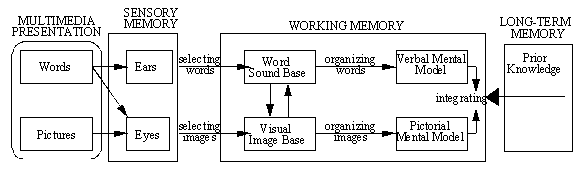
Dr Ruth Clark also said that cognitive overload can occur if several modalities. For example, the use of visual, text and audio together causes a redundancy effect because we are overloading the visual processing area. using audio and text together is better but use of one modality at a time is best.
Dr ruth does not like people multitasking e.g. checking emails when in VC and likes texting in VC to be on task not texting to each other off task or privately. she says this causes split attention effects.
see what you think when you listen to the audio.
——————————————————————————–
also a link to a presentation (pdf) called: Leveraging the virtual classroom
——————————————————————————————————————–
AND her new book at the bookstore.
The New Virtual Classroom:
Evidence-based Guidelines for Synchronous e-Learning
eLearner profiles: Diversity in Learning
I was very interested in a report of a Tertiary eLearning research fund project 2005 which looked at learner profiles – learning styles and preferences of students for elearning. Samuel Mann was on the research team and you may have seen the questionnaire. i have requested a copy of the questionnaire on CD from the lead researcher.
Jeffrey, L. Atkins, C. Laurs, A. & Mann, S. (2005). eLearner profiles: Diversity in Learning. Ministry of Education, TeLRF project report. Available at: http://cms.steo.govt.nz/eLearning/Projects/Tertiary+eLearning+Research+Fund.htm you need to scroll down the page.
What I liked about this research report is the comparison between student preferences for traditional lectures, tutorials and blended forms of online and f2f learning. You may find that these findings mirror some of the feedback you may be getting from your students about online learning. For example, they do not particularly want to be self-directed and do group work. They want lectures and are not particularly keen on online learning which can cause them a lot of anxiety. This is a NZ-based project
\”The sample size was 1811 and came from six universities, five polytechnics or institutes and six private training organisations.\”
Also the researchers categorised the learner profiles as: cognitive voyagers, strategic competitors and multimedia collaborators. If you read the executive summary of the report you will get the gist of the different profiles.
The researchers measured things such as extrinsic and intrinsic motivation, learning styles, dependent versus independent learning preferences, achievement motivation, relativistic reasoning rather than factual,working collaboratively rather than alone, time poorness, global versus sequential learning and reflective versus analytical and much more. It is a fascinating study. I hope you will take a look. Do you believe that this is the same situation for your students.
virtual friends are they disconnecting us?
all this talk about tools for networking and being connected in communities leads me to ask the question are people feeling disconnected as they strive to become more connected?
You may be interested in an article I read recently. here are a couple of excerpts:
\”Jason Calacanis wishes he could be your Facebook friend, but he just can\’t. ….Calacanis now has several thousand friends, with more requests streaming in daily. He\’s tired. So on his blog this summer, Calacanis, 37, declared a Facebook moratorium. In the future he\’ll outsource his friend management to an intern.\”
\”Ogheneruemu \”O.G.\” Oyiborhoro ….is the George Washington University junior who holds the school\’s title of most Facebook friends — 3,456 and counting.\” BUT who is the friend who helps him find an apartment….not his facebook buddies.
See:
An Unmanageable Circle of Friends Social-Network Web Sites Inundate Us With Connections, and That Can Be Alienating
By Monica Hesse
Washington Post Staff Writer
Sunday, August 26, 2007; M10
I have recently decided to spend more time with real flesh and blood, physically accessible friends and to ring fence my virtual networks as the number i belong to is taking up more and more time and impacting on my domestic harmony and peace of mind. I wonder if anyone else is feeling the same?
Putting too much trust in technology
The title of this post is stimulated by the technology hassles we have been having this week in the Facilitating eLearning Communities course. Who would believe it – two nights in a week and the computer conferencing system failed to function. Twice we were embarrassed in front of an international speaker. Twice we were unable to login and proceed smoothly as we have in previous sessions. Twice the course facilitators were getting blamed for the breakdown. And why? Because we had \”put all our eggs in one basket\” and we had begun to trust the technology.

The cynics would say – well it is to be expected.
The skeptics would say – I was surprised it has worked so smoothly so far.
The optimists would say – it will work well next time.
The extrinsically motivated would say – well I will just give up and go do something I really enjoy doing – this is too frustrating.
The intrinsically motivated would say – lets find a solution and do something else to help the community.
What do online facilitators say? What do classroom teachers say?
Imagine you walk into a room to teach your class. The lights wont turn on and the room is dark so they wont be able to see the whiteboard and you were going to use it for the session. What do you do?
OR
You are talking away flicking through your slide presentation and feeling like you have hooked your students. The actually seem interested and they are asking questions. Then the lamp blows on the data projector – no screen presentation. What would you do?
Do you keep talking and wing it and engage the group with some activities to help them piece together what has already been said. Or do you pack up and go home grumbling that they can read the text book.
- How do you placate the disappointed students who are getting ready to up and leave?
- How do you provide alternatives when the technology fails?
Yes these are all very real situations aren\’t they and ones we dread when we have so much content to get through and exams that have to be passed.
But let me ask this question – if you were the students who would you blame? The technology – hey that can happen, the teachers – they tried their best and its not their fault they didn\’t invent the thing. They don\’t manage the electrical grid. Yourself – I hope not.
And so it is with technology in online learning. We can do our very best to set systems up and design learning for our students, and set up interesting lectures and activities. But sometimes students cant access the materials or the sessions, sometimes the software wont run, sometimes the system fails. So what do we do? Last night when Elluminate failed, again! And I was grappling with downloading Java to get Elluminate to work on my home computer, trying to find our guest speaker, trying to contact the IT technician to get help, trying to let every one of the four groups who were invited to the session know what was happening , trying to answer the phone calls and texts, trying to download Skype so I could message people, reading and answering the group email, messaging the facilitator who was trying to keep it all together :O
– I saw some really interesting stuff happening and a community forming. It is almost as if we have to have ripples and bumps to get traction in a community.
- The email group changed from being asynchronous to synchronous.
- People were downloading skype and setting themselves up on it.
- jokes were being passed around.
- discussions were starting.
When we did finally get on Elluminate there was some really good questions and discussion around issues such as confidentiality online, obstructions to getting online from colleagues, what should go on the wiki. We also heard about Merrolees\’ web 2 project and passed around ideas for online facilitating. I saw some very sturdy beams being raised in the barn. I saw some excellent facilitation going on within the group. I saw people pulling together to find solutions. I saw lots of creativity and critical thinking going on. I was amazed.
Now I am really pleased Elluminate failed. Now we actually have a community thing happening and people supporting each other. So that people is what you do when the technology fails you find alternatives, or make sure there is a sense of community happening in your class so that people will pull together when the walls fall down or the technology fails.
Now I can pack my bags and put them at the door…well almost…but I am getting ready because several of you have already climbed the cliff face and reached level 5 in Gilly Salmon\’s pyramid for online facilitation. If you don\’t know what that is you better go look…….:P
when is a community not a community?
 In response to mark\’s suggestion that we contribute to a discussion about why we are in this community has stimulated a question for the group – when is a community not a community?
If you all think about any communities/groups you may belong to – they all have one thing in common.
Faces by Fazen
Faces by Fazen
There is always a core group who seem to do everything, are always involved no matter what, and others who remain quietly on the periphery…sometimes popping up when the need arises and disappearing again. People come and go, and in some instances people are a captive audience at some time or other. I am captivated with this community, and thoroughly enjoying our progress through the course activities. For me a community is about having a common purpose or reason to meet.
The common reason for this community being formed is that we are part of a course with common goals, in terms of assessment, but also in the need to find out more about online communities. Although we all have differing reasons for participating and different expectations and because of this we will each take away different things from this experience.
Because we are an online community, we are using a range of online tools and methods to interact, and a range of activities to give us a reason to use them. We could have set up just a Blackboard discussion Board with 93 forums as they did in one iteration of this course, but we have chosen to give the class the opportunity to see how a variety of tools and strategies work – that way you can experience them and choose what will work for you in your teaching.
So I don\’t expect we will all feel comfortable, or warm and cozy in this community because it is challenging. But I hope that the strength of the community will be in helping each other overcome the challenges. For myself, it is a challenge because I have never used such a wide variety of tools and methods to teach an online course, and this is my first time teaching this course. I am loving it, and I don\’t particularly feel like I am teaching, rather I am feeling like a participant. There are so many interesting viewpoints and discussions going on. I was here because I was one of the facilitators, now I am here because I am finding it fascinating – Although I am spending far too much time participating.
I have also found out a lot about different online communities and some of the theoretical underpinnings by listening to the guest speakers. I am learning so much. I now know that online communities are not just about Gilly Salmon\’s five-step emoderating model or about asynchronous or synchronous discussions. They are so much more. You will see what I mean if you look at the list we compiled last night in the wiki – onlinecommunities. The new page we invite you all to contribute to along with your own discipline-specific page.
The overall aim of this course is to get everyone to the facilitator phase (development – stage five – relates to Gilly Salmon\’s five-stage model) of being in an online community and to get there there are other phases to pass through e.g. access to the tools and strategies (access – stage one) getting to know the community (socialisation – stage two), sharing knowledge and information (information sharing – stage three), creating knowledge and resources (knowledge building – stage four) .
Why is evaluation so important?
 I was asked recently to present about evaluation for one of the constructing courses sessions. I decided to do an Elluminate session so I could fit it around study leave. However this morning when I was all geared up to present, the server decided to play hookey and go west.
This spurred me on to prepare a slide show with audio (Plan B). The presentation is called: Why is evaluation so important?
It can be viewed on the Internet and doesn\’t appear to take too long to load. The presentation is approximately 20 minutes long and covers the what, why and how of evaluation and its relationship to educational design.
I would have preferred the synchronous computer conference option so people could ask questions and we could have some discussion. However, while preparing the audio to accompany the presentation, I found I was able to tie things together better. This meant that my presentation was longer than originally intended, but I feel that it integrates the concepts underlying evaluation much more clearly. I just hope my audience thinks so as well. I have also given them the option of both asynchronous and synchronous discussion around the topic of evaluation.
I used MyPlick to upload the presentation (PowerPoint) and audio (mp3) which I created in Audacity. I prefer this site to SlideShare because the presentation and audio can be lodged on the same site. Mmmn maybe \”all my eggs in one basket\” is not such a good idea.
All this stuff is really helping me develop stronger digital information literacy skills. The importance of this became very apparent today during a research meeting where we were discussing some of the processes we would use to communicate and share ideas. Considering the research project is action research and the focus is digital information literacy, we as researchers will also be learning, not just the participants, through using web 2.0 tools to conduct the research processes. This is the start of my reflections around this project; it will be very important for all of us to keep a log of the process. Preferably an open log on the web where we can read each others entries and really share progress and ideas. This will be very important with the national spread of researchers in the project.
Structured versus not structured versus guided
 Is the Facilitating eLearning Communities course an example of constructionist and constructivist and reflective learning?
Are we like this lego maze (Lego Maze Eric4 by Anvilon)
– structured yet in a quandary and having to find our way around and out? Is there really an end point for a course like this? I hope not….I believe participation in Facilitating eLearning communities needs to be an evolving experience which has to ebb & flow with the technologies, change according to the needs of the participants and catch the trends and waves of eLearning.
I know it is not about mastery learning because the learning is intended to come out of the participants own perceptions, explorations and knowledge development. Plus there is no exam or test. But…
If structured = mastery learning and sequential step by step learning – then this course is not structured. If structured = guided and free to follow your own interests & explore – this course is structured.
I find it quite intriguing that people feel the course is unstructured. Yes there were more instructions for the first few topics and activities and directed discussion than the latter part of the course – yet some people chose not to engage.
The 10 min lecture series has been structured, and also allows discussion and reflection. some people have not been able to engage synchronously and have done so after the events and have made very good postings on their blogs about some, not all the presentations. Others have not engaged at all. Several people have engaged with the assessments – learning log (blog) and wiki – others have not.
I wonder why people feel it is unstructured – or does this mean unguided? Even though there is a learning guide, posted lists of what people should be doing on the course blog, email directions, directed activities for the first few topics, directed assessments, a lecture series, a list of resources, content on WikiEducator etc. Does guided mean something different for all of us? Guided does not equal structured or does it?
In a true constructivist learning community the course is far too structured. There are too many things participants are told to do already. There was very little for them to negotiate. Do participants feel they need to be sat down and directed through a series of topics, and some workshops on how to use some of the technologies? Does structured for some mean teacher-directed rather than learner-directed?
What I would like to know is do people feel they are being guided to be part of an online community? If the answer is yes, then we are on the right track.
Perhaps it is the topic. I believe people learn best how to be an online facilitator by being exposed to a range of strategies and practical opportunities rather than a whole lot of content and theory about how to do something though there is some of that too. Part of being an online facilitator in a community is to experience discomfort as well as comfort. David alludes to that and also mentions the value of finding out things for ourselves.
I am surprised that he feels that participants are \”relatively unguided\” – people have been given a lot of material to look at and plenty of discussion topics have arisen. The facilitators could have continued to impose very directed discussion topics all through, but instead chose to use the 10 minute lectures as the basis for discussion…which has occurred.
Perhaps what we need now is a short presentation to bring all the threads together for the community – this could serve as a reflection on what we have covered and a stimulus for the next leg of discussion. Watch this space!
facilitate or teach or learn
In response to Leigh\’s posting as you prepare to facilitate try not to teach. To teach or not to teach. to facilitate or not to facilitate. To moderate or not to moderate! Is there really a debate to be had I wonder?
I believe that all this angst has come about because \”a teacher\” decided some way back that he or she would replace the word \”teach online\” with \”facilitate online\”. It means the same!
Because we have all been encouraged to step back a bit and stop pushing information at students and encourage them to do more thinking for themselves and more self-directed learning, teaching is now facilitating. But is it?
Learner-centred is the new buzz word along with facilitated learning – it is still about teaching. The teachers, you and I, leigh, are still seen as the experts in the discipline we are teaching otherwise we would not be asked to \”teach\” the course.
So why have we been asked to teach the course and not the local butcher who is equally able to facilitate a jolly good discussion?
Because we have some expertise – like it or not, we have to teach our class something so they can teach themselves. Teach or model, facilitate or model – otherwise they will not just be feeling frustrated or confused – too much to learn – they will be really, really angry and p…ed off. Why didn\’t we just send out the handbook with the instructions for the course and the assessments with a few readings and tell them to get on with it?
Because we have to teach them something. that involves not just facilitating a good ole discussion, it involves giving information, brokering information, helping/facilitating them to find information, setting up systems and facilitating ways for them to develop as a community, directing them towards the things they need to complete to pass the course or not. Is that not teaching in one sense?
Making it interesting and challenging and scary enough to make them come back for more – fear as in the kind you get on a rollercoaster. Fear can be a great stimulant!
In my mind, good teaching is about good facilitating and treating the learners as individuals and as competent intelligent people who can think for themselves and who are encouraged to think critically.
 In response to some of leigh\’s questions –
- Why is this course called facilitate online learning communities and not teach online learning communities? To be absolutely pedantic here it is Facilitating eLearning communities. So just as Leigh has replaced eLearning with online – have we not replaced teaching with facilitating?
- Is teaching and facilitation really interchangeable?
- Yes mostly it is because good teaching should strike a balance and the teacher should step back when necessary and step forward and teach when needed – sometimes we need to be more proactive to facilitate scaffolded learning and not just assume people will enjoy struggling to find out everything themselves. The level of support needed, I believe, depends on each person\’s zone of proximal development(Wikipedia, 2007), for each situation and each topic. As you will see a person can be assisted to develop not only by the teacher but also by their peers – so does the peer then become a teacher too?
- Is facilitation simply one of many techniques that a teacher employs in their work? Or is teaching just one of many 3rd party services that a facilitator might call on in their work?
- Is it possible to be both a teacher and a facilitator within the same group of people?
- In response to these questions, I believe the answer is yes in both cases. Why? Because firstly, I see the terms as interchangeable where someone really knows how to support learners albeit called teacher or facilitator. Secondly, a balance is crucial in contemporary society .
- What are the differences in the roles and what are the social dynamics in play when they function?
- It depends on our definitions for teacher and facilitator and these depend on our philosophies as this discussion is demonstrating.
Examples: If facilitating a meeting – we might approach it in different ways. We can talk and dominate the session for the bulk of the time and answer questions, or present a slide show and demonstrate what we have been doing and/or would like to see being done and answer Qs. we can set an agenda and call for contributions, and chair the meeting to keep discussion on track and comments relevant. we can dominate the meeting by always bringing up points of discussion. a meeting can be facilitated by all members and all members contribute equally thus teaching others by telling them new things or bringing up points they may not have thought of.
I guess it depends on whether you believe that learning occurs all the time and whether when we learn we have taught ourselves or learned from others. Does that then make them teachers?
Oh boy – is it not all about letting others speak, and about people having an equal chance to contribute, and valuing each person\’s contribution and unique style?
To me that is much more important than debating the difference between teaching and facilitating. even someone standing up in front of a class and delivering a lecture for an hour, has facilitated learning in some way. what they may not have done is facilitated group discussion or critical thinking but they could have and I always tried to operate this way in large lectures.
So lecture is not synonymous with monologue or transfer of information – it depends on the style of the lecturer – just as tutorial or discussion is not synonymous with interaction. as we know people can just sit there and wait to be told and not contribute no matter how excellent the facilitator might be. Intrinsic motivation can play a huge part in how actively people engage and contribute.
You facilitate an exam perhaps not teach in it. That is the only example I can think of where there might be a difference BUT you actually supervise an exam or invigilate not really facilitate it. You facilitate a discussion or a meeting but you may not do it well just as you may not teach well. And for me good teaching is about being a good facilitator of knowledge, of interaction, of information, of learning and of people. Are there other examples you can think of where you facilitate not teach?
Auf wiedersehen
This is my good bye to everyone in the Facilitating eLearning Communities course.
When writing to the email group to thank them for participating in the course, I realised that the community was really only beginning. Although the course is now officially finished, we will be keeping the email group open so the community can share ideas, tips and stories about their experiences facilitating online. I also invited everyone to help develop the online communities pages on WikiEducator. I hope some will continue to engage in the group.
As a first time facilitator and co-facilitator in the course I found the experience a very challenging and rewarding experience. It has not been easy and it was never boring. Overall, it was extremely interesting to interact online with such a diverse and highly skilled group of educators; everyone in the group had very different needs and expectations. Sometimes I found it frustrating and sometimes I found it confusing – the reactions of the group were not always logical and rarely predictable.
For example, I believed the instructions for the first part of the course were clear and straightforward but that relied on people working systematically through the Blackboard activities and resources. People did not seem to get it. Then we confused people by throwing other technologies into the mix – email group, blog, wiki – as problems came up we offered a range of solutions. There was choice introduced, not just step-by-step and work through the activities and resources on Blackboard….post a discussion in Blackboard. The options threw a lot of people into the pirana pool. People\’s preference for options other than Blackboard meant the platform became redundant as we thought it would in a networked community.
Was it too much too soon?
For the next class, I feel that the Blackboard option will not be an option. Sure we could have shown people a couple of nice to know web 2.0 technologies and left them safely sitting in the learning Management System AND that could have been a community of sorts. Perhaps a subsistence community and a community with very limited means but a gated community – safe but how I hate the idea.
Instead we took the class out into the scary cyber world of uncertainty and unpredictability. Choice was the flavour of the day – ask a question and there were several options to choose from. Good or bad! We took people on a constructionist, constructivist and scaffolded/facilitated pathway with many forks and turns. People were not comfortable and they complained or disappeared from view. The true blue online facilitators did reappear though and they were stronger than when they started and more innovative – yes there were a few bruises and damaged egos – but they made the effort to ride the bull.
I learned a great deal from the experience and am impressed by the tenacity of the community to try out new challenges and experiences. Facilitating the class with Leigh opened new communities I had hitherto tried but avoided eg Second Life, gaming, FaceBook. I really liked the 10 minute lecture series – how fortunate we were to have so many people willing to contribute their know how to the community. My only regret is not having enough time to reflect on my blog about all the events. I can still do this of course because they are all recorded.
I asked the class to forgive us for discombobulating them. I was impressed with the high level of critical thinking and there was significant diversification of the communities\’ online facilitation abilities as we moved through the course. It is clear there is no one magic bullet for success. Each group will be different. Hopefully the group has established some guidelines for themselves and the groups they will go on to facilitate. I hope they can now recognise the need to allow their students room to evolve as a community. I firmly believe that only by providing loosely-structured problems will students be assisted to think critically and really learn how to learn.
I have never forgotten the words of a visiting lecturer years ago who ran a workshop on critical thinking. \”If you want to get your students to think critically, you have to put them in a place where they do not feel comfortable and where they feel challenged, they will not go there on their own.\”
I particularly like the explanation on the uses of critical thinking on Wikipedia. To get this class to think critically about good and bad methods for facilitating online communities it was necessary to present them with experiential real world problems in an online community and not just one or two but a wide range. Just transmitting information to them abut how to facilitate online would not have cut it; they had to experience it warts and all. What was bad to some was good to others and vice versa. Each experience would have beenunique although the community was exposed to the same things.
\”Critical thinking is also critical inquiry, so such critical thinkers investigate problems, ask questions, pose new answers that challenge the status quo, discover new information that can be used for good or ill, question authorities and traditional beliefs, challenge received dogmas and doctrines, and often end up possessing power in society greater than their numbers.\” \”The intellectual skills of critical thinking–analysis, synthesis, reflection, etc.–must be learned by actually performing them.\” (AN INTRODUCTION TO CRITICAL THINKING by Steven D. Schafersman, 1991).
Facilitating this course has helped me to become better at critical thinking. It is not an easy thing to get the balance right in a course like this and my big question is – should we cater to the lowest common denominator in terms of skill and comfort or should we make the challenge higher and hope for the best. I believe for this class we did the right thing going with the latter – uncomfortable as it was at times for all of us.
Technology in the Classroom: 6 Substitute Lesson Plans
Substitute teachers generally face an uphill battle: Sub lesson plans sometimes might be unclear, the students are wound up (especially this time of year), and it’s tough to perform well in a new environment.
Subbing for a technology teacher can be even more challenging. Subs might not be technologically proficient, or the computer equipment might not function properly.
Today, real-life tech teacher and frequent TeachHUB.com contributor Jacqui Murray offers up six helpful (and easy – even for technophobic teachers) lesson plans for tech teachers to employ when they are out sick – or taking time for professional development – including:
Problem-Solving Challenge
Gameshow Competition
Khan Academy
And more!
What do other teach teachers do for lesson plans when they know they’ll be out?
What Happens If We Abandon the Common Core?
Nationwide, there’s a movement afoot to dump the Common Core State Standards, that set of national benchmarks that create the opportunity for an across-the-board, agreed-upon set of college and career readiness standards.
Ideally, the Common Core allows for more data-driven educational changes that ultimately could improve student performance. The standards focus on not simply providing content to students, but helping students become more solution-oriented and able to apply concepts to real-world situations.
But a fierce backlash from administrators, teachers, parents, and even students has led to the aforementioned backlash.
But what happens if more states abandon the standards? Will academic chaos reign? Today we gaze into the crystal ball and try to predict the outcome.
What are your thoughts on the future of the Common Core?
Subscribe to the TeachHUB.com Newsletter
Every Friday, you have the FREE opportunity to get the latest in TeacHHUB.com updates delivered straight to your inbox! It’s a great way to get a recap of what we’ve been up to, including educational articles, tips and free lesson plans!


You must be logged in to post a comment.