
How India’s massive Election System works?

The world’s biggest democracy just had an election. The world’s biggest democratic election It’s a marathon election A mammoth undertaking It’s the world’s biggest exercise in democracy In India, voters picked its central government for the next five years. An eighth of the world’s population was eligible to vote in this election. In the year, 2019, there are 900 million eligible voters in India making this the largest Democratic exercise in the history of humanity.

A vote for reform: Election Commission collaborating with IIT-M on ...

In one of the largest and most populous countries in the world, that isn’t an easy task. India has to reach voters in coastal cities in the south, in the rural regions of the west, and jungles to the east and everywhere in between. And what’s more, they want every Indian citizen to be within 2 km of a voting station. That’s only about 25 city blocks no matter where you are in the country. It’s an incredibly ambitious goal and yet, somehow they’re able to do it. This is the biggest election in the world and I wanted to know how does it work. Every election a team of state officials and security forces, get on a ship within the east of India to require off towards this island. They travel about 100 km to get here, all to securely deliver these Electronic Voting Machines or EVMS, the instrument that logs India’s votes, the heart of this elaborate election process.

Election Commission's crackdown on poll-related monetary ...

India has 2.3 million voting machines for its 900 million voters. So, getting these machines on the brink of every voter may be a big logistical undertaking. That’s why India doesn’t have one polling day , instead, it’s closer to an election month with multiple phases that last weeks. This process takes more than 11 million election officials and security forces, who move from polling station to polling station to polling station from densely populated cities to the rural areas where the majority of Indians live. Once on the island with the EVMs, officials pile on to bike carts and head towards the polling station. Once they arrive, they start setting everything up for the vote.

On Election Day, voters line up, cast their vote, and get their fingers inked to prevent double voting. This is where the process ends for the voters, but for the election officials this is just the beginning. Driving a boat out to a remote island is just one of many ways that officials reach every voter. India’s vast and diverse terrain requires transportation methods of all kinds, like in the jungles of this northern state where elephants transport voting machines to reach a remote town or in the Himalayas where officials hike for hours to bring EVMS for election day. Helicopters, trains, they even use camels. But what makes India’s elections so impressive is not just how they reach everyone in such an enormous country, that’s just half the battle. It’s also the ways they try to include voters of all backgrounds into the process, a challenge that has been a part of India’s elections since the very beginning. India has 22 official languages and hundreds of dialects and when India became an independent nation, less than a quarter of the population could read and write.
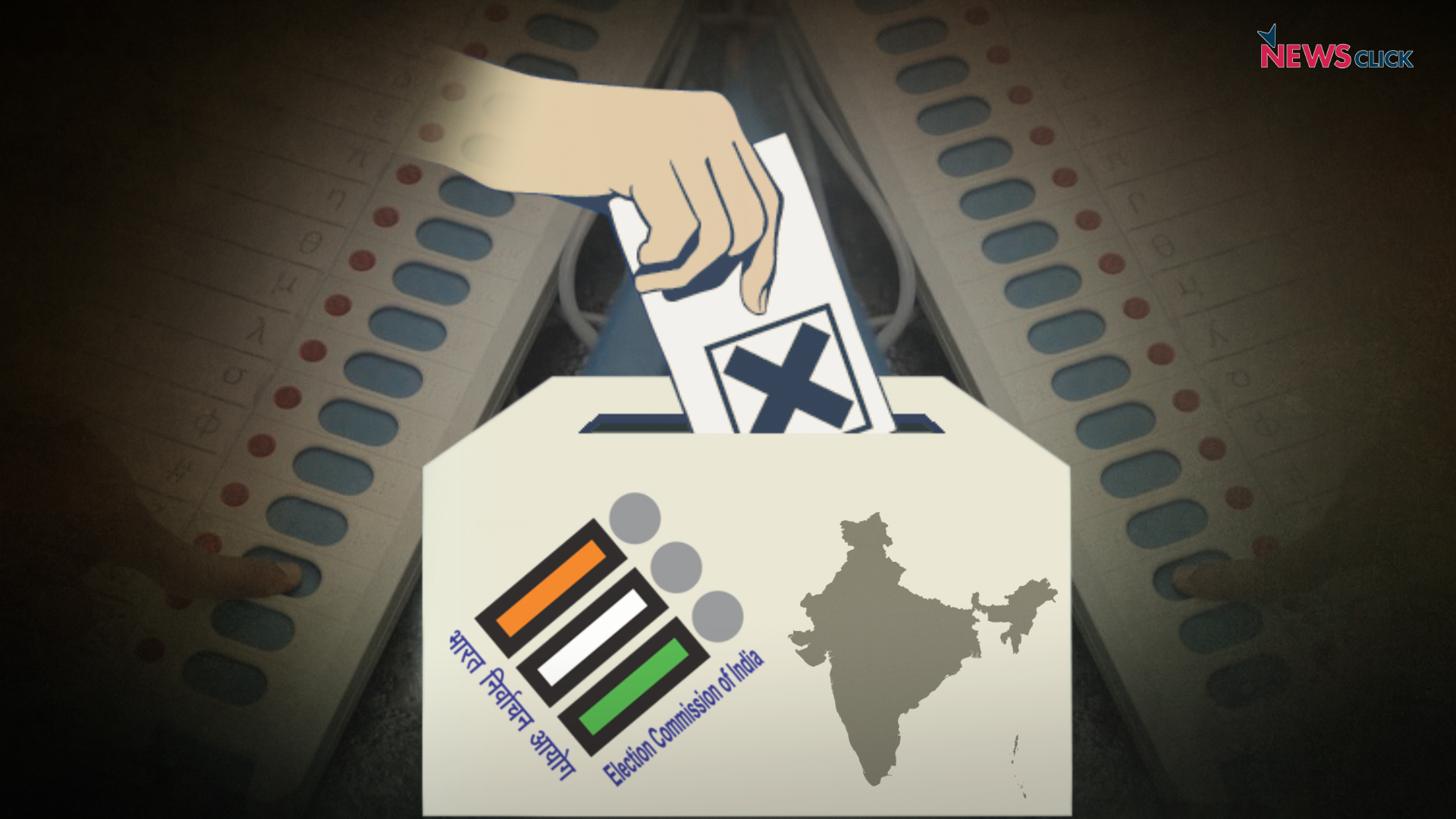
Why EC Owes an Answer to the Country Over 'Phantom Votes' | NewsClick

The newly formed Election Commission of India created a range of symbols to correspond to each political party, like an elephant, a lotus, a hand or even an alarm clock so that from the beginning all people regardless of literacy level and language could vote with confidence. Since 1947, the literacy rate has increased significantly, but it’s still only 75 percent, so these symbols are still useful to many when casting a vote. But this is a massive sprawling operation and over the years it’s run into some pretty serious problems like allegations of election rigging and problems with a practice called booth capture, where gangs actually take over polling stations and tamper with the elections. It’s partly because of these problems that the Commission introduced these voting machines in the 1990s.

It also increased security around the elections. These efforts to include all voters and protect elections seem to be working. In 2019, India saw the highest voter turnout yet and for the firsttime women voted just as much as men. India’s elections are only getting bigger and more complicated. India has one among the fastest growing populations within the world. and in 2020, young people will make up more than a third of the country. This is the most important election within the world that takes many officials fanning out across a huge country to assist many millions vote.

Election Commission rejects Opposition demand to tweak VVPAT ...

Date of Poll and Counting of Votes for Deferred Rajya Sabha Poll

On 25.02.2020, Election Commission of India announced elections to the Council of States to fill 55 seats of Members from 17 States, retiring in the month of April,2020, which were notified vide Notification No. 318/CS-Multi/2020(1) dated 06.03.2020. After the last date of withdrawal on 18.03.2020, respective Returning Officers declared 37 seats from 10 States filled in uncontested. Further, as per the reports received from the concerned Returning Officers, the biennial elections for 18 seats from the States of Andhra Pradesh, Gujarat, Jharkhand, Madhya Pradesh, Manipur, Meghalaya and Rajasthan were to be conducted on 26.03.2020 (Thursday) and the date before which election was to be completed as earlier announced by the Commission was 30.03.2020 (Monday) as per the notification dated 06.03.2020.

          Section 153 of the Representation of the People Act, 1951 specifies that the Election Commission for reasons which it considers sufficient, may extend the time for the completion of any election by making necessary amendments in the notification issued by it under section 30 or sub-section (1) of section 39 of the said Act. Accordingly, considering the prevailing unforeseen situation of public health emergency due to COVID-19 and related advisories in the country, the Election Commission, vide its press note, dated 24.03.2020, deferred the poll and extended the period of said election under the provisions of section 153 of the said Act and decided that the announcement of fresh date of poll and counting for the said biennial elections will be made by the ECI after reviewing the prevailing situation. The Press Note also specified that the list of contesting candidates already published for the said election by the respective Returning Officers, is to remain valid for the purpose of remaining activities as was prescribed under the said notification (dated 06.03.2020).

          Now, Commission has reviewed the matter in detail. Considering all factors, including the guidelines dated 30.05.2020 issued by Union Home Secretary and Chairman, national Executive Committee (NEC) under the National Disaster Management Act, 2005, and taking into account the inputs obtained from the Chief Electoral Officers concerned, the Commission has decided that the date of poll and counting of votes in respect of the biennial elections for 18 seats from the States of Andhra Pradesh (4 seats), Gujarat (4 seats), Jharkhand (2 seats), Madhya Pradesh (3 seats), Manipur (1 seat), Meghalaya (1 seat) and Rajasthan (3 seats) shall be as per the following schedule: 

EventsDate
Date of Poll19th June, 2020 (Friday)
Hours of Poll09:00 am to 04:00 pm
Counting of Votes19th June, 2020 (Friday) at 05:00 pm
Date before which election shall be completed22th June, 2020 (Monday)

          Commission has also decided that the Chief Secretaries shall depute a senior officer from the State to ensure that the extant instructions regarding COVID-19 containment measures are complied with while making arrangements for conducting the elections.

          Further Commission has appointed Chief Electoral Officer concerned as Observer for the election in the respective State.

Election Commission of India to implement the directions of Hon’ble Supreme Court

Election Commission of India has consistently espoused rigorous and loftiest normative standards in public life. Hon’ble Supreme Court on 13 February, 2020 in Contempt Pet. (C) No. 2192 of 2018 of W.P. (C) No. 536 of 2011 invoking Article 129 and Article 142 of the Constitution of India directed as under,

“1) It shall be mandatory for political parties [at the Central and State election level] to upload on their website detailed information regarding individuals with pending criminal cases (including the nature of the offences, and relevant particulars such as whether charges have been framed, the concerned Court, the case number etc.) who have been selected as candidates, along with the reasons for such selection, as also as to why other individuals without criminal antecedents could not be selected as candidates.

2) The reasons as to selection shall be with reference to the qualifications, achievements and merit of the candidate concerned, and not mere “winnability” at the polls.

3) This information shall also be published in: (a) One local vernacular newspaper and one national newspaper; (b) On the official social media platforms of the political party, including Facebook & Twitter.

4) These details shall be published within 48 hours of the selection of the candidate or not less than two weeks before the first date for filing of nominations, whichever is earlier.

5) The political party concerned shall then submit a report of compliance with these directions with the Election Commission within 72 hours of the selection of the said candidate.

6) If a political party fails to submit such compliance report with the Election Commission, the Election Commission shall bring such non-compliance by the political party concerned to the notice of the Supreme Court as being in contempt of this Court’s orders/directions.”

Election Commission of India whole-heartedly welcomes this landmark order, which is bound to go a long way in setting new moral yardsticks for overall betterment of electoral democracy. Earlier, Commission on 10 October 2018 issued detailed instructions and guidelines along with amended form of affidavit for ensuring publicity of criminal antecedents by the candidates and the concerned political parties for the information of voters. This is being implemented in all the elections since November, 2018.  Now, Commission proposes to reiterate these instructions with suitable modifications in order to implement the directions of Hon’ble Supreme Court in letter as well as in spirit.

******