At the touch of a screen, most people now get their news information online, especially from social media. Social media reaches a maximum audience. In a recent survey, 50 percent of internet users said that they get to know about the latest news via social media even before it is on a news station. Social media in reporting is that the news does not get spread fairly quickly. If information is correct then it can be an excellent way of getting the news.
Positive -:
1. The news on social is immediate, while traditional media, can be delayed due to press times
2. Social media is versatile (you can make changes or delete once published. Whereas traditional media, once published, is set in stone.
3. The accessibility of social networks across devices makes them easy to use on the go and one of the most convenient ways to read the news.
4. RVCJ media page that provides the latest news on Instagram
Negative -:
1. There is a fierce media competition 2. Social platforms have control over what news and information we see. Our social media friends have become “managing editors” deciding what we see. An article needs to be liked and shared multiple times before many see it in their feed. Therefore, social media friends have control over what news pieces we see and what we do not. 3. The authentic content is hard to come by now. In fact, fake news is actually more likely to spread than the truth. 4. Falsehood diffused significantly farther, faster, deeper, and more broadly than the truth in all categories of information.
Conclusion -:
News happens fast now. Today’s story will be tomorrow’s forgotten story. It is easy to miss things now because of how quick stories can get turned around and shared. While having so much information at our fingertips is great, it is worth always checking sources and not taking headlines as truth. With social media as our new news managers, it is up to us to be the new fact checkers for media.
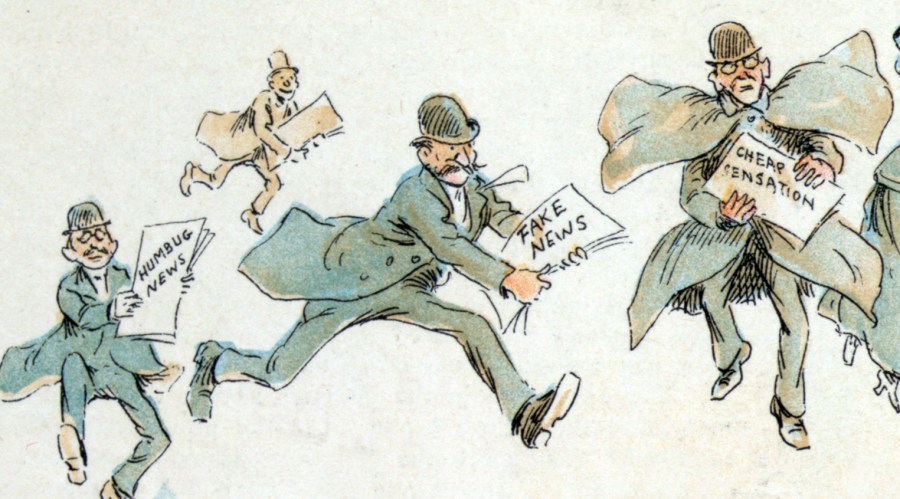
The authenticity of Information has become a longstanding issue affecting businesses and society, both for printed and digital media. On social networks, the reach and effects of information spread occur at such a fast pace and so amplified that distorted, inaccurate or false information acquires a tremendous potential to cause real world impacts, within minutes, for millions of users giving the rise to “fake news”. Fake news or fabricated information that is patently false, has become a major phenomenon in the context of Internet-based media. It has received serious attention in a variety of fields, with scholars investigating the antecedents, characteristics, and consequences of its creation and dissemination. Usually, these stories are created to either influence people’s views, push a political agenda or cause confusion and can often be a profitable business for online publishers. False information can deceive people by looking like trusted websites or using similar names and web addresses to reputable news organisations.
The Rise of False Information
False information is not new; being older than the first Century BC, but under the rule of the internet and the emergence of social media has just added fuel to the fire. Traditionally we got our news from trusted sources including journalists and media outlets that are required to follow strict codes of practice. However, the internet has enabled a whole new way to publish, share and consume information and news at a rapid speed with very little regulation or editorial standards. Many people now get news from social media sites and networks and often it can be difficult to tell whether stories are credible or not. According to Martina Chapman (Media Literacy Expert), there are three elements to fake news: Mistrust, misinformation and manipulation. Information overload and a general lack of understanding about how the internet works by people has also contributed to an increase in fake news or hoax stories. Social media sites can play a big part in increasing the reach of these type of stories.
The False Information Business Model
The internet and social media have made it very easy for anyone to publish content on a website, blog or social media profile and potentially reach large audiences.With so many people now getting news from social media sites, many content creators/publishers have used this to their advantage. False information can be a profitable business, generating large sums of advertising revenue for publishers who create and publish stories that go viral. The more clicks a story gets, the more money online publishers make through advertising revenue and for many publishers social media is an ideal platform to share content and drive web traffic.
Consequences of Fake News
The spread of fake news can have both personal and academic consequences. In a perfect world everything reported would be based on facts and you would be able to trust that the media you consume is reliable. But unfortunately, that’s not the case. As a student you are expected to find, evaluate, and reference trustworthy information sources in a variety of formats. If fake news is included as evidence for your arguments or as part of your research it may raise doubts about the integrity of the sources used as a whole and the ability to identify quality information. It can also be dangerous to do something without having all the facts, but it can be just as detrimental to do so based on inaccurate information. Whether it’s political, medical, academic, or personal, a reliable source of information should be recognized to make an intelligent, fact-based choice. As more and more individuals fall for information online that directly opposes scientific research, researchers are increasingly put in the position of having to defend the validity of their findings. When information dissemination was limited to print, television, and radio there was less opportunity for individuals to publicly comment on, criticize, or refute knowledge presented by experts. With the internet, it is now possible for groups to push misinformation that aligns with their beliefs and disparage that which does not.
What can we do about False Information?
Companies like Google and Facebook have announced new measures to tackle fake news with the introduction of reporting and flagging tools.Media organisations like the BBC and Channel 4 have also established fact checking sites While these are welcome developments, digital media literacy and developing skills to critically evaluate information are essential skills for anyone navigating the internet and especially for young people.
The spread of anti-vaccination misinformation on social media, (and its implications for public health and the global fight against COVID-19) is a textbook example of how deadly misinformation can be. Misinformation can have real life consequences for individuals, businesses and public authorities. Besides the recent pandemic, fake news is another virus we should focus on tackling.
The function of mass media is to aware or inform masses about the happenings in the world. The television, internet and newspapers are the most predominant forms of media today. Television has a massive impact on our generation. Many sections have become vulnerable to what they see and what they are told as they stay glued to TV or laptop for hours. People try to imitate their role models and their activities; they see it as a social norm or a style statement. Media affects all aspects of youth’s life, from how they should look and what they should wear and own.
Media sensationalises things to grab the attention of masses. It can portray someone or something in such a way that the masses either favour or go against the person/ thing mentioned. Journalists are humans, and so biases can cover the news at a personal or basic level, for instance, a public figure’s reputation can sometimes be misleading as a result of bias. Modern mass media also serves the interests of political leaders and corporate to a considerable extent, thereby influencing public opinion as ‘What you see is what you believe”. Media attempts to provide unbiased information, and ethically they must not present their views on a subject but present the issue as it is. So, if politicians manipulate an event or activity and get coverage, deceptive news will reach the audience. Not everything that we take on face value is correct.
We are consumers of information and all the glossy glamour that we are subjected to mislead us. What starts as a curious exploration ends us becoming a destructive habit. Youth becomes fashion-conscious, and eating habits are adversely affected. There are misleading advertisements which give false claims; from beauty products that promise whitening skin to deodorants that attract women, all have an impact on a significant section of viewers. For the youth, it has become a trend to chase the unattainable perfect image that the media shows us.
Many are trapped in the world of daily soaps which add no value but show ways to conspire against people. We don’t even know it, but it plays with our thinking manner and capacity. When we are engrossed in such programs for long periods, we start to think the way TV characters believe. Movies too are influential, people who see fast cars drifting; bikers doing stunts, actors jumping from buildings follow it blindly and get into accidents.
Social media too misleads often as only certain information or news on it is authenticated by authorities, else is just false rumours. People become victims of such unreliability. Pop-ups, advertisements develop a habit of excessive spending too because we are misled into buying things that we think will benefit us because a social networking friend has validated it. Job ads, insurance premiums can be misleading; we are exposed to so much information that we don’t know what to trust and many a time we choose the wrong track.
Studies reveal that the media has a significant impact on children with obstinate and ignorant behaviour. It affects psychology and communication methods. They consume more of flashy information than educational and develop an insensible view of the world. An exaggerated warning of the harmful effects of an object will be taken seriously by a parent who will take it away from a child. Media has also become entirely commercial; it is seen that fear-mongering and sensational news sell more than balanced news. It has been witnessed that adolescents are acting as adults from a much younger age. They are expected to be more knowledgeable on adult’s topic. Being exposed to adult content forms a viewpoint in them at an undesirable age, and we expect unrealistic things too from them.
Media does not intend to mislead us, but many do get mislead. It is up to us to either take the things as they come or realise that not everything is good for us.
The media plays a pertinent role by providing information which is indispensable for two reasons. Primarily, it ensures that citizens formulate proper and updated views by analysing the authentic and genuine facts as provided by media. Secondly, it provides information as a “checking function” by guaranteeing that the chosen government and its representatives act upon electoral promises.
Media thus plays a central role since it is the single means through which public opinion is engendered. The stability of a country is assessed by the way the media report the news of that country. Thus, it becomes the obligation of the media to circulate only applicable and valid facts locally and globally.
The role of media has been changing from what it was perceived. The neutrality of news in reporting is missing in the mainstream media today because of the hidden agendas that many press and media outlets hold.
Media in India is mostly self-regulated. The existing bodies for regulation of media such as the Press Council of India which is a statutory body and the News Broadcasting Standards Authority, a self-regulatory organization, issue standards which are more in the nature of guidelines. Press Council of India established under the PCI Act of 1978 for the purpose of preserving the freedom of the press and of maintaining and improving the standards of newspapers and news agencies in India.
Even though the Constitution guarantees freedom of the press, the government does regulate some media. Print media are largely unregulated, and newspapers and magazines can print nearly anything as long as they don’t slander anyone. The Internet has also gone largely unregulated, despite congressional efforts to restrict some controversial content. Broadcast media, however, are subject to the most government regulation.
Decision-making power in the Indian media regulation is fairly centralized, with the central Government and ministries making the final calls when it comes to new policies and appointments. Politicians have a keen interest in news media regulation owing to the high degree of political ownership in the sector. Thus, political and electoral logic shapes media regulation.
Prime Minister Narendra Modi at the top of the decision-making list. Modi follows a centralized decision-making model with significant power allotted to his Prime Minister’s Office (PMO), Modi has been a vocal advocate of the use of online media for political mobilization, participation and propaganda. Key influencers in the Indian regulation include Mukesh Ambani, chairman of the Reliance Group of Industries, Amit Shah, an MP and current president of Bharatiya Janata Party (BJP), Subhash Chandra, the chairman of Essel Group, Bennett Coleman & Co. Ltd (BCCL), which owns The Times of India.
WhatsApp has become the platform of choice for politicians because of its massive reach that goes beyond a party’s loyal voter base, but also because of the lack of gatekeepers. Messages forwarded through the system have no context about where they originate, but benefit from the trust of coming from a contact . . one of the BJP leaders denies the spreading polarising content, but public WhatsApp data collected by analysts and anecdotal evidence show that Indians are being flooded with propaganda memes, much of it anti-Muslim and critical of the opposition Congress party.
In April smriti Irani’s ministry issued a circular saying that in order to fight the rise in fake news in print and electronic media, the government had decided that journalists who had complaints of creating/propagating fake news against them, would immediately have their press accreditation suspended.The following day, the Prime Minister’s Office asked her ministry to withdraw it.
Recently A picture of Vadra with the Chinese envoy. Both Republic TV and Times Now got excited enough over a picture of Robert Vadra to launch hashtags and primetime shows. Alt News had to give a video tutorial to Times Now and Republic TV to avoid such rookie mistakes. The picture was from a Chinese food festival that was also attended by India’s Railway Minister Suresh Prabhu, Sitaram Yechuri from CPIM, KC Tyagi from JDU and other leaders from BJP such as Tarun Vijay and Udit Raj. A quick google search could have avoided these channels the embarrassment though we suspect that they neither consider this as an embarrassment nor are they interested in the truth.
Similarly there was a statement attributed to Arundhati Roy – ‘’70 lakh Indian soldiers cannot defeat Azadi gang in Kashmir” . A fake statement made in a non-existent interview during a trip that never took place was enough to launch prime time debates on Republic TV and CNN News 18 attacking Roy. The fake news had originated from some obscure Pakistani website called times of Islamabad
What followed was attack on Roy by BJP MP Paresh Rawal and prime time debates on the topic. Arnab Goswami called Roy a “one book whiner wonder” and continued to rant about his favorite topic of Lutyens media and pseudo liberals. An investigation by The Wire revealed the truth behind the fake outrage fueled by the news channels and this piece by News laundry explored it further News laundry had republished an op-ed responding to Roy’s fake quote and it apologised for its editorial oversight and retracted the piece. There was no retraction or apology from Republic TV or CNN News 18 for attacking Roy based on fake news.
Indian media is grappling with many problems, but the country’s regulators fail to address them.
It took the Ministry of Information and Broadcasting (MIB), a key player in India’s media policy, two years and seven months to release public data that had been officially requested in 2015 by TheHoot.org, a website mapping media ownership in India. The ministry said that such data couldn’t be released as it was “third party information.” The ministry’s argument was just tosh as media companies have to reveal ownership data to qualify for a license to operate.
The episode epitomizes the excessively bureaucratic, politicized and clientelistic media regulation in India whose decisions have negative consequences for news media operations
Decision-making in matters related to the Indian media is riddled with political influence, regulatory parallelism and clashes over jurisdiction, involving not only decision-making authorities but also industry players,
What are we going through the most after the coronavirus attacked the world? The simple answer is social media. The use of social media has increased a lot to cut off boredom. But the real question whether the purpose of its use is good/bad or ethical/unethical. Many issues are going viral in social media platforms. The issues usually range from memes and fun challenges to fake news and troll. We all are both the victims and the abusers in different situations. People share stuffs intentionally and unintentionally to praise and hurt someone. Sometimes people do not apply any common sense before posting any news or post or comment. It is totally up to us how the situation will be managed. Let us see what all kind of issues became viral in social media platforms during the lockdown.
Recently the news to become viral is concerns about the ‘phishing attack alert’. The Indian Computer Emergency Response Team has issued a serious alert that the phishing attack campaign is expected to be carried out by cyber criminals through a suspicious email id— ncov2019@gov.in from 21 June, 2020. The cyber criminals claim to have over two million individuals’ mail ids. They have a plan of sending mails with the subject ‘Free COVID-19 Testing’ in cities like Delhi, Mumbai, Hyderabad, Chennai and Ahmedabad. The Government sends an alert that the attackers will imitate government organisations to confuse and that they can also steal sensitive personal data. It has also formed some guidelines to restrict the attackers.
Another hot topic is the attacks on celebrities, including the ‘star-kids’, after the sudden demise of the Bollywood heartthrob, Sushant Singh Rajput. Initially the Maharashtra Police department had reported that he had committed suicide due to depression. But after a day it has filed a case and started investigating the suicide theory. While the investigation is on people have started acting like investigators themselves and are pointing out various issues and events to prove that it was not suicide. So many information are getting viral in Facebook, WhatsApp, Instagram and Twitter. Netizens are attacking celebrities like Karan Johar, Alia Bhatt, Sonam Kapoor, Salman Khan and many more on the ground of ‘nepotism’ in this Bollywood industry. Netizens are also unfollowing them on Twitter and Instagram and posting numerous hate comments on their accounts. Some celebrities have blocked the comment sections of their accounts and some have deleted their accounts to have mental peace. Some people are calling for boycotting the large production houses and swear that they would not watch the movies of these houses in theatres. The followers of Sushant’s account have increased phenomenally in these few days on his Instagram and Facebook accounts.
Things have come to such a pass that the Maharashtra police has been forced to alert netizens with a warning. After the death of the Bollywood actor suddenly two pictures of his dead body lying on his bed became viral. It is unethical to post and share such pictures on both digital and print media. It may invite punishment for posting pictures of a body without the blurred face as per Indian law book. But some people have become insensitive due to the overuse of social media. Sushant’s close friends and some celebrities had to urge their followers not to share such pictures. It was getting out of control. So the police department posted on its social media account a warning that whoever shares the pictures will face severe consequence. One popular news channel also faced a FIR for reporting insensitive headline about Sushant.
Fake news poses a grave challenge to procuring and presenting information. Even the most prominent organizations fall prey to it. Some time back the World Health Organization (WHO) had to post an emergency notice on its official website. It clarified that a fake news was being circulated on various social media. The fake news stated that WHO has released a four-step protocol and procedure for conducting lockdown in India. WHO denied issuing such advisory and has asked people to visit the Ministry of Health and Family Welfare of the Government of India and the official WHO website for verified information.
Last but definitely not the least the Press Information Bureau (PIB), Government of India, informed that the viral news on social media about the central government’s decision to resume lockdown from 18 June is fake. After the news went viral speculations and some panic started. Prior to this news, the PIB also refuted another fake news about the imposition of lockdown from 15 June by the Ministry of Home Affairs.
Social media platforms have much utility in our life. But at times they become quite dangerous for public. Fake news and fake posters can lead some people to take wrong decisions. Some official measures are being taken now. The Indian Government, for instance, has stipulated that in the case of forwarding a particular message WhatsApp authorities have to show the exact number of people forwarding it. We have our responsibility as well. Before forwarding or sharing any piece of information, news or pictures as users we must try to check whether it is true or fake. It is a difficult task indeed but the effort needs to be there.
Fake news is nothing new. We have entered a new world of the media with a speed unheard of and technology makes the spread of ideas faster and more adaptable, hence making it easier for propaganda material to reach more people. Also the advance of new forms of digital media have posed serious challenges for quality journalism. These challenges include a decrease in critical thinking among audiences making them more susceptible to disinformation and manipulation and results in false information reaching the public either deliberately or by accident which results in what we know as fake news today. Fake news is /can be defined as the promotion and propagation of news articles via social media. These articles are promoted in such a way that they appear to be spread by other users, as opposed to being paid-for advertising. The news stories distributed are designed to influence or manipulate users opinions on a certain topic towards certain objectives. Fake news has gained great prevalence in intergovernmental and national policies and regulation. Some believe it is an old media practice of propagating false information that has been in existence since the media was established and journalism became a profession. Others see it as a brand new threat and challenge to democracy and international order. At the same time no general standardized, judicial and institutional framework on how to deal with the phenomena behind the notion of fake news has been found so far.
Fake news is indeed a descendant of propaganda, false rumors, and political manipulation. They include satire or parody ( which has no intention to cause harm but has potential to fool), false connection (when headlines, visuals of captions don’t support the content), misleading content (misleading use of information to frame a person or an issue), False content (when genuine content is shared with false contextual information), imposter content (when genuine sources are impersonated), manipulated content (when genuine information or imagery is manipulated to deceive), fabricated content (new content is 100% false, designed to deceive an individual). Fake news creators make money in very similar ways from how traditional news companies make money, from advertisements. They have display advertising for which they receive a small portion for every person who visits that page. Their goal is to get the news to go viral so a lot of people will visit hence more social shares mean more page views which result in more money. Since a lot of the fake news appears and is shared through Google and Facebook, they have taken steps to do something about it which include cracking down on fake news sites, restricting their ability to garner ad revenue. Google announced that it will prohibit “misrepresentative content” from appearing on its advertising network. Facebook says it will not place advertisements from fake news publishers on third party apps or websites, because the content falls under the category of “illegal, misleading or deceptive” content. Perhaps that could dissipate the amount of foolishness and hogwash online, though news consumers themselves are the best defense against the spread of misinformation.
As readers or general public, we can respond to fake news by looking out for signs such as misspellings in content and awkwardly laid out website, click-bait headlines, doctored photos and image, absence of publishing timestamps, lack of author, sources, and data etc. Lets hope that by becoming aware of the techniques used, we become more resistant to these methods and hence keep our society progressive for the future generations.
What will happen if one morning we wake up and check our phone which will leave us bewildered with a notification of the demise of some famous personality and after few hours of feeling sad you realize that it was a fake news, that someone made a fool out of you. Think about that personality who will read the news of his own demise , such a strange thing right? The new digital era with modern technology has unleashed many unwanted and false practices which is affecting the individuals interpret daily developments. Now this thing leaves me in a state that whether I should watch news or read news articles or just leave everything and be unaware about the facts happening around me. Let me share some of the instances where I felt that fake news is becoming a threat to people. During this time of COVID-19, where the world is suffering from a painful time , people are still spreading fake news. They are giving false information about the number of corona cases rising in India and how the nation is in a dreadful situation with fear and suffrage. https://www.firstpost.com/tag/fake-news Second incident is from CBSE where the people were spreading rumors about the board examination of 10th&12th class. Students were confused with the dates and whether the examination will take place or not, this situation was no less than a terror for them because they were not sure with the dates and evaluation. But now the things have been settled and CBSE has warned against the fake news. https://scroll.in/announcements/958428/cbse-warns-against-fake-news-regarding-2020-board-exams There are many more examples which has threatened people and made a disbelief in media, where the people are in no state whether to believe the media or not. One of the major reasons why fake news is such a threat is the increasing difficulty for readers to identify the legitimacy of wake news websites. People are trusting blindly on everything , they are not checking the facts or they are not able to make a difference between a fabricated news or a real piece of news article. The fabricated news is creating a negative impact on the people and making the situation much more worse and entangled. This is a growing debate on how to address these issues without undermining the benefits of digital media. We should be aware about every digital platform before using it. Government should take preventive measures to combat this problem and come up with a solution so that people can actually rely on real news. Government should promote news literacy and strong professional journalism in the society.The media should work really hard in developing a real piece of news without fabricating it. Tech companies should come up with apps or other tools that can identify fake news in seconds and individuals should follow some guidelines or check the facts before believing in a news article. I will conclude this article with a quote of Abraham Lincoln “Don’t believe everything you read on the internet just because there’s a picture with a quote next to it.”





 Eduindex
You must be logged in to post a comment.