Forced migration- a major crisis in Uttarakhand

Forced migration can be described as mass movement of people of a particular area out of threat to their lives and livelihoods. People unwilling to leave their home towns and countries are forced to migrate to nearby, or sometimes far away, cities, towns and countries to have access to better facilities.

In context to Uttarakhand, forced migration or distressed migration has arisen as one of the major issues in recent times. In particular, male-specific outmigration has become a trend in the hills. The people have been migrating not just to seek better employment but also to have access to better healthcare and educational facilities. The educated ones are the first to leave as they get good opportunities in the cities and settle there forever. However, the elderly population is not yet ready to leave their home land because of the affection and attachment to the place.

More than 5 lakh people have migrated from Uttarakhand within the last 10 years. According to 2011 census, a total of 1,18,961 people from 6,338 village panchayats have migrated out of Uttarakhand permanently, while 3,83,726 people have migrated in search of work and prefer to visit their native places in the hills frequently. Out of 16,500 villages in Uttarakhand, 734 have become ghost villages. Also, there are 664 villages with negligible population and 3,900 other villages in the state that have a population of 50 or less.

The state of Uttarakhand was formed in the year 2000 after separation from Uttar Pradesh to ensure development in the hilly region. Though the purpose doesn’t seem to be served yet. Well structured roads and good health facilities continue as the basic requirements of the people. The lack of educational facilities is also among the majors reasons of migration.

Moreover, the decreased fertility of soil is a major concern for the locals affecting the agricultural productivity. Since it is an ecologically fragile state prone to natural disasters with half of the population’s workforce on farm, scope for other employment opportunities reduces.

Changing time brings along changes in basic needs which might not be fulfilled by the traditional methods and style of Uttarakhand. It proves to be a major cause of the shift. People now prefer to settle in the cities permanently in order to enjoy the relaxing life and lucrative opportunities offered there as compared to their home towns in the hills where the daily routine is tough and hectic and a decent livelihood has become a challenge.

Recent reports show an increase in number of the malnourished in India

According to the Center for Science and Environment (C.S.E.) State of India Environment Report – 2021, the corona epidemic has had a lasting impact on the health and economic conditions of 37.5 million children across the country.

CSE Director General Dr. Sunita Narayan, said that children from new-born to 14 years will have more health-related problems. There is a possibility of low weight of children, lack of physical development according to age and increase in mortality.

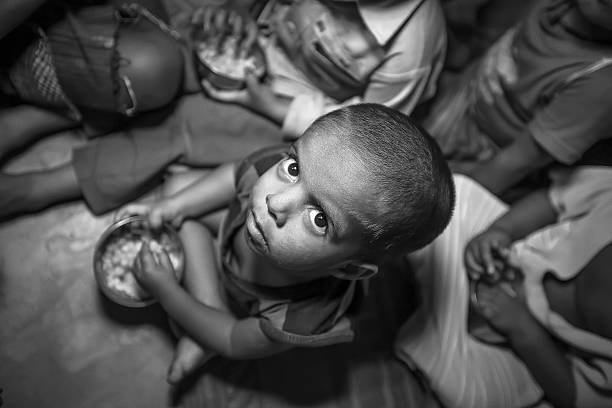
Child from a poverty stricken family gets a free meal at his school.The schools are run by some volunteer organisations or individuals and have inadequate facilities. Yet some people are working relentlessly to help these poor children.

One of the reasons could be India’s struggling with Covid-19 lock down interrupted crucial government schemes that benefit hundreds of millions of women and children. But that still doesn’t explain the rise in malnutrition rates in the years leading up to the outbreak of Covid-19 in 2020.

According to reports, India’s latest National Family Health Survey (NFHS), which shows that children in several states are more undernourished now than they were five years ago, is based on data collected in 2019-20. The survey was conducted in only 22 states before the onset of the pandemic – so experts fear the results will be much worse in the remaining states, where the survey began after the lock down ended.

In rural places the problem seems to have begun earlier. Rural areas have seen a steep rise in the proportion of undernourished children compared with 2015-16, when the last survey was conducted.

Due to malnutrition in infants and young children stunting in growth and even experience wasting away of muscle and anemia. The proportion of severely underweight children has risen. Stunting refers to lower than expected height for age, wasting shows lower than expected weight for height, and anemia is a deficiency of hemoglobin in blood.

Most of the Indian women are anemic and poor women, especially so. According to the experts, the worsening rate of malnutrition could be a result of women struggling to access nutrition benefits because undernourished mothers give birth to undernourished babies.

Migration to cities is also a reason for this. Many families migrate to cities to make a better living. But that also means being left out of massive government schemes that are mostly delivered at local level – so benefits aren’t easily transferred across districts or states.

The National Family Health Survey-5 report, the latest data set on health and nutrition, showed that of the 22 states and Union Territories in the year 2019-20, a majority reported an increase in malnutrition parameters such as stunting and wasting of children, anemia in children and in women between 15-49 years of age.

Due to poor health of children, there may be adverse effects on education and workplace too. This report released online, has been prepared by 60 environmental and other experts from all over the world. The epidemic forced approx. 50 crore children over all the world to leave school. More than 50 percent of these children are in India. Dr. Sunita Narayan said, “An additional 115 million people have come under extreme poverty due to the epidemic.” Most of them live in South Asia.

Given this situation, there is a need to enhance allocations for government schemes to address child malnutrition as well as for schemes promoting nutrition for pregnant and lactating mothers. A group of people should be assigned who provide health and nutrition counseling to pregnant mothers. Better health care and nutritious meals for the pregnant mother, because with proper pre-natal care, adequate food and timely health check-ups, a pregnant woman stays fit and gives birth a healthy child and for that there is a need for huge amount of investments. Different sectors of the government need to coordinate to handle this problem effectively. There are some independent organizations who are working actively to help the unprivileged sections of India and educating others about the problem and with enough funds and support from us maybe they can tackle with the problem more effectively.

Poverty in India

Poverty is not having enough material possessions or income for a person’s needs. Poverty may include social, economic, and political elements. Absolute poverty is the complete lack of the means necessary to meet basic personal needs, such as food, clothing, and shelter. The threshold at which absolute poverty is defined is always about the same, independent of the person’s permanent location or era. On the other hand, relative poverty occurs when a person cannot meet a minimum level of living standards, compared to others in the same time and place. Therefore, the threshold at which relative poverty is defined varies from one country to another, or from one society to another. A person who cannot afford housing better than a small tent in an open field would be said to live in relative poverty if almost everyone else in that area lives in modern brick homes, but not if everyone else also lives in small tents in open fields.

Many governments and non-governmental organizations try to reduce poverty by providing basic needs to people who are unable to earn a sufficient income. These efforts can be hampered by constraints on government’s ability to deliver services, such as corruption, tax avoidance, debt and loan conditionals and by the brain drain of health care and educational professionals. Strategies of increasing income to make basic needs more affordable typically include welfare, economic freedoms and providing financial services. Meanwhile, the poorest citizens of middle-income countries have largely failed to receive an adequate share of their countries’ increased wealth.

In India :

As India is one of the fastest-growing economies in the world, poverty is on the decline in the country, with close to 44 Indians escaping extreme poverty every minute, as per the World Poverty Clock. India had 73 million people living in extreme poverty which makes up 5.5% of its total population, according to the Brookings report. In May 2012, the World Bank reviewed and proposed revisions to their poverty calculation methodology and purchasing power parity basis for measuring poverty worldwide. It was a minimal 3.6% in terms of percentage. As of 2020, the incidence of multidimensional poverty has significantly reduced, declining from 54.7 percent to 6 percent.

The 19th century and early 20th century saw increasing poverty in India during the colonial era. Over this period, the colonial government de-industrialized India by reducing garments and other finished products manufactured by artisans in India. Instead, they imported these products from Britain’s expanding industry due to the many industrial innovations of the 19th century. Additionally, the government simultaneously encouraged the conversion of more land into farms and more agricultural exports from India. Eastern regions of India along the Ganges river plains, such as those now known as eastern Uttar Pradesh, Bihar, Jharkhand and West Bengal, were dedicated to producing poppy and opium. These items were then exported to southeast and east Asia, particularly China. The East India Company initially held an exclusive monopoly over these exports, and the colonial British institutions later did so as well. The economic importance of this shift from industry to agriculture in India was large; by 1850, it created nearly 1,000 square kilo-meters of poppy farms India’s fertile Ganges plains. This consequently led to two opium wars in Asia, with the second opium war fought between 1856 and 1860. After China agreed to be a part of the opium trade, the colonial government dedicated more land exclusively to poppy. The opium agriculture in India rose from 1850 through 1900, when over 500,000 acres of the most fertile Ganges basin farms were devoted to poppy cultivation. Additionally, opium processing factories owned by colonial officials were expanded in Benares and Patna, and shipping expanded from Bengal to the ports of East Asia such as Hong Kong, all under exclusive monopoly of the British. By the early 20th century, 3 out of 4 Indians were employed in agriculture, famines were common, and food consumption per capita declined in every decade. In London, the late 19th century British parliament debated the repeated incidence of famines in India, and the impoverishment of Indians due to this diversion of agriculture land from growing food staples to growing poppy for opium export under orders of the colonial British empire.

Another Expert Group was instituted in 1993, chaired by Lakdawala, to examine poverty line for India. It recommended that regional economic differences are large enough that poverty lines should be calculated for each state. From then on, a standard list of commodities were drawn up and priced in each state of the nation, using 1973–74 as a base year. This basket of goods could then be re-priced each year and comparisons made between regions. The Government of India began using a modified version of this method of calculating the poverty line in India.

There are wide variations in India’s poverty estimates for 1990s, in part from differences in the methodology and in the small sample surveys they poll for the underlying data. A 2007 report for example, using data for late 1990s, stated that 77% of Indians lived on less than ₹ 20 a day. In contrast, S G Datt estimated India’s national poverty rate to be 35% in 1994, at India’s then official poverty line of Rs.49 per capita, with consumer price index adjusted to June 1974 rural prices.

The Poverty in India is to be controlled using various techniques. Economic growth is to be increased so as to reduce the problem of Poverty in India. Agriculture is to be given importance in the country. This has been the main problem of poverty in India. Giving importance to agriculture improvises the economical benefits to the country.

Hypersonic Technology Demonstrator Vehicle

The HSTDV is an unmanned scramjet demonstration aircraft for hypersonic speed flight. It is being developed as a carrier vehicle for hypersonic and long-range cruise missiles, and will have multiple civilian applications including the launching of small satellites at low cost. The HSTDV program is run by the Indian Defence Research and Development Organisation. India is pushing ahead with the development of ground and flight test hardware as part of an ambitious plan for a hypersonic cruise missile.

The Defense Research and Development Laboratory’s Hypersonic Technology Demonstrator Vehicle (HSTDV) is intended to attain autonomous scramjet flight for 20 seconds, using a solid rocket launch booster. The research will also inform India’s interest in reusable launch vehicles. The eventual target is to reach Mach 6 at an altitude of 32.5 km (20 miles).

India is pushing ahead with the development of ground and flight test hardware as part of an ambitious plan for a hypersonic cruise missile.
The Defense Research and Development Laboratory’s Hypersonic Technology Demonstrator Vehicle (HSTDV) is intended to attain autonomous scramjet flight for 20 seconds, using a solid rocket launch booster. The research will also inform India’s interest in reusable launch vehicles. The eventual target is to reach Mach 6 at an altitude of 32.5 km (20 miles).

Initial flight testing is aimed at validating the aerodynamics of the air vehicle, as well as its thermal properties and scramjet engine performance. A mock-up of the HSTDV was shown at the Aero India exhibition in Bangalore in February (see photo), and S. Panneerselvam, the DRDL’s project director, says engineers aim to begin flight testing a full-scale air-breathing model powered by a 1,300-lb.-thrust scramjet engine in near future.

Future strike:
When when ready for test and subsequent use, the hypersonic missiles will considerably augment India’s arsenal, putting it along a a handful of countries that have such weapons. Besides the velocity of over five times the speed of sound (Mach 5), the manoeuvring capability of hypersonic missiles makes maximum very effective offensive weapons capable of defeating enemy missile defence and tracking systems.A Hypersonic missile’s potency is the speed at which it travels, enabling it to have a quick reaction time considered invaluable for both defence and offence.

India has been working on making BrahMos – a supersonic cruise missile – hypersonic and the scramjet will help in the endeavour too. Developed jointly with Russia, the BrahMos now files at Mach 2.8 speed.

Low cost sat launches
Further, on the civilian side, the HSTDV can total satellites at low cost. However, its ability to do so will be restricted. Experts believe that such a vehicle using scramjet can only push satellites into LEO (LOW EARTH ORBIT), and the air breathing engines will not find oxygen at higher altitudes.

According to ISRO, at present, satellites are launched by multistage satellite launch vehicles that can be used only once (expendable). these launch vehicles carry oxidizer along with the fuel for combustion to produce thrust. large vehicles design for one time use are expensive and their efficiency is low because they can carry only 2-4 % of their lift off mass to orbit.

Nearly 70% of the propellant (fuel oxidizer combination) carried by today’s launch vehicles consists of oxidizers. Therefore, the next generation launch vehicles must use a propulsion system which can utilise the atmospheric oxygen during their flight through the atmosphere which will considerably reduced the total propellant and required to place a satellite in orbit. Also, if those vehicles are made reusable, the cost of launching satellites will further come down significantly. Thus, the future reusable launch vehicle concept along with air breathing propulsion is an exciting candidate offering routine access to space at a far lower cost.

A- Sat Capabilities

A Hypersonic vehicle/missile also has the potential to augment India’s anti satellite (A-Sat) capabilities. The country, on March 27 2019, successful be conducted an A-Sat missile test in an operation codenamed ‘Mission Shakti’, making it only the fourth country after the US China and Russia to demonstrate such a capability.

The socioeconomic inclusion of rural India – a major challenge for modern India.

Development is a multi-dimensional phenomenon. Some of its major dimensions include: the level of economic growth, level of education, level of health services, degree of modernization, status of women, level of nutrition, quality of housing, distribution of goods and services, and access to communication. In India, the progress of socio-economic development among major states is not uniform. This study examines the existing variability of inter-state development and thereby identifying the indicators responsible for the diversity in development. Instead of studying the variability of a particular variable across states, a composite index based on several indicators has been developed using principal component analysis and states are arranged according to the indices derived using four broadly accepted components: (a) economic production and economic condition or in other words level of economic development; (b) common minimum needs; (c) health and health-related services and (d) communication. The findings of the analysis support the general perception about the states. The states in India are marked with wide disparity in socio-economic development. The factors, which are found out to be more important for the overall development process, relate to basic needs like education, availability of food, minimum purchasing power and facilities like safe drinking water, health care infrastructure, etc. It is also found that enrolment ratio cannot be raised unless minimum needs of the common people are satisfied. Therefore, true development requires government action to improve elementary education, safe drinking water facilities and health care, and to remove barriers against social minorities, especially women. The role of social development such as literacy (and particularly of female literacy) in promoting basic capabilities emerges as the prerequisite to overall development.

These results clearly emphasize the role of well-functioning public actions in improving the overall living conditions of the people. Although economic growth in the sense of expanding gross national product and other related variables is one of the most fundamental input to the overall development process, the basic objective of development should focus on the expansion of human capabilities which has been neglected for long in India.

By 2030, 40% of Indians will be urban residents. However, there will also be more than 5,000 small urban towns (50,000-100,000 persons each) and more than 50,000 developed rural towns (5,000-10,000 persons each) with similar income profiles, where aspirations are fast converging with those of urban India. The figure below illustrates urban-rural population distribution in India in 2005, 2018, and 2030 projected. Three critical “access” barriers currently constrain the aspirations of those living in rural areas in India. First, constrained physical connectivity ; second, lack of digital connectivity ; and third, limited financial inclusion. While incomes may have begun to rise in rural India, this may not translate into commensurate growth of productivity and inclusion, unless the urban-rural divides are reduced. Given the approximately 60% share of rural population in 2030, this is a critical imperative not only for the government, which serves its people, but also for businesses which are looking for new opportunities and new growth markets in India. A high priority is infrastructure development, both physical and digital, to enable rural dwellers to access the products and services matching their incomes, needs and aspirations. The government already has flagship programmes such as Digital India, which envisions transforming the country into a digitally empowered society and knowledge economy centred on key programme pillars, such as broadband connectivity and universal access to mobile connectivity, and professed roles, such as “faceless, paperless, cashless”. With sustained, efficient execution, such innovative programmes in digital and financial areas, along with the proposed improvement of physical infrastructure (road connectivity to nearby urban centres and reliable power supply to all rural households), will be key drivers to ensure inclusive growth in India, truly bridging urban-rural divides across multiple levels.

Various factors, such as the level of literacy, female education, nutritional standards, infant mortality, morbidity, employment, income distribution, public distribution system, political commitments etc., and their corresponding interactions, contribute to these striking variations among states inn the livelihood of common people. It may be mentioned that broad state-level comparison may not be able to capture fully the extent of diversities among various indicators characterizing several facets of development. Nevertheless, state-level indicators are of prime importance as far as the state is a crucial and political unit. A wide range of relevant fields of actions, including health and education, are constitutionally defined as ‘state subjects’, to be handled by the individual states rather than the central government, or as ‘concurrent subjects’, involving both state and central governments.

Recent Tax Announcements made and Regulatory Reliefs given due to the COVID-19 Effect : An Indian Context

As the world battles the COVID-19 pandemic, countries are moving to stringent measures like lockdowns and curfews. With markets crashing, the global economy is staring at a deep distress.

Entire world is fighting against epidemic COVID 19 outbreak and Hon’ble Prime Minister of India Sh. Narendra Damodardas Modi has taken much need precautionary step of complete lockdown from midnight 12’o clock of 24th March, 2020 onwards for next 21 days and again extended to 3rd May, 2020 for another 19 days.

In this difficult environment, each regulatory body is releasing relief measures and guidelines for easing out the impact of COVID 19. On the financial and compliance front, announcements have been flowing from the Government authorities in the form of deferment of statutory due dates or relaxation in payment terms to overcome the financial crisis being faced due to lock-down.

Similar to several countries, the Government of India has begun working on an economic package to deal with the impact of the pandemic. Realising the hardships faced by its citizens, the Union Finance & Corporate Affairs Minister Smt. Niramla Sitharaman has announced several important relief measures on tax and regulatory aspects.

The Finance Minister also announced that necessary legal circulars and legislative amendments for giving effect to these relief measures will be issued by the concerned Authority.

Following is the summarised form of the key announcements made by the Finance Minister here below:

Direct Taxes

1. Extension of tax return filing deadline

The deadline for the following types of tax return have been extended from 31 March 2020 to 30 June 2020

  1. Belated income-tax return for tax year 2018-19
  2. Revised income-tax return for tax year 2018-19

2. The timeline for linking Aadhaar with PAN has been extended to 30 June 2020

3. Relief with regards to delay in payment of taxes

  • Interest at the reduced rate of 9% (i.e. 0.75% per month instead of 1/1.5 percent per month) will be charged on delay in respect of following payments made between 20 March 2020 and 30 June 2020:
    1. Advanced tax
    2. Self-assessment tax
    3. Regular tax
    4. Taxes withheld or collected at source
    5. Equalization levy
    6. Securities Transaction Tax and
    7. Commodities Transaction Tax
  • Penalty and late fees in relation to the above mentioned payments are to be waived off

4. Extension of compliance due dates

In respect of the following, where the due dates fall between 20 March 2020 and 29 June 2020, the revised due dates shall be 30 June 2020:

  • Issue of notice
  • Intimation
  • Notification
  • Approval order
  • Sanction order
  • Filing of appeal
  • Furnishing of return, statements, applications, reports, any other documents
  • Completion of proceedings by the authority and
  • Any compliance by the taxpayer including investment in saving instruments or investments for roll over benefit of capital gains

5. The Direct Tax Vivad se Vishwas Act, 2020:

The timeline for payment of disputed arrears without attracting additional 10% amount under the Vivad se Vishwas Scheme extended from 31 March 2020 to 30 June 2020.

Indirect Taxes

1. Extension of GST return filing deadlines:

  • The last date for filing the forms GSTR-3B due in months of March, April and May 2020 (i.e. returns of February, March and April 2020) will be extended till 30 June 2020 (in staggered manner)
  • Date for filing GST annual returns of FY 18-19, which is due on 31 March 2020 is extended till the last week of June 2020

2. Relief in respect of payment of taxes

  • For those having aggregate annual turnover less than INR 50mn, no interest, late fee, and penalty will be charged for the period
  • However, for those having an aggregate annual turnover of more than INR 50mn, a reduced rate of interest @ 9% per annum will be charged from 15 days after due date (current interest rate is 18 % per annum) for the delayed payment between 20 March 2020 and 30 June 2020, but no late fee and penalty will be charged if complied before 30 June 2020
  • Last date for making payments by the Composition dealers for the quarter ending 31 March 2020 will be extended till the last week of June 2020
  • Payment under Sabka Vishwas Scheme shall be made without interest till 30 June 2020

3. Extension of compliances due dates

In respect of the following under GST law, where the due date falls between 20 March 2020 and 29 June 2020, shall be extended to 30 June 2020:

  • Issue of notice
  • Notification
  • Approval order
  • Sanction order
  • Filing of appeal and
  • Furnishing of return, statements, applications, reports, any other documents

4. Date for opting for composition scheme for the F.Y. 2020-2021 is extended till 30 June 2020

5. 24X7 Custom clearance till end of 30 June 2020

Corporate Laws 

1. CARO 2020

Applicability of Companies (Auditor’s Report) Order, 2020 will be effective from FY 2020-2021

2. Board meeting

The mandatory requirement of holding Board meetings within prescribed interval provided by the Companies Act, 2013 (120 days) shall be extended by a period of 60 days till next two quarters i.e. till 30 September

3. Meeting of Independence Directors

For FY 2019-20, if mandatory one meeting of independent directors is not held, the same will not be treated as non-compliance

4. Form INC-20A- Declaration of commencement of Business

New Companies being given 6 more months for filing declaration of commencement of business

5. Debenture

Time line to invest 15% of debentures maturing in a particular year has been extended from 30 April 2020 to 30 June 2020

6. Deposit Reserve

Requirement of creating a Deposit Reserve (equal to 20%) of deposits maturing during FY 20-21, extended to 30 June 2020 instead of 30 April 2020

7. Minimum residency

Non-compliances with 182 days residency in India by Director will not treated as non-compliance

8. No Additional Fees

Moratorium period from 1 April 2020 to 30 September 2020, during which no additional fee would be charged in respect of any filing, irrespective of its due date

9. Insolvency and Bankruptcy Code 2016 (IBC)

  • Minimum amount of default required to initiate insolvency and liquidation on corporate debtors raised from INR 1 lakh to INR 1 crore, effective immediately, in order to prevent admission of MSMEs defaulting due to economic conditions in lieu of COVID-19
  • Proposed Suspension of new initiations of Corporate Insolvency Resolution Process under Sections 7, 9 and 10 of IBC for 6 months, contingent upon scenario beyond 30 April 2020 as a safeguard companies from defaults attributable to financial downturn pursuant to the COVID-19 pandemic

Among the measures announced late on Tuesday, the government extended the e-way bill validity for the second time since the lockdown was imposed. The e-way bill generated on or before March 24 and expiring during the March 20-April 15 period would now be valid till May 31. This is likely to help trucks stuck en route to reach their destinations.

Further, the notification extended by three months the deadline for furnishing the annual return and GST audit for financial year 2018-19 to September 30. Additionally, a taxpayer can now furnish monthly return GSTR-3B showing nil sales through SMS using the registered mobile number. This return would be verified by a registered mobile number based one-time password (OTP) facility, the notification said.

WEBSITES REFERRED

1)https://www.mondaq.com/india/operational-impacts-and-strategy/915470/covid-19-impact-indian-government-announces-tax-and-regulatory-reliefs

2)https://vjmglobal.com/blog/covid-19-statutory-businesss-regulatory-relief/

3)https://www.financialexpress.com/economy/procedural-relief-to-gst-payers-but-experts-say-no-substitute-for-financial-package/1950617/

4)http://www.lawstreetindia.com/experts/column?sid=354

5)https://www.a2ztaxcorp.com/fm-releases-ordinance-on-direct-tax-on-relaxation-provided-on-24th-march-2020/

6)https://www.a2ztaxcorp.com/fm-releases-ordinance-on-indirect-tax-on-relaxation-provided-on-march-24-2020/

7)https://dashnews.org/tax-day-in-the-u-s-causes-confusion-within-the-crypto-space/

Covid-19:India adds 24,879 new cases, total cases 7,67,296.

India had a record single-day surge of 24,879 Corona cases taking the cases to 7,67,296 on Thursday, with Maharashtra, Tamil Nadu, Karnataka, Delhi, Telangana, UP and Andhra Pradesh contributing to around 75 per cent of the new cases, according to the Union Health Ministry data.

The death toll climbed to 21,129 with 487 new deaths, the updated data at 8 am showed.

There have been 4,76,377 recovered cases, while there are 2,69,789 active cases of coronavirus infection in the country.

“Around 62.08 per cent of patients have recovered so far,” an official said.

The total number of confirmed cases included foreigners.

Of the 487 deaths reported in the last 24 hours, 198 are from Maharashtra, 64 from Tamil Nadu, 54 from Karnataka, 48 from Delhi, 23 from West Bengal, 18 from Uttar Pradesh, 16 from Gujarat, 12 from Andhra Pradesh, 11 from Telangana, 10 from Rajasthan, seven from Madhya Pradesh, six each from Jammu and Kashmir and Odisha, three each from Bihar, Uttarakhand, Punjab and Haryana and two from Assam.

India is seeing huge surge in cases with almost 20,000 to 25,000 new cases every day. The positive fact is that recovery rate is very good around 61 % and death rate is also nearly 4-5% .India is facing many tensions amid such pandemic ie border disputes with China, terrorist attacks from Pakistan as well as internal attacks from gangsters. But India would soon sort out things and pave way for world to recover from this crisis.

Breaking news Vikas Dubey killed in encounter.Doctors in Kanpur Hallet hospital confirmed death.

Vikas Dubey, dreaded gangster, wanted in killing of 8 policemen, has been killed in an encounter.

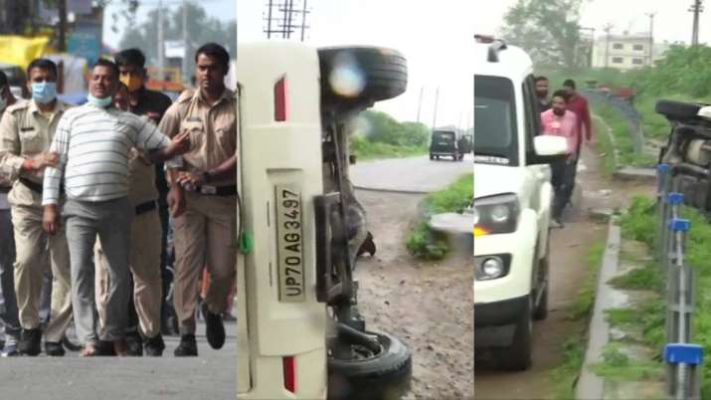
Vikas Dubey, dreaded gangster and prime accused in the killing of 8 police personnel in the Kanpur encounter case, has been killed in an encounter after UP STF’s car carrying the criminal overturned when it was returning from Madhya Pradesh’s Ujjain to Kanpur today amid heavy rainfall.

The incident was reported after Uttar Pradesh police entered the state limits with gangster Vikas Dubey. Doctors in the hospital where Vikas Dubey was rushed after he got injured have pronounced him dead. Meanwhile, information on the injured police personnel and other details are still awaited.

He was brought to Kanpur’s Hallet hospital with bullet wounds. Doctors pronounced him dead.
Police say Vikas Dubey tried to escape after the UP STF car carrying him overturned.
Vikas Dubey attempted to flee by snatching pistol of the injured policemen after car overturned.
Police said that they tried to stop him and surrender, But he fired at the policemen. Vikas was injured in retaliatory firing by police. He was later taken to the hospital, SP Kanpur West said.

Government concerned over return of large number of Indian students from US due F1 visa issues.

The US order of July 7 stating that F1 visas will not be renewed for students if they are attending only online- lectures in the US is a concerning mater for India since the highest number of foreign students in the US are from India. The US government has announced those F-1 and M-1 (non-academic and vocational students) visa holders attending only online classes will not be allowed to remain in the US.

US Noted India's Concerns Regarding F-1 Visa Issue: Centre

India on Thursday said it has reported its concerns to the US govt about the new rule on F1 visa and urged to keep in mind the role education have played in the developing relationship between the two countries.

The concerns were expressed during the virtual foreign office consultations between Foreign Secretary Harsh Vardhan Shringla and US political affairs secretary David Hale on Tuesday. Ministry of External Affairs’ spokesperson Anurag Srivastava said that the US government has looked into the concern regarding the new rule.

During virtual meeting, Srivastava said that India is concerned about the possibility of the return of a large number of Indian students studying in the US due to new rules in visa.

The Immigration and Customs Enforcement (ICE), an agency of the US Department of Homeland Security (DHS) on Monday said that the foreign students pursuing courses in the US must return to their country if their institutes are conducting only online course due to covid-19 pandemic.

Who’s afraid of the monetization of the deficit? The shrill clamour against it!

The harsh fuss against it depends on misguided judgments; fears of swelling need substance.

As the administration grappled with the serious downturn brought about by the novel coronavirus pandemic, some monetary savants encouraged the legislature to go out and spend without stressing over the expansion in open obligation. They said the rating organizations would comprehend that these are irregular occasions. In the event that they didn’t and decided to downsize India, we ought not lose a lot of rest over it.

Rating and basics

Indeed, the choice of the rating office, Moody’s, to minimize India from Baa2 to Baa3 should come as a reality check. The current rating is only one indent over the ‘garbage’ class. Moody’s has likewise held its negative attitude toward India, which recommends that a further downsize is more probable than an overhaul.

The method of reasoning given by Moody’s ought to particularly cause individuals to sit up. The downsize, Moody’s says, has not calculated in the monetary effect of the pandemic. It has to do with India’s essentials before the beginning of the pandemic and the all-inclusive lockdown with which India reacted. The message ought to be sufficiently clear. Any further decay in the essentials starting now and into the foreseeable future will drive India into ‘garbage’ status.

We ought not lose rest over a further downsize and essentially get out of difficulty? Anyone who thinks so is living in cloud cuckoo land. Whatever the failings of the organizations, in the flawed universe of worldwide money that we live in, their evaluations do convey weight. Institutional speculators are to a great extent limited by pledges that expect them to leave an economy that falls underneath venture grade.

In the event that India is minimized to garbage status, remote institutional speculators, or FIIs, will escape in large numbers . The stock and security markets will take an extreme beating. The rupee will deteriorate enormously and the national bank will have its hands full attempting to fight off a remote trade emergency. That is the exact opposite thing we need right now.

Work towards an overhaul

We need to do our absolute best currently to forestall a downsize and achieve an update. To do as such, we have to take note of the key worries that Moody’s has refered to in affecting the current minimization to our rating: easing back development, rising obligation and budgetary area shortcoming. These worries are genuine.

Numerous financial experts as likewise the Reserve Bank of India (RBI) anticipate that India’s economy should contract in FY 2020-21. The consolidated financial deficiency of the Center and the States is relied upon to be in the locale of 12% of GDP. Moody’s anticipates that India’s open obligation should GDP proportion to ascend from 72% of GDP to 84% of GDP in 2020-21. The financial part had non-performing resources of over 9% of advances before the beginning of the pandemic. Powerless development and rising liquidations will build worry in the financial part.

The administration’s spotlight hitherto has been on consoling the money related markets that the fisc won’t turn crazy. It has kept the ‘optional monetary boost’s down to 1% of GDP, a figure that is generally humble comparable to that of numerous different economies, particularly created economies. (‘Optional monetary improvement’s alludes to an expansion in the financial shortfall brought about by government strategy as unmistakable from an expansion brought about by easing back development, the last being called a ‘programmed stabilizer’.

Keeping the financial deficiency on a chain tends to the worries of rating offices about an ascent in the open obligation to GDP proportion. Be that as it may, it does little to address their interests about development. The obligation to GDP proportion will compound and money related pressure will complement if development neglects to recuperate rapidly enough. The administration’s boost bundle depends vigorously on the financial framework to support development. In any case, there is just so much banks can do. Greater government spending is required, particularly for framework.

Clearing confusions

We have to expand the optional monetary boost without expanding open obligation. The appropriate response is monetisation of the shortage, that is, the national bank giving assets to the legislature. Notice ‘monetisation of shortage’ and numerous financial intellectuals will grovel in dread. These feelings of trepidation depend on misinterpretations about monetisation of the shortfall and its belongings.

A typical confusion is that it includes ‘printing notes’. One picture that jumps to mind is the print machines of national banks wrenching out notes with forsake. In any case, that isn’t the means by which national banks subsidize the administration. The national bank ordinarily reserves the legislature by purchasing Treasury bills. As advocates of what is gotten Modern Monetary Theory bring up, even that isn’t required. The national bank could basically acknowledge the Treasury’s record for itself through an electronic bookkeeping section.

At the point when the administration spends the additional supports that have come into its record, there is an expansion in ‘Base cash’, that is, money in addition to banks’ stores. In this way, indeed, monetisation brings about an extension of cash gracefully. In any case, that isn’t equivalent to printing cash notes.

What could be the issue with such an extension in cash flexibly? It may be the case that the extension is inflationary. This complaint has little substance in a circumstance where total interest has fallen pointedly and there is an expansion in joblessness. In such a circumstance, monetisation of the deficiency is bound to raise genuine yield nearer to possible yield with no extraordinary increment in expansion.

Types of the MMT make an additionally striking point. They state there is nothing especially upright about the administration bringing about consumption and giving bonds to banks as opposed to giving these to the national bank. The extension in base cash and consequently in cash gracefully is the equivalent in either course. (The exact succession of national bank exchanges in these two cases and the personality in results is appeared in Macroeconomics by Mitchell, Wray and Watts, three financial analysts who are among the main types of MMT). The inclination for private obligation is deliberate. MMT examples state it has more to do with an ideological inclination for constraining government consumption. In any case, that is a discussion for one more day.

National banks worldwide have depended on gigantic acquisition of government securities in the optional market as of late, with the RBI joining the gathering generally. These are completed under Open Market Operations (OMO). The effect on cash gracefully is a similar whether the national bank procures government securities in the optional market or legitimately from the Treasury. So why the high pitched clatter against monetisation of open obligation?

About swelling control

OMO is supposed to be a lesser evil than direct monetisation in light of the fact that the previous is a ‘transitory’ development in the national bank’s accounting report while the last is ‘perpetual’. In any case, we realize that even purported ‘transitory’ developments can keep going for significant stretches with indistinguishable consequences for expansion. What makes a difference, along these lines, isn’t whether the national bank’s accounting report extension is transitory or perpetual yet how it impacts expansion. For whatever length of time that expansion is monitored, it is difficult to contend against monetisation of the shortfall in a circumstance, for example, the one we are presently faced with.

We currently have an exit from the limitations forced by sovereign appraisals. The legislature must keep itself to the extra obtaining of ₹4. 2 trillion which it has declared. Further optional financial boost must occur through monetisation of the deficiency. That way, the obligation to GDP proportion can be monitored while additionally tending to worries about development. The rating organizations ought to be stressing not over monetisation fundamentally however about its effect on expansion. For whatever length of time that expansion is monitored, they ought not have concerns — and we need not lose rest over a potential downsize.


IMF’s lowering the India’ growth, means the economy will not automatically bounce back

The IMF yesterday brought down its quarterly figure of India’s financial development for 2020-21 to – 4. 5%, from around 1. 9% it had foreseen in April. In only three months, India’s development gauge has been brought down by 6. 4 rate focuses. Alongside a decrease in India’s figure, IMF has brought down the estimate for the remainder of the world. All the significant economies, except for China, are figure to get this year.

This figure ought to be remembered when the administration searches for “green shoots” of recovery. A halfway resumption of monetary movement after the lockdown isn’t equivalent to nascent indications of financial restoration. Truth be told, IMF has additionally brought down its development estimate for one year from now too. We are still at a beginning phase of reviving and it’s impractical to precisely pass judgment on the degree of harm fashioned by the Covid-19 flare-up. In this manner, it’s significant for the legislature to stay focussed on the reviving and be prepared to loan support any place required.

Big loss to China:Chinese apps to lose around USD 6 billion after ban in India.

Chinese  tech giant unicorn ByteDance Ltd. is anticipating a huge loss of over USD 6 billion after ban on its 3 apps including hugely popular video making TIK TOK app in India. The decision was taken by indian government in wake of  unfortunate clash in Galwan valley in Ladakh between Indian and Chinese soldiers which led to death of 20 Indian brave soldiers and more number of casualties in Chinese camps.

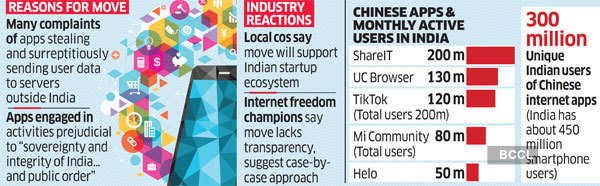
Besides TikTok , India on last Monday banned 58 more Chinese apps including Club Factory, UC Browser and Share it apps for engaging in activities prejudicial to sovereignty  and integrity of India, defence of India, security of India and public order.

India was the biggest market in terms of users . Of the total 611 million  downloads nearly 112 million are from India which is considerably huge. This ban has however sent image to Chinese government that India would never compromise its privacy, sovereignty and integrity.

The Chinese government has been angry over the decision and want us to take back the decision. However the ban period is not clear and the banned apps are claiming that they have not revealed any information to foreign countries even China.

A top official said the government had considered all aspects before taking the decision. “These apps have been there for a long time, and there are some privacy and security issues with them including risks of data going out of the country,” said the person. 

The statement from the Ministry of Electronics and IT (MeitY) said it had received complaints from various sources, including several reports about the misuse of some mobile apps for stealing and surreptitiously transmitting users’ data in an unauthorised manner to servers outside India. 

graph

The ban would surely help in bringing Indian alternatives for the Chinese apps and reduce the dominance of Chinese products in Indian market.