India’s Kashmir Conflict

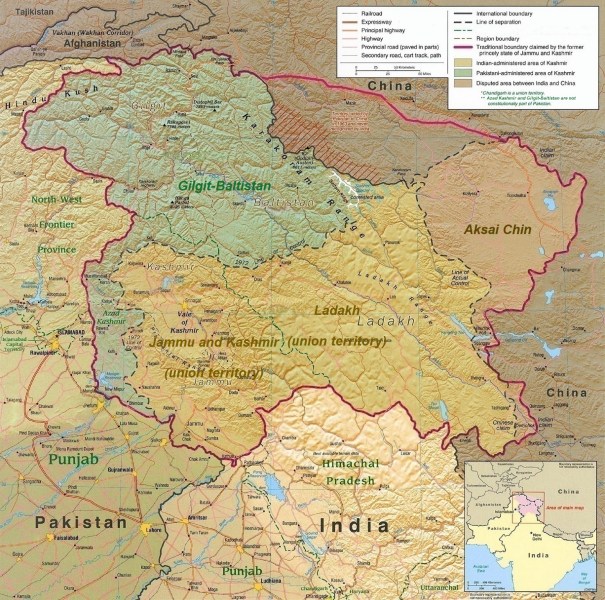
The Conflicted Map Of J&K with Ladakh

With over seven decades crossed since 1947 followed a continuous stretch of never-ending bloodsheds in the Kashmir valley or for the reason of it.  Just in past 27 years, around 41,000 lives have been lost due to this Indo-Pak dispute. The Indian army had lost many of its brave soldiers who sacrificed themselves for the safety and security of people in the valley and rest of India. With more than 950,000 soldiers deployed in Kashmir, making it world’s most strongly guarded place, shows the threat level in the valley. The current Kashmir when compared to the Maharaja Hari Singh’s Kashmir is divided into 3 major parts. Two pieces of territory are illegally occupied by the Pakistan (30%) and China (15%). The regions under Pakistan are Gilgilt, Baltistan and the Pakistan occupied Kashmir (POK) and the region under China is Aksai-Chin which is vastly inhabited by humanity.

The Indian controlled Kashmir (55%) owns 60 per cent of the population of Kashmir in total. The Jammu and Kashmir initially under the Sikh Empire of Maharaja Ranjit Singh, saw a shift in powers with arrival of east India company and british. The empire then switched into the Dogra Empire which was overtaken by Maharaja Gulab Singh and this continued until the independence of India in the year 1947. It was this time, when the britishers before leaving Indian territory kept an opportunity for all the 565 princely states of Indian peninsula to either join an Islamic state named Pakistan or a democratic republic of India. This stretched the long run tensions between the communities of muslims (in favour of an Islamic state) and the rest of people into a massacre of centuries. A bloodshed that no one in the world saw before, it is estimated that up to one million people were killed during the violence in 1947, and around 50,000 women were abducted. Some 12 million people were displaced from their homes in the divided province of Punjab alone, and up to 20 million in the subcontinent as a whole. Few princely states opt to merge with Islamic state of Pakistan and majority of them joined the republic of India. Kashmir on the other side chose to remain an independent state under Maharaja Hari Singh. He decided to stay independent because he expected that the State’s Muslims would be unhappy with accession to India, and the Hindus and Sikhs would become vulnerable if he joined Pakistan. On 11 August 1947, the Maharaja dismissed his prime minister Ram Chandra Kak, who had advocated independence. Observers and scholars interpret this action as a tilt towards accession to India. Pakistanis decided to pre-empt this possibility by wresting Kashmir by force if necessary. Pakistan made various efforts to persuade the Maharaja of Kashmir to join Pakistan. In July 1947, Mohammad Ali Jinnah is believed to have written to the Maharaja promising “every sort of favourable treatment,” followed by the lobbying of the State’s Prime Minister by leaders of Jinnah’s Muslim League party. Faced with the Maharaja’s indecision on accession, the Muslim League agents clandestinely worked in Poonch (west territory of Kashmir) to encourage the local Muslims to an armed revolt, exploiting an internal unrest regarding economic grievances. The authorities in Pakistani Punjab waged a ‘private war’ by obstructing supplies of fuel and essential commodities to the State. Later in September, Muslim League officials in the Northwest Frontier Province, including the Chief Minister Abdul Qayyum Khan, assisted and possibly organized a large-scale invasion of Kashmir by Pathan tribesmen. Several sources indicate that the plans were finalised on 12 September by the Prime Minister Liaquat Ali Khan, based on proposals prepared by Colonel Akbar Khan and Sardar Shaukat Hayat Khan. One plan called for organising an armed insurgency in the western districts of the state and the other for organising a Pushtoon tribal invasion. Both were set in motion.

With Pakistan’s tribesmen invasion, the Kashmir was set on fire, loot, and atrocities to Kashmiris by the Pathan’s were so grieve that it could be hardly penned down. The pathan’s did whatever they could to terrorize Kashmiri’s, they abducted, raped and murdered thousands of girls and women of all ages. This was being done to scare Kashmir and its ruler for their indecision for accession into Islamic state of Pakistan. The Pakistan’s muslim league and its military knew this for sure, that newly formed independent nation of Jammu & Kashmir is heavily outnumbered with its line of defence and weapons. The Maharaja made an urgent plea to Delhi for military assistance. Upon the Governor General Lord Mountbatten’s insistence, India required the Maharaja to accede before it could send troops. Accordingly, the Maharaja signed an instrument of accession on 26 October 1947, which was accepted by the Governor General the next day.

While the Government of India accepted the accession, it added the proviso that it would be submitted to a “reference to the people” after the state is cleared of the invaders, since “only the people, not the Maharaja, could decide where Kashmiris wanted to live.”; it was a provisional accession. The largest political party, National Conference, headed by Sheikh Abdullah, endorsed the accession. In the words of the National Conference leader Syed Mir Qasim, India had the “legal” as well as “moral” justification to send in the army through the Maharaja’s accession and the people’s support of it. The Indian troops, which were airlifted in the early hours of 27 October, secured the Srinagar airport. The visiting journalist at Srinagar city witnessed an incredible sight where volunteers of National Conference (Local political party of Kashmir) was patrolling the city from tribal Pakistani invaders and Minority Hindus, Sikhs were moving freely among Kashmiri Muslims. This was a true example of community harmony in Kashmir.

After securing Sri Nagar, the Indian army troops were set to retrieve other portions of Kashmir, captured by the Pakistani tribesmen and military. Yet, in the meantime the then prime minister of India, Mr J. L. Nehru made an announcement over all India radio, that India would seek United Nation’s (UN) mediation into this matter. This was greatly opposed by the then home minister of India, Sardar Vallabhbhai Patel. Later, with intervention of United Nations group under Sir Owen Dixon (UN mediator) who came up with a plan of seizing the military conflict by mapping a stamp on territories already under control. This led regions already secured by the two countries under their jurisdictions and UN formed a Line of Control between the western and Eastern parts of Kashmir. To this day, India claims the entire region of Kashmir as per the legal instrument of accession signed by the Maharaja of Kashmir, making the whole of Kashmir an integral part of Republic Of India.

Later in the year of 1962, another war broke but this time it was between India and China. The war zone was the regions of Ladakh province to the east of Kashmir. After this Indo-China war of ’62, China captured another part of Maharaja Hari singh territory, the Aksai-Chin. India to this date demands both of its territories and had raised its voice into United Nations Security Council from time to time in the recent past. Whatever is good for Kashmir and safe for Kashmiri dreams should be implemented, to make sure that no more innocent lives are lost, no more brave soldiers are sacrificed for the love of their motherland.
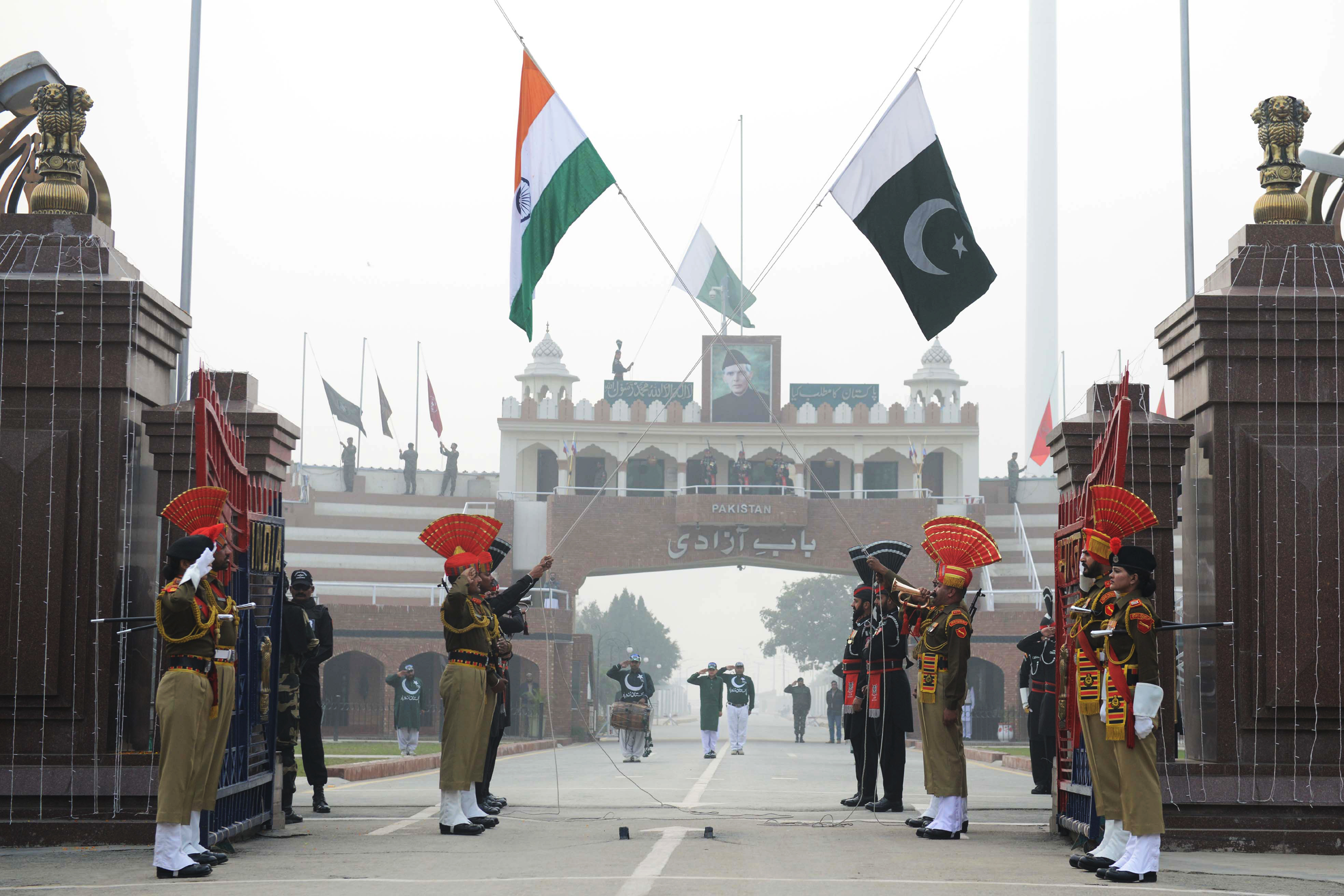
The conflict of Kashmir…

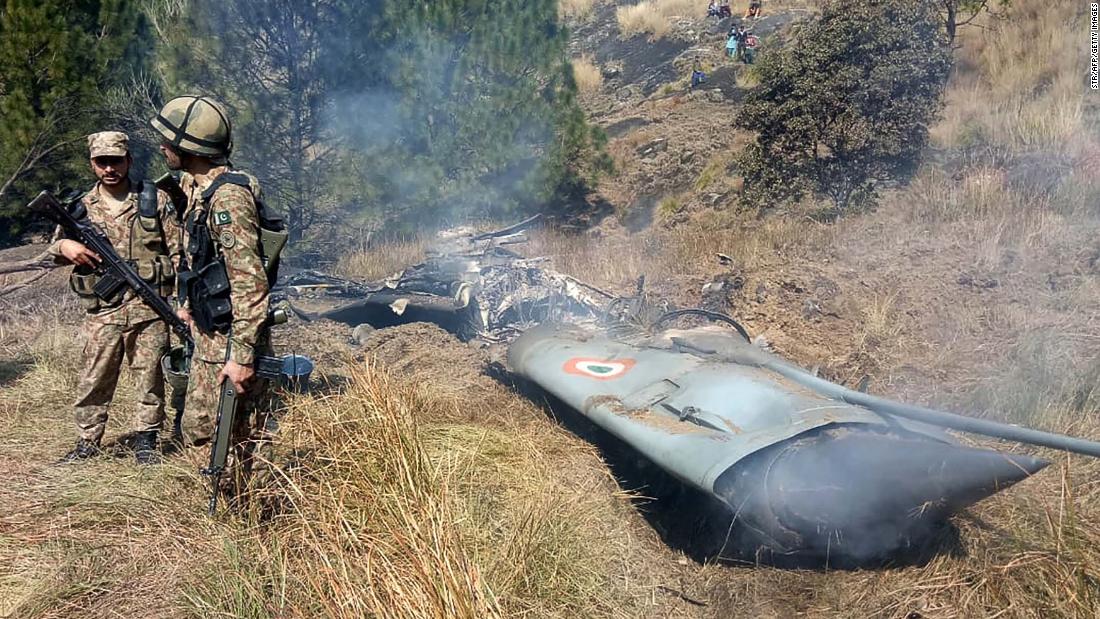
On February 14th 2019, a suicide bomber attacked a convoy of Indian security forces. “We’re getting reports of multiple casualties in a roadside…” He killed at least 40 Indian soldiers here in Kashmir. “The deadliest attack the region has seen this century.” The bomber was part of an Islamic militant group based in Pakistan. “Jaish-e-Mohammed claimed responsibility for that attack.” 12 days later, India carried out airstrikes in Northwestern Pakistan. Then Pakistan shot down at least one Indian aircraft around here. “The most serious escalation in years.” Kashmir is one of the most disputed places on Earth. Over the course of 70 years, it’s been at the center of three wars fought between two massive armies. It’s heavily occupied by more than half a million Indian troops and a deadly collection of militias and terrorist groups.

How Memory of Indian Partition Is Preserved Across Borders | Time
Kashmir is the stage for the relentless conflict between India and Pakistan. But focusing on the two countries can obscure what’s really at stake: The voice of Kashmiris who are caught in a vicious cycle of violence. Kashmir is one of the most strategic places in the world, where 3 powerful countries collide: India, Pakistan, and China. China invaded and took this slice of Kashmir from India. And was given this one by Pakistan. India and Pakistan control these parts, but lay claim to more. This region is at the center of a brutal conflict over these disputed borders. So it’s important to start when they were being drawn. In the mid-1800s, India was a patchwork of several hundred provinces and princely states under British rule. A century later, when British India won independence, the British left and hastily decided to split the region into two. These areas would be a new Muslim-majority country, Pakistan. And this would be the mostly Hindu, but secular, India. The partition was bloody. “Communal hatred flares up within the Punjab.” “1 million people become refugees overnight.” “They flee from savagery and butchery that has never been exceeded, even in India’s stormy history.” Amid the chaos, some princely states were given the choice to join either country. In most cases, the ruling monarchs followed the will of their people. But this state, called “Jammu & Kashmir” was different. It was right along this new border and had a Muslim-majority population, but was ruled by a Hindu monarch. When asked to pick a side, the ruler chose to stay neutral Fearing that the monarch would join India, the Kashmiri population rebelled here in 1947 Armed tribesmen from Pakistan soon joined the fight.

India and Pakistan in Kashmir border skirmish - BBC News
The monarch turned to India for military help and in exchange agreed to join them, which sparked the first Indo-Pakistan war in Kashmir. “Continuing thus increased the threat to world peace and brought the dispute to the eye of the United Nations . The UN Security Council brokered a ceasefire in 1949, which established this line with Pakistan controlling this side and India this one. It also asked Pakistani tribesmen to withdraw and Indian troops to follow, so that Kashmir could hold a direct vote to decide its own future. But neither held up their end of the deal. Pakistan argued that Kashmir’s Muslim-majority population rightfully belonged with them. While India insisted that Kashmir was handed over to them by the Hindu monarch. So they doubled down and added Kashmir to their constution. Both countries continued to tighten their grip around it for many years . “Kashmir. Fighting is going on and heavy casualties in men and equipment have been inflicted on the aggressor.”

India-Pakistan: Latest news on Kashmir crisis
In 1965, the second India-Pakistan war broke out in Kashmir. Thousands of people were killed between the huge armies on both sides. A ceasefire ended the war, but didn’t change this line. Kashmir was kept divided and occupied. And another war broke out in 1971. This time the focus wasn’t in Kashmir — it was in East Pakistan. Here, India helped rebels fight for independence and dealt Pakistan a devastating defeat. This region became a new country, Bangladesh, and Pakistan lost its eastern half. This made Kashmir more important than ever: It became one of the most militarized places on Earth, as India and Pakistan deployed planes, tanks, artillery, and soldiers along the Line of Control. On the political front, in ’87, India reportedly rigged an election, declaring a pro-India party as the winner. Now this was a big turning point for many Kashmiris, who felt they were again denied the chance to vote. Thousands took to the streets in Indian-controlled Kashmir to protest the occupation. But India met the movement for independence with harsh resistance. Which quickly escalated to more violence.
“In January security forces opened fire on demonstrating separatists, turning a two-year old struggling movement into a full-blown popular uprising.” “More than 600 people are killed in clashes between troops and separatists.” Kashmiri militias, just like the Jammu and Kashmir Liberation Front, started recruiting Muslim youth to fight for independence. And increasingly attacked the Indian military. Pakistan saw an opportunity in this insurgency. They helped introduce a new kind of militant group: Radical Islamic fighters who fought for a more pro-Pakistan Kashmir. By the mid ’90s, these groups dominated the insurgency. India responded with incredible military force, deploying 500,000 troops to Kashmir. And they cracked down on militants and protestors. Unarmed civilians were killed and many more were forced to flee the violence. And in ’98 the stakes were raised yet again. “Today India conducted three underground nuclear tests.” “Pakistan today successfully conducted five nuclear tests.” Kashmir became a battleground between two nuclear-armed nations and another war broke out in 1999. “More evidence of the attacks being launched on the Indian-controlled area of Kargil.” “The past two days have seen a number of the fiercest fighting thus far .” “Militant Muslim fighters have also crossed over into some parts of Indian-ruled Kashmir.” The 1999 war ended with another ceasefire, but that did not stop either country.

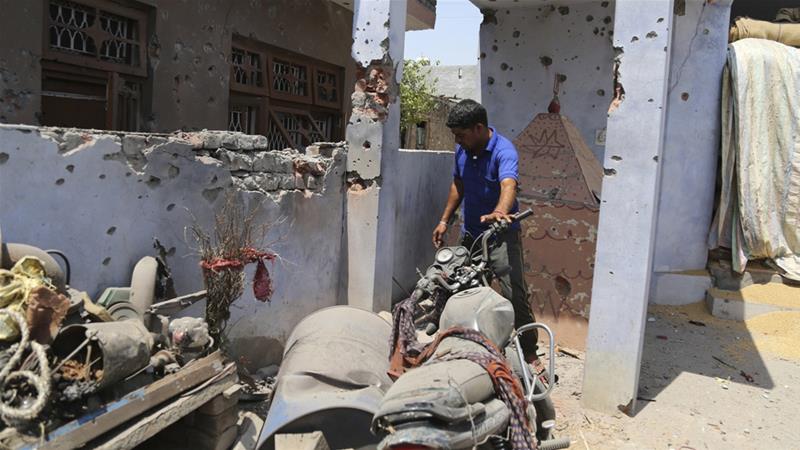
India-Pakistan cross-border shelling hits Kashmir | News | Al Jazeera

Over the years, Pakistan’s militant groups got bolder and launched terror attacks in Kashmir and outside of Kashmir. In 2001, members of Lashkar-e-Taiba bombed India’s parliament building in New Delhi killing 14 people. And in 2008, 10 militants from the same group killed 174 people and wounded 300 in Mumbai. Meanwhile, Indian military cracked down in Kashmir, firing bullets and pellets on unarmed protesters. Leaving hundreds wounded and blind. This is the vicious cycle of violence. The Indian Army’s crackdown drives some Kashmiris to join Pakistani-backed militant groups, who carry out violence against the Indian forces. It’s a cycle that Kashmiri civilians are stuck in the middle of. Which brings us back to 2019. The suicide bomber was 19-year old Adil Ahmed Dar from Pulwama, Kashmir. According to his parents, in 2016, Indian police officers stopped him and humiliated him by forcing his face into the ground. The same year he was shot in the leg at a protest. The next year, Dar left home with his brothers, to join Jaish-e-Mohammed, a Pakistani-supported militia that radicalized him and trained him to be a suicide bomber. A year later, he drove explosives into an Indian military convoy. For more than 70 years India and Pakistan have driven a cycle of violence, retaliation, and exploitation in Kashmir. But beneath it all is the Kashmiri’s wish to make a choice. A wish that continues to be suppressed, again and again, by violence.