India-US a major relation in the world today, says Jaishankar

External Affairs minister Jaishankar on his first visit to U.S. after Biden said the importance of India-US relation: On his first visit to the United States after the end of Trump administration and beginning of the Biden administration, External Affairs Minister S Jaishankar called the relationship of India and US as one of the most important relationships in the world.

On wednesday S Jaishankar told H R McMaster the former national security advisor (during administration of Trump) that “I think our relationship has come a long way. It is, today, one of the major relationships in the world,” during a webcast discussion.

“My own sense is that I Washington today there is a real appreciation of the potential of this relationship … and it’s true of New Delhi as well,” he said. He also added that the challenge today is for the other countries to  learn to work with each other more effectively in this multipolar world.

He further added that “I see a big change in the American mindset in that regard, The United States has not only an enormous ability to reinvent itself, it also has a great ability to assess its situation and re-strategize, in a way. And I do think today that when it comes to the big issues of our day …we have fundamental convergences. Convergences which are societal convergences, which are geopolitical . And I think the challenge before us is how to translate those convergences into actionable policies” .

In July Mr. S Jaishankar gave an statement saying that America need to go “beyond alliance” and should learn how to work in a multipolar world with plurilateral arrangements. But since Biden administration came into power after Trump administration, the country has again started to recommit itself to the multilateralism as a pillar of its foreign policy. During Trump administration major policies were based on the idea of America First.

S Jaishankar also said that “I think there needs to be that realization that this could easily happen to us. In many cases, it has happened to us and the right response, therefore is to help each other out and I am glad to say we’ve [ India] seen a tremendous outpouring of international support and solidarity at this time,”. Mr. Jaishankar emphasised on the changing world after epidemic. Jaishankar also said to world that when you have a big problem the only way out is global cooperation.

Mr. Jaishankar also shared his views on increasing strategic anatomy. He said “I think …the conversations are beginning to change towards more resilience …how do you de-risk the world,“. He also said that world is going to change a lot due to pandemic. He said “We can’t have a world which is part vaccinated and part neglected, because that world is not going to be safe. ‘How do we get through the global challenges in a global way?’ I think that’s the big question,“. He also said regarding the countries pursuing their national interest at the cost of everything else and he said that it is going to cause problems for everyone.


Benefits of internship

Having fair a great degree is not sufficient to guarantee one to have a great work as well in today’s world. Extra capabilities and work experience have presently become a fundamental for a successful career. These are considered as essential as qualifications and degrees. Here comes the need of an internship. Internship is a short-term work experience offered by a company, association or organisation to students or recent graduates for a limited period of time, either paid or unpaid. These are in the form of work experience cum training, volunteership or interning at any company etc. It is more of a learning experience than work which benefits interns by providing entry level exposure to particular fields of industry. Interns spend time working on projects, learning field work, developing soft and hard skills and making industry related connections. Moreover, certain internships do tend to full time job opportunities.

Benefits of internship

>Work experience

The very benefit of any internship is the work experience the interns gain out of it. The sort of experience one gains from internship is something that cannot be obtained through classroom instruction. Interns have the opportunity to make practical use of the skills they acquire and deal with real world challenges.

>Character enhancement and development of skills

While working for an organisation, one learns not only technical skills but also develops soft skills and work ethics. One gets to know about strengths and weaknesses. Internships also provide exposure to real life challenges in work which prove beneficial in future while in full time jobs.

>Gaining confidence

Internships allow interns to put to test the skills and knowledge they acquire in a safe environment that help gain confidence.

> Monetary benefit

Many internships are paid in case of which interns get a chance to earn while learning at the same time.

>Full-time job

Many companies use internships as path of recruitment of skilled freshers. It is more of an easy method wherein the recruiters can train, test and analyse the skills of the interns and later hire them on permanent basis if favourable for the company.

Indian Colourism: Origins and its residual effects


While some people might not be familiar with the concept or term colourism, rest assured for everyone has indulged in it. The oxford dictionary defines colourism as “prejudice or discrimination against individuals with a dark skin tone, typically among people of the same ethnic or racial group.” Perpetuated by both the oppressed and the oppressor alike, it is deeply entrenched in the average person’s psyche. Discussions of such topics are often littered with defensive stances and refusal to believe in one’s own fallacy. People tend to gloss over the microaggressions they partake in every day unbeknownst to themselves.


If we try to look at the roots of the issue and where its origins lie, if there are any, one will find being ruled by fairer-skinned Aryans, Mughals, and Europeans a recurring theme. However, was there no discrimination on the basis of skin in ancient India? The ancient texts portrayed dark-complexioned princes and princesses, gods and heroes in the same light as their fairer counterparts. They were allowed to be heroic and dark and beautiful not in spite of their skin tone but because of it. Lord Krishna’s—whose name means black itself—statues could be dark while Radha’s were made from marble. Times seem to have changed with idols carved in lighter stones selling exponentially more. India’s fanatic obsession hasn’t exempted even gods.


The Britishers moulded the pliable atmosphere after the end of the Mughal rule to their benefit. They were modernized and scientific here to save the uncivilized natives from our erroneous ways. They were symbols of power, class, and status. Who wouldn’t want to be like them? If dogs and Indians were not allowed inside exclusive clubs, who wouldn’t want to shed a part of them for a better life? Thus, colourism unfurled its tendrils. If you weren’t white, be the next best thing. Being white adjacent would land you better opportunities. With the English came the Eurocentric beauty standards. Other places have loosened these to let in talents from diversified backgrounds, but India is still stuck with the remnants of British rule.  


  Manufacturers seized the perfect opportunity by preying on the insecurities of the general public who desperately longed for upward mobility to escape from their circumstances. In 2019, the Indian skin lightening industry was reportedly worth nearly Rs 3000 crore. Bollywood jumped on the bandwagon and ingrained in all our minds that only fair can be attributed to lovely. With whitewashing actors in commercials and casting only fair actresses as love interests, the message was clear: there is no space for dark-skinned actors to be leads in a country of dark-skinned people.


We have internalized the messaging and bigoted ideals. So much to find fair attached to qualities in every matrimonial. To use skin bleaching and lightening products even after knowing their harmful effects. We have attached our self-worth and ability to be seen as desirable and worthy of respect and love to the shade of our skin. We have broken the hearts of millions of innocent kids who would grow to doubt themselves because what they see in the mirror will always resemble the dirt beneath their feet more than it ever does their favourite actor. Change is long overdue.  


Cyclone Tauktae

The Tropical Cyclone Tauktae has crossed Kerala, Karnataka, Goa, Mumbai. The cyclone made it way north towards Gujarat on Monday evening.


There were heavy rains along the regions covering the coastline of the Arabian Sea. The winds blew stronger and the rains were heavier today in Maharashtra. Even though many cities are still in lockdown and everyone is safely in their homes sheltered the cyclone has caused a few damages and also cost lives. The state of Maharashtra has also experienced heavy rainfall rains in Konkan, Mumbai, Palghar, Raigad and Thane regions on 17th of May that is Monday.


The Indian Meteorological Department or IMD had informed that Mumbai is not under the direct threat of the cyclone Tauktae. However, it was predicted to pass through the sea cost of Mumbai. The India Meteorological Department (IMD) is an agency of the Ministry of Earth Sciences of the Government of India. It is mainly responsible for meteorological observations, weather forecasting and studying the changes in the tectonic plates and prediction of earthquakes and other natural disasters.
The news channels showed pictures of the sea, the high tides, water getting accumulated on the roads causing the vehicles to get stuck, potholes getting filled with rain water and trees falling on the road. The power lines have been cut off in some areas for a certain period of time and issues in the internet connectivity is seen due to the cyclone.


15 fishermen who went to sea are found missing in Kozhikode. Kozhikode is also know as Calicut, a city in Kerala. The water level in many dams across Kerala increased immensely after heavy rains were seen. The Cyclone Warning Division of the Indian Meteorological Department (IMD) informed that the wind speed is expected to increase to 150-160 km per hour. Around 1.5 lakh people are being shifted from low lying coastal areas in Gujarat and 54 teams of the National Disaster Response Force (NDRF) and State Disaster Response Force (SDRF) have been deployed in Gujarat beforehand.
It is very important that we keep ourselves updated with the latest incoming news regarding the cyclone in order to keep ourselves braced and prepared for emergency situations like this.


Precautions to take when informed about a cyclone beforehand are given below:
Keep the mobile phones fully charged for emergency.
Keep in handy the emergency numbers of Disaster Management National / District / Region or Maharashtra Control Room contact information.
Do not keep the mobile phone on charging and use it simultaneously.
Make sure that torches or other emergency lights are in working condition.
It is important to keep food, especially medicines and other essential things stored in the house to avoid stepping outdoors unnecessarily.
Keep the important documents handy and keep them all together in a safe place.
The gas pipeline should be switched off when not needed.
Stay away from broken buildings and structures since they are more prone to damage.
Vehicles should be safely parked in the areas where there is less possibility of water getting accumulated.

Changes in the rights given to Overseas Citizens of India (OCI), will be considered foreign nationals

India has changed the rights given to Overseas Citizens of India (O.C.I.) and placed them in the category of foreign national in various cases. Through the new notification issued under the Citizenship Act 1955, many restrictions have also been imposed on them.

The new notification will replace the three notifications issued in April 2005, January 2007 and January 2009. The government has taken this step after the defeat in recent cases related to it.
In a case the Home Ministry had revoked the O.C.I. status of an American-Indian doctor. He was preaching religion in Bihar giving treatment to the poor.
Although the practice of preaching the religion was exempted by the Delhi High Court for the doctors, as there was no law to stop the O.C.I. from doing so. Doctor was also asked to issue O.C.I. card back. 
In another case, the Karnataka High Court had asked O.C.I. students to be treated as Indian citizens during their admission in various courses.
By 2020, a total of 60 lakh people in the world have O.C.I. cards. These cards are given to such people and their matrimonial companions who are of Indian origin, people of Indian origin whose next generations became citizens of Pakistan and Bangladesh. 
O.C.I. card holders get an opportunity to live and work in India indefinitely. Like Indian citizens, many rights are also available.
Although they do not get Indian citizenship, neither can they vote and nor can get government post. The government can withdraw the OCI card whenever it wants.
Now O.C.I. will have to get special permission from research work to missionary or tablighi events in the country. The Ministry of Home Affairs will also have to take permission for journalism and its related activities and to go to various prohibited, restricted and protected areas. An important impact of the notification will be on O.C.I. journalists serving foreign institutions. They have to get permission from the Ministry of Home Affairs to work in India.
The O.C.I. category of people who are empowered in FEMA have also been considered as foreign nationals for activities under FEMA in the economic, financial and education sectors in the country. In this law enacted in 2003, till now they had rights like NRI.

High demand of Indian vaccines, lower than expected no. of Indian people getting vaccinated

The Delhi High Court on Thursday said that Corona vaccines are being donated to other countries, vaccines are being imported abroad, but vaccines are being given to Indians people at lower capacity. The court directed the central government to submit an affidavit by March, to argue the rationale for the classification of vaccinations. Also, the vaccine companies Serum Institute and Bharat Biotech have been asked to explain their manufacturing capacity. The court hearing is due for
the matter on 10 March.

A bench of Justices Vipin Sandhi and Justice Rekha Pali said during the hearing on the PIL of the Bar Council, “Serum Institute and Bharat Biotech can make more vaccines, but it does not seem to be happening.” In fact, in the second phase, the government has approved to give free vaccine to all the elderly above 60 years and those suffering from certain diseases above 45 years of age.
The bench said, Corona cases in the country have started to increase again, so what is the reason for controlling vaccination. It is important to have a sense of responsibility and immediate need. On this, the Additional Solicitor General Chetan Sharma and Advocate Anil Soni told the court that this is a policy decision after consultation with experts. The petition has demanded that all people associated with the justice system, including judges, be declared front-line employees, so that they get priority in getting vaccinated.
India has a huge population and a large part of total population is still to be vaccinated, therefore vaccinating Indians should be prioritized. Due to negligence of the rules of social distancing and other precautions by the people has caused a resurge in the number of corona cases.
On Thursday, for the first time in the last 34 days, the maximum number of new corona cases has been found in a single day. 34 days later 17 thousand new patients were reported. Of these, 860 patients are in only six states.
On Wednesday, 89 patients died of corona. 14,031 patients were also discharged. Earlier – on January 28, 18 thousand patients were found in one day. Since then, their number was continuously reduced.

Poor cyber security – Chinese cyber attacks on Indian vaccine development company servers

The claims of cyber intelligence agencies related to Chinese cyber attacks in India are very important in view of the country’s cyber security. One of these claims is related to US cyber intelligence company Future Recorded, which in its latest report has feared that China’s cyber attack may be responsible for the failure of the power grid in Mumbai last year. 

Reports suggest that labs of two Indian companies that make power grid and COVID vaccine were under Chinese cyber attack. These cyber attack attempts have not only exposed but also have given a future warning for cyber security,

Cyberma, the cyber intelligence firm of rating agency Goldman Sachs, claims that the servers of two Indian companies, Serum Institute and Bharat Biotech, engaged in the manufacture of the Corona vaccine, had been targeted by Chinese hackers for the past few weeks. Certainly these claims of cyber intelligence agencies are yet to be confirmed, but the threat of cyber attack from China is not new, even if it gives a million explanations. 

According to a New York Times report related to Future Recorded’s claim, in Ladakh when tension between India and China was at its peak, on October 12 last year, the power grid was targeted by a Chinese cyber attack that stalled power supplies in India’s commercial capital for several hours, and in the treatment of Corona patients which was a big obstacle. 

There is no reason to doubt the assurance of the Union Ministry of Power that cyber monitoring mechanism is working in the entire power supply system of the country. Not only this, the Indian Computer Emergency Response Team (CERT), the cyber security agency of India, is also not only fully prepared, but has also given power system operation corporation (POSOCO) handling the power grid in the country about the risk of possible cyber attack ,were also warned in November last year. Since cyber attack can be carried out with malware from thousands of kilometers away, there is a need to be very vigilant. 

Future Recorded’s report only shows the severity of this new threat, according to which how a country can be severely harmed without using weapons or fighting nuclear war, by putting malware in the electric grid or other sensitive infrastructure. The methods will not work, we need to be prepared to deal with cyber threats.

Changes in the National Food Security Act

 The NITI Aayog recently circulated a discussion paper on a proposed revision in the National Food Security Act (NFSA), 2013. The NFSA provides a legal right to persons belonging to “eligible households” to receive foodgrains at subsidised price– rice at Rs 3/kg, wheat at Rs 2/kg and coarse grain at Rs 1/kg — under the Targeted Public Distribution System (TPDS). These are called central issue prices (CIPs). A revision of CIPs is one of the issues that have been discussed. The other issues are updating of the population coverage under the NFSA, and beneficiary identification criteria.

Under sub-section (1) of Section 3 of the Act, the term “eligible households” comprises two categories — “priority households”, and families covered by the Antyodaya Anna Yojana (AAY). Priority households are entitled to receive 5 kg of foodgrains per person per month, whereas AAY households are entitled to 35 kg per month at the same prices. Under Schedule-I of the Act, these subsidised prices were fixed for “a period of three years from the date of commencement of the Act”. While different states began implementing the Act at different dates, the deemed date of its coming into effect is July 5, 2013, and the three-year period was therefore completed on July 5, 2016.

However, the government has yet not revised the subsidised prices. The government can do so under Schedule-I of the Act, after completion of the three-year period. To revise the prices, the government can amend Schedule-I through a notification, a copy of which has to be laid before each House of Parliament as soon as possible after it is issued. The Act has prescribed the coverage under “eligible households” — 75% of the rural population and up to 50% of the urban population. On the basis of Census 2011 figures and the national rural and urban coverage ratios, 81.35 crore persons are covered under NFSA currently. This overall figure has been divided among the states and Union Territories, based on the NSSO Household Consumer Expenditure Survey 2011-12. In its discussion paper, the NITI Aayog has suggested that the national rural and urban coverage ratio be reduced from the existing 75-50 to 60-40. if this reduction happens, the number of beneficiaries under the NFSA will drop to 71.62 crore (on the basis of the projected population in 2020).

To make these changes in the law, the government will have to amend sub-section (2) of Section 3 of the NFSA. For this, it will require parliamentary approval.

Besides the Food Ministry and the NITI Aayog, discussions on the proposed revisions include the Chief Economic Adviser and top officers of the Ministry of Statistics and Programme Implementation. According to sources, several meetings have been held under the chairmanship of Prof Ramesh Chand, Member, NITI Aayog, to review the population coverage criterion. If the national coverage ratio is revised downward, the Centre can save up to Rs 47,229 crore (as estimated by the NITI Aayog paper). However, the move may be opposed by some of the states.

On the other hand, if the rural-urban coverage ratio remains at 75-50, then the total number of people covered will increase from the existing 81.35 crore to 89.52 crore —an increase of 8.17 crore. This estimate by the NITI Aayog is based on the projected 2020 population, and, according to the paper, will result in an additional subsidy requirement of Rs 14,800 crore.

Lok Sabha passed the abortion amendment bill, a big step for women's right

All major religions across the world believe that life is a creation, so a person does not have the right to end someone’s life. Voluntary abortion is a punishable offense in India. The right to life is a fundamental right in the Constitution of India. 

Some people believe that reproduction and abortion are a woman’s personal choices and rights. On the other hand many people believe that the ultimate duty of the state is to protect life, not to take life. 
They consider full protection as an integral part of life and abortion as immoral. 
After a great long debate in England, the abortion law was first enacted in 1967 after protests and amendments were made from time to time. There, abortion is allowed only on specific and prescribed basis. In 1973, abortion was legalized by the Supreme Court of America on special grounds and circumstances.
Under the Medical Abortion Act, 1971 in India, abortions can be done up to 12 weeks on the basis of a doctor’s opinion and up to 20 weeks based on the opinion of two doctors, if the life of a pregnant woman and her mental or physical health are in deep danger . Rape can lead to miscarriage within 20 weeks of conception, including failure of pregnancy and birth control measures, or even in the case of a fetus abnormality. There has been a demand for this law amendment in India for a long time. 
The Medical Termination of Pregnancy Amendment Bill, 2020 was introduced in the Lok Sabha on March 2, 2020 by Dr. Harsh Vardhan, Union Health Minister, was passed by the Lok Sabha after discussion on 17 March. There is a proposal for some amendment to increase the upper limit of abortion from 20 weeks to 24 weeks. The bill is in the interest of rape victims, family sexual harassment, sexual protection of minors and personal dignity and female self-respect. It is proposed in the Bill to decide whether a pregnancy can be terminated after 24 weeks in cases of fetal abnormality.
In some cases abnormal fetus or unwillingness are life-threatening situations to the fetus and woman, due to which the abortion will now be done on the prescribed procedure and on a certain basis. Hopefully, the Rajya Sabha will also pass it in the current session. This amendment bill is progressive, fulfills a long expectation and conforms to and empowers the dignity and autonomy of women.

Lok Sabha passed the abortion amendment bill, a big step for women's right

All major religions across the world believe that life is a creation, so a person does not have the right to end someone’s life. Voluntary abortion is a punishable offense in India. The right to life is a fundamental right in the Constitution of India. 

Some people believe that reproduction and abortion are a woman’s personal choices and rights. On the other hand many people believe that the ultimate duty of the state is to protect life, not to take life. 
They consider full protection as an integral part of life and abortion as immoral. 
After a great long debate in England, the abortion law was first enacted in 1967 after protests and amendments were made from time to time. There, abortion is allowed only on specific and prescribed basis. In 1973, abortion was legalized by the Supreme Court of America on special grounds and circumstances.
Under the Medical Abortion Act, 1971 in India, abortions can be done up to 12 weeks on the basis of a doctor’s opinion and up to 20 weeks based on the opinion of two doctors, if the life of a pregnant woman and her mental or physical health are in deep danger . Rape can lead to miscarriage within 20 weeks of conception, including failure of pregnancy and birth control measures, or even in the case of a fetus abnormality. There has been a demand for this law amendment in India for a long time. 
The Medical Termination of Pregnancy Amendment Bill, 2020 was introduced in the Lok Sabha on March 2, 2020 by Dr. Harsh Vardhan, Union Health Minister, was passed by the Lok Sabha after discussion on 17 March. There is a proposal for some amendment to increase the upper limit of abortion from 20 weeks to 24 weeks. The bill is in the interest of rape victims, family sexual harassment, sexual protection of minors and personal dignity and female self-respect. It is proposed in the Bill to decide whether a pregnancy can be terminated after 24 weeks in cases of fetal abnormality.
In some cases abnormal fetus or unwillingness are life-threatening situations to the fetus and woman, due to which the abortion will now be done on the prescribed procedure and on a certain basis. Hopefully, the Rajya Sabha will also pass it in the current session. This amendment bill is progressive, fulfills a long expectation and conforms to and empowers the dignity and autonomy of women.

The new Information Technology Rules

The government recently released a set of guidelines to regulate social media and OTT content providers like Netflix and amazon prime. The prime concern behind this was an alleged misuse of social media, especially for the events that unfolded on January 26, 2021. What exactly is the rules’ impact?

Section 79 of the Information Technology Act provides a ‘safe harbour’ to intermediaries that host user-generated content, exempting them from liability for the actions of users if they adhere to government-prescribed guidelines. However, the new guidelines prescribe an element of due diligence to be followed by the intermediary, failing which the safe harbour provisions would cease to apply to these platforms and they could be held liable.

The guidelines also prescribe a grievance redressal mechanism by mandating that the intermediaries should establish a mechanism for receiving and resolving complaints from users. These platforms will need to appoint a grievance officer to deal with such complaints, who must acknowledge the complaint within 24 hours, and resolve it within 15 days of receipt.

Surprisingly, the guidelines also lays down 10 categories of content that the platforms should not host, including content that “threatens the unity, integrity, defence, security or sovereignty of India, friendly relations with foreign States, or public order, or causes incitement to the commission of any cognizable offence or prevents investigation of any offence or is insulting any foreign States”; “is defamatory, obscene, pornographic, paedophilic, invasive of another’s privacy, including bodily privacy; insulting or harassing on the basis of gender; libellous, racially or ethnically objectionable; relating or encouraging money laundering or gambling, or otherwise inconsistent with or contrary to the laws of India”, etc. which are vague enough to arouse concerns about arbitrary censorship.

The rules also stipulate that upon receipt of information about the platform hosting prohibited content from a court or the appropriate government agency, it should remove the said content within 36 hours. The penal provisions for violating these guidelines vary from imprisonment for three years to a maximum of seven years, with fines starting from Rs 2 lakh. Executives of intermediaries which fail to act on an order issued by the government citing threat to sovereignty or integrity, defence, security of the state or public order, can be jailed for up to a period of seven years under Section 69 of the IT Act.


Hence, a watchful eye must be kept on how these rules are used to ensure we don’t descend into only consuming content the government wants us to consume in a censorship regime.

FUEL PRICE SURGE ADDS TO THE WOES OF PANDEMIC HIT INDIA

The oil marketing companies have continuously been surging the price of fossil fuels for the past few weeks which resulted in the prices reaching an all-time high. During a time when the country is struggling to recover from the covid crisis, the fuel price hike is sure to have a tremendous impact on its citizens and economy. The rise in the price of commodities and public transportation are expected along with a significant dip in the automobile industry. Today, the price of LPG cylinders have been increased by 25 rupees, resulting in a cumulative hike of about 200 rupees within the past three months.

India, being the third-largest importer of oil in the world has always ended up on the suffering end whenever the crude oil price has seen a surge in the international market. The recent firming of international crude oil rates in addition to the high taxes levied on fuel by central and state governments is the major reason for the extremely high fuel price in the country. Since India follows a dynamic system for altering fuel rates, oil marketing companies are mostly responsible for the recent hikes and the government has no control over it. However, the government does impose a tax on the base price of fuel. At the moment, Indians pay one of the highest taxes on fuel in the world.

By late January, the price of extra premium petrol has touched the magic digit of 100 at Rajasthan, with Madhya Pradesh and many other states following the trend in early February. The price of diesel has also set the record of reaching an all-time high in the past days. A remarkable fact is that the Indian citizens are paying about 200% of the actual fuel price as taxes, by far the highest anywhere in the world. Sources close to the oil companies have reported that the fuel prices might see a further hike as the companies will be forced to meet the global developments to avoid making losses on the sale of the fuels. The price of LPG is also on the rise with the surge being constantly climbing higher for the third in this month itself. Within the last 10 days, the price of LPG was increased by more than 50 rupees.

The government is looking forward to getting the situation under control as the surge in the price of auto fuels can directly reflect in its economy and might even result in inflation. Though short term remedies like cutting down taxes and other related costs are in line, the major emphasis is on turning towards sustainable and renewable energy resources and reducing the dependency on fossil fuels in the long run. Plans have already been laid on increasing the natural gas share in the energy basket and to cut short the reliance on fossil fuels to about 60% of the total energy share by 2030.

Unfortunate That The Properties Of Religious And Charitable Institutions Are Being Usurped By Criminals

It is most unfortunate, most alarming and most reprehensible that none other than the Allahabad High Court which is the biggest court in whole of Asia has observed most seriously in a latest, learned, laudable and landmark judgment titled Bharat Das @ Ram Newaz Singh v. State of U.P. in Bail No. 8577 of 2020 delivered on 5 February 2021 that, “It is unfortunate that the properties of religious and charitable institutions are being usurped by criminals. This serious observation was made while dismissing the bail application filed by a man accused of selling properties of a Math (Akhil Bhartiya Udasin Sangat Thakurji Virajman Thakurdwara Jhaaulal) on the basis of forged and fabricated documents in favour of the land mafias. How can criminals be ever allowed to usurp the properties of religious and charitable institutions? But this is happening in reality as has been acknowledged by none other than the Allahabad High Court!

To start with, the ball is set rolling first and foremost in para 1 of this brief, brilliant, blunt and bold judgment wherein it is stated that, “The present petition under Section 439 Cr.P.C. has been filed seeking bail in FIR No.0584 of 2019, under Sections 406, 419, 420, 467, 468, 471, 506 IPC, Police Station P.G.I., Lucknow.”
To put things in perspective, the Bench then elaborates on the facts of the case stating in para 2 that, “The complainant claims to be Mahant Sarvarakar (Jere-Intejaamkaar) of Akhil Bhartiya Udasin Sangat Thakurji Virajman Thakurdwara Jhaaulal (herein after referred to as ‘the Math’). He is responsible for taking care of and managing properties of the Math and securing interest of the Math. It is also said that the complainant has been declared successor of Mahant Parmeshwar Das in the year 2002 unanimously and a Division Bench of this Court vide judgment and order dated 11.01.2016 passed in Writ Petition (Consolidation) No.130 of 2011 has declared him to be the legal heir and successor of Mahant Parmeshwar Das. Copy of the order dated 11.01.2016 was also annexed with the complaint. It is also alleged in the complaint that many imposters claiming to be Mahant of the Math in connivance with the land mafias have sold several properties and land of the Math illegally without taking permission from the District Magistrate. It is further alleged that the present accused-applicant who is a convict and a dreaded criminal by imposting himself as Mahant of Math had been involved in selling the properties of the Math illegally and fraudulently to the land mafias.”
While elaborating further and continuing in a similar vein, the Bench then observes in para 3 that, “The Math has land in Gata Nos.436, 296, 427A, 426, 531, 1951Ka, 1953Ka, 1955Ka, 1960Ka Kalli Paschim, Pargana Bijnore, Tehsil Sarojini Nagar, Lucknow. This land is being transferred on the basis of forged and fabricated documents by a gang of land mafias to earn huge money. Ex-guru of the complainant Somvansh Das had died on 14.04.1980. However, an imposter got his will registered on 04.04.2003 in the office of Dy. Registrar, Lucknow in respect of Gata No.436 and on that basis, this imposter has transferred 3 Bigha land in favour I.K. Singh, 5 Bigha land in favour of Sanjay Tiwari, 1 Bigha 13 Biswa 13 Biswanshi land in favour of Prabhu Nath Tiwari. Forged will got registered by Bharat Singh and the accused-applicant in furtherance of criminal conspiracy and, thereafter accusedIshwar Kant Singh imposted himself as Mahant Parmeshwar Das and transferred the land of Gata No.436 in favour of Satendra Singh Sikarwar on 05.08.2004 for Rs.20,00,000/-. Thereafter, Bharat Singh and the present accused-applicant again transferred the land in Gata Nos.436 and 296 by imposting Ishwar Kant Singh as Parmeshwar Das on 23.11.2016 for a sale consideration of Rs.20,00,000/-. Anil Kumar Singh transferred this land for 3rd time in Gata No.436 on 20.01.2007 in favour of Smt. Manisha Chola and Rekha Gupta. Thereafter, the accused-applicant and Bharat Singh on the basis of forged and fabricated documents of the land in Gata Nos.296, 427A, 426 and 531 executed an agreement for Rs.12,00,000/- on 20.02.2007 in favour of Bharat Singh himself from the accused-applicant and on 16.03.2007 the land was transferred in Gata No.531 in favour of Alpana Gupta for a sale consideration of Rs.36,27,100/-. For the fifth time accused-Bharat Singh and the accused-applicant by imposting Indra Kant Singh as Parmeshwar Das transferred Gata Nos.436 and 296 in the year 2006 in favour of Raj Babu Rastogi. Thus, accused-Bharat Singh and the accused-applicant, Satyendra Kumar Sikarwar, Anil Kumar Singh, Gyaneshwar Singh, Kaushal Kumar, Santosh Singh, Kalpana Gupta, Raj Babu Rastogi had transferred the land of the Government in Gata No.436 and 296 on the basis of forged and fabricated documents. On the basis of forged will which got executed after 23 years from the death of Mahant Somvans Das, these accused have cheated Rs.1.5 Crores by selling the land of the Math on the basis of forged and fabricated documents. These accused had threatened the complainant of his life and had said that they would usurp entire property and land of the Math. On the basis of the aforesaid complaint, the FIR in question has been lodged.” 
Of course, it is then observed in para 4 that, “It is alleged that the present accused-applicant is an imposter who is selling Math land in an illegal manner. Several instances of the cases pending against the accused-applicant have been given in the complaint and, it is alleged that the present accused-applicant has sold the land in Gata Nos.2119, 2118, 676, 2263 also.”
As a corollary, what follows next is then stated in para 5 that, “On the basis of aforesaid complaint, the FIR in question came to be registered against the accused-applicant and other named accused at FIR No.0585 of 2019 under Sections 34, 419, 420, 467, 468, 471, 427, 447, 504 IPC, Police Station P.G.I., Lucknow.”
As we see, para 6 then enunciates that, “It is stated that the accused-applicant has been awarded life imprisonment in Sessions Trial No.46 of 1984 and has been found guilty for offence under Sections 307/34, 301/34, 304/34 IPC. It is further alleged that on 12.02.2007, the accused-applicant acted as an imposter of Mahant executed ikrarnama in favour of Bharat Singh and others. He has also been convicted in Sessions Trial No. 242 of 1979 for offences under Sections 364/149, 302/149, 307/149 IPC and was awarded life imprisonment. In the FIR, it is further alleged that the accused persons by using false and fabricated documents illegally bought and sold the property of the Math by threatening the complainant.”
To be sure, it is then stated in para 7 that, “An affidavit in support of the bail application has been filed by Baba Jeetu Das, son of Mahant Baba Bharat Das.”
It cannot be glossed over that it is put forth in para 9 that, “Learned counsel for the accused-applicant submits that the complainant has falsely claimed that Mahant Parmeshwar Das was Jere-Intejaamkaar of the Math and the informant is the chela of Mahant Parmeshwar Das. The fact of the matter is that the present accused-applicant succeeded as Jere-Intejaamkaar of the Math after demise of Mahant Ramji Das and an order dated 16.07.2005 was passed by Consolidation Officer, Sadar, Lucknow to this effect in Case No.88 of 2005. Present accused-applicant is jere-intejaamkaar of the properties of the land in question till date. Mahant Parmeshwar Das has executed a declaration deed duly registered in the Office of Sub Registrar on 07.09.2012 declaring that the complainant was a dishonest person and wanted to usurp land and properties of Math. The complainant was not the chela of Mahant Parmeshwar Das as claimed by him. Mahant Parmeshwar Das himself had moved an application against the complainant in Police Station Kotwali Chowk on 14.09.2012.”
While stating the factual position, it is then noted in para 10 that, “The correct facts are that Mahant Ramji Das was chela of Somvansh Das and the accused-applicant is chela of Mahant Ramji Das. Allegation against him that he had executed a forged will, is wholly incorrect. Learned counsel has also submitted that the land sold by him was for the purposes of maintaining the Math and for better management of the properties. It has been further submitted that the present complainant himself has a criminal history.”
Furthermore, it is then envisaged in para 11 that, “It is further submitted that in Civil Suit No.155 of 1994 vide judgment and order dated 24.10.1995 passed by Civil Judge by which the present accused-applicant has been declared as successor of Mahant Ramji Das and on the basis of the order dated 18.11.2004 passed by the Consolidation Officer, Sadar Lucknow, name of the accused-applicant has been mutated while deleting the name of Jere-Intejaamkaar, Mahant Baba Ramji Das. Settlement Officer had dismissed the appeal filed against the order passed by the Consolidation Officer and, thereafter the revision was also dismissed by the Additional District Magistrate (Finance and Revenue) vide his order dated 26.04.2010.”
It is worth noting that it is then stated in para 12 that, “A Writ Petition No.130 (Consolidation) of 2011: Mahant Parmeshwar Das vs Additional Collector ‘Finance and Revenue’, Lucknow is pending in this Court. Counter affidavit was filed by the accused-applicant in 2014 but till date the rejoinder affidavit has not been filed and the writ petition is still pending.”
On the one hand, it is stated in para 13 that, “Learned counsel for the accused-applicant has submitted that in many cases mentioned against the accused-applicant, he has been either acquitted or he is not involved in the commission of the offence. He, therefore, has submitted that the accused-applicant himself is grabbing the property of Math and he wants to put the present accused-applicant aside and, therefore, false cases are being instituted against him. The accused-applicant has been in jail since 23.07.2020 and, therefore, he is liable to be enlarged on bail.”
On the contrary, it is then stated in para 14 that, “On the other hand, Mr. Rao Narendra Singh, learned AGA has submitted that it has come in the investigation of the offence that the present accused-applicant fraudulently after preparing forged and fabricated documents, had been selling the properties of the Math by imposting himself as Mahant of the Math whereas he has no right to sell the properties. The accused-applicant had been convicted for life by the III-Additional District Judge, Fatehpur in the year 1981. He is a history sheeter of District Fatehpur and several cases are registered against him.”
It cannot be lightly dismissed that it is then unearthed in para 15 that, “To avoid the police action, he came to the Math as Mahant and as soon as Mahant Ramji Das died, he declared himself as Mahant of the Math by forging the stamp of Gram Sabha Babutha Kala without there being any witness. The fact is that successor of Mahant Ramji Das Ji is his chela, Chacha Dayal Das Awasthi and the Court has declared him to be successor and Mahant of the Math. Present accused-applicant had killed Baba Dayal Das and declared himself to be the successor of Ramji Das. He has also killed Basraj Singh, the witness of the murder of Mahant Dayal Das Awasthi. Mangement of U.P. Udaseen Sampradaya Prabhandh Trust had extricated the present accused-applicant as Mahant on 06.03.2020.”
Damningly, the Bench then also makes it known in para 16 that, “The accused-applicant had presented several of his gang members as imposters of Baba Parmeshwar Das. 23 years after the death of Mahant Soman Das, the accused-applicant had got the forged will registered by imposter of Baba Soman Das.”
More damningly, the Bench then castigates in para 17 stating that, “Despite order passed by the High Court in the writ petition filed by Parmeshwar Das in which stay was granted regarding disposing of the land of the Math, the accused-applicant got registered a forged trust deed namely, Thakur Ji Maharaj Trust and showing his members as disciple (chela) and declared him as treasurer. He started transferring entire money of the Math. The accused had executed several sale-deeds fraudulently on the basis of forged and fabricated documents in favour of the land mafias and there are sufficient evidence against him for committing the offence.”
Most damningly, the Bench then discloses in para 18 bringing out that, “In the counter affidavit, it has been stated that so far following 15 cases have been found against the accused-applicant and investigation is on in respect of other cases:- 
(i) Case Crime No.198/1978, under Section 13 Gambling Act, Police Station Thariyaon, Fatehpur. 
(ii) Case Crime No.199/1978, under Section 25 Arms Act, Police Station Thariyaon, Fatehpur.
(iii) Case Crime No.112/1983, under Section 307 IPC, Police Station Thariyaon, Fathepur.
(iv) Case Crime No.185/1985 under Section 364/302 IPC, Police Station Thariyaon, Fatehpur. 
(v) Case Crime No.14/17, under Section 147, 148, 149, 302, 309 IPC, Police Station Thariyaon, Fatehpur. 
(vi) Case Crime No.346/99 under Sections 302/120B IPC, Police Station Munshiganj, Sultanpur.
(vii) Case Crime No.62/2000 under Sections 147, 148, 149, 452, 302 IPC, Police Station Munshiganj, Amethi. 
(viii) Case Crime No.544 of 2009, under Section 420 IPC, Police Station Mohanlalganj, Lucknow.
(ix) Case Crime No.162/2015 under Sections 452, 504, 506, 323 IPC, Police Station Chowk, Lucknow.
(x) Case Crime No.659/2018, under Sections 120B, 147, 148, 149, 323, 307, 308, 506 IPC, 7 Criminal Law Amendment Act, Police Station Thakurganj, Lucknow.
(xi) Case Crime No.25/2019, under Sections 147, 379 IPC, Police Station P.G.I., Lucknow. 
(xii) Case Crime No.125/2019, under Sections 147, 379, 448 IPC, Police Station P.G.I., Lucknow.
(xiii) Case Crime No.584/2019, under Sections 406, 419, 420, 467, 468, 471, 506 IPC, Police Station P.G.I., Lucknow.
(xiv) Case Crime No.585/2019, under Sections 34/419, 420, 427, 447, 467, 468, 471, 506 IPC, Police Station P.G.I., Lucknow.
(xv) Case Crime No.589/2019, under Sections 147, 419, 420, 467, 468, 471, 506, 34 IPC, Police Station P.G.I., Lucknow.”
Most revealingly, after considering the submissions of the counsel for the accused-applicant as well as learned A.G.A. and learned counsel for the complainant as stated in para 19, it is then finally and far most crucially held in para 20 that, “It is unfortunate that the properties of religious and charitable institutions are being usurped by criminals. Looking at the long criminal history of the accused-applicant and his involvement in the commission of the offence i.e. selling property of the Math by the accused-applicant in active connivance with the land mafias without any authority or competence is serious offence and, therefore, this Court does not find any ground to release the accused-applicant on bail at this stage and this bail application is hereby rejected at this stage.” 
On a concluding note, it must be said that such instances of illegal land grabbing by mafias especially the properties of religious and charitable institutions are becoming more and more common and frequent which is certainly a cause of grave concern. Even the Allahabad High Court itself has noticed this most dangerous trend of religious and charitable institutions being usurped by criminals and mafias. How can all this be allowed to go on unchecked, uninhibited and unpunished? This alone explains why the Allahabad High Court refused to grant bail to the accused-applicant by rejecting the bail application! Very rightly so!
Sanjeev Sirohi


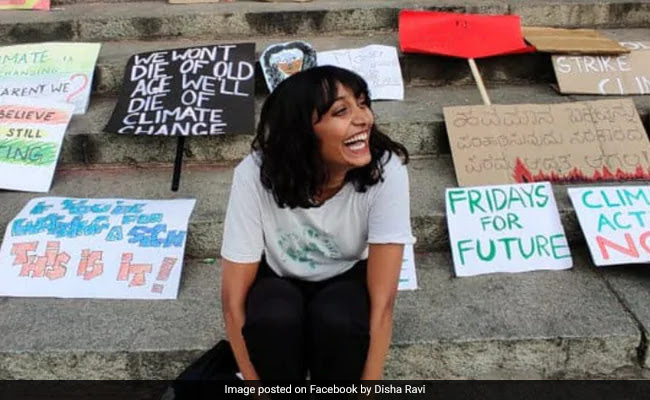
Disha Ravi granted bail, Court says no real evidence to prove the accusations

Yesterday, while granting bail to environmental activist Disha Ravi in ​​the toolkit case related to the farmers’ movement, the court said that creating a WhatsApp group and editing a toolkit is not a crime. Delhi’s Patiala House Court said on Tuesday, “You cannot put anyone in bars only for disagreeing with the government’s policies.” Late night, Disha was released from Tihar jail.

Additional Sessions Judge Dharmendra Rana strictly said that there is no evidence against Disha that she campaigned with the intention of bringing a bad name to India. There is no evidence that she hatched any conspiracy to spread violence. Many people have been arrested in cases of violence, but not a single one has been proved to have any connection with Disha. The court also said that just to maintain the pride government no one can be charged for treason. 
The court granted direction to bail on the condition of personal bond of one lakh and cooperation in investigation. They will also be prohibited from going out of the country during this period. 
The judge said that the police has no evidence to prove the connection between Disha and the Khalistan supporters of the Poetic Justice Foundation.
Similarly, no such evidence has been produced to prove that Disha is a supporter of separatist ideology and there is some kind of connection between her and the banned organization Sikh for Justice.
Disha Ravi, is an Indian youth climate change activist and a founder of Fridays For Future India. Her arrest on 13 February 2021 for an alleged involvement with an online toolkit related to Greta Thunberg and the 2020–2021 Indian farmers’ protests gained international attention.

Government to issue laws to regulate content on Social media

The central government is set to curb the arbitrariness of social media platforms, including Facebook and Twitter. The government is engaged in enacting laws to make them accountable to the Indian Constitution. The government can bring a bill related to it in the second phase of the budget session or the monsoon session.

Actually, there is no law to remove controversial content and bring social media under the purview of the constitution. Social media companies are taking advantage of this.
At the same time, sources say that the government wants to introduce the bill only in the second part of the budget session starting from 8 March. If it is delayed for any reason, the bill will be introduced in the monsoon session. Another cause for concern is that social media is being used by a large number of people.
Around three billion people around the world use Facebook. Among them, its number of users in India is around 32 crores. If we add all the mediums of social media, then this number is more than 500 million, in which Indians topped the number of social media users.
In such a situation, it is difficult to see that there is neither legal nor effective way to monitor the reliability of these platforms.
A court case hearing is going on in the Supreme Court in this dispute case. During the hearing, the government has warned against the threat of social media. The government has said in the apex court that it should be justified to ask to write everything in the name of freedom of expression. The government has also asked the apex court to continue discussions on making laws in this regard.

The Supreme Court has also issued a notice to the Centre and Twitter on a plea, seeking to regulate hate content and to make a law as per which action can be initiated against Twitter and their representatives in India for promoting anti-India tweets and penalize them.
Google is also on target
Australia, in particular, is going to make a law soon to decide the payment in the use of media content on Google. Last week, Australia’s PM Scott Morrison, after talking to PM Modi and Canadian Prime Minister Justin Trudeau, had emphasized the law against Google.