Promoting Investor Education and Financial literacy among youth through Gyan Darshan channel

 The Investor Education and Protection Fund Authority (IEPFA) under the aegis of Ministry of Corporate Affairs has signed a Memorandum of Understanding (MoU) with Indira Gandhi National Open University (IGNOU) through a virtual event here today. The objective for signing the MoU is to achieve the mandate of Investor Education, Awareness and Protection by utilizing the tele-lecturing facility of Gyan Darshan Channel.

This association with IGNOU/Gyan Darshan channel will help in propagating the message of Investor Education and Awareness among a large group of present and prospective stakeholders. The panel of resource persons for the lecture series would include experts from professional institutions such as ICAI, ICSI & Senior officials from IEPFA, Ministry of Corporate Affairs and other regulators. The proposed lecture series of 75 episodes will be live tele-lecturing series on 24×7 Gyan Darshan TV channel and is a part of the ongoing celebration of the yearlong activity commemorating the 75th anniversary of India’s Independence under “Azadi ka Amrit Mahotsav”.

26 Episodes of the tele-lecturing series were earlier rolled out in the year 2021 which were appreciated by all stakeholders. The repository of the tele-lectures is available on IEPFA’s official YouTube channel.

 

      Description: A picture containing text, indoor, wall, personDescription automatically generated


Shri Rajesh Verma, Secretary, Ministry of Corporate Affairs (MCA) and ex-officio Chairperson of IEPFA in his keynote address said, “All of us are here with the common goal of educating people. The entire nation is celebrating 75 years of Azadi ka Amrit Mahotsav to celebrate the spirit of a self-reliant, progressive nation, India has become. This day is also celebrated as National Youth Day to commemorate the birth Anniversary of Swami Vivekananda, the youth ICON and influencer of global stature. With all these noble events falling together, today’s event has become even more apt and relevant. Both IEPFA & IGNOU have the common objective of imparting education and making people aware about subjects affecting their lives. IEPFA intends to create awareness among all the stakeholder groups and specially the youth”.

Prof. Nageshwar Rao, Vice Chancellor, IGNOU, in his remark stated that IGNOU and IEPFA with this initiative shall reach out to youth and other stakeholders at large which would be productive in fulfilling the vision and mission of both the organizations.

Sh Manoj Pandey, CEO IEPFA Authority, Prof. Satyakam, Pro-VC Vice Chancellor, IGNOU, Sh Nihar Jambusaria, President ICAI, Sh Nagendra D. Rao, President ICSI and other Senior officials from IEPFA, IGNOU and Ministry of Corporate Affairs also graced the occasion.

Investor Education and Protection Fund Authority (IEPFA) has been established under Section 125 of the Companies Act 2013 for administration of the IEPF fund as per section 125 (3) of Companies Act 2013. The main objective of the authority includes to promote Investor Education, Awareness & Protection, refund unclaimed shares, dividends and other amounts transferred to it under sections 124 and 125 of the Companies Act 2013 to the rightful claimants. IEPFA works under the administrative control of Ministry of Corporate Affairs.


****

PRIVATE INVESTMENT IN INDUSTRY

 Investment Promotion activities are carried out by Government to attract more investments in the country. As a part of steps being taken to improve private interest and investment, ‘Make in India’ initiative was launched on September 25, 2014, to facilitate investment, foster innovation, building best in class infrastructure, and making India a hub for manufacturing, design, and innovation. Investment outreach is being done through Ministries, State Governments and Indian Missions abroad for enhancing international cooperation for promoting Domestic and Foreign Direct Investment (FDI) in the country.

In addition to ongoing schemes of various Departments and Ministries, Government has taken various other steps to boost domestic and foreign investments in India. These include reduction in Corporate Tax Rates, easing liquidity problems of NBFCs and Banks, improving Ease of Doing Business, FDI Policy reforms, Reduction in Compliance Burden, policy measures to boost domestic manufacturing through Public Procurement Orders, Phased Manufacturing Programme (PMP), Schemes for Production Linked Incentives (PLI) of various Ministries. To facilitate investments, measures such as India Industrial Land Bank (IILB), Industrial Park Rating System (IPRS), soft launch of the National Single Window System (NSWS), National Infrastructure Pipeline (NIP), National Monetisation Pipeline (NMP), etc, have also been put in place.

India registered its highest ever annual FDI inflow of US$ 81.97 billion (provisional figures) in the financial year 2020-21 despite the COVID related disruptions. In the last seven financial years (2014-21), India has received FDI inflow worth US$ 440.27 billion which is nearly 58 percent of the FDI reported in the last 21 years (US$ 763.83 billion). These trends in India’s FDI are an endorsement of the country’s status as a preferred investment destination amongst global investors.

New Regulations for Gold

Gold is not just an asset in India it holds significance in our culture. Being the symbol of the Goddess Lakshmi and considered to be auspicious.

It is part of several cultural and social events of Indian society. Not just bought on special occasions or passed down from several generations, but it also holds the great economical point. Being one of the most trusted investment all over the world even the RBI of India holds 695 tonnes of gold within it as a reserve.
The government of India had mandatory hallmarking for gold in 256 districts and plan to implement it all over India in the future.
What is a Hallmark?
It is series of marks made on the metal to clarify the content of the noble metals like gold, silver, etc.
In other words,s it lends credibility to the purity of gold. The Bureau of Indian Standard (BIS), in India, is the accreditation agency that certifies and Hallmark gold jewelry and other precious metals.

Other key terms related to gold-
Carat– It indicates the percentage of purity of the metal. Eg 24 carat means gold contains 100 pct gold. But to lend it some strength metal is mixed. Hence gold is about 18 -22 K only.
Stamp of BIS and year of the mark-
It is a triangle mark assure of purity with the year of hallmarking of jewelry.
Jewelry Identification mark-
BSI mark also carries jewellery stamps to Indicate that jewelry is certified. Its certification is cheap at Rs 2 per gram of gold.

Currently, this regulation is only imposed on jewelers having a turnover of above 40 Lakh only.

The Ponzi Scheme

What is it?

The Ponzi scheme is an investment fraud and one of the most infamous white-collar crimes in history. It is named after Charles Ponzi, the historical scamster who was best known for his financial crimes in the early 1900’s. He was from Italy, but it was after he moved to America that he started his fraudulent activities. The scheme he developed involved conning investors into giving him millions of dollars, and then paying them returns with other investor’s money. Investors were promised that in consideration of their investment, they would receive large returns of up to 50% in 45 days, or up to 100% in 90 days. Instead of paying these investors out of the actual profit of his business, Ponzi paid these investors by further borrowing from new investors. The investors were inclined to accept these deals as it was investment with seemingly high returns and little to no risk. In this way, Ponzi created a chain of borrowing and repaying from various investors, in the process pocketing some of the money from each transaction for himself.

The Ponzi scheme seems to be the prefect con, with the scammer earning large amounts of money, and the unsuspecting investors also satisfied with their exponential returns. This 100-year-old scheme is so well planned that is made use of even by today’s white-collar criminals. The prime example is Bernie Madoff, who in 2008 was caught operating the largest Ponzi scheme in history. Not all the Ponzi scheme cases are big enough to make the headlines, as some white-collar offenders run this scheme to a small extent. However, it can be said without a doubt that this scheme is one of the most standard, but also effective white-collar crimes a criminal can commit. However, investors are now becoming increasingly aware of these schemes, and there are also several anti-fraud agencies monitoring investment activities. Some of the basic parameter’s investors must identify to avoid falling into a Ponzi scheme are;

  • High returns with little or no risk
  • Overly consistent returns
  • Unregistered investments
  • Unlicensed sellers
  • Issues with paperwork
  • Secretive, complex strategies

The presences of all these features means that there is almost certainly a Ponzi scheme being run. It is evident from these features that it is investors dream to have such characteristics in a business, which is the primary reason why it is so tempting for many investors to fall prey to this scheme. However, over the years, corporate investors have come to realise that if it seems too good to be true, it often is.

Bernie Madoff Case

Many people are of the view that white-collar crimes are more serious than normal crimes committed on a day-to-day basis. Normal crimes are high-risk, low-reward situations such as shoplifting or robberies, wherein the perpetrator is taking a large risk in order to secure a relatively small reward. White collar crimes, on the other hand, are low-risk, high-reward situations. Such perpetrators commit crimes which generally go unnoticed for long periods of time, until some thorough investigation takes place or some questions are raised. In this time, they can earn exponential amounts of money as a result of their offences. We can take the example of Bernie Madoff here, one of the best-known white-collar offenders of all time. He committed the largest financial fraud in the history of the US, which involved around $65 Billion. Madoff had been committing corporate fraud and it was going unnoticed, with his career continuing on for about 20 years even after he committed such serious offences. This is evidence to the nature of white-collar crimes as being low-risk, high-reward crimes. It was only in 2008 that he was apprehended by federal authorities, and pleaded guilty to 11 federal crimes. He also admitted to operating the largest private Ponzi scheme in history. Hence, he was sentences to 150 years in prison in 2009 (the maximum for a person his age), for spending 20 years of his career defrauding clients and committing other federal felonies (including securities fraud, wire fraud, mail fraud, money laundering, theft from employee benefit plan, and many more). In February of 2020, Madoff’s lawyer pleaded for compassionate release of Madoff from prison, citing health and wellness issues (kidney failure and deteriorating health). However, this bid for release failed and Madoff continues to serve his prison time.

Madoff did not sound remorseful when interviewed in the years after his crimes, but he does show some self-awareness. “It wasn’t like I was being blackmailed into doing something, or that I was afraid of getting caught doing it,” he continues. “I, sort of, you know, rationalized that what I was doing was OK, that it wasn’t going to hurt anybody.” This is a prime example of neutralization of crimes by a perpetrator.

Stock Market

Money plays a crucial role in our lives. Every person has a desire to be rich for which people search different paths. One such path is the stock market.
A stock market is a place where buying and selling of ownership of a company take place. These units of ownership are termed shares, which collectively are known as stocks.

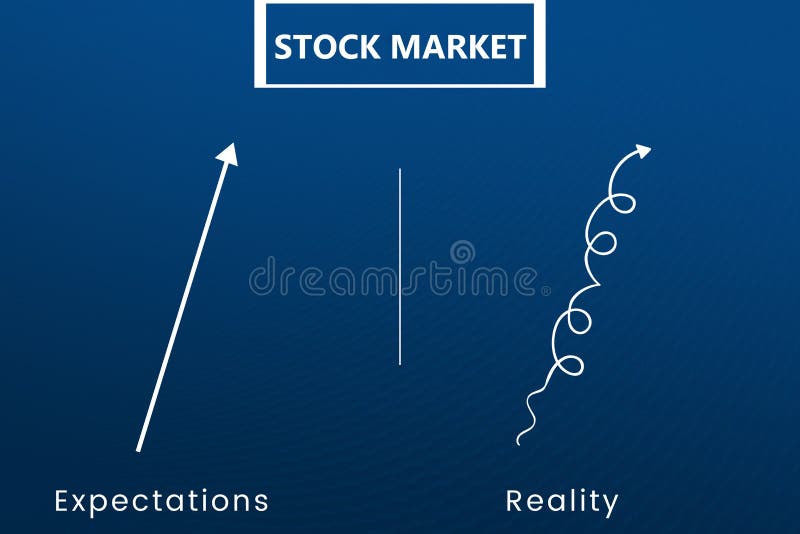
Many regard it as a Gamble & state it’s an easy fortune for some, for others, it is a  road to doom.

There is some element of risk in this investment but majorly success depends on the person and their analysis of the stocks.
Some key things to consider while buying a share:-
• Face value(FV) of the share– Dividend is paid on the face value of the share.
For example, if a share is traded for Rs 1000 with a face value of Rs 2. 100% dividend it would mean a sum of Rs 20 is paid.

•Past performance of the company- A company with a good performance record. Have a growth potential and the chances of price rise are more.

• Any major Change in government policy -Change may have an impact on the business environment. For instance, a policy that bars or regulates new competitors from entry will be a good indicator for the existing players.
• ROI– ROI or Return on Investment tries to measure the amount of return a particular investment, relative to the investment’s costs.

Risk Profile

Risk Profiling refers to the evaluation of an individual ability to take risks. It assists in making the risk profile of the investor.
As psyche of every person differs from others. 

People can be classified as:-
Risk-Averse -Don’t want to take up the risk. 
Risk seeker- Is one who is willing to accept greater financial risk in exchange for more profits.
Risk Neutral- These people are neither risk seekers nor averse.
Due to it, new investors can plan their investments by knowing where they stand and what is right for them Mutual Funds, Shares, or Crypto.
Some other benefits –
•It helps in taking the right risk as per requirements and capacity.
•Bring the right investment opportunities to light, so a balance of risk and reward can be achieved.
•Help to identify psychological reactions to unexpected fluctuation in the market.
•Plan for the worst-case scenario.
                 Know your risk Diet

RCN To Be Dilisted

Ripio credit network commonly known as RCN is a digital currency that aims to build an “open global credit network that connects lenders and borrowers on the Ethereum blockchain to create frictionless, transparent and borderless debt markets.”

Once the coin which enjoyed a market cap of nine million dollars is now facing the misfortune of being delisted from crypto exchanges.
Firstly Binance the giant crypto exchange barred RCN from trading from 16 July 2021.
And now, CoinSwitch Kubar one of India’s exchange latched RCN trade.

What happens when crypto is delisted?

When a digital currency is delisted it simply means that buying and selling of the particular coin will not take place on the platform from a given date.
In such a scenario person is stuck with that currency as he/ she won’t have any alternative except keeping coins in the wallet or selling it before due date.

TIPS TO MAKE YOURSELF FINANCIALLY LITERATE

Have you ever heard or read in a newspaper that a person who won millions of dollar got broke after few years, why is this so ? This is because of lack of financial education, and the reason behind many of the people after good degree and jobs and a good salary still facing financial issues is the same lack of financial education.

1. Listen to podcasts, like the Rich Dad Radio Show.

2. There are plenty of you tube channels of financial experts, subscribe their channels and follow them.

3. Read newspapers, magazines, or books based on money, finance, and investing.

4. Follow peoples or pages sharing financial knowledge on social media.

5. Hang around with people smarter than you beyond all this have a keen interest and a burning desire. That’s all you need to be financially literate.

Investing lesson of Peter Lynch


Peter Lynch is one of the most successful and top value investor of all time. He was a legendary fund manager who gave 29% returns to their investors for 13 years in a row. He wrote books on value investing , where he shared his investment lessons which he learned and used during his journey as an investor. He is one of the greatest value investor of all time. He is a firm believer that an average investor can also pick winning stocks as Wall Street professional with right research, patience , steady discipline and common sense.


Some of his investment principles are –

1. Invest in what you already know – “The worst thing you can do is invest in companies you know nothing about. Unfortunately buying stocks on ignorance is still a popular American pastime.” -Peter Lynch
People can perform well by investing in what they already know. For instance if a doctor wants to invest in banking sector (about which he know nothing) , he will not have that great return as compared to if he will invest in pharmaceutical companies ( as he already knew about drugs, healthcare sector and their companies)
“Invest in what you know. It leaves out the role of serious fundamental stock research. People buy a stock and they know nothing about it. That’s gambling and it’s not good.” -Peter Lynch
So, it’s better to choose the company whose products/services are either used by you or you are familier of the products/services of that company in some way or other. These knowledge will lead you to invest in better stocks .
2. Invest in companies not in stocks – “Look for small companies that are already profitable and have proven that their concept can be replicated. • Be suspicious of companies with growth rates of 50 to 100 percent a year”-Peter Lynch

Behind every stock there is a company. If companies will perform well, the stocks automatically will perform well. So, it’s important to know about the company, it’s business model. Choose a company whose fundamentals are strong. A company whose business model is so easy to understand that anyone can understand and run that company.

“Go for a business that any idiot can run – because sooner or later any idiot probably is going to be running it” -Peter Lynch

Know a companies management, it’s fundamentals and then ask yourself , “are you able to understand the mission and vision of the company? “ or “If you’ll be given the responsibility to run this company, will you be able to run the company? “
If the answers to the above questions are a YES then it’ll be great to invest in that company.
So always remember that you have to invest in a company and not in a single stock.


“Behind every stock is a company. Find out what it’s doing.” -Peter Lynch

“Never invest in a company without understanding its finances. The biggest losses in stocks come from companies with poor balance sheets.”

3. Don’t take unnecessary risks. Take calculated risks – You don’t have to take risks which you can’t bear. Only take calculated risks.
Let’s say, you have $10 dollar, maybe if you will lost this, you won’t regret. But what if you lost $100 or $1000! Always buy stocks of the amount if you lose won’t regret. You are not required to put all your money in market and risk all that money. Instead put only that amount which if you lose won’t make you regret of investing.
Also, invest only the amount you will not need ever back in your life
4. Peter Lynch said that the most important thing that keep in mind while investing is : know why you own it.

“ You have to know what you own ,and why are you own it .” -Petrr Lynch

It sounds simple but it is not . He said when I asked most people they just don’t know why they own a stock . 80% of investors have no answer to this question .

They maybe hear some tip from anywhere and put their money at risk and when they lose it they blame institutions .
First you have to know the reason . Why you should invest in this company ,research about that company . Check their balance sheets . Without proper research you are not investing you are just gambling . Read and know as much as you can about the company. And remember to buy the company and not just a stock.

“If you’re prepared to invest in a company, then you ought to be able to explain why in simple language that a fifth grader could understand, and quickly enough so the fifth grader won’t get bored.” – Peter Lynch

5. Invest for long time- Lynch used to hold stocks for long period of time. He used to sell the stocks when the fundamentals of any company gets changed. This is his advice for all investors out there to not go behind short term profits but invest for a long period of time.
He even conducted many studies to understand the power of compounding.

“People who succeed in the stock market also accept periodic losses, setbacks, and unexpected occurrences. Calamitous drops do not scare them out of the game.”


Some more investment lessons by Peter Lynch :

• “Never invest in any idea you can’t illustrate with a crayon .”

• “The trick is not to learn to trust your gut feelings, but rather to discipline yourself to ignore them. Stand by your stocks as long as the fundamental story of the company hasn’t changed”

• “Whenever you invest in any company, you’re looking for its market cap to rise. This can’t happen unless buyers are paying higher prices for the shares, making your investment more valuable.”


• “There’s no shame in losing money on a stock. Everybody does it. What is shameful is to hold on to a stock, or worse, to buy more of it when the fundamentals are deteriorating.”

• “Never invest in any company before you’ve done the homework on the company’s earnings prospects, financial condition, competitive position, etc”

• “Big companies have small moves, small companies have big moves.”

• “Good management, a strong balance sheet, and a sensible plan of action will overcome many obstacles, but when you’ve got weak management, a weak balance sheet, and a misguided plan of action, the greatest industry in the world won’t bail you out.”

• “In the long run, a portfolio of well chosen stocks and/or equity mutual funds will always outperform a portfolio of bonds or a money-market account. In the long run, a portfolio of poorly chosen stocks won’t outperform the money left under the mattress.”


This is how he succeed in the world of investment. You can learn from him and help yourself to reach the level you want in investment.


Thank you.

Asset Bubble

What Is a Bubble?

A bubble is an economic cycle that is characterized by the rapid escalation of market value, particularly in the price of assets. This fast inflation is followed by a quick decrease in value, or a contraction, that is sometimes referred to as a “crash” or a “bubble burst. Typically, a bubble is created by a surge in asset prices that is driven by exuberant market behavior. During a bubble, assets typically trade at a price, or within a price range, that greatly exceeds the asset’s intrinsic value (the price does not align with the fundamentals of the asset).The cause of bubbles is disputed by economists; some economists even disagree that bubbles occur at all (on the basis that asset prices frequently deviate from their intrinsic value). However, bubbles are usually only identified and studied in retrospect, after a massive drop in prices occurs.

How a Bubble Works

An economic bubble occurs any time that the price of a good rises far above the item’s real value. Bubbles are typically attributed to a change in investor behavior, although what causes this change in behavior is debated. Bubbles in equities markets and economies cause resources to be transferred to areas of rapid growth. At the end of a bubble, resources are moved again, causing prices to deflate.

The Japanese economy experienced a bubble in the 1980s after the country’s banks were partially deregulated. This caused a huge surge in the prices of real estate and stock prices. The dot-com boom, also called the dot-com bubble, was a stock market bubble in the late 1990s. It was characterized by excessive speculation in Internet-related companies. During the dot-com boom, people bought technology stocks at high prices—believing they could sell them at a higher price—until confidence was lost and a large market correction occurred.

The research of American economist Hyman P. Minsky helps to explain the development of financial instability and provides one explanation of the characteristics of financial crises. Through his research, Minsky identified five stages in a typical credit cycle. While his theories went largely under-the-radar for many decades, the subprime mortgage crisis of 2008 renewed interest in his formulations, which also help to explain some of the patterns of a bubble.

Displacement

This stage takes place when investors start to notice a new paradigm, like a new product or technology, or historically low interest rates. This can be basically anything that gets their attention. 

Boom

Prices start to rise. Then, they get even more momentum as more investors enter the market. This sets up the stage for the boom. There is an overall sense of failing to jump in, causing even more people to start buying assets. 

Euphoria

When euphoria hits and asset prices skyrocket, it could be said that caution on the part of investors is mostly thrown out the window. 

Profit-Taking

Figuring out when the bubble will burst isn’t easy; once a bubble has burst, it will not inflate again. But anyone who can identify the early warning signs will make money by selling off positions. 

Panic

Asset prices change course and drop (sometimes as rapidly as they rose). Investors want to liquidate them at any price. Asset prices decline as supply outshines demand. 

The stock market bubble

A real concern or confused market parameters?

Introduction

An assertion like ‘Had you invested in the stock markets in 2011, your investments would have doubled by now’ triggers an urgent rush to invest in the market, bringing in the feel good hormones in most people. But often times, it is extremely misleading and the results could be catastrophic.

A stock market bubble is when the prices of assets rise exponentially, often not justifying their actual value.

Investors in 2020 faced a similar conundrum. With the pandemic induced lock-downs causing normal life and businesses to go haywire, the general investor felt it was better if they pulled their money out of the market. This led to the leading market index NIFTY50 dropping to 7,500 levels,a 40% decline from its value in January 2020(NSE india). As a result, the market became almost risk free and the only way ahead was up.

Investments started pouring in as the Covid-19 cases eased by August and significant institutional and foreign investors started pouring in money into the Indian stock markets because of their abnormally low levels. The domestic average investor soon followed suit and the markets saw a revival. In fact they rose to record highs( From record lows just a few months ago!) and the expectation of ‘winning’ a trade led to impulsive buys.

Perception versus Reality

Investors are not always sensible or rationale in their investing decisions and can be prone to various types of ‘bias’. These phenomena can explain the prevailing overtly optimistic market sentiments even when the macro-economic indicators are lacking behind.

Even with parameters like the G.D.P and inflation on the wrong side of desirable, and unemployment rate sky rocketing in 2021, the profits that the top 50 companies made in India in the last fiscal year has increased. This resulted in a lot of investors ignoring those macro-economic trends and could be the reason as to why the stock market segment is rising irrespective of it.

Hence the ever increasing corporate profits and the ‘feel good’ hormones can attribute to the ascend of the stock market levels from the previous years ruins but the question remains, ‘How long can this last’? Established wisdom suggests that corporates cannot sustain a contacting economy for long and that it is bound to catch up with it sooner rather than later. Caution is advised to investors with a majority of their money in these instruments. A bubble burst is in the realm of recurrent reality and cannot be ignored as a figment of the imagination.

Bandwagon Effect

What Is the Bandwagon Effect?

The bandwagon effect is a psychological phenomenon in which people do something primarily because other people are doing it, regardless of their own beliefs, which they may ignore or override. This tendency of people to align their beliefs and behaviors with those of a group is also called a herd mentality. The term “bandwagon effect” originates from politics but has wide implications commonly seen in consumer behavior and investment activities. This phenomenon can be seen during bull markets and the growth of asset bubbles.

Understanding the Bandwagon Effect

The bandwagon effect arises from psychological, sociological, and, to some extent, economic factors. People like to be on the winning team and they like to signal their social identity. Economically, some amount of bandwagon effect can make sense, in that it allows people to economize on the costs of gathering information by relying on the knowledge and opinions of others. The bandwagon effect permeates many aspects of life, from stock markets to clothing trends to sports fandom.

Politics

In politics, the bandwagon effect might cause citizens to vote for the person who appears to have more popular support because they want to belong to the majority. The term “bandwagon” refers to a wagon that carries a band through a parade. During the 19th century, an entertainer named Dan Rice traveled the country campaigning for President Zachary Taylor. Rice’s bandwagon was the centerpiece of his campaign events, and he encouraged those in the crowd to “jump on the bandwagon” and support Taylor. By the early 20th century, bandwagons were commonplace in political campaigns, and “jump on the bandwagon” had become a derogatory term used to describe the social phenomenon of wanting to be part of the majority, even when it means going against one’s principles or beliefs.

Consumer Behavior

Consumers often economize on the cost of gathering information and evaluating the quality of consumer goods by relying on the opinions and purchasing behavior of other consumers. To some extent, this is a beneficial and useful tendency; if other people’s preferences are similar, their consumption decisions are rational, and they have accurate information about the relative quality of available consumer goods, then it makes perfect sense to follow their lead and effectively outsource the cost of gathering information to someone else.

However, this kind of bandwagon effect can create a problem in that it gives every consumer an incentive to free ride on the information and preferences of other consumers. To the extent that it leads to a situation where information regarding consumer products might be underproduced, or produced solely or mostly by marketers, it can be criticized. For example, people might buy a new electronic item because of its popularity, regardless of whether they need it, can afford it, or even really want it.

Bandwagon effects in consumption can also be related to conspicuous consumption, where consumers buy expensive products as a signal of economic status. 

Investment and Finance

Investing and financial markets can be especially vulnerable to bandwagon effects because not only will the same kind of social, psychological, and information-economizing factors occur, but additionally the prices of assets tend to rise as more people jump on the bandwagon. This can create a positive feedback loop of rising prices and increased demand for an asset, related to George Soros’ concept of reflexivity.

For example, during the dotcom bubble of the late 1990s, dozens of tech startups emerged that had no viable business plans, no products or services ready to bring to market, and in many cases, nothing more than a name (usually something tech-sounding with “.com” or “.net” as a suffix). Despite lacking in vision and scope, these companies attracted millions of investment dollars in large part due to the bandwagon effect.

INSURANCE VS INVESTMENT

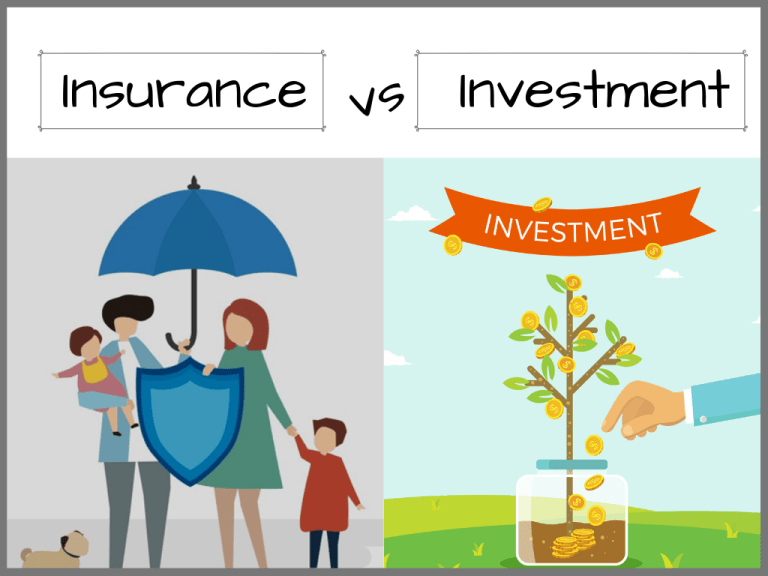
In today’s world, it is very easy to confuse Insurance with Investment. One might feel that he/she is investing in their future and decreasing their future financial burden because he/she purchased an insurance policy. Let’s take a look at the definition of insurance and investment.

Insurance refers to a contract or policy in which an individual or entity receives financial protection or reimbursement against losses. It protects the insured against risk of losses or damage.

Investment, on the other hand, refers to an asset or item acquired with the goal of generating income or appreciation. For example, real estate, mutual funds, shares etc.

With the increase in types of insurance policies and persuasive insurance sales representatives, people tend to think of insurance as investments. However, Insurance merely provides protection in the event of loss, which may or may not arise. In case of no loss or damage, sum total of all the insurance premium paid is profit for the insurance company.

On the other hand, the main purpose of an investment is to generate income by providing returns (dividends and interest) and/or capital gains (value appreciation; increase in price). Insurance does not provide any substantial returns. It merely provides reimbursement in the event of loss/damage and therefore, it is not an investment.

Do you need Insurance? If yes, what kind?

Insurance planning is essential to protect against different kinds of risks and to be financially prepared in case of loss or damage to life or property. However, it should not be used a means to invest.

There are different types of insurance which can be broadly classified into Personal, Property and Liability. There are three types of insurance that you must have to protect against risk, not as an investment: Health insurance, Term life insurance and Automobile insurance.

Health insurance is a must to ensure that in case of an accident or injury, hospital and medical bills don’t eat away your savings.

Term life insurance ensures that in case of death of the earning member of the family, the family has enough to survive for a substantial period of time. Term life insurance has a fixed period and hence, has a very low monthly premium with a decent coverage. However, if the policy expires and the insured is still alive, the insured does not get any amount back. So, this policy should only be taken by the earning member at the right life stage in case he/she does not own enough assets to leave behind for his/her family.

Automobile Insurance (third party) is mandated by the Government of India on the purchase of a vehicle and hence, every vehicle owner should have one.

Other types of insurances sold and bought in the name of ‘investment’ like Endowment plans, Money back policy and the new policy called Unit-linked insurance plans (ULIP) which allows you to invest in the stock market should be avoided at all costs.

It is much more profitable to invest in the market through mutual funds or investor’s Demat account than to do the same through insurance companies. The rate of return in the market is much higher and it doesn’t cost as much as Insurance.

For example, if you buy Money Back insurance plan with a policy term of 20 years with ₹10,00,000 assured cover, the monthly premium calculated on LIC premium calculator comes out to be around ₹6300-6500 per month.

As calculated above, the total premium paid is ₹11,27,282 and the total amount received is ₹18,20,000. The total profit/return (approx.) is only ₹6,90,000 in 20 years. The return on investment (Return/Total Amount paid x 100) is only 61%.

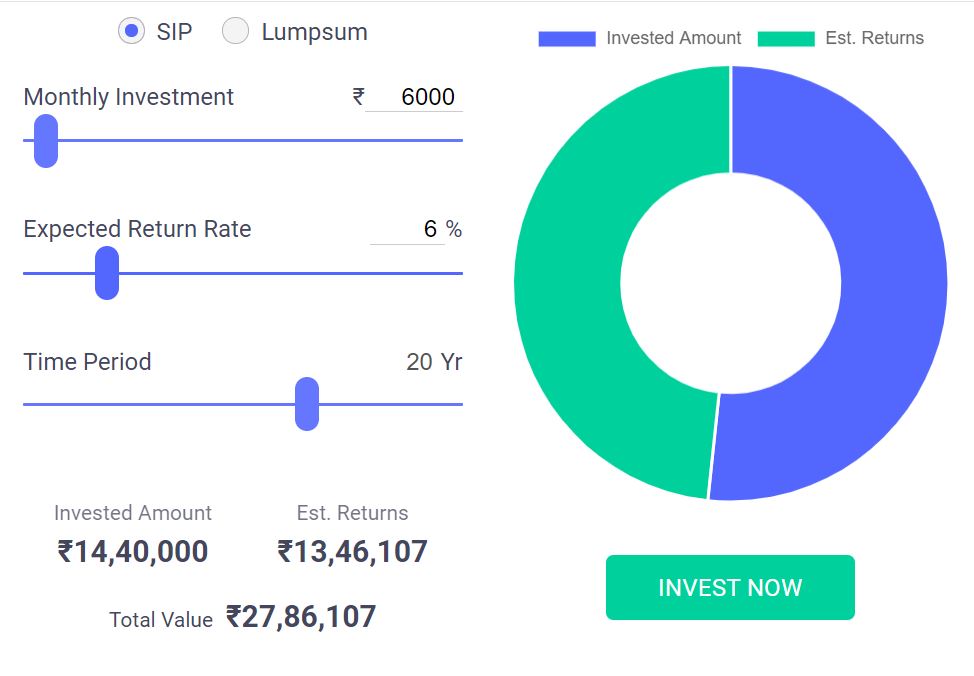
However, if the same amount is invested in SIP of any instrument with a return rate of just 6% for the same time period (20 years), the returns (calculated on Groww SIP calculator) are much higher.

₹6000 rupees invested monthly in any instrument with a return rate of only 6% for 20 years gives a return of ₹13,46,000 making the total value of the investment ₹27,86,000. The ROI (Return/Total Amount paid x 100) in this scenario is 93%.

Conclusion

Although Insurance is an essential part of Financial Planning to protect against different kinds of risks which varies from person to person, it should not be mixed with Investment. For greater returns and growth, investors should directly invest in the market or in any other instrument which suits their risk appetite and capacity.

Mutual Funds 1O1- Advantages

Mutual Funds collect small sums of money from a large number of investors. This becomes a large pool of money which is invested into the market and the returns generated are distributed among the investors proportionately.

There are many advantages of investing in Mutual Funds:  

  • Professional Management: Investing directly in Equity is very risky for those who are not experts and lack the ability to track the market regularly.  Mutual Funds are managed by professionals with adequate  qualifications and experience.
  • In house research is undertaken to aid the fund manager. 
  • Top management involvement to guide the investment policy and the fund house philosophy.
  • Competitive performance resulting in constant improvement of portfolio and NAVs are disclosed at record timings.  
  • Diversification: Diversification is nothing but investing your money across different types of investments. An investor with a limited amount of funds might be able to invest in only one or two stocks/bonds. However, Mutual Funds invest in a no. of companies across a broad cross-section of industries and sectors. This diversification reduces the risk because it is unlikely that all the stocks decline at the same time. So Unit holders of a mutual fund achieve this diversification with very less money that an investor cannot do on its own.  
  • Low Cost: Mutual Funds invest huge amounts of money on a regular basis. Therefore they pay very less % of the amount such as brokerage, depository and other types of charges as compared to the individual investors. So mutual funds provide a cost efficient way to invest in the financial market. 
  • Transparency: Mutual Funds have to publish their NAV on a daily basis and they have to periodically share the portfolio investments with the investors. They offer transparency to investors and have to publish their results semi-annually. Any important change in the scheme has to be duly informed to investors. 
  • Attractive Returns: Mutual Funds give very attractive returns in the long or medium term because fund managers invest in stocks after considering the fundamentals, future plans of companies with the help of trained research teams. They use every possible technique to save the investors’ money such as Hedging. So it’s a very good investment avenue used in the financial planning process. 
  • Well Regulated: All the mutual funds have to be mandatorily registered with SEBI. SEBI Mutual Fund Regulations 1996, as amended till date, governs the mutual fund operations and investments. The regulatory system aims to ensure the protection of interest of investors. The fund investments have to be as per the scheme’s objectives and there has to be complete transparency about funds investment and performance. NAV of the fund has to be published daily and scheme’s performance periodically. SID (Society for Information Display) & SAI contains all relevant and important information pertaining to scheme and fund and serves as an important investment document for the investor. Thus mutual funds are a well regulated investment vehicle in India. 
  • Choice of Options: In India, Mutual Funds offer different types of schemes to suit the varying needs of investors. Investors have different goals and objectives, which may range from retirement planning to investing for a vacation. Investor’s needs may include capital appreciation, liquidity, regular income etc. Because of several types of schemes launched by mutual funds catering to different investment requirements, investors have numerous options to choose from the wide range of schemes such as growth plan, regular income plans or Equity oriented plan, Gilt Funds. They also have the choice available in their method of investment. They can invest lump sum money or they can opt for periodic investment in the form of monthly installments through Systematic Investment Plan (SIP). Similarly they can opt for single withdrawal of entire funds when needed or monthly Systematic Withdrawal Plan (SWP). 
  • Liquidity: Open ended mutual funds are very liquid investment avenues because investors. Open-ended schemes are all the time open for subscription and redemption with the fund house itself. Investors can enter and exit from the scheme at any time at the prevailing NAV. Closed ended schemes offer limited liquidity to investors. Investors can buy the units only during NFO (new fund offer) and can exit at the maturity of the scheme when the mutual fund redeems the units at the prevailing NAV. However, all the closed ended schemes have to be necessarily listed on the stock exchanges in India. This provides a secondary market exit route to the investors of closed ended schemes. Though the schemes are listed but practically trading volumes in mutual fund units are negligible and therefore closed ended schemes don’t offer liquidity to investors. 
  • Convenience: Mutual funds provide a very easy and convenient way of investment as well as withdrawal of funds as compared to other investment avenues like Real estate, Debt instruments etc. Investors can invest in any manner either through distributors in the physical form or can buy units online whatever is convenient to them. Units can be held in physical or demat form. 

Mutual Fund is an investment avenue which gives the small investors an option to participate in the capital market with their small funds and limited knowledge of the volatile market.  

Money does not get Locked ,it’s get invested:MUTUAL FUNDS

A mutual fund is a company that pools money from many investors and invests the money in securities such as stocks, bonds, and short-term debt. The combined holdings of the mutual fund are known as its portfolio. Investors buy shares in mutual funds.

Mutual funds are a popular choice among investors because they generally offer the following features:

  • Professional Management. The fund managers do the research for you. They select the securities and monitor the performance.
  • Diversification or “Don’t put all your eggs in one basket.” Mutual funds typically invest in a range of companies and industries. This helps to lower your risk if one company fails.
  • Affordability. Most mutual funds set a relatively low dollar amount for initial investment and subsequent purchases.
  • Liquidity. Mutual fund investors can easily redeem their shares at any time, for the current net asset value (NAV) plus any redemption fees.

How to buy and sell mutual funds

Investors buy mutual fund shares from the fund itself or through a broker for the fund, rather than from other investors. The price that investors pay for the mutual fund is the fund’s per share net asset value plus any fees charged at the time of purchase, such as sales loads.Mutual fund shares are “redeemable,” meaning investors can sell the shares back to the fund at any time. The fund usually must send you the payment within seven days.

Types of mutual funds

  • Money Market Funds: have relatively low risks. By law, they can invest only in certain high-quality, short-term investments issued by U.S. corporations, and federal, state and local governments.
  • Bond funds: have higher risks than money market funds because they typically aim to produce higher returns. Because there are many different types of bonds, the risks and rewards of bond funds can vary dramatically.
  • Stock funds: invest in corporate stocks. Not all stock funds are the same. Some examples are:
    • Growth funds focus on stocks that may not pay a regular dividend but have potential for above-average financial gains.
    • Income funds invest in stocks that pay regular dividends.
    • Index funds track a particular market index such as the Standard & Poor’s 500 Index.
    • Sector funds specialize in a particular industry segment.
  • Target date funds: hold a mix of stocks, bonds, and other investments. Over time, the mix gradually shifts according to the fund’s strategy. Target date funds, sometimes known as lifecycle funds, are designed for individuals with particular retirement dates in mind.