SHOULD ABORTION BE BANNED WORLDWIDE ?

The discussion about whether abortion ought to be a legitimate alternative keeps on isolating individuals. Some are agreeable to it while others are against it. However, prior to going to the determination we should investigate it’s advantages and disadvantages.

ADVANTAGES:

1.There are a few contentions that one forward on the side of fetus removal. As a matter of first importance, any birth of a youngster ought to happen whenever the guardians need and not by some coincidence. This way it would go far in helping the world to have a climate where all youngsters that are brought into the world in this world have a climate favorable for legitimate turn of events.

2.There is no requirement for swelling the world with numerous kids who can’t approach essential necessities like sufficient attire, food, haven, and instruction.

Abortion activists are ready for Justice Kennedy's retirement — Quartz

3.It ought to likewise be noticed that when an individual chooses to carry out an abortion it isn’t out of her aversion for youngsters but since she feels that it would not be an insightful choice to continue with the pregnancy as it is as yet not yet the ideal opportunity to have a child.

4.On account of assault or inbreeding, keeping a pregnancy is very damaging to the individual assaulted as nobody would wish to keep a kid that is a consequence of this, and the best answer for this issue is to abort the unborn kid.

5.At times entanglements can happen to a pregnancy that might put the existence of the mother or unborn youngster in harm’s way and surprisingly now and again every one of them. For this situation, abortion should be allowed to save the actual wellbeing of the mother.

DISADVANTAGES:

1.As indicated by Koster, abortion is just a brief and unreasonable choice that cause ladies to feel that they have gotten some help to an undesirable kid against odds of extremely durable loss of fruitlessness.

2.She further argues that although removing an unwanted pregnancy may somehow offer relief to the woman the possibility of becoming infertile especially if an unqualified person performed the operation is very significant and once you lose your fertility there is zero chance that you will regain it.

3.Even when performed by a qualified medical doctor there is a chance that complications may arise like in some medical procedures and if this happens, you could definitely lose your fertility.

4.The alleviation that one feels after procuring an abortion is typically brief, and it passes on after some time prompting a long-lasting sensation of blame and bitterness. In fact, in most of the times, this feeling of relief is just a deliberate attempt by the psychology of a person to delete the sense of guilt and shame that creeps in immediately one procures an abortion.

5.A great deal of favorable to lifers would liken early termination to murder, and it is consequently ethically off-base and ought to be prohibited. Genovesi characterizes murder as a purposeful demonstration of removing the existence of an individual. He further adds that since the baby of an individual has life, then, at that point removing it will add up to killing it, which is equivalent to kill.

India's new abortion law is progressive and has a human face | ORF

CONCLUSION:

The way things are today, it appears to be the discussion on abortion won’t reach a conclusion soon. There ought to be endeavors to give an unmistakable approach on this issue that would be worthy in the entire world through a worldwide body like the United Nations.

Apart from that the church and other organizations that are anti-abortion ought to soften their stand in some incidences like rape which are too traumatizing.

RESOURCES:


  1. https://ivypanda.com/essays/pros-and-cons-of-abortion-to-the-society/

2. https://abortion.procon.org/

5 Writs in Indian Constitution

Know about how to voice for your rights, legal bounds, and solve wrong conducts or mistakes by legal officials.

Writs! What do you mean by writs?

In common law, a writ is a formal written order issued by a body with administrative or judicial jurisdiction; in modern usage, this body is generally a court. Warrants, prerogative writs, and subpoenas are common types of writ, but many forms exist and have existed.

Why are Writs needed?

It is a constitutional remedy available to a person to bring his complaint or grievance against any administrative action to the notice of the court.

Types of Writs:

  • Writ of Habeas Corpus
  • Writ of Mandamus
  • Writ of Certiora
  • Writ of Prohibition
  • Writ of Quo-Warranto,

WRIT OF HABEAS CORPUS

It is also known as the “great writ”

Habeas Corpus means “Let us have the body.”. In other words, it means “you may have the body” which means that a person under arrest is to be brought before a judge or into court. It is an important writ for personal liberty. A person, who is arrested, can move the Court for the issue of Habeas Corpus. 

It is an order by a Court to the detaining authority to produce the arrested person before it so that it may examine whether the person has been detained lawfully or not. It ensures that a prisoner can be released from detention if the Court is convinced that the person is illegally detained—that is, detention lacking sufficient cause or evidence.

The person under arrest or any another person on his behalf can file a writ in this. Formal and informal applications in respect of the writ is accepted by the Courts. It is only a procedural remedy and does not necessarily protect other rights, such as the entitlement to a fair trial. A person cannot make the application for the Writ successively to different judges of the same court. 

In India, writs are issued by the Supreme Court under Article 32 of the Constitution of India and by the High Court under Article 226 of the Constitution of India.

Writ of Mandamus:

Mandamus means “We Command”. Mandamus is an order from a superior court to a lower court or tribunal or public authority to perform an act, within its duty. In short, it is an order to perform a duty which should have done but failed to do so.  It is the discretionary power of a court. It is simply to ensure rights are ensured and the Government Authorities perform their duties.

The writ of mandamus can be granted when there is right to compel the performance of some duty cast upon the authority. It can also be issued to public authority to restrain it from acting under a law which has been declared unconstitutional. The petitioner has a right recognized by law.

The writ cannot be granted when

  • Duty is not compulsory.
  • Against a private individual, private organization since they are not entrusted with public duty. 
  • To enforce an obligation arising out of contract.
  • Where the right of the petitioner has lapsed

Writ of Certiora

Certiorari means to be certified. The Writ of Certiorari can be issued by the Supreme Court or any High Court for retracting the order which is already passed by an inferior court and to properly investigate the matter and opinions objectively. A writ of certiorari is only granted when a Court has acted without or in excess of its jurisdiction and For correcting error of law. It cannot lie to remove merely ministerial act or to remove/cancel executive administrative acts. It is corrective in nature which means the purpose of this Writ is to correct an error.

When there is an error apparent on the record, it becomes a valid ground for issuing the Writ of Certiorari.

Certiorari can be resorted to only after the order or decision has been announced.

Writ of Prohibition

Writ of prohibition means to cease or to stop. it is also known as a ‘Stay Order’. When a lower court or a body tries to perform an action outside its jurisdiction, This Writ issued by a superior court to lower court or a tribunal to prohibit or forbidden it to do so. The Supreme Court can issue this Writ only where a fundamental right is affected.

In cases where the court is partly acting within its jurisdiction and partly outside it, the Writ will be issued against the act which is partly outside its jurisdiction. This Writ can be issued only when the proceedings are pending in the inferior court and not when an order has already been passed by that court. The Writ of Certiorari can be issued only when the order has passed.

Writ of Quo-Warranto

The word Quo-Warranto literally means “by what warrants?” and ‘by what authority’. It is issued restraining a person from acting in a public office to which is out of bounds. The business or the office in question is public office. The issue of summon is followed by legal proceedings, during which an individual’s right to hold an office or governmental privilege is challenged. 

Grounds on what it is issued.

The nature of the duties which arises from this office is public. The person against whom the Writ is sought to be issued is in actual possession of the office and is using such office.

Rights Of An Agent

An “agent” is a person employed to do any act for another, or to represent another in dealing with third persons. The person for whom such an act is done, or who is so represented, is called the “principal”. Section 182 of the act defines the terms “Agent” and “Principal”.

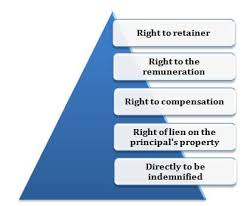
Rights of an Agent

  1. Right to Receive Remuneration: According to Section 219 of the Indian Contract Act, an agent is entitle to his remuneration. But Section 220 of the said act says that, an agent who is guilty of misconduct in the business of an agency is not entitled to any remuneration in respect of that part of the business which he has misconducted.
  2. Right of Lien (Section 221): Agent’s lien on principal’s property- In the absence of any contract to the contrary, an agent is entitled to retain goods, papers and other property, whether movable or immovable, of the principal received by him, until the amount due to himself for commission, disbursements and services in respect of the same has been paid or accounted for to him.
  3. Right to Indemnity: Agent to be indemnified against consequences of lawful acts. Indemnity means promise make good the loss. According to Section 222 of the Indian Contract Act, 1872 “The employer of an agent is bound to indemnify him against the consequences of all lawful acts done by such agent in exercise of the authority conferred upon him. Illustrations: B, at Singapore, under instructions from A of Calcutta, contracts with C to deliver certain goods to him. A does not send the goods to B, and C sues B for breach of contract. B informs A of the suit, and A authorities him to defend the suit. B defends the suit and is compelled to pay damages and costs and incurs expenses. A is liable to B for such damages, costs and expenses.
  4. Right to Compensation: According to Section 225 of the said act, an agent is entitled to claim compensation for the injuries suffered as a consequence or want of skill of the principal. Section 225 reads as follows- “The principal must make compensation to his agent in respect of injury caused to such agent by the principal’s neglect or want of skill. Illustration: A employs B as a bricklayer in building a house, and puts up the scaffholding himself. The scaffholding is unskillfully put up, and B is in consequence hurt. A must make compensation to B.
  5. Right to Retain Sums (Section 217 and 218): The agent has a duty to pay to his principal all sums received on principal’s account. But he also has a right to retain, out of any sums received on account of principal in the business of agency, all money due to himself in respect of advances made or expenses properly incurred by him in conducting such business and also such remuneration as may be payable to him for acting as agent. Similarly, when an agent sells his principal’s goods, he may detain the money received, for his remuneration on account of the goods sold by him. Such right can be exercised by an advocate also but lien must be confined to the costs incurred in that particular case.

Rights of Pawnee and Pawnor

The bailment of goods as a security for payment of a debt or performance of promise is called ‘pledge’. The person with whom the goods are pledged is known as ‘Pawnee’ or Pledgee’. The person pledging the goods is known as ‘Pawnor’.

The rights of the pledgee or pawnee are mentioned in Section 173 to 176 of the Indian Contract Act,1872.

Rights of Pawnee

  1. Right to retain the goods pledged (Section 173 and 174): According to Sec. 173, the right of a pawnee to retain the goods pledged shall not be only for payment of the debt or the performance of the promise, but he can also exercise this right for interest on the debt and all necessary expenses incurred by him in respect of the possession or for the preservation of the goods pledged. According to Section 174, a pawnee can retain the goods pledged only as a security for that debt or promise for which they are pledged, but there is a presumption that if there are subsequent advances, they are also the part of the original debt and the pawnee may retain the goods and to recover subsequent advamces also. This is merely a presumption which could be rebutted by contract to the contrary. The pawnee is bound to redeliver the goods after he gets what is due to him.
  2. Right to recover extraordinary expenses incurred by pawnee (Section 175) : According to section 175, the pawnee is entitled to receive extraordinary expenses incurred by him for the preservation of the goods pledged from the pawnor.
  3. Right of suit to recover debt etc., and sale of the pledged goods (Section 176) : Section 176 confers right on the pawnee, including right of selling the pledged goods if the pawnor makes a default in payment of debt or performance of promise at the stipulated time. This section confers following rights on pawnee on the pawnor’s default in fulfilling promise:-. a) he may bring a suit against the pawnor upon the debt or promise and retain the goods pledged as collateral security. b) he may sell the good pledged on giving reasonable notice of the sale to the pawnor.

Right of Pawnor

Right of Pawnor to Redeem (Section 177): The pawnor has right to redeem the goods pledged, i.e., take back the goods from pawnee on payment of the agreed debt or performance of the promise in accordance with the agreement. He can exercise the right to redeem before the pawnee has made an actual sale of the goods.

Legal Heir’s Right to Redeem: In case of death of a pawnor, the pledge made by him can be redeemed by his legal heirs on meeting the liabilities concerning the pledge.

Legal Positivism

Etymologically, The term positivism is derived from Latin ponerepositum, meaning “to put”. “Positive law” is that which is man-made, i.e., defined formally. Legal positivism is a school of thought of analytical jurisprudence developed largely by legal philosophers during the 18th and 19th centuries, such as Jeremy Bentham and John Austin.While Bentham and Austin developed legal positivist theory, empiricism provided the theoretical basis for such developments to occur. The most prominent legal positivist writer in English has been H. L. A. Hart, who, in 1958, found common usages of “positivism” as applied to law to include the contentions that:

  • laws are commands of human beings;
  • there is not any necessary relation between law and morality, that is, between law as it is and as it ought to be;
  • analysis (or study of the meaning) of legal concepts is worthwhile and is to be distinguished from history or sociology of law, as well as from criticism or appraisal of law, for example with regard to its moral value or to its social aims or functions;
  • a legal system is a closed, logical system in which correct decisions can be deduced from predetermined legal rules without reference to social considerations

Disagreement with Natural lawyers

Historically, legal positivism is in opposition to natural law’s theories of jurisprudence, with particular disagreement surrounding the natural lawyer’s claim that there is a necessary connection between law and morality.

SOURCE OF LAW, ACCORDING TO LEGAL POSTIVISTS

In the positivist opinion, the source of a law is the establishment of that law by some legal authority which is recognised socially. The merits of a law are a separate issue: it may be a ‘bad law’ by some standard, but if it was added to the system by a legitimate authority, it is still a law.

In the The Stanford Encyclopedia of Philosophy it is mentioned that;According to positivism, law is a matter of what has been posited (ordered, decided, practiced, tolerated, etc.); as we might say in a more modern idiom, positivism is the view that law is a social construction.”

Legal positivism does not claim that the laws so identified should be obeyed, or that necessarily there is value in having clear, identifiable rules. The laws of a legal system may be quite unjust, and the state may be quite illegitimate; as a result, there may be no obligation to obey them. Moreover, the fact that a law has been identified by a court as valid does not provide any guidance as to whether the court should apply it in a particular case.

As John Gardner has said, legal positivism is “normatively inert”; it is a theory of law, not a theory of legal practice, adjudication, or political obligation. Legal positivists believe that intellectual clarity is best achieved by leaving these questions for separate investigation.

Antecedents of legal positivism

The main antecedent of legal positivism is Empiricism, the thinkers of which range back as far as Sextus Empiricus, Thomas Hobbes, John Locke, George Berkeley, David Hume, and Auguste Comte. The main idea of empiricism is the claim that all knowledge of fact must be validated by sense experience or be inferred from propositions derived unambiguously from sense data. Further, empiricism is in opposition to metaphysics; for instance, Hume rejected metaphysics as mere speculation beyond what can be learnt from sense experience

Covid -19, Society and Law

Introduction

Humankind is going through a new and unprecedented experience with the rapidly spreading Covid-19 pandemic. We still do not know who ‘patient zero’, the first person to be infected and transmit it to others, was. The severity of this virus, which has caught the world by surprise, lies not only in the delay of laboratories in finding an effective and efficient vaccine, but also in the fact that the measures taken to counter it differ considerably from what was previously adopted to confront various acute crisis, whether health, political, social or economic.

There is no doubt that the Covid-19 pandemic will change the face of human society, but it forces us to ask some important questions. Will this change only affect the healthcare systems, or will it extend to consumption patterns, value systems, political regimes and legal systems, thus leading to the fall of the huge financial and economic empires? Will the major transformations the world will undergo be determined by how we recover from the effects of this situation?

According to the World Health Organization, the problem does not lie in Covid-19 alone but rather in the fear, panic and terror caused by the spread of this virus, and amplified by the media, which has been presenting the situation as if it were the end of the world. Barring the measures adopted by China, where the virus originated, the methods used to manage the crisis around the world are somewhat similar. To some extent, China succeeded in curtailing the spread of the virus, thanks to the spirit of discipline in its people, and due to its health infrastructure, the plethora of research centres and laboratories, and the ability to control the sources of information from the onset. Most other countries have wasted precious time after the first cases appeared, relying on legal and security control in dealing with the pandemic and information about it, rather than establishing a single entity to disseminate information backed by science.

The current crisis is not of the pandemic alone. Rather, it is of the far-reaching consequences on human behaviour. Addressing these repercussions should not be limited to taking ad-hoc costly measures limited to the current situation but should prompt us to think about putting into place innovative measures and actions that go beyond the pandemic. Measures like imposing quarantines, enacting new laws to manage the pandemic, using modern tools for e-learning and telework, ensuring a minimum standard of living for all, granting loans, exemptions from paying water and gas bills and taxes, assisting the unemployed, and using the military to assist in security measures during the epidemic have cost countries billions of dollars. These are funds that could have been invested in infrastructure or other major projects, but instead have now been used to respond to the immediate needs of the people.The pandemic will radically change the modern world, leading to three likely outcomes.

The first outcome

A new theory will be integrated within political science in the future. Indeed, traditional legitimacies in the systems of government, which are derived from ballot boxes, hereditary legitimacy or religion, are beginning to decline, leaving room for a new theory called the “theory of achievements”. Since the Cultural Revolution of Mao Zedong in the 1960s, China has worked on this emerging legitimacy, as the Chinese Communist Party has distinguished itself from the rest of the Communist parties in the world.

The second outcome

The traditional conflict between wrong information and right information will transform into a conflict between convincing information and unconvincing information, as legal arsenals and control tools are no longer effective in the spread and prevalence of correct information. The method of producing information and choosing its dissemination channel is becoming a means of turning it into convincing information, regardless of if it is true or false.

The third outcome

The process of monitoring people will transition from external to internal control using smartphones. This is also what happened in China, to curb down on misinformation on Covid-19 during its early stages and as a preventive measure in the absence of a vaccine. These smart devices have become effective tools for measuring citizens’ reactions at home to what is happening in their surroundings.

A coming human revolution

Humankind is going through a humanitarian revolution, the kind that has occurred only thrice before: first, after the discovery of fire; second, with the advent of agriculture; and third, following the industrial revolution. The most prominent sign of this ‘fourth revolution’ is the predominance of new technology and the supremacy of modern means of communication, which have spawned a conflict between two major concepts of using the internet. The first can be described as social perception with a human connect, while the second is non-social perception, and can be termed as wild and unbridled. The humanitarian-minded perception is likely to win this conflict, as this human revolution is making its mark on our social existence and old behaviours. This will impact the current value system and will have political andeconomic implications.

The post-epidemic stage will see the emergence of a new human being, whose daily behaviour and thinking will differ from what it was before the Covid-19 outbreak. The political, legal and economic systems will have to adapt to this new human being. Despite the timely importance of the current safety measures being put into action around the world, there is a great need for these to be integrated into a comprehensive post-pandemic thinking. In fact, we will find ourselves faced with a generation who thinks differently from the pre- pandemic generation.

In light of the impact of Covid-19 on the individual and collective behaviours of society and State, and people’s continued thirst for information, it is necessary to keep in mind the post- pandemic world when it comes to decision-making. The Covid-19 storm will pass and mankind will survive, despite the loss of many lives. Humankind will soon live in a world that is very different from the one before the virus. However, the pandemic will succeed where the other movements of the 20th century have failed in their struggle to establish democracy and human rights, and preserve a safe environment for all.

Doctrine of Notice

INTRODUCTION

The concept of Notice for the purpose of The Transfer of Property is given under Section 3 of Transfer of Property Act, 1882 (TPA). Notice means to have knowledge of something i.e. to know something. In law, it means knowledge of a fact. It is used to decide on conflicting claims of two parties. In law, the Notice or Knowledge of a fact affects one’s legal rights and liabilities.

Under Section 3 of TPA Notice can be; “Actual or express Notice” or “Constructive Notice”, or it may be imputed to the transferee when information of the fact has been obtained by his Agent.

Constructive notice

It is based on the law of presumption or it is presumed that in certain circumstances that the person knows the fact. He cannot afterwards say against it. This type of notice can be divided into five.

  1. Notice imputed by wilful abstention from enquiry
  2. Notice from gross negligence
  3. Notice by registration
  4. Notice by possession
  5. Notice by agent

Actual notice.- Actual notice, to constitute a binding force, must be definite information given by a person interested in the thing in respect of which the notice is issued, as it is settled rule that a person is not bound to attend to vague rumours or statements by mere strangers, and that a notice to be binding must proceed from some person interested in the thing. A mere casual conversation in which knowledge of a certain thing is imparted, is not notice of it, unless the mind of a person has, in some way been brought to an intelligent apprehension of the nature of the thing, so that a reasonable man or any normal man of business would act upon the information, and would regulate his conduct accordingly. In other words, the party imputing notice must show that the other party had knowledge which would operate upon the mind of any rational man, or man of business, and make him act with reference to the knowledge he has so acquired. A vague or general report or the mere existence of suspicious circumstances is not in itself notice of the matter to which it relates. A general claim is not sufficient to affect a purchaser with notice of a deed of which he does not appear to have knowledge. If a person knows that another has or claims an interest in property for which he is negotiating he is bound to inquire what his interest is, and if he omits to do so, he will be bound, although the notice was inaccurate as to the particulars to the extent of such interest.

The notice must be given in the same transaction. A person is not bound by notice given in a previous transaction which he may have forgotten. Notice to a purchaser by his title papers in one transaction will not be notice to him in an independent subsequent transaction in which the instruments containing recitals are not necessary to his title, but he is charged constructively with notice merely of that which affects the purchase of the property in the chain of title of which the payer forms the necessary link.

Constructive notice.- Constructive notice is the knowledge which the Courts impute to a party upon a presumption so strong that it cannot be allowed to be rebutted, that knowledge must have been communicated. “The doctrine of constructive notice” said Lord Brougham in Kennedy v. Green, depends upon two considerations first that certain things existing in relation or the conduct of parties, or in the case between them, begets a presumption so strong of actual knowledge that the law holds the knowledge to exist because it is highly improbable it should not, and next, that policy and safety of the public forbids a person to deny knowledge while he is so dealing as to keep himself ignorant or so as that he may keep himself ignorant, and yet all the while let his agent know, and himself perhaps, profit by that knowledge. The broad principle underlying the doctrine of constructive notice is that a person who is bound to make an inquiry and fails to do it should be held to have notice of all facts which would have come to his knowledge had he made the inquiry. Where, on the other hand, a person is not bound to make an inquiry he cannot be charged with constructive notice of the facts that might havebeen ascertained on such inquiry. Again, where a fact, of which a person has notice, would not put him on inquiry as to the matters in question, it cannot be constructive notice of such matter.

Classes of constructive notice

(1) Wilful abstention from search which one ought to make.
(2) Gross negligence.
(3) Registration as a notice.
(4) Possession as notice.
(5) Notice to agent
(5.1)Notice should have been received in his capacity as agent.
(5.2)Notice must have been given in the course of agency business.
(5.3)Notice must be of a fact which is material to the Agency Business.
(5.4)Fraud by an agent.

Conclusion

Thus it can be said that Constructive notice is a manifestation of the rule of Caveat Emptor. This is because according to Constructive notice, a person ought to have known a fact as if he actually does know it. It presupposed that in property translation a transferee ought to ascertain and verify certain facts for safeguarding his own interest. Thus he must be aware of the nature of the transaction. These facts may relate to property or the transferor, like whether the property is free of any charge or encumbrances or whether the transferor is competent to transfer the property or not.

If the property is encumbered, then the exact nature of the encumbrance ought to be ascertained by the transferee. Law puts it as the duty of the transferee, as a reasonably prudent person to be reasonably vigilant and diligent to ascertain the facts, inspect the documents relating to property in possession of the transferor, inspecting concerned persons, even with relevant statutory authorities, if required. Failure to do this would result in the imposition of Constructive notice.

Internet and Mobile Association of India v. Reserve Bank of India

Statement of Facts

  1. On 5th April,2018 Reserve Bank of India issued a press release raising the concern about the consumer protection from trade of virtual currencies. They were of the view that trading in virtual currency also referred as crypto currency are prone to hacking and therefore would lead to money laundering, terrorist activities, etc. In this view RBI asked the banks to not to deal with the transactions related to the trading of virtual currency.
  2. The services which RBI directed the bank not to deal with were – maintaining the accounts, registering, trading, settling, clearing, giving loans against virtual currencies, accepting virtual currency as collateral, opening accounts of exchanges dealing with them and transfer of sale/purchase of virtual currencies.
  3. The matter was challenged by Internet and Mobile Association of India. The Supreme Court of India allowed the petition on the ground of proportionality. Earlier in 2013 the Reserve Bank of India do issued a public caution to the traders and holders of virtual currency in context with the legal and security related risks associated with it.

Issues Raised

  1. Whether the Reserve Bank of India had the jurisdiction to disallow the trade of virtual currency?
  2. Whether the Respondent had the powers to regulate virtual currency as they were not equivalent to money or legal tender?
  3. Whether the circular which was issued by the RBI was proportional?

Critical Analysis of the Case

A step in the right direction was taken by the Supreme Court of India, in the judgment of Internet and Mobile Association v. RBI. The court quashed the circular of the RBI that directed financial agencies to disocciate themselves from entities involved in virtual trading or transactions relating to VC’s. Some of the concerns that led to the issuance of circular include the anonymity of the transactions and the protection of investors when dealing in cryptocurrency. The major apprehension of the RBI was the inherent difficulty in tracking the source of money which has led to an increase in the number of cryptocurrency scams in the country. Still a very volatile technology, we have not had enough discussion around its shortcomings, leading to an adverse preference of this technology in the monetary circuit.

The Petitioner relied on the case of MS Gill v. Chief Election Commissioner, which led that there was an express prohibition of any authority to do anything which may improve its case. The contention of the petitioners rested on the premise that denial of banking services to those activities of trade recognized by law, would be extremely disproportionate, leading to the violation of extremely disproportionate, leading to a violation of Article 19(1)(g) of the Constitution. Therefore, an understanding of whether there was an infringement of this constitutional right was necessary and to this end, the court relied on the case of Md. Yasin v. Town Area Committee, which makes it amply clear that the right under article 19(1)(g) would be affecyted “In effect and in substance” when there is a complete stoppage of a particular business activity, owing to a certain measure that was undertaken. In Keshavlal Khemchand and Sons Pvt. Ltd. v. Union of India, the court pointed out that “Reserve Bank of India is an expert body to which the responsibility of monitoring the economic system of the contry is entrusted, under various enactments like the RBI Act, 1934, the Banking Regulation Act, 1949.”

The judgement of the court has started an effective discussion on lines that were never traversed before, and while that is indeed commendable, we need to look ahead and anticipate the potential risks on the economy. With that in mind, VC’s promise a more feasible future, especially in this era where people are connected through technology in ways previously unimaginable. Various stakeholders have posted many suggestions, particularly with regarding to creating a model that can monitor and regulate crypto currency, without bringing a blanket ban of the same, which ought to be considered by the government in the light of pending bill. What we need to do is find a balance and not discourage startups from adopting this technology, and if this is ignored, India could be handicapped from exploring opportunities that crypto currencies have to offer. Instead of shying away from addressing these concerns, we need to be proactive and have a structured policy in pace to assuage any potential concerns in the future.

Anatula Sudhakar v. P. Buchi Reddy

Statement of Facts

This appeal for special leave is by the defendant in a suit for permanent injuction. Puli Chandra Reddy and Puli Buchi Reddy were the plaintiffs in the said suit. Both the plaintiffs claimed to be the respective owners in possession of the said two sites having purchased them under two registered sale deeds dated 9.12.1968 from Rukminibai. When they were digging trenches in order to commence construction, the defendant interfered with said work. The plaintiffs filed a suit for permanent injuction to restrain the defendant from interfering with their possession. Defendant resisted the suit claiming that suit property measuring 300sq. yards in premises No. 13/776 was purchased by him from K.V. Damodar Rao, brother of Rukminibai. He had also obtained a loan for such construction from the Central Government by mortgaging the said property. According to him, when he commenced construction in the said property, the plaintiffs tried to interfere with his possession and filed a false suit claiming to be in possession.

Issues Raised

  1. Whether the plaintiffs are in exclusive possession of the suit sites?
  2. Whether the defendant has interfered with the possession of the plaintiffs over the split plots?
  3. Whether the plaintiffs are entitled to permanent injunction? And to what relief?

Critical Analysis

A step in the right direction was taken by the High Court in its judgement of Anatula Sudhakar V. P. Buchi Reddy. The High Court by its judgement dated 18.1.1991 allowed the second appeal and restored the judgement and decree of the Irial Court and consequently held that plaintiffs had established their title in regard to the two vacant sites purchased by them and drew an inference that possession was presumed to be with them by applying the principle of possession follows title. The HC also held that it was not necessary to plaintiffs to sue for declaration of title, as the question of title could be examined incidental to the question of possession.

There was some confusion as to what circumstances the question of title will be directly and subsequently in issue in the suit for injunction simpliciter. In Vanagri Sri Selliamam Ayyanar Uthirasomasundareswarar Temple V. Rajanga Asari AIR 1965, Madras High Court considered an appeal arising from a suit for possession and injunction. The defendant contended that the plaintiff had filed an earlier suit for injunction which was dismissed, and therefore the plaintiff was precluded from agitating the issue of the title in the subsequent title suit, being barred by the principal of res judicata. It was held that the earlier suit was only for injunction and the averments in the plaint did not give rise to any question necessitating denial of plaintiffs title by the defendant, and as the earliest suit was only concerned only with possessory right and not title, the subsequent suit was not barred. There are several decisions taking similar view that in a suit for injunction, the question of title does not arise or would arise only incidentaly or collateraly, and therefore a subsequent suit for declaration oof title would not be barred. The judgement by the High Court has stated an effective decision and restoring the decree of the trial court in favour of the plaintiffs that the plaintiffs and their witnesses gave evidence to the effect that Damodar Rao represented that his sister Rukminibai was the owner of the plot and negotiated for the sale of the several portions thereof in favour of the plaintiffs. Further, where title of plaintiffs is disputed and claims for possession is purely based on tiltle, and the plaintiffs have to rely on various principles of law relating to ostensible ownership and section 41 of TPA, validity of an oral gift by way of ‘Pasupu Kumkumam’ under Hindu Law, estoppel and acquiescene, to put forth a case of title, such complicated questions could properly be examined only in a title suit, that is a suit for declaration and consequential reliefs and in a suit for an injunction simppliciter.

State of Haryana v. Bhajan Lal and Others

Statement of Facts

The first Respondent was a minister and subsequently Chief Minister of Haryana State. Later he became Union Minister. Bhajan Lal at the same time of the case was the Union Minister of Environment and Forests and Devi Lal was elected as the Chief Minister of the State of Haryana. In the same election Respondent 2, Dharam Pal lost the election against Smt. Jasma Devi, wife of Bhajan Lal . Owing to various political rivalries and institutions of various criminal cases there was a lot of bad blood between Bhajan Lal and Devi Lal. Consequently, Respondent 2 placed a complaint before the CM, Devi Lal against Bhajan Lal where he alleged that Bhajan Lal possesses disproportionate property or pecuniary resources compared to his indefinite sources of income. It was also alleged that the accumulation of that much property was far beyond his legal means. Special officer on duty in CM’s secretriat passed the message to the office Director General of Police stating that the CM has sought appropriate action in the said case. The complaint was further passed on to the Superintendent of Police (SP) asking for the necessary measure to be taken and report back. The SP asked the SHO (Station House Officer) to register the case and investigate. Subsequently, a case was filed under Sec. 161 and Sec. 165 of the IPC and Section 5(2) of the Prevention of Corruption Act in November 1987. The copy of the FIR was then sent to the magistrate and the investigation was started.

Issues Raised

  1. Whether just the allegations are enough to constitute a cognizable offences and give the power of investigation to the police?
  2. Whether the action of investigating on the part of SHO on just the order of one word “investigate” from SPis enough as per Sec. 5 of Prevention of Corruption Act, 1947?
  3. Whether the HC was justified in quashing the FIR and criminal proceedings and acted under the ambit of Article 226 of the Constitution and Sections 482, 154 and 157 of Cr.P.C., and to what extent the orders suffer from legal infirmity?

Critical Analysis

Cases of corruption against politocal leaders in India are not rare. This is one of such case that notified the alleged corruption carried out by a significant political figure leading to registration of a case against him by his rival. Inevitably the suit underwent the question of legitimacy that led to the appearance of the same before the SC. The case holds importance as it significantly points out the powers and limitations of various authorities at different points of time throughout the trial of matter. It re-emphasized the power of investigation that police hlods and in what nature of cases, the necessity of filing an FIR, and the extent to which High Courts should use their special power of quashing Criminal proceedings. The case re-established that our Constitution is based on the concept of Rule of Law which serves as an aorta of governance in our democratic system and no one or authority is higher than law and that law is supreme. Everybody exclusively and on the whole is undeniably under the authority of law irrespective of the wealth and power they possess. The case likewise relooks at the complete and resultant backlogs of evils like corruption that exist in our country. Therefore this parasite of bribery if not battled against all fronts and at the levels checked and completelly removed, will destabilize the very establishments of democracy and erode the foundations of rule of law and make the whole administration ineffectual and broken.

Uniform Civil Code in India

Introduction

India is a very diverse nation having several different cultures, traditions and religions. This diverse nature of India makes it a vibrant and varied country, where it reconciles different religious and cultural views to form one unified nation. However, this also necessitates the need for personal laws that govern each religion and allow their followers to live according to certain religion-specific laws and regulations. For example, Hindus have the Hindu Marriage Act (1955), Muslims have the Muslim Personal Law (Shariat) Application Act (1937), Christians have the Indian Christian Marriage Act (1871), etc. The personal laws are aimed at giving each religion a fair opportunity at following their own customs and traditions. However, many instances in Indian history are evidence to the fact that distributing justice on the basis of religion leads to a multitude of communal issues. Moreover, numerous personal laws have been found to be discriminatory in nature and thereby in derogation of the Fundamental Rights as given in the Indian Constitution. Many a times, these personal laws are regressive in nature and represent ancient societal views that show no congruence to the current, progressive Indian society. It is in view of this that the framers of the Indian constitution, and many other prominent figures during the period of drafting, made efforts to implement a ‘Uniform Civil Code’ in the interest of national consolidation and communal harmony.

The Uniform Civil Code

The Uniform Civil Code refers to a single set of rules or a singular code of law that is applicable to all the citizens of India, regardless of their religious affiliations or which community they belong to. Such a code is the hallmark of a contemporary, progressive nation that has ascended the need for segregation based on religion, caste, race, etc. Article 44 of the Indian Constitution states that a ‘Uniform Civil Code’ is to be implemented for the citizens of India. The Article reads: “The State shall endeavour to provide for its citizens a uniform civil code throughout the territory of India.” Therefore, the idea of a uniform civil code is enshrined in the Indian constitution and stands as a something that the country should strive for. However, it is included as one of the Directive Principles of State Policy, and not as a Fundamental Right or constitutional guarantee. Hence, despite being mentioned in the constitution, there have been no significant steps taken by India to realise such a code.

Goa is the only state in India to have a fully functioning uniform civil code called the Portuguese Civil Code (1867). This code replaces the personal laws based on religion in Goa, and introduces a common law for all its residents regardless of their religion, caste, gender, etc. For example, according to the code, a Muslim man whose marriage is registered in the State of Goa cannot practice polygamy. Although polygamy is a part and parcel of the Muslim personal law, it is nullified in the State of Goa due to the presence of a UCC. Furthermore, a married couple share equal property and divide their assets equally, and succession rights for men and women are similar in Goa. Thus, Goa acts as a contemporary example as to how a uniform civil code works, and what it involves.

Evaluation of the Uniform Civil Code

It can be said that the uniform civil code is a very polarising concept, and that it can bring about both benefits and adversities. It is important to understand these before a solid decision about it can be made. In case it seems like the benefits outweigh the adversities, then it should be implemented, and vice-versa. These can be discussed as:

Pros

  • The application of a uniform code will allow for a much more coherent and efficient system of administration, mitigating a lot of the confusion and conflict created due to the existence of numerous personal laws.
  • A uniform civil code is the hallmark of a secular democracy like India. As mentioned in the Preamble, India is a secular country and does not identify any particular state religion. It is acceptive of all faiths, and gives the freedom to practice and preach any religion its citizens deem suitable for themselves.
  • A common feature seen among most personal laws is discrimination towards women. This is again a reflection of ancient and obsolete beliefs that have no place in modern society. The uniform civil code, however, is devoid of any such discrimination and promotes equal treatment of both genders.
  • Possibly the most important pro is that the implementation of a uniform civil code will infuse the Indian legal system to make it one well-oiled machine. As of right now, the segregation of different personal laws implies different practices in different religions.

Cons

  • Although aiming for communal harmony, the uniform civil code may cause some divisiveness in the Indian society. Communities such Hindus and Muslims have deep-rooted hate against each other, and neither one will be pleased to follow the same code as the other. Hence, the UCC may cause some communal disharmony.
  • It will be a very lengthy and cumbersome process to come up with a uniform civil code that is equitable and non-discriminatory in nature. Realistically, it will take numerous years and make use of many resources, which might not be the best idea considering the many issues India has to focus on in the current times.
  • Most importantly, as mentioned before, people in India have deep emotional ties to their religions. The introduction of such a code that trumps their personal laws is not advisable and can lead to antipathy from the citizens of India.

Conclusion

Ultimately, the debate around the uniform civil code does have valid arguments both for and against it. It boils down to whether it is worth sacrificing some diversity for a stable law and order situation in India. I believe that the UCC could be the need of the hour, and could help in building the egalitarian society India is striving for. India’s long history of communal disputes and discrimination can come to an end, or at least be reduced exponentially, and there can be national integration and unity. However, such a uniform code cannot be suddenly implemented with the hope that it will rectify issues. People should be educated and made aware about it, and a gradual approach should be administered in introducing the UCC.  This will allow it to be effective and accepted in society. Furthermore, each community’s interests should be taken into consideration. In this way, the secular nature of India will be preserved and it will allow for India to progress and grow.

Why use colonial law even after 75 years of independence?

Chief Justice of India N.V. Ramana’s remarks in open court on Thursday sends a strong message to the government that the Supreme Court is prima facie convinced that sedition is being misused by the authorities to trample upon citizens’ fundamental rights of free speech and liberty. The Chief Justice has sent a clear signal that Section 124A (sedition) of the Indian Penal Code may have passed its time. The CJI said “if you look at the history of use of this section 124A of IPC, you will find that the conviction rate is very low.There is misuse of power by executive agencies.

The CJI observed and conveyed his observations to Attorney General, K.K. Venugopal and Solicitor General, Tushar Mehta. The CJI said; “Sedition is a colonial law. It suppresses freedoms. It was used against Mahatma Gandhi and Bal Gangadhar Tilak..Is this law necessary after 75 years of Independence.”

A number of petitions have been filed highlighting the “chilling effect” of sedition on the fundamental right of freedom of speech and expression. The court also observed the need to re-examine its own judgement which withheld section 124A of the IPC; i.e the Kedar Nath judgement.

Origin of the law; section 124A of IPC

Many legal experts argue that the sedition clause is a vestige of British colonial rule, originally introduced to suppress critical voices emanating from the Indian freedom movement. Section 124A of the Indian Penal Code, 1860 (IPC), as we have today, was absent from the original draft of Macaulay’s IPC in 1860, and was only introduced in the year 1870, piloted by James Stephen. This version went through further modification through the IPC (Amendment Act), 1898, since when it has largely retained its form.

Landmark case

The landmark case on this matter was that of Queen-Empress v. Bal Gangadhar Tilak & Keshav Mahadev Bal, (1897) ILR 22 Bom 112. In this case, Bal Gangadhar Tilak was tried for sedition for alleged incitement through speech that led to the killing of two British Officials. In this case, a single judge bench of  the Bombay High Court agreed with the definition of ‘disaffection’ as propounded in Jogendra Chunder Bose and opined that any ‘bad feelings’ towards the government is criminal, irrespective of the level of bad feeling. This way, the High Court virtually disallowed all legitimate criticism. It added that there need not be any material consequence at all to qualify the offence of sedition. The court held that in sedition matters, it is the intention of the offender which is of primacy, and could be presumed based on content, audience and circumstances of their seditious speech.

Events that led to considering the need of sedition law

A case under Sections 124 A (sedition) and 153 B (Imputations, assertions prejudicial to national-integration) has been registered against Ms. Sultana, a native of Chetlat island, based on a petition filed by BJP’s Lakshadweep unit president Abdul Khader. The prosecution case is that that on June 7, during a TV channel discussion, she had allegedly stated that the Centre had used ‘bio-weapon’ against the natives of the islands.

Observing that prima facie the offences, including the sedition charge, alleged against Lakshadweep filmmaker Aisha Sultana are not attracted, the Kerala High Court on Friday made absolute the interim anticipatory bail granted to her in a case registered against her by the Kavaratti police for making a remark against the Central government. Justice Ashok Menon, while allowing her anticipatory bail petition, observed that prima facie the petitioner “did not have a malicious motive to subvert the government established by law by merely using the strong word ‘bio-weapon’, to express her vehemence in disapproval of the subject under discussion

Right to repair

Right to repair is the movement started by the activist and oragination all around the world. Joe -Biden ,US president ,signed an executive order on Federal Trade Commission to institute rules to curb anticompetitive restrictions that limit consumers’ ability to repair gadgets on their own terms. The Uk too had introduced this .

The agenda of the movement is to get compinies to make spare parts of the gadget and the consumers can repair them rather than replacing the product.

Large tech compinies like Apple, Microsoft,Amazon and Tesla are opposing the movement stating that its opening up their intellectual property to third party to repair them.

Case Analysis : National Legal Services Authority Vs Union of India

Indian society has usually lacked gender awareness, and the same is reflected in the mindset of the society. The tale of people who are generally referred to as transgender is a story of pain, misery, and agony.

They have not only face deprivation of rights, but also abuse and violence just because they do not fit within the “norms” that society has generally accepted.   They are shunned and defamed by society and are considered to be outcasts and kept far away from participation in various societal activities.

Background

In 2012, the National Legal Services Authority, an Indian statutory body which is constituted under the Legal Services Authority Act, filed a writ petition (writ petition no. 400 of 2012) with the Supreme Court of India. It was followed by another writ petition (No. 604 of 2013) which was filed by Poojya Mata Nasib Kaur Ji Women Welfare Society, a non-governmental organization representing the Kinnar transgender community. Laxmi Narayan Tripathi, an individual who identified himself as a Hijra also approached the court and was also impleaded in the present case.

Issues involved

The petitions mainly raised an issue of “Gender Identity”. It has two facets, viz.:

  • Whether a person who is born male but has female orientation has the right to be identified as a female as per his choice ; the same question arises when an individual uses surgery to change his/her sex.
  • Whether a person who does not identify either as a male or a female has the right to be categorized in a “third gender”.

Arguments

The argument was made that the recognition of only the binary genders of male and female and the lack of legal measures to cater for the needs of the represented groups violates Right to Equality (Article 14), Freedom of Expression (Article 19), Right to Life and Personal Liberty (Article 21).

The transgender community urged that their inability to express themselves in terms of a binary gender denies them their rights and social welfare schemes.

Judgment

The judgement was delivered by a 2-judge bench comprising of Justice K.S. Radhakrishnan and Justice A.K. Sikri on 15th April 2014. The Court had to decide whether persons who fall outside binary gender can be legally recognised as “third gender” persons.

The Supreme Court in this case relied on various judgements from foreign courts like New Zealand, Australia, and England and took into consideration different foreign judgements like Corbett v. Corbett with its complete emphasis on biological sex, Attorney-General v. Otahuhu Family Court in which Justice Ellis noted that once a transsexual person has undergone surgery, he or she is no longer able to operate in his or her original sex.

The Court ruled that all provisions in the international conventions including the Yogyakarta Principles must be followed provided they align with the fundamental rights guaranteed under Part III of the Constitution.

In this landmark judgement Supreme Court legally recognised “third gender” for the first time and discussed “gender identity” at length. Further, it declared that eunuchs and hijras can legally identify as “third gender”.

The Court recognised that third gender persons were entitled to fundamental rights guaranteed under Part III of the Constitution and under International law.

The Court declared that the State and Central governments must grant transgenders full recognition in the eyes of the law so that they can avail education and healthcare without being subjected to any kind of discrimination.

Conclusion

Well, we cannot ignore the fact that the transgender community for long have suffered torture, humiliation, and pain. This judgement came as a fresh ray of hope for the transgender community who have faced discrimination and social injustice. This is a landmark judgement because it is the first to legally recognise non-binary gender identities and uphold the fundamental rights of transgender people in India. However, the transgender community still has a long way to go.

Gandhi ji and Communal Liberty

Gandhi is an important figure in India’s national movement. A phase of our national movement is called the Gandhian Phase. Nation is defined as a people sharing a common language, history and culture and having a sense of belonging to their common identity. The idea of nation was combined with the nation of the state. It developed where the people of one nation were suppose to live in one state. Nationalism has 2 versions: Premordial and Modernist.

Premordial versions means is the the original versions of nationalism in which the nation has a common language, culture, ethics and history. The modernist version however they treat people like a particular territory and sharing its civic amenities despite loving different ethic on regular affinities.

Gandhi ji was one of the nationalist who was the leader of many movements. He helped us to get independence. He believed in non- violence. He lead many movements in his opposition to the British rule like Satyagraha, Dandi March, Khilafat Movement, the non-cooperation movement. For Mahatma Gandhi, nationalist was based on understanding what was required for people to be free. He was not a socialist but, in common with the socialists, he believed that capitalism could never solve the problem of unemployment and the mental dullness is produced. Gamdhi ji also fought against the practices of sati, child marriage, oppressions of widow, ‘pardah’ and fueled emancipation of women.

Gandhi ji on Communal Liberty

India is a land of diversity. Populated by heterogeneous people of multifarious languages, religion, castes and creeds. Inspite of such diversities of character, there is always an underlying unity among them since time immemorial. The fact also remains that there is always a threat to narrow communal feelings. In modern India, gandhi was one of the greatest champions and communal unity. He lived his whole lofe striving for it, ensuring it, stood firmly by itand finally sacrificed his life in the pursuit of his communal unity. For Gandhi the life of communal unity was even greater than swaraj. None of the political leaders or religious priests were as devotedly concerned about communal unity as Gandhi ji was. Gandhi ji saw truth, love, compassion and service enlisted in all religions, which led him to accord equal respects to all faiths. All religion insist on equality of human race and developing a harmonious relationship with the entirety of creation. Any violation of the principle of equality gives way to conflict and violation. Gnadhiji regarded Islam as a religion of peace in the same sense as Christanity, Buddhism and Hinduism. No doubt, there are differences in the degree. He said in this regard that he knew the passages that could be quoted from the holy Quran to the contrary. Hindu and Muslim has often raised a great challenge before India became secular. Without unity between Hindu and Muslim no certain progress can be made by the nation tenet that ‘unity is strength’ is not merely a copy book maxim but a rule of life. Hindu-Muslim unity means not only unity betwwen Hindus and Muslims but betwwen all these who believe India to be their home, no matter to what faith they belong. Gandhi ji did not fully succeed in Hindu-Muslim unity . Some writers felt that Gandhi ji locked a historocal perspective. He did not take into the account that held that religion with its dagma, tradition, customs, rituals and historical memories has on the minds of men and women in the pre modern society. Gandhi assigned only a derination role to the cultural factors. He did not grasp the deeper social and cultural roots of the hindu-muslims conflict. Gamdhi placed the entire blame for the communal problem on the British. He thought that hindu-muslim was essentially religious amd missed the social aspect of the problems. Gandhi always emphasized upon the necessity of openness of mind for the unity and harmony of the society. It was not a question of failure or success. Gandhi realised that the only alternative to violence coercion, retribution and chaos was restoration of society among the misguided individual to counter Frenzy and indictiveness, gandhi sought rehabilitation of balanced social interrogation among the masses to reslove to put the cause of nation above all denominated prejudices. Today, India is a secular nation. Democracy is mature, muslims have got equal rights and opportunities and are more secure in India than in any other country. The credit goes to the founding father of contribution and Mahatma Gandhi.