Panchakanya- The story of 5 Eternal Virgins despite being married.

अहिल्या, तारा, मंदोदरी, कुंती दृापदी स्मरणं, नित्यं, महापातक नाशनाम.

Ahalya, Tara, Mandodari, and Sita, while Draupadi and Kunti from the Mahabharata. Sita and Kunti are often replaced by each other according to people’s beliefs.

These five women were born in  Kanya Rashi or the constellation of Virgo. The word ‘Kanya’ is used to denote a woman who is a ‘Virgin’. These women were the symbol of “Purity” and were considered the Eternal Virgins group despite being married.

Virgin women were supposed to have great powers of ‘Tapa’. So, all these women, despite being married, had the power of Tapa. These panchakanya are ones who owned their virginity and could revive it. The panchakanya’s were so pure that even through the fire they could pass unharmed.
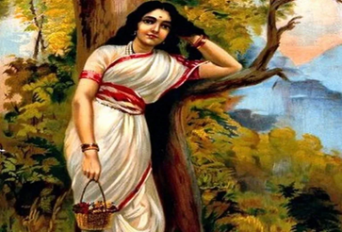
Ahalya

The Bala Kanda of the Ramayana mentions that Brahma molds Ahalya out of pure creative energy. Brahma created her out of the water as the most beautiful woman in order to break the pride of Urvashi, the foremost celestial nymph. Brahma places her in the care of Gautama rishi until she reaches puberty. When that time arrives, the sage returns Ahalya to Brahma, who, impressed by Gautama’s sexual restraint and asceticism, bestows her upon him. Indra, who believes that the best women are meant for him, resents Ahalya’s marriage to the forest-dwelling ascetic.

In another tale, it is said Ahalya is created from the ashes of the sacrificial fire by the Saptarishi (seven seers) and gifted to sage Gautama.

The king of the gods, Indra, was infatuated with her beauty and comes disguised as Gautama when the sage was away, and requests to have physical relationships with Ahalya. In some versions, Ahalya sees through his disguise but still complies out of “curiosity” and because her husband would neglect his matrimonial duties. In later versions, Ahalya falls prey to Indra’s trickery and does not recognize him. In all narratives, Ahalya and her lover Indra are cursed by Gautama. Gautama then curses Ahalya to remain invisible to all beings for thousands of years, fast by subsisting only on-air, suffer and sleep in ashes and be tormented by guilt. Nevertheless, he assures her that her sin will be expiated once she extends her hospitality to Rama, who will visit the ashram. Thereafter, Gautama abandons the ashram and goes to the Himalayas to practice asceticism. Indra was cursed to be castrated or be covered by a thousand vulvae that ultimately turn into a thousand eyes.

The Ayodhya prince Rama, with his brother Lakshmana and their guru, the sage Vishvamitra pass Gautama’s desolate ashram while travelling to King Janaka’s court in Mithila. As they near the ashram, Vishvamitra recounts the tale of Ahalya’s curse and instructs Rama to save Ahalya. Ahalya is said to have been touched by Rama’s feet and rises from her stone state to human form and goes to her abode, the Gautama’s hermitage.
Tara

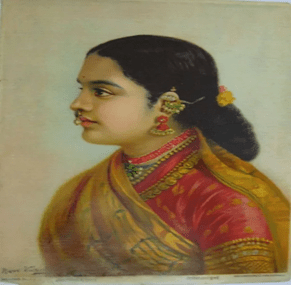
Tara was the wife of the monkey king Bali who was presumed dead after a battle with a demon after which she married his twin brother Sugriva according to the custom of the time. The lack of the description of formal marriage suggests that Tara’s relationship to Sugriva is neither widow re-marriage nor polyandry, but simply appropriation by Sugriva. In the references of the coronation of Sugriva as king, Angada is also described as the heir-apparent crown prince, while Tara is mentioned as Sugriva’s wife. The Adhyatma Ramayana declares that Sugriva acquires Tara.

It turns out that Bali isn’t killed in reality. When Bali returned, he was livid and abducted Sugriva’s first wife, Ruma, as revenge. As battle lines between the brothers were drawn, wise Tara counseled her first husband to return Ruma to his brother. Tara said Sugriva had not snatched her but married her legitimately only because Bali’s death had been confirmed. Tara, the mother of Bali’s son Angad, finally managed to wrest a promise from him that he would not kill his own brother. The brothers fought a duel in which Bali was killed by Sugriva’s mentor Rama. Sugriva was crowned king of the kingdom of Kishkindha. As dowager queen, Tara diplomatically left the question of the ascension of her son to the throne for his stepfather to resolve. She knew well that the guilt-ridden uncle Sugriva would not deny her son his right to the throne.

In his dying breath, Bali reconciles with Sugriva and instructs him to follow Tara’s wise counsel in all matters.

While all was well with the king and his lustful nature got the best of him and he eventually ignored his promise to Rama to help him win Sita back. Lakshaman was livid to find Sugriva had backtracked on his words. He entered Sugriva’s personal chambers to bring upon his wrath on the king but Queen Tara very diplomatically pacified the prince.

Thus she was instrumental in saving the king from the wrath of the Lakshmana and brought coherence in the Rama camp to fight the great war to avenge Sita.
Mandodari

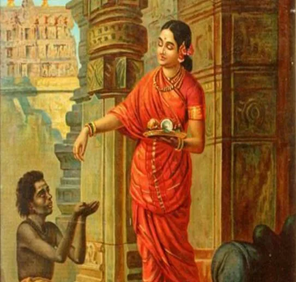
Mandodari is the daughter of Mayasura, the king of the Asuras, who are god-like demons. He rescued a beautiful girl child from the well. He and his, wife, Hema, adopted her and named her Mandodari. She was taught aspects of architecture by King Mayasura. He taught Mandodari about the various landforms of Bharatvarsh which were Swarga (heavenly plateaus), Bhoomi (plains) and Patala (underworld). When she turned fifteen, he started involving her in his projects and eventually met Ravana when he came to seek her counsel.

Valmiki’s Ramayana describes Mandodari as a very beautiful, pious and noblewoman whose appearance once led Hanumana to mistake her for Sita. She was known to be extremely patient with Ravana’s attitude towards women, but always questioning his actions and rebuking his choices.

Despite Ravana’s faults, Mandodari loved him and was proud of his strength. She was aware of Ravana’s weakness towards women. A righteous woman, Mandodari tried to lead Ravana to righteousness, but Ravana ignored her advice.

Draupadi

Draupadi is also referred to as Panchali (meaning one from the kingdom of Panchala), Yajnaseni (meaning one born from a Yajna or fire-sacrifice), Mahabhaaratii (great wife of the five descendants of Bharata) and Sairandhri (an expert maid, her assumed name during her second exile in which she worked as Virat kingdom’s queen Sudeshna’s hair-stylist).

Panchali is the Dharma Pathini of the Pancha Pandavas. The concept behind her marrying five people is that she is the Shakthi Roopa of the five devas, Dharma – Yudhishthira, Vayu – Bheema, Indra – Arjun, Nakul and Sahadev – Ashwini Kumaras.

No woman ever faced the trials and tribulations that Draupadi faced in her life. Even after being born out of the fire to Drupada, even if she had heroic husbands, she had to undergo Vastra harana, exile, Agnata. Post-war she was faced to watch her entire clan being killed.
Kunti

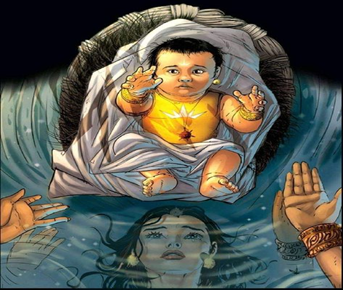
She is one true Matriarch of the Saga of Mahabharata. Kunti or Pritha was the daughter of Shurasena and the foster daughter of his cousin Kuntibhoja. She is the sister of Vasudeva. She was married to King Pandu of Hastinapur and was the mother of Karna and the first three Pandava brothers Yudhishthira, Bhima, Arjuna. She was the paternal aunt of Krishna, Balarama, and Subhadra. She was the stepmother or foster mother of Nakula and Sahadeva.

Kunti’s marital life was also unusual. Having chosen Pandu as her husband in a svayamvara ceremony, she never had a child by Pandu. Her husband had received a curse from the sage Kimdama that he would die on having intercourse with his wife because he had shot the sage with an arrow when he was copulating with his wife in the guise of a deer. Deeply hurt by the turn of events, Pandu decided to retire into the forest and live the life of renunciation. Kunti accompanied him. She invoked her boons for herself and Madri and had 3 children of her own and two for Madri. Pandu dies unable to abstain.

THE AGRARIAN REVOLUTION

The term Agrarian Revolution implies the great changes that took place in the agricultural methods of England during the second half of the 17th century and the first half of the eighteenth century.

Causes of the Revolution:

  • The old open field system was wasteful of land because, according to this arrangement, every year one of the three fields was to be out of cultivation.
  • Secondly, come the old system of distribution of land was wasteful of time.
  • Thirdly, there was the necessity of confirming the customs of the village and thus made experiments in agriculture method possible.

In the 18th century, the population was increasing and so more food was needed. Owing to the scarcity of food materials there was a rise in prices. The old-fashioned farmers thought that they could get more money if they produce more. This idea was an incentive for them to improve their agricultural methods.

Reallocation of Lands:

Reallocation of lands in consolidated blocks which could be enclosed, several Enclosure Acts were passed in the reign of George II and George III. There were many cases of the poor peasants being not satisfied with the reallocation. Such people sold their small holdings to wealthy businessmen of the city who were eager to possess lands of their own. The final result of this tendency was that the class of rural inhabitants known as yeomen disappeared.

Advantages of enclosure system:

One of the advantages of the enclosure system was that it gave scope for many enterprising people to make experiments. Jethro Tull of Berkshire was the inventor of the drill for sowing seeds. He also emphasized the necessity of capital selection of seeds if good crops were to be obtained.

Another pioneer is Charles Townshend of Norfolk. He adopted Tull’s principles and paid much attention to the question of rotation of crops. He introduced the four-course rotation of turnips, barley, clover, and ryegrass, and wheat. These measures prevented an unprotective fallow. His innovation made Norfolk a leading agricultural country. With the result that in the thirty years the rental of the one farm rose from 180 pounds to 800 pounds a year.

The work of Townshend was continued by Thomas Cook. He followed the precepts of Tull and in addition fed the soil with manures including bones. In nine years he was able to grow excellent wheat crops. He also introduced new artificial foods such as oil cake under led the way in fattening cattle for the London markets. He held a yearly meeting for farmers at his house and these meetings farming topics were discussed and much advice was given and received. It is estimated that the annual rental of his estate Rose from 2,200 pounds in 1776 to 20,000 pounds in 1816.

Cattle farming:

While Norfolk landlords were thus making great improvements in arable farming, a Leicestershire farmer, Kama Robert Bakewell was revolutionizing English methods of stock breathing. Up to this time sheep had been valued chiefly for their wool, the production of mutton had been only secondary. Bakewell was the first to turn his attention to the production of meat as the main consideration of stock breeding. By patient choice and experiment, he succeeded in producing a new breed of sheep with fattened quickly and weighed heavy. His success attracted the attention of many. Farmers from far and wide visited his farm at Dishley and became converts to his new methods. Others who did pioneering work in this field were George Culley, Charles Colling, and John Salman.

Board of agriculture:

Royal patronage was also given to the moment of revolutionizing the agriculture methods. George III, affectionately known to his subjects as a farmer George, established a model farm at Windsor. The success of the moment was due to the writings of agriculture writers, the most famous was Arthur Young. When a board of agriculture was established in 1793. Young was made its secretary.

Conclusion:

With the advent of the enclosure system, the English banking system also grows, for even the wealthy landlords did not have money to do the fencing and other improvements. So they have to borrow money from the banks. Through all those methods was very desirable from the point of view of production, it had a harmful effect on the partition. The system deprived him of the privilege of grazing his cattle and cutting fuel from the commons.

What is a Novel

Picaresque Novel

Poverty in India

Poverty one of the major problem in India. India is the second most populous country after China with 1.2 billion people and it is the seventh largest country in the world in terms of area.

Around ⅔rd of people in India live in poverty in which 68.9 % of Indian population lives on less than 2 dollar a day and over 30% even have less than 1.25 dollar per day. And thus they are considered extremely poor.

India subcontinent is one of the poorest country in the world.

The most poor section of our country is children and Womens. They are considered as the weakest member of Indian society and that’s why they suffer the most.

In India womens are not considered as the strongest member of the society because of a patriarchy.

Education and job for womens are not considered important in our society.

By preventing education for Childrens and womens leads to the poverty and poverty is also preventing children from getting an education

Poverty in India impacts children and families in a variety of different ways:-

  • High infant mortality
  • Child labour
  • Malnutrition
  • Lack of education
  • Child marriage

High infant mortality rate

  • India is one of the country with highest child mortality rate.
  • Around 1.4 million children die each year in India their fifth birthday.
  • Major causes of death are due to pneumonia, malaria, diarrhoeal diseases as well as chronic Malnutrition.

Child labour

  • Child labour for children under the age of 14 in India is prohibited by law.
  • According to official figures 12.5 nilganj children between the age of 5 to 14 are working.
  • It is believed that Indian children’s contribute to the living wood of their poor family.
  • Children’s work in the field in factories, in quarries, private households .

Malnutrition

  • India is one of the world’s top countries when it comes to Malnutrition.
  • 7.8 infants were found to have birth weight less than 2.5Kg
  • More than 200 million people don’t have sufficient access food.

Lack of Education

  • Most of childrens have no access to education in India.
  • Girls are excluded from the school in higher numbers with respect to boys.
  • We should have to treat them equally but it is believed to be inferior on lower caste.
  • Without education, chances of finding living from employment in India is impossible.
  • If educated peoples start teaching childrens at free of cost then it also be very useful in making a better world.
  • Like If 30 college students are studying in 1 course and they start teaching poor childrens only 1 day per month then the childrens study 1 month at free of costs.
  • We also have to put some efforts in making better world not for others, but for ourselves as well.

Child marriage

  • As we know Child marriage is crime according to Child marriage Restraint Act, 1929.
  • But it is still widespread in many regions of India.
  • Poverty is also the main reason behind this.

Overpopulation

  • Overpopulation leads to high competition in every aspects of life.
  • We see lack of job opportunities, education.
  • Food production is not as much to fulfill the need of this higher population.
  • Due to overpopulation, and not doing work after having such high population in India is main reason behind poverty.
  • If we utilise this overpopulation as the opportunity to increase country’s financial condition then it actually going to worth it.

Comprehending CHESS through ‘Through the Looking Glass’

Chess was the most important indoor game of the nineteenth century in England. It enjoyed centuries-old privileged status. It was considered as a ‘rational recreation’. Chess, unlike any other game, deals more with logic and rationality rather than fun, as we know, Rationalism had taken over the Victorian era abundantly.

Alice, at once, recognizes the chess board stretched on the vast land in the Looking Glass World. It shows that although she is just seven and a half years, still familiar to the this game, which signifies the popularity of Chess in England in Victorian Era, especially among the bourgeois class(as it is also called ‘game of royals’) and Alice belonged to the same.

In life we make ‘choices’, in chess we make ‘moves’. In order to attain something valuable in life as to capture the opponent’s castle in chess, initiative has to be taken. Nobody can make decisions for me, I’ll have to play myself, it’s just suggestions that our people may put before us. Here, Alice makes a choice to participate in the game ‘imagining’ her goal where she wants to be in the end. Well, talking about imagination with reference to Victorian era, it significantly brought out a drastic change in society, though previously children along with adults were forced into realism. ‘Imagination’ is quite efficient to presume one’s position in the coming years and then working out to get there can be useful, because life makes it hard to calculate the further possibilities due to lack of information. Alice restrained herself asking the Queens about their arrival, thinking it would be obtrusive, which keeps her away from the information, also we see Alice not able to distinguish between Red Knight and White Knight and actually who’s there to save her declares her ignorance towards information.

Chess is symbolic to attributes of life, we see, there are (apparently) three stages in chess, that is, opening, middle game and the end game, similarly we have childhood, youth and adulthood in life. Alice joins the giant Chess game of life as a white pawn, that is, she holds very limited power and can move once at a time. We always need to start from the beginning, that is, from the very first ladder in order to earn it step by step. Alice has the freedom to setup her ‘goal’ to be a Queen, but she has no power over her inevitable maturation that’s leading her to womanhood. Within the framework of the chess game, Alice has almost no control over her path and she, with certain implied rules of the game, is driven by the corresponding characters in the book, as in chess, every piece moves in answer to the move of the other one. She is pushed towards her goal by the various situations occurring before her in every square, such as, the train ride, no-name forest, Humpty Dumpty and the White Knight. Thus, it can be traced from the narrative that in life, there is some invisible force that’s propelling every individual in the direction of set goal. It can be comprehended that collaboration is the biggest instrument to victory, for example, White Knight saved Alice from the attack of Red Knight without which it had been a Herculean task for her to reach to final square. We will have to rely on our people somehow, otherwise we can’t achieve our dreams just by our own self. In chess, one can take full credit for one’s victories, but in life it would be naive to say that what I achieved is all because of my sole efforts.

The game of Chess in Through The Looking Glass represents the interest of Carroll in logics and mathematics, and the agent is ‘Alice’. This game is not about luck unlike other indoor/board games, rather brainy. In the same way, Life is more about randomness, it’s not alone in the hands of fate, though life is much more unpredictable. We need statistics as well as probability in both chess and life. Also, chess possesses two different colors, that is, one is light and the other one is dark, where I suppose, they stand for logic and nonsense respectively. Based on this idea, Alice often proves to be smarter, more prudent than the so-called adults she confronts in the Looking Glass world. This might also be a reverse-reflection of actual world, I guess, where we see adults inclined towards logic and children uttering stuff and nonsense and vice-versa, here, in the world of mirror.

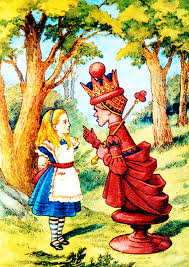
Life of the children in Victorian period was totally opposite to that of present-day children. They were considered as miniature adults and were expected to be highly sophisticated, more in the case of rich class children. Children were not allowed to shout, complain, interrupt or disagree with anyone. The children of rich parents were usually looked after by governesses, no matter humble or strict, and they only used to teach them manners and the way of living. Here, in Looking Glass world, Red Queen, the first character to guide Alice in the reverse world,

resembles very much like a governess of Alice when she teaches her how to not tweedle her fingers while speaking, how to behave, and to curtsey, and how Alice couldn’t go against her. She says, “when you’ve once said a thing, that fixes it, and you must take the consequences.”, because Alice is a Pawn and a Pawn cannot move backward, it is also allusion to the fact that once you have made the decision/choice, you can’t step back and stay committed bearing with it’s outcome, and she also asks Alice only to speak when she was asked to. Even we see TweedleDum-TweedleDee not ready to converse with Alice before she greets them. When Alice thinks that asking the Queens how they arrived would be impertinent, it shows again the social structure built for children in the real Victorian world.

When we are in a state of childhood, we want to turn into an adult soon. Similarly, Alice is excited about her lone-tour of adulthood through the Looking Glass world as she thinks she will be free of all the scolding, she says, “….no one here to scold me away from the fire….and can’t get me!” In the beginning, Alice was thrilled about her journey but as she is heading forward, she encounters the sense of loneliness in her journey to become a Queen(apparently) and acts adult herself. Though she is surrounded by different creatures many a times, but she feels alienated to their foreign ways. Hence, here Chess is a symbol of journey advancing from childhood to adulthood. She undergoes many crucial experiences, putting forward the idea of challenges one has to face in this journey of adulthood in one’s life. In the beginning, we see Alice being rude to Gnat about his jokes and later we see her kindness with White Knight that declares the change in her attitude as moving towards adulthood. When the Queen gives Alice directions as how to be a proper queen, it indicates that Alice wasn’t actually prepared to become a queen, just as it’s hard to prepare to be an adult in real world. Every square leads her to different characters and every character teaches Alice something significant, as we know, advice can come from the most unexpected places. For example, revelation of identity imposed by the situation in the woods of forgetfulness, the White Queen teaches her to believe in impossible, the fall of Humpty Dumpty symbolizes ‘the fall of man for pride’ and also ‘the fall of innocence’ proceeding towards maturity, and likewise all the other characters. These teachings help Alice to inherent the characteristics of adulthood within her. The crown here, symbolizes the transformation of Alice from childhood to adulthood.

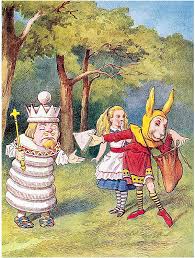
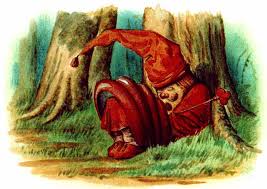
The Red King and the White King are almost doing nothing throughout the game as compared to their Queens. The Red King, as first encountered by Alice, is sleeping and his other pieces are performing their tasks to save him, whereas, the White King seems to be nervous not able to catch up with her Queen.

Now these characters resemble in moves of both as that of the White and Red King in the real chess board. These actions of Queens and Kings in the world behind the mirror, may portray the position of women in the Victorian era. Women, at that time, used to engage themselves working for their husband and family, and also middle class and the working class women were employed to earn bread for their family, in support of their husbands. Red Queen saying to Alice, “…if you want to get somewhere else, you must run at least twice as fast as that!” may ascertain the idea that in a male-dominated society, women need to work double/toil harder in comparison to men in order to attain recognition. Women in the nineteenth century were not given much of the rights and privileges. This period is named after Queen Victoria, who was in the place of power. It is strange to encounter such a frivolous situation of women at the time when a lady herself was reigning over the society. When we behold Alice as a little woman moving from actual world to Looking Glass world, it may seem as she is struggling to change her confided world. She starts her journey all by herself which reflects the essence of independence in her. The characters like Live flowers resemble the social class structure that pushes Alice to follow their rules. When she chooses to be a Queen, she establishes the path for women/girls to upgrade their status because Alice learns that she must have a powerful authority to control Looking Glass world when one of the servants at once answers her after she turns into a Queen, so is the case for women in Victorian era, for example, Queen Victoria.

We need not be afraid of our high-rated opponents and feel incapable before them and it is then only that Alice is able to shake Red Queen in frustration and raises her voice against her rather than stitching her lips out of fear as evident in the beginning, that is, crown here, symbolizes her transformation from childhood to womanhood, gives her voice and finally renovates her status from a pawn to a queen. All the exclusive pieces are placed right behind the pawns. And a Pawn in comparison to them is just an ordinary, common piece that can slowly and gradually become a Queen. Even a pawn can cut down a King, pertaining to life, a single human being, regardless of his status, is enough to bring about revolution in the society, and win the castle of life. Alice suffering through all the odds, obstructions eventually made it, checkmated the Red King and turned into a Queen.

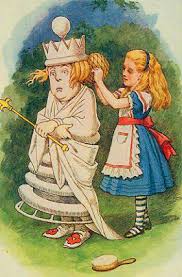
As a Queen in the game, the Red Queen and the White Queen are able to move swiftly and effortlessly. The White Queen, as she says, “jam-tomorrow and jam-yesterday, but never jam-today.”, and screams before pricking her thumb, travels in past and future which is true for the Queen,

in general, in chess that she can freely move in every direction possible, but she is seen nervous and messy all the time here, and ultimately at two points passes up a chance to checkmate and on another occasion she missed the opportunity to capture the Red Knight. Similarly, the Red Queen said to Alice, “Speak when you’re spoken to!”, and having supporting her words, she doesn’t announce it after putting White King on the check, hence, the check is ignored. Their individual character traits restrained them from performing their duties. This also discovers their absent-mindedness and reverse effect of the mirror world.

The Knight in the chess moves very distinctively and is allowed to jump over any other pieces. Riding and falling of the White Knight in looking glass world is signifying it’s unique L-shape movement. The inventions of White Knight are here to present his powerful character trait, like in chess board Knight is an only piece imbibed with many powers, unlike other pieces, not even a Queen can move in same way as Knight, though his inventions are unprofitable disclosing the touch of the illusionary world, still it is pointing to the fact that precaution is must, so his horse wears spikes on it’s ankles to protect it from shark bites and he collects things that might be useful in the difficult situation. The White Knight is the only character that is benevolent with Alice and saves Alice from the attack of Red Knight (stopping her to be a Queen/upgrade the position of women in society), but it can be an example of gender-biased society where a man is shown as a powerful figure and woman belongs to a weaker section. Alice, here, is represented as a weak girl and this action of White Knight throws light on the concept of feminism, and make Alice learn that a woman must stand for herself and must discover her own capabilities.

Chess wasn’t just one of the themes in Carroll’s story, indeed, it was the ground for the novel’s structure. The game of chess in real world is ‘logical’ while in looking glass world it can be called as ‘maddening game of chess’. Also as an inverted image created by the mirror, this indoor game is displayed as an outer giant field of chess. The pieces are definitely running and moving under the implied rules, but the pattern is not applied evenly. This game sets the deterministic way of life. Both life and chess are, more or less, synonymous in almost every aspect.

Citation: https://www.smithsonianmag.com/arts-culture/the-64-square-grid-design-of-through-the-looking-glass-24546391/

Comprehending CHESS through 'Through the Looking Glass'

Chess was the most important indoor game of the nineteenth century in England. It enjoyed centuries-old privileged status. It was considered as a ‘rational recreation’. Chess, unlike any other game, deals more with logic and rationality rather than fun, as we know, Rationalism had taken over the Victorian era abundantly.

Alice, at once, recognizes the chess board stretched on the vast land in the Looking Glass World. It shows that although she is just seven and a half years, still familiar to the this game, which signifies the popularity of Chess in England in Victorian Era, especially among the bourgeois class(as it is also called ‘game of royals’) and Alice belonged to the same.

In life we make ‘choices’, in chess we make ‘moves’. In order to attain something valuable in life as to capture the opponent’s castle in chess, initiative has to be taken. Nobody can make decisions for me, I’ll have to play myself, it’s just suggestions that our people may put before us. Here, Alice makes a choice to participate in the game ‘imagining’ her goal where she wants to be in the end. Well, talking about imagination with reference to Victorian era, it significantly brought out a drastic change in society, though previously children along with adults were forced into realism. ‘Imagination’ is quite efficient to presume one’s position in the coming years and then working out to get there can be useful, because life makes it hard to calculate the further possibilities due to lack of information. Alice restrained herself asking the Queens about their arrival, thinking it would be obtrusive, which keeps her away from the information, also we see Alice not able to distinguish between Red Knight and White Knight and actually who’s there to save her declares her ignorance towards information.

Chess is symbolic to attributes of life, we see, there are (apparently) three stages in chess, that is, opening, middle game and the end game, similarly we have childhood, youth and adulthood in life. Alice joins the giant Chess game of life as a white pawn, that is, she holds very limited power and can move once at a time. We always need to start from the beginning, that is, from the very first ladder in order to earn it step by step. Alice has the freedom to setup her ‘goal’ to be a Queen, but she has no power over her inevitable maturation that’s leading her to womanhood. Within the framework of the chess game, Alice has almost no control over her path and she, with certain implied rules of the game, is driven by the corresponding characters in the book, as in chess, every piece moves in answer to the move of the other one. She is pushed towards her goal by the various situations occurring before her in every square, such as, the train ride, no-name forest, Humpty Dumpty and the White Knight. Thus, it can be traced from the narrative that in life, there is some invisible force that’s propelling every individual in the direction of set goal. It can be comprehended that collaboration is the biggest instrument to victory, for example, White Knight saved Alice from the attack of Red Knight without which it had been a Herculean task for her to reach to final square. We will have to rely on our people somehow, otherwise we can’t achieve our dreams just by our own self. In chess, one can take full credit for one’s victories, but in life it would be naive to say that what I achieved is all because of my sole efforts.

The game of Chess in Through The Looking Glass represents the interest of Carroll in logics and mathematics, and the agent is ‘Alice’. This game is not about luck unlike other indoor/board games, rather brainy. In the same way, Life is more about randomness, it’s not alone in the hands of fate, though life is much more unpredictable. We need statistics as well as probability in both chess and life. Also, chess possesses two different colors, that is, one is light and the other one is dark, where I suppose, they stand for logic and nonsense respectively. Based on this idea, Alice often proves to be smarter, more prudent than the so-called adults she confronts in the Looking Glass world. This might also be a reverse-reflection of actual world, I guess, where we see adults inclined towards logic and children uttering stuff and nonsense and vice-versa, here, in the world of mirror.

Life of the children in Victorian period was totally opposite to that of present-day children. They were considered as miniature adults and were expected to be highly sophisticated, more in the case of rich class children. Children were not allowed to shout, complain, interrupt or disagree with anyone. The children of rich parents were usually looked after by governesses, no matter humble or strict, and they only used to teach them manners and the way of living. Here, in Looking Glass world, Red Queen, the first character to guide Alice in the reverse world,

resembles very much like a governess of Alice when she teaches her how to not tweedle her fingers while speaking, how to behave, and to curtsey, and how Alice couldn’t go against her. She says, “when you’ve once said a thing, that fixes it, and you must take the consequences.”, because Alice is a Pawn and a Pawn cannot move backward, it is also allusion to the fact that once you have made the decision/choice, you can’t step back and stay committed bearing with it’s outcome, and she also asks Alice only to speak when she was asked to. Even we see TweedleDum-TweedleDee not ready to converse with Alice before she greets them. When Alice thinks that asking the Queens how they arrived would be impertinent, it shows again the social structure built for children in the real Victorian world.

When we are in a state of childhood, we want to turn into an adult soon. Similarly, Alice is excited about her lone-tour of adulthood through the Looking Glass world as she thinks she will be free of all the scolding, she says, “….no one here to scold me away from the fire….and can’t get me!” In the beginning, Alice was thrilled about her journey but as she is heading forward, she encounters the sense of loneliness in her journey to become a Queen(apparently) and acts adult herself. Though she is surrounded by different creatures many a times, but she feels alienated to their foreign ways. Hence, here Chess is a symbol of journey advancing from childhood to adulthood. She undergoes many crucial experiences, putting forward the idea of challenges one has to face in this journey of adulthood in one’s life. In the beginning, we see Alice being rude to Gnat about his jokes and later we see her kindness with White Knight that declares the change in her attitude as moving towards adulthood. When the Queen gives Alice directions as how to be a proper queen, it indicates that Alice wasn’t actually prepared to become a queen, just as it’s hard to prepare to be an adult in real world. Every square leads her to different characters and every character teaches Alice something significant, as we know, advice can come from the most unexpected places. For example, revelation of identity imposed by the situation in the woods of forgetfulness, the White Queen teaches her to believe in impossible, the fall of Humpty Dumpty symbolizes ‘the fall of man for pride’ and also ‘the fall of innocence’ proceeding towards maturity, and likewise all the other characters. These teachings help Alice to inherent the characteristics of adulthood within her. The crown here, symbolizes the transformation of Alice from childhood to adulthood.

The Red King and the White King are almost doing nothing throughout the game as compared to their Queens. The Red King, as first encountered by Alice, is sleeping and his other pieces are performing their tasks to save him, whereas, the White King seems to be nervous not able to catch up with her Queen.

Now these characters resemble in moves of both as that of the White and Red King in the real chess board. These actions of Queens and Kings in the world behind the mirror, may portray the position of women in the Victorian era. Women, at that time, used to engage themselves working for their husband and family, and also middle class and the working class women were employed to earn bread for their family, in support of their husbands. Red Queen saying to Alice, “…if you want to get somewhere else, you must run at least twice as fast as that!” may ascertain the idea that in a male-dominated society, women need to work double/toil harder in comparison to men in order to attain recognition. Women in the nineteenth century were not given much of the rights and privileges. This period is named after Queen Victoria, who was in the place of power. It is strange to encounter such a frivolous situation of women at the time when a lady herself was reigning over the society. When we behold Alice as a little woman moving from actual world to Looking Glass world, it may seem as she is struggling to change her confided world. She starts her journey all by herself which reflects the essence of independence in her. The characters like Live flowers resemble the social class structure that pushes Alice to follow their rules. When she chooses to be a Queen, she establishes the path for women/girls to upgrade their status because Alice learns that she must have a powerful authority to control Looking Glass world when one of the servants at once answers her after she turns into a Queen, so is the case for women in Victorian era, for example, Queen Victoria.

We need not be afraid of our high-rated opponents and feel incapable before them and it is then only that Alice is able to shake Red Queen in frustration and raises her voice against her rather than stitching her lips out of fear as evident in the beginning, that is, crown here, symbolizes her transformation from childhood to womanhood, gives her voice and finally renovates her status from a pawn to a queen. All the exclusive pieces are placed right behind the pawns. And a Pawn in comparison to them is just an ordinary, common piece that can slowly and gradually become a Queen. Even a pawn can cut down a King, pertaining to life, a single human being, regardless of his status, is enough to bring about revolution in the society, and win the castle of life. Alice suffering through all the odds, obstructions eventually made it, checkmated the Red King and turned into a Queen.

As a Queen in the game, the Red Queen and the White Queen are able to move swiftly and effortlessly. The White Queen, as she says, “jam-tomorrow and jam-yesterday, but never jam-today.”, and screams before pricking her thumb, travels in past and future which is true for the Queen,

in general, in chess that she can freely move in every direction possible, but she is seen nervous and messy all the time here, and ultimately at two points passes up a chance to checkmate and on another occasion she missed the opportunity to capture the Red Knight. Similarly, the Red Queen said to Alice, “Speak when you’re spoken to!”, and having supporting her words, she doesn’t announce it after putting White King on the check, hence, the check is ignored. Their individual character traits restrained them from performing their duties. This also discovers their absent-mindedness and reverse effect of the mirror world.

The Knight in the chess moves very distinctively and is allowed to jump over any other pieces. Riding and falling of the White Knight in looking glass world is signifying it’s unique L-shape movement. The inventions of White Knight are here to present his powerful character trait, like in chess board Knight is an only piece imbibed with many powers, unlike other pieces, not even a Queen can move in same way as Knight, though his inventions are unprofitable disclosing the touch of the illusionary world, still it is pointing to the fact that precaution is must, so his horse wears spikes on it’s ankles to protect it from shark bites and he collects things that might be useful in the difficult situation. The White Knight is the only character that is benevolent with Alice and saves Alice from the attack of Red Knight (stopping her to be a Queen/upgrade the position of women in society), but it can be an example of gender-biased society where a man is shown as a powerful figure and woman belongs to a weaker section. Alice, here, is represented as a weak girl and this action of White Knight throws light on the concept of feminism, and make Alice learn that a woman must stand for herself and must discover her own capabilities.

Chess wasn’t just one of the themes in Carroll’s story, indeed, it was the ground for the novel’s structure. The game of chess in real world is ‘logical’ while in looking glass world it can be called as ‘maddening game of chess’. Also as an inverted image created by the mirror, this indoor game is displayed as an outer giant field of chess. The pieces are definitely running and moving under the implied rules, but the pattern is not applied evenly. This game sets the deterministic way of life. Both life and chess are, more or less, synonymous in almost every aspect.

Citation: https://www.smithsonianmag.com/arts-culture/the-64-square-grid-design-of-through-the-looking-glass-24546391/

AN INCIDENT THAT RESTORED MY FAITH IN HUMANITY

Prior to disclosing to you my story , I need to make myself clear that I am not saying that humankind has totally evaporated from our reality. Yet, it is truth that we people have gotten insatiable and egotistical. More often than not we don’t help other people except if we see our benefit. These days, cash has gotten more essential to us than others. I additionally sort of accepted that thing, however after that one incident I came to realize that there are as yet pleasant individuals in world, who will help other people without seeing their benefit.

Save The Humanity – We Care For Everything

So, it was around 10 years prior, I was 7 years old around then. It was the long stretch of February and was recent days I was felling extremely debilitated, it was such a lot of that we chose to visit the doctor. The specialist recommended me a medicines, yet those prescriptions were of high dose which consequently demolish my condition. Scarcely any days after that I understood that I was unable to move my limbs much. My parents got truly stressed and we visit to the specialist once more. I got conceded in the emergency clinic yet my condition didn’t improve, it continued getting decline. Then, at that point two of my Mom’s companions came and encouraged to go to the next clinic which was in other city. We went their and we came to realize that my left half of body got paralyzed.

My folks couldn’t really accept that what they heard, they were stunned. I got conceded in that hospital. Since that emergency clinic was not in our city, we dealt with issues particularly me since I was unable to eat custom made food. Close to my ward there was additionally an old individual conceded. His family used to live in that city just , so they brought him hand crafted quality food and other important things. Be that as it may, one day his family visited my ward and connected with my folks. They felt terrible for me and said to my folks that “You can uninhibitedly get in touch with us on the off chance that you need anything”. Following day, when his family came they brought nourishment for us too. We were so moved by their thoughtful gesture. Also, regardless of being a finished outsider to us. They brought food and other important things for us practically ordinary, even after that grandpa got discharged. Following one and a half month I got released, despite the fact that I was not totally well.

They offered us to live in their home since we may require help. In any case, we declined the offer since we would prefer not to give them more difficulty, since they previously helped us a great deal in this range of one and a half month. We chose to go to our home yet following not many months we went to their home to express gratitude toward them, since we were so moved by their thoughtful gesture. We felt so fortunate to met them. They were really heavenly messengers in human structure. They helped us in our difficult stretches. Besides, they additionally gave us moral help and support my parents. They energized me while I was recovering and they wished me wellbeing and accomplishment before we left.

This thoughtful gesture reestablished my confidence in humankind. It caused me to accept that there are as yet pleasant individuals in our reality. Furthermore, in all honesty we as a whole have encountered such incidents in our life which have made us puts stock in humankind. As a result of such individuals “Humankind” actually exist in our reality.

Humanity Online Assignment Help | Thoughtful Minds

AN INCIDENT THAT RESTORED MY FAITH IN HUMANITY

Prior to disclosing to you my story , I need to make myself clear that I am not saying that humankind has totally evaporated from our reality. Yet, it is truth that we people have gotten insatiable and egotistical. More often than not we don’t help other people except if we see our benefit. These days, cash has gotten more essential to us than others. I additionally sort of accepted that thing, however after that one incident I came to realize that there are as yet pleasant individuals in world, who will help other people without seeing their benefit.

Save The Humanity – We Care For Everything

So, it was around 10 years prior, I was 7 years old around then. It was the long stretch of February and was recent days I was felling extremely debilitated, it was such a lot of that we chose to visit the doctor. The specialist recommended me a medicines, yet those prescriptions were of high dose which consequently demolish my condition. Scarcely any days after that I understood that I was unable to move my limbs much. My parents got truly stressed and we visit to the specialist once more. I got conceded in the emergency clinic yet my condition didn’t improve, it continued getting decline. Then, at that point two of my Mom’s companions came and encouraged to go to the next clinic which was in other city. We went their and we came to realize that my left half of body got paralyzed.

My folks couldn’t really accept that what they heard, they were stunned. I got conceded in that hospital. Since that emergency clinic was not in our city, we dealt with issues particularly me since I was unable to eat custom made food. Close to my ward there was additionally an old individual conceded. His family used to live in that city just , so they brought him hand crafted quality food and other important things. Be that as it may, one day his family visited my ward and connected with my folks. They felt terrible for me and said to my folks that “You can uninhibitedly get in touch with us on the off chance that you need anything”. Following day, when his family came they brought nourishment for us too. We were so moved by their thoughtful gesture. Also, regardless of being a finished outsider to us. They brought food and other important things for us practically ordinary, even after that grandpa got discharged. Following one and a half month I got released, despite the fact that I was not totally well.

They offered us to live in their home since we may require help. In any case, we declined the offer since we would prefer not to give them more difficulty, since they previously helped us a great deal in this range of one and a half month. We chose to go to our home yet following not many months we went to their home to express gratitude toward them, since we were so moved by their thoughtful gesture. We felt so fortunate to met them. They were really heavenly messengers in human structure. They helped us in our difficult stretches. Besides, they additionally gave us moral help and support my parents. They energized me while I was recovering and they wished me wellbeing and accomplishment before we left.

This thoughtful gesture reestablished my confidence in humankind. It caused me to accept that there are as yet pleasant individuals in our reality. Furthermore, in all honesty we as a whole have encountered such incidents in our life which have made us puts stock in humankind. As a result of such individuals “Humankind” actually exist in our reality.

Humanity Online Assignment Help | Thoughtful Minds

THE PICARESQUE NOVEL

The Picaresque novel is a famous technique in earlier periods. These techniques were used to record the Kings’ and other person’s victories in and out of the battlefields even during his adventures. This form of literature helped in recording the real historical heroes and events from various perspectives. Many authors adapted these techniques and succeeded in making new epic fictions, mythologies, and other real events and incidents.

The Picaresque Novel originated in Spain. The term ‘Picaresque’ is derived from the Spanish ‘picaro’ meaning an anti-hero or rogue. A Picaresque novel is generally an autobiography account of the hero’s fortunes, sufferings and wanderings. It is a combination of episodic tales arranged as journeys. They episodes generally depict low life in a rambling manner and come to an abrupt ending.

The first prose fiction in the nature of the picaresque was John Lyly’s ‘Euphues’ published in 1578 detailing the loves and adventures of a young Athenian called Euphues. Six years later, Thomas Nash published his ‘Unfortunate Traveller’, a more perfect picaresque romance dealing with the travels and adventure of a page called Jacky Wilton. Defoe’s ‘Moll Flanders’ published in 1722 had an affinity with the picaresque mode of writing. But Smollett’s  ‘The Adventure of Ferdinand Count Fathom’ is a more perfect form of the picaresque. However, it was Fielding’s ‘Tom Jones’ which established the respectability of the picaresque novel. Fielding’s novel describes through 18 book’s the adventures and several love affairs of The Young anti-hero Tom Jones. Elements of the picaresque can be found in Dickens’s Nicholas Nickleby and in Joyce Cary’s “The horse’s mouth.”

The object of the picaresque novel is to take a central figure through a succession of scenes and adventures, introduce a great number of characters around him and thus build-up picture of society. In the eighteenth century and before travel was the only way to get acquainted with social life. That is why heroes in the Picaresque novels are travelling heroes. The hero in a picaresque novel is always in the Whirlpool of adventures and he has to be present in several human situations. The picaresque hero often transcends the level of the rogue into a tragic figure with human attributes as in the case of Fielding’s Tom Jones.

Another feature of the picaresque novel is the dynamic movement of the hero. He should run through a succession of scenes as Tom does during his journey to London. The novelist constructs the picture of society through the narration of the hero’s wanderings. Smollett sends his hero Roderick Random not only to London but also to France and for a ship journey. The picaresque novel may go deeper into a contemplation of the more intricate relationship between good and evil. They also reveal the strange truth that generous impulses exist even in those whom society considers as rougues. Tom Jones is a generous and manly youth in spite of the rouguish elements in his character.

Until now this technique is used by various authors for various books in the name of Mythologies, fiction, and other Genres.

Short stories within novels

All about autobiography

WHAT IS A NOVEL

The novel owes its existence to man’s interest in other men and the great panorama of human passion and action. Both the drama and the novel are compounded of the same material but in drama and the literary element is bound up with the elements of stage settings and interpretations through acting. So, Marion Crawford terms the novel as “Pocket theatre”. The novel may be defined as long narrative prose detailing the actions of fictitious people. Meredith calls it a ‘summing of actual life’. The novel combines narration and description, history and philosophy, poetry and fantasy, social criticism, and a particular view of life.

Elements of the Novel:

The novel has various elements.

  1. In the first place, it should have a plot. The novel deals with elements and actions and how these are presented is the plot.
  2. Secondly, the men and women who are involved in these elements and actions appear as characters in the novel.
  3. The third element is the dialogue the mean of interaction among the characters.
  4. The fourth element is the scene and the time of action because the characters must interact, do or suffer at some place or time.
  5. The fifth element is the style in which the narration is done.
  6. The Sixth Element is the view of life presented by the novelist.

The Plot:

The plot in a novel is the organization of incidents. The theme should have substantial value and human interest. It is primarily concerned with the things which make life strenuous, intense, and morally significant.

There are two types of plots – organic and episodic. In the first, the characters and events are well interwoven that no character or incident can be removed from the novel without causing damages to the whole. The plot and Jane Austen novels are examples. The second type of plot is loosely formed and characters and incidents have no essential bearing on each other. The picaresque novels of Fielding and even some of the novels of Dickens have episodic plots. How the various elements in the plot or organized to achieve a definite artistic purpose is called the structure. Unity in structure and plot is to be observed.

The Characterization:

Characterization is the act of presenting the characters alive and real to our imagination. The men and women in the novel must move through it like living beings they should remain in the readers’ memory after the novel is laid aside. There are two types of characterization – the direct or the analytic and the indirect or dramatic. In the analytical method, the novelist portrays his Characters from outside, dissects their passion, thoughts, and feelings, and even passes judgment upon them.

The Dialogue:

Dialogue is well managed, gives vividness, and actually to the plot and the characters. Dialogue reveals the passion and the emotion of the character and advises the movement of the plot. Dialogue should Constitute an organic element in the story. It should be natural, appropriate, and dramatic. It should be in keeping with the personality of the speaker.

The Time and Place of Action:

Time and place of action in a novel refer to the whole setting of the story, both social and material. They are novels of sea life, military life, industrial life of district life, and life of different classes of people. There are novels with a regional background; there are novels written in the historical background. whatever may be the setting, the novelist should master its details and then present a lively picture of it.

The novel is concerned with life and so the novelist’s view of life may be revealed in the novel. A novelist may make creative observations on human life. By the selection and organization of the material, and by the presentation of character and development of the plot, the novelist can show us what he thinks of life. However, the novelist should not indulge in propaganda or preaching. His philosophy is a part of the structure of the novel and should reveal itself through the interpretation of life, thought, character, and temper of the work as a whole.

The chief characteristics of Shakespearean novels

Must read two books by Paulo Coelho-2

Evolution of ‘Tragedy’ in English Drama

Tragedy as known in Dramas is one of the earliest forms of Drama that you can trace back in the history of Drama. With the passage of time ‘Tragedy’ continued to be redefined in history by many famous philosophers as well as playwrights. Both leading us to the present day contemporary Drama which portrays Tragedy in a whole different aspect as compared to the past.

The beginning of Tragic Drama first took place in Greek culture. The well-known stories and myths were the main sources of inspiration for the Tragic plays. The features of the Greek Tragic Drama were as followed. The play involved few actors who themselves played several characters on-stage. There was a norm that tragedy and comedy were never supposed to be mixed. The play strictly followed the three unities in drama known as the unity of place, unity of action and unity of time.

I will now talk about the description of Tragedy in Drama as approached by the early philosophers as well as modern day playwrights. Thus, proving the variations and evolution that took place in the Tragic category of Drama.

As first defined by the great Greek Philosopher Aristotle, a Tragic Drama was a good Tragic Drama if it followed the certain rules as laid out by the Philosopher. The first rule describing the characters of the Drama. According to Aristotle the character had to be good but not too good. This was because the main purpose of the ‘Tragedy’ play was to evoke feelings of pity and sympathy and not any other. This purging of emotions was what he called Catharsis. He also talked about presence of Hamartia in the lead character, which refers to the presence of flaws that later paved way to the tragic aspect of Drama known as the downfall of the protagonist. Aristotle also believed that apart from all this, the action of the play itself had to be proper and of high magnitude.

Geoffrey Chaucer, one of the great poets and writers of the middle English times, gave us why the subjects of tragedy were of ‘High Society’. He explained that the idea of tragedy was to show falseness of human power and wealth. Unlike Aristotle he believed that humble and meekness were the feelings that had to be purged out through tragic plays.

G.W. Hegel a modern philosopher stressed that ‘Tragedy’ in English Dramas had to have a moral conflict. A conflict between two rights.

The present day modern dramas are highly influenced with the ideas of William Shakespeare about Tragedy in Dramas. William Shakespeare was one of the first playwrights to break away from the restrictions about Tragedy as described by the Greeks, the early philosophers and the playwrights. Though he still followed Aristotle’s concepts of tragedy to some extent but he did not completely follow all of his ideas with regard to Tragedy.

The modern-day Dramas today revolve not just around people of high society but also around the stories of ordinary people, leading to a more realistic feeling in Tragedy. It also breaks away the norm of Tragedy not being mixed up with others genres of Drama. Thus, providing the audience with a combination of genres and a great source of entertainment and learning through Dramas.

Evolution of 'Tragedy' in English Drama

Tragedy as known in Dramas is one of the earliest forms of Drama that you can trace back in the history of Drama. With the passage of time ‘Tragedy’ continued to be redefined in history by many famous philosophers as well as playwrights. Both leading us to the present day contemporary Drama which portrays Tragedy in a whole different aspect as compared to the past.

The beginning of Tragic Drama first took place in Greek culture. The well-known stories and myths were the main sources of inspiration for the Tragic plays. The features of the Greek Tragic Drama were as followed. The play involved few actors who themselves played several characters on-stage. There was a norm that tragedy and comedy were never supposed to be mixed. The play strictly followed the three unities in drama known as the unity of place, unity of action and unity of time.

I will now talk about the description of Tragedy in Drama as approached by the early philosophers as well as modern day playwrights. Thus, proving the variations and evolution that took place in the Tragic category of Drama.

As first defined by the great Greek Philosopher Aristotle, a Tragic Drama was a good Tragic Drama if it followed the certain rules as laid out by the Philosopher. The first rule describing the characters of the Drama. According to Aristotle the character had to be good but not too good. This was because the main purpose of the ‘Tragedy’ play was to evoke feelings of pity and sympathy and not any other. This purging of emotions was what he called Catharsis. He also talked about presence of Hamartia in the lead character, which refers to the presence of flaws that later paved way to the tragic aspect of Drama known as the downfall of the protagonist. Aristotle also believed that apart from all this, the action of the play itself had to be proper and of high magnitude.

Geoffrey Chaucer, one of the great poets and writers of the middle English times, gave us why the subjects of tragedy were of ‘High Society’. He explained that the idea of tragedy was to show falseness of human power and wealth. Unlike Aristotle he believed that humble and meekness were the feelings that had to be purged out through tragic plays.

G.W. Hegel a modern philosopher stressed that ‘Tragedy’ in English Dramas had to have a moral conflict. A conflict between two rights.

The present day modern dramas are highly influenced with the ideas of William Shakespeare about Tragedy in Dramas. William Shakespeare was one of the first playwrights to break away from the restrictions about Tragedy as described by the Greeks, the early philosophers and the playwrights. Though he still followed Aristotle’s concepts of tragedy to some extent but he did not completely follow all of his ideas with regard to Tragedy.

The modern-day Dramas today revolve not just around people of high society but also around the stories of ordinary people, leading to a more realistic feeling in Tragedy. It also breaks away the norm of Tragedy not being mixed up with others genres of Drama. Thus, providing the audience with a combination of genres and a great source of entertainment and learning through Dramas.

Biomedical Wastes

Our environment is degrading day by day. India with its growing population is also keeping up with the waste generation.

Nowadays pollution is everywhere whether its air pollution, water pollution, land pollution, noise pollution, radioactive pollution and the pollution from E waste what not?

Biomedical Waste( BMW) is any waste produced during the diagnosis treatment or immunization of human or Animal Research activities retaining threat or in the production the testing of biological or in health camps.

Let the waste of the ‘sicks’, not ruin the life of the ‘healthy’

Common generator of Biomedical wastes are :-

  • Hospital
  • Emergency Medical Services
  • Medicinal Research Laboratories
  • offices of physician , dentist, veterinarians
  • home Health Care
  • funeral homes

From WHO stats 2000,the improper treatment of medical waste( primary use of infected needles and syringes) caused 21 million hepatitis B infection and 2, 60, 000 HIV infections worldwide.

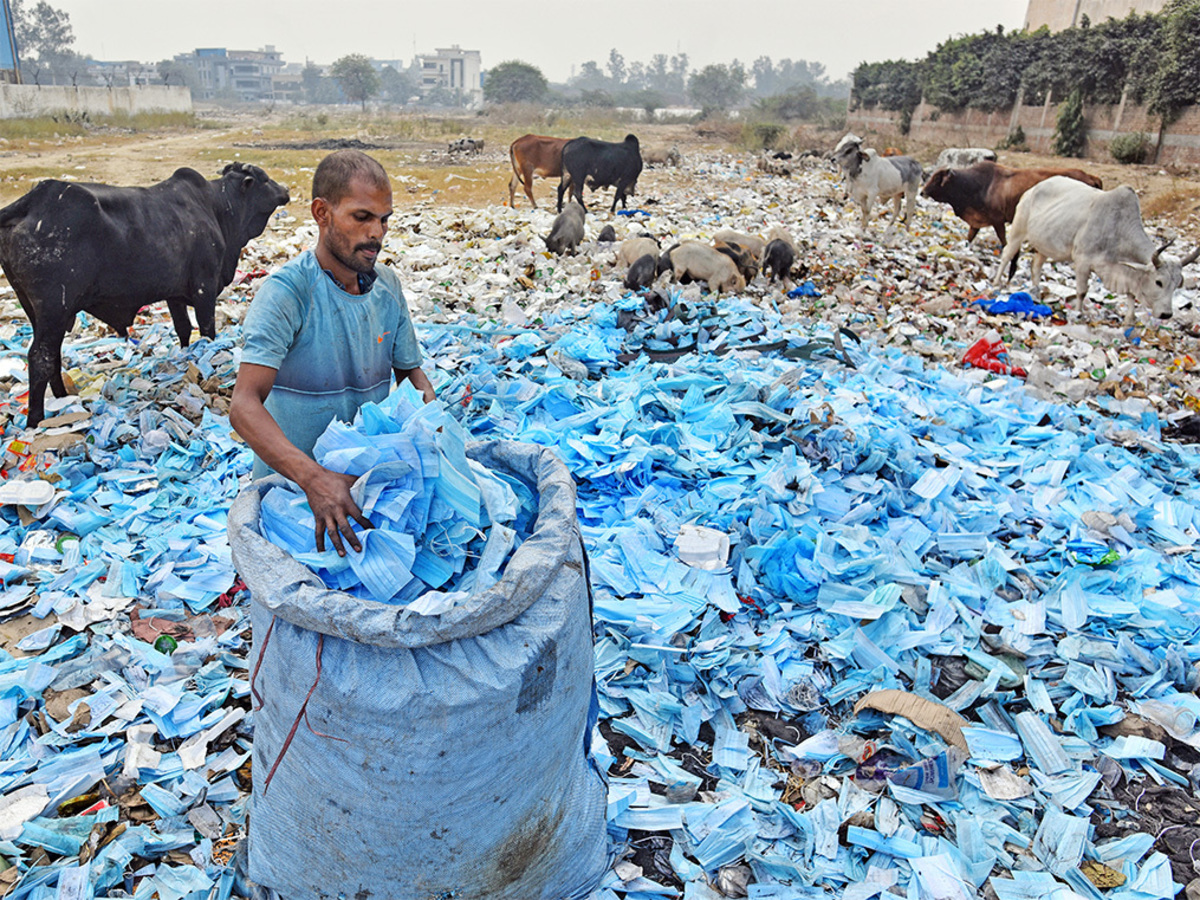
During this pandemic situation, we have witnesses another huge list of Biomedical Waste generation in India. India generated over 18000 tons of covid-19 related biomedical waste in starting 4 months of this pandemic. This includes personal protective equipment (PPE), gloves, face mask, head cover, plastic coverall, hezmet suit and syringes among others.

Types of Biomedical Waste

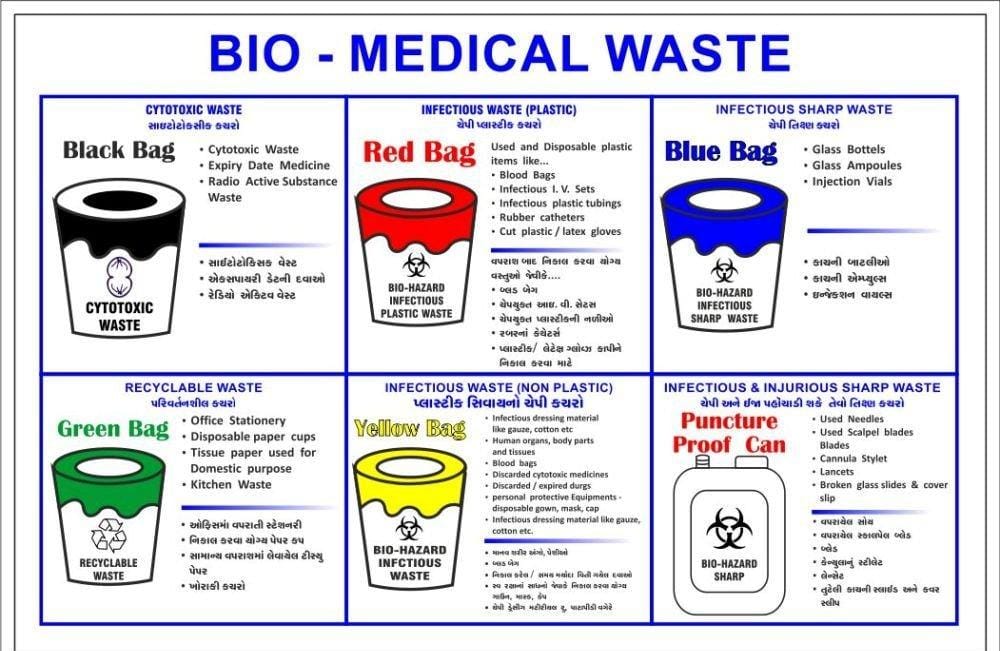
Infectious waste

  • Suspected of containing pathogen in a sufficiently large quantity or concentration to result in disease in susceptible host.
  • Cultures and stock of infectious Agent from laboratory.
  • Waste from operation and autopsies on patient with infectious disease.
  • Waste having come into contact with infected hemodialysis patient.

Pathological waste

  • Infectious material containing dead tissue may conceal specially dangerous and communicable infectious Agent.
  • Include – blood, body fluid, tissues, organs, body parts, human foetus etc.
  • Subcategory of pathological waste is Anatomical waste.
    • Consist of identifiable human or animal body parts healthy or otherwise.

Radioactive waste

  • Waste generated during the different application of radioisotopes in biological research on medicine.
  • May contain infectious biological components from Anatomical, research or clinical sources.
  • By product of various nuclear Technology process.
  • Include-
    • Nuclear medicine
    • nuclear research
    • Nuclear power
    • Manufacturing
    • construction
    • Caol
    • Rare Earth mining
    • Nuclear weapon reprocessing

Pharmaceutical waste

  • Contaminated or expired drugs and vaccine as well as antibiotics and pills.
  • Result from many activities and location in health care facilities.
  • Small quantities at households can often be thrown away in the municipal waste stream.
  • But large quantities kept at pharmacies distribution Centre, Hospital etc. be managed to minimise the risk of release or to exposure to the public.

Genotoxic waste

  • Waste from drugs that are used in radiotherapy and units.
  • One of the type of hospital waste that are extremely dangerous and may cause cell mutation or cancer.
  • Cytotoxic drugs are main components.
  • Include –
    • Urine
    • Faeces
    • Vomit treated with Chemicals or cytotoxic drug.

Sharps

  • Object that are Sharp enough to cut or puncture the skin.
  • Transmit infections directly into the bloodstream.
  • Generally treated as highly hazardous medical waste regardless of whether they are contaminated or not.
  • Includes –
    • knife
    • Blades
    • Infusion set
    • Needles
    • Broken Glass
    • Nails
    • Scalpel

Chemical waste

  • Contain radioactive element poses particularly difficult problem of disposal.
  • Includes –
    • Heavy metal from Medical appliance
    • Disinfectant
    • Solvent
  • Difficulty in disposal are partly technical and partly political
    • The radioactive constituent that find their way into groundwater and surface water must be kept to exceedingly small amount for very long time.
    • Fear of mysterious effect of radiation, politician reluctant to consider disposal of radioactive waste in the area of their constituent.

Books- Our best companion

INTRODUCTION

Our best companies are books because they provide us with knowledge and comfort of mind.

Despite the fact that we have family and friends with whom we may discuss our opinions, we believe that books are the finest way to live a life full of wisdom and without explanation.

A book may be the one thing that one may read all day and leave all of their difficulties behind.

Photo by Mau00ebl BALLAND on Pexels.com

Although a book might provide us with knowledge, we should never expect us to remain obedient to the information provided. Books can also teach you about other facets of life.

Books are regarded for providing unbiased and reliable information. Books provide us with reliable research and information on a subject.

Like a wonderful buddy, good books approach our minds with knowledge and nice thoughts.

It is true that books are our best friends. Books will not abandon us in the face of adversity. They will be a terrific company for us at all times.

There are a lot of fantastic books out there that can help us modify our minds. To be motivated and inspired in our daily lives, we need a lot of good thoughts.

Learning new abilities by reading a book is a great approach to do so.

We can gain a comprehensive understanding of a subject. When we are feeling lonely, we can curl up with a nice book. I can assure you that you will begin to feel better. We must constantly avoid reading terrible novels.

A poor book can destroy your head and cause you to think negatively. That is why, before selecting a book, we should seek recommendations from friends or the internet.

Books can be expensive to purchase at times, but investing in a good book is well worth it. Money cannot be used to measure knowledge. That is why you should never stop purchasing books.

The public library has a lot of free books. If you like to read, you can also borrow books from your friends and elders. When you’re having a bad day and are feeling down, books can assist. Books can help you get out of a bind.

Photo by Leah Kelley on Pexels.com

We can learn many good things while reading a good book.

Books written by famous and experienced people helps us to become a better human being and also teach us how to serve the society in the best possible way.

When we are alone, we can always pick up a book and start reading to feel relax.

FAMOUS QUOTES

Good friends, good books, and a sleepy conscience: this is the ideal life.- Mark Twain

A great book should leave you with many experiences, and slightly exhausted at the end. You live several lives while reading.- William Styron

QUALITIES WE CAN LEARN FROM GOOD BOOKS

Being smart entails having a strong learning ability.

Brave: Willing to tackle challenges head on.

Nothing is impossible if you keep trying.

Demonstrate compassion by expressing positive thoughts toward people.

Don’t Insult Anyone: Be humble.

Always be grateful for what others have done for you.

Help others: Be a source of assistance to everyone.

Be Positive: Enjoy yourself in whatever you do.

Respect for people and their property is one of the most important moral values.

REFERENCES

http://www.vowelor.com

http://www.paragraphbuzz.com

ALL ABOUT AUTOBIOGRAPHY

Write in an autobiography the author writes the story of his own life and achievements. It is the successful presentation of personality. It takes its origin in the common human heart to express once-on achievement in the form of writing. The writer may give a full account of his life in detail or he may give only a few anecdotes or events from his life.

The great drawback of an autobiography is that it can never be complete because it comes to an end before the author’s death. Doctor Johnson preferred autobiography to biography saying that every man’s life is best written by himself. The writer of his own life has the full knowledge of the truth through sometimes he made disguise or suppress it in his writings. From the psychological viewpoint also an autobiography is preferable because the writer knows what are the motives, hopes, and omissions that prompted him to decisive moments in his life. Thus while biography is the product of second-hand knowledge, autobiography is the product of the first-hand experience. R.L. Stevenson says, “There is no truer sort of writing than what is to be found in autobiographies, and certainly none more entertaining”.

An autobiography is a candid narration of events in the author’s life. It may take the form of a confession, apology, self-scrutiny, or a mere delightful account. When it is a mere account of facts without reference to the author’s inner conflicts and motives it is an objective autobiography. When an autobiography reveals the character and inner struggle of the writer and the present a searching analysis of his moods, motives, and fancies, it is subjective. St. Augustine’s confession’s, the earliest example of an autobiography, belongs to the subjective kind. So also Rousseau’s ‘Confessions’ written in the 18th century. Three other important autobiographies appeared in the 18th century. Those of David Hume, Edward Gibbon, and Benjamin Franklin.

Chief characteristic of an autobiography:

  • Truth should be the Hallmark of an autobiography. facts should not be perverted. A true picture of the writer’s personality should emerge from the autobiography. Gandhiji’s autobiography is the best example in this respect.
  • Courage and frankness are the essential virtues of a good writer of an autobiography. The writer should not be secretive and reluctant. Bertrand Russell’s three-volume autobiography is noted for these qualities.
  • The author of an autobiography should be objective in dealing with contemporary events and personalities. Autobiographies of Gibbon and Nehru are good examples of this kind.
  • The author should not be verbose in his description or narration.
  • Self-consciousness is the very essence of an autobiography. An autobiography should not aim at self-effacement as in the autobiography of T.E. Lawrence. Similarly, the author of an autobiography should not indulge in self-clarification.
  • The style should be interesting and even entertaining. A natural felicity of expression and flashes of humor and wit are essential attributes of an autobiography.

Some difficulties an autobiographer faces:

  • He is likely to forget the impressions and emotions connected with the events that happened in the distant past. Sometimes there may be embarrassing episodes he would like to hide or reveal only partially.
  • It is difficult for anyone to be entirely objective while dealing with contemporary persons and events that have affected his personal life and happiness.
  • An autobiographer is likely to omit the details of daily life that are common. This may lead to some falsification.

WHAT IS LITERATURE https://eduindex.org/2021/07/22/what-is-literature/

ADVANTAGES OF EBOOKS https://eduindex.org/2021/07/22/advantages-of-e-books/

The Shadow Lines – A Story about lost Identity!

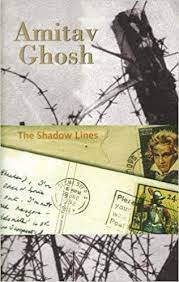
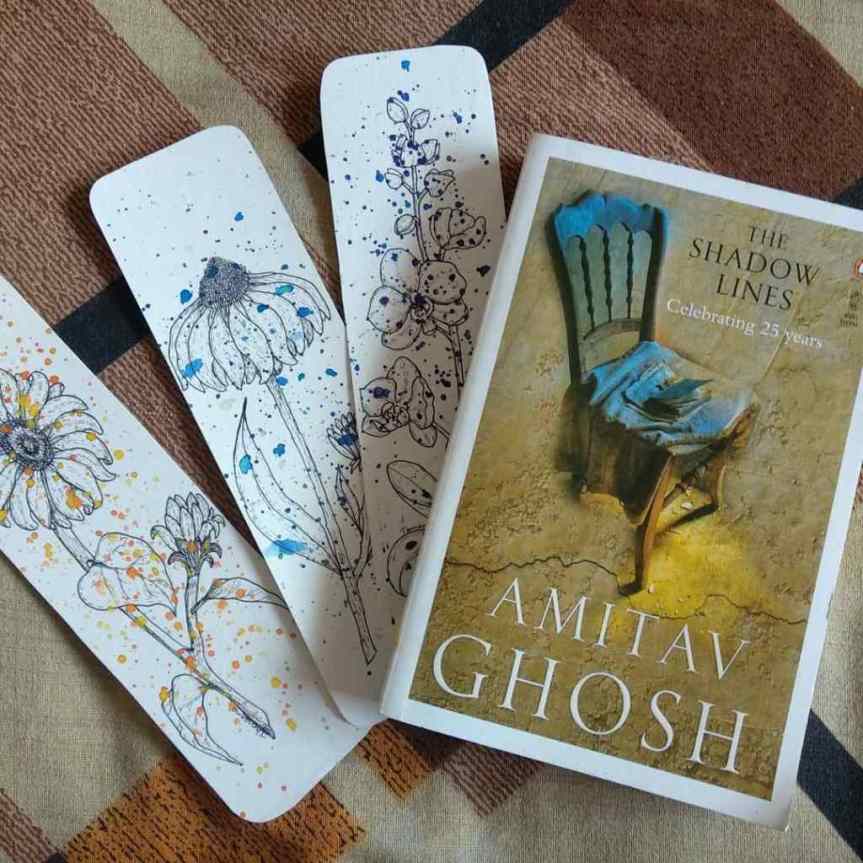
The novel ‘The Shadow Lines by Amitav Ghosh centers around a young boy, the narrator, whose growth in age and maturity is traced slowly through his understanding of the memories that connect him and his family members. Through the novel, we see that the narrator has flashbacks in time as bits and pieces of stories, both half-remembered and imagined, come together in his mind until he arrives at an intricate, interconnected picture of the world where borders and boundaries mean nothing, mere shadow lines that we draw dividing people and nations.

The title ‘The Shadow Lines’ depicts the author’s perspective on the cultural, ideological, geographical, and psychological borders, which he asks us to disregard in favor of broader humanism. The title ‘shadow lines’ can refer to many different things, but I believe that the allusion of Amitav makes is to the borders that separate nations from each other.

Divisions between nations – shadow lines

Amitav Ghosh asserts that the borders that separate nations are nothing more than artificial lines created by humans. Thus, the ‘shadow lines of the title are the borders that divide people, and one of the main emphases of the novel is on the arbitrariness of such cartographic demarcations.

Why are these lines ‘shadowy’ then? Because like shadows, they lack substance, they lack meaning. Ghosh believes that these ‘shadow lines’, these meaningless borders, can and should be crossed – if not physically, then at least mentally through our imagination and open-minded acceptance of people, irrespective of nationality, religion, or race.

In the novel, the lives of the narrator’s family have been irrevocably changed as a consequence of Bengal’s Partition between India and Pakistan at the time of Independence and the subsequent experience of the East Pakistan Civil War of 1971, which led to the creation of Bangladesh. Towards the end, when members of the family are about to undertake a journey from Calcutta to their former home in Dhaka, the narrator’s grandmother asks whether she will be able to see the border between India and East Pakistan from the plane.

     She is puzzled when told that there will be no such visible demarcation and says: “But if there aren’t any trenches or anything, how are people to know? I mean, where’s the difference then? And if there’s no difference both sides will be the same; it’ll be just like it used to be before when we used to catch a train in Dhaka and get off in Calcutta the next day . . .”

The novel is about how pain inflicts in human life even though it is a heart-throbbing past. The burden of the past never leaves is quite visible through this novel, as the characters in the novel who have suffered from the feeling of losing their real homes, their originality, and motherland show the readers about the devastation of Humans and the consequences with humans community due to war and riots.


This ingenious response on her part highlights the absurdity of the revisionist map-making of the politicians responsible for Partition. Because the truth is that there is no difference between this side of the border and that. There’s nothing concrete about these borders for they only exist in maps and our minds.