
GRATITUDE

Gratitude is a wonderful method to improve our life. It refers to the feeling and attitude of gratitude and appreciation for all that we have in life. It has been scientifically shown that expressing gratitude to others makes us feel happier and calmer. As a result, it allows kindness into our lives. It makes you pleased, for example, when a stranger holds the door for you or greets you. 

Gratitude, in layman’s terms, is the trait of showing gratitude to someone for an act of compassion or assistance. It’s the same trait that makes you remember someone’s kindness to you and makes you want to repay the favour. If you have a strong want to repay someone who has aided you, this desire is nothing more than appreciation. Only gratitude motivates you to express thanks or write a thank you note to your teacher. 

Why is it Important To Express Gratitude To Your Parents?

Feeling grateful has many benefits for your body, mind, and relationships, according to Robert Emmons, a world-renowned scientist and authority on the issue of gratitude.You must understand that when you were a child, your parents were the closest people to you and the ones with whom you spent the most time. This may not apply to everyone, but it does to the vast majority of individuals.

Kindness and success both begin at home. Another thing to keep in mind is that you, too, will become a parent at some point. As a result, how you treat your parents will have an effect on your relationship with your children. If you are grateful for your parents and always express gratitude for the good they have brought into your life, you will feel the same way when you become a parent.

How to Make Gratitude a Habit:

Gratitude can be practiced in a variety of ways, including:

1.Make a daily list of all the nice things that happen to you and who is responsible for them.

2.Make plans to repay the favour at a later date.

3.Recognize the value of everything around us, including nature, animals, and plants.

4.When feasible, express gratitude to various community helpers such as the washerman, gardener, policemen, sweepers, and others.

5.Every day as you wake up, thank God for such a beautiful day.

6.Thank God once more for all the trials you’ve faced today that have made you wiser and stronger.

Advantages of Gratitude:

Gratitude provides a variety of advantages in both your personal and social lives.

Relationship Strengthening: Gratitude improves the quality of your relationships with others. Being grateful is a lovely sensation and experience that enhances both parties bonds. It promotes the sense of being recognised and acknowledged, as well as the trust element.

Makes You Smile: Gratitude has a joyful quality to it. When you express appreciation or receive it, you feel glad for doing something nice or for having something good done to you. People who feel grateful are known to have lower stress levels.

Makes Society More Sensible: The happiest and most rational society is one in which people express thanks for one another. People are considerate and never miss an opportunity to express gratitude to others. A Intelligent society will inevitably progress in the correct direction.

Reduces comparisons and increases acceptance: When you express gratitude for others, you don’t make comparisons based on their financial situation or other things. You’re merely grateful to everyone and proud of their accomplishments.
PROCRASTINATION

Procrastination is one of the most significant roadblocks to waking up, making the proper decisions, and living the life you’ve imagined.

According to recent studies, people regret the things they haven’t done more than the things they have done. Furthermore, regret and guilt associated with squandered opportunities tend to linger considerably longer. All of our opportunities appear to be at our fingertips at times, but we can’t seem to get to them. When you procrastinate, you are wasting time that could be spent on something more productive. If you can defeat this formidable foe, you will be able to achieve more and better harness the potential that life has to offer.

We already know that today’s world encourages procrastination, making understanding how to fight it one of the most valuable skills you can acquire. As a result, procrastination is the polar opposite of punctuality. A punctual person accomplishes what has to be done exactly when it needs to be done; a dilatory person never does anything when it needs to be done, preferring to postpone it until tomorrow, next week, or next year. If procrastination is not firmly checked, it quickly develops into a poor habit, making punctual performance of everyday responsibilities impossible. It could be due to simple laziness and a reluctance to work when it is inconvenient, or it could be due to the delusion that there will be enough time in the future to do all of our tasks.

How can you overcome procrastination?

Stop being so pessimistic: People delay for a variety of reasons, one of which is that they catastrophize, or make a big deal out of a minor issue. The underlying idea is that executing the activity will be “unbearable.” It could be related to how difficult, boring, or painful it will be to do the task. Challenges, monotony, and hard labour, in actuality, will not kill you, nor will they make you sick. Procrastination, on the other hand, is linked to stress—imagine how stressed you are when you put off making a phone call you know you need to make. Put things in perspective: “This isn’t my favourite task, but I’ll finish it.”

Concentrate on your “why”: Procrastinators are more concerned with short-term rewards (avoiding the task’s unpleasantness) than with long-term outcomes (the stress of not doing it, as well as the consequences of avoiding this task). Instead, concentrate on why you are performing this task: What are the advantages to finishing it? Imagine how good it will feel to go into a decluttered closet if you’ve been putting off clearing it out.

Keep your expectations in check: Set yourself up for success as you create your schedule. Projects can take far longer than anticipated, so plan ahead. Also, search for ways to make your life easier: If you’re not a morning person, don’t expect to get up an hour earlier to begin a fitness regimen you’ve been putting off for months. That exercise might be better scheduled during lunch or before dinner.

Chunk it: When a task appears to be too demanding, procrastination is common. So, how do you divide that project down into smaller, more manageable chunks? If you want to write a book, for example, you could prepare an outline, identify each chapter, determine the portions inside each chapter, and then commit to writing one segment at a time. Things will make you feel less overwhelmed and more empowered if you break it down like this.

Optimize your environment: Your surroundings can either help or hurt your productivity. Keep an eye out for technology that keeps pinging to let you know someone has contacted you, such as your email or messenger. Procrastination can be caused by social media, internet “research” that takes you off course, and phone calls.

Forgive yourself: Stop berating yourself for the mistakes you’ve made in the past. Things will only get worse if you think things like “I should have begun sooner” or “I always procrastinate; I am such a failure.” According to research, forgiving yourself for past procrastination can help you stop procrastinating on a task. You can also try to capitalise on previous procrastination. How? Determine what caused your avoidance—fear, stress, a lack of understanding of how to move forward, a lack of accountability, and so on. Then, in the present and future, confront those difficulties

HUMANITY

Humanity is defined as the quality of being human; the unique nature of man that distinguishes him from other beings. Being human does not imply that one has humanity. If you want to know how human a person is, look at what he does for others who don’t return the favour. Mother Teresa has beautifully portrayed one of the most extraordinary examples of extra-ordinary humanity in a human being. When and whenever possible, humanity entails caring for and assisting others. 

Humanity entails putting other’s needs before your own, and putting others’ needs ahead of your own when they want assistance. Humanity entails expressing unconditional love to all living things on the planet. The following anecdote serves as an excellent illustration of humanity.

Importance of Humanity:

As humanity progresses towards the future, the true essence of humanity is increasingly distorted. It is critical to remember that actions of humanity must not be motivated by selfish benefit such as celebrity, money, or power. Borders divide the world we live in today, but our reach is infinite. We are fortunate in that we have the ability to travel wherever we choose and experience whatever we desire. Countless nations struggle incessantly over territory, resulting in the deaths of many innocent people.

Similarly, other humanitarian crises such as those in Yemen, Syria, Myanmar, and others have claimed the lives of millions of people. Because the situation is unlikely to be resolved anytime soon, humanity is required. Most importantly, humanity is concerned not only with humans but also with the environment and all living things. We must all band together to display true humanity and aid in the healing and prosperity of other humans, animals, and the environment.

Instead of fighting about democracy in other nations, we should ask ourselves if we have a voice in our own. Because power corrupts even the most strong-willed, we should exercise our right to vote and enhance the government’s procedures. Stop photographing flora and animals to show your friends and relatives. Look at the trees, animals, and natural beauty with your real eyes, not through the lens of a camera. Bring your friends and family to see the breathtaking beauties that surround us and share this beauty with them.

While technology and democracy have given us the ability to accelerate the pace of change in our society, they have also corrupted us. It has given us a sense of unlimited power and knowledge, making us feel as if we are Gods. No, we aren’t gods, and we have no power over other people’s lives. Only that right is theirs. However, we can and must alter ourselves by making informed selections, making the best life choices, and not allowing others to make our decisions for us.

The narrative of a king is an excellent illustration of mankind. When a dove and an eagle were fighting, a kind-hearted king witnessed it. He could communicate with birds and other animals. The pigeon requested the king’s assistance in escaping the eagle’s clutches. The king promised the eagle that in exchange for saving the pigeon, he would pay any price. The eagle requests from the monarch that he be given the same amount of flesh as the pigeon. The king agrees to the Eagle’s condition and begins hacking off his own flesh in proportion to the pigeon’s meat. He finds the pigeon heavier even after donating a small amount of his flesh. Finally, he gives the Eagle his entire being to consume. The Eagle and the Pigeon both transform into angels at that point, appearing on the ground to test the king’s humanity. 

For his deeds of humanity, the monarch has now been awarded with the most beautiful prizes and afterlife heaven. This narrative can be interpreted as an overblown statement intended to make people realise the importance of humanity in their daily lives. One crucial truth to remember is that “an individual’s life is measured not by the number of degrees he or she holds, but by the degree of humanitarian actions that one engages in on a daily basis.”

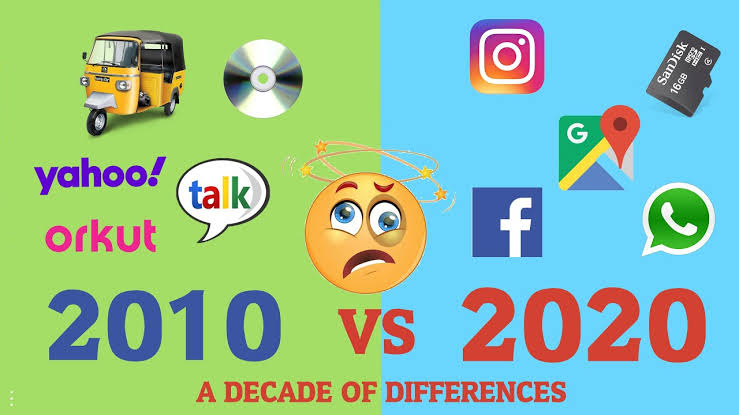
2010 v/s 2020

We no longer smile at people

It has been ages since I last smiled at an unknown stranger when our eyes met. Social media, news, movies, has made us so uptight and alert that our natural reflex has shifted from smiling to suspecting them.

We no longer enjoy food as we did

Snapchat and Instagram have made people forget the value of here and now. Instead of being happily in the present moment, we are often more focused on portraying a happy life which may be far from the reality. The satisfaction of the first sip of the morning tea or the first bite of the domino’s pizza doesn’t feel the same as it did a decade ago. The first thought that we have when we see a delicious food now is to click a perfect picture to show other’s how wonderful our life is.

We no longer see Bollywood as we did before

A decade back movie stars were famous for their work and that was enough in itself. Acting was seen as a profession and a job. However, the current Bollywood seems more like a political party than a show business. It is not the work but the lives of the celebrities that we are most interested in. Political leaders are supposed to have opinions and that is what is to be taken seriously by the people. However, now it is the opinions of our favourite celebrities that we are more into.

We no longer have real meaningful bond

The friendship and relationship trends have changed since the last decade. There were more meaningful bonds between link minded people who were true to one another (even behind their back). However, now the long evening chai meets have turned to Starbucks coffee meets. Where though we are physically together, but mentally and emotionally far into two different worlds in our mobile phones.