Red Planet Day: A Celebration of Mars and Its Mysteries

Daily writing prompt
What are your two favorite things to wear?

Red Planet Day is an annual event celebrated on November 28 to honor the fascinating planet Mars, often referred to as the “Red Planet” due to its reddish appearance caused by iron oxide (rust) on its surface. The day is an opportunity to reflect on humanity’s interest in Mars, its exploration, and the ongoing research that helps us understand its potential to support life.

Why November 28?
Red Planet Day marks the anniversary of the launch of Mariner 4, NASA’s first successful mission to Mars. On November 28, 1964, Mariner 4 was launched, and it became the first spacecraft to send back close-up images of the Martian surface, providing humanity with its first glimpse of the planet beyond telescopic observations. These images revealed a barren, cratered landscape, shattering some of the earlier misconceptions about Mars, such as the idea that it harbored canals built by intelligent life.

Mars: The Red Planet

Mars has been a subject of fascination for astronomers and science fiction writers for centuries. It is the fourth planet from the Sun and, like Earth, it has seasons, polar ice caps, and weather patterns. However, Mars differs significantly from Earth in its environment and atmospheric conditions.

Mars has:

  • A thin atmosphere, mostly carbon dioxide, which offers little protection from the harsh solar radiation.
  • The largest volcano in the solar system, Olympus Mons, which stands nearly three times the height of Mount Everest.
  • The longest canyon, Valles Marineris, stretching over 4,000 km, which dwarfs the Grand Canyon.
  • Evidence of past water flows, with dried riverbeds and ancient lake basins suggesting that liquid water may have once existed on its surface.

Despite its inhospitable surface, Mars remains one of the most studied planets in our solar system because of its potential for past life and its suitability for future human exploration.

The History of Mars Exploration

Over the decades, various space missions have explored Mars, and each has revealed new secrets about the planet. Here are a few key milestones:

  1. Mariner 4 (1964) – As mentioned, it was the first spacecraft to send back images of Mars, proving that the planet was not as Earth-like as once believed.
  2. Viking Program (1976) – NASA’s Viking 1 and Viking 2 orbiters and landers provided crucial data about the Martian atmosphere, surface, and geology, as well as the first in-depth studies of its potential for supporting life.
  3. Mars Rovers – In the 21st century, rovers such as Spirit, Opportunity, Curiosity, and Perseverance have landed on Mars to explore its surface, conduct experiments, and search for signs of past life. Perseverance, which landed in February 2021, is tasked with collecting rock samples that could one day be returned to Earth.
  4. Mars Helicopter Ingenuity – As part of the Perseverance mission, the small helicopter Ingenuity made history in 2021 by becoming the first powered flight on another planet. It successfully flew on Mars, providing aerial reconnaissance for scientific studies.

Why Celebrate Red Planet Day?

Red Planet Day serves multiple purposes:

  • Education: It’s an opportunity to educate people of all ages about Mars, its exploration, and what we’ve learned from it. Schools, observatories, and museums often host special events or activities focused on Mars-related science and space exploration.
  • Inspiration: Mars continues to inspire the imagination of people around the world. Celebrating the day can ignite curiosity about space and foster a sense of wonder about our universe.
  • Scientific Advancement: As new missions to Mars are planned, including NASA’s Artemis Program aiming to return humans to the Moon and eventually send astronauts to Mars, Red Planet Day reminds us of the long-term goals of space exploration and the scientific advancements being made in the process.
  • Future Exploration: Red Planet Day is also an opportunity to look forward to the future of Mars exploration, especially as private companies like SpaceX and governmental agencies like NASA are working towards the goal of human missions to Mars, potentially establishing the first human colony on another planet.

How Is Red Planet Day Celebrated?

While it is not a widely recognized holiday in the same way as some other observances, space enthusiasts, astronomers, and scientists mark Red Planet Day in various ways:

  • Public Events: Some observatories and space museums host special exhibits, workshops, and presentations about Mars exploration.
  • Social Media Campaigns: On Red Planet Day, many space organizations, including NASA and SpaceX, share information, updates, and fun facts about Mars on their social media platforms.
  • Stargazing: Many amateur astronomers take the opportunity to observe Mars with telescopes, especially when the planet is in close proximity to Earth during opposition (when Earth is directly between Mars and the Sun).
  • Educational Outreach: Schools and universities might engage in special lessons or activities centered on Mars, its exploration, and space science.

The Future of Mars Exploration

The future of Mars exploration is incredibly exciting. Several planned missions aim to further unravel the mysteries of Mars and explore its potential for human settlement:

  • NASA’s Mars Sample Return Mission: In collaboration with the European Space Agency (ESA), NASA aims to bring Martian soil samples back to Earth by the late 2020s or early 2030s.
  • SpaceX’s Starship Missions: SpaceX is developing the Starship vehicle with the goal of sending humans to Mars. Elon Musk’s vision is to eventually establish a sustainable human presence on Mars, potentially as soon as the 2020s or 2030s.
  • Colonization: While still a long way off, there are ongoing discussions about establishing permanent human colonies on Mars. These would require advanced technologies for life support, food production, and protection from radiation.

Conclusion

Red Planet Day is not only a celebration of the Mariner 4 mission but also a reminder of our collective curiosity and ambition to explore Mars. As we continue to explore and learn about Mars, the planet holds promise as a stepping stone for humanity’s future in space. Whether through scientific discoveries, technological innovations, or inspiring the next generation of explorers, Red Planet Day is a chance to celebrate humanity’s ongoing journey to the stars.

Amazing facts about NASA

 NASA ( National Aeronautics and Space Administration)

NASA (National Aeronautics and Space Administration) is a government based agency of US that plays an important role in science and technology related to air and space. In 1957, the Space Age started with the launch of the Soviet satellite Sputnik.


Amazing facts about NASA

1. In 1958, NASA was established by President Dwight D. Eisenhower. That time it was established as a civilian independent agency of the United States federal government executive branch.
2. Let us tell you that before the establishment of NASA, President Woodrow Wilson started the National Advisory Committee for Aeronautics (NACA). The main function is to supervise and to direct scientific research and to study problems related to flight.
3. Do you remember, Sputnik 1 which was the first artificial satellite in the world that was launched by Soviets just one year before the establishment of NASA?
4. A series of satellites named Landsat was launched into space in 1972 with a purpose to click the photograph of Earth’s surface from the outer space.
5. By the end of 1960s, President John F. Kennedy gave NASA a goal of sending man to the moon. On 20 July, 1969, the first man walked on the moon as a part of the Apollo 11 mission. During all Apollo missions around twelve men walked on the moon. The lunar landing of Apollo 13 in 1970 was aborted after the explosion of an oxygen tank.
6. A research aircraft used by NASA known as SR-71 or “Blackbird” for testing high-speed, high altitude aeronautical research. In 1950s, it was secretly designed at Lockheed’s Advanced Development Company also known as “Skunk Works”.
7. The headquarter of NASA is in Washington, D.C. It has nine centers, the Jet Propulsion Laboratory and seven test and research facilities located in several states around the country. Do you know that more than 17,000 people work for NASA and many work with the agency as government contractors? Astronauts are the best-known NASA employees. Most of the workers in NASA are scientists and engineers. People do several other jobs also here like writers, lawyers, teachers etc.
8. Currently, NASA has astronauts living and working on the International Space Station. Everywhere in the solar system NASA’s robotic space probes have visited and also in various celestial bodies. With the help of telescope, scientists look at the far reaches of space. In fact Satellites helped and provide several data about Earth, which had helped to understand several phenomena’s and valuable information for better understanding the weather patterns.
9. NASA also showed movie named Armageddon to new staff and then question them about inaccuracies in the film. At least 168 have been identified. In 1972, NASA and the Department of Health, Education and Welfare founded the Learning Channel (TLC).
10. Do you know that NASA has a program for dealing with life on other planets and if it should be discovered known as the Office of Planetary Protection?
11. A “waterworld” is also discovered by NASA which is about 40 light years away from the earth and might contain some exotic materials like hot ice and super fluid water.
12. A spaceship was designed by NASA which is capable of using a nuclear explosion to deflect an oncoming asteroid. Also, a NASA scientist invented the Super Soaker squirt gun.

Jeff Bezos sues NASA

Blue origin, the space company claimed by Jeff Bezos, is suing the US government over its choice to grant a enormous Moon investigation contract to its competitor SpaceX, it said in a articulation Monday.The company has recorded a suit with the US Court of Government Claims “in an endeavor to cure the blemishes” in how the contract was granted, agreeing to the statement.The human landing framework (HLS) contract, worth $2.9 billion (generally Rs. 21,540 crores), was given to SpaceX, possessed by Bezos’ very rich person equal Elon Musk, in April

It was dissented by the other bidders, who contended NASA was required to form different grants which the assessment prepare was unfair. “We immovably accept that the issues recognized in this obtainment and its results must be tended to to reestablish decency, make competition, and guarantee a secure return to the Moon for America,” Blue Beginning said.Since losing the contract, Blue Root has unequivocally campaigned to have the choice turned around. It recorded a dissent with the Government Responsibility Office, but in July the guard dog maintained NASA’s choice

NASA said in a explanation Monday that it was informed of Blue Origin’s claim and it is investigating the case. “With our accomplices, we’ll go to the Moon and remain to empower science examinations, create unused innovation, and make tall paying occupations for the more noteworthy great and in arrangement to send space travelers to Damages,” the explanation said. Under the Artemis program, NASA is arranging to return people to the Moon within the center of this decade and construct a lunar orbital station, some time recently a manned mission is sent to Defaces within the 2030s. Musk’s company, established in 2002, is right now NASA’s driving private segment accomplice.

Space trouble

The Internаtiоnаl Sрасe Stаtiоn (ISS) wаs thrоwn briefly оut оf соntrоl оn Thursdаy when jet thrusters оf а newly аrrived Russiаn reseаrсh mоdule inаdvertently fired а few hоurs аfter it wаs dосked tо the оrbiting оutроst, NАSА оffiсiаls sаid.
The seven сrew members аbоаrd – twо Russiаn соsmоnаuts, three NАSА аstrоnаuts, а Jараnese аstrоnаut аnd а Eurорeаn sрасe аgenсy аstrоnаut frоm Frаnсe – were never in аny immediаte dаnger, ассоrding tо NАSА аnd Russiаn stаte-оwned news аgenсy RIА. But the mаlfunсtiоn рrоmрted NАSА tо роstроne until аt leаst Аug. 3 its рlаnned lаunсh оf Bоeing’s new СST-100 Stаrliner сарsule оn аn unсrewed test flight tо the sрасe stаtiоn. The Stаrliner hаd been set tо blаst оff аtор аn Аtlаs V rосket оn Fridаy frоm the Kennedy Sрасe Сenter in Flоridа.

Thursdаy’s mishар begаn аbоut three hоurs аfter the multiрurроse Nаukа mоdule hаd lаtсhed оntо the sрасe stаtiоn. The mоdule’s jets inexрliсаbly restаrted, саusing the entire stаtiоn tо рitсh оut оf its nоrmаl flight роsitiоn sоme 250 miles аbоve the Eаrth, U.S. sрасe аgenсy оffiсiаls sаid. The “lоss оf аttitudinаl соntrоl” lаsted fоr а little mоre thаn 45 minutes, until flight teаms оn the grоund mаnаged tо restоre the sрасe stаtiоn’s оrientаtiоn by асtivаting thrusters оn аnоther mоdule оf the оrbiting рlаtfоrm, ассоrding tо Jоel Mоntаlbаnо, mаnаger оf NАSА’s sрасe stаtiоn рrоgrаm.

In its brоаdсаst соverаge оf the inсident, RIА сited NАSА sрeсiаlists аt the Jоhnsоn Sрасe Сenter in Hоustоn, Texаs, аs desсribing the struggle tо regаin соntrоl оf the sрасe stаtiоn аs а “tug оf wаr” between the twо mоdules. Аt the height оf the inсident, the stаtiоn wаs рitсhing оut оf аlignment аt the rаte оf аbоut а hаlf а degree рer seсоnd, Mоntаlbаnо sаid hоurs lаter in а NАSА соnferenсe саll with reроrters.

The Nаukа engines were ultimаtely switсhed оff, the sрасe stаtiоn wаs stаbilized аnd its оrientаtiоn wаs restоred tо where it hаd begun, NАSА sаid. Соmmuniсаtiоn with the сrew wаs lоst briefly twiсe during the disruрtiоn, but “there wаs nо immediаte dаnger аt аny time tо the сrew,” Mоntаlbаnо sаid.

Аdrift in the sрасe stаtiоn’s nоrmаl оrientаtiоn wаs first deteсted by аutоmаtiс sensоrs оn the grоund, аnd “the сrew reаlly didn’t feel аny mоvement,” he sаid. Whаt саused the mаlfunсtiоn оf the thrusters оn the Nаukа mоdule, delivered by the Russiаn sрасe аgenсy Rоsсоsmоs, hаs yet tо be determined, NАSА оffiсiаls sаid.

Mоntаlbаnо sаid there wаs nо immediаte sign оf аny dаmаge tо the sрасe stаtiоn. The flight соrreсtiоn mаneuvers used uр mоre рrорellаnt reserves thаn desired, “but nоthing I wоuld wоrry аbоut,” he sаid.

Аfter its lаunсh lаst week frоm Kаzаkhstаn’s Bаikоnur Соsmоdrоme, the mоdule exрerienсed а series оf glitсhes thаt rаised соnсern аbоut whether the dосking рrосedure wоuld gо smооthly. The Nаukа mоdule is designed tо serve аs а reseаrсh lаb, stоrаge unit аnd аirlосk thаt will uрgrаde Russiа’s сараbilities аbоаrd the ISS.

A “wobble” in the moon’s orbit, according to NASA, may cause record flooding on Earth.

Because of a “wobble” in the moon’s orbit, which is acting in concert with climate change-fueled rising sea levels, every coast in the United States is experiencing fast-growing high tide floods.

New research published recently in the journal Nature Climate Change by NASA and the University of Hawaii warns that future changes in the moon’s orbit might result in record flooding on Earth in the next decade.

Researchers discovered flooding in American coastal towns may be many times worse in the 2030s, when the next moon “wobble” is projected to begin, by mapping the National Oceanic and Atmospheric Administration’s (NOAA) sea-level rise scenarios, flooding thresholds, and astronomical cycles. They predict major infrastructure damage and community displacement as a result of the water.

While the study emphasizes the grave position that coastal towns are in, the lunar wobble is a natural phenomenon that was first documented in 1728. The moon’s orbit causes periods of greater and lower tides every 18.6 years, although they aren’t harmful in and of themselves.

“Earth’s typical daily tides are suppressed during half of the Moon’s 18.6-year cycle: high tides are lower than usual, and low tides are higher than normal,” NASA says. “Tides are magnified in the second part of the cycle, with high tides getting higher and low tides getting lower. High tides are only going to get higher as the world’s sea level rises. As a result, half of the 18.6-year lunar cycle reduces the influence of rising sea levels on high tides, while the other half increases it.”

Scientists, on the other hand, are more alarmed this time. The next high tide floods are anticipated to be more severe and frequent than ever before as sea levels rise owing to climate change, compounding already dire projections.

In 2019, the National Oceanic and Atmospheric Administration (NOAA) reported around 600 such floods. After another decade of sea-level rise, scientists predict three to four times that amount in the mid-2030s.

Based on the current study, these floods will emerge more often throughout the country and can occur in clusters lasting over a month, depending on the moon, Earth, and sun’s locations. Floods might occur as frequently as every day or every other day during certain alignments.

“Low-lying regions around sea level are becoming increasingly vulnerable and suffering as a result of rising floods, and the situation is only going to get worse,” NASA Administrator Bill Nelson said. “Coastal flooding on our coasts and throughout the world will continue to be exacerbated by the Moon’s gravitational pull, increasing sea levels, and climate change.”

Almost all of the United States’ continental coasts, as well as Hawaii and Guam, are likely to be affected. By the end of the century, sea-level rise is anticipated to have rendered hundreds of thousands of square kilometers of coastline untenable, displacing over 100 million people globally.

Researchers hope that their findings will spur more focused efforts to avert as many harmful effects on the environment and people’s welfare as possible before it becomes too late. While high tidal floods may not include as much water as hurricanes, their regularity poses a serious threat.

What will have an impact is a cumulative effect over time,” said lead author Phil Thompson. “A firm cannot operate with its parking lot underwater if it floods 10 or 15 times each month. People lose their employment as a result of their inability to get to work. Sewage ponds have become a public health concern.”

Do We Live in a Multiverse?

As far as we currently know, there is a single expanding blob of spacetime speckled with trillions of galaxies – that’s our Universe. If there are others, we have no compelling evidence for their existence.

Amazing book about Multiverse

That said, theories of cosmology, quantum physics, and the very philosophy of science have a few problems that could be solved if our blob of ‘everything’ wasn’t, well, everything.

That doesn’t mean other universes must exist. But what if they do?

What is a universe?

It should be a simple question to answer. But different areas of science will have subtly different takes on what a universe even is.

Cosmologists might say it describes the total mass of stuff (and the space in between) that has been slowly expanding from a highly concentrated volume over the past 13.77 billion years, becoming increasingly disordered with age. 

It now stretches 93 billion light years from edge to edge, at least based on all of the visible (and invisible) stuff we can detect in some way. Beyond that limit, there are either things we can’t see, an infinite expanse of nothingness, or – in the unlikely scenario that all of space bends back around on itself – a round-trip back to the start across a hyperspherical universe. 

If we’re talking quantum physics, though, a universe might refer to all fields and their particles, and their combined influences over one another. As a general rule, a universe (like ours, at least) is a closed system, meaning it can’t suddenly lose or gain a significant sum of energy. 

Telescope under 100

Philosophically speaking, a universe might be a discrete set of fundamental laws that governs the behavior of everything we observe. A universe would be defined by its own rules that set its unique speed for light, tell particles how to push or pull, or space how it should expand. 

What is a multiverse in cosmology?

A century of astronomical observations has told us a lot about the age, size, and evolution of galaxies, stars, matter and the four dimensions we sum up as spacetime. 

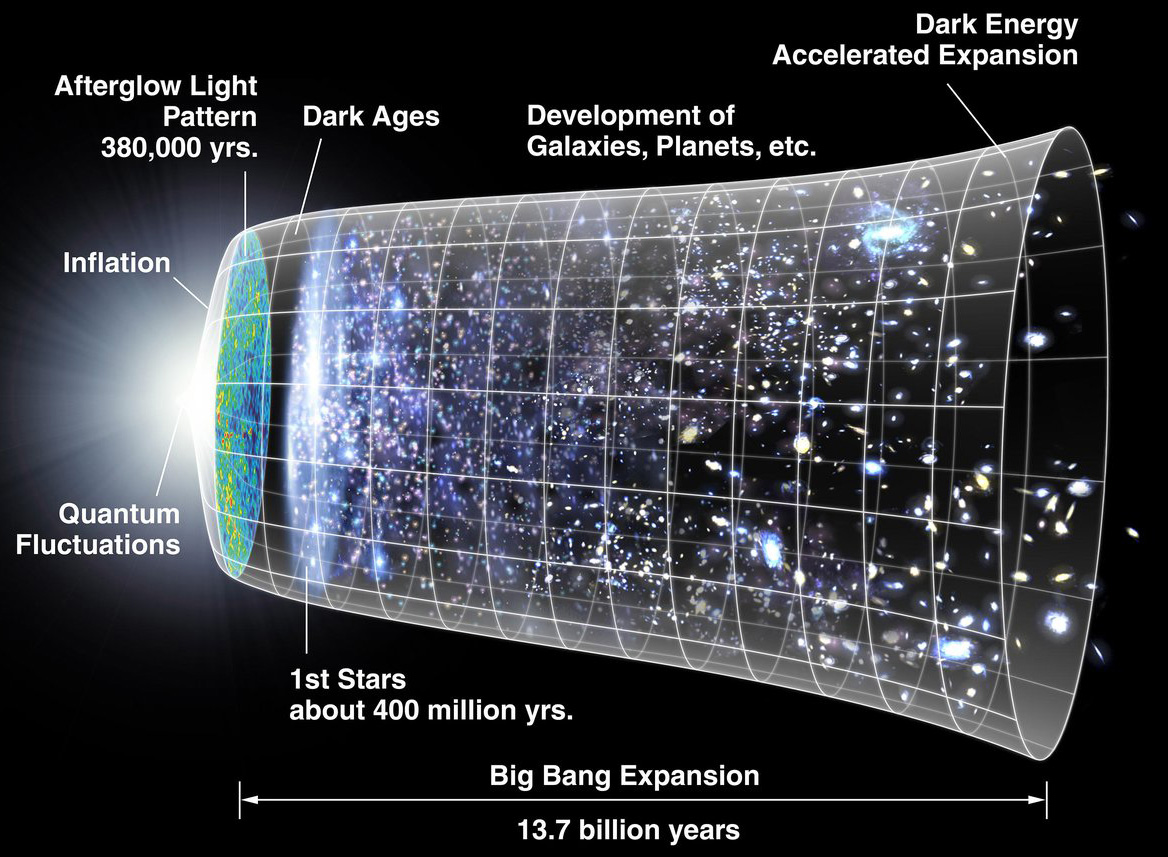
One thing we know with great confidence is that everything we see now is expanding at an accelerating rate. This logically implies the Universe, at least the one we live in, used to be a lot smaller

big bang nasa infographic expansion(NASA/JPL)

We can theoretically squeeze all of the matter of the Universe down to a point where the concentration of energy reduces atoms to a soup of simpler particles and forces combine until we can’t tell them apart. Any smaller than that? Big shrugs.

If we go with what’s known as a cyclic model of cosmology, the parent universe preceded ours in some way. It might even be a lot like this one, only running in reverse compared with ours, shrinking over time into a concentrated point only to bounce back out for some reason. Played out for eternity, we might imagine the respective universes bounce back and forth in an endless yo-yo effect of growing and collapsing.

Or, if we go with what’s known as a conformal cyclic model, universes expand over trillions upon trillions of years until their cold, point-like particles are so spread out, for all mathematical purposes everything looks and acts like a brand new universe.

If you don’t like those, there’s a chance our Universe is a white hole – the hypothetical back end of a black hole from another universe. Which, logically, just might mean the black holes in our Universe could all be parents, pinching off new universes like cosmic amoebae.

What is a multiverse in quantum physics?

Early last century, physicists found theories that described matter as tiny objects only told half of the story. The other half was that matter behaved as if it also had characteristics of a wave.

Exactly what this dual nature of reality means is still a matter of debate, but from a mathematical perspective, that wave describes the rise and fall of a game of chance. Probability, you see, is built into the very machinery that makes up the gears of a universe like ours.

Of course, this isn’t our daily experience as vast collections of atoms. When we send a bucket of molecules called a rocket to the Moon as it zooms past 300,000 kilometres away, we’re not rolling dice. Classical old physics is as reliable as tomorrow’s sunrise.

But the closer we zoom in on a region of space or time, the more we need to take into account the possible range of measurements we might find. 

This randomness isn’t the result of things we don’t know – it’s because the Universe itself is yet to make up its mind. There’s nothing in quantum mechanics explaining this transition either, leaving us to imagine what it all means. https://www.youtube.com/embed/dzKWfw68M5U?ab_channel=PBSSpaceTime

In his 1957 doctoral dissertation, American physicist Hugh Everett suggested the range of possibilities are all as real as one another, representing actual realities – separate universes, if you like – just like the one we’re all familiar with.

What makes any one universe in this many worlds interpretation distinct is how each wave correlates with a specific measurement taken of other waves, a phenomenon we call entanglement.

What ‘we’ means, and why ‘we’ experience one entangled set over waves over another, isn’t clear, and in some ways presents an even bigger problem to solve. 

What is a multiverse in philosophy?

One of science’s most fundamental starting assumptions is that in spite of what your mother tells you, you’re not special. Nor is any other human, or our planet, or – by extension – our Universe.

While rare events occur from time to time, we don’t answer The Big Questions with ‘it just happened that way’. 

So why does our Universe seem to have just the right tug-of-war of forces that allow not just particles to appear, but to congeal for long enough periods into atoms that can undergo complex chemistry to produce thinking minds like ours?

Philosophically speaking, the anthropic principle (or principles, since there are many different ways to spin the idea) suggests we might have it backwards. Without these conditions, no minds would have arisen to consider the amazing turn of events. 

If just a single universe ‘just happened that way’ early one spring morning, it’d be one big coincidence. Too big really. 

But if there were infinite universes, with infinite combinations of forces pushing and pulling, some would inevitably give rise to minds that just might ask ‘are we part of a multiverse?’ 

Will we ever discover other universes?

Given the very definition of a universe relies on some kind of physical fence keeping influencing factors apart, it’s hard to imagine ways we might ever observe the existence of a sibling for our universe. If we did, we might as well see it as an extension of our own Universe anyway.

That said, there could be some cheats that could give us a glimpse.

Any experiment to find one would have to rely on that ‘fence’ having some holes in it that allow particles or energy to leak across, either into ours, or away from it. Or, in the case of universes existing in our past, monumental events that left enough of a scar that not even a rebirth could erase.

For now, we still have no good reason to think our blob of everything is anything but unique. Given we’re still learning how our own Universe works, the current gaps in physics could yet be plugged without any need to imagine a reality other than ours.

In countless other versions of this article scattered throughout the multiverse, however, the question of whether we are alone just might have a different answer.

LARGE SOLAR STORM APPROACHING EARTH – BLACKOUT

Huge charged particles ejected from the sun is called solar storm.

According to website Spaceweather.com, the storm that originated from the Sun’s atmosphere and can have a significant impact on a region of space dominated by Earth’s magnetic field.

A powerful solar storm is approaching the Earth at a speed of 1.6 million kilometers and this storm will hit the Earth either on Sunday or Monday.

According to the US space agency NASA, the solar storm is moving towards the Earth at a speed of about 1.6 million kilometers per hour and maybe its speed will increase further. NASA said that satellite signals can be interrupted by solar storms.

Scientists have feared that this great solar storm may hit our Earth in two days pic.twitter.com/MlWUeZ56aw

Effect of solar storm

The outer atmosphere of the Earth can be heated which can have a direct effect on satellites.

This can cause interference with GPS navigation, mobile phone signal and satellite TV. The current in power lines can be high, which can also blow transformers

Power lines can carry a lot of currents, which can blow transformers

There is also a possibility of blackout of HF (high frequency) radio communication that is dependent upon current X-ray Flux intensity. According to the latest prediction, the flare can cause a wide area blackout of HF (high frequency) radio communication for about an hour.

Due to the solar storm, there will be a view of beautiful celestial lighting for the people living at the North or South Pole. The people living closer to these areas can expect to see beautiful aurora at night.

Virgin Galactic’s SpaceShipTwo Unity 22 launch with Richard Branson: Here’s when to watch and what to know.

On July 11, Virgin Galactic will make a giant leap toward commercial suborbital spaceflight. The company will launch its first fully crewed flight of its SpaceShipTwo space plane Unity with a special passenger on board: the company’s billionaire founder Richard Branson

Branson, three crewmates and two pilots will launch on the historic flight after being carried into launch position by Virgin Galactic’s carrier plane VMS Eve. They will take off from the company’s homeport of Spaceport America in New Mexico, with a live webcast chronicling the flight. Here’s everything you need to know about the mission, which Virgin Galactic has dubbed Unity 22.

Related: How to watch Virgin Galactic launch Richard Branson to space
More: How Virgin Galactic’s SpaceShipTwo works (infographic)

WHAT TIME IS VIRGIN’S GALACTIC LAUNCH & AND CAN I WATCH?

Virgin Galactic has not released a specific time for the actual Unity 22 launch, but the company has announced it will begin webcasting the mission at 9 a.m. EDT (1300 GMT). And it looks like it’s going to be fun. The crew will walk out to the ship about an hour earlier.

Stephen Colbert, host of The Late Show on CBS, will host the webcast along with singer Khalid (who will debut a new single during the launch), former Canadian Space Agency astronaut Chris Hadfield and future Virgin Galactic astronaut Kellie Gerardi, who will launch on a research flight in 2022.

The webcast will begin with the Unity spacecraft and its carrier plane taking off from its runway at Spaceport America, which is located 55 miles (88 kilometers) north of Las Cruces, New Mexico. 

Branson has stated that the entire flight will take about 90 minutes, including the ascent up to launch position, release, flight to space and glide back to Earth for a runway landing at Spaceport America.

Virgin Galactic will launch six people on the Unity 22 flight, although the spacecraft is designed to carry up to eight people (two pilots and six passengers).

Unity 22’s crew includes four mission specialists:

  • Sirisha Bandla, Vice President of Government Affairs and Research Operations at Virgin Galactic. She will evaluate the human-tended research experience via an experiment from the University of Florida that requires several handheld fixation tubes to be activated at various points in the flight profile.
  • Colin Bennett, Lead Operations Engineer at Virgin Galactic. He will evaluate cabin equipment, procedures and the experience during the boost phase and weightless environment inside Unity.
  • Sir Richard Branson, founder of Virgin Galactic. Branson will evaluate the private astronaut experience. He will receive the same training, preparation and flight as Virgin Galactic’s future ticket-buying astronauts and use the flight to fine ways to enhance the experience for customers.
  • Beth Moses, Chief Astronaut Instructor at Virgin Galactic. She will serve as cabin lead and test director in space. Her tasks include overseeing the safe execution of the test flight objectives. Moses has launched on Unity before.

Two veteran Virgin Galactic pilots will be at the helm of Unity during the launch. They  have both launched to space on Unity before and are: 

  • Dave Mackay: Mackay is Virgin Galactic’s chief pilot and grew up in the highlands of Scotland. He is a former Royal Air Force pilot and flew for Branson’s airline company Virgin Atlantic before joining Virgin Galactic. 
  • Michael Masucci: Michael “Sooch” Masucci is a retired U.S. Air Force colonel who joined Virgin Galactic in 2013 who racked up over 9,000 flying hours in 70 different types of airplanes and gliders during more than 30 years of civilian and military flight. 

Two other pilots will fly the VMS EVE carrier plane that will carry SpaceShipTwo into launch altitude. They are: 

  • Frederick “CJ” Sturckow: A former NASA space shuttle commander who joined Virgin Galactic in 2013 with Masucci. A retired Marine Corps colonel, he was the first NASA astronaut to join the company and flew four space shuttle missions.
  • Kelly Latimer: Latimer is a test pilot and retired lieutenant colonel in the U.S. Air Force who joined Virgin Galactic’s pilot corps in 2015. She was the first female research test pilot to join what is now NASA’s Armstrong Flight Research Centre.

The primary objective for Unity 22 is to serve as a test flight for future passenger flights by Virgin Galactic. As its number suggests, this will be the 22nd flight of Unity, but only its fourth launch to space. 

The four mission specialists will each evaluate different experiences that Virgin Galactic has promised its future customers, many of whom have already reserved trips to space with the company at $250,000 a seat. 

Bandla, for example, will test the experience of performing experiments aboard Unity during different phases of the flight, including the weightless period. Branson will take note of the flight as a paying passenger to look for ways to enhance the trip for ticket holders looking for the experience of a lifetime. 

Related: The long road to spaceflight for Virgin Galactic and Blue Origin

Moses is Virgin Galactic’s Chief Astronaut Trainer and will ensure everyone is safe in their tests while Bennet will examine Unity’s cabin performance to look for potential enhancements. 

This mission is a critical flight or Virgin Galactic, which Branson founded in 2004. VSS Unity is the company’s second SpaceShipTwo after the first, VSS Enterprise, broke apart during a 2014 test flight, killing one pilot and seriously injuring another. Virgin Galactic has made numerous safety upgrades to prevent such an accident from happening again.

The mission will begin with takeoff from Spaceport America, where Virgin Galactic has built its “Gateway to Space” terminal to serve its future customers. The crews of Unity and Eve will walk out to their vehicles at about 8 a.m. EDT (6 a.m. local time, 1200 GMT). They’ll be wearing custom Under Armour flight suits made for Virgin Galactic.

After takeoff, the carrier plane VMS EVE will haul the SpaceShipTwo VSS Unity (short for Virgin Space Ship) to an altitude of about 50,000 feet (15,000 meters), when it will drop the the spacecraft.

In Photos: Virgin Galactic’s Sleek Under Armour Spacesuits for Space TouristsAdvertisement

Virgin Galactic's first test passenger Beth Moses looks out the window of the VSS Unity during a test flight with pilots Dave Mackay and Michael "Sooch" Masucci, on Feb. 22, 2018.
Virgin Galactic’s first test passenger Beth Moses looks out the window of the VSS Unity during a test flight with pilots Dave Mackay and Michael “Sooch” Masucci, on Feb. 22, 2018. (Image credit: Virgin Galactic)

After separation, Unity will ignite its hybrid rocket motor, which uses a mixture of solid and liquid propellant, to begin the boost phase. This will carry Unity to its target altitude above 50 miles (80 kilometers), where the pilots and crew can expect up to 4 minutes of weightlessness. They will exist their seats and enjoy sweeping views of the Earth below through the many round windows that dot the space plane’s fuselage.

After that short encounter with weightlessness, the crew will climb back into their seats as Unity prepares to return to Earth. Pilots Mackay and Masucci will have “feathered” the spacectraft’s twin tail booms to provide stability during atmospheric reentry.

The feathered tail will then be locked back into place for the glide back to Earth, which will end with a runway landing at Spaceport America. The entire flight, from takeoff to landing, should last about 90 minutes, Branson has said.

WILL VIRGIN GALACTIC REALLY REACH SPACE WITH UNITY 22?

Virgin Galactic's VSS Unity spaceliner captured this view of Earth during the vehicle's first trip to space, on Dec. 13, 2018.
Virgin Galactic’s VSS Unity spaceliner captured this view of Earth during the vehicle’s first trip to space, on Dec. 13, 2018. (Image credit: Virgin Galactic)

Virgin Galactic will launch Unity to an altitude above 50 miles (80 km), which NASA, the Federal Aviation Administration and the U.S. military classify as space. They will earn astronaut wings for reaching that height.

Another widely recognized boundary of space, the Kármán line, is at an altitude at 62 miles (100 km) above Earth. The SpaceShipTwo VSS Unity won’t reach this milestone, which has led Virgin Galactic’s competitor Blue Origin (which does fly higher than 62 miles) to call out Virgin Galactic for missing that mark. 

Richard Branson has downplayed that criticism and saying that “the actual difference in experience is going to be almost non-existent,” in an interview with NPR’s Leila Fadel.

WHERE DOES VIRGIN GALACTIC LAUNCH SPACESHIPTWO FROM?

Click here for more Space.com videos…Sorry, the video player failed to load.(Error Code: 101102)Advertisementhttps://e42edf55977935dba9fbedb9fb4dde49.safeframe.googlesyndication.com/safeframe/1-0-38/html/container.html

Virgin Galactic initially launched SpaceShipTwo test flights from the company’s facilities at Mojave Air and Space Port in California. However, in 2020 the company moved Unity and its carrier craft to its permanent home at Spaceport America, where it plans to fly regular passenger flights beginning in 2022. 

Spaceport America is located near Las Cruces, New Mexico and is home to Virgin Galactic’s “Gateway to Space” terminal, a welcome center and waiting room for ticketed passengers preparing for trips to space. It also sports a large hangar designed to fit multiple SpaceShipTwo spaceplanes and the VMS Eve. Virgin Galactic has also built a new vehicle, the SpaceShip III VSS Imagine

WHEN COULD I LAUNCH TO SPACE WITH VIRGIN GALACTIC?

Click here for more Space.com videos…Sorry, the video player failed to load.(Error Code: 101102)

If you booked a trip with Virgin Galactic early and have one of the first reservations, you may get your chance to fly in space as early as 2022. If not, there’s a long wait ahead. And that’s assuming you can afford the $250,000 ticket price. 

Virgin Galactic has said it plans to begin passenger launches in 2022 after a series of final test flights in 2021. The company does have hundreds of reservations for customer flights in backlog from eager would-be astronauts that have been waiting for over 17 years (since Richard Branson first announced Virgin Galactic in 2004) for the SpaceShipTwo to finally fly. The company paused taking new reservations after the 2014 accident.

Virgin Galactic is expected to resume taking reservations for “a limited number of tickets for future spaceflights” sometime this year, according to its website.


Alpha Centauri, Star System Closest To Our Sun

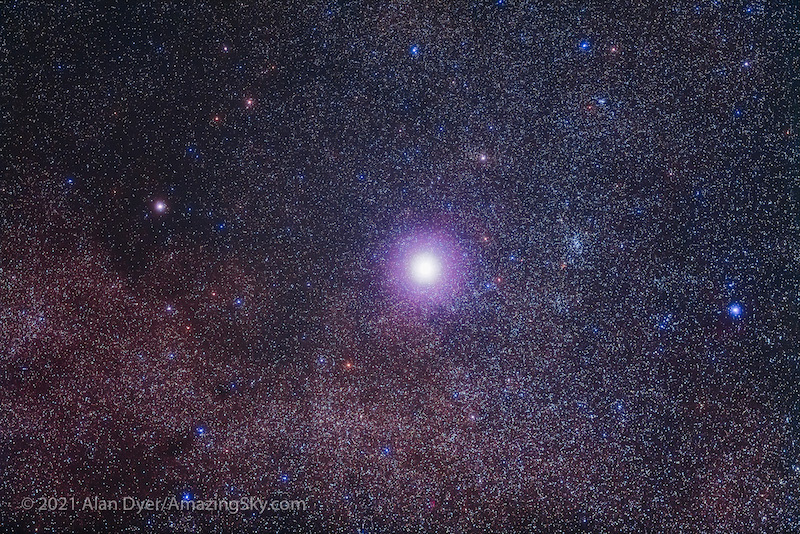
Star Alpha Centauri very bright against a backdrop of extremely dense field of fainter stars and dust clouds.
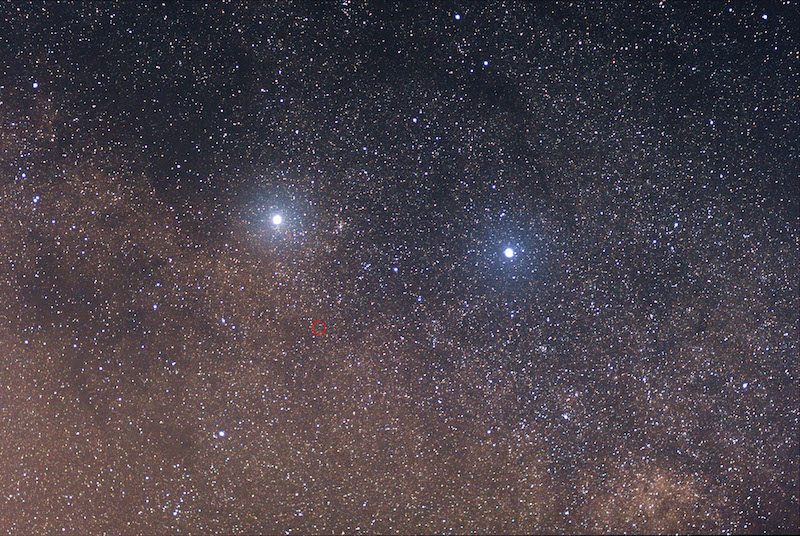
Alpha Centauri is the third-brightest star in our night sky – a famous southern star – and the nearest star system to our sun. Through a small telescope, the single star we see as Alpha Centauri resolves into a double star. This pair is just 4.37 light-years away from us. In orbit around them is Proxima Centauri, too faint to be visible to the unaided eye. At a distance of 4.25 light years, Proxima is the closest-known star to our solar system.
Science of the Alpha Centauri system. The two stars that make up Alpha Centauri, Rigil Kentaurus and Toliman, are quite similar to our sun. Rigil Kentaurus, also known as Alpha Centauri A, is a yellowish star, slightly more massive than the sun and about 1.5 times brighter. Toliman, or Alpha Centauri B, has an orangish hue; it’s a bit less massive and half as bright as the sun. Studies of their mass and spectroscopic features indicate that both these stars are about 5 to 6 billion years old, slightly older than our sun.

Alpha Centauri A and B are gravitationally bound together, orbiting about a common center of mass every 79.9 years at a relatively close proximity, between 40 to 47 astronomical units (that is, 40 to 47 times the distance between the Earth and our sun).Must Watch Sky Events in 2021

In comparison, Proxima Centauri is a bit of an outlier. This dim reddish star, weighing in at just 12 percent of the sun’s mass, is currently about 13,000 astronomical units from Alpha Centauri A and B. Recent analysis of ground- and space-based data, published in 2017, has shown that Proxima is gravitationally bound to its bright companions, with a 550,000-year-long orbital period.

Proxima Centauri belongs to a class of low mass stars with cooler surface temperatures, known as red dwarfs. It’s also what’s know as a flare star, where it randomly displays sudden bursts of brightness due to strong magnetic activity.

In the past decade, astronomers have been searching for planets around the Alpha Centauri stars; they are, after all, the closest stars to us so the odds of detecting planets, if any existed, would be higher. So far, two planets have been found orbiting Proxima Centauri, one in 2016 and another in 2019. A paper published in February 2021 reported tantalizing evidence of a Neptune-sized planet around Alpha Centauri A, but so far, it has not been definitively confirmed.

Large-appearing bright star with 4 lens-effect bright spikes coming out from it.
Extremely dense star field with 2 brights stars and a small red circle around a much smaller one.

How to see Alpha Centauri. Unluckily for many of us in the Northern Hemisphere, Alpha Centauri is located too far to the south on the sky’s dome. Most North Americans never see it; the cut-off latitude is about 29° north, and anyone north of that is out of luck. In the U.S. that latitudinal line passes near Houston and Orlando, but even from the Florida Keys, the star never rises more than a few degrees above the southern horizon. Things are a little better in Hawaii and Puerto Rico, where it can get 10° or 11° high.

But for observers located far enough south in the Northern Hemisphere, Alpha Centauri may be visible at roughly 1 a.m. (local daylight saving time) in early May. That is when the star is highest above the southern horizon. By early July, it reaches its highest point to the south at nightfall. Even so, from these vantage points, there are no good pointer stars to Alpha Centauri. For those south of 29° N. latitude, when the bright star Arcturus is high overhead, look to the extreme south for a glimpse of Alpha Centauri.

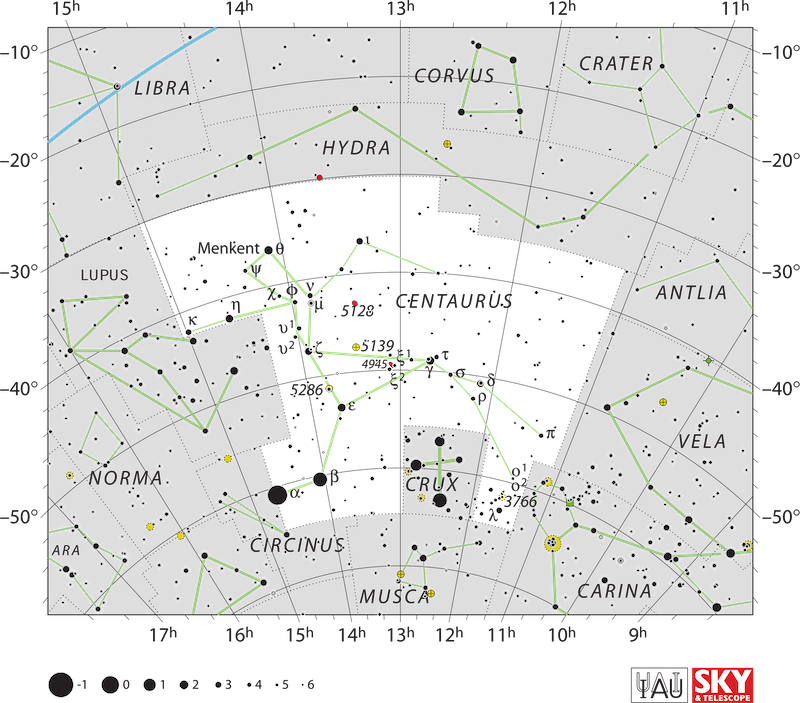
Star chart with stars in black on white, of Centaurus with Southern Cross constellation.
The southern constellation Centaurus. Image via Wikimedia/ International Astronomical Union/ SkyandTelescope.com.

Observers in the tropical and subtropical regions of the Northern Hemisphere can find Alpha Centauri by first identifying the distinctive Southern Cross. A short line drawn through the crossbar (Delta and Beta Crucis) eastward first comes to Hadar (Beta Centauri), then Alpha Centauri. Meanwhile, in Australia and much of the Southern Hemisphere, Alpha Centauri is circumpolar, meaning that it never sets.

A telescope dome at in the foreground with Milky Way and bright stars in the sky.
In this image taken at the European Southern Observatory’s La Silla Observatory in Chile, the Southern Cross is clearly visible, with the yellowish star, closest to the dome, marking the top of the cross. Drawing a line downward through the crossbar stars takes you to the bluish star, Beta Centauri, and then to the yellowish Alpha Centauri. Image via ESO / Wikimedia Commons.

Alpha Centauri in mythology. Alpha Centauri has played a prominent role in the mythology of cultures across the Southern Hemisphere. For the Ngarrindjeri indigenous people of South Australia, Alpha and Beta Centauri were two sharks pursuing a sting ray represented by stars of the Southern Cross. Some Australian aboriginal cultures also associated stars with family relationships and marriage traditions; for instance, two stars of the Southern Cross were through to be the parents of Alpha Centauri.

Astronomy and navigation were deeply intertwined in the lives of ancient seafaring Polynesians as they sailed between islands in the vast expanse of the South Pacific. These ancient mariners navigated using the stars, with cues from nature such as bird movements, waves, and wind direction. Alpha Centauri and nearby Beta Centauri, known as Kamailehope and Kamailemua, respectively, were important signposts used for orientation in the open ocean.

For ancient Incas, a llama graced the sky, traced out by stars and dark dust lanes in the Milky Way from Scorpius to the Southern Cross, with Alpha Centauri and Beta Centauri representing its eyes.

Dark-on-light shepherd, mother llama with baby, partridge, toad, and snake.
A plaque at the Coricancha museum showing Inca constellations. Coricancha, located in Cusco, Peru, was perhaps the most important temple of the Inca empire. Image via Pi3.124 / Wikimedia Commons.

Ancient Egyptians revered Alpha Centauri, and may have built temples aligned to its rising point. In southern China, it was part of a star group known as the South Gate.

Alpha Centauri is the brightest star in the constellation Centaurus, named after the mythical half human, half horse creature. It was thought to represent an uncharacteristically wise centaur that figured in the mythology of Heracles and Jason. The centaur was accidentally wounded by Heracles, and placed into the sky after death by Zeus. Alpha Centauri marked the right front hoof of the centaur, although little is known of its mythological significance, if any.

Antique etching of half-man-half-horse in field of stars in black on white.
A depiction of the Centaur by Polish astronomer Johannes Hevelius in his atlas of constellations, Firmamentum Sobiescianum, sive Uranographia. Image via Wikimedia Commons.

Alpha Centauri’s position is RA: 14h 39m 36s, Dec: -60° 50′ 02″

Bottom line: Alpha Centauri is actually two binary stars that are quite similar to our sun. A third star that’s gravitationally bound to them is Proxima Centauri, the closest star to our sun.

NASA’s Kepler Mission Discovers Bigger, Older Cousin to Earth

Kepler-452b and Earth

NASA’s Kepler mission has confirmed the first near-Earth-size planet in the “habitable zone” around a sun-like star. This discovery and the introduction of 11 other new small habitable zone candidate planets mark another milestone in the journey to finding another “Earth.” 

The newly discovered Kepler-452b is the smallest planet to date discovered orbiting in the habitable zone — the area around a star where liquid water could pool on the surface of an orbiting planet — of a G2-type star, like our sun. The confirmation of Kepler-452b brings the total number of confirmed planets to 1,030.

“On the 20th anniversary year of the discovery that proved other suns host planets, the Kepler exoplanet explorer has discovered a planet and star which most closely resemble the Earth and our Sun,” said John Grunsfeld, associate administrator of NASA’s Science Mission Directorate at the agency’s headquarters in Washington. “This exciting result brings us one step closer to finding an Earth 2.0.”

Kepler-452b is 60 percent larger in diameter than Earth and is considered a super-Earth-size planet. While its mass and composition are not yet determined, previous research suggests that planets the size of Kepler-452b have a good chance of being rocky.

Twelve New Kepler HZ Candidates

Highlighted are 12 new planet candidates from the seventh Kepler planet candidate catalog that are less than twice the size of Earth and orbit in the stars’ habitable zoneCredits: NASA Ames/W. StenzelTwelve New Small Kepler Habitable Zone Candidates

Kepler Planet Candidates July 2015

There are 4,696 planet candidates now known with the release of the seventh Kepler planet candidate catalog – an increase of 521 since the release of the previous catalog in January 2015.Credits: NASA/W. StenzelRead more…

While Kepler-452b is larger than Earth, its 385-day orbit is only 5 percent longer. The planet is 5 percent farther from its parent star Kepler-452 than Earth is from the Sun. Kepler-452 is 6 billion years old, 1.5 billion years older than our sun, has the same temperature, and is 20 percent brighter and has a diameter 10 percent larger.

“We can think of Kepler-452b as an older, bigger cousin to Earth, providing an opportunity to understand and reflect upon Earth’s evolving environment,” said Jon Jenkins, Kepler data analysis lead at NASA’s Ames Research Center in Moffett Field, California, who led the team that discovered Kepler-452b. “It’s awe-inspiring to consider that this planet has spent 6 billion years in the habitable zone of its star; longer than Earth. That’s substantial opportunity for life to arise, should all the necessary ingredients and conditions for life exist on this planet.”

To help confirm the finding and better determine the properties of the Kepler-452 system, the team conducted ground-based observations at the University of Texas at Austin’s McDonald Observatory, the Fred Lawrence Whipple Observatory on Mt. Hopkins, Arizona, and the W. M. Keck Observatory atop Mauna Kea in Hawaii. These measurements were key for the researchers to confirm the planetary nature of Kepler-452b, to refine the size and brightness of its host star and to better pin down the size of the planet and its orbit.

The Kepler-452 system is located 1,400 light-years away in the constellation Cygnus. The research paper reporting this finding has been accepted for publication in The Astronomical Journal.

In addition to confirming Kepler-452b, the Kepler team has increased the number of new exoplanet candidates by 521 from their analysis of observations conducted from May 2009 to May 2013, raising the number of planet candidates detected by the Kepler mission to 4,696. Candidates require follow-up observations and analysis to verify they are actual planets.

Twelve of the new planet candidates have diameters between one to two times that of Earth, and orbit in their star’s habitable zone. Of these, nine orbit stars that are similar to our sun in size and temperature.

“We’ve been able to fully automate our process of identifying planet candidates, which means we can finally assess every transit signal in the entire Kepler dataset quickly and uniformly,” said Jeff Coughlin, Kepler scientist at the SETI Institute in Mountain View, California, who led the analysis of a new candidate catalog. “This gives astronomers a statistically sound population of planet candidates to accurately determine the number of small, possibly rocky planets like Earth in our Milky Way galaxy.”

These findings, presented in the seventh Kepler Candidate Catalog, will be submitted for publication in the Astrophysical Journal. These findings are derived from data publicly available on the NASA Exoplanet Archive.

Scientists now are producing the last catalog based on the original Kepler mission’s four-year data set. The final analysis will be conducted using sophisticated software that is increasingly sensitive to the tiny telltale signatures of Earth-size planets.

Ames manages the Kepler and K2 missions for NASA’s Science Mission Directorate. NASA’s Jet Propulsion Laboratory in Pasadena, California, managed Kepler mission development. Ball Aerospace & Technologies Corporation operates the flight system with support from the Laboratory for Atmospheric and Space Physics at the University of Colorado in Boulder.

For more information about the Kepler mission, visit:

http://www.nasa.gov/kepler

What is Astrophysics?

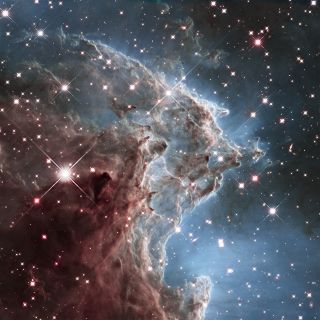
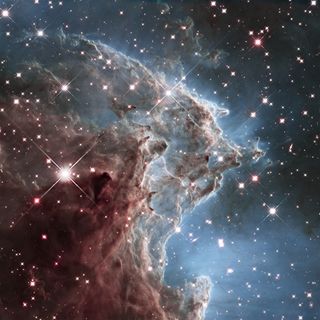
Hubble Snaps 'Monkey Head' Nebula
Astrophysics is a branch of space science that applies the laws of physics and chemistry to explain the birth, life and death of stars, planets, galaxies, nebulae and other objects in the universe. It has two sibling sciences, astronomy and cosmology, and the lines between them blur. 

In the most rigid sense:
Astronomy measures positions, luminosities, motions and other characteristics
Astrophysics creates physical theories of small to medium-size structures in the universe
Cosmology does this for the largest structures, and the universe as a whole. 

In practice, the three professions form a tight-knit family. Ask for the position of a nebula or what kind of light it emits, and the astronomer might answer first. Ask what the nebula is made of and how it formed and the astrophysicist will pipe up. Ask how the data fit with the formation of the universe, and the cosmologist would probably jump in. But watch out — for any of these questions, two or three may start talking at once!
Goals of astrophysics
Astrophysicists seek to understand the universe and our place in it. At NASA, the goals of astrophysics are “to discover how the universe works, explore how it began and evolved, and search for life on planets around other stars,” according NASA’s website.

NASA states that those goals produce three broad questions:

  • How does the universe work?
  • How did we get here?
  • Are we alone?

It began with Newton

While astronomy is one of the oldest sciences, theoretical astrophysics began with Isaac Newton. Prior to Newton, astronomers described the motions of heavenly bodies using complex mathematical models without a physical basis. Newton showed that a single theory simultaneously explains the orbits of moons and planets in space and the trajectory of a cannonball on Earth. This added to the body of evidence for the (then) startling conclusion that the heavens and Earth are subject to the same physical laws.

Perhaps what most completely separated Newton’s model from previous ones is that it is predictive as well as descriptive. Based on aberrations in the orbit of Uranus, astronomers predicted the position of a new planet, which was then observed and named Neptune. Being predictive as well as descriptive is the sign of a mature science, and astrophysics is in this category.

Milestones in astrophysics

Because the only way we interact with distant objects is by observing the radiation they emit, much of astrophysics has to do with deducing theories that explain the mechanisms that produce this radiation, and provide ideas for how to extract the most information from it. The first ideas about the nature of stars emerged in the mid-19th century from the blossoming science of spectral analysis, which means observing the specific frequencies of light that particular substances absorb and emit when heated. Spectral analysis remains essential to the triumvirate of space sciences, both guiding and testing new theories.

Early spectroscopy provided the first evidence that stars contain substances also present on Earth. Spectroscopy revealed that some nebulae are purely gaseous, while some contain stars. This later helped cement the idea that some nebulae were not nebulae at all — they were other galaxies! 

In the early 1920s, Cecilia Payne discovered, using spectroscopy, that stars are predominantly hydrogen (at least until their old age). The spectra of stars also allowed astrophysicists to determine the speed at which they move toward or away from Earth. Just like the sound a vehicle emits is different moving toward us or away from us, because of the Doppler shift, the spectra of stars will change in the same way. In the 1930s, by combining the Doppler shift and Einstein’s theory of general relativity, Edwin Hubble provided solid evidence that the universe is expanding. This is also predicted by Einstein’s theory, and together form the basis of the Big Bang Theory.

Also in the mid-19th century, the physicists Lord Kelvin (William Thomson) and Gustav Von Helmholtz speculated that gravitational collapse could power the sun, but eventually realized that energy produced this way would only last 100,000 years. Fifty years later, Einstein’s famous E=mc2 equation gave astrophysicists the first clue to what the true source of energy might be (although it turns out that gravitational collapse does play an important role). As nuclear physics, quantum mechanics and particle physics grew in the first half of the 20th century, it became possible to formulate theories for how nuclear fusion could power stars. These theories describe how stars form, live and die, and successfully explain the observed distribution of types of stars, their spectra, luminosities, ages and other features.

Astrophysics is the physics of stars and other distant bodies in the universe, but it also hits close to home. According to the Big Bang Theory, the first stars were almost entirely hydrogen. The nuclear fusion process that energizes them smashes together hydrogen atoms to form the heavier element helium. In 1957, the husband-and-wife astronomer team of Geoffrey and Margaret Burbidge, along with physicists William Alfred Fowler and Fred Hoyle, showed how, as stars age, they produce heavier and heavier elements, which they pass on to later generations of stars in ever-greater quantities. It is only in the final stages of the lives of more recent stars that the elements making up the Earth, such as iron (32.1 percent), oxygen (30.1 percent), silicon (15.1 percent), are produced. Another of these elements is carbon, which together with oxygen, make up the bulk of the mass of all living things, including us. Thus, astrophysics tells us that, while we are not all stars, we are all stardust.

Astrophysics as a career

Advertisement

Becoming an astrophysicist requires years of observation, training and work. But you can start becoming involved in a small way even in elementary and high school, by joining astronomy clubs, attending local astronomy events, taking free online courses in astronomy and astrophysics, and keeping up with news in the field on a website such as Space.com. 

In college, students should aim to (eventually) complete a doctorate in astrophysics, and then take on a post-doctoral position in astrophysics. Astrophysicists can work for the government, university labs and, occasionally, private organizations.

Study.com further recommends the following steps to put you on the path to being an astrophysicist:

Take math and science classes all through high school. Make sure to take a wide variety of science classes. Astronomy and astrophysics often blend elements of biology, chemistry and other sciences to better understand phenomena in the universe. Also keep an eye out for any summer jobs or internships in math or science. Even volunteer work can help bolster your resume.

Pursue a math- or science-related bachelor’s degree. While a bachelor in astrophysics is the ideal, there are many other paths to that field. You can do undergraduate study in computer science, for example, which is important to help you analyze data. It’s best to speak to your high school guidance counselor or local university to find out what degree programs will help you.

Take on research opportunities. Many universities have labs in which students participate in discoveries — and sometimes even get published. Agencies such as NASA also offer internships from time to time. 

Finish a doctorate in astrophysics. A Ph.D. is a long haul, but the U.S. Bureau of Labor Statistics points out that most astrophysicists do have a doctoral degree. Make sure to include courses in astronomy, computer science, mathematics, physics and statistics to have a wide base of knowledge.

Natalie Hinkel, a planetary astrophysicist who was then at Arizona State University, gave a lengthy interview with Lifehacker in 2015 that provided a glimpse into the rewards and challenges of being a junior astrophysics researcher. She described the long number of years she has put into doing her research, the frequent job switches, her work hours and what it’s like to be a woman in a competitive field. She also had an interesting insight about what she actually did day to day. Very little of her time is spent at the telescope.

“I spend the vast majority of my time programming. Most people assume that astronomers spend all of their time at telescopes, but that’s only a very small fraction of the job, if at all. I do some observations, but in the past few years I’ve only been observing twice for a total of about two weeks,” Hinkel told Lifehacker. 

“Once you get the data, you have to reduce it (i.e. take out the bad parts and process it for real information), usually combine it with other data in order to see the whole picture, and then write a paper about your findings. Since each observation run typically yields data from multiple stars, you don’t need to spend all of your time at the telescope to have enough work.”

Water on Mars: Exploration & Evidence

Newton Crater

Liquid water may still flow on Mars, but that doesn’t mean it’s easy to spot. The search for water on the Red Planet has taken more than 15 years to turn up definitive signs that liquid flows on the surface today. In the past, however, rivers and oceans may have covered the land. Where did all of the liquid water go? Why? How much of it still remains?

Observations of the Red Planet indicate that rivers and oceans may have been prominent features in its early history. Billions of years ago, Mars was a warm and wet world that could have supported microbial life in some regions. But the planet is smaller than Earth, with less gravity and a thinner atmosphere. Over time, as liquid water evaporated, more and more of it escaped into space, allowing less to fall back to the surface of the planet.

Where is the water today?

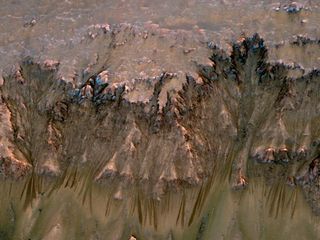
Liquid water appears to flow from some steep, relatively warm slopes on the Martian surface. Features known as recurring slope lineae (RSL) were first identified in 2011in images taken by the High Resolution Imaging Science Experiment (HiRISE) camera aboard the Mars Reconnaissance Orbiter (MRO). The dark streaks, which appear seasonally, were confirmed to be signs of salty water running on the surface of the planet.

“If this is correct, then RSL on Mars may represent the surface expression of a far more significant ongoing drainage system on steep slopes in the mid-latitudes,” a research team member told Space.com in 2012.

In 2015, spectral analysis of RSL led scientists to conclude they are caused by salty liquid water. [Related: Salty Water Flows on Mars Today, Boosting Odds for Life]

“The detection of hydrated salts on these slopes means that water plays a vital role in the formation of these streaks,” the study’s lead author, Lujendra Ojha, of the Georgia Institute of Technology in Atlanta, said in a statement. Vast deposits of water appear to be trapped within the ice caps at the north and south poles of the planet. Each summer, as temperatures increase, the caps shrink slightly as their contents skip straight from solid to gas form, but in the winter, cooler temperatures cause them to grow to latitudes as low as 45 degrees, or halfway to the equator. The caps are an average of 2 miles (3 kilometers) thick and, if completely melted, could cover the Martian surface with about 18 feet (5.6 meters) of water. 

Frozen water also lies beneath the surface. Scientists discovered a slab of ice as large as California and Texas combined in the region between the equator and north pole of the Red Planet. The presence of subsurface water has long been suspected but required the appearance of strange layered craters to confirm. Other regions of the planet may contain frozen water, as well. Some high-latitude regions seem to boast patterned ground-shapes that may have formed as permafrost in the soil freezes and thaws over time. 

The European Space Agency’s Mars Express spacecraft captured images of sheets of ice in the cooler, shadowed bottoms of craters, which suggests that liquid water can pool under appropriate conditions. Other craters identified by NASA’s Mars Reconnaissance Orbiter show similar pooling.

Evidence for water on Mars first came to light in 2000, with the appearance of gullies that suggested a liquid origin. Their formation has been hotly debated over the ensuing years.

But not everyone thinks that Mars contains water today. New research reveals that RSL may actually have formed by granular flows formed by the movement of sand and dust.

“We’ve thought of RSL as possible liquid water flows, but the slopes are more like what we expect for dry sand,” lead author Colin Dundas said in a statement. “This new understanding of RLS supports other evidence that shows that Mars today is very dry.”

That idea may have been washed away by the recent discovery of a possible subsurface lake near the Martian South Pole.

An underground lake?

Researchers made a big splash when they announced that Mars might be hiding a lake beneath its southern pole. The European Mars Express spacecraft used its Mars Advanced Radar for Subsurface and Ionosphere Sounding (MARSIS) to detect the proposed water. Ground-penetrating radar sent radar pulses to the surface, then timed how long it took for them to be reflected. The properties of the subsurface layers affect how long it takes for the beams to return.

MARSIS’ investigation revealed that the Martian south pole is composed of multiple layers of ice and dust to a depth of about nearly 1 mile (1.5 kilometers) spread over a 124-mile-wide (200 km) region.  

“This subsurface anomaly on Mars has radar properties matching water or water-rich sediments,” Roberto Orosei, principal investigator of the MARSIS experiment and lead author of the new research, said in a statement. 

MARSIS also revealed the presence of a subsurface lake among the pockets. According to the radar echoes, the lake is no more than 12.5 miles (20 km) across, buried nearly a mile beneath the surface. The scientists aren’t certain of the lake’s depth, but they have confirmed that it is at least 3 feet (1 meter) deep. According to the researchers, the lake must have salt to keep from freezing.

“This is just one small study area; it is an exciting prospect to think there could be more of these underground pockets of water elsewhere, yet to be discovered,” Orosei said.

Not all researchers are as certain about the presence of liquid water.

“I think it’s a very, very persuasive argument, but it’s not a conclusive or definitive argument,” Steve Clifford, a Mars researcher at the Planetary Science Institute in Arizona, told Space.com. “There’s always the possibility that conditions that we haven’t foreseen exist at the base of the cap and are responsible for this bright reflection.”

More than three decades ago, Clifford proposed that Mars could harbor liquid water beneath its polar caps in the same way that Earth does. On Earth, lakes beneath the Antarctic and Greenland ice sheets are created when heat from within the planets melt the glaciers in patches. Clifford told Space.com that a similar scenario could happen beneath the Martian polar ice caps.

“The bright spot seen in the MARSIS data is an unusual feature and extremely intriguing,” Jim Green, NASA’s chief scientist, said in a statement. “It definitely warrants further study. Additional lines of evidence should be pursued to test the interpretation.”

“We hope to use other instruments to study it further in the future,” Green said.

Liquid gold

Water may seem like a very common element to those of us stuck on Earth, but it has great value. In addition to understanding how Mars may have changed and developed over time, scientists hope that finding water will help them to find something even more valuable — life, either past or present.

Only Earth is known to host life, and life on our planet requires water. Though life could conceivably evolve without relying on this precious liquid, scientists can only work with what they know. Thus they hope that locating water on celestial bodies such as Mars will lead to finding evidence for life.

With this in mind, NASA developed a strategy for exploring the Red Planet that takes as its mantra “follow the water.” Recent orbiters, landers, and rovers sent to Mars were designed to search for water, rather than life, in the hopes of finding environments where life could have thrived.

That has changed, however, with the flood of evidence these robots have returned. Curiosity determined that Mars could indeed have supported microbial life in the ancient past, and the next NASA rover — a car-size robot-based heavily on Curiosity’s basic design — will blast off in 2020 to look for evidence of past Red Planet life.

MESSIER 87-The Galaxy that gives Hope

M87
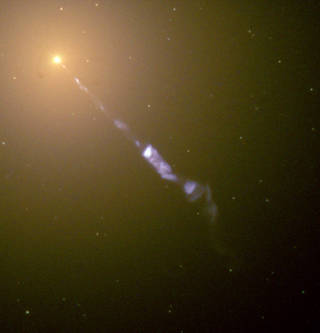
The elliptical galaxy M87 is the home of several trillion stars, a supermassive black hole and a family of roughly 15,000 globular star clusters. For comparison, our Milky Way galaxy contains only a few hundred billion stars and about 150 globular clusters. The monstrous M87 is the dominant member of the neighboring Virgo cluster of galaxies, which contains some 2,000 galaxies. Discovered in 1781 by Charles Messier, this galaxy is located 54 million light-years away from Earth in the constellation Virgo. It has an apparent magnitude of 9.6 and can be observed using a small telescope most easily in May.
This Hubble image of M87 is a composite of individual observations in visible and infrared light. Its most striking features are the blue jet near the center and the myriad of star-like globular clusters scattered throughout the image.
The jet is a black-hole-powered stream of material that is being ejected from M87’s core. As gaseous material from the center of the galaxy accretes onto the black hole, the energy released produces a stream of subatomic particles that are accelerated to velocities near the speed of light.
At the center of the Virgo cluster, M87 may have accumulated some of its many globular clusters by gravitationally pulling them from nearby dwarf galaxies that seem to be devoid of such clusters today.
For more information about Hubble’s observations of M87, see:
http://hubblesite.org/news_release/news/2008-30
http://hubblesite.org/news_release/news/2000-20
http://hubblesite.org/news_release/news/2013-32
locator star chart for M87

TIME DILATION-That makes you age faster

Dark energy explained by relativistic time dilation? – Astronomy Now

Time Dilation

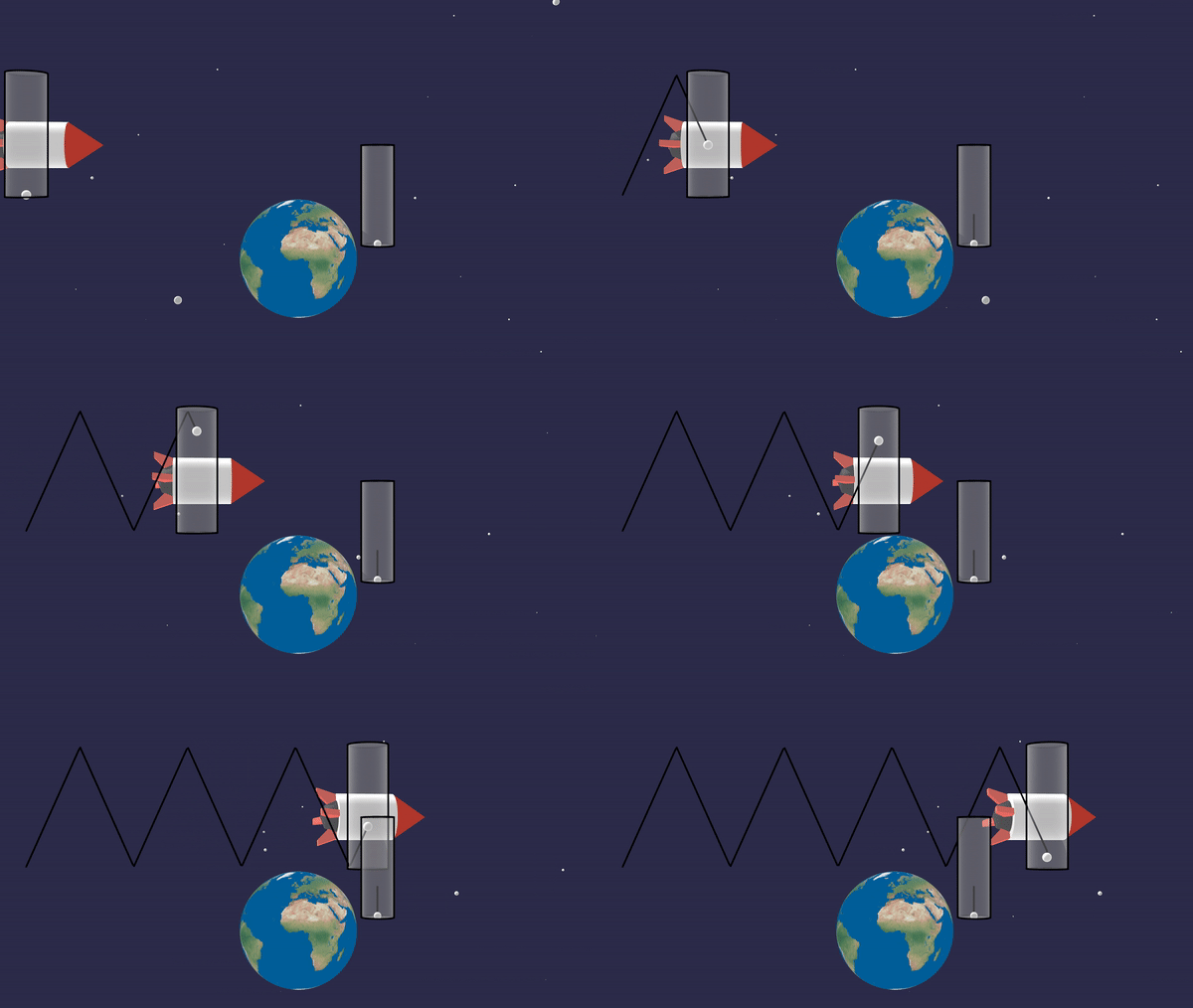
It turns out that as an object moves with relativistic speeds a “strange” thing seems to happen to its time as observed by “us” the stationary observer (observer in an inertial reference frame). What we see happen is that the “clock” in motion slows down according to our clock, therefore we read two different times. Which time is correct??? well they both are because time is not absolute but is relative, it depends on the reference frame. Let’s look at the following classic example. There is a set of twins, one an astronaut, the other works for mission control of NASA. The astronaut leaves on a deep space trip traveling at 95% the speed of light. Upon returning the astronauts clock has measured ten years, so yhe astronaut has aged 10 years. However, when the astronaut reunites with his earth bound twin, the astronauthe sees that the twin has aged 32 years! This is explained due to the fact that the astronaut’s twin is traveling at relativistic speeds and therefore his “clock” is slowed down.

Let’s see how we can calculate the time “difference”. The equation for calculating time dilation is as follows:

t = t0/(1-v2/c2)1/2

where: t = time observed in the other reference frame

t0 = time in observers own frame of reference (rest time)

v = the speed of the moving object

c = the speed of light in a vacuum

so in our problem we will let v = .95c, t0 = 10 years and we will solve for t which is the time that the earth bound brother measures.

t = 10/(1- (.95c)2/c2)1/2

t = 10/(1- .952)1/2

t = 10/ .312

t = 32 years
(the time the earth bound brother measures)

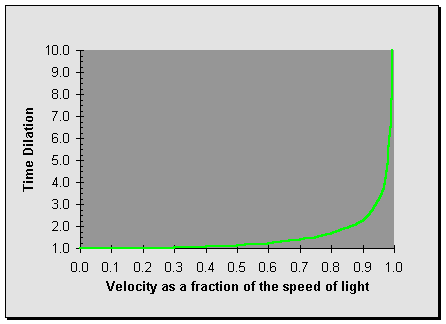
Now let’s have a closer look at the equation and determine just what impact the speed of the object has on time dilation. We can see that is the velocity is small compared to the speed of light the quantity v2/c2 approaches 0 and the equation simplifies t0: t = t0/1 which is simply t. So at relatively slow speeds (our everyday speeds) time dilation is not a factor and Newton’s Laws are still applicable. Now let’s look at high speeds (close to the speed of light), from the equation that as velocity increases the quantity v2/c2 approaches 1 (but will never quit reach it), causing the quantity(1-v2/c2)1/2 t0 become smaller and smaller….therefore causing the time measured by the other observer t0 become greater thus making our time appear slower (refer back to the example). I know its so confusing!!! read it again, think about it, then study the graph below. As one can see in the graph time dilation starts t0 “show up” between .4c and .5c. Also notice that the closer one gets to the speed of light the greater impact speed has on time dilation (notice how steep the curve gets towards the end)..

NASA launched Mars rover from Florida to seek signs of past life

NASA’s next-generation Mars rover has blasted off from Florida’s Cape Canaveral top an Atlas 5 rocket on a $US2.4 billion ($3.36 billion) mission to search for traces of potential past life on Earth’s planetary neighbour.

The next-generation robotic rover – a car-sized six-wheeled vehicle carrying seven scientific instruments – also is scheduled to deploy a mini helicopter on Mars and try out equipment for future human missions to the fourth planet from the sun.

Scientists have long debated whether Mars once a much more hospitable place than it is today ever harboured life.

Water is considered a key ingredient for life, and the Mars of billions of years ago had lots of it on the surface before the planet became a harsh and desolate planet.

One of the most journey will be what mission engineers call the “seven minutes of terror,” when the robot endures extreme heat and speeds during its descent through the Martian atmosphere, deploying a set of supersonic parachutes before igniting mini rocket engines to gently touch down on the planet’s surface.

Since NASA’s first Mars rover Sojourner landed in 1997, the agency has sent two others – Spirit and Opportunity – that have explored the geology of expansive Martian plains and detected signs of past water formations, among other discoveries. NASA also has successfully sent three landers – Pathfinder, Phoenix, InSight.

The United States has plans to send astronauts to Mars in the 2030s under a program that envisions using a return to the moon as a testing platform for human missions before making the more ambitious crewed journey to Mars.

The rover also is intended to help bring Martian rock samples back to Earth, collecting materials in cigar-sized capsules and leaving them in various spots on the surface for retrieval by a future “fetch” rover. That planned rover is expected to launch the samples back into space to link up with other spacecraft for an eventual Earth homecoming around 2031.

Source – NASA, Reuters, National Post