RBI and credit control

ReserveBankOfIndia (@RBI) / Twitter

RBI governor, Shaktikanth Das, on May 4 2022 revised the repo rates. On this context, let us look more about the credit control measures adopted by Reserve bank of India.

Reserve bank is the apex body to control the banking system in India. As we all know banks are the major link in money supply. Thus, RBI can control the money in the economy by controlling the banks. These policies are termed as monetary policy.

RBI could adopt either quantitative or qualitative methods.

Quantitative methods

Statutory Liquidity Ratio

Statutory Liquidity Ratio or SLR is the minimum percentage of deposits that a commercial bank has to maintain in the form of liquid cash, gold or other securities. It is basically the reserve requirement that banks are expected to keep before offering credit to customers. The SLR is fixed by the RBI and is a form of control over the credit growth in India.

The government uses the SLR to regulate inflation and fuel growth. Increasing the SLR will control inflation in the economy while decreasing the statutory liquidity rate will cause growth in the economy. The SLR was prescribed by Section 24 (2A) of Banking Regulation Act, 1949.

Cash Reserve Ratio

CRR is an essential monetary policy tool used for controlling the money supply in the economy, a regulation implemented in almost every nation by the Central Bank of that country.

CRR rate is the minimum percentage of cash deposits (as specified by RBI) that must be maintained by every commercial bank as per the requirement of the Central Bank.

Cash Reserve Ratio Rate is computed as a percentage of the net demand and time liabilities of each bank. Net Demand and Time Liability is reached with the total of the savings account, current account, and fixed deposit balances.

Bank rate

Bank rate is a rate at which the Reserve Bank of India (RBI) provides the loan to commercial banks without keeping any security. There is no agreement on repurchase that will be drawn up or agreed upon with no collateral as well. The RBI allows short-term loans with the presence of collateral. This is known as Repo Rate. Bank Rates in India is determined by the RBI. It is usually higher than a Repo Rate on account of its ability to regulate liquidity.

Open market operations

Open market operations refer to the selling and purchasing of the treasury bills and government securities by the central bank of any country in order to regulate money supply in the economy.

It is one of the most important ways of monetary control that is exercised by the central banks. Under this system, the central bank sells securities in the market when it wants to reduce the money supply in the market. It is done to increase interest rates. This policy is also known as the contractionary monetary policy.

Similarly, when the central bank wants to increase the money supply in the market, it will purchase securities from the market. This step is taken to reduce the rate of interest and also to help in the economic growth of the country. This policy is known as the expansionary monetary policy.

Qualitative methods

Margin Requirement:

Margin requirement refers to the difference between the current value of the security offered for loan (called collateral) and the value of loan granted. It is a qualitative method of credit control adopted by the central bank in order to stabilize the economy from inflation or deflation.

Rationing of Credit:

Rationing of credit refers to fixation of credit quotas for different business activities which is introduced when the flow of credit is to be checked particularly for speculative activities in the economy.

Moral Suasion:

The central bank makes the member bank agree through persuasion or pressure to follow its directives which is generally not ignored by the member banks. The banks are advised to restrict the flow of credit during inflation and be liberal in lending during deflation.

Life insurance corporation of India

LIC share Market Price: Life Insurance Corporation's market share falls  below 70%

Life insurance corporation of India has initiated its initial public offer for five percent of its shares. It is one of the largest profit-making enterprises owned by the government of India. In this instance, it is important to know more about this enterprise.

LIC or Life Insurance corporation of India was started in the year 1956 in accordance with the Life insurance corporation of India act of 1956. As India was following a socialistic approach of economic development, LIC was introduced as an enterprise owned and operated by the government of India.

Story of formation

The Oriental Life Insurance Company, the first company in India offering life insurance coverage, was established in Kolkata in 1818. Its primary target market was the Europeans based in India, and it charged Indians heftier premiums. After that several companies emerged. The first 150 years were marked mostly by turbulent economic conditions. It witnessed India’s First War of Independence, adverse effects of the World War I and World War II on the economy of India, and in between them the period of worldwide economic crises triggered by the Great depression. The first half of the 20th century saw a heightened struggle for India’s independence. The aggregate effect of these events led to a high rate of and liquidation of life insurance companies in India. This had adversely affected the faith of the general in the utility of obtaining life cover. In 1955, parliamentarian Feroze Gandhi raised the matter of insurance fraud by owners of private insurance agencies. The Parliament of India passed the Life Insurance of India Act on 19 June 1956 creating the Life Insurance Corporation of India, which started operating in September of that year.

Structure

The LIC’s executive board consists of Chairman, currently M R Kumar, and Managing Directors, Vipin Anand, T. C. Suseel Kumar, Mukesh Kumar Gupta and Raj Kumar. The Central Office of LIC is based out of Mumbai which sits The Chairman, all four Managing Directors, and all Executive Directors (Department Heads). LIC has a total of 8 Zonal Offices namely Delhi, Chennai, Mumbai, Hyderabad, Kanpur, Kolkata, Bhopal & Patna.

Policies

Some important policies are:

LIC tech term plan

LIC Jeevan Umang

LIC Jeevan Amar

LIC Money back years

LIC New Jeevan Anand

Role of LIC

It has been a significant driver in creating the culture of investment in insurance. It has made insurance accessible to the economically weaker sections. The long-term schemes with affordable premiums made it highly attractive. The role of Life insurance corporation as an employer is also applaudable. It provides employment to many. More than all, many other insurance firms in India has benefitted out of the trust built by LIC.

Initial public offering

Finance Minister Nirmala Sitharaman announced a proposal to conduct an initial public offering for LIC in the 2021 Union Budget. The IPO opens on 4th May 2022 and closes on 9th May 2022. The Government of India will remain the majority shareholder after the public listing. Due to the scale of the offering and LIC’s ownership structure, the deal has been referred to as “India’s Aramco moment” in reference comparable importance and scale of 2019 IPO of Saudi Aramco. The latest development in the LIC IPO is the slashing of issue size from 5% to 3.5% of total equity of the company. LIC will open its IPO to the public on May 4 and the process concludes on May 9. Through this IPO, the Government of India, the sole owner of LIC, is now aiming to raise ₹21,000 crore, as opposed to raising between ₹65,000 crore to ₹70,000 crore by diluting 5% equity earlier, indicating more than 50% compromise on valuation as well. As per the IPO price band for 3.5% stakes for Rs. 21,000 crores, the valuation comes to around Rs 6 lakh crore.

RBI ACCOUNT AGGREGATOR FRAMEWORK

What will the future of banking look like in the Gulf? - Arabian Business

The Account Aggregator framework, introduced by the RBI, aims to make financial data more accessible by creating data intermediaries called Account Aggregators (AA) which will collect and share the user’s financial information from a range of entities that hold consumer data called Financial Information Providers (FIPs) to a range of entities that are requesting consumer data called Financial Information Users (FIUs) after obtaining the consent of the consumer.

For example, if a user wishes to apply for a loan, the lender (an FIU) will require access to the previous financial statements of the user – which reside with the user’s Bank (an FIP) – in order to check their creditworthiness. Here’s how an AA will facilitate the flow of information:

  1. The FIU will request the AA to share the desired financial information.
  2. The AA will request the user for their consent to share financial information with the FIU. The Account Aggregator must interact with the customer using either a web-based or a mobile app-based client.
  3. If the user consents, the AA will request the FIP (the User’s bank in this case) to share the financial information.
  4. The FIP will transfer the information, which will be encrypted, to the AA, which will then transfer it to the FIU.

Roles of each party:

  • Banks act as financial data providers. They supply the data required for Reserve bank of India to create a database of the account data and create reliable rankings.
  • Lenders act as financial data seekers. The lenders or financial institutions who provide fund to people acts as the seekers or demands the data aggregated by the Reserve bank.
  • Non-banking finance corporations act as mediums of communication between banks and lenders and they are the links.
  • Third-party service providers work with AAs.

Process

  • An individual or business opens an account with an account aggregator. Then, they link their bank accounts, insurance policies, etc. — which are accounts containing the customer’s financial data.
  • The customer can provide consent to a lender to access their financial data through the NBFC-AA.
  • After consent is provided, the account aggregator seeks permission from the financial data providers to access the customer’s data.
  • The data is sent to the account aggregator, which, in turn, empowers lenders to better evaluate the customer’s financial profile and risk associated with providing a loan.

Banks involved at present are:

These are the banks which act as the data providers:

State Bank of India

 ICICI Bank

Axis Bank

IDFC First Bank

 Kotak Mahindra Bank

 HDFC Bank

 IndusInd Bank

Federal Bank.

Advantages

  • Data scattered around the financial system can be made available under a single database.
  • This helps the institutions build a better understanding of potential customers and tailor their services accordingly.
  • It also enables the free flow of data between banks and financial service providers.
  • Helps financial institutions to make better assessment of creditworthiness of individuals and thus make better loan decisions.
  • Helps to eliminate the limitations of credit rating agencies.
  • Helpful for creditworthy customers

Disadvantages

  • It faces the issue of data privacy.
  • It is proposed as a self- Regulator framework, which would be an issue.
  • This data could be used for several other purposes.

World immunization week

Vaccination Tracker for COVID-19 | UL

After two long years of Covid 19 and its difficulties world is getting back to normalcy. Covid vaccines are the most important weapon which helped the human kind to defeat this virus which bought the entire world to a halt. Similarly, there are several instances when vaccines came to the rescue of mankind.

Recognising the significance of immunization, world health organization observes the last week of April as world immunization week every year. It aims to highlight the need for collective action to promote the use of vaccine. The theme for this year is “Life for all”. On this instance, let us learn more about vaccines:

What are vaccines?

A vaccine is a biological preparation that provides active acquired immunity to a particular infectious disease. A vaccine typically contains an agent that resembles a disease-causing microorganism and is often made from weakened or killed forms of the microbe, its toxins, or one of its surface proteins. The agent stimulates the body’s immune system to recognize the agent as a threat, destroy it, and to further recognize and destroy any of the microorganisms associated with that agent that it may encounter in the future.

The administration of vaccines is called vaccination. Vaccination is the most effective method of preventing infectious diseases widespread immunity due to vaccination is largely responsible for the worldwide eradication of smallpox and the restriction of diseases such as polio, measles, and tetanus from much of the world.

Even though vaccines have got all these positives many are still hesitant to get vaccinated. This is termed as vaccine hesitancy. The major reasons are:

  • Lack of confidence

Most of the times people will show hesitancy towards vaccine if they are not confident about the manufacturers. In order to solve this issue, the government has to ensure the general public about the reliability of vaccines.

  • Lack of sufficient testing

In some cases, vaccines may not be pre tested sufficiently before administering to the general public. In such instances government has to clarify regarding the surety of vaccines.

  • Illiteracy

Lack of knowledge among people also act as a barrier to vaccination drives. Due to ignorance people will not give importance to vaccine.

  • Religious and cultural beliefs

Some religions lay down restrictions to their followers in case of immunization. As a part of cultural or religious beliefs there exists some inherent resistance towards vaccination

  • Lack of access

Inaccessibility to vaccines also restricts vaccination process. Lack of health care services and facilities in remote areas prevents vaccination.

  • Inconvenience

Sometimes the long process and follow ups are difficult for people and many people find it inconvenient. In this case people should be made aware of the importance of vaccination. Also, efforts should be made to make the process less tiring.

  • Economic barriers

In many cases the vaccines are costly and downtrodden masses are unable to pay the price for vaccines. The government subsidies must be provided properly to solve this issue.

  • Future health implications

Some people don’t take vaccines fearing the health impacts in future. Believing the rumours many people fear to take loans.

  • Personal beliefs

The inherent beliefs and thoughts May also restrict people from getting vaccinated. Their political inclination and other such factors will affect this process.

Ultimately, it is the duty of general public to educate the hesitant population about the benefits of vaccination. The government should also play significant role in educating people and encouraging research.

So, let us work together and ensure a healthy life for all.

Mann Ki Baat

 My dear countrymen, Namaskar. Today we are coming together through yet another episode of ‘Mann Ki Baat’. This is the first ‘Mann Ki Baat’ of 2022. Today we will once again take forward discussions which are related to the positive inspirations and collective efforts of our country and countrymen. Today is also the death anniversary of our revered Bapu Mahatma Gandhi ji. The 30th of January reminds us of the teachings of Bapu. Just a few days ago, we celebrated Republic Day as well. The display of the nation’s valour and strength, which we witnessed on Rajpath in Delhi filled everyone with pride and enthusiasm. One change you must have noticed is that now the Republic Day functions will start from the 23rd of January, i.e. the birth anniversary of Netaji Subhas Chandra Bose and will continue till the 30th of January i.e. Gandhiji’s death anniversary. A digital sculpture of Netaji has also been installed at India Gate. We can never forget the way the country welcomed this, the wave of joy that arose from every corner of the country; the kind of feelings expressed by every countryman.


Friends, in the Azadi Ka Amrit Mahotsav, the country is re-establishing its national symbols through these efforts. We saw that the ‘Amar Jawan Jyoti’ near India Gate and the Jyoti lit at the ‘National War Memorial’ in the vicinity, were merged. There were tears in the eyes of many countrymen and martyr families on this emotional occasion. At the ‘National War Memorial’, the names of all the bravehearts of the country who have been martyred since Independence have been inscribed. Some former soldiers of the army have written to me saying that – “The ‘Amar Jawan Jyoti’ lit at the memorial is a symbol of the immortality of the martyrs”. Truly, like ‘Amar Jawan Jyoti’ our martyrs, their inspiration and their contribution are also immortal. I would urge all of you to certainly visit the ‘National War Memorial’ whenever you get an opportunity. Do take along your family and children too. Here you will feel a different energy and inspiration.


Friends, in the midst of these events of Amrit Mahotsav, many important national awards were also given away in the country. One of them is the Pradhan Mantri Rashtriya Baal Puraskaar. These awards are given to the children who have rendered courageous and inspirational work at a young age. We all must highlight about these children in our homes. Our children will also get inspiration from this and the enthusiasm to bring glory to the country will be awakened in them. Padma awards have also just been announced in the country. There are many names among the recipients of Padma awards, about whom very few people know. These are the unsung heroes of our country, who have done extraordinary deeds in ordinary circumstances. For example, Basanti Devi of Uttarakhand, who has been honored with Padma Shri, lived her whole life in the midst of struggles. Her husband died at an early age and she had started living in an ashram. Staying there, she fought to save the river and made an extraordinary contribution to the environment. She has also done a lot of work for the empowerment of women. Similarly, 77-year-old Lorembam Beino Devi of Manipur has been conserving the Liba textile art of Manipur for decades. She has also been awarded the Padma Shri. Arjun Singh of Madhya Pradesh has received Padma award for imparting recognition to the art of Baiga tribal dance. Another person to receive the Padma award is Shriman Amai Mahalinga Naik. He is a farmer and hails from Karnataka. Some people also call him Tunnel Man. He has made such innovations in agriculture, seeing which anyone could be surprised. Small farmers are getting huge benefit from his efforts. There are many more such unsung heroes who have been honoured by the country for their contribution. You must try to know about them. We will get to learn a lot from them in life.


My dear countrymen, all of you send a lot of letters and messages, including many suggestions in connection with The Amrit Mahotsav. Under this series something has happened which is unforgettable for me. More than one crore children have written to me through their ‘Mann Ki Baat’ post cards. These one crore post cards have come from different parts of the country; they have also come from abroad. I have tried to take time out to read many of these post cards. These postcards show how broad and wide is the vision of our new generation for the future of the country. I have shortlisted some postcards for the listeners of ‘Mann Ki Baat’ which I want to share with you. Like this one is the post card of Riddhima Swargiyari from Guwahati, Assam. Riddhima is a student of class 7th and she has written that she wants to see an India in the 100th year of independence which is the cleanest country in the world, completely free of terrorism, included in the 100 percent literate countries, Zero accident country, and be capable of food security with sustainable technology. Riddhima, what our daughters think, the dreams they see for the country, do come true. When everyone’s efforts come together, when your young generation will work towards this goal, you will definitely make India the way you want her to be. I have also got a post card of Navya Verma of Prayagraj, Uttar Pradesh. Navya has written that her dream for 2047 is of an India where everyone has a dignified life, where farmers are prosperous and there is no corruption.


Navya, your dream for the country is very commendable. The country is also moving rapidly in this direction. You talked about a corruption free India. Corruption hollows the country like a termite. Why wait for 2047 to get rid of it? All of us countrymen, today’s youth have to do this work together, as soon as possible and for this it is very important that we give priority to our duties. Where duty is felt, Duty is paramount, corruption cannot even think of entering there.


Friends, in front of me is another postcard of Mohammed Ibrahim from Chennai. Ibrahim wants to see India as a major power in the field of defence in 2047. He wants that India should have its own research base on the Moon, and that India should start the work of settling the human population on Mars. Ibrahim also sees a big role for India in making the earth free from pollution. Ibrahim, nothing is impossible for a country that has youth like you.


Friends, I have another letter in front of me sent by Bhavna, a class 10th student of Saraswati Vidya Mandir in Raisen, Madhya Pradesh. First of all, I will say to Bhavna that I really liked the way you have decorated your postcard with the Tricolor. Bhavna has written about revolutionary Shirish Kumar.


Friends, I have also received Laurencio Pereira’s postcard from Goa. She is a student of class 12th. The subject of her letter is also – Unsung Heroes of Freedom. I am sharing with you its essence in Hindi. She has written that Bhikaji Cama was one of the bravest women involved in the Indian freedom struggle. She carried out many campaigns in the country and abroad to empower daughters; organized many exhibitions. Certainly Bhikaji Cama was one of the most courageous women of the freedom movement. In 1907, she hoisted the Tricolor in Germany. The person who supported her in designing this Tricolor was  Shri Shyamji Krishna Varma. Shri Shyamji Krishna Varma ji died in 1930 in Geneva. His last wish was that after India’s independence, his ashes should be brought to India. Although his ashes should have been brought back to India on the very next day of independence in 1947, this did not happen. Maybe it was the wish of the Almighty to assign me this work… and I was fortune to fulfil this duty. In the year 2003, when I was the Chief Minister of Gujarat, his ashes were brought to India. A memorial has also been constructed in the memory of Shyamji Krishna Varma ji at his birth place, Mandvi in ​​Kutch.


Friends, the enthusiasm of India’s Azaadi ka Amrit Mahotsav is not limited to our country. I have also received 75 postcards from Croatia, a friendly country of India. Students of the School of Applied Arts and Design in Zagreb, Croatia have sent these 75 cards to the people of India and congratulated them on the Amrit Mahotsav. On behalf of all countrymen, I thank Croatia and her people.


My dear countrymen, India has been the sacred land of education and knowledge. We have not confined education to bookish knowledge, but have seen it as a holistic experience of life. The great personalities of our country have also had a deep relationship with education. While Pandit Madan Mohan Malviya ji founded the Banaras Hindu University, Mahatma Gandhi played an important role in the establishment of Gujarat Vidyapeeth. There is a very lovely place in Anand, Gujarat – Vallabh Vidyanagar. On the insistence of Sardar Patel, two of his associates, Bhai Kaka and Bhikha Bhai, established education centres for the youth there. Similarly, Gurudev Rabindranath Tagore established Shantiniketan in West Bengal. Maharaja Gaikwad was also one of the ardent supporters of education. He got many educational institutions built and inspired many personalities including Dr.Ambedkar and Shri Aurobindo for higher education. In the list of such great personalities, there is also the name of Raja Mahendra Pratap Singh ji. Raja Mahendra Pratap Singh ji had handed over his house for the establishment of a technical school. He gave a lot of financial help for the construction of education centers in Aligarh and Mathura. Sometime back I also had the privilege of laying the foundation stone of a university in his name in Aligarh. I am happy that the same vibrant spirit of taking the light of education to the people continues in India even today. Do you know what is the most beautiful thing about this feeling? That is, this awareness about education is visible at every level in the society. The example of Taimmal ji living in Udumalpet block of Trippur district of Tamil Nadu is very inspiring. Taimmal ji does not have any land of her own. For years, her family is making a living by selling coconut water. The financial condition may not be good, but Taimmal ji had left no stone unturned to educate her son and daughter. Her children studied in Chinnaveerampatti Panchayat Union Middle School. One day in the meeting with the parents in the school, it was raised that the condition of the classrooms and school should be improved; the school infrastructure should be fixed. Taimmal ji was also in that meeting. She heard everything. In the same meeting, the discussion again came to a halt on the paucity of money for these works. After this, no one could have imagined what Taimmal did. Taimmal ji, who had accumulated some capital by selling coconut water, doanted one lakh rupees to the school.


Indeed, it takes a big heart, a sense of service, to do this. Taimmal ji says that in the school that is there has classes till 8th standard. Now when the infrastructure of the school improves, classes till higher secondary education will be held. This is the same sentiment I was talking about regarding education in our country. I have also come to know about a similar donation by an alumnus of IIT BHU. Jai Chaudhary, alumnus of BHU, donated one million dollars i.e. about seven and a half crores to IIT BHU Foundation.


Friends, in our country there are many people belonging to different fields, who are fulfilling their responsibility towards the society by helping others. I am very happy that such efforts are being seen continuously in the field of higher education especially in our different IITs. There is no dearth of such inspiring examples in Central Universities as well. To further enhance such efforts, from September last year, Vidyanjali Abhiyan has also been started in the country. Its objective is to improve the quality of education in schools across the country with the participation of various organizations, CSR and private sector. Vidyanjali is furthering the spirit of community participation and ownership. To be constantly connected with your school, college, to contribute something according to your ability, it is something whose fulfilment and joy  can be felt only through experience.


My dear countrymen, love for nature and compassion for every living being, this is our culture as well as innate nature. A glimpse of these Sanskaras of ours was seen recently when a tigress left the world in Pench Tiger Reserve of Madhya Pradesh. People used to call this tigress collared tigress. The Forest Department named it T-15. The death of this tigress made people so emotional as if someone of their own had left the world. People performed her last rites, bid her farewell with full respect and affection. You must have also seen these pictures on social media. This love of Indians for nature and living beings was greatly appreciated the world over. The collared tigress gave birth to 29 cubs in her lifetime and raised 25 of them to maturity. We also celebrated this life of T-15 and when she left the world, we also gave her a heartfelt farewell. This is the specialty of the people of India. We make a relationship of love with every conscious being. We also got to see a similar sight this time in the Republic Day parade as well. In this parade, the charger mount of the President’s Bodyguard, Virat took part in his last parade. Horse Virat came to Rashtrapati Bhavan in 2003 and used to lead the parade every time on Republic Day as Commandant Charger. Even when a foreign head of state was welcomed in Rashtrapati Bhavan, Virat used to play this role. This year, on Army Day, horse Virat was also given COAS Commendation Card by the Army Chief. In view of Virat’s immense services, after his retirement he was given farewell in an equally grand manner.


My dear countrymen, when there is a sincere effort, work is done with a noble intention, results also follow. A great example of this has emerged from Assam. As soon as the name of Assam is taken, the thought of tea plantation and many national parks come to mind. Along with this, the picture of one horned rhinoceros i.e. one horn rhino also emerges in our mind. You all know that the one horned rhinoceros has always been a part of Assamese culture. This song of Bharat Ratna Bhupen Hazarika ji will resonate in every ear.


Friends, the meaning of this song is very relevant. This song says, the lush green surroundings of Kaziranga, the abode of elephants and tigers, the Earth watches one horned rhinoceros and listens to the melodious chirping of birds. The images of the rhinoceros are also seen in the Moonga and Eri dresses woven on the world famous handlooms of Assam. The rhinoceros, which has such great glory in the culture of Assam, also had to face difficulties. In 2013, 37 and in 2014, 32 rhinos were killed by poachers. To tackle this challenge, a huge campaign against the poaching of rhinoceros was launched in the last seven years with the special efforts of the Assam government. On the 22nd of September last year, on the occasion of World Rhino Day, more than 2400 horns seized from smugglers were burnt. This was a stern message to the poachers. The result of such efforts is that now there is a steady decrease in the hunting of rhinos in Assam. Where 37 rhinos were killed in 2013, 2 killings in 2020 and only 1 in 2021 have come to the fore. I appreciate the resolve of the people of Assam to save the rhinoceros.


Friends, the diverse colours and spiritual strength of Indian culture have always attracted people from all over the world. If I tell you that Indian culture is very popular in America, Canada, Dubai, Singapore, Western Europe and Japan, you will find this very common; you will not be surprised. But, if I say that Indian culture has a big attraction in Latin America and South America too, you will definitely think once. Whether it is a matter of promoting Khadi in Mexico or an attempt to popularize Indian traditions in Brazil, we have discussed these topics earlier in ‘Mann Ki Baat’. Today I will tell you about the Indian culture making its mark in Argentina. Our culture is very much liked in Argentina. In 2018, during my visit to Argentina, I participated in a yoga program – ‘Yoga for Peace’. There is an organization in Argentina – Hastinapur Foundation. You will be surprised to hear… whither Argentina… and Hastinapur Foundation there too! This foundation is involved in the propagation of Indian Vedic traditions in Argentina. It was founded 40 years ago by a lady, Professor Aida Albrecht. Professor Aida Albrecht is going to turn 90 today. How her association with India happened is also very interesting. When she was 18 years old, she was first introduced to the power of Indian culture. She also spent a lot of time in India. She studied about Bhagavad Gita and Upanishads in depth. Today the Hastinapur Foundation has more than 40,000 members and about 30 branches in Argentina and other Latin American countries. Hastinapur Foundation has also published more than 100 Vedic and philosophical texts in Spanish language. Her ashram is also very enchanting. Twelve temples have been built in the ashram, in which there are idols of many Gods and Goddesses. There is also a temple at the center of all this which has been built for Advaitwadi Dhyan.


Friends, hundreds of such examples prove that our culture is a priceless heritage not only for us, but for the whole world. People all over the world want to know it, want to understand it, and want to live it. We should also try to make our cultural heritage a part of our life with full responsibility and try to take it to all the people.


My dear countrymen, I now want to ask a question to you and especially to our youth. Now imagine how many push-ups you can do at once. What I am about to tell you will surely fill you with wonder? Thounaojam Niranjoy Singh, a 24-year-old youth in Manipur, has made a record of 109 push-ups in a minute. Breaking the record is nothing new for Niranjoy Singh, earlier also, he had held the record for most Knuckle push-ups with one hand in a minute. I am sure you will be inspired by Niranjoy Singh and make physical fitness a part of your life.


Friends, today I want to share with you one such information about Ladakh which you will definitely be proud to know about. Ladakh will soon be blessed with an impressive Open Synthetic Track and Astro Turf Football Stadium. This stadium is being built at a height of more than 10,000 feet and its construction is going to be completed soon. This will be the largest open stadium in Ladakh where 30,000 spectators can sit together. This modern football stadium in Ladakh will also have a synthetic track with 8 lanes. Apart from this, there will also be a hostel facility with one thousand beds. You will also like to know that this stadium has also been certified by FIFA, the biggest organization of football. Whenever such a big sports infrastructure comes up, it brings great opportunities to the youth of the country. Alongwith such an arrangement, movement of people from all over the country takes place, tourism gets promoted and many employment opportunities are created. The stadium will also benefit many of our youth in Ladakh.


My dear countrymen, this time also in ‘Mann Ki Baat’ we touched upon many topics. There is one more topic, which is on everyone’s mind at this time and that is of Corona. India is fighting with great success with the new wave of corona, it is also a matter of pride that till now about four and a half crore children have been administered the dose of Corona Vaccine. This means that about 60% of youth in the age group of 15 to 18 years have got their vaccines within three to four weeks. This will not only protect our youth but will also help them to continue with their studies. Another good thing is that within 20 days, one crore people have taken the precaution dose as well. This trust of our countrymen on the indigenous vaccine is our great strength. Now the cases of corona infection have also started decreasing – this is a very positive sign. People should be safe, the pace of economic activities of the country should be maintained – this is the wish of every countryman. And you already know, in ‘Mann Ki Baat’, there are certain things, I cannot stay without mentioning… like, we should not forget the’Swachhta Abhiyan’ ; we should accelerate the campaign against single use plastic; Vocal for Local mantra is our responsibility, we have to work wholeheartedly for the Atma Nirbhar Bharat campaign. With the efforts of all of us, the country will reach new heights of development. With this wish, I bid you farewell. Thank you very much


******

India's performance in Tokyo Olympics so far

We are in day 5 of Olympics and toady I will discuss about the performances of Indian athletes so far. India had sent 127 athletes in Tokyo Olympics 2021. but performance so far is as usual its not been up to the mark and according to expectations of fans.

India got a perfect start on day 1 of the Tokyo Olympics as weightlifter Mirabhai chanu won Silver medal and created history of become just 2nd women weightlifter to win a medal in Olympics for India after Karnam Malleswari. there were many events but some of them were as:- After winning qualification round easily, Saurabh Chaudhary finished seventh in the 10m air pistol final. In archery, the pair of Deepika Kumari and Pravin Jadhav qualified for the finals but lost the next round from south korean archers. Our Mens hockey team won the first match of Olympics and defeated New Zealand by 3-2.

On day 2, India could not improve their medal tally. However, it was a good day for the Indian rowing team of Arjun Lal and Arvind Singh that were qualified for the semifinals. Shuttler PV Sindhu won her opener in a perfect start to better Rio campaign. Paddler Manika Batra moved to the third round.later, Mary Kom opened her Tokyo 2020 campaign with a round of 32 win in the 51kg category but all o us were shocked by India’s disappointment in shooting as Manu Bhaker, Yashaswini Deswal and Deepak Kumar, Divyansh Panwar failed to qualify for 10m air pistol in their respective categories. senior tennis player Sania Mirza and Ankita Raina were knocked out of the women’s doubles after losing 6-0, 6-7(0), 8-10 to the Kichenok twins of Ukraine. and India’s lone gymnast Pranati Nayak also failed to qualify.

Day 3 also didn’t bought any smile on Indian fans as Indian shooters dissapointed again and the hockey team were hammered by australia 1-7 but badminton star player P V Sindhu, boxing great M C Mary Kom and table tennis star Manika Batra won their respective matches. The 38-year-old Mary Kom, who is already an 2012 Olympic bronze-medallist, prevailed 4-1 against a rival who is 15 years her junior to start her pursuit of a second medal but apart from these 2-3 small success other athletes dissappointed.

on day 4,Team India had a heartbreaking day in Badminton and Shooting on Tuesday. Initially the day was good for India as Indian shooters Manu Bhaker, Saurabh Chaudhary topped their mixed team air pistol qualification Stage 1 but were unable to go ahead after that. The day then continued to worsen for Indian shooting as Divyansh/Elavenil and Anjum/Deepak also failed to make it to rifle final. but it was not enough as Divyansh/Elavenil and Anjum/Deepak also failed to make it to rifle final. Indian men hockey team made a terrific comeback and defeated Spain 3-0 after getting hammered by Australia. Meanwhile, boxer Lovlina Borgohain made indian fans smile was qualified to quarterfinals and is a step away from winning a medal. She will face Nien-Chin Chen of Chinese Taipei in the quarterfinal on Friday (July 30). (Stats source: https://indianexpress.com/article/olympics/tokyo-olympics-2020-day-4-live-updates-7423748/)

Apart from weightlifter Mirabhai chanu, India had really disappointed so far but we will continue to support our athletes and will expect a medal very soon. as many events our still remaining.

The climate is changing , why aren't we ?

Our climate is changing around us faster than predicted. From more frequent and extreme storms to unprecedented heatwaves, from landslides to earthquake , we’re feeling the impacts of human-caused global warming. Global warming is the long-term heating of Earth’s climate system observed since the pre-industrial period (between 1850 and 1900) due to human activities, primarily fossil fuel burning, which increases heat-trapping greenhouse gas levels in Earth’s atmosphere. Certain gases in the atmosphere block heat from escaping. Long-lived gases that remain semi-permanently in the atmosphere and do not respond physically or chemically to changes in temperature are described as “forcing” climate change. Gases, such as water vapor, which respond physically or chemically to changes in temperature are seen as “feedbacks.”

SOME OF THE GASSES THAT CONTRIBUTE TO CLIMATE CHANGE ARE :

  • Water vapor. The most abundant greenhouse gas, but importantly, it acts as a feedback to the climate. Water vapor increases as the Earth’s atmosphere warms, but so does the possibility of clouds and precipitation, making these some of the most important feedback mechanisms to the greenhouse effect.
  • Carbon dioxide (CO2). A minor but very important component of the atmosphere, carbon dioxide is released through natural processes such as respiration and volcano eruptions and through human activities such as deforestation, land use changes, and burning fossil fuels. Humans have increased atmospheric CO2 concentration by 48% since the Industrial Revolution began. This is the most important long-lived “forcing” of climate change.
  • Methane. A hydrocarbon gas produced both through natural sources and human activities, including the decomposition of wastes in landfills, agriculture, and especially rice cultivation, as well as ruminant digestion and manure management associated with domestic livestock. On a molecule-for-molecule basis, methane is a far more active greenhouse gas than carbon dioxide, but also one which is much less abundant in the atmosphere.
  • Nitrous oxide. A powerful greenhouse gas produced by soil cultivation practices, especially the use of commercial and organic fertilizers, fossil fuel combustion, nitric acid production, and biomass burning.
  • Chlorofluorocarbons (CFCs). Synthetic compounds entirely of industrial origin used in a number of applications, but now largely regulated in production and release to the atmosphere by international agreement for their ability to contribute to destruction of the ozone layer. They are also greenhouse gases.

The consequences of changing the natural atmospheric greenhouse are difficult to predict, but some effects seem likely:

  • Earth becomes warmer .
  • Stronger green house effect will warm the earth , melt the glaciers , increasing sea levels
  • Outside of a greenhouse, higher atmospheric carbon dioxide (CO2) levels can have both positive and negative effects on crop yields. Some laboratory experiments suggest that elevated CO2 levels can increase plant growth. However, other factors, such as changing temperatures, ozone, and water and nutrient constraints, may more than counteract any potential increase in yield. 

DELUGE: A CONCERN

Every year, monsoon season occurs in various parts of the world. It has been coming sooner in recent years, accompanied by rising amounts of rainfall, or later than normal, with a considerably drier start. While monsoon-affected nations plan for the monsoons on a yearly basis, the changes due to covid-19 are making it more difficult for them to respond without help.

Recently, the heavens have opened up in the highlands of north India and along the coasts of western India in the last ten days, unleashing severe weather phenomena. More than 150 people have died because of landslides and flash floods across Himachal Pradesh, Uttarakhand, Maharashtra, and parts of Karnataka. At least 53 people were killed when a hilltop collapsed south of the city in Raigad, Maharashtra’s hardest-hit district. The floods in Goa are the worst since 1982. The Indian monsoon is rapidly becoming known for its unpredictable behavior of the elements. However, the country’s weather forecasters, planners, and lawmakers have yet to accept climate change as a threat. 

Most Indian cities, including Delhi and Mumbai, are ill-equipped to deal with such severe rains, with drainage systems blocked at many locations. The defense of city residents against weather oddities is jeopardized by urbanization that is uninformed by basic hydrological principles. 

Farmers in several areas have discovered that rain is falling in torrents rather than being evenly distributed throughout the season, resulting in floods and erosion, followed by times of drought. Increasing automation, on the other hand, entails heavy machinery tamping down soil and producing rutting, all of which are detrimental to the orchard and vineyard floor. Furthermore, Aquifers that used to recharge groundwater and convey rainfall to bigger water bodies have been replaced by concrete in most cities.

Therefore, it is vital to tackle this problem as soon as possible because these disasters affect the poor in return. The scale of the devastation witnessed in the preceding examples, as well as what occurred in the Bay of Bengal last year, demonstrate a lack of disaster preparedness and mitigation, an issue that affects most of the country’s metropolitan areas. 

We propose that the government develop long-term disaster management plans to reduce the impact of floods in Indian states. It is critical to enhance flood-forecasting techniques and install flood-warning systems in low-lying areas as a first step in this direction. Second, the government should devote greater resources to flood prevention, mitigation, and preparation. Third, river connection and the development of multifunctional structures and flood shelters in low-lying regions should be done on a mission-mode scale to assist minimize flood-related deaths. However, these methods will go a long way toward reducing and avoiding flood damage in Indian states. But its better to do something to prevent it all rather than sitting and watching the god’s show. 

Scholars in development studies have written on these issues, but in ecologically vulnerable places, the political costs of altering the current development paradigm are frequently substantial. The Gadgil committee report on the Western Ghats, for example, which recommended for controlling development operations, was met with opposition in the region and largely ignored by mainstream political parties. 

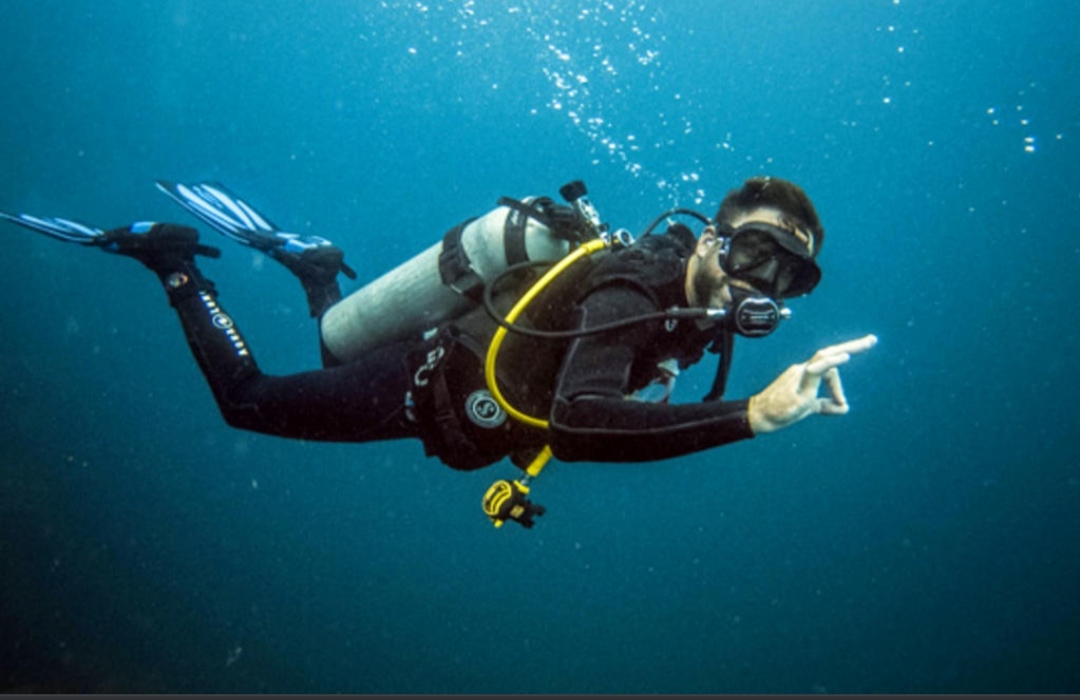
Scuba diving academy to come up at Chintapalli in Visakhapatnam, Andhra Pradesh

Here is some good news for all the watersport lovers in Vizag. A scuba diving academy will be coming up soon in the district, at Chintapalli. The city of beaches has been into the watersports trend, with activities like kayaking, snorkeling, jet skiing and scuba diving. Among these four, scuba diving is the more popular watersport. This watersport is not available at places in India such as Goa, Pondicherry, and the Andaman and Nicobar Islands. But fortunately, Vizag has adopted this highly thrilling and mesmerising underwater activity. 

Taking a big step towards promoting tourism in Vizag, a scuba diving academy at Chintapalli village in Visakhapatnam District. The academy will be started by Livein Adventures, a Vizag-based adventure sports firm, which operates water sports activities in the city with the support of the Andhra Pradesh Tourism Development Corporation (APTDC). This will be a first-of-its-kind scuba diving academy in Andhra Pradesh and one among very few such academies in India. The academy will come up on four acres of land at chintapalli and will be built at an estimated budget of Rs 2 crore. 

Speaking to Yo! Vizag, Balaram Naidu, of Livein Adventures, revealed, “The academy will have courses on basic diving, kayaking, and boating from October 2021. The courses will range from two days to 6 months in duration. Interested individuals, swimmers and non-swimmers, will be able to take globally certified courses on open water diving, rescue diving and advanced diving.” 

World Hepatitis Day 2021: Theme, Hep types, and Significance.

What is hepatitis? Theme this year, few symptoms, about types of Hep, and how to contribute?

THEME 2021 : “Hepatitis Can’t Wait”

What is Hepatitis:

Hepatitis means inflammation of the liver. It can lead to scarring, cirrhosis, and liver cancer. There are 5 main hepatitis viruses: –

Types A, B, C, D and E. These 5 types are very serious since they cause severe illness, even leading to death. They can also cause outbreaks and spread of epidemic.

 A person dying every 30 seconds from a hepatitis related illness 

Causes :

Heavy alcohol use, toxins, some medications, autoimmune diseases can cause hepatitis

Ways of transmission: Have contact or receiving of contaminated blood or blood products, invasive medical procedures using contaminated equipment. Hepatitis B can transfer from mother to baby at birth, from family member to child, and by sexual contact.

Main symptoms:

  • Jaundice (yellowing of the skin and eyes)
  • Dark urine,
  • Extreme fatigue
  • Nausea
  • Vomiting
  • Abdominal pain. 

Types of hepatitis:

1 Hepatitis A Virus (HAV) :

Transmitted through consumption of contaminated water, food; sometimes sexual contact. It’s trace is present in faeces. In most of the cases, it is usually mild and when treated properly it can make one immune from further infections. But, left untreated it can turn life threatening.

Additional symptoms :

  • Abdominal pain or discomfort, (by your liver)
  • Clay-colored bowel movements
  • Severe itching

Safe, effective vaccines are available to prevent HAV.

2 Hepatitis B Virus (HBV): –

Transmitted through exposure to infective blood, semen, and other body fluids, mother to baby, family member to a child during early childhood, transfusions of HBV-contaminated blood and blood products, contaminated injections during medical procedures, and through injection drug use. Medical workers have a greater chance of exposure.

Add Symptoms:

  • Fever
  • Joint pain
  • Loss of appetite

Safe, effective vaccines are available to prevent HAV.

IT HAS NO CURE, BUT JUST CAN BE PREVENTED

3 Hepatitis C Virus :-

Transmitted through exposure to infective blood, instruments during surgeries; even though the chance is low, sexual transmission is possible. If detected soon it can be treated. But, most of them have no idea they have Hep C starts with it’s acute form which rarely shows symptoms.

Add. symptoms:

  • Bleeding easily
  • Bruising easily
  • Itchy skin
  • Fluid buildup in your abdomen (ascites)
  • Swelling in your legs
  • Spiderlike blood vessels on your skin

NO Vaccine yet

4 Hepatitis D Virus : –

It can transmit through blood and body fluids but it only occurs when the person is already affected with Hepatitis B. IT IS MOST SEVERE FORM OF HEPATITIS. It can lead to lifelong liver damage and even death. HBV vaccine gives protection from Hepatitis D virus. If you have HBV, haven’t taken HBV vaccine and live where HDV is more prevalent; the chance of contracting HDV is higher.

Add. Symptoms:

  • Not feeling hungry
  • Joint pain
  • Dark urine
  • Light-colored stool

NO CURE

5 Hepatitis E Virus (HEV): –

Transmission through contaminated food like undercooked meat from infected animals, such as pigs or deer, or water. The one that causes most outbreaks. It can get better by practicing hygiene, but pregnant women and people with weak immune system are at a risk.

Add. symptoms:

  • Light-colored poop
  • Skin rash or itching
  • Joint pain
  • Less hunger and throwing up

Safe and effective vaccines to prevent HEV infection have been developed but are not widely available.

Why 28th July?

It is the birthday of Dr Baruch Blumberg, the Nobel-laurate scientist discovered the Hepatitis B virus (HBV), diagnostic tests and vaccine for Hep B.

How to contribute:

  • Practice hygiene for yourself and encourage those around you.
  • Join drives which support sanitation of unhygienic, neglected areas.
  • Educate yourself and people around you.
  • Donate to legit Hep donations.
  • Before travelling to areas where Hep prevails, get yourself vaccinated against Hep.
  • Spread awareness, because it might help someone one day. (Learning about symptoms encourages one to go to Doctor)
  • Join the campaigns by WHO.

REF:

https://www.who.int/news-room/events/detail/2021/07/28/default-calendar/world-hepatitis-day-2021

ATLANTIC CHARTER

The Atlantic Charter was a joint statement published by the United States and the United Kingdom during World War II (1939–45) that laid forth a vision for the postwar world. It set forth a wide set of objectives of U.S and British war such as:-

1. the desire for no territorial changes without the consent of the peoples affected.

2. They believed that every people had the right to select their own type of government and that those who had been stripped of their sovereign rights and self-governance should have them restored.

3. They would work to ensure that all states had equitable access to commerce and raw commodities.

4. They aimed to enhance labor standards, economic growth, and social security by promoting global collaboration.

5. They would seek a peace in which all countries could live peacefully inside their borders, without fear or want, after the “Nazi tyranny” (Germany) was destroyed.

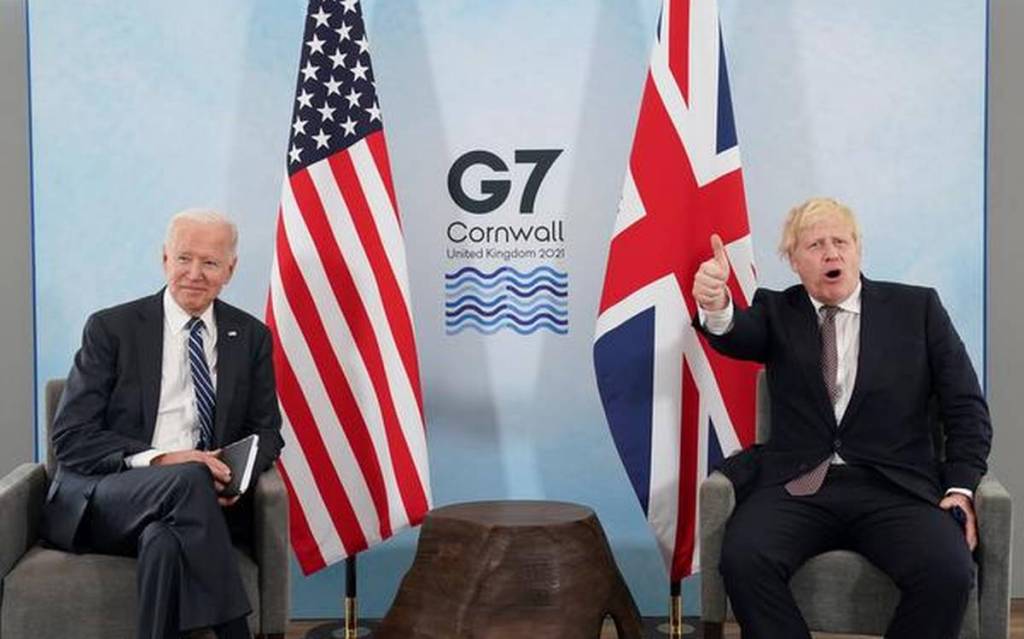
Now, u must be wondering about why we are discussing the year-old charter now. That is because recently, The President of the United States and the Prime Minister of the United Kingdom have signed a revised version of the 80-year-old Atlantic Charter.

This revised version is a 604-word declaration which is an attempt to lay out a grand vision for global relations in the twenty-first century, much like the original charter was a declaration of a Western commitment to democracy and territorial integrity just months before the United States entered World War II. It’s a declaration of principles, a pledge that the United Kingdom and the United States will work together to meet the challenges of their time. It also emphasizes climate change and the need of biodiversity preservation. With references to new technology, cyberspace, and global development that is sustainable. 

It urges Western partners to fight electoral meddling, particularly through misinformation and other harmful activities. In a technology era, it rates the risks to democratic states. It also declared that that the North Atlantic Treaty Organization (NATO) will remain a nuclear alliance as long as nuclear weapons exist.

Now, what will this new version of Atlantic charter holds the opportunity for India. Comparing the old and new version of Atlantic charter, the previous Atlantic Charter alienated Indian nationalism from the West, but the new Charter, as well as the rebooting of western institutions, could pave the way for a fruitful period of India’s collaboration with the US and its allies. 

In 1941, the United Kingdom maintained that the charter’s self-determination concept did not apply to India. However, the inclusion of India and South Africa, as well as Australia and South Korea (as guests) at the G-7 meeting in 2021, demonstrates the urgent need to broaden the West’s base in dealing with global issues. Furthermore, The present Anglo-American initiative to formalize western talks with India is long overdue. 

The Indian Prime Minister, who is participating in the G-7 meeting from afar, has the chance to demonstrate a commitment to both addressing views of decreasing democratic freedoms in India and offering genuine partnership with western democracies on global issues.

Men in blue beats Spain 3-0,to progress into next round of Tokyo Olympics

Spain in their first match leveled 1-1 against defending champions Argentina. In their next match they lost 4-3 to New Zealand. They conceded 2 goals in the last quarter and eventually lost their lead and match too.

India on the other hand started their campaign with defeating New Zealand 3-2, vice-captain Harmanpreet singh scored 2 goals and Rupinder pal singh scored 1 goal. In their next match, India encountered the number 1 team Australia. Australia defeated India by a margin of 7-1 and it’s one of the worst defeat for the Indian Hockey team in Olympics.

Rupinder pal and simranjeet singh handed Spain a 3-0 defeat

Today morning in OI Hockey Stadium, India and Spain locked horns and India dominated throughout the game and handed Spain a 3-0 defeat.

Simranjeet Singh scored in 14th minute and Rupinder Pal Singh was hero of the match and he striked twice in 15th and 51st minute.

Spain side got many chances but they failed to convert them into goals. With this win India have inched closer to a quarterfinal berth. India have moved to the second spot in Pool A of the Tokyo Olympics. India will face Olympic champion Argentina on Thursday. Spain are yet to register their first win.

Existing Unjust Laws for Women Across the Globe

No country in the world has succeeded in closing the gender gap. Its undeniably true that there’s never been a finer moment for women to be born because there are some sexist laws which are still prevailing. In this article we will know about the discriminatory laws against the women. 

  1. In India Wives can be raped by their husbands with no repercussions.

Starting with our very own country, non-consensual sex inside marriage is not considered a criminal offence or a kind of rape as long as the woman is over a particular age i.e 18 years old. Indian Government in a press release stated that due to various factors, such as levels of education/illiteracy, poverty, myriad social customs and values, religious beliefs, and the society’s mindset to treat marriage as a sacrament, the concept of marital rape, as understood internationally, cannot be appropriately applied in the Indian context.

2. Women may be slaughtered in the sake of “honor” in Jordan

There is no honor in murdering a spouse, daughter, sister, or niece for a supposed moral violation, yet far too many nations like Jordan continue to look the other way when killers use this as an excuse.Articles 340 and 98 of Jordan’s penal code allow judges to lower penalties in situations of murder committed in retaliation for adultery or in a fit of rage.

3. In Northern Nigeria, a man is permitted to strike his wife in order to “correct” her.

Intimate partner violence is legal as long as a husband can show that the beating is “for the purpose of correcting his wife” and does not cause “grievous physical harm.” Surprisingly, the same phrase defines “bodily damage” as injuries that need more than 21 days in the hospital. The Russian government just approved on a measure to decriminalize domes across the world. According to the new rule, first-time offenders would no longer face criminal penalties, while repeat offenders will be granted mercy if the abuse occurs “no more than once a year.”

4. Women in Saudi Arabia are still unable to get a passport without the consent of a man. 

Saudi Arabia may have been elected to the United Nations Women’s Council and recently reversed a prohibition on women driving, but it remains one of the least gender-equal countries in the world. Women in Saudi Arabia are still barred from getting a passport, marrying, or using some government services unless they get permission from a male guardian.

5.A lady may be imprisoned in Iran for disobeying the country’s stringent clothing code.

An instance can be highlighted on this issue when an Iranian lady was detained in 2016 after sharing a selfie of herself on Instagram without a hijab. The arrest drew increased attention to Iran’s stringent dress code, which mandates that women wear a hijab in public or face fines and up to a two-month prison sentence. In recent years, a website called My Stealthy Freedom has encouraged Iranian women to submit photographs of themselves with their heads uncovered in protest of the government’s policies.

Sunsets

The only reason I believe in happy endings

Like SRK said if the ending is not happy ending then, “Picture abhi baki hai mere dost”. When the sky is in it’s beautiful colours and the sun is going down, may be they are trying to say us that look, “the endings can be beautiful too”, may be they are giving us hope, hope for better and beautiful future, may be, they are trying to say us that, let go what happened today, just forgot what happened in the past by looking at this beautiful sunset skies and look forward to every sunrise, it’s your golden opportunity to “RESET”.

It’s the nature of life that things don’t stay the same but sunsets are the proof that, they can end beautifully, so don’t give up, just keep going no matter what happens the end gonna be beautiful. After entire day work just you, a cup of coffee and beautiful sunset with your favourite music will help you to forgot about all your worries and you’ll just want to live in that moment forever when the sky is in it’s beautiful colours. The world is fighting against the virus and we are too young to dealing with all this, so much has happened, so much is happening, at some point in our life we all feel depressed, sad and lonely, sometimes we just want to give up and it’s a life but, DON’T, comfort yourself by looking at these beautiful sunset skies.

Some people may sound like that, you need to do something special in life, and that’s not true. They will judge you at every point in your life but, don’t think, don’t put so much thoughts into what you’re doing and what others are saying or what others will say, you just have to keep going. Start doing things for yourself let them call you selfish sometimes it’s really okay to be selfish.

Also always remember, you are just a little bit doubtful of your potential and unsure of your worth but you are as amazing as these sunset skies.

The Threat To Your Privacy!

Image source

Would you like if anyone secretly hacks your phone Or keeps a watch on you via your smartphones. If they see all your personal data, messages, pictures etc. Basically, if you’re spied on!? No right. But what if it’s your own government or some agency doing it for them, while you are absolutely unaware about it. It’s possible. Let me tell you how.

As per the information of En. M. Wikipedia. Org Pegasus is a spyware developed by the Israeli cyberarms firm NSO Group that can be covertly installed on mobile phones (and other devices) running most versions of iOS and Android. The 2021 Project Pegasus revelations suggest that the current Pegasus software can exploit all recent iOS versions up to iOS 14.6. As of 2016, Pegasus was capable of reading text messages, tracking calls, collecting passwords, location tracking, accessing the target device’s microphone and camera, and harvesting information from apps. The spyware is named after the mythical winged horse Pegasus—it is a Trojan horse that can be sent “flying through the air” to infect phones. NSO Group has published sections of contracts which require customers to use its products only for criminal and national security investigations and has stated that it has an industry-leading approach to human rights. Rather than being a specific exploit, Pegasus is a suite of exploits that uses many vulnerabilities in the system. Infection vectors include clicking links, the Photos app, the Apple Music app, and iMessage. Some of the exploits Pegasus uses are zero-click- attacks that is, they can run without any interaction from the victim. Once installed, Pegasus has been reported to be able to run arbitrary code, extract contacts, call logs, messages, photos, web browsing history, settings,[22] as well as gather information from apps including but not limited to communications apps iMessage, Gmail, Viber, Facebook, WhatsApp, Telegram, and Skype.

HISTORY.

Pegasus was discovered in August 2016 after a failed installation attempt on the iPhone of a human rights activist led to an investigation revealing details about the spyware, its abilities, and the security vulnerabilities it exploited. News of the spyware caused significant media coverage. It was called the “most sophisticated” smartphone attack ever, and marked the first time that a malicious remote exploit using jailbreak to gain unrestricted access to an iPhone had been detected. On August 23, 2020, according to intelligence obtained by the Israeli newspaper Haaretz, NSO Group sold Pegasus spyware software for hundreds of millions of US dollars to the United Arab Emirates and the other Gulf States, for surveillance of anti-regime activists, journalists, and political leaders from rival nations, with encouragement and mediation by the Israeli government. Later, in December 2020, the Al Jazeera investigative show The Tip of the Iceberg, Spy partners, exclusively covered Pegasus and its penetration into the phones of media professionals and activists; and its use by Israel to eavesdrop on both opponents and allies. In late 2019, Facebook initiated a suit against NSO, claiming that Pegasus had been used to intercept the WhatsApp communications of a number of activists, journalists, and bureaucrats in India, leading to accusations that the Indian government was involved.

Image source

THE CURRENT AFFAIRS

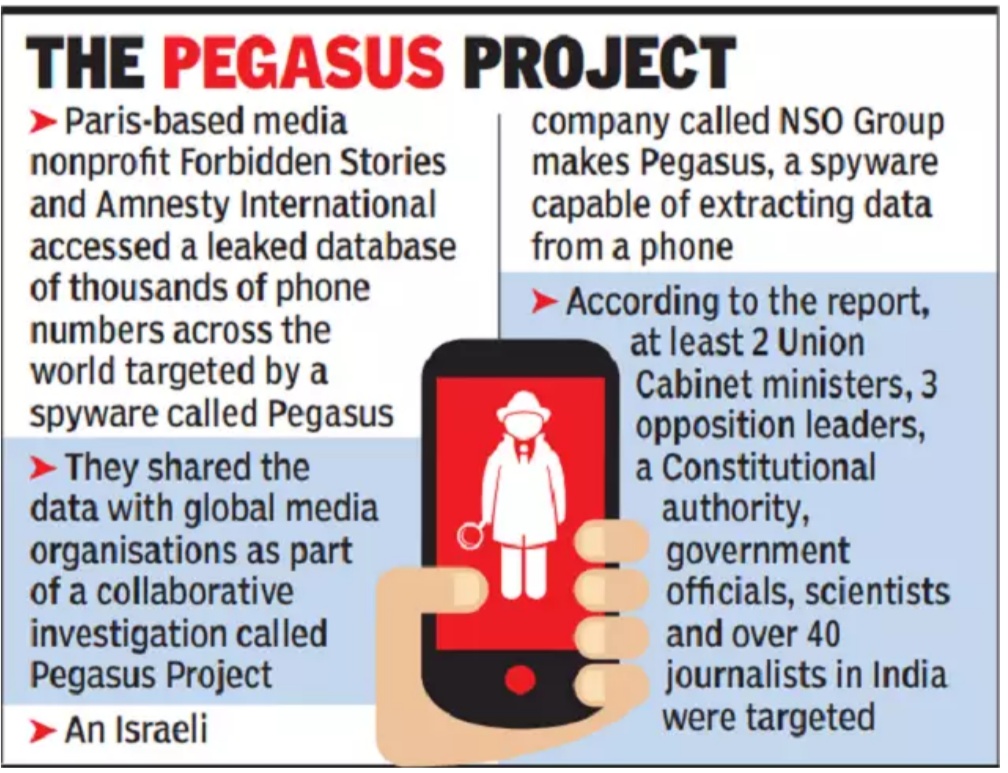
A leak of a list of over 50,000 phone numbers believed to have been identified as those of people of interest by clients of NSO since 2016 became available to Paris-based media nonprofit organisation Forbidden Stories and Amnesty International. They shared the information with seventeen news media organisations in what has been called “Project Pegasus”, and a months-long investigation was carried out, which reported from mid-July 2021. A total of 300 Phone numbers including that of Indian ministers, opposition leaders, ex-election commissioners and journalists were allegedly found on a database of NSO hacking targets by Project Pegasus in mid July. Independent digital forensic analysis conducted on 10 Indian phones whose numbers were present in the data showed signs of either an attempted or successful Pegasus hack. The results of the forensic analysis threw up shows sequential correlations between the time and date a phone number is entered in the list and the beginning of surveillance. The gap usually ranges between a few minutes and a couple of hours. 11 phone numbers associated with a female employee of the Supreme Court of India and her immediate family, who accused the former Chief Justice of India, Ranjan Gogoi, of sexual harrasment, are also allegedly found on a database indicating possibility of their phones being snooped. However, the crucial investigations are still being carried forward by officials.