“Justice delayed is Justice denied” – The case of police brutality in Sathankulam, Tamilnadu.


The very phrase “Justice delayed is Justice denied ” is an antonym for the word “justice” because justice means the quality of being fair and reasonable which in the very least is considered in our country. Everyday we see innocent people being charged for something they did not do, women being victims of sexual assaults, people being murdered in the name of honour killing etc . But are the people who commit these crimes arrested?. Justice has become a joke material in our country. Justice is something people talk about in social media platforms, create memes and write articles about, but nothing can ever change the delay in justice because after months and years of yearning for justice the only thing innocent people receive is their justice being denied.
India is a country known for dragging innocent people all their lives for justice. The recent incident of the police assault done to Felix and Jeyaraj is the perfect example of a manifold denial of justice. Jeyaraj aged 58 and his son Fenix aged 31 who resided in Sathankulam, Tuticorin, were arrested on the night of June 19, 2020 for having their shop open beyond the curfew time of coronovirus induced lock down but a video evidence proved that they weren’t guilty of the charge. Yet the duo was arrested and tortured throughout the night only because the police had some personal vengeance against them. They were tortured in ways that was extremely inhuman and cannot be explained. The police used their power and authority to murder those men and shamelessly blame the men for their fate. Justice was murdered in the first place when the men were taken under custody for a crime they did not commit. Justice was crushed into pieces when these men became the victim of assault by the police. And justice was denied to them when they were deprived of their basic Human Rights. The men were not allowed to exercise their right to life and liberty and freedom from torture.
The incident became the recent best example of the phrase ” Justice delayed is Justice denied” because justice was not given even at the cost of two lives and the plight of their family members. The policemen who assaulted these men were only suspended and transferred not dismissed or put in jail for the crime they committed but the innocent lost their lives with peace being shattered for the rest in their family. Here is a serious delay in justice because the policemen have not received the punishment they deserve which by all means is a pure denial of justice in our country. This alone is not a pathetic situation of our country, there is more to it, an article stated that a senior police officer told the press that hardly any police officer had been put behind bars for any custodial deaths. This is just one case among the thousand other cases of police brutality which is often not addressed. Policemen are supposed to be the protectors of the people in a country. But rather they have instilled fear in the minds of people and have failed to be man’s best friend. Fenix and Jeyaraj are not the only ones who have been deprived of their justice but the entire nation because it is very evident that when justice is delayed eventually it leads to its denial creating a scenario where anybody who is in power and authority can get away with whatever crimes they commit.
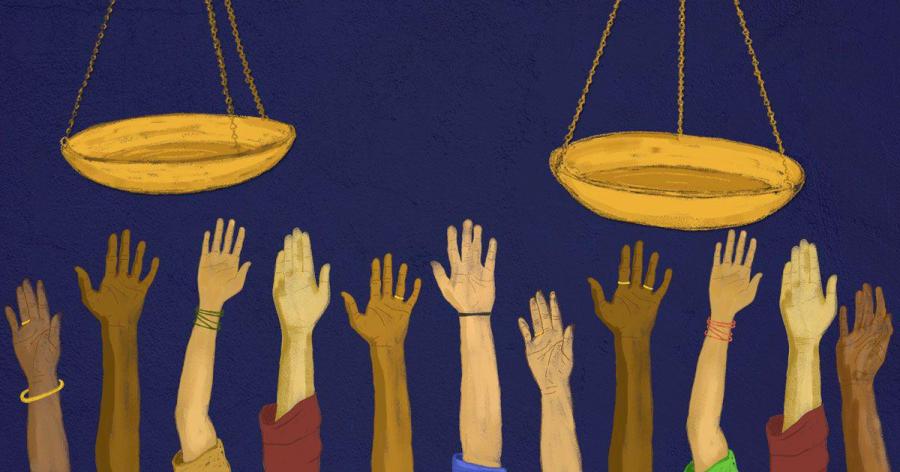
Such incidents do not just reflect badly on the police force of our country but also on the justice system which is supposed to give people hope that their lives and words matter. Social media posts, memes, videos, petition letters, rally, strike or anything of that sort will not advance justice. The government must realise that every single life in the country has a right to justice and it must be bestowed upon them irrespective of their power, authority etc. Everybody must be equal in the eyes of justice because that is what the scales of justice stand for. There are good people and there are bad people but justice must always on the side of the good and it should be provided immediately otherwise it looses it’s meaning and purpose.

India reels from police brutality

Police brutality, ever since the death of George Floyd, the world had been reeling from the inhumane way police treat the “suspects”. Since then a number of protests have surged throughout the world regarding the brutality of police and thus moving to the broader spectrum of overall racism faced by the African-American community in America. While such a movement has done a lot of good, it has also spread a false sense of ease, projecting that such cases of the police brutalizing people is limited to America only. However, that is not the case, in countries such as India the problem is much larger and much more multi-faceted. Here the police do not target by race but by the Social status of a person, i.e. your monetary worth determines how the police treat you.

Photo by NEOSiAM 2020 on Pexels.com

People are often seen chanting the same old things such as know your rights, no one can arrest you without a warrant after such cases, however the problem is, that it isn’t the case of ground reality. Very often at the mere mention of their rights, the “alleged suspects” are beaten to an inch of their lives. Less than a month since the killing of George Floyd, another incident has the world reeling at the blatant lack of humanity within those who call themselves police. The case of P. Jeyraj and J. Fenix shows how these uniformed thugs terrorise the common folk. The cause of their arrest was an alleged violation of Covid-19 Curfew; however, several eyewitnesses deny to that as the arrest took place 30 mins before that. After the arrest of his father, Fenix reaches the station to inquire and is taken into custody. The father-son duo is beaten, nay brutalized by the police. They are tortured beyond imagination and after three days of constant torture the two succumb to their injuries. However, in order to cover up their crime the police file a hospital notice that the two allegedly fell and rolled over and had a subsequent hearth attack, however upon a closer look at the bodies by eyewitnesses that was no the case. The two had injuries throughout their bodies, their chest hair had been ripped out in tufts, their knees completely smashed by lathis, their faces pushed against the walls and blows rained upon their backsides and buttocks until they bled and ripped and subsequently the were stripped naked and thrown into jail. This is way to excessive just for a curfew break and just for this, the responsible police should have been sentenced to the maximum. However, this was not the case as the two were tortured way beyond this by someone who shouldn’t even be considered human. Their cries were heard throughout the time they were tortured. Behind the bars, where there are no CCTV cameras, these goons did their evil deed, they showed up iron tipped lathis or batons up their buttholes several times and their genitalia and backsides were completely ripped and mangled. Three times during the course of this torture, their blood-soaked clothes were sent back to their homes and fresh ones were demanded and then they would be sent back and so on. After a phony trial with a magistrate by the police, the two were taken back to custody and the torture upon their bodies and souls resumed. Two days after the phony trial the two were admitted into a hospital, and were pronounced dead due to heart failure and fever. This shows that even the medical practitioners hand out fake reports for the police. Since this issue came to light even after the blatant trying of Tamil Nadu police to cover it up, a mere two sub inspectors have been suspended and a few have been transferred. That seems like way below the bare minimum that the responsible authorities could do. To define how small the heinous crime’s punishment is, let us compare it to the sentencing of any given rapist. Nirbhaya case’s culprits dragged their cases for eight years. People arguing no matter how irrefutably inhumane their crime was they deserved the treatment of human beings. How is it that Indian society gives better treatment to bloody rapists than lower middleclass working people? How is it that even a terrorist is treated with better respect than a common folk. This wasn’t just a murder, this was a brutalizing work of psychopaths, who have no shred of human morality. No one should be treated like this, much less people who have “allegedly” committed such a small crime. We as a society must question ourselves that how can we progress further if we turn a blind eye to such events.

I feel that I speak about a vast majority of people who are going to see something like this, feel sad for about a minute or so and forget about it because it hasn’t happened to them. However, to them I say, you are even worse than these scums because the only one worse than someone who commits such a crime is someone who can act upon it but doesn’t.

India as a country has rotten to its core, rape, murder and now torture has become common place. In today’s India, Might makes Right. It is up to us, the future generation to change it, but by the looks of it we don’t have the ability to do so.

How television shaped our views on police

Television and media, the one source for early all people to tune to whether they need entertainment, news or anything else. It is a portal which connects us to others within the world. It is also a place from where we form most of our opinions. In the wake of the Black Lives Matter movement, many are wondering not just in US but throughout the world as to why this chain of thoughts not grip us sooner. Why is it that most of the people were oblivious to the abuse of power police use throughout the world? One of the main reasons for this are cop shows and movies. Its usually because as individuals not many of us have much actual experience with the police. We form our opinions through the junk that is fed to us by the television.

Photo by Alou00efs Moubax on Pexels.com

It can be noted by anyone that most tv shows and movies far too readily show the cops as trustworthy and infallible, all the while undermining real life claims of systemic racism and abuse of power. There are many reasons for this, ranging from the money hungry producers simply chasing after TRP to negligence from the writers and directors about not showing realism within the shows. However one of the main reasons for this is that no matter whether it is a movie or a TV show cops are not only consulter during the making of such shows but are also aware that their portrayals impact public perception and thus have a vested interest in making sure that the portrayal stays positive. A 2015 study showed that viewers of crime dramas are more likely to believe that police are very often successful at lowering crime, use force only when necessary and misconduct never results in false arrests. Now part of it is due to the viewers human nature, everyone wants to believe that the people who enforce laws do so effectively and fairly so that we as citizen don’t have to take the burden. The shows and movies like Law and order or Singham and Dabangg show the cops using force only when they necessarily have to. They make it seem that bending the rules set in place to govern their misbehaving is the only way to keep the general populace safe.  This is the power of such shows they make us believe that the only way the police can truly be effective is if they broke the rules that society created to protect us from the police. And the way they show mainstream cops bending the rules is by plain torturing a suspect who may have committed the crime. And showing that if the suspect hadn’t committed the crime it would serve as a deterrent from committing one in the first place. By that logic a parent should pre-beat their children to make sure that they do not stray to a bad path, but that is not the case. One has to realize that the cop shows are the only profession-based show where they show wanton unwarranted abuse of power as a good thing. However, beating a suspect in real life makes a person confess to a crime they didn’t commit. Which means an innocent was locked away while the real guilty party walks free. Beating a suspect to solve crimes has the same effect that washing a computer to remove a virus would have, sure the virus is gone but so is the computer.

What we do further is upon us but as Trevor Philips once said “The media and the government would have us believe that torture is some necessary thing. We need it to get information, to assert ourselves…… Torture’s for the torturer or for the guy giving orders to the torturer. You torture for the good times – we should all admit that. It’s useless as a means of getting information.”

Justice for Jayraj and Fenix – The Need To Stop Custodial Deaths

More than 1,000 people of Sathankulam town in Tamil Nadu’s Thoothukudi district staged a dharna Tuesday after two persons were allegedly killed in police custody here. In a chilling case of police torture, a father and son died in a span of 10 hours, in judicial custody in Thoothukudi, a coastal town in south Tamil Nadu, allegedly after being subjected to third-degree tre­at­ment by the police. The incident triggered widespread political and societal outrage.

The deceased have been identified as Jayaraj (59) and his son Fenix Emmanuel (31).  Two sub-inspectors have been suspended. According to the protesters and other local residents, Jayaraj along with Fenix ran a mobile shop named APJ in the town. On Friday, he closed his shop around 8:15 pm. Personnel from the Sathankulam police station, who was on patrol duty, reportedly pulled him up for running the store beyond the permitted time, and an argument took place.

On Saturday evening, the police personnel visited the shop again and had an altercation with Jayaraj.  When Fenix intervened, both father and son were taken to the police station and booked under several sections of the IPC, including Section 188 (disobedience to order duly promulgated by public servant) and 353 (use of force to deter public servant from duty).

On Sunday, after a medical check-up, the duo was lodged in the Kovilpatti sub-jail. That evening, local residents alleged, Fenix complained of chest pain and Jayaraj had a high fever. Both were taken to the Kovilpatti government hospital, where Fenix died on Monday evening and Jayaraj succumbed to respiratory illness Tuesday morning.

Jayaraj’s wife Selvarani has lodged a complaint, alleging that police brutality led to the death of her husband and son. In her complaint letter to the district criminal court and Assistant Commissioner, she said the police brutally attacked her husband and son, used curse words, and threatened to kill them. She urged them to book the police officers responsible under section 302 of the IPC and suspend them from duty.Condemning the killing, all trader union bodies, various political outfits, activists, and the local public staged protests in various parts of the town. Kanniyakumari MP Vasanthakumar, former AIADMK MP Sasikala Pushpa, and other party functionaries participated in the protest. Their demands include the arrest and suspension of the police officers responsible for the incident, compensation of Rs 50 lakh to the family members of the deceased, a doctor from the protesters’ side to be allowed during the autopsy, and a government job to one member of the deceased’s family.

The series of violations in the case mock our procedures. Whenever there is a death in police custody, the concerned police officers are duty-bound to bring it to the notice of senior officers expeditiously.

In view of the perception that custodial deaths take place because of reckless incidents of arrest, amendments have been effected to the Criminal Procedure Code, stating arrests be made only in offences which attract punishment of more than seven years or in those offences where there is apprehension that the accused may commit similar offences or assist other accused to escape. As soon as the accused is arrested, he should be medically examined by competent government medical officers and necessary medical assistance should be provided as per the requirement. Information about the arrest should be communicated to his advocate and relatives/family members. Details of his arrest need to be conveyed to the police control room and displayed on the unit website. In addition, following directives from the Supreme Court, a State Police Complaints Authority has been formulated under the chairmanship of a retired High Court judge to look into grievances in this regard. All complaints about custodial death are also looked into minutely by NHRC and SHRC from time to time.

Even though all these directives are being underlined and well-published from time to time, it is a matter of concern why these are not implemented at the ground level. Once one gets a job in the police department and wears the police uniform, there is a misconception that this is a blanket approval to arrest anyone and obtain a confession by indulging in physical harassment. Several times, suspecting someone for petty theft or because of personal rivalry, complaints are registered by people of means, and this is followed by arrest and physical torture.

If the police officer does not do so, he is declared a good-for-nothing. Many a time, a police officer who indulges in beating a citizen in public and violates all norms is appreciated by people and he is considered a hero.  Kamte was working as officer-in-charge of detecting crimes in Sangli police station for the last three years, and had reportedly detected several offences using high handed tactics and was applauded by the public from time to time. This must-have led him to believe he is beyond any law.

NHRC, as well as SHRC, have clarified more than once that unless a person has gone to a police station to lodge a complaint, whether he is in the lock-up or outside, he would be treated as under arrest and it is the responsibility of the police officer in charge of the police station to take care of his health. The study of custodial deaths reveals that more than 65 per cent are attributed to suicide, about 25 per cent to mental shock and less than five per cent to police harassment. These are official statistics and they tell us that we need a whole range of steps – from safety measures to psychological inputs and an array of methods and systems to keep a check on these violations and create a culture of fair and proper investigations.

Acting with impunity

These incidents have brought into sharp focus the way Indian policemen torture and interrogate suspects in their custody leading to death in several cases. As a result, policemen all over the country have been severely criticised and condemned. Strictures passed against policemen from time to time by learned judges of various courts notwithstanding, the police continue to brazenly torture suspects in their custody.

The Central Bureau of Investigation too uses torture as a method of investigation. In September 2016, B.K. Bansal, Director General of Corporate Affairs, and his son Yogesh committed suicide. In their suicide note, the two men listed the names of officers who had tortured their family in connection with a case of disproportionate assets. Bansal’s wife and daughter too had committed suicide two months earlier. On the directions of the National Human Rights Commission, an inquiry was held by the CBI. Expectedly, the agency exonerated all the accused. Taking cognisance of the matter, the Central Vigilance Commission published a standard operating procedure laying down guidelines for interrogation of accused officials.

Custodial deaths have been on the increase in recent years. They increased by 9% from 92 in 2016 to 100 in 2017, according to the National Crime Records Bureau. Since policemen responsible for custodial deaths rarely get punished, they feel emboldened to continue using torture as the tool to get to the truth. In 2015, for instance, the police registered cases against fellow police officers in only 33 of the 97 custodial deaths.

A historic order

The Supreme Court delivered a historic order in 2006 on police reforms. It stated, among other things, that every State should have a Police Complaints Authority where any citizen can lodge a complaint against policemen for any act of misdemeanour. However, only a few states such as Kerala, Jharkhand, Haryana, Punjab and Maharashtra have implemented the order. Others have not taken the matter seriously.

Until exemplary punishment is meted out to policemen who are responsible for custodial deaths after proper judicial inquiry, not much can be expected to ameliorate the situation. Proper interrogation techniques coupled with the use of scientific methods to extract the truth from suspects can go a long way in reducing custodial deaths.

Therfore, It should be mandatory for every officer in charge of the unit to visit immediately all incidents of escape of prisoners or deaths in custody. If the unit in charge does not reach the spot of the incident promptly, she or he should be held accountable. Otherwise, such serious incidents would continue to recur. The time is now ripe for the Indian government to consider ratifying the international treaty against torture and declare her commitment to human dignity.


A messy circumstance: A deadly Drive-Thru

Yet another Monday went by, yet another black man in America dies from a police shooting. As the world saw their eyes open from the sadistic killing of George Floyd, people mobilized and hit the streets to protest. That too during a pandemic unlike any the world had ever seen. One could do well to understand the gravitas of the situation, the frustration of the people down on the streets, the fact that they choose to contract a deadly disease than to continue to suffer under a systemic abuse of their rights not just as a citizen but as a human being.

Photo by kat wilcox on Pexels.com

As the story has been seen, Rayshard Brooks, a black man from Atlanta, was shot dead near a drive thru at a local Wendy’s. The man was probably inebriated when he came by to the drive-thru and subsequently fell asleep. The other customers simply drove past him to place their orders as they weren’t really bothered by a man sleeping in his car. Soon a Wendy’s employee calls the police on Brooks. The police came, took him out of the car and talked to him. In the video, Rayshard can clearly be seen drunk, but still being respectful to the cops, and for a change the cops to were respectful of him and talking courteously. This went on for about 30 mins or so and it seemed it would have a normal ending and not result in the death of another black man. However, what happened next ensured that this was going to be yet another story with an abnormal ending that has become too common place when we see a black man interacting with the police. The police suddenly move to arrest him, and tase him. Rayshard slips from their grip, takes their taser and tries to run away. One of the officers shoots him not once, not twice but thrice and Brooks dies. At this point I guess everyone moves to their battle stations, the right portraying this as a black man being a criminal, and the left showing an innocent man dying at the hands of the police. But that is not the case, the story is messy. The fact that they talked to him for so long and things seemed so calm – he seemed respectful and cooperative, doing everything he could to be reasonable – he probably felt safe and that things would ride out okay.  Then suddenly they’re breaking this rapport they’ve built with him, doing a 180 and putting him under arrest.  He was drunk, and it upended how he thought things were going – fight or flight kicked in and he panicked.  It wasn’t the right thing to do, but I do think it was understandable.  The officer was unable to retain control of his Taser, but the ability of Rayshard to hurt anyone at that point was pretty minimal.  He was running away.  Lethal force ultimately didn’t belong anywhere in that equation. It was much more complicated than just a cop killing another black man; however, it was also more than just a case of a man breaking the law, threatening a cop, and dying for it. A situation like this requires close attention to detail and logical deduction to figure out if the actions were justified. In my opinion, this situation was not a hate crime, but a failure of our system to properly train cops to handle scenarios like this one. I ask that people on either side of this argument challenge what I am about to say. Rayshard Brooks broke the law by driving drunk. He resisted arrest, stole a cop’s taser and pointed it at them as he tried to escape. We can all agree that he should not have done this and should have been arrested. But was shooting him really the proper way to handle the situation? To answer this, the details need to be analysed and certain questions need to be addressed: Should the cop have really feared for his life when Brooks pointed a taser at him? How does a drunk man not only escape from the custody of two cops, but also take one of their tasers? What is the worst-case scenario if Brooks escapes? And does tasing a cop warrant a death sentence? I would answer these by saying that shooting Rayshard Brooks was not the proper way to handle the situation. The officer was not in a life-threatening situation and if you are going to shoot and kill somebody, it should only be as a last resort because of a real threat. In regards to his escape, I wonder how two trained officers failed to properly detain a drunk man and allow him to take one of their weapons. And in situations like this, why is the first option to shoot someone? Worst case scenario is he gets away with a taser. Shouldn’t they chase him down, call for backup, or at the very worst shoot him once and not three times? Seriously think about that, why do cops have to instantly shoot someone who is breaking the law? Doesn’t there have to be a trial with a judge and jury to determine if someone’s actions warrant a death sentence? Why do cops get to make this decision on impulse? And why do they need qualified immunity for when they do kill someone? If you are in real danger and need your gun, you don’t worry about the trouble you get in for using your weapon because it is either your life or theirs. If you have to question whether using your weapon is justified, then you probably don’t need to use your weapon.

Now this may have been swept under the rug under normal circumstances, but due to the current scenario it seems vital that this be thought about.

What happens next is for all of us to see.