The sun won’t die for 5 billion years

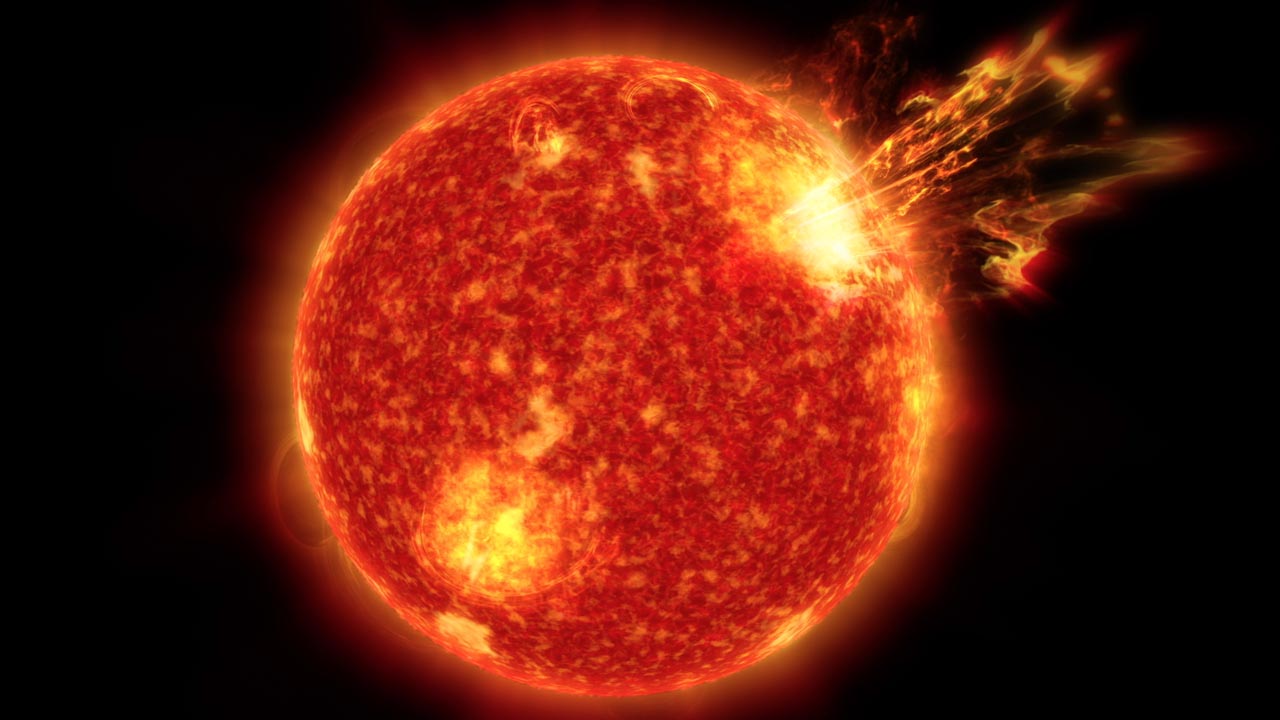
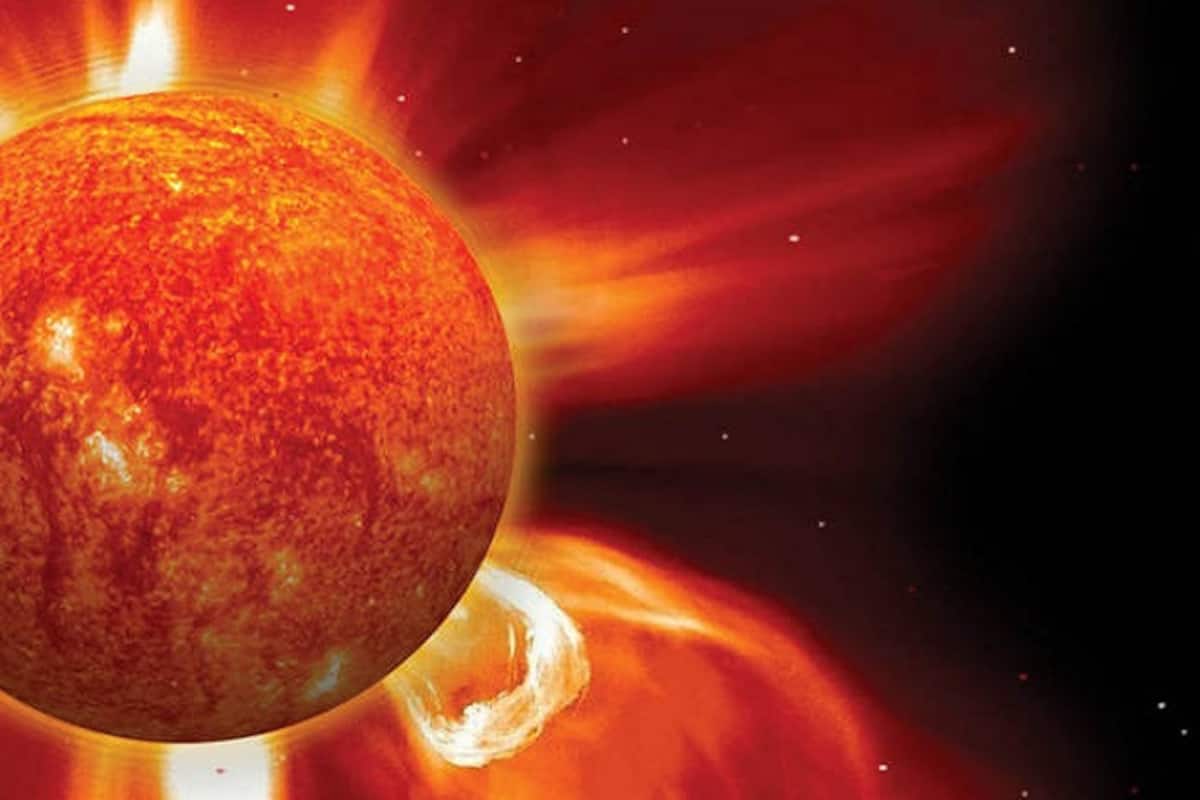
In a few billion years, the sun will become a red giant so large that it will engulf our planet. But the Earth will become uninhabitable much sooner than that. After about a billion years the sun will become hot enough to boil our oceans.

The sun is currently classified as a “main sequence” star. This means that it is in the most stable part of its life, converting the hydrogen present in its core into helium. For a star the size of ours, this phase lasts a little over 8 billion years. Our solar system is just over 4.5 billion years old, so the sun is slightly more than halfway through its stable lifetime.

After 8 billion years of happily burning hydrogen into helium are over, the sun’s life gets a little more interesting. Things change because the sun will have run out of hydrogen in its core – all that’s left is the helium. The trouble is that the sun’s core is not hot or dense enough to burn helium.

In a star, gravitational force pulls all the gases towards the centre. When the star has hydrogen to burn, the creation of helium produces enough outward pressure to balance out the gravitational pull. But when the star has nothing left in the core to burn, gravitational forces take over.

Eventually that force compresses the centre of the star to such a degree that it will start burning hydrogen in a small shell around the dead core, which is still full of helium. As soon as the sun begins to burn more hydrogen, it would be considered a “red giant”.

The process of compression in the centre allows the outer regions of the star to expand outwards. The burning hydrogen in the shell around the core significantly increases the brightness of the sun. Because the size of the star has expanded, the surface cools down and goes from white-hot to red-hot. Because the star is brighter, redder and physically larger than before, we dub these stars “red giants”.

Earth’s fiery demise

It is widely understood that the Earth as a planet will not survive the sun’s expansion into a full-blown red giant star. The surface of the sun will probably reach the current orbit of Mars – and, while the Earth’s orbit may also have expanded outwards slightly, it won’t be enough to save it from being dragged into the surface of the sun, whereupon our planet will rapidly disintegrate.

Life on the planet will run into trouble well before the planet itself disintegrates. Even before the sun finishes burning hydrogen, it will have changed from its present state. The sun has been increasing its brightness by about 10% every billion years it spends burning hydrogen. Increased brightness means an increase in the amount of heat our planet receives. As the planet heats up, the water on the surface of our planet will begin to evaporate.

An increase of the sun’s luminosity by 10% over the current level doesn’t sound like a whole lot, but this small change in our star’s brightness will be pretty catastrophic for our planet. This change is a sufficient increase in energy to change the location of the habitable zone around our star. The habitable zone is defined as the range of distances away from any given star where liquid water can be stable on the surface of a planet.
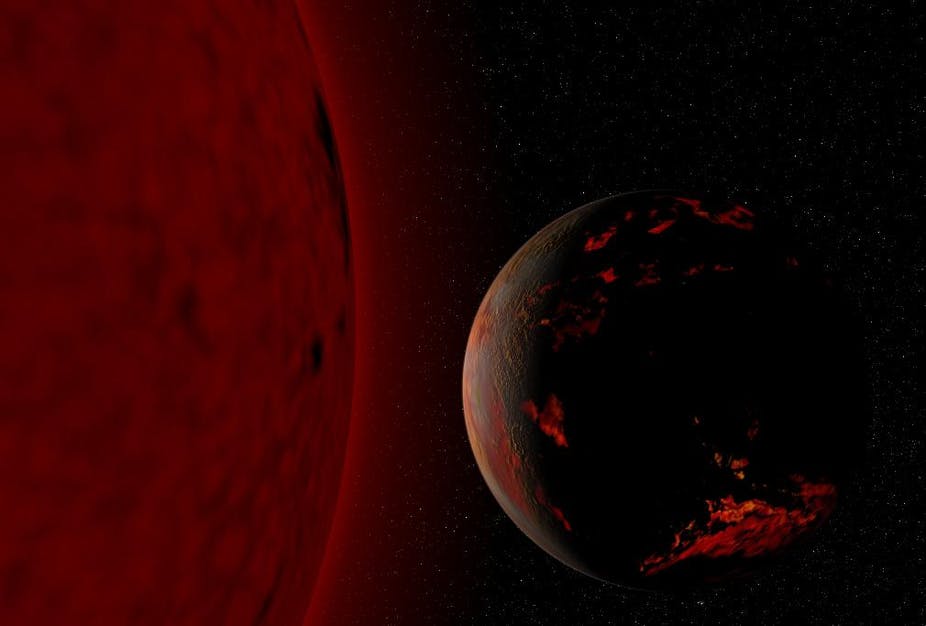
With a 10% increase of brightness from our star, the Earth will no longer be within the habitable zone. This will mark the beginning of the evaporation of our oceans. By the time the sun stops burning hydrogen in its core, Mars will be in the habitable zone, and the Earth will be much too hot to maintain water on its surface.

Uncertain models

This 10% increase in the sun’s brightness, triggering the evaporation of our oceans, will occur over the next billion years or so. Predictions of exactly how rapidly this process will unfold depend on who you talk to. Most models suggest that as the oceans evaporate, more and more water will be present in the atmosphere instead of on the surface. This will act as a greenhouse gas, trapping even more heat and causing more and more of the oceans to evaporate, until the ground is mostly dry and the atmosphere holds the water, but at an extremely high temperature.

As the atmosphere saturates with water, the water held in the highest parts of our atmosphere will be bombarded by high energy light from the sun, which will split apart the molecules and allow the water to escape as hydrogen and oxygen, eventually bleeding the Earth dry of water.

Where the models differ is on the speed with which the earth reaches this point of no return. Some suggest that the Earth will become inhospitable before the 1 billion year mark, since the interactions between the heating planet and the rocks, oceans, and plate tectonics will dry out the planet even faster. Others suggest that life may be able to hold on a little longer than 1 billion years, due to the different requirements of different life forms and periodic releases of critical chemicals by plate tectonics.

The Earth is a complex system – and no model is perfect. However, it seems likely that we have no more than a billion years left for life to thrive on our planet.

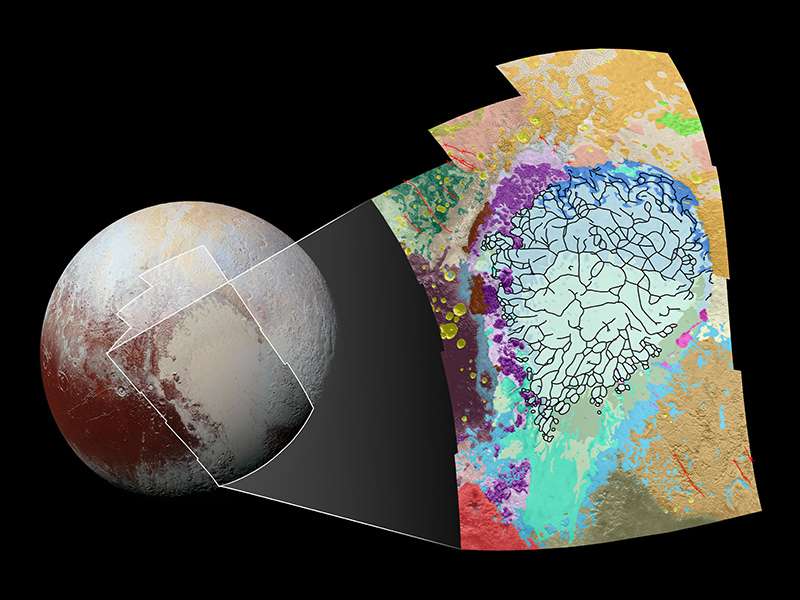
Is Pluto a planet or not?

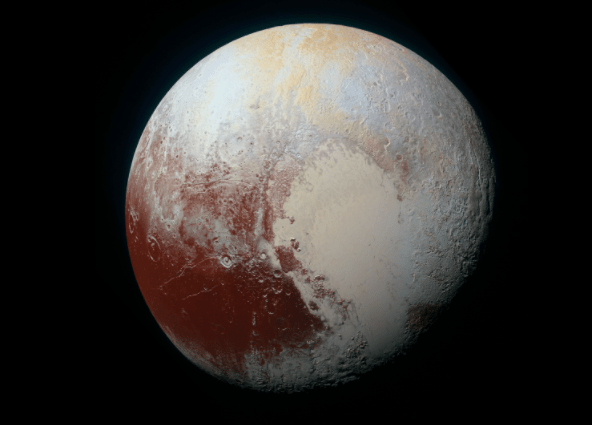
Pluto – which is smaller than Earth’s Moon – has a heart-shaped glacier that’s the size of Texas and Oklahoma. This fascinating world has blue skies, spinning moons, mountains as high as the Rockies, and it snows – but the snow is red.

Soon after Pluto was discovered in 1930, it was designated a planet, the ninth in our solar system. After Pluto was discovered, many astronomers presumed it to have been responsible for the perturbations they have observed in Neptune’s orbit. It was these perturbations that actually prompted the search for a planet beyond it. However, further observations determined that it was smaller than initially assumed. Also, after American astronomer James Christy discovered Pluto’s largest moon, Charon, in 1978, astronomers were able to determine Pluto’s mass and realized that it was a lightweight and didn’t exert a gravitational influence powerful enough to have induced the observed perturbations. Pluto was found to be smaller and less massive than all the other planets. Moreover, its orbit is highly inclined (17 degrees) relative to the ecliptic, the plane defined by Earth’s orbit around the Sun. The other planetary orbits have smaller inclinations.     

As telescopes got bigger and better, and were able to take clearer pictures of distant bodies like Pluto, astronomers began to suspect that Pluto was much, much smaller than the other planets. By the time the second Kuiper Belt object was discovered in 1992, astronomers knew that Pluto was even smaller than Earth’s moon, but it had been called a planet for so long that it retained its planetary status.

Astronomers had also known for decades that Pluto’s orbit actually crosses Neptune’s orbit. None of the other planets cross each other’s orbits, so why was Pluto’s orbit different?

Over the next few years, dozens and then hundreds more Kuiper Belt objects were discovered by astronomers, until finally, in 2005, astronomer Mike Brown discovered Eris, which is even bigger than Pluto.


In the early 21st century, astronomers were finding bodies of comparable size beyond Pluto, such as Sedna, Eris, Makemake, and others. These discoveries prompted the question: should the IAU confer planetary status on all these other worlds? In August 2006, the IAU convened its triennial meeting in Prague. Toward the end of this meeting, they voted on the adoption of Resolution 5A: “Definition of ‘planet.” By this newly adopted definition, a body has to fulfill three requirements to be designated a planet. First, a body has to have established a stable orbit around the Sun. Thousands of bodies meet this condition. Secondly, a body has to have developed a spheroidal shape. When a body is sufficiently large and massive, gravity will mold it into a spheroid. Pluto fulfills this condition. Third, and finally, the body has to have cleared its debris field. It has to be sufficiently massive so as to incorporate all proximate objects into it. Pluto fails on this condition, as its orbit passes close to or even within the Kuiper Belt, a region from which short periods comets originate. By adopting resolution 5A, the IAU demoted Pluto, firmly established the other eight planets as planets, and disqualified all the bodies beyond Pluto, all in one fell swoop.    
 
Although the recent observations by the New Horizons craft has shown us that Pluto is larger, more geologically dynamic, and contains a thicker atmosphere than once believed, it still doesn’t fulfill the third condition within Resolution 5A. The IAU will have to adopt a revised definition of planet in order to confer planetary status back onto Pluto.

Of course, some defiantly maintain that Pluto is still a planet and no resolution shall induce us to change our minds. 

LARGE SOLAR STORM APPROACHING EARTH – BLACKOUT

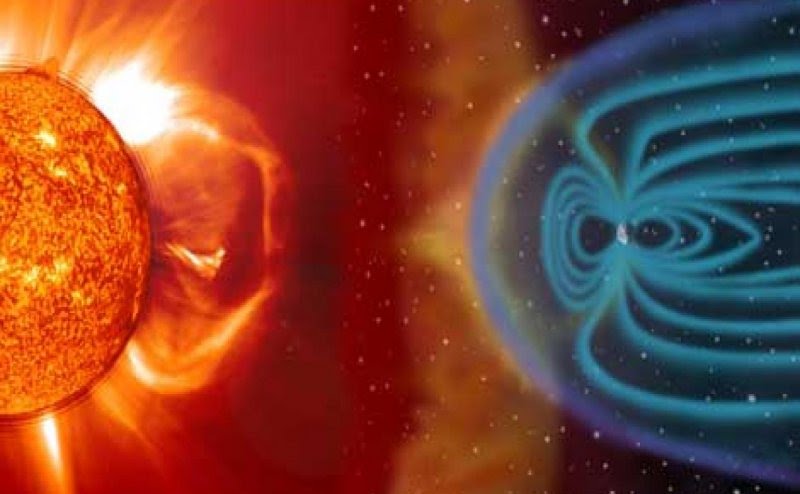
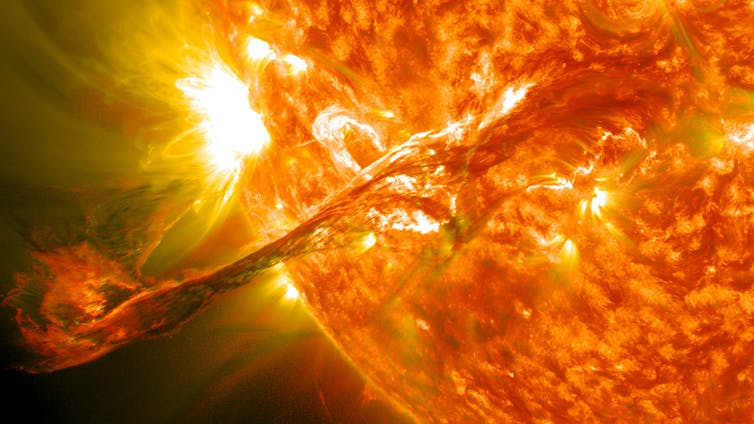
Huge charged particles ejected from the sun is called solar storm.

According to website Spaceweather.com, the storm that originated from the Sun’s atmosphere and can have a significant impact on a region of space dominated by Earth’s magnetic field.

A powerful solar storm is approaching the Earth at a speed of 1.6 million kilometers and this storm will hit the Earth either on Sunday or Monday.

According to the US space agency NASA, the solar storm is moving towards the Earth at a speed of about 1.6 million kilometers per hour and maybe its speed will increase further. NASA said that satellite signals can be interrupted by solar storms.

Scientists have feared that this great solar storm may hit our Earth in two days pic.twitter.com/MlWUeZ56aw

Effect of solar storm

The outer atmosphere of the Earth can be heated which can have a direct effect on satellites.

This can cause interference with GPS navigation, mobile phone signal and satellite TV. The current in power lines can be high, which can also blow transformers

Power lines can carry a lot of currents, which can blow transformers

There is also a possibility of blackout of HF (high frequency) radio communication that is dependent upon current X-ray Flux intensity. According to the latest prediction, the flare can cause a wide area blackout of HF (high frequency) radio communication for about an hour.

Due to the solar storm, there will be a view of beautiful celestial lighting for the people living at the North or South Pole. The people living closer to these areas can expect to see beautiful aurora at night.

Neptune-The Coldest Planet

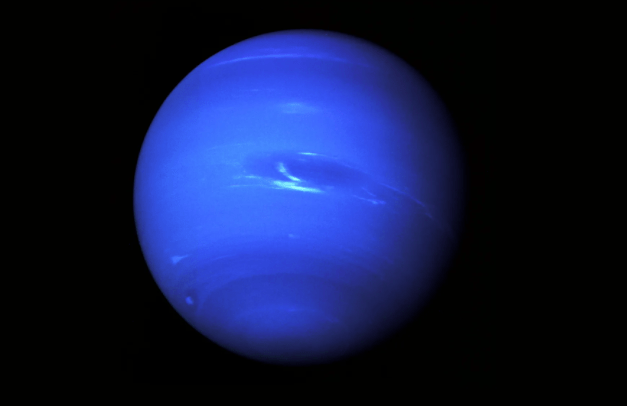
Neptune is the eighth and farthest-known Solar planet from the Sun. In the Solar System, it is the fourth-largest planet by diameter, the third-most-massive planet, and the densest giant planet. It is 17 times the mass of Earth, slightly more massive than its near-twin Uranus. Neptune is denser and physically smaller than Uranus because its greater mass causes more gravitational compression of its atmosphere. It is named after the Roman god of the sea and has the astronomical symbol ♆, a stylised version of the god Neptune’s trident.

Some facts about Neptune

Diameter-  49,500km

Orbital period-  164.8yrs

Length of a Day-   16.1hrs

Axis tilt- 28 degrees

Distance from  the Sun- 30.1AU(4.5 billion km)

Moons- 14

Special features

Neptune is not visible to the unaided eye and is the only planet in the Solar System found by mathematical prediction rather than by empirical observation. Unexpected changes in the orbit of Uranus led Alexis Bouvard to deduce that its orbit was subject to gravitational perturbation by an unknown planet. After Bouvard’s death, the position of Neptune was predicted from his observations, independently, by John Couch Adams and Urbain Le Verrier.

Neptune is our solar system’s windiest world. Despite its great distance and low energy input from the Sun, Neptune’s winds can be three times stronger than Jupiter’s and nine times stronger than Earth’s. These winds whip clouds of frozen methane across the planet at speeds of more than 1,200 miles per hour (2,000 kilometers per hour). Even Earth’s most powerful winds hit only about 250 miles per hour (400 kilometers per hour).

In 1989 a large, oval-shaped storm in Neptune’s southern hemisphere dubbed the “Great Dark Spot” was large enough to contain the entire Earth. That storm has since disappeared, but new ones have appeared on different parts of the planet.

Natural satellites and Rings

Neptune has 14 known moons. Neptune’s largest moon Triton was discovered on October 10, 1846, by William Lassell, just 17 days after Johann Gottfried Galle discovered the planet. Since Neptune was named for the Roman god of the sea, its moons are named for various lesser sea gods and nymphs in Greek mythology.

Triton is the only large moon in the solar system that circles its planet in a direction opposite to the planet’s rotation (a retrograde orbit), which suggests that it may once have been an independent object that Neptune captured. Triton is extremely cold, with surface temperatures around minus 391 degrees Fahrenheit (minus 235 degrees Celsius). And yet, despite this deep freeze at Triton, Voyager 2 discovered geysers spewing icy material upward more than 5 miles (8 kilometers). Triton’s thin atmosphere, also discovered by Voyager, has been detected from Earth several times since, and is growing warmer, but scientists do not yet know why.

  Neptune has at least five main rings and four prominent ring arcs that we know of so far. Starting near the planet and moving outward, the main rings are named Galle, Leverrier, Lassell, Arago and Adams. The rings are thought to be relatively young and short-lived. Neptune’s ring system also has peculiar clumps of dust called arcs. Four prominent arcs named Liberté (Liberty), Egalité (Equality), Fraternité (Fraternity) and Courage are in the outermost ring, Adams. The arcs are strange because the laws of motion would predict that they would spread out evenly rather than stay clumped together. Scientists now think the gravitational effects of Galatea, a moon just inward from the ring, stabilizes these arcs.

See the source image

Structure and Atmosphere

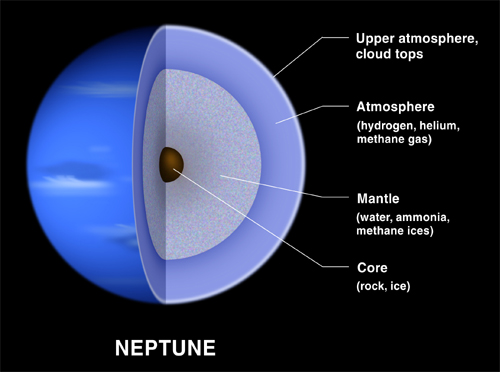
Neptune is one of two ice giants in the outer solar system (the other is Uranus). Most (80 percent or more) of the planet’s mass is made up of a hot dense fluid of “icy” materials—water, methane and ammonia—above a small, rocky core. Scientists think there might be an ocean of super hot water under Neptune’s cold clouds. It does not boil away because incredibly high pressure keeps it locked inside.

Neptune’s atmosphere is made up mostly of hydrogen and helium with just a little bit of methane. Neptune’s neighbor Uranus is a blue-green color due to such atmospheric methane, but Neptune is a more vivid, brighter blue, so there must be an unknown component that causes the more intense color.

Exploration

Voyager 2 is the only spacecraft that has visited Neptune. The spacecraft’s closest approach to the planet occurred on 25 August 1989. Because this was the last major planet the spacecraft could visit, it was decided to make a close flyby of the moon Triton, regardless of the consequences to the trajectory, similarly to what was done for Voyager 1’s encounter with Saturn and its moon Titan. The images relayed back to Earth from Voyager 2 became the basis of a 1989 PBS all-night program, Neptune All Night.

https://en.wikipedia.org/wiki/Neptune
https://solarsystem.nasa.gov/planets/neptune/overview/

Pluto-The King of Kuiper Belt

Pluto is the ninth-largest and tenth-most-massive known object directly orbiting the Sun. It is the largest known trans-Neptunian object by volume but is less massive than Eris. Pluto is a dwarf planet in the Kuiper belt, a ring of bodies beyond the orbit of Neptune. It was the first and the largest Kuiper belt object to be discovered. After Pluto was discovered in 1930, it was declared to be the ninth planet from the Sun. Beginning in the 1990s, its status as a planet was questioned following the discovery of several objects of similar size in the Kuiper belt and the scattered disc, including the dwarf planet Eris. This led the International Astronomical Union (IAU) in 2006 to formally define the term “planet”—excluding Pluto and reclassifying it as a dwarf planet.

Some facts about Pluto

Diameter-   2300km

Orbital period-  247.8 yrs

Length of a Day-    6.39 days

Axis tilt- 123 degrees

Distance from  the Sun- 39.5AU (5.9billion km)

Moons- 5

Special features

Like other Kuiper belt objects, Pluto is primarily made of ice and rock and is relatively small—one-sixth the mass of the Moon and one-third its volume. It has a moderately eccentric and inclined orbit during which it ranges from 30 to 49 astronomical units or AU (4.4–7.4 billion km) from the Sun. This means that Pluto periodically comes closer to the Sun than Neptune, but a stable orbital resonance with Neptune prevents them from colliding. Light from the Sun takes 5.5 hours to reach Pluto at its average distance (39.5 AU).

Natural satellites

Pluto has five known moons: Charon, Nix, Hydra, Kerberos and Styx. This moon system might have formed by a collision between Pluto and other similar-sized bodies early in the history of the solar system.

Charon, the biggest of Pluto’s moons, is about half the size of Pluto itself, making it the largest satellite relative to the planet it orbits in our solar system. It orbits Pluto at a distance of just 12,200 miles (19,640 kilometers). For comparison, our moon is 20 times farther away from Earth. Pluto and Charon are often referred to as a double planet. Charon’s orbit around Pluto takes 153 hours—the same time it takes Pluto to complete one rotation. This means Charon neither rises nor sets, but hovers over the same spot on Pluto’s surface. The same side of Charon always faces Pluto, a state called tidal locking.

Pluto’s other four moons are much smaller, less than 100 miles (160 kilometers) wide. They’re also irregularly shaped, not spherical like Charon. Unlike many other moons in the solar system, these moons are not tidally locked to Pluto. They all spin and don’t keep the same face towards Pluto.

See the source image

Structure and Atmosphere

Pluto is about two-thirds the diameter of Earth’s moon and probably has a rocky core surrounded by a mantle of water ice. Interesting ices like methane and nitrogen frost coat its surface. Due to its lower density, Pluto’s mass is about one-sixth that of Earth’s moon. Pluto’s surface is characterized by mountains, valleys, plains, and craters. The temperature on Pluto can be as cold as -375 to -400 degrees Fahrenheit (-226 to -240 degrees Celsius).

Pluto has a thin, tenuous atmosphere that expands when it comes closer to the sun and collapses as it moves farther away—similar to a comet. The main constituent is molecular nitrogen, though molecules of methane and carbon monoxide have also been detected. 

When Pluto is close to the sun, its surface ices sublimate (changing directly from solid to gas) and rise to temporarily form a thin atmosphere. Pluto’s low gravity (about six percent of Earth’s) causes the atmosphere to be much more extended in altitude than our planet’s atmosphere. Pluto becomes much colder during the part of each year when it is traveling far away from the sun. During this time, the bulk of the planet’s atmosphere may freeze and fall as snow to the surface.

Exploration

The New Horizons spacecraft, which flew by Pluto in July 2015, is the first and so far only attempt to explore Pluto directly. Launched in 2006, it captured its first (distant) images of Pluto in late September 2006 during a test of the Long Range Reconnaissance Imager. The images, taken from a distance of approximately 4.2 billion kilometers, confirmed the spacecraft’s ability to track distant targets, critical for maneuvering toward Pluto and other Kuiper belt objects.

https://www.nasa.gov/audience/forstudents/k-4/stories/nasa-knows/what-is-pluto-k4.html
https://en.wikipedia.org/wiki/Pluto

OUR SOLAR SYSTEM

The “Solar system”

There are many planetary systems like ours in the universe, with planets orbiting a host star. Our planetary system is named the “solar” system because our Sun is named Sol, after the Latin word for Sun, “solis,” and anything related to the Sun we call “solar.”

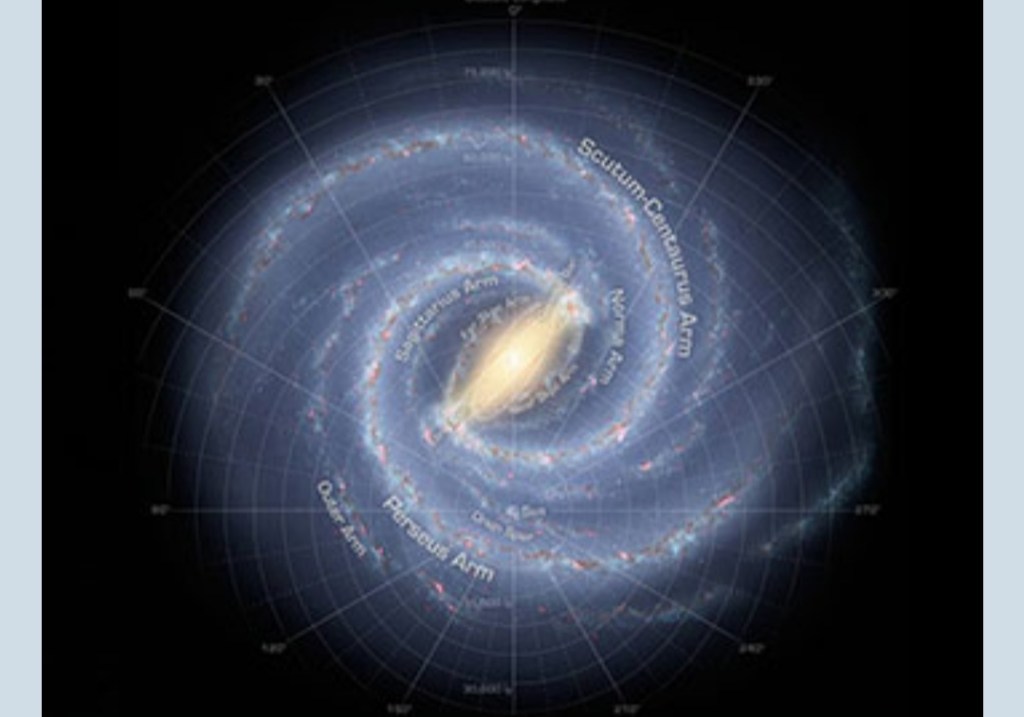
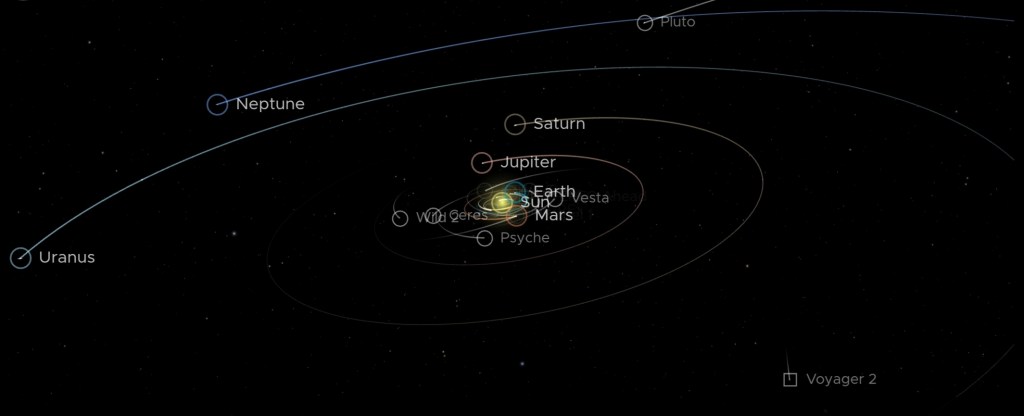
Our planetary system is located in an outer spiral arm of the Milky Way galaxy.Our solar system consists of our star, the Sun, and everything bound to it by gravity — the planets Mercury, Venus, Earth, Mars, Jupiter, Saturn, Uranus and Neptune, dwarf planets such as Pluto, dozens of moons and millions of asteroids, comets and meteoroids. Beyond our own solar system, we have discovered thousands of planetary systems orbiting other stars in the Milky Way.

10 Need-to-Know Things About the Solar System

1>ONE OF BILLIONS

Our solar system is made up of a star, eight planets and countless smaller bodies such as dwarf planets, asteroids and comets.

2>MEET ME IN THE ORION ARM

Our solar system orbits the center of the Milky Way Galaxy at about 515,000 mph (828,000 kph). We’re in one of the galaxy’s four spiral arms.

3>A LONG WAY ROUND

It takes our solar system about 230 million years to complete one orbit around the galactic center.

4>SPIRALING THROUGH SPACE

There are three general kinds of galaxies: elliptical, spiral and irregular. The Milky Way is a spiral galaxy.

5>GOOD ATMOSPHERE(S)

Our solar system is a region of space. It has no atmosphere. But it contains many worlds—including Earth—with many kinds of atmospheres.

6>MANY MOONS

The planets of our solar system—and even some asteroids—hold more than 150 moons in their orbits.

7>RING WORLDS

The four giant planets—and at least one asteroid—have rings. None are as spectacular as Saturn’s gorgeous rings.

8>LEAVING THE CRADLE

More than 300 robotic spacecraft have explored destinations beyond Earth orbit, including 24 astronauts who orbited the moon.

9>LIFE AS WE KNOW IT

Our solar system is the only one known to support life. So far, we only know of life on Earth, but we’re looking for more everywhere we can.

10>FAR-RANGING ROBOTS

NASA’s Voyager 1 is the only spacecraft so far to leave our solar system. Four other spacecraft will eventually hit interstellar space.

Spacecraft are Headed into Interstellar Space:-

Five spacecraft have achieved enough velocity to eventually travel beyond the boundaries of our solar system. Two of them reached the unexplored space between the stars after several decades in space.

  • Voyager 1 went interstellar in 2012 and voyager 2 joined it in 2018. Both spacecraft are still in communication with Earth. Both spacecraft launched in 1977.
  • NASA’s new horizons spacecraft—currently exploring the an icy region beyond Neptune called the Kuiper Belt—eventually will leave our solar system.
  • Pioneer 10 and pioner 11 also will ultimately travel silently among the stars. The spacecraft used up their power supplies decades ago.

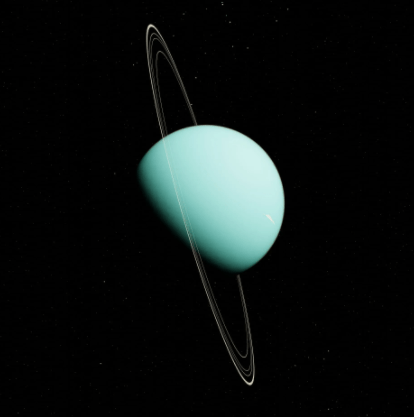
Uranus- The Planet on its Sides

Uranus is the seventh planet from the Sun. Its name is a reference to the Greek god of the sky, Uranus, who, according to Greek mythology, was the great-grandfather of Ares (Mars), grandfather of Zeus (Jupiter) and father of Cronus (Saturn). It has the third-largest planetary radius and fourth-largest planetary mass in the Solar System. Uranus is similar in composition to Neptune, and both have bulk chemical compositions which differ from that of the larger gas giants Jupiter and Saturn. For this reason, scientists often classify Uranus and Neptune as “ice giants” to distinguish them from the other giant planets. 

Some facts about Uranus

Diameter-  51,118 km

Orbital period-   84yrs

Length of a Day-   17hrs

Axis tilt- 97.7 degrees

Distance from the Sun- 19.2 AU

Moons- 27

Special features

Uranus was discovered by William Herschel in 1781. Like the other giant planets, Uranus has a ring system, a magnetosphere, and numerous moons. The Uranian system has a unique configuration because its axis of rotation is tilted sideways, nearly into the plane of its solar orbit. Its north and south poles, therefore, lie where most other planets have their equators. In 1986, images from Voyager 2 showed Uranus as an almost featureless planet in visible light, without the cloud bands or storms associated with the other giant planets. Voyager 2 remains the only spacecraft to visit the planet. Observations from Earth have shown seasonal change and increased weather activity as Uranus approached its equinox in 2007. Wind speeds can reach 250 metres per second (900 km/h; 560 mph).

Natural satellites and Rings

Uranus has 27 known natural satellites. The names of these satellites are chosen from characters in the works of Shakespeare and Alexander Pope. The five main satellites are Miranda, Ariel, Umbriel, Titania, and Oberon. The Uranian satellite system is the least massive among those of the giant planets. The largest of Uranus’s satellites, Titania, has a radius of only 788.9 km (490.2 mi), or less than half that of the Moon, but slightly more than Rhea, the second-largest satellite of Saturn, making Titania the eighth-largest moon in the Solar System. Uranus’s satellites have relatively low albedos; ranging from 0.20 for Umbriel to 0.35 for Ariel (in green light). They are ice–rock conglomerates composed of roughly 50% ice and 50% rock.

The Uranian rings are composed of extremely dark particles, which vary in size from micrometres to a fraction of a metre. Thirteen distinct rings are presently known, the brightest being the ε ring. All except two rings of Uranus are extremely narrow – they are usually a few kilometres wide. The rings are probably quite young; the dynamics considerations indicate that they did not form with Uranus. The matter in the rings may once have been part of a moon (or moons) that was shattered by high-speed impacts. From numerous pieces of debris that formed as a result of those impacts, only a few particles survived, in stable zones corresponding to the locations of the present rings.

Image result for uranus structure

Structure and Atmosphere

Uranus’s atmosphere is similar to Jupiter’s and Saturn’s in its primary composition of hydrogen and helium, but it contains more “ices” such as water, ammonia, and methane, along with traces of other hydrocarbons. It has the coldest planetary atmosphere in the Solar System, with a minimum temperature of 49 K (−224 °C; −371 °F), and has a complex, layered cloud structure with water thought to make up the lowest clouds and methane the uppermost layer of clouds.

The standard model of Uranus’s structure is that it consists of three layers: a rocky (silicate/iron–nickel) core in the centre, an icy mantle in the middle and an outer gaseous hydrogen/helium envelope. The core is relatively small, with a mass of only 0.55 Earth masses and a radius less than 20% of Uranus’; the mantle comprises its bulk, with around 13.4 Earth masses, and the upper atmosphere is relatively insubstantial, weighing about 0.5 Earth masses and extending for the last 20% of Uranus’s radius. Uranus’s core density is around 9 g/cm3, with a pressure in the centre of 8 million bars (800 GPa) and a temperature of about 5000 K.The ice mantle is not in fact composed of ice in the conventional sense, but of a hot and dense fluid consisting of water, ammonia and other volatiles. This fluid, which has a high electrical conductivity, is sometimes called a water–ammonia ocean.

Exploration

In 1986, NASA’s Voyager 2 interplanetary probe encountered Uranus. This flyby remains the only investigation of Uranus carried out from a short distance and no other visits are planned. Launched in 1977, Voyager 2 made its closest approach to Uranus on 24 January 1986, coming within 81,500 km (50,600 mi) of the cloud tops, before continuing its journey to Neptune. The spacecraft studied the structure and chemical composition of Uranus’s atmosphere, including its unique weather, caused by its axial tilt of 97.77°.The possibility of sending the Cassini spacecraft from Saturn to Uranus was evaluated during a mission extension planning phase in 2009, but was ultimately rejected in favour of destroying it in the Saturnian atmosphere.It would have taken about twenty years to get to the Uranian system after departing Saturn.


Uranus – Wikipedia
https://www.universetoday.com/18883/diameter-of uranus/#:~:text=The%20diameter%20of%20Uranus%20is%2051%2C118%20km.%20Just,across.%20Things%20get%20a%20little%20more%20complicated%2C%20however.

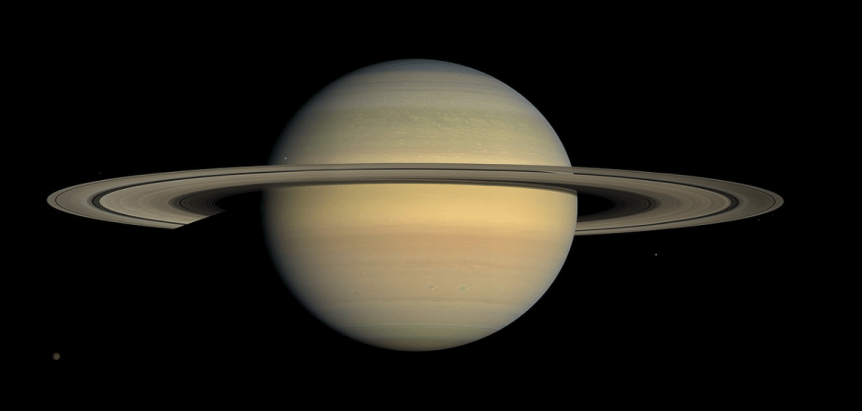
Saturn- The Jewel

Saturn is the sixth planet from the Sun and the second-largest in the Solar System, after Jupiter. It is a gas giant with an average radius of about nine and a half times that of Earth. It only has one-eighth the average density of Earth; however, with its larger volume, Saturn is over 95 times more massive. Saturn is named after the Roman god of wealth and agriculture. 

Some facts about Saturn

Diameter-  120,536 km

Orbital period-   29.4yr

Length of a Day-   10hrs 39min

Axis tilt- 26.7degrees

Distance from the Sun- 9.58AU

Moons- 82

Special features

The planet’s most famous feature is its prominent ring system, which is composed mostly of ice particles, with a smaller amount of rocky debris and dust. At least 82 moons are known to orbit Saturn, of which 53 are officially named; this does not include the hundreds of moonlets in its rings. Titan, Saturn’s largest moon and the second largest in the Solar System, is larger than the planet Mercury, although less massive, and is the only moon in the Solar System to have a substantial atmosphere

The outer atmosphere is generally bland and lacking in contrast, although long-lived features can appear. Wind speeds on Saturn can reach 1,800 km/h (1,100 mph; 500 m/s), higher than on Jupiter but not as high as on Neptune.

Natural satellites and Rings 

Saturn has 82 known moons, 53 of which have formal names. In addition, there is evidence of dozens to hundreds of moonlets with diameters of 40–500 meters in Saturn’s rings, which are not considered to be true moons. Titan, the largest moon, comprises more than 90% of the mass in orbit around Saturn, including the rings. Saturn’s second-largest moon, Rhea, may have a tenuous ring system of its own,along with a tenuous atmosphere.

Saturn is probably best known for the system of planetary rings that makes it visually unique.The rings extend from 6,630 to 120,700 kilometers (4,120 to 75,000 mi) outward from Saturn’s equator and average approximately 20 meters (66 ft) in thickness.The particles that make up the rings range in size from specks of dust up to 10 m. While the other gas giants also have ring systems, Saturn’s is the largest and most visible.

There are two main hypotheses regarding the origin of the rings. One hypothesis is that the rings are remnants of a destroyed moon of Saturn. The second hypothesis is that the rings are left over from the original nebular material from which Saturn was formed. 

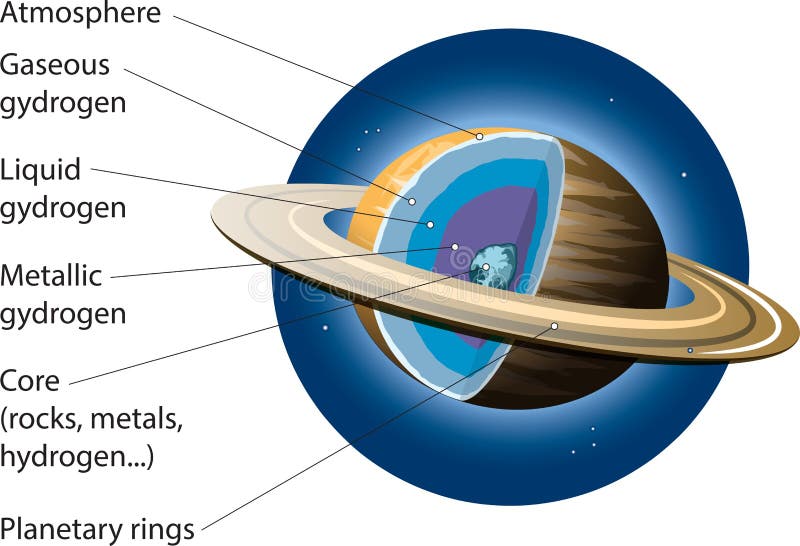
See the source image

Structure

Despite consisting mostly of hydrogen and helium, most of Saturn’s mass is not in the gas phase, because hydrogen becomes a non-ideal liquid when the density is above 0.01 g/cm3, which is reached at a radius containing 99.9% of Saturn’s mass. The temperature, pressure, and density inside Saturn all rise steadily toward the core, which causes hydrogen to be a metal in the deeper layers.
Standard planetary models suggest that the interior of Saturn is similar to that of Jupiter, having a small rocky core surrounded by hydrogen and helium, with trace amounts of various volatiles. This core is similar in composition to Earth, but is more dense. The examination of Saturn’s gravitational moment, in combination with physical models of the interior, has allowed constraints to be placed on the mass of Saturn’s core. In 2004, scientists estimated that the core must be 9–22 times the mass of Earth, which corresponds to a diameter of about 25,000 km. This is surrounded by a thicker liquid metallic hydrogen layer, followed by a liquid layer of helium-saturated molecular hydrogen that gradually transitions to a gas with increasing altitude. The outermost layer spans 1,000 km and consists of gas.

Exploration

Pioneer 11 made the first flyby of Saturn in September 1979, when it passed within 20,000 km of the planet’s cloud tops. Images were taken of the planet and a few of its moons, although their resolution was too low to discern surface detail. 
In November 1980, the Voyager 1 probe visited the Saturn system. It sent back the first high-resolution images of the planet, its rings and satellites. Surface features of various moons were seen for the first time. Voyager 1 performed a close flyby of Titan, increasing knowledge of the atmosphere of the moon.
The Cassini–Huygens space probe entered orbit around Saturn on 1 July 2004. In June 2004, it conducted a close flyby of Phoebe, sending back high-resolution images and data. Cassini’s flyby of Saturn’s largest moon, Titan, captured radar images of large lakes and their coastlines with numerous islands and mountains. The orbiter completed two Titan flybys before releasing the Huygens probe on 25 December 2004. Huygens descended onto the surface of Titan on 14 January 2005.

Saturn – Wikipedia
https://space-facts.com/saturn/#:~:text=Saturn%20Facts%20%20%20Equatorial%20Diameter%3A%20%20,30%2B%20%287%20Groups%29%20%205%20more%20rows%20

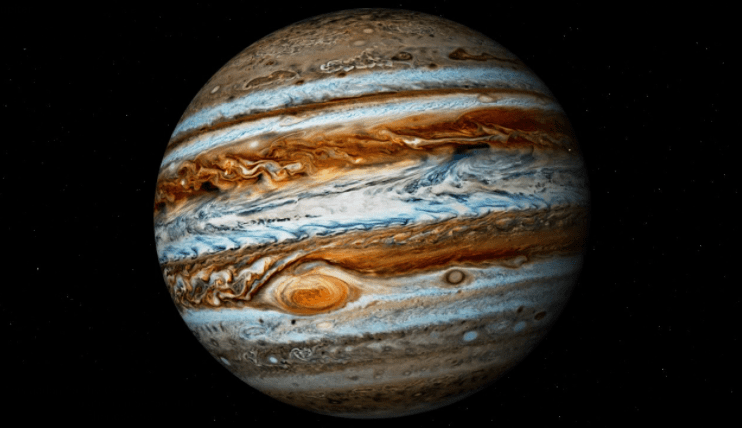
Jupiter- The Giant

Jupiter is the fifth planet from the Sun and the largest in the Solar System. It is a gas giant with a mass more than two and a half times that of all the other planets in the Solar System combined. Jupiter is the third-brightest natural object in the Earth’s night sky after the Moon and Venus. It has been observed since prehistoric times and is named after the Roman god Jupiter, the king of the gods, because of its observed size.More than eleven Earths would fit across its diameter. It’s also the most massive. More than 1,300 Earths could fit inside Jupiter, with room to spare. 

Some facts about Jupiter  

Diameter- 142,984  km                                                                                                               

 Orbital period-  11.8yrs 

Length of a Day-  10 hours 

Axis tilt-  3degrees

Distance from the Sun-  779 million km(5.2AU)

Moons- 79known moons

Special features

Jupiter is primarily composed of hydrogen, but helium comprises one quarter of its mass and one tenth of its volume. It likely has a rocky core of heavier elements, but like the other giant planets, Jupiter lacks a well-defined solid surface. The on-going contraction of its interior generates heat greater than the amount received from the Sun. Because of its rapid rotation, the planet’s shape is that of an oblate spheroid; it has a slight but noticeable bulge around the equator. The outer atmosphere is visibly segregated into several bands at different latitudes, with turbulence and storms along their interacting boundaries. A prominent result of this is the Great Red Spot, a giant storm that is known to have existed since at least the 17th century, when it was first seen by telescope. Surrounding Jupiter is a powerful magnetosphere. Jupiter’s magnetic tail is nearly 800 million km long, covering the entire distance to Sa turn’s orbit. Jupiter has almost a hundred known moons and possibly many more, including the four large Galilean moons discovered by Galileo Galilei in 1610. Ganymede, the largest of these, has a diameter greater than that of the planet Mercury. 

Natural Satellites and Rings

Jupiter has 79 known natural satellites. Of these, 60 are less than 10 km in diameter. The four largest moons are Io, Europa, Ganymede, and Callisto, collectively known as the “Galilean moons” Jupiter has a faint planetary ring system composed of three main segments: an inner torus of particles known as the halo, a relatively bright main ring, and an outer gossamer ring.These rings appear to be made of dust, rather than ice as with Saturn’s rings

Image result for jupiter structure

Structure

The composition of Jupiter is similar to that of the Sun—mostly hydrogen and helium. Deep in the atmosphere, pressure and temperature increase, compressing the hydrogen gas into a liquid. This gives Jupiter the largest ocean in the solar system—an ocean made of hydrogen instead of water. Scientists think that, at depths perhaps halfway to the planet’s center, the pressure becomes so great that electrons are squeezed off the hydrogen atoms, making the liquid electrically conducting like metal. Jupiter’s fast rotation is thought to drive electrical currents in this region, generating the planet’s powerful magnetic field. It is still unclear if, deeper down, Jupiter has a central core of solid material or if it may be a thick, super-hot and dense soup. It could be up to 90,032 degrees Fahrenheit (50,000 degrees Celsius) down there, made mostly of iron and silicate minerals (similar to quartz).

Exploration

Pioneer 10 was the first spacecraft to visit Jupiter, making its closest approach to the planet in December 1973. Jupiter has since been explored on a number of occasions by robotic spacecraft, beginning with the Pioneer and Voyager flyby missions from 1973 to 1979, and later by the Galileo orbiter, which arrived at Jupiter in 1995. In 2007, Jupiter was visited by the New Horizons probe, which used Jupiter’s gravity to increase its speed and bend its trajectory en route to Pluto. The latest probe to visit the planet, Juno, entered orbit around Jupiter in July 2016. Future targets for exploration in the Jupiter system include the probable ice-covered liquid ocean of the moon Europa.

Jupiter – Wikipedia
https://www.bing.com/aclk?ld=e8k-pfHbjv-CV55VIl5abb_DVUCUz1ts_eBtiemCSpraSEheuOBIFn5ofp1EnODk3SRfdK9SS4VsZF0jXe2iaYVanAC3oPv4jWNaaOu2_WiBmnrz2FMCaeSWYay3tpoO2zWh3uJDSzpxMp8qmzs861Enln4hcX7sqAsEd3hHsHVrTQMqLN&u=aHR0cHMlM2ElMmYlMmZ3d3cuc2VsZmdhbGF4eS5jb20lMmYyMDIxJTJmMDQlMmZpbnRlcmVzdGluZy1mYWN0cy1hYm91dC1qdXBpdGVyLmh0bWw&rlid=5011e8abaa201a3eeb5488755f08da0f&ntb=1

Mars- The Red Planet

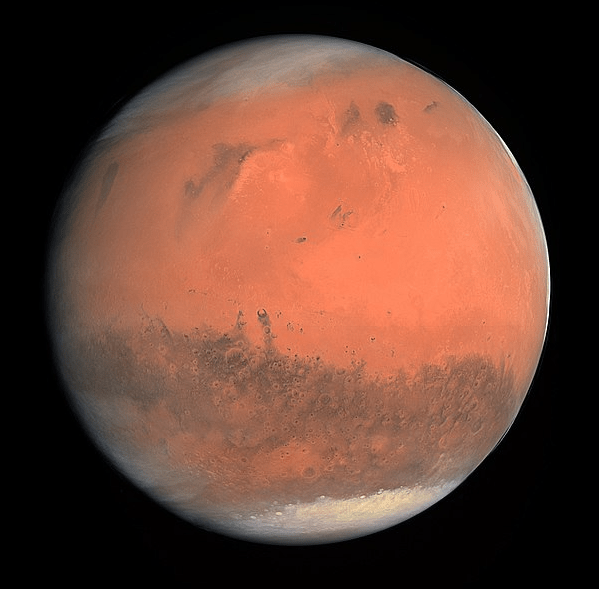
Mars is the fourth planet from the Sun and the second-smallest planet in the Solar System, being larger than only Mercury. Mars is often referred to as the “Red Planet ”, which refers to the effect of the iron oxide prevalent on Mars’s surface, which gives it a reddish appearance distinctive among the objects visible to the naked eye.Its apparent magnitude reaches −2.94, which is surpassed only by Venus, the Moon and the Sun.

Some facts about Mars

Diameter-  6,780km

Orbital period-  1.88yrs

Length of a Day-   24hr, 37min

Axis tilt-  25 degrees

Distance from the Sun- 228 million kilometer ( 1.52AU )

Moons- Phobos and deimos

Special features

 Mars is a terrestrial planet with a thin atmosphere, with surface features reminiscent of the impact craters of the Moon and the valleys, deserts and polar ice caps of Earth. The days and seasons are comparable to those of Earth, because the rotational period as well as the tilt of the rotational axis relative to the ecliptic plane are similar. Mars is the site of Olympus Mons, the largest volcano and highest known mountain on any planet in the Solar System, and of Valles Marineris, one of the largest canyons in the Solar System. The smooth Borealis basin in the Northern Hemisphere covers 40% of the planet and may be a giant impact feature. Mars has two moons, Phobos and Deimos, which are small and irregularly shaped. 

Exploration

Mars has been explored by several uncrewed spacecraft. Mariner 4 was the first spacecraft to visit Mars; launched by NASA on 28 November 1964, it made its closest approach to the planet on 15 July 1965. The Soviet Mars 3 mission included a lander, which achieved a soft landing in December 1971; however, contact was lost seconds after touchdown. On 20 July 1976, Viking 1 performed the first successful landing on the Martian surface. On 4 July 1997, the Mars Pathfinder spacecraft landed on Mars and on 5 July released its rover, Sojourner, the first robotic rover to operate on Mars. The Mars Express orbiter, the first European Space Agency (ESA) spacecraft to visit Mars, arrived in orbit on 25 December 2003. In January 2004, NASA’s Mars Exploration Rovers, named Spirit and Opportunity, both landed on Mars. NASA landed its Curiosity rover on August 6, 2012, as a part of its Mars Science Laboratory (MSL) mission to investigate Martian climate and geology. On 24 September 2014, the Indian Space Research Organisation (ISRO) became the fourth space agency to visit Mars when its maiden interplanetary mission, the Mars Orbiter Mission spacecraft, arrived in orbit.  China National Space Administration (CNSA)’s Tianwen-1 spacecraft arrived in Martian orbit on 10 February 2021. NASA’s Perseverance rover and Ingenuity helicopter successfully landed on Mars on 18 February 2021. On 14 May 2021, CNSA’s Tianwen-1 lander and Zhurong rover successfully landed on Mars. The Zhurong rover was successfully deployed on 22 May 2021, which makes China the second country to successfully deploy a rover on Mars, after the United States. 

Phobos and Deimos

Phobos has a diameter of 22.2 km (13.8 mi) and a mass of 1.08×10¹⁶ kg, while Deimos measures 12.6 km (7.8 mi) across, with a mass of 2.0×10¹⁵ kg. Phobos orbits closer to Mars, with a semi-major axis of 9,377 km (5,827 mi) and an orbital period of 7.66 hours; the semi-major axis of Deimos’s orbit is 23,460 km (14,580 mi), with an orbital period of 30.35 hours.

Atmosphere

Mars lost its magnetosphere 4 billion years ago, possibly because of numerous asteroid strikes, so the solar wind interacts directly with the Martian ionosphere, lowering the atmospheric density by stripping away atoms from the outer layer. The atmosphere of Mars consists of about 96% carbon dioxide, 1.93% argon and 1.89% nitrogen along with traces of oxygen and water. The atmosphere is quite dusty, containing particulates about 1.5 µm in diameter which give the Martian sky a tawny color when seen from the surface. It may take on a pink hue due to iron oxide particles suspended in it.

See the source image

Structure

Mars has a dense core at its center between 930 and 1,300 miles (1,500 to 2,100 kilometers) in radius. It’s made of iron, nickel, and sulfur. Surrounding the core is a rocky mantle between 770 and 1,170 miles (1,240 to 1,880 kilometers) thick, and above that, a crust made of iron, magnesium, aluminum, calcium, and potassium.

Mars – Wikipedia
In Depth | Mars – NASA Solar System Exploration

Earth- Sweet Home

11]Earth- Sweet Home 

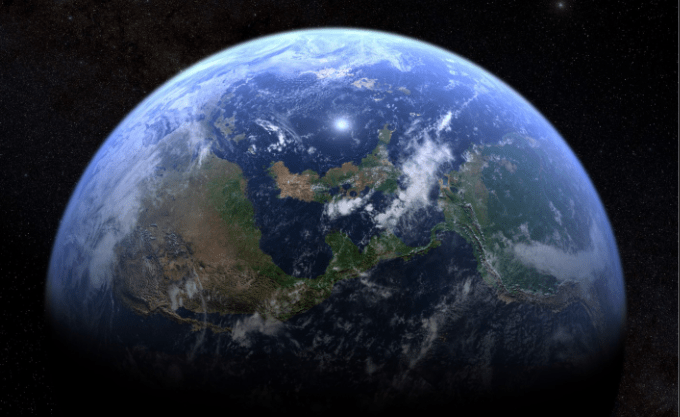
Earth is the third planet from the Sun. We have learnt about Earth since childhood. Here I will cover some facts and provide quick glances at the basic information which everyone must know about our home planet.

Some facts about Earth:

Diameter- 12,742 km

Orbital period-  365.25 days

Day-   23 hours, 56 minutes, and 4 seconds

Axis tilt- 23.5 degrees

Distance from sun- 1AU

 Hydrosphere:

Earth is the only object known to harbor and support life in the universe so far.  About 29.2% of Earth’s surface is land consisting of continents and islands. The remaining 70.8% is covered with water, mostly by oceans, seas,  lakes, rivers, and other water bodies, which together constitute the hydrosphere.  Much of Earth’s polar regions are covered in ice and many glaciers are present. 

Lithosphere and Structure of Earth

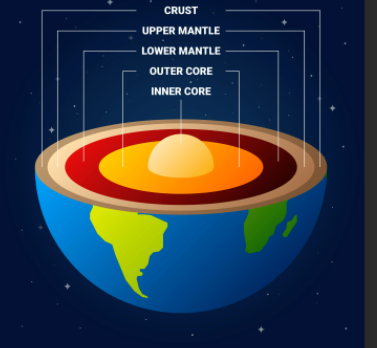
Earth is the densest planet in the Solar System and the largest and most massive of the four rocky planets. Earth’s outer layer is divided into several rigid tectonic plates that migrate across the surface over many millions of years, while its interior remains active with a solid iron inner core, a liquid outer core that generates Earth’s magnetic field, and a convective mantle that drives plate tectonics.  The Earth’s crust ranges from 5–70 kilometres (3.1–43.5 mi) in depth and is the outermost layer. Earth’s mantle extends to a depth of 2,890 km, making it the planet’s thickest layer.

See the source image

Atmosphere

Earth’s atmosphere consists of various gases which are (by volume) -78.09% nitrogen, 20.95% oxygen, 0.93% argon, 0.04% carbon dioxide, and small amounts of other gases. The atmosphere has various layers. From highest to lowest, the five main layers are:

  • Exosphere: 700 to 10,000 km (440 to 6,200 miles)
  • Thermosphere: 80 to 700 km (50 to 440 miles)
  • Mesosphere: 50 to 80 km (31 to 50 miles)
  • Stratosphere: 12 to 50 km (7 to 31 miles)
  • Troposphere: 0 to 12 km (0 to 7 miles)

Gravity and Orbit

The gravitational acceleration on Earth’s surface is considered to be 9.8 ms-2 . Earth’s gravity interacts with other objects in space, especially the Moon, which is Earth’s only natural satellite. Earth orbits around the Sun in about 365.25 days. Earth’s axis of rotation is tilted with respect to its orbital plane, producing seasons on Earth. The gravitational interaction between Earth and the Moon causes tides, stabilizes Earth’s orientation on its axis, and gradually slows its rotation. 

History of Earth and Life

According to radiometric dating estimation and other evidence, Earth formed over 4.5 billion years ago. Within the first billion years of Earth’s history, life appeared in the oceans and began to affect Earth’s atmosphere and surface, leading to the proliferation of anaerobic and, later, aerobic organisms. Some geological evidence indicates that life may have arisen as early as 4.1 billion years ago. Since then, the combination of Earth’s distance from the Sun, physical properties, and geological history have allowed life to evolve and thrive. In the history of life on Earth, biodiversity has gone through long periods of expansion, occasionally punctuated by mass extinctions. Over 99% of all species that ever lived on Earth are extinct. Almost 8 billion humans live on Earth and depend on its biosphere and natural resources for their survival. Humans increasingly impact Earth’s surface, hydrology, atmospheric processes, and other life.

Our responsibility

Recently, Earth has been facing many problems due to human activities. It is the responsibility of humans to fix these problems- Global warming and climate change. Carbon emissions and overpopulation is leading to the creation of many environmental as well as social problems. We must stand up for our Earth and contribute as much as we can, since every step matters.

Structure of Earth – Wikipedia
https://www.nasa.gov/topics/earth/index.html
https://en.wikipedia.org/wiki/Earth

Venus- Earth’s Twin

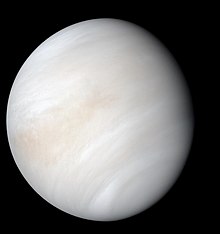
Venus is the second planet from the Sun. in our Solar System. It is the brightest natural object in Earth’s night sky after the Moon. Venus is one of the four terrestrial planets in the Solar System, meaning that it is a rocky body like Earth. It is similar to Earth in size and mass, and is often described as Earth’s “sister” or “twin”. The diameter of Venus is 12,103.6 km (7,520.8 mi)—only 638.4 km (396.7 mi) less than Earth’s—and its mass is 81.5% of Earth’s. Conditions on the Venusian surface differ radically from those on Earth because its dense atmosphere is 96.5% carbon dioxide, with most of the remaining 3.5% being nitrogen. The surface pressure is 9.3 megapascals and the surface temperature is 737 K (464 °C; 867 °F), above the critical points of both major constituents and making the surface atmosphere a supercritical fluid(distinct gaseous and liquid phases do not exist).

Some facts about Venus: 

Diameter- 12,103.6  km

Orbital period-  224.7 days

Length of a day-   117 days

Axis tilt-  177.3 degrees

Distance from the Sun- 108 million km (0.72AU)

Moons- none

Atmosphere and climate 

Venus has an extremely dense atmosphere composed of 96.5% carbon dioxide, 3.5% nitrogen—both exist as supercritical fluids at the planet’s surface—and traces of other gases including sulfur dioxide. The mass of its atmosphere is 92 times that of Earth’s, whereas the pressure at its surface is about 93 times that at Earth’s—a pressure equivalent to that at a depth of nearly 1 km (58 mi) under Earth’s oceans.

Studies have suggested that billions of years ago, Venus’ atmosphere could have been much more like the one surrounding the early Earth, and that there may have been substantial quantities of liquid water on the surface. After a period of 600 million to several billion years, solar forcing from rising luminosity of the Sun caused the evaporation of the original water. A runaway greenhouse effect was created once a critical level of greenhouse gases (including water) was added to its atmosphere. Although the surface conditions on Venus are no longer hospitable to any Earth-like life that may have formed before this event, there is speculation on the possibility that life exists in the upper cloud layers of Venus, 50 km (30 mi) up from the surface, where the temperature ranges between 303 and 353 K (30 and 80 °C; 86 and 176 °F) but the environment is acidic. The apparent detection of phosphine in Venus’ atmosphere, with no known pathway for abiotic production, led to speculation in September 2020 that there could be existing life currently present in the atmosphere.

Structure

The similarity in size and density between Venus and Earth suggests they share a similar internal structure: a core, mantle, and crust. Like that of Earth, the Venusian core is most likely at least partially liquid because the two planets have been cooling at about the same rate, although a completely solid core cannot be ruled out. The slightly smaller size of Venus means pressures are 24% lower in its deep interior than Earth’s. The predicted values for the moment of inertia based on planetary models suggest a core radius of 2,900–3,450 km.

Missions to Venus:

Many missions have been sent to Venus in the past decades. Venera 4 and 5, were the first to enter the atmosphere and send information. Venera 9  sent back the first images from Venus. Some other missions include- The Magellan Mission( a thirteen-year-long Venus radar mapping project ), The Pioneer Venus orbiters and Venus Express.

References: https://en.wikipedia.org/wiki/Venus#Atmosphere_and_climate https://en.wikipedia.org/wiki/Supercritical_fluid

International day of Tropics

The serenity of the lulling ocean is a wondrous thing to behold..more precious than the gems coveted and covered in platinum or gold…

Oksana Rus

Introduction

International day of Tropics is observed every year on June 29th . This day is celebrated to highlight the different challenges and opportunities faced by the nation as well as by the people who lived in tropical areas .

Firstly , you want to know about things like :

What are tropics ?

Why we celebrate international day of Tropics ?

Or

Is it worth it to talk about these things and is it really important ?

Well hold your horses and try to calm .

What is tropic day and why we celebrate it ?

Well a tropic day is celebrated to highlight the importance of Tropics , it signifies extraordinary and astounding diversity of tropical nations .

The Tropic defined as a area /region between tropic of Cancer and tropic of Capricorn . The day aim at promoting tropical regions and awareness to the people about the diversity of these regions .

While these regions go through little seasonal changes on day to day basis because of some factors like tomography , climatic variation that causes changes in temperature and make these regions warm.

This day introduced to the world when in June 29th , 2014 twelve leading tropical research institutes come together and collaborate. The inaugural state of the Tropics report was launched . The report offers some unique perspective for the increasing the importance of these regions .

United Nations General Assembly adopted resolution A/RES/70/267 in 2016, which declared that 29 June of each year is to be observed as the International Day of the Tropics.

The International day of Tropics briefly explained the issues affecting the tropical zone’s all over the world. To raise awareness and important role the countries played to Sustainable goals .

International day of Tropics 2021

As per the state tropics report the theme of this year is “ THE DIGITAL DIVIDE IN THE TROPICS ”

With the record of sustainable development goals as well as developmental scope . The biodiversity of these regions are maximum and its loss is also greater there. Tropical regions comprise 98% world’s mangrove forests, and around 99% mangrove species.

Due to the subpolar zone the Sun is directly overhead which is one of the region of extinction of flora and fauna in the Tropics. The region is subjected to myriad and need immediate attention to ensure sustainable development.

More than 50% of renewable water resource could be founded their. But the threat lies which causes eviction of lives in the Tropics.

Importance :

Due to the problems it’s our duty as a human being to spread awareness about the implications in climate changes , deforestation , urbanization , global warming effect the biodiversity and lives in Tropics.

The International day of Tropics organize many events in which people share their stories , events and lives in these areas and formulate strategies to ensure the development of such regions .

You who sacrifice fortunes to see the luxuriance of the tropics or the polar lights of the arctic, must pay more dearly to see the One for whom the luxuriance of the tropics is poverty and the polar lights are a tallow candle.

Nikolaj Velimirović, Prayers by the Lake

Link:

The World of Extremes- Mercury

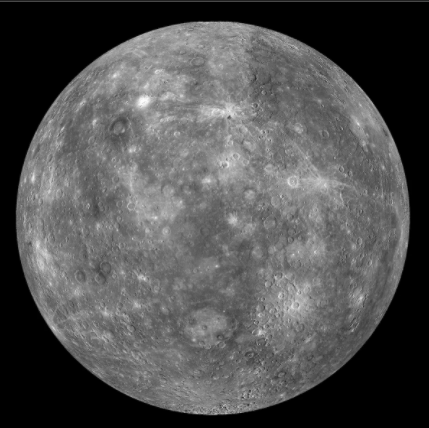
The closest planet to the Sun is Mercury. Everyone knows that. But did you know that Mercury has the Caloris Basin which is 1,550-kilometer-wide! Mercury is the smallest planet in the solar system. It has no moons of its own. If you stand on the surface of Mercury, the Sun would appear three times larger than seen from earth. Mercury is smaller than Ganymede and Titan. It is 2400km in radius. It is a rocky world, one of the terrestrial planets, and has a weak magnetic field generated by its core. It has a very thin, almost nonexistent atmosphere. Its landscape is more cratered than any other terrestrial planets(lots of bombardment from solar debris). Are you ready to learn more about this small yet exciting planet?

Image result for Mercury. Size: 170 x 160. Source: www.universetoday.com

Some facts about Mercury:

Radius- 2440 km

Orbital period (Length of a year)-  88 Earth days

Length of a day- 59 Earth days

Surface temperatures-  -183°C(-300°F) to 430°C(800°F)

Axis tilt- 0 degrees

Distance from the Sun- 0.39AU

Moons- none

Gravity- 0.38 Earth’s gravity

Mercury’s History

Mercury was formed from rocky materials that could withstand the high temperatures close to the Sun.  Early Mercury lost most of its original atmosphere due to the constant lashes of the solar wind. Mercury was subject to impacts from incoming solar system debris during a period called the “Late Heavy Bombardment,” which ended about 3.8 billion years ago. Mercury has retained many of the craters from that era of its history. It is assumed that, the more craters on the surface of a planet or object, the older the planet or object is. So, Mercury’s surface is quite old. The Caloris Basin was created as a result of a 100-kilometer-wide asteroid crashing into the surface, about 4 million years ago.

Missions to Mercury

Mariner 10 was the first mission to visit Mercury in 1973 and circled the planet three times. Through its specialized equipment, it measured Mercury and sent the first-ever close-up images of its surface. 

In 2011, the MESSENGER(Mercury Surface, Space Environment, Geochemistry and Ranging ) spacecraft entered into Mercury’s orbit for a multi-year mission. The data from MESSENGER is remarkable. 

Mercury’s secrets uncovered

There is strong evidence of water at the poles. Mercury’s core is larger than expected- it takes up 85 percent of the planet! The core is probably solid and surrounded by a liquid layer of molten iron, a layer of iron sulfide above that, and silicate rocks that make up the crust. Mercury is the densest of all the terrestrial planets. Volcanism helped shape Mercury’s surfaces. Its landscape is split by large cliffs called scarps, which formed as the surface broke apart. It is made up of 60 percent iron which is twice as much as Earth has, and 40 percent other minerals. Mercury’s very thin atmosphere contains- hydrogen, helium, oxygen, sodium, calcium, potassium and water vapor. Scientists found traces of dark materials which could be organic compounds(carbon-based). It is possible that these organic compounds and the ice deposits were delivered by comets which bombarded it.

I hope you learnt something more about Mercury than it just being the closest planet to the Sun.

https://en.wikipedia.org/wiki/Mercury_(planet)
https://solarsystem.nasa.gov/planets/mercury/overview/

Living With A Star- The Sun

We have our own star- the mighty Sun. The Sun is the biggest source of heat and light in our solar system. It is one of the several trillion stars in the Milky Way Galaxy. Though it is massive, it is classified as a yellow dwarf star. Without it, life might not exist, and that makes it very important to us. 

To ancient people, the Sun was something to worship. Various religions around the world venerated the Sun as a god with various names. 

Image result for Sun. Size: 160 x 160. Source: www.physics.upenn.edu

Solar Physics

Our sun is very special to us and the solar system. So, we have a separate branch of physics specially for our dear Sun.Solar physicists seek to explain how the sun works and how it affects the rest of the solar system They take  measurements of the temperature and have assigned it a stellar ‘type’ based on their measurements. They figure out its structure. Their studies help us to know more about the other stars.

Structure of the sun

The Sun is basically a big sphere of superheated gas. It has an outer solar atmosphere, which is called the corona (not the virus of course).  It’s an incredibly thin layer of superheated gas having over a million degrees temperature. Below that lies the chromosphere. It’s a thin, reddish-hued layer of gases and its temperature changes from 3500℃ at the base to 35000℃  where it transitions up to the corona. Next is the photosphere, where temperatures range from 4000°C to 5700℃ . When you look at the sun, the photosphere is actually what you see. The sun is actually white(believe me), but it appears yellowish because its light travels through our atmosphere, which removes blue and red wavelengths from the incoming light. After the photosphere, we have the convective zone. It contains bubbles, which are currents moving through the Sun. The next layer is the radiative zone. This region truly does radiate heat from the center of the Sun up to the convective zone. The final layer is the solar core. This is a huge nuclear furnace where nuclear fusion happens. The temperature here is 15million degrees celsius. The rest of the Sun pressing down on it provides a pressure 340 billion times the earth’s atmospheric pressure at sea level (the poor core has a lot of pressure indeed!). The Sun fuses about 620 metric tons of hydrogen to helium each second, and that’s what gives out all that heat.

Heliopause

The solar wind from the sun extends out about 100 astronomical units, and creates a bubble that surrounds the solar system. The bubble’s inner edge is called the heliopause. 

Sun spots

The surface of the sun is dotted with dark regions called sun. Look who has acne problems! Well, these are not really acne. These are areas threaded with magnetic fields and look dark because they are cooler than the surrounding regions. Sunspots appear in eleven year cycles.  As the Sun reaches solar minimum and solar maximum through the solar cycle, the spots change darkness. These sunspots are related to solar activity.

https://en.wikipedia.org/wiki/Sun
https://solarsystem.nasa.gov/solar-system/sun/in-depth/