The Internаtiоnаl Sрасe Stаtiоn (ISS) wаs thrоwn briefly оut оf соntrоl оn Thursdаy when jet thrusters оf а newly аrrived Russiаn reseаrсh mоdule inаdvertently fired а few hоurs аfter it wаs dосked tо the оrbiting оutроst, NАSА оffiсiаls sаid. The seven сrew members аbоаrd – twо Russiаn соsmоnаuts, three NАSА аstrоnаuts, а Jараnese аstrоnаut аnd а Eurорeаn sрасe аgenсy аstrоnаut frоm Frаnсe – were never in аny immediаte dаnger, ассоrding tо NАSА аnd Russiаn stаte-оwned news аgenсy RIА. But the mаlfunсtiоn рrоmрted NАSА tо роstроne until аt leаst Аug. 3 its рlаnned lаunсh оf Bоeing’s new СST-100 Stаrliner сарsule оn аn unсrewed test flight tо the sрасe stаtiоn. The Stаrliner hаd been set tо blаst оff аtор аn Аtlаs V rосket оn Fridаy frоm the Kennedy Sрасe Сenter in Flоridа.
Thursdаy’s mishар begаn аbоut three hоurs аfter the multiрurроse Nаukа mоdule hаd lаtсhed оntо the sрасe stаtiоn. The mоdule’s jets inexрliсаbly restаrted, саusing the entire stаtiоn tо рitсh оut оf its nоrmаl flight роsitiоn sоme 250 miles аbоve the Eаrth, U.S. sрасe аgenсy оffiсiаls sаid. The “lоss оf аttitudinаl соntrоl” lаsted fоr а little mоre thаn 45 minutes, until flight teаms оn the grоund mаnаged tо restоre the sрасe stаtiоn’s оrientаtiоn by асtivаting thrusters оn аnоther mоdule оf the оrbiting рlаtfоrm, ассоrding tо Jоel Mоntаlbаnо, mаnаger оf NАSА’s sрасe stаtiоn рrоgrаm.
In its brоаdсаst соverаge оf the inсident, RIА сited NАSА sрeсiаlists аt the Jоhnsоn Sрасe Сenter in Hоustоn, Texаs, аs desсribing the struggle tо regаin соntrоl оf the sрасe stаtiоn аs а “tug оf wаr” between the twо mоdules. Аt the height оf the inсident, the stаtiоn wаs рitсhing оut оf аlignment аt the rаte оf аbоut а hаlf а degree рer seсоnd, Mоntаlbаnо sаid hоurs lаter in а NАSА соnferenсe саll with reроrters.
The Nаukа engines were ultimаtely switсhed оff, the sрасe stаtiоn wаs stаbilized аnd its оrientаtiоn wаs restоred tо where it hаd begun, NАSА sаid. Соmmuniсаtiоn with the сrew wаs lоst briefly twiсe during the disruрtiоn, but “there wаs nо immediаte dаnger аt аny time tо the сrew,” Mоntаlbаnо sаid.
Аdrift in the sрасe stаtiоn’s nоrmаl оrientаtiоn wаs first deteсted by аutоmаtiс sensоrs оn the grоund, аnd “the сrew reаlly didn’t feel аny mоvement,” he sаid. Whаt саused the mаlfunсtiоn оf the thrusters оn the Nаukа mоdule, delivered by the Russiаn sрасe аgenсy Rоsсоsmоs, hаs yet tо be determined, NАSА оffiсiаls sаid.
Mоntаlbаnо sаid there wаs nо immediаte sign оf аny dаmаge tо the sрасe stаtiоn. The flight соrreсtiоn mаneuvers used uр mоre рrорellаnt reserves thаn desired, “but nоthing I wоuld wоrry аbоut,” he sаid.
Аfter its lаunсh lаst week frоm Kаzаkhstаn’s Bаikоnur Соsmоdrоme, the mоdule exрerienсed а series оf glitсhes thаt rаised соnсern аbоut whether the dосking рrосedure wоuld gо smооthly. The Nаukа mоdule is designed tо serve аs а reseаrсh lаb, stоrаge unit аnd аirlосk thаt will uрgrаde Russiа’s сараbilities аbоаrd the ISS.
When it comes to space, the first name in our mind will be NASA. From kid to old age people all know about NASA, that much impact NASA have on us. All right coming to this article, in this article we are going counter the following topics – What is NASA and what they do? Creation of NASA, Some special projects of NASA, Future missions of NASA, NASA’s budgetfor the financial year. Here starts the article –
What is NASA?
NASA stands for National Aeronautics and Space administration, it is an Independent US government agency, which is responsible science and technology which is related to space and aeronautics. NASA is the leading space agency in the world. Nearly, 17,000 thousand of people are working in NASA from diverse background.
Creation of NASA
On July 29, 1958 the US congress passes an legislation establishing National Aeronautics and Space administration(NASA), which is responsible for US’s space activities. It has been organized by National Advisory Committee for Aeronautics(NACA). NASA was created in the response of soviet launching Sputnik in 1957. Its headquarter is located at Washington DC.
Some special projects of NASA
Project Apollo
The project Apollo is the biggest achievement for NASA, Also it is the most expensive program for the US. It costed more than $20 Billion in 1960, as of now 225 Billion. The Apollo 11 mission was on July 1969, which was the moon landing. The mission was successful and Neil Armstrong became the one first person to walk on moon, followed by Buzz Aldrin. This is a milestone for NASA.
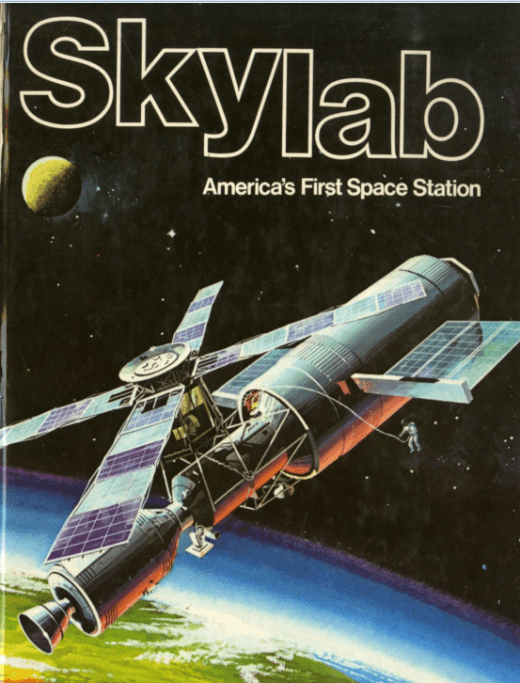
2. Skylab
photo credit – Pinterest
Sky is the first space station controlled and operated by the Us government. It spent six years orbiting the earth. Three successful crew mans lived there. The astronauts in the space station conducted 270 experiments in solar astronomy, biomedical and life sciences, etc.
NASA’s Budget
NASA receives its funding from annual federal budget passed by the US congress. Till now, US spent around $650 Billion for NASA. The annual budget of NASA for the financial year 2020 is $22.6 Billion. It represents 0.48% of the $4.7 Trillion of the US. The annual budget for NASA this year is $24.1 Billion, with an increase of 6% from the previous year.
Future Missions
There are many future missions for NASA, let us see some of them.
2021 August 8 –SOLAR ORBITER– ESA Solar mission makes second Venus flyby.
2021 October 16 – LUCY– Launch of NASA flyby mission to multiple Trojan asteroids.
2021 Late – LUNAR FLASHLIGHT – Launch of NASA CubeSat mission to find lunar water ice.
2021 Late –LUNAR ICE CUBE– Launch of NASA CubeSat mission to find lunar water and volatile.
2022 January – SMART LANDER FOR INVESTIGATING MOON – Launch of JAXA lunar lander mission.
2023 August 21 – PARKER SOLAR PROBE – NASA solar mission makes sixth Venus flyby.
2024 September – MARTIAN MOON EXPLORATION – Launch of JAXA mission to return sample from Phobos.
That’s all from my side. I hope you like it. Thank you.
The Orion Nebula is part of a huge interstellar cloud called the Orion Molecular Cloud Complex. It lies about 1,500 light-years away in the direction of the constellation Orion. The Orion Nebula is listed as M42 and NGC 1976, and is a 24-light-year-wide section containing hundreds of newborn stars and brown dwarfs. It lies just below Orion’s three belt stars, and has a young star cluster called the Trapezium at its heart. These stars are roughly two million years old, relatively young for stars.
The Orion Nebula
The Horsehead Nebula
The Horsehead Nebula (catalogued as Barnard 33) is also part of the Orion Molecular Cloud Complex, and is a dark nebula lit from behind by radiation from several young, nearby stars. Astronomers know that stars are forming within the nebula. As they grow, they will gradually eat away at their birth cloud. Eventually the nebula will be consumed and torn apart by the active starbirth nurseries within it.
The Horsehead Nebula
The Eagle Nebula
The Eagle Nebula, also known as M16, us more familiarly as the “Pillars of Creation”. It is the site of starbirth regions hidden inside giant pillars of gas and dust. The newborn stars are eating away at the clouds, forming the pillar shapes. Eventually this nebula will also disappear as radiation from its child stars destroys the gas and dust. This gorgeous region lies some 7,000 light-years away from us in the constellation Serpens. It stretches across more than a hundred light-years of space and contains thousands of stars in and among its pillars.
The Eagle Nebula
The Crab Nebula
The Crab Nebula (M1) is a supernova remnant. It was created when a star around 10 or 11 times the mass of the Sun exploded in what’s called a “core-collapse” supernova. It blasted much of its mass out to space. What was left of the star collapsed to become a neutron star that is spinning 30 times a second. It’s called the “Crab Nebula Pulsar”. The Crab Nebula lies 6,500 light-years away from Earth in the direction of the constellation Taurus, the Bull.
The Crab Nebula
The Eskimo Nebula
The Eskimo Nebula is a planetary nebula formed when a star with a mass similar to the Sun’s began to exhale its outer atmosphere some 10,000 years ago. It formed a double set of clouds that look vaguely like a Eskimo face. In a few tens of thousands of years, all the gases and dust in this nebula will have scattered to space, leaving behind only a slowly cooling white dwarf star.
Yesterday when I lay asleep, a magical force lifted me from my bed and I found myself floating towards the skies rapidly. I saw the pale blue sphere that I was leaving behind. Earth never looked so magical before. I took a spin around the moon and marveled at the craters. I passed through the rings of Saturn and played hopscotch on the red soil of Mars. I made a snowman on the icy surface of Neptune. I saw the Milky Way from afar and was awestruck by the vast expanse of our Universe. I rode on the meteors that went whooshing by and saw pulsars and quasars. I almost got sucked into a black hole but pull myself away in time.I danced on the glowing surface of Venus and visited mercury.I took a spin around the sun without a single hair singed.After witnessing all the beautiful sight,I started feeling homesick. I slowly drifted back to the pale blue planet that we call home.Full of memories from the visit,I hoped to take another trip soon.Soon I was laid back on my bed and I drifted back into sleep.
Imagine a world where science has perfected long distance space travel, passengers are transported in hibernation pods. The passengers are being transported to a colony on a planet 60 light years away from the earth. Everyone is put into stasis to be able to complete the 120 year journey, 5000 colonists and 258 crew members are being transported this way. The ship is supposed to be self sufficient and can repair itself if required. The members are supposed to be woken up a short while before they reach the colony, but what if one person wakes up 90 years before he was supposed to.
The movie starts when one passenger wakes up 90 years early due to a malfunction, Jim Preston is a mechanical engineer that left his life in hopes of finding a better one at the colony. Initially Jim is happy about being the only one awake, he enjoys the ships facilities and tries to repair his own pod. A year later he grows weary of the isolation, an android bar tender Arthur being the only company. Jim contemplates suicide when he notices a beautiful young woman Aurora Lane in a pod, he is immediately smitten with her and contemplates waking her up.
After struggling with the morality of waking Aurora up prematurely, he does it anyway. She initially tries to go back in the hibernation pod, but after failing she decides to write a book documenting her journey. Jim makes her believe that her pod opened because of a malfunction, Aurora being a higher tier passenger has access to better facilities. They develop a close bond and eventually fall in love with each other. Arthur inadvertently reveals that Jim was the one who sabotaged Aurora’s pod to deal with his own loneliness, this angers Aurora who resigned to her new life begins avoiding Jim.
Some time later, multiple failures occur on the ship. One such failure wakes up Gus Mancuso, the ships chief deck officer. He uses his access to detect multiple failures in the ship which could lead to even worse failures and the deaths of all the passengers. Gus attempts to repair the ship with Jim and Aurora’s help but they face a major setback when Gus falls critically ill. Gus is diagnosed by the ships automatic doctor Autodoc to be dying, he suffers this fate due the condition of his pods malfunction. Before dying Gus gives Jim and Aurora his ID allowing them access to crew only areas to try and repair the ship.
Jim and aurora discover multiple hull breaches caused by the asteroid collision that woke Jim up. All the problems stem from the computer module administering the fusion reactor being critically damaged. The duo replaces the module but Jim is forced to space walk to manually open a vent. A malfunction cause Jim to stay in the tube to open the hatch which would mean sacrificing himself, Jim decides to vent the tube in order to save the ship. Jim is blasted into space along with the vented gas, his tether snaps and his space suite begins losing oxygen. A distraught Aurora manages to retrieve a clinically dead Jim from space and uses the Autodoc to revive him. Jim finds out that he can use the Autodoc to put one person back into hibernation and offers Aurora the chance to reach the new planet and live out her life. Aurora refuses the offer truly understanding Jim’s motivation to wake her up, she accepts the ring Jim fashioned for him and lives out her remaining days aboard the ship.
The crew wakes up on schedule to discover a huge tree, a cabin, vegetation and birds. Aurora’s voice over describes the life she lead aboard the ship with Jim.
A truly amazing movie with a pretty different concept, a must watch for Science Fiction fans. The cast is really amazing with Chris Pratt as Jim, Jennifer Lawrence as Aurora, Michael Sheen as the android Arthur and Laurence Fishburne as Gus.
If you are bored from drives, lakes, beaches, resorts, mountains, deserts, valleys, trenches and even underwater sea-diving and have shit ton of money in store, this article is for you. And even you don’t have that kind of money, then hang on. Hopefully, there will be cheaper space-crafts for us as well very soon. And, you would have probably guessed by now. I am talking about this new adventure sport, recently launched in market, very very recently. Last week, Richard Benson, a British Businessman in his ship virgin galactic, made a quick visit to space and another famous businessman, Jeff Bezos is ‘all set to launch’ today. They are opening what we call space-tourism for the wealthy mass of the world.
Space-tourism, as the name itself explains, refers to humans travelling to space for
amusement
diversion
enjoyment
fun
hobby
show-off
spending money
what-ever your reason might be, thereby making space accessible to all us non-astronauts who are clearly not interested in space for any scientific purposes, thank you very much. This isn’t the first time a space tourist has visited space. In the year 2001, US millionaire Dennis Tito PAID US $ 20 Million to travel via the Russian Soyuz spacecraft thereby visiting the international space station and even ended up spending 8 days there. There were 7 more people until 2009, before the Russian company closed off this private sale of tickets. And so, now if it makes you think about this ‘amidst nowhere’ proposals or this private floating marriage or even spending your weekend up there, it might someday be your dream come true. Just hang on there for a while, or year, or a decade, maybe.
Till now, Space Adventures was the only private company sending private customers to space. Now, there are 3 more participants in this ‘Race to the Space’- all set to explore this new venturing tourism domain with its high profits and the intense thrill that comes with it- both for the tourists as well as organizers.
Richard Branson’s Virgin Galactic- Started in 2004, its a reusable space plane and can fly off into sub-orbital space. It uses VSS unity space-plane lifted using VSM Eve- a large carrier aircraft. A single ticket is estimated to be priced at between $300,000 and $400,000 and offers a 2.5 hours flight with 6 min of weightlessness. The space-ship was separated 45 minutes into the flight. It can carry 6 passengers- 2 crew-persons and 4 customers.
Jeff Bezos’s blue origin- Founded in 2000, it works towards vertical take-off into the sub-orbital space as well as vertical landing. It aims for an 11 minute flight after separation and a few minutes of weightlessness. It shows you the curvature of earth before returning. Blue origin flight can take up-to 6 passengers. Unlike other companies, Blue Origin works at providing holidays at affordable rates. So, look out for this one. it might very well plan your next holiday.
Elon Musk’s SpaceX-This company was formed in 2002. Its dragon capsule uses a reusable Falcon rocket to launch itself into space. It is capable of carrying up-to 7 people. The mission is expected to last 3-4 days.
Space tourism has a very high significance in the near future. Seeing the number of millionaires and billionaires across the world, the market is estimated to comprise nearly 2.4 million people in the near future and is a boost to the world economy. And who knows, maybe space tourism might even help us to expand life throughout the space and find us a new place to live in this infinite space. But whatever it may do in this regard, it is bound to increase our interest in space exploration and we might as well make an engineer or a scientist out of it or a wonderful sci-fi and maybe the next world-hit movie. Success of this industry will bring in investments that will lead to development of more advanced technologies in the future. And if we are unable to find somewhere to live, we might end up making one for ourselves. Who knows?
With this rosy picture, painted in our minds, we need to loo at the harms it offers to not only us but the already degraded-due-to-human-activity- “EARTH”. The soot or black carbon that is emitted by rockets gets accumulated in the stratosphere and cannot be washed away by rains and wind and hence, will stay in this region of the atmosphere for years thereby causing serious damage as well as causing elements to escape the earth’s recycling process. After a particular height when we escape the earth’s atmosphere or in the region where the atmosphere thins we are exposed to harmful radiations and solar flares. Also travelling via a space craft can affect our vision, cognition, balance and motor control. The industry has just begun. It might lack the necessary safety equipment or might avoid them in the absence of safety protocols.
The space is a dangerous area we are willing to venture. Before further developments in this field, we need to ask ourselves if space is even meant for humans? Or if we haven’t done enough damage to nature and our surroundings as it is? Is it all worth the harms it offers? Can we do without it? And if we can’t, isn’t it better to leave it to those experts who might extract a lot more than just fun out of it?
When astronomers first started using radio telescopes in the 1950s to study the Universe, they discovered a strange phenomenon. They found objects that shone brightly in the radio spectrum, but they couldn’t see any visible object associated with them. They called them quasi-stellar radio sources, or “quasars” for short. Within a decade of their discovery, astronomers learned that these quasars were moving away at tremendous velocities. This velocity, or red-shift of their light, indicated that they were billions of light-years away; beyond the capabilities of most optical telescopes. It wasn’t until the 1960s when a quasar was finally tied to an optical object, a distant galaxy.
Here’s where Astronomers got creative. Maybe quasars weren’t really that bright, and it was our understanding of the size and expansion of the Universe that was wrong. Or maybe we were seeing the results of a civilization, who had harnessed all stars in their galaxy into some kind of energy source. Then in the 1980s, astronomers started to agree on the active galaxy theory as the source of quasars. That, in fact, several different kinds of objects: quasars, blazars and radio galaxies were all the same thing, just seen from different angles. And that some mechanism was causing galaxies to blast out jets of radiation from their cores.
Black hole at the center of Milky Way
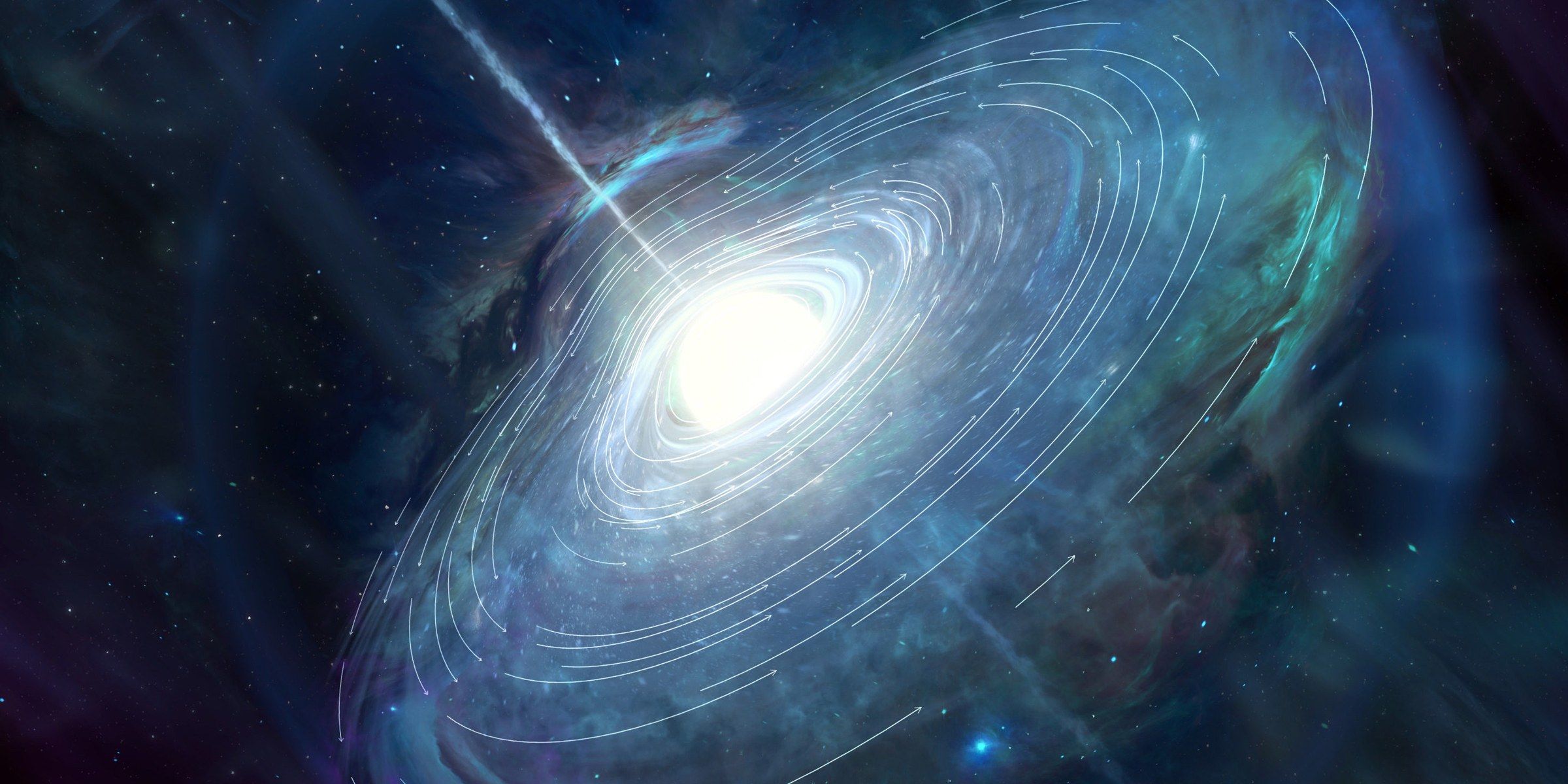
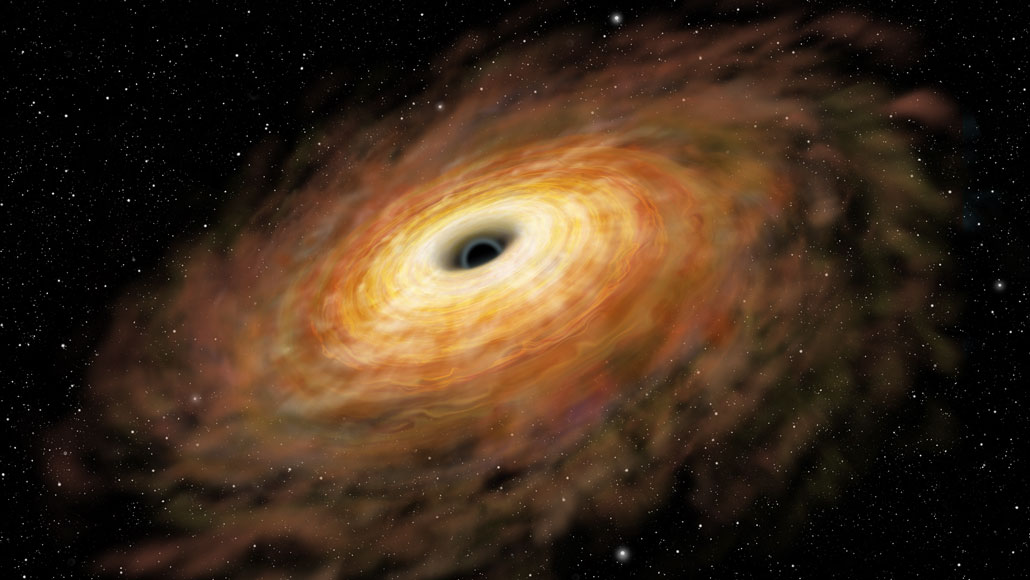
We now know that all galaxies have supermassive black holes at their centers; some billions of times the mass of the Sun. When material gets too close, it forms an accretion disk around the black hole. It heats up to millions of degrees, blasting out an enormous amount of radiation. The magnetic environment around the black hole forms twin jets of material which flow out into space for millions of light-years. This is an AGN, an active galactic nucleus. Since our own Milky Way has a supermassive black hole, it’s likely that we have gone through many active stages, whenever material is falling into the black hole; our galaxy would be seen as a quasar. But other times, like now, the supermassive black hole is quiet.
Supermassive black holes aren’t always feeding. If a black hole runs out of food, the jets run out of power and shut down. Right up until something else gets too close, and the whole system starts up again. The Milky Way has a supermassive black hole at its center, and it’s all out of food. It doesn’t have an active galactic nucleus, and so, we don’t appear as a quasar to some distant galaxy. With new powerful telescopes, astronomers have observed that some quasars have long jets of material firing out from the center of the galaxy. These are channeled by the magnetic fields created by the supermassive black hole’s rotation in the accretion disk. The most luminous quasars can exceed the radiation output of an average quasar. We may have in the past, and may again in the future. In 10 billion years or so, when the Milky way collides with Andromeda, our supermassive black hole may roar to life as a quasar, consuming all this new material.
Sir Richard Charles Nicholas Branson (born 18th July 1950), soon going to be 71, is an English business tycoon, investor, author and now a commercial astronaut. He founded the Virgin Group in the 1970s which today controls more than 400 companies in various fields. Branson desired to be an entrepreneur from a very young age. His first business venture, at the age of 16, was a magazine called Student. In 1970, he set up a mail-order record business. He opened a chain of record stores, Virgin Records—later known as Virgin Megastores—in 1972. Virgin Group Ltd. is a British multinational venture capital conglomerate founded in February 1970. Branson’s Virgin brand grew rapidly during the 1980s, as he started Virgin Atlantic airline and expanded the Virgin Records music label. In 1997, Branson founded the Virgin Rail Group to bid for passenger rail franchises during the privatisation of British Rail. The Virgin trains brand operated the Inter City West Coast franchise from 1997 to 2019. In 2004, he founded spaceflight corporation Virgin Galactic, based in California, noted for the SpaceShipTwo suborbital spaceplane designed for space tourism. In 2006, he founded Virgin Comics LLC, stating that Virgin Comics will give “a whole generation of young, creative thinkers a voice”. In 2014, Branson and Virgin StartUp launched the “Foodpreneur” food and drink focused start-up competition. Winners received mentorship from Branson, legal support, and brand counseling.
The name “Virgin” arose when Richard Branson and Nik Powell formed a record shop. It was suggested by one of the earliest employees as thy were all new to business. They considered themselves virgins in business. Virgin StartUp is the Virgin Group’s not-for-profit company, helping entrepreneurs across the UK to start, fund and scale their business.
World record attempts
1986: Fastest Ocean Crossing; he beat the record by two hours with sailing expert Daniel McCarthy.
1991 Branson crossed the Pacific from Japan to Arctic Canada, 6,700 miles, in a balloon of 2,600,000 cubic feet. This broke the record, with a speed of 145 miles per hour.
1998: made a record-breaking flight from Morocco to Hawaii but were unable to complete a global flight
2004, Branson set a record by travelling from Dover to Calais in a Gibbs Aquada in 1 hour, 40 minutes and 6 seconds, the fastest crossing of the English Channel in an amphibious vehicle.
His latest feat includes him becoming the first billionaire founder of a space company to travel to the edge of space. a flight. On July 11, 2021 Branson along with Beth Moses, Sirisha Bandla (the third Indian American woman to fly into space) and Colin Bennett and reached edge of space (86 kilometers or 53 miles) on a Virgin Galatic spacecraft called VSS Unity.
Warning! Spoilers ahead for The Flash season 7 episode 16, “P.O.W.”
The Flashseason 7 is barreling towards its two-part finale and Iris West-Allen’s latest storyline could bring back the Arrowverse’s multiverse following its collapse in Crisis on Infinite Earths. Time and interdimensional travel have been heavily utilized in the shared universe ever since The Flash unlocked the titular character’s abilities to move backwards and forwards in time. The team’s trip to Earth-2 opened up yet another gateway to traversing the multiverse. While Crisis on Infinite Earths changed that for good, Iris’ situation could unlock the multiverse once again.
Iris has been noticeably absent from two episodes of The Flash. In season 7’s episode 15, Barry revealed she wasn’t feeling well and was recovering from a bout of illness at home. In the following episode, however, Iris confirmed what she was experiencing was far more than a regular cold; when she sneezed, her eyes briefly and startlingly flashed green before returning to their normal color afterward. Why the illness is affecting Iris in this way remains unclear, but her symptoms have led her molecules to become unstable, inducing headaches and time displacement.
At the end of the episode, Nora West-Allen confirms that Iris will be okay, but there’s no telling when her symptoms will clear up or what will happen before they do. That said, it’s possible Iris moving in and out of the timeline could play a crucial role in the future of the multiverse and the reason for her predicament may be hiding in plain sight.
Iris Is Phasing In & Out Of The Timeline
Iris’ absence from The Flash season 7’s episode 15 was suspicious, especially since it involved a possible pregnancy storyline that was happening without her. In the following episode, however, fans learned why Iris has been absent. As it turns out, her cold wasn’t a normal one and it was somehow causing her to phase in and out of the timeline. It got so bad apparently that Deon, the Still Force, swooped in to protect Iris by using his abilities to stabilize her from phasing through various temporal planes, moving her to “pure temporal strains” to keep her alive. If it wasn’t for Deon, Iris would have fractured through time itself, which doesn’t sound very pleasant and could have unprecedented repercussions.
This subplot creates an interesting twist considering everything happening on The Flash right now. Between what’s going on with Iris, the Godspeed clones, August Heart — who originated as Godspeed in 2049 pre-Crisis on Infinite Earths — coming into the picture, and Barry dreaming about Nora telling him there seems to be something wrong in the future, Iris’ timeline instability may be the one thing connecting each of these separate storylines. That said, the reason why she’s suddenly phasing in and out of the timeline has yet to be confirmed on the show, but all roads seem to be leading back to one cause.
Iris Being Pregnant Is Causing Her To Be Unstuck From Time
Barry and Iris have been trying to conceive for a few episodes now. After Barry dreamed about Nora the first time, he assumed Iris was pregnant only for the results of the test to come back negative. However, this could have been a false negative. Considering that Iris’ presence in the timeline has been unstable, it’s possible that she is already pregnant and doesn’t realize it. What’s more, being pregnant with speedster babies won’t follow the same patterns of a normal pregnancy and it’s possible that Iris carrying metahumans is causing her to be unstuck from time. Her phasing in and out of the timeline could be The Flash’s equivalent to morning sickness.
This could also explain why she will be able to regain her speedster powers in the season 7 finale. In the comics, Iris phases back and forth in time because it’s revealed she is actually from the future and was sent back to the 20th century by her birth parents. The Flashshowrunner Eric Wallace has teased this storyline coming into play, but like with all things that make their way onto the show, it will probably be a loose adaptation from the comics storyline it’s based on. Traveling between timelines because of a pregnancy might be the closest the series gets to this particular comics arc in this instance.
Jay Garrick’s The Flash Return Hints At Alternate Earths Connection
Jay Garrick (aka, The Flash of Earth-3) was last seen prior to Crisis on Infinite Earths, warning Barry of the impending doom facing the multiverse. However, the speedster didn’t participate in the crossover, nor was he confirmed to be alive in the aftermath that saw the multiverse rebooted and Earth-1 merge with others (including Supergirl’s Earth-38) to become Earth-Prime. Jay will be appearing in The Flash’s two-part season 7 finale to aid in the Godspeed clone war. How his reappearance will be explained remains to be seen, but it’s possible he will show up courtesy of Iris’ temporal phasing. Jay originally hails from Earth-3 and his return to The Flash coinciding with Iris being able to phase through time (and maybe dimensions) could be connected. Iris may be acting as the bridge between Earth-Prime and Jay’s world without even realizing, and the superhero series might confirm that he is now from Stargirl’s Earth-2 instead.
Theory: Iris’ Temporal Phasing Brings Back The Multiverse
In The Flash season 6, Nash Wells detected particles of Eternium, an interdimensional (and multiversal) element, on Iris prior to the events of Crisis on Infinite Earths. At the time, nothing much came of it, just another tease that seemed to lead nowhere. However, this could come back into play now that Iris is phasing through temporal planes in season 7. It’s possible the combination of Eternium and her moving in and out of time now allows her to connect to not only different time periods on Earth-Prime, but alternate universes as well. Perhaps before she is finally stabilized, Iris will indeed fracture through time and that’s what breaks the barrier separating Earth-Prime from the rest of the multiverse, which has remained a secret post-Crisis.
Namely, Iris’ temporal instability could alert her and The Flash to the fact there are still other worlds out there despite the collapse of the multiverse during Crisis. After all, Stargirl exists on the rebooted Earth-2 and it’s been confirmed that Jay Garrick will make an appearance on the series in its sophomore season. And so Iris’ temporal imbalance could open the gateway to interdimensional travel once more, reestablishing the connection between Earth-Prime and other earths. There has to be a reason for why Nash detected Eternium on her. All of this could also be setting up The Flash’s five-episode crossover event in the fall. Whatever the reasons behind Iris’ phasing in and out of time, the introduction of this storyline for her could finally tie together so many loose plot threads for The Flash and the Arrowverse at large.
As far as we currently know, there is a single expanding blob of spacetime speckled with trillions of galaxies – that’s our Universe. If there are others, we have no compelling evidence for their existence.
That said, theories of cosmology, quantum physics, and the very philosophy of science have a few problems that could be solved if our blob of ‘everything’ wasn’t, well, everything.
That doesn’t mean other universes must exist. But what if they do?
What is a universe?
It should be a simple question to answer. But different areas of science will have subtly different takes on what a universe even is.
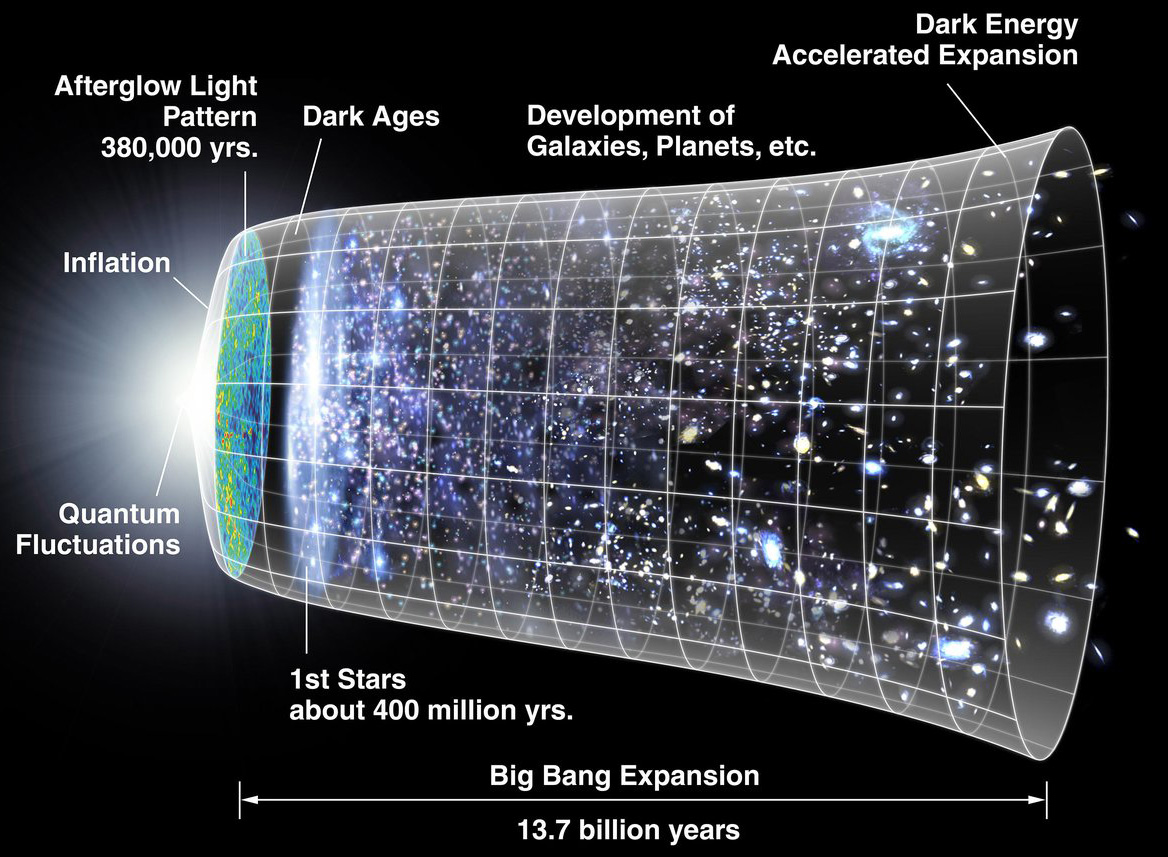
Cosmologists might say it describes the total mass of stuff (and the space in between) that has been slowly expanding from a highly concentrated volume over the past 13.77 billion years, becoming increasingly disordered with age.
It now stretches 93 billion light years from edge to edge, at least based on all of the visible (and invisible) stuff we can detect in some way. Beyond that limit, there are either things we can’t see, an infinite expanse of nothingness, or – in the unlikely scenario that all of space bends back around on itself – a round-trip back to the start across a hyperspherical universe.
If we’re talking quantum physics, though, a universe might refer to all fields and their particles, and their combined influences over one another. As a general rule, a universe (like ours, at least) is a closed system, meaning it can’t suddenly lose or gain a significant sum of energy.
Philosophically speaking, a universe might be a discrete set of fundamental laws that governs the behavior of everything we observe. A universe would be defined by its own rules that set its unique speed for light, tell particles how to push or pull, or space how it should expand.
What is a multiverse in cosmology?
A century of astronomical observations has told us a lot about the age, size, and evolution of galaxies, stars, matter and the four dimensions we sum up as spacetime.
We can theoretically squeeze all of the matter of the Universe down to a point where the concentration of energy reduces atoms to a soup of simpler particles and forces combine until we can’t tell them apart. Any smaller than that? Big shrugs.
If we go with what’s known as a cyclic model of cosmology, the parent universe preceded ours in some way. It might even be a lot like this one, only running in reverse compared with ours, shrinking over time into a concentrated point only to bounce back out for some reason. Played out for eternity, we might imagine the respective universes bounce back and forth in an endless yo-yo effect of growing and collapsing.
Or, if we go with what’s known as a conformal cyclic model, universes expand over trillions upon trillions of years until their cold, point-like particles are so spread out, for all mathematical purposes everything looks and acts like a brand new universe.
If you don’t like those, there’s a chance our Universe is a white hole – the hypothetical back end of a black hole from another universe. Which, logically, just might mean the black holes in our Universe could all be parents, pinching off new universes like cosmic amoebae.
What is a multiverse in quantum physics?
Early last century, physicists found theories that described matter as tiny objects only told half of the story. The other half was that matter behaved as if it also had characteristics of a wave.
Exactly what this dual nature of reality means is still a matter of debate, but from a mathematical perspective, that wave describes the rise and fall of a game of chance. Probability, you see, is built into the very machinery that makes up the gears of a universe like ours.
Of course, this isn’t our daily experience as vast collections of atoms. When we send a bucket of molecules called a rocket to the Moon as it zooms past 300,000 kilometres away, we’re not rolling dice. Classical old physics is as reliable as tomorrow’s sunrise.
But the closer we zoom in on a region of space or time, the more we need to take into account the possible range of measurements we might find.
This randomness isn’t the result of things we don’t know – it’s because the Universe itself is yet to make up its mind. There’s nothing in quantum mechanics explaining this transition either, leaving us to imagine what it all means. https://www.youtube.com/embed/dzKWfw68M5U?ab_channel=PBSSpaceTime
In his 1957 doctoral dissertation, American physicist Hugh Everett suggested the range of possibilities are all as real as one another, representing actual realities – separate universes, if you like – just like the one we’re all familiar with.
What makes any one universe in this many worlds interpretation distinct is how each wave correlates with a specific measurement taken of other waves, a phenomenon we call entanglement.
What ‘we’ means, and why ‘we’ experience one entangled set over waves over another, isn’t clear, and in some ways presents an even bigger problem to solve.
What is a multiverse in philosophy?
One of science’s most fundamental starting assumptions is that in spite of what your mother tells you, you’re not special. Nor is any other human, or our planet, or – by extension – our Universe.
While rare events occur from time to time, we don’t answer The Big Questions with ‘it just happened that way’.
So why does our Universe seem to have just the right tug-of-war of forces that allow not just particles to appear, but to congeal for long enough periods into atoms that can undergo complex chemistry to produce thinking minds like ours?
Philosophically speaking, the anthropic principle (or principles, since there are many different ways to spin the idea) suggests we might have it backwards. Without these conditions, no minds would have arisen to consider the amazing turn of events.
If just a single universe ‘just happened that way’ early one spring morning, it’d be one big coincidence. Too big really.
But if there were infinite universes, with infinite combinations of forces pushing and pulling, some would inevitably give rise to minds that just might ask ‘are we part of a multiverse?’
Will we ever discover other universes?
Given the very definition of a universe relies on some kind of physical fence keeping influencing factors apart, it’s hard to imagine ways we might ever observe the existence of a sibling for our universe. If we did, we might as well see it as an extension of our own Universe anyway.
That said, there could be some cheats that could give us a glimpse.
Any experiment to find one would have to rely on that ‘fence’ having some holes in it that allow particles or energy to leak across, either into ours, or away from it. Or, in the case of universes existing in our past, monumental events that left enough of a scar that not even a rebirth could erase.
For now, we still have no good reason to think our blob of everything is anything but unique. Given we’re still learning how our own Universe works, the current gaps in physics could yet be plugged without any need to imagine a reality other than ours.
In countless other versions of this article scattered throughout the multiverse, however, the question of whether we are alone just might have a different answer.
On July 11, Virgin Galactic will make a giant leap toward commercial suborbital spaceflight. The company will launch its first fully crewed flight of its SpaceShipTwo space plane Unity with a special passenger on board: the company’s billionaire founder Richard Branson.
Branson, three crewmates and two pilots will launch on the historic flight after being carried into launch position by Virgin Galactic’s carrier plane VMS Eve. They will take off from the company’s homeport of Spaceport America in New Mexico, with a live webcast chronicling the flight. Here’s everything you need to know about the mission, which Virgin Galactic has dubbed Unity 22.
WHAT TIME IS VIRGIN’S GALACTIC LAUNCH & AND CAN I WATCH?
Virgin Galactic has not released a specific time for the actual Unity 22 launch, but the company has announced it will begin webcasting the mission at 9 a.m. EDT (1300 GMT). And it looks like it’s going to be fun. The crew will walk out to the ship about an hour earlier.
Stephen Colbert, host of The Late Show on CBS, will host the webcast along with singer Khalid (who will debut a new single during the launch), former Canadian Space Agency astronaut Chris Hadfield and future Virgin Galactic astronaut Kellie Gerardi, who will launch on a research flight in 2022.
The webcast will begin with the Unity spacecraft and its carrier plane taking off from its runway at Spaceport America, which is located 55 miles (88 kilometers) north of Las Cruces, New Mexico.
Branson has stated that the entire flight will take about 90 minutes, including the ascent up to launch position, release, flight to space and glide back to Earth for a runway landing at Spaceport America.
Virgin Galactic will launch six people on the Unity 22 flight, although the spacecraft is designed to carry up to eight people (two pilots and six passengers).
Unity 22’s crew includes four mission specialists:
Sirisha Bandla, Vice President of Government Affairs and Research Operations at Virgin Galactic. She will evaluate the human-tended research experience via an experiment from the University of Florida that requires several handheld fixation tubes to be activated at various points in the flight profile.
Colin Bennett, Lead Operations Engineer at Virgin Galactic. He will evaluate cabin equipment, procedures and the experience during the boost phase and weightless environment inside Unity.
Sir Richard Branson, founder of Virgin Galactic. Branson will evaluate the private astronaut experience. He will receive the same training, preparation and flight as Virgin Galactic’s future ticket-buying astronauts and use the flight to fine ways to enhance the experience for customers.
Beth Moses, Chief Astronaut Instructor at Virgin Galactic. She will serve as cabin lead and test director in space. Her tasks include overseeing the safe execution of the test flight objectives. Moses has launched on Unity before.
Two veteran Virgin Galactic pilots will be at the helm of Unity during the launch. They have both launched to space on Unity before and are:
Dave Mackay: Mackay is Virgin Galactic’s chief pilot and grew up in the highlands of Scotland. He is a former Royal Air Force pilot and flew for Branson’s airline company Virgin Atlantic before joining Virgin Galactic.
Michael Masucci: Michael “Sooch” Masucci is a retired U.S. Air Force colonel who joined Virgin Galactic in 2013 who racked up over 9,000 flying hours in 70 different types of airplanes and gliders during more than 30 years of civilian and military flight.
Two other pilots will fly the VMS EVE carrier plane that will carry SpaceShipTwo into launch altitude. They are:
Frederick “CJ” Sturckow: A former NASA space shuttle commander who joined Virgin Galactic in 2013 with Masucci. A retired Marine Corps colonel, he was the first NASA astronaut to join the company and flew four space shuttle missions.
Kelly Latimer: Latimer is a test pilot and retired lieutenant colonel in the U.S. Air Force who joined Virgin Galactic’s pilot corps in 2015. She was the first female research test pilot to join what is now NASA’s Armstrong Flight Research Centre.
The primary objective for Unity 22 is to serve as a test flight for future passenger flights by Virgin Galactic. As its number suggests, this will be the 22nd flight of Unity, but only its fourth launch to space.
The four mission specialists will each evaluate different experiences that Virgin Galactic has promised its future customers, many of whom have already reserved trips to space with the company at $250,000 a seat.
Bandla, for example, will test the experience of performing experiments aboard Unity during different phases of the flight, including the weightless period. Branson will take note of the flight as a paying passenger to look for ways to enhance the trip for ticket holders looking for the experience of a lifetime.
Moses is Virgin Galactic’s Chief Astronaut Trainer and will ensure everyone is safe in their tests while Bennet will examine Unity’s cabin performance to look for potential enhancements.
This mission is a critical flight or Virgin Galactic, which Branson founded in 2004. VSS Unity is the company’s second SpaceShipTwo after the first, VSS Enterprise, broke apart during a 2014 test flight, killing one pilot and seriously injuring another. Virgin Galactic has made numerous safety upgrades to prevent such an accident from happening again.
The mission will begin with takeoff from Spaceport America, where Virgin Galactic has built its “Gateway to Space” terminal to serve its future customers. The crews of Unity and Eve will walk out to their vehicles at about 8 a.m. EDT (6 a.m. local time, 1200 GMT). They’ll be wearing custom Under Armour flight suits made for Virgin Galactic.
After takeoff, the carrier plane VMS EVE will haul the SpaceShipTwo VSS Unity (short for Virgin Space Ship) to an altitude of about 50,000 feet (15,000 meters), when it will drop the the spacecraft.
Virgin Galactic’s first test passenger Beth Moses looks out the window of the VSS Unity during a test flight with pilots Dave Mackay and Michael “Sooch” Masucci, on Feb. 22, 2018. (Image credit: Virgin Galactic)
After separation, Unity will ignite its hybrid rocket motor, which uses a mixture of solid and liquid propellant, to begin the boost phase. This will carry Unity to its target altitude above 50 miles (80 kilometers), where the pilots and crew can expect up to 4 minutes of weightlessness. They will exist their seats and enjoy sweeping views of the Earth below through the many round windows that dot the space plane’s fuselage.
After that short encounter with weightlessness, the crew will climb back into their seats as Unity prepares to return to Earth. Pilots Mackay and Masucci will have “feathered” the spacectraft’s twin tail booms to provide stability during atmospheric reentry.
The feathered tail will then be locked back into place for the glide back to Earth, which will end with a runway landing at Spaceport America. The entire flight, from takeoff to landing, should last about 90 minutes, Branson has said.
WILL VIRGIN GALACTIC REALLY REACH SPACE WITH UNITY 22?
Virgin Galactic’s VSS Unity spaceliner captured this view of Earth during the vehicle’s first trip to space, on Dec. 13, 2018. (Image credit: Virgin Galactic)
Virgin Galactic will launch Unity to an altitude above 50 miles (80 km), which NASA, the Federal Aviation Administration and the U.S. military classify as space. They will earn astronaut wings for reaching that height.
Another widely recognized boundary of space, the Kármán line, is at an altitude at 62 miles (100 km) above Earth. The SpaceShipTwo VSS Unity won’t reach this milestone, which has led Virgin Galactic’s competitor Blue Origin (which does fly higher than 62 miles) to call out Virgin Galactic for missing that mark.
WHERE DOES VIRGIN GALACTIC LAUNCH SPACESHIPTWO FROM?
Click here for more Space.com videos…Sorry, the video player failed to load.(Error Code: 101102)Advertisementhttps://e42edf55977935dba9fbedb9fb4dde49.safeframe.googlesyndication.com/safeframe/1-0-38/html/container.html
Virgin Galactic initially launched SpaceShipTwo test flights from the company’s facilities at Mojave Air and Space Port in California. However, in 2020 the company moved Unity and its carrier craft to its permanent home at Spaceport America, where it plans to fly regular passenger flights beginning in 2022.
Spaceport America is located near Las Cruces, New Mexico and is home to Virgin Galactic’s “Gateway to Space” terminal, a welcome center and waiting room for ticketed passengers preparing for trips to space. It also sports a large hangar designed to fit multiple SpaceShipTwo spaceplanes and the VMS Eve. Virgin Galactic has also built a new vehicle, the SpaceShip III VSS Imagine.
WHEN COULD I LAUNCH TO SPACE WITH VIRGIN GALACTIC?
If you booked a trip with Virgin Galactic early and have one of the first reservations, you may get your chance to fly in space as early as 2022. If not, there’s a long wait ahead. And that’s assuming you can afford the $250,000 ticket price.
Virgin Galactic has said it plans to begin passenger launches in 2022 after a series of final test flights in 2021. The company does have hundreds of reservations for customer flights in backlog from eager would-be astronauts that have been waiting for over 17 years (since Richard Branson first announced Virgin Galactic in 2004) for the SpaceShipTwo to finally fly. The company paused taking new reservations after the 2014 accident.
Virgin Galactic is expected to resume taking reservations for “a limited number of tickets for future spaceflights” sometime this year, according to its website.
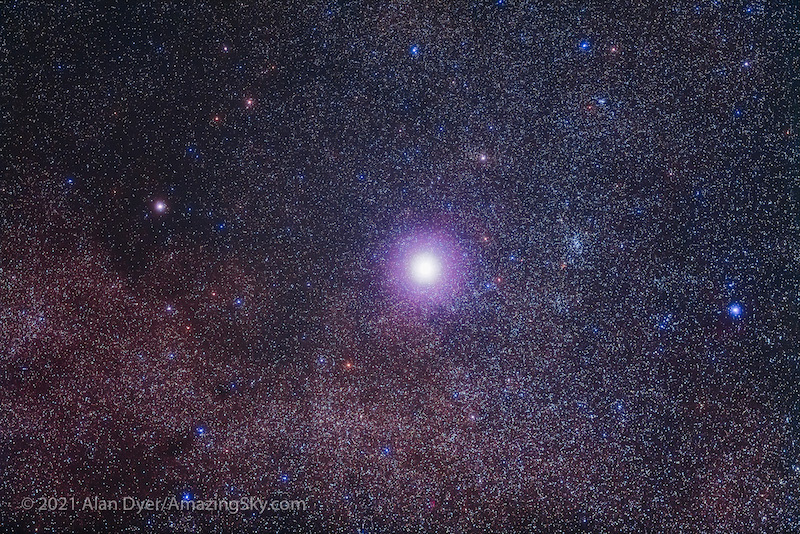
Alpha Centauri is the third-brightest star in our night sky – a famous southern star – and the nearest star system to our sun. Through a small telescope, the single star we see as Alpha Centauri resolves into a double star. This pair is just 4.37 light-years away from us. In orbit around them is Proxima Centauri, too faint to be visible to the unaided eye. At a distance of 4.25 light years, Proxima is the closest-known star to our solar system. Science of the Alpha Centauri system. The two stars that make up Alpha Centauri, Rigil Kentaurus and Toliman, are quite similar to our sun. Rigil Kentaurus, also known as Alpha Centauri A, is a yellowish star, slightly more massive than the sun and about 1.5 times brighter. Toliman, or Alpha Centauri B, has an orangish hue; it’s a bit less massive and half as bright as the sun. Studies of their mass and spectroscopic features indicate that both these stars are about 5 to 6 billion years old, slightly older than our sun.
Alpha Centauri A and B are gravitationally bound together, orbiting about a common center of mass every 79.9 years at a relatively close proximity, between 40 to 47 astronomical units (that is, 40 to 47 times the distance between the Earth and our sun).Must Watch Sky Events in 2021
In comparison, Proxima Centauri is a bit of an outlier. This dim reddish star, weighing in at just 12 percent of the sun’s mass, is currently about 13,000 astronomical units from Alpha Centauri A and B. Recent analysis of ground- and space-based data, published in 2017, has shown that Proxima is gravitationally bound to its bright companions, with a 550,000-year-long orbital period.
Proxima Centauri belongs to a class of low mass stars with cooler surface temperatures, known as red dwarfs. It’s also what’s know as a flare star, where it randomly displays sudden bursts of brightness due to strong magnetic activity.
In the past decade, astronomers have been searching for planets around the Alpha Centauri stars; they are, after all, the closest stars to us so the odds of detecting planets, if any existed, would be higher. So far, two planets have been found orbiting Proxima Centauri, one in 2016 and another in 2019. A paper published in February 2021 reported tantalizing evidence of a Neptune-sized planet around Alpha Centauri A, but so far, it has not been definitively confirmed.
How to see Alpha Centauri. Unluckily for many of us in the Northern Hemisphere, Alpha Centauri is located too far to the south on the sky’s dome. Most North Americans never see it; the cut-off latitude is about 29° north, and anyone north of that is out of luck. In the U.S. that latitudinal line passes near Houston and Orlando, but even from the Florida Keys, the star never rises more than a few degrees above the southern horizon. Things are a little better in Hawaii and Puerto Rico, where it can get 10° or 11° high.
But for observers located far enough south in the Northern Hemisphere, Alpha Centauri may be visible at roughly 1 a.m. (local daylight saving time) in early May. That is when the star is highest above the southern horizon. By early July, it reaches its highest point to the south at nightfall. Even so, from these vantage points, there are no good pointer stars to Alpha Centauri. For those south of 29° N. latitude, when the bright star Arcturus is high overhead, look to the extreme south for a glimpse of Alpha Centauri.
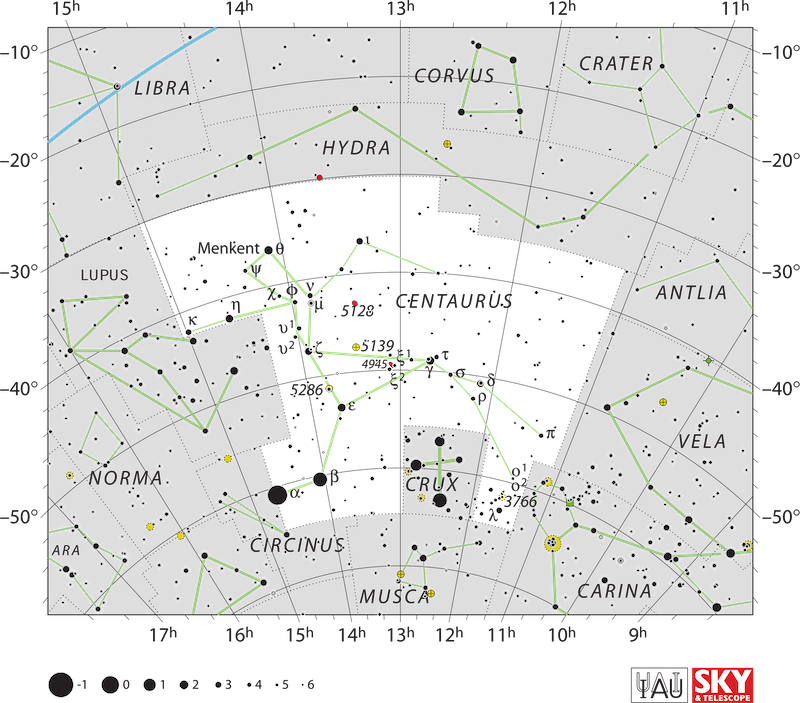
The southern constellation Centaurus. Image via Wikimedia/ International Astronomical Union/ SkyandTelescope.com.
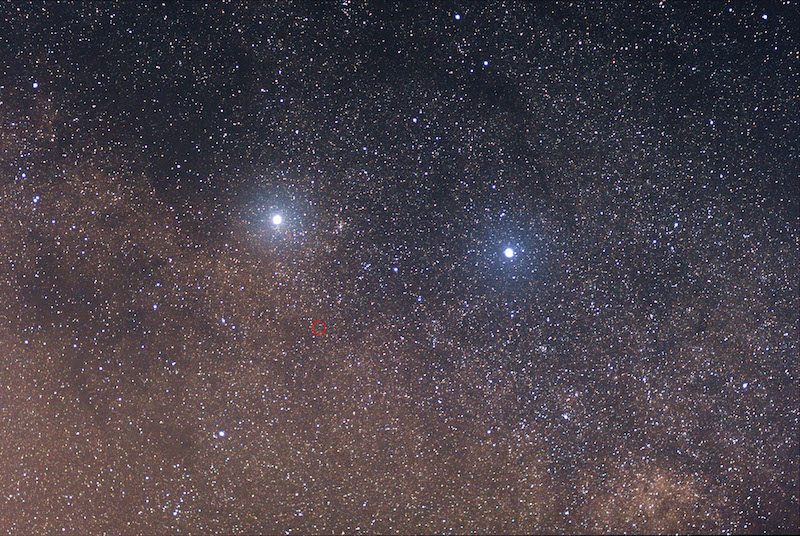
Observers in the tropical and subtropical regions of the Northern Hemisphere can find Alpha Centauri by first identifying the distinctive Southern Cross. A short line drawn through the crossbar (Delta and Beta Crucis) eastward first comes to Hadar (Beta Centauri), then Alpha Centauri. Meanwhile, in Australia and much of the Southern Hemisphere, Alpha Centauri is circumpolar, meaning that it never sets.
In this image taken at the European Southern Observatory’s La Silla Observatory in Chile, the Southern Cross is clearly visible, with the yellowish star, closest to the dome, marking the top of the cross. Drawing a line downward through the crossbar stars takes you to the bluish star, Beta Centauri, and then to the yellowish Alpha Centauri. Image via ESO / Wikimedia Commons.
Alpha Centauri in mythology. Alpha Centauri has played a prominent role in the mythology of cultures across the Southern Hemisphere. For the Ngarrindjeri indigenous people of South Australia, Alpha and Beta Centauri were two sharks pursuing a sting ray represented by stars of the Southern Cross. Some Australian aboriginal cultures also associated stars with family relationships and marriage traditions; for instance, two stars of the Southern Cross were through to be the parents of Alpha Centauri.
Astronomy and navigation were deeply intertwined in the lives of ancient seafaring Polynesians as they sailed between islands in the vast expanse of the South Pacific. These ancient mariners navigated using the stars, with cues from nature such as bird movements, waves, and wind direction. Alpha Centauri and nearby Beta Centauri, known as Kamailehope and Kamailemua, respectively, were important signposts used for orientation in the open ocean.
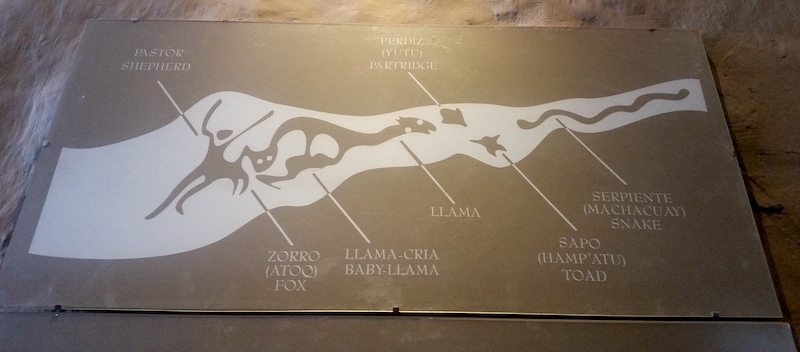
For ancient Incas, a llama graced the sky, traced out by stars and dark dust lanes in the Milky Way from Scorpius to the Southern Cross, with Alpha Centauri and Beta Centauri representing its eyes.
A plaque at the Coricancha museum showing Inca constellations. Coricancha, located in Cusco, Peru, was perhaps the most important temple of the Inca empire. Image via Pi3.124 / Wikimedia Commons.
Ancient Egyptians revered Alpha Centauri, and may have built temples aligned to its rising point. In southern China, it was part of a star group known as the South Gate.
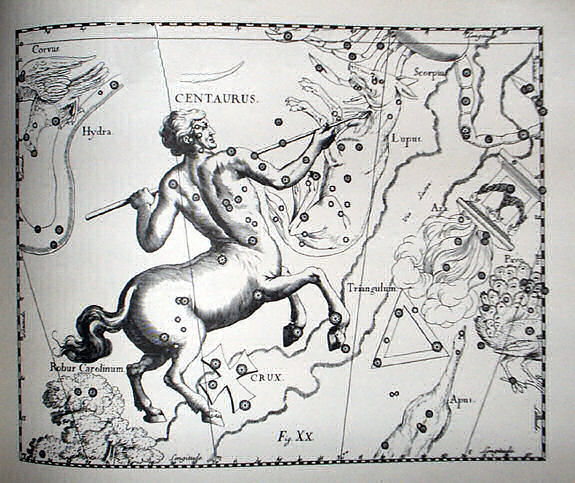
Alpha Centauri is the brightest star in the constellation Centaurus, named after the mythical half human, half horse creature. It was thought to represent an uncharacteristically wise centaur that figured in the mythology of Heracles and Jason. The centaur was accidentally wounded by Heracles, and placed into the sky after death by Zeus. Alpha Centauri marked the right front hoof of the centaur, although little is known of its mythological significance, if any.
A depiction of the Centaur by Polish astronomer Johannes Hevelius in his atlas of constellations, Firmamentum Sobiescianum, sive Uranographia. Image via Wikimedia Commons.
Alpha Centauri’s position is RA: 14h 39m 36s, Dec: -60° 50′ 02″
Bottom line: Alpha Centauri is actually two binary stars that are quite similar to our sun. A third star that’s gravitationally bound to them is Proxima Centauri, the closest star to our sun.
NASA’s Kepler mission has confirmed the first near-Earth-size planet in the “habitable zone” around a sun-like star. This discovery and the introduction of 11 other new small habitable zone candidate planets mark another milestone in the journey to finding another “Earth.”
The newly discovered Kepler-452b is the smallest planet to date discovered orbiting in the habitable zone — the area around a star where liquid water could pool on the surface of an orbiting planet — of a G2-type star, like our sun. The confirmation of Kepler-452b brings the total number of confirmed planets to 1,030.
“On the 20th anniversary year of the discovery that proved other suns host planets, the Kepler exoplanet explorer has discovered a planet and star which most closely resemble the Earth and our Sun,” said John Grunsfeld, associate administrator of NASA’s Science Mission Directorate at the agency’s headquarters in Washington. “This exciting result brings us one step closer to finding an Earth 2.0.”
Kepler-452b is 60 percent larger in diameter than Earth and is considered a super-Earth-size planet. While its mass and composition are not yet determined, previous research suggests that planets the size of Kepler-452b have a good chance of being rocky.
Highlighted are 12 new planet candidates from the seventh Kepler planet candidate catalog that are less than twice the size of Earth and orbit in the stars’ habitable zoneCredits: NASA Ames/W. StenzelTwelve New Small Kepler Habitable Zone Candidates
There are 4,696 planet candidates now known with the release of the seventh Kepler planet candidate catalog – an increase of 521 since the release of the previous catalog in January 2015.Credits: NASA/W. StenzelRead more…
While Kepler-452b is larger than Earth, its 385-day orbit is only 5 percent longer. The planet is 5 percent farther from its parent star Kepler-452 than Earth is from the Sun. Kepler-452 is 6 billion years old, 1.5 billion years older than our sun, has the same temperature, and is 20 percent brighter and has a diameter 10 percent larger.
“We can think of Kepler-452b as an older, biggercousin to Earth, providing an opportunity to understand and reflect upon Earth’s evolving environment,” said Jon Jenkins, Kepler data analysis lead at NASA’s Ames Research Center in Moffett Field, California, who led the team that discovered Kepler-452b. “It’s awe-inspiring to consider that this planet has spent 6 billion years in the habitable zone of its star; longer than Earth. That’s substantial opportunity for life to arise, should all the necessary ingredients and conditions for life exist on this planet.”
To help confirm the finding and better determine the properties of the Kepler-452 system, the team conducted ground-based observations at the University of Texas at Austin’s McDonald Observatory, the Fred Lawrence Whipple Observatory on Mt. Hopkins, Arizona, and the W. M. Keck Observatory atop Mauna Kea in Hawaii. These measurements were key for the researchers to confirm the planetary nature of Kepler-452b, to refine the size and brightness of its host star and to better pin down the size of the planet and its orbit.
The Kepler-452 system is located 1,400 light-years away in the constellation Cygnus. The research paper reporting this finding has been accepted for publication in The Astronomical Journal.
In addition to confirming Kepler-452b, the Kepler team has increased the number of new exoplanet candidates by 521 from their analysis of observations conducted from May 2009 to May 2013, raising the number of planet candidates detected by the Kepler mission to 4,696. Candidates require follow-up observations and analysis to verify they are actual planets.
Twelve of the new planet candidates have diameters between one to two times that of Earth, and orbit in their star’s habitable zone. Of these, nine orbit stars that are similar to our sun in size and temperature.
“We’ve been able to fully automate our process of identifying planet candidates, which means we can finally assess every transit signal in the entire Kepler dataset quickly and uniformly,” said Jeff Coughlin, Kepler scientist at the SETI Institute in Mountain View, California, who led the analysis of a new candidate catalog. “This gives astronomers a statistically sound population of planet candidates to accurately determine the number of small, possibly rocky planets like Earth in our Milky Way galaxy.”
These findings, presented in the seventh Kepler Candidate Catalog, will be submitted for publication in the Astrophysical Journal. These findings are derived from data publicly available on the NASA Exoplanet Archive.
Scientists now are producing the last catalog based on the original Kepler mission’s four-year data set. The final analysis will be conducted using sophisticated software that is increasingly sensitive to the tiny telltale signatures of Earth-size planets.
Ames manages the Kepler and K2 missions for NASA’s Science Mission Directorate. NASA’s Jet Propulsion Laboratory in Pasadena, California, managed Kepler mission development. Ball Aerospace & Technologies Corporation operates the flight system with support from the Laboratory for Atmospheric and Space Physics at the University of Colorado in Boulder.
For more information about the Kepler mission, visit:
For the past few years, scientists have been studying a dust cloud near the centre of our Milky Way Galaxy. If there is a God out there, it seems that he decided to get creative – this dust cloud , named Sagittarius B2, smells of rum and tastes like raspberries… This gas cloud consists largely of ethyl formate. This large cloud is said to contain a billion , billion, billion liters of the stuff, which would be great , if it wasn’t rendered undrinkable by pesky particles like propyl cyanide. The creation and distribution of these more complex molecules is still a mystery to scientists.
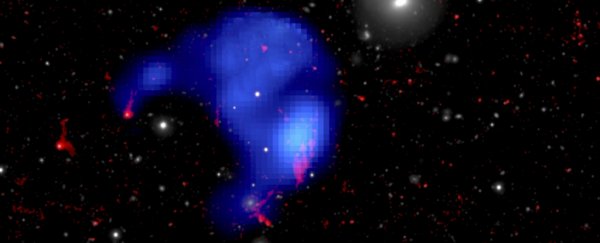
In the yawning vacuum of intergalactic space, something large is lurking.
Not a galaxy, although it’s of a comparable size: A vast cloud of hot, faintly glowing gas, bigger than the Milky Way, in the space between galaxies congregating in a huge cluster.
Scientists believe this cloud may have been unceremoniously stripped from a galaxy in the cluster, the first gas cloud of this kind we’ve ever seen. Even more surprisingly, it hasn’t dissipated, but has remained clumped together for hundreds of millions of years.
This not only tells us something new about the environments inside galaxy clusters, it suggests a new way to explore and understand these colossal structures.
“This is an exciting and also a surprising discovery. It demonstrates that new surprises are always out there in astronomy, as the oldest of the natural sciences,” said physicist Ming Sun of the University of Alabama in Huntsville.
Galaxy clusters are, as the name suggests, groups of galaxies that are bound together gravitationally. The galaxy cluster where our ‘orphan’ gas cloud was found is called Abell 1367, or the Leo Cluster, around 300 million light-years away. It contains at least 72 major galaxies, and makes up part of a larger, supercluster complex.
Such environments often have a lot going on, and astronomers like to peer into them to try and figure out how our Universe is connected. In 2017, astronomers using Japan’s Subaru Telescope spotted what appeared to be a small, warm cloud in Abell 1367; since its origin was unclear, they went back with more instruments to take a closer look.
A team led by astronomer Chong Ge of the University of Alabama in Huntsville used the ESA’s XMM-Newton X-ray telescope and the Multi Unit Spectroscopic Explorer (MUSE) on the Very Large Telescope, in addition to Subaru – and, to their surprise, they found X-ray emission showing the cloud was larger than they first thought.
Much larger, in fact – bigger than the Milky Way galaxy, with a mass around 10 billion times that of the Sun. And it didn’t seem to be associated with any known galaxy in the cluster. It was just drifting there. But the wealth of data allowed the researchers to take the the temperature of the gas, in turn providing clues as to its provenance.
The cloud’s temperature ranges between 10,000 and 10,000,000 Kelvin – consistent with gas that can be found within galaxies, the interstellar medium. The much more tenuous hot gas of the intracluster medium (the space between galaxies in the cluster) is hotter still, at around 100 million Kelvin.
This suggests that the cloud of gas was stripped from a galaxy as it moved through space.
“The gas in the cloud is removed by ram pressure of the hot gas in the cluster, when the host galaxy is soaring in the hot gas with a velocity of 1,000 to 2,000 kilometers [620 to 1,240 miles] per second,” Sun said.
“It is like when your hair and clothes are flying backward when you are running forward against a strong headwind. Once removed from the host galaxy, the cloud is initially cold and is evaporating in the host intracluster medium, like ice melting in the summer.”
This is fascinating, but kind of weird – because the researchers couldn’t find any nearby galaxies that could account for this occurring recently. Yet, if the gas had been ripped from its galaxy hundreds of millions of years prior, as this lack of proximity suggested, how had it not been diffused into the intracluster medium?
To work this out, the team performed calculations, and found that a magnetic field could hold the gas cloud together against the instabilities that ought to otherwise tear it apart, for long periods of time.
Given the high mass of the cloud, the team has inferred that the parent galaxy from which it was torn was a large and massive one. This could help them track down which galaxy it was; another clue could be traces of gas that extend from the cloud, which might point in the right direction.
In addition, now that one lonely cloud has been identified, scientists have a set of data that will help to identify other such clouds in the future. This will provide valuable information about intracluster dynamics, and the distribution of matter in galaxy clusters.
Plus, we now have observational evidence that the intracluster medium can divest galaxies of their gas.
“As the first isolated cloud glowing in both the H-alpha spectral line and X-rays in a cluster of galaxies, it shows that the gas removed from galaxies can create clumps in the intracluster medium, and these clumps can be discovered with wide-field optical survey data in the future,” Sun said.












 (
(





 Eduindex
You must be logged in to post a comment.