PM SVANidhi benefits over 57 lakh street vendors across country

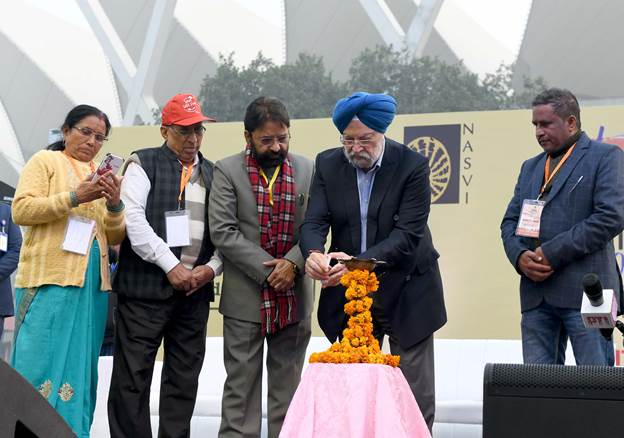
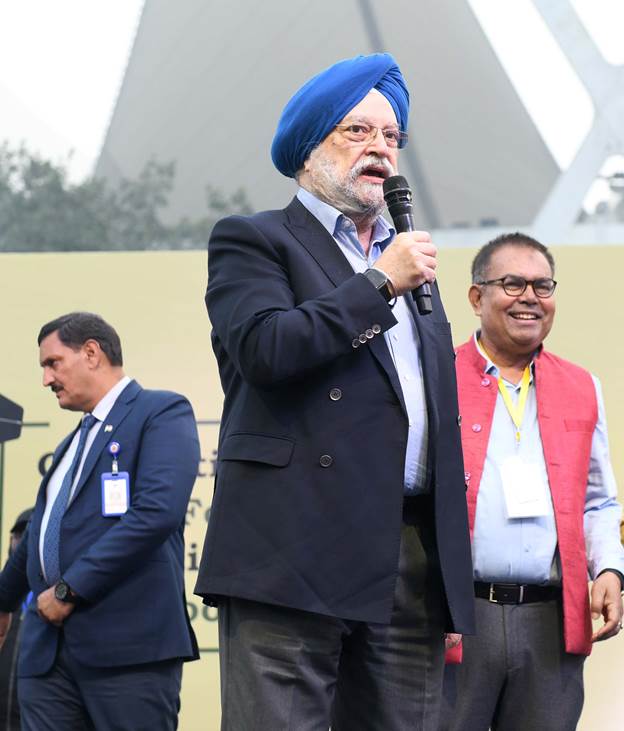
 Extending the best wishes to the vibrant community of street food vendors from across 28 states, Shri Hardeep Singh Puri, Minister of Housing & Urban Affairs and Petroleum & Natural Gas, inaugurated the National Street Food Festival 2023 here today. This street food festival is being organized by the National Association of Street Vendors of India (NASVI) from 29 December to 31 December 2023 at Jawaharlal Nehru Stadium.

While addressing the event, the Union Minister highlighted the role of Prime Minister Street Vendor’s AtmaNirbhar Nidhi (PM SVANidhi) Scheme in empowerment of street vendors. He said that the PM-SVANidhi scheme, launched during COVID pandemic, has become a beacon of hope for many. Over the past two years, it has disbursed substantial loans, facilitated digital transactions, and even opened doors to food delivery platforms. This has not only provided financial assistance but has also expanded the market reach for our street vendors.

Referring to the achievements of the scheme, the Minister informed that the scheme has benefitted 57.83 lakh street vendors. He said, 80.77 lakh loans have been sanctioned and 76.22 lakh loans worth Rs. 10,058 crores have been disbursed under the scheme. Further he noted that the percentage of women street vendors, who have received loans under the scheme is about 45 % (25.78 lakh) of all loans disbursed. Around 72% of the beneficiaries of PM SVANidhi are from marginalised sections, he noted.

This festival being the first ‘Zero Waste Street Food Festival’ in India, Shri Puri, congratulated the NASVI for conceptualising the programme in alignment with India’s Swachhata movement.

The Minister appreciated NASVI for providing training to 1,50,000 street vendors in food safety and hygiene. He also noted the establishment of two Regional Street Food Vendors Training Institutes (SVTI) which will be launched by NASVI in 2024 in Delhi and Patna. These institutes will not only provide training in culinary skills but will also prioritise food safety and hygiene, he said.

***

PM SVANidhi fostering entrepreneurship and stability among Street Vendors

 Shri Hardeep S. Puri, Minister for Housing and Urban Affairs and Petroleum and Natural Gas complimented the Prime Minster Street Vendor’s AtmaNirbhar Nidhi (PM SVANidhi) Scheme on its successful completion of 3 momentous years. The Minister stated that PM SVANidhi yojana is witnessing one of the fastest roll-outs of government schemes. He further stated that PM SVANidhi has led an unparalleled wave of financial inclusion and digital literacy in India’s cities and towns that has provided dignity and stability to Street Vendors.

PM SVANidhi Scheme launched on 01 June, 2020, aiming to restore Swarozgar, Svavlamban, Swabhimaan (Self Employment, Self-Sustenance, and Self-Confidence) within street vendors has become one of the fastest growing micro-credit schemes of the Government of India and has provided its citizens access to credit and linkages to social security schemes.

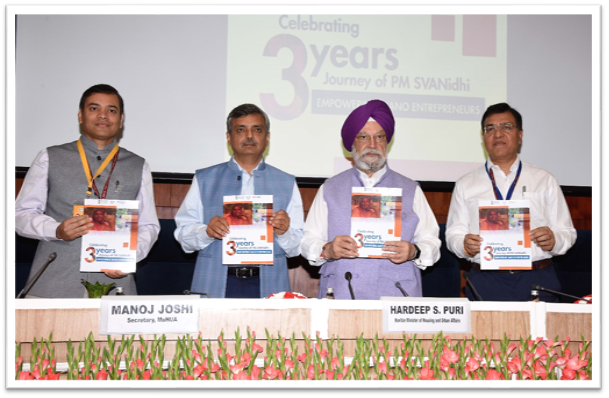
The Ministry of Housing and Urban Affairs (MoHUA) organised an event at Vigyan Bhawan to celebrate 3 years journey of PM Street Vendor’s AtmaNirbhar Nidhi (PM SVANidhi) Yojana, here today. The scheme has empowered COVID-19 affected street vendors to resume their livelihood. Not just that, it has achieved various milestones in financial inclusion and mainstreaming of street vendors. were highlighted. This scheme, launched amidst the pandemic, has made significant contributions to the lives of street vendors across the country.

During the event, a booklet highlighting the noteworthy achievements and initiatives implemented under the PM SVANidhi scheme was released. The booklet provides insights into the various initiatives and reforms undertaken by the scheme to transform the lives of street vendors and their families throughout the country. The event was attended by Shri Manoj Joshi, Secretary, MoHUA; Sh. Rajeev Jain, Addl. DG (Media); Sh. Rahul Kapoor, Jt. Secretary & Mission Director; and senior officials from Central Government, State Governments, Banks, Digital Payment Aggregators, key partners and the PM SVANidhi beneficiary Street Vendors.

In addition, the Minister launched a PM SVANidhi mobile app for street vendors, to ease the loan application process and provide various information to Street Vendors regarding the Scheme. Moreover, a facility for ‘Udyam’ registration and obtaining ‘Udyam Assist’ certificate for Street Vendors on PM SVANidhi portal was also launched with the help of Ministry of Small and Medium enterprises, MSME, to provide easy access to vendors for obtaining Udyam Registration Certificate for promotion of their business.

Further, States and lending Institutions which have shown good performance under the Scheme were also felicitated for their valuable contribution towards empowering the street vendors. Amongst the banks, State Bank of India, Bank of Baroda, and Union Bank of India were felicitated for offering large number of loans to street vendors. Amongst RRBs Andhra Pradesh Grameen Vikas Bank, and from State Cooperative banks Stree Nidhi Credit Cooperative Federation Ltd. were felicitated.

Shri Hardeep S. Puri, Minister, MoHUA also interacted with beneficiary Street Vendors of PM SVANidhi scheme and was apprised with the changes which the scheme has brought in their lives. He expressed his gratitude to all the stakeholders, including Central Ministries and State Governments, Urban Local Bodies, Lending Institutions, and partners for their enormous support and contribution to the success of the scheme.

PM SVANidhi scheme has achieved significant milestones over the past three years. The scheme facilitates working capital loans in three tranches to the Street Vendors. It has been providing microcredits to more than 36 lakh Street Vendors across India. As on June 30, 2023, 48.5 lakh loan applications have been sanctioned, with over 46.4 lakh loans disbursed to street vendors, amounting to a total of Rs. 5,795 crore. Digital on boarding and training have been a key component of the scheme and the Ministry is taking various efforts training all PM SVANidhi beneficiaries in making digital transactions and thus providing them social acceptance and dignity.

*******

"Main Bhi Digital 3.0" campaign aimed at digital onboarding of Street Vendors

 Digital onboarding and training of Street Vendors (SVs) is an integral part of PM Street Vendor’s AtmaNirbharNidhi (PM SVANidhi) Scheme.Lending Institutions (LIs) have been instructed to issue a durable QR Code & UPI ID at the time of disbursement and train the beneficiaries in conduct of digital transactions.

In order to give further impetus to the digital onboarding and training of beneficiaries, Ministry of Housing & Urban Affairs (MoHUA) and Ministry of Electronics & Information Technology (MeitY) jointly launched ‘Main Bhi Digital 3.0’from September 9 to November 30, 2021, to complement the efforts of LIs in adoption of digital transactions by the PM SVANidhi beneficiaries.

“Main Bhi Digital 3.0” campaign is aimed at digital onboarding of Street Vendors (SVs)who have already been provided loans under PM SVANidhi Scheme.

An Integrated IT Platform has been developed for implementation of this Scheme. The application process is fully online. SVs can apply for loan directly through PM SVANidhiPortal. The application can also be submitted at Municipal Offices and Common Service Centres (CSCs). In addition, the SVs can approach municipal functionaries or representatives of Lending Institutions to apply through PM SVANidhi mobile App.

PM SVANidhi Scheme is available to all street vendors across the country, including those from Dahod tribal area, who are engaged in vending in urban areas on or before March 24, 2020. InDahod Municipality of Gujarat, out of 868 beneficiaries of the scheme, 337 are from Scheduled Tribes Category.

"Main Bhi Digital 3.0" campaign aimed at digital onboarding of Street Vendors

 Digital onboarding and training of Street Vendors (SVs) is an integral part of PM Street Vendor’s AtmaNirbharNidhi (PM SVANidhi) Scheme.Lending Institutions (LIs) have been instructed to issue a durable QR Code & UPI ID at the time of disbursement and train the beneficiaries in conduct of digital transactions.

In order to give further impetus to the digital onboarding and training of beneficiaries, Ministry of Housing & Urban Affairs (MoHUA) and Ministry of Electronics & Information Technology (MeitY) jointly launched ‘Main Bhi Digital 3.0’from September 9 to November 30, 2021, to complement the efforts of LIs in adoption of digital transactions by the PM SVANidhi beneficiaries.

“Main Bhi Digital 3.0” campaign is aimed at digital onboarding of Street Vendors (SVs)who have already been provided loans under PM SVANidhi Scheme.

An Integrated IT Platform has been developed for implementation of this Scheme. The application process is fully online. SVs can apply for loan directly through PM SVANidhiPortal. The application can also be submitted at Municipal Offices and Common Service Centres (CSCs). In addition, the SVs can approach municipal functionaries or representatives of Lending Institutions to apply through PM SVANidhi mobile App.

PM SVANidhi Scheme is available to all street vendors across the country, including those from Dahod tribal area, who are engaged in vending in urban areas on or before March 24, 2020. InDahod Municipality of Gujarat, out of 868 beneficiaries of the scheme, 337 are from Scheduled Tribes Category.

Architecture is a Living Tapestry

“And of everything We have created in pairs.”

-The Holy Quran [51:49]

“Glory to Allah, who created in pairs all things that the earth produces, as well as their own(human) kind and (other) things of which they have no knowledge.”

-The Holy Quran [36:36]


No element on the life sustaining earth exists without its complement. For example, the complement of zero is one; solids and voids; light and dark; if one did not exist, the other would lose its meaning.
This refers to both in terms of the one who sustains as well as the energies sustaining them. The balance among the elements of the entire universe is maintained through the various visible as well as invisible energies which in turn exist in pairs.
The energy could be classified as the ones within the human who sustain the energies of the earth and the other being the natural forces of the universe that aids the universal equilibrium which further keeps the physical and psychic activity in balance.
The harmony of the earth is controlled by the physical as well as the metaphysical energy forces of the cosmic energy. The energy takes part in influencing all the occurrences on the earth be it at architecturally large scale element like a city or a small scale architectural structure as a home. Both would be classified into the microcosmic level of the energy.

“Space is nothing, yet we have a kind of vague faith in it.”

-Robert Smithson


The existence of energy occurs in the place of nothingness. Voids hold the highest sources of energy. The architectural design is nothing but a technique of designing voids to show a flow of spaces making a way for the flow of energy among the various spatial arrangements. Most of the people in the Indian Society prefer Vastu Vidya to be incorporated while designing a space. The major reason being the energies that is considered to be flowing through the designed spaces and to create the balance between the concrete mass and the natural elements. Humans occupy the voids yet they fail to understand the meaning of the unseen energy forces that is felt through the experiences they encounter while inhabiting that particular personalized void that is the physical manifestation of the memories and imagination of their own. The metaphysical aspect of architecture lies within the fact that it influences the user experiences of their inhabited voids in the line of time. It connects the past to present and brings about a psychological and emotional connection.

An environology master, David Koh, stated, “When people built the house, the energy inside the house is static. Once the people live in, the energy inside the house is dynamic. People may affect the building, and the building may affect the people. And it’s not positive thinking that the people need, but it’s energy that makes people think positively.”
The energy flowing through the various spaces creates an imbalance due to the dynamism of the humans living in. This in turn, creates a flux within the dialects of energy within the physical, emotional and psychic connectivity of the people.
Architecture is a living tapestry and a constantly changing phenomena. The connection of the energy within the human body and outside, impacts not only buildings but other elements too that together builds the abstract and hypothetical whole.
The spatial fabrication of the concrete masses and the multiplicity of the same in diverse alignments as a whole builds the city fabric. A city is a spatial and temporal dimensions of architecture on a vast scale. The physicality that a city comprises is, districts, landmarks, streets, edges and nodes. The streets become the prominent defining thread of the city, connecting the different entities through its networks. They show a directional shift in motion of spaces with respect to different frames of reference exploring more than what is comprehended by the senses with the metaphysical lens to look behind the abstraction.

To represent the extraordinary within the ordinary, the light is put forth to a street in Kolkata, Topsia, recognized by the number ‘90’, has not yet been identified as one of the most alive streets of the city of joy yet they have the metaphysical fundamentalism. The street is particularly a connectivity to one of the Muslim populated locality of the place. The majority of the population living in the locality belongs to the middle class strata of society. They adapt themselves to the concept of ‘less is more’3 and seek the intangible aspects of the spaces that they use.
Considering the theories relating to the energy sources, streets becomes the most dynamic element that could be considered as the life of the whole city. They deal with more than the vehicular and pedestrian movement. The streets deal with the dialects of dynamics of metaphysical consequences.

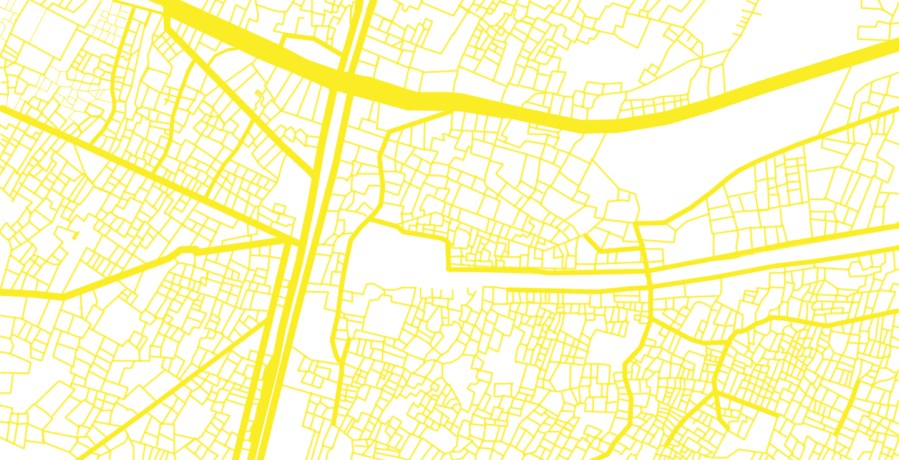
Figure 1: Layout of Streets of Kolkata; source: author.

Within and outside the realms of architecture, streets pave the way at the microcosmic level for the energy distribution network similarly to the way it functions for the crowd and vehicular activity. The metaphysical lens from different frames of reference gives an opportunity to analyze the impact of the metaphysical link and how it is evoked with the crowd in context to the existing surrounding. Different users feel a variety of different emotions in consideration to one particular space.

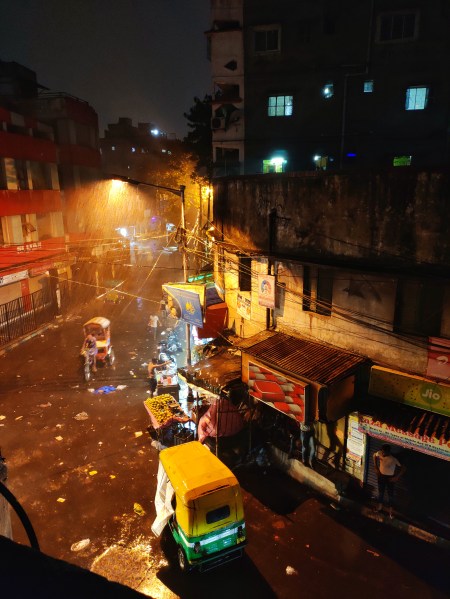
Figure 2: The Street ‘90’ on 12th June, 2019; source: author.


A resident of the place when asked about her experiences with the place said, “We have been staying here for about 15-18 years now. It has an essence of familiarity and home. The existing buildings, the shopkeepers, the vendors, and when I say vendors I really mean it. They are accurate with their location of stalls and wouldn’t trade it with anyone. Ive seen a lot of changes in the place. The building in red and white was built after demolition of an old 3-storey building for commercial purpose yet the upper floors still remain untouched after being built for so many years. The chaos is the essence of this place and without it, this street will lose its essence and identity.”

Considering the quantitative aspect of the street, it is about ten meters in width, with two meters of it occupied by the street vendors. An analysis of the street was done in three different phases of the day. When the morning struck, the silence is disturbed only by the daily activities of parents dropping off their half-dozed children to schools either by private or public convenience, which here is the auto rickshaws, who typically place themselves along the edge of the building as shown in Figure 2. Slowly and gradually as the time transcends the vegetable and fruit vendors take the edge of the street as their potential business spot. The traffic becomes evident by the noon with children coming back from school, having there go at the Sharbet waalas. As soon as the sun goes down, the street has an overwhelming response by the users creating itself in a chaotic mess of disoriented vehicles and people trying to make way to get out. Simultaneously, the sequence of functioning of the streets inflects thrrough its natural course. The female crowd encircles the ‘puchka waale bhaiya’, drooling over the smell of the tamarind water. A few steps towards the east would bring us to a smellscape of a multi-cuisine food corner with a large hot plate with parathas being fried, a traditional clay barbeque for the kebabs being cooked upon the coals, another man assorting the shelves with momos, fried crispy chicken and another struggling with delivering the order to the respective customers superimposing each other tones in a competitive streak to get their order first. The edges of the streets are defined by the utilities of all kind such as a pharmacy, general stores, grocery shops, food kiosks and corners, markets within a radius of a hundred meters, a shopping complex built few years back, occupied only the ground floor of the building structure. A fruit vendor defined the street as, “It is a metaphor of how our life is, always moving and moving in the forward direction. Despite the chaos we love our life so do we love this place.”

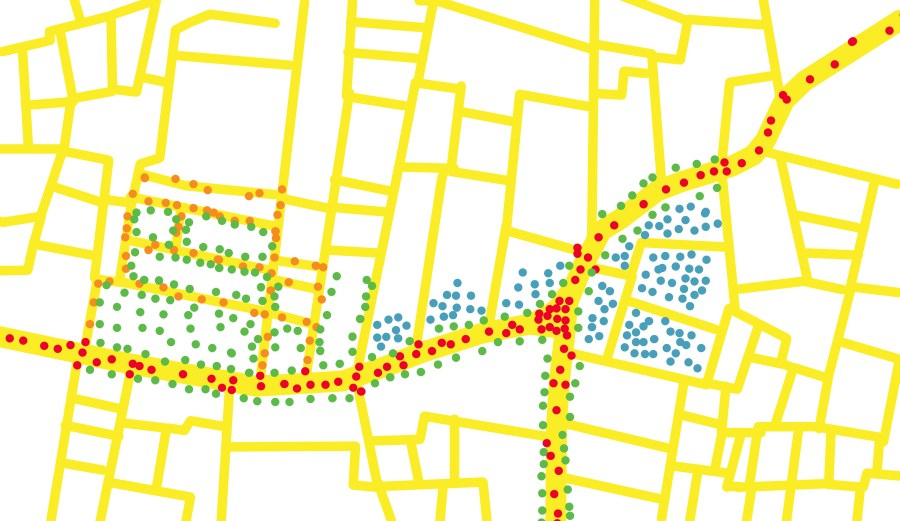
Figure 3: The Feeling Mapping of the Street (red-chaos, green- rejuvenation, orange-action, blue-contentment); source: author

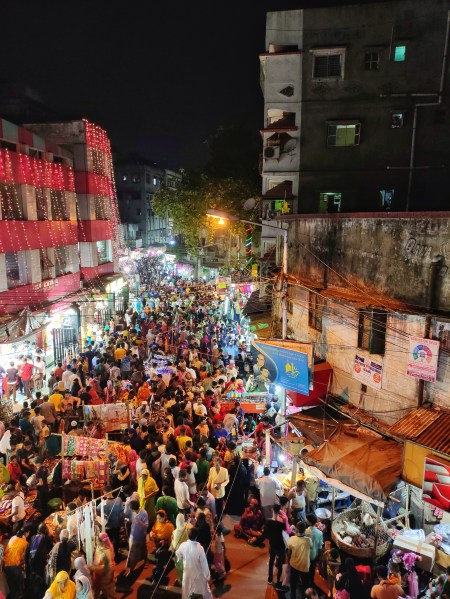
The rhythm of the basic functioning of the street is inflected during the festivities, such as the two Eids and Muharram. The zeal within the crowd becomes evident and the streets stop serving as a vehicular access instead it becomes a hub of utilities as shown in Figure 4.

Figure 4: The Street ‘90’ on 4th June, 2019 (On the Eve of Eid); source: author


In terms of architectural analysis, the flaws couldn’t remain unseen, but what the architects couldn’t see is the intrinsic experiences that the users have with the place. The elegance of the street is a culture of contentment and containment. It depicts the unification of the users belonging to all strata of the society interacting with each other whatever the purpose may be. The dynamics of the streets and the humans represent a whole of the community be it the rich or the poor. In a simple world, the whole of the world can be explored. The local architectural vocabulary of the streets shows motions and emotions of all colours. It depicts joy as well as sorrow. The chaos and the peace, all the comedies and tragedies. The energy drained is rejuvenated with the constant flow of energy on the street. The essence of the chaos in itself shows the intrinsic connection between the built and the unbuilt. The street evokes the intangible aspects of the userrs. The user activity is the result of the concentrated energy source at the micro cosmic level connecting humans with the space at a deeper level. Configuration of the whole of the city is determined by the streets that becomes the highest sources of energy flowing throughout.
The built is to exist what the unbuilt is to life. The boundaries defined by the concrete is a personalized space to exist in harmony, but to co-exist, an undefined yet the key that holds the city together. A street has a potential to turn itself into anything it wants. The street is an induced public space. The street has evolved through the line of time of urbanization inflecting the course of its motion. Due to the increasing number of concrete massing, the spatial contraction of the streets are taking place in localities like Topsia in Kolkata whereas due to the urbanization, the expansion of streets also take place with putting an end to the life of the city creating it in a block of monotony and regularity only used as an access not as a space for creating an interaction between the built and the unbuilt, the known and the unknown. Spatial expansion and contraction taking place to accommodate structures. Street is one part to the whole that encapsulates the built and the user.
People have a tendency to experience voids hence, they hold human sentiments. We are dehumanizing the streets by making it lose its existence by the loss of depiction of culture and tradition. It is a lost element with the thoughts drowned in hues of grey unaware of how to survive in the chaos. The task of an architect is to blend imagination with practicality by balancing ideas and reviving the true nature of the streets in context to human activities.

REFERENCES

1. The Holy Quran

2. Mustofa, 2011. According to Dr. R Tatang Santanu Adikara, the Head of Bioenergy Research Centre in Surabaya, human gets energy from two sources: inside the human body and outside the human body.

3. Metaphysical Approach for Design Functionality in Malay-Islamic Architecture, article in procedia-social and behavioral sciences-aug 2015

4. Mies Van der Rohe

5. Lynch, Kevin. Image of the City.

Junk this food

One of the most doable memory of everyone’s school life is the joy of hearing the arrival of those hawkers and peddlers selling spic & spicy snacks and mouth watering sweets.

But it’s a thorny pricky fact too, tgat due to the consumption of all these flavor boosters or mood swingers, our lovely little Angels are sitting and playing in the lap of deadly diseases known to all as obesity and food poisoning.

brown woven basket on brown brick floor
Photo by Ajay Singh on Pexels.com


Throughout the developed world, with every passing second, with every single tik-tok of your clock, obesity is becoming a grave problem. Many greybeards are offering a suggestion to confort this issue i.e. debarring those unhealthy food (read junk) hawkers from entering the school premises. This way one can stop them to lure the Little education seekers towards theirnasty and unhygienic snacks.

This cumbersome suggestion needs to be executed in a well planned manner. Firstly, teachers and proffs are needed to make students aware about the fact that rather than helping in growth, that delicious looking all sort of mouth watering snack is harmful for their well being.

Just like every thing has two sides, one good and another dark and pitch black, similarly one can say that all this of shunning and restricting sort of stuff’s not good. Thinking as a child, by banning the presence of hawkers , you are basically denying the children of enjoyment (which they think is their birthright). Or, at worse the schools may resemble an Olympic size swimming pool filled with tears of those little Angels.

All and all, instead of a strick prohibition, a regular monitoring of street vendors can be done to ensure that the snacks they’re offering are not stale or made in unhygienic way. Many other diamond solid steps should be taken to ensure that the youth of your nation mustn’t fall in the hands of the demon of diseases like obesity and food poisoning.

Historic decisions for MSME sector, street vendors and farmers taken

The Union Cabinet, chaired by Prime Minister Shri Narendra Modi met on Monday, 1st June 2020. This was the first meeting of the Union Cabinet after the Central Government entered into its second year in office.

During the meeting, historic decisions were taken that will have a transformative impact on the lives of India’s hardworking farmers, MSME sector and those working as street vendors.

Helping hand to MSMEs:

Micro, small and Medium Enterprises popularly called as MSMEs are the backbone of Indian economy. Silently operating in different areas across the country, more than 6 crore MSMEs have a crucial role to play in building a stronger and self-reliant India.

In the aftermath of COVID-19 pandemic, PM Shri Narendra Modi was quick to recognise the role of MSMEs in building the Nation. That is why MSMEs formed a very prominent part of the announcements made under the Atmanirbhar Bharat Abhiyaan. 

Under this package, the MSME sector has not only been given substantial allocation but has also been accorded priority in implementation of the measures to revive the economy. Implementation relating to several of the key announcements have been made already.

Today, Government of India has laid down the road map for effective implementation of other announcements under the Atmanirbhar Bharat Package too. These include:

  • Upward revision of MSME Definition. This is yet another step towards ease of doing business. This will help in attracting investments and creating more jobs in the MSME sector;
  • Proposal for provisioning of Rs 20,000 crore as subordinate debt to provide equity support to the stressed MSMEs has been formally approved by the cabinet today. This will benefit 2 lakh stressed MSMEs.
  • Proposal for equity infusion of Rs. 50,000 crores for MSMEs through fund of funds has also been approved by the Cabinet today.   This will establish a framework to help MSMEs in managing the debt-equity ratio and in their capacity augmentation. This will also provide an opportunity to get listed in stock exchanges.

Further upward revision of MSME definition:

The Government of India today decided for further upward revision of MSME definition. In the package announcement, the definition of micro manufacturing and services unit was increased to Rs. 1 crore of investment and Rs. 5 crore of turnover. The limit of small unit was increased to Rs. 10 crore of investment and Rs 50 crore of turnover. Similarly, the limit of a medium unit was increased to Rs 20 crore of investment and Rs. 100 crore of turnover. It may be noted that this revision was done after 14 years since the MSME Development Act came into existence in 2006. After the package announcement on 13th May, 2020, there were several representations that the announced revision is still not in tune with market and pricing conditions and it should be further revised upwards. Keeping in mind these representations, Prime Minister decided to further increase the limit for medium manufacturing and service units. Now it will be Rs. 50 crore of investment and Rs. 250 crore of turnover. It has also been decided that the turnover with respect to exports will not be counted in thelimits of turnover for any category of MSME units whether micro, small or medium.

Supporting our hardworking street vendors:

The Ministry of Housing and Urban Affairs has launched a Special Micro-Credit Facility Scheme – PM SVANidhi (PM स्वनिधि ) – PM  Street  Vendor’s AtmaNirbharNidhi,for providing affordable loans to street vendors. This scheme will go a long way in enabling them to resume work and earn livelihoods.

Over 50 lakh people, including vendors, hawkers, thelewalas, rehriwala, theliphadwala etc. in different areas/ contexts are likely to benefit from this scheme.

The goods supplied by them range from vegetables, fruits, ready-to-eat street foods, tea, pakodas, breads, eggs, textiles, apparel, footwear, artisan products, books/ stationaries etc. The services include barber shops, cobblers, pan shops, laundry services etc.

The Government of India is sensitive towards the problems they have faced in the wake of the COVID-19 crisis. In such a time, there is an urgent need to provide affordable credit to them to ensure their business gets a boost.

Urban Local Bodies will play pivotal role in the implementation of the scheme.

This scheme is special due to a number of reasons:

1- A historic first:

This is for the first time in India’s history that street vendors fromperi- urban/ rural areas have become beneficiaries of an urban livelihood programme.

The vendors can avail a working capital loan of up to Rs. 10,000, which is repayable in monthly instalments in the tenure of one year. On timely/ early repayment of the loan, an interest subsidy @ 7% per annum will be credited to the bank accounts of beneficiaries through Direct Benefit Transfer on six monthly basis. There will be no penalty on early repayment of loan.

The scheme provides for escalation of the credit limit on timely/ early repayment of loan to help the vendor achieve his ambition of going up on the economic ladder.

It is for the first time that MFIs/ NBFCs/ SHG Banks have been allowed in a scheme for the urban poor due to their ground level presence and proximity to the urban poor including the street vendors.

2- Harnessing technology for empowerment:

In line with the Government’s vision of leveraging technology to ensure effective delivery and transparency, a digital platform with web portal/ mobile app is being developed to administer the scheme with end-to-end solution. The IT platform will also help in integrating the vendors into the formal financial system. This platform will integrate the web portal/ mobile app with UdyamiMitra portal of SIDBI for credit management and PAiSA portal of MoHUA to administer interest subsidy automatically.

3- Encouraging digital transactions:

The scheme incentivises digital transactions by the street vendors through monthly cash back.

4- Focus on capacity building:

MoHUA in collaboration with State Governments, State Missions of DAY-NULM, ULBs, SIDBI, CGTMSE, NPCI and Digital Payment Aggregators will also launch a capacity building and financial literacy programme of all the stakeholders and IEC activities throughout the country during the month of June and loaning will commence in the month of July.

Igniting the spirit of Jai Kisan:

For the Kharif season 2020-21, the government has kept its promise of fixing the MSP at a level of at least 1.5 times of the cost of production. Today, the MSP of 14 crops for the Kharif season 2020-21 has been announced, based on the recommendation of CACP. The return over cost for theses 14 crops ranges from 50% to 83%.

The Government of India has also decided to extend repayment date up to 31.08.2020 for all Short-Term loans up to Rs.3 lakh advanced for agriculture and allied activities by banks. Farmers will also get benefit of interest subvention and prompt repayment incentive.

The agricultural short-term loan due between 1st March 2020 and 31stAugust 2020 will continue to get benefit of 2% Interest Subvention (IS) to Banks and 3% Prompt Repayment Incentive (PRI) to farmers.

Government of India’s decision of providing such loans to farmers through banks @ 7% per annum, with 2% per annum interest subvention to banks and 3% additional benefit on timely repayment by farmers thus provides loans upto Rs.3 lakh at 4% per annum interest.

Interest Subvention Scheme (ISS) wasstarted toprovideconcessionalshort-term crop loansincludingloans availedthroughKisan Credit Cards tothefarmers. In the last few weeks, many farmers are not able to travel to bank branches for payment of their short-term crop loan dues. Hence the cabinet decision would help crores of farmers.

Caring for the poor the Government’s top focus:

The poor and vulnerable are at the top of the priorities of the Government led by the Prime Minister. During the Coronavirus pandemic, right from the day of announcement of the lockdown, the government has been sensitive to the needs of the poorest of the poor. This was seen in the announcement of the Pradhan MantriGaribKalyanYojana package on 26th of March 2020, within just two days of the start of lockdown.

From ensuring coverage of around 80 crore people with food security to direct cash transfers into the bank accounts of 20 crore women, from putting money into the hands of senior citizens, poor widows and poor Divyangs to front-loading of the PM-KISAN instalment to crores of farmers, steps were announced. These covered a wide range of vulnerable sections who would have borne the brunt of the lockdown if not for the immediate intervention of the government. Moreover, these were not mere announcements. Within days, assistance reached crores of people directly, either in cash or kind.

As part of the Atmanirbhar Bharat initiative, One Nation One Ration card, free food grains even for those without ration cards, a new affordable rental scheme for their housing and many more measures have been announced for the welfare of the migrant labourers.

Massive reforms were announced for farmer welfare, freeing farmers from the chains that bound them and giving their income prospects a significant boost. Along with this, more investments into farm infrastructure were proposed. Allied activities such as fisheries too received a financial package.

At every step, the Government of India has shown compassion and alacrity in serving the needs of the most vulnerable.