Health tips for students that don’t suck

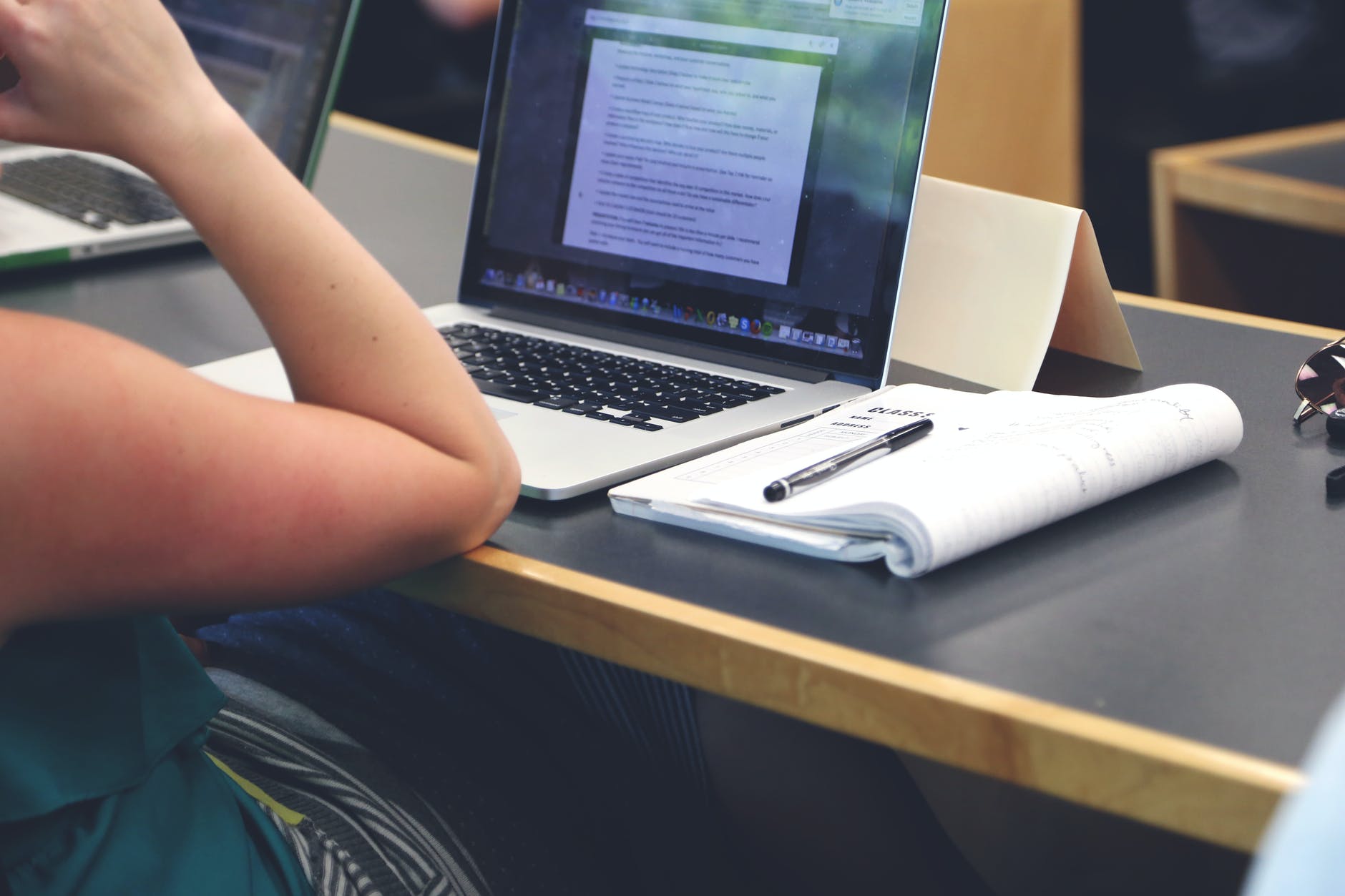
Photo by Gabby K on Pexels.com

You are a student so you’re probably young and feel indestructible. But we all have to take care of ourselves if we want to stay healthy, especially if we want to do well in your studies. The good news is that staying healthy doesn’t mean giving up everything you enjoy. And if you stick to these basic health tips, you should be in great shape to excel in your studies.

1. You Are What You Eat

Eating well is vital for healthy living, but it’s not something that students are always good at. There’s a reason for all those cold beans and instant noodles.  stereotypes, after all.

This is changing, though. Increasing awareness of diet means more students are eating healthily. Many are even trying vegetarianism and veganism, which are good for the environment as well! But the most important thing is making time to eat proper, healthy meals on a regular basis.

2. A Healthy Body

Maybe you’re a gym bunny already. Good for you. But if not, don’t be put off by people demanding that you “feel the burn.” Even a little bit of regular exercise can help keep you healthy.

Ideally, you should find time for around 150 minutes of moderate aerobic activity per week. You can even work it into your daily routine, if going to the gym doesn’t appeal to you.

3. A Healthy Mind

Anxiety and other mental health issues affect most people at some point. And students can be especially vulnerable, since balancing your studies, work, and social life is often stressful.

But there are simple ways you can help stay healthy, including:

  • Being aware of your own mental health and stress levels.
  • Knowing your stress triggers.
  • Taking time out to relax now and then.
  • Meditation and breathing techniques.

Most important, though, is not being afraid to seek help if you need it. Your college should have support systems in place if you are feeling overwhelmed.

Talking to friends or family when you’re feeling low is a great first step, too.

4. Sleeping Is Good

Sleep is just as important as diet and exercise for a healthy lifestyle. Ideally, you should get between seven and nine hours every night. If this isn’t currently the case, cutting back on caffeine after 3pm and avoiding illuminated screens (phones, tablets, etc.) before bed could help.

5. Sex, Drugs and Rock ‘n’ Roll (in Moderation)

While college life should, of course, include trying out new things and having fun, excessive partying will take its toll. Limiting yourself to going out at the weekends is a good start. If nothing else, it will mean you won’t have to deal with 9am lectures on next to no sleep.

6. Do Good

This one might sound strange, especially if your schedule is already hectic, but research shows that volunteering counteracts stress and makes you happier. It also lets you try new things and get valuable experience, so there’s plenty to gain from being selfless!

These were some of the basic health tips for students. Everything in moderation is the key to a healthy student life.

I hope these tips were helpful to you.

Thank you!

Proven Study methods to Ace your Exams

Photo by RODNAE Productions on Pexels.com

Scoring good marks and acing the exams should be easy if you have studied every lesson by heart, solved the questions and had good revision schedules. But majority of the students do not seem to be getting that amount of time and motivation to keep up. To keep up with the massive amount of syllabus seems impossible and as a result we have to leave out some parts of the syllabus or do not get a chance to revision the lessons. And then add procastination to it even worse. However modern research has been able to crack the code to score well in exams while eliminating inefficiency and increasing efiiciency.

So, while studying the two most important aspects are-

  1. Understanding
  2. Memorising

The first aspect is understanding. If we do not understand what we are studying we will never be able to produce the lessons in our exams. It is quite common that if we understand the lesson once we will be to remember it better. Understanding is truly the most crucial step to acing the exams.

The best scientific method to understand our lessons have been given by an American psychologist Richard Feynman. He gave a pretty simple technique or method. He said that if we are able to explain what we are studying to a 5-year-old clearly, we have understood it. And if we have understood it, we are good to go. We need to get the basic concepts clear in our head. Children like stories and easy explanations so that is what is going to help us. Get to the core of the subject. This was the main idea given by him but it is not practical to get a 5-year old to listen to you. So a better and more appropriate way to inculcate this approach is to get your friends listen to you explaining a concept. It will be beneficial for both you and your friend.

Alright, the next essential thing to studying is memorizing. The two most helpful study methods are

  1. Active Recall and
  2. Spaced Repetition

So the idea behind spaced repetition is that the more we actively recall something, the brain cells register them better in our memory. This is the main idea behind active recall. The ways by which you can practise this method is by first understanding a topic and then answering all the possible questions from it. If you cannot answer a question it is completely fine, go back and check the answers. This will strengthen the brain connections and you will be good to go for a long time. Just be active with your studies even if you sit to study for just 30 minutes.

Another great method that is extremely good for memorizing is Spaced Repetition. To follow this technique is by studying a lesson deliberately at intervals. So if say you decide to study something for the first time then the next time study it for revision only when you have forgotten it to a certain extent. So again the idea behind this technique is to actively strengthen the brain cells when you have forgotten them. A study has shown that with time the brain connections seem to fade away. So the best way to recall is to delay the study only when you have forgotten some parts of it.

Ali Abdaal, a famous youtuber explains these concepts in his videos really well, do not forget to check them out.

I hope this article helps me as much it did to me.

WAYS TO EARN MONEY IN LOCKDOWN:


Students can start earning very easily and efficiently with all the jobs listed below. They can earn money with a little to no investment by them. The ways of these money making are effective and student friendly.

So instead of wasting a lot of time in binge watching let’s earn some money and be productive during this pandemic all around. Because it’s said that “a creative mind is the house of all new innovations”.

TOPS WAYS TO EARN MONEY FOR STUDENTS:

  1. YOUTUBE CHANNEL:

With the art and creativity of doing anything good you could start your very own YouTube channel. And with the passage of time and increment in subscribes you would start earning greatly. Whether you have good culinary skills, poem, recitation, dancing, singing, fashion, motivational speaker or any other skills can be out shown on YouTube and lead to a source of good income.

  • FREELANCER:

Using the websites like UPWORK, FIVERR you can easily become a freelancer. In this job you could easily choose with which client to work and with whom not to. This can help you earn from rupees 1000 to up to a six -digit money. The money you earn is totally based on the experience you have and the clients that approaches you.

  • RESEARCH WORK:

On the basis your skills to do research you can earn up to rupees 2000-5000 per hour of study.

Using websites like RESPONDANT AND USER INTERVIEWS one could start.

  • ONLINE TUTOR:

In this time of lockdown when all the educational institutes are nit working students can come forward and help the other students in their academics and earn some money.

One can use skype, WhatsApp, google-meet, MS-TEAMS and also could use FIVERR.COM, TUTOR.COM, TUTORVISTA etc.

  • CREATING COUSES:

By creating courses online on SLIISHARE, UDEMY, COUSRERA also you could earn money.

  • BLOGGER:

Become a blogger by creating a domain name and creating different articles and write-uos combatable to your  niche. Divert people towards you site and can also add revenues on the article to earn some money.

  • PHOTOS, DESIGN, LOGOS:

By clicking photos of nature, roadside, people around. And also, by creating design and logos and uploading them on SHUTTERSTOCKS, FOTOLIA etc. you can earn money.

  • TUTOR OF TEST APPS AND WEBSITES:

Register yourself in the test apps LIKE CHEGG so that you could solve the doubts and earn money.

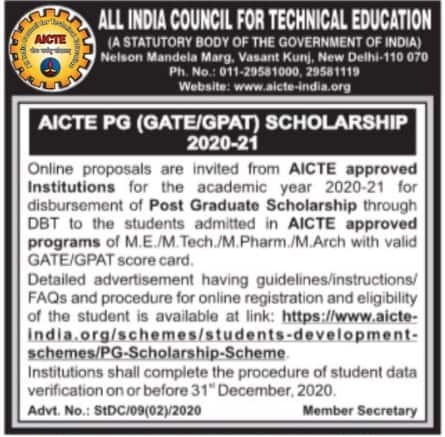
AICTE announces scholarship for PG 2020-21

The All India Council For Technical Education (AICTE) has announced the scholarship programme for the post graduate (PG) students for the year 2020-21. The candidates of ME, MTech, MPharm, MArch with valid Graduate Aptitude Test in Engineering (GATE) or Graduate Pharmacy Aptitude Test (GPAT) score can apply for the scholarship. The eligible candidates can apply through the website- aicte-india.org.

“AICTE in order to ensure development of technical education in India awards Post Graduate Scholarship of Rs. 12,400/- per month to full-time GATE/GPAT qualified students admitted to AICTE approved post graduate programs in AICTE approved Institutions/ University Departments,” reads the official notice.

AICTE offers scholarship of Rs 12400 per month to PG students. This facility is offered to full time GATE / GPAT qualified students.

A total of 24 months scholarship is awarded during the two-year PG course. Scholarships are awarded from the month of classes commencing to the month when classes are closed.

AICTE-Scholarsip

To receive the scholarship, candidates have to validate their students ID and proceed with filling the GATE PG scholarship form. All the details like Bank account number, institute permanent ID, students ID and date of birth have to filled correctly, failing which the disbursal of scholarship will be affected. After filling the form, institutes have to verify and submit the data of all candidates admitted in M.Tech/M.E./M.Arch through GATE for the academic years 2020-21.

The last date for institutes to verify and submit students data to AICTE is December 31. The scholarship will be provided from the date of commencement of classes/date of admission whichever is earlier. Students will receive the GATE scholarship 2020 amount directly in their bank account.

To receive the GATE scholarship 2020, candidates need to have a savings account in their name, same as furnished in GATE/institute admission. Candidates belonging to OBC-Creamy layer who have qualified GATE under OBC category will not be eligible for the scholarship. Candidates who qualified GATE under any reserved category (SC/ST/PwD/OBC-NCL) must have a valid category certificate without which they will not be considered for the scholarship.

Candidates who have qualified under the OBC (Creamy Layer) category are not eligible for the scholarship. However, OBC (Non-Creamy Layer) candidates will be required to submit certificates which are not more than one year old to process their applications for the programme.

Online mode of Education: Is it really advantageous to the Indian youth or there are any limitations too?

Article by – Shishir Tripathi

Intern at Hariyali Foundation
In collaboration with
Educational News

After the arrival of Corona Virus into the country after the months of February and March, educational institutions including schools and colleges were shut down and the normal teaching learning process was hampered. After, a certain time, the Teaching process again started through online mode and till now the same process is being followed.

Now, the question arises that the available mode of teaching is accessible to all the students across India or there are other students left who still are not connected with their respective educational institutions through the new mode of learning?

The normal classroom learning is not possible at present because of transmission of virus amongst the students and that will make the situation even worse than before. Therefore, lectures and notes to the students are given via the online mode with help of apps like Zoom, Google meet, Jio meet, Google Classroom and many more. These apps can only be accessed with the help of a Smartphone. Now, being a developing country, unequal distribution of wealth and resources is genuine in a country like India.

According to a survey by Central Board of Secondary Education (CBSE), at least 27% students do not have access to Smart phones, tablets or laptops for online classes. Such college and school students are facing a lot of problems in their studies

According to a real time progress tracker, 83% of households in India had electricity connection till 2018, and after some tome Modi government claimed that they have electrified India to 100% but everyone knows that laying wire lines, and transformers doesn’t mean that electricity reaches to the place.

Though the data is unavailable, there are villages still left waiting for electricity and hence in such remote areas it is so difficult for a student having a phone or any other electronic device and charging it properly for uninterrupted attendance in the online classes.

Now, there are sudden prolonged power cuts too which occur and can obstruct the power supply to electronic devices which can hamper the delivery of education through online mode from teachers and professors to the students and scholars. The all India average duration of power cuts was 5 hours and 28 minutes on May 2, 2019. And also, in villages sometimes the reason is all unknown to the people behind the sudden power cuts.

There is also a problem of slow speed in congested localities, small towns, villages and remote areas of the country. According to the Akamai Q1 2017 State of the Internet Report, the average internet connection speed in India is 6.5 Mbit/s and the average peak connection speed is 41.4 Mbit/s. Globally, India was ranked 89th out of 149 countries/regions by average internet connection speed and 97th by average peak connection speed. According to telecom industry experts, the slow bandwidth speed in India is due to the high cost of spectrum leading to Internet Service Providers (ISPs) not investing much into the spectrum. The growing number of telecom users and Smartphone users are also cited as one of the reasons for slow speed in the country.

Therefore, taking into consideration the present situation, the online mode of education is the best way possible to deliver knowledge to the students in these tough times of Corona. Also, the problems of unavailability of electronic devices and slow internet speed and proper supply of electricity to each and every household must be ensured so that the youth which is the future of the nation gets uninterrupted education and training through online mode.

Protests in Thailand for Democracy

Despite the COVID-19 pandemic restrictions and the imposition of an emergency decree which prohibit mass gatherings, young Thai activists continue to organize massive protests across the country. This student-led pro-democracy movement marks the first time in modern Thai history when the Thai monarchy has been talked about publicly in a critical way since doing so is a jailable offense.

The first wave of protests was sparked in February 2020 by the forced dissolution of an opposition party which outraged and inspired young people to organize pro-democracy actions. Despite the COVID-19 March lockdown, the ‘youthquake’ continued and saw young Thais use cyberspace to speak out on political issues, build resistance networks, and launch online protests.

The second wave of protests was signaled by the student-led protest on July 18 at Bangkok’s landmark Democracy Monument. More than 2,000 protesters gathered and raised three demands, namely dissolving the parliament, rewriting the military-based constitution and ending the intimidation and arbitrary arrests of critics of the government.

Another significant demand is the call for reforms of the the monarchy, a topic which is not only taboo but also a criminal offense since Thailand has a strict Lèse Majesté (anti-Royal insult) law.

Students and youth activists echo these demands in various forms of creative online and offline protests. For example, Thai protesters have adopted as a symbol of their defiance and demand for democracy the three-finger salute inspired by the popular US movie series the “Hunger Games”.

On August 16, more than 20,000 people assembled again at the Democracy Monument in central Bangkok. It was the biggest protest in Thailand since the military grabbed power in 2014.

Authorities have since summoned dozens of student leaders, artists, and human rights activists and threatened them with harassment suits, yet the youth-led protest movement has gained nationwide support. Pro-democracy advocates from various sectors have also participated in several rallies organized by students.

Besides, young activists from Hong Kong and Taiwan have also issued solidarity statements that reflect the growing influence of the #MilkTeaAlliance, a netizen-driven democracy campaign challenging Chinese trolls.

85% of the parents of this state are in favor of the school opening from September, the education department told the plan.

The biggest question among the Corona virus epidemic is about the opening of schools and colleges. Some people are in favor of opening the school and many are against it. Meanwhile, a survey has revealed shocking results. The survey has been conducted by the Education Department of the state Haryana adjacent to Delhi.

In this survey of Haryana Education Department, it has been found that about 85% of the students of class 10th and 12th in the state are in favor of opening school from September 2020. Despite the dangers of the Corona epidemic, these parents are ready to send their children to school.

The survey was conducted online by the state school education department. In this, parents of a total of 76,019 students of class 10th and 12th of various government schools of the state attended. It included a few schools from all the 22 districts of the state.

What questions were asked from parents
These four questions were asked by the education department to all parents –

  • Should schools be opened by September 2020?
  • Are parents ready to send their children to school from September 2020?
  • Have any of your family members conducted the Kovid test?
  • Have any of your family members been found to be Kovid positive? … so how will the schools be opened now.

An Education Department official said that ‘most of the students of 10th-12th students are in favor of opening of schools. Therefore, the department has decided to run trial run by opening two schools in different districts first. Government Senior Secondary School in Karnal and Government High School in Sonepat will be opened for four days. Dates will be revealed soon. ‘ In these four days, every movement of the school will be recorded on cameras. How students come to school, how they enter, how classes attend, or not touch each other, how they get out of school .. All these things will be recorded. Classes will be held in small groups instead of classrooms. After the trial, a team of seven members of the education department, including health and hygiene experts, will watch these video recordings to see if all the rules are being followed. If there is a shortage, teachers will be asked to remove it the very next day. These recordings will be shown to every teacher before school opens. The education department is preparing to open schools for class 10th and 12th from September 21.

Students have to submit written consent of their parents for this. An official of the Directorate of School Education has told that the ‘School Management Committee will conduct a survey from the parents of all the students from class 9th to 12th. If 60 percent or more of the parents are in favor of opening the school, it will be recorded in the school register. However, all these things are still in the planning stage.

Why are students from International Boards being welcomed by Indian Universities

The world is facing a learning crisis. While countries have significantly increased access to education, being in school isn’t the same. Crisis will affect generations of students without action to boost teaching. Global learning crisis is costing $129 billion a year 10% of global spending on primary education is being lost on poor quality education that is falling to ensure that students learn. This situation leaves one in for young people in poor countries unable to read a single sentence. International students applying to foreign universities have hit a wall due to this global crisis. The dilemma to continuing with their education in India on waiting for universities abroad is faced by many students who are studying in international board. Many studies explored the challenges and hurdles experienced by international students attending institutions of higher education abroad.

Universities and college campuses are places where students live and study in close proximity to each other. They are also a buzzing cultural hubs where students are brought together from Nations around the world. Recently, the foundations of this unique ecosystem have been impacted significantly by the rapid spread of the coronavirus (COVID-19) outbreak, creating uncertainty regarding the implications for higher education.

One of the biggest concerns for the sector at large is the percentage of international students that make up the domestic higher education markets. This pandemic has resulted in an economic slump globally and parents are becoming conscious of the cost of sending the children abroad. As a result, international school students who would have ideally chosen to apply to universities abroad are now evaluating higher education prospects in their home country.

The question we often ask parents is : if their ward is planning to apply to an Indian university, should they opt for a school that offers curriculum from international boards, or stick to conventional Indian boards.

It is believed that it is highly advisable for parents to enroll their child in an international board as the curriculum is global and the skills amasses will ensure that every student becomes an active learner for life. These programs are brilliantly designed to help students become adaptable, thereby helping students to perform with ease in the Indian education system as well as Internationally.

It is important to understand that a rigorous curriculum ensures that students are challenged effectively to think critically and creatively. These skills along with many others these programmes inculcate, are learning for a lifetime. They are also highly sought after by universities and employers both abroad and within India.

International board follows application based teaching – It is also important at this stage to understand that while many curricula focus on teacher-led methodology, the international curriculum is more about an involved facilitation process, in order to allow the student to develop essential independent thinking skills.

Cambridge international AS and A Level is an in-depth program which helps students develop many core higher-order thinking skills that universities are looking for, such as analysis, evaluation, and synthesis. The program also focuses on building research, innovation, reflection, and communication skills in each student. These I believe are essential for the 21st-century learning and a global citizen.

Students adapting to international curriculum – Let us focus on India for the moment. Many parents were often worried if the process of transferring a child from an international curriculum to our national one is easy. Let me reassure you here that there is a smooth progression for the learners who choose to study at universities in India. These learners from international boards acquire knowledge, skills, and adaptability that enable them to enter, or re-enter the Indian education system, without difficulty as they are well prepared for independent study. All reputed indian universities accept and value international qualifications.
The subject knowledge along with the critical thinking and reasoning skills that the Cambridge International AS and A Level programme grants its students is unparalleled. And this has been of immense help to our students who have moved on to various Indian and international universities to study science, technology, law, design, medicine, management, finance, history, math, psychology, literature, research etc.

The international outcomes allow them to apply to all universities including esteemed organisations such as All India Institute of Medical Sciences (AIIMS), Indian Institute of Technology, National Institute of Design etc.

Many students from Podar International School have over the years successfully found placements in renowned universities. I strongly believe that the skills and knowledge that they amass during their years of international education are significant contributors to them being successful in the field of their choice.

Steps colleges need to take before they open after Covid-19

This pandemic has brought us all into a dilemma regarding the position of academics of students. Online classes are already being carried on by schools and colleges. Yet, this cannot be continued for long as the effectiveness of classroom education lacks in online classes. No one actually knows when the pandemic will be flattened and students flock to campuses.

The only thing that is known is that a large number of students and teachers would come together at their colleges. Students are already mentally fatigue and dying to be back to the campus.

The Government had earlier instructed a gradual opening of colleges with caution and precautionary measures from September 1st. But with more than 3.6 million Coronavirus cases in India, the date was shifted and the next plausible one may go for the dawn of the new year, with one semester going online.

Colleges have to be opened someday. When the day comes, there are many chances of arising this pandemic again. We can avoid this situation to an extent by following certain steps and safety measures.

Here are the steps colleges need to take before the reopen after Covid-19 :

1) To start with, all educational institutes need to quickly migrate to the digital mode through the use of existing massive online courses (MOOCs) and create their own MOOCs for the domains they deal in, provided they can muster the courage and the resources. Going ahead, it will by PhyGital or blended learning, with physical being the base and digital being the larger engagement period. Even virtual labs and studios will do half the practical work as well. This is a big call and for digital content creation and aggregation along with engaging delivery need to be ensured.

2) It goes without saying, that no campus can ensure a batch coming in for all 5 days or 6 days to the campuses physically for a long time ahead. It will be two to a maximum of three days a week, and that too, with temperature checking, gloves and masks, ideally with full sleeves and legs covered, and a head cover might be ordered also.

3) Many campuses will and should have a sanitising tunnel to walk through, will have to walk with a minimum 4 feet distance from the nearest peer and sit at a distance from the next buddy.
This will make it necessary for half the batch to sit in a classroom, and half the team working in studios at a point of time, which stretches the infrastructure to a hilt and doubles the workload of mentors, who anyways shall be rarer and lesser paid in these Corona times.

4) The lunch-time will be staggered to reduce crowding at eating places, while session timings will be changed to reduce commotion on corridors. Lunch-time is a weaker time period during which the students tend to form groups for informal talks.

5) Campuses will call for creating a digital persona for all learners thus making it compulsory for all to have networked smartphones, specific apps to be downloaded for regular use, a good laptop, WiFi-driven high-speed digital access at homes, and cameras, to assist tech-driven learning. Though many schools banned mobiles sometime earlier, today, schools need mobile handsets more than ever. The tool of wasting time is the harbinger of besting time today.

6) While an individual student may need to come to campuses for two to three days a week, most staff and faculty members may in fact need to be on campus for five to six days to cater to the staggered and smaller batches, while continuing to guide those online at homes. That’s a double whammy for the staff in times of fewer colleagues and insecure salaries.

7) Another major need is to revolutionise the assessment system with loads of formative assessments online through quiz and open book tests. Instead of conducting exams offline, online exams would give a way to reduce the chances of another pandemic.

8) Libraries need to go digital, and mentors need to be thoroughly trained to create and deliver an engaging learning content and aggregated learning resources, apart from management becoming flexible on fees and add-ons.

9) Hostels may be hit hard for a while, and learners may choose to have home food and water. This will harm economic interests of the related service providers.

10) We are in for a plethora of surprises. But college campuses with a quick migration to a robust yet easy-to-use learning management systems, and with a sanitised environment are expected to do better.

Are Online Classes Being Able To Replace Traditional Classrooms?

With the rise of the pandemic and the extended lockdown, educational institutions have been prompted to shift towards online teaching. While initially digital classrooms seem to be a great alternative, whether it can successfully replace traditional classroom teaching is a question yet to be answered. Online teaching has also posed a threat to students belonging to the economically backward sections of the society. In a country like India, a great percentage of students do not have the access to such means or find it difficult to avail those options.

Photo by Startup Stock Photos on Pexels.com

According to survey findings there is a noticeable change in behavior and habits following the forced lockdown among the school goers. The sleep cycle and sleeping pattern of nearly 50 per cent children have been disturbed. It also indicates that 13 per cent of children have no regular pattern of sleeping. As a result, 67 per cent of parents think that their child’s screen time has gone up by at least 50 per cent during the lockdown. Increased screen time is known to severely affect concentration levels and leading to insomnia and other sleep disorders. The fear of pandemic has affected children in the worst way, nearly 40 per cent of the children who were surveyed, have been known to have mental health and unaddressed anxiety issues.

Schools and Colleges have set timetable in such a way so that there are breaks in between classes but because of network connectivity issues, students have started logging in earlier, which have lessened the break times. A teacher said in an interview, “In the first month, things were fine but with time students are losing interest and a kind of boredom is setting in even for the bright kids. For students in senior classes or those who will appear for board exams there is pressure from teachers and parents which is taxing.” After attending classes online, many students are also sitting for online tuition or extracurricular activity classes.

Teachers of many schools have reported that students have become “more subdued” in class and their energy levels have decreased than before. According to psychiatrists and teachers, months of being inside and attending classes from within the screen has made students “fatigued” and “demotivated.” Even students who are academically strong have not been responding in class like before, teachers said. They have observed that the “naughty and mischievous” ones who would always be up to some mischief in classrooms have become “quiet and subdued” during online classes.

Photo by Yan on Pexels.com

Psychiatrist Jai Ranjan Ram said to a newspaper, “Teachers are trying but online classes are not the same as what school was for children. No wonder they are feeling demotivated and fatigued. They have to attend continuous classes on the screen, at times not on laptops but on phones. All this while there is monotony of the same environment. It’s difficult to maintain a sense of well-being. In an online class the nuances of non-verbal communication are completely lost.”

Sneha Priya S, Co-Founder & CEO of SP Robotic Works, has said, “Covid has proven to be the turnstile for education in India. The current situation has unearthed the immense potential of platforms with experiential and interactive learning which engage children in practical tasks and logical reasoning.”

In a physical classroom, students and teachers would even discuss things not related to academics and eagerly share their experiences. While there are downsides, there are also some positive aspects to it. Educational institutions have been closed for months at a stretch. With online classes there is the possibility to catch up with studies. Many students feel that at least in an online mode there is some form of interaction which helps them in these trying times. Online classes have made possible for students and teachers to get back to their routines within safe conditions. They also provide students with something to look forward to everyday. But amidst the current social conditions, students long to go back to their campuses. As we adjust to the ‘new normal’ many young people who are at the beginning of their career are also uncertain of what challenges they might face in the future.

Final year written exams to be cancelled, Delhi state Government

Vaishali Singh

In response to a petition challenging UGC guidelines mandating the conduct of final year exams by universities before September 30, Government of Delhi has informed the Supreme Court that Delhi State Universities exams have been cancelled.

In a latest decision, Deputy Chief Minister of Delhi has directed “all Delhi State Universities to cancel all written online and offline semester examinations including final year exams.

The Supreme Court had directed. all parties to file their affidavits by August 7, and for rejoinders to be filed a day after that.

Delhi government in its affidavit states that on July 11, a decision was taken by the Deputy Chief Minister/Higher and Technical Education Minister of the National Capital Territory of Delhi that all online-offline exams of universities under the state including final year exams would be cancelled in the wake of rising COVID-19 cases.

However, the affidavit notes that some vice-chancellors of certain universities were in favour of wrapping up at least the final semester exams.

However, after perusing all details including the latest UGC directive to complete final year exams by September 2020, Delhi government decided to stick to its July 11 decision and continue with not holding the exams.

Delhi Government has further stated that “in Delhi’s State universities, best efforts were made to conduct online classes, but the reality of our digital divide is that online classes are not accessible equally by all”.

“During this extremely tough period, regular physical classes got completely interrupted. The students had no access to study material and the college libraries were closed, although getting access through online mode in such peculiar circumstances, the students did not get the kind of preparation needed to attempt a full-fledged examination,” reads the plea.

As per present status, GGSIP University has around 27,000 final year students and are now devising mechanism for assessment to award marks to final year students and this is also the case for Delhi Pharmaceutical Science and Research University (DPSRU).

The other six universities have completed the final year Examination by online mode.

A total of 31 students from different universities across India had approached the Supreme Court to quash the latest University Grants Commission (UGC) circular directing universities to wrap up final year examinations by September 30.

Before Delhi Government, Maharashtra Government on August 7 informed the Supreme Court that the State Disaster Management Authority on July 13 had resolved to not conduct examinations in the state amid the COVID-19 pandemic.

The decision was taken after a majority of University Vice-Chancellors from across the state voted against conducting exams in view of the rising number of COVID-19 cases.

MOST CHEAP & AFFORDABLE CITIES FOR STUDENTS in the WORLD

Students are already drowning in student loan and upon that they have miscellaneous expenses to cover. Many of you would have lost hopes of studying in prestigious Universities thinking about the expensive cos of living there. However there are cities in the world which offer cheap and affordable living especially for students.

This article derives results based on the average costs indicated on the Mercer Cost of Living Survey. Each of these cities contain not only cheap living but also some of the top universities one might be delighted to get into.

Kuala Lumpur

Kuala Lumpur, Malaysia’s capital and largest city, ranks second in the world for affordability. Also featuring in joint 29th place overall in the best student cities this year, tuition fees at one of Kuala Lumpur’s five ranked universities will cost an average of only US$2,500 per year for international students. For those looking to live in the city center, a one-bedroom apartment will cost an average of US$568 per month.

IHG to develop new Holiday Inn in Kuala Lumpur, Malaysia | Hotel ...

Kuala Lumpur also ranks well for affordability in the Mercer Cost of Living Survey, coming 141st of 209 countries in terms of expense.

Bangalore

the Indian city of Bangalore, a new entry in this year’s Best Student Cities index at 81st, has the lowest tuition fees of all the cities on this list (only costing US$100 per year on average.) The city also has extremely low living costs , a one bedroom apartment in the city center, for example, will cost you an average of US$250 — this is extremely low compared to cities such as London, where you’d be paying a monthly average of US$2,132.

Bengaluru Smart City Project: Free Wi-Fi, E-Toilets, Water ATMs ...

Bangalore has two universities currently featuring in the world university rankings. It also ranks highly in both the student view indicator and the employer activity indicator, suggesting that Bangalore’s graduates are viewed highly among graduate employers.

Johannesburg

Coming in at ninth worldwide for affordability in 2019, individuals in Johannesburg’s city center can expect to pay an average of US$471 in rent per month for a one bedroom apartment, excluding bills and annual tuition fees of around US$2,300. The city also ranks 185th out of 209 cities in the Mercer Cost of Living Survey (where first place is the most expensive).

The Ultimate Guide To Cheap Hotels in Johannesburg - Hotels.ng Guides

This sunny South African city is ranked 78th overall in the Best Student Cities and climbed six places this year in the affordability indicator. The city is home to two institutions featured among the world’s top 550 in the world university rankings.

Budapest

Boasting three world leading universities, and home to over three million people, Hungary’s capital ranks first once again for the affordability category in 2019. Budapest also comes 43rd overall in the Best Student Cities, rising six places his year due to its improved scores in the desirability and student mix indicators (appearing in the global top 60 for both).

Traveling to Budapest in October

Budapest will cost international students an average of US$1,400 in tuition fees per year (much lower than many other study destinations). The city also ranks 164th out of 209 countries in the Mercer Cost of Living Survey.

Tomsk

Ranking 73rd overall in the Best Student Cities index, Tomsk places joint fourth for affordability in 2019 along with fellow Russian cities Novosibirsk and St. Petersburg. Tomsk gained the title of the ‘cultural capital of Siberia’ from the 1960s, when it was fill of artists, writers and film directors, and is still known today as a major educational, scientific and innovation center in Siberia. 

Siberian IT exchange – Software cluster in Tomsk in 2017 ...

If you’re interested in studying at one of Tomsk’s leading institutions, international undergraduate tuition fees cost an average of US$2,600 per year.

St. Petersburg

St. Petersburg is Russia’s second largest city (after Moscow, of course) and home to over five million people. Ranked 66th in the city ranking in 2019, it’s climbed four places in the affordability indicator to claim joint fourth place, with tuition fees at its three leading universities costing an average of US$2,600 per year.

48 hours in St. Petersburg, Russia | Luxury Travel Magazine ...

Students looking to study in this awe-inspiring city will be pleased to find out that the city’s cost of living is 28.2 percent cheaper than in Russia’s capital, Moscow. And although St Petersburg’s best score overall is for its affordability, its biggest improvement this year is in the student view indicator, rising 16 places in 2019, reflecting its popularity among students.

Manila

The capital city of the Philippines and one of the oldest cities in the world, Manila is ranked eighth in the world for affordability this year, as well as joint 85th overall in the Best Student Cities index. Manila contains four excellent universities, led by the University of Philippines, which places joint 356th in the world.

Experience the Best of Spain by Train | Railbookers

With tuition fees averaging out at around US$2,400, and the city ranking 109th out of 209 in the Mercer Cost of Living Survey, Manila is a great place to get a top-quality education without breaking the bank. On top of this, Manila earns its best score in Student View this year, based on student’s experiences whilst studying in the city, and their perceptions of the availability and quantity of graduate employment.

Wroclaw

With sensational architecture and a plethora of diverse cafés and restaurants, Wroclaw, the fourth-largest city in Poland, comes third in the affordability indicator and is a new entry in the Best Student Cities index in 2019 at 108th. Students looking to study in Wroclaw will be pleased to hear that higher education is free for Polish students, and for international students willing to take the same entrance exams and to study a course taught in Polish.

Wroclaw | L.E.K. Consulting

However, if you’d prefer to study in English, tuition fees are still much lower than you’ll find elsewhere. The cost of living in Wroclaw is also relatively low, estimating that the monthly rent for a single person living in the center will cost on average around US$597.

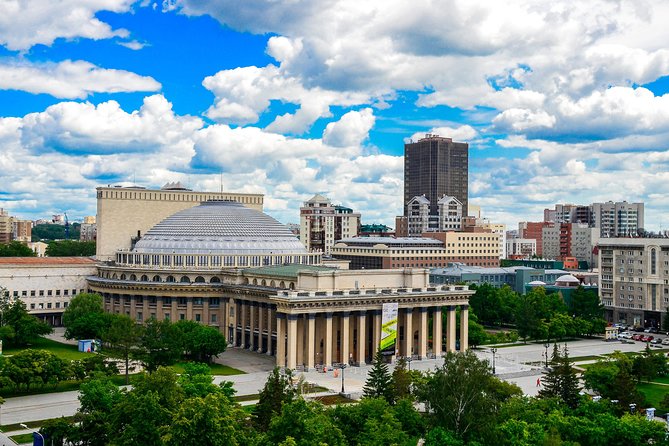
Novosibirsk

Russia’s third largest city, Novosibirsk is packed full of parks and tree lined avenues, as well as being a major manufacturing and administrative center.

Novosibirsk travel | Western Siberia, Russia - Lonely Planet

It climbed six places to rank 92nd in the Best Student Cities ranking this year and is rated joint fourth for affordability, with tuition fees averaging at US$2,600 per year for international students. Living costs are lower here than in Moscow, with a single metro ticket for example only costing 22 rubles (the equivalent to only 35 US cents).

Hsinchu

Putian Temple in Hsinchu tells your fortune, makes relationship ...

Perhaps those of you looking for a great place to study abroad will be blown away by Hsinchu, the second city laying claim to the title, ‘The Windy City’ (the first, of course, being Chicago). Coming 10th for affordability this year and joint 68th overall in the Best Student Cities index, Hsinchu is an excellent option for those who want to study in Taiwan without all the hustle and bustle of a big city.


Diary of a final year student

Let me show you my Diary

16th March

Due to Corona pandamic I received a mail, that University will be closed for a month and asked us to pack our things from hostel. Our wardens told us to book tickets so that we can reach our homes as soon as possible. Whole hostel is celebrating this unexpected pandamic vacation while I was thinking when will be my final year farewell party. As I went into my room I saw my friends packing their stuffs. I took my keys to open my cupboard to pack my stuffs along with them.


The last supper of my university life with my friends. Tomorrow we all will be leaving to the our native places. We hugged tightly one last time and walked around our campus. This is my Online Diary.

28th April,

All the classes which we left half way are completed as online classes. Final year project reviews are also conducted on online. Basically all my classes and exams are over.


5th May

Those who are placed on campus placements are suddenly started getting mails like work as an intern or will call you after this pandamic over. Only few managed to stay placed. I planned to do higher studies in abroad and now I am left with no job in my hand.


1st June

My goals are changed. I am leading my life in a new path which I can’t even dream before this pandamic. I started preparing for civil services examination. I am a volunteering teacher in a village school. I am teaching online class to the underprivileged children.
Never in my all 21 years of life I taught I will have a goal to become a civil services officer, because my past goal is used to be. To study masters in a Ivy league college and to do further researches in my dream field.
But there is a saying,

“Once you replace negative thoughts with positive ones, you’ll start having positive results.”
           

— Willie Nelson


15th June

This pandamic made me realise that I am a person who is filled with lots of emotion and craving for satisfaction in all the things that I am doing. My frozen heart which always runs towards money is now running towards humanity. 


22nd June

Everything changed from what it used to before corona. There is still a chance to follow my past dreams or I can pursuit my new goals. Eventhough thousands of questions arises in my mind and everything is not hundred percent perfect I am confident in myself that I can overcome this.


30th June

I am finally graduated! No farewell… No graduation ceremony… No job fair… All these things are telling me situation is not normal yet. But I am proud of myself that I faced everything which I couldn’t even dare to imagine a year before.


“I always like to look on the optimistic side of life, but I am realistic enough to know that life is a complex matter.”    

-Walt Disney
The first step is to take a step first.

Part-Time MBA in Canada for International Students

Want to know about part-time MBA in Canada for International Students? This is the right place for you. Many students look for a part-time MBA course so that they can work and study abroad simultaneously. Studying abroad and pay the hefty tuition fees could take a toll on you. You can always choose to work as well as pursue your business degree together. This will be helpful for you, as it can get costly to stay abroad and pay the tuition fees. Hence, here is a detailed list of universities that offer a part-time MBA in Canada for International Students. Now you can efficiently study for your business degree abroad as well as pay the bills without having to worry any further.

List of Universities who offer Part-Time MBA in Canada

  • Concordia University

Concordia University has its business school in Montreal, Toronto. The Molson School of Business offers a part-time MBA in Investment Management. The students get to write the three levels of CFA exams along with pursuing their MBA degree.

  • Queen’s University

Queen’s University has its business school all around Canada. The Smith School of Business is widely famous in Canada because of it’s Accelerated MBA program, which is offered in many cities such as Calgary, Kingston, Markham, Montreal, Toronto, Vancouver, Ottawa, Mississauga, Ontario, and Edmonton.

  • University of Alberta 

The University of Alberta has its School of Business, which offers two MBA courses for International Students. It is located in Edmonton. The courses, the Part-time MBA and the FastTrack MBA course have their separate classes. The classes are taken in the daytime at Keyano College, which is located in Fort McMurray.

  • University of Toronto

The University of Toronto has its business management school in the city of Toronto. The Rotman School of Management gives you an option to either take your classes in the morning or the evening. Hence, they have two MBA courses, one in the morning and the other in the evening, according to the convenience of the students. There are two classes each week. The morning classes start around 7:00 a.m. and end by 9:00 a.m., and the evening classes start around 6:30 p.m. and end around 8:30 p.m., also sometimes it the classes extend up to 9:30 p.m.

  • Brock University

Brock University has its school of business, which is located in St. Catharines. The Goodman School of Business offers a part-time MBA to International Students. 

  • Simon Fraser University

Simon Fraser University has its school of business, which offers a part-time MBA to students in Surrey. Along with the part-time MBA course, the Beedie School of Business also offers a degree in Management of Technology in Vancouver. The classes of the part-time MBA course take place every Monday and Wednesday in the evenings. The classes start around 6:00 p.m. and end at around 9:30 p.m.

Along with the universities mentioned above, some more well-known universities offer weekend MBA courses or professional part-time MBA courses. You can go check out these universities as well. 

  • HEC Montreal

They offer a part-time MBA degree as well as two MSc degrees in Economics. The classes take place in Montreal.

  • McGill University

The Desautels Faculty of Management offers a professional part-time MBA degree to the students. The classes take place in Montreal.

  • York University

The Schulich School of Business offers two MBA degrees. They have two campuses located in Toronto, where they take classes for Part-time MBA degree as well as for Accelerated MBA degree.

  • University of British Columbia

The Sauder School of Business offers a Professional MBA degree to the students. The classes take place in Vancouver. 

  • Carleton University

The Faculty of Graduate Studies of Carleton University offers a Professional MBA degree to the students. The classes take place in Ottawa.

  • McMaster University

The DeGroote School of Business offers an Accelerated MBA program to the students. The classes take place in Burlington.

  • University of Calgary

The Haskayne School of Business offers an exclusive Evening MBA program for the students. The evening classes take place in Calgary.

  • University of Victoria

The Gustavson School of Business offers a Weekend MBA program for the students. The classes take place in Victoria.

Hence, Canada is filled with universities that offer or have arranged for programs to meet the requirements of students who are working. You can efficiently work in the morning shift and attend your classes in the evening, or you can take your courses in the morning and work in the evening shift as well. Not only that, but many universities also take classes only on the weekends. So, you can efficiently work full-time on weekdays and attend your lessons at the weekends. Now, you don’t need to worry much about missing out on classes due to work.

Cheapest MBA in Canada for International Students

Do you want to get some information about the most affordable MBA in Canada for International Students? What is the very first thing that comes to your mind when you think about studying an MBA abroad? The cost, of course. Many students dream about going to international universities and pursuing their MBA from there. But we know how much studying and staying abroad costs. Worry not! Here are some selective universities that provide the cheapest MBA in Canada for International Students

List of Universities for MBA in Canada

Here’s a detailed list of universities that offer MBA to International students without charging a hefty sum of money. Once you go through the list, you would get an excellent idea of how to pursue your career abroad and which University suits your choice.

  • Memorial University of Newfoundland

The Memorial University of Newfoundland is popularly known as MUN is one of the leading universities in Canada. It is located in St. John’s and has four satellite campuses. It has a considerable student population from around the world. If you talk about universities that provide the cheapest MBA to International Students in Canada, this is the one that comes first to your mind. The tuition fees for MBA here are $4,833 per year.

  • University of New Brunswick

The University is the first-ever English-Speaking University of Canada. The University of New Brunswick is most famous for its MBA curriculum and its world-class faculty. Along with their excellent MBA framework, their fee is cheap compared to many other universities. They offer two business courses, MBA as well as Juris Doctor. Both of the classes cost $12,410, respectively.

  • Laval University

Laval University is most popularly known as the French Research University of Canada. Here, the duration of an MBA is one and a half years in total. Besides being the 15th best University in Canada, it also charges less tuition fee. The tuition fees for the MBA here is $14,774.16 in total.

  • University of Victoria

The University of Victoria is one of the best public universities, located in British Columbia. The University was formerly an affiliated college under McGill University. But it has developed to be an autonomous university now. The University offers an excellent Daytime MBA course, which is pocket-friendly for International Students. The tuition fees for the MBA here is $12,737.73 in total.

  • McMaster University

McMaster University is famous all around the world for the excellent research curriculum they have in Science as well as Engineering. Along with this, it also offers MBA to International Students, and the fee doesn’t cost much. The tuition fees for the MBA here is $19,868.16 in total.

Hence, you get an elegant idea about how much MBA costs in Canada for International Students. The five universities mentioned here offer the cheapest MBA in Canada for International Students. Now, all you have to do to take admission is to go to their official website and apply for the MBA course. That’s all you need to take the step forward to achieve your dream. Isn’t this exciting?